Size-based Scheduling to Improve Web Performance
Mor Harchol-Balter
Bianca Schroeder
Mukesh Agrawal
Nikhil Bansal
Abstract
This paper proposes a method for improving the per-formance of web servers servicing static HTTP re-quests. The idea is to give preference to those requests which are short, or have small remaining processing requirements, in accordance with the SRPT (Shortest Remaining Processing Time) scheduling policy.
The implementation is at the kernel level and in-volves controlling the order in which socket buffers are drained into the network.
Experiments are executed both in a LAN and a WAN environment. We use the Linux operating sys-tem and the Apache web server.
Results indicate that SRPT-based scheduling of connections yields significant reductions in delay at the web server. These result in a substantial reduction in mean response time, mean slowdown, and variance in response time for both the LAN and WAN environ-ments.
Significantly, and counter to intuition, the large
re-quests are only negligibly penalized or not at all
pe-nalized as a result of SRPT-based scheduling.
1
Introduction
A client accessing a busy web server can expect a long wait. This delay is comprised of several components: the propagation delay and transmission delay on the path between the client and the server; delays due to queueing at routers; delays caused by TCP due to loss, congestion, and slow start; and finally the delay at the server itself. The aggregate of these delays, i.e. the time from when the client makes a request until the entire file arrives is defined to be the response time of the request.
In this paper we focus on what we can do to im-prove the delay at the server. Research has shown that in situations where the server is receiving a high rate of requests, the delays at the server make up a signif-icant portion of the response time [8], [7], [28]. More
This research is funded by Cisco Systems via a grant from the Pittsburgh Digital Greenhouse 00-1 and by NSF-ITR 99-167 ANI-0081396. Equipment was also provided by the Parallel Data Lab.
specifically, [8], [7] find that even if the network load is high, the delays at a busy web server can be respon-sible for more than 80% of the overall response time of a small file, and for 50% of the overall response time of a medium size file.
Measurements [27] suggest that the request stream at most web servers is dominated by static requests, of the form “Get me a file.” The question of how to ser-vice static requests quickly is the focus of many com-panies e.g., Akamai Technologies, and much ongoing research. This paper will focus on static requests only. Our idea is simple. For static requests, the size of
the request (i.e. the time required to service the
re-quest) is well-approximated by the size of the file, which is well-known to the server. Thus far, almost no companies or researchers have made use of this information. Traditionally, requests at a web server are scheduled independently of their size. The re-quests are time-shared, with each request receiving a fair share of the web server resources. We call this FAIR scheduling. We propose, instead, unfair
scheduling, in which priority is given to short
re-quests, or those requests which have short
remain-ing time, in accordance with the well-known
schedul-ing algorithm Shortest-Remainschedul-ing-Processschedul-ing-Time- Shortest-Remaining-Processing-Time-first (SRPT). The expectation is that using SRPT scheduling of requests at the server will reduce the queueing time at the server.
Although it is well-known from queueing theory that SRPT scheduling minimizes queueing time, [36], applications have shied away from using this policy for fear that SRPT “starves” big requests [10, 38, 39, 37]. This intuition is usually true. However, we have a new theoretical paper, [30], which proves that in the case of (heavy-tailed) web workloads, this intuition falls apart. In particular, for heavy-tailed workloads, even the largest requests are either not penalized at all, or negligibly penalized by SRPT scheduling (see Sec-tion 6 for more details). These new theoretical results have motivated us to reconsider “unfair” scheduling.
It’s not immediately clear what SRPT means in the context of a web server. A web server is not a single-resource system. It is not obvious which of the web server’s resources need to be scheduled. As one would expect, it turns out that scheduling is only important
at the bottleneck resource. Frequently this bottleneck resource is the bandwidth on the access link out of the web server. “On a site consisting primarily of static
content, network bandwidth is the most likely source
of a performance bottleneck. Even a fairly modest server can completely saturate a T3 connection or 100Mbps Fast Ethernet connection.”[25] (also corrob-orated by [13], [4]). There’s another reason why the bottleneck resource tends to be the bandwidth on the access link out of the web site: Access links to web sites (T3, OC3, etc.) cost thousands of dollars per month, whereas CPU is cheap in comparison. Like-wise disk utilization remains low since most files end up in the cache. It is important to note that although we concentrate on the case where the network band-width is the bottleneck resource, all the ideas in this paper can also be applied to the case where the CPU is the bottleneck — in which case SRPT scheduling is applied to the CPU.
Since the network is the bottleneck resource, we try to apply the SRPT idea at the level of the net-work. Our idea is to control the order in which the server’s socket buffers are drained. Recall that for each (non-persistent) request a connection is estab-lished between the client and the web server, and corresponding to each connection, there is a socket buffer on the web server end into which the web server writes the contents of the requested file. Tradition-ally, the different socket buffers are drained in Round-Robin Order, each getting a fair share of the band-width of the outgoing link. We instead propose to give priority to those sockets corresponding to connections for small file requests or where the remaining data re-quired by the request is small. Throughout, we use the Linux OS.
Each experiment is repeated in two ways:
Under standard Linux (fair-share draining of socket buffers) with an unmodified web server. We call this FAIR scheduling.
Under modified Linux (SRPT-based draining of socket buffers) with the web server modified only to update socket priorities. We call this
SRPT-based scheduling.
Experiments are executed first in a LAN, so as to isolate the reduction in queueing time at the server. Response time in a LAN is dominated by queueing delay at the server and TCP effects. Experiments are next repeated in a WAN environment. The WAN al-lows us to incorporate the effects of propagation de-lay, network loss, and congestion in understanding the full client experience. Response time in a WAN
en-vironment represents all these factors, in addition to delay at the server.
In the LAN setting, we experiment with two dif-ferent web servers: the common Apache server [20], and the Flash web server [33] which is known for speed. Our clients use a request sequence taken from a web trace. All experiments are also repeated using requests generated by a web workload generator (See Section 4.1.2). This request sequence is controlled so that the same experiment can be repeated at many dif-ferent server loads. The server load is the load at the bottleneck device – in this case the network link out of the web server. The load thus represents the fraction of bandwidth used on the network link out of the web server.
For lack of space, we only include the Apache re-sults in this abstract; the Flash rere-sults, which are sim-ilar, are in the associated technical report [31].
We obtain the following results in a LAN:
SRPT-based scheduling decreases mean re-sponse time in a LAN by a factor of 3 – 8 for loads greater than
under Apache.
SRPT-based scheduling helps small requests a lot, while negligibly penalizing large requests. Under a load of
,
of the requests improve by a factor of 10 under SRPT-based scheduling. Only the largest
of requests suffer an in-crease in mean response time under SRPT-based scheduling (by a factor of only 1.2).
The variance in the response time for most re-quests under SRPT is far lower for all rere-quests, in fact two orders of magnitude lower for most requests.
SRPT (as compared with FAIR) does not have any effect on the network throughput or the CPU utilization.
Next we consider a WAN environment, consist-ing of 6 client machines at various locations within the U.S., feeding 1 sever. For the WAN, we use the Apache web server and again run at different loads.
We obtain the following results in a WAN:
The improvement in mean response time of SRPT over FAIR under a server load of ranged from a factor of 8 (for clients with a Round-trip-time of 100 ms) to a factor of 20 (for clients with an RTT of 20ms). On the other hand there was hardly any improvement in SRPT over FAIR for a server load of
The improvement of SRPT over FAIR in a WAN can actually be greater than in a LAN, for the case of high load at the server.
Unfairness to large requests is nonexistent in a WAN setting. All request sizes have higher mean response time under FAIR in a WAN environ-ment. We provide theoretical justification for this highly counter-intuitive result in Section 6. The poor performance of FAIR scheduling through-out encourages us to consider several enhancements to FAIR involving modifications to the Linux kernel. Some of these modifications have been suggested by previous literature and some are new. We find that while some enhancements help somewhat, the don’t improve the performance of FAIR to anywhere near the performance of SRPT, in either the LAN setting or the WAN setting.
It is important to realize that this paper is a pro-totype to illustrate the power of using SRPT-based scheduling. In Section 8, we elaborate on broader applications of SRPT-based scheduling, including its application to other resources, and to non-static re-quests. We also discuss SRPT applied to web server farms and Internet routers.
2
Previous Work
There has been much literature devoted to improving the response time of web requests. Some of this lit-erature focuses on reducing network latency, e.g. by caching requests ([21], [12], [11]) or improving the HTTP protocol ([19], [32]). Other literature works on reducing the delays at a server, e.g. by building more efficient HTTP servers ([20], [33]) or improving the server’s OS ([18], [5], [26], [29]). Recent studies show that delays at the server make up a significant portion of the response time [8], [7]. Our work fo-cuses on reducing delay at the server by using size-based connection scheduling.
In the remainder of this section we discuss only work on priority-based or size-based scheduling of re-quests. We first discuss related implementation work and then discuss relevant theoretical results.
Almeida et. al. [1] use both a user-level ap-proach and a kernel-level implementation to prioritiz-ing HTTP requests at a web server. In their exper-iments, the high-priority requests only benefit by up to
and the low priority requests suffer by up to
.
Another attempt at priority scheduling of HTTP re-quests is more closely related to our own because it too deals with SRPT scheduling at web servers [15].
The authors experiment with connection scheduling at the application level only. Via the experimental web server, the authors are able to improve mean response time by a factor of close to 4, but the improvement comes at a price: a drop in throughput by a factor of almost 2.
The papers above offer coarser-grained implemen-tations for priority scheduling of connections. Very recently, many operating system enhancements have appeared which allow for finer-grained implementa-tions of priority scheduling [22, 34, 3, 2].
Several papers have considered the idea of SRPT scheduling in theory.
Bender et. al. [10] consider size-based scheduling in web servers. The authors reject the idea of using SRPT scheduling because they prove that SRPT will cause large files to have an arbitrarily high max
slow-down. However, that paper assumes a worst-case
ad-versarial arrival sequence of web requests. The paper goes on to propose other algorithms, including a theo-retical algorithm which does well with respect to max slowdown and mean slowdown.
Roberts and Massoulie [35] consider bandwidth sharing on a link. They suggest that SRPT scheduling may be beneficial in the case of heavy-tailed (Pareto) flow sizes.
The primary theoretical motivation for this paper, comes from our own paper, [30] which will be dis-cussed in Section 6.
3
Implementation of SRPT
In Section 3.1 we explain how socket draining works in standard Linux. In Section 3.2 we describe how to achieve priority queueing in Linux versions 2.2 and above. One problem with size-based queueing is that for small requests, a large portion of the time to ser-vice the request is spent before the size of the request is even known. Section 3.2.1 describes our solution to this problem. Section 3.3 describes the implementa-tion end at the web server and also deals with the algo-rithmic issues such as choosing good priority classes and setting and updating priorities.
3.1
Default Linux configuration
Figure 1 shows data flow in standard Linux.
There is a socket buffer corresponding to each con-nection. Data streaming into each socket buffer is en-capsulated into packets which obtain TCP headers and IP headers. Throughout this processing, the packet streams corresponding to each connection is kept
sep-TCP processing IP processing TCP processing IP processing TCP processing IP processing FAIRLY TAKING TURNS , Network Wire Single Priority Queue Ethernet Card Socket 1
Socket 2
Socket 3
FEED
(transmit queue)
Figure 1: Data flow in Standard Linux. The important thing to observe is that there is a single priority queue
into which all connections drain fairly.
arate. Finally, there is a single “priority queue” (transmit queue), into which all streams feed. In the abstract, these flows take equal turns feeding into the priority queue. Although the Linux kernel does not explicitly enforce fairness, we find that in practice, TCP governs the flows so that they share fairly on short time scales.
This single “priority queue,” can get as long as 100 packets. Packets leaving this queue drain into a short Ethernet card queue and out to the network.
3.2
How to achieve priority queueing in
Linux
To implement SRPT we need more priority levels. Fortunately, it is relatively easy to achieve up to 16 priority queues (bands), as follows:
First, we build the Linux kernel with support for the user/kernel Netlink Socket, QOS and Fair Queueing, and the Prio Pseudoscheduler. Then we use thetc[3] user space tool to switch the device queue from the default 3-band queue to the 16-band prio queue. Fur-ther information about the support for differentiated services and various queueing policies in Linux can be found in [22, 34, 3, 2].
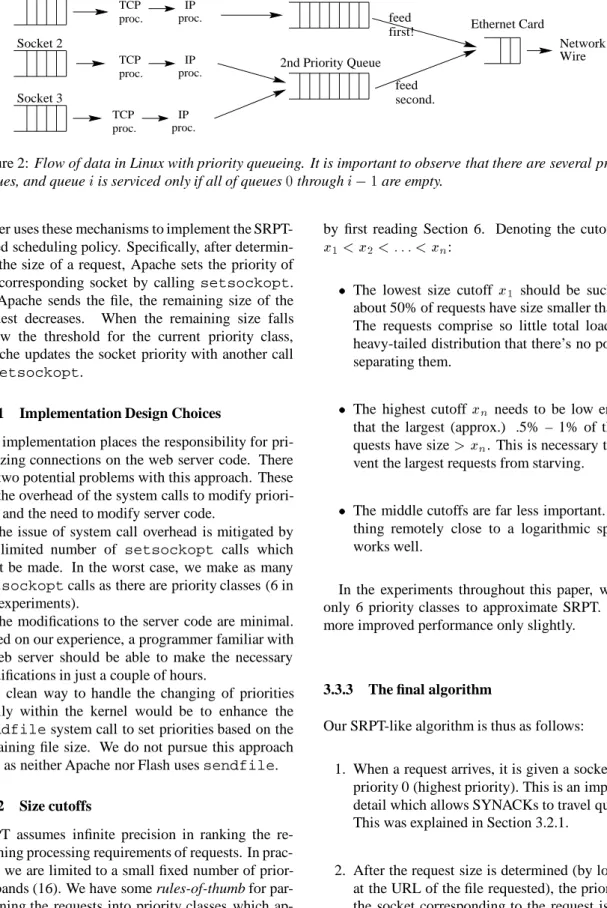
Figure 2 shows the flow of data in Linux after the above modification: The processing is the same until the packets reach the priority queue. Instead of a sin-gle priority queue (transmit queue), there are 16 pri-ority queues. These are called bands and they range in number from 0 to 15, where band 15 has lowest priority and band 0 has highest priority. All the con-nections of priority
feed fairly into the
th priority queue. The priority queues then feed in a prioritized fashion into the Ethernet Card queue. Priority queue
is only allowed to flow if priority queues
through
The queue actually consists of 3 priority queues, a.k.a. bands. By default, however, all packets are queued to the same band.
are all empty.
Besides the above modifications to Linux, there is another fix required to make priority queueing effec-tive.
3.2.1 An additional fix – Priority to SYNACKs
An important component of the response time is the connection startup time. In SRPT scheduling, we are careful to separate the small requests from the large ones. However during connection startup, we don’t yet know whether the request will be large or small. The packets sent during the connection startup might therefore end up waiting in long queues, making con-nection startup very costly. For short requests, a long startup time is especially detrimental to response time. It is therefore important that the SYNACK be isolated from other traffic. Linux sends SYNACKs, to priority band 0. It is important that when assigning priority bands to requests that we:
1. Never assign any sockets to priority band 0. 2. Make all priority band assignments to bands of
lower priority than band 0, so that SYNACKs
al-ways have highest priority.
Observe that giving highest priority to the SYNACKs does not negatively impact the perfor-mance of requests since the SYNACKs themselves make up only a negligible fraction of the total load. Another benefit of giving high priority to SYNACKs is that it reduces their loss probability, which we’ll see is sometimes helpful as well.
3.3
Modifications to web server and
al-gorithmic issues in approximating
SRPT
The Linux kernel provides mechanisms for prioritized queueing. In our implementation, the Apache web
Socket 1 Socket 2 Socket 3 TCP proc. IP proc. TCP proc. IP proc. TCP proc. IP proc. 1st Priority Queue 2nd Priority Queue Ethernet Card Network Wire first! second. feed feed
Figure 2: Flow of data in Linux with priority queueing. It is important to observe that there are several priority
queues, and queue
is serviced only if all of queues
through
are empty.
server uses these mechanisms to implement the SRPT-based scheduling policy. Specifically, after determin-ing the size of a request, Apache sets the priority of the corresponding socket by callingsetsockopt. As Apache sends the file, the remaining size of the request decreases. When the remaining size falls below the threshold for the current priority class, Apache updates the socket priority with another call tosetsockopt.
3.3.1 Implementation Design Choices
Our implementation places the responsibility for pri-oritizing connections on the web server code. There are two potential problems with this approach. These are the overhead of the system calls to modify priori-ties, and the need to modify server code.
The issue of system call overhead is mitigated by the limited number of setsockopt calls which must be made. In the worst case, we make as many
setsockoptcalls as there are priority classes (6 in our experiments).
The modifications to the server code are minimal. Based on our experience, a programmer familiar with a web server should be able to make the necessary modifications in just a couple of hours.
A clean way to handle the changing of priorities totally within the kernel would be to enhance the
sendfilesystem call to set priorities based on the remaining file size. We do not pursue this approach here as neither Apache nor Flash usessendfile.
3.3.2 Size cutoffs
SRPT assumes infinite precision in ranking the re-maining processing requirements of requests. In prac-tice, we are limited to a small fixed number of prior-ity bands (16). We have some rules-of-thumb for par-titioning the requests into priority classes which ap-ply to the heavy-tailed web workloads. The reader not familiar with heavy-tailed workloads will benefit
by first reading Section 6. Denoting the cutoffs by :
The lowest size cutoff should be such that about 50% of requests have size smaller than . The requests comprise so little total load in a heavy-tailed distribution that there’s no point in separating them.
The highest cutoff
needs to be low enough that the largest (approx.) .5% – 1% of the re-quests have size
. This is necessary to pre-vent the largest requests from starving.
The middle cutoffs are far less important. Any-thing remotely close to a logarithmic spacing works well.
In the experiments throughout this paper, we use only 6 priority classes to approximate SRPT. Using more improved performance only slightly.
3.3.3 The final algorithm
Our SRPT-like algorithm is thus as follows:
1. When a request arrives, it is given a socket with priority 0 (highest priority). This is an important detail which allows SYNACKs to travel quickly. This was explained in Section 3.2.1.
2. After the request size is determined (by looking at the URL of the file requested), the priority of the socket corresponding to the request is reset based on the size of the request, as shown in the table below.
Priority Size (Kbytes) 0 (highest) -1 1K 2 1K - 2K 3 2K - 5K 4 5K-20K 5 20K - 50K 6 (lowest) 50K
3. As the remaining size of the request diminishes, the priority of the socket is dynamically updated to reflect the remaining size of the request.
4
LAN setup and experimental
results
In Section 4.1 we describe the experimental setup and workload for the LAN experiments. Section 4.2 illus-trates the results of the LAN experiments. Section 4.3 proposes some enhancements to improve the perfor-mance of FAIR scheduling and describes the results of these enhancements. Lastly Section 4.2.1 illustrates a simplification of the SRPT idea which still yields quite good performance.
4.1
Experimental Setup (LAN)
4.1.1 Architecture
Our experimental architecture involves two machines each with an Intel Pentium III 700 MHz processor and 256 MB RAM, running Linux 2.2.16, and connected by a 10Mb/sec full-duplex Ethernet connection. The Apache web server is running on one of the machines. The other machine hosts the clients which send re-quests to the web server.
4.1.2 Workload
The clients’ requests are generated either via a web
workload generator (we use a modification ofSurge
[9]) or via traces. Throughout this paper, all results shown are for a trace-based workload. We have in-cluded in the associated technical report [31] the same set of results for theSurgeworkload.
4.1.3 Traces
The trace-based workload consists of a 1-day trace from the Soccer World Cup 1998, from the Internet Traffic Archive [23]. The 1-day trace contains 4.5 mil-lion HTTP requests, virtually all of which are static.
An entry in the trace includes: (1) the time the re-quest was received at the server, (2) the size of the request in bytes, (3) the GET line of the request, (4) the error code, as well as other information. In our experiments, we use the trace to specify the time the client makes the request and the size in bytes of the request.
The entire 1 day trace contains requests for approx-imately 5000 different files. Given the mean file size of 5K, it is clear why all files fit within main memory. This explains why disk is not a bottleneck.
Each experiment was run using a busy hour of the trace (10:00 a.m. to 11:00 a.m.). This hour consisted of about 1 million requests, during which over a
thou-sand files are requested.
Some additional statistics about our trace workload: The minimum size file requested is a 41 byte file. The maximum size file requested is about 2 MB. The distribution of the file sizes requested fits a heavy-tailed truncated Pareto distribution (with -parameter
). The largest
of the requests make up
of the total load, exhibiting a strong heavy-tailed property.
of files have size less than 1K bytes.
of files have size less than 9.3K bytes.
4.1.4 Generating requests at client machines
In our experiments, we usesclient[6] for creat-ing connections at the client machines. The original version ofsclientmakes requests for a certain file in periodic intervals. We modifysclientto read in traces and make the requests according to the arrival times and file names given in the trace.
To create a particular load, we simply scale the in-terarrival times in the trace’s request sequence. The scaling factor for the interarrival times is derived both analytically and empirically.
4.1.5 Performance Metrics
For each experiment, we evaluate the following per-formance metrics:
Mean response time. The response time of a
re-quest is the time from when the client submits the request until the client receives the last byte of the request.
Mean slowdown. The slowdown metric attempts
to capture the idea that clients are willing to tol-erate long response times for large file requests and yet expect short response times for short re-quests. The slowdown of a request is therefore its response time divided by the time it would
require if it were the sole request in the sys-tem. Slowdown is also commonly known as
nor-malized response time and has been widely used
[10, 35, 17, 24].
Mean response time as a function of request size.
This will indicate whether big requests are being treated unfairly under SRPT as compared with FAIR-share scheduling.
4.2
Main Experimental results (LAN)
Before presenting the results of our experiments, we make some important comments.
In all of our experiments the network was the bottleneck resource. CPU utilization during our experiments ranged from
in the case of low load to
in the case of high load.
The measured throughput and bandwidth utiliza-tion under the experiments with SRPT schedul-ing is identical to that under the same experi-ments with FAIR scheduling. The same exact set of requests complete under SRPT scheduling and under FAIR scheduling.
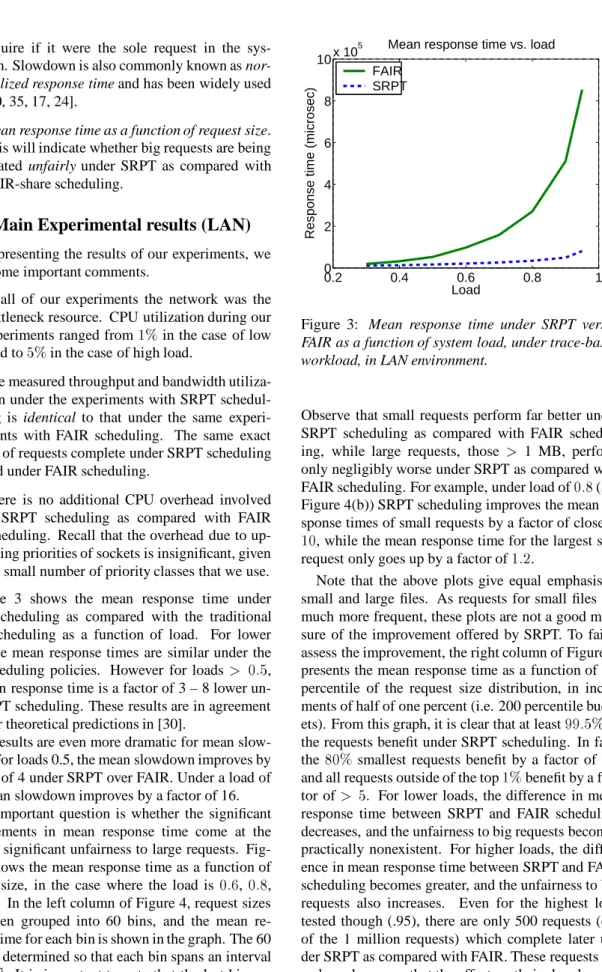
There is no additional CPU overhead involved in SRPT scheduling as compared with FAIR scheduling. Recall that the overhead due to up-dating priorities of sockets is insignificant, given the small number of priority classes that we use. Figure 3 shows the mean response time under SRPT scheduling as compared with the traditional FAIR scheduling as a function of load. For lower loads the mean response times are similar under the two scheduling policies. However for loads
, the mean response time is a factor of 3 – 8 lower un-der SRPT scheduling. These results are in agreement with our theoretical predictions in [30].
The results are even more dramatic for mean slow-down. For loads 0.5, the mean slowdown improves by a factor of 4 under SRPT over FAIR. Under a load of
, mean slowdown improves by a factor of 16. The important question is whether the significant improvements in mean response time come at the price of significant unfairness to large requests. Fig-ure 4 shows the mean response time as a function of request size, in the case where the load is
, , and
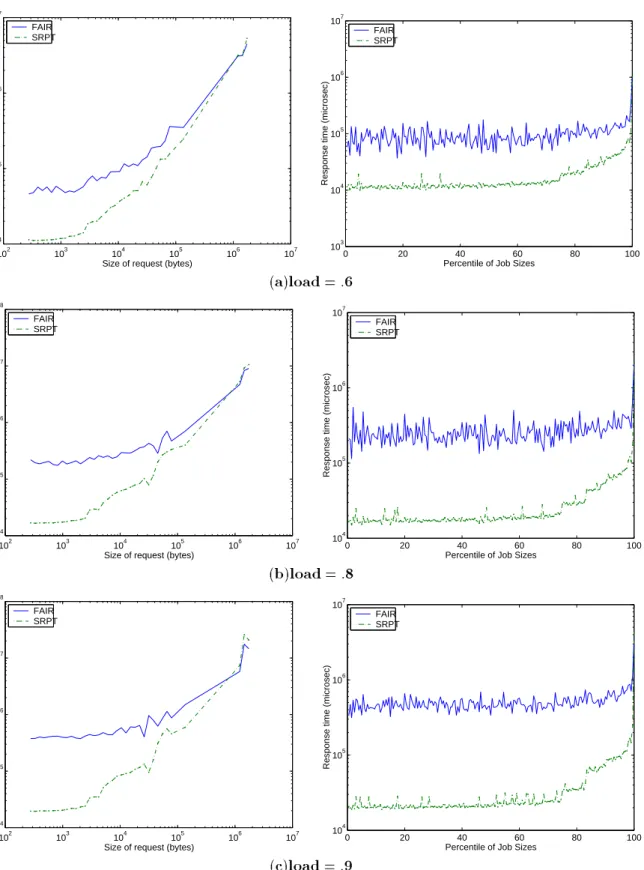
. In the left column of Figure 4, request sizes have been grouped into 60 bins, and the mean re-sponse time for each bin is shown in the graph. The 60 bins are determined so that each bin spans an interval
. It is important to note that the last bin ac-tually contains only requests for the very biggest file.
0.2 0.4 0.6 0.8 1 0 2 4 6 8 10x 10
5 Mean response time vs. load
Load
Response time (microsec)
FAIR SRPT
Figure 3: Mean response time under SRPT versus
FAIR as a function of system load, under trace-based workload, in LAN environment.
Observe that small requests perform far better under SRPT scheduling as compared with FAIR schedul-ing, while large requests, those 1 MB, perform only negligibly worse under SRPT as compared with FAIR scheduling. For example, under load of
(see Figure 4(b)) SRPT scheduling improves the mean re-sponse times of small requests by a factor of close to
, while the mean response time for the largest size request only goes up by a factor of
.
Note that the above plots give equal emphasis to small and large files. As requests for small files are much more frequent, these plots are not a good mea-sure of the improvement offered by SRPT. To fairly assess the improvement, the right column of Figure 4, presents the mean response time as a function of the percentile of the request size distribution, in incre-ments of half of one percent (i.e. 200 percentile buck-ets). From this graph, it is clear that at least
of the requests benefit under SRPT scheduling. In fact, the
smallest requests benefit by a factor of
, and all requests outside of the top
benefit by a fac-tor of
. For lower loads, the difference in mean response time between SRPT and FAIR scheduling decreases, and the unfairness to big requests becomes practically nonexistent. For higher loads, the differ-ence in mean response time between SRPT and FAIR scheduling becomes greater, and the unfairness to big requests also increases. Even for the highest load tested though (.95), there are only 500 requests (out of the 1 million requests) which complete later un-der SRPT as compared with FAIR. These requests are so large however, that the effect on their slowdown is negligible.
102 103 104 105 106 107 104
105 106 107
Size of request (bytes)
Mean response time (microsec)
FAIR SRPT 0 20 40 60 80 100 103 104 105 106 107
Percentile of Job Sizes
Response time (microsec)
FAIR SRPT 102 103 104 105 106 107 104 105 106 107 108
Size of request (bytes)
Mean response time (microsec)
FAIR SRPT 0 20 40 60 80 100 104 105 106 107
Percentile of Job Sizes
Response time (microsec)
FAIR SRPT 102 103 104 105 106 107 104 105 106 107 108
Size of request (bytes)
Mean response time (microsec)
FAIR SRPT 0 20 40 60 80 100 104 105 106 107
Percentile of Job Sizes
Response time (microsec)
FAIR SRPT
Figure 4: Mean response time as a function of request size under trace-based workload, shown for a range of
system loads, in a LAN. The left column shows the mean response time as a function of request size. The right column shows the mean response time as a function of the percentile of the request size distribution.
0 20 40 60 80 100 106 107 108 109 1010 1011 1012 1013 1014
Percentile of Job Size
Variance
FAIR SRPT
Figure 5: Variance in response time as a function of
the percentile of the request size distribution for SRPT as compared with FAIR, under trace-based workload with load =
, in a LAN.
Figure 5 shows the variance in response time for each request size as a function of the percentile of the request size distribution, for load equal to
. The improvement under SRPT with respect to vari-ance in response time is 2 – 4 orders of magni-tude for the
smallest files. The improvement with respect to the squared coefficient of variation (variance mean
) is about 30.
4.2.1 Parameter Sensitivity in SRPT (LAN)
To evaluate the importance of choosing precise cut-offs, we evaluate SRPT with only two priority classes. We define small requests as the smallest 50% of quests and large requests as the largest 50% of re-quests (note, this is not the same thing as equalizing load) The cutoff falls at 1K. We find that this simple algorithm results in a factor of
improvement in mean response time and a factor of 5 improvement in mean slowdown over FAIR.
4.3
Enhancements to FAIR (LAN)
At this point it is natural to wonder why the FAIR policy performs so poorly. The obvious reason is that the time-sharing behavior of FAIR causes all requests to be delayed, which leads to high response times and high numbers of requests in the system. By contrast, SRPT works to minimize the number of requests in the system, and thus the mean response time as well.
Despite the above argument, one can’t help but
wonder whether Linux or Apache/Flash itself is caus-ing FAIR to perform especially badly.
To answer this question, we instrumented the web server’s kernel to provide statistics including: the oc-cupancy of the SYN and ACK (listen) queues, the number of incoming SYNs dropped due to the SYN queue being full, the number of times a client’s ac-knowledgement of a SYNACK was discarded due to the ACK queue being full, and the number of outgo-ing SYNACKs dropped inside the kernel.
Under the newly instrumented kernel, we reran all the LAN experiments. Below we discuss our findings just for the case of load
. For this case the response time was 452ms under FAIR and 38ms under SRPT. Our measurements indicate that under FAIR, a signif-icant fraction (5%-10%) of connections suffered long delays due to loss at the server. Under SRPT, this ef-fect is virtually non-existent.
Effect of length of transmit queue
Consider Figure 1 which shows flow of control in standard Linux (FAIR). Observe that all socket buffers drain into the same single priority queue. This queue may grow long. Now consider the effect on a new short request. Since every request has to wait in the priority queue, which may be long, the short request typically incurs a cost of close to 120 ms just for wait-ing in this queue (assumwait-ing high load). This is a very high startup penalty, considering that the service time for a short request should really only be about 10-20 ms.
In our first experiment, we shortened the length of the transmit queue. This resulted in an increase in mean response time — from 452ms to 629ms under FAIR. The problem is that by shortening the length of the transmit queue, we increase the loss.
We next tried to lengthen the transmit queue, in-creasing it from 100 to 500, and then to 700. This helped a little — reducing mean response time from 452ms to 342ms. The reason was a reduction in loss. Still, performance was nowhere near that of SRPT – 38ms.
Effect of length of SYN and ACK queues
We observe that in the LAN experiments neither the SYN queue nor the ACK queue ever fills to capacity. Therefore increasing its length has no effect.
Effect of giving priority to SYNACKs
Recall in Section 3.2.1 we showed that giving priority to SYNACKs was an important component of
imple-menting SRPT. We therefore decided to try the same idea for FAIR. We found that when SYNACKs were given priority the mean response time dropped from 452ms to only 265ms – a decent improvement, but still nowhere close to the performance of SRPT.
Lastly we combined all 3 enhancements to FAIR. The performance remained at 265ms for FAIR.
5
WAN setup and Experimental
Results
In Section 5.1 we describe the setup for the WAN ex-periments. In Section 5.2 we describe the results of the WAN experiments. In Section 5.3 we consider the effect of several enhancements to FAIR scheduling in the WAN environment.
5.1
Experimental setup (WAN)
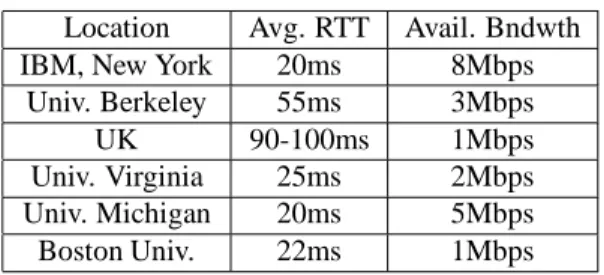
We use the same server machine as for the LAN ex-periment. This time we have 6 client machines located throughout the Internet. The clients generate the re-quests in the same way as before based on a trace. Again each experiment again spans 1 hour (about 1 million requests).
The clients are located at various distances from the server (indicated by round trip times, RTT) and have varying available bandwidth, as shown in the table be-low.
Location Avg. RTT Avail. Bndwth
IBM, New York 20ms 8Mbps
Univ. Berkeley 55ms 3Mbps
UK 90-100ms 1Mbps
Univ. Virginia 25ms 2Mbps Univ. Michigan 20ms 5Mbps
Boston Univ. 22ms 1Mbps
5.2
Experimental results for the WAN
setup
Figure 6 shows the mean response time (in ms) as a function of load for each of the six hosts. This figure show that the improvement in mean response time of SRPT over FAIR is a factor of 8–20 for high load (0.9) and only about 1.1 for lower load (0.5).
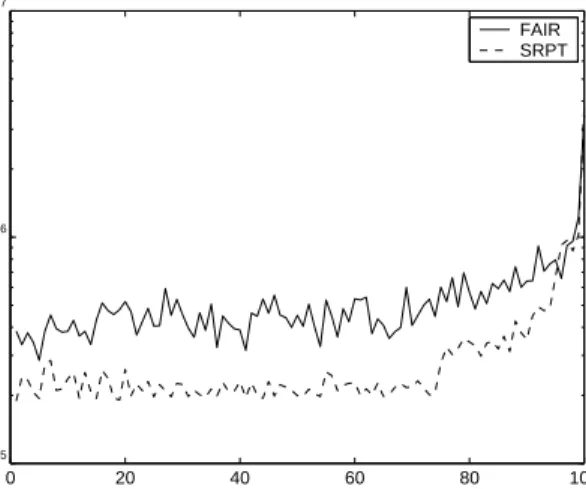
Figure 7(a) and 7(b) shows the mean response time of a request as function of the percentile the request size at a load of 0.8 for the hosts at IBM and UK re-spectively. It’s not clear from looking at the figures whether there is any starvation. It turns out that all request sizes have higher mean response time under FAIR, as compared with SRPT. For the largest file, the
mean response time is almost the same under SRPT and FAIR.
We also measured the variance in response time (graph omitted for lack of space) in the WAN environ-ment for a load of
. While the variance for FAIR stayed the same under the LAN and WAN environ-ments, the variance for SRPT increased somewhat in the WAN environment due to losses. Still, however, the variance in response time under SRPT remains over an order of magnitude below that in FAIR, for a load of
.
We make the following observations:
Observation 1 The improvement of SRPT over FAIR in mean response time is greater at higher loads.
For example in Figure 6 the mean response time for the IBM host under SRPT improves over FAIR by a factor of 20,3,1.5 and 1.1 at loads 0.9,0.8,0.7 and 0.5 respectively. Explanation: We already saw in a LAN that under higher load, the difference between SRPT and FAIR is higher. This is coupled with the fact that at higher load the queueing delay at the server makes up a larger component of response time.
Observation 2 The improvement of SRPT over FAIR is less for far away clients.
For example in Figure 6, at load 0.8, the mean re-sponse time for the IBM host (RTT 20ms) improves by a factor of about 3 under SRPT over FAIR, whereas there is only a factor 1.6 improvement for the far away host at UK (RTT 90 ms). Explanation: The delays caused by propagation and Internet congestion miti-gate the effect of the queueing delay on total response time.
Observation 3 The improvement of SRPT over FAIR in a WAN environment can actually be greater than in a LAN environment, for the case of high load at the server.
For example in Figure 6 the mean response time for the host at IBM is 2500 ms under FAIR scheduling, vs. 125 ms under SRPT scheduling, hence about 20 times better. However, in the LAN setup the mean response time improved by a factor of about 12 at load 0.9 (See Figure 3).
Explanation: This surprising observation is due to
effects not yet considered: loss, and the effect of loss on TCP.
Observe that the mean response times under FAIR are very high (at least 2500 ms) at load 0.9. This suggests that some loss is occurring during the early
IBM Berkeley UK Virginia Michigan Boston 0 500 1000 1500 2000 2500 3000 3500 Response Time (ms) Load=0.9 FAIR SRPT
IBM Berkeley UK Virginia Michigan Boston 0 100 200 300 400 500 600 Load=0.8 Response Time (ms) FAIR SRPT
(a) load 0.9 (b) load 0.8
IBM Berkeley UK Virginia Michigan Boston 0 50 100 150 200 250 300 350 400 Response Time (ms) Load=0.7 FAIR SRPT
IBM Berkeley UK Virginia Michigan Boston 0 50 100 150 200 250 300 Response Time (ms) Load=0.5 FAIR SRPT (c) load 0.7 (d) load 0.5
parts of the connections (when the retransmit time-out penalties are high). Our measurements show the server under FAIR is in fact dropping about 7% of the SYN – connection requests from the IBM client, as compared with only 0.2% under SRPT.
The reason that SYNs are being dropped is that the SYN queue (which stores SYNs at the server) under FAIR is almost always full. For a SYN to be removed from the SYN queue, requires that a SYNACK (ac-knowledgement for the SYN) be sent by the server and a final ACK received from the client. The prob-lem is that the SYNACKs are delayed in leaving the server under FAIR (they wait up to 120 ms in the transmit queue), causing the SYN to sit in the SYN queue an unduly long time.
Observation 4 The mean response times under SRPT are close to optimal even under high loads.
For example, for the host at Berkeley (RTT 55ms), the mean response times are 186, 209, 210 and 270 ms at loads 0.5,0.7,0.8 and 0.9 respectively under SRPT scheduling. Observe that these are quite close to 170ms, which is the optimal mean response time (i.e. when the load at the server is close to 0) for this host.
Observation 5 While the penalty of SRPT to large re-quests is almost absent in the LAN setting (see Figure 4), we observe that it is even less of an issue in the WAN environment.
As explained above now all request sizes have higher mean response time under FAIR, as compared with SRPT. Explanation: The reason is simply that the propagation delay in the case of a WAN mitigates the effect of the queueing delay (in particular the dif-ference between the queueing delay under SRPT and that under FAIR).
5.3
Enhancements to FAIR (WAN)
In Section 4.3 we considered several enhancements to FAIR scheduling. For completeness, we again tried these enhancements in the WAN setting. We find that increasing the length of both the SYN and ACK queues simultaneously improves upon the response time of FAIR by almost a factor of 2. This corrob-orates our explanation of Observation 3. Prioritizing SYNACKs did not have significant effect. Increasing the length of the transmit queue reduced performance. Note that SRPT improves upon the performance of the best FAIR configuration by a factor of 5-10 (depend-ing on the client host) under load 0.9.
6
How can every request prefer
SRPT to FAIR in expectation?
Theoretical Explanation
It has been suspected by many that SRPT is a very unfair scheduling policy for large requests. The above results have shown that this suspicion is false for web workloads. It is easy to see why SRPT should pro-vide huge performance benefits for the small requests, which get priority over all other requests. In this sec-tion we describe briefly why the large requests also benefit under SRPT, in the case of a heavy-tailed
workload.
In general a heavy-tailed distribution is one for which where
. A set of request sizes following a heavy-tailed distribution has some distinctive proper-ties:
1. Infinite variance (and if
, infinite mean). In practice there is a finite maximum request size, which means that the moments are all finite, but still quite high.
2. The property that a tiny fraction (usually
) of the very longest requests comprise over half of the total load. We refer to this important property as the heavy-tailed property.
The lower the parameter , the more variable the dis-tribution, and the more pronounced is the heavy-tailed property, i.e. the smaller the fraction of long requests that comprise half the load.
Request sizes are well-known to follow a heavy-tailed distribution [14, 16]. Our traces also have strong heavy-tailed properties. (In our trace the largest
of the requests make up
of the total load.)
Consider a workload where request sizes exhibit the heavy-tailed property. Now consider a large re-quest, in the
-tile of the request size distribution. This request will actually do much better under SRPT scheduling than under FAIR scheduling. The reason is that this big request only competes against
of the load under SRPT (the remaining
of the load is made up of requests in the top
-tile of the request size distribution) whereas it competes against of the load under FAIR scheduling. The same argu-ment could be made for a request in the
-tile of the request size distribution.
However, it is not obvious what happens to a re-quest in the
0 20 40 60 80 100 104
105 106 107
Response Time (micro seconds)
Percentile of Job Size
FAIR SRPT 0 20 40 60 80 100 105 106 107
Response Time (microseconds)
Percentile of Job Size
FAIR SRPT
(a) IBM clients (b) UK clients
Figure 7: Response time as a percentile of request size under SRPT scheduling versus traditional FAIR scheduling
at load 0.8, measured for (a) the IBM host and (b) the UK host.
(i.e. the largest possible request). It turns out that, provided the load is not too close to 1, the request in the
-tile will quickly see an idle period, dur-ing which it can run. As soon as the request gets a chance to run, it will quickly become a request in the
-tile, at which time it will clearly prefer SRPT. For a formalization of the above argument, we refer the reader to [30].
7
Conclusion
This paper demonstrates that the delay at a busy server can be greatly reduced by SRPT-based scheduling of requests at the server’s outgoing link. We show fur-ther that the reduction in server delay often results in a reduction in the client-perceived response time.
Our SRPT-based scheduling algorithm reduces mean response time in a LAN setting significantly un-der high server loads, over the standard FAIR schedul-ing algorithm. In a WAN settschedul-ing the improvement is similar for very high server loads, but is less signifi-cant at moderate loads.
Surprisingly, this improvement comes at no cost to large requests, which are hardly penalized, or not at all penalized. Furthermore these gains are achieved under no loss in byte throughput or request through-put.
8
Limitations and Future work
Our current setup involves only static requests. In fu-ture work we plan to expand our technology to
sched-ule cgi-scripts and other non-static requests. Deter-mining the size (processing requirement) of non-static requests is an important open problem, but much progress is being made on better predicting the size of dynamic requests, or deducing them over time.
Our current setup considers network bandwidth to be the bottleneck resource and does SRPT-based scheduling of that resource. In a different application (e.g. processing of cgi-scripts) where some other re-source was the bottleneck (e.g., CPU), it might be de-sirable to implement SRPT-based scheduling of that resource.
Although we evaluate SRPT and FAIR across many server loads, we do not in this paper consider the case of overload. This is an extremely difficult problem both analytically and especially experimentally. Our preliminary results show that in the case of transient
overload SRPT outperforms FAIR across a long list
of metrics, including mean response time, throughput, server losses, etc.
Our SRPT solution can also be applied to server farms. In this scenario the bottleneck moves from the outgoing link at each server to the access link for the server farm — thus scheduling needs to be applied at the access link. To achieve this, servers would mark packets to designate their priority. These priorities would be enforced by the router at the access link.
Lastly, at present we only reduce mean delay at the server. A future goal is to use SRPT connection-scheduling at proxies. Our long-term goal is to ex-tend our SRPT connection-scheduling technology to routers and switches in the Internet.
References
[1] J. Almeida, M. Dabu, A. Manikutty, and P. Cao. Providing differentiated quality-of-service in Web hosting services. In
Proceedings of the First Workshop on Internet Server Perfor-mance, June 1998.
[2] W. Almesberger, J. Hadi, and A. Kuznetsov. Differentiated services on linux. Available at http://lrcwww.epfl.ch/linux-diffserv/.
[3] Werner Almesberger. Linux network traffic control — imple-mentation overview. Available at http://lrcwww.epfl.ch/linux-diffserv/.
[4] Bruce Maggs at Akamai. Personal communication., 2001. [5] G. Banga, P. Druschel, and J. Mogul. Better operating
sys-tem features for faster network servers. In Proc. Workshop on
Internet Server Performance, June 1998.
[6] Gaurav Banga and Peter Druschel. Measuring the capacity of a web server under realistic loads. World Wide Web, 2(1-2):69–83, 1999.
[7] Paul Barford and M. E. Crovella. Measuring web perfor-mance in the wide area. Perforperfor-mance Evaluation Review –
Special Issue on Network Traffic Measurement and Workload Characterization, August 1999.
[8] Paul Barford and Mark Crovella. Critical path analysis of tcp transactions. In SIGCOMM, 2000.
[9] Paul Barford and Mark E. Crovella. Generating representative Web workloads for network and server performance evalua-tion. In Proceedings of SIGMETRICS ’98, pages 151–160, July 1998.
[10] Michael Bender, Soumen Chakrabarti, and S. Muthukrish-nan. Flow and stretch metrics for scheduling continuous job streams. In Proceedings of the 9th Annual ACM-SIAM
Sym-posium on Discrete Algorithms, 1998.
[11] Azer Bestavros, Robert L. Carter, Mark E. Crovella, Car-los R. Cunha, Abdelsalam Heddaya, and Sulaiman A. Mirdad. Application-level document caching in the internet. In
Pro-ceedings of the Second International Workshop on Services in Distributed and Networked Environments (SDNE’95), June
1995.
[12] H. Braun and K. Claffy. Web traffic characterization: an as-sessment of the impact of caching documents from NCSA’s Web server. In Proceedings of the Second International
WWW Conference, 1994.
[13] Adrian Cockcroft. Watching your web server. The Unix In-sider at http://www.unixinIn-sider.com, April 1996.
[14] Mark E. Crovella and Azer Bestavros. Self-similarity in World Wide Web traffic: Evidence and possible causes.
IEEE/ACM Transactions on Networking, 5(6):835–846,
De-cember 1997.
[15] Mark E. Crovella, Robert Frangioso, and Mor Harchol-Balter. Connection scheduling in web servers. In USENIX
Sympo-sium on Internet Technologies and Systems, October 1999.
[16] Mark E. Crovella, Murad S. Taqqu, and Azer Bestavros. Heavy-tailed probability distributions in the World Wide Web. In A Practical Guide To Heavy Tails, pages 3–26. Chap-man & Hall, New York, 1998.
[17] Allen B. Downey. A parallel workload model and its im-plications for processor allocation. In Proceedings of High
Performance Distributed Computing, pages 112–123, August
1997.
[18] Peter Druschel and Gaurav Banga. Lazy receiver processing (LRP): A network subsystem architecture for server systems. In Proceedings of OSDI ’96, October 1996.
[19] Fielding, Gettys, Mogul, Frystyk, and Berners-lee. DNS sup-port for load balancing. RFC 2068, April 1997.
[20] The Apache Group. Apache web server.
http://www.apache.org.
[21] James Gwertzman and Margo Seltzer. The case for geograph-ical push-caching. In Proceedings of HotOS ’94, May 1994. [22] A. Halikhedkar, Ajay Uggirala, and D.K. Tammana.
Imple-menation of differentiated services in linux (diffspec). Avail-able at http://www.rsl.ukans.edu/ dilip/845/FAGASAP.html. [23] Internet Town Hall. The internet traffic archives. Available at
http://town.hall.org/Archives/pub/ITA/. [24] M. Harchol-Balter and A. Downey. Exploiting process
life-time distributions for dynamic load balancing. ACM
Transac-tions on Computer Systems, 15(3), 1997.
[25] Microsoft TechNet Insights and Answers for IT Profession-als. The arts and science of web server tuning with internet information services 5.0. http://www.microsoft.com/technet/, 2001.
[26] M. Kaashoek, D. Engler, D. Wallach, and G. Ganger. Server operating systems. In SIGOPS European Workshop, Septem-ber 1996.
[27] S. Manley and M. Seltzer. Web facts and fantasy. In
Proceed-ings of the 1997 USITS, 1997.
[28] Evangelos Markatos. Main memory caching of Web docu-ments. In Proceedings of the Fifth Interntional Conference
on the WWW, 1996.
[29] J. Mogul. Operating systems support for busy internet servers. Technical Report WRL-Technical-Note-49, Compaq Western Research Lab, May 1995.
[30] Authors omitted for purpose of double-blind reviewing. Anal-ysis of SRPT scheduling: Investigating unfairness. In To
ap-pear in Proceedings of Sigmetrics ’01.
[31] Authors omitted for purpose of double-blind reviewing. Im-plementation of SRPT scheduling in web servers. Technical Report XXX-CS-00-170, 2000.
[32] V. N. Padmanabhan and J. Mogul. Improving HTTP latency.
Computer Networks and ISDN Systems, 28:25–35, December
1995.
[33] Vivek S. Pai, Peter Druschel, and W. Zwaenepoel. Flash: An efficient and portable web server. In Proceedings of USENIX
1999, June 1999.
[34] S .Radhakrishnan. Linux – advanced networking overview version 1. Available at http://qos.ittc.ukans.edu/howto/. [35] J. Roberts and L. Massoulie. Bandwidth sharing and
admis-sion control for elastic traffic. In ITC Specialist Seminar, 1998.
[36] Linus E. Schrage and Louis W. Miller. The queue M/G/1 with the shortest remaining processing time discipline. Operations
Research, 14:670–684, 1966.
[37] A. Silberschatz and P. Galvin. Operating System Concepts,
5th Edition. John Wiley & Sons, 1998.
[38] W. Stallings. Operating Systems, 2nd Edition. Prentice Hall, 1995.
[39] A.S. Tanenbaum. Modern Operating Systems. Prentice Hall, 1992.