A Collaborative Clinical Trial Protocol Writing System
Chunhua Weng M.S.
1, David W. McDonald Ph.D.
2, John H. Gennari Ph.D.
11
Department of Medical Education and Biomedical Informatics, University of Washington, Seattle 2
Information School, University of Washington, Seattle {cweng, gennari, [email protected]}
Abstract
Increasing complexity in medicine has caused clinical trial experts with disparate backgrounds from multiple organiza-tions to collaborate when developing clinical trial protocols. Although many protocol-authoring tools provide computer-based decision support to assist in protocol writing, few of them provide sufficient collaboration support for a group of protocol writers. The iterative group writing activities among interdisciplinary clinical trial experts call for advanced tool support. Here we present a web-based protocol writing sys-tem with integrated support for collaborative reviewing and collaborative editing. The system uses a shared database to store threaded review comments and version information for electronic protocols. It also captures rich group event info r-mation to provide cross-activity awareness and to facilitate self-coordination within the collaborative writing team. We believe that our system can help streamline collaborative clinical trial protocol writing pro cesses.
Keywords
Internet, Clinical Protocols, Interdisciplinary Communication, Cooperative Behavior, Awareness
Introduction
High-quality clinical trial protocols, widely utilized in medical research, are critical to conducting safe clinical trials and ena-bling cost-effective health care. However, many existing clini-cal trial protocols contain problems such as incompleteness, ambiguity, and inconsistency.[1] Most of the errors are intro-duced during the protocol writing process, which is often inef-ficient. Recent studies have shown that protocol develo pment is a collaborative scientific writing process to achieve consen-sus within a group of interdisciplinary clinical trial ex-perts.[2][3][4] It is an intellectual and creative group task involving clinical experts, statisticians, protocol editors, and regulatory affair officers.[3]
Much prior medical informatics research has been done to as-sist in the protocol-writing task. The major efforts fall into the following three categories: 1) Using computational model-based decision support tools to guide clinical protocol author-ing, such as PROforma [5], Design a Trial (DaT) [6], and EON [7] 2) Using mark-up languages or models to transfer existing
free text clinical protocols into a computer-interpretable format and provide critiques to the protocol content, such as GEM [8] and DeGel [9] 3) Using a knowledge management approach to provide a structured document model or reusable text to facili-tate knowledge reuse in clinical trial design, such as WITH [10]. These tools facilitate the automation, standard ization, and dissemination of clinical protocol knowledge; but they have varied limitations. First, most of them are designed for a single author and do not support collaborative writing activities such as group discussions, group coordination, or version control. Second, their interfaces are often driven by rigorous comput-able models and are not intuitive to clinical trial experts; this necessitates assistance from knowledge engineers, who might complicate the authoring process. Third, they do not support the interactive and expressive communications required by any group-writing task, which is characterized by a high degree of amb iguity and the lack of a fixed goal.[11] Therefore, existing medical informatics tools for protocol writing mainly support computer interactions but ignore the aspect of human-human interactions among multiple writers.
Although many collaborative writing systems are available in the field of Computer-Supported Cooperative Work (CSCW) such as Quilt [12] and PREP [13], none of them have been adopted in group writing of clinical trial protocols. Most pro-tocol writers rely on standard word processors and email sys-tems to collaborate on protocol writing.[3] One possible reason is that out-of-the-box systems cannot fit into the complex workflow of the collaborative protocol writing process. Therefore, our approach to protocol writing support is to aug-ment the natural collaborative protocol writing process and facilitate better interactions and more expressive communica-tions among protocol writers. Aiming at imp roving the quality of the resulting clinical trial protocols, we try to encourage human-centered quality control for clinical protocols by sup-porting multidisciplinary human clinical trial experts in iterative and collaborative protocol reviewing and revis ing activities, instead of relying on computer-based critiquing mechanisms. In this paper, we present an asynchronous collaborative tocol writing system that can be directly used by multiple pro-tocol writers as a group. The asynchronous working mode is the most suitable option for clinical trial experts, who often have varied schedules. Below we first present our design methodology, including our ethnographic study methods and
participatory design process. Then we describe the system framework, the underlying comment model, our version control mechanism, the user interface, and our formative evaluation results. Finally, we provide a summary and discussion.
Methods
System Requirements Analysis
To better understand the precise tool support needs of col-laborative protocol writers, we conducted an ethnographic study at the Southwest Oncology Group (SWOG), a major adult cooperative cancer research group funded by the NCI. Our detailed study results are presented in a separate paper; [3] here are the major identified problems that call for collabora-tion support:
• Ineffective and iterative reviewing and revising • Poor version control for evolving protocol drafts • Challenging integration of heterogeneous input • Insufficient feedback and awareness of group activities • Inefficient group coordination
All of the above problems highlight a lack of awareness within collaborative writing groups. “Awareness is an understanding of the activities of others. Awareness of individual and g roup activities is critical to successful collaboration and is com-monly supported in CSCW systems by active information gen-eration mechanisms separate from the shared work space.” [14]Awareness happens naturally in the shared workspace; therefore, users do not need methods such as email or phone calls to notify each other explicitly. In particular, we consider cross-activity awareness missing in the current protocol writ-ing process. Cross-activity awareness is a type of awareness among collaborative writers engaged in various writing activi-ties. For example, cross-activity awareness enables reviewers to understand the follow-up status of their comments as well as how their comments are incorporated into the new versions of the protocol; it also enables protocol editors to get immedi-ate feedback for their writings.
Considering the above problems, we have designed a web-based collaborative protocol writing system with integrated version control for both protocol review comments and proto-cols. Our design goals include: 1) to enable smooth collabora-tive protocol reviewing and editing workflow; 2) to facilitate comment-centered in situ group discussions; and 3) to enable progress tracking for protocol development. We choose to build a web-based system for two reasons. First, it is easier to prototype and to deploy than stand alone applications. Sec-ond, it has good accessibility so that users can access it from anywhere and at any time.
Participatory Design
To ensure a close fit into clinical trial protocol writers’ daily work practice, we use a hybrid participatory design ap-proach.[15][16] We organize a participatory design team in-cluding three protocol writers, each person representing a dif-ferent role in the collaborative writing process, and conduct
formative user evaluations throughout the whole design pro c-ess. We incrementally prototype the system and increase its fidelity. We present the prototypes to users, elicit their feed-back, and incorporate their feedback into the next design cycle. We begin the iterative design with paper-based scenarios. For each scenario, we perform a cognitive walkthrough for our users.[17] The users could walk through the actions for each task and evaluate the system usability at a fine granula rity level from an early stage and at no development cost. We then build the real system based on the feedback for the s cenarios. Our users have had active participation in the development process and provided timely feedback with fine details in each phase of the design. This greatly ensures the usability of the resulting system.
Results
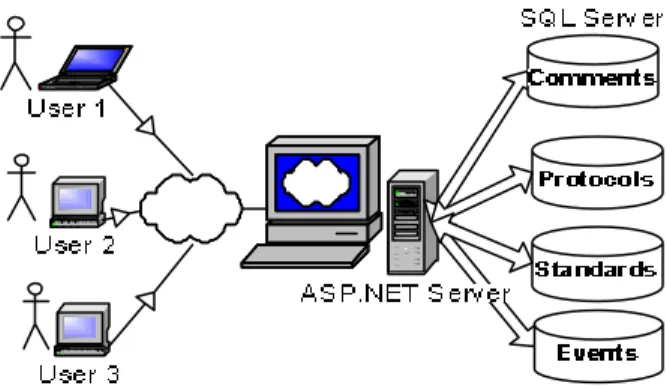
Figure 1. System Framework
Figure 1 shows the framework of our web-based asynchronous collaborative writing system, which integrates these major modules:
• Electronic protocol management with version control • Collaborative annotation and group discussion support • Online protocol editing support by a rich-text web editor • Group and shared workspace awareness support • User access management for versioned protocols Protocol writers can access the protocol server through the Internet using browsers. The web server is built on Windows .NET server and is connected to an SQL server database. The database stores protocol chunks, comments and their re-sponses, version information for protocols, and user activities. Typically there are three roles in a collaborative writing proc-ess: 1) the author, who gets credit for the protocol design by contributing research ideas 2) the reviewer, who adds com-ments to protocols 3) the editor, who manages protocol drafts by integrating scattered inputs into a coherent document fo l-lowing a certain format. In SWOG, each team has only one protocol editor. All above roles are termed writers. Our system also supports a fourth role, a protocol manager, who monitors the schedule and progress of the protocol develo pment. Table 1 shows the system functio nalities for each role.
A Comment Model and Awareness Support
Protocol review comments and version history are important information communicated within the collaborative writing group. In the current work practice, reviewers use emails to send out comments, which are detached from protocols; but they do not get timely feedback for the status of each com-ment. They do not know whether or not the comments have been incorporated into new versions. Reviewers have to care-fully compare old versions and new versions to find differ-ences. This process tends to be arduous and troublesome. To solve these problems, we present a comment model with a life cycle of four statuses: 1) Unread 2) Responded to 3) In-corporated into the new version, and 4) Resolved. An editor can change the status of a comment when he or she revises the protocol. The comment model contains rich information about protocol reviewing activities, such as the comment-maker, comment-responder, commenting-time, comment prior-ity category, protocol context information, and protocol ver-sion information. When a reviewer makes a comment, he can also identify a group of protocol writers whom he wants to read or respond to the comment. Once these people are se-lected, they will be notified that a new comment is awaiting them for processing by email or when they log into the system. This comment model helps us provide “design rationale” to collaborative writers and helps them understand the co-evolving process of group communications and the shared document. They can make better sense of how the shared document is modified and how a coauthor’s opinions are in-corporated into a document’s new versions. Also, the rich information of group activities is very useful for group aware-ness support. Once comments are created or responded to, the protocol writers receive notification. When new versions are generated, protocol reviewers are notified of the changes as well as the causal relationships between comments that are incorporated and the changes that have been made. In addi-tion, the web-based protocol workspace provides shared feed-back for group activities and document progress. Protocol writers using this system will use less time to understand the context of their work. The group activity information is also used to form the progress tracking report of the protocol. A protocol manager can browse the version history and the status of comments at any time during the protocol develop-ment process.
Version Control and Concurrency Control
SWOG was accustomed to having only one editor in each writ-ing group.[3] After seewrit-ing our earlier prototypes, they showed interest in a more collaborative editing mode. They suggested allowing authors to edit different parts of a protocol concur-rently. Based on this request, we provide an enhanced version control at two levels: one is at the section level, and the other is at the document level. Each protocol has a complex version history tree; authors and editors can navigate through the tree to retrieve old versions for sections or a complete protocol. The authors perform version control for sections. The editor in a group is allowed to collect heterogeneous inputs from re-viewers and authors , compose them into a coherent draft, and publish a new version at both levels. In addition, for each sec-tion, authors can save their writings to either the shared copy or a private copy. For each version, we use explicit lock to avoid overwriting activities.
User Interfaces
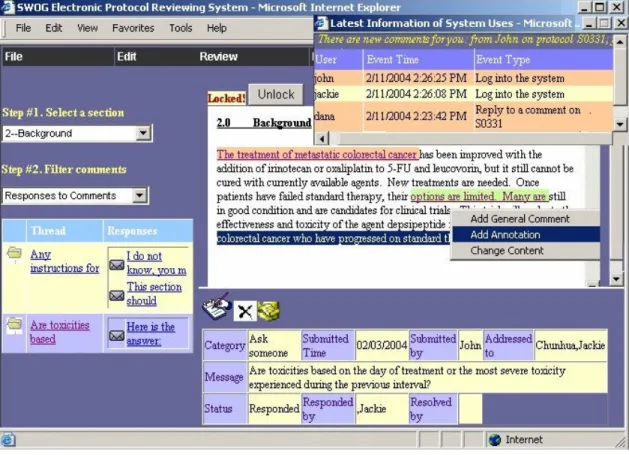
Examples of our user interfaces are shown in Figure 2 and Fig-ure 3 on page 4. As shown in FigFig-ure 2, when a reviewer wants to add a comment, he or she can simply use the mouse to se-lect some text in the protocol, right click the mouse button, and select “Add an annotation” from the popup menu. Then a dia-log will pop up with populated anchor information as the se-lected text . The reviewer only needs to type a comment, select a category, and indicate who should be notified. Compared to current work practice where specifying the context of a com-ment is by tediously typing locations such as “section 2, para-graph 1, line 6,…” our system provides an easier method, much to the relief of reviewers. Moreover, all the online writers can immediately see highlighted in-text annotations in different colors, each color indicating a reviewer. If the writer selects to revise the content, he or she can edit a specific section or pin-point a certain part of the protocol with a specific comment. Revisions will be done in a rich text web editor (Figure 3). To help writers share group information, we also open a small floating monitoring window to display recent activities in the writing group, as shown in Figure 2.
Status and Evaluation
The SWOG researchers who participated in our informal user Table 1. Roles and Associated Activities In the Collaborative Writing Process
Collaborative Writing Activities Rolesà Editor Author Reviewer Manager Create a new protocol: Use templates and reusable standards to create a protocol. X
Edit a Protocol section: Change the content of a section with an exclusive lock. X X
Review a Protocol: Add in-text annotations or reply to existing annotations. X X X
User Management: User access control and user profile configuration. X
Track Protocol Review Progress:Browse the status of each comment, related dis-cussions on the comment, and unresolved comments for the current version.
X X X X
Track Protocol Version History:Track the evolving protocol and its evolving sec-tions and their version history.
Figure 2: Collaborative Protocol Reviewing
studies of the prototype have given us positive feedback and showed enthusiastic acceptance of our system. Our next step is to have a field trial of the system at SWOG, test its usability and efficiency, and assess whether it can augment the real work process of collaborative clinical protocol writers. Our further evaluation goal is threefold. We will evaluate 1) whether the system is generalizable to other cooperative pro-tocol development groups, 2) whether collaboration support among human experts is more efficient than traditional com-puter-based decision support tools for clinical trial design, and 3) whether this system is generalizable to other collaborative clinical document writing activities.
Summary and Discussion
We have described a web-based collaborative protocol writing system. The system design is based on a thorough under-standing of the complex workflow in SWOG. Our system main-tains old work practices but also encourages new collaborative work practice. We expect to see the following advantages of this system in future evaluation studies. First, reviewers will make comments directly in the context of clinical protocols and simplify the editorial process. Second, protocol document re-viewing and revising activities will be seamlessly intertwined to each other. Third, interactions among group writers with disparate expertise or responsibilities will be more efficient. We hope this system can also be generalizable to other document writing activities. Moreover, we hope that our experiences from this exploratory work can help us derive better ideas to achieve collaborative information integration through annotations in dynamic collaborations. In the future, we also hope this sys-tem can be integrated into exis ting decision support tools for clinical trial design thereby achieving a super tool that can assist protocol writers in both “human-computer interaction” and “human-human interaction” in clinical trial design.
Acknowledgments
This research was supported by Southwest Oncology Group Statis-tical Center. We particularly thank Dr. John Crowley, Dr. Charles A. Coltman, Jr., Dr. Jacqueline Benedetti, Dr. Stephanie Green, Dana Sparks, and other SWOG researchers who assisted in the participa-tory design of this system and provided valuable feedback.
References
[1] Musen M. A., Rohn J. A., Fagan L. M., & Shortliffe E. H.. Knowledge engineering for a clinical trial advice system: Uncov-ering errors in protocol specification. Bulletin du Cancer 74:291-296, 1987.
[2] Fazi P., Luzi D., Ricci FL, Vignetti M., Supporting writing and diffusion of clinical trials, 12th International Conference on In-formation and Intelligent Systems, 2001.
[3] Gennari JH, Weng C, McDonald D, Benedetti J, Green S, An Ethnographic Study of Clinical Trial Protocol Writing, Proc of MedInfo’04, in press.
[4] van der Lei J., What’s in a protocol, An Invitational Workshop: Towards Representations for Sharable Guidelines, March 3-4, 2000. Position Paper.
[5] Bury J., Fox J., & Sutton D. The PROforma guideline specifica-tion language: progress and prospects. Proc of 1st European Workshop, Computer-based Support for Clinical Guidelines and Protocols (EWGLP 2000), Leipzig 13-14 Nov. 2000.
[6] Wyatt JC, Altman DG, Heathfield HA, Pantin CF. Develop-ment of Design-a-Trial, a knowledge-based critiquing system for authors of clinical trial protocols. Comput Methods Programs Biomed. 1994 Jun; 43(3-4):283-91.
[7] Tu SW, Musen MA, Modeling Data and Knowledge in the EON Guideline Architecture, MedInfo 2001, London, UK, 2001. [8] Shiffman RN, Karras BT, Agrawal A, Chen R, Marenco L, Nath
S. GEM: A proposal for a more comprehensive guideline docu-ment model using XML. JAMIA 2000; 7(5): 488-498.
[9] Shahar Y., Shalom E., Mayaffit A., Young O., Galperin M., Martins S., Goldstein M., A Distributed, Collaborative, Struc-turing Model for a Clinical Guideline Digital Library, Proc AMIA Symp. 2003, in press.
[10] Fazi P, Luzi D, Manco M, Ricci FL, Toffoli G, Vignetti M., WITH: a system to write clinical trials using XML and RDBMS, Proc AMIA Symp. 2002; 240-4.
[11] Galegher, J., and Kraut, R. E. Computer-mediated communica-tion for intellectual teamwork: an experience in group writing. Information Systems Research 5, 2 (1994), 110-139.
[12] Leland MDP, Fish RS, Kraut RE, Collaborative Document Pro-duction Using Quilt, Proc. CSCW'88, Portland, Oregon, 1988, pages 206-215.
[13] Neuwirth CM, Kaufer DS, Chandhok R, Morris JH, Issues in the Design of Computer Support for Co-authoring and Com-menting, Proc. CSCW'90, October 7-10, 1990, Los Angeles, pp 183-195.
[14] Dourish P., Bellotti V., Awareness and coordination in shared workspaces, Proc of 1992 ACM CSCW, p 107-114.
[15] Sjoberg C, Timpka T, Participatory Design of Information Sy s-tems in Health Care, JAMIA, Vol. 5, No. 2, 1998.
[16] Weng C., Gennari J., McDonald D., Scenario-based Participa-tory Design of A Collaborative Clinical Trial Protocol Authoring Sy stem, Poster, Proc AMIA Symp, pp 1051, 2003.
[17] Rowley, David E., and Rhoades, David G. "The Cognitive Jog-through: A Fast-Paced User Interface Evaluation Procedure.'' CHI `92 Proceedings, (May 3-7, 1992): 389-395
Address for correspondence
Chunhua Weng, Department of Medical Education and Biomedical Informatics, Box 357240, University of Washington, Seattle, 98195-7240 – USA