All Rights Reserved © 2014 IJARTET
32
The Effect of Supply Chain management Practices
and Competitive Advantage in the Performance of
Kerala PSU’s: A Structural Equation Modeling
Approach
Arun A1, Asok kumar N2
College Of Engineering Trivandrum, College Of Engineering Trivandrum1,2
Abstract:Supply chain management (SCM) has become a potentially valuable way of acquiring competitive advantage and improving organizational performance. Supply chain management practices (SCMP) are defined as the set of activities undertaken by an organization to promote effective management of its supply chain. The importance of SCM in the achievement of organizational performance has been highlighted in many studies. The purpose of this study is to propose supply chain management practices (SCMP) and Organizational Performance (OP) model for Kerala PSU’s. This paper develops a framework showing the effect of SCMP and competitive advantage on organizational performance. Data for the study were collected from PSU’s in Kerala by developing a questionnaire and conducting survey among top level managers in the marketing and purchase department of Kerala public sector units(PSU’s). And the relationships proposed in the framework were tested using structural equation modeling (SEM) approach using the software WARPpls.
Keywords: Competitive advantage, SCMP, SEM, Organizational performance, WARPpls
I. INTRODUCTION
The goal of Supply Chain Management (SCM) is to integrate both information and material flows flawlessly across the supply chain as an effective competitive weapon. The Global Supply Chain Forum consists of top executives of leading firms from a wide variety of industries, such as communications and technology, consumer packaged goods, fashion apparel, commodity merchandising, automotive manufacturing, household plumbing and accessories, and consumer electronics. Member companies represent all possible locations across a supply chain: original suppliers, manufacturers of industrial products (business to business), manufacturers of consumer products, distributors, and retailers. Therefore, the view presented by the Global Supply Chain Forum represents combined knowledge and experiences from leading firms in the corresponding industry.[17-19] Organizations began to realize that it is not enough to improve efficiencies within an organization, but their
whole supply chain has to be made competitive. The understanding and practicing of supply chain management (SCM) has become an essential prerequisite for staying competitive in the global race and for enhancing profitably [1–4].
Council of logistics management defines SCM as the systematic, strategic coordination of the traditional business functions and tactics across these businesses functions within a particular organization and across businesses within the supply chain for the purposes of improving the long-term performance of the individual organizations and the supply chain as a whole. SCM has been defined to explicitly recognize the strategic nature of coordination between trading partners and to explain the dual purpose of SCM: to improve the performance of an individual organization, and to improve the performance of the whole supply chain.[1,6].
The purpose of this study is therefore to empirically test a framework identifying the relationships among Supply
All Rights Reserved © 2014 IJARTET
33
chain management practices, competitive advantage and organizational performance. The Supply chain management practices are defined as the set of activities undertaken by an organization to promote effective management of its supply chain. The Supply chain management practices are proposed to be a multi-dimensional concept, including the downstream and upstream sides of the supply chain. Operational measures for the constructs are developed and tested empirically, using data collected from respondents to a survey questionnaire. Structural equation modeling is used to test the hypothesized relationships.[14-16]
The remainder of this paper is organized as follows. Section 2 presents the literature review, provides the definitions and theory underlying each dimension of Supply chain management practices, discusses the concepts of competitive advantage and organizational performance, and develops the hypothesized relationships. The research methodology and analysis of results are then presented.
II. LITERATURE REVIEW
The practice of SCM is also known by other terms such as relationship marketing and global account management [8]. The review of literature revealed that SCMP has been studied and used in many organizations. Different constructs which affect organizational performance are SCMP and competitive advantage. These are discussed below,
2.1 Supply chain management practices
SCM practices have been defined as a set of activities undertaken in an organization to promote effective management of its supply chain. Donlon describes the latest evolution of SCM practices, which include supplier partnership, outsourcing, cycle time compression, continuous process flow, and information technology sharing. Tan et al. use purchasing, quality, and customer relations to represent SCM practices, in their empirical study. Alvarado and Kotzab include in their list of SCM practices concentration on core competencies, use of inter-organizational systems such as EDI, and elimination of excess inventory levels by postponing customization toward the end of the supply chain.[22] Tan et al. identify six aspects of SCM practice through factor analysis: supply chain integration, information sharing, supply chain
characteristics, customer service management, geographical proximity and JIT capability. Chen and Paulraj use supplier base reduction, long-term relationship, communication, cross-functional teams and supplier involvement to measure buyer–supplier relationships. Min and Mentzer identify the concept SCM as including agreed vision and goals, information sharing, risk and award sharing, cooperation, process integration, long-term relationship and agreed supply chain leadership. Thus the literature portrays SCM practices from a variety of different perspectives with a common goal of ultimately improving organizational performance. In reviewing and consolidating the literature, seven distinctive dimensions, including supplier selection, strategic supplier partnership, demand management, Outsourcing management, customer relationship, level of information sharing, quality of information sharing are selected for measuring SCM practice.[20]
2.2 Competitive advantage
A competitive advantage is an advantage gained over competitors by offering customers greater value, either through lower prices or by providing additional benefits and service that justify similar or possibly higher prices. Competitive advantage is the extent to which an organization is able to create a defensible position over its competitors.[21] It comprises capabilities that allow an organization to differentiate itself from its competitors and is an outcome of critical management decisions.[5] The empirical literature has been quite consistent in identifying price/cost, quality, delivery, and flexibility as important competitive capabilities[1]. Suhong Li identifies Price, quality, delivery Dependability, Product innovation, time to market.[1] Che Yao Chen et al identify inventory, Quality and Delivery rate.[5] Based on the above, the dimensions of the competitive advantage constructs used in this study are Price, Quality, Time to market, Product innovation.
2.3 Organizational performance
Organizational performance refers to how well an organization achieves its market-oriented goals as well as its financial goals. The short-term objectives of SCM are primarily to increase productivity and reduce inventory and cycle time, while long-term objectives are to increase market share and profits for all members of the supply chain. Any
All Rights Reserved © 2014 IJARTET
34
organizational initiative, including supply chain management, should ultimately lead to enhanced organizational performance.[5] A number of prior studies have measured organizational performance using both financial and market criteria, including return on investment (ROI), market share, profit margin on sales, the growth of ROI, the growth of sales, the growth of market share, and overall competitive position.[7] In line with the above literature, the same items is adopted to measure organizational performance in this study.
III. RESEARCH FRAMEWORK
H2
H1
H3
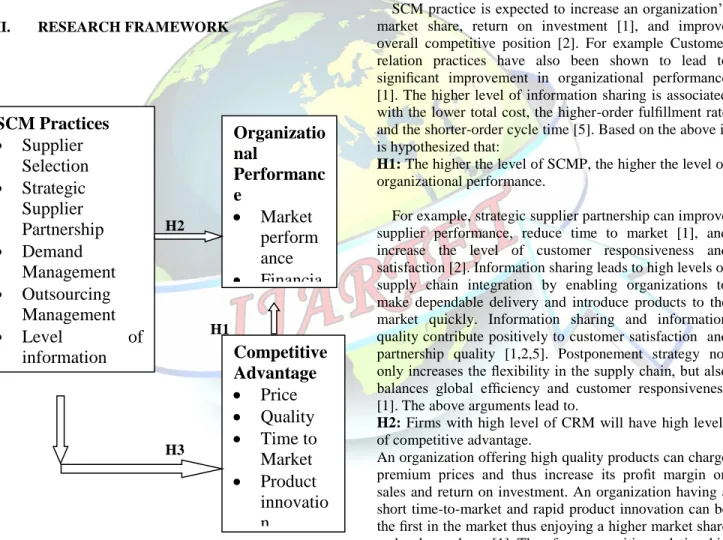
FIG 1 Research framework
Fig. 1 represents the SCM framework developed in this research. The framework proposes that SCM will have an impact on organizational performance both directly and indirectly through competitive advantage [1,2]. Using literature support, the expected relationships among SCM, Competitive advantage and organizational performance are developed, and hypotheses relating these variables are developed 3.1 Research hypotheses
SCM practice is expected to increase an organization’s market share, return on investment [1], and improve overall competitive position [2]. For example Customer relation practices have also been shown to lead to significant improvement in organizational performance [1]. The higher level of information sharing is associated with the lower total cost, the higher-order fulfillment rate and the shorter-order cycle time [5]. Based on the above it is hypothesized that:
H1: The higher the level of SCMP, the higher the level of organizational performance.
For example, strategic supplier partnership can improve supplier performance, reduce time to market [1], and increase the level of customer responsiveness and satisfaction [2]. Information sharing leads to high levels of supply chain integration by enabling organizations to make dependable delivery and introduce products to the market quickly. Information sharing and information quality contribute positively to customer satisfaction and partnership quality [1,2,5]. Postponement strategy not only increases the flexibility in the supply chain, but also balances global efficiency and customer responsiveness [1]. The above arguments lead to.
H2: Firms with high level of CRM will have high levels of competitive advantage.
An organization offering high quality products can charge premium prices and thus increase its profit margin on sales and return on investment. An organization having a short time-to-market and rapid product innovation can be the first in the market thus enjoying a higher market share and sales volume.[1] Therefore, a positive relationship between competitive advantage and organizational performance can be proposed.
SCM Practices
Supplier
Selection
Strategic
Supplier
Partnership
Demand
Management
Outsourcing
Management
Level
of
information
sharing
Level
of
information
quality
Customer
Relationship
Management
Competitive
Advantage
Price
Quality
Time to
Market
Product
innovatio
n
Aftersales
service
Organizatio
nal
Performanc
e
Market
perform
ance
Financia
l
perform
ance
All Rights Reserved © 2014 IJARTET
35
H3: The higher the level of competitive advantage, the higher the level of organizational performance.
IV. Methodology
The purpose of this study is to determine the relationship between the strategic development of supply chain management practice (SCMP), competitive advantage and organizational performance. Surveys were used to collect data. Three measures were used in this study; SCMP, organizational performance, and competitive advantage.
4.1 Procedures
Data for this study were collected using a 20-item survey administered to top management executives from a variety of industries. The survey was administered from April 2014 to July 2014. Survey was conducted among top level managers of Kerala PSU’s. The survey included a cover page that further described the purpose of the study. Participation was strictly voluntary; all respondents’ anonymity was maintained.
The initial survey was pilot tested with a group of academicians with the purpose of collecting feedback on the instrument to identify confusing and/or misleading items, identify items and/or scale overlap, ensure item clarity and brevity, and identify the time required to complete the survey. Comments and observations were used to create the final survey.
The methodology adopted for this study is given as follows: (1) collection of literature to identify different factors affecting organizational performance. (2) Develop a framework to show how these factors will affect organizational performance. (3) Developing questionnaire and collecting responses from the targeted group. (4) Statistical analysis of data using SPSS. (5) Framework testing using SEM.
The questionnaire for this survey is prepared with the help of instruments established through previous researches. The questionnaire consists of a total of 20 questions distributed among individual profile, competitive advantage, CRM, organizational performance. The questionnaire employed a five point interval scale for the measurement. The individual profile of the employees comprised of designation, department,
experience etc. Competitive advantage consists of price, quality, time to market, product innovation, after sales service etc. [1,2,3]. CRM consists of customer satisfaction, customer expectation, and relationship with customer etc. [2].
4.2 Participants
The population chosen for the study was drawn from among the top level managers from different PSU’s situated in Kerala especially from the marketing and purchase department. The sampling method used for this study is convenient sampling.
The questionnaire was distributed to top level managers of different manufacturing industries in person. The internal consistency of the collected data is carried out using Statistical Solution for Software Solution (IBMSPSS Statistics Version.21). From the analysis, Cronbach’s alpha (measure of internal consistency) was found to be 0.832 in organizational performance, 0.712 in SCMP, and 0.821 in Competitive advantage respectively(Table I) Thus it indicates a good level of internal consistency for the collected data.
Table I Cronbach’s values for reliability tests on various constructs
Constructs Cronbach’s Alpha
SCMP 0.712
CA 0.821
OP 0.832
V. RESULTS
The purpose of this thesis is to determine if the supply chain management practices (CRM) were positively related to competitive advantage and organizational performance. This chapter summarizes the findings of analysis conducted on data collected using the Survey. The three hypotheses were evaluated using Structural equation modeling.
Structural Equations
In the case of measurement model there are 28 factors to be measured. Each of the factors is manifested by
All Rights Reserved © 2014 IJARTET
36
different variables. That is the latent variables are measured using indicator variables. In the path diagram supply chain management practices (SCMP) is measured by 28 indicator variablesSCMP1,SCMP2,… SCMP28 . Similarly the latent construct Competitive Advantage (CA) is measured by 8 indicator variables. Organizational performance (OP) by 6 indicators.
In confirmatory factor analysis the basis is that the latent construct are the causes of the manifest (indicator) variables. By drawing the arrowhead from latent construct to the indicator variable we are actually restricting the model. The parameter depicting the relationship between Supply chain management practices and SCMP1 is denoted by λ11 that is 1 the subscript of SCMP1 and
Supply chain management practices considered as the first variable.
Before writing the equations, for simplicity all the latent factors can be represented under single variable say X. Therefore in the equations Supply chain management practices will be represented by X1, Competitive
Advantage by X2 , Organizational performance by X3.
Now the equations are as follows: SCMP1 = λ11X1 + 0*X2 + 0*X3 + e1 SCMP2 = λ21X1 + 0*X2 + 0*X3 + e2 ……… SCMP28 = λ41X1 + 0*X2 + 0*X3 + e28 CA29 = 0*X1 + λ52X2 + 0*X3 + e29 ……… CA36 = 0*X1 + λ92X2 + 0*X3 + e36 OP37 =0*X1 + 0*X2 + λ103X3 + e37 ……… OP41= 0*X1 + 0*X2 + λ143X3 + e41
In the measurement model we have taken all the latent variables without designating which of them are endogenous latent variables and exogenous latent variables. In path analysis or structural model we have to specify which of them are endogenous and exogenous. Here γ is used to find the relationship between exogenous and endogenous latent variables. In this model Supply chain management practices and Competitive advantage are exogenous latent constructs. Organizational Performance is the endogenous latent construct.
For the simplicity of writing equation, certain variables are represented by letter:
Supply chain management practices as S, Competitive advantage as A, and Organizational Performance as O
So the equation can be written as, O = µOC * S + µOA * A + e
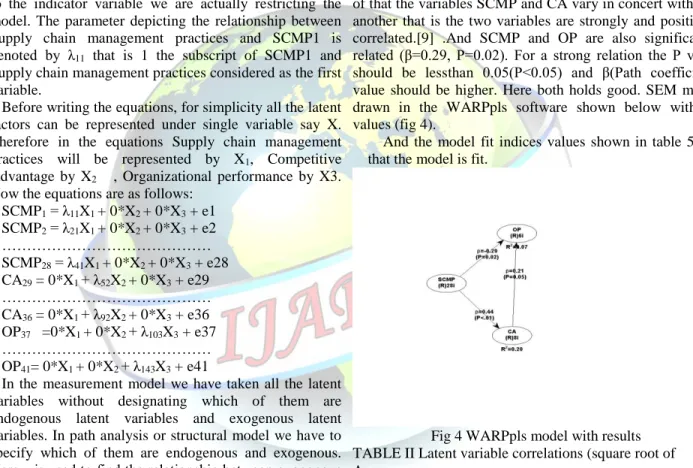
The theoretical framework illustrated in Fig. I has three hypothesized relationships among the variables SCMP, Competitive Advantage, and Organizational Performance. Fig. 4 displays the WARPpls model with results. Based on the result, we can say that competitive advantage significantly related to organizational performance (β=0.21,P=0.05). This significant association is a reflection of that the variables SCMP and CA vary in concert with one another that is the two variables are strongly and positively correlated.[9] .And SCMP and OP are also significantly related (β=0.29, P=0.02). For a strong relation the P value should be lessthan 0.05(P<0.05) and β(Path coefficient) value should be higher. Here both holds good. SEM model drawn in the WARPpls software shown below with its values (fig 4).
And the model fit indices values shown in table 5 say that the model is fit.
Fig 4 WARPpls model with results TABLE II Latent variable correlations (square root of Average
Variance extracted value’s shown on diagonal)
SCMP OP CA
CRM (0.359) 0.192 0.445
OP 0.192 (0.535) 0.086
CA 0.445 0.086 (0.496)
Table III Average variance extracted values Latent constructs AVE
All Rights Reserved © 2014 IJARTET
37
OP 0.731
CA 0.704
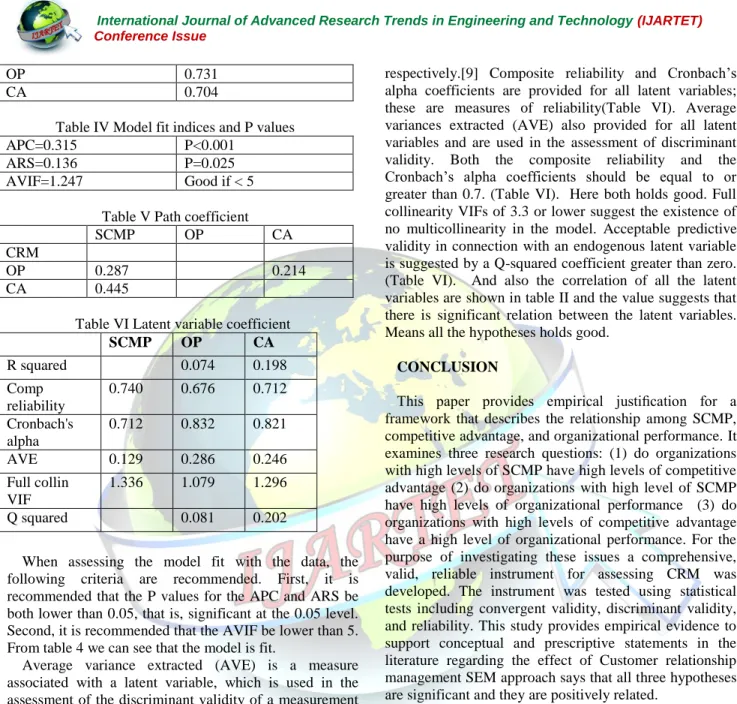
Table IV Model fit indices and P values APC=0.315 P<0.001
ARS=0.136 P=0.025
AVIF=1.247 Good if < 5 Table V Path coefficient
SCMP OP CA
CRM
OP 0.287 0.214
CA 0.445
Table VI Latent variable coefficient
SCMP OP CA R squared 0.074 0.198 Comp reliability 0.740 0.676 0.712 Cronbach's alpha 0.712 0.832 0.821 AVE 0.129 0.286 0.246 Full collin VIF 1.336 1.079 1.296 Q squared 0.081 0.202
When assessing the model fit with the data, the following criteria are recommended. First, it is recommended that the P values for the APC and ARS be both lower than 0.05, that is, significant at the 0.05 level. Second, it is recommended that the AVIF be lower than 5. From table 4 we can see that the model is fit.
Average variance extracted (AVE) is a measure associated with a latent variable, which is used in the assessment of the discriminant validity of a measurement instrument. For discriminant validity assessment for each latent variable, the square root of the average variance extracted should be higher than any of the correlations involving that latent variable. That is, the values on the diagonal should be higher than any of the values above or below them, in the same column (Table III).
R-squared and Q-squared coefficients reflects the percentage of explained variance and predictive validity associated with each of those latent variables,
respectively.[9] Composite reliability and Cronbach’s alpha coefficients are provided for all latent variables; these are measures of reliability(Table VI). Average variances extracted (AVE) also provided for all latent variables and are used in the assessment of discriminant validity. Both the composite reliability and the Cronbach’s alpha coefficients should be equal to or greater than 0.7. (Table VI). Here both holds good. Full collinearity VIFs of 3.3 or lower suggest the existence of no multicollinearity in the model. Acceptable predictive validity in connection with an endogenous latent variable is suggested by a Q-squared coefficient greater than zero. (Table VI). And also the correlation of all the latent variables are shown in table II and the value suggests that there is significant relation between the latent variables. Means all the hypotheses holds good.
CONCLUSION
This paper provides empirical justification for a framework that describes the relationship among SCMP, competitive advantage, and organizational performance. It examines three research questions: (1) do organizations with high levels of SCMP have high levels of competitive advantage (2) do organizations with high level of SCMP have high levels of organizational performance (3) do organizations with high levels of competitive advantage have a high level of organizational performance. For the purpose of investigating these issues a comprehensive, valid, reliable instrument for assessing CRM was developed. The instrument was tested using statistical tests including convergent validity, discriminant validity, and reliability. This study provides empirical evidence to support conceptual and prescriptive statements in the literature regarding the effect of Customer relationship management SEM approach says that all three hypotheses are significant and they are positively related.
REFERENCES
1. Suhong Li. , Bhanu Ragu Nathan, Ragu Nathan, T S & Subba Rao, S(2004). The Impact Of Supply Chain Management Practices On Competitive Advantage And Organizational Performance. International Journal Of Management,34(2006),107-124.
All Rights Reserved © 2014 IJARTET
38
2. Murali sambasivan and George Jacob(2008). An Empirical Study On The Impact Of Supply Chain Practices On Competitive Position Of MNEs In Malaysia. International Journal Of Economics And Management 2(2),369-394
3. Wing S. Chow et al(2008). Supply Chain Management In The US And Taiwan:An Empirical Study. International Journal Of Management 36(2006),665-679
4. Lang Ling Yap & Cheng Ling Tan(2012). The Effect Of Service Supply Chain Management Practices On The Public Healthcare Organizational Performance. International Journal Of Business And Social Science Vol.3 No.16
5. Che Yao Chen et al(2006). The Impact Of E Supply Chain Capability On Competitive Advantage And Organizational Performance. International Journal
Of Electronic Business Management
Vol.4,No.5,pp.419-427.
6. Sahay, B.S. et al(2003). Insight From Industry The Indian Supply Chain Architecture. Supply Chain Management: An International Journal Vol.8 No.2,pp 93-106
7. Sadia Majeed(2011). The impact of competitive advantage on organizational performance. European journal of business management Vol.3, No.4 pp. 191-196
8. Naimah Ali(2013). Customer Relationship Management and Organizational Performance in Malaysian Healthcare Industry. International
Journal of Advancements in Research &
Technology, Volume 2, Issue1, January-2013 9. Ned kock(2013). Using WARPpls in e-collaboration
studies: What if I have only one group and one condition?. International journal of e-collaboration, volume3,Issue1 pp.1-12
10. Ned kock(2011). Using WarpPLS in e-Collaboration Studies: Mediating Effects, Control and Second Order Variables, and Algorithm Choices.
International Journal of e-Collaboration, 7(3), pp1-13
11. Byrne, B M(2013) Structural equation modelling with AMOS: Basic concepts, application and programming
12. Adebayo, I. Toyin (2012). Supply Chain Management (SCM) Practices in Nigeria Today:
Impact on SCM Performance. European Journal of Business and Social Sciences, Vol. 1, No. 6, pp 107 – 115
13. Elaheh Taghavi Shavazi(2013). Customer Relationship Management And Organizational Performance: A Conceptual Framework Based On The Balanced Scorecard (Study Of Iranian Banks). IOSR Journal of Business and Management (IOSR-JBM) Volume 10, Issue 6 (May. - Jun. 2013), PP 18-26.
14. Basher abbas al-alak(2011).Gaining competitive advantage and organizational performance through customer orientation, innovation differentiation and market differentiation. International Journal of Economics and Management Sciences Vol. 1, No. 5, 2011, pp. 80-91
15. Bharadwaj, S. G., Varadarajan, P. R., & Fahy, J. (1993). Sustainable Competitive Advantage in Service Industries: A Conceptual Model and Research Propositions. Journal of Marketing, 37(4), 83-99.
16. Boulding, W., Staelin, R., Ehret, M., & Johnston, W. J. (2005). A Customer Relationship Management Roadmap: What is Known, Potential Pitfalls, and Where to Go. Journal of Marketing, 69(4), 155-166. 17. Chinho Lin(2005). A structural equation model of
supply chain quality management and organizationalperformance. International journal of production economics 96 355-365
18. Lambert, D. M. (2010). Customer Relationship Management as a Business Process. Journal of Business & Industrial Marketing, 25(1), 4-17. 19. Reinartz, W., Krafft, M., & Hoyer, W. D. (2004,
August). The Customer Relationship Managment Process: Its Measurement and Impact on Performance. Journal of Marketing Research, XLI, 293-305.
20. Rigby, D. K., Reichheld, F. F., & Schefter, P. (2002). Avoid the Four Perils of CRM. Harvard Business Review, 80(2), 101-109.
21. Tan, K.C., Kannan, V. R., Handfield, R. B., & Ghosh, S. (1999). Supply chain management: an empirical study of its impact on performance. International Journal of Operations & Production Management, 19(10), 1034-1052.