Visualization of the Nordic academic web: Link analysis
using social network tools
Jose´ Luis Ortega
*, Isidro F. Aguillo
Cybermetrics Lab, CINDOC-CSIC, Joaquı´n Costa, 22, 28002 Madrid, SpainReceived 27 July 2007; received in revised form 18 September 2007; accepted 25 September 2007
Abstract
The aim of this paper is to study the link relationships in the Nordic academic web space – comprised of 23 Finnish, 11 Danish and 28 Swedish academic web domains with the European one. Through social networks analysis we intend to detect sub-networks within the Nordic network, the position and role of the different university web domains and to under-stand the structural topology of this web space. Co-link analysis, with asymmetrical matrices and cosine measure, is used to identify thematic clusters. Results show that the Nordic network is a cohesive network, set up by three well-defined sub-networks and it rests on the Finnish and Swedish sub-sub-networks. We conclude that the Danish network has less visibility than other Nordic countries. The Swedish one is the principal Nordic sub-network and the Finland network is a slightly isolated from Europe, with the exception of the University of Helsinki.
Ó2007 Elsevier Ltd. All rights reserved.
Keywords: Information visualization; Social network analysis; Webometrics; Co-link analysis; Nordic universities
1. Introduction
Webometric studies have focused their analyses mainly in the performance of the academic web domains, because universities are stable and well-defined institutions on the Web since long time ago. Furthermore, this interest is due to the possibility of building web indicators which explain the academic activity and production (Scharnhorst & Wouters, 2006; Thelwall, 2001, 2002). This has produced several studies that compare the aca-demic web development in different countries through web indicators (Ingwersen, 1998; Smith, 1999) or through visualization (Heimeriks & Van Den Besselaar, 2006; Polanco, Boudourides, Besagni, & Roche, 2001).
From a visual point of view,Polanco et al. (2001)mapped and clustered 791 European universities web sites using co-link analysis.Heimeriks (2005)andHeimeriks, Horlesberger, and Van Den Besselaar (2003), more recently, mapped 220 EU universities at the level of departments, universities and countries finding cultural
0306-4573/$ - see front matter Ó2007 Elsevier Ltd. All rights reserved. doi:10.1016/j.ipm.2007.09.010
* Corresponding author. Tel.: +34 915635482(313); fax: +34 915635482.
E-mail addresses:[email protected](J.L. Ortega),[email protected](I.F. Aguillo). Information Processing and Management xxx (2007) xxx–xxx
and linguistic patterns in their relationships.Vaughan (2006)used Co-links analysis to map the Canadian uni-versities, grouping them by linguistic characteristics.
One of the first works about Nordic relationships on the web was developed byAlmind and Ingwersen (1997). They studied the scientific and web production of three Nordic countries, finding that the Danish web fall behind the other Nordic countries with respect to visibility on the Web.Ingwersen (1998)obtained similar results when he calculated the Web Impact Factor for several Nordic countries, highlighting the good result of Norway.Holmberg and Thelwall (2007)studied more recently the local government relationships on the web in Finland, showing that geographical distances affect the network structure of e-government sites.
2. Objectives
The aim of this paper is to study the link relationships in the Nordic academic web space, formed by 23 Finnish, 11 Danish and 28 Swedish academic web domains. Through web graphs and Co-link analysis we intend to visualise this network with the purpose of appreciating the general characteristics and relationships of this network. We also intend to introduce the social network analysis (SNA) on the webometric research in order to detect sub-networks inside the Nordic network, the position and role of the different universities web domains and to understand the structural topology of this network.
3. Methods
The analysis of the Nordic academic web space is within the framework of the analysis of the European one (Ortega, Aguillo, Cothey, & Scharnhorst, 2008). Five hundred and thirty five universities of the 14 European countries (EU except Luxembourg) in 2004 were selected from Webometrics Ranking of World Universities (www.webometrics.org). This site ranks 3000 universities according two main criteria: size (number of pages and rich files) and visibility (number of incoming links). This set of European universities was mapped accord-ing to the link relationships among them. From the first 1000 universities ranked in this web site, we extracted the European ones, obtaining 535 universities web domains.Yahoo! Search(search.yahoo.com) was used to obtain the outcoming links data of each university domain (Aguillo, Granadino, Ortega, & Prieto, 2006). It was used because allows to combine several search operators. The following query was used to extract the links in August of 2005:
þsite:funiversity domainAg þlinkdomain:funiversity domainBg
From this set of data we extracted the nodes and the links between Nordic universities23 from Finland, 28 from Sweden and 11 from Denmark- and the remaining European university domains.
The resulting maps were processed in two different ways. A graph was built through the link matrix retrieved from the search engine to illustrate the topology of the network and its connectivity degree. This graph was laid out with the Spring embeddingalgorithm (Kamada & Kawai, 1989) through NetDraw 2.2 (Borgatti, 2002). This layout shows the nodes and the arcs minimizing the cross points and the overlap of nodes to obtain an optimal network visualization and thus to detect the main characteristics of the network. It is also more appropriate to small and medium size networks because it is quite slow when it comes to con-figure the network (Nooy, Mrvar, & Batagelj, 2005). Finally, multiple arcs with fewer than 50 links were removed to reveal a clearer graph.
On the other hand, a co-link map (Leydesdorff & Vaughan, 2006) was constructed to detect the link pattern among the universities web domains and how these are grouped according to the co-link degree. The co-link degree between two web domains is the frequency with which two web domains are linked by a third web domain. It is a measure which points to a possible substantial relationship between the two co-linked web domains. An asymmetrical matrix of links between university websites was built with the search engine data. Then it was converted to a symmetrical matrix applying the Salton’s cosine measure (Salton, 1971; Salton, Wong, & Yang, 1975). Next, distance coordinates were calculated from this symmetrical matrix through applying multidimensional scaling techniques (MDS) to locate the university web domains according to their co-link degree on a two-dimensional plane. Finally, the coordinates of universities obtained from the MDS of their co-link structure were plotted together with the network graph.
Since the web is a graph of links that connect several web sites, the SNA techniques allow us to analyze the structural and topological features of a web network. Several social network measures were used to analyze the resulting graphs:
§ Degree: measure the number of lines incident with a node. This can be normalized (nDegree) by the total
number of nodes in the network. In a directed network such as the web we can count only the incoming links (InDegree) or the outcoming links (OutDegree). In Webometrics, this measure allows us to detect the visibility of a web domain (Cothey, 2005; Kretschmer & Kretschmer, 2006).
§ Betweenness: measures the intermediation degree of a node to keep the network connected, that is to say,
the capacity of one node to connect only those nodes that are not directly connected to each other. From a webometric point of view, this measure allows us to detect hubs or gateways that connect different web net-works (Faba-Pe´rez, Zapico-Alonso, Guerrero-Bote, & de Moya-Anego´n, 2005).
§ p-Cliques: ap-clique is a sub-network where every node is directly connected among them. It shows groups
with a high density and a way to detect underlying sub-networks. Thep-value is the number of nodes that constitute a clique. It was used byCothey, Aguillo, and Arroyo (2006)to uncover web site structures clus-tering web pages.
§ k-Cores: is a sub-network in which each node has k degree in that sub-network. Unlike thep-cliques the
k-cores allow us to detect groups with a strong link density. In free-scale networks, i.e. the Web, the core with the highest degree is the central core of the network, detecting the set of nodes where the network rests on.
§ Distance: is the number of steps in the shortest path that connect two nodes, the average among all the
shortest paths in the network is the average distance. This measure allows us to know the cohesion of a network, if the distance is short there is a strong cohesion, if not the cohesion is weak (Broder et al., 2000).
§ Diameter: is the number of steps in the longest path. Just like the distance allows us to measure the cohesion
of a network. Diameter is also used to detect ‘‘small-worlds’’ properties on the Web (Bjo¨rneborn, 2001, 2006).
4. Results
4.1. Nordic network
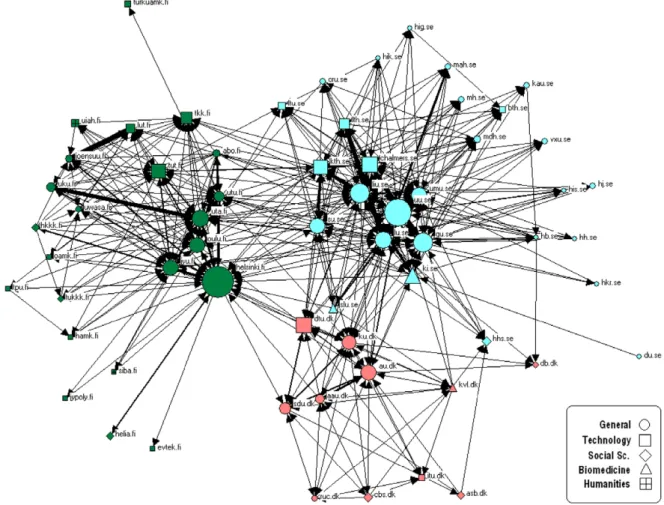
Fig. 1shows the Nordic academic network set up by 62 nodes and 584 ties. As the European academic web space, the Nordic one shows Scale-free properties (Ortega et al., 2008). Its diameter is 4, slightly larger than the European one caused by the smaller number of nodes. Even so, the Nordic network shows a great cohe-sion degree with only 2.16 average distance between nodes and they formed a Strongly Connected component, except 5 nodes (Broder et al., 2000).
Tables 1 and 2, respectively, show the five highest InDegree and OutDegree of the Nordic universities. It is interesting to notice that there is not any Danish university in the rank and both tables list the same univer-sities, with the exception of the University of Tampere and the Royal Institute of Technology.
Thek-cores analysis confirms this assumption. A main core of 25 nodes (k= 10) has been detected in the
graph. This core is set up mainly by 12 Finnish, 12 Swedish and only 1 Danish university. So this confirms that the Nordic network rests on the Finnish and Swedish sub-networks while the Danish one plays a secondary role.
The Nordic graph clearly shows three well-defined groups formed by the Finnish, Danish and Swedish net-works. The Finnish one (dark) is located on the left of the image, the Swedish one (light) on the right side and the Danish one (grey) on the bottom-right side. Sixtyp-cliques (p= 6) have been detected in the network, and 4 clusters have been identified according to the co-memberships. A first clique of 14 Finnish, a second one of 18 Swedish, a third one of 8 Danish and finally a fourth group with 20 remaining universities. This result allows us to think that the Nordic network is set up by three defined sub-networks, although there is a con-siderable group of universities that can not be located in one of them, which explains somewhat the cohesion degree of this network.
If the Nordic network is set up by three national sub-networks, then, how this cohesion is supported? As the European universities web space (Ortega et al., 2008) this cohesion is supported and reinforced by some
Fig. 1. Network graph of the Nordic web space (62 nodes; 584 ties;P50 links).
Table 1
Five universities with highest nInDegree
Universities Web domains InDegree NrmInDeg
1 University of Helsinki helsinki.fi 32 52.45
2 Linko¨ping University liu.se 29 47.54
3 Uppsala University uu.se 28 45.90
4 Lund Uiversity lu.se 27 44.26
5 University of Tampere uta.fi 25 40.98
Table 2
Five universities with highest nOutDegree
Universities Web domains OutDegree NrmOutDeg
1 University of Helsinki helsinki.fi 30 49.18
2 Lund Uiversity lu.se 29 47.54
3 Linko¨ping University liu.se 27 44.26
4 Royal Institute of Technology kth.se 27 44.26
gateway universities or hubs (Kleinberg, 1999) that mediate between sub-networks. Table 3shows the five highest nBetweenness degree of the Nordic universities. As we said before, this measure allows us to know the mediator universities between one and the others. Thus, we detect the ‘‘gateway’’ universities that connect a national sub-network with the whole network. Hence, the University of Helsinki is the gateway to the Finn-ish sub-network; Lund, Linko¨ping and Uppsala universities for the SwedFinn-ish sub-network and the University of Copenhagen for the Danish one. We can see that these universities themselves hold a high centrality degree as well (InDegree and OutDegree), so we can confirm that they are not only the mediator between sub-net-works, but they are the centre of the Nordic university web space.
Fig. 2 shows a Co-link map of these Nordic universities. The Co-link analysis develops a map where the distances between nodes are caused by the similarity in the origin of their incoming links. Unlike the
Fig. 1, a Co-link map allows us to find some thematic relationships. Thus, we can see in the Danish network a close location of the Business Schools (asb.dk, cbs.dk), in the Swedish one we find a close relationship of the Table 3
Five universities with highest nBetweenness
Universities Web domains Betweenness nBetweenness
1 University of Helsinki helsinki.fi 32 52.45
2 Lund Uiversity lu.se 29 47.54
3 Linko¨ping University liu.se 28 45.90
4 Uppsala University uu.se 27 44.26
5 University of Copenhagen ku.dk 25 40.98
Biosciences universities (ki.se, slu.se) and the grouping of the Technological universities in Finland and Swe-den. However, the map does not show thematic relationships between universities of different countries. 4.2. National networks
Next we are going to study the particular characteristic of each national network and their European relationships.
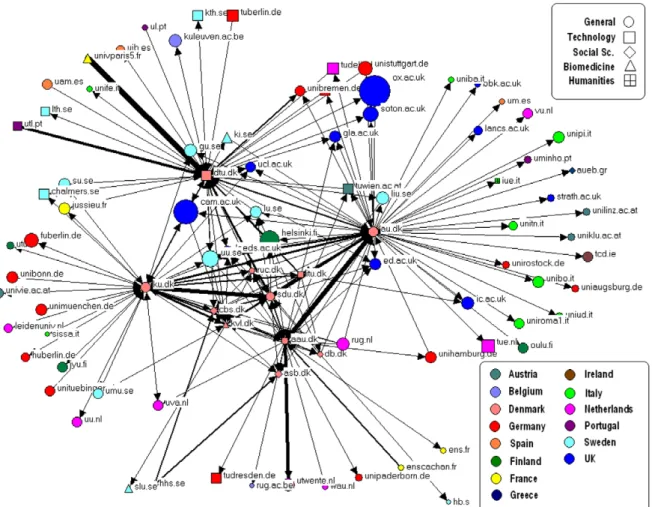
Fig. 3shows the Danish network and its link relationships with the remaining European universities. We can see that the more connected Danish universities with Europe are: Technical University of Denmark (dtu.dk), University of Aarhus (au.dk), University of Copenhagen (ku.dk) and Aalborg University (aau.dk) which have the highest centrality scores. We also appreciate that country universities closer to the Danish net-work are mainly Swedish and British universities, although it is significant that the University of Helsinki (hel-sinki.fi) is the only Finnish one located in the centre of the Danish network. Mainly, this is connected with Swedish (29; 12.6%), British (29; 12.6%) and German ones (18; 7.82%).
Fig. 4shows the Finnish academic web space and its relationships with the European one. It should be noted that the huge amount of links that the University of Helsinki (helsinki.fi) attracts and makes, achieving a strong centrality position. Thus, we can really consider the University of Helsinki a gateway between the European networks and the Finnish sub-network because the 71.07% of the European universities that link to a Finnish university do it to the University of Helsinki. The remaining Finnish network basically are linked with Swedish (11; 31.42%), British (10; 28.57%) and German ones (6; 17.14%).
Fig. 5shows the Swedish network and its link relationships with the remaining European universities. It is the most connected of all the Nordic sub-networks with an average distance of 2.29 and a diameter of 4. The main universities, due to their centrality values, are Linko¨ping University (liu.se), Uppsala University (uu.se) and the Royal Institute of Technology (kth.se). With regard to the European relationships of the Swedish uni-versities we can appreciate that these are quite varied, but mainly they connect with British (113; 13,27%), Ger-man (82; 9.63%) and Finnish ones (49; 5.75%).
5. Discussion
We have used asymmetric matrices and the cosine measure in order to develop the Co-link analysis. Unlike
Leydesdorff (2007)andLeydesdorff and Vaughan (2006)argue, webometric studies can also be developed with asymmetric matrices (Aguillo, Ortega, & Granadino, 2006; Ortega et al., 2008), depending on the data used and their extraction’s way. Even so, we consider that the results obtained with an asymmetric matrix are better than with a symmetric one because the links analysed belong to the study population. A symmetric matrix obtained from a search engine query counts the links from all the web sites indexed in the search engine data-base. We think that this introduces noise and biases whereas the asymmetric matrices produce more solid, strong and significant results.
For example, a possible bias of our results is that the some Finnish universities share web domain with their city councils. This is the case of the University of Helsinki (helsinki.fi), University of Joensuu (joensuu.fi) or University of Oulu (oulu.fi). A symmetric matrix from a search engine query would contain links from any
web site, i.e. government web sites, introducing non academic relationships. The asymmetric matrix removes these kinds of biases and only contains links from the academic web sites involved in the study.
According to the results, prior studies have proved the cohesion of the Nordic network.Musgrove, Binns, Page-Kennedy, and Thelwall (2003)used a probabilistic model to map European academic web space, finding a well-defined Nordic group andHeimeriks and Van Den Besselaar (2006)detected through network graphs a Nordic region of university web domains. The central position of the Swedish universities may be explained by the finding ofThelwall, Tang, and Price (2003)which argue that the Swedish language is used as international language in the Nordic countries, besides the English. Although is more probable that there are cultural link-ages between Swedish minorities in the Nordic countries. For example, there are in Finland Swedish-speaking universities as Academia Abo (abo.fi) and University of Vaasa (uwasa.fi) that keep links with Swedish universities.
6. Conclusions
Co-link analysis has contributed valuable information, mainly regarding thematic relationships, in the Nor-dic academic web space, grouping universities web domain according to their thematic area. We can conclude that this webometric technique, developed from asymmetric matrices and the cosine measure, is an efficient tool in order to detect thematic relationships on the Web. These thematic relationships have been perceived into national sub-network but have not been seen between countries. However, many of the universities analysed are multidisciplinary and this conclusion have to be formulated with caution. Forthcoming studies might be developed which map entities more close to a thematic definition such as research group, department or e-journal web sites.
SNA techniques and measures used have allowed to know the network relationships, structure and topol-ogy and the position of different nodes. We think that the introduction of these techniques in webometric anal-yses is an important way to develop this discipline (Bjo¨rneborn, 2006; Kretschmer & Aguillo, 2004; Ortega et al., 2008). However, these have to be interpreted from a webometric point of view and have to be adapted to the characteristic of the Web.
According to the results themselves, the Nordic network holds a solid and cohesive structure proved by their diameter and inter-distances. It is set up by three well-defined sub-networks: the Finnish, the Sweden and the Danish sub-network. This statement has been confirmed by thep-cliques analysis and the MDS coor-dinates in the Co-link analysis. The core of this network rest on Sweden and Finland, whereas Denmark has a secondary role. No Danish university have a good centrality degree measure but only one, University of Copenhagen, has a good betweenness score. Just like Almind and Ingwersen (1997), we conclude that the Danish academic web network have less visibility than other Nordic countries studied. Nevertheless, we have to warn that this study only covers the Nordic countries of the European Union in 2004. So, the absence of Norway or Iceland may distort our results about the region.
With regard to each country, the Danish network is the most isolated in the Nordic network and their con-nections are mainly set up with Sweden. Their most outstanding universities are the University of Copenhagen on the Nordic network and the Technical University of Denmark and the University of Aarhus on the Euro-pean university network.
Finnish network is characterized by the strong presence of the University of Helsinki, which is the most linked Finnish university (71% of the European inlinks) and the authentic gateway between Finland and Eur-ope. The rest of Finnish universities have a quite low proportion of links and their come/go mainly from/to Sweden (31.42%) and United Kingdom (28.57%).
Swedish network is the main component of the Nordic network because Sweden is the countries with larger number of universities in the study and they have the highest centrality scores, standing out the Linko¨ping University and Uppsala University. The Swedish web space is also the most connected with Europe which principal linking countries are United Kingdom (13.27%) and Germany (9.63%). Swedish universities are the most connected from the Finnish and Danish network, so we can consider that the Swedish network is the mediator between the Nordic network and the European one through UK and Germany.
Acknowledgements
This work was supported by a grant from the Common Basis for Science, Technology and Innovation Indi-cators part of the Improving Human Research Potential specific programme of the Fifth Framework for Re-search ad Technological Development of the European Commission. It is part of the WISER project (web indicators for scientific, technological and innovation research) (Contract HPV2-CT-2002-00015) (www. webindicators.org).
References
Aguillo, I. F., Granadino, B., Ortega, J. L., & Prieto, J. A. (2006). Scientific research activity and communication measured with cybermetrics indicators.Journal of the American Society for Information Science and Technology, 57(10), 1296–1302.
Aguillo, I. F., Ortega, J. L., & Granadino, B. (2006). Brazil academic webuniverse revisited: a cybermetric analysis. In Proceedings international workshop on webometrics, informetrics and scientometrics&seventh COLLNET meeting, Nancy, France.
Almind, T. C., & Ingwersen, P. (1997). Informetric analyses on the world wide web: Methodological approaches to ‘webometrics’.Journal of Documentation, 53(4), 404–426.
Bjo¨rneborn, L. (2001).Small-world linkage and co-linkage.Proceedings of the 12th ACM conference on hypertext and hypermedia. New York: ACM Press, pp. 133–134.
Bjo¨rneborn, L. (2006). ‘Mini small worlds’ of shortest link paths crossing domain boundaries in an academic web space.Scientometrics, 68(3), 395–414.
Borgatti, S. P. (2002).NetDraw: Graph visualization software. Harvard: Analytic Technologies.
Broder, A., Kumar, R., Maghoul, F., Raghavan, P., Rajagopalan, S., Stata, R., et al. (2000). Graph structure in the web.Computer Networks the International Journal of Computer and Telecommunications Networking, 33(1–6), 309–320.
Cothey, V. (2005). Some preliminary results from a link-crawl of the European union research area web. In P. Ingwersen & B. Larsen (Eds.),Proceeding of the 10th international conference of the international society for scientometrics and informetrics. Stockholm: Karolinska University Press.
Cothey, V., Aguillo, I. F., & Arroyo, N. (2006). Operationalising ‘‘Websites’’: lexically, semantically or topologically?Cybermetrics, 10(1), 3<http://www.cindoc.csic.es/cybermetrics/articles/v10i1p3.html>.
Faba-Pe´rez, C., Zapico-Alonso, F., Guerrero-Bote, V. P., & de Moya-Anego´n, F. (2005). Comparative analysis of webometric measurements in thematic environments.Journal of the American Society for Information Science and Technology, 56(8), 779–785. Heimeriks, G. (2005).Knowledge production and communication in the information society: Mapping communications in heterogeneous
research networks. Amsterdam: University of Amsterdam.
Heimeriks, G., Horlesberger, M., & Van Den Besselaar, P. (2003). Mapping communication and collaboration in heterogeneous research networks.Scientometrics, 58(2), 391–413.
Heimeriks, G., & Van Den Besselaar, P. (2006). Analyzing hyperlinks networks: The meaning of hyperlink based indicators of knowledge production.Cybermetrics, 10(1), 1<http://www.cindoc.csic.es/cybermetrics/articles/v10i1p1.html>.
Holmberg, K., & Thelwall, M. (2007). Local government web sites in Finland: A geographic and webometric analysis. InProceeding of the 11th international conference of the international society for scientometrics and informetrics, Madrid, Spain.
Ingwersen, P. (1998). The calculation of web impact factors.Journal of Documentation, 54(2), 236–243.
Kamada, T., & Kawai, S. (1989). An algorithm for drawing general undirected graphs.Information Processing Letters(31). Kleinberg, J. (1999). Authoritative sources in a hyperlinked environment.Journal of the ACM, 46(5), 604–632.
Kretschmer, H., & Aguillo, I. F. (2004). Visibility of collaboration on the Web.Scientometrics, 61(3), 405–426.
Kretschmer, H., & Kretschmer, T. (2006). A new centrality measure for social network analysis applicable to bibliometric and webometric data. InInternational Workshop on Webometrics, Informetrics and Scientometrics&Seventh COLLNET Meeting.
Leydesdorff, L. (2007). Should co-occurrence data be normalized? A rejoinder.Journal of the American Society for Information Science and Technology, <http://www3.interscience.wiley.com/cgi-bin/fulltext/116322669/HTMLSTART>.
Leydesdorff, L., & Vaughan, L. W. (2006). Co-occurrence matrices and their applications in information science: Extending ACA to the web environment.Journal of the American Society for Information Science and Technology, 57(12), 1616–1628<http://users.fmg.uva.nl/ lleydesdorff/aca/index.htm>.
Musgrove, P. B., Binns, R., Page-Kennedy, T., & Thelwall, M. (2003). A method for dentifying clusters in sets of interlinking web spaces.
Scientometrics, 58(3), 657–672.
Nooy, W. d., Mrvar, A., & Batagelj, V. (2005).Exploratory social network analysis with pajek. Cambridge, UK: Cambridge University Press.
Ortega, J. L., Aguillo, I. F., Cothey, V., & Scharnhorst, A. (2008). Maps of the academic web in the European higher education area – an exploration of visual web indicators.Scientometrics, 74(2)<http://internetlab.cindoc.csic.es/cv/11/EU_Web_maps/EU_Web_maps. htm>.
Polanco, X., Boudourides, M., Besagni, D., & Roche, I. (2001). Clustering and mapping European university web sites sample for displaying associations and visualizing networks.NTTS&ETK 2001 Conference, Hersonissos, Crete.
Salton, G. (1971). The smart retrieval systemexperiments. In G. Salton (Ed.),Automatic document processing. New York: Prentice-Hall. Salton, G., Wong, A., & Yang, C. S. (1975). A vector space model for automatic indexing.Communications of the Association for
Computing Machinery, 18(11), 613–620.
Scharnhorst, A., & Wouters, P. (2006). Web indicators – a new generation of S&T indicators? Cybermetrics, 10(1), 6 <http:// www.cindoc.csic.es/cybermetrics/articles/v10i1p6.html>.
Smith, A. (1999). A tale of two web spaces: Comparing sites using web impact factors.Journal of Documentation, 55(5), 577–592. Thelwall, M. (2001). Extracting macroscopic information from web links.Journal of the American Society for Information Science and
Technology, 52(13), 1157–1168.
Thelwall, M. (2002). A research and institutional size based model for national university web site interlinking.Journal of Documentation, 58(6), 683–694.
Thelwall, M., Tang, R., & Price, L. (2003). Linguistic patterns of academic web use in western Europe.Scientometrics, 56(3), 417–432. Vaughan, L. (2006). Visualizing linguistic and cultural differences using web co-link data.Journal of the American Society for Information