Visually Mapping Requirements Models to Cloud Services
Shaun Shei, Aidan Delaney, Stelios Kapetanakis and Haralambos Mouratidis
Abstract
We extend an existing visual language for require-ments modelling to model the requirerequire-ments of cloud ser-vices. To achieve this we demonstrate how candidate cloud services can be identified from existing visual re-quirements models. We further extend the meta-model of the visual language to include cloud requirements in order to migrate our candidate service to a cloud provider.
1
Introduction
Cloud computing allows the provision of a wide range of services through the abstraction of physical and virtual resources. This offers seemingly unlimited scalability, availability, flexibility and dynamic provi-sioning through a pay-per-use model. However, some organisations are still hesitant to fully commit to this technology due to negative publicity regarding data-breaches [1, 2], security leaks [3] as well as interop-erability and compatibility issues when migrating to-wards cloud environments [4, 5, 6]. Cloud comput-ing is built upon and extends several established con-cepts and technologies such as Service-Oriented Archi-tecture (SOA), distributed computing and virtualiza-tion. Moreover, through extension of existing tech-nologies we also inherit the security issues and vulner-abilities of each [7]. This creates a complicated sce-nario where we need to consider security from multi-ple perspectives. One method for tackling this prob-lem is to adopt an agent oriented software engineering approach [8], where the focus is placed on analysing components and properties to elicit requirements for a software system. There is currently a lack of standard-ised modelling languages and approaches to holistically capture cloud computing environments in the context of software security. The existing notations capture as-pects of different service models such as Software-as-a-Service [6], Platform-as-a-Software-as-a-Service [9] or Infrastructure-as-a-Service [10]. There is a lack of a holistic modelling language that captures both the customer requirements
and cloud services corresponds to the need for secure software systems in the industry [11]. Security is a concept that is often tacked on after the design and deployment of software systems, where security mech-anisms are introduced in response to vulnerabilities as they appear. Security-by-design is a branch within re-cent research efforts [12], where the goal is to obtain a clear understanding of security issues early in the soft-ware development process. The Secure Tropos method-ology provides a modelling language that represents security requirements through security constraints, al-lowing developers to model software systems and its organizational environment using actors, goals and re-lational links such as dependencies. The contributions presented in this paper are as follows:
• We define a pattern for service identification based on grouping a goal, plans and resources in software systems.
• We then model an initial description of properties required by services when migrated to cloud envi-ronments.
The rest of this paper is organized as follows. In sec-tion 2 we present an overview of the the Secure Tropos visual language. In section 3 we provide a standard def-inition of a software service and demonstrate how such services can be identified from a Secure Tropos require-ments model. Section 4 extends the meta-model for Secure Tropos to incorporate cloud computing require-ments as identified from the literature and describes how to adapt the identification of services towards a cloud environment. Finally, in section 5 we present our conclusion and future work.
2
Secure Tropos Notation
Secure Tropos is a requirements engineering methodology aimed at fully capturing the properties of software systems and the organizational environment, focusing on modelling security [13]. The language ex-tends the concepts of (social) actor, goal, task, resource and social dependency from the i* modelling language
and redefining existing concepts introduced in the Tro-pos language and development process [14]. The Se-cure Tropos methodology closely follows the software development life-cycle with emphasis on security and privacy requirements, allowing the developer to incre-mentally create and refine models of the system-to-be during the analysis and design stage.
The Secure Tropos notation is fully defined in [13]. Here we present an outline of the subset of the notation used in this paper. The concrete notation is presented withinviews, where each view denotes a specific phase of activity in the modelling process. We now discuss Secure Tropos Views.
2.1
Organisational View
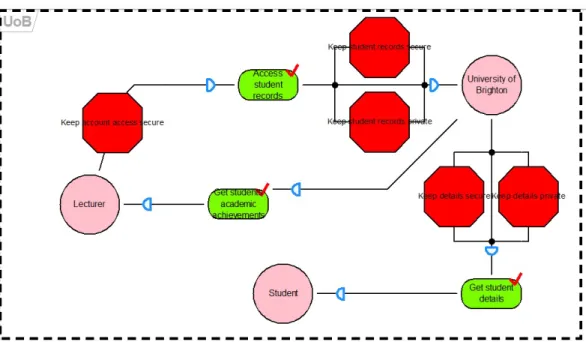
The diagram in Figure 1 illustrates the main nodes of an organisational view of Secure Tropos. It depicts a node-link diagram enclosed in a bounding rectangle. The nodes in the node-link diagram vary in shape ac-cording to the type of Secure Tropos element that they depict. The links similarly vary.
The circular node depicts an actor. An actor can be a physical or abstract manifestation, with strategic goals and intentions. An example actor labelled “Lec-turer” can be seen in Figure 1.
The semi-oval node depicts a goal. Goals repre-sent an actors strategic interests, which can be decom-posed into sub-goals and combined using Boolean op-erations. An example goal labelled “Get student aca-demic achievements” can be seen in Figure 1. Goals are linked through aDependency link, depicted by one semi-circles on each side of the goal element.
ADependency link indicates that an actor depends on another actor in order to achieve some goal/plan or to obtain a resource, where the direction the semi-circle is pointing towards denotes the dependee. An example dependency link can be found linking the goal “Get student academic achievements” with the actor “Uni-versity of Brighton” who depends on the actor “Lec-turer” to achieve the goal.
Security Constraints are depicted by the octagon node. Security constraints define security requirements through a set of restrictions that limit the way goals can be carried out. An example of a security constraint “Keep account access secure” can be found from the actor “Lecturer” to the goal “Access student records”.
2.2
Security Requirements View
The diagram in Figure 2 illustrates the security re-quirements view, which provides a detailed analysis of the organisational view. This view depicts a node-link
diagram enclosed in a bounding circle, defined by an actor that is delegated as the solution “system”. Sev-eral new elements are introduced in this view.
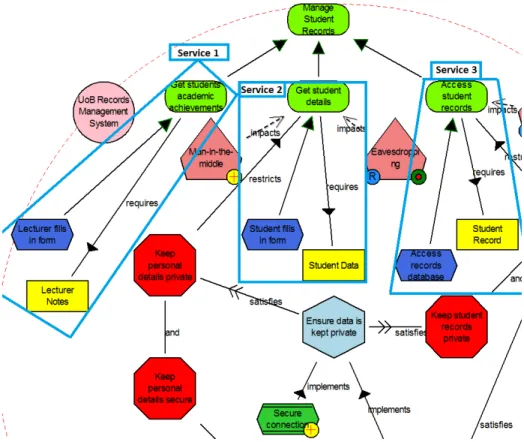
The elongated hexagon node depicts aPlan. A plan specifies the details and conditions under which a goal or measure is operationalised. “Lecturer fill in form” is an example of a plan.
The rectangle node depicts a Resource. Resources represent a physical or virtual entity. Resources can be linked to goals using a Requires link. An example of a resource is “Lecturer Notes” which is linked to the goal “Get academic achievements” via a requires link. The requires link indicates that the goal requires certain resources in order to be satisfied.
The pentagon node depicts a Threat. A threat in-dicates the potential loss or problems that can put the system at risk. The “Man-in-the-middle” is an exam-ple of a threat, which is linked via theImpacts link to the goal “Get student details”.
TheImpacts link indicates the presence of a threat targeting a goal.
The hexagon node depicts aSecurity Objective. An example of a security objective is “Ensure data is kept private”, which is linked to the security constraint “Keep personal details private” and “Keep student records private” via Satisfies links and the Security Mechanism “Secure connection” via the Implements link.
TheSatisfies link indicates that the security objec-tive satisfies the given security constraint.
The hexagon node with two parallel horizontal lines depicts a Security Mechanism. A security mechanism is a method or procedure that enforces security objec-tives. “Secure connection” is an example of a security mechanism, which is linked via the implements link to the security objective “Ensure data is kept private”.
The example organisational and security views demonstrate the syntactic richness of Secure Tropos. Of which, we have provided outline explanations of a subset. We will now use this subset to identify services in Secure Tropos models.
3
Service
Before we can begin the process of determining what properties and aspects to capture when modelling cloud services, there is a need to obtain a concrete def-inition on what a service is. The common defdef-inition of a service can be given as “The performance of work (a function) by one for another”. However, service, as the term is generally understood, also combines the following related ideas [15]:
Figure 1. An example of an organisational view in Secure Tropos
• The specification of the work offered for another
• The offer to perform work for another
Our interpretation for a computing service is based on definitions provided by IT standards bodies, specifi-cally from the “Organization for the Advancement of Structured Information Standards” (OASIS). OASIS defines a service as “A mechanism to enable access to one or more capabilities, where the access is provided using a prescribed interface and is exercised consistent with constraints and policies as specified by the service description” [15].
Capability The capability of a service represents the ability to do something. Capabilities are a way to meet the needs of an agent by fulfilling their requirements. A capability has no function on its own, therefore service functionalities in the service description link together with the capabilities in order to fulfill a purpose. Interface The OASIS definition states that inter-faces provide access to the capabilities of a service. The interface describes the means of interacting with a service and the actions involved in using a capability. These actions are initiated through specific protocols, commands, and information exchange specified by ser-vice functionalities in the serser-vice description. This is essentially the information that needs to be provided to the service in order to access it’s capabilities and receive a result.
Service Description In order to ensure that ser-vices are published and visually available for access, the interaction with services are described in the ser-vice description in terms of inputs, outputs and asso-ciated semantics.
3.1
Service Identification
Based on the OASIS definition, we propose that in the context of our work a service can be identi-fied and modelled through a combination of a goal, plans and resources. Goals provide a description of the main underlying capability of the service, which re-lies on the functionality provided by the plan and the attributes defined in the resource to give the service description. Eachplandescribes a functionality of the service, which is required to give purpose to the ser-vice capability through the interface. The resources provide a specification of the information required by the interface in order to access the capabilities of the service.
This pattern can be identified in Secure Tropos by indicating a goal, searching for dependants of the goal and including any plans and resources linked to the goal. The most basic form of the pattern includes a goal, plan and resource. As goals increase in complex-ity, additional plans and resources may be added in order to specify additional functionalities. A simple example denoting the identification of a service based on the goal “Get student details”, plan “Student fills in form” and resource “Student Data” is shown in Figure
Figure 2. An example of a security requirements view in Secure Tropos.
2. We explain the key characteristics required to iden-tify a service in the following sub-sections, jusiden-tifying the goal, plan, resource pattern.
3.1.1 Capability and Functionality
Goals represent an actors strategic interest, which can be defined as the user requirements. In terms of the service definition, goals provides a description of the main underlying capability of the service. In the exam-ple shown in Figure 2, the goal “Get student details” describes the need to get student details. However on its own, this underlying capacity does not describe how this is fulfilled, nor does it specify the inputs or out-puts when accessing the interface. The functionality is described by the plan, which is a description of what something does and how to achieve that goal. The plan provides parameters for a particular function in terms of behaviour and purpose. In essence, the capability of the service is described by the goal and the func-tionality is described by the plan. Thus by linking a function to a capability to describe how and what to do, we come closer to the definition of a service.
3.1.2 Interface
The plan describes the actions required for interacting with the service while the resource describes the infor-mation required for the interface to access the service capabilities. For example in Figure 2, the plan “Stu-dent fills in form” indicates that the interface has to have a functionality that captures the action of stu-dents filling in forms. The resource “Student Data” is also required in order to specify and store the data that was captured by the functionality of the service defined through the plan.
3.1.3 Service Description
Goals provide a conceptual part of the service de-scription by describing what the service is supposed to accomplish and the conditions for using the service through capabilities. The service description also relies on the plan to define the semantics of interaction with the service, in addition to the resource in order to spec-ify the attributes of the input and outputs. For exam-ple in Figure 2, the goal “Get student details” indicates that the service description will publish the fact that this service will get student details. The plan “Student fills in form” tells us the semantics of the interaction
and the resource “Student data” describes the inputs and outputs of the service in the service description.
Having established a visual Goal-Plan-Resource pat-tern in the Secure Tropos diagram, we now proceed to incorporate cloud requirements into Secure Tropos.
4
Incorporating in Secure Tropos
We validate our proposed work through constructed examples based on existing systems. In our case study, we create a scenario based on migrating an university records management system to the cloud.
4.1
Extensions to the Meta-Model
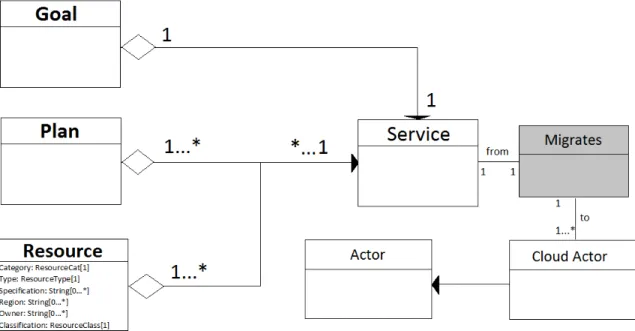
We extend the Secure Tropos meta-model to in-clude additional attributes to model cloud require-ments. Figure 3 shows a portion of the meta-model illustrating our extensions.
Resource The resource object is extended to include fields specifying the category of the resource, type, specifications, region, owner and classification. These notions are based on requirement-level properties de-fined in both CloudML [16], a domain-specific mod-elling language that specifies the provisioning, deploy-ment, and adaptation concerns of cloud systems at design-time [5] and Cloud Computing Ontology (Co-CoOn) [17], an ontology-based system for describing cloud infrastructure. As an example consider the re-gion property from CloudML and CoCoOn, which de-scribes the geographical location of the hardware com-ponent and is used to determine security/privacy juris-diction and legislation. An example of a property from CloudML that is not requirement-level isPrivateIP, as this is implementation-specific. The extended resource will be deployed in the physical layer when modelling cloud services, providing a fine-grained view of the in-frastructure required to enact services defined in the software system layer. This also provides the founda-tion for performing security analysis on cloud-specific threats and vulnerabilities and the modelling of data-flow. Service DefinitionGoal, plan and resource are existing concepts in the Secure Tropos meta-model. We propose the identification of a service based on the Goal-Plan-Resource pattern and extend the meta-model as shown in Figure 3, where we indicate that a service is an aggregation of a single goal, one or many plans and one or many resources.
The migration link is indicated by the shaded box in Figure 3, which links one service to one or many cloud actors.
4.2
Organisational View
An example demonstrating the organisational view is illustrated in Figure 1, which shows the dependency relational link between different actors and the security constraints imposed based on goals. The security con-straints are identified from the perspective of the de-pendent and dependee with regards to the goal. In this example, theLecturer actor depends on theUniversity of Brighton actor to satisfy theAccess student records goal. The Lecturer has a security constraint that they should keep their account access secure while the Uni-versity of Brighton actor has the security constraints of both keeping student records private AND secure.
4.3
Security Requirements View
The security requirements view in Figure 2 shows a wide range of elements that can be modelled in or-der to analyse the security requirements of a software system. The primary goal “Manage Student Records” has three sub-goals, in this example the “Get Student Details” goal is examined in more detail. This sub-goal requires the resource “Student Data” and the plan “Student Fills in Form” in order to satisfy its require-ments. It also has the security constraints of keep-ing personal details private and secure and is impacted by two threats; “Man-in-the-Middle” and “Eavesdrop-ping”. Each of the sub-goals also define a service with its corresponding plan and resource links, as indicated by the bounding box and service labelling.
4.4
Defining and Migrating Services to the Cloud
Our proposed process allows the developer to iden-tify and indicate a set of components that conceptually contribute towards a service. The constructed group is then linked via the migration relationship to a cloud service defined in another view, the cloud service view. In Figure 2, we have indicated that the goal “Get Stu-dent Details”, the plan “StuStu-dent Fills in Form” and the resource “Student Data” contribute towards the definition of a service. Based on the goal description, the functionality of the service is to obtain details from students. The plan indicates that the service will in-clude the capacity to obtain student data from forms that are filled in by the student, possibly through an form defined by the interface. The required input will be student data which the resource describes in full de-tail, including properties such the owner of the data, how the data is stored and the specifications of the data.
Figure 3. Extensions to the meta-model to identify services from goal, plans and resources, define the migration link from service to a cloud actor and add attributes to resource.
In order to model and analyse software systems for cloud environments, we need to create a model for de-scribing cloud services and the components involved in the definition of these services. This would include the software applications deployed to address the problem or tasks that the service is trying to solve or achieve, specifications of the resources required to execute the software and identifying the data that will be processed to determine the flow of data. The resources can then be categorised further into network, compute and stor-age requirements, depending on the capabilities the ser-vice requires.
There are several possible scenarios where migrat-ing to the cloud is applicable. In order to model cloud services, we propose a two-layer model; the software system and the physical layer. The software sys-tem describes the programmatic implementations of the functions offered by the services. The software sys-tem contains applications and services which provide solutions to the client requirements. Descriptions in each of the components within the software layer de-fine a dependency link with required resources, which are provided in the physical layer. Thephysical layer contains resource elements that describe the storage, compute and network components required to satisfy the service requirements(Goal) based on the require-ments of the stakeholder. Each one of the components in the physical layer describes an aspect of the
infras-tructure required to define a cloud computing system. Each cloud service will include deployment models, service models and specifications for resources, based upon the user requirements and restrictions identified in the early stages of the requirements modelling. This process allows us to define the exact requirements when planning for resource provision, utilisation and optimi-sation.
5
Conclusion
We have discussed the current progress and chal-lenges for modelling secure software system in this pa-per, emphasising the need for a modelling language that is able to holistically capture properties that de-fine a cloud computing system based on client require-ments. To address this gap, we define the properties and attributes required to model software services and cloud services. We define a pattern to group inter-dependent properties for the migration towards cloud services in a cloud computing environment, based on the strategic interests of stakeholders. These proper-ties consist of the primary goal which defines what the main functionality of the service should be, plans that tells us what the capabilities of the service should be in order to fulfil the functionalities defined in the goal and the resources that are required by the service in order
to perform its functions. We validate our proposed re-search through extensions to the security requirements modelling language Secure Tropos and provide a case study based on modelling the migration of an univer-sity records management system to a cloud computing environment.
In order to obtain a holistic view of security vulner-abilities and threats, we will build on the cloud service view to examine each component within the cloud ser-vice based on different cloud models. We can further extend the security attacks view to include cloud spe-cific security vulnerabilities, threats and mechanisms to mitigate these attacks. The nature and approach of attacks changes dynamically according to a wide vari-ety of parameters, such as the service model, deploy-ment model and in scenarios involving deploydeploy-ment of services to multiple clouds or service providers.
References
[1] T. H. Depot, “The home depot reports findings in payment data breach investigation,” 2014. [2] A. Pavel, “Amazon.com server said to have been
used in sony attack,” May 2011.
[3] Cloud Security Alliance, “Security research al-liance to promote network security,”Network Se-curity, vol. 1999, no. 2, pp. 3–4, 1999.
[4] A. Bergmayr, H. Bruneli`ere, J. L. C. Izquierdo, J. Gorro˜nogoitia, G. Kousiouris, D. Kyriazis, P. Langer, A. Menychtas, L. Orue-Echevarria, C. Pezuela, and M. Wimmer, “Migrating legacy software to the cloud with ARTIST,” Proc. Eu-ropean Conference on Software Maintenance and Reengineering, CSMR, pp. 465–468, 2013. [5] N. Ferry, A. Rossini, F. Chauvel, B. Morin, and
A. Solberg, “Towards model-driven provisioning, deployment, monitoring, and adaptation of multi-cloud systems,” Proc. IEEE Sixth International Conference on Cloud Computing, pp. 887–894, 2013.
[6] S. Frey and W. Hasselbring, “The cloudmig ap-proach: Model-based migration of software sys-tems to cloud-optimized applications,” Interna-tional Journal on Advances in Software, vol. 4, no. 3 and 4, pp. 342–353, 2011.
[7] M. Armbrust, O. Fox, R. Griffith, A. D. Joseph, Y. Katz, A. Konwinski, G. Lee, D. Patterson, A. Rabkin, I. Stoica, et al., “Above the clouds: A Berkeley view of cloud computing,”University
of California, Berkeley, Tech. Rep. UCB, pp. 07– 013, 2009.
[8] N. R. Jennings, “Agent-oriented software engi-neering,” in Multiple Approaches to Intelligent Systems, pp. 4–10, Springer, 1999.
[9] E. Kamateri, N. Loutas, D. Zeginis, J. Ahtes, F. D’Andria, S. Bocconi, P. Gouvas, G. Ledakis, F. Ravagli, O. Lobunets, and K. a. Tarabanis, “Cloud4SOA: A semantic-interoperability paas so-lution for multi-cloud platform management and portability,” Lecture Notes in Computer Science (including subseries Lecture Notes in Artificial In-telligence and Lecture Notes in Bioinformatics), vol. 8135 LNCS, pp. 64–78, 2013.
[10] R. G. Cascella, C. Morin, P. Harsh, and Y. Je-gou, “Contrail: A reliable and trustworthy cloud platform,” inProc. 1st European Workshop on De-pendable Cloud Computing, p. 6, ACM, 2012. [11] W. Madsen,Trust in Cyberspace, vol. 1999. 1999. [12] P. Devanbu, S. Stubblebine, and S. S. Premkumar T. Devanbu, “Software engineering for security -a ro-adm-ap,”Icse, pp. 227–239, 2000.
[13] H. Mouratidis and P. Giorgini, “Secure Tro-pos: A Security-Oriented Extension of the Tropos methodology,” International Journal of Software Engineering and Knowledge Engineering, vol. 17, pp. 285–309, Apr. 2007.
[14] A. Bandara, H. Shinpei, J. Jurjens, H. Kaiya, A. Kubo, R. Laney, H. Mouratidis, A. Nhlabatsi, B. Nuseibeh, Y. Tahara, T. Tun, H. Washizaki, N. Yoshioka, and Y. Yu, “Security patterns: com-paring modeling approaches,” 2010.
[15] C. M. MacKenzie, K. Laskey, F. McCabe, P. Brown, and R. Metz, “Reference Model for Ser-vice Oriented Architecture,”Oasis, 2006.
[16] E. Brandtzæg, S. Mosser, and P. Mohagheghi, “Towards cloudml, a model-based approach to provision resources in the clouds,” in8th European Conference on Modelling Foundations and Appli-cations (ECMFA), pp. 18–27, 2012.
[17] M. Zhang, R. Ranjan, A. Haller, D. Georgakopou-los, M. Menzel, and S. Nepal, “An ontology-based system for cloud infrastructure services’ discov-ery,” in Collaborative Computing: Networking, Applications and Worksharing (CollaborateCom), 2012 8th International Conference on, pp. 524– 530, IEEE, 2012.