Tree Care Plan
Table of Contents
1. Purpose of the Plan 1
2. Campus Forest Summary 2
a) UIC and campus forest background 2
b) Campus forest metrics 2
c) Campus forest benefits 8
3. Goals and Strategies 12
a) Campus forest metrics 12
b) Campus forest benefits 16
c) Expenditures 18
4. Management Staff 20
a) Management levels 20
b) Campus tree advisory committee 20
c) Enforcement of management plan 21
5. Management Policies 22
a) Maintenance 22
b) Planting 23
c) Removals 25
d) Tree health care 25
e) Protection and preservation 26
f) Tree damage assessment 28
g) Tree risk assessment 29
h) Catastrophic event response plan 29
i) Forest product utilization 30
j) Recommended and prohibited species 30
k) Prohibited practices 31 6. Communication 32 7. Further Work 33 8. Works Cited 35 Appendices A. Definitions B. Recommended species
1. Purpose
The purpose of this plan is to establish a clear set of policies and procedures for management of the campus forest at the University of Illinois at Chicago (UIC). The specific objectives laid out aim to maximize the health and benefits of both individual trees and the forest as a whole. Trees have the potential to provide many benefits to the campus, including improved aesthetics, removal of air pollutants, carbon sequestration, improved wildlife habitat and microclimate modification, among others. However, in order to maximize these benefits trees must be properly managed. This plan aims to lay out the steps necessary to achieve such management.
Specific objectives of the plan include:
1. Develop a policy for tree maintenance, including pruning, planting, removals and preservation. 2. Establish a campus tree advisory committee.
3. Maximize the benefits of carbon sequestration and air pollutant removal provided by campus trees.
4. Increase the use of the campus forest as an educational and outreach tool for the campus and surrounding community.
Tree Campus USA
This plan is being established, in part, to fulfill one of the requirements for UIC to achieve recognition by the Arbor Day Foundation as a Tree Campus USA.
Note: The policies and guidelines set forth in the plan do not necessarily constitute official University policy. However, the Campus Tree Advisory Committee is currently attempting to have the plan adopted
2. Campus Forest Summary
a) Background i. UIC Background
UIC is a public research university located south and west of the Loop in Chicago, Illinois. The university was formed in 1982 by the consolidation of two University of Illinois campuses – The Medical Center Campus and Chicago Circle Campus. Enrollment at the school in the Fall 2013 semester included 16,660 undergraduate students, 8,186 graduate students and 2,743 professional students, for a total of 27,589 students1.
Figure 2.1. Location of UIC within the Chicagoland region.
UIC contains three geographically separate areas which are referred to as the East, West, and South Campus. The entire UIC campus is approximately 240 acres in size2.
ii. Campus Forest Background
The UIC campus forest is defined as all trees that fall within the boundaries of the campus or are close enough to the campus (on boulevards, parkways, etc.) that their benefits directly extend to the campus. This plan covers all trees considered to be part of this forest, including some trees that are not located on campus property. Because benefits of these neighboring trees often extend onto the campus, UIC often takes responsibility for their management. Approximately 16% of trees within the UIC campus forest are not on UIC-‐owned property.
b) Campus Forest Metrics
i. Campus Forest Inventory
A complete inventory of trees on the UIC campus was conducted between May and October of 2011, and reevaluated in 2013 when 5,298 trees were identified and measured. In completing the inventory, measurements were taken that conform to input needs for i-‐Tree Eco (part of i-‐Tree Tools v.4.0), an urban forest management tool developed by the U.S. Forest Service. i-‐Tree Eco estimates the ecosystem services provided by a specified forest3. Measurements taken include the following:
-‐ diameter at breast height (4.5 feet) -‐ total height
-‐ height to live top -‐ crown width,
-‐ percent of canopy missing -‐ percent of canopy dieback -‐ condition
-‐ impervious surface percentage -‐ age class
The following is a summary of the campus tree inventory and the benefits provided by the trees, as calculated through the inventory and by i-‐Tree Eco.
ii. Species diversity
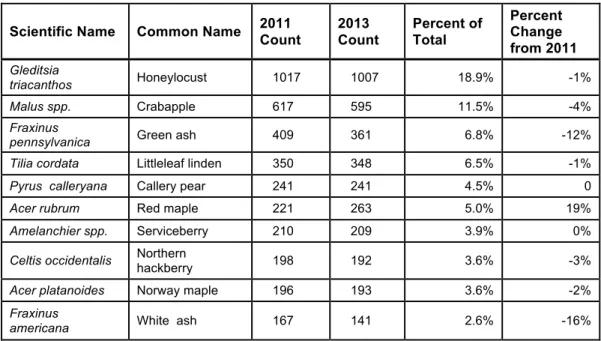
The UIC campus contains at least 101 different tree species. However, as some genera (Malus, for example) have not been identified to the species level this number is likely an underestimate. Table 2.1 shows the ten most common trees on the UIC campus. As can be seen from the table, honeylocust is by far the most common species on campus, comprising nearly 19% of all trees.
Scientific Name Common Name 2011 Count 2013 Count Percent of Total Percent Change from 2011 Gleditsia
triacanthos Honeylocust 1017 1007 18.9% -1%
Malus spp. Crabapple 617 595 11.5% -4%
Fraxinus
pennsylvanica Green ash 409 361 6.8% -12%
Tilia cordata Littleleaf linden 350 348 6.5% -1%
Pyrus calleryana Callery pear 241 241 4.5% 0
Acer rubrum Red maple 221 263 5.0% 19%
Amelanchier spp. Serviceberry 210 209 3.9% 0%
Celtis occidentalis Northern
hackberry 198 192 3.6% -3%
Acer platanoides Norway maple 196 193 3.6% -2%
Fraxinus
americana White ash 167 141 2.6% -16%
Figure 2.2. A grouping of honeylocust (Gleditsia triacanthos) on the East Side of UIC. Honeylocust is the most
common tree at UIC.
iii. Native species
The U.S. EPA lists three characteristics to define a native plant4:
1. They have evolved within a particular region over thousands of years.
2. They have adapted to the geography, hydrology, and climate of their particular region. 3. They have typically evolved within communities, meaning that they have evolved together with other plants. Because of this, they have evolved to adapt not only to each other but to native species of animals as well.
These three characteristics make it so that no single plant is able to dominate a landscape, as all plants have evolved to hold each other in check.
50.6% of trees at UIC are native to the state of Illinois. 53.6% of East Side trees and 48.5% of West Side trees are native. These numbers were determined by i-‐Tree, using their database of
trees known to be native to the state. These numbers give a general indication of the native character of the campus forest, but do not take the specific climate or history of UIC into consideration. Therefore, the numbers can be used as a general reference, but not as a determinant of the actual prevalence of native species on campus.
iv. Age class breakdown
Trees were put into one of three age classes:
Young: Trees recently planted that have not yet become fully established in the landscape. Semi-‐mature: Trees that have become established in the landscape, having not yet reached their full-‐grown size.
Mature: Trees that have reached full-‐grown size.
Young Semi-Mature Mature
Location Count % Count % Count %
West Side 594 28.5 746 35.7 747 35.8
East Side 370 11.2 1615 49.1 1304 39.6
Entire Campus 964 17.9 2361 43.9 2051 38.2
Table 2.2. Age class breakdown of campus trees.
As a whole, over 60% of trees on the campus are young or semi-‐mature, meaning that they can be expected to increase in size in the future. Their associated benefits, such as carbon sequestration and pollutant removal, can also be expected to increase as these benefits typically increase until a tree has reached mature size.
v. Canopy coverage with maps
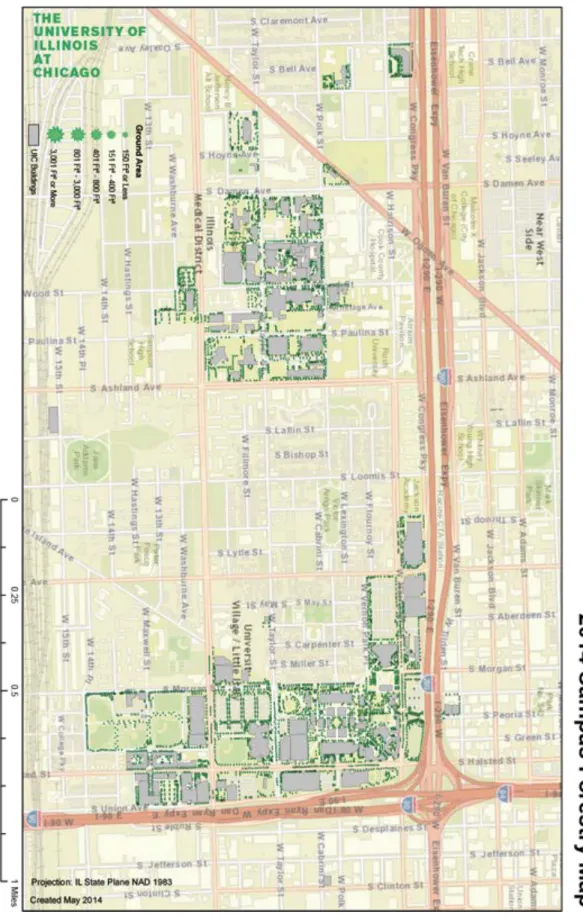
Through the combination of tree measurements and ArcGIS software, canopy coverage on the UIC campus was calculated at 17%. 16% of the East Side and 18% of the West Side are covered by tree canopy. This calculation accounts for all surface area of the campus forest, as diagrammed in Figure 2.3.
Figure 2.3. Tree locations at UIC.
c) Campus Forest Benefits
i. Carbon sequestration and storage.
Carbon is a gas released by both human and non-‐human processes. It is widely agreed that carbon in the atmosphere is a significant contributor to climate change. Carbon sequestration, through either living (such as trees) or non-‐living mechanisms is often seen as one potential remedy to this problem. Trees remove carbon from the air for use in photosynthesis. Much of the carbon that they absorb becomes stored in the woody parts of the tree5.
i-‐Tree calculates that the UIC campus forest collectively stores about 1.7 million pounds of carbon. Over 70,000 pounds of carbon are sequestered by campus trees annually. This is equivalent to the amount of carbon saved by recycling 11.2 tons of waste instead of sending it to a landfill or saving 3,600 gallons of gasoline every year6.
Figure 2.4. These two American
elms (Ulmus americana), near the
intersection of Seeley Ave. and Grenshaw St. on the west side of campus, collectively store about 7,500 pounds of carbon. . Location 2011 Carbon Stored (lbs). 2011 pounds per tree 2013 Carbon Stored (lbs). 2013 pounds per tree Percent Change from 2011 East Side 1,041,513 316.7 1,045,748 323.8 0.4% West Side 645,975 309.5 629,674 304.19 -2.5% Entire Campus 1,687,488 313.9 1,675,421 316.23 -0.7%
Table 2.3 .Breakdown of carbon storage by campus trees Location 2011 Carbon sequestered per year (lbs) 2011 pounds per tree 2013 Carbon sequestered per year (lbs) 2013 pounds per tree Percent Change from 2011 East Side 44,106 13.4 44,079 13.65 -0.1% West Side 26,831 12.9 26,225 12.66 -2.3% Entire Campus 70,937 13.2 70,304 13.26 -0.9%
ii. Pollutant removal
Another benefit calculated by i-‐Tree for the campus forest is the amount of several pollutants removed by each tree. i-‐Tree compares pollution removal capabilities of each tree to levels of air pollution measured at a weather station at Chicago’s O’Hare International Airport. Trees mainly remove air pollutants by uptake via leaf stomata, with additional pollutants being removed by the leaf surface. Once inside the leaf, gases diffuse into intercellular spaces and may be absorbed by water films to form acids or react with inner-‐leaf surfaces7.
Removal was calculated for the following pollutants8:
Carbon monoxide(CO)– Carbon monoxide (CO) is a colorless, odorless gas emitted from combustion processes. CO causes harmful health effects by reducing oxygen delivery to the body's organs (like the heart and brain) and tissues. At extremely high levels, CO can cause death.
Ozone (O3) -‐ Ground-‐level ozone is not emitted directly into the air, but is created by chemical reactions between oxides of nitrogen (NOx) and volatile organic compounds (VOC) in the presence of sunlight. Breathing ozone can trigger a variety of health problems including chest pain, coughing, throat irritation, and congestion.
Nitrogen Dioxide (NO2) -‐ forms from emissions from cars, trucks and buses, power plants, and off-‐road equipment. NO2 contributes to the formation of ground-‐level ozone and fine particle pollution and is linked with a number of adverse effects on the respiratory system.
Particulate Matter (PM-‐10) -‐ a complex mixture of extremely small particles and liquid droplets. PM-‐10 indicates matter with a size of 10 micrometers or less. It is particles of this size that generally pass through the throat and nose and enter the lungs. Once inhaled, these particles can affect the heart and lungs and cause serious health effects.
Sulfur Dioxide (SO2) -‐ Current scientific evidence links short-‐term exposures to SO2, ranging from 5 minutes to 24 hours, with an array of adverse respiratory effects including bronchoconstriction and increased asthma symptoms. The largest sources of SO2 emissions are from fossil fuel combustion at power plants (73%) and other industrial facilities (20%).
Figure 2.5. This Norway maple (Acer platanoides), north of the School of Public Health West,
removes 30.9 ounces of ozone (O3) from the air every year.
Ounces removed in 2013
Location
CO
O3
NO2
PM10
SO2
Total
Percent
Change
from 2011
East Side
852.1
14,953.00 6,454.00
9,943.60
2,611.90 34,814.60 41.4%
West Side 441.2
6,396.40
2,853.40
3,631
1,306.70 14,629.00 0.3%
Entire
Campus
1,293.30 21,349.40 9,307.30
13,574.90 3,918.60 49,443.50 26.1%
Table 2.5. Breakdown of pollutant removal services performed by campus trees.
Value ($) per year of pollutants removed in 2013 dollars
Location CO O3 NO2 PM10 SO2 Total East Side 26.5 2795.10 1226.4 1332.9 137.0 0 5,517.9 West Side 17.4 1,79417 54.53 783.6 664.2 88.6 3,308.3 Entire Campus 43.9 4549.7 2009.9 1997.2 225.6 8,826.3
Table 2.6. Breakdown of monetary value of pollutant removal services performed by campus trees.
iii. Compensatory value breakdown
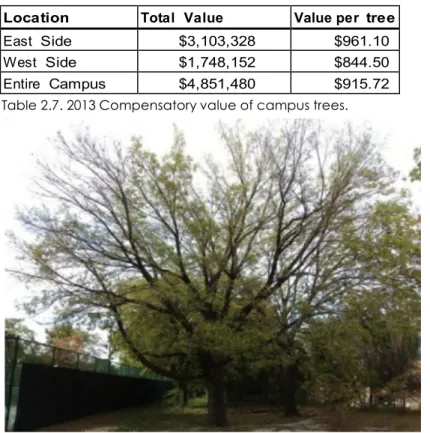
The compensatory value of every tree on campus was determined through i-‐Tree. The value of each tree determined by i-‐Tree is an estimate of the cost it would take to replace all of the benefits of a tree. These benefits include not only pollutant removal and carbon sequestration and storage, but aesthetics as well.
Location Total Value Value per tree
East Side $3,103,328 $961.10
West Side $1,748,152 $844.50
Entire Campus $4,851,480 $915.72
Table 2.7. 2013 Compensatory value of campus trees.
Figure 2.6. At $8,364, this
northern hackberry (Celtis
occidentalis) has the third highest compensatory value of any campus tree, according to i- Tree. It is located near the northeast corner of the Student Recreation Facility.
3. Goals and Strategies
The goals of those managing the UIC campus forest must align with the goals of the campus community as a whole. The goals should also align with, and help work towards, goals and strategies in other related management plans such as the UIC Climate Action Plan9 and UIC Strategic Plan10. The UIC Climate Action Plan, completed in 2010, lists strategies such as capturing stormwater onsite, reducing irrigation and the use of native species. The 2010 UIC Campus Master Plan lists goals of a reduced urban heat island effect and increased landscape standards including the increased use of native species and updating of the campus tree database. This plan also aligns with several goals in the 2008 Chicago Climate Action Plan11, such as decreasing water use and adapting landscapes to respond to climate change. All of these strategies are addressed in the sections below.
a. Campus Forest Metrics
i. Biodiversity
Goal: Increase campus tree biodiversity
Barker12 recommends planting no more than 5% of an urban forest with trees of the same species and 10% of the same genus. UIC should strive to meet these levels. Doing so is beneficial for several reasons. One benefit is that having a balanced makeup helps lessen susceptibility to insects and diseases that predominantly affect one species or genus. This can help prevent associated catastrophic loss.
There are three species of tree that exceed the 5% level, as shown in Table 3.1. One species, honeylocust, accounts for almost one in every five trees on the campus. Planting of these trees should be avoided unless their prevalence decreases to an acceptable level in the future. Species of crabapple (Malus spp.) may also exceed these levels, but this genus was not identified to the species level.
Latin Name Common Name Count Percent of Total
Gleditsia triacanthos Honeylocus t 1007 19.1 Fraxinus pennsylvanica Green as h 361 6.8 Tilia cordata Littleleaf linden 348 6.5
Table 3.1. Species present at higher than recommended levels on the UIC campus.
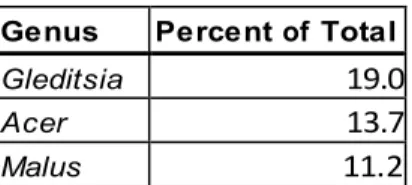
There are 3 genera that exceed the recommended limits. Again, Gleditsia is by far the most common tree on campus.
Genus Percent of Total
Gleditsia 19.0
Acer 13.7
Malus 11.2
Table 3.2. Genera present at higher than recommended levels on the UIC campus.
The genus Fraxinus is no longer on the list as it has decreased from 10.7% in 2011
to 9.5% in 2013.
However, trees should not be selected for planting simply because they fall below the acceptable limits. Richards13 discourages the use of numerical limits on one species or genus if it leads to planting trees that are untested or unsuited for a location. Trees must therefore be selected based on their suitability for the unique characteristics of the site where they are to be planted.
UIC should not become too focused on meeting the species or genus limits in the near future, as the predominance of a few species will make doing so difficult. It is difficult to know when the campus might fall below acceptable limits. Instead of setting a timeframe for meeting the recommendations, the current numbers can be used as a guide on what not to continue planting and to get an idea of how big an effect a species-‐ or genus-‐specific disease or insect might have if introduced to campus.
Emerald Ash Borer
There is an increasing threat to ash trees in North America, and especially the Chicago area, from the emerald ash borer (Agrilus planipennus). The borer affects trees of the genus
Fraxinus and has killed a significant number of these trees in affected areas. In some areas of infestation, Fraxinus loss has been 100%14. This is especially concerning to UIC because 9.5 percent of trees in the campus forest are of the genus Fraxinus. Because of the large number of susceptible trees on the campus, the campus must be prepared for significant tree loss in the near future. We already experienced a 1% loss in the emerald ash in two years. If UIC experienced more loss from the borer, it would see a significant reduction in both the number of trees on campus and the size of the tree canopy within a short period of time.
UIC currently removes any ash showing signs of emerald ash borer infestation. Neighboring ash trees are also often removed. Other treatment options, such as insecticides are likely too expensive for consideration at this time. The impact that the borer will likely have on the campus forest serves as evidence of the need for greater campus tree diversity to prevent such a large impact by an insect that affects only one genus of tree.
Figure 3.1. An adult emerald ash borer (Agrilus planipennis) Source: www.emeraldashborer.info
ii. Native Species
Goal: Increase the prevalence of native tree species to 65% by 2030.
50.6% of the trees in the UIC forest are native to the state of Illinois, according to i-‐Tree results. UIC should strive to increase this to 65% by the year 2030. Doing so will afford UIC the benefits of an increased native population, such as resistance to native pests and reduced maintenance. It may be difficult to increase numbers much above this point because of the amount of trees already on campus. An increase in native species prevalence will be accomplished by replacing dead, dying or diseased exotic species with native ones.
One debate about planting native species is whether future changes to an area’s climate should be taken into account in defining what plants are considered native. It is generally predicted that northeastern Illinois will see a rise in average temperatures in the future. It is also predicted that the area will see more extreme temperature events (both hot and cold) and will experience more extreme precipitation events15. These events are expected to happen over a time span not long enough to allow native species to adapt. Therefore, the question arises as to whether or not species more adapted to the expected future climate of the area should be favored over native species that are more adapted to current conditions.
UIC should generally plant trees that will be adapted to the predicted future climate, but with a bias towards trees that are native to the area. Therefore, it can be considered satisfactory to plant a species of tree not traditionally considered to be native, as long as the benefits of doing so will outweigh any potential detriment. This viewpoint is reflected in the recommended species list for the campus in Appendix B. The City of Chicago also maintains a list of recommended trees for planting that considers the projected future climate of the area.
The list is available at:
Figure 3.2. These Ginkgo (Ginkgo biloba) trees, while not considered native, are an example of a species that is well adapted to the urban environment and expected future climate of the Chicago region.
iii. Age Diversity
Goal: Attain at least a 20% prevalence for each age class by 2030
An even-‐aged population of trees is easier to manage than one with a diversity of age classes, as management decisions are likely similar for trees of the same age class. However, a more diverse population may be more stable as it will reduce the chance of tree loss should a catastrophic event affect one age class16. As with species diversity, it may make sense to concentrate trees of similar age in close proximity to each other to make management more efficient as long as this does not work against the overall goal of age diversity. This is satisfactory, so long as the campus forest as a whole strives to attain age diversity.
As can be seen in Table 2.2, the West Side of UIC has greater age diversity than does the East Side. Only 11.2% of trees on the East Side are in the “young” age class, compared with 28.5% on the West Side. This means that, if no further planting were to take place that it may be easier for existing trees to replace those that are lost on the West Side. Therefore, it makes sense to concentrate planting activities on the East side to make up for the discrepancy.
iv. Tree Canopy Percentage
Goal: Increase campus tree canopy coverage to 25% by 2030
17% of the UIC campus is currently covered by tree canopy. This includes all areas of the campus, including buildings, open space, parking lots, sidewalks, etc. This also takes into
remain unforested for a variety of reasons, the canopy coverage for the campus could still be increased. An analysis using ArcGIS and aerial imagery determined that the optimal canopy coverage that UIC should strive for is approximately 25%. Such a stocking level would allow for increased forestry benefits, while still allowing ample space for other needs.
b. Campus Forest Benefits
i. Carbon Sequestration and Pollutant Removal
Goal: Increase carbon sequestration and pollutant removal services by 15% by 2030
UIC should strive to improve the amount of environmental benefits provided by its forest by planting trees that do the most efficient job of removing air pollutants and sequestering carbon.
There is evidence to show that deciduous, hardwood trees do a more efficient job of sequestering carbon and removing pollutants than do softwood trees, or conifers. Species with high leaf circumference to area and surface volume are also more efficient17. Another factor to consider is the longevity and mature size of the tree to be planted. Trees that grow larger and live longer are able to sequester more carbon over their lifetime. An important thing to remember is that the carbon that a tree stores during its lifetime is released back into the atmosphere once the tree dies and decomposes. To increase carbon sequestration and pollutant removal, UIC should strive to plant trees that have greater capabilities in providing these services.
A stand of trees provides maximum pollutant removal and carbon sequestration when it consists of trees of varying canopy height and width17. This is a result of maximum wind exposure to the canopy. Where possible, UIC should attempt to establish stands with this characteristic.
ii. Tree Survival
Goal: Increase existing tree management expenditures by 10% by 2015
It is much more economical to manage for survival of existing trees than it is to spend money on planting new, replacement trees. As mentioned above, larger and more mature trees also have increased benefits over younger trees. Because of this, UIC should strive to increase its expenditures on maintaining existing trees over the planting of new ones. Doing so will help to ensure the health of these trees going forward. Accomplishing this will mean either diverting funds from tree planting or other services not associated with existing tree management or increasing available funds.
iii. Education
The UIC campus forest presents an excellent opportunity to educate students, visitors and the community about the benefits of trees in urban areas. UIC should strive to use the campus forest as an educational tool in the following ways:
Service learning projects
Goal: Perform at least 3 tree-‐related service projects every year starting in 2012
Service learning projects present an excellent opportunity for students and community members to get hands-‐on experience in improving the campus forest. Examples of projects might include tree planting, pruning, other general maintenance and updating the campus tree inventory.
In September of 2011, an interactive tree walk was organized to educate the campus community about the benefits of individual trees. Signs were placed on specific trees to indicate pollutant removal, carbon sequestration and overall value for each tree. The signs also contained a QR code, linking passersby to a website with more information about UIC’s campus forest and Tree Campus USA recognition efforts.
In 2013, A dozen UIC staff and students helped plant 2 crabapple trees on Morgan Street and also tagged trees noting their environmental and financial benefits to humans.
I
In 2014, interns inventoried nearly 300 trees and has been dedicated to keeping an up-‐to-‐date inventory of the 5,000 trees on and around campus. The College of Dentistry also participated in the tagging noting benefits of the trees surrounding the College of Dentistry.
See all service learning projects and photographs at https://sustainability.uic.edu/treecampus
Figure 3.4 Educational signage to indicate the benefits of trees at the
College of Dentistry
Figure 3.3 Educational signage was placed on 30 trees in 2011 to raise awareness of the benefit of
Arbor Day Observance
Goal: Hold a well-‐publicized Arbor Day observance on campus every year
In Illinois, Arbor Day takes place on the last Friday in April. UIC has held Arbor Day observances in the past, and should continue to do so in the future. Such an observance might include highlighting the benefits and importance of campus trees through a presentation or planting of a tree on Arbor Day to mark the occasion. See the annual events at https://sustainability.uic.edu/treecampus
Tree Campus USA
Goal: Maintain Tree Campus USA certification on an annual basis
In 2011, UIC began work towards achieving recognition as a Tree Campus USA by the Arbor Day Foundation for the first time. The benefits of recognition include national recognition, a healthier campus community, student engagement and campus pride. Recognition involves meeting five standards18:
1. Campus Tree Advisory Committee 2. Campus Tree Care Plan
3. Campus Tree Program with Dedicated Annual Expenditures 4. Arbor Day Observance
5. Service Learning Project
UIC expects to meet all five standards to achieve certification for 2011. However, the campus must be recertified every year, so it is important that the standards are completed or continued in subsequent years. The last two standards will have to be re-‐planned in the future. A celebration and observance should be held once the campus receives notification of certification. c. Expenditures
Goal: Increase all tree care-‐related expenditures by 10% by 2015
The University allocates funding on an annual basis for tree care activities. A graduate assistant was hired for May to December to administer the Tree Campus USA program. Considering a student population of 27,309 in 2011, this budget works out to about $2.56 per student. The Arbor Day Foundation recommends a budget of $3 per student for schools participating in the Tree Campus USA Program. UIC should strive to achieve this level. A graduate assistant was not hired in 2012 or 2013, so therefore the funds dedicated to this position in 2011 were re-‐allocated to other tree care-‐related activities.
2011 Budget ($) 2013 Budget ($) Graduate assistantship 19,202 0 Planting 14,538 93,624 Maintenance 34,000 40,311 Removal 16,000 56,817 Volunteer 1,980 11,322 Total 85,720 202,074
Table 3.3 Summary of tree-‐related expenditures in 2011 and 2013
The ultimate limiting factor in managing the campus forest is the availability of funds to do so. It may be difficult to increase funding from the University for tree-‐related management. However, the University can look to improve resources by gaining funding from outside sources.
Grants
Several foundations and agencies offer grants that could be used to aid in the management of the campus forest. UIC should explore the possibility of receiving funds from these sources. Possible funding sources include:
A. The TREE Fund (www.treefund.org)
The TREE Fund offers funding for scientific research into critical urban tree care issues, arboriculture education programs in schools and leadership and resources for workforce development programs.
B. Tree Campus USA planting events
The Arbor Day Foundation awards select Tree Campus USA campuses for planting events every year. Through tree planting events, the Arbor Day Foundation provides up to 100 free trees to selected schools, along with professional assistance and guidance for planting of the new trees.
4. Management Staff
Several different individuals and campus departments provide input on the management of the campus forest. Facilities Management is ultimately responsible for tree care management decisions.
a. Management Levels
The departments and individuals who are directly or indirectly involved with the management of the campus forest include:
i. Facilities Management
Facilities Management is ultimately responsible for the care of trees on the campus. They are responsible for planting, pruning, removals and other miscellaneous work. A member of the department shall also sit on the Campus Tree Advisory Committee.
ii. Faculty
Faculty shall be involved in the Campus Tree Advisory Committee and shall otherwise be consulted for advice on tree care-‐related activities when their subject matter expertise is needed (e.g. soil science, urban ecology, etc).
iii. Students
Besides serving on the Campus Tree Advisory Committee, students should be involved in the management of the campus forest through participation in volunteer activities and in putting forth ideas for how campus trees should be managed. The campus should strive to get students involved in tree management
iv. City of Chicago
About 16% of trees within the UIC campus forest are located on property of the city of Chicago, not the University. Therefore, management of these trees is ultimately the responsibility of the city. However, as these trees have a direct benefit for the campus, UIC often takes the initiative in their care. As these trees are the property of the City, any work to be performed on them must be coordinated with the Chicago Bureau of Forestry. A representative from the Bureau will also serve on the Campus Tree Advisory Committee.
b. Campus Tree Advisory Committee
This plan authorizes the establishment of a Campus Tree Advisory Committee, which fulfills Standard 1 of Tree Campus USA requirements. The Committee shall provide guidance for tree care management decisions and outreach into the community. While ultimate management decision-‐ making will not fall to the Committee, input from members shall be used in making tree care related decisions.
The committee shall consist of at least one member from each of the following groups: 1. Students 2. Faculty 3. Facility Management 4. Community
The Committee was formally established in October of 2011. Initial members include: Pablo Acevedo, Associate Director of Grounds at UIC
Janet Backs, PhD student in Ecology and Evolution
Darlene Ebel, Director, Facility Information Management at UIC Cynthia Klein-‐Banai, Associate Chancellor for Sustainability at UIC Andrew Lueck, Masters in Urban Planning and Policy student Douglas Lynch, PhD student in Ecology and Evolution
Roberta Mason-‐Gamer, Associate Professor and Director of Graduate Studies, Department of Biological Sciences
Joseph McCarthy, Senior City Forester at the City of Chicago Jason Palagi, PhD student in Ecology and Evolution
Colin Smalley, graduate student in Earth and Environmental Sciences at UIC
Each committee member shall serve a term of one year. Committee membership will be approved by the UIC Office of Sustainability. The Committee will be limited to 10 members. The Committee will meet at least once every 3 months, or on an as-‐needed basis.
All Tree Care Committee minutes and members are listed online at https://sustainability.uic.edu/treecampus/tree-‐advisory-‐committee/
c. Tree Care Plan Enforcement
The Facilities Maintenance Department shall have ultimate enforcement responsibility for the tree care plan and its policies, as this department is ultimately responsible for tree care management decisions. Therefore, it is the responsibility of this department to ensure that the standards and policies contained within the plan are being followed. Assistance in enforcement may be provided by members of the Campus Tree Advisory Committee.
5. Management Policies
Tree management at UIC should strive to further the goals set forth in Section 3. There is a limited amount of funds available for tree management. The following management policies strive to maximize the benefit derived from these funds and foster a healthy, safe campus forest.
a. Tree Maintenance
All tree maintenance shall conform to ANSI A300 standards in order to promote the health and structural integrity of trees. The safety of the campus community should be the top priority in managing campus trees. Therefore, maintenance tasks should first be performed to ensure that no trees present a hazard. Maintenance for tree health and aesthetic purposes may proceed after this has been accomplished.
i. Pruning
All pruning shall conform to ANSI A300 standards. As is allowed by budgetary constraints, tree pruning should preventive rather than reactionary so as to minimize structural and safety issues early on. Proper pruning can lead to reduction in storm damage and safety issues in the future19. To accomplish this, a tree pruning schedule should be developed that allows for trees to be pruned on a regular cycle. Pruning priority should be given to trees based on age class. Priority should be given in the following order:
1. Young trees. The first priority in pruning should be given to young trees. Pruning young trees frequently will help prevent structural problems in the future. The goals of young tree pruning include promoting a strong central leader and proper branch spacing.
2. Semi-‐mature trees. Semi-‐mature trees should be pruned to promote proper structure and to alleviate safety and aesthetic concerns. Trees may need to be raised or reduced to provide proper clearance to infrastructure or neighboring plants.
3. Mature trees. Mature trees should be pruned to remove large dead limbs and alleviate other safety issues. Structural pruning may be needed to correct problems that have developed over the tree’s lifetime, or to provide proper clearance to infrastructure or neighboring plants.
4. Overmature Trees. Pruning of overmature trees should only take place to mitigate a hazardous situation. This might involve the removal of large dead or cracked limbs, limbs overhanging a parking lot, etc.
Proper pruning procedure
All pruning cuts should be made to ensure the health and safety of the target tree. Cuts should be made so that only branch tissue is cut, with no damage to stem tissue. If a portion of a branch is removed, the branch should be cut back to a point where the remainder of the branch can assume dominance. Branches should be removed before
they reach half the diameter of the branch in which they are attached. No more that 25% of live branches should be removed from a healthy tree in one growing season. A live crown ratio of at least 66% should be maintained for all trees.
Fig. 5.1. Placement of Proper Pruning Cut. (U.S. Forest Service)20
ii. Cabling and Bracing.
The purpose of cabling and bracing is to improve or maintain the structural integrity of an individual tree. These actions are generally performed on trees that have poor or unsafe branching to prevent failure in the future. When feasible and cost effective, cabling and bracing can prevent the removal of trees or large branches. Cabling and bracing can often prevent tree failure at a cost that is comparable to tree pruning and removal.
Fig 5.2. Proper cabling configurations. Source: http://www.rainbowtreecare.com/tree-‐knowledge/health-‐maintenance/tree-‐cabling/
iii. Lightning Protection
Lightning protection systems are often installed to protect high value trees or large trees next to residences or other occupied buildings. Trees of high value are targets for installation because of their monetary or ecological benefits. Trees next to occupied buildings are often targeted for installation because protection systems can have the residual effect of serving as a lightning protection system for the building. Because of the cost to install such systems, a cost-‐benefit analysis should be performed before a system is installed.
b. Tree Planting
and expenses should generally favor caring for existing trees over planting new ones, tree planting can still be justified in several cases. Tree planting can often be used as a tool to draw attention to the campus forest and its benefits. Planting can also be used as a tool for educating the campus on proper tree care through service projects. Planting is justified when such benefits, coupled with the benefits of the planted trees over their expected lifespan outweigh the cost of planting.
i. Location
Trees should be planted in a location where they will have the best opportunity to survive, while providing their maximum potential benefits as part of the campus forest. They should not be planted in a location where an overhead obstruction, such as power lines, is lower than the expected mature height of the tree. They should also not be planted in a location where there are obstructions located within the expected mature canopy spread of the tree. Vertical and horizontal obstructions could be either infrastructure or other plants. Selecting a tree with the proper form and size for its location will help alleviate the need for future pruning, reducing maintenance costs. Tree should be planted in a location where roots will have enough space to grow and function properly. Potential benefits of trees should also be considered in selecting a location for planting. For example, planting a tree in a location where it will intercept a large amount of rainwater will help increase the benefits the tree provides over its lifetime.
ii. Sources
The University should strive to purchase trees from sources that use locally grown trees. This has the double benefit of receiving trees adapted to the local environment and reduction of tree transportation costs.
iii. Species
Tree species should be selected that will help in attaining species diversity goals set forth in Section 3a. Species should also be selected based on the specific location targeted for planting. Attention should be paid to soil type, drainage, available irrigation, potential for vandalism, available sunlight and aesthetic appeal at each location. A list of recommended species is provided in Appendix B.
iv. Planting Technique
Proper technique should be followed to allow trees the best chance at long-‐term survival. The following practices should be followed when planting any tree:
-‐ Plant the tree at the proper depth, so that the root collar is exposed
-‐ Place mulch above the root ball to a depth of 2 inches to moderate soil temperature and help retain soil moisture and nutrients
-‐ Remove at least the top 50% of any wire basket and burlap on ball and burlap trees to remove impediments to root growth
-‐ Ensure that soil in planting hole is of similar texture to that in the root ball, so that movement of water into or out of the root ball will not be impeded.
-‐ Staking of trees is only necessary if the newly planted tree will not stand on its own or under moderate wind. If stakes are installed, they should be removed after one year. They should contact the tree in such a way that will not harm the bark.
-‐ Trees should be properly watered at planting. If proper irrigation is not available at the planting site, watering bags should be installed to ensure proper soil moisture. Newly planted trees should be checked 1-‐2 times per week to ensure that the moisture level around the root ball is adequate.
-‐ A radius of 24” from the stem should be kept free of turf or other plants.
Fig. 5.3. Proper Tree Planting
Source:http://hort.ufl.edu/woody/documents/EP314.pdf
c. Tree Removal
Trees shall only be removed when they are hazardous, dead, diseased or unlikely to survive planned construction activities. Trees deemed to be hazardous should be removed immediately by either Facilities Management or a qualified contractor. Other trees considered for removal should be evaluated fully to determine if corrective action is likely to allow them to be viable in the future. The costs associated with keeping or removing a tree should be weighed against the benefits of doing so. Aside from safety, benefits such as aesthetics, carbon sequestration and pollutant removal should also be considered in determining whether or not a tree needs to be removed.
d. Health Care
Tree health care should be performed to ensure the health of individual trees and the collective campus forest. When a health care concern is noticed, an appropriate response shall be determined by Facilities Management. Responses might include treatment, removal or no action. The visibility and value of the affected tree and potential effects on neighboring trees should be considered alongside the cost and likelihood of success of prescribed treatment in determining action. In the case of pests being found on campus trees that have potentially devastating effects on trees outside of the campus, the appropriate authority (e.g. Chicago District Forester, State Urban Forestry Coordinator, etc.) shall be notified to determine the appropriate course of action.
Tree health care practices include the following:
no action, tree pruning, etc. Monitoring of individual trees and stands for signs of a pest outbreak is important. This, combined with an understanding of pest life cycles can be used to prescribe appropriate treatment actions. In the case where treatments are made to suppress an insect or disease infestation, biological controls should be favored over pesticides.
Figure 5.4. Insects like the praying mantis can be used to control pests without the need for pesticides.
Source:http://www.bartlett.com/resources/Monitor-‐Rx.pdf
ii. Fertilization/Soil Amendments
In the case where tree health is impacted by the quality and content of its soil, amendments to the soil may be made to improve the condition of the tree. Amendments may include fertilization, pH modification, drainage improvement, etc. Soil sampling should be performed before any amendments are made to determine the soil characteristics of the site and amendments needed.
iii. Watering
Trees should be watered to ensure their health and vigor. Any trees showing signs of water stress (leaf browning, wilting, etc.) should be watered as resources allow. If the prevalence of drought increases as a result of climate change, UIC must be prepared to respond accordingly. Newly planted trees should be watered according to guidelines for tree planting, above.
e. Protection and Preservation
All trees should be evaluated for their potential to be preserved when located in an area planned for construction. Trees should only be removed for construction when the cost to preserve them is too significant to justify the loss of potential future benefits. Therefore, benefits such as aesthetics, energy savings, carbon sequestration and pollutant removal, among others should be closely weighed against the cost of preservation. Tree removal decisions shall be made by Facilities Management, with assistance from the Campus Tree Advisory Committee.