Real Time Hand Pose Estimation for Human
Computer Interaction
Philip Krejov
Submitted for the Degree of Doctor of Philosophy
from the University of Surrey
Centre for Vision, Speech and Signal Processing Faculty of Engineering and Physical Sciences
University of Surrey
Guildford, Surrey GU2 7XH, U.K.
September 2015
c
Abstract
The aim of this thesis is to address the challenge of real-time pose estimation of the hand. Specifically this thesis aims to determine the joint positions of a non-augmented hand. This thesis focuses on the use of depth, performing localisation of the parts of the hand for efficient fitting of a kinematic model and consists of four main contributions. The first contribution presents an approach to Multi-touch(less) tracking, where the objective is to track the fingertips with a high degree of accuracy without sensor contact. Using a graph based approach, the surface of the hand is modelled and extrema of the hand are located. From this, gestures are identified and used for interaction. We briefly discuss one use case for this technology in the context of the Making Sense demonstrator inspired by the film ”The Minority Report”. This demonstration system allows an operator to quickly summarise and explore complex multi-modal multimedia data. The tracking approach allows for collaborative interactions due to its highly efficient tracking, resolving 4 hands simultaneously in real-time.
The second contribution applies a Randomised Decision Forest (RDF) to the problem of pose estimation and presents a technique to identify regions of the hand, using features that sample depth. The RDF is an ensemble based classifier that is capable of generalising to unseen data and is capable of modelling expansive datasets, learning from over 70,000 pose examples. The approach is also demonstrated in the challenging application of American Sign Language (ASL) fingerspelling recognition.
The third contribution combines a machine learning approach with a model based method to overcome the limitations of either technique in isolation. A RDF provides initial segmentation allowing surface constraints to be derived for a 3D model, which is subsequently fitted to the segmentation. This stage of global optimisation incorporates temporal information and enforces kinematic constraints. Using Rigid Body Dynam-ics for optimisation, invalid poses due to self-intersection and segmentation noise are resolved.
Accuracy of the approach is limited by the natural variance between users and the use of a generic hand model. The final contribution therefore proposes an approach to refine pose via cascaded linear regression which samples the residual error between the depth and the model. This combination of techniques is demonstrated to provide state of the art accuracy in real time, without the use of a GPU and without the requirement for model initialisation.
Key words: Hand Pose Estimation, Discriminative, Generative, Depth, Combined Decent, Random Decision Forest, 3D Tracking, Hand Segmentation, Pairwise Feature, Occlusion, Multi-touch, Hand Tracking, Sign Language, Model Fitting, 3D, Temporal, Articulated Pose, Kinematics
Acknowledgements
I would first like to express my sincerest gratitude to Prof. Richard Bowden for his belief in me and this work. I have been very lucky to have a supervisor with so much motivation, enthusiasm and knowledge. His patience and support are the only reason this thesis was possible.
I must acknowledge the members of CVSSP and the Cognitive Vision Lab at the uni-versity of Surrey, your help and assistance knows no bounds. In particular Dr. Andrew Gilbert and Dr. Simon Hadfield who shared their time and insightful knowledge. I thank my Mother, Father and Uncle for giving me the best opportunities in life and encouraging me in every endeavour. I cannot thank you enough for the direction and encouragement you have given me especially since coming to university. I also thank my far flung family members for their kind support.
To my partner, Tanya, I am indebted to her. She gave me the strength to carry on through late nights and many drafts. She has helped me in many ways to finish this thesis, with both quiet patience and unwavering love.
Contents
Nomenclature xi Declaration xix 1 Introduction 1 1.1 Motivation . . . 1 1.2 Depth Acquisition . . . 4 1.3 Contributions . . . 5 2 Literature Review 7 2.1 Augmentation . . . 7 2.1.1 Active Capture . . . 8 2.1.2 Passive Capture . . . 9 2.2 Structural Analysis . . . 10 2.2.1 Part Detection . . . 112.2.2 Contour and Surface . . . 12
2.3 Discriminative Modelling . . . 13
2.3.1 Pose Classification . . . 14
2.3.2 Region Classification . . . 15
2.3.3 Joint Regression . . . 17
2.4 Generative Model Optimisation . . . 18
2.4.1 Particle Optimisation . . . 18
2.4.2 Iterative Closest Point . . . 21
2.5 Hybrid Methods . . . 22
2.6 Conclusion . . . 23 vii
3 Multi-touchless Finger Tracking 25
3.1 Method Overview . . . 26
3.2 Hand and Forearm Segmentation . . . 28
3.2.1 Hand Centre localisation . . . 30
3.3 Candidate Finger Detection . . . 31
3.4 Non-Fingertip Rejection . . . 34
3.4.1 Finger Assignment and Tracking . . . 38
3.5 Experiments . . . 40 3.5.1 Wrist Exclusion . . . 41 3.5.2 Fist Exclusion . . . 41 3.5.3 Evaluation . . . 41 3.5.4 Limitations . . . 44 3.6 Application of Multi-touchless . . . 45 3.6.1 Recognising Gestures . . . 48 3.7 Conclusions . . . 50
4 Hand Pose Estimation using Randomised Decision Forests 53 4.1 Randomised Decision Forests . . . 54
4.1.1 Splitting Criteria . . . 56
4.1.2 Training Trees . . . 58
4.1.3 Tree Classification . . . 61
4.1.4 Glove Based Labelling . . . 61
4.2 ICVL Evaluation . . . 65 4.2.1 Dataset . . . 65 4.2.2 Parameter Selection . . . 66 4.2.3 Results . . . 69 4.3 NYU Evaluation . . . 70 4.3.1 Dataset . . . 73 4.3.2 Results . . . 73 4.4 Application to ASL . . . 74 4.4.1 ASL Forest . . . 74 4.4.2 Dataset . . . 74 4.4.3 Results . . . 75 4.5 Conclusions . . . 79
Contents ix
5 Combined Decent Optimisation 81
5.1 Introduction . . . 81
5.2 Method Overview . . . 82
5.3 Hand Pose Estimation Approach . . . 84
5.3.1 Segmentation and Filtering . . . 84
5.3.2 Kinematic Hand Model . . . 85
5.3.3 Rigid Body Simulation . . . 87
5.3.4 Point to Surface Constraints . . . 88
5.3.5 Randomised Decision Forest (RDF) Assignment . . . 89
5.4 Residual Error Regression . . . 91
5.5 Parameter Selection . . . 94
5.5.1 Maximal Feature Radius . . . 94
5.5.2 Number of Features . . . 95 5.6 Experiments . . . 96 5.6.1 NYU dataset . . . 96 5.6.2 ICVL dataset . . . 97 5.7 Conclusions . . . 99 6 Discussion 109 Bibliography 113
Nomenclature
ASL American Sign Language
ABS Articulated Body Simulation
AR Augmented Reality
CRF Conditional Regression Forest
CDO Constraint Driven Optimisation
CNN Convolutional Neural Network
DoF Degree of Freedom
DSP Dijkstra’s shortest path
GMM Gaussian Mixture Model
GJK Gilbert-Johnson-Keerthi distance algorithm
HMM Hidden Markov Model
HCI Human Computer Interaction
IR Infrared
ICP Iterative Closest Point
KF Kalman Filter
LED Light Emitting Diode
PSO Particle Swarm Optimisation
PCA Principal Component Analysis
PDF Probability Density Function
RDF Randomised Decision Forest
RER Residual Error Regressor
RBS Rigid Body Simulation
SLR Sign Language Recognition
SVM Support Vector Machine
List of Figures
1.1 Examples of hand and bodies captured using depth . . . 3
3.1 Multi-touchless method overview . . . 27
3.2 Examples of wrist segmentation . . . 29
3.3 The hands chamfer distance . . . 30
3.4 Surface graph construction . . . 32
3.5 Examples of geodesic extrema . . . 33
3.6 Ellipse formed using the hands covariance . . . 36
3.7 Examples of the penalty used to filter extrema . . . 37
3.8 The result of tracking fingertips . . . 39
3.9 Parametric optimisation ofθ . . . 42
3.10 Parametric optimisation ofβ . . . 43
3.11 Example poses from the Multi-touchless dataset . . . 45
3.12 Finger detection rate . . . 46
3.13 The Multi-touchless interface . . . 47
3.14 Overview of the Making Sense system . . . 47
3.15 Examples of gestures . . . 48
4.1 Tree training overview . . . 55
4.2 Pairwise depth features . . . 56
4.3 Colour calibration chart and clustering . . . 62
4.4 Depth with and without the glove . . . 63
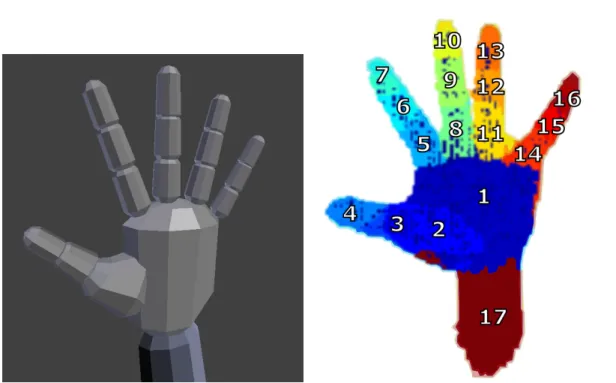
4.5 Model and labelling used in ground truth . . . 66
4.6 Classification performance against number of trees . . . 67
4.7 Forest performance against number of features . . . 68 xiii
4.8 Forest performance against tree depth . . . 68
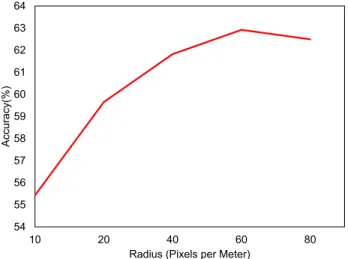
4.9 Forest accuracy against feature radius . . . 69
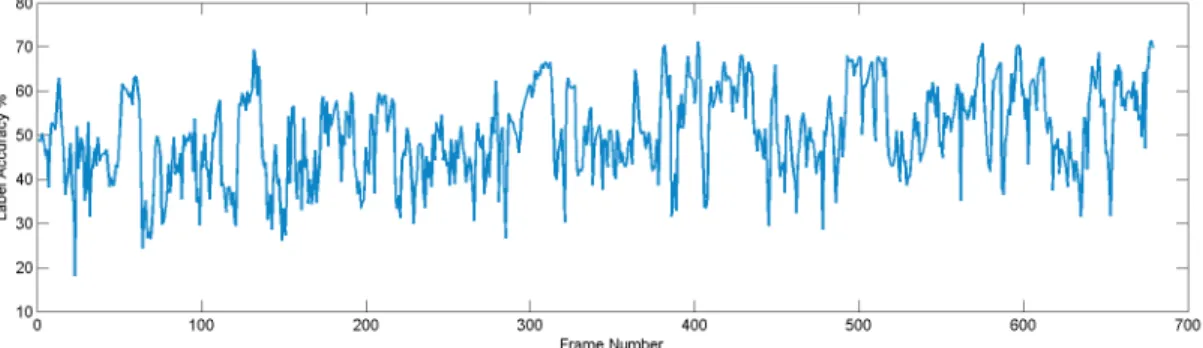
4.10 Classification accuracy over ICVL, Seq1 . . . 70
4.11 Classification accuracy over ICVL, Seq2 . . . 71
4.12 Examples of forest classification and boundary error . . . 71
4.13 Classification confusion matrix of the hand . . . 72
4.14 Classification confusion matrix of the fingers . . . 72
4.15 Classification accuracy over NYU . . . 74
4.16 Examples from the ASL dataset . . . 75
4.17 Result of GMM glove classification . . . 76
4.18 Pixel-wise accuracy from ASL test sequence . . . 77
4.19 Histogram of classification accuracy . . . 77
4.20 ASL fingerspelling handshapes . . . 78
4.21 Classification confusion matrix for ASL fingerspelling . . . 79
5.1 Overview of the combined estimation approach . . . 83
5.2 Demonstration of voxel filtering . . . 85
5.3 Hand model used in generative estimation . . . 87
5.4 Demonstration of point to surface constraints . . . 88
5.5 Comparison of labelling methods for the ground truth . . . 90
5.6 Example of constraint driven optimisation . . . 91
5.7 Residual error between user and model . . . 92
5.8 Performance when changing the radius of the features . . . 95
5.9 Performance when changing the number of features . . . 95
5.10 Part error performance over the NYU dataset . . . 101
5.11 Part errors in ground truth . . . 102
5.12 Inaccuracies in ground truth labelling . . . 103
5.13 Evaluation of part estimation on ICVL seq 1 . . . 103
5.14 Evaluation of part estimation on ICVL seq 2 . . . 104
5.15 Comparison of performance for part refinement . . . 104
5.16 Comparison against Melax’s model fitting . . . 105
List of Figures xv
5.18 Model fitting examples . . . 106 5.19 Examples of part refinement . . . 107 5.20 Demonstration of live pose estimation . . . 108
List of Tables
3.1 Multi-touchless dataset statistics . . . 41 3.2 Errors over each sequence in the multi-touchless dataset . . . 44 5.1 Comparison in performance for state of the art approaches . . . 99
Declaration
The work presented in this thesis is also present in the following manuscripts:
[1] Philip Krejov, Andrew Gilbert, and Richard Bowden. Guided Optimisation
Through Classification and Regression for Hand Pose Estimation. In preperation for submittion to IVC, 2015.
[2] Philip Krejov, Andrew Gilbert, and Richard Bowden. Combining Discriminative
and Model Based Approaches for Hand Pose Estimation. In 2015 IEEE
Inter-national Conference and Workshops on Automatic Face and Gesture Recognition (FG), 2015.
[3] Philip Krejov, Andrew Gilbert, and Richard Bowden. A multitouchless interface: Expanding user interaction. Computer Graphics and Applications, IEEE, 34(3):40– 48, May 2014.
[4] Philip Krejov and Richard Bowden. Multi-touchless: Real-time fingertip detection
and tracking using geodesic maxima. In 2013 IEEE International Conference and
Workshops on Automatic Face and Gesture Recognition (FG), pages 1–7. IEEE, April 2013.
Chapter 1
Introduction
The human hand is our most versatile tool for manipulating the world that surrounds us. Hand gestures are also a natural part of human interaction. As such, resolving the pose of the hand has been a long-standing challenge for computer vision. Cur-rently, computer vision offers the greatest opportunity for natural, non-intrusive hand pose estimation. Therefore, the focus of this thesis is the automatic estimation of the pose of the hand. In particular, the approaches discussed, aim to localise the hand’s parts using depth-based sensors without augmentation, investigating computationally efficient algorithms that allow real-time interaction.
This chapter presents the motivation of the work, objectives of the research and the associated challenges. An overview of the thesis structures is also provided, alongside a breakdown of the contributions of each chapter.
1.1
Motivation
There is an increasing need for new innovative methods of interaction, for example in Virtual and Augmented reality. Both offer the potential for new computer interfaces but methods of interaction are underdeveloped, with hand pose estimation being the next step toward seamless human-machine interaction. The mouse and keyboard are the typical devices used for Human Computer Interaction (HCI), however, they are only
suited to conventional computing where users are sat at a desk. Hand pose estimation offers user control without physical contact with the computer and is better suited for collaborative computing. Such technology will provide new applications of computing such as; remote surgery, robotics, home entertainment and communication.
Resolving the hand with minimal computational expense is important for the widespread adoption of hand orientated HCI. Reduced computational cost allows real-time estima-tion and multiple hands to be tracked. Integraestima-tion with embedded applicaestima-tions would also be feasible, with gestures replacing remote controls in consumer environments. There are also important social implications regarding the application of sign language recognition. Distinguishing the pose of multiple hands in real-time has the potential to improve recognition rates, and facilitate gestural communication. Recognition of American Sign Language (ASL) fingerspelling hand shapes is one such application demonstrated in this thesis.
Prior work has drawn comparisons between the challenge of hand pose and body pose estimation. In both cases, the objective is to estimate the configuration of an articulated object with a complex kinematic structure and there are similar requirements for real-time performance and accuracy. While there is overlap in the challenges, there are distinct challenges relating to the hands;
Challenging Variation. The range of possible arm motions results in a large vari-ety of global hand poses. The hand can be observed from a range of global rotations (Figure 1.1(a)) while bodies are typically limited to “feet on the floor” scenarios (Fig-ure 1.1(b)). Thus, extensive datasets (50,000+ images) are required to capt(Fig-ure the huge variability of the hand. The hand is also subject to considerably fast motion. Es-timation must therefore consider the contrasting cases of rapid hand motion and subtle finger motion.
Complex joint dependencies and range. The hand is comprised of a complex chain of kinematic relationships that can cause large-scale deformation. The hand has many Degree of Freedom (DoF) allowing vastly different poses to be formed. The internal structure of the hand also presents dependencies between joints, which are challenging to model explicitly. The folding of fingers also leads to self occlusion,
1.1. Motivation 3
Figure 1.1: (a) Examples of typical hand shapes captured in depth showing noise and large amounts of global rotation. (b) Body poses exhibits less global rotation and
better depth estimation.
requiring approaches to have the ability to infer pose for parts of the hand that are occluded. Both dexterity and occlusion lead to ambiguity, which introduces failures in tracking.
An additional challenge using depth sensors is that hands captured using depth can exhibit large amounts of contour noise and missing depth data. This noise is challenging to reproduce in synthetic data [126], and recover when using real data [28]. It is also challenging to obtain large quantities of accurately labelled ground truth data for machine learning approaches.
Lacking Salient Features. With the limited acquisition resolution of depth sensors, and lack of texture, identifying salient parts of the hand is challenging.
Hand pose estimation can however make assumptions that body pose estimation can not, particularly the relatively consistent appearance of hands. Body pose estimation must consider increased degrees of freedom, varied proportions and clothing.
1.2
Depth Acquisition
Using appearance based sensors, many approaches have been proposed to determine both the joints and fingertips of the hand. Such approaches face difficulties due to variance in lighting conditions, and background segmentation. Therefore, a number of them are not suitable for unconstrained environments.
An Infrared (IR) stereo sensor tailored for hand interaction named the Leap Motion [52], provides tracking of fingertips with high accuracy enabling interaction with existing multi-touch applications. However, the Leap Motion has a limited working volume and struggles with complex poses. With the arrival of time-of-flight (TOF) and struc-tured light cameras, depth information has become available and has brought about pioneering methods of capturing user interaction. The depth allows improved back-ground subtraction, facilitating robust isolation of the hand, regardless of backback-ground colour. The depth estimate is also invariant to lighting, as the IR light source is actively projected from the sensor itself.
There are several depth sensors now commercially available, each with their own char-acteristics. The first generation Microsoft Kinect is used in Chapter 1 to provide depth for the Multi-touchless approach. The sensor recovers depth using structured light, which works by projecting a speckle pattern of IR dots. The deformation of this known pattern is then used to recover depth with a resolution of 640x480 pixels. The range of depth that can be recovered is from 500mm to 3000mm. However, due to the typical size of the fingers with respect to the sensor and use of structured light, fingers pointing directly at the Kinect often fail to be recovered. A similar sensor is also available from Asus called the Xtion Motion Sensor.
The second generation Kinect for Xbox One improves the depth resolution and range using time-of-flight, which measures the phase shift of the projected IR light. This allows improved pose recovery at ranges that exceed the previous generation sensor. A close-range sensor provided by Intel called RealSense offers a more suitable range for hand pose estimation. Ranging 0.2m - 1.2m the hand is therefore larger in the depth image providing increased resolution but due to this fact, the device has limited scope for body pose estimation, which can assist hand localisation.
1.3. Contributions 5
1.3
Contributions
The following section provides a brief overview of each chapter.
Chapter 2 presents a review of the literature concerning hand pose estimation. The chapter draws a comparison between notable works and those discussed in the remain-der of the thesis.
Chapter 3 discusses an approach to identify fingertips during rapid movement at vary-ing depths allowvary-ing multitouch interaction without contact with a screen. The first contribution is the novel application of a graph based search, to accurately retrieve candidate fingertips. Secondly, we demonstrate an approach to filtering wrist points wrongly identified in the process of selecting fingertip. Its application in a Multi-touchless visualisation system is discussed which allows multimedia data to be browsed using gestures.
Chapter 4 investigates the use of the machine learning for labelling regions of the hand using a RDF. The RDF is an ensemble based classifier which learns features that describe the local and global structure of the hand. The model is capable of learning from thousands of example images while generalising to unseen data. Part based recognition of the hand can then be achieved in real-time allowing its use in initialisation. The model can also store additional information, such as joint offsets or shape labels. The forest is trained using varying sources of data and explores the use of synthetic and glove based automatic labelling. The contributions of the chapter are, the use of a coloured glove as a training aid for labelling vast amounts of ground truth data of the hand, the use of an extended GMM classifier, which integrates noise rejection, and the direct encoding of ASL fingerspelling labels directly in the forest structure.
Chapter 5 presents an approach to hand pose estimation that combines discriminative and model-based methods. This combination aims to remove the need for initialisa-tion and improve model optimisainitialisa-tion performance. RDF segmentainitialisa-tion forms the basis of fitting a kinematic model to the observation. The models structure is formed of rigid parts, connected using the hand hierarchy. These joints are limited to reflect
the limitations imposed by hand kinematics. The first contribution of this chapter is using segmentation to constrain a model solver, which enforces temporal continuity and prevents self-intersection. Secondly, the introduction of cascaded linear regres-sion to improve accuracy, refining part location estimates by removing residual error in model fitting. Finally, intelligent sampling is proposed that represents the models fitting characteristics against various users.
Chapter 6 concludes this thesis, collating and summarising the contributions made in the prior chapters. The chapter also discusses future research, proposing methods for improving the discussed techniques and highlights several long term objectives for the field of hand pose estimation.
Chapter 2
Literature Review
This chapter presents a survey of work relevant to hand pose estimation. There have been a number of methods used in the literature to achieve this. This began with augmentation of the hand with gloves and fiducial markers, allowing the hands parts to be easily distinguished. The demand for unimpeded interaction then led to the use of standard appearance based cameras. Prepossessing such as skin colour segmentation is typically used to capture the shape and contour of the hand. More recently, depth sensors, which where developed for body pose estimation have been explored. The advent of such sensors has improved robustness to varying lighting conditions because depth sensors use infrared light to measure the distance from the sensor. The methods of measurement vary between depth devices, and include; structured light [98], time-of-flight [95] or intensity regression [27]. Many of the following approaches that are applied to depth are inspired by historical appearance based methods.
2.1
Augmentation
In a number of a recent works [42, 95, 114], comparisons have been drawn between the challenge of hand pose and that of body pose estimation. This is because there are similar requirements for real-time performance and accuracy in determining the configuration of an articulated object. However, due to limitations in the resolution
and the small area of the fingertips, there are increased challenges in hand estimation as discussed in Chapter 1.
Many of those challenges discussed in the previous chapter can be overcome through augmentation. The addition of salient markers allows robust tracking of the hand, similar to motion capture for body performance. Augmentation can be performed with either active or passive techniques. Active methods apply electronic components to the hand, while passive approaches observe markers using a camera. This thesis will not discuss the use of flex sensors or other mechanical means, and focuses on vision-based approaches.
2.1.1 Active Capture
Using Light Emitting Diodes (LEDs), the position of the hand can be tracked using a video camera. Benko [8] modified a data glove that used flex sensors, with an LED based tracking system allowing the hands complete pose to be recovered. The complete system was rather cumbersome, but demonstrated the validity of hand pose for application control. Inspired by the Minority Report film, Park [77] positioned LEDs on the index, middle finger and palm. The use of multiple LEDs allowed the hand to be localised accurately while gestures could also be recognised. Using LEDs alone greatly reduced the size of the glove. This led to approaches that mount a number of LEDs across the hand. A review of active glove based approaches is presented by Dipietro [23]. With the limited size of the hand, there is an upper limit for the number of LEDs that can be mounted, as placing an LED at each joint is not ideal. Alternatively, using less markers than joints, together with the knowledge of joint limitations, the remaining joints can be resolved. With LED markers placed at the wrist and each fingertip, Aristidou [4] could accurately locate these distinct parts. Then using inverse kinematics, the remaining joints of the hand where estimated.
Another approach to active finger tracking is to place a camera on the user. This improves robustness to global orientation, in turn improving accuracy. Depth cameras can be placed on the shoulder [38] for forward facing interaction and is described as an egocentric mounting. Using relatively simple measurements of the fingers width and
2.1. Augmentation 9
contact point with other surfaces, such a mounting allows mobile touch interaction. The camera can also be placed on the wrist [44] for accurate recovery of finger pose. Mounting the camera so close to the hand almost entirely normalises against global rotation. However, mounting such cameras is cumbersome due to their size and because they must protrude from the wrist, so not to be occluded by the palm.
Despite their high level of accuracy and reducing size, active gloves are likely to have an increased production complexity over passive alternatives. This reduces their viability as a solution for general computing. However, they are still popular for motion capture in the film industry and product development [19].
2.1.2 Passive Capture
Due to limited texture information on the hand, it is challenging to discriminate be-tween it and other parts of the body, for example, the face. Therefore, in the past, coloured gloves have been used to help distinguish the hand and improve segmentation. Starner used coloured gloves in his early work on sign recognition [107] as did Bowden and Kadir in [9]. An early approach by Keskin [41] utilised a coloured glove to perform robust tracking of the hand. In many cases subsequent gestures are then recognised using Hidden Markov Models (HMMs).
The use of colour markers has progressed similarly to active pose estimation techniques, being positioned across the hand and reducing in size. Fiducial markers can be placed at key locations on the hand providing features to track. Chua [17] placed a number of coloured markers on the fingertips thumb and wrist. Each marker was a different colour allowing them to be easily distinguished. However, occlusion was not consid-ered, and this lead to failure in tracking. Chua also performed inverse kinematics but with a reduced number of degrees of freedom, to reduce computational complexity. Augmented Reality (AR) markers similar to QR codes have also been used to augment the fingertips allowing pose and rotation to be determined. Piekarski [80] first placed an AR marker on the thumb allowing pinching to be tracked. This was followed by Buchmann [13], who placed a marker on both the index finger and thumb, improving augmented grasping.
As discussed previously there is, a natural limit on the number of markers that can be placed on the hand. Wang [124] proposed the use of a skin-tight glove with a unique pattern. Using a textured model hand, Wang rendered an extensive database of 100,000 hand images. The images themselves were of low resolution, allowing fast comparison. To allow matching against the database, it was encoded using similarity sensitive coding which allowed Hamming distance to be measured. Re-ranking of the 300 best matches was then performed using a Hausdorff-like measure which was more accurate but slower to compute. Poses were then refined with inverse kinematics which incorporated a temporal term. Despite its excellent performance, it is important to note that the bespoke pattern of the glove reduces possible applications. This thesis presents an alternative approach using the glove as a training aid for machine learning and is discussed in Chapter 4.
Limited research has since been conducted with the use of markers with exception of those targeting mobile devices. This is due to its computational simplicity. The recent work of Hurst [40] demonstrates a number of applications focusing on augmented interaction with coloured markers, but gestures are limited, with tracking only being available for the thumb and index finger.
Both approaches proposed by Liang [57] and Tagliasacchi [112] perform augmentation using a wristband to robustly isolate the hand. The wristbands are vivid in colour, ensuring that they are easily distinguished against skin tones. This is not ideal for nat-ural use. However, as show in Chapter 4 it is not necessary as the wrist is differentiable from the rest of the hand. The approach proposed in Chapter 4 isolates the hand using discriminative means, robustly partitioning the hand and forearm.
2.2
Structural Analysis
For unimpeded interaction, approaches were developed using appearance only cameras. As there is limited texture information on the hand, appearance-based approaches tend to rely on information from the edge or contour of the hand to infer structure.
2.2. Structural Analysis 11
2.2.1 Part Detection
Performing segmentation is challenging when considering complex backgrounds. There-fore robust hand segmentation is required. Using an infrared camera, Oka [75] demon-strated that a strong contour could be captured. This allowed a scanning window to be used to find candidate fingertips and was performed using a template of a rectangle with a semi-circular tip. Oka also demonstrated a method for matching fingertips from one frame to another, using the hand’s orientation to find correspondence. Several other bottom-up approaches have also been proposed. Bretzner [12] identified fingertips as blobs using a multi-scale detector. Blobs at multiple scales would be identified as finger-tips, fingers and the palm, allowing a hierarchical model of the hand to be formed. The robustness of the model was further improved using a probabilistic skin prior. Many approaches choose to perform skin segmentation as an initial stage [57, 72, 104] . Two widely used skin segmentation techniques are presented by Sigal [100] and Phung [79].
Hierarchical modelling is often performed in body pose estimation. This allows part detections to come together forming a global formation. One notable method was that of Ren [89] that modelled the body using pairwise constraints. These constraints described the spatial relationship between pairs of body parts. Together, multiple constraints model the entirety of the body, and were learnt from training examples. Hackenberg [36] found the fingers and tips using tailored detectors, while Mokhtar [69] used circular templates. Ultimately, the use of part detection and constraint modelling allowed Hamer [37] to estimate occluded hands grasping objects. Using a Markov Random field, pairwise constraints enforced the anatomical structure. Belief propaga-tion was then used to find the optimal pose configurapropaga-tion, with performance decaying gracefully with increased occlusion. Computing these constraints is however computa-tionally intensive, taking several seconds for a single frame. More recent approaches have developed efficient means using hierarchical particle filtering [63] and can operate in real-time without the use of a GPU [82].
2.2.2 Contour and Surface
Pointing is a fundamental gesture that can be robustly detected using both the closest point in a depth image [113], or through Principal Component Analysis (PCA) [39] of the hands silhouette [25, 29]. The fingertips of extended fingers can be found using the contour of the hand, given poses which face the camera. Computing K-curvature, Malik [65] locates peaks and valleys along the contour. The finger orientation is then determined through least-squares fitting of a line against midpoints, found by travers-ing around the contour. Several similar approaches have been applied to depth images, which improves segmentation robustness [30, 51, 55, 128]. Argyros [3] improved detec-tion and tracking using multiscale curvature, and determined correspondence between frames using an Iterative Closest Point (ICP) derived for contours. Alternatively, el-lipses were fitted by Lee [54], providing non-maximal suppression and the improved stability needed for augmented reality applications. Such approaches can also be used for the initialisation of hand tracking [16, 76, 85].
The contour of the hand is subject to acquisition noise for both appearance and depth cameras. This can lead to missed detection of the fingertips. Simion [101] instead computes the midpoint between pairs of contour points mapping the internal area of the fingers. However, the approach only seeks to count the number of fingers shown. A similar approach to finding the middle of the finger is performed by Harrison [38], with an egocentric mounting allowing mobile touch gestures by detecting an unbroken path between fingertips and surfaces. Considering the constrained range of poses that an egocentric camera can observe, relatively simple heuristics can be used to localise the finger. Harrison uses vertical slicing of the depth map’s derivative to find edges and label the midpoints of the fingers. However, this approach is dependent on horizontal fingers. Alternatively, convex decomposition was proposed by Qin [86] aiming to perform cuts separating the fingers from the palm. A skeleton could then be extracted using the base of the cut and the fingertip. The skeleton was then used for pose classification of easily distinguished gestures.
With the necessity for a strong contour and non-occluded surface, the previously dis-cussed approaches tend to struggle with out of plane gestures. When using the depth
2.3. Discriminative Modelling 13
surface, the planar constraints can be more relaxed, allowing fingertip detection for more complex poses. This is because the fingers occluding the hand still present a detectable depth discontinuity [70]. This depth discontinuity was leveraged in body pose estimation approaches that searched for extremities. The first use of geodesic distance was applied to body pose by Plagemann [81]. Using a time of flight camera, the surface of the body was mapped as a graph, with Euclidean edge weightings. Later work by Schwarz [94] and Baak [6] developed improved methods for searching body extrema. Baak proposed the use of a non-initialised distance map, greatly reducing the run-time expense. Schwarz incorporated temporal continuity using optical flow for recovery, which improved robustness further. Both of these approaches also performed skeletal optimisation, explicitly modelling kinematic relationships. Chapter 3 applies this search for geodesic extrema to the task of locating fingertips and extends the ap-proach to provide efficient filtering and was published in [47]. This work in [47] was concurrent with that of Liang [118], which used fingertip detections to initialise a series of particle based trackers.
With surface-based approaches, it is challenging to disambiguate fingers that are next to each other as they form a continuous surface. The approach by Yu [131] aims to alleviate this by manipulating the graphs edge weights, horizontally across the palm. However, this is only suitable for vertical poses. Instead, Liang [59] incorporated appearance information, in which closely neighbouring fingers are separable. The finger locations were then used to initialise a model fitting stage by allowing additional joints to be recovered while imposing kinematic constraints.
2.3
Discriminative Modelling
Many machine learning approaches have been proposed for learning the hands config-uration. Discriminative models learn a mapping between observed features and those variables to be predicted. Early discriminative methods performed pose classification, identifying the hand shape against previously seen examples.
2.3.1 Pose Classification
Given an image of the hand, pose classification aims to determine a label that cate-gorises the pose into one of a set of discrete predetermined configurations. For example identifying characters used in fingerspelling. This requires finding unique features which allow a compact representation [49, 129]. An early depth based approach by Malassio-tis [64] performed K-nearest neighbour classification against a training set containing 20 alphanumeric signs. Using circular features, a global representation of the hand was captured which was rotationally invariant. This meant that similar poses that differed only due to in plane rotation, could still be matched. The training set used was synthe-sised using captured poses acquired from a data glove. This allowed an abundance of data to be generated, which is needed to cover the wide pose variation (as discussed in Chapter 1). Using the contour of the hand and Bayesian inference, Guan [35] retrieved similar hand configurations. The approach incorporated the use of a second appear-ance camera, which dramatically improved performappear-ance, highlighting the ambiguity of contour analysis.
Approaches to pose classification have progressed quickly with the introduction of con-sumer depth cameras. Doliotis [24] proposed a clutter-tolerant hand segmentation algorithm where 3D pose estimation is formulated as a retrieval problem: best matches are extracted from a large database of synthetically generated hand images. Utilising both the appearance and depth, Bergh [122] performed classification by computing Haarlet coefficients which encode the structure of the hand. A discriminative feature projection was then performed, allowing nearest neighbour classification.
Random forests were demonstrated by both Minnen [68] and Pugeault [84] to perform well with both Local and Global features. Inspired by Pugeault, Pedersoli [78] employed Gabor features in combination with Support Vector Machine (SVM) classification to identify the hand shape. This was combined with gesture classification, distinguish-ing gesture trajectories with a HMM. A review of gesture recognition approaches is presented by [110].
Pose classification can also be used for pose estimation. Matching against a labelled pose allows the joint configuration to be recovered through association. However, is it
2.3. Discriminative Modelling 15
is difficult to generalise to the range of poses expected during use. Several approaches choose to synthesise their training data as this produces vast training sets with accurate labelling. Proposing two clutter-tolerant indexing methods, Athitsos [5] performed image retrieval from a large dataset. This was only achievable through the use of a low-cost distance measure, which was fast to compute. The matches were then refined using a line based measure that improves discrimination but at an increased cost. An alternative retrieval approach was proposed by Romero [91], using HOG features. Romero also demonstrated that the HOG space lead to ambiguous mapping which was resolved using temporal continuity. This was later improved using a weighted set of prior estimates, allowing the propagation of multiple hypothesis, derived from prior examples [92]. Thippur [119] presents a study comparing Hu moments, HOG and shape feature representations for hand retrieval and discusses their attributes.
Discriminative approaches have since performed region-based detection. This is well suited to the articulated nature of the hand as region-based detection can generalise to other examples. Such approaches can perform joint localisation and implicitly model both kinematic and hierarchical constraints.
2.3.2 Region Classification
These discriminative methods require large amounts of labelled training data, which is often generated synthetically. While synthetic data can provide the extensive training examples required, the quality of the data is heavily dependent on both the physio-logical accuracy of the model and how closely the data reflects the characteristics of the capture device. To promote realism, Xu [126] incorporates the traits of shadow-ing and missshadow-ing depth data, indicative to structured light based depth, while Tang et al [115] explores introducing real data into training using 1.2k manually labelled im-ages. Tang acknowledges that “manually labelled realistic data is extremely costly to obtain” and so combines real and synthetic data using semi supervised learning, which utilises knowledge transfer.
With the recent resurgence of RDFs, real-time localisation and segmentation can be performed. An RDF is a machine learning ensemble, which is comprised of several
decision trees [11]. An RDF can be used in a number of ways including classification, regression and manifold learning, which are discussed in the survey by Criminisi [18]. Shotton [98] used depth based features to segment the body into discrete joint based regions. By storing simple features at each tree level, increasingly complex structures could be represented. The span of each decision tree also meant that a large range of poses could be modelled.
Keskin [42] then applied this theory to determine regions of the hand, partitioning it into 21 regions. Using a textured model, Keskin generated synthetic renderings of both the depth and labels. To localise joint positions both Keskin and Shotton performed mean shift ascent for density estimation. Mateusz [66] instead used integral images claiming an improved runtime performance. Localising the joints through mode selec-tion meant kinematic limitaselec-tions were only modelled implicitly. Keskin also detailed the application of a SVM classifier to identify ASL digits and other easily identified hand shapes. Keskin [43] later extended this by specialising multiple RDFs into cluster based experts. This was an important step in improving the generalisation of random forests. However, the training of multiple forests leads to an increased number of trees, increasing hardware requirements. A alternative solution was presented by Tang [115] which utilised multiple objective functions. Training incorporated clustering into the tree structure, using global pose as the first level objective. As the depth of the tree progressed, the training objective switched to optimising classification and then regres-sion.
The features used in the above approaches all utilise pairwise pixel comparisons of depth, but could also compare depth patches [102], improving their tolerance to camera noise. Yao [127] proposed alternative features that measure surface curvature, which is rotationally invariant. Training was also performed using a coloured glove with segmented regions which separate the fingers and palm. This approach to labelling training data is explored further in Chapter 4.
Region classification is not confined to RDF based methods. The use of a Convolutional Neural Network (CNN) was evaluated by Neverova [71], demonstrating classification with comparable performance. The optimisation of the CNN was driven by two terms,
2.3. Discriminative Modelling 17
the first, enforced global compactness and homogeneous segments. While the second sought consistency within the local neighbourhood of the predictions. Locally consistent predictions were also sought by Kontschieder [46] and Liang [58], which aimed to reduce classification noise using local geodesic context and a Superpixel-Markov Random Field respectively.
2.3.3 Joint Regression
The location of each of the joints can be regressed directly by discriminative means. Tompson [120] trains a CNN with real labelled data that is annotated using a much slower generative approach. The joints of the hand could also be localised using a regression based RDF, first demonstrated for body pose [34, 99]. This was performed by storing positional offsets from training samples to their respective joints. The multi-objective RDF proposed by Tang [115] optimised over joint variance at the final levels of tree optimisation. This assumes unimodal distributions of offsets at the leaf nodes and is contrary to Girshick’s findings, where better accuracy was achieved using region labels as the training objective [34].
Utilising the kinematic structure of the hand improved mode selection. Kirac [45] used bone length to select optimal configurations, as opposed to the globally maximum mode selection, chosen in previous approaches. Poudel [83] performed mode selection using a Markovian model, enforcing kinematic constraints and temporal cohesion. Tang [114] also incorporated hierarchical information. Partitioning the hand using a Latent Tree model, the hands hierarchy could be built into the structure of each regression tree during forest training, such that a single-pass of the forest could recover all of the joints. CNNs can also model such structure implicitly by introducing a bottleneck layer, in practice reducing the variance in the poses to a lower dimensional space. Using both the depth and segmentation, Liang [56] performed a second stage learning, regressing the joints through modelling region correlation. This would predict the joint locations while considering discriminative regions that were already labelled.
These examples of data-driven approaches which incorporate hierarchical structure could potentially fail in generalising to unseen examples, because by their very nature,
they are trying to constrain predictions to known configurations. For this reason, the approach discussed in this thesis introduces the combination of discriminative region labelling with generative model optimisation, allowing kinematic, temporal and hier-archical constraints to differentiate ambiguous modes. This is discussed with further detail in Chapter 5
These approaches operated using depth, which limits their use in mobile applications. Song [104] redefined the depth-based features, such that they could operate on skin segmentation masks. This meant depth normalisation had to be discarded, which pre-viously ensured the features were scale invariant. An initial stage classifier was trained to provide feedback to ensure the hand was the correct operational range, where train-ing data modelled the variance in scale. Features could then be sampled for both pose and part classification. Rotational invariance was also incorporated, rotating using the principal axis hand through PCA, but could also be regressed [126]. Liang [57] later presented egocentric appearance-based joint regression using a Conditional Re-gression Forest (CRF) which incorporated a hidden latent variable, allowing the pose and distance to be inferred jointly.
2.4
Generative Model Optimisation
Generative methods determine the hands configuration using measurements against a model of the hand. The model is commonly rendered with estimated pose parameters typically derived from the previous frames estimate. This operates in an optimisation framework in an attempt to establish the optimal model parameters through refinement. There are a number of benefits in using model optimisation, which include; explicit modelling of the hands kinematics and temporal context. Such processes also allow interaction with objects.
2.4.1 Particle Optimisation
An early optimisation approach was proposed by Rehg [88] which modelled the hand us-ing rigid parts. These parts were connected with joints to represent the hierarchy of the
2.4. Generative Model Optimisation 19
hand skeleton. Each finger was modelled with limited DoF, ensuring the model could only produce valid hand shapes (additional constraints have been developed since [53]). Tracking assumed a limited change in pose which allowed a linear prediction regarding the new position of parts. On acquisition, features were sampled and a residual error vector was determined. A state update was then found through optimisation which reduced this residual error with respect to the kinematic constraints. The approach was later extended to handle self occlusion [87]. Stenger [108] also performed state updates but allowed larger changes in pose between frames by predicting the next pose using an Unscented Kalman Filter, facilitating non-linear prediction. The state of each part could also be updated independently with impact on other joints being deduced through non-parametric belief propagation [111]. However, this was computationally intensive, taking approximately 4 minutes per frame.
As the features in these methods sampled changes in brightness, many required strong background contrast, with tracking performed in front of a black backdrop. A proba-bilistic framework proposed by Stenger [109] aimed to relax background constraints, and would re-initialise after tracking failure. A tree structure was used to carve the search space so to avoid unlikely poses providing efficient evaluation. To remove ambiguity due to edge contour information, DeLaGorce [20] modelled the lighting and texture of the hand in a constrained fashion, and was shown to improve accuracy. A comprehensive review regarding appearance-based approaches was presented by Erol [26].
It is common for model-based approaches to become trapped in local minima due to the similar appearance of fingers. To recover from such failures Bray [10] proposed the use of stochastic gradient descent computing the response from multiple hypotheses. The optimisation would adjust the step size during updates, to speed up convergence. This was also one of the first approaches to optimise against depth, dramatically improving robustness against background clutter.
Subsequent approaches optimised using Particle Swarm Optimisation (PSO) which provided stochastic descent, in an attempt to avoid local minima. Each particle has a position in the parameter space which is used to evaluate the objective function’s score. Oikonomidis [72] constructed an energy term which compared the depth of observed
skin coloured pixels ( or hand augmented with a coloured glove [90] ), against a rendered model. The model was rendered using a GPU allowing many evaluation to be performed for each frame and operated at 15 frames per second. The approach could also be performed in a parametric space of 56 DoF allowing two strongly interacting hands to be estimated. Again, this optimisation was performed on a GPU and performed at 4 frames per second. To improve frame rate, Qian [85] reduced the generative process, using spheres to approximate the shape of the hand. This was combined with extensive sub-sampling of the observed depth, which reduced the cost of calculating the error between the observation and model.
Oikonomidis [74] introduced the use of the Sobol sequence to perform quasi-random sampling. This offered improved characteristics for reduced sample sizes when com-pared against a uniform distribution, which had been used in previous approaches. In turn, a dramatic improvement in performance was observed when searching high-dimensional parameter spaces.
With increasing demand from the field of robotics, the action of a hand grasping an object has become an important area of research. However, grasping leads to increased difficulties regarding occlusion. The advances in PSO have also allowed estimation of hands grasping simple [73], complex [103] and multiple objects [50]. By considering the constraints between the hand and model of the object, optimisation can be performed as a single system resolving the hand and object jointly. In doing so, knowledge of the hands pose provides information regarding the object’s pose and vice versa. This demonstrated that the apparently increased complexity, actually reduced the computa-tional expense and has also been performed with appearance based cameras [125], but again, requires a contrasting background. Due to the features used in discriminative approaches, object interaction leads to degradation of joint localisation.
To improve the optimisation efficiency and realism, Lin [61] proposed reducing the search space using PCA. Learning the variance in the data allows inter and intra finger constraints to be modelled. Dynamic constraints were also modelled, which are difficult to define explicitly with regards to a kinematic model. One such example is when forming a fist, it is more likely that the fingers will fold together. This has since been
2.4. Generative Model Optimisation 21
incorporated into optimisation frameworks to enforce realistic pose transitions [112].
2.4.2 Iterative Closest Point
One of the first approaches to performing 3D articulated Iterative Closest Point (ICP) for the hand was that of Delamarre [22] that presented optimisation of a single finger. Using force to drive model position, the finger model was pulled towards a 3D obser-vation. This is less computationally intensive than particle optimisation approaches, where state updates are determined indirectly from a high-dimensional space. The model was later extended to encompass the complete hand [21], allowing all the joints to be recovered. Loss of tracking was not discussed but must be considered for robust temporaly dependent approaches.
Ganapathi [32] performed ICP for solving body pose estimation. Along with the con-ventional Physical model of the body, pulled by constraints, Ganapathi proposed a measure of fit, introducing the principle of free space, in which, rays cast from the camera must not occlude background observations. This constraint was later used by Melax [67], alongside several other heuristics to guide state exploration for the hand. Several hypothesis of the pose would be generated simultaneously, each with different kinematic properties. The simulation that had minimal error against the observation was then chosen as the candidate pose. The simulations were constrained using tailored heuristics designed for typical use cases. This however reduced flexibility and led to the model becoming trapped in local minima. ICP surface constraints could be posed as a nonlinear optimisation using the Signed Distance Function [93]. This, however, does not model physical contact between bodies which must be resolved by an additional energy term.
It has been demonstrated that ICP can converge quickly. However, by its very nature, it is highly likely to become trapped in local minima. Using a hybrid approach Qian [85] combines ICP with PSO to improve exploration of the search space. The approach also highlights that ”re-initialisation on every frame is critical for robust tracking.” and proposes an extrema based fingertip detection method. These fingertips are then used to initialisation their model parameters with a reduced DoF, ensuring fast detection.
2.5
Hybrid Methods
Several approaches combine both discriminative and generative techniques, to provide smooth and robust tracking. An early approach performing combined optimisation was proposed by Shimada [96] where pose configuration was initialised via pose retrieval and refined using optimisation. Due to the computational expense and limited resources available, such an approach required multiple computers. Subsequent approaches have reduced the complexity, by optimising over partial detection of hand regions.
One such approach by Ballan [7] performed model fitting against edges, optical flow and salient point correspondences. Fingernails are one such example of a salient feature and were localised using a regression forest (Hough Forest [31]). This was then improved by Tzionas [121] allowing two hands to interact. Sridhar instead localised the fingertips using an SVM classifier [106] which was considerably faster, performing at 10 frames per second. The approach was also found to implicitly reinitialize when fingertips were visible, compared to the simulated annealing, required by Ballan.
The computational performance of randomised decision forests has allowed rapid seg-mentation of the hands regions. Subsequently, several approaches perform generative optimisation and validation against the forest result. Xu [126] verifies candidate poses through minimization of an energy term derived from the observed and synthesised depth. However, their approach to minimization is computationally expensive allowing only 20 candidates to be minimised at 12 frames per second.
Work conducted in human pose estimation also provides insight for tracking of hands. Taylor [116] regresses continuous labels that correspond to unique positions on the body. This provides dense correspondence allowing the optimisation of a model stood in a default pose with outstretched arms. This research intentionally omits temporal continuity, discarding prior estimates, which offers invaluable information. Chapter 5 presents an approach to efficient minimization of forest segmentation using ICP op-timisation. This has since been followed by several approaches minimising labelled hand regions [105]. An alternative approach that offer similar benefits is presented by Sharp [95]. The technique retrieves candidate poses which are minimised using an oc-clusion aware depth measure. Optimisation is performed using PSO in which particles
2.6. Conclusion 23
from prior estimates are carried over, to incorporate temporal information. However, this method of minimisation requires a GPU in order to generate the thousands of particle hypotheses.
2.6
Conclusion
To summarise, hand pose estimation has been conducted using a number of techniques. Early approaches utilised augmentation of the hand. Those that chose active markers were able to demonstrate the viability of gesture control for applications, tracking with a high degree of accuracy. However, these approaches were cumbersome and expensive, detracting from their use in mainstream computing. This led to the development of passive augmentation, providing a low-cost alternative, often using web cameras as the capture device. To achieve natural interaction, no augmentation was favoured. This proved challenging due to complex backgrounds and varying lighting. Utilising skin segmentation and depth based sensors, researchers were able to analyse the shape and contour of the hand, in order for part based models to be fitted. Around this time, approaches sought to recognise poses against a limited vocabulary of known examples. This was often posed as a dataset retrieval problem, utilising discriminative methods. This later extended to continuous pose spaces but required extensive datasets, which were often synthetically rendered. Modelling such large datasets was computation-ally intensive, requiring approximate measures to allow real-time retrieval. Generative approaches on the other hand, required no training data. Such approaches are able to exploit kinematic and temporal information to improve computational efficiency. However, minimisation techniques can become trapped in local minima due to their dependence on said information. This often required manual reinitialization, as such failures were difficult to detect. The most recent works have opted for a combined ap-proach, exploiting the benefits of multiple techniques. This reduces the mutual failure cases, leading to more robust frameworks.
Chapter 3
Multi-touchless Finger Tracking
Multitouch technology is widespread across modern computers, providing direct inter-action with applications spanning mobile and desktop computing. However, interinter-action is limited to the two-dimensional plane of that display. With the widening spread of computers there is a need for tracking of fingertips independent of the display. Finger tracking in three dimensions opens up multi-touch to new application areas. Removing the need to physically touch the screen would allow new modes of computing rang-ing from medical analysis in sterile environments to home entertainment and gamrang-ing. There is also potential for interactive spaces, with contactless installations and Virtual Reality. The additional depth dimension also provides new avenues for user interface design.
The proposed approach detects only fingertips, but it does so without the use of machine learning. Operating through an entirely structural method, no training data is required. The Multi-touchless approach employs a robust, real-time methodology using depth information. The tips of extended fingers are considered geodesic extrema of the surface of the hand. Using a graph based approach, the extrema can be found and filtered. Tracking fingertips using geodesic maxima instead of their visual appearance is both efficient to compute and robust to both varying poses and contour noise which is typical of depth sensors.
This method of tracking enables interaction with surfaces that are beyond the physical reach of the operator. Providing greater scope for natural interaction as the working
space of the user can easily be extended to walls or the entire environment around the users.
This chapter presents three main contributions: Firstly, a novel application of Dijk-stra’s Shortest path to find candidate fingertips. Secondly, an approach for filtering wrist points that are wrongly identified as extrema. And finally the integration and de-velopment of a system for exploring multimedia data using Multi-touchless interaction. The approach operates at 30 fps. Running on a consumer desktop PC, it is capable of processing four hands simultaneously. The techniques developed are designed to be efficient to compute while having the ability to generalise to a range of poses.
3.1
Method Overview
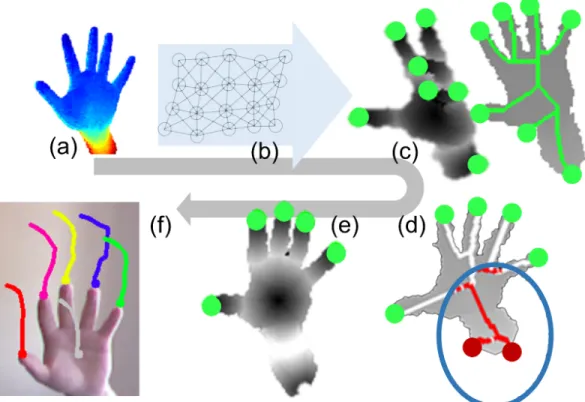
The following section provides an overview of the Multi-touchless approach. The ap-proach analyses images of the hand captured using a depth sensor to find geodesic extreme that correspond to the fingertips. The hand and wrist are segmented from the background, by estimating the users working volume. The depth for a segmented hand can be seen in figure 3.1(a) which includes the hand and wrist. This working volume is established using facial tracking. The hands surface is represented using a connected graph of the three-dimensional points, with edge connections encoding the neighbourhood connectivity (figure 3.1(b)). An efficient derivative of Dijkstra’s short-est path algorithm is used to perform a search over the surface of the hand for multiple geodesic extrema. Additional extrema are included to account for extrema that reside around the wrist, and can be seen in figure 3.1(c). The falsely identified fingertips are rejected using highly efficient filtering. The approach considers the path through an elliptical model shown in figure 3.1(d). The resulting fingertip locations (figure 3.1(e)) are then used to update a series of Kalman filters that enforce temporal continuity and models noise characteristics. Frame to frame correspondence is determined using the filter prediction, allowing consistent tracking, necessary for interaction. The tracking is then projected to the image plane for visualisation and integration with existing two-dimensional multi-touch applications. The path followed by each fingertip over the previous ten frames can be seen in figure 3.1(f).
3.1. Method Overview 27
Figure 3.1: Method overview of the Multi-touchless approach showing each stage of the method. (a) Depth is captured using a Kinect sensor and the background is segmented leaving only the hand and wrist. (b) Using a neighbourhood connectivity,
each depth pixel is connected to form a graph of the hand surface. (c) Dijkstra’s shortest path algorithm searches for a number of extrema. (d) The extrema are then
filtered to remove non-fingertips using structural information. (E,F) The final fingertip locations are tracked using a bank of Kalman filters.
3.2
Hand and Forearm Segmentation
The user is captured using a Kinect sensor which uses structured light to acquire a depth image. The value of each pixel in the depth image corresponds to that pixel’s distance from the sensors imaging plane. This allows robust background segmentation to be performed, as objects behind a specified distance can be removed. The hands are to be isolated with the depth, by establishing a working volume in front of the user. The users position in front of the camera can be found using standard face detection methods. For each colour frame provided by the Kinect, the user’s face is located using a Viola Jones detector [123]. The face detection provides a bounding box of the face, with multiple face detections removed using non-maximal suppression. Using the depth image, the face closest to the sensor f is found and is considered the working user. The depth of the working user is smoothed over a small temporal window, which reduces noise present in the Kinect’s estimate of depth. This depth defines a backplane used for segmentation, allowing the body and background to be removed from the depth image. The remaining depth space in front of this is considered the working area for interaction. Depth images are captured which correspond to the colour image using camera calibration. For the purpose of formulation each pixel in this depth image is defined as p, containing the pixel and corresponding real world coordinates. Using the notationw(p) = (xw, yw, zw), to represent world coordinates of a point, and
c(p) = (xc, yc) for image coordinates. In both cases the use of the subscript w i(p),
i∈ {x, y, z}provides short hand for a specific dimension.
Points within the working space are connected using connected component analysis. Each connected component is then assigned to a hand candidate which undergoes further analysis. The points of each hand are represented by the set P, hence a hand can be described as the following set of points,
P ={pi}|P|i=1 (3.1)
Those components that are smaller than potential hand shapes are rejected with nor-malisation using wz(f) which accounts for the user’s distance from the Kinect. The components that remain are in practice considered the hand and wrist. Points inP are
3.2. Hand and Forearm Segmentation 29
then classified as belonging to either a hand or wrist subset defined as PH ⊂ P and
PW = P \ PH. The classification of these points is performed using a depth cut-off
Wdepth positioned at one-quarter of the arms total depth which is calculated using the following: Wdepth=Zmax− (Zmax−Zmin) 4 (3.2) where, Zmax= max p∈P(wz(p)) (3.3) and, Zmin = min p∈P(wz(p)) (3.4) (a) (b) (c) (d)
Figure 3.2: Wrist and forearm segmentation using the depth
This segmentation was found experimentally while being constrained to lie between the forearm and wrist. Points inP further from the camera thanWdepthform the forearm set defined as;
PW ={p |p∈ P, wz(p)>=Wdepth} (3.5)
The result of segmentation can be seen in figure 3.2 for several examples. It should be noted that this segmentation is likely to fail should a hand be slanted backwards. This shortcoming can be ignored giving the application requires users to present their hands in front of their body, ensuring a forward incline. An alternative method for partitioning the hand is presented in Chapter 4 which uses discriminative learning.
3.2.1 Hand Centre localisation
The centre of the hand must be estimated for tracking the hands motion, which also serves as the seed location for geodesic computation. A naive approach to localise the hand would be using the centroid of points P|PPHH| however this would result in the
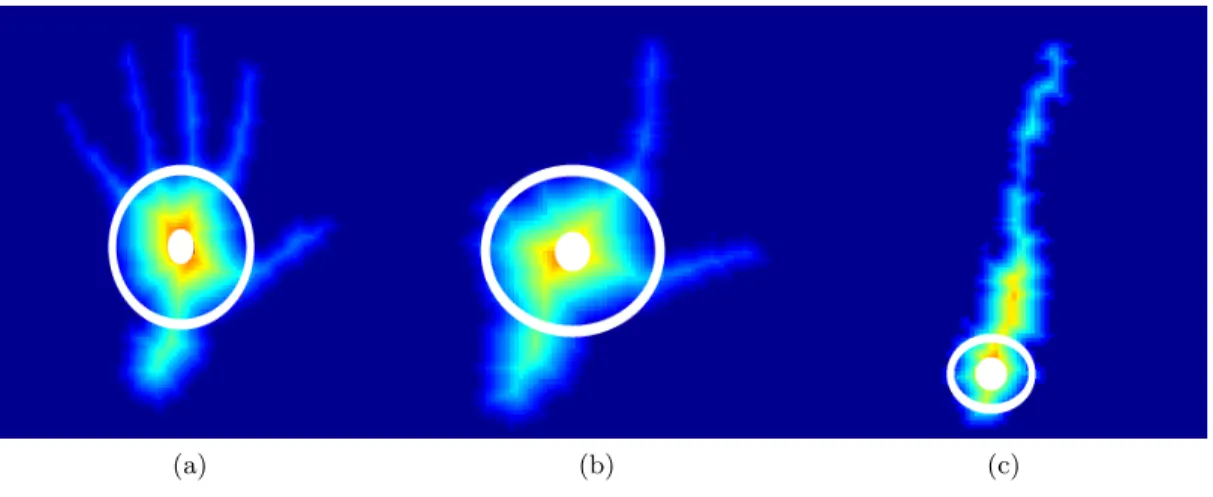
seed point shifting when the fingers are folded forming a fist. Therefore the chamfer distance ofPH is used, which considers the boundary information, inspired by Oka [75] to identify the hands centre. The chamfer distance transform computes the distance for each point in the image to its closest boundary point. The location which maximises this transform is the innermost location of the hand. The centre of the hand is defined as pHb. This process is conceptually similar to iteratively eroding the hand, removing
the finger and contour noise first until a centre is found. This process can be seen in figure 3.3 for several hand poses.
(a) (b) (c)
Figure 3.3: The chamfer distance of the segmented hand for three typical poses.
For the majority of frontal poses, this approach is robust as the palm is the widest part of the hand. However, this is not the case for hands which are profile to the camera, demonstrated in figure 3.3(c) where the most inner point moves towards the wrist. However, this is unlikely to cause failure when searching for geodesic maxima as the fingertips are still relatively far from this point.
The centre of the palm is then used to find candidate fingertips by performing a search for geodesic maximum discussed in more detail in the following section.
3.3. Candidate Finger Detection 31
3.3
Candidate Finger Detection
The fingertips can be considered extremities of the hand when extended, which is consistent with the use case for Multi-touchless tracking. Through mapping the surface of the hand and searching for surface extrema, those fingers which are not folded can be found. The approach does not consider those fingers which are folded as folded fingers are not considered important for Multi-touchless interaction. This is analogues to multi-touch screens disregarding fingers, not in contact with the screen. The search for extrema is conducted by computing the minimal geodesic distance from the centre of the hand to all other points on the surface of the hand. This is performed using Dijkstra’s shortest path algorithm. Those of the greatest local value correspond to geodesic maxima. Theoretically, a search for only five extrema would account for all open fingertips. In practice, the wrist can also form additional extremities that are of similar geodesic magnitude. These additional extrema are filtered in Section 3.4. For this reason, we greedily compute multiple extremities, ensuring each finger is accounted for. The extremity associated with a finger which is actually folded forms an additional false-positive to be filtered at a later stage. Those fingers which are extended yet touching are only considered a single extrema which is addressed in Chapters 4 and 5. In order to find multiple geodesic extrema we first build a weighted undirected graph
G of the hand. The points in PH labelled in Section 3.2 are repersented as a vertex
v ∈ G. Utilising the image domain, each vertex v is connected to all neighbours u in the 8-neighbourhood of v using an edge suv. The cost of suv is computed using the Euclidean distance defined in world coordinates assuv=||w(u)−w(v)||.
The evaluation of Dijkstra shortest path is performed by growing outward from the seed position pHb, computing the minimal distance to each of the nodes visited. As
such, each vertex inG stores its minimal surface distance topHb
. During growth, each newly visited nodevstores a reference to the neighbouruthat came before it, allowing a path to Hb to be defined. Initially, the distance to each node is of a high positive
value. Should a path leading to a node offer a shorter route then it is stored as the improved route. Once the geodesic distance has been computed to all points, growth is terminated and the node with the largest distance is considered the geodesic maximum
Figure 3.4: The graph construction using the image coordinates to form an 8-neighbourhood undirected connection between pixels. The edge costs are derived
from the Euclidean distance between the pixels 3D locatio