JACC Vel 4, No.3 Septernbe 1984:571-6
Application of a Computerized Medical Decision-Making Process to
the Problem of Digoxin Intoxication
KEITH S. WHITE, ALAN LINDSAY, MD, FACC, T. ALLAN PRYOR, PHD, WAYNE F. BROWN, MD, PHD, KEVIN WALSH, MD
Salt Loke City, Utah
571
A computerizedmedicaldecision-making systemwas used to monitor signs and predisposing factors of digoxin in-toxication in patients receiving digoxin. This process automatically reviewed the patient's data base nightly for drug interactions, laboratory data and electrocar-diographic findings with known association with digoxin intoxication. These decisions were formated into a "di-goxin alert report" and sent to line printers in the nurs-ing division to be placed on the individual patients' charts.
To assess the effect of these reports on patient man-agement, a randomized double-blind study was under-taken. Patients were assigned to an alert or nonalert group. Alert reports were withheld from charts of pa-tients in the nonalert group. A medical record review was subsequently carried out, wherein the physician's
Although the problem of digoxin intoxicationhas been known for many years, digoxin continues to be the fifth most frequently prescribed drug in the United States (1). Car-diologists and noncarCar-diologists are frequently challenged by the task of maintaining adequate drug levels in their patients while avoiding the dangerous consequences of toxicity. Un-fortunately, no definitive markers of digoxin intoxication have been defined. Even serum digoxin level elevation lacks adequate sensitivity and specificity to make the diagnosis. The diagnosis of digoxin intoxication is most often made when clinical findings lead the physician to suspect toxicity, and discontinuation of the drug leads to abatement of symptoms.
A number of medical conditions including pulmonary
From the Department of Medical Biophysics and Computing and the Department of Internal Medicine, University of UtahiLDS Hospital, Salt Lake City, Utah. Manuscript received January 10, 1984; revised manuscript received March 20, 1984, accepted April 6, 1984.
Address for reprints: T. Allan Pryor, PhD, Department of Medical Biophysics and Computing, LDS Hospital, 325 Eighth Avenue, Salt Lake City, Utah 84143.
orders were searched to identify actions taken with pos-sible relation to the digoxin alerts.
The computer monitored 396 patients over a 3 month period. Ofthese, 211 (53%) were randomized to the alert group and 185 (47%) to the nonalert group. Seventy-two percent of patients received at least one alert. The most frequently occurring alerts included: hypoxemia, hypokalemia, concurrent use of a beta-adrenergic block-ing agent, renal insufficiency and ventricular arrhyth-mia. Results from the record review demonstrated a 22% increase in physician actions for the alert group. Specifically, patients in the alert group were 2.7 times more likely to have a serum digoxin determination or-dered and 2.8 times more likely to have digoxin withheld on the day of a digoxin alert than were patients in the nonalert group.
disease, electrolyte imbalances, acute myocardial infarc-tion, renal insufficiency and advanced age predispose to digoxin intoxication and should alert the physician to the possibility of toxicity in the patient (2-4). Although these are common and nonspecific conditions, they should be considered carefully in management of the patient.
Quinidine, potassium-depleting diuretic drugs, beta-ad-renergic receptor antagonists and calcium channel blocking agents have all been shown to interact with digoxin and enhance its toxic potential (2,3,5,6). These drugs are used frequently in patients with heart disease and are often given along with digoxin. Use of these drugs concurrently with digoxin should increase the clinician's awareness that in-toxication may occur.
Clinical manifestations of digoxin intoxication include fatigue, nausea, visual changes, confusion and arrhythmias. These manifestations suggest intoxication, but are usually not specific enough to permit the diagnosis until discontin-uation of the drug results in their abatement (3,4,7).
Although the factors contributing to digoxin toxicity have been well documented and publicized, intoxication contin-ues to be a major patient management problem. We pro-posed that a computerized medical decision-making process
572 WHITE ET AL.
COMPUTER MONITORING OF DIGOXIN [NTOXICA nON
lACC Vol.4.No.3 September [984:571-6
could efficiently identify these factors in individual patients and bring them to the attention of the attending physician. We further postulated that this increased suspicion of di-goxin toxicity would lead to an increase in the preventive and therapeutic measures taken by physicians. A comput-erized monitoring system was developed and implemented at LDS Hospital, whereby patients were automatically mon-itored for existing signs and predisposing factors of digoxin intoxication.
Methods
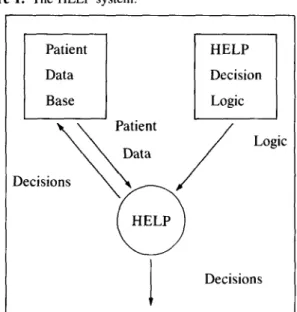
HELP Computer System. To screen patients daily for conditions that increase the likelihood of digoxin toxicity, the medical decision-making system Health Evaluation through Logical Processing (HELP) was used. The system (Fig. 1) is described in detail elsewhere (8). Briefly, it accesses patient data from a comprehensive patient data base and applies these data to a set of decision criteria. These criteria are established by medical experts and encoded into a form (the HELP logic) interpretable by the system. The HELP logic for a single decision is formated into a single module that can be accessed, evaluated and modified in-dependently from the data and other HELP logic modules. Each logic module corresponds to a storable data code along with its associated textual message. These messages can be modified by the outcome of the HELP evaluation. For ex-ample, laboratory values or text modifiers (such as mild, moderate or severe) may be incorporated into the message. A positive evaluation of a HELP logic module, then, con-stitutes a medical decision. These decisions can be sent by
Figure 1. TheHELPsystem.
Patient Data Base Patient Data HELP
j
HELP Decision Logic Logic Decisionsthe HELP system to application programs or they can be returned to the data base for future access by HELP and data review programs, or both.
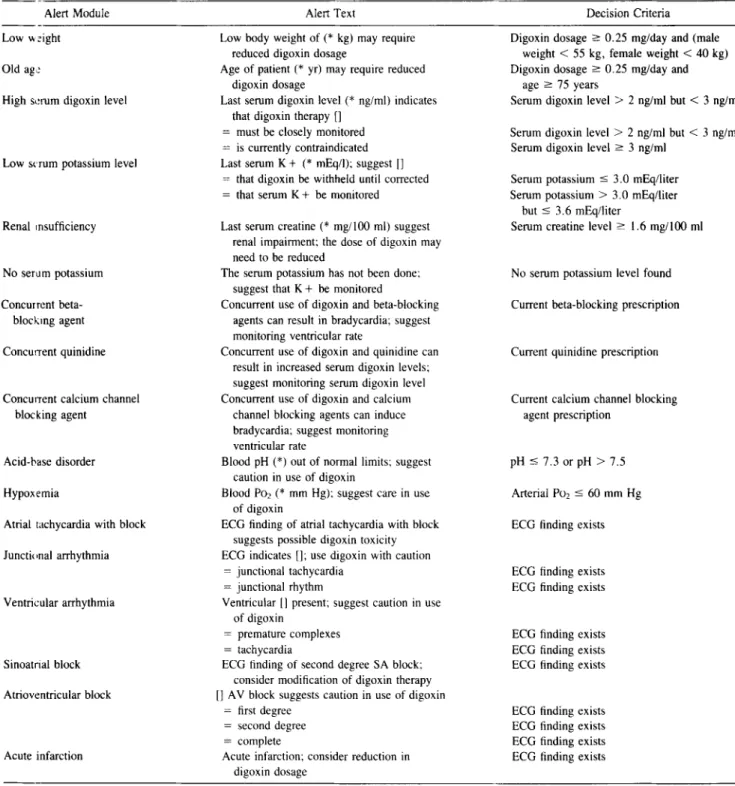
Digoxin alert system. Application of the HELP system to the problem of digoxin toxicity was accomplished by the establishment of a series of digoxin alert HELP logic mod-ules. Each module was designed to alert the physician to a condition that could be of concern in management of the patient with digoxin. Table 1 lists the alert modules along with their text and decision criteria. In evaluating these modules, HELP utilizes serum chemistry data, arterial blood gas data, electrocardiographic interpretations, medications and demographic data. In addition, outcomes from previous HELP evaluations of the alert modules are accessed to pre-vent excessive repetition of alerts. Because these data are all routinely stored in the computerized patient data records, no additional data entry is required to evaluate the alert modules.
To completely automate the process, a time-driven di-goxin alert program was written. Each night, this program activates the HELP evaluation of the alert modules for all patients in the hospital. Alert messages returned from HELP are formated into a "digoxin alert report" that is sent out to a line printer in the nursing division nearest the patient (Table 2). This report is placed in the patient chart by nursing personnel.
Study design. After a trial period, a double-blind ran-domized study was initiated to determine the effect of the digoxin alerts on patient management. All patients receiving digoxin were included in the study. A random number gen-erator was used to assign patients to an alert or nonalert group. For patients in the alert group, the decision process and alert reporting were carried out as outlined. The digoxin alert reports were withheld from the charts of patients in the nonalert group. After 3 months of operation, a blinded medical record review was carried out in accordance with a protocol aimed at identifying physician actions with pos-sible relation to the digoxin alerts. Progress notes and phy-sicians' orders were reviewed for the day of each generated alert. All data from the patient record review and the alert data were entered into the patient data base for computer-assisted analysis.
Data analysis. The HELP system was used to segregate the main patient population into alert and nonalert groups. These groups were then evaluated for differences in size, gender and age distributions and medical versus surgical service. Statistical analysis was performed with the chi-square test.
The frequency of occurrence of each of the digoxin alerts was established for both the alert and nonalert groups and evaluated with the chi-square test. A proportion method described by Armitage (9) was used in evaluating the dis-tribution of physician actions recorded for the two groups.
JACC \oi.4, No.3 September1984:571-6
Table1. Characteristics of Alert HELP Logic Modules
WHITE ET AL.
COMPUTER MONITORING OF DIGOXIN INTOXICATION 573
Alert Module Alert Text Decision Criteria
Low weight Oldage:
High serum digoxin level
Low Strum potassium level
Renal insufficiency
No serum potassium Concurrent
beta-blocking agent Concurrent quinidine
Concurrent calcium channel blocking agent
Acid-base disorder Hypoxemia
Atrial tachycardia with block Junctional arrhythmia
Ventricular arrhythmia
Sinoatrial block Atrioventricular block
Acute infarction
Low body weight of(*kg) may require reduced digoxin dosage
Age of patient(*yr) may require reduced digoxin dosage
Last serum digoxin level(*ng/ml) indicates that digoxin therapy []
= must be closely monitored
= is currently contraindicated Last serum K+(*mEq!l); suggest []
= that digoxin be withheld until corrected
= that serum K+be monitored
Last serum creatine (*mglI00 ml) suggest renal impairment; the dose of digoxin may need to be reduced
The serum potassium has not been done; suggest that K+be monitored
Concurrent use of digoxin and beta-blocking agents can result in bradycardia; suggest monitoring ventricular rate
Concurrent use of digoxin and quinidine can result in increased serum digoxin levels; suggest monitoring serum digoxin level Concurrent use of digoxin and calcium
channel blocking agents can induce bradycardia; suggest monitoring ventricular rate
Blood pH(*)out of normal limits; suggest caution in use of digoxin
BloodPOl (*mm Hg); suggest care in use of digoxin
ECG finding of atrial tachycardia with block suggests possible digoxin toxicity ECG indicates []; use digoxin with caution
= junctional tachycardia
= junctional rhythm
VentricularIIpresent; suggest caution in use of digoxin
= premature complexes
= tachycardia
ECG finding of second degree SA block; consider modification of digoxin therapy [] AV block suggests caution in use of digoxin
= first degree
= second degree
= complete
Acute infarction; consider reduction in digoxin dosage
Digoxin dosage 2: 0.25 mg/day and (male weight <55 kg, female weight <40 kg) Digoxin dosage 2: 0.25 mg/day and
age 2: 75 years
Serum digoxin level > 2 ng/ml but < 3 ng/ml Serum digoxin level > 2 ng/ml but< 3 ng/ml Serum digoxin level2: 3 ng/rnl
Serum potassium$ 3.0 mEqlliter Serum potassium> 3.0 mEq/liter
but$ 3.6 mEq/liter
Serum creatine level2: 1.6 mg/lOO ml No serum potassium level found Current beta-blocking prescription
Current quinidine prescription
Current calcium channel blocking agent prescription
pH$ 7.3 or pH > 7.5 Arterial POl $ 60 mm Hg
ECG finding exists
ECG finding exists ECG finding exists
ECG finding exists ECG finding exists ECG finding exists
ECG finding exists ECG finding exists ECG finding exists ECG finding exists
AV = atrioventricular; ECG = electrocardiogram;POl = partial pressure or oxygen; *= value insertion point; []= text modifier insertion point;
(=) = text modifier.
Results
Patient profile. Over a 3 month period, 396 patients
were monitored with the digoxin alert program. Of these patients, 211 (53%) were randomized to the alert group while 185 (47%) were randomized to the nonalert group.
The male:female ratio was 1:l , medical:surgical service ra-tio was 0.8: 1 and the mean age was 69 years. There was no statistically significant difference between the two groups for these variables.
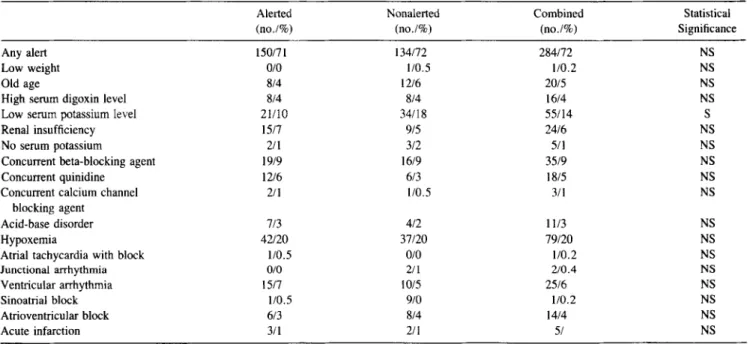
Distribution of alerts. The results of the alert distri-bution are tabulated in Table 3. The number of patients in
574 WHITE ET AL.
COMPUTER MONITORING OF DIGOXIN INTOXICATION
lACC Vol. 4, No.3
September 1984:571-6
Table 2. Sample Digoxin Alert Report
Digoxin Alert Report-06/15/83 15:20 Patient: XXXXXXXXXXXX Number 4981213 Dr: XXXXXXXXXXXXXXX Room: 4W09 Digoxin dosage: 0.250MG,TABS
ALERT 18: The serum potassium has not been done. Suggest that serumK+ be monitored.
ALERT 22: Concurrent use of digoxin and quinidine can result in increased serum digoxin levels. Suggest monitoring serum digoxin levels.
ALERT 39: First degree AV block, Suggest caution in use of digoxin,
each group receiving a given alert along with the corre-sponding percent of the total number of patients in the group are shown for each alert, Statistical data are for comparison between the alert distributionsinthe alert and nonalert groups, Only for the low serum potassium alert did the analysis show a statistically significant difference between these groups,
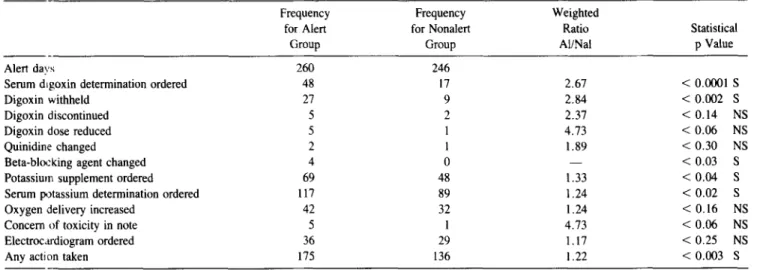
Distribution of physician actions. Results from the medical record review are listed in Table 4, The total number of data entries (alert days) is given along with the frequency of each action in the alert and nonalert groups, The "weighted ratios" show the relative increase in frequency of action taken between the two groups, These values are "weighted" by the ratio of alert days, Statistically significant increases in actions were found for the alert group in five areas: serum digoxin determinations ordered, digoxin withheld beta-ad-renergic blocking agent change, potassium supplement and serum potassium determination ordered, Borderline
statis-Table 3. Distribution of Alerts
tical significance was obtained for increase in digoxin dos-age reductions and notes of concern in progress notes for the alert group, Overall, physician actions increased for the alert group as evidenced by the statistically significant in-crease in "any action taken",
Discussion
Theoretical considerations. Computer-assisted medi-cal decision-making affords numerous advantages to the clinician, In essence, this system adds another observer to the patient care team, The computer system does not com-pete with the clinician; rather, it supplements and backs up the clinical observations, Human observers, of course, have many advantages over computer systems, Human observers are far better at synthesizing abstract concepts and calling on previous experience, Additionally, many more data are available to the human observer.
Computer decision-making is restricted to a predefined logic format and set of data and, thus, is inflexible once programmed. It does, however, have some advantages over the human observer. The computer is ideal for monitoring the multitude of small mundane details that so often escape the attention, interest and memory of the human observer. Therefore, the computer decision-making system serves as an additional data input for the clinician and, in this way, expands his or her medical decision-making capabilities. By combining the human and computer capabilities, the strengths of both can be used effectively to provide better patient observation and care.
System performance. The digoxin alert system was
re-Any alert Low weight Old age
High serum digoxin level Low serum potassium level Renal insufficiency No serum potassium
Concurrent beta-blocking agent Concurrent quinidine
Concurrent calcium channel blocking agent
Acid-base disorder Hypoxemia
Atrial tachycardia with block Junctional arrhythmia Ventricular arrhythmia Sinoatrial block Atrioventricular block Acute infarction
NS =not significant; S =significant.
Alerted (no.l%) 150171 0/0 8/4 8/4 21110 1517 2/1 19/9 12/6 2/1 7/3 42/20 110.5 0/0 1517 1/0,5 6/3 3/1
Nonalerted Combined Statistical
(no.l%) (no.l%) Significance
134/72 284/72 NS 1/0.5 1/0,2 NS 12/6 20/5 NS 814 16/4 NS 34118 55114 S 915 24/6 NS 3/2 5/1 NS 16/9 35/9 NS 6/3 18/5 NS 1/0.5 3/1 NS 4/2 1113 NS 37120 79/20 NS 0/0 110,2 NS 2/1 2/0.4 NS 10/5 25/6 NS 9/0 110.2 NS 8/4 1414 NS 2/1 51 NS
JACC Vo. 4,NO.3 September 1984:571-6
WHITE ET AL.
COMPUTER MONITORING OF DIGOXIN INTOXICATION 575
Table 4. Distribution of Physician Actions
Frequency Frequency Weighted
for Alert for Nonalert Ratio Statistical
Group Group AI/Nal P Value
-Alert days 260 246
Serum digoxin determination ordered 48 17 2.67 <0.0001 S
Digoxin withheld 27 9 2.84 <0.002 S
Digoxin discontinued 5 2 2.37 <0.14 NS
Digoxin dose reduced 5 I 4.73 <0.06 NS
Quinidine changed 2 I 1.89 <0.30 NS
Beta-bloc king agent changed 4 0 < 0.03 S
Potassium supplement ordered 69 48 1.33 < 0.04 S
Serum potassium determination ordered 117 89 1.24 < 0.02 S
Oxygen delivery increased 42 32 1.24 < 0.16 NS
Concern of toxicity in note 5 I 4.73 < 0.06 NS
Electrocardiogram ordered 36 29 1.17 < 0.25 NS
Any action taken 175 136 1.22 < 0.003 S
Al ,. alerted; Nal =nonalerted; NS =not statistically significant; S =statistically significant.
liable and consistent in its performance. Occasional errors in the data base resulted in some erroneous decisions. Over-all, highly verifiable decisions were generated. Failure of the alert program to activate and complete evaluation of the entire hospital population was also rare, occurring only two or three times during the 3 month period. Once imple-mented. the system was entirely automatic. No time was expended by hospital personnel in data entry or program activation.
Study design considerations. In the implementation of the randomized double-blind study, the preliminary trials of the digoxin alert process accustomed the medical staff to the digoxin alert reports. As a result, they gained some experience in evaluating the significance of the alerts before the study began. The medical staff was not told that a study was being performed. Because LDS Hospital is a teaching hospital, the responses of medical students, interns, resi-dents and attending physicians were measured by the study. The HELP system is used extensively at LDS Hospital, and numerous alerting systems are already a part of routine daily patient care. Because the physicians had previous exposure to similar alerting systems their response was more likely to be based on the content of the alert messages rather than the novelty of a computerized monitoring system.
Alert frequencies. The only apparent aberration from randomness between the alert and nonalert groups was that more patients in the nonalert group received the low serum potassiumalert. We can only speculate as to whether there is any causal relation in this finding. Nonetheless, the fact that more patients were hypokalemic in the nonalert group would have the tendency to increase the number of actions in this group. If any significant bias in the distribution of physician actions resulted from this, the bias would be for an increase in actions for the nonalert group.
The high frequency of alerts generated attests to the com-plexity of managing patients with digoxin. In decreasing
order of frequency, the most common alerts were hypox-emia, low serum potassium, concurrent use of a beta-ad-renergic blocking agent, ventricular arrhythmia and renal impairement. Because of varying degrees of incompleteness in the data base, however, the true relative and absolute frequencies of these alerts may vary significantly from those reported. The frequencies given represent the minimal prev-alence of each alert state in the study group.
Effects on patient management. An objective analysis of the physician response to the digoxin alerts is accom-plished with the distribution of possible alert-related actions among the alert and nonalert groups. Although some of the reported action distributions were not statistically signifi-cant, in every case the alert group received more actions than the nonalert group. There was a statistically significant increase of "any related action" of 22% in the alert group. These increases indicate that the physicians received in-formation from the alerts that altered their management of the patient receiving digoxin. One may ask whether this increase in action constitutes a benefit or only an added expense to the patient. Objective measurement of actual patient benefit will require study of a more extensive patient population. The cost of digoxin intoxication in terms of lives and money is impressive. Experts in the field have published guidelines and suggested certain actions for phy-sicians when the alert states monitored by this system are encountered in patients receiving digoxin (2,3,7). We found that the digoxin alert system made physician behavior more consonant with these suggested protocols. We anticipate that ultimately the patient will benefit directly by having a de-creased morbidity and mortality as a result of an inde-creased physician awareness of potential digoxin intoxication.
Conclusion. The clinical response to the digoxin alert system indicates that the system was successful in increasing physician awareness of conditions predisposing their pa-tients to digoxin intoxication. This computer-assisted
med-576 WHITE ET AL.
COMPUTER MONITORING OF DIGOXIN INTOXICATION
lACC Vol. 4, No.3 September 1984:571-6
ical decision-making system adds another observer to the clinical team and enhances the decision-making capabilities of the physician. Future refining of the decision logic and expansion of the data base will further extend the utility of this valuable tool.
References
1. Top 200 Drugs in 1982. Pharmacy Times 1983 April:25-33. 2. Doherty JE. Digitalis serum levels: clinical usefulness. Primary Cardiol
1982;8:65-76.
3. Doherty JE. Digitalis 1982. Over 200 years of clinical use, research and opinion. Baylor College of Medicine Cardiology Series 1982;5:5-27.
4. Aronson JK. Digitalis intoxication. Clin Sci 1983;64:253-57. 5. BiggerJT.The quinidine-digoxin interaction. What do we know about
it? N Engl J Med 1979;301 :779-81.
6. Bussey HI. The influence of quinidine and other agents on digitalis glycosides. Am Heart J 1982;104:289-302.
7. Ewy GE, Marcus FI, Fillmore SJ, Matthews NP. Digitalis intoxica-tion-diagnosis, management, and prevention. Cardiovasc Clin 1974;6:153-71.
8. Pryor TA, Gardner RM, ClaytonPD, Warner HR. The Help system. J Med Syst 1983;7:87-102.
9. Armitage P. Statistical inference. In: Statistical Methods in Medical Research. Oxford: Blackwell Scientific, 1971:111-5.