RatFish: A File Sharing Protocol Provably
Secure Against Rational Users
Michael Backes1,2, Oana Ciobotaru1, and Anton Krohmer1 1
Saarland University 2 MPI-SWS
Abstract. The proliferation of P2P computing has recently been pro-pelled by popular applications, most notably file sharing protocols such as BitTorrent. These protocols provide remarkable efficiency and scala-bility, as well as adaptivity to dynamic situations. However, none of them is secure against attacks from rational users, i.e., users that misuse the protocol if doing so increases their benefits (e.g., reduces download time or amount of upload capacity).
We propose a rigorous model of rational file sharing for both seeders and leechers, building upon the concept of rational cryptography. We design a novel file sharing protocol called RatFish, and we formally prove that no rational party has an incentive to deviate from RatFish; i.e., RatFish constitutes a Nash equilibrium. Compared to existing file sharing pro-tocols such as BitTorrent, the tracker in RatFish is assigned additional tasks while the communication overhead of a RatFish client is kept to a minimum. We demonstrate by means of a prototype implementation that RatFish is practical and efficient.
1 Introduction
Recently, the peer-to-peer (P2P) paradigm has emerged as a decentral-ized way to share data and services among a network of loosely connected nodes. Characteristics such as failure resilience, scalability and adaptivity to dynamic situations have popularized P2P networks in both academia and industry. The proliferation of P2P computing has also been propelled by popular applications, most notably file sharing protocols such as Bit-Torrent [6].
A crucial assumption underlying the design of such file sharing pro-tocols is that users follow the protocol as specified; i.e., they do not try to bypass the design choices in order to achieve higher download rates, or to avoid uploading to the system at all. However, not all users are necessarily altruistic, and publicly available, modified BitTorrent clients like BitThief [20] or BitTyrant [22] can be used to strategically exploit BitTorrent’s design to achieve a higher download while contributing less or nothing at all in return. While several minor protocol adaptations have
been suggested to mitigate the attacks underlying these clients [30], the core weaknesses remain: In its current form, BitTorrent – and current file sharing protocols in general – offer better service to cheating clients, thereby creating incentives for users to deviate from the protocol; in turn, it further decreases the performance of honest clients. The task is thus to design a protocol that not only retains the remarkable characteristics of current file sharing protocols, but that is rational in the sense that it offers sufficient incentives for users to stick to the precise protocol specification. In more technical terms, this file sharing protocol should constitute an equilibrium state: Adhering to the protocol should optimize the bene-fits received by each individual participant, and any deviation from the protocol should result in a lower payoff for the cheating user.
1.1 Contributions
We contribute RatFish, a protocol for rational file sharing. RatFish is built upon the concepts and design choices that underlie BitTorrent, but it resolves the weaknesses that clients such as BitThief and BitTyrant exploit. We achieve this mostly by ensuring rational exchange of pieces between leechers and by having the tracker participate in the coordination of the downloads. In this context, an exchange is called rational if the participants have no incentive to deviate from it.
The distinctive feature of RatFish, however, is not that it discourages the use of several selfish strategies, but that it comes with a formal proof that deviating from RatFish is irrational for both seeders and leechers. In order to do this, we first characterize rational behaviors of leechers and seeders in file sharing protocols, building upon the concept of the recently emerging field of rational cryptography, in which users are de-fined as rational players in a game-theoretic sense. Intuitively, leechers are primarily interested in minimizing their download time and the amount of uploaded data, whereas seeders value the efficiency of the protocol in using their upload capacity. We cast this intuition into a rigorous mathe-matical model, and we formally prove that our protocol is secure against deviations of rational parties, by showing that it constitutes a Nash equi-librium. This holds even though RatFish allows users to dynamically leave and (re-)join. We prove this Nash equilibrium using a new proof technique that is of independent interest for rational cryptography: the step-by-step substitution of a deviating strategy with hybrid, semi-rational strategies. We have built a prototype implementation of RatFish that demon-strates that RatFish is practical and efficient. We stress though that the
purpose of RatFish is not to achieve performance improvements over ex-isting protocols, but to establish a formal proof that under realistic con-ditions, such as dynamically joining users, no rationally-behaving user has an incentive to deviate from RatFish. The additional computational overhead of RatFish compared to BitTorrent is small: basic cryptographic primitives (symmetric encryptions and digital signatures schemes) are used, and the tracker is assigned additional tasks such as the coordination of downloads and the generation of user incentives. The communication overhead of a RatFish client is kept to a minimum.
1.2 Related Work
The performance of BitTorrent has been thoroughly studied [25,3,12,24,23]. All these works attest to the impressive performance of BitTorrent in the presence of honest participants; however, it has been noted [3] that the rate-based Tit-For-Tat policy of BitTorrent does not prevent nodes from uploading less content than they should serve (in all fairness), thereby creating an incentive for abuse of the protocol.
The behavior of BitTorrent in the presence of cheating peers was sub-sequently investigated [19,22,20,27], revealing that cheating leads to a loss in overall performance for honest peers.
Our rigorous model of rational file sharing is grounded in the recently emerging field of rational cryptography, where users are assumed to only deviate from a protocol if doing so offers them an advantage. Rational cryptography is centered around (adapted) notions of game theory such as computational equilibria [7]. A comprehensive line of work already exists that develops novel protocols for important cryptographic primitives such as rational secret sharing and rational secure multiparty computation [8,11,10,1,15,9].
There has been already a variety of research aimed at making BitTorrent more robust against deviations of rationally-behaving users [30,16,23,21,28]. All these works provide stronger user incentives: they choke problematic connections [30], grant additional bandwidth to gen-erously uploading neighbors [16], reward leechers that continue seeding after their download is completed [23], optimally distribute a seeder’s bandwidth across swarms [21], and employ fair exchange protocols to stop leechers from aborting the protocol [28] early. These modified pro-tocols, however, are still prone to rational attacks; in particular, none of these works reached a (Nash) equilibrium. There has been research [28] on how to ensure that certain deviations from selfish leechers or attacks
of malicious peers cannot succeed, e..g., no peer can assume another au-thorized peer’s identity. However, so far there is no work which ensures that deviating from the protocol cannot yield better results.
There is also previous work that strived to establish an equilibrium in the context of file sharing [25]. However, this equilibrium was severely restricted in that it was only guaranteed when rational parties were al-lowed to only tweak the protocol parameters, but not when they could deviate in larger ways.
More recent research such as BAR-B [2], Equicast [14], and FOX [26] aimed at deploying incentives and punishments such that obeying the pro-tocol is the best strategy for every rational player. The first two propro-tocols were shown to be strict Nash equilibria, i.e., a rational peer obtains no benefit from unilaterally deviating from the assigned strategy. The draw-back is that their strict equilibrium solutions limit the design: the BAR-B system only permits a static set of users. Equicast requires the rate at which leechers join to precisely match the rate of which they leave and considers only restricted utility functions that do not take downloading time into account; moreover, these protocols require nodes to waste net-work bandwidth by sending garbage data to balance bandwidth consump-tion. FOX [26] establishes a stable Nash equilibrium, but again it only allows a static set of leechers; moreover, its rationality is not grounded on incentives but on fear of retaliation such that a single Byzantine node can cause the entire system to collapse. Somewhat orthogonal to our work are the file streaming applications BAR-Gossip [18] and FlightPath [17]. Both works show a Nash equilibrium (a strict one for BAR-GOSSIP, and an approximate one for Flightpath), but rational players are only interested in minimizing the amount of uploaded data and reducing jitter. While such time-independent utility functions are reasonable for streaming ap-plications, they do not apply to the more sophisticated setting of rational file sharing, where minimizing the time to complete a download is usu-ally the primary goal. Moreover, none of these five protocols considers seeders as part of the rational model. We conclude by saying that like our approach, none of these works offers resistance against Sybil attacks. A Nash equilibrium ensures that no individual user has an incentive to deviate. However, it conceptually does not take coalitions of users into ac-count, rendering Sybil attacks possible in most works on rationally secure protocols.
1.3 Outline
Section 2 provides a bird’s eye view of the core ideas underlying how we create incentives in file sharing. Section 3 summarizes the concepts we use from rational cryptography and defines rational behaviors of seeders and leechers. Section 4 presents the RatFish protocol in detail. Section 5 contains the proof of equilibrium for RatFish; i.e., it shows that users cannot achieve a better payoff by deviating from the protocol. Section 6 discusses our experimental results. Section 7 concludes this work.
2 A Bird’s Eye View on How to Rationalize P2P
For the sake of exposition, we provide a high-level overview of the core ideas underlying how we create incentives in file sharing. We briefly dis-cuss which behaviors of seeders and leechers we consider rational, intu-itively explain how to incentivize these behaviors, and finally discuss how an equilibrium is obtained for a small example protocol. In this section, we abstract away many important system’s details and impose several as-sumptions to improve understanding. However, all these restrictions will be removed in section 4 where we present our RatFish protocol in its full generality.
In the following, we consider a single seederS that intends to upload a file f to leechers L1, . . . , LM. The file is split into pieces f1, . . . , fM2.
In this exposition, we describe a simplistic protocol that proceeds in a sequence of M + 1 monolithic rounds. We assume that the seeder can upload exactly M pieces per round and that every leecher is able to upload and to download at least M pieces of the file in each round.
On the Rationality of Seeding. A seeder is a player that uploads without requesting reciprocation. Intuitively, it thus acts rationally if it uses its upload time and upload speed as efficiently as possible; i.e., for any fixed upload speed and time that the seeder spends within the system, the average download time for all leechers should be as small as possible. It is thus in the interest of the seeder to incentivize leechers to share parts of the file amongst each other as this increases the throughput of the whole system. As a consequence, the naive approach of uploading the whole file to an arbitrary leecher at once cannot yield a rationally secure protocol: This leecher may just complete the download and leave, causing some pieces of the file to be effectively lost from the system. Moreover, since there is only one seeder in this simplistic protocol and the number of leechers is known and does not change, there is no need for a third party,
i.e., a tracker. In the simplistic protocol, the seeder sends each leecher Li
in each roundj the piecefj·M+i.
On the Rationality of Leechers. Leechers aim to download the file as fast as possible while saving upload capacity. The protocol thus has to enforce leecher participation as they will otherwise just download and leave. We need to propose a suitable piece selection algorithm and a piece exchange mechanism that prevents parties from cheating each other. In our example, piece selection is easy: In each round j a leecher Li holds
a piece fj·M+i obtained from the seeder that no one else has. As the
leecher can upload M pieces per round, he can exchange with the rest of the leechers their unique pieces. To ensure fair exchanges, leechers first exchange the pieces in encrypted form and subsequently send the corresponding decryption keys.
How an Equilibrium is Achieved. We conclude with some basic in-tuition on why no rational user has an incentive to deviate from the protocol. If all peers adhere to the protocol, the seeder will upload the file exactly once and stay in the system for M rounds. Each of the leech-ers will upload M2−M pieces and complete its download after M + 1
rounds. It is easy to see that the average download time and hence the seeder’s utility cannot be improved.
This outcome cannot be further improved for the leechers either: None of the leechers can download the file in less than M + 1 rounds since after roundM each of them is missing at least M−1 pieces. This holds because the protocol treats the rounds integrally. Otherwise, we could split a sufficiently big file intoMKpieces for someKand achieve a slightly
reduced, optimal download time of M+ M2
MK using an analog algorithm. Moreover, since the seeder only providesM pieces to each of its peers, no leecher can obtain the full file without uploading at leastM2−Mpieces in
exchange for the pieces that it is missing from the seeder. This statement holds as no leecher can cheat during the rational piece exchange protocol: A leecher spends his upload capacity to receive an encrypted piece, hence he has no incentive not to send the much smaller decryption key to its partner. Thus, no party can improve its utility by deviating from the protocol.
3 A Game-theoretic Model for File Sharing
In this section, we propose a game-theoretic model for rationally secure file sharing. We start by reviewing central concepts from game theory and rational cryptography.
A Bayesian game Γ = ({Ti}ni=1,{Ai}ni=1,Pr,{ui}ni=1), also called a
game with incomplete information, consists of players 1, . . . , n. The in-complete information is captured by the fact that thetypefor each player
i(i.e., its private information) is chosen externally, from a setTi, prior to
the beginning of the game. Pr is a publicly known distribution over the types. Each player has a set Ai of possible actionsto play and individual
utility functions ui. Actions are played either simultaneously or
sequen-tially; afterwards, every player ireceives a payoff that is determined by applying its utility functionuito the vector of types received in the game,
i.e., profile types, and the actions played, i.e.,action profile.
Recent work has extended the traditional notion of a game to the requirements of cryptographic settings with their probabilistically gener-ated actions and computationally-bounded running times. The resulting definition – calledcomputational game [13] – allows each playerito decide on a probabilistic polynomial-time, in the security parameter, interactive Turing machineMi(short PPITM). The machineMi is called thestrategy
for player i. The output of Mi in the joint execution of these interactive
Turing machines denotes the actions played by participant i.
Definition 1 (Computational Game). Let k be the security parame-ter and let Γ = ({Ti}ni=1,{Ai}ni=1,Pr,{ui}ni=1) be a Bayesian game. Then
Γ is a computational game if the played action Ai of each participant
i is computed by a PPITM Mi and if the utility ui of each player i is
polynomial-time computable.
Because of the probabilistic strategies, the utility functions ui now
correspond to the expected payoffs. Thus, when there is no possibility for confusion, we overload the notation for ui. However, when the utility we
employ is not clear from the context, we denote byUi the expected utility
for party i.
Rationally behaving players aim to maximize these payoffs. In par-ticular, if a player knew which strategies the remaining players intend to choose, he would hence pick the strategy that induces the most benefit for him. As this simultaneously holds for every player, we are looking for a so-calledNash equilibrium, i.e., a strategy vector where each player has no incentive to deviate from, provided that the remaining strategies do not change. Similar to the notion of a game, we consider a computational variant of a Nash equilibrium.
Definition 2 (Computational Nash Equilibrium). Let Γ be a com-putational game, where Γ = ({Ti}ni=1,{Ai}ni=1,Pr,{ui}ni=1) and let k be
the security parameter. A strategy vector (ormachine profile) consisting of PPITMs−M→= (M1, . . . , Mn) is a computational Nash equilibriumif for
all iand any PPITMMi0 there exists a negligible function such that
ui(k, Mi0,−−→M−i)−ui(k,−M→)≤(k)
holds.
Here ui(k, Mi0,
−−→
M−i) denotes the function ui applied to the setting
where every player j 6= i sticks to its designated strategy Mj and only
playerideviates by choosing the strategyMi0. In the definition above, we callMi acomputational best responseto−−→M−i.
We finally define the outcome of a computational game as the tran-script of all players’ inputs and the actions each has taken. In contrast to strategy vectors, an outcome thus constitutes a finished game where every player can determine its payoff directly. A utility function is thus naturally defined on the outcome of a computational game: When applied to a strategy vector with its probabilistic choices, it describes the vector’s expected payoff; when applied to an outcome of the game, it describes the exact payoff for this outcome.
3.1 A Game-theoretic Model for File Sharing Protocols
We now define the utility functions for seeders and leechers such that these functions characterize rational behavior in a file sharing protocol. We start by introducing common notation and some preliminaries.
Notation and Preliminaries.Following the BitTorrent convention, we call a player in the file sharing game a peer. The peers are divided into two groups: Aseederuploads to other peers afilef that it owns, whereas a leecher downloads f. To mediate the communication among peers, we thus implicitly require a trusted party called the tracker. The tracker holds a signing key pair (pk,sk), and we assume that its IP address and public key pk are known to all peers.
The file f consists of pieces f1, . . . , fN, each of length B bytes.
The participants in the file sharing protocol hold the values h1 =
h(f1), . . . , hN =h(fN), wherehis a publicly knownhash function. When
deployed in practice, this publicly known information is distributed via a metainfo file. The tracker is only responsible for coordinating peers that are exchanging the same file. In order to stay close to a realistic setting, we allow different peers to have different upload and download capacities. Ev-ery seederSi has its individualupload speedupsi(t, o) that depends on the
timetand the outcomeo. Note that a seeder does not download anything except for metadata; hence we do not need to consider the download speed of seeders. Similarly, every leecherLi has individualuploadand download
speedsupl
i(t, o) anddownli(t, o). We denote byTi,fin(o) the total time that
leecher Li spends downloading the file. In terms of measurement units,
each of the upload and download capacities defined so far is considered as bytes per second. Additionally, the time is measured in seconds. To increase readability, we omit the outcome in all formulas whenever it is clear from the context. We also introduce the setsL={i|Li is a leecher}
and S={i|Si is a seeder}.
Rationally-behaving Seeders. A seeder uploads parts of the file to other peers without requesting reciprocation. Intuitively, a seeder is in-terested in using as efficiently as possible its upload time and upload speed. Thus for any fixed upload speed and time that the seeder spends within the system, the average download time for all leechers should be as small as possible. We express this preference by the following seeder’s utility function.
Definition 3 (Seeder’s Utility Function). We say thatus
i is autility
function for a seeder Si if for any two outcomes o, o0 of the game with
the same fixed upload speed ups
i and fixed time Tis spent by Si in the
system, it holds that ui(o) ≥ ui(o0) if and only if |L|1
P i∈LTi,fin(o) ≤ 1 |L| P i∈LTi,fin(o0).
IfSi is the first seeder in the system, we implicitly require thatSiuploads
the whole file at least once. Otherwise, it is not rational to share the file in the first place.
Rationally-behaving Leechers. Leechers aim at downloading the shared file as fast as possible; moreover, they also try to use as little upload capacity as possible. The relative weight of these two (typically contradictory) goals is given by a parameter αi in the system measuring
time units per capacity units, e.g., sec2/bytes.
Definition 4 (Leecher’s Utility Function). Let αi ≥ 0 be a fixed
value. We say that ul
i is a utility function for leecher Li if the following
condition holds: For two outcomeso, o0,Li prefers outcome oto o0 if and
only if αi· Z Ti,fin(o) 0 upli(t, o)dt+Ti,fin(o)≤αi· Z Ti,fin(o0) 0 upli(t, o0)dt+Ti,fin(o0).
The value αi corresponds to Li’s individual valuation for upload speed
and time; e.g., if αi = 0.5sec 2
bytes, the leecher values time twice as much as
the uploaded data.
In particular, this definition implies that a rationally-behaving leecher prioritizes completing the download over everything else: If the leecher does not download the file in outcome o, then Ti,fin(o) equals infinity. If
it downloads the file in some outcomeo0, then Ti,fin(o0) is finite and thus
increases its payoff.
4 The RatFish Protocol
We now present the RatFish protocol. We start with the description of the tracker and proceed with the seeders and leechers, respectively.
4.1 The Protocol of the Tracker
Similar to BitTorrent, our tracker manages all valid IP addresses in the system and introduces new leechers to a set of neighbors. However, we assign the tracker additional tasks: First, our tracker is responsible for awarding each newcomer with seeding capacity equivalent toγ file pieces, for a tunable parameterγ. In practice,γ is a small constant number just big enough for the new leecher to participate in the system. As long as the seeders can provide γ pieces to each newly joining leecher, this value does not influence the existence of the Nash equilibrium.
Second, our tracker keeps track of which file pieces each peer owns at any given moment. This bookkeeping will be crucial for incentivizing peers to follow the RatFish protocol, for computing the deserved rewards and for answering queries about the leechers’ availabilities. Third, the tracker imposes a forced wait for every leecher upon connecting, thereby preventing leechers from gaining advantages by frequently disconnecting and rejoining the protocol. Finally, if a leecher wishes to disconnect, the tracker provides a certificate on the most recent set of pieces the leecher has to offer. This allows leechers to later reconnect to RatFish and use their partially downloaded data, i.e., in order to cope with network dis-ruptions. In the following, we describe the individual subprotocols of the tracker in detail. A rigorous description is given in Fig. 1, Fig. 2, Fig. 3 and Fig. 4.
The Connect Protocol.The tracker assigns every new leecherLia
ran-dom subset of sizeH of all leechers that are currently in the system. This random subset corresponds toLi’s local neighborhood. The tracker sends
this neighborhood information toLiafterTseconds. Once the forced wait
is over, the leecher may start downloadingγ free pieces from seeders. The rationale behind this forced wait is that granting newly joined leechers free pieces creates incentives for whitewashing, i.e., frequent disconnecting and rejoining. Intuitively, the forced wait is a simple defense against such a behavior. From a rational perspective, if a leecher joins the system only once, the induced small delay will not be hurtful; however, whitewashing by frequently rejoining will cause an accumulated delay that will result in a smaller payoff. The forced wait is achieved by having the tracker sign the leecher’s connecting time and IP address. Such signed timestamps are exchanged between neighboors and are used to determine whether leechers are allowed to start uploading to eachother. Neighbors use the timestamps to determine whether they are allowed to start uploading to each other. Thus as long as a user’s IP address does not change, it can idle and become active again without being penalized by a forced wait, since the user’s old signature on its IP address and time is still valid. This is detailed in Fig. 1.
TrackerConnect(peer)
Ifpeer is a seederSi, receive the seeder’s upload speedupsi and store it. Else, do: – • If a messagePIECES(a1, . . . , aN,idr00,sig00i) is received fromLi, verify that sig00i is a valid signature on (a1, . . . , aN,idr00) for verification keypk and
thatp= (a1, . . . , aN,idr00) was previously stored. Each correctam, with
m∈ {1, . . . , N}, is the binary representation of availability of piecej. If all above checks succeed, removepfrom storage and setAmi :=am, for allm∈ {1, . . . , N}and select a randomidr.
• Otherwise, if a messagePIECES(0, . . . ,0) is received, select a randomidr.
– As soon as the current timeTcis larger thanT+Tpi, whereT i
pis the connecting time of the leecher, i.e.,Tcis the time after the forced wait ofT seconds, send
Lia random subset of sizeH of current leechers’ IP addresses, corresponding toLi’s neighborhood. Moreover, computeSsk(i, Ti
p), yielding a signaturesigi. SendTIME(Tpi,idr,sigi) toLi.
Fig. 1.The protocol of the tracker with procedure Connect.
The RatFish tracker has a mechanism for proving piece availability of rejoining leechers: it chooses a random rejoin ID idr and signs it
to-gether with the departing leecher’s piece availability. The tracker stores the availability status for leecherLi and each piecem in the variableAim.
The algorithms of the trackers ensure thatAi
m= 1 ifLihasm-th piece of
filef andAi
m = 0 otherwise. The leecher usesidr to prove its piece
avail-ability to the tracker upon rejoining the system. The rejoiningidris then
deleted from the tracker’s memory preventing leechers from reconnecting twice using the same reconnectidr. This is detailed in Fig. 1, Fig. 2 and
Fig. 3.
CheckExchange
Do the following steps unless one of their checks fails; abort in this case: (Below it is given only the protocol between the tracker and Li. By symmetry, we can obtain the protocol between the tracker andLj, whereLjis the exchange partner ofLi for the exchange described below.)
– Upon receiving a messageHAS(j, y) from a leecherLi, send back 1 ifAyj= 1, and 0 otherwise.
– Upon receiving a message EXCHANGED(j, y, x) from a leecherLi, indicat-ing that pieces fx and fy have been exchanged with Lj, send the message
ACKNOWLEDGE(i, x, y) toLj.
– Upon subsequently receiving the messageOK(i, x, y) fromLj, setXi:=Xi+1 andAyi := 1, and send the messageOK(j, y, x) toLi.Xidenotes the number of acknowledged exchanges of leecherLi in the current round of T seconds.
Xiis reset to 0 and computed anew each round.
Fig. 2.The protocol of the tracker with procedure Check Exchange.
PeerLeave(i)
– Computesig0i:=Ssk(A1i, . . . , AiN,idr). Store (A1i, . . . , ANi ,idr).
– Send the messageLEAVE(idr,sig0i) toLiand disconnect fromLi.
Fig. 3.The protocol of the tracker with procedure PeerLeave.
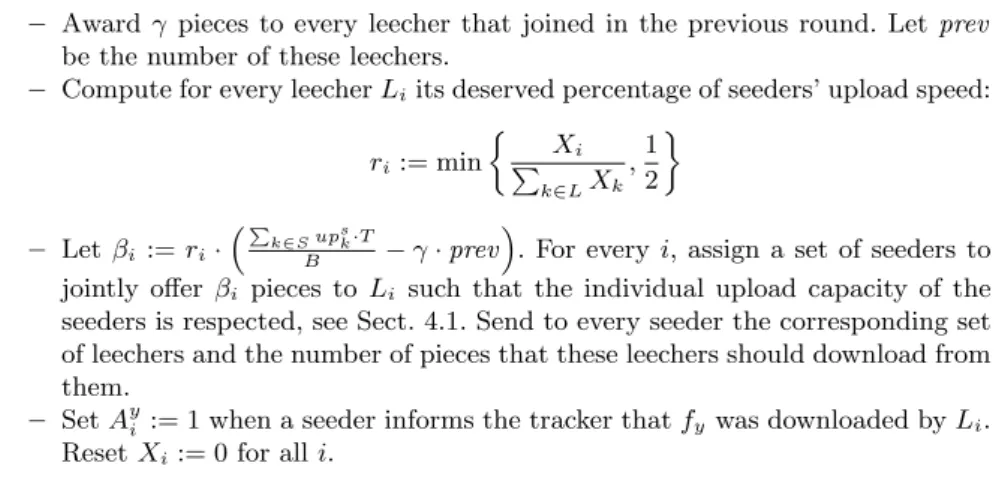
The Reward Protocol.The reward system constitutes the crucial part of RatFish. The underlying idea is to reward only leechers who are ex-changing. We only allow one exception to this rule: The leechers that have just connected to the tracker in the previous round are also entitled
to a reward of γ pieces in the current round. Thus the seeders do not automatically upload to their neighborhood as in BitTorrent; rather they are told by the tracker whom to upload to.
To determine whether an exchange between Li and Lj has indeed
taken place, the tracker asks both Li and Lj to acknowledge the
ex-change. If the acknowledgements succeed, the tracker internally increases the variables Xi and Xj, which corresponds to the number of file piece
exchanges of Li and Lj, respectively. The tracker moreover stores which
pieces of the file the leechers now additionally know. This is detailed in Fig. 4. Details on the participation of the tracker in the exchange proto-col are given in Sect. 4.3, where the rational exchange of pieces between leechers is explained.
RewardLeechers(called everyT seconds, i.e., at the start of a new round) – Awardγ pieces to every leecher that joined in the previous round. Let prev
be the number of these leechers.
– Compute for every leecherLiits deserved percentage of seeders’ upload speed:
ri:= min Xi P k∈LXk ,1 2 – Letβi:=ri· P k∈Supsk·T B −γ·prev
. For everyi, assign a set of seeders to jointly offerβi pieces to Li such that the individual upload capacity of the seeders is respected, see Sect. 4.1. Send to every seeder the corresponding set of leechers and the number of pieces that these leechers should download from them.
– SetAyi := 1 when a seeder informs the tracker thatfywas downloaded byLi. ResetXi:= 0 for alli.
Fig. 4.The protocol of the tracker with procedure RewardLeechers.
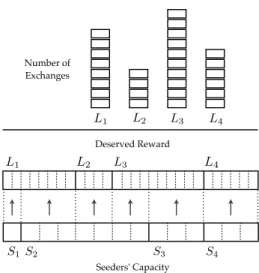
Every round, i.e., after T seconds, the actual rewards are given out. The tracker distributes the seeders’ upstream proportional to the number of exchanges every leecher made in the previous round. Hence, the more exchanges a leecher completed in a certain round, the larger the reward computed for him by the tracker, and hence the more download capacity the leecher receives from the seeders. At the beginning of a round, once the reward deserved by each leecher is computed, the old values Xi are
Seeders' Capacity L1 L2 L3 L4 Number of Exchanges Deserved Reward L1 L2 L3 L4 S1S2 S3 S4
Fig. 5.Schematic distribution of the rewards
the current round. A graphical illustration of the reward protocol is given in Fig. 5.
More precisely, Fig. 5 depicts a system with a tracker, four leechers and four seeders. During the latest complete round of exchanges, leecher L1
has performed a number of 8 exchanges and leechersL2,L3 andL4 have
performed a number of 4,10 and 6 exchanges, respectively. In terms of existing notation, this can simply be written asX1 = 8,X2= 4,X3= 10
and X4 = 6. This means that for example L1 has performed 28,57% of
all exchanges during the latest complete round. Taking into account that there are no new leechers currently connecting to the system, according to Fig. 5, at the beginning of next round,L1will receive for free 28,57% of all
the seeding capacity currently available in the system. Given the existing upload capacity of the seeders, this effectively implies that the tracker informs seeders S1 and S2 that they should upload 2 and respectively 6
file pieces for free to L1. It is assumed that S1 and S2 have the complete
file, so L1 can choose which pieces he wants to download for free. The
same reward distribution algorithm applies for the rest of the leechers and seeders.
4.2 The Protocol of the Seeder
Upon connecting, the seeder informs the tracker about the upload speed it is going to offer. The tracker adds the seeder’s speed to the amount of free available upload capacity. As the tracker performs all the computations
Seedingj
Upon connecting, the seeder sends its upload speedups
j to the tracker. Addition-ally, in each round:
– Receive from the tracker a setM of leechers and the corresponding number of piecesωithat every leecherLi∈M should receive.
– Inform every leecherLi∈M how many piecesωi they are allowed to down-load.
– When a leecherLi ∈M requests at mostωi pieces byLi (potentially incre-mentally in this round, i.e., it may ask for a few pieces first), send these pieces toLiand send a message to the tracker that these pieces have been uploaded toLi. Requests by leechersLj6∈M are ignored.
Fig. 6.The protocol of the seederSj.
for determining the rewards, the seeder simply proceeds by uploading the number of file pieces to the leechers as instructed by the tracker. To keep the tracker’s information about individual leechers up-to-date, the seeder informs the tracker whenever it uploads a piece to a leecher. A rigorous description is given in Fig. 6.
4.3 The Protocol of the Leecher
From a rational perspective, the leecher protocol is the most difficult to get right: while the tracker is honest and seeders partially altruistic, a leecher tries to bypass the incentives for uploading wherever reasonable. Intuitively, the exchange protocol looks like this: Leechers use the signed messages from the tracker to verify each other’s join times. Also, when two leechers exchange data, the tracker participates in this exchange: Before two leechers start an exchange, they verify with the tracker that the other party holds the desired piece. If this check succeeds, the encryptions of the pieces agreed upon are exchanged. Before they also send the key to each other to decrypt these messages, both leechers acknowledge the exchange to each other so that they get a higher reward.
The Connect Protocol. When a leecher connects to the tracker for the first time, it requests a local neighborhood. If the leecher rejoins, it additionally proves to the tracker that it already owns some pieces of the file by sending the signature received from the tracker at its last disconnect. When connecting to a seeder, the leecher requests pieces until its seeder’s reward is depleted.
LeecherConnecti(party) Ifpartyis the tracker, then:
1. If Li rejoins the protocol, send PIECES(a1, . . . , aN,idr, sig0i) to the tracker wheream= 1 ifLi owns the m-th piece of the file,idr is the rejoin ID and sigi0 is the signature received when disconnecting from the system last time. IfLiis a new leecher, it sendsPIECES(0, . . . ,0).
2. ReceiveTIME(Ti
p,idr, sigi) from the tracker – indicating the signed connecting time and ID, as well as a set of neighbors’ IP addresses. Connect to them. Ifpartyis a leecherLj, do (abort if a check fails):
– Send the messageMYTIME(Ti
p, sigi) toLj.
– Receive the messageMYTIME(Tpj, sigj) from Lj. Verify that sigj is a valid signature on (j, Tj
p) forpkand thatTc> Tpj+T holds.
– SendAVAILABILITY(a1, . . . , aN) toLj wheream= 1 ifLiownsfm. – Receive the messageAVAILABILITY(a01, . . . , a
0
N) fromLj.
Fig. 7.The Connect protocol for leecherLi.
Upon contacting another leecher, it waits until both forced waits are over. Afterwards, both leechers exchange information such that they know which pieces they can request from each other. To keep track of the avail-ability in its neighborhood, the leecher observes the messages that leechers broadcast to their local neighborhood, indicating which pieces of the file they have just downloaded. A detailed description is given in Fig. 7.
The Piece Exchange. The piece exchange protocol run between two leechers uses encryptions to ensure that no leecher can get a piece without completing the exchange phase. From a practical perspective, it is important to note that the key sizes are small compared to a file piece size. Thus the communication and storage overhead induced by the keys and cryptographic operations is kept manageable. Leechers addition-ally query the tracker to ensure that their exchange partners own a file piece they need. Moreover, leechers want their exchanges to be counted and rewarded. Thus, after the encryptions are exchanged, each leecher prompts the tracker to ask the other leecher for an acknowledgement. In-tuitively, there is no incentive to deviate in this step as they still lack the key from the other party. Once the acknowledgement step is successfully completed, both leechers exchange the keys. If a leecher deviates from any of these steps, it is blacklisted by the other leecher. We stress that blacklisting is not required for the security proof; it solely constitutes a
LeecherAwarded
Whenever Li is informed by a seederSj that it can downloadωi pieces, request up toωipieces fromSj(potentially incrementally in this round, i.e.,Limay ask for a few pieces first), and download these pieces.
Exchangei(fx, j, y)
If any of the following checks fails, blacklistLj and abort.
– Send the message HAS(j, y) to the tracker and wait for a positive answer represented by a bit b = 1.
– Choose a random keykj,x and computecj,x ← E(kj,x, fx). – Sendcj,x toLj and wait forcyfromLj.
– Perform the following two steps in parallel and proceed once both steps are completed:
• Send EXCHANGED(j, x, y) to the tracker and wait for OK(j, x, y) as re-sponse
• If receiving ACKNOWLEDGE(j, y, x) from the tracker, reply with
OK(j, y, x).
– Send the keykj,x toLj.
– Upon receivingky fromLj, retrievefy0 ← D(ky, cy) and verifyhy=h(fy0). – Broadcast to the local neighborhood that you now own the piecey.
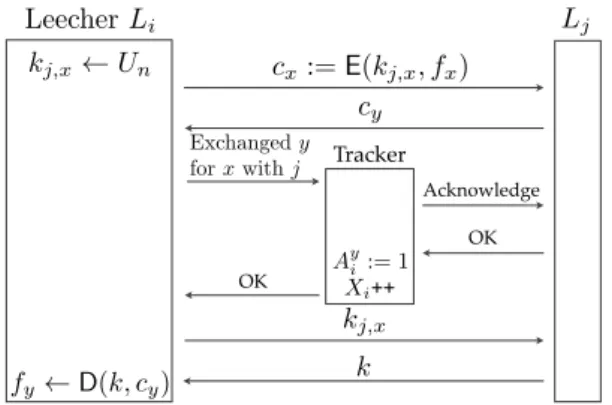
common technique in this setting to deal with malicious parties. A de-tailed description is given in Fig. 8. Fair exchange protocols have been used in prior work to incentivize peers to fairly exchange information [28]. A fair exchange intuitively means that either both parties obtain what they want or none of them obtains something. In contrast to [28], however, RatFish needs to neither periodically renew cryptographic keys, nor implement a non-repudiable complaint mechanism to allow parties to prove possible misbehaviors; instead it relies on short acknowledgment messages for each recipient and on collecting these messages to monitor the file completion for the participants. In fact, RatFish implements a weaker version of fair exchange, which is called rational exchange [5,29]. Intuitively, an exchange protocol is rational if the self-interested partici-pating parties do not have an incentive to deviate. A schematic overview of the core part of the piece exchange protocol is provided in Fig. 9.
cy k fy←D(k, cy) LeecherLi Acknowledge OK OK Tracker Lj Exchangedy forxwithj cx:=E(kj,x, fx) kj,x←Un Ayi := 1 Xi++ kj,x
Fig. 9.The core part of piece exchange protocol between two leechers
5 Equilibrium Proof
In this section we prove that RatFish yields a computational Nash equi-librium; i.e., no leecher or seeder has an incentive to deviate from the protocol.
5.1 Underlying Assumptions
Recall that RatFish proceeds in rounds ofTseconds. For simplicity, we as-sume that peers can join or leave only at the beginning or end of a round. This assumption can be easily enforced by letting the tracker force joining
peers to wait until the first round after at least T seconds pass. We also assume that it is impossible to forge identities on the IP layer (e.g., by using appropriate authentication mechanisms). Additionally, at least one seeder is present in the beginning to bootstrap the system and that the overall seeding capacity does not exceed twice the overall upload capacity of the leechers; this bound on the seeding capacity prevents the leechers from free riding, which is easy given enough seeding power. We moreover assume that each leecher’s dedicated upload speed upl
i is fully exhausted
by other peers. This is equivalent to saying that there are enough leechers in the system such that each of them has enough neighbors for completely exhausting his upload capacity. These assumptions seem reasonable as the average seeders/leechers ratio is often close to 1:1 [4], and optimized cen-tralized coordinators are capable of distributing upload capacities among different swarms [21]. Moreover, we assume that there exists a value δ
such that for every leecher Li the download speed downli is at most δ
times larger thanupl
i. This assumption is not restrictive in the sense that
we do not need to make any assumption regarding the magnitude of δ. Additionally, we assume keys do not contribute to the uploaded amount, since in practice, the size of the short keys is dominated by the size of the encrypted file piece. Moreover, we assume that each peer is only able to maintain one identity in the system. This in particular excludes Sybil attacks, in which multiple distinct identities are created by the same peer to subvert the reputation system of a P2P network. This assumption does not come as a surprise, since the Nash equilibrium conceptually does not defend against coalitions, rendering Sybil attacks possible in most works on rationally secure protocols. Regarding the cryptographic primitives, we assume that the signature scheme used by the tracker is secure against existential forgery under chosen-message attack and that the encryption scheme is semantically secure under chosen-plaintext attack. Finally, we assume that the encryption scheme is length preserving.
5.2 Proving the Nash Equilibrium
We finally show that RatFish constitutes a Nash equilibrium.
We first prove that a leecher deviating from the protocol cannot in-crease its utility by more than at most a negligible value, provided that no other party deviates. To show this, we determine two sets of possi-ble cheating actions for leechers, which we call independent actions and correlated actions. Intuitively, the independent cheating actions can be individually replaced by honest actions without decreasing the utility, in-dependent of the remaining parts of the deviating strategy. Correlated
cheating actions are sensitive to the details of the deviating strategy: we can only replace a correlated cheating action by a corresponding honest action without decreasing the utility if all deviating actions that jointly influence the leecher’s utility are simultaneously replaced in one round. We show that the only correlated cheating action is the refusal of ac-knowledgement for an exchange.
Our proof technique starts with an arbitrary deviating strategy M0 i
and provides a proof in two steps: In the first step, we replace all indepen-dent cheating actions step-by-step; here, a step within a strategy denotes the computation performed within the strategy between two consecutive outputs. Slightly more formally, letMi be the honest strategy for leecher
Li, Mi0 a deviating strategy, and {H ∗
ack,j}j the set of all strategies that
in every step are either honest or do not acknowledge an exchange. Then our technique takes as inputMi0 and yields a so-calledsemi-honest strat-egy Mi∗ ∈ {Hack∗ ,j}j that for every input and random tape outputs in
every step the same action as M0
i whenever possible, and plays honest
otherwise. We then show that the semi-honest strategy Mi∗ cannot yield a worse payoff thanMi0. The proof is based on the novel concept of hybrid concatenation of strategies.
We start by proving the following:
Lemma 1 (No Independent Cheating Actions of Leechers). Let
γ be the number of uploaded pieces a newly joined leecher is awarded. Let
M0
i be a deviating strategy of Li and let Mi∗ be the semi-rational strategy
as defined above. Then for αi∈[0,δ·γ·BT ], we have
ui(k, Mi0,M−i)−ui(k, Mi∗,M−i)≤(k),
for some negligible function .
Proof. We consider two main cases, depending on the number of steps of
Mi0. If Mi0 does not terminate in a finite number of steps, then the time
Ti,fin(o) the leecher Li has to spend in the system is infinite. Thus any
strategy, including M∗
i, cannot give a worse payoff. If Mi0 runs in N ∈N
steps, then we construct N hybrid concatenations and prove that for all
n= 0, . . . , N−1, there exist a negligible functionn
i such that it holds
ui(k, Mi0ksnM ∗ i,M−i)≤ui(k, Mi0ksn+1M ∗ i,M−i) +ni(k), (1) where by Mi0ks
nMi∗ we denote the strategy Mi0 with the last n steps
In order to show this, we use induction on the steps of strategyMi0. As there is no difference between the base case and the inductive step, we present below only the later. We examine all possible independent cheating actions which could have been performed by Mi0 at step n+ 1. Intuitively, such independent cheating actions can be grouped into two main categories: related to the messages sent or related to the messages received. When a message is sent, there are three possible scenarios: send-ing no message, sendsend-ing the correct message or sendsend-ing a malformed mes-sage. When a message is received, there are also three possible scenarios: receiving no message, receiving the message and using it correctly for nec-essary computations or receiving the message and using it in a different way than described by the protocol.
In the following, we will concentrate on the case of messages which are sent. For the messages received, the proof follows a very similar approach. It is clear that if at step n+ 1 the action performed is the action prescribed by M∗
i, then we have:
ui(k, Mi0knsMi∗,M−i) =ui(k, Mi0ksn+1Mi∗,M−i). (2)
Below we give a detailed case distinction for the situation when the action is either to send no message or to send a malformed message.
Case 1:Mi0 does not announce the correct timestamp that it received from the tracker.
Because Li is required to provide a valid signature from the tracker
on the timestamp, this deviation will be undetected only with a negligible probability, corresponding to the probability of constructing a selective forgery against the signature scheme. If Li is caught cheating, then the
other peers do not let Li connect to them. Therefore, we obtain that (1)
holds.
Case 2: Mi0 does not announce any timestamp that it received from the tracker.
As the other leechers follow the protocol as prescribed, they will not connect to a neighbor which did not announce his timestamp received from the tracker. Thus, in this case, leecher Li cannot complete the file
download and (1) trivially holds.
Case 3:Mi0 connects to leechers before the penalty wait of T seconds is over.
Other leechers will not reply toLi unless it provides a valid signature
on a timestampTi
p< Tc−T. Since an invalid signature can be produced
Case 4: Mi0 connects to leechers after the penalty wait of T seconds is over.
The more time leecherLi waits to connect to others after his penalty
wait is over, the more his utility decreases as compared to the case when he follows the prescribed strategy. So (1) is true.
Case 5: M0
i does not connect to leechers even after the penalty wait
of T seconds is over.
IfLidoes not connect to other leechers in his neighborhood orLidoes
not reply to their connect requests, then Li will not be able to download
the file at all or his upload capacity will not be fully utilized as it is the case when he follows the protocol. In both situations, his benefit by performing this deviation decreases compared to the prescribed run of the protocol. More formally, (1) holds.
Case 6: Mi0 accepts connections from leechers whose penalty wait is not over.
Because those leechers will not connect to Li, this does not change
the outcome of the game. Therefore, (1) trivially holds.
Case 7:M0
i does not accept connections from at least one leecher in
its own neighborhood, even though leecher’s penalty wait is over.
Such a deviation would slow down Li as his upload capacity would
not be fully exhausted. Thus, we have (1).
Case 8:M0
i announces to hold more pieces than it actually does.
There are two possible cases. Either Li tries to convince the tracker
upon connecting that it holds more pieces, or it has sent wrong “HAVEx” messages. In the first case, Li has to provide a valid signature from the
tracker on wrong data, which is possible only with negligible probability. In the second case, this will not affect anything until some other leecher requests a piecefxfromLithat it does not own yet. Then, in the exchange
step, the tracker will send the other leecher the message that Li does not
have fx. The exchange will be canceled and this will not allow Li to
increase his utility, thus fulfilling (1).
Case 9:Mi0 announces to hold fewer pieces than it actually does. This does not increase its utility, because the amount of pieces is used by other leechers to determine whether they can exchange withLi. Fewer
parties are willing to exchange with Li if it claims to have fewer pieces.
This case also fulfills (1).
Case 10:Mi0 does not make any announcement on the pieces it has. Such a deviation from Li would only slow it down as the other leechers
would not connect to Li for performing new exchanges: Li would
Case 11:When receiving an encrypted piece from a neighbor,Mi0 does not send anything as a reply to the corresponding leecher.
In this case, the utility ofLi would increase only if the leecher is able
to guess the file piece from the encrypted message. Since the encryption scheme is semantically secure against chosen plaintext attack, the de-viating leecher would succeed only with negligible probability so (1) is fulfilled.
Case 12:In the exchange phase, M0
i sends a wrong encryption upon
being requested to exchange piece fx.
AssumeLi does not hold piecefx. Because other leechers only request
what it announced with “HAVEx”, this means it wrongly announced that it has too many pieces. This case is already discussed above. Therefore,
Li has the piece the other party requested and the other party expects a
message of the length|Ek(fx)|. But then,Li can also send the encryption
of the requested piece, because sending a wrong encryption still requires it to upload exactly as much as uploading the right encryption. Thus, this deviation leavesLi with (1).
Case 13:Mi0 requests an invalid reward from the tracker.
By assumption,Mi0 cannot send a message under the identity of an-other player (we assumed authentic channels). However, its request will not be acknowledged by any other party, as they are sticking to the pro-tocol. Therefore, this does not increase its utility and (1) holds.
Case 14:Mi0 makes no request for reward, even though he is entitled to such a reward.By performing this deviation, the overall download time forLi will increase, thus trivially (1) holds.
Case 15:In the exchange phase,Mi0 does not send the key in the end. If the exchange reached the keys sending phase, sinceLi’s partner
fol-lows the protocol, it means that the two parties have the right piece for one another and they have already exchanged encryptions. By assump-tion, the key size does not increase the uploaded amount so if Li sends
the key it will not reduce his utility and (1) still holds.
Case 16:M0
i reconnects afterr rounds.
Let o0 be the outcome when Li follows the reconnecting strategy
M0
iksnMi∗ and let o be the outcome when Li follows Mi0ksn+1Mi∗. Since
the strategies of all other parties do not change and a leecher can recon-nect only at the beginning of a new round, we have the following relation:
Ti,fin(o0) =Ti,fin(o)+τ. The valueτ is the additional timeLispends in the
system since for at least one round, Li did not interact with any leecher.
In a similar way, ifUi is the overall amount of uploaded data for outcome
γ·B is the number of free awarded bytes for a (re-)joining leecher. As a reminder, B represents the bytes size of a file piece.
We observe that in outcomeo0, after the rejoin, the leecher is missing
at least T ·upl
i bytes compared to o. By assumption we know that the
leecher never has a download speed larger thanδ·upl
i. Hence, the time τ
the leecher needs to additionally stay in the system is given by how fast he can download the missing data. This is at least:
τ ≥ T·up l i δ·upl i = T δ.
Proving (1) is equivalent to proving
Ti,fin(o) +αi·Ui ≤Ti,fin(o) +τ +αi·(Ui−γB).
This holds true ifαi≤ γ·Bτ .The last inequality holds since by assumption
αi∈[0,δ·γ·BT ] and τ ≥ Tδ.
Case 17:Mi0 sends incompliant messages.
Because such messages are ignored by other parties, this does not affect the utility, and (1) is fulfilled.
To summarize, we obtain that (1) holds for alln∈ {0, . . . , N−1}. By summating al these equations and taking into account that N is polyno-mial inkand also that the sum of polynomially many negligible functions is still negligible, we infer that there exists a negligible function 0 such that: ui(k, Mi0,M−i) =ui(k, Mi0ks0Mi∗,M−i) ≤ui(k, Mi0ksNM ∗ i,M−i) +0(k) =ui(k, Mi∗,M−i) + 0 (k).
This concludes our proof.
Thus far, we have transformed a deviating strategy M0
i into a
semi-rational strategyM∗
i that uses only correlated cheating actions and does
not decrease the payoff. In the second step, we replace all correlated cheat-ing actions round-by-round until we reach the honest strategy Mi. We
use a hybrid argument based on the hybrid concatenation of strategies to show that the honest strategy outperforms the semi-rational strategy for leechers.
Lemma 2 (No Correlated Cheating Actions of Leechers).Let Mi
be the honest strategy for Li, i.e., following the RatFish protocol and let
Mi∗ be the semi-rational strategy as defined above. Then
ui(k, Mi∗,M−i)−ui(k, Mi,M−i)≤(k),
holds for some negligible function .
Proof. We again use the hybrid concatenation of strategies. However, now we need to replace correlated deviations with honest actions; hence the hybrids are constructed over rounds, and the notationAkr
nB denotes
that the last n rounds of strategy A are replaced by the last n rounds of strategy B. The proof starts with the last round and replaces the deviating strategy with the RatFish protocol round-by-round. We show by induction that each such replacement will not decrease the utility, i.e., for every n ∈ {1, . . . , R}, where R is the number of rounds for strategy
Mi∗, there exists a negligible functionn
i such that:
ui(k, Mi∗krn−1Mi,M−i)≤ui(k, Mi∗krnMi,M−i) +ni(k). (3)
As a consequence, the payoff for the honestMi cannot be exceeded.
For the base step, we examine the initial hybrid where no devia-tion has been removed. Clearly, it holds that ui(k, Mi∗kr0Mi,M−i) =
ui(k, Mi∗,M−i).For the inductive step, we have the induction hypothesis
ui(k, Mi∗krn−1Mi,M−i)≤ui(k, Mi∗krnMi,M−i) +ni(k),
for some negligible function n i.
Now we consider the n-th hybrid: the last n rounds are all played according to Mi and all previous rounds are played according to Mi∗.
If we compare this hybrid with the n+ 1st hybrid, the only difference is that the possibly deviating n+ 1-st round is replaced by an honest one. By definition, in round n+ 1, the strategy Mi∗ says that Li does
not acknowledge Z ≥ 0 correct exchanges, but his exchange partners acknowledge all exchanges made so far. If Z = 0, then M∗
i played in
roundn the honest strategyMi, thus:
ui(k, Mi∗krnMi,M−i) =ui(k, Mi∗krn+1Mi,M−i).
For the case where Z > 0, we investigate the properties of the util-ity function. To reach the phase of acknowledging the other’s exchange,
Li first needs to upload the encrypted data. Therefore, the amount of
honest strategy. The only possibility to increase the utility is then to download more data in the same time span. In the following, we show this is not possible.
WithMi, the leecher’s amount of downloaded data corresponding to
one round of T seconds equals
B·Xi+T ·( X k∈S upsk)·min Xi P k∈LXk ,1 2 .
Note that in the second summand, we have the reward gained in the next round, because the tracker rewards exchanges always one round later. Furthermore, the tracker caps the reward to at most one half of the total seeders’ upload, according to the protocol in Fig. 2. However, for a non-deviating player, it is impossible to obtain more than half of the overall exchanges, thus we have minn Xi
P k∈LXk, 1 2 o = Xi P k∈LXk.Using
Mi∗ in round n+ 1, the leecher gains Z ·B bytes less from the cheated exchanges, but he may obtain higher reward from the seeders.
This sums up to at most
B·(Xi−Z) +T ·( X k∈S upsk)·min Xi (P k∈LXk)−Z ,1 2 .
Indeed, the intuition for the first summand is that when leecher Li
does not acknowledge Z exchanges in a round, there is only a negligi-ble probability thatLi will obtain the corresponding decryption keys for
these exchanges. This holds asLi has only honest exchange partners and
they respond to a non-acknowledge of a correct exchange by blacklist-ing the deviatblacklist-ing Li and also by interrupting communication with Li.
The second summand gives the amount of upload reward thatLi receives
from the seeders in a round ofT seconds when he does not acknowledge
Z exchanges. The value Xi
(P
k∈LXk)−Z gives the ratio of acknowledged ex-changes forLito the total number of acknowledged exchanges. Therefore,
his utility will not increase if
Z·B+T·(X k upsk)PXi kXk ≥T ·(X k upsk)·min Xi (P kXk)−Z ,1 2 . (4) To simplify the inequality more, we can express the number of ex-changes Xk as the ratio of capacity used for uploading in one correct
round divided by the size of a file piece. Formally, we have
Xk =
T B ·up
l
for all k∈L.
Indeed, due to our assumption, for each leecherLk there are enough
neighbors in the system that can exhaust Lk’s upload capacity. Due to
the fact that valuesXk, withk∈ {1, . . . , n}, are defined for the case when
everybody is honest, and following the protocol implies exchanging with the neighbors until the full upload capacity is exhausted, we have that (5) holds.
We are now ready to distinguish two cases for the current proof. In the first case, the deviating leecher increases the benefit from the seeders, but stays below 12 of the overall seeding capacity. In the second case, the reward is capped by the tracker at exactly half of this capacity. Note that those computations below rely on the assumption that seeding power is at most twice as large as leeching power.
Case 1:min{ Xi (P kXk)−Z, 1 2}= Xi (P kXk)−Z. Then (4) evaluates to Z·B·(P kXk)·(( P kXk)−Z) T·(P kupsk) ≥Z·Xi ⇔ ( P kuplk) (P kupsk) | {z } ≥1 2 ((X k Xk)−Z)≥Xi.
The last inequality holds as we are in case 1.
Case 2:min{ Xi (P kXk)−Z, 1 2}= 1 2, then (4) evaluates to Z·B+T ·(X k upsk)PXi kXk ≥ T 2( X k upsk) ⇔ P kuplk P kupsk | {z } ≥1 2 Z≥ 1 2( X k Xk)−Xi.
The above inequality is fulfilled as we are in case 2. It follows that
ui(k, Mi∗krnMi,M−i)≤ui(k, Mi∗krn+1Mi,M−i) +n+1i (k)
and this also concludes our induction proof. By summing up all the in-equalities described by (3), wheren∈ {1, . . . , R}and taking into account that R is the number of rounds of a polynomially bounded strategy, we obtain there exists a negligible function 0 such that
ui(k, Mi∗,M−i) =ui(k, Mi∗kr0Mi,M−i)
≤ui(k, Mi∗krRMi∗,M−i) +0(k)
This concludes our proof.
Showing that seeders have no incentive to deviate from the protocol is considerably easier than the corresponding statement for leechers, since seeders are considered partially altruistic. We show that as long as all leechers follow the protocol, a seeder cannot run a deviating strategy to improve its payoff.
Lemma 3 (No Seeder Deviation). There is no deviating strategy for any seeder that increases its payoff if all other parties follow the RatFish protocol.
Proof. We prove that no matter how a seeder distributes its upload speed over the leechers, their average time to completion does not decrease. In particular, it implies the seeder’s utility does not increase if its upload speed initially announced to the tracker decreases.
The statement holds as all other participants stick to their strategy: a seeder may deviate only by assigning leechers different weights than those received from the tracker. Letr be the last round in which the seederSj
deviates and letups
i be its full upload speed. Letω1, . . . , ωnbe the weights
on the upload speed to all leechers given by the tracker and letφ1, . . . , φn
be some other arbitrary weights. It holds that Pn
k=1φk ≤
Pn
k=1ωk = 1
and that we have ωk, φk≥0 for allk. We obtain the following bound for
the average download speed of all leechers in round r:
1 |L| X k∈L (downlk+ωk·upsi) = 1 |L| X k∈L (downlk) +upsi ! ≤ 1 |L| X k∈L (downlk+φk·upsi).
Thus, if a seeder deviates from RatFish, it causes a decrease in the average download speed in round r for the leechers. Consequently, the average completion time for a leecher does increase when the seeder deviates, i.e., the seeder has no incentive to deviate from RatFish.
We finally combine the results that neither leechers nor seeders have an incentive to deviate (the tracker is honest by assumption) to establish our main result.
Theorem 1 (Computational Nash Equilibrium). The RatFish pro-tocol constitutes a computational Nash equilibrium if αi ∈[0,δ·γ·BT ]for all
Proof. We show that for every participant in the protocol, a deviation increases the utility by at most a negligible value. Assume leecher Li
deviates from the strategyMi described by the protocol usingMi0. Then,
by Lemma 1, we have that there exists a sem-rational strategy Mi∗ ∈ {H∗
ack,j}j such that for some negligible function1 it holds
ui(k, Mi0,M−i)−ui(k, Mi∗,M−i)≤1(k).
However, by Lemma 2, we have that for all M∗
i and for some negligible
function2,
ui(k, Mi∗,M−i)−ui(k,M)≤2(k).
Therefore, we obtain that for all deviating strategies Mi0 there exists a negligible function such that
ui(k, Mi0,M−i)−ui(k,M)≤(k).
Lemma 3 gives us an analogous result for seeders. Therefore, RatFish gives a computational Nash equilibrium.
After we have shown how to derive by hand the rather long and in-tricate proof that RatFish represents a Nash equilibrium, an important observation is due. First, it is not clear at first glance that our case anal-ysis technique is exhaustive. Unfortunately, since the protocol is rather complex in terms of number of different messages which are sent and re-ceived and also in terms of the side effects that they may incur, it is not clear how to perform an exhaustive case analysis by hand. Second, using a tool or a method off-the-shelf that performs an automatic verification of the game theoretic property, namely computational Nash equilibrium, for a protocol that involves cryptographic primitives and assumptions, has not been, to the best of our knowledge, attempted yet. Thus, in the current work we perform an analysis using only known or adapted proofs techniques and we leave the automated analysis for future work.
6 Implementation and Performance Evaluation
In this section, we describe the implementation of RatFish and we ex-perimentally evaluate its performance. We focus on the implementation and performance evaluation of the tracker, since the tracker took on sev-eral additional responsibilities and is now involved in every exchange. In contrast to the tracker, seeders and leechers are largely unchanged when compared to BitTorrent: the exchange of encrypted pieces constitutes a
small computational overhead, but leaves the network complexity that usually constitutes the performance bottleneck of P2P protocols essen-tially unchanged.
6.1 Implementation
The RatFish tracker was implemented using about 5000 lines of code in Java, thus ensuring compatibility with common operating systems. The implementation is designed to work with both UDP and TCP.
The messages sent in the protocol start with the protocol version number and message ID (which determines the length of the message), followed by the torrent ID, and additional information that depends on the type of message.
Afterwards, a task is created that processes the received message. This task is given to the threadpool executor – the main part of the RatFish tracker that also ensures parallelization. The threadpool sustains eight parallel threads and assigns new tasks to the next free thread. For instance, when the tracker receives a notification that a leecher joined the protocol, the task extracts the leecher’s IP from this message and triggers the forced wait. AfterT = 300 seconds it replies with a digital signature for the leecher using an RSA-based signature scheme that signs SHA-1 hashes.
6.2 Experimental Setup
For the evaluation, we ran the RatFish tracker on a server with a 2-cores Intel Xeon CPU, 2GB of RAM, a 100MBit Internet connection and an Ubuntu SMP operating system with kernel version 2.6.28-18. We simulated a swarm with up to 50,000 peers, divided into neighborhoods of size 4. The simulated leechers send the same messages as a real leecher would, thus yielding an accurate workload measure for the tracker. Every leecher was configured to complete one exchange per second, and we chose the size of a piece to be 256 kB according to BitTorrent standards. Hence every leecher has a virtual upload speed of 256 kB/s. The size of the shared file is 50 MB, and the seeders upload one forth of the file per second in a round-robin fashion to their neighborhoods. The simulated clients are running on a separate machine. This allows us to measure network throughput. In our simulation, we need to pretend to the tracker that clients connect from different IPs. We thus used UDP in our experiments. Deploying RatFish in reality would presumably be based on TCP, which would slightly increase the network complexity.
6.3 Performance Evaluations
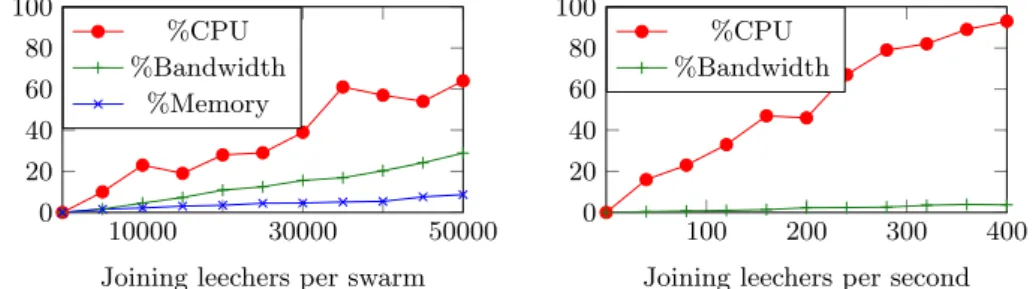
Fig. 10 depicts the results for our experiments. The main observation, shown in the left part of Fig. 10, is that even though we engage the tracker in every exchange in the swarm, the protocol scales well (a resource usage of 65% for 50,000 leechers). One can also observe that the computation complexity becomes a limiting factor, but we expect this to change for more cores given our highly parallelized implementation. Memory was not a bottleneck in any experiment.
The right part of Fig. 10 considers the case where many leechers join at once, but no exchanges are happening. This study is important since the tracker’s most expensive task is to sign the join time of leechers. In our experiments, the tracker was able to serve about 400 new leechers per second. Since the server has T seconds for signing in practical de-ployments, the signature computation would be scheduled in free CPU time and hence not delay ongoing exchanges. We also observed that the two measurements depicted in Fig. 10 on CPU usage are additive, e.g., a system with 30,000 leechers and 200 joining leechers per second uses 90% of the CPU. 10000 30000 50000 0 20 40 60 80 100
Joining leechers per swarm %CPU %Bandwidth %Memory 100 200 300 400 0 20 40 60 80 100
Joining leechers per second %CPU
%Bandwidth
Fig. 10. Left:Resource usage for a static number of leechers engaging in exchanges. Right:Resource usage for dynamically joining leechers.
7 Conclusions and Future Work
We have proposed a file sharing protocol called RatFish that we have proven secure against deviations of rational users. We first characterized rational behaviors of leechers and seeders in file sharing protocols. Sub-sequently, we formally showed that no rational party has an incentive to deviate from RatFish; i.e., RatFish constitutes a Nash equilibrium. While the tracker in RatFish is assigned additional tasks compared to existing
file sharing protocols such as BitTorrent, the communication overhead of a RatFish client compared to a BitTorrent client is minimal. We have demonstrated by means of a prototype implementation that RatFish is practical and efficient.
A central question for future work on rational file sharing – and for rational cryptography in general – is whether the Nash equilibrium is a strong enough notion for real-world applications and threat models. Ro-bustness against user coalitions would be more desirable. (See the discus-sion in [8] and [1].) RatFish already provides suitable hooks for potential mitigation techniques against coalitions, e.g., by ensuring that players entering small coalitions can only increase their utilities by a negligi-ble amount; hence entering a coalition would be irrational in the first place. Moreover, RatFish currently considers file sharing for independent swarms only, i.e., seeders in one swarm cannot be leechers in another swarm. Extending RatFish to cope with such more a general setting re-quires to generalize the seeders’ utility functions and to adapt the relevant parts of RatFish in order to maintain the Nash equilibrium property.
References
1. Abraham, I., Dolev, D., Gonen, R., Halpern, J.: Distributed computing meets game theory: robust mechanisms for rational secret sharing and multiparty computa-tion. In: 25th Annual ACM Symposium on Principles of Distributed Computing (PODC’06). pp. 53–62. ACM (2006)
2. Aiyer, A.S., Alvisi, L., Clement, A., Dahlin, M., Martin, J.P., Porth, C.: BAR fault tolerance for cooperative services. Operating Systems Review 39(5), 45–58 (2005) 3. Bharambe, A.R., Herley, C., Padmanabhan, V.N.: Analyzing and improving a BitTorrent network’s performance mechanisms. In: The 25th IEEE Conference on Computer Communications (INFOCOM’06). pp. 1–12. IEEE (2006)
4. Bieber, J., Kenney, M., Torre, N., Cox, L.P.: An empirical study of seeders in BitTorrent. Tech. rep., Duke University (2006)
5. Butty´an, L., Hubaux, J.P.: Rational exchange - a formal model based on game theory. In: Electronic Commerce, Second International Workshop (WELCOM’01). pp. 114–126. Springer (2001)
6. Cohen, B.: Incentives build robustness in BitTorrent. Tech. rep., bittorrent.org (2003)
7. Dodis, Y., Halevi, S., Rabin, T.: A cryptographic solution to a game theoretic problem. In: 20th Annual International Cryptology Conference (CRYPTO’00). pp. 112–130. Springer (2000)
8. Feigenbaum, J., Shenker, S.: Distributed algorithmic mechanism design: recent re-sults and future directions. In: 6th International Workshop on Discrete Algorithms and Methods for Mobile Computing and Communications (DIAL-M’02). pp. 1–13. ACM (2002)
9. Fuchsbauer, G., Katz, J., Naccache, D.: Efficient rational secret sharing in standard communication networks. In: 7th Theory of Cryptography Conference (TCC’10). pp. 419–436. Springer (2010)