Land Development Code Amendment
MEETING: City Council, July 10, 2012
CASE NUMBER: LDC-11-512
PROPOSED AMENDMENT: To add “religious institutions,” “amusement and recreation services, indoor” and “schools, trade, correspondence and vocational” as permitted uses in the LI, Light Industrial zoning district
CODE SECTION(S): Chapter 18, Article 5, Division II, Sections 18-198
APPLICANT: Michael Nadeau
PRESENTED BY: Brian Chambers, Associate Planner
STAFF RECOMMENDATION: APPROVAL
PLANNING COMMISSION
RECOMMENDATION: APPROVAL, 6-0
CITY COUNCIL ACTION: APPROVED, 7-0
BACKGROUND
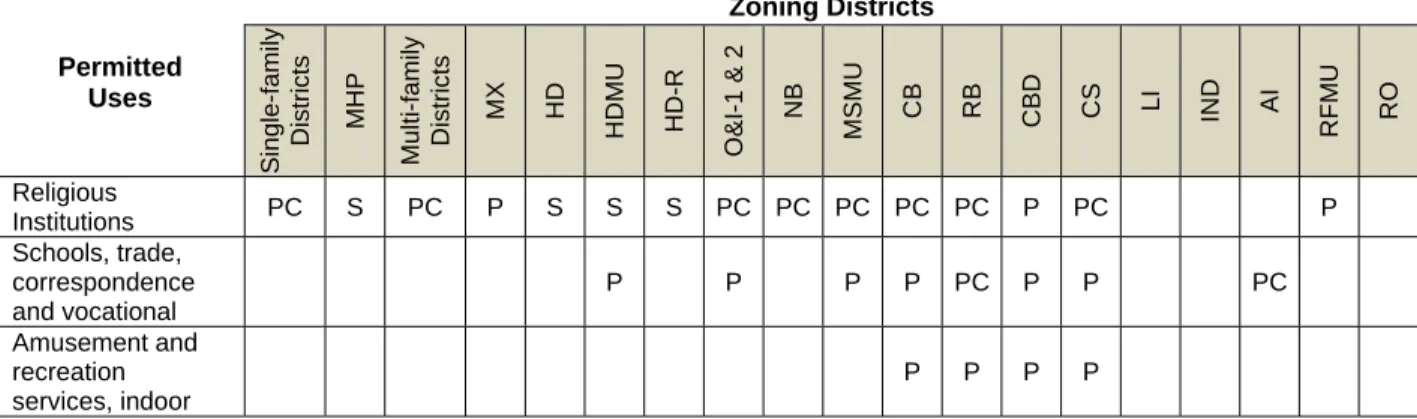
The applicant is requesting to amend the Land Development Code (LDC) to allow religious institutions under prescribed conditions and trade, correspondence and vocational schools and indoor amusement and recreation services by-right in the LI, Light Industrial district. The table below provides a detailed summary of the zoning districts in which each of these uses are currently permitted.
Table 2. Zoning districts and currently permitted uses.
Permitted Uses Zoning Districts Sing le-family D is tricts MH P M u lt i-fa m ily D is tricts MX HD HDM U HD-R O& I-1 & 2 NB MSMU CB RB CB D CS LI IN D AI RFM U RO Religious Institutions PC S PC P S S S PC PC PC PC PC P PC P Schools, trade, correspondence and vocational P P P P PC P P PC Amusement and recreation services, indoor P P P P
LDC-11-512
2 Religious institutions are currently allowed under prescribed conditions or by special use permit in all zoning districts except the industrial districts (LI, IND, AI) and the Residential-Office district (RO). Prescribed conditions and special use prerequisites include access requirements, outdoor lighting provisions, and additional bufferyard requirements.
Trade, correspondence and vocational schools are allowed by-right in most commercial districts and with prescribed conditions in the regional business (RB) and airport industrial (AI) districts. Prescribed conditions and special use prerequisites for schools include additional side and rear yard setbacks and outdoor lighting provisions.
“Amusement and recreation services, indoor” is defined by the LDC as “an establishment providing completely enclosed recreation activities.” Representative uses include arcades with coin-operated amusement devices and related amusements. This definition does not include bowling alleys, pool halls or roller skating facilities. Indoor amusement and recreation services are currently permitted by right in the CB, RB, CBD and CS districts.
ANALYSIS
In response to the current request, staff researched the land use regulations for City Council’s identified benchmark cities as well as several other North Carolina cities (see Attachment 2 for full details). This research revealed that 63% of the municipalities allow religious institutions, trade schools and indoor amusement and recreation uses in their industrial districts. Fifty percent (50%) of the cities that allow indoor amusement and recreation uses in their industrial districts, only allow them in their light industrial districts.
The LI district is established to provide areas for office, distribution, warehousing, storage and light industrial uses in accordance with adopted plans and policies. The LI district is intended to be located for satisfactory integration into the surrounding area, so as not to negatively impact existing or planned industrial uses or residential areas. The LI district allows for limited non-industrial uses, such as professional office and retail uses that are intended to serve the
employees of industrial uses as well as the surrounding area.
City Council recently added other non-industrial uses (night clubs, spas and health clubs) as permitted uses with prescribed conditions in the LI district. Prescribed conditions were adopted for these uses in order to limit the scale of these non-industrial uses so as not to constrain existing industrial sites or make it difficult for industrial uses to locate in certain areas. There are currently 317 acres of land zoned LI, which represents 0.9% of the city’s total land area.
Twenty-three percent (23%) of the city’s light industrial land area remains undeveloped.
JUSTIFICATION
The following adopted focus areas are relevant to this request:
Diverse and Thriving economy – The city will create and implement a sustainable, regionally coordinated economic development plan and business-friendly processes and policies to attract new businesses of different sizes and types and support existing businesses.
Sustainability and Adaptability – The city will make decisions focused on ensuring the long-term financial, physical and environmental, and social health of the city. We will implement
initiatives designed to augment the city’s capacity to respond to changing conditions with new solutions. Our actions will be based on a shared commitment to continuous improvement.
Applicability: The city’s focus areas recognize that sustainability and adaptability are an
important part of a thriving economy. The proposed uses are compatible with currently permitted uses in the LI district and would expand the options available to property owners looking to develop and/or redevelop underutilized or vacant buildings and tracts within these areas. The proposed amendment may allow for the adaptive reuse of existing buildings in the city’s light industrial areas that may otherwise remain vacant; thereby, contributing to the tax base and helping to ensure the long-term financial stability of the city.
PROPOSED AMENDMENTS
Additions are underlined, deletions in strikethrough.
Amend Article 5, Division II, Section 18-198 as follows:
Sec. 18-198. LI, Light Industrial District. ***
(b) Uses Permitted by Right. The following uses are permitted by right in the light
industrial district, provided that they meet all requirements of this section and all other applicable requirements established in these regulations:
***
(47) Amusement and recreation services, indoor
(48) Schools, trade, correspondence, and vocational ***
(c) Uses Permitted under Prescribed Conditions. The following uses are permitted provided that they meet all requirements of this section, Article 6, and all other applicable requirements established in these regulations:
(23) Religious institutions
CONCLUSION/RECOMMENDATION
The LI district is established to provide areas for basic industrial uses, as well as allow for limited non-industrial uses that are intended to serve the employees of and the surrounding area. The city’s light industrial areas are typically surrounded by commercial and/or office and institutional uses and in some cases are adjacent to residential areas. Indoor amusement and recreation services are currently allowed by-right in most of the city’s commercial zoning
districts and religious institutions are currently allowed under prescribed conditions or by special use permit in all zoning districts except the industrial districts. These uses are not inconsistent with currently permitted uses in the LI district and may allow for the adaptive reuse of existing vacant buildings in the city’s light industrial areas. Allowing religious institutions under
prescribed conditions would be consistent with how this use is currently permitted in the city’s commercial zoning districts. Trade and vocational schools would meet the intent of the industrial districts, as these institutions may provide necessary training for employees of industrial uses. Staff believes these uses are not inconsistent with the intent of the LI district. Therefore, staff recommends approval of the proposed Land Development Code amendment.
LDC-11-512
4 NEIGHBORHOOD CONTACT
City Notifications: Planning Commission City Council
Signs Posted N/A N/A
Adjacent Letters N/A N/A
Advertisement Dates 6/1/12 6/29/12 & 7/6/12
General Inquires: None
ACTIONS TO DATE
Planning Commission: 5/2/12, Continued, 7-0
Information from the 5/2/12 Planning Commission meeting: No one spoke in favor of or in opposition to the proposed amendment. The applicant’s initial request was to allow religious institutions, schools and indoor amusement and recreation services in both the LI, Light
Industrial and IND, Industrial districts by-right. Planning Commission discussed their concern for the compatibility of permitting schools, religious institutions and amusement and recreation uses in the industrial districts, particularly the IND district. The Planning Commission continued the item until the June 6th meeting to allow time for staff to work with the applicant on possible alternatives for the proposed amendment that may address their concerns.
Information since the 5/2/12 Planning Commission meeting: Staff met with the applicant on 5/10/12 to discuss possible alternatives for modifying the requested amendment. The applicant has since modified their original code amendment request.
Planning Commission: 6/6/12, Recommended for approval, 6-0
Information from the 6/6/12 Planning Commission meeting: No one spoke in favor of or in opposition to the proposed amendment. Staff presented an alternative amendment based on Planning Commission’s discussion at their 5/2/12 meeting. The applicant agreed to amend their request to coincide with the alternative amendment. After a brief discussion, the Planning Commission voted unanimously to recommend approval of the alternative amendment.
City Council: 7/10/12, Approved, 7-0
Information from the 7/10/12 City Council meeting: No one spoke in favor of or in opposition to the proposed amendment. After a brief discussion, City Council voted unanimously to
approve the requested amendment on first and second reading.
ATTACHMENTS
1. Land Development Code Amendment Application (dated received 2/23/12) 2. Industrial zoning benchmark information
3. Map of areas zoned LI and IND in the Wilmington city limits. (dated 3/27/12) 4. Planning Commission Recommendation (dated 6/6/12)
Religious
Institutions Schools
Amusement and recreation, indoor Alexandria, VA I, Industrial N N S
Annapolis, MD I1, Industrial N P N LI, Light Industrial N P (Trade schools) N I, Industrial P
P (Trade schools, Colleges & universities)
N
LI, Light Industrial P P P
HI, Heavy Industrial P P P
Cary, NC I, Industrial P P (Colleges) N I-1, Light Industrial P
P (Trade schools), C (Colleges &
Universities)
P
I-2, General Industrial P
P (Trade schools), C (Colleges & Universities) P M-2, Light Industrial N N N M-4, Outdoor Industrial N N N
IL, Industrial Light C P P
I, Industrial N N N
M1, Industrial N N N
M2, Industrial N N N
LI, Light Industrial P P P
HI, Heavy Industrial P P N
I, Industry N N N
IU, Unoffensive Industry S N N
LI, Light Industrial P P (Colleges) P
HI, Heavy Industrial P N N
I-1, Light Industrial P P (Trade schools,
Colleges) P I-2, Heavy Industrial P P (Trade schools,
Colleges) N
I-1, Industrial 1 P P P
I-2, Industrial 2 P P P
I-1, Light Industrial P
P (Trade schools), S (Primary & secondary schools)
P
I-2, General Industrial N N N
I-L, Light Industrial N P P
I-H, Heavy Industrial N P N
St. Augustine, FL IW, Industrial and N P (Trade schools) N IT, Industrial Traditional N N P
IS, Industrial Suburban N N P
LI, Limited Industrial P P (Trade schools) P Sante Fe, NM Savannah, GA St. Petersburg, FL Chattanooga, TN Durham, NC Fayetteville, NC Greensboro, NC Greenville, NC High Point, NC Uses Industrial Zoning Districts
Benchmark City
Raleigh, NC New Bern, NC
P = Permitted, C = Conditional, S = Special Use, N = Not Permitted
Asheville, NC
Charleston, SC
LDC-11-512
LDC 11 512
Current Industrial
Zoning Districts
I
t j
h
LI, Light Industrial IND, Industrial