1. General
description
The LPC2141/42/44/46/48 microcontrollers are based on a 16-bit/32-bit ARM7TDMI-S CPU with real-time emulation and embedded trace support, that combine the
microcontroller with embedded high-speed flash memory ranging from 32 kB to 512 kB. A 128-bit wide memory interface and a unique accelerator architecture enable 32-bit code execution at the maximum clock rate. For critical code size applications, the alternative 16-bit Thumb mode reduces code by more than 30 % with minimal performance penalty. Due to their tiny size and low power consumption, LPC2141/42/44/46/48 are ideal for applications where miniaturization is a key requirement, such as access control and point-of-sale. Serial communications interfaces ranging from a USB 2.0 Full-speed device, multiple UARTs, SPI, SSP to I2C-bus and on-chip SRAM of 8 kB up to 40 kB,
make these devices very well suited for communication gateways and protocol converters, soft modems, voice recognition and low end imaging, providing both large buffer size and high processing power. Various 32-bit timers, single or dual 10-bit ADC(s), 10-bit DAC, PWM channels and 45 fast GPIO lines with up to nine edge or level sensitive external interrupt pins make these microcontrollers suitable for industrial control and medical systems.
2. Features and benefits
2.1 Key features
16-bit/32-bit ARM7TDMI-S microcontroller in a tiny LQFP64 package.
8 kB to 40 kB of on-chip static RAM and 32 kB to 512 kB of on-chip flash memory. 128-bit wide interface/accelerator enables high-speed 60 MHz operation.
In-System Programming/In-Application Programming (ISP/IAP) via on-chip boot loader software. Single flash sector or full chip erase in 400 ms and programming of 256 B in 1 ms.
EmbeddedICE RT and Embedded Trace interfaces offer real-time debugging with the on-chip RealMonitor software and high-speed tracing of instruction execution.
USB 2.0 Full-speed compliant device controller with 2 kB of endpoint RAM.
In addition, the LPC2146/48 provides 8 kB of on-chip RAM accessible to USB by DMA. One or two (LPC2141/42 vs. LPC2144/46/48) 10-bit ADCs provide a total of 6/14
analog inputs, with conversion times as low as 2.44s per channel.
Single 10-bit DAC provides variable analog output (LPC2142/44/46/48 only). Two 32-bit timers/external event counters (with four capture and four compare
channels each), PWM unit (six outputs) and watchdog.
Low power Real-Time Clock (RTC) with independent power and 32 kHz clock input.
with ISP/IAP, USB 2.0 full-speed device, 10-bit ADC and DAC
LPC2141_42_44_46_48 All information provided in this document is subject to legal disclaimers. © NXP B.V. 2011. All rights reserved.
Multiple serial interfaces including two UARTs (16C550), two Fast I2C-bus (400 kbit/s),
SPI and SSP with buffering and variable data length capabilities.
Vectored Interrupt Controller (VIC) with configurable priorities and vector addresses. Up to 45 of 5 V tolerant fast general purpose I/O pins in a tiny LQFP64 package. Up to 21 external interrupt pins available.
60 MHz maximum CPU clock available from programmable on-chip PLL with settling time of 100s.
On-chip integrated oscillator operates with an external crystal from 1 MHz to 25 MHz.
Power saving modes include Idle and Power-down.
Individual enable/disable of peripheral functions as well as peripheral clock scaling for additional power optimization.
Processor wake-up from Power-down mode via external interrupt or BOD. Single power supply chip with POR and BOD circuits:
CPU operating voltage range of 3.0 V to 3.6 V (3.3 V10 %) with 5 V tolerant I/O pads.
3. Ordering
information
3.1 Ordering options
[1] While the USB DMA is the primary user of the additional 8 kB RAM, this RAM is also accessible at any time by the CPU as a general
purpose RAM for data and code storage.
Table 1. Ordering information
Type number Package
Name Description Version
LPC2141FBD64 LQFP64 plastic low profile quad flat package; 64 leads; body 10101.4 mm SOT314-2 LPC2142FBD64 LPC2144FBD64 LPC2146FBD64 LPC2148FBD64
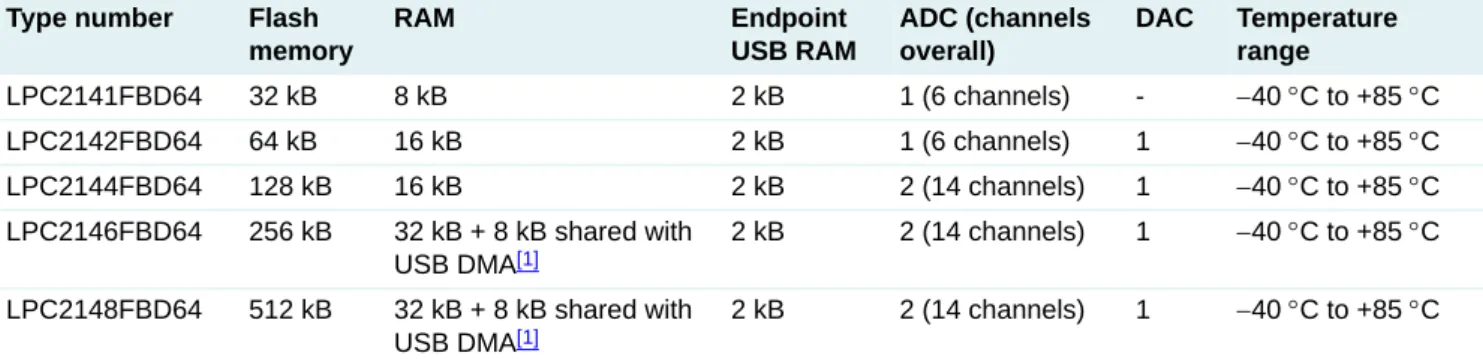
Table 2. Ordering options
Type number Flash memory RAM Endpoint USB RAM ADC (channels overall) DAC Temperature range LPC2141FBD64 32 kB 8 kB 2 kB 1 (6 channels) - 40 C to +85 C LPC2142FBD64 64 kB 16 kB 2 kB 1 (6 channels) 1 40 C to +85 C LPC2144FBD64 128 kB 16 kB 2 kB 2 (14 channels) 1 40 C to +85 C LPC2146FBD64 256 kB 32 kB + 8 kB shared with USB DMA[1] 2 kB 2 (14 channels) 1 40 C to +85 C LPC2148FBD64 512 kB 32 kB + 8 kB shared with USB DMA[1] 2 kB 2 (14 channels) 1 40 C to +85 C
4. Block
diagram
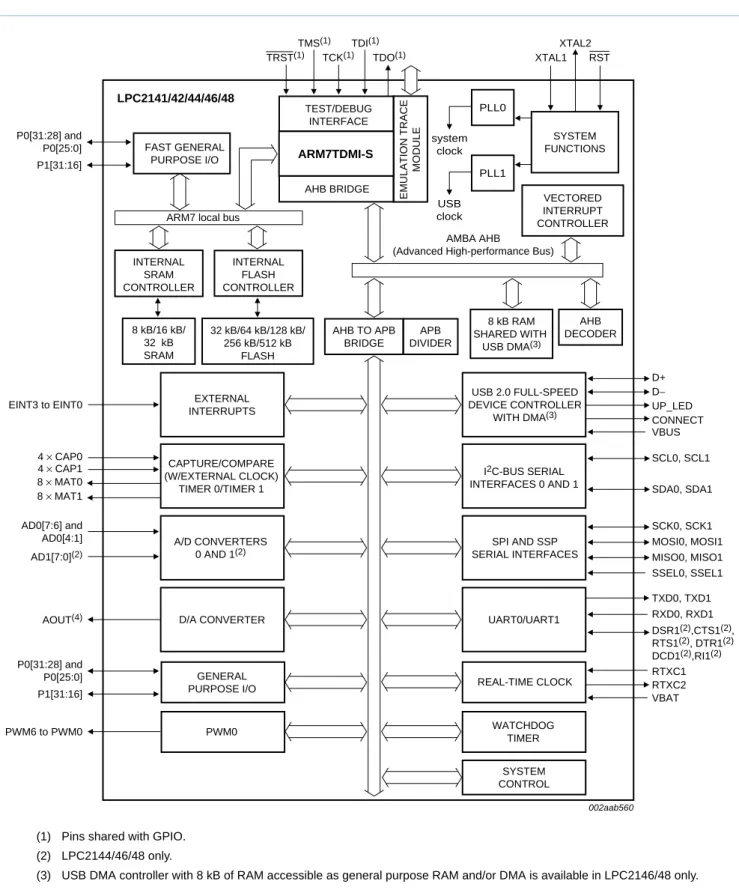
(1) Pins shared with GPIO. (2) LPC2144/46/48 only.
(3) USB DMA controller with 8 kB of RAM accessible as general purpose RAM and/or DMA is available in LPC2146/48 only. (4) LPC2142/44/46/48 only.
Fig 1. Block diagram
002aab560 system clock TRST(1) TMS(1) TCK(1) TDI(1) TDO(1) XTAL2 XTAL1 AMBA AHB
(Advanced High-performance Bus) INTERNAL FLASH CONTROLLER AHB BRIDGE EMULATION TRACE MODULE TEST/DEBUG INTERFACE AHB DECODER AHB TO APB BRIDGE APB DIVIDER VECTORED INTERRUPT CONTROLLER SYSTEM FUNCTIONS PLL0 USB clock PLL1 SYSTEM CONTROL 32 kB/64 kB/128 kB/ 256 kB/512 kB FLASH ARM7TDMI-S LPC2141/42/44/46/48 INTERNAL SRAM CONTROLLER 8 kB/16 kB/ 32 kB SRAM
ARM7 local bus
SCL0, SCL1 SDA0, SDA1 4 × CAP0 4 × CAP1 8 × MAT0 8 × MAT1 I2C-BUS SERIAL INTERFACES 0 AND 1 CAPTURE/COMPARE (W/EXTERNAL CLOCK) TIMER 0/TIMER 1
EINT3 to EINT0 EXTERNAL
INTERRUPTS D+ D− UP_LED CONNECT VBUS USB 2.0 FULL-SPEED DEVICE CONTROLLER WITH DMA(3) SCK0, SCK1 MOSI0, MOSI1 MISO0, MISO1 AD0[7:6] and AD0[4:1] AD1[7:0](2) SSEL0, SSEL1 SPI AND SSP SERIAL INTERFACES A/D CONVERTERS 0 AND 1(2) TXD0, TXD1 RXD0, RXD1 DSR1(2),CTS1(2), RTS1(2), DTR1(2) DCD1(2),RI1(2)
AOUT(4) D/A CONVERTER UART0/UART1
P0[31:28] and P0[25:0] P1[31:16] RTXC2 RTXC1 VBAT REAL-TIME CLOCK GENERAL PURPOSE I/O PWM6 to PWM0 WATCHDOG TIMER PWM0 P0[31:28] and P0[25:0] P1[31:16] FAST GENERAL PURPOSE I/O 8 kB RAM SHARED WITH USB DMA(3) RST
LPC2141_42_44_46_48 All information provided in this document is subject to legal disclaimers. © NXP B.V. 2011. All rights reserved.
5. Pinning
information
5.1 Pinning
Fig 2. LPC2141 pinning LPC2141 P0.21/PWM5/CAP1.3 P1.20/TRACESYNC P0.22/CAP0.0/MAT0.0 P0.17/CAP1.2/SCK1/MAT1.2 RTCX1 P0.16/EINT0/MAT0.2/CAP0.2 P1.19/TRACEPKT3 P0.15/EINT2 RTCX2 P1.21/PIPESTAT0 VSS VDD VDDA VSS P1.18/TRACEPKT2 P0.14/EINT1/SDA1 P0.25/AD0.4 P1.22/PIPESTAT1 D+ P0.13/MAT1.1 D− P0.12/MAT1.0 P1.17/TRACEPKT1 P0.11/CAP1.1/SCL1 P0.28/AD0.1/CAP0.2/MAT0.2 P1.23/PIPESTAT2 P0.29/AD0.2/CAP0.3/MAT0.3 P0.10/CAP1.0 P0.30/AD0.3/EINT3/CAP0.0 P0.9/RXD1/PWM6/EINT3 P1.16/TRACEPKT0 P0.8/TXD1/PWM4 P0.31/UP_LED/CONNECT P1.27/TDO VSS VREF P0.0/TXD0/PWM1 XTAL1 P1.31/TRST XTAL2 P0.1/RXD0/PWM3/EINT0 P1.28/TDI P0.2/SCL0/CAP0.0 VSSA VDD P0.23/V BUS P1.26/RTCK RESET VSS P1.29/TCK P0.3/SDA0/MAT0.0/EINT1 P0.20/MAT1.3/SSEL1/EINT3 P0.4/SCK0/CAP0.1/AD0.6 P0.19/MAT1.2/MOSI1/CAP1.2 P1.25/EXTIN0 P0.18/CAP1.3/MISO1/MAT1.3 P0.5/MISO0/MAT0.1/AD0.7 P1.30/TMS P0.6/MOSI0/CAP0.2 VDD P0.7/SSEL0/PWM2/EINT2 VSS P1.24/TRACECLK VBAT 002aab733 1 2 3 4 5 6 7 8 9 10 11 12 13 14 15 16 48 47 46 45 44 43 42 41 40 39 38 37 36 35 34 33 17 18 19 20 21 22 23 24 25 26 27 28 29 30 31 32 64 63 62 61 60 59 58 57 56 55 54 53 52 51 50 49Fig 3. LPC2142 pinning LPC2142 P0.21/PWM5/CAP1.3 P1.20/TRACESYNC P0.22/CAP0.0/MAT0.0 P0.17/CAP1.2/SCK1/MAT1.2 RTCX1 P0.16/EINT0/MAT0.2/CAP0.2 P1.19/TRACEPKT3 P0.15/EINT2 RTCX2 P1.21/PIPESTAT0 VSS VDD VDDA VSS P1.18/TRACEPKT2 P0.14/EINT1/SDA1 P0.25/AD0.4/AOUT P1.22/PIPESTAT1 D+ P0.13/MAT1.1 D− P0.12/MAT1.0 P1.17/TRACEPKT1 P0.11/CAP1.1/SCL1 P0.28/AD0.1/CAP0.2/MAT0.2 P1.23/PIPESTAT2 P0.29/AD0.2/CAP0.3/MAT0.3 P0.10/CAP1.0 P0.30/AD0.3/EINT3/CAP0.0 P0.9/RXD1/PWM6/EINT3 P1.16/TRACEPKT0 P0.8/TXD1/PWM4 P0.31/UP_LED/CONNECT P1.27/TDO VSS VREF P0.0/TXD0/PWM1 XTAL1 P1.31/TRST XTAL2 P0.1/RXD0/PWM3/EINT0 P1.28/TDI P0.2/SCL0/CAP0.0 VSSA VDD P0.23/V BUS P1.26/RTCK RESET VSS P1.29/TCK P0.3/SDA0/MAT0.0/EINT1 P0.20/MAT1.3/SSEL1/EINT3 P0.4/SCK0/CAP0.1/AD0.6 P0.19/MAT1.2/MOSI1/CAP1.2 P1.25/EXTIN0 P0.18/CAP1.3/MISO1/MAT1.3 P0.5/MISO0/MAT0.1/AD0.7 P1.30/TMS P0.6/MOSI0/CAP0.2 VDD P0.7/SSEL0/PWM2/EINT2 VSS P1.24/TRACECLK VBAT 002aab734 1 2 3 4 5 6 7 8 9 10 11 12 13 14 15 16 48 47 46 45 44 43 42 41 40 39 38 37 36 35 34 33 17 18 19 20 21 22 23 24 25 26 27 28 29 30 31 32 64 63 62 61 60 59 58 57 56 55 54 53 52 51 50 49
LPC2141_42_44_46_48 All information provided in this document is subject to legal disclaimers. © NXP B.V. 2011. All rights reserved. Fig 4. LPC2144/46/48 pinning LPC2144/2146/2148 P0.21/PWM5/AD1.6/CAP1.3 P1.20/TRACESYNC P0.22/AD1.7/CAP0.0/MAT0.0 P0.17/CAP1.2/SCK1/MAT1.2 RTCX1 P0.16/EINT0/MAT0.2/CAP0.2 P1.19/TRACEPKT3 P0.15/RI1/EINT2/AD1.5 RTCX2 P1.21/PIPESTAT0 VSS VDD VDDA VSS P1.18/TRACEPKT2 P0.14/DCD1/EINT1/SDA1 P0.25/AD0.4/AOUT P1.22/PIPESTAT1 D+ P0.13/DTR1/MAT1.1/AD1.4 D− P0.12/DSR1/MAT1.0/AD1.3 P1.17/TRACEPKT1 P0.11/CTS1/CAP1.1/SCL1 P0.28/AD0.1/CAP0.2/MAT0.2 P1.23/PIPESTAT2 P0.29/AD0.2/CAP0.3/MAT0.3 P0.10/RTS1/CAP1.0/AD1.2 P0.30/AD0.3/EINT3/CAP0.0 P0.9/RXD1/PWM6/EINT3 P1.16/TRACEPKT0 P0.8/TXD1/PWM4/AD1.1 P0.31/UP_LED/CONNECT P1.27/TDO VSS VREF P0.0/TXD0/PWM1 XTAL1 P1.31/TRST XTAL2 P0.1/RXD0/PWM3/EINT0 P1.28/TDI P0.2/SCL0/CAP0.0 VSSA VDD P0.23/V BUS P1.26/RTCK RESET VSS P1.29/TCK P0.3/SDA0/MAT0.0/EINT1 P0.20/MAT1.3/SSEL1/EINT3 P0.4/SCK0/CAP0.1/AD0.6 P0.19/MAT1.2/MOSI1/CAP1.2 P1.25/EXTIN0 P0.18/CAP1.3/MISO1/MAT1.3 P0.5/MISO0/MAT0.1/AD0.7 P1.30/TMS P0.6/MOSI0/CAP0.2/AD1.0 VDD P0.7/SSEL0/PWM2/EINT2 VSS P1.24/TRACECLK VBAT 002aab735 1 2 3 4 5 6 7 8 9 10 11 12 13 14 15 16 48 47 46 45 44 43 42 41 40 39 38 37 36 35 34 33 17 18 19 20 21 22 23 24 25 26 27 28 29 30 31 32 64 63 62 61 60 59 58 57 56 55 54 53 52 51 50 49
5.2 Pin description
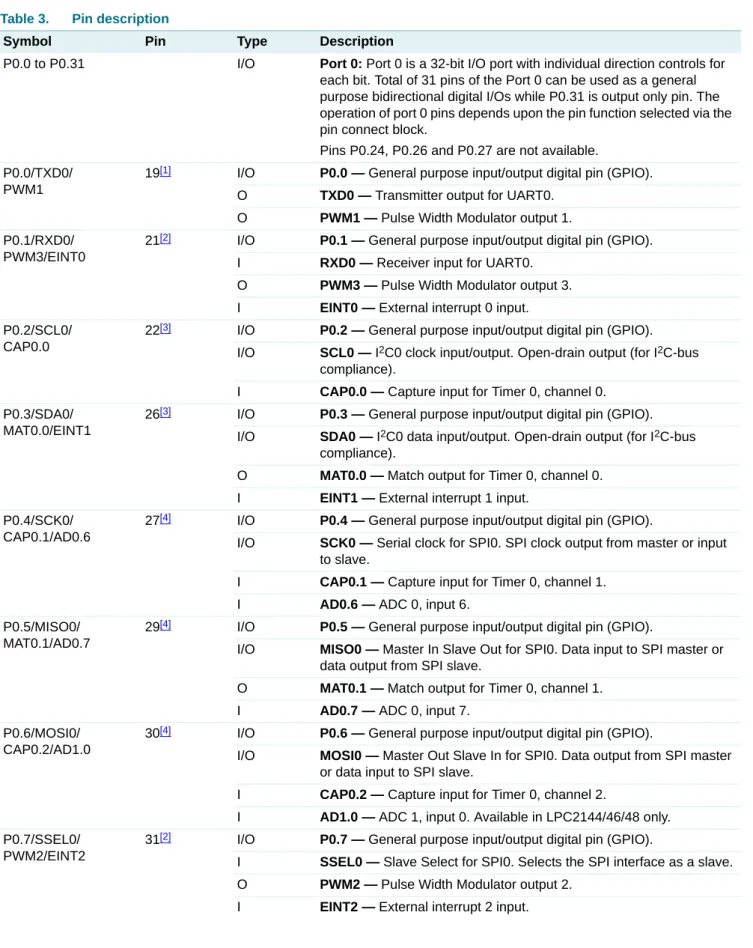
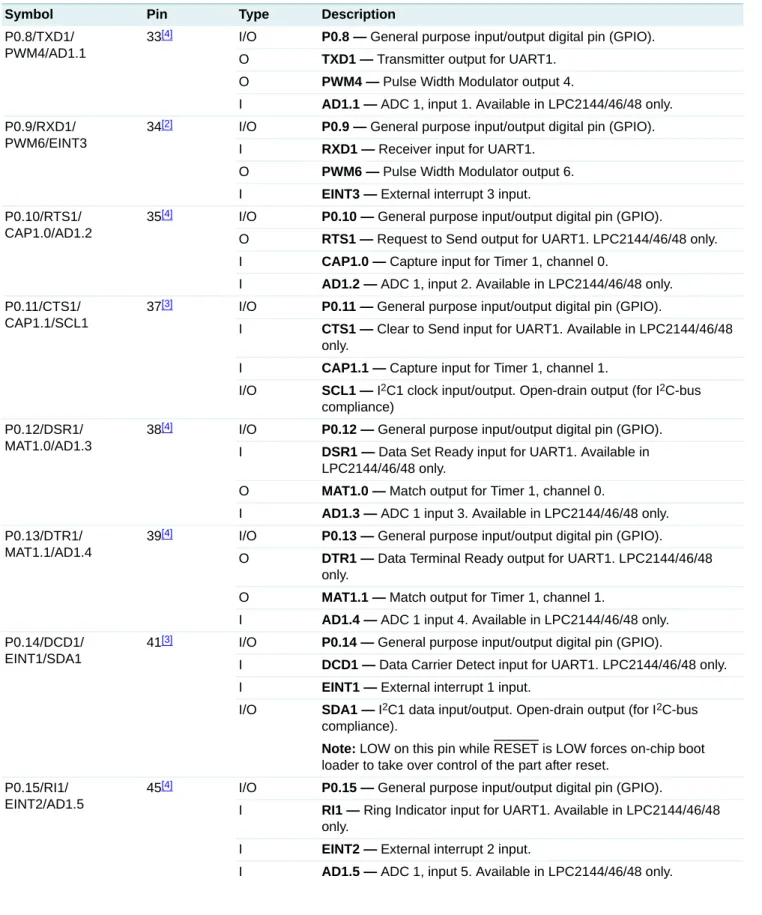
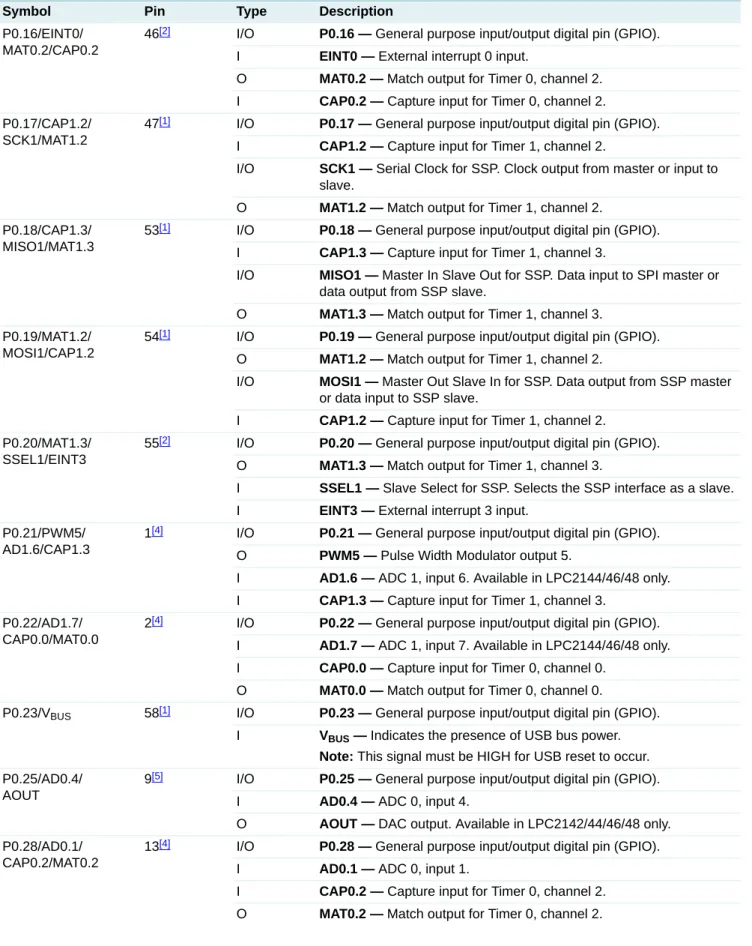
Table 3. Pin descriptionSymbol Pin Type Description
P0.0 to P0.31 I/O Port 0: Port 0 is a 32-bit I/O port with individual direction controls for each bit. Total of 31 pins of the Port 0 can be used as a general purpose bidirectional digital I/Os while P0.31 is output only pin. The operation of port 0 pins depends upon the pin function selected via the pin connect block.
Pins P0.24, P0.26 and P0.27 are not available. P0.0/TXD0/
PWM1
19[1] I/O P0.0 — General purpose input/output digital pin (GPIO).
O TXD0 — Transmitter output for UART0. O PWM1 — Pulse Width Modulator output 1. P0.1/RXD0/
PWM3/EINT0
21[2] I/O P0.1 — General purpose input/output digital pin (GPIO).
I RXD0 — Receiver input for UART0. O PWM3 — Pulse Width Modulator output 3. I EINT0 — External interrupt 0 input. P0.2/SCL0/
CAP0.0
22[3] I/O P0.2 — General purpose input/output digital pin (GPIO).
I/O SCL0 — I2C0 clock input/output. Open-drain output (for I2C-bus
compliance).
I CAP0.0 — Capture input for Timer 0, channel 0. P0.3/SDA0/
MAT0.0/EINT1
26[3] I/O P0.3 — General purpose input/output digital pin (GPIO).
I/O SDA0 — I2C0 data input/output. Open-drain output (for I2C-bus
compliance).
O MAT0.0 — Match output for Timer 0, channel 0. I EINT1 — External interrupt 1 input.
P0.4/SCK0/ CAP0.1/AD0.6
27[4] I/O P0.4 — General purpose input/output digital pin (GPIO).
I/O SCK0 — Serial clock for SPI0. SPI clock output from master or input to slave.
I CAP0.1 — Capture input for Timer 0, channel 1. I AD0.6 — ADC 0, input 6.
P0.5/MISO0/ MAT0.1/AD0.7
29[4] I/O P0.5 — General purpose input/output digital pin (GPIO).
I/O MISO0 — Master In Slave Out for SPI0. Data input to SPI master or data output from SPI slave.
O MAT0.1 — Match output for Timer 0, channel 1. I AD0.7 — ADC 0, input 7.
P0.6/MOSI0/ CAP0.2/AD1.0
30[4] I/O P0.6 — General purpose input/output digital pin (GPIO).
I/O MOSI0 — Master Out Slave In for SPI0. Data output from SPI master or data input to SPI slave.
I CAP0.2 — Capture input for Timer 0, channel 2.
I AD1.0 — ADC 1, input 0. Available in LPC2144/46/48 only. P0.7/SSEL0/
PWM2/EINT2
31[2] I/O P0.7 — General purpose input/output digital pin (GPIO).
I SSEL0 — Slave Select for SPI0. Selects the SPI interface as a slave. O PWM2 — Pulse Width Modulator output 2.
LPC2141_42_44_46_48 All information provided in this document is subject to legal disclaimers. © NXP B.V. 2011. All rights reserved.
P0.8/TXD1/ PWM4/AD1.1
33[4] I/O P0.8 — General purpose input/output digital pin (GPIO).
O TXD1 — Transmitter output for UART1. O PWM4 — Pulse Width Modulator output 4.
I AD1.1 — ADC 1, input 1. Available in LPC2144/46/48 only. P0.9/RXD1/
PWM6/EINT3
34[2] I/O P0.9 — General purpose input/output digital pin (GPIO).
I RXD1 — Receiver input for UART1. O PWM6 — Pulse Width Modulator output 6. I EINT3 — External interrupt 3 input. P0.10/RTS1/
CAP1.0/AD1.2
35[4] I/O P0.10 — General purpose input/output digital pin (GPIO).
O RTS1 — Request to Send output for UART1. LPC2144/46/48 only. I CAP1.0 — Capture input for Timer 1, channel 0.
I AD1.2 — ADC 1, input 2. Available in LPC2144/46/48 only. P0.11/CTS1/
CAP1.1/SCL1
37[3] I/O P0.11 — General purpose input/output digital pin (GPIO).
I CTS1 — Clear to Send input for UART1. Available in LPC2144/46/48 only.
I CAP1.1 — Capture input for Timer 1, channel 1.
I/O SCL1 — I2C1 clock input/output. Open-drain output (for I2C-bus
compliance) P0.12/DSR1/
MAT1.0/AD1.3
38[4] I/O P0.12 — General purpose input/output digital pin (GPIO).
I DSR1 — Data Set Ready input for UART1. Available in LPC2144/46/48 only.
O MAT1.0 — Match output for Timer 1, channel 0.
I AD1.3 — ADC 1 input 3. Available in LPC2144/46/48 only. P0.13/DTR1/
MAT1.1/AD1.4
39[4] I/O P0.13 — General purpose input/output digital pin (GPIO).
O DTR1 — Data Terminal Ready output for UART1. LPC2144/46/48 only.
O MAT1.1 — Match output for Timer 1, channel 1.
I AD1.4 — ADC 1 input 4. Available in LPC2144/46/48 only. P0.14/DCD1/
EINT1/SDA1
41[3] I/O P0.14 — General purpose input/output digital pin (GPIO).
I DCD1 — Data Carrier Detect input for UART1. LPC2144/46/48 only. I EINT1 — External interrupt 1 input.
I/O SDA1 — I2C1 data input/output. Open-drain output (for I2C-bus
compliance).
Note: LOW on this pin while RESET is LOW forces on-chip boot loader to take over control of the part after reset.
P0.15/RI1/ EINT2/AD1.5
45[4] I/O P0.15 — General purpose input/output digital pin (GPIO).
I RI1 — Ring Indicator input for UART1. Available in LPC2144/46/48 only.
I EINT2 — External interrupt 2 input.
I AD1.5 — ADC 1, input 5. Available in LPC2144/46/48 only. Table 3. Pin description …continued
P0.16/EINT0/ MAT0.2/CAP0.2
46[2] I/O P0.16 — General purpose input/output digital pin (GPIO).
I EINT0 — External interrupt 0 input.
O MAT0.2 — Match output for Timer 0, channel 2. I CAP0.2 — Capture input for Timer 0, channel 2. P0.17/CAP1.2/
SCK1/MAT1.2
47[1] I/O P0.17 — General purpose input/output digital pin (GPIO).
I CAP1.2 — Capture input for Timer 1, channel 2.
I/O SCK1 — Serial Clock for SSP. Clock output from master or input to slave.
O MAT1.2 — Match output for Timer 1, channel 2. P0.18/CAP1.3/
MISO1/MAT1.3
53[1] I/O P0.18 — General purpose input/output digital pin (GPIO).
I CAP1.3 — Capture input for Timer 1, channel 3.
I/O MISO1 — Master In Slave Out for SSP. Data input to SPI master or data output from SSP slave.
O MAT1.3 — Match output for Timer 1, channel 3. P0.19/MAT1.2/
MOSI1/CAP1.2
54[1] I/O P0.19 — General purpose input/output digital pin (GPIO).
O MAT1.2 — Match output for Timer 1, channel 2.
I/O MOSI1 — Master Out Slave In for SSP. Data output from SSP master or data input to SSP slave.
I CAP1.2 — Capture input for Timer 1, channel 2. P0.20/MAT1.3/
SSEL1/EINT3
55[2] I/O P0.20 — General purpose input/output digital pin (GPIO).
O MAT1.3 — Match output for Timer 1, channel 3.
I SSEL1 — Slave Select for SSP. Selects the SSP interface as a slave. I EINT3 — External interrupt 3 input.
P0.21/PWM5/ AD1.6/CAP1.3
1[4] I/O P0.21 — General purpose input/output digital pin (GPIO).
O PWM5 — Pulse Width Modulator output 5.
I AD1.6 — ADC 1, input 6. Available in LPC2144/46/48 only. I CAP1.3 — Capture input for Timer 1, channel 3.
P0.22/AD1.7/ CAP0.0/MAT0.0
2[4] I/O P0.22 — General purpose input/output digital pin (GPIO).
I AD1.7 — ADC 1, input 7. Available in LPC2144/46/48 only. I CAP0.0 — Capture input for Timer 0, channel 0.
O MAT0.0 — Match output for Timer 0, channel 0.
P0.23/VBUS 58[1] I/O P0.23 — General purpose input/output digital pin (GPIO).
I VBUS — Indicates the presence of USB bus power.
Note: This signal must be HIGH for USB reset to occur. P0.25/AD0.4/
AOUT
9[5] I/O P0.25 — General purpose input/output digital pin (GPIO).
I AD0.4 — ADC 0, input 4.
O AOUT — DAC output. Available in LPC2142/44/46/48 only. P0.28/AD0.1/
CAP0.2/MAT0.2
13[4] I/O P0.28 — General purpose input/output digital pin (GPIO).
I AD0.1 — ADC 0, input 1.
I CAP0.2 — Capture input for Timer 0, channel 2. O MAT0.2 — Match output for Timer 0, channel 2. Table 3. Pin description …continued
LPC2141_42_44_46_48 All information provided in this document is subject to legal disclaimers. © NXP B.V. 2011. All rights reserved.
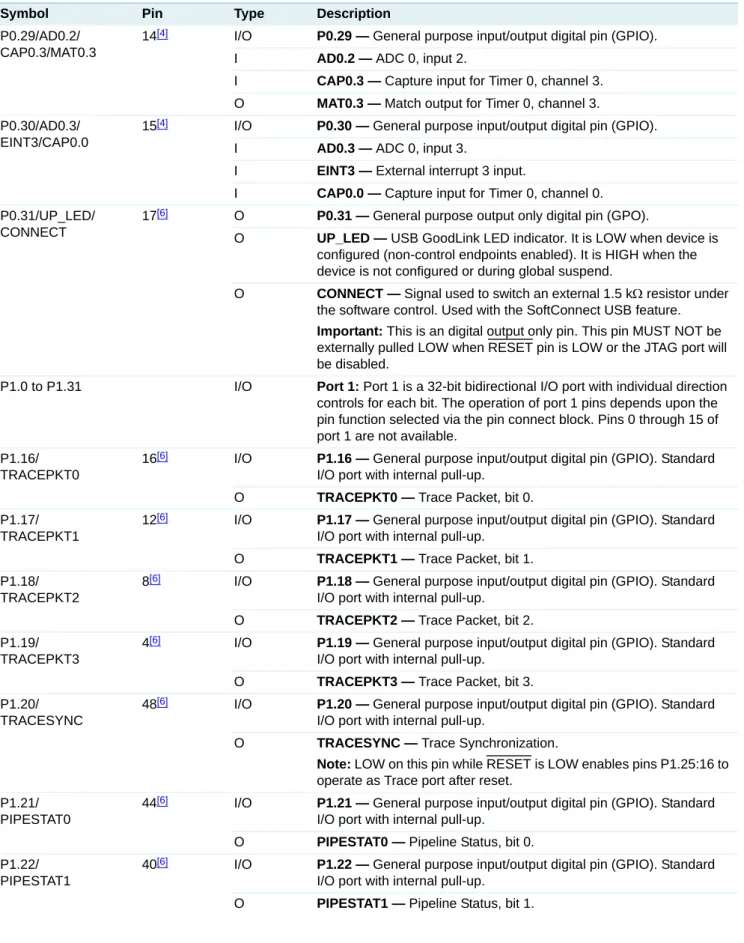
P0.29/AD0.2/ CAP0.3/MAT0.3
14[4] I/O P0.29 — General purpose input/output digital pin (GPIO).
I AD0.2 — ADC 0, input 2.
I CAP0.3 — Capture input for Timer 0, channel 3. O MAT0.3 — Match output for Timer 0, channel 3. P0.30/AD0.3/
EINT3/CAP0.0
15[4] I/O P0.30 — General purpose input/output digital pin (GPIO).
I AD0.3 — ADC 0, input 3.
I EINT3 — External interrupt 3 input.
I CAP0.0 — Capture input for Timer 0, channel 0. P0.31/UP_LED/
CONNECT
17[6] O P0.31 — General purpose output only digital pin (GPO).
O UP_LED — USB GoodLink LED indicator. It is LOW when device is configured (non-control endpoints enabled). It is HIGH when the device is not configured or during global suspend.
O CONNECT — Signal used to switch an external 1.5 k resistor under the software control. Used with the SoftConnect USB feature.
Important: This is an digital output only pin. This pin MUST NOT be externally pulled LOW when RESET pin is LOW or the JTAG port will be disabled.
P1.0 to P1.31 I/O Port 1: Port 1 is a 32-bit bidirectional I/O port with individual direction controls for each bit. The operation of port 1 pins depends upon the pin function selected via the pin connect block. Pins 0 through 15 of port 1 are not available.
P1.16/ TRACEPKT0
16[6] I/O P1.16 — General purpose input/output digital pin (GPIO). Standard
I/O port with internal pull-up. O TRACEPKT0 — Trace Packet, bit 0. P1.17/
TRACEPKT1
12[6] I/O P1.17 — General purpose input/output digital pin (GPIO). Standard
I/O port with internal pull-up. O TRACEPKT1 — Trace Packet, bit 1. P1.18/
TRACEPKT2
8[6] I/O P1.18 — General purpose input/output digital pin (GPIO). Standard
I/O port with internal pull-up. O TRACEPKT2 — Trace Packet, bit 2. P1.19/
TRACEPKT3
4[6] I/O P1.19 — General purpose input/output digital pin (GPIO). Standard
I/O port with internal pull-up. O TRACEPKT3 — Trace Packet, bit 3. P1.20/
TRACESYNC
48[6] I/O P1.20 — General purpose input/output digital pin (GPIO). Standard
I/O port with internal pull-up.
O TRACESYNC — Trace Synchronization.
Note: LOW on this pin while RESET is LOW enables pins P1.25:16 to operate as Trace port after reset.
P1.21/ PIPESTAT0
44[6] I/O P1.21 — General purpose input/output digital pin (GPIO). Standard
I/O port with internal pull-up. O PIPESTAT0 — Pipeline Status, bit 0. P1.22/
PIPESTAT1
40[6] I/O P1.22 — General purpose input/output digital pin (GPIO). Standard
I/O port with internal pull-up. O PIPESTAT1 — Pipeline Status, bit 1. Table 3. Pin description …continued
P1.23/ PIPESTAT2
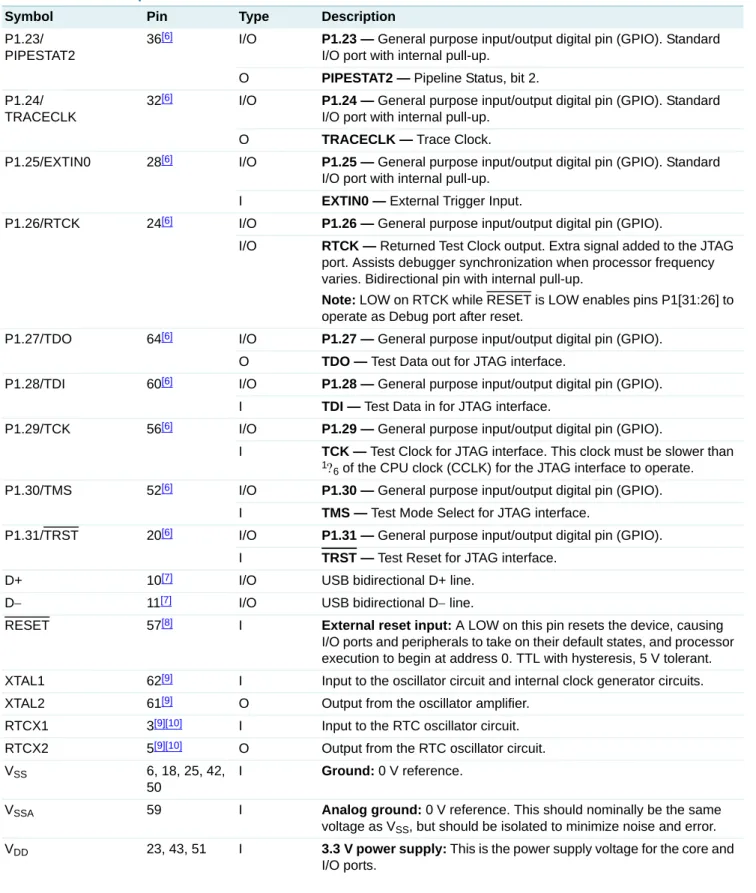
36[6] I/O P1.23 — General purpose input/output digital pin (GPIO). Standard
I/O port with internal pull-up. O PIPESTAT2 — Pipeline Status, bit 2. P1.24/
TRACECLK
32[6] I/O P1.24 — General purpose input/output digital pin (GPIO). Standard
I/O port with internal pull-up. O TRACECLK — Trace Clock.
P1.25/EXTIN0 28[6] I/O P1.25 — General purpose input/output digital pin (GPIO). Standard
I/O port with internal pull-up. I EXTIN0 — External Trigger Input.
P1.26/RTCK 24[6] I/O P1.26 — General purpose input/output digital pin (GPIO).
I/O RTCK — Returned Test Clock output. Extra signal added to the JTAG port. Assists debugger synchronization when processor frequency varies. Bidirectional pin with internal pull-up.
Note: LOW on RTCK while RESET is LOW enables pins P1[31:26] to operate as Debug port after reset.
P1.27/TDO 64[6] I/O P1.27 — General purpose input/output digital pin (GPIO).
O TDO — Test Data out for JTAG interface.
P1.28/TDI 60[6] I/O P1.28 — General purpose input/output digital pin (GPIO).
I TDI — Test Data in for JTAG interface.
P1.29/TCK 56[6] I/O P1.29 — General purpose input/output digital pin (GPIO).
I TCK — Test Clock for JTAG interface. This clock must be slower than
1
6 of the CPU clock (CCLK) for the JTAG interface to operate.
P1.30/TMS 52[6] I/O P1.30 — General purpose input/output digital pin (GPIO).
I TMS — Test Mode Select for JTAG interface.
P1.31/TRST 20[6] I/O P1.31 — General purpose input/output digital pin (GPIO).
I TRST — Test Reset for JTAG interface.
D+ 10[7] I/O USB bidirectional D+ line.
D 11[7] I/O USB bidirectional D line.
RESET 57[8] I External reset input: A LOW on this pin resets the device, causing
I/O ports and peripherals to take on their default states, and processor execution to begin at address 0. TTL with hysteresis, 5 V tolerant. XTAL1 62[9] I Input to the oscillator circuit and internal clock generator circuits.
XTAL2 61[9] O Output from the oscillator amplifier.
RTCX1 3[9][10] I Input to the RTC oscillator circuit.
RTCX2 5[9][10] O Output from the RTC oscillator circuit.
VSS 6, 18, 25, 42,
50
I Ground: 0 V reference.
VSSA 59 I Analog ground: 0 V reference. This should nominally be the same
voltage as VSS, but should be isolated to minimize noise and error.
VDD 23, 43, 51 I 3.3 V power supply: This is the power supply voltage for the core and
I/O ports. Table 3. Pin description …continued
LPC2141_42_44_46_48 All information provided in this document is subject to legal disclaimers. © NXP B.V. 2011. All rights reserved.
[1] 5 V tolerant pad (no built-in pull-up resistor) providing digital I/O functions with TTL levels and hysteresis and 10 ns slew rate control. [2] 5 V tolerant pad (no built-in pull-up resistor) providing digital I/O functions with TTL levels and hysteresis and 10 ns slew rate control. If
configured for an input function, this pad utilizes built-in glitch filter that blocks pulses shorter than 3 ns.
[3] Open-drain 5 V tolerant digital I/O I2C-bus 400 kHz specification compatible pad. It requires external pull-up to provide an output
functionality.
[4] 5 V tolerant pad (no built-in pull-up resistor) providing digital I/O (with TTL levels and hysteresis and 10 ns slew rate control) and analog input function. If configured for an input function, this pad utilizes built-in glitch filter that blocks pulses shorter than 3 ns. When configured as an ADC input, digital section of the pad is disabled.
[5] 5 V tolerant pad (no built-in pull-up resistor) providing digital I/O (with TTL levels and hysteresis and 10 ns slew rate control) and analog output function. When configured as the DAC output, digital section of the pad is disabled.
[6] 5 V tolerant pad with built-in pull-up resistor providing digital I/O functions with TTL levels and hysteresis and 10 ns slew rate control. The pull-up resistor’s value typically ranges from 60 k to 300 k.
[7] Pad is designed in accordance with the Universal Serial Bus (USB) specification, revision 2.0 (Full-speed and Low-speed mode only).
[8] 5 V tolerant pad providing digital input (with TTL levels and hysteresis) function only.
[9] Pad provides special analog functionality.
[10] When unused, the RTCX1 pin can be grounded or left floating. For lowest power leave it floating. The other RTC pin, RTCX2, should be left floating.
VDDA 7 I Analog 3.3 V power supply: This should be nominally the same
voltage as VDD but should be isolated to minimize noise and error.
This voltage is only used to power the on-chip ADC(s) and DAC. VREF 63 I ADC reference voltage: This should be nominally less than or equal
to the VDD voltage but should be isolated to minimize noise and error.
Level on this pin is used as a reference for ADC(s) and DAC. VBAT 49 I RTC power supply voltage: 3.3 V on this pin supplies the power to
the RTC. Table 3. Pin description …continued
6. Functional
description
6.1 Architectural overview
The ARM7TDMI-S is a general purpose 32-bit microprocessor, which offers high performance and very low power consumption. The ARM architecture is based on Reduced Instruction Set Computer (RISC) principles, and the instruction set and related decode mechanism are much simpler than those of microprogrammed Complex
Instruction Set Computers (CISC). This simplicity results in a high instruction throughput and impressive real-time interrupt response from a small and cost-effective processor core.
Pipeline techniques are employed so that all parts of the processing and memory systems can operate continuously. Typically, while one instruction is being executed, its successor is being decoded, and a third instruction is being fetched from memory.
The ARM7TDMI-S processor also employs a unique architectural strategy known as Thumb, which makes it ideally suited to high-volume applications with memory restrictions, or applications where code density is an issue.
The key idea behind Thumb is that of a super-reduced instruction set. Essentially, the ARM7TDMI-S processor has two instruction sets:
•
The standard 32-bit ARM set.•
A 16-bit Thumb set.The Thumb set’s 16-bit instruction length allows it to approach twice the density of standard ARM code while retaining most of the ARM’s performance advantage over a traditional 16-bit processor using 16-bit registers. This is possible because Thumb code operates on the same 32-bit register set as ARM code.
Thumb code is able to provide up to 65 % of the code size of ARM, and 160 % of the performance of an equivalent ARM processor connected to a 16-bit memory system. The particular flash implementation in the LPC2141/42/44/46/48 allows for full speed execution also in ARM mode. It is recommended to program performance critical and short code sections (such as interrupt service routines and DSP algorithms) in ARM mode. The impact on the overall code size will be minimal but the speed can be increased by 30 % over Thumb mode.
6.2 On-chip flash program memory
The LPC2141/42/44/46/48 incorporate a 32 kB, 64 kB, 128 kB, 256 kB and 512 kB flash memory system respectively. This memory may be used for both code and data storage. Programming of the flash memory may be accomplished in several ways. It may be programmed In System via the serial port. The application program may also erase and/or program the flash while the application is running, allowing a great degree of flexibility for data storage field firmware upgrades, etc. Due to the architectural solution chosen for an on-chip boot loader, flash memory available for user’s code on LPC2141/42/44/46/48 is 32 kB, 64 kB, 128 kB, 256 kB and 500 kB respectively.
The LPC2141/42/44/46/48 flash memory provides a minimum of 100000 erase/write cycles and 20 years of data-retention.
LPC2141_42_44_46_48 All information provided in this document is subject to legal disclaimers. © NXP B.V. 2011. All rights reserved.
6.3 On-chip static RAM
On-chip static RAM may be used for code and/or data storage. The SRAM may be accessed as 8-bit, 16-bit, and 32-bit. The LPC2141, LPC2142/44 and LPC2146/48 provide 8 kB, 16 kB and 32 kB of static RAM respectively.
In case of LPC2146/48 only, an 8 kB SRAM block intended to be utilized mainly by the USB can also be used as a general purpose RAM for data storage and code storage and execution.
6.4 Memory map
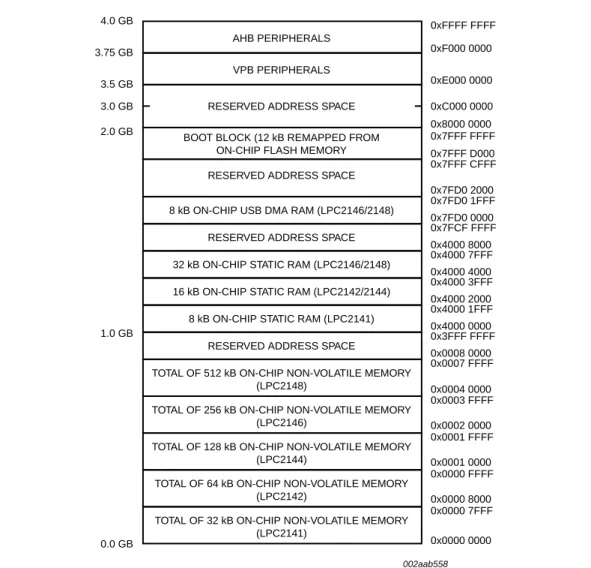
The LPC2141/42/44/46/48 memory map incorporates several distinct regions, as shown in Figure 5.
In addition, the CPU interrupt vectors may be remapped to allow them to reside in either flash memory (the default) or on-chip static RAM. This is described in Section 6.19 “System control”.
Fig 5. LPC2141/42/44/46/48 memory map
AHB PERIPHERALS VPB PERIPHERALS
RESERVED ADDRESS SPACE BOOT BLOCK (12 kB REMAPPED FROM
ON-CHIP FLASH MEMORY RESERVED ADDRESS SPACE
0xFFFF FFFF 0xF000 0000 0xE000 0000 0xC000 0000 0x8000 0000 0x7FFF FFFF 0x7FD0 2000
TOTAL OF 512 kB ON-CHIP NON-VOLATILE MEMORY
(LPC2148) 0x0004 0000
0x0007 FFFF
TOTAL OF 256 kB ON-CHIP NON-VOLATILE MEMORY
(LPC2146) 0x0002 0000
0x0003 FFFF
TOTAL OF 128 kB ON-CHIP NON-VOLATILE MEMORY
(LPC2144) 0x0001 0000
0x0001 FFFF
TOTAL OF 64 kB ON-CHIP NON-VOLATILE MEMORY
(LPC2142) 0x0000 8000
0x0000 FFFF
TOTAL OF 32 kB ON-CHIP NON-VOLATILE MEMORY (LPC2141)
0x0000 0000 0x0000 7FFF RESERVED ADDRESS SPACE
0x0008 0000 0x3FFF FFFF 8 kB ON-CHIP STATIC RAM (LPC2141)
0x4000 0000 0x4000 1FFF 16 kB ON-CHIP STATIC RAM (LPC2142/2144)
0x4000 2000 0x4000 3FFF 32 kB ON-CHIP STATIC RAM (LPC2146/2148)
0x4000 4000 0x4000 7FFF RESERVED ADDRESS SPACE
0x4000 8000 0x7FCF FFFF 8 kB ON-CHIP USB DMA RAM (LPC2146/2148)
0x7FD0 0000 0x7FD0 1FFF 0x7FFF D000 0x7FFF CFFF 4.0 GB 3.75 GB 3.5 GB 3.0 GB 2.0 GB 1.0 GB 0.0 GB 002aab558
6.5 Interrupt controller
The Vectored Interrupt Controller (VIC) accepts all of the interrupt request inputs and categorizes them as Fast Interrupt reQuest (FIQ), vectored Interrupt ReQuest (IRQ), and non-vectored IRQ as defined by programmable settings. The programmable assignment scheme means that priorities of interrupts from the various peripherals can be dynamically assigned and adjusted.
FIQ has the highest priority. If more than one request is assigned to FIQ, the VIC combines the requests to produce the FIQ signal to the ARM processor. The fastest possible FIQ latency is achieved when only one request is classified as FIQ, because then the FIQ service routine does not need to branch into the interrupt service routine but can run from the interrupt vector location. If more than one request is assigned to the FIQ class, the FIQ service routine will read a word from the VIC that identifies which FIQ source(s) is (are) requesting an interrupt.
Vectored IRQs have the middle priority. Sixteen of the interrupt requests can be assigned to this category. Any of the interrupt requests can be assigned to any of the 16 vectored IRQ slots, among which slot 0 has the highest priority and slot 15 has the lowest. Non-vectored IRQs have the lowest priority.
The VIC combines the requests from all the vectored and non-vectored IRQs to produce the IRQ signal to the ARM processor. The IRQ service routine can start by reading a register from the VIC and jumping there. If any of the vectored IRQs are pending, the VIC provides the address of the highest-priority requesting IRQs service routine, otherwise it provides the address of a default routine that is shared by all the non-vectored IRQs. The default routine can read another VIC register to see what IRQs are active.
6.5.1 Interrupt sources
Each peripheral device has one interrupt line connected to the Vectored Interrupt
Controller, but may have several internal interrupt flags. Individual interrupt flags may also represent more than one interrupt source.
6.6 Pin connect block
The pin connect block allows selected pins of the microcontroller to have more than one function. Configuration registers control the multiplexers to allow connection between the pin and the on chip peripherals. Peripherals should be connected to the appropriate pins prior to being activated, and prior to any related interrupt(s) being enabled. Activity of any enabled peripheral function that is not mapped to a related pin should be considered undefined.
The Pin Control Module with its pin select registers defines the functionality of the microcontroller in a given hardware environment.
After reset all pins of Port 0 and Port 1 are configured as input with the following exceptions: If debug is enabled, the JTAG pins will assume their JTAG functionality; if trace is enabled, the Trace pins will assume their trace functionality. The pins associated with the I2C0 and I2C1 interface are open drain.
LPC2141_42_44_46_48 All information provided in this document is subject to legal disclaimers. © NXP B.V. 2011. All rights reserved.
6.7 Fast general purpose parallel I/O (GPIO)
Device pins that are not connected to a specific peripheral function are controlled by the GPIO registers. Pins may be dynamically configured as inputs or outputs. Separate registers allow setting or clearing any number of outputs simultaneously. The value of the output register may be read back, as well as the current state of the port pins.
LPC2141/42/44/46/48 introduce accelerated GPIO functions over prior LPC2000 devices:
•
GPIO registers are relocated to the ARM local bus for the fastest possible I/O timing.•
Mask registers allow treating sets of port bits as a group, leaving other bitsunchanged.
•
All GPIO registers are byte addressable.•
Entire port value can be written in one instruction.6.7.1 Features
•
Bit-level set and clear registers allow a single instruction set or clear of any number of bits in one port.•
Direction control of individual bits.•
Separate control of output set and clear.•
All I/O default to inputs after reset.6.8 10-bit ADC
The LPC2141/42 contain one and the LPC2144/46/48 contain two analog to digital converters. These converters are single 10-bit successive approximation analog to digital converters. While ADC0 has six channels, ADC1 has eight channels. Therefore, total number of available ADC inputs for LPC2141/42 is 6 and for LPC2144/46/48 is 14.
6.8.1 Features
•
10 bit successive approximation analog to digital converter.•
Measurement range of 0 V to VREF (2.5 V VREF VDDA).•
Each converter capable of performing more than 400000 10-bit samples per second.•
Every analog input has a dedicated result register to reduce interrupt overhead.•
Burst conversion mode for single or multiple inputs.•
Optional conversion on transition on input pin or timer match signal.•
Global Start command for both converters (LPC2142/44/46/48 only).6.9 10-bit DAC
The DAC enables the LPC2141/42/44/46/48 to generate a variable analog output. The maximum DAC output voltage is the VREF voltage.
6.9.1 Features
•
10-bit DAC.•
Buffered output.•
Selectable speed versus power.6.10 USB 2.0 device controller
The USB is a 4-wire serial bus that supports communication between a host and a number (127 max) of peripherals. The host controller allocates the USB bandwidth to attached devices through a token based protocol. The bus supports hot plugging,
unplugging, and dynamic configuration of the devices. All transactions are initiated by the host controller.
The LPC2141/42/44/46/48 is equipped with a USB device controller that enables 12 Mbit/s data exchange with a USB host controller. It consists of a register interface, serial interface engine, endpoint buffer memory and DMA controller. The serial interface engine decodes the USB data stream and writes data to the appropriate end point buffer memory. The status of a completed USB transfer or error condition is indicated via status registers. An interrupt is also generated if enabled.
A DMA controller (available in LPC2146/48 only) can transfer data between an endpoint buffer and the USB RAM.
6.10.1 Features
•
Fully compliant with USB 2.0 Full-speed specification.•
Supports 32 physical (16 logical) endpoints.•
Supports control, bulk, interrupt and isochronous endpoints.•
Scalable realization of endpoints at run time.•
Endpoint maximum packet size selection (up to USB maximum specification) by software at run time.•
RAM message buffer size based on endpoint realization and maximum packet size.•
Supports SoftConnect and GoodLink LED indicator. These two functions are sharingone pin.
•
Supports bus-powered capability with low suspend current.•
Supports DMA transfer on all non-control endpoints (LPC2146/48 only).•
One duplex DMA channel serves all endpoints (LPC2146/48 only).•
Allows dynamic switching between CPU controlled and DMA modes (only in LPC2146/48).•
Double buffer implementation for bulk and isochronous endpoints.6.11 UARTs
The LPC2141/42/44/46/48 each contain two UARTs. In addition to standard transmit and receive data lines, the LPC2144/46/48 UART1 also provides a full modem control handshake interface.
Compared to previous LPC2000 microcontrollers, UARTs in LPC2141/42/44/46/48 introduce a fractional baud rate generator for both UARTs, enabling these microcontrollers to achieve standard baud rates such as 115200 with any crystal frequency above 2 MHz. In addition, auto-CTS/RTS flow-control functions are fully implemented in hardware (UART1 in LPC2144/46/48 only).
LPC2141_42_44_46_48 All information provided in this document is subject to legal disclaimers. © NXP B.V. 2011. All rights reserved.
6.11.1 Features
•
16 B Receive and Transmit FIFOs.•
Register locations conform to 16C550 industry standard.•
Receiver FIFO trigger points at 1 B, 4 B, 8 B, and 14 B•
Built-in fractional baud rate generator covering wide range of baud rates without a need for external crystals of particular values.•
Transmission FIFO control enables implementation of software (XON/XOFF) flow control on both UARTs.•
LPC2144/46/48 UART1 equipped with standard modem interface signals. This module also provides full support for hardware flow control (auto-CTS/RTS).6.12 I
2C-bus serial I/O controller
The LPC2141/42/44/46/48 each contain two I2C-bus controllers.
The I2C-bus is bidirectional, for inter-IC control using only two wires: a Serial Clock Line
(SCL), and a Serial DAta line (SDA). Each device is recognized by a unique address and can operate as either a receiver-only device (e.g., an LCD driver or a transmitter with the capability to both receive and send information (such as memory)). Transmitters and/or receivers can operate in either master or slave mode, depending on whether the chip has to initiate a data transfer or is only addressed. The I2C-bus is a multi-master bus, it can be
controlled by more than one bus master connected to it.
The I2C-bus implemented in LPC2141/42/44/46/48 supports bit rates up to 400 kbit/s
(Fast I2C-bus).
6.12.1 Features
•
Compliant with standard I2C-bus interface.•
Easy to configure as master, slave, or master/slave.•
Programmable clocks allow versatile rate control.•
Bidirectional data transfer between masters and slaves.•
Multi-master bus (no central master).•
Arbitration between simultaneously transmitting masters without corruption of serial data on the bus.•
Serial clock synchronization allows devices with different bit rates to communicate via one serial bus.•
Serial clock synchronization can be used as a handshake mechanism to suspend and resume serial transfer.•
The I2C-bus can be used for test and diagnostic purposes.6.13 SPI serial I/O controller
The LPC2141/42/44/46/48 each contain one SPI controller. The SPI is a full duplex serial interface, designed to handle multiple masters and slaves connected to a given bus. Only a single master and a single slave can communicate on the interface during a given data transfer. During a data transfer the master always sends a byte of data to the slave, and the slave always sends a byte of data to the master.
6.13.1 Features
•
Compliant with SPI specification.•
Synchronous, Serial, Full Duplex, Communication.•
Combined SPI master and slave.•
Maximum data bit rate of one eighth of the input clock rate.6.14 SSP serial I/O controller
The LPC2141/42/44/46/48 each contain one Serial Synchronous Port controller (SSP). The SSP controller is capable of operation on a SPI, 4-wire SSI, or Microwire bus. It can interact with multiple masters and slaves on the bus. However, only a single master and a single slave can communicate on the bus during a given data transfer. The SSP supports full duplex transfers, with data frames of 4 bits to 16 bits of data flowing from the master to the slave and from the slave to the master. Often only one of these data flows carries meaningful data.
6.14.1 Features
•
Compatible with Motorola’s SPI, TI’s 4-wire SSI and National Semiconductor’s Microwire buses.•
Synchronous serial communication.•
Master or slave operation.•
8-frame FIFOs for both transmit and receive.•
Four bits to 16 bits per frame.6.15 General purpose timers/external event counters
The Timer/Counter is designed to count cycles of the peripheral clock (PCLK) or an externally supplied clock and optionally generate interrupts or perform other actions at specified timer values, based on four match registers. It also includes four capture inputs to trap the timer value when an input signal transitions, optionally generating an interrupt. Multiple pins can be selected to perform a single capture or match function, providing an application with ‘or’ and ‘and’, as well as ‘broadcast’ functions among them.
The LPC2141/42/44/46/48 can count external events on one of the capture inputs if the minimum external pulse is equal or longer than a period of the PCLK. In this configuration, unused capture lines can be selected as regular timer capture inputs, or used as external interrupts.
6.15.1 Features
•
A 32-bit timer/counter with a programmable 32-bit prescaler.•
External event counter or timer operation.•
Four 32-bit capture channels per timer/counter that can take a snapshot of the timer value when an input signal transitions. A capture event may also optionally generate an interrupt.•
Four 32-bit match registers that allow:LPC2141_42_44_46_48 All information provided in this document is subject to legal disclaimers. © NXP B.V. 2011. All rights reserved.
– Stop timer on match with optional interrupt generation. – Reset timer on match with optional interrupt generation.
•
Four external outputs per timer/counter corresponding to match registers, with the following capabilities:– Set LOW on match.
– Set HIGH on match.
– Toggle on match.
– Do nothing on match.
6.16 Watchdog timer
The purpose of the watchdog is to reset the microcontroller within a reasonable amount of time if it enters an erroneous state. When enabled, the watchdog will generate a system reset if the user program fails to ‘feed’ (or reload) the watchdog within a predetermined amount of time.
6.16.1 Features
•
Internally resets chip if not periodically reloaded.•
Debug mode.•
Enabled by software but requires a hardware reset or a watchdog reset/interrupt to be disabled.•
Incorrect/Incomplete feed sequence causes reset/interrupt if enabled.•
Flag to indicate watchdog reset.•
Programmable 32-bit timer with internal pre-scaler.•
Selectable time period from (Tcy(PCLK) 256 4) to (Tcy(PCLK) 232 4) in multiples ofTcy(PCLK)4.
6.17 Real-time clock
The RTC is designed to provide a set of counters to measure time when normal or idle operating mode is selected. The RTC has been designed to use little power, making it suitable for battery powered systems where the CPU is not running continuously (Idle mode).
6.17.1 Features
•
Measures the passage of time to maintain a calendar and clock.•
Ultra-low power design to support battery powered systems.•
Provides Seconds, Minutes, Hours, Day of Month, Month, Year, Day of Week, and Day of Year.•
Can use either the RTC dedicated 32 kHz oscillator input or clock derived from the external crystal/oscillator input at XTAL1. Programmable reference clock divider allows fine adjustment of the RTC.6.18 Pulse width modulator
The PWM is based on the standard timer block and inherits all of its features, although only the PWM function is pinned out on the LPC2141/42/44/46/48. The timer is designed to count cycles of the peripheral clock (PCLK) and optionally generate interrupts or perform other actions when specified timer values occur, based on seven match registers. The PWM function is also based on match register events.
The ability to separately control rising and falling edge locations allows the PWM to be used for more applications. For instance, multi-phase motor control typically requires three non-overlapping PWM outputs with individual control of all three pulse widths and positions.
Two match registers can be used to provide a single edge controlled PWM output. One match register (MR0) controls the PWM cycle rate, by resetting the count upon match. The other match register controls the PWM edge position. Additional single edge
controlled PWM outputs require only one match register each, since the repetition rate is the same for all PWM outputs. Multiple single edge controlled PWM outputs will all have a rising edge at the beginning of each PWM cycle, when an MR0 match occurs.
Three match registers can be used to provide a PWM output with both edges controlled. Again, the MR0 match register controls the PWM cycle rate. The other match registers control the two PWM edge positions. Additional double edge controlled PWM outputs require only two match registers each, since the repetition rate is the same for all PWM outputs.
With double edge controlled PWM outputs, specific match registers control the rising and falling edge of the output. This allows both positive going PWM pulses (when the rising edge occurs prior to the falling edge), and negative going PWM pulses (when the falling edge occurs prior to the rising edge).
6.18.1 Features
•
Seven match registers allow up to six single edge controlled or three double edge controlled PWM outputs, or a mix of both types.•
The match registers also allow:– Continuous operation with optional interrupt generation on match. – Stop timer on match with optional interrupt generation.
– Reset timer on match with optional interrupt generation.
•
Supports single edge controlled and/or double edge controlled PWM outputs. Single edge controlled PWM outputs all go HIGH at the beginning of each cycle unless the output is a constant LOW. Double edge controlled PWM outputs can have either edge occur at any position within a cycle. This allows for both positive going and negative going pulses.•
Pulse period and width can be any number of timer counts. This allows complete flexibility in the trade-off between resolution and repetition rate. All PWM outputs will occur at the same repetition rate.•
Double edge controlled PWM outputs can be programmed to be either positive going or negative going pulses.LPC2141_42_44_46_48 All information provided in this document is subject to legal disclaimers. © NXP B.V. 2011. All rights reserved.
•
Match register updates are synchronized with pulse outputs to prevent generation of erroneous pulses. Software must ‘release’ new match values before they can become effective.•
May be used as a standard timer if the PWM mode is not enabled.•
A 32-bit Timer/Counter with a programmable 32-bit Prescaler.6.19 System control
6.19.1 Crystal oscillator
On-chip integrated oscillator operates with external crystal in range of 1 MHz to 25 MHz. The oscillator output frequency is called fosc and the ARM processor clock frequency is
referred to as CCLK for purposes of rate equations, etc. fosc and CCLK are the same
value unless the PLL is running and connected. Refer to Section 6.19.2 “PLL” for additional information.
6.19.2 PLL
The PLL accepts an input clock frequency in the range of 10 MHz to 25 MHz. The input frequency is multiplied up into the range of 10 MHz to 60 MHz with a Current Controlled Oscillator (CCO). The multiplier can be an integer value from 1 to 32 (in practice, the multiplier value cannot be higher than 6 on this family of microcontrollers due to the upper frequency limit of the CPU). The CCO operates in the range of 156 MHz to 320 MHz, so there is an additional divider in the loop to keep the CCO within its frequency range while the PLL is providing the desired output frequency. The output divider may be set to divide by 2, 4, 8, or 16 to produce the output clock. Since the minimum output divider value is 2, it is insured that the PLL output has a 50 % duty cycle. The PLL is turned off and
bypassed following a chip reset and may be enabled by software. The program must configure and activate the PLL, wait for the PLL to Lock, then connect to the PLL as a clock source. The PLL settling time is 100s.
6.19.3 Reset and wake-up timer
Reset has two sources on the LPC2141/42/44/46/48: the RESET pin and watchdog reset. The RESET pin is a Schmitt trigger input pin with an additional glitch filter. Assertion of chip reset by any source starts the Wake-up Timer (see Wake-up Timer description below), causing the internal chip reset to remain asserted until the external reset is de-asserted, the oscillator is running, a fixed number of clocks have passed, and the on-chip flash controller has completed its initialization.
When the internal reset is removed, the processor begins executing at address 0, which is the reset vector. At that point, all of the processor and peripheral registers have been initialized to predetermined values.
The Wake-up Timer ensures that the oscillator and other analog functions required for chip operation are fully functional before the processor is allowed to execute instructions. This is important at power on, all types of reset, and whenever any of the aforementioned functions are turned off for any reason. Since the oscillator and other functions are turned off during Power-down mode, any wake-up of the processor from Power-down mode makes use of the Wake-up Timer.
The Wake-up Timer monitors the crystal oscillator as the means of checking whether it is safe to begin code execution. When power is applied to the chip, or some event caused the chip to exit Power-down mode, some time is required for the oscillator to produce a signal of sufficient amplitude to drive the clock logic. The amount of time depends on many factors, including the rate of VDD ramp (in the case of power on), the type of crystal
and its electrical characteristics (if a quartz crystal is used), as well as any other external circuitry (e.g. capacitors), and the characteristics of the oscillator itself under the existing ambient conditions.
6.19.4 Brownout detector
The LPC2141/42/44/46/48 include 2-stage monitoring of the voltage on the VDD pins. If
this voltage falls below 2.9 V, the BOD asserts an interrupt signal to the VIC. This signal can be enabled for interrupt; if not, software can monitor the signal by reading dedicated register.
The second stage of low voltage detection asserts reset to inactivate the
LPC2141/42/44/46/48 when the voltage on the VDD pins falls below 2.6 V. This reset
prevents alteration of the flash as operation of the various elements of the chip would otherwise become unreliable due to low voltage. The BOD circuit maintains this reset down below 1 V, at which point the POR circuitry maintains the overall reset.
Both the 2.9 V and 2.6 V thresholds include some hysteresis. In normal operation, this hysteresis allows the 2.9 V detection to reliably interrupt, or a regularly-executed event loop to sense the condition.
6.19.5 Code security
This feature of the LPC2141/42/44/46/48 allow an application to control whether it can be debugged or protected from observation.
If after reset on-chip boot loader detects a valid checksum in flash and reads 0x8765 4321 from address 0x1FC in flash, debugging will be disabled and thus the code in flash will be protected from observation. Once debugging is disabled, it can be enabled only by performing a full chip erase using the ISP.
6.19.6 External interrupt inputs
The LPC2141/42/44/46/48 include up to nine edge or level sensitive External Interrupt Inputs as selectable pin functions. When the pins are combined, external events can be processed as four independent interrupt signals. The External Interrupt Inputs can optionally be used to wake-up the processor from Power-down mode.
Additionally capture input pins can also be used as external interrupts without the option to wake the device up from Power-down mode.
6.19.7 Memory mapping control
The Memory Mapping Control alters the mapping of the interrupt vectors that appear beginning at address 0x0000 0000. Vectors may be mapped to the bottom of the on-chip flash memory, or to the on-chip static RAM. This allows code running in different memory spaces to have control of the interrupts.
LPC2141_42_44_46_48 All information provided in this document is subject to legal disclaimers. © NXP B.V. 2011. All rights reserved.
6.19.8 Power control
The LPC2141/42/44/46/48 supports two reduced power modes: Idle mode and Power-down mode.
In Idle mode, execution of instructions is suspended until either a reset or interrupt occurs. Peripheral functions continue operation during Idle mode and may generate interrupts to cause the processor to resume execution. Idle mode eliminates power used by the processor itself, memory systems and related controllers, and internal buses.
In Power-down mode, the oscillator is shut down and the chip receives no internal clocks. The processor state and registers, peripheral registers, and internal SRAM values are preserved throughout Power-down mode and the logic levels of chip output pins remain static. The Power-down mode can be terminated and normal operation resumed by either a reset or certain specific interrupts that are able to function without clocks. Since all dynamic operation of the chip is suspended, Power-down mode reduces chip power consumption to nearly zero.
Selecting an external 32 kHz clock instead of the PCLK as a clock-source for the on-chip RTC will enable the microcontroller to have the RTC active during Power-down mode. Power-down current is increased with RTC active. However, it is significantly lower than in Idle mode.
A Power Control for Peripherals feature allows individual peripherals to be turned off if they are not needed in the application, resulting in additional power savings during active and Idle mode.
6.19.9 APB bus
The APB divider determines the relationship between the processor clock (CCLK) and the clock used by peripheral devices (PCLK). The APB divider serves two purposes. The first is to provide peripherals with the desired PCLK via APB bus so that they can operate at the speed chosen for the ARM processor. In order to achieve this, the APB bus may be slowed down to 1
2 to 14 of the processor clock rate. Because the APB bus must work
properly at power-up (and its timing cannot be altered if it does not work since the APB divider control registers reside on the APB bus), the default condition at reset is for the APB bus to run at 1
4 of the processor clock rate. The second purpose of the APB divider
is to allow power savings when an application does not require any peripherals to run at the full processor rate. Because the APB divider is connected to the PLL output, the PLL remains active (if it was running) during Idle mode.
6.20 Emulation and debugging
The LPC2141/42/44/46/48 support emulation and debugging via a JTAG serial port. A trace port allows tracing program execution. Debugging and trace functions are multiplexed only with GPIOs on Port 1. This means that all communication, timer and interface peripherals residing on Port 0 are available during the development and debugging phase as they are when the application is run in the embedded system itself.
6.20.1 EmbeddedICE
Standard ARM EmbeddedICE logic provides on-chip debug support. The debugging of the target system requires a host computer running the debugger software and an EmbeddedICE protocol convertor. EmbeddedICE protocol convertor converts the remote debug protocol commands to the JTAG data needed to access the ARM core.
The ARM core has a Debug Communication Channel (DCC) function built-in. The DCC allows a program running on the target to communicate with the host debugger or another separate host without stopping the program flow or even entering the debug state. The DCC is accessed as a co-processor 14 by the program running on the ARM7TDMI-S core. The DCC allows the JTAG port to be used for sending and receiving data without affecting the normal program flow. The DCC data and control registers are mapped in to addresses in the EmbeddedICE logic.
This clock must be slower than 1
6 of the CPU clock (CCLK) for the JTAG interface to
operate.
6.20.2 Embedded trace
Since the LPC2141/42/44/46/48 have significant amounts of on-chip memory, it is not possible to determine how the processor core is operating simply by observing the external pins. The Embedded Trace Macrocell (ETM) provides real-time trace capability for deeply embedded processor cores. It outputs information about processor execution to the trace port.
The ETM is connected directly to the ARM core and not to the main AMBA system bus. It compresses the trace information and exports it through a narrow trace port. An external trace port analyzer must capture the trace information under software debugger control. Instruction trace (or PC trace) shows the flow of execution of the processor and provides a list of all the instructions that were executed. Instruction trace is significantly compressed by only broadcasting branch addresses as well as a set of status signals that indicate the pipeline status on a cycle by cycle basis. Trace information generation can be controlled by selecting the trigger resource. Trigger resources include address comparators, counters and sequencers. Since trace information is compressed the software debugger requires a static image of the code being executed. Self-modifying code can not be traced because of this restriction.
6.20.3 RealMonitor
RealMonitor is a configurable software module, developed by ARM Inc., which enables real-time debug. It is a lightweight debug monitor that runs in the background while users debug their foreground application. It communicates with the host using the DCC, which is present in the EmbeddedICE logic. The LPC2141/42/44/46/48 contain a specific
LPC2141_42_44_46_48 All information provided in this document is subject to legal disclaimers. © NXP B.V. 2011. All rights reserved.
7. Limiting
values
[1] The following applies to the Limiting values:
a) This product includes circuitry specifically designed for the protection of its internal devices from the damaging effects of excessive static charge. Nonetheless, it is suggested that conventional precautions be taken to avoid applying greater than the rated maximum.
b) Parameters are valid over operating temperature range unless otherwise specified. All voltages are with respect to VSS unless
otherwise noted.
[2] Including voltage on outputs in 3-state mode.
[3] Not to exceed 4.6 V.
[4] The peak current is limited to 25 times the corresponding maximum current.
[5] Dependent on package type.
[6] Human body model: equivalent to discharging a 100 pF capacitor through a 1.5 k series resistor.
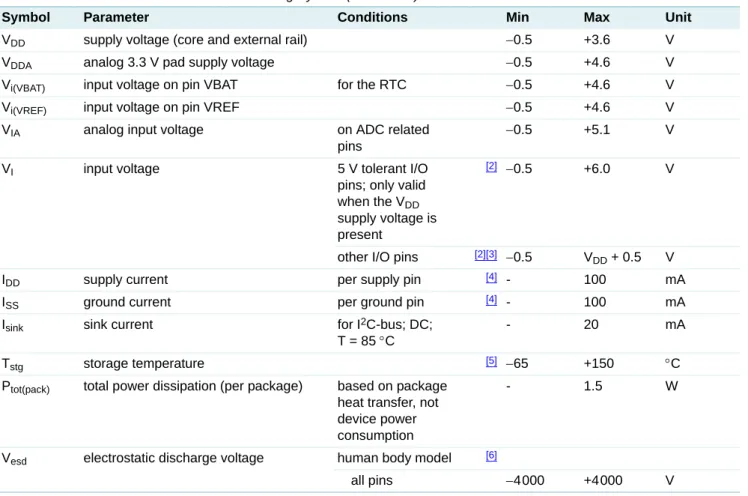
Table 4. Limiting values
In accordance with the Absolute Maximum Rating System (IEC 60134).[1]
Symbol Parameter Conditions Min Max Unit
VDD supply voltage (core and external rail) 0.5 +3.6 V
VDDA analog 3.3 V pad supply voltage 0.5 +4.6 V
Vi(VBAT) input voltage on pin VBAT for the RTC 0.5 +4.6 V
Vi(VREF) input voltage on pin VREF 0.5 +4.6 V
VIA analog input voltage on ADC related
pins
0.5 +5.1 V
VI input voltage 5 V tolerant I/O
pins; only valid when the VDD
supply voltage is present
[2] 0.5 +6.0 V
other I/O pins [2][3] 0.5 V
DD + 0.5 V
IDD supply current per supply pin [4] - 100 mA
ISS ground current per ground pin [4] - 100 mA
Isink sink current for I2C-bus; DC;
T = 85 C
- 20 mA
Tstg storage temperature [5] 65 +150 C
Ptot(pack) total power dissipation (per package) based on package
heat transfer, not device power consumption
- 1.5 W
Vesd electrostatic discharge voltage human body model [6]
8. Static
characteristics
Table 5. Static characteristicsTamb=40C to +85C for commercial applications, unless otherwise specified.
Symbol Parameter Conditions Min Typ[1] Max Unit
VDD supply voltage [2] 3.0 3.3 3.6 V
VDDA analog supply voltage 3.3 V pad 3.0 3.3 3.6 V
Vi(VBAT) input voltage on pin
VBAT
[3] 2.0 3.3 3.6 V
Vi(VREF) input voltage on pin
VREF
2.5 3.3 VDDA V
Standard port pins, RESET, P1.26/RTCK
IIL LOW-level input current VI= 0 V; no pull-up - - 3 A
IIH HIGH-level input current VI= VDD; no pull-down - - 3 A
IOZ OFF-state output
current
VO= 0 V; VO= VDD; no
pull-up/down
- - 3 A
Ilatch I/O latch-up current (0.5VDD) < VI < (1.5VDD);
Tj < 125C
- - 100 mA
VI input voltage pin configured to provide a
digital function
[4][5][6] [7]
0 - 5.5 V
VO output voltage output active 0 - VDD V
VIH HIGH-level input voltage 2.0 - - V
VIL LOW-level input voltage - - 0.8 V
Vhys hysteresis voltage 0.4 - - V
VOH HIGH-level output voltage IOH=4 mA [8] VDD0.4 - - V VOL LOW-level output voltage IOL=4 mA [8] - - 0.4 V IOH HIGH-level output current VOH= VDD0.4 V [8] 4 - - mA IOL LOW-level output current VOL= 0.4 V [8] 4 - - mA
IOHS HIGH-level short-circuit
output current
VOH= 0 V [9] - - 45 mA
IOLS LOW-level short-circuit
output current
VOL= VDDA [9] - - 50 mA
Ipd pull-down current VI= 5 V [10] 10 50 150 A
Ipu pull-up current VI= 0 V [11] 15 50 85 A
LPC2141_42_44_46_48 All information provided in this document is subject to legal disclaimers. © NXP B.V. 2011. All rights reserved.
IDD(act) active mode supply
current
VDD= 3.3 V; Tamb= 25C;
code
while(1){}
executed from flash, no active peripherals CCLK = 10 MHz - 15 50 mA CCLK = 60 MHz - 40 70 mA VDD= 3.3 V; Tamb= 25C;
code executed from flash; USB enabled and active; all other peripherals disabled CCLK = 12 MHz - 27 70 mA CCLK = 60 MHz - 57 90 mA IDD(pd) Power-down mode supply current VDD = 3.3 V; Tamb= 25C - 40 100 A VDD= 3.3 V; Tamb= 85C - 250 500 A
IBATpd Power-down mode
battery supply current
RTC clock = 32 kHz (from RTCXn pins); Tamb= 25C VDD= 3.0 V; Vi(VBAT)= 2.5 V [12] - 15 30 A VDD= 3.0 V; Vi(VBAT)= 3.0 V - 20 40 A
IBATact active mode battery
supply current CCLK = 60 MHz; PCLK = 15 MHz; PCLK enabled to RTCK; RTC clock = 32 kHz (from RTCXn pins); Tamb= 25C VDD= 3.0 V; Vi(VBAT)= 3.0 V [12] - 78 -A IBATact(opt) optimized active mode
battery supply current
PCLK disabled to RTCK in the PCONP register; RTC clock = 32 kHz (from RTCXn pins); Tamb= 25C; Vi(VBAT)= 3.3 V CCLK = 25 MHz [12][13] - 23 -A CCLK = 60 MHz - 30 - A I2C-bus pins
VIH HIGH-level input voltage 0.7VDD - - V
VIL LOW-level input voltage - - 0.3VDD V
Vhys hysteresis voltage - 0.05VDD - V
VOL LOW-level output
voltage
IOLS= 3 mA [8] - - 0.4 V
ILI input leakage current VI= VDD [14] - 2 4 A
VI= 5 V - 10 22 A
Oscillator pins
Vi(XTAL1) input voltage on pin
XTAL1
0.5 1.8 1.95 V Table 5. Static characteristics …continued
Tamb=40C to +85C for commercial applications, unless otherwise specified.
[1] Typical ratings are not guaranteed. The values listed are at room temperature (25C), nominal supply voltages.
[2] Core and external rail.
[3] The RTC typically fails when Vi(VBAT) drops below 1.6 V.
[4] Including voltage on outputs in 3-state mode.
[5] VDD supply voltages must be present.
[6] 3-state outputs go into 3-state mode when VDD is grounded.
[7] Please also see the errata note mentioned in errata sheet.
[8] Accounts for 100 mV voltage drop in all supply lines.
[9] Allowed as long as the current limit does not exceed the maximum current allowed by the device.
[10] Minimum condition for VI= 4.5 V, maximum condition for VI= 5.5 V.
[11] Applies to P1.16 to P1.31. [12] On pin VBAT.
[13] Optimized for low battery consumption. [14] To VSS.
[15] Includes external resistors of 33± 1 % on D+ and D.
Vo(XTAL2) output voltage on pin
XTAL2
0.5 1.8 1.95 V Vi(RTCX1) input voltage on pin
RTCX1
0.5 1.8 1.95 V Vo(RTCX2) output voltage on pin
RTCX2 0.5 1.8 1.95 V USB pins IOZ OFF-state output current 0 V < VI< 3.3 V - - 10 A
VBUS VBUS line input voltage
on the USB connector
- - 5.25 V VDI differential input sensitivity |(D+)(D)| 0.2 - - V VCM differential common-mode range includes VDI range 0.8 - 2.5 V
Vth(rs)se single-ended receiver
switching threshold voltage
0.8 - 2.0 V
VOL LOW output level RL of 1.5 k to 3.6 V - - 0.3 V
VOH HIGH output level RL of 15 k to GND 2.8 - 3.6 V
Ctrans transceiver capacitance pin to GND - - 20 pF
ZDRV driver output impedance
for driver which is not high-speed capable
steady state drive [15] 29 - 44
Rpu pull-up resistance SoftConnect = ON 1.1 - 1.9 k
Table 5. Static characteristics …continued
Tamb=40C to +85C for commercial applications, unless otherwise specified.