Standard:
PCI Data Security Standard (PCI DSS)
Version:
2.0
Date:
February 2013
Author:
Cloud Special Interest Group
PCI Security Standards Council
Information Supplement:
PCI DSS Cloud Computing
Guidelines
Table of Contents
1 Executive Summary ... 1 1.1 Intended Use ... 1 1.2 Audience ... 2 1.3 Terminology ... 2 2 Cloud Overview ... 32.1 Deployment and Service Models ... 3
3 Cloud Provider / Cloud Customer Relationships ... 6
3.1 Understanding Roles and Responsibilities ... 6
3.2 Roles and Responsibilities for Different Deployments Models ... 6
3.3 Responsibilities for Different Service Models... 7
3.4 Nested Service-Provider Relationships ... 9
4 PCI DSS Considerations ... 10
4.1 Understanding PCI DSS Responsibilities ... 10
4.2 PCI DSS Responsibilities for Different Service Models ... 10
4.3 Security as a Service (SecaaS) ... 12
4.4 Segmentation Considerations ... 12
4.5 Scoping Considerations ... 15
5 PCI DSS Compliance Challenges ... 18
5.1 What does “I am PCI compliant” mean? ... 19
5.2 Verifying Scope of Validated Services and Components ... 19
5.3 Verifying PCI DSS Controls Managed by the Cloud Provider ... 20
6 Additional Security Considerations ... 22
6.1 Governance, Risk and Compliance ... 22
6.2 Facilities and Physical Security ... 24
6.3 Data sovereignty and Legal considerations ... 24
6.4 Data Security Considerations ... 25
6.5 Technical Security Considerations ... 27
6.6 Incident Response and Investigation ... 31
7 Conclusion ... 32
Appendix A: Sample PCI DSS Responsibilities for Different Service Models ... 33
Appendix B: Sample Inventory ... 39
Appendix C: Sample PCI DSS Responsibility Matrix ... 41
Appendix D: PCI DSS Implementation Considerations ... 43
Acknowledgements ... 48
References ... 49
1
Executive Summary
Cloud computing is a form of distributed computing that is yet to be standardized1. There are a number of factors to be considered when migrating to cloud services, and organizations need to clearly understand their needs before they can determine if and how they will be met by a particular solution or provider. As cloud computing is still an evolving technology, evaluations of risks and benefits may change as the technology becomes more established and its implications become better understood.
Cloud security is a shared responsibility between the cloud service provider (CSP) and its clients. If payment card data is stored, processed or transmitted in a cloud environment, PCI DSS will apply to that environment, and will typically involve validation of both the CSP’s infrastructure and the client’s usage of that environment. The allocation of responsibility between client and provider for managing security controls does not exempt a client from the responsibly of ensuring that their cardholder data is properly secured according to applicable PCI DSS requirements.
It’s important to note that all cloud services are not created equal. Clear policies and procedures should be agreed between client and cloud provider for all security requirements, and responsibilities for operation, management and reporting should be clearly defined and understood for each requirement.
1.1 Intended Use
This document provides guidance on the use of cloud technologies and considerations for maintaining PCI DSS controls in cloud environments. This guidance builds on that provided in the PCI DSS Virtualization Guidelines and is intended for organizations using, or thinking of using, providing, or assessing cloud technologies as part of a cardholder data environment (CDE).
This document is structured as follows:
Executive Summary– Includes a brief summary of some key points and provides context for the remainder of the document.
Cloud Overview– Describes the deployment and service models discussed throughout this document. Cloud Provider/ Cloud Customer Relationships– Discusses how roles and responsibilities may differ
across different cloud service and deployment models
PCI DSS Considerations– Provides guidance and examples to help determine responsibilities for individual PCI DSS requirements, and includes segmentation and scoping considerations.
PCI DSS Compliance Challenges– Describes some of the challenges associated with validating PCI DSS compliance in a cloud environment.
Additional Security Considerations– Explores a number of business and technical security considerations for the use of cloud technologies.
Conclusion– Presents recommendations for starting discussions about cloud services.
1
The following appendices are included to provide additional guidance:
Appendix A: PCI DSS Responsibilities for different Service Models – Presents additional considerations to help determine PCI DSS responsibilities across different cloud service models. Appendix B: Sample Inventory – Presents a sample system inventory for cloud computing
environments.
Appendix C: PCI DSS Responsibility Matrix – Presents a sample matrix for documenting how PCI DSS responsibilities are assigned between cloud provider and client.
Appendix D: PCI DSS Implementation Considerations – Suggests a starting set of questions that may help in determining how PCI DSS requirements can be met in a particular cloud environment.
This document is intended to provide an initial point of discussion for cloud providers and clients, and does not delve into specific technical configurations. This document does not endorse the use of any specific technologies, products, or services.
The information in this document is intended as supplemental guidance and does not supersede, replace or extend PCI DSS requirements. For the purposes of this document, all references made are to PCI DSS version 2.0.
1.2 Audience
The information in this document is intended for merchants, service providers, assessors and other entities looking for guidance on the use of cloud computing in the context of PCI DSS. For example:
Merchants – The security and PCI DSS considerations are applicable to all types of cloud environments, and may be useful to merchants managing their own cloud infrastructure as well as those looking to engage with a third party. Guidance for working with third-party cloud providers and PCI DSS compliance challenges may also be useful.
Cloud service providers – The security and PCI DSS considerations may provide useful information for CSPs to assist their understanding of the PCI DSS requirements, and may also help CSPs to better understand their clients’ PCI DSS needs. Guidance on CSP/client relationships and PCI DSS compliance challenges may also be useful for providers.
Assessors – The security and PCI DSS considerations may help assessors to understand what they might need to know about an environment in order to be able to determine whether a PCI DSS requirement has been met.
1.3 Terminology
The following terms are used throughout this document:
CSP – Cloud Service Provider. The CSP, or cloud provider, is the entity providing the cloud service. The CSP acquires and manages the infrastructure required for providing the services, runs the cloud software that provides the services, and delivers the cloud services through network access.2
Cloud customer or client – The entity subscribing to a service provided by a cloud provider. May
include merchants, service providers, payment processors, and other entities utilizing cloud services. May also be referred to as a cloud tenant.
2
2
Cloud Overview
Cloud computing provides a model for enabling on-demand network access to a shared pool of computing resources (for example: networks, servers, storage, applications, and services) that can be rapidly
provisioned and released with minimal management effort or cloud provider interaction.3
Cloud computing can be used to provide clients with access to the latest technologies without a costly investment in hardware and software. Due to the economies of scale associated with the delivery of cloud services, CSPs can often provide access to a greater range of technologies and security resources than the client might otherwise have access to. Client organizations without a depth of technically-skilled personnel may also wish to leverage the skills and knowledge provided by CSP personnel to securely manage their cloud operations.
Cloud computing therefore holds significant potential to help organizations reduce IT complexity and costs, while increasing agility. Cloud computing is also seen as a means to accommodate business requirements for high availability and redundancy, including business continuity and disaster recovery.
2.1 Deployment and Service Models
Deployment models are defined to distinguish between different models of ownership and distribution of the resources used to deliver cloud services to different customers. Cloud environments may be deployed over a private infrastructure, public infrastructure, or a combination of both. The most common deployment models, as defined by NIST, include:
Private cloud – The cloud infrastructure is operated solely for a single organization (client). It may be managed by the organization itself or a third-party provider, and may be on-premise or off-premise. However, it must be solely dedicated for the use of one entity.
Community cloud – The cloud infrastructure is shared by several organizations and supports a specific community with shared requirements or concerns (for example, business model, security requirements, policy, or compliance considerations). It may be managed by the organizations or a third party, and may be on-premise or off-premise.
Public cloud – The cloud infrastructure is made available to the general public or a large industry group and is owned by an organization selling cloud services. Public cloud infrastructure exists on the premises of the cloud provider.
Hybrid cloud – The cloud infrastructure is a composition of two or more clouds (private, community, or public) that remain unique entities but are bound together by technology to enable portability. Hybrid clouds are often used for redundancy or load-balancing purposes—for example, applications within a private cloud could be configured to utilize computing resources from a public cloud as needed during peak capacity times (sometimes called “cloud-bursting”).
With respect to understanding roles and responsibilities, this paper is largely focused on public cloud scenarios. However, many of the concepts discussed remain applicable to the other deployment models.
3
Service models identify different control options for the cloud customer and cloud provider. For example, SaaS customers simply use the applications and services provided by the CSP, where IaaS customers maintain control of their own environment hosted on the CSP’s underlying infrastructure.
The three most commonly used service models are described as follows4:
Software as a Service (SaaS) – Capability for clients to use the provider’s applications running on a cloud infrastructure. The applications are accessible from various client devices through either a thin client interface, such as a web browser, or a program interface.
Platform as a Service (PaaS) – Capability for clients to deploy their applications (created or acquired) onto the cloud infrastructure, using programming languages, libraries, services, and tools supported by the provider.
Infrastructure as a Service (IaaS) – Capability for clients to utilize the provider’s processing,
storage, networks, and other fundamental computing resources to deploy and run operating systems, applications and other software on a cloud infrastructure.
The main difference between service levels relates to how control is shared between client and CSP, which in turn impacts the level of responsibility for both parties. It should be noted that, other than in a truly private cloud (on-premise) scenario, the client rarely has any control over hardware, and it is the degree to which virtual components, applications and software are managed by the different parties that differentiates the service models. As a general rule, SaaS provides clients with the least amount of control, whereas IaaS offers the most control for the client.
It’s important to note that these descriptions for deployment and service models, although widely accepted by the industry, may not be universally followed by cloud providers or reflect actual cloud environments. For example, a CSP might be selling a “private cloud” service that does not meet the intent of “private” as it is described above. Similarly, the details of what is and what is not included in a particular service will probably vary between CSPs, even if they each identify their service by the same term (IaaS, PaaS, or SaaS). The level of security responsibility across the cloud service models generally migrates towards the client as the client moves from a SaaS model (least client responsibility) to an IaaS model (most client responsibility). The greatest level of responsibility for the CSP to maintain security and operational controls is present in the SaaS service model.
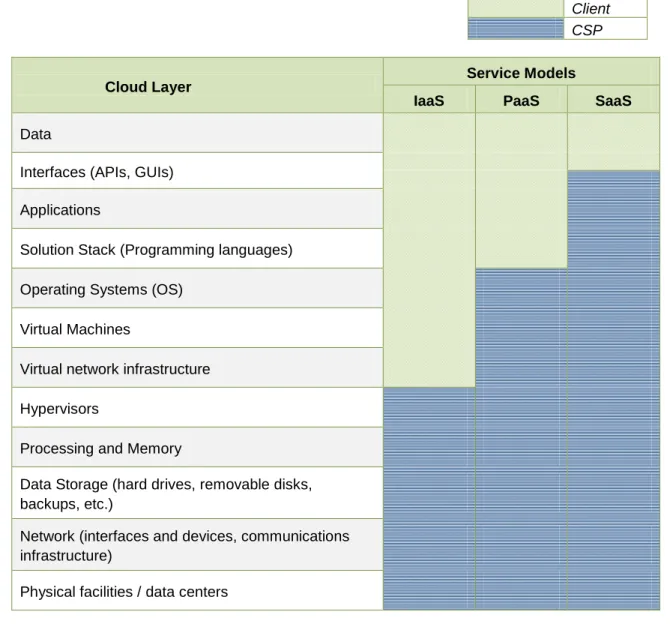
Figure 1 on the following page shows how control is typically shared between the CSP and client across different service models.
4
Figure 1: Level of control/responsibility for client and CSP across different service models
While clients may be attracted to the SaaS and PaaS models due to the resource savings and reduced responsibility for administering the cloud environment, they should be aware that these models also correspond to a greater loss of control of the environment housing their sensitive data. Contractual
agreements and ongoing due diligence become especially critical where control is outsourced, to ensure that the required security measures are being met and maintained by the CSP for the duration of the agreement.
3
Cloud Provider / Cloud Customer Relationships
3.1 Understanding Roles and Responsibilities
The lines of accountability and responsibility will be different for each service and deployment model. Clear policies and procedures should be agreed upon between client and cloud provider for all security
requirements, and clear responsibilities for operation, management and reporting need to be defined for each requirement.
3.2 Roles and Responsibilities for Different Deployments Models
The entity performing the role of CSP will vary according to the type of deployment model. For example, the CSP role may be assigned entirely to an external third party (as in a public cloud), or the role may be
undertaken by an internal department or business function (as in an on-premise private cloud). Similarly, the role of CSP may be assigned to more than one entity in a community or hybrid cloud scenario.
To understand how responsibilities are assigned in a particular deployment model, consider the following: Private cloud – Where a private cloud is managed on-premise, the CSP role may be undertaken within
the client organization. For example, the IT department could take on the role of CSP with various operational departments as its clients. In this scenario, the client organization retains full control of their environment and its security and compliance.
Dedicated, private clouds may also be provisioned off-premise by a third-party CSP. In this case, the delineation of responsibility will also depend on the particular service model, as described in Section 3.3, “Responsibilities for Different Service Models.”
Community cloud – The CSP could be one of the client organizations within the community or a separate third party. The delineation of responsibility follows the particular service model implemented. Public cloud – The CSP is a third party that is an organizationally-separate entity to its clients. The cloud
is deployed within a CSP’s environment and responsibility is delineated according to the particular service model, as defined by the CSP.
Hybrid cloud – The CSP role may be assigned to both internal and third-party entities for different elements of the overall cloud infrastructure. Responsibility will be assigned based on the combination of deployment models and service models implemented.
The responsibility for implementation, operation, and management of security controls will be shared differently within each of the cloud models, and needs to be clearly understood by both the client and CSP. The client also needs to understand the level of oversight or visibility they will have into security functions that are outside their control. If these security responsibilities are not properly assigned, communicated, and understood, insecure configurations or vulnerabilities could go unnoticed and unaddressed, resulting in potential exploit and data loss or other compromise.
3.3 Responsibilities for Different Service Models
In all deployment models, and particularly in public cloud environments, it is important for all parties to understand the specific elements of the service model used and its associated risks. Any cloud deployment model that is not truly private (on-premise) is by nature a shared responsibility model, where a portion of responsibility for the cloud service falls under the realm of the CSP, and a portion of responsibility also falls to each client. The level of responsibility that falls to the CSP or the client is determined by the cloud service model being utilized—that is, IaaS, PaaS, or SaaS. Clear delineation of responsibilities should be established as a prerequisite to any cloud service implementation to provide a baseline for the cloud operation.
Figure 2 on the following page illustrates how control of the different technical layers is often shared across different service models. For illustration purposes, different layers of the cloud stack are described as follows:
Layer Description
Application Program Interface (API) or Graphical User Interface (GUI)
The interface used by the client or their customers to interact with the application. The current most common API is RESTful HTTP or HTTPS. The current most common GUI is an HTTP or HTTPS based Web site.
Application The actual application being used by one or more clients or their
customers.
Solution stack This is the programming language used to build and deploy
applications. Some examples include .NET, Python, Ruby, Perl, etc. Operating systems (OS) In a virtualized environment, the OS runs within each VM. Alternatively,
if there is no underlying hypervisor present, the operating system runs directly on the storage hardware.
Virtual machine (VM) The virtual container assigned for client use.
Virtual network infrastructure For communications within and between virtual machines
Hypervisor When virtualization is used to manage resources, the hypervisor is
responsible for allocating resources to each virtual machine. It may also be leveraged for implementing security.
Processing and memory The physical hardware that supplies CPU time and physical memory.
Data Storage The physical hardware used for file storage.
Network This can be a physical or virtual network. It is responsible for carrying
communications between systems and possibly the Internet. Physical facility The actual physical building where the cloud systems are located.
Appendix B illustrates a sample inventory for cloud computing systems, as guidance for how CSPs and their customers can document the different layers of the cloud environment.
Figure 2: Example of how control may be assigned between CSP and clients across different service models.
Client CSP
Cloud Layer Service Models
IaaS PaaS SaaS
Data
Interfaces (APIs, GUIs) Applications
Solution Stack (Programming languages) Operating Systems (OS)
Virtual Machines
Virtual network infrastructure Hypervisors
Processing and Memory
Data Storage (hard drives, removable disks, backups, etc.)
Network (interfaces and devices, communications infrastructure)
Physical facilities / data centers
Note: This table provides an example of how responsibilities might be assigned according to common descriptions of the different service models. However, it’s important to note that the technology layers and their corresponding lines of responsibility may be different for each CSP, even if they use the same terminology to describe their service, and the individual service offerings may or may not align with the responsibly assignments indicated above.
Some CSPs offer multiple “options” for their services—for example, a CSP may have one IaaS offering that includes a client-controlled hypervisor and a separate IaaS offering with no client access to the hypervisor. It’s imperative that clients and CSPs clearly document and understand where the boundaries are in their
Even where a client does not have control over a particular layer, they may still have some responsibility for the configurations or settings that the CSP maintains on their behalf. For example, a client may need to define firewall rules and review firewall rule-sets for those firewalls applicable to the protection of their environment, even though the CSP actually configures and manages the firewalls. Similarly, clients may be responsible for approving and reviewing user access permissions to their data resources, while the CSP configures the access according to client needs.
The allocation of responsibility for managing security controls does not exempt a client from the responsibility of ensuring that their cardholder data is properly secured.
3.4 Nested Service-Provider Relationships
Nested service-provider relationships are not uncommon in cloud scenarios, as CSPs sometimes rely on other third-party companies to deliver their services. For examples, some CSPs use third-party storage providers as part of their cloud service offering, while some might partner with other CSPs for redundancy or fail-over as part of their cloud-delivery strategy.
Identifying all third-party relationships that the CSP has in place is important in order to understand the potential ramifications to a client’s environment. The existence of multiple nested relationships—for example, where there is a chain of vendors and/or other providers required for delivery of a cloud service—will also add complexity to both the CSP’s and the client’s PCI DSS assessment process.
4
PCI DSS Considerations
4.1 Understanding PCI DSS Responsibilities
The responsibilities delineated between the client and the CSP for managing PCI DSS controls are influenced by a number of variables, including but not limited to:
The purpose for which the client is using the cloud service.
The scope of PCI DSS requirements that the client is outsourcing to the CSP.
The services and system components that the CSP has validated within its own operations. The service option that the client has selected to engage the CSP (IaaS, PaaS or SaaS).
The scope of any additional services the CSP is providing to proactively manage the client’s compliance (for example, additional managed security services).
The client needs to clearly understand the scope of responsibility that the CSP is accepting for each PCI DSS requirement, and which services and system components are validated for each requirement. For example, PCI DSS Requirements 6.1 and 6.2 address the need for vulnerabilities to be identified, ranked according to risk, and deployed in a timely manner. If not properly defined, a client could assume that the CSP is managing this process for the entire cloud environment, whereas the CSP could be managing vulnerabilities for their underlying infrastructure only, and assuming that the client is managing vulnerabilities for operating systems and applications.
4.2 PCI DSS Responsibilities for Different Service Models
As a general rule, the more aspects of a client’s operations that the CSP manages, the more responsibility the CSP has for maintaining PCI DSS controls. However, outsourcing maintenance of controls is not the same as outsourcing responsibility for the data overall. Cloud customers should not make assumptions about any service, and should clearly spell out in contracts, memorandums of understanding, and/or SLAs exactly which party is responsible for securing which system components and processes.
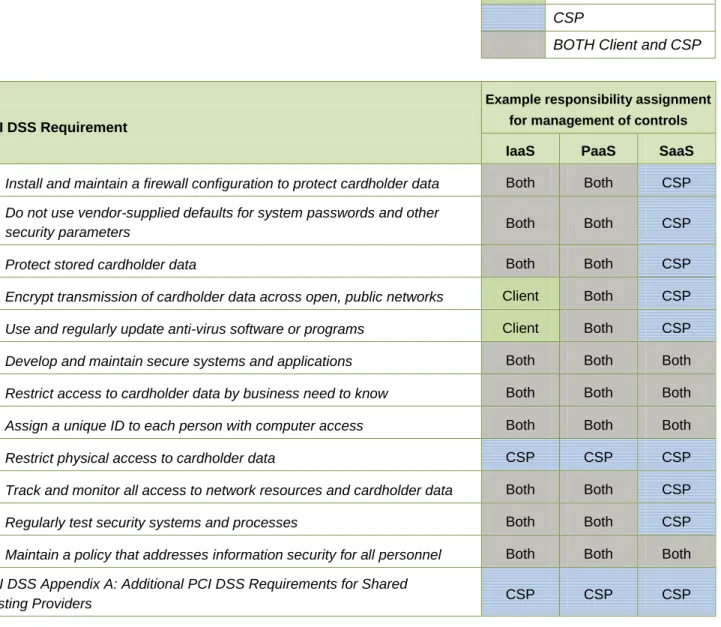
Figure 3 on the following page provides an example of how responsibilities for PCI DSS requirements may be shared between clients and CSPs across the three service models. There will of course be exceptions and variations across each individual service, and this table is provided as a guideline for clients and CSPs to help plan discussions and negotiations.
Responsibilities have been identified as follows:
Client – Generally each client will retain responsibility for maintaining and verifying the requirement. CSP – Generally the CSP will maintain and verify the requirement for their clients.
Both – Generally responsibility is “shared” between the client and the CSP. This may be due to the requirement applying to elements present in both the client environment and the CSP-managed environment, or because both parties need to be involved in the management of a particular control.
Appendix A includes additional considerations for determining how PCI DSS responsibilities may be assigned for each service model.
Figure 3: Example of how PCI DSS responsibilities may be shared between clients and CSPs.
Client CSP
BOTH Client and CSP
PCI DSS Requirement
Example responsibility assignment for management of controls
IaaS PaaS SaaS
1: Install and maintain a firewall configuration to protect cardholder data Both Both CSP
2: Do not use vendor-supplied defaults for system passwords and other
security parameters Both Both CSP
3: Protect stored cardholder data Both Both CSP
4: Encrypt transmission of cardholder data across open, public networks Client Both CSP
5: Use and regularly update anti-virus software or programs Client Both CSP
6: Develop and maintain secure systems and applications Both Both Both
7: Restrict access to cardholder data by business need to know Both Both Both
8: Assign a unique ID to each person with computer access Both Both Both
9: Restrict physical access to cardholder data CSP CSP CSP
10: Track and monitor all access to network resources and cardholder data Both Both CSP
11: Regularly test security systems and processes Both Both CSP
12: Maintain a policy that addresses information security for all personnel Both Both Both
PCI DSS Appendix A: Additional PCI DSS Requirements for Shared
Hosting Providers CSP CSP CSP
Note: The sample responsibilities illustrated in this table do not include consideration for any activities or operations performed outside of a hypothetical cloud service offering. This table provides an example of how PCI DSS responsibilities might be assigned for different service models. However, each CSP ultimately defines their own service, and particular service offerings may or may not be consistent with those illustrated above. Clients and CSPs should clearly document their responsibilities as applicable to their particular agreement.
The concept of “shared” or “joint” responsibility can be a particular tricky path to navigate. While some
services and functions will be relatively straightforward to scope and establish boundaries, many services and functions will overlap if not clearly demarcated at the outset of the service relationship.
Where the CSP maintains responsibility for PCI DSS controls, the client is still responsible for monitoring the CSP’s ongoing compliance for all applicable requirements. CSPs should be able to provide their clients with ongoing assurance that requirements are being met, and where the CSP is managing requirements on behalf of the client, they should have mechanisms in place to provide the customer with the applicable records—for example, audit logs showing all access to client data.
Clients are still required to validate their compliance in accordance with payment brand programs.
Appendix C illustrates a sample PCI DSS Responsibly Matrix, as guidance for how CSPs and their customers can document PCI DSS responsibility assignments.
Appendix D includes Implementation Considerations for PCI DSS Requirements.
4.3 Security as a Service (SecaaS)
Security as a Service, or SecaaS, is sometimes used to describe the delivery of security services using a SaaS-based delivery model. SecaaS solutions not directly involved in storing, processing, or transmitting CHD may still be an integral part of the security of the CDE. As an example, a SaaS-based anti-malware solution may be used to update anti-malware signatures on the client’s systems via a cloud-delivery model. In this example, the SecaaS offering is delivering a PCI DSS control to the client’s environment, and the SecaaS functionality will need to be reviewed to verify that it is meeting the applicable requirements.
4.4 Segmentation Considerations
Outside of a cloud environment, individual client environments would normally be physically, organizationally, and administratively separate from each other. Clients utilizing a public or otherwise shared cloud must rely on the CSP to ensure that their environment is adequately isolated from the other client environments. In addition to enforcing separation between client environments, segmentation may also be desired within a client’s environment to isolate their CDE components from non-CDE components in order to reduce their own PCI DSS scope.
Segmentation on a cloud-computing infrastructure must provide an equivalent level of isolation as that
achievable through physical network separation. Mechanisms to ensure appropriate isolation may be required at the network, operating system, and application layers; and most importantly, there should be guaranteed isolation of data that is stored. Client environments must be isolated from each other such that they can be considered separately managed entities with no connectivity between them. Any systems or components shared by the client environments, including the hypervisor and underlying systems, must not provide an access path between environments. Any shared infrastructure used to house an in-scope client environment would be in scope for that client’s PCI DSS assessment.
A segmented cloud environment exists when the CSP enforces isolation between client environments.
Examples of how segmentation may be provided in shared cloud environments include, but are not limited to: Traditional Application Service Provider (ASP) model, where physically separate servers are provided for
each client’s cardholder data environment.
Virtualized servers that are individually dedicated to a particular client, including any virtualized disks such as SAN, NAS or virtual database servers.
Environments where clients run their applications in separate logical partitions using separate database management system images and do not share disk storage or other resources.
The PCI DSS assessor must validate the effectiveness of the segmentation to ensure it provides adequate isolation. If adequate segmentation is provided between clients, the client environment and the CSP-managed environment and processes would be in scope for a client’s PCI DSS assessment. If adequate segmentation is not in place or cannot be verified, the entire cloud environment would be in-scope for any one client’s assessment. Examples of “non-segmented” cloud environments include but are not limited to:
Environments where organizations use the same application image on the same server and are only separated by the access control system of the operating system or the application.
Environments where organizations use different images of an application on the same server and are only separated by the access control system of the operating system or the application.
Environments where organizations’ data is stored in the same instance of the database management system’s data store.
Without adequate segmentation, all clients of the shared infrastructure, as well as the CSP, would need to be verified as being PCI DSS compliant in order for any one client to be assured of the compliance of the environment. This will likely make compliance validation unachievable for the CSP or any of their clients.
4.4.1 Segmentation Challenges
Segmentation in traditional hosted environments can be applied via separate physical servers and security measures applied using known methods. The difference in a cloud environment is that there are common shared layers (such as hypervisors and virtual infrastructure layers), which can present a single point of entry (or attack) for all systems above or below those shared layers. The security applied to these layers is therefore critical not only to the security of the individual environments they support, but also to ensure that segmentation is enforced between different client environments.
Once any layer of the cloud architecture is shared by CDE and non-CDE environments, segmentation becomes increasingly complex. This complexity is not limited to shared hypervisors; all layers of the infrastructure that could provide an entry point to a CDE must be included when verifying segmentation. In a private cloud environment, one approach that may help reduce the complexity of segmentation efforts could be to locate all CDE virtual components on a dedicated “CDE hypervisor,” and ensure all non-CDE virtual components are located on separate hypervisors, adequately segmented from the CDE hypervisor.
The need for adequate segmentation of client environments in a public or shared cloud is underscored by the principle that the other client environments running on the same infrastructure are to be considered untrusted networks. The client has no way of confirming whether other client environments are securely configured, patched appropriately to protect against attack, or that they are not already compromised or even designed to be malicious. This is particularly relevant where a CSP offers IaaS and PaaS services, as the individual clients have greater control and management of their environments.
4.4.2 Segmentation Responsibilities
Ultimately, the CSP needs to take ownership of the segmentation between clients and verify it is effective and provides adequate isolation between individual client environments, between client environments and the CSP’s own environment, and between client environments and other untrusted environments (such as the Internet). Applicable PCI DSS controls for the segmentation functions would also be the CSP’s responsibility (for example, firewall rules, audit logging, documentation, reviews, etc.). The client is responsible for the proper configuration of any segmentation controls implemented within their own environment (for example, using virtual firewalls to separate in-scope VMs from out-of-scope VMs), and for ensuring that effective isolation is maintained between in-scope and out-of-scope components. Clients wishing to implement segmentation within their cloud environment also need to consider how the CSP’s environment and processes may impact the effectiveness of the segmentation. For example, CSP systems could be providing connectivity between the client’s own VMs that is not visible to the client. Clients should also consider how the CSP manages offline or dormant VMs, and whether in-scope and out-of-scope VMs could potentially be stored together by the CSP without active segmentation controls.
4.4.3
Segmentation Technologies
Traditional network segmentation technologies consist of hardware devices such as firewalls, switches, routers, and so forth. These physical components could be used to separate VMs hosted on the same or multiple hypervisors similar to the manner in which systems could be segmented in a “physical” network. This would require hypervisors with multiple network interfaces and PCI DSS compliant configurations for the various types of network hardware. Additionally, virtual counterparts of firewalls, switches and routers now exist and can be incorporated into a virtual environment.
As mentioned above, a key consideration is how secure the “common layers” (such as hypervisors and shared physical components) are, and whether they represent a potential attack surface between zones or clients. The answer is that yes, they do; however the associated risks are still not well understood. Examples of controls to be considered when evaluating segmentation options include, but are not limited to:
Physical firewalls and network segmentation at the infrastructure level Firewalls at the hypervisor and VM level
VLAN tagging or zoning in addition to firewalls
Intrusion-prevention systems at the hypervisor and/or VM level to detect and block unwanted traffic Data-loss-prevention tools at the hypervisor and/or VM level
Controls to prevent out-of-band communications occurring via the underlying infrastructure Isolation of shared processes and resources from client environments
Segmented data stores for each client Strong, two-factor authentication
Separation of duties and administrative oversight
4.5 Scoping Considerations
Merchant or other organizations looking to store, process, or transmit payment card data in a cloud
environment should clearly understand the impact that extending their CDE into the cloud will have on their PCI DSS scope. For example, in a private-cloud deployment, an organization could either implement adequate segmentation to isolate in-scope systems from other systems and services, or they could consider their private cloud to be wholly in scope for PCI DSS. In a public cloud, the client organization and CSP will need to work closely together to define and verify scope boundaries, as both parties will have systems and services in scope.
Appendix D includes Implementation Considerations for PCI DSS Requirements.
Recommendations for minimizing and simplifying PCI DSS scope in a cloud environment include:
Don’t store, process or transmit payment card data in the cloud. This is the most effective way to keep a cloud environment out of scope, as PCI DSS controls are not required if there is no payment card data to protect.
Implement a dedicated physical infrastructure that is used only for the in-scope cloud environment. The scoping process will be simplified if all in-scope operations are limited to a known, defined set of physical and virtual system components that are managed independently from other components. Once defined, the client will be reliant on the CSP’s ability to ensure scope boundaries are maintained—for example, by ensuring that all segmentation controls are operating effectively and that any new components connected to the in-scope environment are immediately brought into scope and protected accordingly.
Minimize reliance on third-party CSPs for protecting payment card data. The more security controls the CSP is responsible for, the greater the scope of the CDE will potentially be, thereby increasing the complexity involved in defining and maintaining CDE boundaries.
Ensuring that clear-text account data is never accessible in the cloud may also assist to reduce the number of PCI DSS requirements applicable to the cloud environment. As an example, let’s say the client performs all encryption and decryption operations and all key-management functions5 in their own data center and uses a third-party cloud only to store or transmit encrypted data. In this scenario, clear-text data would never exist in the cloud environment—not even temporarily or in memory. Additionally, the cloud environment would never have access to cryptographic keys or key-management processes.
It should be noted that the encrypted data is still in scope for PCI DSS (generally for the entity that controls or manages the encrypted data and/or the cryptographic keys6) to ensure that applicable controls are in place. However, by keeping all encryption/decryption and key-management operations isolated from the cloud, the number of PCI DSS requirements that the CSP is required to maintain may be reduced, as these
requirements will instead be applicable to the client’s own environment and personnel. The CSP will still be in scope for any PCI DSS requirements it manages on behalf of the client—for example, access controls managed by the CSP will need to be verified to ensure that only authorized persons (as determined by the client) have access to the encrypted data, and that access is not granted to unauthorized persons.
5
In accordance with PCI DSS Requirements
6 Refer to FAQ “Is encrypted cardholder data in scope for PCI DSS?”
Alternatively, if clear-text account data is present (for example, in memory) in the cloud environment, or the ability to retrieve account data exists (for example, if decryption keys and encrypted data are present), all applicable PCI DSS requirements would apply to that environment.
4.5.1 Scoping Examples for Different Deployment Models
For private cloud environments, segmentation efforts are focused on isolating CDE components from non-CDE components to reduce the number of systems in scope for PCI DSS. In public or shared cloud environments, segmentation between clients is critical for the security of the entire client environment, and is additional to any segmentation managed by the client within their environment for the purposes of scoping.
A number of simple scoping examples are presented here to provide guidance.
Scenario Environment description PCI DSS scoping guidance
Case 1: Private Cloud hosted and controlled by entity seeking PCI DSS compliance, with
segmentation.
All CDE VMs are hosted on a single, dedicated hypervisor; non-CDE VMs are hosted on a separate hypervisor(s).
Validated segmentation of CDE systems from non-CDE systems using a combination of physical and logical controls
The CDE hypervisor and VMs, and all cloud components that are not segmented are in scope
(segmentation must be validated as providing effective isolation)
Case 2: Private Cloud hosted and controlled by entity seeking PCI DSS compliance, no segmentation.
All VMs are hosted on one or more hypervisors; some VMs are considered part of the CDE and some are not.
No segmentation of CDE systems from non-CDE systems.
The entire cloud environment and all connected systems are in scope and considered part of the CDE (similar to a flat network).
Scenario Environment description PCI DSS scoping guidance Case 3: Third-party CSP hosting a
“PCI DSS compliant” public cloud supporting multiple clients, with validated segmentation for client environments.
VMs may be on one or multiple hypervisors, all hypervisors and VMs are configured by CSP to support PCI DSS requirements.
Multiple clients hosted on each hypervisor.
Validated segmentation of client environments using a
combination of physical and logical controls.
The CSP is responsible for compliance of all elements of the cloud service provided. Each client’s scope would include their own environment (for example, VMs, applications etc.) and any other elements not managed by the CSP. Segmentation must be validated as providing effective isolation between clients as part of the CSP’s validation, and may require additional validation as part of each client’s validation.
Case 4: Third-party CSP hosting a “PCI DSS compliant” public cloud supporting multiple clients, no client segmentation.
VMs may be on one or multiple hypervisors, all hypervisors configured by CSP to support PCI DSS requirements.
Multiple clients hosted on each hypervisor, VM configuration managed by each client.
Segmentation between client environments is not verified.
Entire cloud service and all client environments are in scope. Note that validating PCI DSS compliance may be intractable and infeasible as every client environment would need to be included in the
5
PCI DSS Compliance Challenges
Storing, processing, or transmitting cardholder data in the cloud brings that cloud environment into scope for PCI DSS, and it may be particularly challenging to validate PCI DSS compliance in a distributed, dynamic infrastructure such as a public or other shared cloud. For example, it can be difficult to identify which system components are in scope for a particular service, or identify who is responsible for particular PCI DSS
controls. Some of the technical controls and auditing processes traditionally used to attain a measurable level of assurance in static environments (for example, in-house data storage servers) are not designed for rapidly-changing cloud environments and processes (for example, cloud bursting, continual deployment and
retirement of virtual machines, dynamic IP addressing, and so on). Additionally, clients and assessors often can’t “see and touch” CDE systems as they would in a traditional environment (for example, by visiting the data center).
The distributed architectures of cloud environments add layers of technology and complexity that challenge traditional assessment methods. For example, how does an assessor determine an appropriate sample size for a dynamic cloud environment in which systems can appear and disappear in minutes?
Examples of compliance challenges include but are not limited to:
Clients may have little or no visibility into the CSP’s underlying infrastructure and the related security controls.
Clients may have limited or no oversight or control over cardholder data storage. Organizations might not know where cardholder data is physically stored, or the location(s) can regularly change. For redundancy or high availability reasons, data could be stored in multiple locations at any given time.
Some virtual components do not have the same level of access control, logging, and monitoring as their physical counterparts.
Perimeter boundaries between client environments can be fluid.
Public cloud environments are usually designed to allow access from anywhere on the Internet.
It can be challenging to verify who has access to cardholder data processed, transmitted, or stored in the cloud environment.
It can be challenging to collect, correlate, and/or archive all of the logs necessary to meet applicable PCI DSS requirements.
Organizations using data-discovery tools to identify cardholder data in their environments, and to ensure that such data is not stored in unexpected places, may find that running such tools in a cloud environment can be difficult and result in incomplete results. It can be challenging for organizations to verify that cardholder card data has not “leaked” into the cloud.
Many large providers might not support right-to-audit for their clients. Clients should discuss their needs with the provider to determine how the CSP can provide assurance that required controls are in place.
These challenges will impact a number of factors related to how PCI DSS compliance is managed, including how segmentation is implemented, how PCI DSS assessments are scoped, how individual PCI DSS
requirements are validated, and which party will perform particular validation activities.
At a high level, CSPs can be identified as those that have been validated as meeting a particular level of PCI DSS compliance and those that have not. The recommended practice for clients with PCI DSS considerations is to work with CSPs whose services have been independently validated as being PCI DSS compliant.
5.1 What does “I am PCI compliant” mean?
Much stock is placed in the statement “I am PCI compliant”, but what does this actually mean for the different parties involved?
Use of a PCI DSS compliant CSP does not result in PCI DSS compliance for the clients. The client must still ensure they are using the service in a compliant manner, and is also ultimately responsible for the security of their CHD—outsourcing daily management of a subset of PCI DSS requirements does not remove the client’s responsibility to ensure CHD is properly secured and that PCI DSS controls are met. The client therefore must work with the CSP to ensure that evidence is provided to verify that PCI DSS controls are maintained on an ongoing basis—an Attestation of Compliance (AOC) reflects a single point in time only; compliance
requires ongoing monitoring and validation that controls are in place and working effectively. Even where a cloud service is validated for certain PCI DSS requirements, this validation does not
automatically transfer to the client environments within that cloud service. For example, a CSP’s validation may have included use of up-to-date anti-virus software on the CSP’s systems; however, this validation might not extend to the individual client OS or VMs (such as in an IaaS service). Additionally, the client must still maintain compliance for all of their own operations—for example, by ensuring anti-virus is installed and updated on all client-side systems used to connect into the cloud environment.
Similarly, a client’s PCI DSS compliance does not result in any claim of compliance for the CSP, even if the client’s validation included elements of the service managed by the CSP.
Regarding the applicability of one party’s compliance to the other, consider the following: a) If a CSP is compliant, this does not mean that their clients are.
b) If a CSP’s clients are compliant, this does not mean that the CSP is.
c) If a CSP and the client are compliant, this does not mean that any other clients are.
The CSP should ensure that any service offered as being “PCI compliant” is accompanied by a clear and unambiguous explanation, supported by appropriate evidence, of which aspects of the service have been validated as compliant and which have not.
5.2 Verifying Scope of Validated Services and Components
Clients should first verify that the service they are using is the one that has been validated. CSPs that have validated PCI DSS compliance may be included on a list published by a payment card brand or they may not; either way, the client will need to obtain details of the CSP’s compliance validation in order to determine whether the service they are using is wholly covered.
Considerations for the client may include:
How long has the CSP been PCI DSS compliant? When was their last validation? What specific services and PCI DSS requirements were included in the validation? What specific facilities and system components were included in the validation?
Are there any system components that the CSP relies on for delivery of the service that were not included in the PCI DSS validation?
How does the CSP ensure that clients using the PCI DSS compliant service cannot introduce non-compliant components to the environment or bypass any PCI DSS controls?
CSPs should provide their clients with evidence that clearly identifies what was included in the scope of their PCI DSS assessment, as well as the specific PCI DSS requirements that the environment was assessed against, and the date of the assessment. All aspects of the cloud service not covered by the CSP’s PCI DSS assessment should also be identified and documented, as these will need to be validated either by the client or the CSP in order for a client’s assessment to be completed. The client must have a detailed understanding of any security requirements that are not covered by the provider and are
therefore the client’s responsibility to implement, manage, and validate as part of their own PCI DSS compliance.
CSPs that have undergone an independent PCI DSS assessment to validate their compliance will have the results summarized in an Attestation of Compliance (AOC) and detailed in a Report on Compliance (ROC). The Executive Summary and Scope of Work sections of the ROC should detail the scope of the assessment including the specific components, facilities, and services that were assessed.
5.3 Verifying PCI DSS Controls Managed by the Cloud Provider
As with all hosted services in scope for PCI DSS, the client organization should request sufficient evidence and assurance from their CSP that all in-scope processes and components under the
CSP’s control are PCI DSS compliant. This verification may be completed by the client’s assessor (such as a QSA or ISA) as part of client’s PCI DSS assessment. If the CSP has already undergone a PCI DSS assessment that was performed by another assessor, the client’s assessor will need to verify that the CSP’s validation is current, that the assessment covered all services provided to or used by the client, and that all applicable requirements were found to be in place for the environments and systems in scope.
CSPs that have undergone PCI DSS compliance assessment and validation should be able to provide their clients with the following:
Proof of compliance documentation (such as the AOC and applicable sections from the ROC), including date of compliance assessment
Documented evidence of system components and services that were included in the PCI DSS assessment
Documented evidence of system components and services that were excluded from the PCI DSS assessment, as applicable to the service
CSPs that have not undergone a PCI DSS compliance assessment will need to be included in their client’s assessment. The CSP will need to agree to provide the client’s assessor with access to their environment in order for the client to complete their assessment. The client’s assessor may require onsite access and detailed information from the CSP, including but not limited to:
Access to systems, facilities, and appropriate personnel for on-site reviews, interviews, physical walk-throughs, etc.
Policies and procedures, process documentation, configuration standards, training records, incident response plans, etc.
Evidence (such as configurations, screen shots, process reviews, etc.) to show that all applicable PCI DSS requirements are being met for the in-scope system components
Appropriate contract language, if applicable
The client and CSP will need to agree upon which assessment activities can be performed by the client and which testing is the responsibility of the CSP. For example, in an IaaS/PaaS service, the client may wish to test within their own environment and whatever else they can access, such as the boundaries between themselves and other clients, or between themselves and the CSP’s systems. However, if such testing is not permitted by the CSP, the client will have to rely on the CSP to perform and validate these requirements. In SaaS environments, the client will have limited or no visibility or permission to perform testing, and will generally be reliant on the CSP for all testing and validation. Defined testing activities and their associated controls and permissions should be detailed in the SLA.
The CSP also needs to be able to provide clients with specific details as applicable to the ongoing maintenance of PCI DSS compliance. For example, depending on the service provided, the CSP may need to produce copies of log files, patch update records, or firewall rule-sets that specifically apply to an individual client’s environment.
CSPs wishing to provide a PCI DSS compliant service may wish to consider isolating the PCI DSS compliant services from their non-PCI compliant services. This may help to simplify the compliance validation process for both the CSP and for their individual clients. It may also help the CSP to standardize the PCI DSS compliant services being provided to their clients.
6
Additional Security Considerations
While the use of cloud services can provide an attractive opportunity for organizations of all sizes to outsource and utilize centrally-managed security resources, organizations should also be aware of the risks and
challenges associated with a particular cloud choice before moving their sensitive data or services into the cloud environment. This section explores some of these additional security considerations.
6.1 Governance, Risk and Compliance
One of the primary challenges with cloud environments is that governance, compliance, and risk management are typically shared between the client and CSP. This shared delineation of responsibilities emphasizes the importance of a strong governance and risk-management structure. Without a clear governance strategy, the client may be unaware of issues arising from use of the cloud service, and the CSP may be unaware of issues within the client environment that could impact their service provision. A strategy for shared governance and communication should be established between client and CSP to enable clear
communication of all aspects of the relationship from operational performance to security risk management and issue resolution. Reporting and monitoring mechanisms should be made available to client organizations to provide assurance that effective governance is applied by the CSP.
6.1.1
Risk Management
Consistent with a risk-management approach for in-house services, outsourced cloud services should be assessed against an organization’s risk criteria with the intent of identifying critical assets, analyzing potential vulnerabilities and threats to those assets, and developing an appropriate risk-mitigation strategy (see PCI DSS Requirement 12.1.2). Lack of physical control of infrastructure, as occurs when the
environment is outsourced to a third-party CSP, renders a thorough risk-management process all the more important.
In traditional environments, the physical location of sensitive data can be restricted to dedicated systems, facilitating the identification and implementation of effective risk-mitigation controls. However, the advent of new technologies requires a reevaluation of traditional risk strategies. For example, data in cloud environments is no longer tied to a physical system or location, reducing the effectiveness of traditional security mechanisms to protect data from risk. Traditional security approaches that build security controls “around” sensitive data may therefore need to evolve to address this new risk environment.
Similarly, traditional forms of risk assessment might not take into consideration particular cloud characteristics, such as a pay-as-you go model or multi-tenancy (described in Section 6.5.7), and may therefore require new or modified procedures.
6.1.2
Due Diligence
A CSP that stores, processes, or transmits cardholder data on behalf of a client, provides a security service for the protection of a client’s cardholder data, or could otherwise impact the security of a client’s cardholder data, would be considered a third-party service provider of the client. As with all service providers, clients should follow a thorough due-diligence process (see PCI DSS Requirement 12.8) prior
to engagement of the CSP. The specific due-diligence process and goals will vary for each client organization, however common objectives typically include:
1. Confirming the provider has a history of sound work practices and ethical behavior and is legitimately performing the services the client believes them to be
2. Verifying that the provider is compatible with the client’s business image and risk profile
3. Identifying potential risks or circumstances associated with the provider that may impact the client’s operations or business
4. Identifying elements of the service that need to be clarified, and that need to be included in contracts or service agreements
Due diligence is not simply reading the provider’s marketing material or relying on a provider’s claims of “PCI compliance” or secure operations. Clients should be sufficiently assured that they are engaging with a provider that can meet their security and operational needs before undertaking any such engagements. The scope of the due-diligence exercise should consider, at a minimum, the topics discussed throughout this document, as applicable to a client’s particular requirements.
6.1.3
Service Level Agreements (SLAs)
The use of cloud services includes the deployment of a defined service model and should always be underwritten by comprehensive service level agreements (SLAs). The secure delivery of any cloud service is dependent on the CSP’s personnel, processes, and technologies, while the secure usage of cloud services remains the responsibility of the client.
Typically, cloud-hosting agreements are concerned with “up-time” and high availability, with little or no mention or assurance of security. However, the client is ultimately responsible for ensuring the service they’re using meets their security requirements and compliance obligations.
SLAs and other written agreements between the CSP and client should clearly identify the delineation of responsibilities between parties, including responsibilities for implementing and managing different security controls. These SLAs and agreements should be established as a prerequisite to any cloud service implementation. PCI DSS compliance validation and testing activities (with the associated controls, permissions, and schedules) should also be clearly detailed in the SLA.
Failure to develop and agree upon appropriate SLAs may result in issues for the client if the cloud service does not meet the needs and demands of their business. SLAs should be established and agreed as part of any contract and service negotiations. Performance, availability, integrity, and confidentiality should be considered and SLAs agreed for each service managed and/or operated by the CSP. Written agreements should also cover activities and assurances to be provided by both parties upon termination of the service provision.
6.1.4
Business Continuity Plans and Disaster Recovery
Organizational requirements for business-continuity plans (BCP) and disaster recovery (DR) apply to the client’s outsourced environments as they do for client-managed facilities. Clients should consider whether the CSP’s continuity and recovery procedures are sufficient to meet the client’s organizational
that might be used to store, process, or transmit cardholder data in BCP or DR situation, The ability to perform tests of the BCP and DR capabilities and/or to observe results of the CSP’s testing should also be considered.
6.1.5
Human resources
Management of the CSP’s human resources is largely out of the control of the client. The client’s due-diligence processes should include an understanding of the CSP’s human resources and employee engagement practices, as inappropriately or under-qualified personnel may expose data to unnecessary risk. PCI DSS Requirement 12.7 provides a basis for assessing the recruitment process at the CSP.
6.2 Facilities and Physical Security
Cloud services are only “cloud” in concept. In reality, cloud services involve physical resources located at the CSP environment which are accessed remotely from the client’s environment. Similarly to other third-party providers, CSPs of public and shared clouds provide services to multiple clients whose data and virtual components co-exist in the same physical location and on the same physical systems as other clients. Poor physical security controls at a CSP facility may expose many clients’ data to unnecessary risk, and poor environmental controls may impact the performance and integrity of the service provision.
In a private cloud, the physical location of all components is known and can be verified. When using a public cloud, different elements of the environment, such as VMs, hypervisors, virtual network devices, etc., could be frequently relocated according to the CSP’s load-balancing strategy. Verifying that appropriate physical security is in place can be challenging in an environment where data and infrastructure can be in multiple different locations at different times. A client should seek assurance that their physical security requirements are consistently applied across all potential locations.
6.3 Data sovereignty and Legal considerations
Depending on the deployment and service model adopted, and due to the dynamic nature of cloud operations, it may not be known where particular information actually resides. This may result in concerns over data ownership and potential conflicts between domestic or international legal and regulatory
requirements. For example, the CSP’s infrastructure may result in data traversing or being stored in politically or economically unstable countries.
Understanding the legal jurisdictions that apply to data in different countries or regions can be a challenge for the client organization. For example, clients subject to regional laws restricting cross-border flows of data will need to verify all locations and flows of their data to ensure their cloud service is compliant with their legal obligations.
Other legal considerations include requirements for electronic discovery, evidence preservation and integrity, and data custody. CSPs should have documented processes for responding to legal requests for seizure of records, including data/audit logs belonging to the CSP and their clients. Clients should understand the ramifications of such laws in the countries where their data exists, as well as the processes that their CSP will engage in.
6.4 Data Security Considerations
Further to the data-sovereignty considerations mentioned above, public-cloud providers often have multiple data storage systems located in multiple data centers, which may often be in multiple countries or regions. Consequently, the client may not know the location of their data, or the data may exist in one or more of several locations at any particular time. Additionally, a client may have little or no visibility into the controls protecting their stored data. This can make validation of data security and access controls for a specific data set particularly challenging.
It is recommended that data-security needs are evaluated for all types of information being migrated to a cloud environment, not only cardholder data. For example, operational data, security policies and procedures, system configurations and build standards, log files, audit reports, authentication credentials, cryptographic keys, incident response plans, and employee contact details are just some of the types of data with different security requirements that may need to be considered. If data security processes are not clearly defined and documented, the data may be unintentionally exposed or subject to unnecessary risk that could result in loss or inappropriate disclosure.
6.4.1
Data Acquisition
The client will ultimately determine how and when the cardholder data is acquired in the cloud
environment. End-to-end processes and data flows must be documented across both client and cloud provider networks, so that it is clearly understood where cardholder data is located and how it is traversing the infrastructure (see PCI DSS Requirement 1.1.2). This will also help the client and CSP to identify where each entity acquires and relinquishes cardholder data throughout the process.
6.4.2
Data storage and persistence
In addition to the known range of intended storage locations, data may also be present in other CSP systems used for maintenance of the cloud infrastructure, such as VM images, backups, monitoring logs, and so on. Cardholder data stored in memory could also be written to disk for recovery or high availability purposes (for example, in the case of virtual machine suspension or snapshot). Such stored data may easily be “forgotten” and so not protected by data security controls. All potential capture points should be identified and managed as necessary to prevent unintended or unsecured storage or transmission of sensitive data. Specialized tools and processes may be needed to locate and manage data stored on archived, off-line, or relocated images.
Potential hypervisor access to data in memory should also be taken into consideration, to ensure that client-defined access controls are not unintentionally bypassed by CSP administrator personnel.
6.4.3
Data lifecycle management
For all cloud models, clear requirements for data retention, storage and secure disposal should form an integral part of the engagement process to ensure that sensitive data is:
Retained for as long as needed, Not retained any longer than needed,