FISCAL YEAR 1985. PROGRAM
REPORT
WATER RESOURCES RESEARCII INSTITtYE OREGON STATE UNIVERSITY
Report No. G1039-01
Fiscal Year 1985 Program Report Grant No. 14-08-0001-G1039
for
U.S. Department of the Interior Geological Survey
by
Water Resources Research Institute Oregon State University Corvallis, Oregon 97331 Peter C. Klingeman, Director
August 1986
The activities on which this report is based were financed in part by the Department of the Interior, U.S. Geological Survey, through the Oregon Water Resources Research Institute.
The contents of this publication do not necessarily reflect the views and policies of the Department of the Interior, nor does mention of trade names or commercial products constitute their endorsement by the United States Government.
ABSTRACT
The FY 1985 Oregon Water Resources Research Institute program included six projects concerned with water management of forest, range and agricultural zones, including the associated biological resources. These emphasized
physical, chemical and biological processes for streams, lakes, groundwater zones and watersheds.
Brief summaries of research findings are presented for each project: 02, Water Budget Model of Western Juniper; 03, Assessing Culvert Effectiveness in Mountainous Terrain; 04, Effect of Sorption on Bacterial Metabolism of Trace Toxicants in Groundwater Aquifers; 05, Determination of Minimum Flow Needs for Juvenile Salmonids in Central Oregon Streams; 06, Effects of
Long-Term Regulated Flow on Community Composition of Stream Invertebrates; and 07, Development of Field Assay of Iron Limitation in Eutrophic Lakes.
TABLE OF CONTENTS
Page
Abstract . . .
. ...
...
Water Problems and Issues of Oregon . . .
...
. 1Program Goals and Priorities . . .
...
' 5ResearchProjectSynopses . . .
. ... .
. . .1002. Water Budget Model of Western Juniper - R.F. Miller and L.E. Eddleman . . .
. ... .
. . ....
1103. Assessing Culvert Effectiveness in Mountainous Terrain -R.L. Beschta and M.R. Pyles
... .
. . . .. ...
1504. Effect of Sorption on Bacterial Metabolism of Trace Toxicants in Groundwater Aquifers - S.L. Woods and R.J. Williamson
...
1805. Determination of Minimum Flow Needs for Juvenile Salmonids in Central Oregon Streams - H.W. Li
...
.2106. Effects of Long-Term Regulated Flow on Community Composition of Stream Invertebrates - N.H. Anderson
... .
. . .2507. Development of Field Assay of Iron Limitation in Eutrophic Lakes J. Sanders-Loehr
...
...
29Information Transfer Activities . . .
... .
. .32Cooperative Arrangements
... .
. . . .36WATER PROBLEMS AND ISSUES OF OREGON
Major water-related problems in Oregon result from seasonal, geographic, and year-to-year variability of water supply and the associated competition among water uses. Excess surface water runoff during most winters and springs causes flooding, bank erosion and related problems. Depleted streamflows
contaminated return flows, and lowered ground-water levels occur during most late-summer periods. These create problems of water storage, poor water
quality, and intense competition among water users. Extensive agricultural development in the more arid parts of Oregon and high population densities in the wetter parts of the state lead to severe water-related problems in
drier-than-normal years and to drastically curtailed water use during years of drought.
Water storage in single- and multiple-purpose reservoirs is significant in balancing part of the seasonal maldistributions of water in many river basins. But most reservoirs in Oregon do not provide much carry-over water
from wet years to dry years. While solving some problems of water supply,
dams and reservoirs create other problems, particularly for anadromous fish. Hence, a continuing conflict exists in the state between advocates of water resource development and those favoring protection of natural resources. Better watershed management and water conservation are being urged by many citizens as non-structural alternatives to explore before more dams are
built.
At the regional level, water-related concerns continue to focus on the Columbia River, where multiple-purpose regional coordination was diminished through elimination of the Pacific Northwest River Basins Commission in 1981. The Northwest Power Planning Council (created in 1981 by the Pacific Northwest Electric Power Planning and Conservation Act) and Bonneville Power
Administration presently dominate regional coordination activities; their program emphasis is almost entirely on power, fish and wildlife. Columbia
River water is fully committed and must be very closely managed to assure efficient streamf low use for major competing economic purposes that include agriculture, industry, navigation, and recreation in addition to fish, wildlife and hydroelectric power generation.
At the state level, budgetary support continues at reduced levels for natural resource management by Oregon's state agencies. Many water resource management activities have been curtailed or eliminated. Setbacks in programs such as water rights adjudication, ground water resources assessment, and interagency, multi-focus planning could have long-term detrimental effects.
The principal water problem in Oregon is competition among users for the available water. A second major problem is the protection of environmental
quality. Withdrawals from streamflow and total water consumption are expected
to rise steadily through the 1990's, based on projected population growth in the state. Therefore, water competition and threats to environmental quality
are expected to become more severe unless serious efforts are made to conserve and recycle the available water through structural and non-structural
measures.
The critical water policy issues and management problems that confront the state have received broad public scrutiny during recent state
legislative sessions. They have continued to be in the forefront of public water consciousness. In the 1985 state legislative session some 80 water bills were considered. The adequacy of Oregon's water laws and water
management system to meet past commitments as well as to satisfy shifting public goals has been questioned. Better water conservation has been
coordination in management is also viewed as a potential remedy. The process of dealing with policy issues and management problems was addressed by the 1983 state legislature through passage of three bills -- SB 523 (strategic water planning), SB 225 (protection of minimum instream flows), and SJR 4
(establishing environmental criteria for hydropower site evaluation). Further scrutiny of the state's water laws occurred during the 1985 legislative
session with passage of several less-sweeping bills.
Beyond the high-public-attention areas of water policy and management, there remain many unresolved technical questions that are involved in water resource management. The main problem areas and specific problems that have
been identified by the Oregon WRRI include: * Inadequate instream flows
(adverse effects on aquatic habitat, waste dilution and assimilation, recreation, downstream needs);
* Ground water level decline
(poor knowledge of aquifer conditions, excessive withdrawals, need for management);
* Surface-water/ground-water relations
(inter-connectedness, joint management, water yield, interstate use); * Contamination of quality of ground and surface waters
(sources, control, cleanup, protection of drinking water supplies); * Deterioration and loss of aquatic/riparian habitat;
* Management for protection of forested and rangeland streams; * Protection of bay, estuarine and wetland resources
(processes, impacts of nearby development);
* Impacts of energy-related activities on water-related resources (hydropower, geothermal);
* Structural and non-structural options for water management
(reservoir impacts, alternatives, seasonal and geographic problems, floods, water shortages, land use, management);
* Efficiency of water use
(agriculture, industry, municipal and domestic systems); * Competition for available water
(shifting priorities, alternative sources, valuation);
* Planning and management for water-related resources
(implementation of state-of-art technologies and methodologies); * Water uses
(laws, rights, pricing, reuse, competition);
* Water institutions and institutional arrangements;
* Technology/information transfer to effectively disseminate information from researchers to users.
These are addressed in the Oregon WRRI's five-year research and development plan and the Pacific Northwest regional five-year research and development
plan. Information from these plans is included in the Program Goals and
Priorities section of this report.
PROGRAM GOALS AND PRIORUIES
The main purposes and activities of the Oregon Water Resources Institute remain those originally formulated in 1959. These are to (1) appraise water
research needs, (2) promote research to meet needs, (3) develop new water researchers and resource managers, (4) coordinate efforts of researchers, (5) promote research capabilities, (6) disseminate research results, and (7) promote interdisciplinary graduate education.
The Institute's general long-range goal is to effectively pursue its main objectives so as to assist in the sound management, use and protection of
the state's waters and water-dependent resources. Specific long-range goals
of the Institute are to analyze and clarify the major water problems and issues in the state and help to alleviate or solve these problems through research and related activities.
Water-related problems in Oregon have quantity, quality, economic, institutional and social aspects. Therefore, the physical, biological,
socio-economic and related sciences are all viewed as essential contributors to solutions of these problems. The Institute activities emphasize
multi-disciplinary, problem-oriented research and encourage interdisciplinary activities in support of that research.
To facilitate its activities, the Institute has periodically established research priorities for solving critical water-related problems and has
solicited funds and projects to address those priorities. The updated
research and development plan for 1984-1987 has served as an important guiding document for development of the FY 1985 program; the FY 1985 program has been responsive to that plan.
The FY 1985 Oregon Water Resources Research Institute Program has focused on comprehensive multiple-purpose use of water resources and the resolution of
problems and issues that arise over limited water-related resources. The main
priority of the FY 1985 program was to advance technical knowledge related to water management. Specific priorities were to advance our knowledge of
(a) useful water management options in forest, range and agricultural zones of the state (projects 02, 03); (b) instream flow needs for fish and benthic organisms (projects 05, 06); and (c) biological processes that control contamination of aquifers and lakes (projects 04, 07).
The projects included in the FY 1985 Oregon WRRJ Program all addressed issues and problems that are identified in the Oregon and Pacific Northwest five-year plans. In addition, most addressed the high-public-attention issues
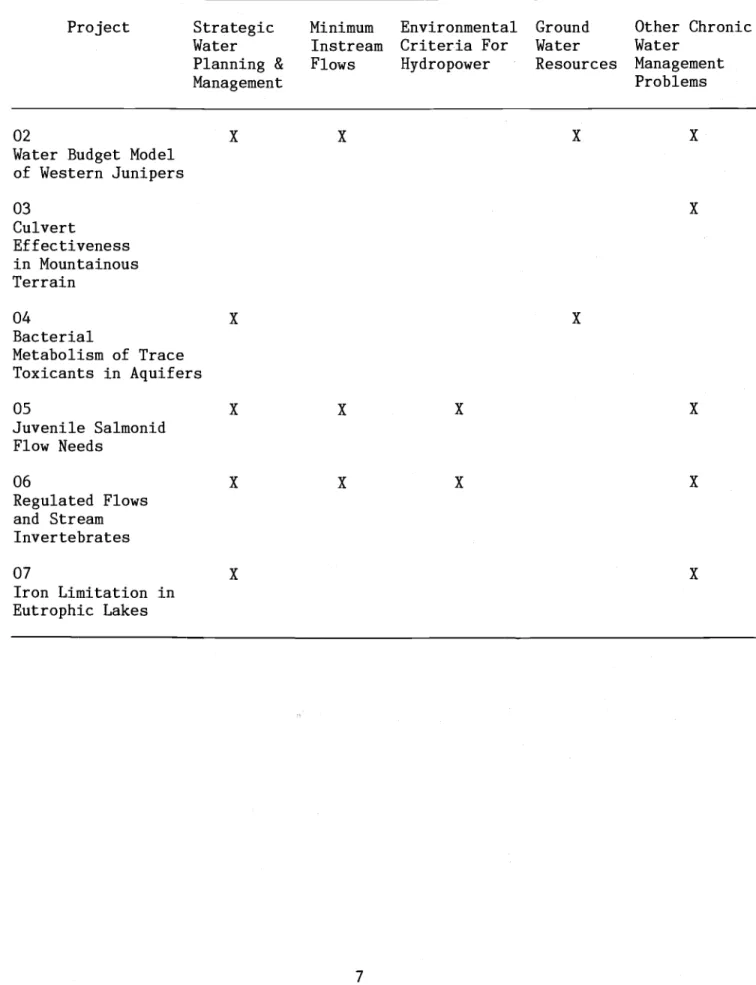
and problems associated with recent state legislative acts and bills. The ways in which the six FY 1985 projects addressed water policy issues and management problems are shown in Table 1.
The specific relation of each project to state and regional water policy issues and management problems is described in the following paragraphs. The
ways that research results may hasten their solutions are also indicated. 02. Water Budget Model of Western Juniper
Competition for available water in the arid regions of the West and Northwest may lead to management decisions to remove economically-low-valued vegetation so as to eliminate its consumptive use of water. Juniper has been subject to such removal although little is known of the actual water
requirement of juniper stands. Furthermore, there may be impacts on soil moisture, riparian habitat and instream flows at rangeland streams where juniper is removed. This research helps increase knowledge of water impacts of juniper so that better predictions can be made of the utility of managing rangelands to remove or control juniper and thus to manipulate water yield and forage yield.
03. Assessing Culvert Effectiveness in Mountainous Terrain
There are chronic problems associated with failures of culvert drainage systems during storm runoff. Such failures affect the management of forested and rangeland streams, cause deterioration and loss of aquatic/riparian
habitat, and can lead to water quality degradation of surface waters. By establishing and testing criteria to assess existing culvert installations, this research provides a method to allow managers to identify potential problems and take corrective action before serious failures occur.
Table 1. Relation of Projects to Water Policy Issues and Management Problems
Project Strategic Minimum Environmental Ground Other Chronic Water Instream Criteria For Water Water
Planning & Flows Hydropower Resources Management
Management Problems
02 X X X X
Water Budget Model of Western Junipers 03 X Culvert Effectiveness in Mountainous Terrain 04 X X Bacterial Metabolism of Trace Toxicants in Aquifers 05 X X X X Juvenile Salmonid Flow Needs 06 X X X X Regulated Flows and Stream Invertebrates 07 X X Iron Limitation in Eutrophic Lakes 7
04. Effect of Sorption on Bacterial Metabolism of Trace Toxicants in Groundwater Ag uifers
Accurate predictions of the transport of degradable trace contaminants are presently extremely difficult if the contaminants exhibit strong sorption to organic solids and strong toxicity to microbes. Yet bacterial metabolism of trace toxicants may offer one significant means of managing contaminated groundwater systems. This research will investigate mechanisms that may govern the metabolic process, to better understand how bacteria may be
effectively used to break down toxicants and to better assess the movement of many toxic organic compounds, particularly pentachiorophenol and its
associated dioxins and furans. Information gained will allow agencies to formulate long-term management strategies for protecting groundwater aquifers or controlling toxic contaminants.
05. Determination of Minimum Flow Needs for Juvenile Salmonids in Central Oregon Streams
Inadequate streamf lows and the deterioration or loss of aquatic/riparian habitat are major concerns that have been addressed by state legislation in
1981, 1983 and 1985. An important aspect for managers is to determine the relationships among streamf low, riparian vegetation, habitat availability, and habitat quality. This research provides an approach to evaluate the
relationships among streamf low-habitat-quality-population for a stream reach. From this, resource managers can better determine the desired instream flows and make more effective use of habitat rehabilitation funds.
06. Effects of Long-Term Regulated Flow on Community Composition of Stream Invertebrates
Reduced streamf lows that result from water diversion have impacts on aquatic and riparian habitat. Long-term changes in the biological community structure of smaller streams can have important local effects and can impact downstream zones through the altered transport of dissolved and particulate matter. This research provides information on the kinds of changes that have actually occurred in a 24-year period for a "stabilized" stream from which all but a small flowrate have been diverted. Such information is useful in
predicting environmental impacts of potential out-of-stream diversions and in managing the food base for fish and other aquatic life.
07. Development of Field Assay of Iron Limitation in Eutrophic Lakes Severe blooms of nitrogen-fixing blue-green algae adversely affect
recreational and aesthetic uses of many lakes. In some instances, soluble or colloidal forms of iron are present that limit the extent and duration of blooms. Refinement and testing of a practical new biochemical field assay for iron-limitation of blooms will be useful for land-use and water-quality
planning decisions, especially in setting limits for point-source and non-point-source inputs of phosphate from existing or proposed land uses. Ability to identify iron-limited systems, where expensive or restrictive controls on further phosphorus inputs may be considered unwarranted, will allow regulatory efforts and resources to be redirected to other areas where stringent control is more appropriate.
Federal USD1 funds for support of the FY 1985 program provided almost half of the total funds used for Institute research and technology!
information transfer activities during FY 1985. Much of the non-federal funding was of a cost-sharing nature and was only available because of the availability of federal funds. State and regional funding has been very
limited in the past three years. Thus, the USD1 Water Resources Research Institute program has been of utmost importance in maintaining a
multi-disciplinary problem-solving water research program active in Oregon during a period of minimal state funding for water research. The USD1 program
is also an important catalyst for initial contacts with the university by federal agencies and for bringing research to other units of the OSU campus, such as the experiment stations and academic departments.
RESEARCH PROJE( SYNOPSES
02 -
Water Budget Model of Western Juniper - R. F. Miller and L. E. Eddleman03 -- Assessing Culvert Effectiveness in Mountainous Terrain -R. L. Beschta and N. -R. Pyles
04 -- Effect of Sorption on Bacterial Metabolism of Trace Toxicants in Groundwater Aquifers S. L. Woods and K. J. Williamson
05 -- Determination of Minimum Flow Needs for Juvenile Salmonids in Central Oregon Streams - H. W. Li
06 -- Effects of Long-Term Regulated Flow on Community Composition of Stream Invertebrates - N. H. Anderson
07 -- Development of Field Assay of Iron Limitation in Eutrophic Lakes -J. Sanders-Loehr
Synopsis
Project Number: 02 Start: 07/84
End : 06/86
Title: Water Budget Model of Western Juniper
Investigators: Miller, Richard F. and Eddleman, Lee E., Oregon State University
COWRR: 2D Congressional District: Fifth
Descriptors: hydrologic budget, water budget, soil water, transpiration, stomata, stomatal transpiration, leaves, plant tissues, vapor pressure deficit, juniper trees
Problem and research objectives:
The critical state water problem addressed is efficiency of water use in agricultural rangelands where livestock-wildlife forage plants and western juniper are competing for a limited supply of moisture. As western juniper woodlands continue to increase, we expect to see continued deterioration of decreased subsurface flow, increased interception of precipitation, increased loss through transpiration, and a decline in forage production. The project also provides information required to evaluate the potential impact of western juniper on inadequate instream flow, deterioration and loss of aquatic!
riparian habitat, management for protection of rangeland stream aquatic! riparian habitat, and management for water-related resources.
Western juniper is rapidly increasing in density and has approximately doubled its range in the last 100 years throughout the cold deserts of Oregon, Washington, Idaho, Nevada and California. Current estimates place its range in excess of 1.4 million hectares. Currently, the Soil Conservation Service, Bureau of Land Management, U.S. Forest Service and private landowners are greatly concerned about this increasing problem due to the lack of knowledge on the autecology, synecology and, consequently, management of this species. Limited research has shown that this increase in juniper has caused a decline in forage crops, subsurface flow of water and an increase in sediment
production.
The overall goal of this project was to develop a tool that would help scientists and resource managers evaluate the impact of western juniper on water resources. More specifically, the research goal was to develop a model
that would predict the amount of water (transpiration) used by a western juniper woodland on a daily or annual basis. Another goal was to determine the amount of rainfall intercepted and evaporated from western juniper canopies. Objectives included:
a) Develop a model of transpiration loss for western juniper and validate this model by testing both predicted stomatal conductance and the total water transpired through field measurements throughout eastern Oregon. b) Collect data to fine tune and support model subroutines which make stomatal
conductance responsive to vapor pressure deficit and soil temperature.
c) Determine canopy interception, stem flow and throughfall of precipitation for addition to the transpiration model and development of a comprehensive water loss model.
d) Estimate Juniperus occidentalis leaf area on a water shed basis from large scale aerial photography.
Methodology:
Objective a: The model was validated in two ways. The first was to take hourly measurements on several trees at four different dates in the season
(from early spring to fall) (on the Squaw Butte Experimental Range). Hourly measurements over a 24-hour period were taken on air temperature, relative humidity, conductance and photosynthetic active radiation. In addition, soil water was measured. Hourly readings were compared to model predicted values. The second test was to measure conductance and environmental parameters for at least four different geographic locations in eastern Oregon for a minimum of three dates (spring, summer and fall). Morning and midday readings were recorded. Conductance values were compared to predicted values under similar environmental conditions (soil water, soil temperature and VPD).
Objective b: A subroutine in the model adjusts conductance based on WPD and soil temperature. Additional points for these three variables were also recorded through eastern Oregon over a 12-month period to develop a response surface with conductance being the dependent variable. These data helped to fine tune and support assumptions made in this subroutine.
Objective c: Precipitation interception of the canopy was determined by measuring precipitation in the canopy interspaces with rain gauges, measuring throughfall with a fabricated collection trough that sampled proportionate area from the bole to the canopy margin, and measuring stemf low using the procedure of Young et al. (1985) with limited modifications. Interception = total precipitation - throughf all + stemf low). Interception was regressed on the tree size and a function developed for input into the water loss model. Measurements were made using three juniper size classes. Size classes were the same as those used to determine leaf area relationships. In each size class four replicate measurements were made. If variation was determined to be too high, the number of replicate measurements was increased. Since weather station data was available, primary emphasis was on collection of daily data points during storm periods and development of a submodel of daily, monthly, kind of precipitation, and those atmospheric factors affecting
transpiration that also modify throughfall and stemf low.
Objective d: Results of research completed the first year of the project established regression relationships for western juniper leaf area and basal circumference and leaf area and sapwood area. Additional data were available to develop the relationship of canopy diameter to leaf area. These regression relationships enabled the estimation of total leaf area for individual trees.
Work completed under this objective determined the regression
relationships between canopy measurements determined from large scale aerial photographs and leaf area for individual trees. Leaf area of test trees was estimated from basal circumference, sapwood area and canopy diameter as measured on the ground. Equations were developed for predicting leaf area
from canopy diameters (taken at right angles) and canopy cross-sectional areas derived from aerial photographs.
Principal findings and significance:
Leaf conductances g1 across tree sizes were similar. This conclusion enables us to use the same relationship between g1 and environmental factors regardless of tree size. Soil moisture levels were above normal during the 1984 growing season. Soil moisture below 60 cm remained near or at field capacity (-0.03 MPa). Leaf g1 may be different for different tree sizes in drier years due to differences in root mass. However, for the purpose of this model, varying tree sizes are treated the same.
A strong linear relationship between leaf weight and surface area of leaves allowed us to estimate leaf area by measuring leaf weight. Sapwood area and basal circumference were significantly (P<0.01) correlated with total leaf area. Estimates, however, can be improved for small trees (primarily for trees with basal diameters < 20 cm) if the regression equation developed for trees less than 50 cm in circumference is used.
Relationships between total leaf area and sapwood area measured at the tree base, and leaf area and sapwood area midway up the tunk were
significantly different (P<0.05). At the tree base, 1 cm of spwood
supported 0.45 m2 of leaf area. At the tree's midsection, 1 cm of sapwood supported 0.64 m of leaf area. Gholz (1980) reported a leaf area: sapwood ratio of 0.56 for western juniper when sapwood was measured at DBH.
Aerial photos may be used as a tool to attain total leaf surface area of a juniper woodland. This can be obtained by multiplying the average estimated green needle biomass (using CANOP 3 or 4) times tree density of the woodland. Total estimated green biomass can then be converted to leaf surface area using the equation:
Y = -40.566 + 65.238X
where X is leaf weight in grams and Y is leaf area in cm.
Precipitation for the period for the study of canopy throughfall was 431 mm (17 in). Many of the storms were very light, ranging from less than 1 mm up to 9 mm. Heaviest storms came as snowfall in the winter period; however, one rainstorm in May of 1986 produced 58 mm (2.3 in) of moisture.
Examination of the data shows interception of moisture for the entire year was very high, reaching more than 70% for the larger tree size class. Throughfall constitutes the larger portion of the moisture reaching the ground while stem flow is rather small. Percent of precipitation reaching the ground is greatest for small trees while interception is greatest for larger trees.
When interception was regressed on precipitation amount, the relationship was linear and strongly correlated. The two larger diameter size classes were not different, however, small diameter canopies intercepted lesser absolute amounts of precipitation than the larger canopies. It was expected that in larger storms a higher percentage of moisture would reach the ground; however, that did not appear to be the case. In a single rainstorm of 58.2 mm, which continued over a 2-day period, 63, 76, and 90% of the moisture was intercepted by small, medium and large trees, respectively. Several storm events resulted in very little interception by the tree canopy. These storms, however, tended to be accompanied by high winds.
Publications and professional presentations:
Angell, R.F., R.F. Miller, and L.E. Eddleman. 1985. Water Use by Western Juniper: A Preliminary Model. p. 31-36. In Res. in Rangeland Manage. Or
State Univ. Agr. Exp. Sta. Spec. Rep. 743.
Miller, R.F., R.F. Angell, and L.E. Eddleman. (in press) Water Use by Western Juniper. In. PinyonJuniper Conf. Symp., Reno, Nev. Jan. 1986. USDA For. Ser. Interm. For, and Range Exp. Sta. Gen. Tech. Rep.
In Preparation
Angell, R.F., R.F. Miller, and L.E. Eddleman. Western Juniper Water Budget Model (possibly Can. J. For. Res.).
Eddleman, L.E., R.F. Miller and R.F. Angell. Western Juniper Canopy Interception of Precipitation. (J. Range Manage., Weed Sd. or N.W. Sci.?)
Miller, R.F., L.E. Eddleman, and R.F. Angell. (submitted) The Relationship of Western Juniper Stern Conducting Tissue and Basal Circumference to Leaf Area and Biomass. Great Basin Nat.
Miller, R.F., R.F. Angell, and L.E. Eddleman. Western Juniper Water
Budget: How to Model Water Use. Ore. State Univ. Agric. Tech. Bull. M.S. theses: none
Ph.D. dissertations: none
Synopsis
Project Number: 03 Start: 07/84
End : 06/86
Title: Assessing Culvert Effectiveness in Mountainous Terrain
Investigators: Beschta, Robert L. and Pyles, Marvin R., Oregon State University
COWRR: 4A Congressional District: Fifth
Descriptors: culverts, roads, drainage, slope stability, installation, maintenance
Problem and research objectives:
The Coast Range of Oregon is intensively managed for timber production and thus requires an extensive road network, with new road construction continuing yearly. Where drainage systems are poorly designed forest roads have experienced fill slope failures, excessive road surface erosion and increased sediment production. However, a properlydesigned road drainage system--culverts in particular--can reduce the risk of these occurrences. The large amount of annual precipitation, steep unstable land and importance of anadromous fish in this area make the design of road drainage systems for forest roads very important to minimizing management impacts.
Culverts provide the most common means for moving water across a road and, therefore, are an essential component in the design and operation of a forest road drainage system. Culvert failures during storm events can lead to roadfill erosion and ultimately to failure. The direct costs associated with these failures include the loss of use of the road and the expense of
replacing the culvert and it's associated fill. Additional costs can be
incurred when a failure impacts a stream channel and causes adverse changes in water quality and aquatic habitat.
The culverts used in forest roads can be grouped into two classif i cations: ditch relief culverts (DRCs) and stream crossing culverts (SCCs). On forested hillslopes, water is routed naturally by subsurface flow through the soil to defined channels, becoming surface flow. Forest roads often convert subsurface flow to surface flow by collecting it in a ditch. This water must be diverted across the road, in many cases this is done with a ditch relief culvert.
Problems associated with ditch relief culvert installations include excessive ditch and fill slope erosion. Both types of erosion are usually a function of how closely the DRCs are spaced. If the spacings are too great the ditch may collect large quantities of water which can cause ditch and road prism erosion severe enough to make the road unusable.
The larger quantities of water collected at long spacings present an equally, if not more, important problem at the culvert outlet. The
concentrated discharge of water usually exceeds the infiltration rate and
proceeds as overland flow which can result in gully erosion. In addition, it can increase the depth of saturated soil locally and in doing so increase the possibility of fill slope failure. In some areas, reducing the spacing enough to control fill slope erosion may not be adequate or feasible. In these cases erosion control devices at the outlet are required; rip-rap, to harden the outfall; downspouts or plastic tubes, to divert the discharge downslope; or a combination of these. Spacing culverts close enough to avoid these problems is important, but if they are placed too close together they will add greatly to the expense of road building and maintenance.
Other potential problems with ditch relief culverts are blockage or
damage to the pipe which reduces the amount of water, debris and sediment that can pass through it. There are several ways such blockage can occur, but the result is usually a bent or plugged section of pipe, which reduces its
functional capabilities. The pipes can be dented or bent during road
construction or by road maintenance crews, logging trucks or other traffic. They can be plugged by sediment, organic debris, logging slash or sluffing of the cutbank. These problems can occur anywhere along the length of the pipe but are most common at the inlet.
Stream crossing culverts are used where forest roads cross flowing streams and ephemeral channels. SCCs should be designed to pass a certain peak flow-rate of water (in Oregon, a flow greater than or equal to the
25-year peak discharge), but also should be able to pass debris and allow for fish passage where it is important. If culverts are grossly oversized they may be unnecessarily expensive. Conversely, culverts that are undersized may have an increased risk of failure. Historically, culverts have been installed on many small forested watershed without adequate knowledge of what quantities of water and debris to expect.
Problems that are associated with stream crossing culverts are: erosion at the outlet, blockage to fish passage, organic debris and/or sediment
accumulation and inadequate sizing which may result in roadf ill failure. This study evaluated the capability of SCCs to pass a design discharge. The
capability of a pipe to pass a design discharge will decrease, if there is any reduction in the control section of the pipe. Physical damage or denting may be incurred during installation and road construction or later during use and maintenance of the road. Blocking of the pipe can be associated with sediment or organic debris.
The objectives of this study were: 1) to develop specific rating criteria for each type of culvert, 2) inventory culvert installations using the
developed criteria, and 3) compare the culvert installations against selected design guidelines.
Methodology:
A stratified, random sample selection procedure was used to obtain
representative samples. The study area was stratified by township, and three roads were randomly selected from each township. Each road was divided into a number of sections depending on it's length, with a section of the road
randomly selected as the starting point. The first six culverts (DRCs and/or SCCs) on that road were sampled. Using this method, 515 DRCs and 143 SCCs were sampled during the summers of 1984 and 1985.
A list of criteria with associated rating procedures was developed to assess potential problems with culverts. Stream crossing and ditch relief culverts function differently; therefore, different criteria were developed for each and the data analysis was done separately. The main data analysis was accomplished by dividing each data base into subgroups (e.g. by owners, installations and pipe characteristics) and evaluating any differences or trends in rating criteria between the subgroups, using descriptive statistics and graphical comparisons.
Principal findings and significance:
A total of 515 ditch relief culverts and 143 stream crossing culverts were randomly selected for evaluation, in the central Oregon Coast Range. The purpose of this evaluation was to compare existing design guidelines to these road drainage installations and also rate their capability of functioning effectively during high-flow events. The study area consisted primarily of steep slopes, sandstone bedrocks and had an extensive road network.
The inlets of 74% of all ditch relief culverts (DRCs) were reduced from original; the average inlet cross-sectional area was 80.6% of original.
Almost half of all DRCs have inlet reductions associated with sediment and/or denting. Outlet erosion occurred at 38% of all DRCs and had an average volume of 2.5 cubic yards. Outlet erosion increased substantially with fill slopes greater than 40% and for spacings which exceeded USF (r-6) guidelines.
Significant differences in erosion volumes and spacings were related to land ownership.
In order to evaluate the design capacity of stream crossing culverts (SCCs), 25-year peak flows were calculated using the latest regional analysis for the Oregon Coast Range. The ability of SCCs to pass a 25-year peak flow was then evaluated with two different methods. For almost one-quarter of all stream crossing culverts the estimated 25-year peak flows would be expected to overtop the road. About 80% of all SCCs were unable to pass a 25-year peak flow at a headwater to diameter ratio of 0.75. Significant differences in SCC design were related to ownership. The capacity of most Coast Range SCCs seems to have been seriously underdesigned.
Publications and professional presentations:
Water Resources Bulletin and Western Journal of Applied Forestry articles are in progress.
M.S. theses: Bradley T. Piehi, 1986 Ph.D. dissertations: none
Synopsis
Project Number: 04 Start: 06/85
End : 06/86
Title: Effect of Sorption on Bacterial Metabolism of Trace Toxicants In Groundwater Aquifers
Investigators: Woods, Sandra L. and Williamson, Kenneth J., Oregon State University
COWRR: 5B Congressional District: Fifth
Descriptors: bacteria, biodegradation, microbial degradation, groundwater pollution, groundwater transport, sorption, toxicity,
organic compounds, pollutants Problem and research objectives:
Bacterial degradation and sorption are important mechanisms affecting the fate of trace organic compounds in groundwater aquifers. Degradation and sorption are also important parameters in groundwater models, yet little
quantitative information is available describing interactions between sorption and biodegradation. Additionally, little kinetic information is available to describe these processes.
The objectives of this project are:
(1) to determine the effect of the concentration of solids on the sorption and, therefore, the biodegradation and toxicity of trace organic compounds,
(2) to determine the rate at which a sorbed organic compound is degraded by bacteria,
(3) to determine kinetic coefficients for sorption and desorption reactions, and
(4) to develop a fundamental model of sorption reactions based on kinetics and incorporating solids concentration.
The results of these individual studies will be used to develop a model describing the combined sorption, desorption and degradation of a trace organic in a system containing nonviable sorbing solids.
Methodology:
Throughout the first year, a kinetic model describing sorption and desorption was developed. This model is currently being tested in batch and column experiments. Batch equilibrium and nonequilibrium sorption experiments are being performed in which concentrations of the sorbent and sorbate are systematically varied. 3,4dichiorophenol is used as the model sorbate, and cellulose triacetate is used as the model sorbent. An important controversy in the sorption literature is the effect of dissolved carbon or colloidal
particles on sorption equilibrium. Cellulose triacetate was chosen as the solid due to its negligible solubility in water. Thus, experiments can be performed with cellulose triacetate without interferences from colloids or dissolution of the solid. An additional advantage of the cellulose triacetate is its uniformity in size and its ability to settle quickly. Thus, samples of the supernatent can be taken without centrifugation or filtration, allowing the rates of the forward and reverse sorption reactions to be determined.
These batch experiments are performed in glass vials. The solid is weighted and placed in the vial in an appropriate volume of distilled water. 3,4-dichlorophenol is added to the vial, and the vial is shaken in a water bath held at 20 C. Samples of the water phase are taken with time, and
concentrations of 3,4-dichlorophenol in the liquid phase are determined by gas chromatography with electron capture detection. The concentration of
3,4-dichlorophenol associated with the solid phase is determined by mass balance. This experiment yields information which allows us to determine kinetic constants for the sorption reaction. It also provides an
equilibrium sorption partition coefficient and the time required to reach sorption equilibrium.
Column experiments are also2being performed in a 30 cm glass column with a cross-sectional area of 0.9 cm . A tracer experiment with a nonsorbing compound (chloride) has been completed to determine the dispersion coefficient for the column, and experiments are currently being conducted with a sorbent
(3,4-dichlorophenol). The chlorophenol is added in a pulse or step input. Samples of the effluent of the column are taken with a fraction collector at
six to twenty-four second intervals. The concentration of 3,4-dichlorophenol in the effluent is determined by gas chromatography with electron capture detection.
Rate constants for the forward and reverse reactions can be determined by fitting the experimental data with a one dimensional model based on the
assumption of a Langmuirian isotherm. This assumption will be tested through further pulse and step loading experiments and by comparison with data
generated in batch experiments.
Principal findings and significance:
The sorption distribution coefficient has been considered a constant with solids concentration for the past several decades. In recent literature it has been suggested that the distribution coefficient is also dependent on the solids concentration. However, no fundamental explanation has been offered to characterize this observation. This research program has allowed us to
develop a fundamental model based on kinetics of the sorption and desorption reaction. This model is being tested in batch and continuous flow column experiments at several concentrations of sorbent and sorbate. This is of importance because biodegradation in soil is strongly dependent on the interactions between sorption, desorption and the rate of uptake by the microorganisms. Without a fundamental understanding of the kinetics of the sorption and desorption reactions and the effects of solids concentration, it is impossible to predict the fate of organic compounds in soil environments based on equilibrium constants. Thus, a fundamental understanding of the sorption and biodegradation processes will allow better estimation of the fate of organic compounds in soil environments and will provide information that is required to enhance degradation of trace organics in contaminated
aquifers.
Publications and professional presentations:
There are no publications in print. However, there is a publication in preparation based on the work of Mark Dolan and Lionel Patrier.
M.S. theses:
Mark Dolan, "Effects of Solids Concentration on the Sorption of Trace Organic Compounds," December, 1986.
Lionel Patrier, "Determination of Kinetic Coefficients for Sorption and Desorption Reactions Using a Plug Flow Colummn Reactor," December, 1986. Ph.D. dissertations: none
Synopsis
Project Number: 05 Start: 07/84
End : 06/86
Title: Determination of Minimum Flow Needs for Juvenile Salmonids in Central Oregon Streams
Investigators: Li, Hiram W. and Tubb, Richard A., Oregon State University
COWRR: 6D Congressional District: Fifth
Descriptors: salmon, salmonids, minimum flow, model studies, habitats, aquatic habitats, riparian vegetation
Problem and research objectives:
The John Day Basin produces one of the most significant runs of wild steelhead trout (Salmo gairdneri) and chinook salmon (Oncorhynchus
tshawytscha) in the Columbia River Drainage. At one time, it produced the largest runs of anadramous salmonids in the Columbia Basin; but forestry impacts, dewatering streams for agriculture, and overgrazing riparian
vegetation by cattle have reduced productive capacity of the basin in recent years (Oregon Department of Fish and Wildlife, unpublished report). The fish in the John Day Basin are not supplemented with hatchery stocks, although catchable hatchery trout are released in a limited "put and take" program. The goal of the Oregon Department of Fish and Wildlife is to attain escapement
(numbers of spawning fish) levels of 5,700 spring chinook salmon and 23,000 summer steelhead trout. The means to achieve these goals are through habitat improvement and restoration projects and by developing a multiagency basinwide plan to manage land and water resources within the basin. To date, $1,277,000 has been spent to rehabilitate fish habitats. There are plans to invest an additional $1,938,000 in future work.
With the exception of the Eastern Oregon Habitat Study (Maciolek, 1979, and J. Esch, National Marine Fisheries Service, unpublished data), there was little data from which to assess factors contributing to habitat quality in the John Day Basin. Maciolek and Esch's results suggested that flow and riparian vegetation interacted to influence the carrying capacity of juvenile salmonids (measured in Weighted Usable Area) from different drainages in eastern Oregon. However, they were unable to derive a predictive model that expressed this relationship satisfactorily and that could be used to determine habitat quality for the John Day Basin. Part of the problem is that the
Instream Flow Incremental Methodology (IFIM) used in the study does not incorporate the condition of the riparian vegetation as one of the model's parameters.
The objective of our study was to attempt to describe the influence of riparian habitat, geomorphic features of the stream, and flow on habitat quality in the John Day Drainage. Our approach incorporated the following elements:
1) Develop a heirarchical classification of the basins, streams and habitat types (riffles, runs, pools) of study areas within the John Day Basin. This served statistically to block out the study design, to control variability
through judicious selection of study sites and to stratify different ecological settings.
2) Identify different habitat types using cluster analysis and multivariate statistics.
3) Relate differences in physical habitat to densities of juvenile salmonids. 4) Determine the interaction between the condition of the aquatic habitat and the assemblage structure of fishes. This was done to determine whether or not assemblage structure could be used as an index of habitat quality for salmonids (similar to an Index of Biotic Integrity).
5) Examine the use of the presence of coliform bacteria as an index of habitat degradation.
We hoped that this would provide a basis for developing a key to types of habitat that could be used by fisheries' managers to conduct habitat inventories within the John Day Basin.
Methodology:
Heirarchical Classification of Lotic Habitats:
We classified habitats at several levels: basins, subbasins, and habitat types within the John Day basin. The degree of similarity among three basins of the John Day Drainage, the South Fork, the upper Main Stem, and the Middle Fork, was determined from the following characteristics from USGS quadrangle maps: drainage length, stream gradient, compass aspect, and stream order. Data for watershed area, mean annual discharge and highest and lowest
elevation were obtained from "A Resource Survey of River Energy and LowHead Hydroelectric Power Potential in Oregon" (WRRI, 1979: Appendix 6). Mean annual precipitation and area geology, as expressed in water yield capacity, were obtained from maps published by the State of Oregon Water Resources Board.
We clustered the following subbasins within each basin of the John Day to ensure that inappropriate comparisons would be avoided: Murderer's Creek
(South Fork Drainage); Camp Creek (Middle Fork Drainage); Reynolds Creek, Deardorff Creek, and Call Creek (Upper Main Stem Drainage). Characteristics of total length of all subbasin streams, drainage density, and watershed area were gathered from USGS quadrangle maps. A digitizer was used to integrate proportional values based on area (e.g. precipitation within a subbasin, water yield of a subbasin).
Habitats were classified into ecological subunits using two approaches from data gathered in the field: (1) physical and two geomorphological
features, and (2) species composition. The habitats were subjectively grouped into riffles, runs, and pools initially. These habitats were later regrouped through statistical analyses, first using a hierarchical, agglomerative, cluster analysis wherein correlation was used as the dissimilarity measure, and the group average clustering strategy was employed. Groups from these clusters were inspected and subjectively divided based upon ecological criteria and statistically analyzed using stepwise Discriminant Function
Analysis (DFA). This statistical tool determines the best linear combinations of the variables (either physical, geomorphic data, or species abundances in the two approaches we used) that discriminate between the groups. Each habitat in the analysis is then classified as a member of a specific group depending upon the classification functions. Variables to which most of the variability is attributable are identified at different steps.
A one-way analysis of variance was used to test the null hypothesis that there were no differences in standing crops of different age classes of
salmonid juveniles in different habitat classes. Tukey's test of multiple comparisons was used to determine significant differences among habitat classes when the null hypothesis was rejected.
Data were collected during the summer low-flow period of 1985 which extends from the second week of July to approximately the third week in
September. This was done for several reasons. It is considered the "crunch" period of the salmonids in the Pacific Northwest and the period during which there is no migratory activity by juvenile salmonids.
Principal findings and significance:
The most important determinants of habitat quality for juvenile salmonids in the John Day Drainage above the confluence of the North Fork Drainage are related to the condition of the riparian habitat and to factors associated with stream profile. Factors associated with the condition of the riparian habitat are (1) light excluded from the stream by shade, (2) the type of vegetative bank cover, (3) the degree of soil alteration caused by cattle grazing. Elevation, average stream depth, and discharge, in that order, are
important variables associated with the second factor, stream profile. Habitats clustered into the following ecological categories roughly in descending order of quality for age 0+ juvenile steelhead trout based upon their physical properties:
(1) riffles, runs, and pools at high elevation tributary streams associated with good riparian vegetation;
(2) riffles, runs, and pools at high elevation tributary streams that have been disturbed by grazing;
(3) riffles, runs, and pools in subbasin mainsteam reaches with substantial riparian canopy;
(4) big, deep, slow runs and pools, irrespective of elevation;
(5) riffles, runs, and pools at low elevation with little riparian cover.
This is roughly the same order of quality for age 1+ steelhead trout; whereas, spring chinook juveniles tended to be found in habitat cluster (2) and were not found in cluster (5).
Neither flow nor average current velocity were positively correlated with standing crops of juvenile salmonids. We believe that this is due to three factors: (1) juvenile steelhead tend to be found in higher densities in tributaries than in mainstems of subbasins; (2) the current selected by
juvenile salmonids is related to the ability to swim, which is size related;, and (3) juvenile salmonids tend to be associated with habitats on the edges of streams.
Certain species can be associated with habitat quality for juvenile salmonids. Densities of speckled dace are positively correlated with densities of age 0+ steelhead (P<005). There is no evidence to support symbiotic or competitive reasons for these associations. Our evidence suggests that there are several species associations based on (1) size of stream and (2) physiological tolerances to cold/warm water.
We recommend that Tennant's Method or the Instream Flow Incremental
Methodology be used to determine minimum stream flows for each habitat cluster after verifications of preference curves for each species are obtained. The data suggest that a suite of minimum flow requirements will be needed because different age-classes and species of salmonids differ in their use of
different habitat classes.
Publications and professional presentations: none to date
M.S. theses: In progress, Eric J. Letizinger, Fish and Wildlife. Ph.D. dissertations: None expected from this aspect of the program.
Synopsis
Project Number: 06 Start: 07/84
End : 06/86
Title: Effects of Long-term Regulated Flow on Community Composition of Stream Invertebrates
Investigators: Anderson, Norman H.
COWRR: 6G Congressional District: Fifth
Descriptors: regulated flow, aquatic populations, benthic environment, benthic fauna, substrates, habitats
Problem and research objectives:
Reduced instream flow results from many uses of water: hydropower, irrigation and withdrawals for domestic and industrial purposes. Competition for this water can lead to overappropriation of existing supplies. Minimum stream flows are being established on many streams in an attempt to match hydrological data to the fisheries and environmental quality needs of each stream. Benthic invertebrates are a dominant component of the aquatic
community. They have a central role in the recyling of nutrients and are of direct economic importance as the food base for fish. Thus, quantification of invertebrate taxonomic composition and abundance should be an important
consideration in any minimum-stream-flow calculation.
Berry Creek, Benton County, Oregon, provides the opportunity to investigate some of the physical and biological consequences of long-term reduced flow and to relate these to changes in the community composition of stream invertebrates. An experimental section was constructed in the late 1950's, with flow control regulated by a dam and bypass channel, for studies of the biological impact of stream enrichment on the cutthroat trout
population. With a 25-year history of flow modification, there is
considerable background information on Berry Creek. Our study links together some of the available data bases.
Specific research objectives of this 2-year project were: (a) to compare taxonomic composition of insects and snails in the regulated-flow section of Berry Creek with an upstream area that has a normal flow regime; and (b) to
compare benthic communities in riffles, glides and poois of these two areas in relation to substrate composition.
Methodology:
Invertebrate sampling was done with a Hess-type sampler (0.025 m2) with a mesh size of 250 m. In the regulated-flow section and in the natural channel,
four samples were taken in a transection across three habitats (riffles,
glides and pools). Replicate transects were sampled at four sites for a total of 48 samples in both areas in fall, winter, spring and summer.
The stream bed was compared in the two areas for substrate particle-size composition by wet and dry seiving. In addition, freeze cores were taken to obtain depth profiles of particle size. The percentage of organic matter in
the <1mm fraction of the Hess samples was compared for the natural channel and a regulated-flow reach by combustion of samples in a muffle furnace.
Wood debris is a habitat that potentially affords a refuge from the presumed adverse effects of high sedimentation, so invertebrate-wood inter-actions were studied in the regulated-flow reach using alder posts submerged on the stream bed as a sampling substrate. The quantity and distribution of small wood debris (<10cm dia.) was measured in February 1986 for the natural channel and regulated-flow reach, using a line-intercept technique.
Principal findings and significance: 1. Insect Fauna of Berry Creek
An annotated check list of the insect fauna at Berry Creek was prepared to summarize collection records since 1960. Kraft's (1963) Ph.D. thesis, based on his study in 1960, listed about 200 species. Records from about 20 other projects (many unpublished) since then have increased this to over 300 species, which is probably the largest insect species list for any western stream.
The number of species per order in our Berry Creek check list is:
Ephemeroptera, 28; Plecoptera, 40; Odonata, 2; Hemiptera, 9; Megaloptera, 3; Trichoptera, 30; Coleoptera, 37; Diptera-Chironornidae, 78: other Diptera, 89. 2. Substrate Composition of the Regulated-Flow Reach and Natural Channel.
It was obvious in looking at the two stream sections that the regulated-f low reach has stored a tremendous quantity oregulated-f regulated-fine particles due to lack oregulated-f winter scour in the past 25 years. However, in comparing particle-size distribution, the results were quite similar because the contribution of cobble and large gravel to weight of total substrates obscures the signif i-cance of fine particles and the embedded nature of cobbles in the test section.
Data from freeze cores and the organic-matter content of the <1mm
component provide a better index of sediment changes resulting from regulated
flow. Fine particulate organic matter was 1.6 times greater in the
regulated-flow section than in the natural channel. Pore size and relative permeability were measured from freeze cores using the Fredle index. Indices for riffles were: regulated flow, 7.49; natural channel 12.84. Both pore size and
relative permeability increase with the index number. 3. Wood Storage and Wood-Associated Invertebrates
The amount of small wood (<10cm dia.) stored in the regulated-f'ow section ws about 40% greater than in the natural channel (0.64 Kd/m vs 0.45 Kg/rn ) because stream power is insufficient to remove it from the
channel. Also, this small wood is evenly distributed in the regulated-flow reach, whereas most of it occurs in a few debris jams in the natural channel.
Wood-feeding invertebrate densities have increased at Berry Creek s a result of long-term flow control. The density of xylophages was 1400/rn on alder posts in our samples, whereas in 1963 collections these taxa were either rare or absent. For taxa that are primarily found on mineral substrates
(eg. many mayf lies and stoneflies), wood in the regulated-flow section was an important additional habitat; it provides a feeding platform and a refuge above the anoxic layers where fine particles have coated the streambed.
P
4. Benthic Invertebrate Community in the Natural Channel and Regulated-Flow Section
On a reach basis (i.e., combining data for riffles, glides and pools) the total density was 38% higher for insects and 16% higher for snails in the regulated-flow section compared with the natural channel. This demonstrates that invertebrates are still abundant after 25 years of flow control, but it obscures the significant canges that have occurred. The extreme density of chironomid larvae (32600/rn ) in regulated-flow pool accounts for 75% of all insects in this section. Excluding the chironomids, there was a 40% decrease in insect density in the regulated-flow section and significantly lower
diversity (measured as number of families, heterogeneity and evenness).
The affected groups were primarily taxa that are characteristic of clean riffles with moderate to rapid flow. Insects that were only half as abundant in the regulated flow treatment as in the natural channel were elmid beetles, heptageneid and baetid mayf lies, and stonef lies. Insects favored by the regulated-flow treatment are burrowing taxa that inhabit pools (chironomid, ptychopterid and tipulid flies, dragonflies and Sialis); slow-water
detritivores (philopotamid and Lepidostorna caddisf lies, and Paraleptophlebia mayflies); and the generalist feeding snails.
The most interesting comparison between the two stream sections is the shift in abundances of taxa between areas defined as riffles, glides or pools. In the natural channel the density of insects other than chironomids was about 40% greater than in the regulated flow section. Of the nine taxa preferring glides in the former (i.e. 50% or more in glides) none preferred glides in the regulated-flow section. In fact, the only two taxa with a preference for regulated-flow glides, Lepidostoma and Ptychoptera, were pool inhabitants in the natural channel.
Our interpretation for the habitat shifts is that regulated-flow glides have become depositional areas (more pool-like) rather than erosional
(riffle-like). This interpretation is also supported by the occurrence of glossomotids, hydropsychids and elmids which are almost exclusively in riffles in the regulated-flow section but predominately in glides in the natural
channel; these are not "fast-water" taxa, but their minimum current velocity requirements now only occur in riffles of the regulated-flow section.
The distribution of mayflies, stoneflies, and rhycophilid and
philopotamid caddisfiles is spread more evenly through riffles, glides and pools of the regulated-flow section that it is in the natural channel. Paraleptophiebia and philopotamids occur in higher densitites with
regulated-flow and may be responding to an abundance of fine-particle detritus throughout the reach. Since the other taxa are much less abundant than in the natural channel, the pattern suggests sub-optimal substrates or habitat in all parts of the regulated-flow section.
Summary
In addition to the 1984-85 field work, we have developed data bases on the physical and biological changes that have occurred at Berry Creek in the past 25 years. The historical record helps to document incremental changes that would not be apparent in short-term studies.
The major changes in the invertebrate community associated with long-term regulated flow have been the increase in chironomids and snails and a 40% decrease in density of other insects. There have been significant habitat shifts for many benthic taxa with several that prefer glides in the natural channel being restricted to riffles in the regulated-flow section. This is associated with storage of fine sediments; the regulated-flow glides have become depositional areas (more pool-like) rather than erosional
(riffle-like).
Publications and professional presentations:
Hansen, B., and N.H. Anderson. The Effects of Long-term Regulated Flow on Community Compositions of Stream Invertebrates. Poster session, North American Benthological Society, Lawrence, Kansas, May 23-26, 1986.
MS. theses:
Hansen, Bruce. The Effects of Long-term Regulated Flow on Community Composition of Stream Invertebrates at Berry Creek, Benton County, Oregon (in preparation).
Synopsis
Project Number: 07 Start: 06/85
End : 06/87
Title: Development of Field Assay of Iron Limitation in Eutrophic Lakes Investigators: Sanders-Loehr, Joann, Oregon Graduate Center
COWRR: 5G Congressional District: First
Descriptors: iron, eutrophication, cyanophyta, iron bacteria, field test, algal growth
Problem and research objectives:
The first-year objectives of the current project were: to refine the procedures for isolating redox proteins from cyanobacteria, to test the assay on laboratory cultures of iron-deficient and iron-replete cells, to develop a field sampling protocol for selected eutrophic lakes, to apply the assay to cyanobacterlal samples from two Oregon lakes (Cullaby and Upper Klamath), and to determine the iron nutritional status of bloom organisms in those lakes. Substantial progress has been made in all of these areas. The published
methods for isolating cyanobacterial redox proteins require very large amounts of cells and, therefore, are not generally applicable to field studies of lakes. Hutber et al., for example, used 30 liters of dense laboratory cultures for each assay in their study of flavodoxin substitution in Nostoc MAC, while Ho et al. used 50 kg of wet cells in their field study of
ferredoxin depletion. Such large quantities of cells can only be collected from extraordinarily dense blooms and, even when available, present great problems in field collection and laboratory processing.
Methodology:
As part of the field studies, various sampling techniques were tested at Cullaby Lake. For cyanobacterial populations of moderate density the best
samples were obtained by a two-stage process using a large (0.3 x 1.5 m) conical plankton net followed by reconcentration of cells in a small (12 x 30 cm) plankton net. For high cell densities, as were observed at Upper IClamath Lake, a single concentration was sufficient. Immediate cooling and rapid processing of concentrated samples minimized cell lysis and the resultant loss of soluble proteins. Mid- and late-bloom samples were taken at Upper IClamath Lake in early August and in mid- and late September; Cullaby Lake samples were collected in late July and late August.
Principal findings and significance:
We have scaled down the isolation methods of Smillie & Entsch and Hutber et al. by a factor of fifteen and have been able to easily quantify ferredoxin and flavodoxin in samples as small as 0.9 g of dry cells. We anticipate that our procedures can be scaled down by another factor of five, making the
technique feasible for studies of relatively sparse cyanobacterial populations, as for example near the beginning or end of a bloom.
Cellular concentrations of flavodoxin and ferredoxin can be determined by buffer extraction of cyanobacterial cell powder followed by (NH4)2SO4 fractionation and DEAE-cellulose chromatography. The redox proteins are
easily identified and quantified by their characteristic electronic absorbance spectra. Flavodoxin can also be identified by the fluorescence of its flavin moiety after acidification. The proteins separated on the DEAE-cellulose column are represented graphically by plots of the optical absorbance of successive column fractions. The absorbance at 465 nm reveals the elution peak of flavodoxin while the absorbance at 42 nm indicates the ferrodoxin peak (Fig 1).
The procedure was tested on laboratory cultures of Anabaena strain 7120, a nitrogen-fixing, filamentous cyanobacterium. Cells grown at an initial Fe concentration of 5 uM exhibited a relatively high concentration of cellular ferredoxin (11.8 umol/lOOg dry weight) and only a small amount of flavodoxin (1.6 umol/lOOg)(Fig. la). In contrast, cells grown with an initial Fe
concentration of 0.1 tiM showed a pronounced increase in the flavodoxin levels to 6.6 umol/lOOtg and a concomitant decrease in ferredoxin to 6.0 umol/lOOg (Fig ib). Further studies are underway documenting the response of flavodoxin and ferredoxin levels in Anabaena 7120 grown over a range of iron
concentrations.
Analyses of species composition indicated that nearly pure cultures of Aphizomenon flos-aguae were obtained in all Upper Kiamath samples, while
Cullaby samples were primarily Anabaena spp. and Microcystis spp. with varying proportions of subdominant diatoms.
Analysis of ferredoxin and flavodoxin concentrations in the lake samples are currently underway. Preliminary assays of the mid-summer Upper Kiamath samples revealed a moderate level of ferredoxin (5.0 umol/lOOg) and trace amounts of flavodoxin (Fig ic). These results indicate that in mid-bloom, the Upper Klamath cyanobacteria are not iron-deficient. Analysis of later samples will document any changes in the iron nutritional status of the cyanobacteria
as the bloom matures and begins to decline. The results will provide direct biochemical evidence for the presence or absence of iron limitation of
nitrogen-fixing cyanobacteria in eutrophic lake systems. Publications and professional presentations: being prepared M.S. theses: none
Ph.D. dissertations: none
Figure 1.
0.6
Elution profiles of I lavodoxin
(Fl) and ferredoxin (Vd) on a
DEAL-cellulose column.
Q4
Solid line is the optical absorttion at 280 run (cor-responding to total protein),
Fl=465 nm, Fd=420 mm. 0.2
a) Laboratory culture of
Anabaena grown on high 0.0
iron concentration (5.0 U .0 0.6 0 <0.4 b) Laboratory culture of 0.2
Anabaena grown on low
iron concentration (0.1 iiM).
0.0
0.6
0.4
0
c'J
c) Field samnie of panizoinenon
02
flos-.aguae collected from Upper Kiamath Lake, 8/3/85.
0.0 Mbpena 7120 5.0 pM Fe Ft U 20 30 40 50 60 Fraction Number Ft Anabaena 7120 0.1 pM Fe Fd
A
20 30 40 50 60 Fraction Number Aphanizomenofl flos-aquae FUpper Kiarnath Lalce
(early bloom) p
A
H
/
\/\/N/\\J\
aao*OOcJ
20 30 40 50 60 Fraction Number 31 0.3 0.2 < -S 0 5-0 0.1 . 0.0 LL'4 -5' S 03 0.2 0.1 < 0.0 8 16 . 4 a 0 12 <INFORMATION TRANSFER ACTIVITIES The Institute's Program
An important part of the Institute's program management is the
dissemination of information about water resources and the research programs of the Institute, including ongoing and past research. For FY 1985, this was combined with other program management activities, rather than treated as a separate information transfer project. In other years, there has often been a
separate information transfer activity.
The overall objective of the technology and information transfer program is to facilitate communication between the university community and those in the public and private sector who guide policy, decisions and management of the state's water-related resources, with the ultimate goal of assisting in the improved management of water and related resources to meet and
tomorrow's needs.
More specifically, the objectives of the technology and information transfer program are to: (1) disseminate the results of water resources research throughout the state and region to potential users by a variety of formats, including reports, workshops, and one-to-one discussions; (2) inform university researchers of the current and expected needs of water managers and decision makers for research findings and new information that will assist in the improved management of the state's and region's waters and related
resources; (3) facilitate the involvement of university researchers with agency resource managers in the exploration of concepts for improved water management; and (4) contribute to the scientific basis for successful implementation of state water programs.
Subject Matter of Information Transfer Activities
Our experience demonstrates that as public interest shifts from one water problem to another, there are periods of renewed interest in various past
research activities and the results of those efforts. Therefore, we attempt to maintain files on past research and a limited number of extra reports for promoting the application of research findings on a broad spectrum of subjects that have been researched by the Institute in the past two decades.
During FY 1985, the Institute experienced a continued demand for technical information related to water policy issues. This demand results from the multi-disciplinary character of research supported by the Institute, allowing us to respond on a broad range of topics, and to the present high level of legislative activity on water issues.
Target Audiences for Information Dissemination
Groups that benefit from the Institute's information dissemination activities include: the university research community, other faculty (with
respect to their academic programs), graduate and undergraduate students, resource managers and governmental officials at the federal, state and local levels in Oregon, and numerous public-interest and vested-interest groups. Strategies Employed to Promote Application of Research Results
The ongoing Institute program for information dissemination has several elements. Because of good public awareness of WRRI, direct one-to-one
discussions with concerned individuals routinely occur via the telephone (several per day) and less frequently by visitors to the Institute (several per week). These generally involve the Institute director or secretary but
may also include Institute researchers. A major aspect of such inquiries is
the ability of Institute staff to refer particular inquiries to the
appropriate sources (people or bibliographic material) or to provide quick answers to a wide variety of questions. Much staff. effort is needed to help
people identify available information that is not readily known nor conveniently accessible.
The WRRI director and other university faculty continued to actively 33