INTRODUCTION
Have you ever built a sandcastle on an ocean beach only to find it washed away a few hours later? Every 6 to 12 hours or so in most places along the shore, the water rises and falls in a regular cycle called “tides.” What causes this phenomenon? In Lessons 14 and 15, you inves-tigated the effects of gravity on weight and orbital motion. In this lesson, which concludes Part 2 of the module, you will apply what you know about gravity to the Sun-Earth-Moon sys-tem and to the occurrence of tides on Earth. To begin, you will read about the effect of tides on organisms along the shore. You will brainstorm what you know about ocean tides. Consider how the relative position of the Sun, Earth, and Moon causes ocean tides on Earth. How do the times of high and low tide along the Atlantic Ocean change each day and throughout the month? Is there any relationship between moonrise and
16
Gravity and Tides
OBJECTIVES FOR THIS LESSON
Graph and analyze patterns in the times and heights of tides, moonrise and moonset times, and phases of the Moon along Virginia Beach.
Draw conclusions about the cause and occurrence of tides.
Consider whether tidal processes exist on other planets and moons.
Summarize and organize information about Pluto and compare Pluto to Ocean tides along the shore rise and fall throughout the
day under the influence of the Moon and Sun’s gravitational pull on Earth. The height of an ocean tide depends on its location on Earth. Can you see evidence of the Sun’s and Moon’s tidal effects on Earth’s ocean in this photograph?
DAN AND MARCI RIVERA, © 2000
Getting Started
1.
Read “Marching to the Beat of Tides.” Discuss with your class the following ques-tion and give one example of an organism that is affected by tidal rhythms. Why does the story say that tides are like clocks?2.
Record in your science notebook what you already know about ocean tides.3.
Share your ideas within your group or with the class.4.
Examine the water-filled balloon that your teacher is holding. Observe its shape. A volunteer will trace the shadow of the balloon onto the board.5.
Watch as your teacher removes the hand that supported the balloon, and holds the balloon by its neck. Again, a volunteer will trace the shape of the balloon on the board. How did the balloon’s shape change under the influence of the “pull” of your teacher’s hand and Earth’s gravity? How does the Moon “pull” on Earth to create tides? Discuss your observations.MATERIALS FOR LESSON 16 For you 1 copy of Student Sheet 16: Bode’s Law 1 sheet of graph paper 1 working copy of Student Sheet 10.1c: Planetary Chart
For your group
1 copy of Inquiry Master 16.1a: Earth’s Tidal Bulge (copied onto blue cardstock) 1 Sun-Earth-Moon Board™ 1 set of 8 rods, labeled #1–#8 1 rod labeled E 1 globe of Earth 1 Mini Maglite® 2 AA batteries 1 white sphere, 3.5 cm 1 pair of scissors moonset times and tides? Does the phase of the
Moon affect tides? In this lesson, you will discover answers to these questions.
INTRODUCTION
Have you ever built a sandcastle on an ocean beach only to find it washed away a few hours later? Every 6 to 12 hours or so in most places along the shore, the water rises and falls in a regular cycle called “tides.” What causes this phenomenon? In Lessons 14 and 15, you inves-tigated the effects of gravity on weight and orbital motion. In this lesson, which concludes Part 2 of the module, you will apply what you know about gravity to the Sun-Earth-Moon sys-tem and to the occurrence of tides on Earth. To begin, you will read about the effect of tides on organisms along the shore. You will brainstorm what you know about ocean tides. Consider how the relative position of the Sun, Earth, and Moon causes ocean tides on Earth. How do the times of high and low tide along the Atlantic Ocean change each day and throughout the month? Is there any relationship between moonrise and
16
Gravity and Tides
OBJECTIVES FOR THIS LESSON
Graph and analyze patterns in the times and heights of tides, moonrise and moonset times, and phases of the Moon along Virginia Beach.
Draw conclusions about the cause and occurrence of tides.
Consider whether tidal processes exist on other planets and moons.
Summarize and organize information about Pluto and compare Pluto to Ocean tides along the shore rise and fall throughout the
day under the influence of the Moon and Sun’s gravitational pull on Earth. The height of an ocean tide depends on its location on Earth. Can you see evidence of the Sun’s and Moon’s tidal effects on Earth’s ocean in this photograph?
DAN AND MARCI RIVERA, © 2000
Getting Started
1.
Read “Marching to the Beat of Tides.” Discuss with your class the following ques-tion and give one example of an organism that is affected by tidal rhythms. Why does the story say that tides are like clocks?2.
Record in your science notebook what you already know about ocean tides.3.
Share your ideas within your group or with the class.4.
Examine the water-filled balloon that your teacher is holding. Observe its shape. A volunteer will trace the shadow of the balloon onto the board.5.
Watch as your teacher removes the hand that supported the balloon, and holds the balloon by its neck. Again, a volunteer will trace the shape of the balloon on the board. How did the balloon’s shape change under the influence of the “pull” of your teacher’s hand and Earth’s gravity? How does the Moon “pull” on Earth to create tides? Discuss your observations.MATERIALS FOR LESSON 16 For you 1 copy of Student Sheet 16: Bode’s Law 1 sheet of graph paper 1 working copy of Student Sheet 10.1c: Planetary Chart
For your group
1 copy of Inquiry Master 16.1a: Earth’s Tidal Bulge (copied onto blue cardstock) 1 Sun-Earth-Moon Board™ 1 set of 8 rods, labeled #1–#8 1 rod labeled E 1 globe of Earth 1 Mini Maglite® 2 AA batteries 1 white sphere, 3.5 cm 1 pair of scissors moonset times and tides? Does the phase of the
Moon affect tides? In this lesson, you will discover answers to these questions.
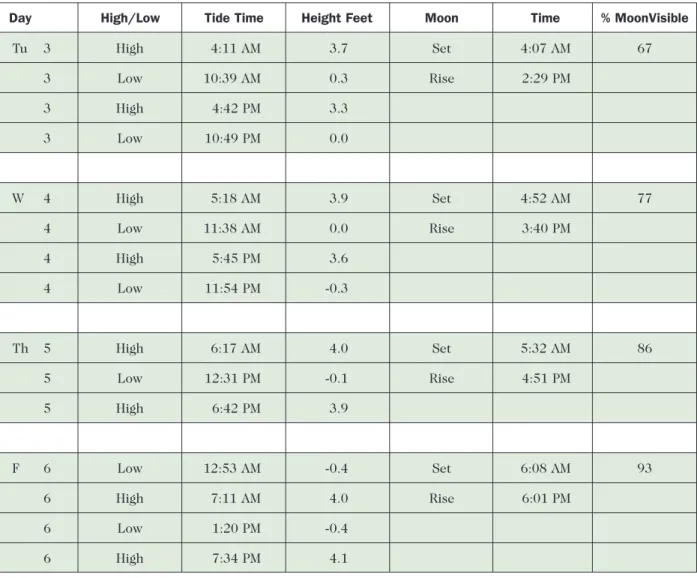
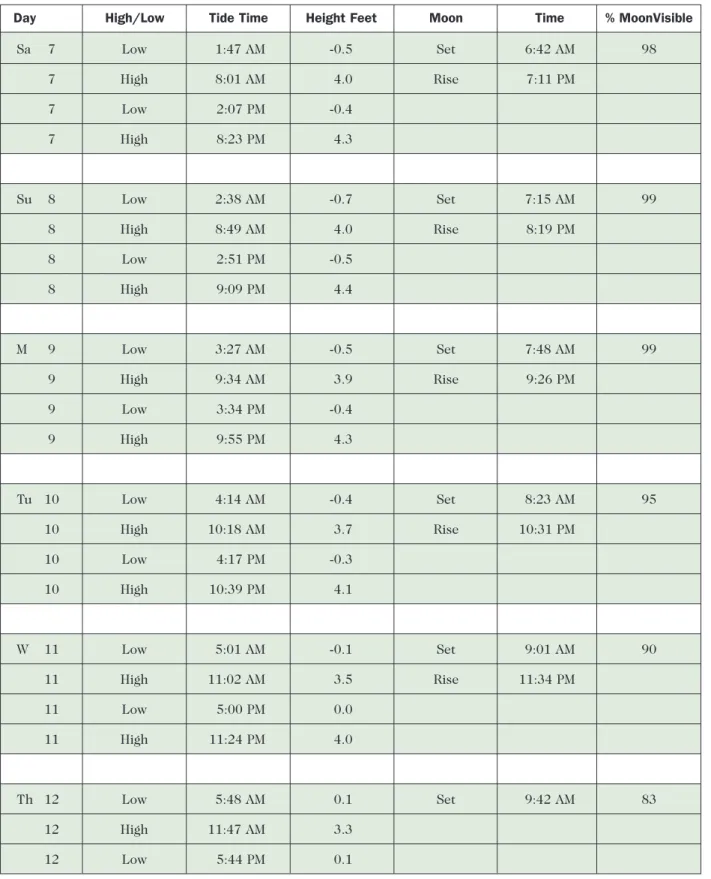
Table 16.1 Tides for Virginia Beach: April 3–30, 2001
Day High/Low Tide Time Height Feet Moon Time % MoonVisible
At what time did the Moon rise on April 9, 2001?
At what time did the second high tide occur on April 9, 2001?
How much of the Moon was visible on April 8, 2001? Given this percentage, what phase was the Moon in on April 8? How much of the Moon was visible on April 16, 2001? Given this percentage, what phase was the Moon in on April 16? Where did the tides in Table 16.1 occur?
Inquiry 16.1
Analyzing Tidal Data
PROCEDURE
1.
Examine the data in Table 16.1: Tides for Virginia Beach: April 3–30, 2001. With your teacher, discuss how to read the table by answering questions such as the following:At what time did the high tides occur on April 5, 2001?
How high were the high tides on April 5?
Tu 3 High 4:11 AM 3.7 Set 4:07 AM 67 3 Low 10:39 AM 0.3 Rise 2:29 PM 3 High 4:42 PM 3.3 3 Low 10:49 PM 0.0 W 4 High 5:18 AM 3.9 Set 4:52 AM 77 4 Low 11:38 AM 0.0 Rise 3:40 PM 4 High 5:45 PM 3.6 4 Low 11:54 PM -0.3 Th 5 High 6:17 AM 4.0 Set 5:32 AM 86 5 Low 12:31 PM -0.1 Rise 4:51 PM 5 High 6:42 PM 3.9 F 6 Low 12:53 AM -0.4 Set 6:08 AM 93 6 High 7:11 AM 4.0 Rise 6:01 PM 6 Low 1:20 PM -0.4 6 High 7:34 PM 4.1 Sa 7 Low 1:47 AM -0.5 Set 6:42 AM 98 7 High 8:01 AM 4.0 Rise 7:11 PM 7 Low 2:07 PM -0.4 7 High 8:23 PM 4.3 Su 8 Low 2:38 AM -0.7 Set 7:15 AM 99 8 High 8:49 AM 4.0 Rise 8:19 PM 8 Low 2:51 PM -0.5 8 High 9:09 PM 4.4 M 9 Low 3:27 AM -0.5 Set 7:48 AM 99 9 High 9:34 AM 3.9 Rise 9:26 PM 9 Low 3:34 PM -0.4 9 High 9:55 PM 4.3 Tu 10 Low 4:14 AM -0.4 Set 8:23 AM 95 10 High 10:18 AM 3.7 Rise 10:31 PM 10 Low 4:17 PM -0.3 10 High 10:39 PM 4.1 W 11 Low 5:01 AM -0.1 Set 9:01 AM 90 11 High 11:02 AM 3.5 Rise 11:34 PM 11 Low 5:00 PM 0.0 11 High 11:24 PM 4.0 Th 12 Low 5:48 AM 0.1 Set 9:42 AM 83 12 High 11:47 AM 3.3 12 Low 5:44 PM 0.1
Day High/Low Tide Time Height Feet Moon Time % MoonVisible
Table 16.1 Tides for Virginia Beach: April 3–30, 2001
Day High/Low Tide Time Height Feet Moon Time % MoonVisible
At what time did the Moon rise on April 9, 2001?
At what time did the second high tide occur on April 9, 2001?
How much of the Moon was visible on April 8, 2001? Given this percentage, what phase was the Moon in on April 8? How much of the Moon was visible on April 16, 2001? Given this percentage, what phase was the Moon in on April 16? Where did the tides in Table 16.1 occur?
Inquiry 16.1
Analyzing Tidal Data
PROCEDURE
1.
Examine the data in Table 16.1: Tides for Virginia Beach: April 3–30, 2001. With your teacher, discuss how to read the table by answering questions such as the following:At what time did the high tides occur on April 5, 2001?
How high were the high tides on April 5?
Tu 3 High 4:11 AM 3.7 Set 4:07 AM 67 3 Low 10:39 AM 0.3 Rise 2:29 PM 3 High 4:42 PM 3.3 3 Low 10:49 PM 0.0 W 4 High 5:18 AM 3.9 Set 4:52 AM 77 4 Low 11:38 AM 0.0 Rise 3:40 PM 4 High 5:45 PM 3.6 4 Low 11:54 PM -0.3 Th 5 High 6:17 AM 4.0 Set 5:32 AM 86 5 Low 12:31 PM -0.1 Rise 4:51 PM 5 High 6:42 PM 3.9 F 6 Low 12:53 AM -0.4 Set 6:08 AM 93 6 High 7:11 AM 4.0 Rise 6:01 PM 6 Low 1:20 PM -0.4 6 High 7:34 PM 4.1 Sa 7 Low 1:47 AM -0.5 Set 6:42 AM 98 7 High 8:01 AM 4.0 Rise 7:11 PM 7 Low 2:07 PM -0.4 7 High 8:23 PM 4.3 Su 8 Low 2:38 AM -0.7 Set 7:15 AM 99 8 High 8:49 AM 4.0 Rise 8:19 PM 8 Low 2:51 PM -0.5 8 High 9:09 PM 4.4 M 9 Low 3:27 AM -0.5 Set 7:48 AM 99 9 High 9:34 AM 3.9 Rise 9:26 PM 9 Low 3:34 PM -0.4 9 High 9:55 PM 4.3 Tu 10 Low 4:14 AM -0.4 Set 8:23 AM 95 10 High 10:18 AM 3.7 Rise 10:31 PM 10 Low 4:17 PM -0.3 10 High 10:39 PM 4.1 W 11 Low 5:01 AM -0.1 Set 9:01 AM 90 11 High 11:02 AM 3.5 Rise 11:34 PM 11 Low 5:00 PM 0.0 11 High 11:24 PM 4.0 Th 12 Low 5:48 AM 0.1 Set 9:42 AM 83 12 High 11:47 AM 3.3 12 Low 5:44 PM 0.1
Day High/Low Tide Time Height Feet Moon Time % MoonVisible
Day High/Low Tide Time Height Feet Moon Time % MoonVisible
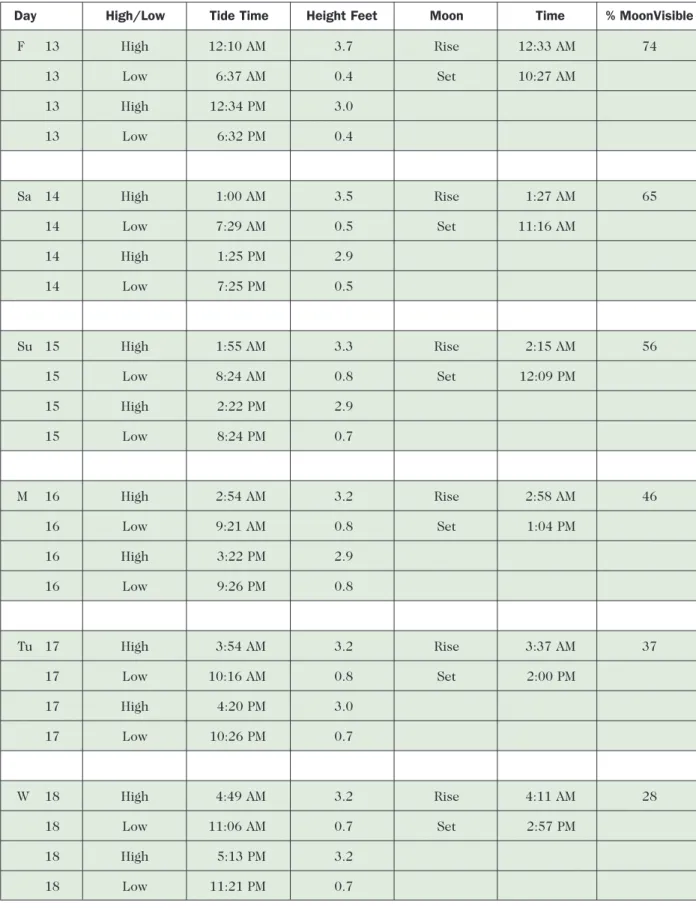
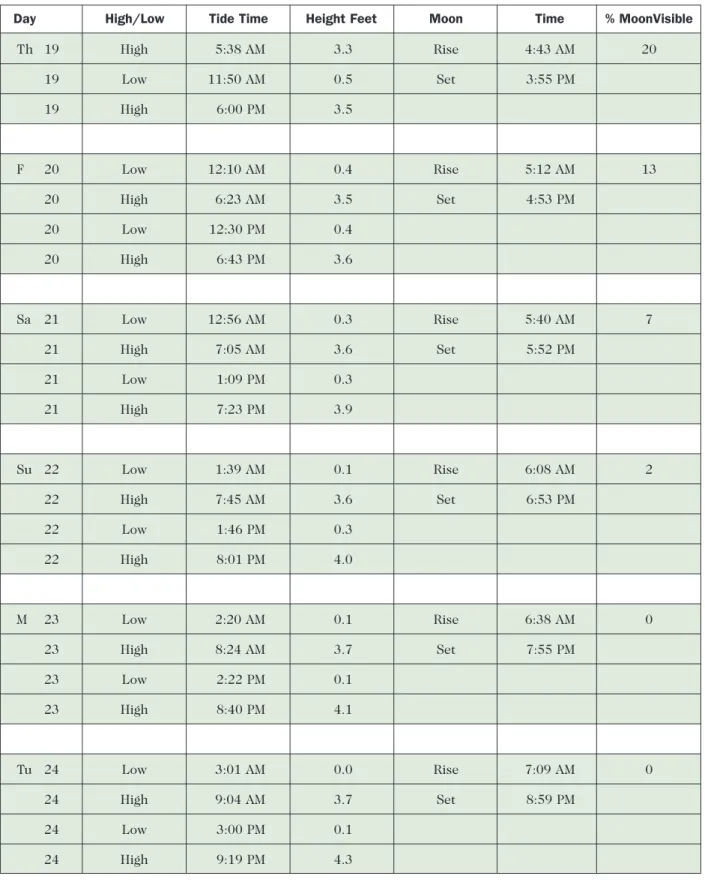
Table 16.1 Tides for Virginia Beach: April 3–30, 2001 (continued)
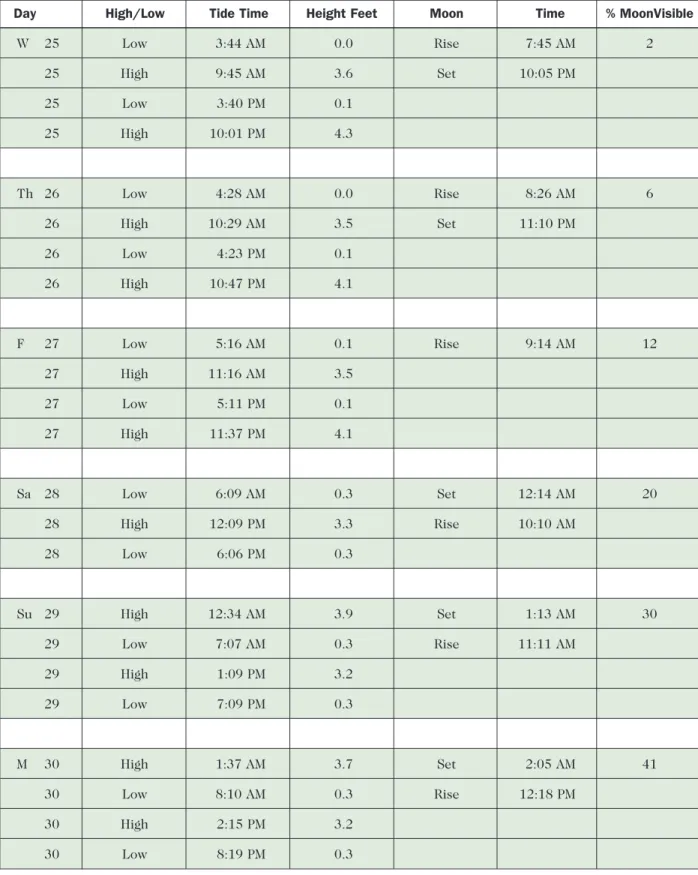
F 13 High 12:10 AM 3.7 Rise 12:33 AM 74 13 Low 6:37 AM 0.4 Set 10:27 AM 13 High 12:34 PM 3.0 13 Low 6:32 PM 0.4 Sa 14 High 1:00 AM 3.5 Rise 1:27 AM 65 14 Low 7:29 AM 0.5 Set 11:16 AM 14 High 1:25 PM 2.9 14 Low 7:25 PM 0.5 Su 15 High 1:55 AM 3.3 Rise 2:15 AM 56 15 Low 8:24 AM 0.8 Set 12:09 PM 15 High 2:22 PM 2.9 15 Low 8:24 PM 0.7 M 16 High 2:54 AM 3.2 Rise 2:58 AM 46 16 Low 9:21 AM 0.8 Set 1:04 PM 16 High 3:22 PM 2.9 16 Low 9:26 PM 0.8 Tu 17 High 3:54 AM 3.2 Rise 3:37 AM 37 17 Low 10:16 AM 0.8 Set 2:00 PM 17 High 4:20 PM 3.0 17 Low 10:26 PM 0.7 W 18 High 4:49 AM 3.2 Rise 4:11 AM 28 18 Low 11:06 AM 0.7 Set 2:57 PM 18 High 5:13 PM 3.2 18 Low 11:21 PM 0.7 Th 19 High 5:38 AM 3.3 Rise 4:43 AM 20 19 Low 11:50 AM 0.5 Set 3:55 PM 19 High 6:00 PM 3.5 F 20 Low 12:10 AM 0.4 Rise 5:12 AM 13 20 High 6:23 AM 3.5 Set 4:53 PM 20 Low 12:30 PM 0.4 20 High 6:43 PM 3.6 Sa 21 Low 12:56 AM 0.3 Rise 5:40 AM 7 21 High 7:05 AM 3.6 Set 5:52 PM 21 Low 1:09 PM 0.3 21 High 7:23 PM 3.9 Su 22 Low 1:39 AM 0.1 Rise 6:08 AM 2 22 High 7:45 AM 3.6 Set 6:53 PM 22 Low 1:46 PM 0.3 22 High 8:01 PM 4.0 M 23 Low 2:20 AM 0.1 Rise 6:38 AM 0 23 High 8:24 AM 3.7 Set 7:55 PM 23 Low 2:22 PM 0.1 23 High 8:40 PM 4.1 Tu 24 Low 3:01 AM 0.0 Rise 7:09 AM 0 24 High 9:04 AM 3.7 Set 8:59 PM 24 Low 3:00 PM 0.1 24 High 9:19 PM 4.3
Day High/Low Tide Time Height Feet Moon Time % MoonVisible
Day High/Low Tide Time Height Feet Moon Time % MoonVisible
Table 16.1 Tides for Virginia Beach: April 3–30, 2001 (continued)
F 13 High 12:10 AM 3.7 Rise 12:33 AM 74 13 Low 6:37 AM 0.4 Set 10:27 AM 13 High 12:34 PM 3.0 13 Low 6:32 PM 0.4 Sa 14 High 1:00 AM 3.5 Rise 1:27 AM 65 14 Low 7:29 AM 0.5 Set 11:16 AM 14 High 1:25 PM 2.9 14 Low 7:25 PM 0.5 Su 15 High 1:55 AM 3.3 Rise 2:15 AM 56 15 Low 8:24 AM 0.8 Set 12:09 PM 15 High 2:22 PM 2.9 15 Low 8:24 PM 0.7 M 16 High 2:54 AM 3.2 Rise 2:58 AM 46 16 Low 9:21 AM 0.8 Set 1:04 PM 16 High 3:22 PM 2.9 16 Low 9:26 PM 0.8 Tu 17 High 3:54 AM 3.2 Rise 3:37 AM 37 17 Low 10:16 AM 0.8 Set 2:00 PM 17 High 4:20 PM 3.0 17 Low 10:26 PM 0.7 W 18 High 4:49 AM 3.2 Rise 4:11 AM 28 18 Low 11:06 AM 0.7 Set 2:57 PM 18 High 5:13 PM 3.2 18 Low 11:21 PM 0.7 Th 19 High 5:38 AM 3.3 Rise 4:43 AM 20 19 Low 11:50 AM 0.5 Set 3:55 PM 19 High 6:00 PM 3.5 F 20 Low 12:10 AM 0.4 Rise 5:12 AM 13 20 High 6:23 AM 3.5 Set 4:53 PM 20 Low 12:30 PM 0.4 20 High 6:43 PM 3.6 Sa 21 Low 12:56 AM 0.3 Rise 5:40 AM 7 21 High 7:05 AM 3.6 Set 5:52 PM 21 Low 1:09 PM 0.3 21 High 7:23 PM 3.9 Su 22 Low 1:39 AM 0.1 Rise 6:08 AM 2 22 High 7:45 AM 3.6 Set 6:53 PM 22 Low 1:46 PM 0.3 22 High 8:01 PM 4.0 M 23 Low 2:20 AM 0.1 Rise 6:38 AM 0 23 High 8:24 AM 3.7 Set 7:55 PM 23 Low 2:22 PM 0.1 23 High 8:40 PM 4.1 Tu 24 Low 3:01 AM 0.0 Rise 7:09 AM 0 24 High 9:04 AM 3.7 Set 8:59 PM 24 Low 3:00 PM 0.1 24 High 9:19 PM 4.3
Day High/Low Tide Time Height Feet Moon Time % MoonVisible
W 25 Low 3:44 AM 0.0 Rise 7:45 AM 2 25 High 9:45 AM 3.6 Set 10:05 PM 25 Low 3:40 PM 0.1 25 High 10:01 PM 4.3 Th 26 Low 4:28 AM 0.0 Rise 8:26 AM 6 26 High 10:29 AM 3.5 Set 11:10 PM 26 Low 4:23 PM 0.1 26 High 10:47 PM 4.1 F 27 Low 5:16 AM 0.1 Rise 9:14 AM 12 27 High 11:16 AM 3.5 27 Low 5:11 PM 0.1 27 High 11:37 PM 4.1 Sa 28 Low 6:09 AM 0.3 Set 12:14 AM 20 28 High 12:09 PM 3.3 Rise 10:10 AM 28 Low 6:06 PM 0.3 Su 29 High 12:34 AM 3.9 Set 1:13 AM 30 29 Low 7:07 AM 0.3 Rise 11:11 AM 29 High 1:09 PM 3.2 29 Low 7:09 PM 0.3 M 30 High 1:37 AM 3.7 Set 2:05 AM 41 30 Low 8:10 AM 0.3 Rise 12:18 PM 30 High 2:15 PM 3.2 30 Low 8:19 PM 0.3 Source: www.saltwatertides.com
NOTESome of the information in this table is incomplete.
Day High/Low Tide Time Height Feet Moon Time % MoonVisible
Table 16.1 Tides for Virginia Beach: April 3–30, 2001 (continued)
2.
Use Table 16.1 and work with your groupto analyze the patterns that exist in the rise and fall of tides, then answer the fol-lowing questions in your notebook: A. Examine the height of tides each day. How does the height change over 24 hours? B. A high tide occurs when the tide reach-es its maximum height on each rise. How many high tides normally occur along Virginia Beach in 24 hours?
C. A low tide occurs when the tide reach-es its minimum height on each fall. How many low tides normally occur along Virginia Beach in 24 hours?
D. Why do you think this pattern in high and low tides exists?
E. Compare the times that high and low tides occur each day over a two-week period. What do you observe? Explain why you think this happens.
F. Examine the data showing moonrise and moonset times. Compare these times to the times of high and low tides. What patterns do you observe? What explana-tion can you give for these patterns?
G. Examine the data showing phases. Compare the phases of the Moon to the times of high and low tides. During what phase(s) do the lowest high tides occur? During what phases do highest high tides occur? What explanation can you give for these patterns?
3.
Use your graph paper to show the relation-ship between two sets of data examined during this inquiry. Work with your teacher to decide what to graph. Graphs might include one or more of the following:• times and heights of tides for each day
over 4 days
• times and heights of tides and times of
moonrise and moonset for each day over 4 days
• times and heights of tides and phases of
the Moon over 1 month
4.
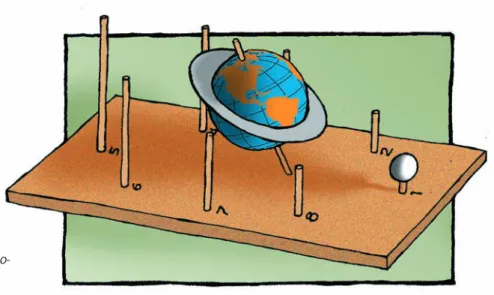
When you have completed your graph, cut out the cardboard pattern of the tidal bulge from Inquiry Master 16.1a. Place the tidal bulge pattern around the 12-cm Earth globe on your Sun-Earth-Moon (SEM) Board to model how Earth’s high and low tides occur throughout the day and month (see Figure 16.1 for one setup). For exam-ple, put the Moon on rod #1. Face theFigure 16.1 One method for modeling the patterns in Earth’s ocean tides. Notice how the locations of high tides Earth fall along the line that connects Earth and the Moon. This means that a high tide faces the Moon (and is oppo-site the Moon) as Earth rotates on its axis.
W 25 Low 3:44 AM 0.0 Rise 7:45 AM 2 25 High 9:45 AM 3.6 Set 10:05 PM 25 Low 3:40 PM 0.1 25 High 10:01 PM 4.3 Th 26 Low 4:28 AM 0.0 Rise 8:26 AM 6 26 High 10:29 AM 3.5 Set 11:10 PM 26 Low 4:23 PM 0.1 26 High 10:47 PM 4.1 F 27 Low 5:16 AM 0.1 Rise 9:14 AM 12 27 High 11:16 AM 3.5 27 Low 5:11 PM 0.1 27 High 11:37 PM 4.1 Sa 28 Low 6:09 AM 0.3 Set 12:14 AM 20 28 High 12:09 PM 3.3 Rise 10:10 AM 28 Low 6:06 PM 0.3 Su 29 High 12:34 AM 3.9 Set 1:13 AM 30 29 Low 7:07 AM 0.3 Rise 11:11 AM 29 High 1:09 PM 3.2 29 Low 7:09 PM 0.3 M 30 High 1:37 AM 3.7 Set 2:05 AM 41 30 Low 8:10 AM 0.3 Rise 12:18 PM 30 High 2:15 PM 3.2 30 Low 8:19 PM 0.3 Source: www.saltwatertides.com
NOTESome of the information in this table is incomplete.
Day High/Low Tide Time Height Feet Moon Time % MoonVisible
Table 16.1 Tides for Virginia Beach: April 3–30, 2001 (continued)
2.
Use Table 16.1 and work with your groupto analyze the patterns that exist in the rise and fall of tides, then answer the fol-lowing questions in your notebook: A. Examine the height of tides each day. How does the height change over 24 hours? B. A high tide occurs when the tide reach-es its maximum height on each rise. How many high tides normally occur along Virginia Beach in 24 hours?
C. A low tide occurs when the tide reach-es its minimum height on each fall. How many low tides normally occur along Virginia Beach in 24 hours?
D. Why do you think this pattern in high and low tides exists?
E. Compare the times that high and low tides occur each day over a two-week period. What do you observe? Explain why you think this happens.
F. Examine the data showing moonrise and moonset times. Compare these times to the times of high and low tides. What patterns do you observe? What explana-tion can you give for these patterns?
G. Examine the data showing phases. Compare the phases of the Moon to the times of high and low tides. During what phase(s) do the lowest high tides occur? During what phases do highest high tides occur? What explanation can you give for these patterns?
3.
Use your graph paper to show the relation-ship between two sets of data examined during this inquiry. Work with your teacher to decide what to graph. Graphs might include one or more of the following:• times and heights of tides for each day
over 4 days
• times and heights of tides and times of
moonrise and moonset for each day over 4 days
• times and heights of tides and phases of
the Moon over 1 month
4.
When you have completed your graph, cut out the cardboard pattern of the tidal bulge from Inquiry Master 16.1a. Place the tidal bulge pattern around the 12-cm Earth globe on your Sun-Earth-Moon (SEM) Board to model how Earth’s high and low tides occur throughout the day and month (see Figure 16.1 for one setup). For exam-ple, put the Moon on rod #1. Face theFigure 16.1 One method for modeling the patterns in Earth’s ocean tides. Notice how the locations of high tides Earth fall along the line that connects Earth and the Moon. This means that a high tide faces the Moon (and is oppo-site the Moon) as Earth rotates on its axis.
REFLECTING ON WHAT YOU’VE DONE
1.
Share your findings with the class. Use your graphs as needed.2.
Read “Can Water Fall Up?” In your science notebook, answer the questions that follow the reading selection. Be prepared to share your notebook entries with the class. “high tide” bulge in the cardboard toward rod #1. Slowly rotate Earth one complete turn on its axis, but keep the “high tide” bulge facing the Moon. This represents one day on Earth. Watch how in 24 hours, each body of water experiences a high tide as Earth rotates on its axis. Now move the Moon to rod #2. Face the “high tide” bulge to rod #2 and repeat this process.3.
What new information about tides do you want to add to your brainstorming list from “Getting Started” Step 2? Discuss that information with the class.4.
With your class, return to the Question I folder for Lesson 1. Is there anything you would now change or add? Discuss your ideas with the class.5.
Read the “Mission” reading selection on Pluto. Add any information about Pluto to your working copy of Student Sheet 10.1c: Planetary Chart (and onto Student Sheet 10.1b: Planetary Brochure Outline if your Anchor Activity planet assigned during Lesson 10 was Pluto).Marching to the
Beat of Tides
Tidal Rhythms
A fiddler crab dashes about on the beach, find-ing food and fightfind-ing other crabs. It is low tide, and the crab has a limited amount of time to do its business. Once the water starts to rise, the crab returns to its burrow. A fiddler crab’s activ-ities do not coincide with day and night, but are linked to the tides. At low tide, the crab is active. When high tide comes about six hours later, the crab rests. This pattern repeats throughout both day and night.
COURTESY OF CAROLINA BIOLOGICAL SUPPL
Y COMP
ANY
A male fiddler crab
We live on a round, rotating planet. Every day, as Earth turns on its axis, we experience the natural cycle of day and night. By day, most humans are busy. During the dark hours of night, we rest. Have you ever wondered why we follow this pattern? Why do we wake up in the morning, even without an alarm clock ringing in our ears?
All living things have internal systems that function like clocks. These timekeepers are called “biological clocks.” In humans, these bio-logical clocks keep us in sync with our environ-ment. They wake us up in the morning and let us know when it is time to sleep. We follow a daily rhythm. But some marine animals follow a different rhythm. Their activities correspond to the rise and fall of ocean tides.
In an ocean environment, tides are like clocks. They provide a steady beat that some animals use to regulate their behavior. Animals that live near the beach in the intertidal zone— the area between the high- and low-water marks—often follow a tidal rhythm.
REFLECTING ON WHAT YOU’VE DONE
1.
Share your findings with the class. Use your graphs as needed.2.
Read “Can Water Fall Up?” In your science notebook, answer the questions that follow the reading selection. Be prepared to share your notebook entries with the class. “high tide” bulge in the cardboard toward rod #1. Slowly rotate Earth one complete turn on its axis, but keep the “high tide” bulge facing the Moon. This represents one day on Earth. Watch how in 24 hours, each body of water experiences a high tide as Earth rotates on its axis. Now move the Moon to rod #2. Face the “high tide” bulge to rod #2 and repeat this process.3.
What new information about tides do you want to add to your brainstorming list from “Getting Started” Step 2? Discuss that information with the class.4.
With your class, return to the Question I folder for Lesson 1. Is there anything you would now change or add? Discuss your ideas with the class.5.
Read the “Mission” reading selection on Pluto. Add any information about Pluto to your working copy of Student Sheet 10.1c: Planetary Chart (and onto Student Sheet 10.1b: Planetary Brochure Outline if your Anchor Activity planet assigned during Lesson 10 was Pluto).Marching to the
Beat of Tides
Tidal Rhythms
A fiddler crab dashes about on the beach, find-ing food and fightfind-ing other crabs. It is low tide, and the crab has a limited amount of time to do its business. Once the water starts to rise, the crab returns to its burrow. A fiddler crab’s activ-ities do not coincide with day and night, but are linked to the tides. At low tide, the crab is active. When high tide comes about six hours later, the crab rests. This pattern repeats throughout both day and night.
COURTESY OF CAROLINA BIOLOGICAL SUPPL
Y COMP
ANY
A male fiddler crab
We live on a round, rotating planet. Every day, as Earth turns on its axis, we experience the natural cycle of day and night. By day, most humans are busy. During the dark hours of night, we rest. Have you ever wondered why we follow this pattern? Why do we wake up in the morning, even without an alarm clock ringing in our ears?
All living things have internal systems that function like clocks. These timekeepers are called “biological clocks.” In humans, these bio-logical clocks keep us in sync with our environ-ment. They wake us up in the morning and let us know when it is time to sleep. We follow a daily rhythm. But some marine animals follow a different rhythm. Their activities correspond to the rise and fall of ocean tides.
In an ocean environment, tides are like clocks. They provide a steady beat that some animals use to regulate their behavior. Animals that live near the beach in the intertidal zone— the area between the high- and low-water marks—often follow a tidal rhythm.
Some animals are active during high tide. Oysters and scallops, for example, open their shells to feed during high tide. They close their shells during low tide. Rock barna-cles are creatures that permanently attach to rocks and other objects along the coast. During high tide, their feathery feet emerge from their shells to screen the water for
plankton and other food. Barnacles close their shells at low tide. Razor clams live between the tide lines in a vertical position, with part of their shells sticking out of the sand. During high tide, these clams open their shells to gather food. At low tide, their shells close.
The fiddler crab is not the only animal you might see at low tide. Shorebirds, such as sandpipers and plovers, scurry along the beach feeding at low tide. You might also see a plough snail using its large foot to move up and down the beach. It is searching for stranded jellyfish and other prey. As the tide comes in, the snail burrows into the sand.
The Beat Goes On
What happens when fiddler crabs are taken from their natural home and put in a scientist’s lab, where there are no tides to regulate their activities?
Surprisingly, even when the crabs are away from the sea, they still become active at the same times as low tides. This behavior occurs in other ani-mals, too. For example, some kinds of snails will remain inactive until it’s time for low tide, even when they are in a tank or aquarium. Then they start moving about. Oysters, too, continue to open and close their shells with the tides, even when they are in a closed tank that has no tidal activity. For these marine animals, their biological clocks are still keeping time to the rhythm of the sea.
COURTESY OF CAROLINA BIOLOGICAL SUPPL
Y COMP
ANY
Rock barnacles
A fresh water mussel opens its shell to feed as the tide comes in.
COURTESY OF CAROLINA BIOLOGICAL SUPPL
Y COMP
ANY
On a hot summer day, you might pick a spot on the beach only to find that hours later you have to find a new spot farther from the water. The tide has come in. What does this mean? The Moon’s gravity pulls on Earth in a way that we can easily see—the tides.
Tides
The gravitational pull of the Moon causes tides, or the periodic rise and fall of the ocean sea level and other waters on Earth. Every 12 hours or so, the ocean water swells to its high-est point, called “high tide.” When the water
IMAGES OF NEW BRUNSWICK, IMAGES DU NOUVEAU-BRUNSWICK
PHOTOGRAPHER: ROBERT D. H. W
ARREN
IMAGES OF NEW BRUNSWICK, IMAGES DU NOUVEAU-BRUNSWICK
High tide at the Hopewell Rocks in New Brunswick, Canada
Low tide at the Hopewell Rocks in New Brunswick, Canada
Can Water
F
a
ll ?
U
p
Some animals are active during high tide. Oysters and scallops, for example, open their shells to feed during high tide. They close their shells during low tide. Rock barna-cles are creatures that permanently attach to rocks and other objects along the coast. During high tide, their feathery feet emerge from their shells to screen the water for
plankton and other food. Barnacles close their shells at low tide. Razor clams live between the tide lines in a vertical position, with part of their shells sticking out of the sand. During high tide, these clams open their shells to gather food. At low tide, their shells close.
The fiddler crab is not the only animal you might see at low tide. Shorebirds, such as sandpipers and plovers, scurry along the beach feeding at low tide. You might also see a plough snail using its large foot to move up and down the beach. It is searching for stranded jellyfish and other prey. As the tide comes in, the snail burrows into the sand.
The Beat Goes On
What happens when fiddler crabs are taken from their natural home and put in a scientist’s lab, where there are no tides to regulate their activities?
Surprisingly, even when the crabs are away from the sea, they still become active at the same times as low tides. This behavior occurs in other ani-mals, too. For example, some kinds of snails will remain inactive until it’s time for low tide, even when they are in a tank or aquarium. Then they start moving about. Oysters, too, continue to open and close their shells with the tides, even when they are in a closed tank that has no tidal activity. For these marine animals, their biological clocks are still keeping time to the rhythm of the sea.
COURTESY OF CAROLINA BIOLOGICAL SUPPL
Y COMP
ANY
Rock barnacles
A fresh water mussel opens its shell to feed as the tide comes in.
COURTESY OF CAROLINA BIOLOGICAL SUPPL
Y COMP
ANY
On a hot summer day, you might pick a spot on the beach only to find that hours later you have to find a new spot farther from the water. The tide has come in. What does this mean? The Moon’s gravity pulls on Earth in a way that we can easily see—the tides.
Tides
The gravitational pull of the Moon causes tides, or the periodic rise and fall of the ocean sea level and other waters on Earth. Every 12 hours or so, the ocean water swells to its high-est point, called “high tide.” When the water
IMAGES OF NEW BRUNSWICK, IMAGES DU NOUVEAU-BRUNSWICK
PHOTOGRAPHER: ROBERT D. H. W
ARREN
IMAGES OF NEW BRUNSWICK, IMAGES DU NOUVEAU-BRUNSWICK
High tide at the Hopewell Rocks in New Brunswick, Canada
Low tide at the Hopewell Rocks in New Brunswick, Canada
Can Water
F
a
ll ?
U
p
The Sun, the Moon, and all of the planets in the solar system tug on the waters and land of Earth, but only the Moon and Sun have significant effects. Because the Moon is so close to Earth, it exerts twice the tidal effect on Earth that the Sun does, even though the Sun is much larger.
Tides on Opposite Sides of Earth
The water on the side of Earth that faces the Moon is more strongly attracted by the gravita-tional force of the Moon than the water on the opposite side of Earth. However, both sides of Earth experience high tide at the same time.
Why? Look at the illustration showing Earth and the Moon. Imagine a line that connects their two centers. High tides will occur along this line. Low tides occur away from (and per-pendicular to) this line. This means that water tends to get deeper on the side of Earth nearest the Moon. On the opposite side of Earth, away from the Moon, the solid Earth is pulled away from the water. This gives Earth a football-like shape. This pulling of the solid Earth causes the water to be left behind, and a high tide occurs on the opposite side, too. Low tides occur on the sides of Earth that are not in line with the Moon.
The ocean water rises along the line joining the center of the elongated Earth and the center of the Moon. High tides occur at points (A) and (C). Low tides occur at points (D) and (E).
sinks to its lowest level, it is called “low tide.”
A B C Earth Moon E D
Spring and Neap Tides
When the Moon is overhead, a high tide can occur. But tides are particularly high when the Sun, Moon, and Earth are in line. From your study of lunar phases, you know that this alignment occurs when the Moon is in its full moon and new moon phases. These high tides are called “spring tides,” even though they happen year-round and have nothing to do with the seasons.
When the Moon is in its first and last quarters, the Sun and the Moon are at right angles to one another. During this time, the gravitational force of the Sun partially offsets the gravitational force of the Moon. This causes lower-than-normal high tides, called neap tides. There are two spring tides and two neap tides for each revolution of the Moon around Earth.
The relative position of the Sun, Moon, and Earth affect the formation of spring and neap tides.
Neap Tide Sun Moon Earth Spring Tides Sun Earth Moon Earth Sun Moon (continued)
The Sun, the Moon, and all of the planets in the solar system tug on the waters and land of Earth, but only the Moon and Sun have significant effects. Because the Moon is so close to Earth, it exerts twice the tidal effect on Earth that the Sun does, even though the Sun is much larger.
Tides on Opposite Sides of Earth
The water on the side of Earth that faces the Moon is more strongly attracted by the gravita-tional force of the Moon than the water on the opposite side of Earth. However, both sides of Earth experience high tide at the same time.
Why? Look at the illustration showing Earth and the Moon. Imagine a line that connects their two centers. High tides will occur along this line. Low tides occur away from (and per-pendicular to) this line. This means that water tends to get deeper on the side of Earth nearest the Moon. On the opposite side of Earth, away from the Moon, the solid Earth is pulled away from the water. This gives Earth a football-like shape. This pulling of the solid Earth causes the water to be left behind, and a high tide occurs on the opposite side, too. Low tides occur on the sides of Earth that are not in line with the Moon.
The ocean water rises along the line joining the center of the elongated Earth and the center of the Moon. High tides occur at points (A) and (C). Low tides occur at points (D) and (E).
sinks to its lowest level, it is called “low tide.”
A B C Earth Moon E D
Spring and Neap Tides
When the Moon is overhead, a high tide can occur. But tides are particularly high when the Sun, Moon, and Earth are in line. From your study of lunar phases, you know that this alignment occurs when the Moon is in its full moon and new moon phases. These high tides are called “spring tides,” even though they happen year-round and have nothing to do with the seasons.
When the Moon is in its first and last quarters, the Sun and the Moon are at right angles to one another. During this time, the gravitational force of the Sun partially offsets the gravitational force of the Moon. This causes lower-than-normal high tides, called neap tides. There are two spring tides and two neap tides for each revolution of the Moon around Earth.
The relative position of the Sun, Moon, and Earth affect the formation of spring and neap tides.
Neap Tide Sun Moon Earth Spring Tides Sun Earth Moon Earth Sun Moon (continued)
Tides on the Moon
While the Moon produces tides on Earth, Earth produces tidal effects on the Moon. Although the Moon doesn’t have oceans, there are signs of Earth’s tidal effects on the Moon. For exam-ple, the Moon rotates on its axis one time in 27.3 days. It also takes 27.3 days for the Moon to orbit Earth. Earth’s tidal forces probably slowed the Moon down until it reached its current state. With a synchronous (same) rotation and revolution, the same side of the Moon— the “near side”—always faces Earth; while the side that faces away from Earth—the “far side”—is always turned away from our view (see the photos). Other signs that tidal forces are at work on the Moon are in the Moon’s shape (it is elongated, like the balloon) and in how the Moon leans toward Earth.
NA
TIONAL AERONAUTICS AND SP
ACE ADMINISTRA
TION/UNITED ST
ATES GEOLOGICAL SUR
VEY
The Moon’s near side
Another tidal effect on the Moon occurs when the Moon lines up with the Sun and Earth. During this alignment, the Moon is wracked with “moonquakes” as the bigger bodies literally fracture the Moon and pull it out of shape.
Jupiter’s Moon, Io
One of the most dramatic examples of tidal forces is the effect that Jupiter has on Io, one of its moons. Io has many active volcanoes. It has more volcanoes than any of the larger planets. This is because of Jupiter’s gravita-tional effect on Io. Io is about the same dis-tance from Jupiter as our Moon is from Earth, but Jupiter is 300 times more massive
than Earth. Io’s tremendous tides are a result of Jupiter’s powerful gravitational pull on that moon.
Jupiter’s gravitational force squeezes Io. The friction caused by this “squeezing and releasing” causes the moon to heat up. This heat melts the rocks under Io’s surface and gives rise to that moon’s continuous volcanic activity.
QUESTIONS
1. Why does the Moon exert twice the amount of tidal effect on Earth than the larger Sun? 2. During which two Moon phases do spring
tides (higher than normal high tides) occur? 3. During which two Moon phases do neap
tides (lower than normal high tides) occur? 4. What are two effects of Earth’s gravitational
pull on the Moon?
5. How does Jupiter’s gravitational pull cause volcanic activity on its moon Io?
NATIONAL AERONAUTICS AND SPACE ADMINISTRATION. IMAGE PRODUCED BY UNIVERSITY OF ARIZONA
NA
TIONAL AERONAUTICS AND SP
ACE ADMINISTRA
TION/
JET PROPULSION LABORA
TOR
Y
Volcanoes on Jupiter’s moon, Io
Tides on the Moon
While the Moon produces tides on Earth, Earth produces tidal effects on the Moon. Although the Moon doesn’t have oceans, there are signs of Earth’s tidal effects on the Moon. For exam-ple, the Moon rotates on its axis one time in 27.3 days. It also takes 27.3 days for the Moon to orbit Earth. Earth’s tidal forces probably slowed the Moon down until it reached its current state. With a synchronous (same) rotation and revolution, the same side of the Moon— the “near side”—always faces Earth; while the side that faces away from Earth—the “far side”—is always turned away from our view (see the photos). Other signs that tidal forces are at work on the Moon are in the Moon’s shape (it is elongated, like the balloon) and in how the Moon leans toward Earth.
NA
TIONAL AERONAUTICS AND SP
ACE ADMINISTRA
TION/UNITED ST
ATES GEOLOGICAL SUR
VEY
The Moon’s near side
Another tidal effect on the Moon occurs when the Moon lines up with the Sun and Earth. During this alignment, the Moon is wracked with “moonquakes” as the bigger bodies literally fracture the Moon and pull it out of shape.
Jupiter’s Moon, Io
One of the most dramatic examples of tidal forces is the effect that Jupiter has on Io, one of its moons. Io has many active volcanoes. It has more volcanoes than any of the larger planets. This is because of Jupiter’s gravita-tional effect on Io. Io is about the same dis-tance from Jupiter as our Moon is from Earth, but Jupiter is 300 times more massive
than Earth. Io’s tremendous tides are a result of Jupiter’s powerful gravitational pull on that moon.
Jupiter’s gravitational force squeezes Io. The friction caused by this “squeezing and releasing” causes the moon to heat up. This heat melts the rocks under Io’s surface and gives rise to that moon’s continuous volcanic activity.
QUESTIONS
1. Why does the Moon exert twice the amount of tidal effect on Earth than the larger Sun? 2. During which two Moon phases do spring
tides (higher than normal high tides) occur? 3. During which two Moon phases do neap
tides (lower than normal high tides) occur? 4. What are two effects of Earth’s gravitational
pull on the Moon?
5. How does Jupiter’s gravitational pull cause volcanic activity on its moon Io?
NATIONAL AERONAUTICS AND SPACE ADMINISTRATION. IMAGE PRODUCED BY UNIVERSITY OF ARIZONA
NA
TIONAL AERONAUTICS AND SP
ACE ADMINISTRA
TION/
JET PROPULSION LABORA
TOR
Y
Volcanoes on Jupiter’s moon, Io
Pluto is the smallest planet in our solar sys-tem—approximately two-thirds the size of Earth’s Moon. Pluto is also the planet farthest from the Sun. No spacecraft has ever visited this tiny planet, discovered in 1930 by a young astronomer named Clyde Tombaugh.
Pluto’s distance from Earth and its small size do not mean that we don’t know a great deal about it. For that, we can thank the Hubble Space Telescope (HST), an instrument that has made some of the most incredible discoveries in the history of astronomy.
Mission:
Pluto
NA
TIONAL AERONAUTICS AND SP
ACE ADMINISTRA
TION
Hubble Space Telescope
Hubble’s History
Launched by the space shuttle Discoveryon April 24, 1990, the Hubble Space Telescope is a joint project of the European Space Agency and NASA. Hubble is more than a telescope. It is a space-based observatory that is expected to remain in operation until 2010. It makes a complete orbit around the Earth every 96 to 97 minutes.
Hubble travels in a low orbit of approximately 600 kilometers above Earth’s surface, well above Earth’s atmosphere. As a result, the images Hubble transmits to Earth are not distorted like images taken from Earth’s surface. Hubble’s lenses are 10 times sharper than those of the largest ground-based telescope. What’s more, Hubble operates across the entire spectrum of light—from infrared through the visible to ultra-violet light. This means it can register wave-lengths that are normally filtered out by the atmosphere. Not bad for an instrument that is barely 16 meters long and slightly more than 4 meters in diameter!
Pluto is the smallest planet in our solar sys-tem—approximately two-thirds the size of Earth’s Moon. Pluto is also the planet farthest from the Sun. No spacecraft has ever visited this tiny planet, discovered in 1930 by a young astronomer named Clyde Tombaugh.
Pluto’s distance from Earth and its small size do not mean that we don’t know a great deal about it. For that, we can thank the Hubble Space Telescope (HST), an instrument that has made some of the most incredible discoveries in the history of astronomy.
Mission:
Pluto
NA
TIONAL AERONAUTICS AND SP
ACE ADMINISTRA
TION
Hubble Space Telescope
Hubble’s History
Launched by the space shuttle Discoveryon April 24, 1990, the Hubble Space Telescope is a joint project of the European Space Agency and NASA. Hubble is more than a telescope. It is a space-based observatory that is expected to remain in operation until 2010. It makes a complete orbit around the Earth every 96 to 97 minutes.
Hubble travels in a low orbit of approximately 600 kilometers above Earth’s surface, well above Earth’s atmosphere. As a result, the images Hubble transmits to Earth are not distorted like images taken from Earth’s surface. Hubble’s lenses are 10 times sharper than those of the largest ground-based telescope. What’s more, Hubble operates across the entire spectrum of light—from infrared through the visible to ultra-violet light. This means it can register wave-lengths that are normally filtered out by the atmosphere. Not bad for an instrument that is barely 16 meters long and slightly more than 4 meters in diameter!
NA
TIONAL AERONAUTICS AND SP
ACE ADMINISTRA
TION
Another important feature of Hubble is that it is modular. If something goes wrong, it can most likely be repaired. When the Hubble Space Telescope had been in orbit only two months, scientists discovered that its main mirror was not perfectly shaped and it had to be fixed. Likewise, if a system becomes obsolete, it can be replaced. For example, the cameras on board have been replaced twice—in 1993 and 1997.
The Hubble Space Telescope being refur-bished by astronauts Story Musgrave and Jeffrey Hoffman. Australia’s West Coast can be seen in the background.
Pluto and Charon are like a double planet.
When it is in sunlight, Hubble is powered by solar energy. When Hubble moves into the Sun’s shadow, it relies on nickel-hydrogen batteries that have also been charged by the Sun.
A Fuzzy Planet Comes Into Focus
In pre-Hubble days, few details were known about Pluto. From even the most powerful land telescopes, Pluto looked like a fuzzy yellow ball.
DR. R. ALBRECHT
, EUROPEAN SP
ACE AGENCY/ESO SP
ACE TELESCOPE EUROPEAN COORDINA
TING F
ACILITY/NA
TIONAL AERONAUTICS AND SP
ACE ADMINI
STRA
TION
In 1978, astronomers discovered that Pluto had a moon, which they named Charon. Charon’s diameter is about half that of Pluto. Its orbit is only about 18,000 kilometers above Pluto’s sur-face. In many ways, Pluto and Charon are more like a double planet than a planet and satellite.
trade places. For about 20 years, Pluto becomes the eighth planet and Neptune the ninth planet from the Sun. For example, Pluto was closer to the Sun than Neptune from 1979 until 1999. Then, in 1999, Pluto switched places with Neptune, and Pluto once again became the ninth planet from the Sun.
Another unique thing about Pluto is its orbit. At times, Pluto is closer to the Sun than
NA
TIONAL AERONAUTICS AND SP
ACE ADMINISTRA
TION
Another important feature of Hubble is that it is modular. If something goes wrong, it can most likely be repaired. When the Hubble Space Telescope had been in orbit only two months, scientists discovered that its main mirror was not perfectly shaped and it had to be fixed. Likewise, if a system becomes obsolete, it can be replaced. For example, the cameras on board have been replaced twice—in 1993 and 1997.
The Hubble Space Telescope being refur-bished by astronauts Story Musgrave and Jeffrey Hoffman. Australia’s West Coast can be seen in the background.
Pluto and Charon are like a double planet.
When it is in sunlight, Hubble is powered by solar energy. When Hubble moves into the Sun’s shadow, it relies on nickel-hydrogen batteries that have also been charged by the Sun.
A Fuzzy Planet Comes Into Focus
In pre-Hubble days, few details were known about Pluto. From even the most powerful land telescopes, Pluto looked like a fuzzy yellow ball.
DR. R. ALBRECHT
, EUROPEAN SP
ACE AGENCY/ESO SP
ACE TELESCOPE EUROPEAN COORDINA
TING F
ACILITY/NA
TIONAL AERONAUTICS AND SP
ACE ADMINI
STRA
TION
In 1978, astronomers discovered that Pluto had a moon, which they named Charon. Charon’s diameter is about half that of Pluto. Its orbit is only about 18,000 kilometers above Pluto’s sur-face. In many ways, Pluto and Charon are more like a double planet than a planet and satellite.
trade places. For about 20 years, Pluto becomes the eighth planet and Neptune the ninth planet from the Sun. For example, Pluto was closer to the Sun than Neptune from 1979 until 1999. Then, in 1999, Pluto switched places with Neptune, and Pluto once again became the ninth planet from the Sun.
Another unique thing about Pluto is its orbit. At times, Pluto is closer to the Sun than
NA
TIONAL AERONAUTICS AND SP
ACE ADMINISTRA
TION
planets are in the inner solar system. In the outer part of the solar system, the huge, gaseous planets reign—with the exception of rocky Pluto.
Some astronomers believe that Pluto was once a satellite of Neptune that got knocked out of its orbit. Others think that both Pluto and Charon are part of the Kuiper belt. The Kuiper belt is a ring of comets—rocky, icy objects—that orbit the Sun just beyond Neptune. It was formed at the time of origin of the solar system. It’s possible that Pluto is an exceptional “KBO”— Kuiper Belt Object— that broke away from the crowd!
Future explorations will let scientists learn more about Pluto—its surface properties and its interior makeup. In the meantime, photos from Hubble help us prepare for future missions by telling us more about this distant little planet. These images of Pluto were taken with the Hubble Space Telescope during one solar day on Pluto. Notice the polar ice caps and bright features near the equator. Some of the dark areas may be valleys or fresh impact craters.
The Hubble Space Telescope sent back its first images of Pluto in 1994, when it mapped about 85 percent of the planet’s surface. These images show a planet of enormous contrasts. Parts of the planet’s surface are bright white, while other parts look black. Pluto also has a cap on its north pole. Dr. Marc Buie, a member of the Hubble team, said, “It’s fantastic. Hubble has brought Pluto from a fuzzy, distant dot of light to a world that we can begin to map and watch for surface changes. The results … are much better than I ever hoped for.”
Pluto the Planet?
We still know less about Pluto than about any other planet. Its size, its odd orbit, and its rela-tionship with Charon are unique. What’s more, Pluto’s composition—a mixture of rock and ice—makes it stand out. All the other rocky
Pluto: Quick Facts
Diameter 2340 km
Average distance from the Sun 5.9 billion km
Mass 1 ×10²²kg Surface gravity (Earth =1) 0.06
Average temperature –230 °C
Length of sidereal day 6.39 Earth days
Length of year 248 Earth years
Number of observed moons 1
Relative size
Did You Know?
• Pluto’s orbit is the least like a circle of all the plants. Its distance from the Sun varies from less than 41⁄2 billion km to over 7 billion km.
• Pluto’s orbit around the Sun is tilted 17 degrees, more than any other planet in the solar system.
Icy surface Icy mantle Large rock core
Earth Pluto
NA
TIONAL AERONAUTICS AND SP
ACE ADMINISTRA
TION
planets are in the inner solar system. In the outer part of the solar system, the huge, gaseous planets reign—with the exception of rocky Pluto.
Some astronomers believe that Pluto was once a satellite of Neptune that got knocked out of its orbit. Others think that both Pluto and Charon are part of the Kuiper belt. The Kuiper belt is a ring of comets—rocky, icy objects—that orbit the Sun just beyond Neptune. It was formed at the time of origin of the solar system. It’s possible that Pluto is an exceptional “KBO”— Kuiper Belt Object— that broke away from the crowd!
Future explorations will let scientists learn more about Pluto—its surface properties and its interior makeup. In the meantime, photos from Hubble help us prepare for future missions by telling us more about this distant little planet. These images of Pluto were taken with the Hubble Space Telescope during one solar day on Pluto. Notice the polar ice caps and bright features near the equator. Some of the dark areas may be valleys or fresh impact craters.
The Hubble Space Telescope sent back its first images of Pluto in 1994, when it mapped about 85 percent of the planet’s surface. These images show a planet of enormous contrasts. Parts of the planet’s surface are bright white, while other parts look black. Pluto also has a cap on its north pole. Dr. Marc Buie, a member of the Hubble team, said, “It’s fantastic. Hubble has brought Pluto from a fuzzy, distant dot of light to a world that we can begin to map and watch for surface changes. The results … are much better than I ever hoped for.”
Pluto the Planet?
We still know less about Pluto than about any other planet. Its size, its odd orbit, and its rela-tionship with Charon are unique. What’s more, Pluto’s composition—a mixture of rock and ice—makes it stand out. All the other rocky
Pluto: Quick Facts
Diameter 2340 km
Average distance from the Sun 5.9 billion km
Mass 1 ×10²²kg Surface gravity (Earth =1) 0.06
Average temperature –230 °C
Length of sidereal day 6.39 Earth days
Length of year 248 Earth years
Number of observed moons 1
Relative size
Did You Know?
• Pluto’s orbit is the least like a circle of all the plants. Its distance from the Sun varies from less than 41⁄2 billion km to over 7 billion km.
• Pluto’s orbit around the Sun is tilted 17 degrees, more than any other planet in the solar system.
Icy surface Icy mantle Large rock core
Earth Pluto