Scholarship@Vanderbilt Law
Vanderbilt Law School Faculty Publications
Faculty Scholarship
2018
Decoding Guilty Minds: How Jurors Attribute
Knowledge and Guilt
Owen D. Jones
Vanderbilt University Law School
Matthew R. Ginther
United States Court of Federal Claims
Francis X. Shen
Univ. of Minnesota Law School
Richard J. Bonnie
University of Virginia - Main Campus
Morris B. Hoffman
University of Denver
See next page for additional authors
Follow this and additional works at:
https://scholarship.law.vanderbilt.edu/faculty-publications
Part of the
Criminal Law Commons
, and the
Law and Psychology Commons
This Article is brought to you for free and open access by the Faculty Scholarship at Scholarship@Vanderbilt Law. It has been accepted for inclusion in Vanderbilt Law School Faculty Publications by an authorized administrator of Scholarship@Vanderbilt Law. For more information, please contact
Recommended Citation
Owen D. Jones, Matthew R. Ginther, Francis X. Shen, Richard J. Bonnie, Morris B. Hoffman, and Kenneth W. Simons,Decoding Guilty Minds: How Jurors Attribute Knowledge and Guilt, 71 Vanderbilt Law Review. 241 (2018)
Owen D. Jones, Matthew R. Ginther, Francis X. Shen, Richard J. Bonnie, Morris B. Hoffman, and Kenneth W. Simons
+
(,1 1/,1(
2
Citation:
Matthew R. Ginther; Francis X. Shen; Richard J. Bonnie;
Morris B. Hoffman; Owen D. Jones; Kenneth W. Simons,
Decoding Guilty Minds: How Jurors Attribute Knowledge
and Guilt, 71 Vand. L. Rev. 241 (2018)
Provided by:
Vanderbilt University Law School
Content downloaded/printed from
HeinOnline
Tue Jun 12 10:22:10 2018
-- Your use of this HeinOnline PDF indicates your acceptance
of HeinOnline's Terms and Conditions of the license
agreement available at https://heinonline.org/HOL/License
-- The search text of this PDF is generated from
uncorrected OCR text.
-- To obtain permission to use this article beyond the scope
of your HeinOnline license, please use:
Copyright Information
Use QR Code reader to send PDF to
your smartphone or tablet device
Decoding Guilty Minds:
How Jurors Attribute
Knowledge and Guilt
Matthew R. Ginthero Francis X. Shenat Richard J. Bonniey Morris B. Hoffman8 Owen D. Jonese Kenneth W. SimonsK2
A central tenet of Anglo-American penal law is that in order for
an actor to be found criminally liable, a proscribed act must be accompanied by a guilty mind. While it is easy to understand the
a. Law Clerk, Office of Special Masters, Court of Federal Claims, Washington, D.C. 8. Associate Professor, University of Minnesota Law School; Executive Director of Education and Outreach, MacArthur Foundation Research Network on Law and Neuroscience; Faculty Member, Massachusetts General Hospital Center for Law, Brain, and Behavior.
1. Co-authors listed beyond the second author are listed alphabetically by last name. y. Harrison Foundation Professor of Medicine and Law, Professor of Psychiatry and Neurobehavioral Sciences, Professor of Public Policy, and Director of the Institute of Law, Psychiatry, and Public Policy at the University of Virginia.
6. District Judge, Second Judicial District (Denver), State of Colorado; Adjunct Professor of Law, University of Colorado and University of Denver; Member, MacArthur Foundation Research Network on Law and Neuroscience; Research Fellow, Gruter Institute for Law and Behavioral Research.
c. New York Alumni Chancellor's Professor of Law and Professor of Biological Sciences, Vanderbilt University; Director, MacArthur Foundation Research Network on Law and Neuroscience.
(.
Chancellor's Professor of Law and Philosophy, University of California, Irvine School of Law.2. Acknowledgments: We received helpful comments from Frank Partnoy, and from members of the MacArthur Foundation Research Network on Law and Neuroscience. This work was supported, in part, by a grant from the John D. and Catherine T. MacArthur Foundation to Vanderbilt University. Its contents reflect the views of the authors and do not necessarily represent the official views of either the John D. and Catherine T. MacArthur Foundation or the MacArthur Foundation Research Network on Law and Neuroscience (http://www.lawneuro.org).
importance of this principle in theory, in practice it requires jurors and judges to decide what a person was thinking months or years earlier at
the time of the alleged offense, either about the results of his conduct or about some elemental fact (such as whether the briefcase he is carrying contains drugs). Despite the central importance of this task in the administration of criminal justice, there has been very little research investigating how people go about making these decisions, and how these decisions relate to their intuitions about culpability. Understanding the cognitive mechanisms that govern this task is important for the law, not only to explore the possibility of systemic biases and errors in attributions of culpability but also to probe the intuitions that underlie them.
In a set of six exploratory studies reported here, we examine the way in which individuals infer others' legally relevant mental states about elemental facts, using the framework established over fifty years
ago by the Model Penal Code ("MPC'). The widely adopted MPC
framework delineates and defines the four now-familiar culpable mental states: purpose, knowledge, recklessness, and negligence. Our studies reveal that with little to no training, jury-eligible Americans can apply the MPC framework in a manner that is largely congruent with the basic assumptions of the MPC's mental state hierarchy. However, our results also indicate that subjects' intuitions about the level of culpability warranting criminal punishment diverge significantly from prevailing legal practice; subjects tend to regard recklessness as a sufficient basis for punishment under circumstances where the legislatures and courts tend to require knowledge.
INTRODUCTION... 243
I. EXPLORING MENTAL STATE ATTRIBUTION .. ... 245 II. THE SIX EXPERIMENTS ... ... 254
A. Experiment 1: Attributing Mental States Using
MPC Definitions... ... 254
B. Experiment 2: Subjects' Unguided Moral Intuitions About What Mental State Is Sufficient for Criminal
Liability ... ... 256 C. Experiment 3: Use of Signals to Align Subjects'
Responses with the Best Fit Mental State... 259
D. Experiment 4: Subjects' Unguided Intuitions About Culpability Sufficient for
Criminal Liability: Revisited ... 262 E. Experiment 5: The Effect of Instructions .... ... 264
III. DISCUSSION... 268
A. Attributing Mental States ... 268
B. From Attribution to Culpability ... 270
1. Intuitions About Culpability and Punishment ... 270
2. The Puzzling Impotency of the Knowledge Instruction ... 273
C. Future Research ... 274
1. Willful Blindness. ... ... 274
2. The Effect of Hindsight Bias and Wrongful Conduct Bias ... 274
3. Patterns and Correlates of Attributions... 275
CONCLUSION ... 276
APPENDIX A: THE SUBJECTS... 279
APPENDIX B: FULL TEXT OF SCENARIOS ... 283
INTRODUCTION
All across America, every day, we ask jurors to decide what some
stranger, who stands accused of criminal behavior in the past, was thinking at the time of his alleged crime. That's hard to do. And despite the fact that the task is ubiquitous, and crucial to the government's legitimacy in depriving citizens of physical liberty, the ways that jurors actually impute mental states to defendants is almost entirely unknown. If jurors aren't operating the way the legal system assumes they are, then gross injustices-wrongful convictions and wrongful acquittals-may be pervasive.
Cognitive science has provided some clues. We have learned some of the cognitive mechanisms at play when a person attempts to
infer another's state of mind and intentions.3 And these "theory of
mind" studies have even begun to uncover the neural foundations for
taking the perspective of another.4 Yet the law's interest, more
specifically, is in how potential jurors attribute mental states to defendants while operating under established legal frameworks. Little
empirical research has addressed that issue.5
3. See generally IAN APPERLY, MINDREADERS: THE COGNITIVE BASIS OF "THEORY OF MIND"
(2011).
4. See, e.g., R. Saxe et al., Understanding Other Minds: Linking Developmental Psychology and Functional Neuroimaging, 55 ANN. REV. PSYCHOL. 87 (2004).
5. See Matthew R. Ginther, Francis X. Shen, Richard J. Bonnie, Morris B. Hoffman, Owen
D. Jones, Rend Marois & Kenneth W. Simons, The Language of Mens Rea, 67 VAND. L. REV. 1327, 1331-34 (2014) (summarizing the extant literature).
The legal frameworks are quite specific. As most readers will recall, statutes typically require both a bad act (actus reus) and a culpable mental state (mens rea) for criminal liability to attach. Further, most states follow the Model Penal Code's ("MPC") approach of using a hierarchy of culpable mental states (which correspondingly calibrate the crime committed and the punishment earned). Although state implementations vary somewhat, the MPC's mental state
hierarchy includes these: purposeful, knowing, reckless, and negligent.6
A 2011 article published by several of us cut initial inroads into
how jury-eligible subjects applied the MPC framework to mens rea
determinations. In that study-Sorting Guilty Minds7-we provided
subjects with short written criminal scenarios in which an interior sentence provided a transparent window into the mental state of a harm-causing protagonist. For instance, when the actor was reckless, we told subjects that: "The offender was aware of a substantial risk that his actions would cause the victim's death." We then asked subjects, in various interconnected experiments, either to sort these different mental states by MPC categories or instead to simply choose appropriate punishment amounts.
Those experiments revealed two troubling things. First, although subjects could appreciate the differences in language that communicated a blameless actor compared to one acting with purpose to cause a harmful result, subjects had much more trouble distinguishing between negligent, reckless, and knowing actors. Second, the punishments subjects imposed suggested they do not see any consistent moral distinction (which law often assumes) between
reckless and knowing actors.8
As with any groundbreaking research, Sorting Guilty Minds raised as many questions as answers. Two of those unanswered questions are central to the new research and results reported here. First, how do subjects impute mental states when they are not given a transparent window into the thoughts of defendants? Second, how do subjects map mental states, as they have been defined by the MPC, onto judgments about criminal culpability?
The six new experiments reported here, generously funded by
the MacArthur Foundation Research Network on Law and
6. MODEL PENAL CODE § 2.02 (AM. LAW INST. 1980).
7. Francis X. Shen, Morris B. Hoffman, Owen D. Jones, Joshua D. Greene & Ren6 Marois,
Sorting Guilty Minds, 86 N.Y.U. L. REV. 1306 (2011).
8. Our 2014 article confirmed and extended these results by demonstrating that the difficulties subjects experienced were not simply semantic. For even when the language used to define and communicate mental states was clarified, the reckless and knowing mental states remained relatively indistinguishable to subjects. Ginther et al., supra note 5, at 1360.
Neuroscience,9 provide the first rigorously empirical answers to those questions. Each experiment sheds important new light on how jury-eligible subjects actually perform the mind-reading tasks our criminal justice system assigns to them.
For example, our studies reveal that, with little to no training, jury-eligible Americans can apply the MPC framework in a manner that is largely congruent with the basic assumptions of the MPC's mental state hierarchy. At the same time, however, our results also provide cause for concern. For instance, subjects' intuitions about the level of culpability warranting criminal punishment diverge significantly from prevailing legal assumptions and practice, because subjects tend to regard recklessness as a sufficient basis for punishment even under circumstances in which the legislatures and courts tend to require knowledge.
We proceed in three Parts. Part I provides background and context, and introduces the common elements and basic design of our experiments. Part II presents the key findings. Part III discusses their implications-including for deepening our understanding of juror behavior, for further informing potential efforts at reform, and for future research.
I. EXPLORING MENTAL STATE ATTRIBUTION
To be convicted, one must not only have engaged in prohibited conduct but must ordinarily have done so with a guilty mind. The requirement of establishing a guilty mind, commonly referred to as mens rea,1 0 is a predicate of modern criminal statutes" and has
9. See generally MACARTHUR FOUND. RES. NETWORK ON L. & NEUROSCIENCE, http://www.lawneuro.org (last visited Oct. 19, 2017) [https://perma.cc/6H7C-UL7U].
10. The term mens rea is adopted from the longstanding legal axiom of actus reus non facit
reum nisi mens sit rea, or "the act is not culpable unless the mind is guilty." This famous phrase
dates back at least approximately one thousand years. Francis Bowes Sayre, Mens Rea, 45 HARV. L. REV. 974, 983 (1932).
11. This is perhaps no more evident than in modern drug laws. A recent survey indicates that forty-eight of the fifty states require that a defendant both have possession of the drugs and know he is possessing illegal drugs as an element of the offense. The two exceptions are Florida and Washington, where state legislatures have eliminated this knowledge provision in favor of an affirmative defense. See State v. Adkins, 96 So. 3d 412, 423 n.1 (Fla. 2012) (Pariente, J., concurring) (citing a survey done in Dawkins v. State, 313 Md. 638, 646-49 (1988), though correcting for North Dakota revising the law to include a willfulness provision and Florida's decision in Adkins upholding the constitutionality of a statute without a knowledge requirement); State v. Bradshaw, 98 P.3d 1190 (Wash. 2004). Even then, in both Florida and Washington defendants charged under the statute are provided the opportunity to raise the affirmative defense that they did not have knowledge of the illicit nature of the substance. Id. ("[Tihe defendant can concede all elements of the offense but still coherently raise the 'separate issue' . . . of whether the defendant lacked knowledge of the illicit nature of the controlled substance." (citation omitted)); City of Kennewick v. Day, 11 P.3d 304, 310 (Wash. 2000) (noting the affirmative defense is
constitutional significance, as illustrated by recent Supreme Court
jurisprudence.1 2 And the requisite mens rea must be established
separately for each element of the offense. Broadly construed, these elements are categorized as pertaining either to the defendant's conduct, to the result of the conduct, or to the attendant circumstances. In previous work we explored how well subjects could distinguish different mens rea language as it pertained to the result elements of an offense. This is important, for instance, because in many states a jury finding of a purposeful (P) or knowing (K) killing could yield decades in prison, while a finding that the same killing was reckless (R) or negligent (N), in the alternative, could result in as little
as probation. 13 And yet we found our subjects struggled to differentiate
the language associated with knowing and reckless conduct.
The importance of differentiating mental states is not limited to result elements. It is often, in fact, more crucial for circumstance elements.
For result elements, the significance that mens rea plays in grading homicide offenses is largely focused on whether the defendant purposefully, knowingly, or merely recklessly caused the victim's death. However, there are few other instances where mens rea as to a result plays as critical a role.
With circumstance elements, by contrast, disputes about mens rea as to attendant circumstance elements are quite frequently at the
crux of culpability determinations. In most (though not all1 4) statutes
available by "one of two alternative showings: (1) that the defendant did not know he was in possession of the controlled substance ... ; or (2) that the defendant did not know the nature of the substance he possessed" (citation omitted)).
12. Staples v. United States, 511 U.S. 600, 619 (1994) (holding that "[s]ilence does not suggest that Congress dispensed with mens rea for the element ...at issue"); United States v. X-Citement Video, Inc., 513 U.S. 64, 69, 77-78 (1994) (declining to enforce the plain meaning of the statute criminalizing distribution of child pornography and instead creating a knowledge requirement with respect to the elements of the age of the minor performers and the sexually explicit nature of the material).
13. See Shen et. al., supra note 7, at 1348 n.98 (noting that "[m]ost states use either the K/R distinction as an express distinction in the definition of levels of homicide, or effectively do so by making K an aggravator to an R homicide").
14. Even if the defendant did not know that a material circumstance existed, some criminal statutes permit a criminal conviction if he or she was aware of a "substantial risk" that it did ("recklessness") or if he or she should have been aware of such a risk under an objective standard ("negligence"). In rare cases, criminal liability may be "strict" because no mens rea is required for the material circumstance. The typical case is statutory rape where even a non-negligent belief that the underage party was over the statutory age would not be exculpatory. For its part, the MPC strongly discourages the use of strict liability for all but minor violations but does make a single exception in the case of statutory rape of a child under the age of ten. MODEL PENAL CODE
§§ 213.4(4), 213.6(1) (AM. LAW INST. 1980). For a more thorough discussion of strict liability offenses, see generally Kenneth W. Simons, When is Strict Criminal Liability Just?, 87 J. CRIM. L. & CRIMINOLOGY 1075 (1997).
in which a material circumstance is part of the offense, knowledge of the inculpatory circumstance is the threshold requirement for criminal liability. For example, even if a defendant transports hazardous waste without a permit, he's not generally guilty of any crime at all unless he
knows the waste was hazardous. He might have been negligent in not
knowing, or even reckless in taking the chance. But for this crime, as for many circumstance crimes, knowledge is required for liability to attach. This same analysis differentiates innocent and guilty conduct across a number of different offenses. For example, did he know there were drugs in his car? Did he know the kid he just sold alcohol to was underage? Did he know that the tax return didn't include all his income? Did he know that the car he received was stolen? Did he know the chemicals were going to be used to make methamphetamine? Did he know that his emails contained classified material? In this way, compared to decoding guilty minds for result elements, decoding guilty minds as they pertain to circumstance elements is both a much more ubiquitous and consequential task in assessing culpability under a criminal statute. For this reason, the present study focuses its examination solely on circumstance elements.
Given its importance, defining the contours of what exactly constitutes a "guilty mind" has been a central issue in criminal law
throughout history.15 Modern legislation usually follows the Model
Penal Code's four-part approach to categorizing mental states.16 With
respect to circumstance elements, the relevant mental states are
defined as follows by the MPC.11
>
Knowingly. A person acts knowingly with respect to acircumstance when he is aware that the circumstance exists.
>
Recklessly. A person acts recklessly with respect to acircumstance when he consciously disregards a
substantial and unjustifiable risk that the
circumstance exists. The risk must be of such a nature and degree that, considering the nature and purpose of the actor's conduct and the circumstances known to him, its disregard involves a gross deviation
15. Sayre, supra note 10, at 988.
16. For an exposition of the historical development, see Paul H. Robinson, A Brief History of
Distinctions in Criminal Culpability, 31 HASTINGS L.J. 815 (1980).
17. See MODEL PENAL CODE § 2.02 (AM. LAW INST. 1980). We note that while "purposefulness" is defined by the MPC, it practically never applies for circumstance elements. Consideration of the defendant's purposefulness regarding the existence of a circumstance arises only in relation to inchoate offenses.
from the standard of conduct that a law-abiding person would observe in the actor's situation.
>
Negligently. A person acts negligently with respect toa circumstance when he should be aware of a
substantial and unjustifiable risk that the
circumstance exists. The risk must be of such a nature and degree that the actor's failure to perceive it, considering the nature and purpose of his conduct and the circumstances known to him, involves a gross deviation from the standard of care that a reasonable person would observe in the actor's situation.
>
Blamelessly. A person acts blamelessly when he doesnot have any of the culpable mental states defined above.
Variations of this language appear in a majority of jurisdictions
in the United States.1 8 Even jurisdictions that have not legislatively
endorsed the MPC's approach often employ its mental state
categories.1 9 The Supreme Court has frequently done so in recent years
when interpreting federal statutes that lack an explicit mens rea
requirement.2 0
Given the MPC's wide adoption and influence, our empirical focus in this study is on how everyday subjects understand and apply the MPC's culpability hierarchy when decoding the mental state of others. To achieve this, we employed six interrelated experiments. In all of them, jury-eligible subjects read a series of short scenarios online and then answered a question. (Details on the subjects appear in Appendix A.) Each scenario presented a series of facts about a fictional protagonist named "John." The scenarios were designed to enable lay subjects to characterize John's mental state. We used a "fact pattern-scenario" paradigm in which we crafted nine distinct (or "core") fact patterns, each of which we could alter slightly in order to communicate
evidence compatible with attributions of different mental states.21
18. See Paul H. Robinson & Jane A. Grall, Element Analysis in Defining Criminal Liability: The Model Penal Code and Beyond, 35 STAN. L. REV. 681, 691-92 (1983).
19. JOSHUA DRESSLER, UNDERSTANDING CRIMINAL LAW 33 (4th ed. 2006) ("[C]ourts, on their
own, sometimes turn to the Model [Penal] Code and its supporting commentaries for guidance."). 20. An example is the 2016 decision in Voisine v. United States, 136 S. Ct. 2272 (2016). In analyzing the scope of the statutory language "misdemeanor crime of domestic violence" involving the "use ... of physical force," the Court relied entirely on MPC mental state categories. Id. at 2276. It held that reckless assaults, no less than knowing or intentional assaults, were embraced by this language. Id. at 2282.
21. This was similar to the approach taken in Ginther et. al., supra note 5, and Shen et. al.,
"Scenario," as used here, and as illustrated momentarily, refers to an individual, mental-state-specific version of the core fact pattern.
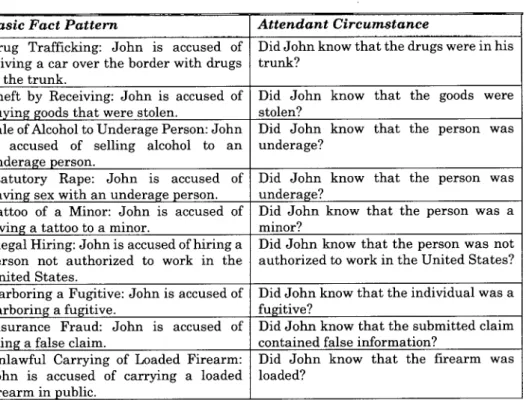
Each of the nine core fact patterns involved a different criminal offense. Each offense used in our experiments has an attendant circumstance element. We ensured that our fact patterns spanned a spectrum of wrongful conduct, ranging from selling alcohol to a minor to harboring a fugitive, and we used a preliminary study to validate
that we were successful in this regard.22 Table 1 lists the nine core
fact-pattern offenses used in our experiments.
TABLE 1: THE CORE FACT PATTERNS
Basic Fact Pattern Attendant Circumstance
Drug Trafficking: John is accused of Did John know that the drugs were in his driving a car over the border with drugs trunk?
in the trunk.
Theft by Receiving: John is accused of Did John know that the goods were buying goods that were stolen. stolen?
Sale of Alcohol to Underage Person: John Did John know that the person was is accused of selling alcohol to an underage?
underage person.
Statutory Rape: John is accused of Did John know that the person was having sex with an underage person. underage?
Tattoo of a Minor: John is accused of Did John know that the person was a giving a tattoo to a minor. minor?
Illegal Hiring: John is accused of hiring a Did John know that the person was not person not authorized to work in the authorized to work in the United States? United States.
Harboring a Fugitive: John is accused of Did John know that the individual was a harboring a fugitive. fugitive?
Insurance Fraud: John is accused of Did John know that the submitted claim filing a false claim. contained false information?
Unlawful Carrying of Loaded Firearm: Did John know that the firearm was John is accused of carrying a loaded loaded?
firearm in public. I
Unbeknownst to subjects, we generated four different scenarios from each of the nine core fact patterns. Specifically, each of the core fact patterns yielded one scenario each for the knowledge, recklessness,
negligence, and blameless mental states.23 For instance, there were four
different versions of the drug trafficking fact pattern, and each of these four varied only in the mental state dimension. In Table 2 we show how this worked for a single, illustrative scenario.
22. Data on file with author and available upon request.
23. Again, the mens rea of purposefulness almost never applies to circumstance elements.
Each fact pattern was a paragraph in length, ranging from 80 to
160 words. The complete set of fact patterns is provided in Appendix B.
For context, each fact pattern also included a simplified version of the relevant criminal statute.2 4
For instance, the drug trafficking fact pattern began with the statement: "A person is guilty of unlawful trafficking of illegal drugs if the person transports an illegal drug."2 5
Each fact pattern then proceeded with one or two introductory sentences that set up the facts relevant for that fact pattern. For example, the drug trafficking fact pattern always started with:
"John is an American citizen who regularly travels to Nogales, a Mexican town near the U.S. border where John has many relatives, including an uncle. Several of John's relatives have told John that his uncle hangs out with local drug dealers."
These opening facts were the same in each of the knowledge, recklessness, negligence, and blameless scenarios.
Following the opening facts, the second component communicated information bearing on John's mental state. As an example, the blameless scenario version of the fact pattern provided:
"When he travels, John makes every effort to avoid interacting with his uncle, but one night despite all the precautions John takes, when John is asleep the uncle secretly breaks into John's car and hides a large package of cocaine inside the spare tire compartment, where it is not visible to the naked eye."
The final sentence of the scenario completed the facts, making clear that the circumstance in question was present. This final sentence was also, like the opening facts, identical across each of the four mental state scenarios generated for each fact pattern. For example, in the drug trafficking fact pattern, all four scenarios ended with the text:
"When John tries to re-enter the United States, the border patrol agents who inspect John's car at the border
24. These statutes were not meant to reflect the language of any specific jurisdiction. 25. Except where otherwise noted in specific experiments below, all language pertaining to the required mental state for culpability was excised from the statute. This was because we were not interested in testing subjects' ability to interpret the statute, but rather the facts of the scenario themselves.
open up the package given to John by his uncle and find that it contains cocaine."
Constructed in this way, our fact patterns resembled the typical circumstance case in the real world: there is no doubt that the circumstance exists (e.g., the drugs were in the car), but there is potentially much doubt about whether the actor knew those drugs were
in the car or was aware of the possibility that the drugs were in the car.
The key aspect of this experimental design is that we manipulated the surrounding circumstances to strengthen or weaken the inferences that might be drawn about John's awareness of the material facts, while controlling other aspects of the fact pattern. This manner of manipulating the scenarios reflects the realities of criminal trials wherein the mental state of another person at a particular time (specifically whether or not that person was aware of a particular fact or suspected it) is inferred from their behavior and from the surrounding circumstances.
We recognize that in the case of recklessness, negligence, and blamelessness, the application of these concepts also includes value judgments about whether the person (John) should have refrained from acting as he did in our scenarios. Recognizing this, we constructed our scenarios to vary the circumstances to "best fit" the distinctions drawn
by the MPC drafters between knowledge, recklessness, negligence, and
blamelessness. Specifically, we constructed four kinds of scenarios designed to convey different fits, which we have labeled "manifest
knowledge," "awareness of risk," "negligently unaware," and
"blameless."
The "manifest knowledge" scenarios include objective evidence about John's own conduct tending to show that he knows, as in this example, that drugs are in the trunk of the car (e.g., he opens the duffel bag containing the drugs, looks inside it, and puts it in the trunk). These are meant to elicit the conclusion that John had actual knowledge of the circumstance in question. Because knowledge is directly demonstrated through the facts of the scenario, we regard all responses other than knowledge to be erroneous.
The "awareness of risk" scenarios, by contrast, only include inferential evidence about the circumstances. This inferential evidence includes John's observations of the behavior of other people. For example, in the same fact pattern as above, John's uncle, who associates with drug dealers, pays him one hundred dollars to bring a duffel bag across the border. As part of the scenario we tell subjects that "[h]is
sister says 'I don't think that's a birthday present . . .' but his uncle says
of the circumstances, we think the best fit for these scenarios is recklessness, but knowledge and even just negligence could also be plausible responses, depending on a subject's judgment about the strength of the appropriate inferences.
The "negligently unaware" scenarios include evidence that would make some people suspicious but wouldn't necessarily make everyone suspicious, and was thus intended to elicit negligence as the best fit. Using the same example, subjects are told that "John's uncle gives John a giftwrapped package to bring to a friend, and when John asks what's in the box, John's uncle says it is a birthday present for the friend." For these scenarios, we define the best fit as negligence, but recklessness and blamelessness are plausible responses.
Finally, the "blamelessness" scenarios include evidence that the person takes active and reasonable precautions to avoid criminal conduct and thus is not criminally culpable. Again using the same example, "[w]hen he travels, John makes every effort to avoid interacting with his uncle, but one night despite all the precautions John takes, when John is asleep the uncle secretly breaks into John's car and hides a large package of cocaine inside the spare tire compartment, where it is not visible to the naked eye." Based on the circumstances presented, we regard all responses aside from blameless to be erroneous.
For all experiments, we randomized the order in which subjects encountered the scenarios and mental states. Subjects read one and only one scenario from each of the nine fact patterns. After reading each scenario, subjects were asked to answer a question, which varied (as described in the next Section).
vs, 0 (D0
ID
c 0 0 Mrl* C 0)0 00 (D 0 -0 e*1 U) c-CDU CeD 0 V S ro C -I~0o
.0CD U) Pcr. CD ad0 00 0rrl P , -o 2-K
0
U) 0 03 U) to 0 ~Th 03 03 0 -I 03II. THE Six EXPERIMENTS
A. Experiment 1: Attributing Mental States Using MPC Definitions
The MPC has established a hierarchy of mental states relating to the circumstance elements of an offense. Experiment 1 set out to answer a straightforward question: Do subjects reliably apply this hierarchy as the drafters assumed they would? We presented subjects with the scenarios, as described above, and then asked them to select the wrongdoer's mental state, with a prompt specific to the mental state in question. For example, in the case of the drug trafficking scenario, subjects were asked:
"Which of the following mental states best describes John's mental state as to the fact that drugs are in the bag?"
Following that prompt, subjects were provided with the four mental states and their definitions and asked to select which best
represented the mental state of John as to the pertinent circumstance.26
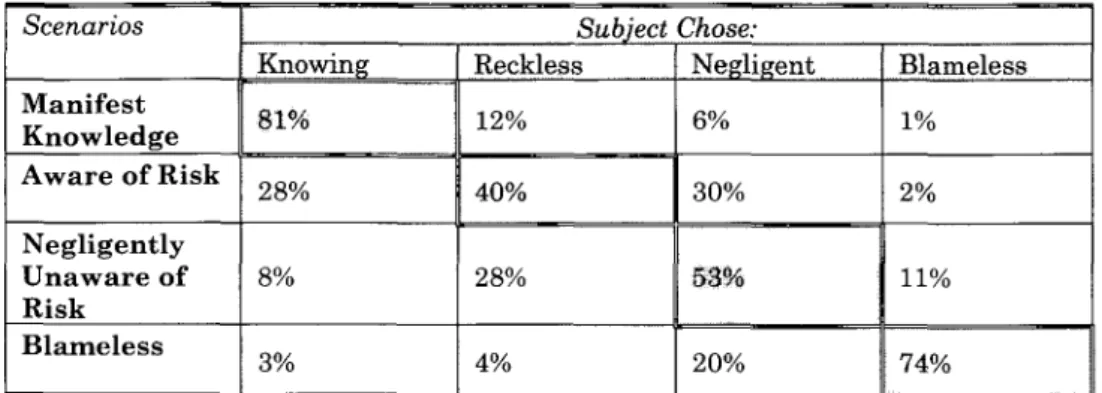
The results from Experiment 1, summarized in Table 3, demonstrate that the typical juror grasps the hierarchy established by the Model Penal Code. The leftmost vertical column indicates what we refer to as the best fit mental state. Moving rightward, each column identifies in turn the mental state actually selected by subjects for those scenarios. More specifically, the cells with figures indicate the percentage of subjects who selected a given mental state described in the top row, for each scenario type described in the leftmost column. For instance, 6% of subjects attributed a negligent state of mind to protagonists in scenarios intended to describe manifest knowledge. The gray-shaded diagonal of cells, from the upper left to the lower right, identifies the percentage of subjects that identified the best fit for the protagonist's mental state.
26. The definitions were the MPC definitions, save for two slight modifications. First, because the MPC definitions were written to apply not only to circumstance elements but result and conduct elements as well, we excised the results- and conduct-based components from each of the definitions we provided (with minor rephrasing so it worked as a stand-alone sentence). Second, we customized each definition so it referred to the specific facts in each scenario. For instance, we changed the definition of "knowingly" from "[a] person acts knowingly with respect to the attendant circumstances when he is aware that such circumstances exist" to "[a] person acts knowingly with respect to the duffel bag containing illegal drugs when he is aware that the drugs are in the bag."
TABLE 3: JuRY-ELIGIBLE AMERICANS CAN APPLY THE MPC FRAMEWORK IN A MANNER THAT Is LARGELY CONGRUENT WITH
THE BASIC ASSUMPTIONS OF THE MPC's MENTAL STATE HIERARCHY
Scenarios Subject Chose:
Knowing Reckless Negligent Blameless
Manifest 81% 12% 6% 1% Knowledge Aware of Risk 28% 40% 30% 2% Negligently Unaware of 8% 28% 53% 11% Risk Blameless 3% 4% 20% 74%
As expected, we observed high correspondence between subjects' responses and our best fit response for the manifest knowledge and blamelessness scenarios-81% and 74%, respectively. However, for our ''aware of the risk" and "negligently unaware of the risk" scenarios, there was the possibility of multiple plausible responses, and concordantly the correspondence between subjects' responses and what we labelled the best fit was commensurately lower-40% and 53%, respectively. In addition to correspondence between responses and the best fit, we examined how individuals tended to err in their responses. In other words, did individuals tend to err towards more or less culpable determinations? For "aware of the risk" scenarios, subjects were about as likely to select negligence (30%) as knowledge (28%). However, for the "negligently unaware of the risk scenarios," subjects strongly erred towards ascribing awareness of the risk to the offender, with 28% selecting recklessness, while only 11% selected blamelessness.
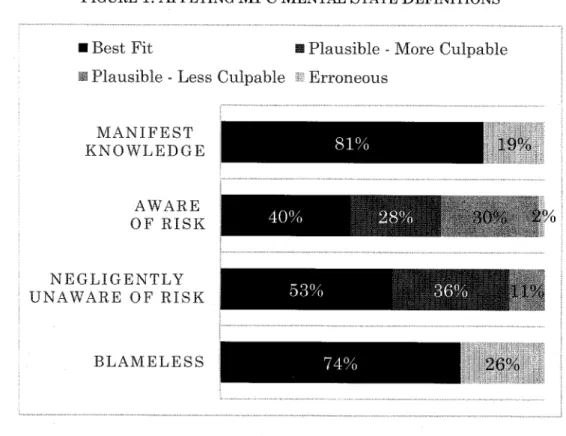
A graphic depiction of the subjects' performance in applying the
MPC definitions to the scenarios is displayed in Figure 1, below. The black shading represents the best fit between the MPC mental states and the evidence described in scenarios, while the lightest gray shading represents clearly erroneous responses. Dark gray reflects responses that were plausible but inclined towards greater culpability, while mid-gray reflects responses that were plausible but inclined towards less culpability. Generally speaking, the subjects tended toward the best fit, but they also varied in their attributions.27
27. One interesting empirical question is whether individual subjects show state- or trait-based differences in how they ascribe mental states. Our data is not well-suited to answer this
FIGURE 1: APPLYING MPC MENTAL STATE DEFINITIONS
m Best Fit U Plausible -More Culpable
* Plausible - Less Culpable Erroneous MANIFEST KNOWLEDGE AWARE OF RISK NEGLIGENTLY UNAWARE OF RISK BLAMELESS 0612.
B. Experiment 2: Subjects' Unguided Moral Intuitions About What Mental State Is Sufficient for Criminal Liability
What level of culpability do individuals regard as sufficient for punishment? Experiment 2 was designed to ascertain how ordinary jury-eligible persons would answer this question when given free rein to do so: we asked them to decide whether or not they would convict John without giving them a mens rea instruction. In other words, after evaluating a scenario, they were asked to apply a statute that contained only an actus reus, with no mention of any requisite mens rea for the attendant circumstance. By asking whether they would find the defendant guilty under the statute, this question served as a proxy for asking the subjects whether John's level of culpability, as demonstrated in the particular scenario (i.e., our best fit scenarios for K, R, or N) provided a sufficient basis for punishment.
question, though further research could evaluate the extent to which this may account for some of the intersubject variability.
For example, subjects evaluating the drug trafficking scenario received the following prompt:
Criminal Statute for Unlawful Trafficking: A person is guilty of unlawful trafficking of illegal drugs if the person transports an illegal drug.
Based on the evidence provided do you think that John is guilty of unlawful trafficking?
This question is similar to the types of questions that psychologists ask when they use what are called "detection and discrimination" tasks. Such tasks help to answer the question: What type of information is necessary for an individual to draw a particular conclusion? In the present case, this detection and discrimination analysis applies because we are seeking to discover the level of culpability (as defined by the MPC) that is sufficient for subjects to return a guilty verdict under a statute that lacks any specific mens rea requirement.
Figure 2 displays a "decision curve" that plots the percentage of guilt determinations on the y-axis (vertical axis) and the mental state on the x-axis (horizontal axis). This kind of plot allows us to examine whether the shape of the decision curve presents a discrete "inflection point"-that is, a disproportionate jump in percentages-as our subjects move from sorting scenarios into one mental state to another.
If so, we call this point the "decision threshold."28 The heavily shaded line presents the average of all nine scenarios while the light dashed lines present the average for each of the individual scenarios.
28. What we refer to here as a decision curve is equivalent to what psychologists refer to as a psychometric function. The inflection points of these functions (where the slope is the highest or where the second derivative is equal to zero) is a commonly used indicator of a sensory or decision threshold in not only psychology, but signal detection more generally. For more information see generally Neil A. Macmillan, Signal Detection Theory, in 4 STEVENS' HANDBOOK OF EXPERIMENTAL PSYCHOLOGY (Hal Pashler ed., 3d ed. 2002) (using inflection points as an indication of the location of a decision or sensory threshold).
FIGURE 2: THE RELATIONSHIP BETWEEN BEST FIT MENTAL STATE AND PERCEIVED CULPABILITY
100 - ---90 -;t 80 NO 70 50 50 0 0 20 10 0
Blameless Neg. Unaware Aware of Risk Manifest
of Risk Knowledge
Mental State of Offender
Our first finding in Experiment 2 is that there is substantial
variability across the nine scenarios, particularly for the "negligently unaware of the risk" and "aware of the risk" categories.29
This is, however, consistent with the study design (which allowed a range of plausible attributions of these two mental states) and with the finding in Experiment 1 that the subjects varied substantially in their selections when exposed to scenarios describing protagonists with these two mental states. A second finding is that for all but two of the
29. A natural question would be: What are the characteristics of the scenarios that lead to more culpability as opposed to less? While this is an interesting question and we provide the full tables in the appendix, the study was not designed to make claims about individual scenario fact patterns, and so we omit discussion of individual scenarios here since any conclusions would be purely speculative. We do note, however, that linking scenario characteristics with intuitions about culpability is an area of research we intend to explore.
statutory contexts, four out of five subjects exposed to strong evidence that the material circumstance was present (our best fit scenario for recklessness) regarded this evidence as a sufficient basis for punishment. Moreover, we found that two out of three subjects found that weak, but suspicious, evidence of the material circumstance (our best fit for negligence) was regarded as sufficient for criminal punishment under the statute. The shape of the decision curve supports the conclusion that the decision threshold for culpability exists at negligence, with much more modest incremental increases in the percentage finding guilt above the level of negligence.
In summary, when unguided by any instruction regarding the mens rea required for conviction, most jury-eligible subjects find an offender guilty even when the evidence of knowledge is murky. Why are subjects so willing to convict on the basis of evidence that only raises a suspicion that the actor was aware of the material circumstance? One potential explanation lies in the results of Experiment 1, which demonstrated that when evaluating such scenarios, individuals have a bias towards attributing awareness when the evidence is ambiguous. For example, in the scenarios where the best fit response was negligence, three-fourths of the subjects who did not select negligence selected knowledge or recklessness as opposed to blamelessness. This finding suggests that jury-eligible adults tend to be willing to attribute knowledge or awareness of risk (suspicion) to hypothetical defendants based on equivocal evidence. Another possible explanation is that jury-eligible adults find recklessness, and in many cases negligence, to be a morally sufficient basis for criminal liability in the context of the "circumstance" offenses explored in this study. In the sequence of experiments beginning with Experiment 3 we attempt to disentangle the subjects' attributions of mental state from their moral judgments about liability.
C. Experiment 3: Use of Signals to Align Subjects'Responses with the
Best Fit Mental State
In order to make more precise connections between mental state and culpability, we adopt from our previous two sets of published
experimentS30 the use of "signals" to convey information about John's
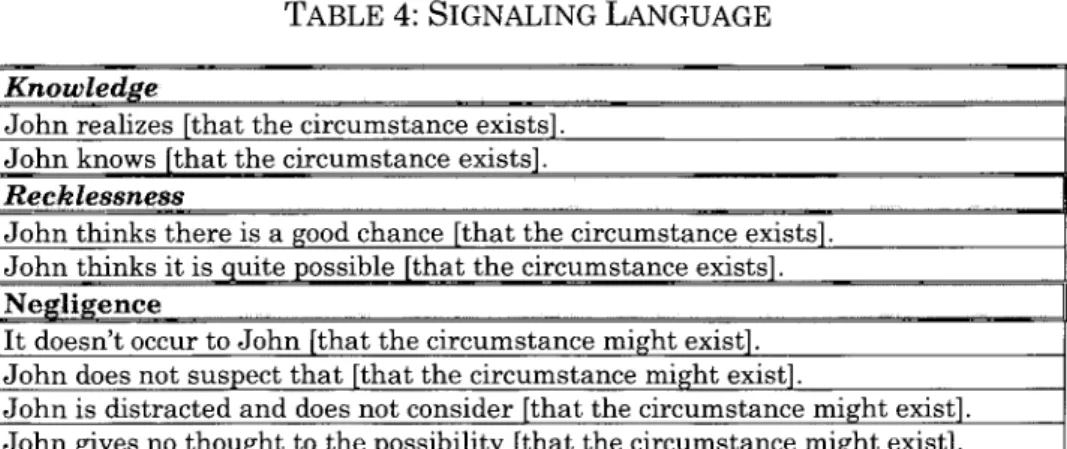
mental state. For instance, to communicate that John was reckless in the drug trafficking fact pattern, we told subjects, "John thinks there is a good chance that the duffel bag contains illegal drugs." The text of all signals is provided in Table 4.
TABLE 4: SIGNALING LANGUAGE
Knowledge
John realizes [that the circumstance exists]. John knows [that the circumstance exists]. Recklessness
John thinks there is a good chance [that the circumstance exists]. John thinks it is quite possible [that the circumstance exists]. Negligence
It doesn't occur to John [that the circumstance might exist]. John does not suspect that [that the circumstance might exist].
John is distracted and does not consider [that the circumstance might exist]. John gives no thought to the possibility [that the circumstance might exist].
We used signals for K and R to push the "awareness of the risk" scenarios towards either knowledge or recklessness, while we used the negligence signals to buttress the fact that the "negligently unaware of the risk scenarios" did, in fact, describe negligent conduct. So that subjects did not think that the absence of a signal in the "manifest knowledge" scenarios was indicative of anything, we also included knowledge signals in those scenarios as well.
True, real jurors don't get direct access, like this, to a defendant's prior thoughts. But the value of using explicit signals nonetheless, in the present experiment, is to discover the relationships between the mental states of offenders, on one hand, and subjects' intuitions about culpability, on the other.
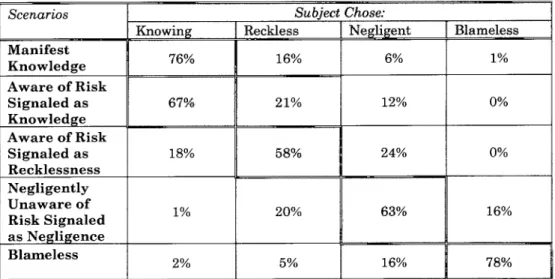
Experiment 3 repeated Experiment 1, with the sole difference being the use of the "signaled" scenarios. The results from Experiment
3 are displayed in Table 5. As might be expected, the signaling language
had no significant impact on the responses to unambiguous scenarios reflecting manifest knowledge and blamelessness, but it did nudge subjects' responses toward the best fit mental state attributions for the scenarios meant to reflect knowledge, recklessness, and negligence. In general, the signaling produces results more in line with the best fit mental state that was signaled in the scenario.
Specifically, when using the knowledge and recklessness signals we were able to shift "awareness of risk" scenario responses-which had
previously been relatively evenly distributed among K/R/N
(28%/40%/30%) in Experiment 1-towards either K (which increased from 28% to 67%) or R (from 40% to 58%), respectively. Similarly, the responses to the "negligently unaware of the risk" scenarios shifted toward negligence (from 53% to 63%), but more importantly, subjects no longer displayed a robust predisposition to err towards awareness of
the risk when the negligence signals were used (compare responses selected for N scenarios in Table 3 with Table 5).
One question posed by these results is why the effect of the signal was not even more substantial in aligning the answers with the best fit mental state. The most likely explanation, in our view, is that the information communicated in the scenarios is fairly complex, including (1) several sentences about the surrounding circumstances that were designed to raise different levels of suspicion about the presence of the material fact, and (2) a simple declarative statement by an omniscient observer about John's mental state. We suspect that the complexity of the stimulus weakened the impact of the mental state signal-which would have been determinative if it had been given by itself without any additional evidence (because it would have amounted to nothing more than a matching exercise). Nonetheless, the increased accuracy and the removal of strong error biases in the case of negligence provided us with greater precision with which to make conclusions about how the typical juror assesses the culpability of an actor with these prescribed mental states.
TABLE 5: APPLYING MPC MENTAL STATE DEFINITIONS WHEN MENTAL
STATE IS EXPLICITLY SIGNALED
Scenarios Subject Chose:
Knowing Reckless Negligent Blameless
Manifest Knwede 76% 16% 6% 1% Knowledge Aware of Risk Signaled as 67% 21% 12% 0% Knowledge Aware of Risk Signaled as 18% 58% 24% 0% Recklessness Negligently Unaware of 1% 20% 63% 16% Risk Signaled as Negligence Blameless 2% 5% 16% 78%
D. Experiment 4: Subjects' Unguided Intuitions About Culpability
Sufficient for Criminal Liability: Revisited
In Experiment 3 we repeated the procedures of Experiment 1, but using signals to nudge subjects towards the best fit mental state in each scenario. Having established in Experiment 3 that this was largely successful, in Experiment 4 we repeated the procedures of Experiment 2, except again using signals to clarify subjects' intuitions about the link between mental state and culpability. Again, we included statutory definitions of the offenses applicable to each fact pattern that did not include a mens rea requirement.
Our data, plotted in Figure 3, reveal a key new finding: First, as compared with Figure 2, the variability among scenario fact patterns was significantly reduced, as intended. But most significantly, the data show that for most people, the decision threshold of culpability lies between negligence and recklessness. To see this from the Figure, notice that there are nine dashed lines, each of which shows the subjects' decision curve for one of the nine given scenarios. The dark, unbroken line is the average of those nine. The inflection point is recognizable at the negligence-recklessness boundary, which reflects the largest (and therefore steepest) jump up, from the prior mental state, in the percentage of subjects willing to convict. Indeed, as Figure
3 depicts, the percentage willing to convict jumped from under 50% for
those exposed to the scenarios signaled as negligence to over 80% of those exposed to the scenarios signaled as recklessness.
FIGURE 3: RECKLESSNESS IS A THRESHOLD FOR CULPABILITY 100 -90- / S80 4 V 60-4 50 lUena Sttoofffne 4011 0 S20- 10-0 1
Blameless Neg. Unaware Aware of Risk Aware of Risk Manifest
of Risk Signaled Signaled as Signaled as Knowledge
as Negligence Recklessness Knowledge
Mental State of Offender
Note that there is very little difference between the proportion of people finding an offender guilty if he had a mens rea of recklessness
(82%) compared to a mens rea of knowledge (88%), even if it was
manifested by conduct (91%). Put another way, for a large proportion of the subjects, recklessness was both necessary and sufficient for
conviction.
To be clear, this doesn't mean that people find perpetrators with knowledge to be only a few percentage points more blameworthy than people performing the same act recklessly. And it doesn't mean that people somehow think that those with knowledge should only be punished a few percentage points above the punishments that the reckless receive. What it does suggest is that roughly 80% of the
population-if interpreting a statute without any mention of the mens rea requirement as to a relevant circumstance (that is, unconstrained
believe that the mental state the law tends to call "reckless" is fully sufficient to warrant a guilty verdict and conviction.
Of course, this finding immediately suggests the tantalizing
question to investigate next: Would instructing the subjects about the mens rea required for conviction by the applicable statutes make any difference?
E. Experiment 5 The Effect of Instructions
Experiment 4 showed that most subjects required recklessness (awareness that the circumstance might exist) before they were willing to find John criminally liable, but did not require knowledge that the circumstance actually existed. We designed Experiment 5 to assess the subjects' response to an instruction requiring knowledge as the mens rea before criminal liability would attach. Put another way, would expressly informing subjects that the statute actually required knowledge push the culpability threshold up from recklessness to knowledge? Experiment 5 thus had to differ in two ways from Experiment 4.
First, at the beginning of Experiment 5 we provided subjects with an instruction page similar to the guidance provided by a judge to
a jury. This page instructed subjects on the basics of element analysis
and how bad acts need to be accompanied by a culpable mental state in
order to hold an individual criminally responsible.3 1 We also provided
subjects with slightly modified versions of the MPC's definitions of
knowledge, recklessness, and negligence.32 And we instructed them to
carefully note the mental state demands of the statute.
Second, we altered each statute to expressly require knowledge as an element. This addition, alone, appeared bolded in the statute presented to subjects. For example, for the drug trafficking fact pattern, subjects were told:
"A person is guilty of unlawful trafficking of illegal drugs
if the person knowingly transports an illegal drug."
31. The instruction read as follows:
A crime is committed when the defendant has performed an illegal act accompanied by a culpable mental state. That means proof of the commission of the act alone is not sufficient to prove that a crime has been committed. The defendant must also have a culpable mental state to certain attendant circumstances such as someone's age. Culpable mental state means either knowingly, recklessly or negligently, as described below.
The bolded term-"knowingly"-was defined immediately below the statute and in a manner specific to the facts of the case.
Despite these explicit directions, the results from Experiment 5 indicate that subjects did not measurably alter their decision threshold for culpability. Figure 4 illustrates the finding by comparing the decision curve from the last experiment-Experiment 4 (the "No Instruction" condition)-with the new decision curve, reflecting the "Knowledge Instruction." What's immediately striking, of course, is that the curves are virtually identical. Specifically, the percentage of subjects finding a defendant signaled as reckless guilty of violating a statute that explicitly required actual knowledge was virtually the same as the percentage who held the defendant liable when no mens rea was prescribed-82% and 81%, respectively.
What these results demonstrate is that, at least in laboratory conditions, juror intuitions about whether the defendant who behaved negligently or recklessly when engaging in the illegal conduct should be convicted appear to be unaffected by an explicit instruction prescribing knowledge as the mental state required for conviction.
FIGURE 4: COMPARISON OF INSTRUCTION AND NO INSTRUCTION CONDITIONS 100 90 80 70 -:Z 60- 5040 30 20 -10 - No Instruction - - Knowledge Instru .0I ction
Blameless Neg. Unaware Aware of Risk Aware of Risk Manifest of Risk Signaled Signaled as Signaled as Knowledge
as Negligence Recklessness Knowledge Mental State of Offender
F. Experiment 6: The Effect of Instructions: Revisited
A puzzle emerges when comparing the results of Experiments 3
and 5. Recall that in Experiment 3 about 60% of the scenarios signaled as demonstrating awareness of risk were characterized by the subjects as constituting recklessness under the definitions provided (see Table
5). However, in Experiment 5 we saw that more than 80% of subjects
evaluating these same scenarios believed John was guilty of violating a statute that conspicuously required knowledge as a predicate for conviction (see Figure 3). Can these two findings be explained or reconciled? Two possibilities come to mind: Perhaps twice as many subjects in Experiment 5 found the distinction between knowledge and recklessness to be confusing (when no definitions were provided) as did those in Experiment 3 (when definitions were provided). Alternatively,
perhaps being told that knowledge was required for guilt affected the subjects' attributions of mental state.
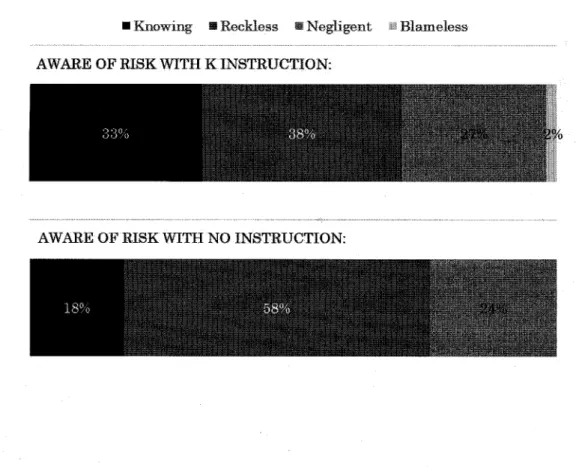
To investigate further, we conducted Experiment 6, which was identical to Experiment 5, except for the addition of a new question. After presentation of the scenario and after eliciting the subjects' decisions about whether the defendant should be convicted, subjects were also asked to make a specific finding about the defendant's mental state-i.e., to identify and select the defendant's mental state from the list of definitions specifically tailored to the facts of the scenario. The results, depicted in Figure 5, show that in the scenarios signaled as involving awareness of risk (what we have been calling "recklessness" scenarios), subjects were more likely to attribute knowledge to the actor when told that knowledge was required for conviction (33%) than when they were told to apply the definitions without being told about the legal consequences of their finding (18%). Thus, Experiment 6 seems to show that knowing that "knowledge" was required for conviction made subjects more likely to attribute knowledge to the actor in ambiguous scenarios than they would otherwise have been in a context where they were not told the legal consequences of the attribution.
FIGURE 5: COMPARISON OF How SUBJECTS CLASSIFY AWARE OF THE
RISK SCENARIOS BASED ON WHETHER THE APPLICABLE STATUTE HAD A
KNOWLEDGE INSTRUCTION
m Knowing a Reckless a Negligent IN Blameless
AWARE OF RISK WITH K INSTRUCTION:
III. DISCUSSION
These experiments were designed to study attribution of mental states based on postulated observations of a criminal actor's conduct and the circumstances clearly known to him. They built on the foundation laid in earlier studies by the research team, which used structured scenarios to vary the harm caused by the actor and the actor's mental state regarding that harm. Mental states were operationalized based on the MPC's hierarchical framework. The present study differed from those studies in two major respects. First, rather than focusing on mens rea as to result elements (e.g., the death of the victim), this study focused on the actor's mental state regarding a material circumstance (e.g., the age of a sexual partner) in the definition of the offense that differentiates lawful conduct from criminal conduct. Second, whereas the previous study stipulated the actor's mental state, the current study was designed to elicit subjects' attributions of mental state to the actor based on descriptions of the objectively observable circumstances relating to the actor's conduct.
A. Attributing Mental States
A man is stopped at the U.S. Border and his duffel bag contains
a large container of cocaine. In the United States it is illegal to
"knowingly or intentionally . . . possess a controlled substance."33 The
man claims he had no idea the drugs were in the bag. In the absence of a confession or direct observation of the defendant's incriminating conduct, how are jurors to decide what the defendant knew or believed? Do they do it in an acceptable manner? In this exploratory study, we used scenarios to represent varying levels of evidence regarding the existence of the legally material circumstance-such as the presence of cocaine in a bag-as a basis for exploring the subjects' attributions of a putative defendant's mental state pertaining to that circumstance.
On the upper end of the culpability hierarchy, "knowing" that the circumstance exists (K) is distinguished categorically from all cases where it is suspected but not "known" to exist (R). In order to isolate clear cases of K, we modeled a case where the actor manifests "knowledge" by his own conduct such as acknowledging the existence of the material circumstance; in all other cases, however, whether the actor "knows" or "believes" the circumstance exists or only "suspects" that it does is a probabilistic attribution based on the strength of the evidence.