Race
Management
Handbook
15 Maritime Drive Portsmouth, RI 02871 First edition, 1993 Second edition, 1997 Third edition, 2002 Fourth edition, 2005 Fifth edition, 2009 ISBN-13: 978-0-9821676-3-2 ISBN-10: 0-9821676-3-6
Foreword ...xiii
Introduction ...xiv
About this edition ...xv
1
Objectives, Responsibilities and Authority ... 1
Objectives ... 1
What do sailors expect of race committees? ... 1
Primary elements of success ...3
How do you accomplish these objectives? ...3
A few words about race officials and alcohol ...4
Definitions and rules ...5
Terms used in this handbook ...5
Rules governing regattas and race management ...5
The organizing authority ...6
Who may act as an organizing authority? ...6
Responsibilities of an organizing authority ...7
Designing the event ...8
The host club ... 10
Providing the environment ... 10
The regatta chairman ...11
The race committee ... 12
What is the race committee? ... 12
Duties and functions of a race committee ... 12
Notices of race and sailing instructions ... 12
Safety ... 13
Measurement and “authority responsible” ... 13
Selection of protest committees ... 13
Selection and maintenance of equipment ... 14
Selection of race committee personnel ... 14
Other, in general ... 14
Race officers ... 14
Selection and characteristics ... 14
US SAILING Race Officer Certification Program ... 15
Race Officer Programs ... 15
Race Officer Training and Certification Programs ... 15
Contents
International Sailing Federation (ISAF) Race Officer Program ...21
Personal conduct of race officers ...21
Other race officer duties ...21
Obtaining the necessary personnel ... 23
Training race committee personnel ... 25
The protest committee ... 26
Responsibilities and authority ... 26
The race committee as a “party” to a hearing ... 27
The International Jury ... 28
2
Organizing the Event ...31
The annual racing schedule ...31
Meet within the club ...31
Coordinate with other clubs ... 32
Contact other organizations affected ... 32
Consider other factors affecting the regatta ... 32
Maintain continuity ... 32
Marine event permits ... 32
Major or “principal” events, in general ... 33
Venue selection ... 33
The regatta committee—basic organizational structure ... 33
Budget and finance ... 35
Eligibility, entry and registration ... 36
Eligibility and conditions of entry ... 36
Exclusion of competitors ... 37
Advance registration or entry ... 37
Entry forms ... 38
Declarations ... 38
Registration ... 39
Housing ... 40
Grounds Coordination ... 40
Boat trailer parking ... 40
Vehicle parking ...41
Sailboard storage ... 42
Boat slips and moorings ... 42
Boat hoists ... 42
Loudspeaker systems ... 43 Flagstaffs ... 44 Measurement facilities ... 44 Protest rooms ... 44 Arriving equipment ... 45 Cleanup ... 45 Offshore coordination ... 45
Meal delivery plan ... 46
Scoring ... 46
Fuel sources ... 46
Measurement coordination ... 47
In general ... 47
Requirements for measurement ... 47
Communication with others ... 47
Measurement forms ... 48
Support personnel ... 48
Protest committee coordination ... 48
Social events ... 49
Media relations and promotion ... 50
Press relations off site ... 50
Press facilities on site ...51
The regatta office ... 52
A regatta planning timetable ... 53
Special considerations... 54
Competitors’ meetings ... 54
The official notice board ... 55
Volunteer recognition ... 55
Advertising and event categories ... 56
Determine the philosophy of the host club ... 56
What is “advertising”? ... 56
The advertising categories ... 57
Obtaining sponsorship ... 57
Tax consequences of sponsorship ... 60
Sponsor fulfillment ...61
Prizegiving ...61
The objective ... 64
After the regatta ... 64
Cleanup ... 64
Letters to competitors ... 65
Regatta post mortem ... 65
3
Risk Management ...67Scope of the chapter ... 67
Five basic safety subjects ... 67
Electrical hazards ... 68
Identification of electrical hazards ... 68
Action to eliminate electrical hazards ... 69
Precautions regarding electrical hazards ... 69
Docks and electricity ... 70
Other Hazards ... 70
Security and accreditation ... 70
Security, in general ... 70
Credentialing, in general ...71
Credentialing plans ...71
Liability ... 72
Equipment and firearms ... 73
Boats ... 74
Weather considerations ... 74
Communications ... 75
Accounting for competitors ... 75
Crisis management ... 75
Rescue plan... 76
Crowd control ... 78
Medical ... 78
Hurricane preparedness plan ... 79
Plan summary ... 79
Hurricane and tropical storm guidelines ... 79
4
Insurance and Legal Issues ... 85Insurance ... 83
Applications for insurance ... 87
Legal Issues ... 87
Recommended exculpatory clauses ... 88
Chartering and “passengers for hire” issues ...91
Coast Guard interpretations involving regattas ...91
Bareboat chartering—does it solve the problem? ... 93
5
Competition Formats ... 95Boat rotations in general ... 95
Fleet race boat rotations ... 96
Basic match racing formats ... 99
Using supplied or borrowed boats ... 99
Equalizing supplied boats ... 99
Starting line assignments ...100
Match racing round-robins and boat rotations ...100
Creative round-robin design ...104
Team racing ...112
In general ...112
Team racing courses ...113
Ways to save time in team racing events ...114
Suggested formats ...117
Elimination systems and round-robins ...119
Team racing rotations and boat pairings ...125
6
Course Configuration ...151Course design, in general ...149
Performance considerations ...149
Class and competitor considerations ...149
Location considerations...149
The purpose of course design ...150
Alternative courses ...150
Diagramming the course ...150
Elements of course configuration ...150
Starting line locations ...150
Offset marks ...151
Reaches ...152
Runs ...153
Gates ...153
Finish line locations ...155
Timed courses ...155
Course Selection Guide ...159
Windward-leeward courses ...160
Triangular courses ...160
Other courses ...165
Match racing course ...166
Non-geometric courses ...166
In general ...166
Using government marks ...166
Using other permanent marks ...167
7
Notices of Race and Sailing Instructions ...169Notices of Race in general ...169
Comments regarding Appendix J1 ...169
Sailing instructions in general...175
Changes to the sailing instructions ...176
Sailing instruction principles ...176
Sailing instruction contents ...177
Sailing Instructions model ...178
Sailing instructions guide (Appendix L) ...180
Windward-Leeward Course Diagram ...181
8
Race Committee Equipment ...183Boats ...183 In general ...183 Signal boats ...183 Line boats ...184 Mark-set boats ...184 Rescue boats ...185 Patrol boats ...185
Ownership and control ...185
In general ...185
Equipment ...186
In general ...186
Marks ...186
Mark inflators ...187
Anchors and ground tackle ...188
Visual signals ...188
Sound signals ...189
Hand bearing compasses ...192
Laser rangefinders ...192
Wind speed and direction indicators ...192
Radar and global positioning systems (GPS) ...193
Timers ...193 Radios ...194 Binoculars ...195 Recording aids ...196 Computers ...196 Publications ...196
Race management committee reference materials ...197
Personal race management equipment ...198
Race committee signal boat equipment ...199
Race committee support boat equipment ...200
9
Race Day ...201Preparations ...201
Check the weather ...201
Check your equipment ...202
Check your paperwork...202
Personnel and shore-side tasks ...203
Race committee briefing ...203
Changes in sailing instructions—notices to competitors ...203
Written changes in sailing instructions ...203
Notices to competitors ...204
Signals made ashore ...204
In general ...204
“AP” and related signals ...204
Flag “L”—notification signal ...206
“N” and related signals ...206
Flag “Y”—personal flotation signal ...206
Special signals ashore ...206
The sortie plan ...207
Radio check/roll call ...207
Time tick ...207
Anticipate tasks affecting arrival time at the racing area ...208
After returning to the dock ...210
Begin the procedure for “protest time” ...210
Preliminary race results ...210
Equipment ...210
Confirm personnel for the next day ...211
Assemble race data ...211
Post mortem ...211
Be available for protest time ...212
10
Setting the Course ...213The starting line ...213
General ...213
Locating the starting line ...213
Restricted areas ...213
Setting a “square” line ...214
Moving a starting mark ...214
Wind direction ...215
Length of line ...215
Running the line ...216
Limit marks ...216
Guide marks ...216
Angle of the starting line ...217
Windward starts ...217
Downwind starts ...217
Reaching starts ...218
Temporary windward marks, and offset marks ...218
Current considerations in setting the starting line ...218
In general ...218
Starting lines for windward legs ...219
Setting the bearing to the windward mark...222
Starting line systems ...224
In general ...224
The four-boat system ...225
The three-boat system ...226
The “mid-line boat” variation on three-and four-boat systems ...227
Two-boat system ...227
One-boat system ...227
Setting courses and laying marks ...227
In general ...227
Setting marks in current ...230
Stake boats ...231
The finishing line ...232
An anchor retrieval system ...232
Deep water mark setting ...233
A retrievable system ...233
Course calculators ...236
Using GPS to set marks ...242
11
The Start...243Before the starting sequence begins ...243
Boat check–in ...243
Restricted area buoys ...244
Setting a preliminary course orientation ...244
Scope, current, wind direction ...244
Make certain the course Is clear ...245
Line flag ...245
Changing the line (shifting a starting mark) ...245
The starting sequence ...246
Advantages of the system ...247
Alternative starting sequences ...247
The match racing starting sequence ...247
Which fleet to start first ...249
Prior to the starting sequence ...249
Quiet on the race committee signal boat ...249
Communications with competitors ...250
Designating the course ...251
Postponement and abandonment prior to the start ...252
Personnel functions during the sequence ...253
Principal race officer ...253
Spotters...253
Timer ...254
Signalling ...254
Sighting the line...254
After the start ...255
Individual recalls ...255
Under what circumstances should you signal? ...256
Sound signals for individual recalls ...257
Hailing ...257
Line sighting for aggressive fleets ...257
General recalls ...258
In general ...258
Parameters for general recalls ...258
Time interval for a start after a general recall ...259
Starting penalties ...259
I Flag Rule, rule 30.1 ...259
Z Flag Rule, rule 30.2 ...259
Black Flag Rule, rule 30.3 ...260
12
The Race ...261Accounting for starters ...261
Observing the course ...261
Support boats ...262
Patrol boats/managing spectator craft ...263
What you may do during the race ...263
Changing the course ...264
How effective sailing area is changed by a wind shift ...264
Common method for changing course...265
Changing course for short course racing and sailboards...265
At what point can you change course? ...265
Changing course for one of several classes ...266
Which marks should you change? ...266
Should you change a gate for a wind shift?...266
How much of a wind shift? ...267
What if the wind shifts more than ninety degrees? ...267
Desired accuracy in resetting the course ...269
Missing or drifting marks ...269
Shortening or abandoning after the start ...270
When may you shorten or abandon? ...270
Shortening the course ...273
Abandoning the race—use good judgment ...273
Abandoning for fewer than all classes ...274
Abandoning when no boat finishes within the time limit ...274
Where can you shorten course? ...276
Effects upon scoring in ORR ...277
Sailing the course (rule 28) ...277
Recording rounding order ...277
The finish ...278
Recording finishes ...278
Finishing properly ...279
Sound signals for finishers ...279
Recording protests ...280
Remaining in the racing area ...280
Accounting for finishers ...280
13
Scoring and Handicapping ...287Scoring, in general ...281
Objectives of a scoring system ...282
Characteristics—selecting the system ...282
Straight and curved line scoring systems ...283
Straight-line systems ...283
Curved line systems ...283
Selecting straight line or curved line scoring ...283
Low point scoring systems ...285
The Appendix A low point scoring system ...285
The Appendix A bonus point system ...285
High pointscoring systems ... 286
The high point percentage system ...288
The Cox-Sprague scoring system ...288
Long series scoring ...289
20 or ...289
more ...289
The default system (Appendix A9) ...290
Qualification criteria ...290
Number of race scores included in the series score ...290
Computerized scoring systems ...290
Penalties, excluded races and tie breaking ...291
Penalties ...291
Excluded scores ...292
Redress ...292
Handicap racing systems, in general ...294
Empirical handicapping systems vs. measurement rating rules ...294
Producing of certificates at competitive events ...297
The Performance Handicap Racing Fleet ...297
Characteristics of PHRF© ...297
The Portsmouth Yardstick Handicapping System ...300
Use of pursuit starts ...302
The Offshore Racing Rule (ORR) ...304
General features of ORR ...304
Speed prediction, the Velocity Prediction Program (VPP) ...306
Scoring Options ...306
IRC Handicap Rule ...306
Midget Ocean Racing Fleet (MORC) ...307
Race Management Committee forms and worksheets ...307
Computer scoring programs ...307
Race results ...307
y Mix a little foolishness with your prudence: It’s good to be silly at the right moment. —Horace
Over the past few years both the ISAF and US SAILING have spent considerable time in efforts to improve race management practices. Nowadays it is much more likely that a visiting sailor will find the sailing instructions produced in an easily understood and familiar layout.
The Rule 26 starting system is the standard which sailors all around the world expect to be used. The majority of races are still run by volunteers to whom sailors owe a debt of gratitude for the time and effort which these volunteers put in by learning and practicing good race manage-ment techniques.
This new edition of the Race Management Handbook has been carefully revised and updated once again by Pat Seidenspinner to be consistent with TheRacing Rules of Sailing for 2009-2012.
As with any system, we are always looking out for improvements so if you have any suggestions, please send them to [email protected].
Inevitably as soon as any book is published, something will happen that requires an update, so please check the Race Management section of the US SAILING web site at intervals. This web site also has a wide range of forms that may be of help to race officials.
May your time on the water be straightforward and redress free! Robin Wallace
Chairman, Race Management Committee
This hand book is dedicated to the competitors who expect race committees to provide the best in racing, who constantly remind us when we need to improve, and thank us when we have; to the outstanding race officers from whom we have learned and whom we try to emulate; and to those striving mightily to make the racing experience just a little better each weekend.
The first edition of this handbook was published in the late 1970’s. It was revised in 1988-89 by then chairman Larry White, Executive Director John Bonds and members of US SAILING’s Race Management Committee. It was not a comprehensive text, but it included many helpful articles and forms. In 1993, the entire text was reorganized by Terry Harper who was, at the time, chairman of the Race Management Committee. It is now divided into logical aspects of the organization and conduct of a race or regatta. The articles were incorporated into the substantially augmented text. Extensive references to the racing rules were added. In 1997, the book underwent a significant number of changes to accommodate the then “new” rules and also got a “new look”. For that edition, and the three subsequent editions, Patricia Seidenspinner, a member of the Race Management Committee, has served as editor.
The Table of Contents is designed for use as a check list for organizing regattas, preparing notices of race and sailing instructions, and planning race operations. We have endeavored to address many types of racing, and to discuss why one type is run differently from another. The primary purpose of suggesting systems, techniques and equipment for conducting a wide variety of racing is to develop quality race management. If this handbook helps to accomplish that goal, it will have been well worth the time and effort expended.
Complete standardization of the methods for conducting races is not possible. Certain criteria, techniques, and equipment are common to all race committee work. Some clubs run races for small dinghies on lakes, while others run offshore regattas, team races, or multihull events. This handbook attempts to present material so that race committees can adapt it to local conditions and circumstances.
This book assumes that you are a good enough seaman to handle your boat in all conditions, that you know how to dress for those conditions, that you know first aid and CPR, that you can read the weather conditions, navigate, swim, moor, use firearms safely, count and do all of those other things that anyone associated with water sports should be able to do.
The handbook is intended for use with The Racing Rules of Sailing and with the US SAILING APPEALS AND ISAF CASES (one book). The best thing about race committee work is that it is an “open book” test of your skills. Take this handbook to the race course with you.
This edition of the Race Management Handbook brings its content into conformity with The
Racing Rules of Sailing 2009-2012.
A number of years ago, the Race Management Committee developed and implemented a comprehensive training and testing program for race officers. That experience helped all of us to sharpen our own skills while helping others gain the knowledge and confidence required of a race officer. This book is a vital part of that program.
My thanks go to Paul Ansfield (Oskosh, WI), Bruce Bingman (Arlington, VA), Darline Hobock (Tulsa, OK) and staff members Dan Nowlan, Jim Teeters and Eric Baittinger for their work in
updating the handicapping section.
The amazing world of desktop publishing is available to anyone with a computer. This book was designed and composed in Adobe InDesign CS4, a sixth-generation page layout and design application, on a Macintosh computer. It was transformed (with the click of a mouse) into a Portable Document File (PDF) and was then launched electronically to the printer. The process was almost as much fun as sailing!
Included in the book (here and there), are some philosophical reflections of the like not found in ordinary manuals—just for fun!
Patricia H. Seidenspinner, Editor St. Petersburg, Florida
July 2009
Three rules for life: Your attitude is your life. Maximize your options.
Never take yourself too seriously.
1
What do sailors expect of race committees? What should race committees expect of themselves? Who has the authority to organize and conduct regattas? How is that authority divided among the various groups involved? How should race committees be structured to achieve the best results? This chapter addresses those, and related issues.
Objectives
What do sailors expect of race committees?
In most locations, race committees are comprised of people who race, but have agreed to take the time to run some races for their home club. Or they may be the wives, husbands, or friends of the competitors who, in order to spend some time enjoying their spouse’s or friend’s sport, help with a weekend race.
Almost all race committee members throughout this country are volunteers. At the same time, most competitors have spent considerable time and money preparing their boats and equipment for competition, making their crews ready, and, often, simply getting to the regatta.
As the desire to compete in sailboats has increased, so have the demands on those people who conduct the competition. The number of significant regattas has increased, and so has the quality of race management at most of those regattas.
Having witnessed good race management at many regattas, competitors have come to expect certain standards for race committee work. People who devote their time to running races do so because of their own interest in the sport, and the pleasure it brings to them and to the competitors. Race committees perform a valuable service to their constituents—the racers—which few racers can or are willing to buy. The members of the committee take pride in providing the best service possible. Both sailors and race committees should have the same expectations:
Perfection—little short of it!
Competence. Competitors need clear, concise, sailing instructions. So do race committees. Both want the race committee to be comprised of knowledgeable people. Both want the race
Objectives, Responsibilities
and Authority
committee personnel to have good equipment—appropriate to the type of racing involved, and well maintained, so that running the race can be accomplished without error.
Knowledge of the sport, the class, the locale and the event. Persons involved in running races should understand the sport of sailboat racing, the tactics involved, and the reasons sailors compete. Competitors also expect the race committee to understand the characteristics of the boats which are competing.
As important, all boats which race either have class organizations or sail in accordance with performance or measurement rules, because such a structure ensures a particular level of racing—equalization of construction and equipment, or theoretical equalization of performance. A race committee which ignores, or fails to recognize, the desires of the class may not provide
the best racing for the type of boat or skill level of the competitors.
A race committee which does not understand local sailing conditions will find it difficult to set fair courses, and may be unable to anticipate dangerous weather conditions. It may also cause the competitors to experience long periods of sheer boredom, waiting for the wind to fill in because the race committee scheduled the start too early for the local weather conditions to provide good sailing.
The club which conducts a regatta without assuring that its race committee has the proper equipment—adequate mark-set boats, sufficient safety boats, appropriate marks, proper facilities, and the like—will find that the race committee will have a difficult time doing a good job.
Fair competition. Everyone wants square lines, good courses, and reasonable, practical time limits. When the lines are good, starting line discipline becomes a simple matter. The racers also expect the race committee to know how to provide discipline to an aggressive fleet of starters. Knowledge of alternative methods of control is critical to good starts. For a competitor, few things are worse than a race committee which recalls his or her best start of the series for a new start.
Adaptability to and anticipation of changes of conditions make the racing more fair. The sailor has far less opportunity to anticipate a wind shift than a race committee. When the race committee changes the course to keep the next leg square to the wind, the competitors will believe that the race committee is doing its best to make the racing fair for everyone.
Flexibility is very important. A race committee which has performed its functions in a certain manner for years may find it difficult to adopt a new procedure which the class, or the racers, request. Old habits are difficult to change, but there are many excellent, relatively new race management techniques, and sailors and class associations are beginning to feel the need to experiment in order to maintain interest in the boat or class. The first time a race committee is asked to use courses with leeward gates, or a three minute sound signal starting sequence, instead of its “traditional” isosceles triangular course and ingrained five minute interval starting sequence, there is a true test of the race committee’s flexibility.
Safety and good sense. Although the rules place upon the competitor the sole responsibility to decide whether to start or continue to race, the race committee should know when to abandon or not start. A race committee which places young competitors in the predicament of having to make the determination whether it is safe to race, or to continue, fails to recognize the limita-tions of the competing boats, and the age and experience of the sailors.
Decisiveness. Sailors have the right to expect that the race committee will make decisions when necessary and appropriate, and have the courage to support those decisions when questioned.
Fun. Who among racers or race committees does not want to have a good time on the water? Sailors will have less fun if they have reason to spend their recreational hours complaining about the starting line, an improper course change, or race results which are not posted until well after everyone has gone to sleep. Those same circumstances, and many more, can ruin an otherwise beautiful weekend for the volunteer members of the race committee.
These objectives apply to all events, large or small. The scale of the event and its importance determine the complexity of organization. The principles remain the same.
Primary elements of success
How do you accomplish these objectives?
Plan and prepare. Nothing is more critical. In designing the race or regatta, think about giving satisfaction to your competitors. At the end of the event, most of the competitors should feel that, allowing for the vagaries of wind and weather, they had fun, ashore and afloat. This requires foresight and detailed planning. Early symptoms of an unsatisfactory event are confused competitors and harassed race officials.
Understand the rules affecting race management. Know the proper race management tech-niques for choices you must make on the water. Be ready to conduct the race before you leave the dock.
The rest of this handbook is devoted to these simple principles.
Teamwork is vital. No race or regatta is the product of one individual. The race organizer needs shoreside assistance, as well as an on-the-water race committee. The race officer on the water needs signallers, timers, mark-setting personnel, recorders, and many others. Most important, each needs the others. The race and the regatta are team efforts. Use the opportunity to build a team which, at the end, can take pride in its accomplishments and look forward, as a group, to the next event.
Change is inevitable—except from a vending machine. –Robert C. Gallagher
Know the wind. Then, use your intuition. It is much easier to have superior intuition if you know what the wind patterns are in your racing area. Get out to the race course early and find out!
Local knowledge . Knowledge of current, wind shifts and weather patterns is essential. The more you know about the characteristics of the locale, the easier it will be for you to deduce what will probably happen on a given day.
Know the weather forecast. Local knowledge tells you what has happened. A weather forecast tells you what the local weather service believes will happen in the immediate future.
Know the fleet. Participation in the fleet as a competitor is the best source of information. If you do not sail that type of boat, ask someone who does. Does it plane? Surf? At what wind velocity? How old are the competitors? What types of courses are they used to? What do they consider too little wind to start a race? Too much wind? What is their reputation on the starting line? Are they aggressive? Prone to numerous right-of-way protests? If you know these things, you
have a decided advantage in determining how to conduct the race.
Select a good location for racing. It is very important to anchor the signal boat in the best possible position. An entire chapter is devoted in this handbook to selecting racing areas and setting the course (see Chapter 10, “Setting the Course”).
Select good courses. Make certain you have several courses from which to choose. Try some new ones occasionally. Make certain that it is possible to sail the course in the time allowed. Another chapter in this handbook is devoted to designing the course (see Chapter 6, “Course Configuration”). Stay “ahead of the power curve” at all times. Keep your head out of the race committee boat. Observe
what is going on.
Everyone makes mistakes. The mark of a good race committee is its ability to take corrective action when something goes wrong. The best part of race committee work is that, on the water, it is always “open book.”
A few words about race officials and alcohol
Competitors view the use of alcohol by their race officials very negatively. Although competi-tors in youth events are probably the most vocal, it is highly undesirable that competicompeti-tors of any age prejudge the effectiveness of a race committee by watching how much beer is loaded aboard the race committee signal boat.
Racing has become more intense, and the competitors expect equally intense and expert race management. Over the last several years, we have made enormous strides in the development of techniques which have directly improved the quality of racing for most competitors. Racers are serious, and they expect the race committee to be equally serious. Many of the competitors do not allow any alcohol on their boats at all, and nearly all restrict the use of alcohol to post-race periods. Racers know that alcohol use detrimentally affects performance and judgment.
Most race committees today prohibit the use of alcohol and controlled substances while conducting races. All race committees should. In addition, the personal conduct of US SAILING Race Officers must be above reproach at all times before, during and after an event as a condition of continued certification. Inappropriate conduct by a US SAILING Race Officer may become the subject of an investigation and possible decertification or other disciplinary measures by the US SAILINGRace Management Committee.
Wait until after all of your race committee duties are over (including showing up in the protest room) for the beer or drink. Certainly, wait until you are in an adult environment, rather than drinking alcoholic beverages in the company of organized juniors (who are denied the right to join the adults by law and good sense).
Definitions and rules
Terms used in this handbook
Throughout this handbook, the words “rule” and “racing rules” refer to The Racing Rules of Sailing 2009-2012 and any prescriptions to those rules published by our national authority for the sport, the United States Sailing Association (US SAILING). The word “rule” , followed by a number (such as “rule 30.1”) is a reference to a specific rule.
When reference is made to “Appendix __” it is to one of the appendices to the rules, and is generally so indicated.
A regatta means a series of two or more races conducted on consecutive days (lay days excluded). Each race may consist of several classes or fleets, whether starting separately or at the same time. Rules governing regattas and race management
Offering fair competition begins with an understanding of the responsibilities and duties of organizing authorities, race committees, and protest committees, as prescribed in both the rules and the appendices to those rules.
Most of those responsibilities are set forth in the Definitions, Part 3 (Conduct of a Race), Part 5 (Protests, Redress, Hearings, Misconduct and Appeals), Part 6 (Entry and Qualification), and Appendices A (Scoring), B (Windsurfing Competition Rules), C (Match Racing Rules), D (Team Racing Rules), M (Recommendations for Protest Committees), N (International Juries), Q (Sound Signal Starting System) and rule 44 (Penalties for Breaking Rules of Part 2). In addition, there are helpful appendices on sailing instructions and notices of race (Appendices J and K).
The organizing authority and the race committee establish the rules for the event. There are only six sources of those rules. They are set forth in the definition of “Rule”.
• The rules in the RRS, including the Definitions, Race Signals, Introduction, preambles and the rules of relevant appendices, but not titles;
• ISAF Regulation 19, Eligibility Code; Regulation 20, Advertising Code; and Regulation 21, Anti-Doping Code;
• the prescriptions of the national authority, unless they are changed by the sailing instructions in compliance with the national authority’s prescription, if any, to rule 88;
• the class rules (for a boat racing under a handicap or rating system, the rules of that system are ‘class rules’);
• the notice of race;
• the sailing instructions; and
• any other documents that govern the event.
The organizing authority
Who may act as an organizing authority?
Three bodies share the authority for most regattas: the organizing authority, the race committee, and the protest committee.
Rule 89 requires that an “organizing authority” be one of the following: • the ISAF;
• a member national authority of the ISAF (in the United States, the national authority is US SAILING);
• a club or other organization affiliated to a national authority;
• a class association either with the approval of a national authority or in conjunction with an affiliated club;
• an unaffiliated body in conjunction with an affiliated club (where the body is owned and controlled by the club. The national authority may prescribe that its approval is required for such an event or
• if approved by the ISAF and the national authority of the club, an unaffiliated body in conjunc-tion with an affiliated club where the body is not owned and controlled by the club.
In three of the six instances, either a club or another organization affiliated to a national authority must be involved. A class association, acting alone, cannot act as an organizing authority, but it may do so by forming its own organization affiliated to US SAILING. Nor can an advertising agency, private or public corporation, or other commercial entity, organize a regatta unless it acts in conjunction with such a club or organization.
The national authority itself may act as the organizing authority, and usually does for its championship events. As such, it coordinates the dates and venues, and may approve or select certain members of the regatta committee, the race committee, or the protest committee (or all three).
For most events, however, a yacht club or other local sailing organization acts as the organizing authority, and appoints both the race committee and the protest committee.
As the organization of regattas has become more complex (even overwhelming to a small club), some clubs have tended to seek assistance from other entities. A club may not wish to bear the financial responsibility for a major event, because of the potential impact on its members. The club’s members may not be able to provide the necessary time, or have the experience, to
organize a major regatta.
One alternative to the financial burden is for the host club to seek commercial sponsorship to offset regatta costs. Corporate sponsorship of events is difficult to obtain in any sport. Most clubs are organized for sport and social activities, not as fund-raisers. Organizations which have access to potential sponsors, or hold the rights to sponsorship, are always in demand. The key is to determine whether the organizing authority is able to provide the commercial sponsor with sufficient exposure to ensure that the sponsor will feel that it has received a reasonable return on its investment.
At the same time, sponsors are seldom in the business of organizing events. Yacht clubs have, historically, been organized specifically for that purpose. It is for that reason that yacht clubs have traditionally been the event organizers.
Because of the magnitude of some events, or because they have funds which are not available to the host club, some associations of yacht clubs have undertaken to organize particular regattas. The association creates a “regatta committee” which assumes the responsibility for planning as
the organizing authority.
In such instances, a host club may provide the shoreside venue for social and organizational functions, and arrange for its race committee to conduct the event on the water, while the “regatta committee” provides the organization and planning, and the sponsor provides the financing. Similarly, a class association, or other entity outside the yacht club structure (for example, a boat manufacturer), which wants to conduct an event, may ask a yacht club to act as host, and delegate the responsibility to organize the event to the host club. Although the class associa-tion will want to ensure that its class rules are observed, both in terms of measurement and its established practices for race organization, most classes tend to leave the regatta organization to the host club.
Responsibilities of an organizing authority
In each of these circumstances, it is very important to define who is the organizing authority. Appendix J1 requires that the notice of race contain the name of the organizing authority. The
position carries with it significant responsibilities. It may also carry significant cost and legal exposure.
If your club is considering association with others to conduct a regatta, make certain that the rights and responsibilities are clearly defined in writing. The club affiliated with US SAILING
can obtain insurance to cover many possible circumstances (see Chapter 4, “Insurance and Legal Issues”).
Rule 89 provides that it is the responsibility of the organizing authority to appoint the race committee and publish a notice of race that conforms to Appendix J1. That sounds like a simple task. It is not.
The organizing authority determines the philosophy of the event. When a class association is involved, but does not act as the organizing authority, the club or other organization should work closely with the class to design the event. In addition, it is becoming more common to create new events and formats. A manufacturer may wish to promote its boats. A sponsor may want to have its name associated with a unique event.
Selection of the format becomes critical to the event’s success. The organizing authority must work closely with the sponsor to develop the format best suited to achieving the sponsor’s goals.
Designing the event
In each case, the format must address:
Who should race?
Do you want a regatta directed toward youth sailing? masters? boardsailors? women? people of all ages?
Do you want a regatta which combines various skill levels—expert, intermediate, novice? How do you entice them to come?
Do you want to direct the regatta toward different classes? If so, which classes do you want to include? Are there special class rules or other considerations which are involved? Are there modifications to the rules which are necessary to make the regatta more inviting?
Do you want to include or exclude professionals and persons who are involved in the marine industry? Do you want to require that the owner of the boat steer? How do you want to limit the participation of professionals if they are on the boats? How will you address the provi-sions of ISAF Regulation 19 regarding competitor eligibility? ISAF Regulation 22 regarding competitor classification?
What is the size of the fleet you expect to compete? Do you intend to limit the number of entries? Are there other alternatives, such as using heats or eliminations?
Should there be special conditions of entry, such as experience level or special safety equipment? Some regattas, for example, require a particular level of experience before being allowed to race. Long distance offshore races usually require that skippers provide information regarding the experience level of each crew member. Many regattas require that boats carry minimum levels of safety equipment. Is this appropriate for your regatta?
What boats should race?
If this is an event for particular classes, the decision is easy. Should there be variations in the type of equipment the class requires or not? Will there be a separate class for non-spinnaker boats? Is this a “bring your own boat” race? Or is this a regatta where the boats, even if considered “one design”, are equalized, as in match racing or team racing? Do you intend to borrow boats to supply to the competitors? Will the boats be supplied by a manufacturer? What modification to borrowed boats will be allowed?
Will the boats be measured? If so, to what extent? If they are supposed to be equalized, how will you make them equal? Will there be a spare parts program where the manufacturer provides spare equipment or extra boats? Will the factory supply personnel to maintain them?
What type of racing is desired? Do you want fleet racing? Match racing? Both? Do you want a team racing format? Should you have closed course racing? Or do you want to race point-to-point?
How should the boats be equipped?
For most races conducted outside very protected waters, minimum levels of construction and safety equipment should be specified. For one-design boats, these may be contained in the class rules. For offshore races, (IOR, IRC, ORR, IMS, PHRF, and perhaps Portsmouth Handicaps), invoke US SAILING’s “Recommendations for Offshore Sailing” at a suitable level. Following the “ISAF Special Regulations Governing Offshore and Oceanic Racing”, events can select Category “0”, “1”, “2”, “3”, or “4” (“0” for transoceanic, “4” for protected waters, and the others in between),
and the requirements are specified accordingly.
A statement in the notice of race and sailing instructions (such as: Offshore boats shall comply with the requirements of ISAF Special Regulations , Category “3”) will suffice.
Organizing authorities should carefully consider whether to alter any of these internationally and nationally approved requirements. An accident could require you to justify the exceptions, and lead to serious liability issues for the regatta organizer.
Where should the boats race?
Where do you want the regatta venue? Why do you want to hold it there? Are the wind or sea conditions appropriate? Are there good facilities for launching? Is it a great place to have social events? Where is the desired race area? Is it free from current? Less affected by local knowledge? Is it affected by commercial shipping traffic?
When do you want to have this regatta?
Does it conflict with other local events? If the competitors are expected to come from other parts of the country or the world, are there other events already scheduled which may compete and limit your ability to attract those competitors?
How long should the regatta be? If it is scheduled for a week, will it be affected by school sched-ules? Other events? Vacation time available to the competitors?
When should you start each day? Is the wind most suitable at that time of day? How many races do you expect to conduct each day? How important is it to have the fleet ashore by a certain time, whether for weather, safety or social considerations?
How do you intend to start each fleet? Do you want to finish them all together, as closely as possible (starting on handicap time)? Do you intend to have multiple starts? How much time do you plan between starts? Do the competitors have to go to the beach after each race to find out when their next start is? Should the competitors expect to be able to have lunch between races?
Why should the competitors attend?
How should the regatta be scored? Do you want low point scoring? bonus point scoring? Should it be scored separately for novices, intermediate-level competitors, and experts? Separated by gender, age? Should you have excluded races (“throwouts”)? Should there be an elimination series or repechage (single, double, triple elimination)?
What event classification (advertising) should be in effect? Do you expect that the competi-tors will have individual sponsors? Do you require that competicompeti-tors carry some form of event sponsor advertising on their boats?
What will be the authority of the protest committee? Do you want an international jury, so that decisions are final? If the racing is to be match racing, how will you select and invite the umpires?
Should there be direct judging on the water? If not, do you expect that the judges should be on the water for any purpose, such as enforcement of the propulsion rule (rule 42)?
What alternative penalties do you want to apply? Should there be some alternative to protests, such as arbitration prior to a protest hearing, so that fewer protests may be heard?
What types of courses do the competitors want to sail? Should the course should be completed within a particular time? Should it be a distance course? What should be the time limits for finishing?
How much will it cost to enter and to stay at the venue for the event? What social events should be included? What do the competitors get if they win (what are the prizes)? What do they receive if they simply show up? Participation awards are highly valued by competitors.
The host club
Providing the environment
For most races in this country, a yacht club is the organizing authority. For some of the reasons mentioned above, it sometimes may act simply as host for an event.
As a host, the yacht club provides the venue and facilities for the regatta, and may or may not be responsible for the duties of an organizing authority. When it is not the organizing authority, it usually provides the facilities, the equipment, and the race committee to conduct the racing for the organizing authority, and may also provide finances, trophies and other services as agreed with the organizing authority.
The regatta chairman
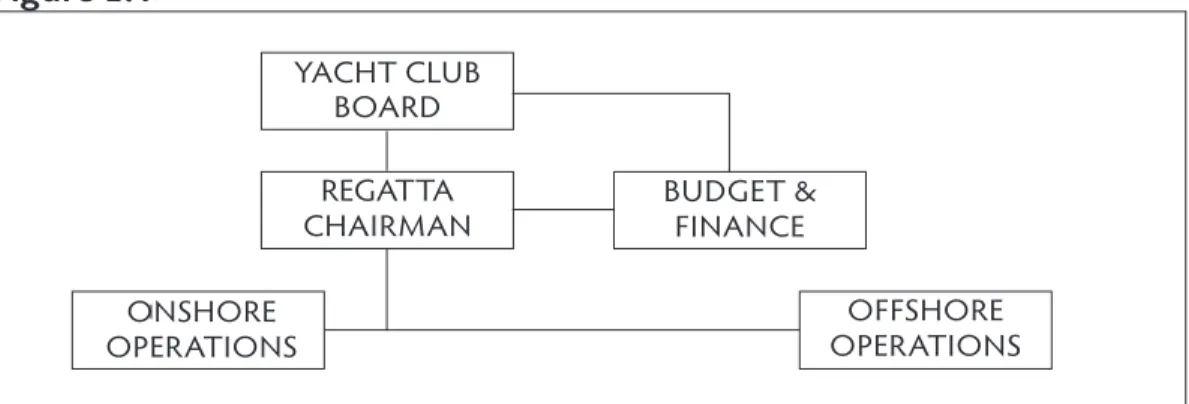
Yacht clubs often appoint a “regatta chairman” or “regatta organizer” who is responsible to the club for organizing its seasonal races or a particular regatta. He or she creates and implements the regatta’s operational aspects, prepares a budget for submittal to and approval by the club’s flag officers or board of directors, works directly with the class(es) to formulate the concept of the regatta, and selects and organizes a group of people (usually volunteers) who will be responsible for the planning and day-to-day conduct of each regatta’s events.
Although the manner in which these tasks are performed varies from club to club, the regatta chairman is responsible for reporting to the club’s board or flag officers on the status of the preparations for the event and its cost.
The position of regatta chairman requires certain traits. A person who is unsurpassed at fund-raising may not understand enough about the conduct of a sailing event to perform the job adequately. Similarly, an experienced racer who understands the demands of a class may not have the organizational skills, or the desire, to address such issues as registration, social events, and fund-raising.
In general, the chairman must be a leader, able to maintain the organization necessary to manage the event to a successful conclusion. The ability to obtain volunteer assistance, to recognize and encourage dedication, and to sustain the group over a significant period of time, are critical elements of his or her success.
Organizational skills are equally important. The chairman must be able to create the organiza-tional structure, then delegate the details to others, and allow them to plan and execute their assigned tasks. At the same time, the chairman must offer supervision and guidance to ensure that the people planning the various elements of the regatta continue to understand how their tasks fit into the overall structure of the event.
Thirdly, the chairman must be financially responsible. Every person involved in organizing any event perceives that his or her part is a key element of the event’s success, and wants to do the best possible job, sometimes regardless of cost. The chairman must be able to put the various elements in the proper financial perspective, so that everyone understands how the parts fit into the financial whole.
The operational aspects of regatta organization are discussed in further detail in Chapter 2, “Organizing the Event.”
The race committee
What is the race committee?
The term “race committee” is only very generally defined as including “any person or committee performing a race committee function.” It is appointed by the organizing authority (rule 89.2).
In the United States, race committees generally consist of a group of volunteers who have agreed to work together to conduct the races. The committee’s duties and functions are set forth in rules 90.1 and 90.2:
The race committee shall conduct races as directed by the organizing authority and as required by the rules.
The race committee shall publish written sailing instructions that conform to rule J2.
Race committees are chaired by one or more persons, usually referred to as the “race committee chairman.” In various places, the duties and titles of the chairman differ.
At some clubs, the “chairman” is an administrator, who assigns to various race officers the respon-sibility to conduct a particular race or regatta, but does not necessarily personally conduct the races. In others, he or she is designated by the yacht club to conduct all of the club’s racing for the year, and is responsible for all of the operational aspects of the race committee.
For reasons of either expertise or time availability, some clubs have several such chairmen, and divide the responsibilities for different aspects of the club’s racing among them. For example, one person may be responsible for “offshore,” another for “one-design,” and a third for “special events.”
Duties and functions of a race committee
In the traditional sense, the race committee is the team which goes on the water to carry out the planned sailing activities, including laying marks, setting the starting and finishing lines, signaling, timing and scoring.Its duties and functions are, however, much greater. How the race committee may accomplish them on the water is generally set forth in Parts 3 and 7 of the rules, and is covered throughout this handbook. The basic duties are:
Notices of race and sailing instructions
Most regattas are not of the scale to require a “regatta chairman.” They consist of a weekend of racing, with no formal registration, little or no ceremony, and no structured social events. In such instances, the host club (the organizing authority) generally delegates to the race committee the responsibility to prepare and issue the notice of race. Whether or not the notice of race is prepared by the race committee, the race committee should insist on reviewing it before it is issued. The sailing instructions and the notice of race must be coordinated. The sailing instruc-tions cannot be inconsistent with the notice of race, and the race committee must conform to both while conducting the race.
It is also the responsibility of the race committee, under rule 90, to publish the sailing instruc-tions. “Publish” as used in that rule usually means that the race committee is also responsible for writing the sailing instructions.
For some events, the sailing instructions may be written by a person who is not a part of the race committee, but is affiliated with, for example, a class organization, or a national governing body. Some clubs and local sailing associations use standing sailing instructions which are published for the season, and which are used for all regattas, and include a list of courses from which the race committee may choose. Nevertheless, the sailing instructions are published under the authority of the race committee.
Chapter 7 is devoted to notices of race and sailing instructions, but as you read this handbook, you will find suggestions on various topics which should, in some circumstances, be included in the sailing instructions.
Safety
Safety on the water is of paramount importance. While the race committee does not decide whether a boat should start or continue to race (that is the responsibility of the boat under rule 4), it is the race committee’s responsibility to provide a safe environment within which to race.
Sailboat racing involves inherent risks. There are, however, methods for reducing those risks which are available to the race committee, and it should do its best to use them. This includes safety on the race committee boats themselves, as well as exercising proper risk management on the course. There are suggestions for both throughout this handbook.
Measurement and “authority responsible”
It is ordinarily not the duty of the race committee to either conduct or be responsible for the measurement of boats. This is usually left to the class measurer, or other “authority responsible for interpreting the rules” (see rule 64.3(b)). However, it is not uncommon in informal regattas for the race committee to be designated as the “authority responsible,” in the absence of a class measurer.
Measurement procedures, if used, must be specified in both the notice of race (Appendix J 1.2 (7)) and the sailing instructions (Appendix J 2.2 (9)), and the sailing instructions must include any inspection procedures (Appendix J 2.2 (9)). For such regattas, it is the responsibility of the race committee, when publishing the sailing instructions, to identify the “authority responsible,” if it is not to be the race committee itself.
Selection of protest committees
In many smaller regattas, the protest committee is either the race committee itself, or a subcom-mittee of the race comsubcom-mittee. These types of protest comsubcom-mittees are authorized by rule 91. While it is now more common (and preferred) for the protest committee to be separate and independent from the race committee, it must, nevertheless, be appointed by either the race
committee or the organizing authority. It is incumbent upon the organizing authority to deter-mine how the protest committee will be selected.
Selection and maintenance of equipment
The race committee must also ensure that all equipment which it requires to conduct the races is both available and in good working condition. This handbook devotes a chapter to that specific topic (see Chapter 8, “Race Committee Equipment”).
Selection of race committee personnel
Finally, it is the responsibility of the race committee to select and train the people who will conduct the races. This is not an easy task. What types of people should you look for? How do you train them? What should they be expected to do before they show up on the day of the race? Before the committee boats leave the dock?
Other, in general
There are a number of functions essential to the conduct of authorized, safe regattas. These include obtaining necessary permits (and assistance as necessary from governmental authorities), accurate weather forecasts, and the like, which are incidental to the general duties and functions of the race committee. Many of these are discussed in Chapter 2, “Organizing the Event.”
Race officers
Selection and characteristics
The person in charge on the water is called by various titles (“race committee chairman”, “race manager,” “principal race officer” (or PRO), “line captain,” etc.). Selection of a qualified PRO is one of the most important aspects of conducting successful, safe races. He or she is responsible for all decisions made on the water, and for directing the actions of race committee personnel during the race.
The PRO sets the standard for the race committee’s conduct, and is generally responsible for representing the race committee in requests for redress which involve the race committee. As a result, he or she should be extremely knowledgeable of the rules, as they pertain to the conduct of the races, and of good, safe, race management procedures. It is preferable that he or she be an experienced racing sailor. Other desirable characteristics include leadership, mature judgment, decisiveness, organization, and composure under stress.
All active members of race committees, especially principal race officers, should be members of US SAILING to stay informed on rule changes, appeals decisions, and new information on race management.
QBe careful about reading health books, You may die of a misprint. —Mark Twain
US SAILING Race Officer Certification Program
Race Officer Programs
In 1982, US SAILING introduced its Senior Race Officer recognition program. The Club Race Officer program followed in 1988. These programs were designed to recognize qualified race offi-cers throughout the country and to promote quality race management. The Race Management Committee established qualifications, and recognition was granted for the lifetime of the indi-vidual. As of February 2005, there were 325 recognized Club Race Officers and 343 Senior Race Officers. These people are identified in the on-line directory as “Race Officer, Recognized Club” or “Race Officer, Recognized Senior.”
During the time these programs were active, over 1000 individuals were recognized. They have, collectively, made immense contributions to the sport by providing race management for countless races. Competitors throughout the country have benefited significantly from these volunteer services.
In 1994, US SAILING introduced the Certified Principal Race Officer program to certify highly qualified race officers – people who were capable of running any level of regatta. These certi-fications were for four year terms, and renewable. At the end of 1998, when the program was replaced, there were 31 CPROs. The last of these certifications expired at the end of 2002. In 1998, a working group was formed to recommend a comprehensive program of race officer training and certification. This program replaced the three existing programs in 1999, and since the end of 1998, no additional people have been or will be recognized under the old Club and Senior Race Officer Programs. Current Club and Senior Race Officers will retain that recogni-tion for their lifetimes, as long as they remain members of US SAILING.
Race Officer Training and Certification Programs The goals of this program are:
• to improve the quality of race management at all levels throughout the country to make racing more enjoyable for all;
• to increase the standardization of race management practices, making it less confusing for the competitors;
• to provide structured training for upgrading the skills of race officers; • to identify the most qualified active race officers throughout the country;
• to make event organizers aware of the availability of highly qualified and certified race officers.
• to provide coverage under US SAILING’s general liability insurance to properly qualified and certified race officers;
• to replace the prior programs with expanded programs in order to serve the sport more effectively.
The program has three levels: Club, Regional and National Race Officer. All appointments are for four-year terms, and are renewable. In addition to meeting criteria similar to those of the prior programs, participants in the new program must attend an approved seminar and demonstrate their knowledge of race management rules and procedures by passing a test. The requirements, including the seminar and test, must be met for initial certification and for re-certification (see below for some exceptions). All race officers that are certified under the program are covered under US SAILING’s general liability insurance. This benefit can be provided because the programs include specific terms rather than lifetime appointments, and because the program includes training and an objective measurement of each individual’s knowledge.
This program is for US SAILING members. In order to be certified, remain certified or be re-certified, you must be an individual or family member of US SAILING.
Applications can be downloaded from the race management page of the US SAILING Web site.
Club Race Officer
A Club Race Officer is expected to be able to properly run any race normally conducted at his or her local sailing organization, including organizing the race committee, writing correct sailing instructions, and doing the scoring.
In order to qualify as a Club Race Officer, a person must: • be an individual or family member of US SAILING; • be at least 18 years old;
• be recognized as having outstanding personal character; • have experience as a racing sailor (no time limit);
• own a copy of the current version of Join the Race Committee Team!;
• own a copy of the current version of the Race Management Handbook;
• have served at least twice in each race committee job;
• have been the principal race officer at least four times in the United States;
• be recommended by a flag officer (or equivalent) of his local sailing organization, which must be affiliated with US SAILING;
• have attended a complete, approved one-day or advanced race management seminar; • have successfully passed the basic race management test, or the advanced test at the Club Race
Officer level.
All of the experience (except the racing) must be during the four years ending at the time the application is submitted. The minimum experience requirements must be met at events in the United States. In addition, it is recommended, but not required, that applicants be qualified in CPR and small boat handling. In order to be re-certified, a Club Race Officer must submit an
activity report detailing his race management experience since last being certified, and must continue to meet the other program requirements, including attending a seminar and passing the appropriate test. An on-line reporting system (SOARS, an acronym for Sailing Officials Automated Reporting System) is available on the US SAILING Web site. Using SOARS is
required. If you need assistance, contact your Area Race Officer.
Re-testing: A person who has taken the basic race management test and not passed it can take another test only after completing another approved seminar.
The certified Club Race Officer program is administered within each of US SAILING’s geographic areas by the Area Race Officer. The current Area Race Officers can be found by searching on “Area Race Officer (ARO) Working Group” in the US SAILING on-line membership directory.
The Area Race Officers may certify people as Club Race Officers whenever all of the material necessary for certification has been received.
As of July 2009, there were 606 certified Club Race Officers. They are identified as “Certified Race Officer, Club” in the US SAILING on-line membership directory.
Regional Race Officer
A Regional Race Officer is expected to be able to go anywhere in his or her area and serve as the principal race officer with any race committee to properly run any race or regatta normally conducted in that area, including regional championship events. This includes organizing the event and the race committee, writing correct sailing instructions, and doing the scoring. In order to qualify as a Regional Race Officer, a person must:
• be an individual or family member of US SAILING; • be at least 21 years old;
• be recognized as having outstanding personal character; • have experience as a racing sailor (no time limit);
• own a copy of the current version of Join the Race Committee Team!; • own a copy of the current version of the Race Management Handbook; • own a copy of the current US SAILING Appeals and ISAF Cases (one book);
• have been the principal race officer at least five times in the United States, including at least one regional or higher level event (a “regional” event is a major regatta that includes competi-tors from a broad geographic area or determines a regional or higher level championship); • have been the principal race officer at two or more venues;
• be recommended by a flag officer* (or equivalent) of his local sailing organization, which must be affiliated with US SAILING;
• be recommended by a competitor* (who is not a member of the local sailing organization that is recommending him) in an event at which he was the principal race officer;
• be recommended by a US SAILINGRegional or National Race Officer, Judge or Senior Judge or ISAF Race Official* (who is not a member of the local sailing organization that is recom-mending him) who has observed his work as a principal race officer;
• be recommended by his Area Race Officer;
• have attended or been the primary instructor at a complete, approved advanced (two-day) race management seminar;
• have successfully passed the advanced race management objective test at the regional level [not required for people who have been the primary instructor at an advanced (two-day) seminar].
All of the experience (except the racing) must be during the four years ending at the time the application is submitted. The minimum experience requirements must be met at events in the USA. In addition, it is recommended, not required, that applicants be qualified in CPR and small boat handling. It is also recommended that applicants have been active in teaching race management, either seminars or on-the-water training. In order to maintain certification, a Regional Race Officer must continue to meet the program requirements, and submit an annual activity report to US SAILING and his Area Race Officer by March 1 of the following year. An on-line reporting system (SOARS) is available on the US SAILING Web site. Using SOARS is required. If you need assistance, contact your Area Race Officer.
Both the Area Race Officer Working Group and the Race Management Committee consider appli-cations for Regional Race Officer certification or re-certification at the semi-annual US SAILING meetings in March and October. Only complete application packages will be considered. Applicants should be sure that all of the supporting material, including references, is in the hands of their Area Race Officer one month before the meeting at which the application will be considered. This permits the US SAILING staff to assemble a package of applications and circulate it to the committees in time for them to carefully consider each application before the meeting.
Re-certification: In order to be re-certified, a Regional Race Officer must submit an applica-tion and continue to meet the other program requirements, including attending a seminar and passing the appropriate test. Applicants for re-certification are not required to submit references unless requested to do so by their Area Race Officer
A person who has taken the advanced race management objective test and not passed at the desired level must attend another advanced seminar in order to take another test.
As of July 2009, there were 95 certified Regional Race Officers. The current list can be produced by searching under Certification for “Certified Race Officer” in the US SAILING on-line member-ship directory and then selecting “Regional” as the certification level.
* Neither an Area Race Officer nor a member of the US SAILING Race Management Committee may serve as this reference.