The candidate confirms that the work submitted is their own and the appropriate credit has been given where reference has been made to the work of others. I understand that failure to attribute material which is obtained from another source may be considered as plagiarism.
(Signature of student) _______________________________
A Feasibility Study into the use of
Collaborative Software Tools to
Improve the Sales Process for an SME
Computing for Business
Neha Malik
I
Summary
Vaioni Group Ltd (VGL) is a Small to Medium Enterprise based in Manchester which delivers internet connectivity and managed security to businesses globally. Established for almost a decade, the company was struggling to meet its growing demand as it gained a stronger foothold in the IT industry. Difficulties employees were experiencing were hindering the company in its continuing efforts to continue growing. To address this, they had considered implementing collaborative software; however, there was reluctance to add a new IT system to the business without further investigation.
A Feasibility Study was conducted to analyse the client’s problems in depth, and to establish if collaborate software was viable and appropriate to satisfy the needs of both the business and the users. The study led to the conclusion that this approach was viable, and options were identified for the client to choose from. A Proof of Concept tested the technical feasibility of the chosen solution to verify its ability to integrate into the company, followed by a Prototype to demonstrate the solution’s ability to satisfy all requirements which had been defined during the Feasibility Study.
II
Acknowledgements
I would like to thank my project supervisor Dr Lydia Lau, for her continued support and guidance throughout the duration of this project.
I would also like to thank my assessor Sarah Fores for her valuable feedback on my Mid-Project report and during the progress meeting.
A special thank you is dedicated to all employees at Vaioni Group Ltd for providing the opportunity for me to help improve their business practices.
III
Contents
1 Introduction ... 1
1.1 Project Motivation ... 1
1.2 Problem Domain... 1
1.3 Aims & Objectives... 2
1.4 Deliverables ... 2
1.5 Project Approach ... 3
1.6 Schedule and Milestones ... 3
1.7 Report Structure ... 4 2 Methodology ... 6 2.1 Background Analysis ... 6 2.2 Feasibility Study... 7 2.2.1 Process ... 7 2.2.2 Data Collection ... 8 2.2.3 Data Analysis ... 10 2.3 Prototyping ... 11
3 Analysis of the Current Sales Process... 14
3.1 Background Analysis ... 14 3.2 Data Collection ... 17 3.2.1 Semi-structured Interview ... 17 3.2.2 Focus Group... 18 3.2.3 Direct Observation ... 18 3.3 Data Analysis ... 19 3.3.1 Semi-structured Interview ... 19 3.3.2 Focus Group... 20
3.3.3 Direct Observation - Execution ... 22
3.4.3 Direct Observation - Systems used ... 24
3.3.3 Direct Observation - Analysis ... 25
3.4 Problematic areas and root causes ... 27
3.6 Summary of Analysis... 28
3.7 Requirements Specification ... 28
4 Study of Collaborative Tools ... 30
4.1 Literature Review ... 30
IV
4.1.2 Workflow Management ... 31
4.1.3 Document Management ... 31
4.1.4 Enterprise Content Management ... 32
4.1.5 Summary of Collaborative Tools ... 33
4.2 Candidate Options ... 33
4.2.1 Option 1: Alfresco Enterprise ... 33
4.2.2 Option 2: Invu Document Management ... 33
4.2.3 Option 3: Zucker Docs ... 34
4.2.4 Option 4: iNet Docs ... 34
4.2.5 Option 5: IBM Lotus Quickr ... 34
4.3 Comparative Study of Collaborative Features... 35
4.4 Assessment of Short-listed Options ... 36
5 Recommendations ... 37 5.1 Recommendations ... 37 5.3 Presentation to VGL ... 37 5.4 Outcome ... 38 6 Proof of Concept ... 39 6.1 Integration Testing ... 39 6.2 Storyboard Prototypes... 42 7 Evaluation ... 43 7.1 Outcome of Project ... 43
7.1.1 Aims and Objectives ... 43
7.1.2 Methodology and Project Schedule ... 44
7.2 Feasibility Study... 44 7.3 Proof of Concept ... 47 8 Conclusion ... 50 8.1 Achievements ... 50 8.2 Future Work ... 50 References ... 51 Appendices ... 53
1
1
Introduction
1.1 Project Motivation
The fast paced industry of IT and technology is an area of particular interest to me. Collaborative Software has advanced heavily in the industry over recent years and I am keen to learn more about its potential. Open source collaborative software is an increasing phenomenon as it enables smaller companies to take advantage of this, without incurring the cost implications. This was something only larger companies were able to reap the benefits of in the past. Vaioni Group Ltd is an SME I am particularly familiar with, who were considering the implementation of such software to help them overcome their challenges. This provided an opportunity to learn more about collaborative software and I offered to be a business analyst for them to help them solve the problems they were facing. Although it will be a challenge for me to work on a real problem with an external company, which is something I have not done previously, I look forward to this opportunity as it will enable me to learn more about collaboration in a business setting, and will be my biggest academic achievement to date.
1.2 Problem Domain
Vaioni Group Limited (VGL), an SME established in 2001, is an Internet Connectivity and Managed Security Provider for businesses across the UK, Europe, America and Asia. Based in Manchester, it delivers networks, telecoms and support services to over 6000 clients. Having grown from a small start-up to a more established business within its industry over recent years, VGL employees were in a position where they were finding that many of the business activities involved within the Sales Process were complex and that the current methods they were using were insufficient and under stress.
The Sales Process was the key driving force of the company’s revenue, and so it was fundamental for such problems to be addressed in this business critical process. In particular, employees were finding it increasingly difficult to respond to customer queries in a timely manner and the activity of searching for key documents very time consuming. Version control and security of documentation were also issues of concern.
Operating in the fast-paced industry of IT Services and Technology, VGL was dedicated to achieving a high standard of customer service and efficiency in its Sales Process from the preliminary quotation stage, through to the delivery, technical support and invoicing activities. With an expanding
2
customer base resulting in an increased volume of documentation and the aspiration to become a greener, paperless office, the company was driven to eliminate the difficulties it was experiencing in its existing sales process to help meet the demands of its growth.
The Managing Director (MD), the problem owner was keen to use collaborative software to tackle the difficulties his employees were experiencing as he was aware of the increasing popularity of collaborative technologies in the workplace in recent years, allowing individuals to work more effectively towards a common deliverable. To survive in such a competitive market, he was aware that VGL needed to improve the efficiency and productivity within the sales process and felt that this could be achieved with effective collaboration. Ambitious to develop the business further, he felt that there was a need for these problems to be addressed to ensure a secure foundation was in place prior to any future expansions.
1.3 Aims & Objectives
The aim of this project was to analyse the feasibility of introducing collaborative software into the business, and if this was the right approach for the client to adopt in order to meets its business needs and overcome the challenges faced. The primary focus was to understand VGL’s problems within the Sales Process and attempt to solve them.
The objectives of this project are:
Detailed analysis of the problems and causes inherent in the existing process to form a requirements specification for the client
Undertake a literature review on collaborative software types to identify possible IT options Produce and present a Feasibility Report to the client containing an evaluation of 3 options
followed by recommendations
Implement a Proof of Concept Prototype to demonstrate the capabilities of the solution chosen by the client
Evaluate each of the project deliverables
1.4 Deliverables
The deliverables for this project are:
Project Report
3 Proof of Concept Prototype of chosen solution
1.5 Project Approach
A systematic approach was followed to drive this project and its deliverables. This comprised of three main stages; Background Analysis, a Feasibility Study, and a Proof of Concept. The purpose was to gain an in-depth understanding of the problem, attempt to solve it through the identification of possible solutions and to propose and prototype the best course of action. A more detailed discussion of the methodologies chosen to implement each of these stages will appear in chapter 2.
1.6 Schedule and Milestones
Based on the methodology, a preliminary project schedule was devised to ensure time was managed effectively throughout the duration of the project life cycle. Below is a specification of the milestones which led to the solution of the problem:
Objectives Tasks
Detailed Analysis to form requirements
1: Data Collection Techniques to gather qualitative and quantitative data
2: Data Analysis to identify problematic areas and their root causes
3: Define a Requirements Specification based on these findings
4: Request approval from problem owner
Literature review to identify possible options
1: Summarise the collaborative concept
2: Review literature on Workflow, Enterprise Content Management and Document Management
3: Identify possible IT options to solve the problems experienced and satisfy the specified requirements
4
Feasibility Report 1: Summarise analysis of problems, causes and requirements identified
2: Evaluate the shortlisted options against the specified requirements
3: Present the report to the client and offer high quality recommendations
4: Request feedback and a choice of their preferred solution
Proof of Concept 1: Produce a prototype of the solution chosen to demonstrate its capabilities and any customisations
2: Present to the client and request verbal and written feedback to evaluate the solution
Evaluation 1: Of the Feasibility Study
2: Of the Proof of Concept Prototype
3: Of the outcome of this Project
The precise schedule, which was created in the form of a Gantt chart provided in Appendix B, contains a breakdown of project tasks and their envisaged completion dates. Key milestones were also marked to ensure deadlines were met efficiently.
The focus for the first half of the project was to gain an in-depth understanding of the problem, identify requirements, and recommend viable solutions in the form of a Feasibility Report. The focus for the second half of the project was to prototype the solution to verify its technical feasibility and ability to meet the specified requirements.
1.7 Report Structure
5
Chapter 2 summarises the methods that were adopted to satisfy each of the three steps outlined in the project approach.
Chapters 3 and 4 detail the process of the Feasibility Study which led to the production of a Feasibility Report. This process involved a detailed analysis of VGL’s Sales Process using a combination of data gathering techniques to gain an in-depth understanding of problems and their root causes. Requirements for a solution were then defined followed by a literature study of collaborative software to examine the tools within this concept. Possible options for VGL were then identified.
Chapter 5 discusses the recommendations that were presented to VGL as part of the Feasibility Report. The options that were addressed in the previous chapter were compared and shortlisted to form these recommendations. This section attempts to solve the problem through a display of viable solutions.
Chapter 6 offers a solution to the problem by means of a Proof of Concept. Objectives are outlined at the beginning of this section followed by a discussion of the execution of each. A VGL development platform was used to test the integration of the chosen solution and storyboard designs were created to illustrate the customisations.
Chapter 7 provides a well justified evaluation of all elements of the project. The outcome and delivery of the overall solution is evaluated against specified criteria. Time management and the effectiveness of the chosen methodology are topics also discussed.
Chapter 8 concludes by reflecting on the project experience and offering advice as a result of this. Suggestions for future enhancements are also outlined for VGL to consider.
6
2
Methodology
This chapter discusses the research that was undertaken to discover appropriate methods for completing each of the 3 main stages within this project; Background Analysis, Feasibility Study, and Proof of Concept. The components inherent in each of these stages have also been addressed.
2.1 Background Analysis
Research into the background of the company was required early on to identify the scope for this project. This was achieved through email and telephone conversations with the problem owner. Initial research was undertaken to discover the nature of VGL’s services and values in addition to company size, vision, and sales strategy. The purpose of obtaining this information was to gain an insight into the company’s background, in order to facilitate a better understanding of the inherent problems at a later stage.
The author had worked at VGL for a short period in the past which proved to be beneficial as it wasn’t necessary to start from scratch in this research area. This experience also provided personal insight into some of the problems that existed within the Sales Process. Professional relationships were maintained with employees and subsequent discussions with the Managing Director regarding the problems faced, led to the possibility of this project.
A great deal of reading was essential to initiate the learning process. This included company documents regarding VGLs profile, and books, journals and articles regarding collaborative software. Initially only workflow IT options were considered. However, further research led to the discovery of enterprise content management and document management and so the broader concept of collaborative software was assessed. Fortunately, this was a concept VGL had considered yet they were unsure which type would be most beneficial to the company, or if such software would integrate well with the current systems and activities. This discussion led to the adoption of the project title and the logical decision to proceed with a Feasibility Study to assess if collaborative software, and the variations within it, were viable for VGL to implement.
Related work, previous studies and projects were subsequently sought for to gain knowledge and develop ideas relevant to the subject matter of this project. With regards to Feasibility Studies, the outcome was fairly unsuccessful as many of these studies appeared to exist in the medical industry rather than technology and business and so didn’t provide a great deal of value. Fortunately, many
7
sources were located on the subjects of collaboration, groupware, and system types, some of which were used as part of a literature review later in the project.
2.2 Feasibility Study
Background research into the scope of this project led to the chosen methodology of a Feasibility Study. Recognised as a key decision point in traditional systems development projects on whether to proceed with a proposed idea (Avison and Fitzgerald, 2006), this study was conducted to determine and document, by means of a Feasibility Report, the viability for collaborative software to be deployed into VGL with recommendations for progression. The results were used to support the problem owner’s decision making process at VGL.
A systematic structure was devised to guide this study. Decisions based on the choice of process, data collection, and data analysis, are explained below. These preferences facilitated a detailed understanding of the problem and the discovery of potential solutions.
2.2.1 Process
A Feasibility Study, which can be defined as a controlled process for describing situations, identifying problems and opportunities, and determining alternatives for solving a problem (Thompson, 2005), is ideal for identifying gaps and providing insight on how to address them (Bickerdyke, 2000). The term is used to denote both the process of the study and the resulting document itself (Bickerdyke, 2000), and is recognised as a particularly beneficial approach as it considers the positive and negative aspects of an opportunity, and helps to understand everyday practices, ideas, needs and requirements (Thompson, 2005), Feasibility Studies can also be used to provide analytical data to support business decisions and determine the efficiency and success of implementing something new (Bickerdyke, 2000).
This particular study required an analysis of all stages of the Sales Process, to identify the systems used, the manual flow of information between them, and the feedback and requirements stated by representative employees. Problematic areas in the process were identified and categorised with the aim of eliminating them to meet the demands of VGLs growth. From this analysis, requirements werederivedto establish if a collaborative solution would be viable for the business to adopt. Using this information, collaborative options for the company were then scoped and evaluated through a method of comparison to establish high quality recommendations.
8
1. Data Collection to identify needs and understand all elements of the Sales Process 2. Analysis and interpretation of the data gathered to establish problems and their causes 3. Identification of requirements; to be approved by the problem owner
4. Recognition of possible collaborative solutions followed by a comparison
5. Production and delivery of a Feasibility Report with high quality recommendations 6. Presentation of the report to the client where a choice was necessary
These steps guide the structure and flow of the first few chapters of this report. In order to address and resolve VGL’s problems, it was considered that collaborative IT solutions may be suitable and that a re-design of the Sales Process may be necessary. This study aimed to work out an ideal solution for the company.
2.2.2 Data Collection
Research was carried out through an extensive review of literature to establish best practices for data gathering during the Feasibility Process. These techniques formed a foundation from which data could be analysed.
Data gathering describes methods for capturing information to be analysed and interpreted. This activity enables accurate and relevant data to be collected and reproduced into a formal set of requirements (Sharp, et al, 2007). Goal setting is a key issue that should be considered in the planning phase of data gathering sessions to ensure the execution is successful (Sharp, et al, 2007).
The primary purpose of data gathering in this study was to establish problems, their causes, the needs of VGL, and the expectations for a solution. This information was later processed and analysed to form a requirements specification. Although there are a range of techniques, to avoid biases when gathering data, it’s fundamental to use a combination (Sharp, et al, 2007).
Interviews are a common technique in data gathering. The effectiveness of them however can, relate to how well questions are prepared and structured in order to gain the most relevant information.
There are four types of interview, each requiring a different level of control from the interviewer. The most appropriate approach is dependent on the questions and the purpose of the interview (Sharp, et al, 2007).
Structured interviews tend to be used when data needs to be gathered very quickly. They contain closed questions and a set of predetermined alternative answers for the interviewee to choose from
9
(Sharp, et al, 2007). Yet unstructured interviews contain open-ended questions enabling both the interviewer and interviewee to steer the direction of the conversation. This can however, generate a lot of data causing the activity of analysis to be very time consuming (Sharp, et al, 2007).
Semi-structured interviews contain a mix of closed and open questions combining the features of structured and unstructured techniques. This style of interview also enables the interviewer to probe the interviewee to discuss relevant information beyond the predetermined question set, ensuring all relevant information is discussed (Sharp, et al, 2007). This technique therefore seemed most appropriate to adopt for interviewing the problem owner early on in the project, where it was necessary to discuss VGL’s problems, their perceived causes, and business needs. The purpose of this interview was to capture rich information which could be achieved through guidance and probing to uncover hidden issues.
Focus groups differ from the other interview methods in that they allow a group of people to be involved. This enables the interviewer to target a specific user group and build a consensus view by means of an interactive group discussion (Sharp, et al, 2007). It was necessary to hold a focus group session at VGL with representative employees to capture their individual needs and establish an agreement on expectations for a solution. An agenda was developed for guidance as this helps to prompt focus points during a discussion, but focus groups also have the flexibility for unknown issues to be raised, encouraging the free flow of ideas (Sharp, et al, 2007). It was discovered that this method is particularly useful as the group dynamics can help to develop diverse ideas, ensuring issues are covered thoroughly and it seemed that this approach would provide high validity of the research multiple viewpoints could be captured.
Another method for gathering data is through observation. This is a very useful technique as it captures user’s tasks and goals (Sharp, et al, 2007). Direct observation occurs in the natural setting, rather than a controlled environment and involves observing activities as they happen through spending time with individuals (Sharp, et al, 2007). This form of observation was adopted to analyse all stages of the Sales Process, including user behaviour, systems used, and the flow of information. Data gathered using this technique is particularly valuable when it is important to understand how certain activities occur, providing that a framework is in place to structure the observation (Sharp, et al, 2007). Research into the degree of participation was also required to establish if it was beneficial to be more of a participant observer or passive observer to achieve the stated goal.
10
Questionnaires can have closed or open questions and are therefore similar to interviews (Sharp, et al, 2007). They usually require preparation and distribution to a demographic range, but for this particular study they were used to evaluate the Proof of Concept. Research and effort was required to ensure questions were clear and concise. However the presence of the author meant that there was the opportunity for any ambiguities or misunderstandings from users to be resolved. This is a powerful technique as it provides understanding in the context of user activity.
Throughout the data collection process, data was recorded through a combination of note taking and audio recording. Note taking is recognised as being easy to transcribe during analysis, and is very flexible and unobtrusive whilst audio recording is useful when gathering multiple opinions in group situations (Sharp, et al, 2007), providing that the quality of sound is high. In regards to the questionnaire, data recording was not required as participants self documented their responses.
Data gathering was fundamental to the success of this project as it enabled the users to deeply engage. Additional exchanges of information were also required with the problem owner during the project lifecycle. The chosen techniques enabled a mixture of qualitative and quantitative data to be collected, which was later analysed to achieve the stated goals. Further research was also required to ensure high quality guidelines were followed when preparing and implementing some of these techniques.
2.2.3 Data Analysis
Data analysis is an important stage of the research process as it enables information to be extracted from raw data through methods of processing and organisation. Processing and interpretation of the data collected from the client was required to create a basis for requirements to be derived from. The data gathered from each technique was analysed subsequent to its completion as this provided a foundation for the following technique to build upon. The research goal was to identify areas of the Sales Process that were problematic for users and from this recognise requirements for a solution.
First, the data required processing which was achieved by expanding, transcribing and filtering it. Next it was necessary to analyse the data through the application of quantitative and qualitative approaches as research suggested that recommendations should have clear supporting evidence and be based on a combination of quantitative and qualitative data (Thompson, 2005). Quantitative analysis tends to focus on interpreting numerical data, whilst qualitative focuses on emerging themes and patterns in textual or visual data (Sharp, et al, 2007).
11
To manipulate raw data, software tools can be used such as Nvivo, XSight, and SPSS. However, they are more suitable when there is a vast amount of data to be analysed, and are unable to interpret and judge the data as effectively as a human would (Sharp, et al, 2007). For this particular study, it seemed unnecessary and costly to use such tools given the small sample and therefore, the data was collated and analysed manually. Excel and other spreadsheet packages are commonly used to graphically represent data. This helps to identify any patterns the data may contain (Sharp, et al, 2007).
Thematic analysis is a qualitative technique that can be adopted when analysing narrative data captured during interviews, enabling themes to be identified in the transcript (Anderson, 2007). This process will be applied to the data captured during the semi-structured and focus group interviews, with the aim of identifying problematic areas and requirements for a solution. Some of the data captured during the observation period however, will be represented quantitatively to illustrate patterns and key findings. Research confirmed that a graph could be used as an effective mechanism for presenting the data collected. These creative depictions can aid decision makers in understanding the data and help them to draw better conclusions (Black, 2010).
Once analysed, it was necessary to interpret and disseminate the results with regards to the research goals. The results were used to derive a formal requirements specification. Approval was sought from the problem owner to validate the research and confirm that solutions could be scoped to match this specification.
2.3 Prototyping
A prototype can be defined as a communication device that simulates scenarios of use (Sharp, et al, 2007). Varying from paper based storyboards through to complex software; prototypes enable users to explore the suitability of a proposed design (ibid). They were used to demonstrate to the client how the solution they had chosen had the potential to satisfy all specified requirements, and this technique is particularly beneficial when the project size and number of users is relatively small, and where the proposition will have a high impact on users and the organisation (Avison and Fitzgerald, 2006).
There are several kinds of prototypes each with different objectives. Categorised into levels of fidelity, the type chosen is usually influenced by time and budgetary constraints inherent in the design process (Avison and Fitzgerald, 2006).
12
Low-fidelity prototypes usually take the form of paper based mock ups and storyboards, allowing designs to be modified flexibly whilst ideas are explored. Key benefits are that these techniques are simple, quick and cheap to produce, are ideal for proof of concept designs, and provide rapid feedback. Storyboards are also often used in conjunction with scenarios to illustrate how a user may progress though a task (Sharp, et al, 2007).
Medium-fidelity prototypes often have the characteristics of both low and high fidelity, and can take the form of a PowerPoint presentation (Sharp, et al, 2007).
High-fidelity prototypes hold more of a resemblance to the final product using powerful software tools to achieve this. Although this technique is useful for testing out technical issues, and serves as a living specification, it often takes too long to build, is more expensive to develop, and can often set expectations too high (Sharp, et al, 2007).
Subsequent to having conducted a Feasibility Study, it was useful to test out the technical feasibility of the solution chosen, using a Proof of Concept. It was discovered that a Proof of Concept could be designed to reduce uncertainty and would be an excellent way for VGL to evaluate the business proposition.
Bespoke Development allows for software to be tailored to the specific requirements of a business, providing a competitive advantage (Bocij,et al, 2006). Generic software rarely meets the demands of an individual business’ needs and therefore it was expected that some form of customisation would be required if the option chosen by the client did not meet all requirements specified.
The key deliverable of this stage was storyboard designs to represent a prototype of the solution. Created in the form of PowerPoint slides, the designs were formed to prove that the specified requirements had been, or could be met. They required evaluation from the client and therefore various approaches were considered.
There are three recognised approaches; usability testing, field studies, and analytical evaluation (Sharp, et al, 2007). Usability testing requires users to self-test a fully working prototype and therefore this approach did not seem appropriate as this study aimed to create a prototype design. Field studies tend to be used to develop a relationship with the user and often assist the early stages of design (Sharp, et al, 2007).
Analytical evaluation however, differs from the others in that users are generally not involved but are required to inspect the prototype. This can be achieved by means of observing an expert as they
13
simulate the user’s problem solving process. Defined as a Cognitive Walkthrough, pre-planned scenarios are presented using a prototype, and feedback is usually acquired to be used by the designer (Sharp, et al, 2007).
It was decided that the prototype would be presented to the client in the form of a Cognitive Walkthrough session as this would visually aid discussions around the tasks users would be required to perform. Questionnaires were also formed to gather written feedback in relation to each storyboard, and users were given a few minutes after the presentation of each, to complete the relevant questions. The objective of this session was to emphasise that the customised version of the chosen solution could overcome the difficulties faced, and provide a solid foundation fundamental to VGL’s growth.
14
3
Analysis of the Current Sales Process
This chapter provides an overview of VGL’s company background followed by the first few stages of the Feasibility Study Process, and the discoveries that were made as a result of them. The objective of this analysis was to understand VGL’s problems and their characteristics to help identify requirements. The steps that were outlined in Chapter 2 were applied here and outcomes summarised.
3.1 Background Analysis
A valuable insight into the background of VGL was gained through initial discussions with the problem owner. This information was used to secure a foundation of knowledge in which the Sales Process could build upon. As an Internet Service Provider, VGL provides innovative and compelling services to end users, delivering an end to end managed service. Its core values to customers are the skill to design, project manage and implement an extraordinary connectivity service or WAN solution backed with support services. With a vision for continued growth, innovation, and to be ‘greener’, VGL needed to address and improve its Sales Process.
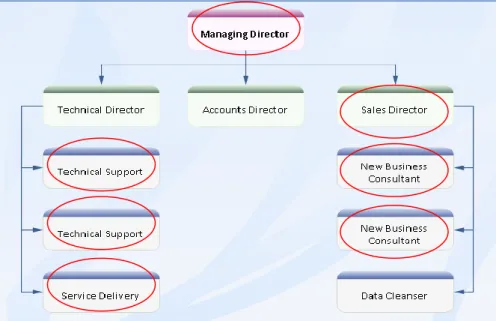
An insight into the Sales Strategy also proved to be useful in highlighting VGLs business objectives to succeed. However, due to the confidential nature of this information details cannot be disclosed in this report. Company size was also discussed which led to the discovery that there were a total of ten employees at VGL. The position of each of these employees is specified in Figure 1, below.
15
As illustrated, three departments exist: Sales, Technical, and Accounts. Figure 1 provides a useful visual aid of these departments, all of which were required to liaise with customers at some point during the Sales Process. As a result, most employees had been impacted by the difficulties that had presented themselves.
The focal point however, was to identify a solution that helped the circled employees (illustrated on Figure 1) primarily, as they were experiencing difficulties more frequently than other employees due to the nature of their day to day activities, and strong participation within the Sales Process.
These departments shared information from the early stages of lead generation, quotation and confirmation of an order, through to the delivery, technical support and payment required from a successful sale. Further discussion was required to understand the role of each division in the Sales Process. A summary of each follows:
Sales Division
The New Business Consultants (NBC), managed by a Sales Director, are responsible for generating new business and nurturing relationships with existing clients. The Data Cleanser is accountable for filtering customer data purchased from external sources. A client list is extracted from this data and then passed to NBCs as a foundation for them to scope new opportunities through cold calling.
Technical Division
The Technical Support and Service Delivery employees, managed by a Technical Director, are responsible for dealing with orders once they have been approved and the signed documentation has been received back from the customer. They contact suppliers to estimate timeframes for delivery and also liaise with clients to update them on the status of their orders. Once a service is live, this team provide technical support for any difficulties the client may experience during the term of contract.
Accounts Division
The accounts director is responsible for producing invoices once orders become a live service. Customers are contacted to discuss their payment options and agreement terms are set up.
16
Initial Sales Process Flow Diagram
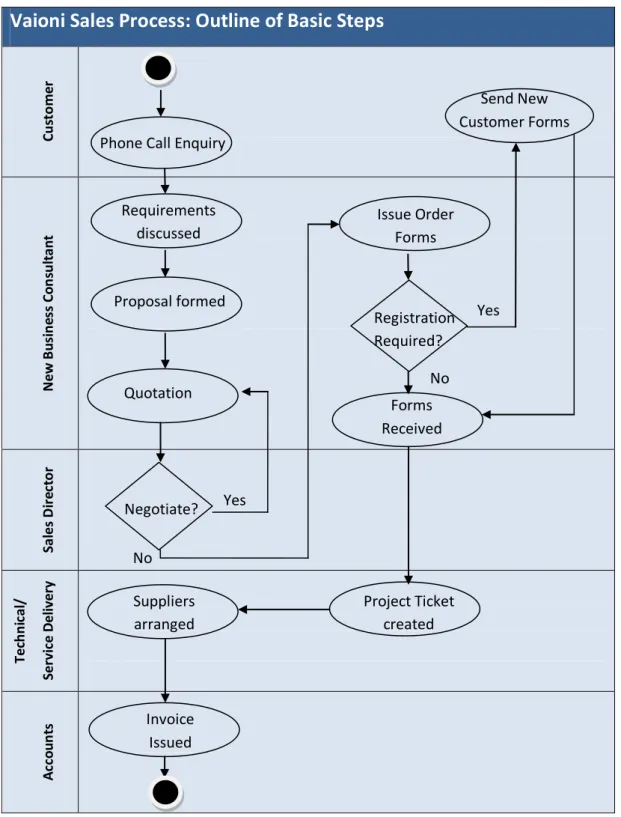
A basic understanding of the key tasks involved in the Sales Process, was gained from this initial analysis and led to the creation of Figure 2 below, to illustrate how activities flow from role to role, as indicated in the left-hand column. This diagram was used to guide further analysis, in the next section, posing as a roadmap for tasks to be explored.
Figure 2: Initial Sales Process
Vaioni Sales Process: Outline of Basic Steps
C u st o m er N e w B u si n es s C o n su lt an t Sa le s D ire ct o r Te ch n ic al / Se rv ic e D el iv ery A cc o u n ts
Phone Call Enquiry
Send New Customer Forms
Proposal formed Yes
Yes Quotation Negotiate? No Registration Required? Issue Order Forms No Suppliers arranged Project Ticket created Invoice Issued Requirements discussed Forms Received
17
3.2 Data Collection
A combination of data gathering techniques helped to capture accurate and relevant data. This data provided a foundation for a detailed analysis of the Sales Process, building on the initial analysis discussed in section 3.1. The objective was to research and assemble a range of quantitative and qualitative data to be analysed and processed into information, which would later form the requirements for a solution.
3.2.1 Semi-structured Interview
Goal
To discuss the key stages in VGL’s Sales Process, problems faced, and their perceived causes, with the problem owner.
Preparation
This was essential to ensure the interview was conducted effectively. A suitable question set was devised, provided in Appendix C1, to ensure maximum co-operation from the interviewee. Open, closed and probing questions were used to maximise the level of detail discussed. This was achieved through drafting and pilot testing on acquaintances to reach a high quality final version. Questions were then ordered to ensure the structure of the interview ran smoothly. This preparation was not only a professional approach to the situation but also set a foundation for the interviewee to fully engage with.
Execution
An interview was set up with the problem owner in November 2009 at the client’s office, where a series of prepared questions were asked to gather quantitative and qualitative data. The interviewee was probed at times to uncover further issues, and overall the interview ran smoothly and successfully. Rich data was captured through note taking to be later analysed and an outline of the interview transcript has been provided in Appendix C1.
It was discovered during this meeting that the Sales Process can take one of two steams. One is geared towards a new client, whilst the other targets an existing client. This was explored further during the observation session to identify the variation of tasks involved in these two types of sale.
18
3.2.2 Focus Group
Goal
To gain a consensus of needs and expectations for a solution by means of a group discussion with employees involved in the Sales Process.
Preparation
It was necessary to develop an agenda containing question topics and possible branches to guide the discussion. Parent topics were acquired from the results of analysing data gathered in the preceding technique, a semi-structured interview. Branch topics were formed based on knowledge gained from background research. The final version of the agenda for this focus group has been provided in Appendix C2. As the population was small, most of the employees involved in the Sales Process were selected to attend.
Execution
A focus group was scheduled in December 2009 at the client’s office. Several themes arose from the agenda topics and a broad scope of qualitative data was captured from the seven employees that attended. An audio recorder was used to sufficiently capture all viewpoints to be later analysed.
3.2.3 Direct Observation
Goal
To observe the Sales Process from end to end over a period of days in the business’s natural setting, to understand user behaviour and identify the root causes of problems experienced.
Preparation
It was paramount for observation in the field to be planned out carefully to ensure that only relevant data was captured. It was also important to recognise that although goals had been set, external influences could not be accounted for, and so a strict time schedule could not be devised as the duration of the Sales Process would be partially dependant on the length of time it would take for customers to make decisions. A sample of three employees were selected to be observed, one representing each division to ensure a sale could be examined from the beginning of the process, through to the end. It was decided that two sales would be observed, one for a new client and one for an existing client, to ensure both streams of the process that were identified during the semi structured interview, were analysed. A framework, provided in Appendix C3, was then devised to
19
structure what was going to be observed and how. The results of the focus group session provided a focal point for particular tasks to be observed.
Execution
This activity was performed in January 2010 at the client’s office. Three employees were observed in their natural setting during a course of five working days.Field notes were recorded in the form of a diary, where a mixture of quantitative and qualitative data was captured as activities were observed. The goal was achieved by observing the use of IT and paper based systems to complete tasks in the Sales Process, paying particular attention to areas that were problematic for users. This experience enabled the author to identify any underlying causes that the problem owner was initially unaware of.
3.3 Data Analysis
This section encapsulates the key findings from each of the data gathering methods that were executed in the previous section. The results obtained from each were used to facilitate the preparation of the next. Qualitative and quantitative techniques of analysis were utilised to support these discoveries.
3.3.1 Semi-structured Interview
A thematic analysis was applied to identify key themes that emerged in the textual data collected during this interview. Patterns and relationships were identified to facilitate general discoveries. Themes are highlighted below followed by the results of this analysis.
A summary of the project scope provided by the problem owner:
The business had recently launched a new product line as part of their business objectives; to maintain a competitive edge and to continually innovate. As a result of this expansion to the product portfolio, employees had been receiving an increased volume of calls from potential clients. The current process proved to be inefficient in adapting to the growing demands of VGL, thus, the problem owner envisaged scope for such problems to be addressed and resolved. Due to a lack of resources, and smaller demand, such difficulties had been overlooked in the past. With the Managing Director’s vision of continued growth, there was now an opportunity to rectify the errors within the Sales Process. Streamlining the existing process had been considered in the past, so VGL were ambitious to take advantage of IT to address its needs and maximise potential.
20
Themes that were identified from the Interview Transcript, provided in Appendix C1:
Too long to close sales Searching difficulties
Long response time to clients Documents in different locations
Lack of versioning Lack of restrictive permissions Document Management Better position for growth
Collaboration 35-45 new paper based documents per week
Manage the process more efficiently Majority of paperwork is stored in filing cabinets Document cycle lacks flow Vision to be greener
Results of the thematic analysis:
Table 1: Thematic analysis of problematic areas and perceived causes
From these results, it was identifiable that certain topics needed to be further analysed. To facilitate the next data gathering method of a focus group session, the main themes, indicated in Table 1 above, were used to initiate some of the discussion topics and placed in the agenda, provided in Appendix C2.
3.3.2 Focus Group
As a result of the group discussion user requirements and constraints for a solution were identified as summarised and listed below:
Main Themes Sub-themes Total
Time consuming Too long to close sales
Long response time to clients 2 Document
Inefficiency
Documents in different locations
35-45 new paper based documents per week Majority of paperwork is stored in filing cabinets Lack of versioning
Lack of restrictive permissions
Document cycle lacks flow 6 VGL Needs Manage the process more efficiently
Better position for growth Document Management Collaboration
Continually innovate Maximise potential
21 Initial user requirements for a solution:
Need to search for and locate information quickly Increase response time to customer enquiries
Better management of the proposal and quotation stage of the process Reduce inaccuracy on paper based documents caused by human errors
Provide accessibility to documentation with restrictive controls to protect the confidentiality of certain documents
Version control to ensure customers are given up-to date information Constraints specified:
A minimal level of change to current practices
Needs to compliment and be compatible with VGL’s existing IT infrastructure Avoid duplication of work or activities for employees
IT expertise of employees is limited so extensive training must not be required Will enable VGL to adopt a greener culture
Budget: a maximum of £5000. Providing that an open-source solution was proposed as a result of this study, the problem owner emphasised that he would handle any follow up costs required for bespoke development and follow up support, if he was keen to deploy the solution that was proposed.
Themes identified during the group discussion:
A thematic approach was again applied to analyse the data collected during this discussion.
Searching difficulties Low response time Inaccuracy
Human errors Restrictive controls Version control
Minimal change Duplication Too much paper
Better management of quotation
Results of the thematic analysis:
Main Themes Sub-themes Total
Problems Low response time to customers Searching difficulties
Too much paper involved Management of quotation Inaccuracy
Human errors 6 Changes Minimal change
22
Table 2: Thematic analysis of needs and requirements
This information was used to establish focus points for the next data gathering technique, a direct observation. The analysis highlighted needs and additional problems, therefore it was necessary to explore these further to establish their root causes and perhaps identify additional requirements.
3.3.3 Direct Observation - Execution
A brief summary of the activities that were observed and recorded in the form of a diary during the Sales Process for anew customer, have been described below.
Sales Division
A new contact was located in the Customer Relationship Management System, Sugar CRM. The NBC began scoping out this business through online research to gain an idea of the company type, size, and location. The contact then received a cold call from the NBC. A receptionist answered and the NBC requested to speak to the director of IT. She was put through and began introducing herself swiftly followed by questions relating to the client’s current broadband product. To her delight, the client was looking to upgrade their internet connectivity package and began to disclose requirements. The NBC noted these down using a pen and paper and further questions were asked to ensure all topics had been covered. She then informed the client that they would receive a quotation and proposal by the end of the day. It became apparent that the customer was looking at VGL competitors to find the best offer which led to a lengthy and reoccurring process of quotation and negotiation. Two days later order forms and new customer forms were issued to the customer via email. The customer approved the order and faxed the completed forms back to VGL the following day.
Technical Division
As the order was now confirmed, it moved to the Technical division. The NBC passed the order forms to the technical specialist in the form of paper printouts – as they had been faxed over by the customer. It was noted that emailing these forms had also been an option for the customer.
The order and customer details were manually input into RT, a project management system. The completed order forms also needed to be attached to the order and as they were paper based in this instance, they had to be scanned and uploaded. As a result, a unique project reference number was
Avoid duplication Restrictive controls
23
created for the order. Subsequent to this, suppliers were contacted via telephone to discuss availability and delivery timeframes. The client was called with an update. Once delivered and set up, a purchase order form was received from the customer via email. This was printed and stored in a filing cabinet.
Accounts Division
As the order was now a live service, it was passed to accounts to be processed. The accounts director used Sage, an account management system to store the new client’s details and the outstanding balance. Details regarding the order and contact details for the client were manually typed into the system. The client was then contacted to discuss their payment options. Subsequent to this an invoice was issued.
A summary of the activities that were observed and recorded in the form of a diary during the Sales Process for an existing customer, have been described below.
Sales Division
The NBC rang several clients in her sales pipeline whose contracts were soon due to expire. After several attempts she was able to get hold of one of her clients and began discussing their renewal options. The client was keen to renew but also felt that perhaps an upgrade was required as their existing service was no longer meeting demand. This provided an opportunity for the NBC to renew and up-sell a better product to the client. Requirements and constraints were discussed and again noted down by the NBC. The client had several queries regarding their current service which the NBC was unable to answer without locating the relevant paperwork. The client was informed that they would receive a proposal with a quotation, and the answers to their queries via email by 12pm the following day. It was then necessary for the NBC to locate the client’s existing documentation to gain an understanding of their history with VGL. The filing cabinets were searched to locate order forms, purchase orders and delivery documents. Invoicing history was fairly difficult to locate here as documents hadn’t been filed correctly. The CRM and desk draws were checked in an attempt to locate any notes regarding the client, their IT infrastructure and their previous requirements. Overall this proved to be a very time consuming activity. The following day the client was informed that their proposal wasn’t ready to their discontent. It was in fact two days later when the client received the information they had requested and a proposal. Fortunately, the NBC applied sales tactics and was able to induce the client to upgrade.
24
Technical Division
Many of the activities observed here were identical to the previous sale. Documentation regarding previous suppliers also had to be located however, and the customer had several follow up queries regarding the provisioning of the new service on their office premises. Such queries were not easy to respond to as documentation was stored in various locations.
Accounts Division
The activities observed here were identical to the previous sale.
3.4.3 Direct Observation - Systems used
Employees utilised a combination of IT and paper-based systems to assist them in their sales based day-to-day activities. It was observed that there was a lack of collaborative software tools within the working environment and the IT systems used were not integrated with one another. An outline of each system used is provided below:
Sugar CRM – Customer Relationship Management Tool
This is Open-Source (coded in PHP) software for sales force automation and customer support that was used daily by all employees, particularly the Sales division. The CRM managed VGL leads, sales pipeline and customer records containing contact details. A key deficiency of this tool was that it was unable to store detailed information about each client and documents could not be efficiently uploaded here due to the lack of versioning and metadata functionalities. There was also a lack of security, and the search engine was identified as being inefficient as its results only detected key words, so users found it frustrating to locate information if they couldn’t remember the exact name of the file they needed to retrieve.
RT - Request Tracker Project Management Tool
This is an Open-Source issue-tracking system which managed projects once VGL orders had been confirmed. Used daily by the Technical division, users manually fed orders and customer details into the system to produce a unique ticket number. This system was not integrated with the CRM which meant key information was duplicated here.
Sage – Accounts Management Tool
This is business accountancy software that manages invoicing and payroll. Used by the Accounts division, VGL order details were also duplicated here to assist invoices as this system was not integrated with the CRM.
25
Network Drive
Some general company material was loosely stored in a ‘Sales Drive’ folder for all users to access. This material included a combination of document types; Word, PDF and Spreadsheets. This method of storage was very basic and did not appear to be efficient for storing information in a business.
Document & Filing System
A paper based filing system was used to store the majority of documentation that required access during the Sales Process. This included Quotations, Order Forms, Terms and Conditions, New Customer Registration Forms, Customer Invoices, Order forms for Suppliers, Supplier Invoices, Supplier Contracts, Supplier Terms and Conditions, and Job sheets (Satisfaction Notes).
Each document sat within a category e.g. customer and categories were ordered alphabetically by name. It was observed that unique codes existed for each customer and supplier, and were used across all IT systems to maintain consistency. A high volume of paperwork in this system already existed (300 contracts alone) and new documents were being produced or received 5-10 times per day on average. Each document contained between 1-5 sheets of paper which meant that a maximum of 50 new sheets required filing per day. This was evidently a very time-consuming activity.
3.3.3 Direct Observation - Analysis
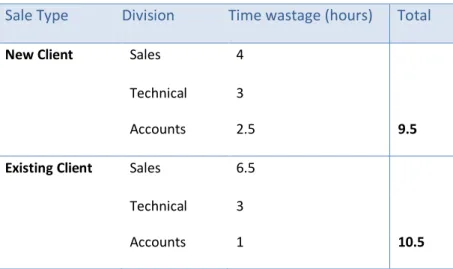
Problems and their causes were analysed and categorised. Time wastage appeared to be the key problem as it had a severe impact on performance, and increased the length of the Sales Process. A Frequency Distribution table, table 3 (below) was formed to group the data recorded for time wastage.
Sale Type Division Time wastage (hours) Total
New Client Sales 4
Technical 3
Accounts 2.5 9.5
Existing Client Sales 6.5
Technical 3
Accounts 1 10.5 Table 3: Frequency distribution for time wastage data
26
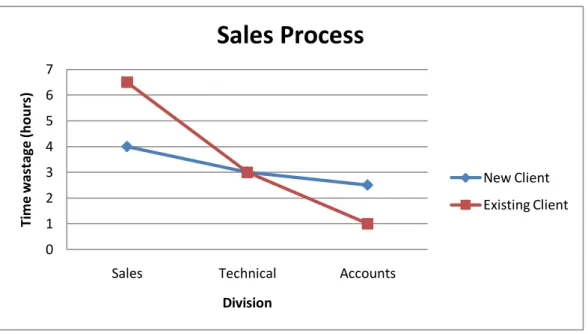
From this, a quantitative data graph was produced to visually illustrate the length of the two variations of the process. The graph (Figure 3 below), represents the time wastage in hours, that was observed per division in the Sales Process. The wastage refers to the length of time that was spent completing activities, in what was perceived to be an inefficient manner. A break-down of the problems and causes in depth follow in section 3.4. However, it was clear from this observation that employees were engaging in many time-wasting activities in order to achieve their daily responsibilities. Figure 3 also represents a comparison of the time wastage that was observed for two types of sale; for a new client, and for an existing one, to highlight to VGL the differences between the two.
The graph below indicates the time wastage for both:
Figure 3: Time wastage observed during the Sales Process for two different clients
The sale to a new client involved a lot of time to be wasted as the new details were duplicated across existing systems. Additionally, time was wasted in locating up-to-date versions of certain documentation the client needed to be sent. In contrast, the sale to an existing client required a lot of time to be spent locating existing order forms and tracking the history of previous orders. As a result of the detailed analysis, it appeared paramount that the process for both sales needed to run more efficiently; potential new customers needed to be won to continue growing the customer base, and existing clients needed to be assured that they were with the right provider; maintaining customer loyalty. This has direct relevance to this title of this project as the key was to improve the Sale Process, and time wastage was clearly an issue that needed to be addressed in order to achieve this. 0 1 2 3 4 5 6 7
Sales Technical Accounts
Ti m e w as ta ge (h o u rs ) Division
Sales Process
New Client Existing Client27
To address this problem area, it seemed a good idea to re-use this graph during an evaluation of the prototyped solution later in the project, to compare the time wastage that was observed here, against a prediction of time wastage if a new system were in place. With the aim of identifying a solution to reduce this time wastage and make the overall Sales Process more efficient, it was hoped that there would be a visible reduction between the first graph and the second.
3.4 Problematic areas and root causes
Subsequent to a lengthy process of data collection and analysis, it was possible for problems and their root causes to be established. The problem owner had initially anticipated that most of the problems experienced were a result of documentation residing in different locations (See Appendix C1). This statement proved to be correct; however underlying issues were also identified as a result of detailed analysis. Time wastage was inherent in all aspects of the Sales Process. Problems followed by a summary of their actual causes are listed below. Each problem has been numbered and later referenced in the requirements specification (section 3.7).
P1 Data Duplication: users printed many documents, some of which required scanning and uploading, or manually typing into other software. Hence, data was duplicated across all systems due to a lack of integration between the existing systems.
P2 Searching: users found it difficult to locate specific information such as contracts and company policies as most of this documentation was paper based. This was due to the lack of a centralised repository where information could be searched for quickly and easily.
P3 Responsiveness: responding to customer queries with quotes and proposals was slow when paper based documentation needed to be referenced. This was due to the lack of document version control. The customer needed to be given accurate up to date information and the NBC struggled to locate this.
P4 Manual checking - before up-selling (sales technique where additional products/services are offered) to an existing client, the NBC was required to manually check purchasing history, order forms and invoices to see if the client was still being billed for the service they originally purchased or whether they had cancelled it since.
P5 Track history – the processing of orders was slow because order track history was not stored in a centralised location. As all systems were remote, it was difficult for the user to track information relevant to a particular sale for a client. If seemed that if this type of information was easily accessible, many activities would be more efficient and time effective.
28
P6 Workflow – the quotation process was lengthy as documents had to be sent back and forwards manually when the NBC was forming a quotation for the client. This was due to the lack of an automated workflow to manage the life cycle of quotation documents
Additional discoveries during data collection included:
P7 Lack of explicit clerical support for filing
P8 Customer Relationship Management tool only held limited information
P9 Security issues - no restrictions for colleagues to see what managers see, and confidential information lacked safe storage
P10 The client was not perceived as being environmentally friendly
P11 Lack of an effective foundation for growth
3.6 Summary of Analysis
An initial analysis provided background to the problems faced, their perceived causes, and the needs required as part of a solution. Whereas, a detailed analysis provided insight into business activities enabling the root causes of problems to be identified.
To summarise, information was collated and manipulated to identify key themes and patterns. As a result of analysis, it was evident that there was scope for improvement particularly in the area of time efficiency. The length of time that VGL could potentially save however, could not be identified until possible solutions had been scoped. Specific themes that emerged during analysis were time consuming searches, data duplication, documentation being prone to human errors, and the lack of integration. The latter was particularly noted for causing a host of the issues, and so it was necessary to ensure that the implications of a new solution were considered before adding an additional remote system into VGL’s IT infrastructure.
Research goals were met and overall this analysis proved to be very useful as it identified that some of the perceived causes of problems differentiated from their actual causes. Business needs were also identified which allowed the initial user requirements to be expanded upon.
3.7 Requirements Specification
Problems and their root causes had been identified by means of a thorough business analysis therefore; it was now possible to translate them into a formal requirements specification. Requirements were documented and categorised based on the findings in the previous chapter, to
29
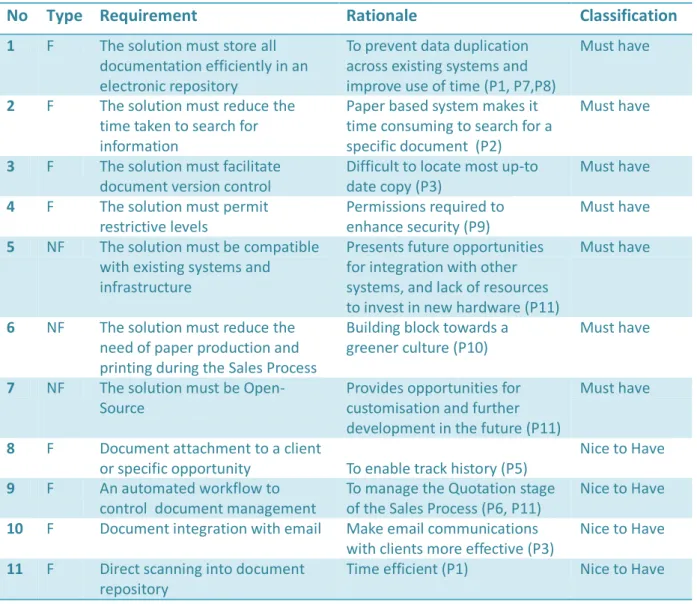
address the problems specified, and a list was devised and sent to the problem owner as a result. This list comprised of the original user requirements that were established following on from the focus group session, in addition to the business needs that were identified during the observation session. Table 4 below, contains the formal ‘must haves’ and ‘nice to have’ requirements that were agreed with the problem owner. Each requirement has been categorised as a Functional (F) or Non-Functional (NF) need.
No Type Requirement
Rationale
Classification
1 F The solution must store all documentation efficiently in an electronic repository
To prevent data duplication across existing systems and improve use of time (P1, P7,P8)
Must have
2 F The solution must reduce the time taken to search for information
Paper based system makes it time consuming to search for a specific document (P2)
Must have
3 F The solution must facilitate document version control
Difficult to locate most up-to date copy (P3)
Must have
4 F The solution must permit restrictive levels
Permissions required to enhance security (P9)
Must have
5 NF The solution must be compatible with existing systems and infrastructure
Presents future opportunities for integration with other systems, and lack of resources to invest in new hardware (P11)
Must have
6 NF The solution must reduce the need of paper production and printing during the Sales Process
Building block towards a greener culture (P10)
Must have
7 NF The solution must be Open-Source
Provides opportunities for customisation and further development in the future (P11)
Must have
8 F Document attachment to a client
or specific opportunity To enable track history (P5)
Nice to Have
9 F An automated workflow to control document management
To manage the Quotation stage of the Sales Process (P6, P11)
Nice to Have
10 F Document integration with email Make email communications with clients more effective (P3)
Nice to Have
11 F Direct scanning into document repository
Time efficient (P1) Nice to Have
Table 4: Requirements Specification
The problem owner’s approval signified that the knowledge which had been gained during data collection and analysis was robust, and so further research in this area was not required.
30
4
Study of Collaborative Tools
Now that the requirements for a solution were firmly in place, it was possible to realise the vision and initiate the process of designing it. This chapter thoroughly examines and condenses the broad concept of collaboration. Collaborative functions were recognised as a result of a literature review, enabling commercial software tools for the client to be identified. Subsequent to a process of comparison and elimination, a short-list of options was produced.
4.1 Literature Review
Literature and case studies on collaborative functions and tools were extensively reviewed to determine types and overlaps. Areas that were explored included workflow, document management, and enterprise content management. It was paramount for the feasibility of such functions to be analysed; this formed the focus of this research.
4.1.1 Overview of Collaboration
Lu, et al, (2009) define collaboration in the business setting as an act of employees efficiently working together to achieve collective goals. Beyerlein, et al, (2002) highlight that effective collaboration has become a critical success factor encompassing many benefits in the workplace, of which include the ability to boost a company’s competitive advantage, and enhance customer satisfaction through increased speed, responsiveness, and quality. Collaborative software, also termed as groupware, enables work carried out on a project by multiple users on different workstations to be integrated into one application, however its key drawback is that it can be quite complex to implement and users often require training (What is Collaborative Software...?The National Business to Business Centre). This research emphasised the many benefits of a collaborative approach. If viable solutions were identified for VGL, it would be necessary to ensure these benefits were realised.
Studies generally indicate that collaborative software has emerged as an important technology in team based processes over recent years as the need for innovation increases. This theory applies to VGL, a growing SME that appears to have capacity for collaboration, and perhaps requires it in order to meet its demands and overcome the challenges faced.
A Collaborative Working Environment (CWE) brings together the information and resources required by managers and employees to run a business on a daily basis, empowering individuals to work more