High-tech entrepreneurial ecosystems: using a
complex adaptive systems framework
Michael Sheriff* and Moreno Muffatto
Department of Industrial Engineering,University of Padua, Padova, Italy
Email: [email protected] Email: [email protected] *Corresponding author
Abstract: The entrepreneurship ecosystem concept has been examined by various scholars resulting in different definitions and the development of various frameworks. High-tech entrepreneurial ecosystems are special types that are closely linked to innovative, high growth firms. We argue that the logic of interpretation of high-tech entrepreneurial ecosystems is quite different from that of national entrepreneurial ecosystems. The latter are guided by national policies and follow mainly a top down approach. This paper posits that the emergence and development of high-tech entrepreneurial ecosystems follow mainly a bottom up approach. For this reason, we have used a complex adaptive systems framework to interpret high-tech entrepreneurial ecosystems. In addition, we have also examined the network effects in these ecosystems. Reflecting on these effects, we have highlighted the additional roles of agents such as universities and local governments in contributing to the success of high-tech ecosystems. Finally, we have developed propositions that could be transformed into testable hypothesis and suggested further research.
Keywords: entrepreneurship; entrepreneurial ecosystems; high-tech; complex adaptive systems; CAS.
Reference to this paper should be made as follows: Sheriff, M. and Muffatto, M. (xxxx) ‘High-tech entrepreneurial ecosystems: using a complex adaptive systems framework’, Int. J. Entrepreneurship and Innovation Management, Vol. X, No. Y, pp.000–000.
Biographical notes: Michael Sheriff is a Research Fellow in the Department of Industrial Engineering at University of Padua. He holds a PhD in Engineering management and a Master in Project and Innovation Management. His research interests are in entrepreneurship, innovation and management. He is a member of the Research Team on Management and Entrepreneurship, Department of Industrial Engineering, University of Padua. He is a member of the Global Entrepreneurship Monitor Team in Italy and an associate coordinator for the research on innovative startups in Italy. He contributes to work in support of the School of Entrepreneurship at the University of Padua. Prior to joining the University of Padua, he has worked in industry as a consultant and mechanical engineer. He has also worked in international organisations as project manager in Europe and Africa.
Moreno Muffatto is a Full Professor of Innovation and Entrepreneurship at University of Padua and a PhD in Management of Innovation. He is a coordinator of the Research Team on Management and Entrepreneurship, Department of Industrial Engineering at University of Padua. He is a Team
Leader of the Global Entrepreneurship Monitor Italy and for the research on Innovative startups of Italy. He is Founder and Director of School of Entrepreneurship at the University of Padua and the Director of Master Program in Project and Innovation Management. He is a research affiliate at International Motor Vehicle Program, Massachusetts Institute of Technology Cambridge MA, USA in 1998 to 2002. He is a Japan Foundation Research Scholar at School of Economics, University of Tokyo, Tokyo, Japan in 1994.
1 Introduction
A basic tenet of entrepreneurship is that entrepreneurs interact with other entities in complex ways when executing entrepreneurial activities. It is on this basis that the notion of entrepreneurial ecosystems emerged. Entrepreneurial ecosystems are analogous to natural ecosystems in some ways. Hence, natural ecosystem as a metaphor can drive studies on entrepreneurship beyond a narrow view, since a natural system is a complex self-organising system (Anggraeni et al., 2007). However, this type of analogy is being questioned since natural systems do not exhibit the capability for intentionality and foresight. According to Iansiti and Levien (2004), business ecosystems show three characteristics that are not evident in natural ecosystems namely: intelligent players, competition and innovation.
The concept of entrepreneurial ecosystems is not new. For example, Italy was well-known for the existence of industrial clusters centuries ago. “Business networks did not start with the Internet” …. “For hundreds of years, the Italian apparel industry has been organized as a loosely connected network of many organizations” [Iansiti and Levien, (2004), p.5]. However, existing entrepreneurship ecosystems are mostly at the national level supporting both necessity and opportunity entrepreneurship. In national entrepreneurship ecosystems, the emphasis is on identifying the building blocks that promotes entrepreneurship and how these blocks are combined to produce a holistic national system for effective entrepreneurship (Isenberg, 2010).
The concept of high-tech entrepreneurial ecosystems (HTEEs) is very recent since these are a special type of ecosystems. They are locally or regionally based and are necessary for the creation of innovative high growth ventures. These types of ventures are crucial to both local and national economic development because high-tech ventures have the highest job multiplier effects (Moretti, 2012). However, less effort has been directed in examining these firms (Levie and Autio, 2013). In HTEEs, the agents change their strategies, structures and the composition of their activities during interactions and as they do so, a selection process emerges which creates more opportunities for surviving agents.
According to Stam (2015), the dominant discourse on entrepreneurial ecosystems is based on several components which are fundamental for success. On the other hand, Feld (2012) emphasised the interaction between agents in the ecosystem. Mason and Brown (2014) emphasised the existence of fertile places as a prerequisite for the emergence of entrepreneurship ecosystems. These places provide new innovative ventures with resources, information, and partners. It is therefore worthwhile to understand the additional roles of agents such as universities and local governments, which are normally location specific, in contributing to the success of such ecosystems.
The purpose of this paper is to support the claim that entrepreneurial ecosystems frameworks at the national level are not suitable for the interpretation of high-tech entrepreneurship ecosystems. We have therefore attempted to interpret high-tech entrepreneurship ecosystems using a complex adaptive systems (CAS) framework to understand the nature and dynamics of the interactions. We have also explored how HTEEs could benefit from network effects. The additional roles of universities and local governments, two of the agents that are fixed to a geographical area and have the potential to influential these ecosystems, were identified. In addition, several propositions were developed for further inquiry.
The remainder of the paper is organised as follows. In Section 2, national and HTEEs are reviewed and compared. The CAS framework is presented in Section 3. The properties of variation, interaction and selection as applied to high tech ecosystems and the network effects are presented in Section 4. What drives the emergence of high-tech entrepreneurship ecosystems is presented in Section 5. The attractiveness of places and the additional roles of local governments and universities are examined in Section 6. The conclusion and suggestions for further research are elaborated in Section 7.
2 National versus HTEEs frameworks
The entrepreneurship ecosystems concept captured the interest of scholars because of the shift from the concept of industrial clusters that underscore the importance of agglomeration toward a more holistic approach that is centred on entrepreneurs. This approach underscore the importance of the agents, their interactions, the locations and the emerging network effects in enhancing the performance of entrepreneurial firms. Different definitions of the concept have been forwarded by various scholars (Moore, 1993; Iansiti and Levien, 2004; Peltoniemi et al., 2005; Isenberg, 2010; Mason and Brown, 2014; Stam, 2015). However, there is no consensus yet on an accepted definition of entrepreneurial ecosystems.
Table 1 Entrepreneurial ecosystem frameworks Global
Entrepreneurship Monitor
GEM Framework (1999) Basic requirements, efficiency enhancers, innovation and business sophistication, individual
attributes, social values, entrepreneurial activity, entrepreneurial output World Bank Doing Business (2002) Policy, infrastructure, regulations World Economic
Forum
Global Competitiveness Index (2004) Policy, finance, infrastructure, human capital, support, culture OECD Entrepreneurship Framework (2006) Policy, finance, infrastructure,
markets, human capital, support, culture, R&D, macroeconomic
conditions Babson College Babson Entrepreneurship Ecosystem
(2010)
Policy, human capital, support, culture
George Mason University
Global Entrepreneurship Development Index (GEDI) (2011)
Policy, finance, markets, human capital, support, culture, R&D
From anecdotal evidence, most of the building blocks of entrepreneurial ecosystems frameworks are similar and Isenberg (2010), suggested that the combination of these building blocks is idiosyncratic due to varying national characteristics. Different frameworks of entrepreneurial ecosystems have been developed and some of these are illustrated in Table 1.
The frameworks are listed according to the year of first publication. The first four are from international organisations while the last two are developed by universities. A few of these frameworks have evolved overtime. For example, the Global Entrepreneurship Monitor (GEM) framework is one of the very few that focus not only on individual entrepreneurial activities but also on social values and personal attributes that may facilitate or hinder such activities (Singer et al., 2015).
Economic ecosystems in the realm of national economies are presumed to be either a stimulant or a hindrance factor to economic growth. Along this reasoning, Baumol et al. (2007) identified four different types of ecosystems namely: oligarchic (power concentrated to a few), state-directed (socialist economies), big-firm (vertically integrated) and entrepreneurial (fast growing small and innovative) and each has its advantages and disadvantages. However, entrepreneurial ecosystems at the national level focus on general entrepreneurship and usually follow a top-down approach. These ecosystems depend on factors such as policies, regulations, finance, education and infrastructure which are typically analysed at the national level. National governments usually focus on these factors in the creation of entrepreneurial ecosystems because they have nationwide effects.
Recently, governments’ intervention is becoming increasingly essential in financing research that specialises in emerging science and technology. But so far, local or regional governments have limited capacities to carry out this function. National governments, on the other hand, are more interested on nationwide economic development and as a consequence view entrepreneurial ecosystems from a wider perspective. The level and mode of government involvement are critical determinants for the success of such systems (Sheriff and Muffatto, 2015). In stressing the role of governments, Mazzucato (2011) argued that governments have not only funded research in the past, but have often been the source of radical innovation. Governments have also been key investors in early stage research and development which the private sector is sometimes reluctant to undertake. In contrast, Mason and Brown (2014) argued that it is difficult to identify any entrepreneurial ecosystem that has emerged through direct government intervention. According to Auerswald (2015), many governments have sought to implement programs to support entrepreneurs but the focus is narrowly confined on financing and training.
Another important concept is that of networks since these are essential for the functioning of entrepreneurial ecosystems whether national or high-tech. These networks are embedded in social and cultural structures (Granovetter, 1985) but they can be bounded by different political and geographical jurisdictions that may usher in restrictions to entrepreneurial activities (Thornton and Flynn, 2003). Since networks are collaborative relationships within ecosystems, and with other ecosystems, they involve social processes with spatial and temporal scales. Networking allows entrepreneurs to have access to resources that are scarce or external to them (Jarillo, 1989). Network ties are especially crucial for startups whose liabilities of newness and smallness (Stinchcombe, 1965) can be mitigated. Positive externalities from networks can make a location very attractive for entrepreneurial activities.
Similar to clusters, ecosystems in some sectors tend to be locally based. A special case of such ecosystems is found in high-tech sectors. A shift in the level of analysis from national to local (regional) is therefore inevitable when considering these ecosystems.
HTEEs is a recent phenomenon, the existing literature is therefore mainly descriptive in nature. Exceptions are the detailed studies conducted on the functioning of matured HTEEs like Silicon Valley and Route 128 by several scholars (Saxenian, 1991; Gibbons, 2000; Kenny and Florida, 2000). These two ecosystems are locally based, they have transformed and revitalised local economies and in the process have created jobs, wealth and economic competitiveness (Feldman et al., 2005). Silicon Valley’s lack of prior industrial experience and its isolation from well established economic and political institutions facilitated experimentation with innovative relationships leading to open and symbiotic ties between Stanford University and local industries (Feldman et al., 2005). This is an example of the importance of universities to high-tech entrepreneurship ecosystems.
The evolution of each region shows important path dependence characteristics. Silicon Valley evolved into the centre of semiconductor industry while Route 128 became the centre of the mini computer industry (Kenny and Von Burg, 1999). Scholars have observed various variables critical to the high-tech development in these two regions including supplier networks, closer proximity to universities, labour mobility, cutting edge technology, abundance of venture capital and entrepreneurship (Storper, 1993; Saxenian, 1994). The main distinction between the two regions is related to cultural differences (Saxenian, 1994). These two entrepreneurial ecosystems are influential models to be considered. However, replicating them in other regions has not been very successful due to idiosyncratic peculiarities. It is therefore evident that local factors played a crucial role in the creation of these ecosystems more than national factors.
HTEEs are a special type of ecosystems that enhance the creation of new innovative high-tech ventures. Such new ventures are different from traditional entrepreneurial ventures due to the fact that their success is not frequent. However, when successful, they can propel economic growth and the creation of jobs to higher levels.
3 CAS framework
The notion of CAS has drawn the attention of scholars from across diverse fields of study such as biology, physics, economics, management and social sciences. Many phenomena in natural and artificial systems are normally impervious to traditional linear analysis methods because the interactions in these systems are nonlinear and complex. Using a CAS approach can help in deriving insights into the dynamics of systems such as high-tech entrepreneurship ecosystems. Four features of CAS commonly found in the literature (Duit and Galaz, 2008) are
1 CAS consist of agents that follow certain behavioural schemata 2 no central authority controls the behaviour of agents which results in
self-organisation
3 co-evolutionary processes driven by agents give rise to temporary and unstable equilibria
4 this in turn generates a changing system behaviour with limited predictability. HTEEs function as prevalently bottom-up systems. They tend to self-organise in the sense that local interactions at the bottom produce mutual coordination and synergy at the top (Heylighen, 2008). This calls for a complexity science approach to address a systematic perspective of entrepreneurship ecosystems along the lines of the interactions of the agents and the emergent patterns. Thus, the properties associated with CAS can be applied to interpret HTEEs. However, to understand the functioning of high-tech entrepreneurship ecosystems as CAS, a notable assumption is that the outcome of the interactions is not arbitrary but exhibit a preference for certain situations over others (Heylighen, 2008).
HTEEs are complex because they have many components which are interdependent. They are adaptive because their feedback structure gives them the ability to adapt in ways that enable survival in a continuous fluctuating environment. The emergence and evolution evident in HTEEs could make sense when interpreted using CAS.
HTEEs are the outcome of interactions of diverse agents driven by different interests and motivations. These agents have their goals and usually direct their actions to maximise their individual fitness, utility and preference. The structure of HTEEs follows a bottom up approach and open participation where agents are not restricted in their interactions and whatever new state that emerges as a result of the interactions is produced by all the agents. The development of such ecosystems can be seen as the process of creating order out of disorder (McKelvey, 2004).
Central to the CAS theory are the concepts of variation, interaction and selection (Axelrod and Cohen, 1999). In variation, a variety of agents continually adapt to enable them to cope with the variation in the environment. An ecosystem must be ready to respond to internal and external changes and there should be a variety of distinct agents to ensure that the ecosystem will cope with any new emerging situation. The diversity of agents therefore influences the ecosystem stability. Multiple interactions are also required to enhance the change processes. These interactions create networks which affect the system. The interactions of the agents are determined by their proximity (physical and virtual) and results in the creation of links (ties) and networks. The stabilised links or ties can be weak or strong, both can be found in networks and are agreed to be positively related to performance (Elfring and Hulsink, 2003). The distribution of the links tends to follow a power law. In other words, there are many agents with few links and few agents with many links also called hubs. By identifying these hubs, it becomes easier to manipulate the dynamics of a network.
The mechanisms of increasing returns exist alongside those of diminishing returns in networks. Performance is affected by these mechanisms since positive feedback tends to magnify the network effects of a system through increasing returns with multiple points of equilibrium. In contrast, negative feedback tends to stabilise the network effects of a system through diminishing returns with a single point of equilibrium (Arthur, 1989).
4 Variation, interaction and selection in high-tech ecosystems
Previous definitions of entrepreneurship ecosystems presented by Mason and Brown (2014), and Stam (2015) focused on the formal and informal interconnectedness of actors, organisations, institutions, processes and factors that support entrepreneurial
activities. While we agree that these definitions encompass entrepreneurship ecosystems in general, it is less clear how they cater for the selection, variation and retention processes that facilitate self-organisation and emergent patterns which are common in high-tech entrepreneurship ecosystems.
As discussed above, CAS are characterised by three fundamental processes namely: variation, interaction and selection. We shall now examine these properties in HTEEs. First and foremost, we shall present a definition of a high-tech entrepreneurial ecosystem. It follows thus:
“High-tech entrepreneurial ecosystems are open complex adaptive systems made up of a variety of agents that interact formally and informally in specific locations. The interactions among agents enhances self-organization and the emergence of loosely coupled connections that facilitates the establishment of high-tech ventures with potential high growth. The selection of agents and their strategies influences the functioning, performance and evolution of the ecosystem.”
4.1 Variation in high-tech ecosystems
The variation of actors influences the performance of entrepreneurship ecosystems. Variation permits a better exploration of possible alternatives and as a consequence, introduces not only flexibility but also improves the velocity of evolution of the ecosystem.
Variation accounts for the variety or diversity of agents or groups of agents and their entrepreneurship strategies. These agents interact both on the basis of their unique objectives, and of the expected results of the interactions. The diverse agents are responsible for the creation, use and exchange of resources within ecosystems. It is therefore imperative to examine the roles of agents in order to be able to facilitate targeted interventions that will sustain entrepreneurship ecosystems. We have focused on the following key agents: startups (new/existing ventures), investors, incubators/ accelerators, large companies, support companies, university and local governments. Each of these agents is free to interact with other agents or groups of agents thus forming sub-systems within the entire system.
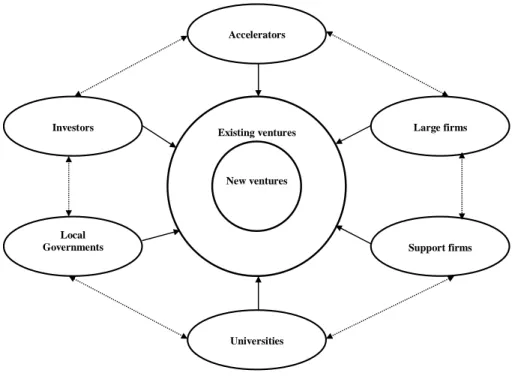
Most of these agents are heterogeneous in terms of their organisational structures and strategies. The differences among the agents determine the variation within the ecosystem while the entry and exit of these agents in the ecosystem contributes to the variety of the ecosystem. However, the number of agents alone is misleading since they do not have equal importance in the functioning and maintenance of the ecosystem. Perhaps, one approach in overcoming this anomaly is to apply Paine’s (1969) notion of keystones. These are agents that play roles disproportionate to their numbers. Thus, the addition or removal of a keystone agent might trigger nonlinear responses that may lead to a fundamental change in the whole ecosystem. Figure 1 shows the main agents of a high-tech entrepreneurial ecosystem. The continuous arrows show links to the startups while the dashed arrows show links between agents.
Comparing this framework to that developed by Isenberg (2011), shows similarities in the number of domains and in some agents such as (governments/policy; investors/ finance; support firms/support; universities/human capital). The differences are that while Isenberg’s framework consists of culture, markets and general entrepreneurship which are typical at the national level, this framework consists of accelerators, large companies
and high-tech entrepreneurship at the local or regional level. This is due to the fact that high-tech entrepreneurship ecosystems are a special form of general entrepreneurship ecosystems which focuses on innovative high-growth entrepreneurship in high-tech sectors.
Figure 1 Key agents of a high tech entrepreneurial ecosystems
Existing ventures New ventures Accelerators Universities Local Governments Investors Support firms Large firms
From Figure 1, it is evident that some of the key agents are made up of populations of agents (e.g., groups of founders). Internal interactions within these populations and external interactions across populations occur within ecosystems. Startups (new and existing ventures) are placed at the centre since all the other agents focus on contributing to the launching of new ventures some of which then mature to become established companies. The launching of new ventures is a continuous process and the number of innovative startups, at any point in time, is one of the performance measures of a successful high-tech entrepreneurship ecosystem.
4.1.1 Startups (new/existing ventures)
Potential, nascent, novice and experienced entrepreneurs in the high-tech sectors are all present in HTEEs. These entrepreneurs need various kinds of input from other agents. The support for potential entrepreneurs is mainly awareness creation while nascent entrepreneurs need information and advice. Novice entrepreneurs, operating newly launched startups need support in mentoring and accelerating their ventures. Successful experienced entrepreneurs give support to new ventures by reinvesting their time, finances and expertise. All of these agents are critical to the success of ecosystems. Since
one of the metrics to measure the success of ecosystems is the number of successful new ventures, it is assumed that having a critical mass of the different types of entrepreneurs will yield positive outcomes.
In contributing to the development of HTEEs, entrepreneurs should utilise their social competence and capital (Phelan et al., 2006) in forming networks. These networks can mitigate the liability of newness and smallness of high-tech startups. Entrepreneurs should occupy a strong position within the ecosystem otherwise even though an ecosystem exists, it cannot effectively enhance their activities. By occupying a central position, entrepreneurs are likely to access all the benefits that the ecosystem offers. However, certain standards of behaviour are expected from entrepreneurs who form part of the ecosystem. Those who fall short of the expected standard will quickly find themselves and their ventures isolated.
4.1.2 Investors
Access to finance remains a critical barrier to the success of entrepreneurial ventures. Angel investors and venture capital either contribute sequentially or simultaneously in supporting startups (Dutta and Flotta, 2016). There are key funding stages at every stage of entrepreneurial ventures and in the not too distant past, startups used to search for investors. However, in recent times, the opposite is happening with investors scouting for high potential startups.
Investors are a key factor in the emergence and growth of high technology ecosystems and their main function lies in financing new ventures that would otherwise find it difficult to find investors elsewhere. Investors also support existing ventures through difficulties, when moving from one stage to another and when expanding. In return for their investments, they ask for equity which qualifies them to become partial owners of ventures. Sometimes, they demand direct representation in the board. Venture Capital usually look for places where there is a potential for exceptionally profitable investment opportunities.
Recently, alternative financing has emerged as a grass root phenomenon following the financial crisis. It shows innovation in terms of business models and technology platforms which are decentralised (Wardrop et al., 2015). Alongside traditional financing mechanisms, high-tech entrepreneurial ventures benefit from the presence of alternative financing mechanisms in an ecosystem. However, financing of innovative ventures has to overcome the problem of double trust (Cooter and Schäfer, 2012). The investor wants assurance that the investment is sound while the entrepreneur wants to make sure that innovative ideas are not leaked or stolen. The root cause might lie in information asymmetry and a plausible solution that conveys trustworthy information to both parties might come from a robust high-tech entrepreneurship ecosystem.
4.1.3 Incubators/accelerators
Incubators and accelerators involve programs that help entrepreneurs accelerate entry into the market. They operate by attracting founders to work intensively on their ideas for a period of time. Accelerators can be differentiated by their value proposition and business model. They act as facilitators for investments from institutional investors and intermediaries between startups and large companies. Accelerators assist in team building, idea tuning and guiding new ventures from idea to product launch. They serve a
dual function as deal sorters and deal accelerators from the perspective of venture capital investors. Accelerators and incubators can offer entrepreneurs with good opportunities to enhance the growth of their ventures. The proximity of accelerators is an advantage for HTEEs.
4.1.4 Support firms
Support firms play a vital role in high-tech ecosystems. These are firms that provide the necessary services to other agents within the ecosystem. There are several intermediary companies in any ecosystem. A few notable ones are law, accounting and management consulting firms. Recruitment firms that identify and recruit staff and entrepreneurial connectors that connect entrepreneurs are all service firms within ecosystems.
Another type of service firms facilitates relationship building between the different agents within ecosystems. These firms are networking organisations, business, consumer and prosumer associations. Linking universities to HTEEs is also a function of support firms.
4.1.5 Large firms
Large companies can collaborate with new ventures in the early stages as development, production and distribution partners. Their operations and reputations can enhance the acceptance of a product or technology in the market. Flourishing ecosystems need large companies to enhance knowledge spillovers and access to information through informal and formal networks. The collaboration of larges companies and new ventures is essential in ensuring the success and performance of ecosystems. The proximity of large companies plays an important role.
4.1.6 Universities and research centres
Universities are responsible for nurturing talent pools and technology transfer. They develop and patent technological inventions. They also offer consulting services for businesses. As the commercialisation of knowledge is one of the functions of universities, researchers in universities are developing ideas with a potential for commercialisation through technology transfer offices.
The third mission of universities is concerned with the generation, application and exploitation of knowledge beyond the academic borders. This trajectory is having a major impact on the character of universities. Research centres focus mainly on conducting applied research for commercialisation.
The development of entrepreneurship educational programs rests with universities. However, it could be advisable for these programs to be located in departments where the invention occurs such as in science and engineering departments to improve their effectiveness. Some of the factors that link universities to ecosystems include patenting, ease of access to information and knowledge and the diffusion of research breakthroughs. The proximity, type, orientation, policies and strategies of universities are important determinants for the successful participation of universities.
4.1.7 Governments
Governments influence high-tech ecosystems in various ways. The interaction between governments and high-tech ecosystems takes different forms depending on the approach of governments. Local governments are expected to play a more active role in high-tech ecosystems because they are locally based and are responsible for the development of their defined area of responsibility. Recently, local governments have been engaged in their own forms of economic policy in diverse sectors. This economic decentralisation operates at different administrative levels: especially the city, the municipality and the region. The local authorities seek new combinations to derive strong competitive advantages and the trend toward the internationalisation of regions prompts them to get involved with the entrepreneurial activities of the region.
Central governments have contributed to research and have been participating in innovation. They have also contributed in the creation of markets and are also active in the creation of networks. Government policy is not just in areas related directly to entrepreneurship, but it includes other areas such as taxation and immigration which are indirectly related to entrepreneurship. Such policy is expected to foster linkages between new ventures and other agents within ecosystems to stimulate innovation.
We summarise our insights regarding agents for successful HTEEs in the following propositions.
Proposition 1a The existence of a variety (diverse typologies) of agents enhances the emergence of a high-tech entrepreneurial ecosystem.
Proposition 1b The number of agents (of diverse typologies) enhances the development of a high-tech entrepreneurial ecosystem.
4.2 Interactions in HTEEs
Proximity plays an important role in the functioning of ecosystems. Interactions within ecosystems are strongly influenced by different types of proximities. Some of which are namely: spatial proximity, temporal proximity, processes proximity, organisational proximity, virtual proximity and cultural proximity.
Agents engage in open interaction and participation within ecosystems. Open participation is expected to enhance loosely coupled ties with decentralised decision-making. However, this does not mean a total lack of organisation. It only ensures the absence of an inflexible top-down approach which may hamper the smooth functioning of high-tech ecosystems. Agents view the ecosystem from different perspectives and are therefore tempted to apply different strategies when interacting with other agents and the environment. The concept of strategic fit enhances such interactions. Flexibility of strategies contributes to the variation within the ecosystem. The agents can freely explore and exploit alternative strategies during the process of interaction.
An alternative approach suggests that complexity does not emerge from a large number of interacting factors but rather from a smaller number of controlling processes. Since ecosystems are self-organised, only a small number of critical processes are required to create and maintain this self-organisation (Gunderson and Holling, 2001). The quality of these processes is determined by the speed and the frequency of interaction among all agents. Continuous interactions are involved in these routine processes in
HTEEs. These interactions create adaptive cycles which are responsible for the evolution of high-tech ecosystems.
The adaptive cycles occur in scales ranging from lower to higher levels. For example, at lower levels, founders of new ventures informally interact amongst themselves while at intermediate levels, new ventures formally interact amongst themselves. At higher levels, new ventures interact with other agents such as accelerators and venture capital among others. Each level communicates information to the next level and feedback to the lower level, and as long as these interactions and communications are maintained, the interactions within levels can be transformed with no disturbance to the whole system. The interactions within levels increase the rate of evolution.
Emergent properties such as the springing up of new unexpected structures and patterns at higher levels of ecosystems are as a result of the interactions and evolution of individual agents at lower levels. The emergent structures and patterns are qualitatively different from the original structures at lower levels.
Interactions also occur between local ecosystems and global networks. Linking local ecosystems to global networks produces dyadic benefits. Such links influence local agents who are expected to adjust or adapt in the presence of global networks. Elements like idea generation and team building are increasingly becoming loosely coupled with local ecosystems and can be obtained from global networks. Open innovation and knowledge exchanges catalyze these linkages.
Agents could operate at both local ecosystems and global networks like the foreign-born, technically skilled entrepreneurs who travel between well established technological ecosystems and their home countries to launch companies. These individuals form the pillars of brain circulation according to Saxenian (2005). This new relationships in high-tech ecosystems can propel little known ecosystems to prominence. Connecting local ecosystems to global networks will bring more advantages to regions with less developed ecosystems as they can be linked to better positioned ecosystems along relevant axis.
We summarise the discourse on interactions with the following propositions. Proposition 2a Agents with a high-tech strategy produce valuable interactions with
other agents in a high-tech entrepreneurial ecosystem. Proposition 2b The development and evolution of a high-tech entrepreneurial
ecosystem is influenced by the level and quality of the interactions among agents.
Proposition 2c The quality of the ecosystem depends on the quality of action carried out by each agent towards innovation and entrepreneurship.
Proposition 2d The existence of different types of proximities is positively correlated to the frequency of the interactions.
4.3 Selection in HTEEs
Selection in high-tech ecosystems accounts for the separation of agents into winners and losers. Winners are retained and continue to operate within the ecosystem while losers may exit the ecosystems since they cannot survive or adapt. The number of winners and losers is related to the performance of the ecosystem. Selection is linked to the evolution of HTEEs through the continuous entry and exit of agents. The evolution of high-tech
ecosystems as they adapt to their environments is defined by the potential, connectivity and resilience of these systems. These properties determine the future state of ecosystems.
High-tech ecosystems need to be constantly monitored through measurements to provide information about performance. Such performance measurements could provide information to raise awareness and to contribute to policy decisions for the improvement of these ecosystems. A failure to measure the performance of the various agents and processes in ecosystems as well as ecosystems as a whole, will usher in difficulties in improving existing ecosystems. Various approaches have been used to measure the performance of ecosystems. However, most of these approaches measure entrepreneurship ecosystems at the national level. Different metrics are needed to measure the performance HTEEs. Some of the indicators of productivity have both quantitative and qualitative attributes. These are as follows: number of new entrepreneurs; number of female entrepreneurs; number of young entrepreneurs; number of foreign entrepreneurs; number of new ventures; new ventures growth rate; inflow of capital investments; talent acquisition; talent retention; new jobs generated; number of new ventures sold; number of initial public offerings (IPOs).
We develop the following propositions with regards to the performance measurement of HTEEs.
Proposition 3a A new set of key performance indicators is required to measure the performances of HTEEs.
Proposition 3b Performance indicators produce signalling effects for the attraction of new agents to high-tech entrepreneurship ecosystems.
4.4 Network effects in high-tech ecosystems
Network effects allow agents in HTEEs to incur explicit benefits when these agents align their activities to those of others. These effects create a situation in which the survival of an agent is affected by the behaviour of other agents. For example entrepreneurs can benefit from knowledge spillovers from large companies and when similar knowledge producing agents enter the ecosystem, these benefits are expected to be increased. Similar situations are envisaged with other agents such as investors. Positive feedback reinforces success and aggravates losses. Positive feedback or increasing returns generate instability by amplifying the ecosystem. High-tech ecosystems show positive feedback by promoting successful agents to achieve more success and failing agents to fail further thus exiting the ecosystem.
The performance of high-tech entrepreneurship ecosystems therefore depends on network effects. In a network, an agent is supposed to take into account both his strategies and activities and those of the other agents. The quantity and quality of the agents will affect the network effects. High-tech ecosystems should be able to attract a high number of quality agents for them to be successful. Reaching a critical mass of agents is therefore essential. Critical mass induces threshold behaviour or tipping points where small events might trigger changes that are irreversible. Hence seemingly stable ecosystems can suddenly undergo complete transformations. Without a critical mass, HTEEs are vulnerable because the loss of any keystone agent would hinder the survival of ecosystems. To build such a critical mass, all the keystone agents should be present
within the ecosystem. Some agents that are not available locally should be attracted. The threshold effects and surprising behaviours of high-tech ecosystems can have alluring consequences when they cascade across scale (cities to regions) and time (sudden to delayed impact). We developed the following proposition with regards to network effects.
Proposition 4a The development of HTEEs is possible when the necessary variety of agents reached a critical mass.
Proposition 4b Network effects positively influence the possibility of exponential growth in HTEEs.
5 What drives the emergence of high-tech entrepreneurship ecosystem?
The emergence of high-tech entrepreneurship ecosystems might be driven by many reasons ranging from governments desire to boost economic growth to entrepreneurs desire to nurture and launch innovative ventures. The presence of a variety of agents in a geographic area coupled with the active and effective role each agent plays can enhance the emergence of high-tech entrepreneurship ecosystems. The existence of keystone agents which are fixed to a geographical area and the proximity of these agents can reinforce efforts geared towards the emergence of such ecosystems.
The problem is that most entrepreneurs are not connected to one another as they often work in isolation. Collective innovative entrepreneurs’ efforts are needed to address their entrepreneurial needs and this can be achieved through the cultivation of a high-tech entrepreneurship ecosystem. The business needs of entrepreneurs most times push them to form networks to access information and resources that they do not possess. These networks usually grow to incorporate formal institutions both in the private and public sectors. Governments sensing and feeling the impact of these networks usually try to get involved to provide support. This is one of the ways HTEEs are cultivated using a bottom up approach driven by the needs of entrepreneurs. Such HTEEs are usually more successful because they are locally placed owned by the agents and are not imposed by governments. In such ecosystems, entrepreneurs occupy a central position.
Recently, entrepreneurs are beginning to congregate and co-locate in entrepreneurial munificent environments where they can mingle with other entrepreneurs and have access to information and support. This can help them to share ideas and practice open innovation (Katz and Wagner, 2014). The need for economic, physical and networking assets is paramount to entrepreneurs and factors such as proximity, density, a variety of agents and firms, and new technologies contribute to entrepreneurial success. Entrepreneurs can have access to these assets through HTEEs.
By understanding HTEEs as bottom up systems initiated by entrepreneurs to address their needs, policy could focus on providing support for entrepreneurs to address these needs rather than on improving a geographic area by developing science parks, incubators and innovation support programs. Such policies may have less impact and may completely ignore the key factors that drive the success of HTEEs.
6 Why location matter
The localisation of economic activity has long been noticed by researchers. Some studies have provided confirmation of the clustering phenomena of entrepreneurship (Glaeser and Kerr, 2009; Delgado et al., 2010). Other studies have gone beyond examining the localisation of high-tech entrepreneurship to examine the differences in the level of activity across regions (Saxenian, 1996; Feldman, 2001).
When analysing the development of high-tech ecosystems, a common pattern that is observed is the regional concentration of industrial sectors. Plausible explanations range from the presence of big cities to the presence of top quality universities that enhance knowledge spillovers (Henderson et al., 1995). However, these geographically localised knowledge spillovers have proved insufficient to explain how research in universities is crucial for local economic impact and therefore seem unconvincing to policy makers. There is therefore a need to examine and measure the direct and indirect effects of knowledge spillovers due to the closeness of industries to universities.
High-tech ecosystems are very much differentiated and their location matters a lot. Entrepreneurial ecosystems at the national levels are normally related to national competitiveness issues while those at local levels are seen as systems to cultivate new technology-based companies for local or regional economic development as well as competitiveness.
Location matters for some elements of ecosystems (entrepreneurial culture, universities, taxation, local government policies) which are idiosyncratic. But location matters less, for other elements (idea generation and founders, hiring and workforce) which are less location specific. To cultivate high-tech ecosystems, an inventory of the resources present in a geographic area is essential. Since high-tech entrepreneurship is likely to occur at specific locations, individuals are likely to start ventures in locations where they have established business relations and have access to resources. In addition, some individuals are grounded in a location due to family commitments. High-tech ecosystems cannot be created just anywhere, they need places bestowed with an abundance of specific characteristics.
Geographic proximity also plays an important role in enhancing other proximities such as social, organisational, institutional and cognitive proximities (Guerini et al., 2013). The reason why some places are better than others is due to the presence of some of the following: an industrial structure which enhances entrepreneurship, higher levels of education, wider work experiences and the presence of migrants, solid financial institutions and an active local government.
Qualities that distinguished dynamic entrepreneurial places from the rest include resilience, creativity, initiative taking and diversity. The creation of such characteristics depends on the presence of elements such as research funding; territorial knowledge management; systematic method of support; incubators; venture capital and policy interventions.
Key themes bearing on competition among local ecosystems include the presence of big cities and entrepreneurial universities. The emergence of new ventures in the high-tech sector has replaced the struggle for traditional entrepreneurial ventures in the race towards local economic development. Localities therefore compete in the nurturing of new ventures that have high growth potential. Thus the competition is redefined in favour of special agents that would contribute to the success of innovative startups. The
competition among local ecosystems to attract a critical mass of these special agents is very intensive. Local governments and universities are therefore expected to play significant roles in such a competition.
6.1 The role of universities
Research and technology intensive universities have a dramatic impact on the milieus where they are located. These institutions should have a strong science and engineering resource base and the ability to attract financial resources at both local and global levels to fund research. The introduction of formal and experimental entrepreneurship education will have a strong influence on the entrepreneurial activities of a region. The encouragement of interdisciplinary activities both internally and externally will enhance collaboration and the formation of partnerships. The establishment of intermediary institutions to forge links between universities and high-tech businesses could be one approach to achieve success. The role of universities is crucial to a vibrant innovation driven entrepreneurship ecosystem (Chisholm et al., 2014).
However, some scholars (Power and Malmberg, 2008) have argued that universities are perhaps not very tightly coupled into regional entrepreneurial ecosystems on the premises that regional excellence which comprises the three dimensions of research, innovation and value creation especially in science and technology can best be secured by concentrating on the best possible resources and talents irrespective of their location.
While we believe that universities play a vital role in regional HTEEs, this does not mean that all universities are inclined to participate or support entrepreneurial activities. Most universities in regions are still focusing on the teaching and research missions. To transform these universities into entrepreneurial universities of excellence, the ‘Third Mission’ which focuses on university engagement eith society for societal economic development should be emphasised. However, Brown (2016) challenged the belief that all universities should be vital entrepreneurial actors in all regions using data from Scotland. This is in line with our belief mentioned above. For universities to accomplish their missions effectively, they need the support of regional and local governments. A policy shift from an earlier focus on general engagement to entrepreneurial engagement will increase the effectiveness of universities in contributing to regional economic development.
6.2 The role of local governments
Local governments can be the stewards of successful high-tech ecosystems in regions. Through pertinent policy and regulation, they are in a unique position to intervene in the creation and support of these systems. This could be achieved by attracting a variety of agents like venture capital, large companies, support services, incubators and accelerators. Flexibility with rules and regulations to facilitate the smooth operations of these agents would be beneficial. Cultural aspects are also very important for the attraction of agents to a region. The affinity between the culture of potential agents to be attracted and those already present in a region will facilitate the attraction process.
A strategy to create an environment for the promotion of high-tech entrepreneurship should be a priority. But an obstacle concerns the screening of adaptive and non-adaptive agents that exist in an ecosystem. Local governments cannot determine the non-adaptive agents until the ecosystem selects them out. Strategies employed by local governments
should therefore focus on creating a situation where an increasing number agent that contributes to the creation of high-tech ventures is retained.
Regional partnerships between local governments, industry associations, universities, financial institutions, entrepreneurial associations can help in producing a collective impact. Regions interested in creating HTEEs should be highly intentional and committed to sustain public and private partnerships that promote high-tech entrepreneurship. These regions should take a comprehensive approach by providing a consistent environment that focus on developing local agents within regions while at the same time reaching out to attracting foreign agents.
As local authorities are expected to develop initiatives for economic growth, high-tech entrepreneurship ecosystems of localities could be used for this purpose. Comparisons of the performances of these ecosystems will show the leaders and the laggards within regions. Such analysis could be useful to central governments in formulating policies for enhancing the economic development of regions.
Proposition 5a Universities with an entrepreneurial attitude are more effective to support the emergence of HTEEs.
Proposition 5b Local governments with an entrepreneurial orientation are more effective to support the emergence of HTEEs.
7 Conclusions and further research
Having the entrepreneurial infrastructure alone in regions is necessary but not sufficient to guarantee a successful entrepreneurial ecosystem since most dynamic HTEEs are supported by strong networks that link entrepreneurs together. HTEEs also contribute to a growing pool of innovative entrepreneurs through positive network effects. Research and practice is therefore focusing on the importance of reinforcing entrepreneurial networks and connections between entrepreneurs, investors, universities, local and central governments, support organisations and large companies.
The orientation towards high-tech new ventures is gaining momentum and special entrepreneurial ecosystems are needed to facilitate the launching of such ventures. Much of what we have presented has been directed to the emergence of these ecosystems. The structure and interactions we have identified follow a bottom up approach which is identical to CAS.
First, we have shown that high-tech entrepreneurship ecosystems are different from nationwide entrepreneurial ecosystems. A new definition of HTEEs has been presented. We have shown that by applying CAS, a better understanding of the development and structure of HTEEs will be derived since these are bottom up systems that generate new patterns (high growth ventures) through complex nonlinear interactions among a plethora of heterogeneous and autonomous agents.
Second, we have identified seven dissimilar agents (Startups; Investors; Universities; Accelerators; Large companies; Support companies; and Local governments) and the characteristics of the surrounding locations for the successful functioning of such ecosystems. We have also shown why some places perform better than others in the creation of HTEEs. The significance and benefits of linkages between locally based HTEEs and global networks of high-tech sectors has been explained.
Third, we have examined the role of universities and local governments in attracting other agents that are not locally based. In this stream, entrepreneurial universities are better suited than other types of universities in enhancing HTEEs. Local governments should focus their strategies for the creation of HTEEs.
Finally, we have advanced several propositions that could be transformed into testable hypotheses. The propositions address issues related to the agents, interactions, network effects, performances, locations and the additional roles of universities and local governments.
This work shows that the dichotomy between high-tech entrepreneurship ecosystems and traditional entrepreneurship ecosystems can be understood without losing the characteristics of each. The former are mainly bottom up regional systems as opposed to the latter which are mainly top up national systems. As this is a preliminary research, the topic of HTEEs needs further studies to understand how they function and how they impact local communities and regions. In this vein, longitudinal studies and empirical analysis will be effective in advising regional policy makers. The interaction between HTEEs and global networks is an area that calls for further inquiry to have a profound understanding about the benefits of such linkages. Comparing the performances of high-tech ecosystems with similar agents and processes but located in different places is another area for further research.
References
Anggraeni, E., Hartigh, E.D. and Zegveld, M. (2007) ‘Business ecosystem as a perspective for studying the relations between firms and their business networks’, Paper presented at the
ECCON Annual Meeting.
Arthur, W.B. (1989) ‘Competing technologies, increasing returns and lock-in by historic events’,
The Economic Journal, Vol. 99, No. 394, pp.116–131.
Auerswald, P. (2015) Enabling Entrepreneurial Ecosystems: Insights from Ecology to Inform Effective Entrepreneurship Policy, Kauffman Foundation Research Series on City, Metro and Regional Entrepreneurship.
Axelrod, R. and Cohen, M.D. (1999) Harnessing Complexity: Organizational Implications of a Scientific Frontier, Free Press, New York.
Baumol, W. J., Litan, R.E. and Schramm, C.J. (2007) Good Capitalism, Bad Capitalism and the Economics of Growth and Prosperity, Yale University Press, New Haven, CT.
Brown, R. (2016) ‘Mission impossible: entrepreneurial universities and peripheral regional innovation systems’, Industry and Innovation, Vol. 23, No. 2, pp.189–205.
Chisholm, D. et al. (2014) Increasing Innovation-Driven Entrepreneurship in Scotland Through Collective Impacts, REAP Report, Highlands and Islands Enterprise/Scottish Enterprise [online] http://www.hie.co.uk (accessed 7 January 2016).
Cooter, R.D. and Schäfer, H-B. (2012) Solomon’s’ Knot: How Law Can End the Poverty of Nations, Princeton University Press, Princeton.
Delgado, M., Porter, M.E. and Stern, S. (2010) ‘Clusters and entrepreneurship’, Journal of Economic Geography, Vol. 10, No. 4, pp.495–518.
Duit, A. and Galaz, V. (2008) ‘Governance and complexity: emerging issues for governance theory: governance’, An International Journal of Policy, Administration and Institutions, Vol. 21, No. 3, pp.311–335.
Dutta, S. and Flotta, T.B. (2016) ‘A comparison of the effects of angels and venture capitalists on innovation and value creation’, Journal of Business Venturing, Vol. 31, No. 1, pp.39–54.
Elfring, T. and Hulsink, W. (2003) ‘Networks in entrepreneurship: the case of high-technology firms’, Small Business Economics, Vol. 21, No. 4, pp.409–422.
Feld, B. (2012) Startup Communities: Building an Entrepreneurial Ecosystem in Your City, John Wiley & Sons, Hoboken, New Jersey.
Feldman, M.P. (2001) ‘The entrepreneurial event revisited: an examination of new firm formation in the regional context’, Industrial and Corporate Change, Vol. 10, No. 4, pp.861–891. Feldman, M.P., Francis, J. and Bercovitz, J. (2005) ‘Creating a cluster while building a firm:
entrepreneurs and the formation of industrial clusters’, Regional Studies, Vol. 39, No. 1, pp.121–149.
Gibbons, J.F. (2000) ‘The role of Stanford University: a dean’s reflections’, in Moon Lee, C. et al. (Eds.): The Silicon Valley Edge: A Habitat for Innovation and Entrepreneurship, pp.200–217, Stanford University Press, Stanford, California.
Glaeser, E.L. and Kerr, W.R. (2009) ‘Local industrial conditions and entrepreneurship: how much of spatial distribution can we explain’, Journal of Economics and Management Strategy, Vol. 18, No. 3, pp.623–663.
Granovetter, M.S. (1985) ‘Economic action and social structure: the problem of embeddedness’,
American Journal of Sociology, Vol. 91, No. 3, pp.481–510.
Guerini, M., Bonaccorsi, A. and Colombo, M.G. (2013) ‘The role of geographical, social and cognitive proximity in collaborations between high-tech entrepreneurial ventures and universities’, Paper presented at the 35th DRUID Celebration Conference, 17–19 June, Barcelona, Spain.
Gunderson, L.H. and Holling, C.S. (Eds.) (2001) Parnachy: Understanding Transformations in Human and Natural Systems, Island Press, Washington, DC.
Henderson, V., Kuncoro, A. and Turner, M. (1995) ‘Industrial development in cities’, Journal of Political Economy, Vol. 103, No. 5, pp.1067–1090.
Heylighen, F. (2008) ‘Complexity and self-organization’, in Bates, M.J. and Maack, M.N. (Eds.):
Encyclopedia of Library and Information Sciences, Taylor & Francis.
Iansiti, M. and Levien, R. (2004) ‘Strategy as ecology’, Harvard Business Review, Vol. 82, No. 3, pp.68–78.
Isenberg, D. (2010) ‘The big idea: how to start an entrepreneurial evolution’, Harvard Business Review, Vol. 88, No. 6, pp.41–50.
Isenberg, D. (2011) The Entrepreneurship Ecosystem Strategy as a New Paradigm for Economic Policy: Principles for Cultivating Entrepreneurship, Babson Entrepreneurship Ecosystem Project, Babson College, Babson Park, MA.
Jarillo, J.C. (1989) ‘Entrepreneurship and growth: the strategic use of external resources’, Journal of Business Venturing, Vol. 4, No. 2, pp.133–147.
Katz, B. and Wagner, J. (2014) The Rise of Innovation Districts: A New Geography of Innovation in America, Metropolitan Policy Program, Brookings.
Kenny, M. and Florida, R. (2000) ‘Venture capital in Silicon Valley: fueling new firm formation’, in Kenny, M. (Ed.): Understanding Silicon Valley: The Anatomy of an Entrepreneurial Region, pp.98–123, Stanford University Press, Stanford, California.
Kenny, M. and Von Burg, U. (1999) ‘Technology, entrepreneurship and path dependency: industrial clustering in Silicon Valley and Route 128’, Industrial and Corporate Change, Vol. 8, No. 1, pp.67–103.
Levie, J. and Autio, E. (2013) ‘Assessing regional innovative entrepreneurial ecosystems with the global entrepreneurship and development index’, Paper presented at the Global Entrepreneurship Monitor Research Conference, 19 June, Barcelona, Spain.
Mason, C. and Brown, R. (2014) Entrepreneurial Ecosystems and Growth Oriented Entrepreneurship, Final Report to OECD, Paris.
McKelvey, B. (2004) ‘Toward a complexity science of entrepreneurship’, Journal of Business Venturing, Vol. 19, No. 3, pp.313–343.
Moore, J.F. (1993) ‘Predators and prey: a new ecology of competition’, Harvard Business Review, Vol. 71, No. 3, pp.75–86.
Moretti, E. (2012) The New Geography of Jobs, Houghton Mifflin Harcourt, Boston.
Paine, R.T. (1969) ‘A note on tropic complexity and community stability’, The American Naturalist, Vol. 103, No. 929, pp.91–93.
Peltoniemi, M., Vuori, E. and Laihonen, H. (2005) ‘Business ecosystem as a tool for the conceptualization of the external diversity of an organization’, Proceedings of the Complexity, Science and Society Conference, Liverpool, Great Britain.
Phelan, S., Dalgic, T., Li, D. and Sethi, D. (2006) ‘The development of entrepreneurial networks: a necessary condition for international new ventures’, Strategic Management Review, Vol. 1, No. 1, pp.1–21.
Power, D. and Malmberg, A. (2008) ‘The contribution of universities to innovation and economic development: in what sense a regional problem?’, Cambridge Journal of Regions, Economy and Society, Vol. 1, No. 2, pp.233–245.
Saxenian, A. (1991) ‘The origins and dynamics of production networks in Silicon Valley’,
Research Policy, Vol. 20, No. 5, pp.423–437.
Saxenian, A. (1994) Regional Advantage: Culture and Competition in Silicon Valley and Route 128, Harvard University Press, Cambridge, MA.
Saxenian, A. (1996) ‘Inside-out: regional networks and industrial adaptation in Silicon Valley and Route 128’, Cityscape: A Journal of Policy Development and Research, Vol. 2, No. 2, pp.41–60.
Saxenian, A. (2005) ‘From brain drain to brain circulation: transitional communities and regional upgrading in India and China’, Studies in Comparative International Development, Vol. 40, No. 2, pp.35–61.
Sheriff, M. and Muffatto, M. (2015) ‘The present state of entrepreneurial ecosystems of selected countries in Africa’, African Journal of Economic and Management Studies, Vol. 6, No. 1, pp.17–54.
Singer, S., Amoros, J.E. and Moska, D. (2015) The Global Entrepreneurship Monitor, The 2014 Global Report.
Stam, E. (2015) ‘Entrepreneurial ecosystems and regional policy: a sympathetic critique’,
European Planning Studies, Vol. 23, No. 9, pp.1759–1769.
Stinchcombe, A.L. (1965) ‘Social structures and organizations’, in March, J.G. (Ed.): Handbook of Organizations, pp.142–193, Rand McNally, Chicago.
Storper, M. (1993) ‘Regional worlds of production: learning and innovation in the technology districts of France, Italy and the USA’, Regional Studies, Vol. 27, No. 5, pp.433–455. Thornton, P.H. and Flynn, K.H. (2003) ‘Entrepreneurship, networks and geographies’, in Acs, Z.J.
and Audretsch, D.B. (Eds.): Handbook of Entrepreneurship Research, pp.401–433, Kluwer Academic Publishers, Great Britain.
Wardrop, R., Zhang, B., Rau, R. and Gray, M. (2015) Moving Mainstream, The European Alternative Finance Benchmarking Report, University of Cambridge and EY.