A super-aggregation strategy for multi-homed mobile hosts
with heterogeneous wireless interfaces
Cheng-Lin Tsao•Shruti Sanadhya• Raghupathy Sivakumar
Springer Science+Business Media New York 2014
Abstract Most mobile devices today are equipped with multiple and heterogeneous wireless interfaces. In this paper we ask the following question: What is the best approach to leverage the multiple interfaces available at a mobile device in terms of the performance delivered to the user? In answering the question we argue that simple ‘‘bandwidth aggregation’’ approaches do not provide any meaningful benefits when the multiple interfaces used have highly disparate bandwidths as is true in many practical environments. We then presentsuper-aggregation, a set of mechanisms that in tandem use the multiple interfaces intelligently and in the process is able to achieve a per-formance that is ‘‘better than the sum of throughputs’’ achievable through each of the interfaces individually. We prototype super-aggregation on both a laptop and the Go-ogle Android mobile phone and demonstrate the significant (up to 3 throughput) performance improvements it pro-vides in real-world experiments. We conduct both theo-retical analysis and extensive experiments to show that super-aggregation is able to improve throughput beyond the sum of the parts under most of the cases.
Keywords Mobile devices Heterogeneous networks Bandwidth aggregationWiFiCellular networks TCP
1 Introduction
Most mobile devices today are equipped with multiple and heterogeneous wireless interfaces to cater to the users’ requirements of ubiquitous and best possible connectivity, For example, it is commonplace for a typical laptop to be equipped with WiFi, Bluetooth, and possibly even 2.5G/3G wireless interfaces. Similarly, popular mobile phones today ranging from the iPhone to the Google Android phone, all come equipped with multiple wireless data interfaces. Not surprisingly, an interesting and relevant question that arises in the context of such mobile devices is the following: What is the best approach to leverage the multiple inter-faces available at a mobile device in terms of the perfor-mance delivered to the user?
This above question has not gone unanswered in related literature. Approaches that have tackled the question fall under two broad categories: ‘‘one-interface at a time’’ approaches and the more recently studied ‘‘simultaneous use of multiple interfaces’’ approaches. For obvious rea-sons including the fact that the wireless interfaces are innately limited and heterogeneous in capabilities, the lat-ter class of approaches have significant promise in improving the performance experience by the user. How-ever, many of the approaches that fall into this category have focused on what can be defined as bandwidth aggregationas the primary goal to achieve. In other words, if there are two interfacesI1 andI2 available with respec-tive bandwidths of B1 and B2, the approaches focus on delivering the aggregate bandwidth ofB1þB2 to the user. We call the functionality provided by such approaches simple aggregation [2–4].
In this paper we argue that for most practical environ-ments, simple aggregation, while achievable, will provide no meaningful benefits to the user. We make this argument An earlier version [1] appeared in CoNEXT 2009.
C.-L. TsaoS. Sanadhya (&)R. Sivakumar Georgia Institute of Technology, Atlanta, GA, USA e-mail: [email protected] C.-L. Tsao e-mail: [email protected] R. Sivakumar e-mail: [email protected] DOI 10.1007/s11276-014-0794-y
in the context of typical wireless interfaces today exhibit-ing a large degree of heterogeneity in terms of capabilities including bandwidth. Consider, for example, a mobile phone that supports both 3G and WiFi. 3G data rates support bandwidths of up to 100–500 Kbps while WiFi interfaces support 2–54 Mbps. A simple aggregation of the bandwidths provided by the two interfaces will provide negligible improvement in terms of performance perceived by the user, with respect to a best-available-interface solution. In experimental field trials conducted with an Android phone that supports both 3G (HSDPA) and WiFi (802.11g), the typical application layer data rates we observed on the two interfaces were 420 and 11.6 Mbps respectively. Performing simple aggregation of these two interfaces will achieve a net performance improvement of merely 3.6 % to the user, with respect to using WiFi by default.
In this context, we ask the following question in this paper:Is there a more intelligent strategy for aggregation of multiple heterogeneous interfaces that will enable us to achieve ‘‘more than the sum of the parts’’ in terms of performance? For example, is it possible to intelligently aggregate the aforementioned interfaces on the Android phone and achieve more than 0:42þ11:6 Mbps? In answering the question, we present a set of super-aggre-gation principles that with appropriate knowledge of the data being transferred over the interfaces do indeed enable an aggregate performance that is more than the sum of the parts. We call an approach that uses these principles as simplysuper-aggregation.
While we elaborate on the rationale behind the princi-ples and their value later in the paper, briefly we introduce threesuper-aggregationprinciples: selective offloading: in spite of the fact that an interface has a much smaller amount of bandwidth, selectively offloading certain por-tions of the data transferred can have a significant impact on the performance;proxying: when an interface has only limited bandwidth but is up when the other interface is down, the limited bandwidth can be used for critical con-trol information that in turn can serve to significantly improve the overall performance of the data transfer; and mirroring:for certain portions of the data being transferred intelligently mirroring the transfer on the interface with lower bandwidth can again have a profound impact on the perceived performance.
We present thesuper-aggregation strategy as a generic solution, but consider in detail one instantiation of it in the specific context of TCP acceleration over wireless data networks. We show howsuper-aggregationcan be used to provide considerable performance improvements when using TCP. We later discuss other applications/protocols that may also benefit from super-aggregation. Also, we place special emphasis on the adoptability of
super-aggregation and hence focus on a realization of super-aggregationthat requires changesonly to the mobile device and, in some cases, a stateless proxy. It does not require any changes to end-servers. We believe that such a design strategy may prove to be critical in the practicality of the solution. Finally, we implementsuper-aggregationon two platforms - a laptop and an Android mobile phone, and through real-world experiments that involve 3G (EVDO/ HSDPA) and WiFi (802.11g/b) interfaces demonstrate the efficacy of the principles and the overall solution.
2 Super-aggregation
2.1 Scope
The scope of this work is restricted to devices with multiple wireless interfaces. While several of the principles pre-sented may be relevant for devices for multiple wired interfaces or heterogeneous wired and wireless interfaces as well, we do not delve into such scenarios in the paper. The devices themselves can be either mobile computing devices such as laptops and mobile smart phones that have data capabilities. In terms of the wireless interfaces, the principles and solutions presented are agnostic to the spe-cific technologies used.
Without impacting the generality of the proposed solu-tions, we rely entirely on a laptop and a mobile phone (Google Android) as the devices in the experimental set-up used for performance characterization, evaluation and proof-of-concept demonstration. Similarly, we use 3G and WiFi as the heterogeneous wireless interfaces in all our experiments. The laptop is equipped with an Atheros 802.11b/g card and a 3G (EVDO) USB stick. The Google Android phone has built-in 802.11g and 3G (HSDPA) interfaces. Further details of the test-bed can be found in Sect.5.
While the super-aggregation principles presented are extensible to other applications and protocols, we ground most of our initial discussions of super-aggregation in the context of TCP acceleration. We later revisit the extensi-bility of super-aggregation to both other applications/pro-tocols and to environments with more wireless interfaces later in the paper.
2.2 Problem motivation
In this section we briefly illustrate the limitation of switching and simple aggregation and thus motivate the need for super-aggregation. Figure 1shows measurement of TCP throughput as experienced by a multi-interface laptop that has 3G (EVDO) and WiFi (g/b) connectivity. We emulate a perfect simple aggregation mechanism by
opening two independent TCP connections through the two available interfaces, thus removing any synchronization bottlenecks. Hence, the result presented for simple aggre-gation is idealized.
The average throughput on the 3G link is much smaller than that on the WiFi link and hence simple aggregation only gives marginal improvement: merely 3 % in the ’g’ mode and 16 % in the ’b’ mode. The measurement shows that simple aggregation is not an effective way of aggre-gating heterogeneous wireless interfaces in typical sce-narios. The above result, while obvious, serves as the motivation for our investigation into super-aggregation principles that more intelligently leverage the multiple interfaces to achieve a throughput performance that is better than the sum of the parts.
2.3 Goals
The goals of this work, beyond identification and devel-opment of super-aggregation principles, are:
• Deployability: We believe that any aggregation solu-tion for multi-homed mobile devices will have a significantly better adoption rate if it requires only mobile device side changes. Hence, one of our key goals will be to develop and realize super-aggregation through changes only at the mobile device. In scenarios where mobile-only solution is not feasible, due to ISP policies, a proxy-based deployment model is proposed. • TCP and beyond: Since TCP is by far the most dominantly used transport layer protocol in today’s Internet, we focus our goals almost entirely on TCP acceleration as the first application of super-aggrega-tion. We however will revisit extending super-aggre-gation to other applications/protocols later in the paper.
• Prototyping: Another key goal for the work is proto-typing and demonstrating super-aggregation on real-world platforms including a laptop and a mobile phone.
3 Super-aggregation principles
In this section we present the different super-aggregation principles, and ground the discussions specifically in the context of TCP acceleration. At a high level, when aggregating a high-bandwidth interface with a low-band-width interface, a simple bandlow-band-width aggregation strategy does not yield any significant improvements in perfor-mance. The super-aggregation principles on the other hand explicitly leverage properties of the low-bandwidth inter-face that may be superior to those of the high-bandwidth interface to relieve any bottlenecks that prevent the effec-tive utilization of the high-bandwidth interface.
For each of the principles, we identify the rationale and present the high-level design. We arrive at the rationale by appropriately identifying an existing bottleneck in TCP’s operation and show how super-aggregation may be used to relieve that bottleneck. For all the experiments we use the set-up discussed in Sect.5 where both the laptop and the smartphone are connected to the backbone using a 3G link and a WiFi link. A file server hosted in a major university is used as the fixed point from where content is down-loaded or to where content is updown-loaded. We revisit the solution details including the generalization of the princi-ples to beyond TCP in the next section. Also, we present the super-aggregation techniques for TCP acceleration in the form of a layer 3.5 solution in the protocol stack. For brevity, in the rest of the discussions we refer to the high bandwidth interface as the WiFi interface and the low bandwidth interface as the 3G interface.
3.1 Selective offloading: tackling TCP self contention 3.1.1 TCP self contention
Figure2(a) shows the TCP throughput measurements for downstream traffic as observed at both the laptop and the smartphone. The figure also shows the throughput enjoyed by an application using UDP in a similar set-up. The UDP packet sizes are set to be the same as the TCP maximum segment size (MSS). The UDP throughput is 30 % higher than the TCP throughput in the 802.11g network and as much as 70 % higher in the 802.11b network.
Hence, the difference in performance is attributable to two possible factors: (a) upstream load imposed by TCP’s ACK traffic and the resulting self-contention; and (b) TCP’s congestion control algorithm potentially
Fig. 1 Marginal improvement of simple aggregation on heteroge-neous interfaces
inhibiting the connection throughput. However, the experimental set-up is such that there is no contending traffic on the wireless legs, thus leading to the first factor as the dominating one. We refer to this cause as simplyACK related self contention. Although a typical TCP imple-mentation sends an ACK for every two data packets, the ACK is significantly smaller with only a 20 B IP payload as opposed to a 1480 B IP payload for the data.However, due to the overheads imposed by the 802.11 protocol, even small sized ACK frames end up contending on an equal footing to the data frames at the MAC layer. This is because of both the byte overheads due to link layer headers and the preamble and other MAC operations such as inter-frame spacings and transmission of certain portions of the frames at base transmission rate.
We verify this self-contention hypothesis by explicitly sending bidirectional UDP traffic in the WiFi network to mimic the behavior of TCP. We send 1464B UDP data-grams on the downlink, and 32B UDP datadata-grams on the uplink. As shown in Fig.2(a), we send up to four ACKs per eight segments. The last case mimics self-contention of TCP ACKs, which reduces throughput from 20 to 15 Mbps. This is despite the fact that TCP ACKs take only 164 kbps. Other cases show that intermediate levels of self-contention also cause corresponding throughput reduction, and that TCP throughput can be increased by removing ACKs from WiFi network.
3.1.2 Selective offloading
In this context, we propose anoffloading-ACKmechanism to address self-contention in WiFi networks. The key idea is to divert uplink ACKs to the 3G uplink to prevent them from contending with the downlink data in the WiFi network.1
There are, however, two challenges that need to be addressed in order foroffloading-ACKto be viable in a real environment: (i) The 3G uplink may not have sufficient bandwidth to send the required number of ACKs that will sustain the maximum TCP downlink throughput on the WiFi network. The low uplink bandwidth has two impacts on TCP. ACKs may be dropped at the transmission buffer, which renders the TCP sender unable to increase its con-gestion window or have more bursty transmissions. (ii) The 3G link has a larger RTT, which increases the RTT observed by the TCP sender and hence slows down the growth rate of its congestion window and hence the overall throughput enjoyed by the TCP connection.
We address both the above challenges by adding intel-ligence to the offloading-ACK mechanism to better control when the ACKs are offloadedandhow many of the ACKs are offloaded. First, offloading-ACK is performed only when the consequent RTT inflation does not adversely impact the growth of the congestion window. This occurs when the congestion window is large (and hence the con-nection throughput is less dependent on congestion window growth rate), which naturally is also when self-contention will be near its peak. A simple heuristic we use for the offload-ACK threshold is thessthreshvalue that TCP uses in its congestion avoidance algorithm. The value is 20 segments in our prototyping. Secondly, offloading-ACK is performed only to that fraction of ACKs that are indeed sustainable by the low-bandwidth interface. The remaining ACKs are sent as-is through the default interface. ACKs in the beginning of a congestion window are preferably sent over the low-bandwidth interface as opposed to those toward the rear-end of the congestion window to offset the delay differences and also to mitigate any adverse impacts of out of order receipt of ACKs at the TCP sender.2
(a)Impact from self-contention (b)Impact from blackout (c)Effect of random wireless losses
Fig. 2 Motivation ofsuper-aggregationfor TCP
1 We address obvious issues such as impact of ingress filtering later in the paper
2 Note that a TCP sender that receives spurious ACKs (with sequence number less than a previously received ACK sequence number) will simply ignore the spurious ACKs
3.2 Proxying: overcoming impact of blackouts on TCP 3.2.1 Impact of blackouts on TCP
A blackout for a wireless link occurs when the wireless channel experiences severe fading or the client undergoes a layer two or layer three handoff. TCP’s performance is severely impacted by such blackouts, especially in vehic-ular WiFi networks, as an experimental study shows average 51-s blackouts [5]. Figure2(b) shows the state of a TCP connection during a blackout that occurs during a 2 s period. The TCP sender, unaware of the blackout, will lose all packets transmitted during the blackout and hence will experience a retransmission timeout. The sender subse-quently will enter slow start and drop its congestion win-dow to one. Since the TCP sender cannot know the exact time the blackout ends, it relies on retransmissions of the first segment in the congestion window followed by an exponential backoff in the RTO if no ACKs are received. It is very likely that when the blackout ends at the mobile device end, the TCP sender is still in the midst of waiting for the expiry of a now inflated retransmission timeout. This unnecessary idle period coupled with the TCP con-nection starting back from a congestion window of one and a very small ssthresh (due to the back to back timeouts) render the TCP connection crippled to a low throughput performance. In this particular example, the throughput of the TCP connection is roughly reduced by half because of the 2 s blackout. Note that any mechanism such as the mobile device gratuitously sending an ACK when the wireless interface comes out of blackout is unlikely to address all the above problems.
3.2.2 Proxying
In this context, we propose a super-aggregation technique called proxying-blackout-freeze in which the 3G link is used to notify the TCP sender about blackout events on the WiFi link. The notification is in the form of a zero-window advertisement as if it were sent from the receiver with the WiFi interface’s IP address. The notification will freeze the TCP connection when blackout occurs. When the WiFi interface recovers from the blackout, a resume notification in the form of a non-zero window advertisement is sent through the WiFi interface. According to RFC 1122 [6], the TCP sender should enter persist mode upon receiving a zero-window advertisement. When it receives the window update at a later point it restarts sending segments from the first unacknowledged sequence number without reducing the congestion window or the slow-start threshold.
An important challenge that needs to be addressed is the actual blackout detection that must be done in real time and ideally with a low overhead. In the proposed
super-aggregation technique, we implement a hybrid blackout detection mechanism to achieve a high responsiveness with a low overhead. An active link probing is performed when a passive link monitoring mechanism indicates that a blackout has likely occurred. The passive link monitor merely tracks if any packet is seen at all on the wireless interface of interest. If no packets are seen for more than 200 ms, the wireless client sends an ICMP ping message to its default gateway on the wireless interface to verify if a blackout has actually occurred. The zero-window adver-tisement through the 3G interface is generated as soon as the blackout is verified. The monitor module continues sending ICMP ping messages to the default gateway of the WiFi interface until it receives a response to its query. As soon as recovery from the blackout is verified (through the receipt of response to the ping) a window update is sent to the TCP sender to resume the connection.
Another challenge is that TCP sender may not implement zero-window behaviors suggested by RFC 1122. For example, Linux (kernel 2.6.27) TCP implementation responds to zero window advertisement only when there is no outstanding packets. This can be resolved by combining the mechanism in next subsection. New ACKs are sent via 3G interface to make TCP sender believe all outstanding packets are received, and use mirroring-loss-fetching to recover those packets without impacting the performance on WiFi. 3.3 Mirroring: hiding random losses from TCP
3.3.1 Random losses
TCP is well known to suffer in the presence of random losses in wireless environments. Figure2(c) shows the TCP throughput when introducing random wireless losses into the network. Even a 1 % packet loss can reduce a TCP connection’s throughput to less than 20 % of the achiev-able performance. As identified by a multitude of prior works, the main cause of the degradation is TCP’s inter-pretation of all packet losses to be due to network con-gestion and the consequent reduction of its sending rate by half. However, the above mentioned random wireless los-ses may occur due to a high bit error rate in the wireless network due to low signal-to-noise-ratios because of channel fading, large tx-rx distances, or interference.
Thus, if there is a reliable approach to distinguish con-gestion losses from random losses and have the TCP sender react only to congestion losses, considerable improvements can be achieved.
3.3.2 Mirroring
In this context we introduce a concept of random-loss hiding for TCP connections, wherein a loss classified as a
random loss is not reported by the mobile device back to the TCP sender. If such losses are not reported (positive ACKs are sent as if such segments were received suc-cessfully) the TCP sender will not retransmit those seg-ments thus compromising on the guaranteed reliability semantics. To facilitate such loss hiding without compro-mising on the reliability semantics the proposed super-aggregation technique establishes a mirrored TCP con-nectionthrough the 3G interface with the goal of fetching only the segments lost due to random loss. Segments fet-ched using the mirror connection are then inserted back into the byte stream of the original connection to fill the holes created by the random losses. Such loss hiding and lost segment fetching through the 3G interface can provide considerable benefits for the TCP connection established through the WiFi interface. However, several key chal-lenges need to be tackled. We now briefly elaborate on the challenges and the solutions proposed.
Loss distinction How the proposed technique performs successful distinction of random and congestion losses is an important design element. However, note that the link layer at the mobile device will receive corrupted frames that it will then discard due to the errors unlike segments lost due to congestion that it will not receive in the first place. With an appropriate interface into the link layer the proposed super-aggregation technique gathers information on frames discarded due to corruption and consequently classifies losses as congestion losses or random wireless losses.
TCP connection mirroring The mirroring of a TCP connection, in general, will require application layer knowledge. While performing such mirroring is one option, the proposed super-aggregation technique relies on a sim-ple connection set-up replay for mirroring the TCP con-nection. In other words, the sequence of messages exchanged since the set-up of the original connection is replayed in order to mirror the original TCP connection. With typical Internet applications (HTTP, FTP, SMTP, CIFS, P2P) we have considered thus far such a replay suffices. Once a TCP connection is established via the WiFi interface, it is mirrored via the 3G interface. The validation of the content fetched in the mirror connection is per-formed since the connection establishment instead of when packet losses occur in the original connection. Whenever a byte seen in the mirror connection is different from the byte at the same position in the original connection, the client detects that the server produces different results in the two connections. Thensuper-aggregation stops the mirroring and falls back to default TCP operation that reports all packet losses in the original connection to the TCP sender. Selected and Fast fetching Since the 3G link has a considerably lower magnitude in terms of data-rate, a brute-force simple fetching of all the content just to
retrieve the randomly lost segments is clearly not a viable strategy. Hence, the proposed mirroring mechanism per-forms selected and fast fetching, whereby the receiver proactively acknowledges segments that it does not need irrespective of whether it was received or not. The only sequence numbers that the receiver does not proactively acknowledge unless received correctly are the sequence numbers corresponding to the randomly lost segments. We place a guard time before fetching the desired segment to make the space for it to squeeze the narrow 3G link. The guard time is at least one segment size divided by data rate, and is configured as 256 ms in prototyping. We later show in the Sect.5 on how such a fast and selected fetching scheme performs effectively. Note that some newer implementations of the TCP sender perform an explicit check for an incoming ACK sequence number being smaller than the right edge of the current send window. However, even under such conditions proactive ACKs paced correctly can appropriately accelerate the progress of the mirror connection. Each proactive ACK that falls within the right edge of the send window makes the TCP sender to update the send window to accommodate the following ACKs. An unexpected ACK outside the send window occurs if a continuous series of ACK packets are dropped and the send window was not updated accord-ingly. The sending rate of the proactive ACKs has to be controlled based on the available bandwidth of the 3G interface to prevent the problem. If an unexpected ACK is delivered due to certain vagaries in the network, it wouldn’t cause the TCP sender to close the connection [7], and we provide experimental proof in Sect.5.
Sequence number offsets Since every new TCP con-nection establishment results in a new start sequence number, the mirroring mechanism appropriately offsets the sequence number of segments (or bytes) received on the mirror connection to retrieve the sequence number perti-nent to the original TCP connection.
3.4 Integrated operations
The three mechanisms proposed for TCP acceleration can seamlessly work with each other. Moreover, the traffic processing sequence would be as follows: mirroring-loss-fetching, offloading-ACK, and proxying-blackout-freeze. When segments arriving at the WiFi interface have holes that have been attributed to random wireless losses, mir-roring-loss-fetching hides them and generates a positive ACK for the latest segment. The generated ACKs are sent via the 3G interface using offloading-ACK mechanism. Finally, Mirroring-loss-fetching also establishes a mirror connection to recover the randomly lost segments, and shares the 3G uplink capacity with offloading-ACK. If no packets are received for a period of time on the WiFi
interface, proxying-blackout-freeze detects the blackout and freezes the WiFi TCP connection using a notification through the 3G interface.
Finally, eachsuper-aggregationprinciple shown in this section does outperform simple aggregation in a setting with heterogeneous interfaces by leveraging the multiple interfaces intelligently. However, super-aggregation in principle may include as one of its mechanisms simple bandwidth aggregation as well especially when the inter-faces have bandwidths of similar orders.
Although the super-aggregation principles presented thus far were discussed in the context of downstream data transfer, they can be adapted for upstream data transfer in a straightforward manner. We discuss this in detail in [8].
4 Super-aggregation architecture 4.1 Deployment model
The super-aggregation principles presented in the last section can be implemented as a layer-3.5 software mid-dleware in the mobile host. It can be implemented in the Linux kernel using NetFilter [9] to capture and process TCP packets traversing the network stack, or generate packets if necessary. The super-aggregation principles only require deployment at the mobile device and do not require any modification at the remote host. A stateless proxy is required in scenarios where IP spoofing is not allowed by the ISP. Details of this model are discussed in Sect.4.3.
The TCP implementations on the remote host and the mobile device are unaware of thesuper-aggregation prin-ciples that improve their performances transparently. With this deployment model, super-aggregation can enhance end-to-end performance of mobile host with any legacy TCP-based server.
4.2 Software architecture
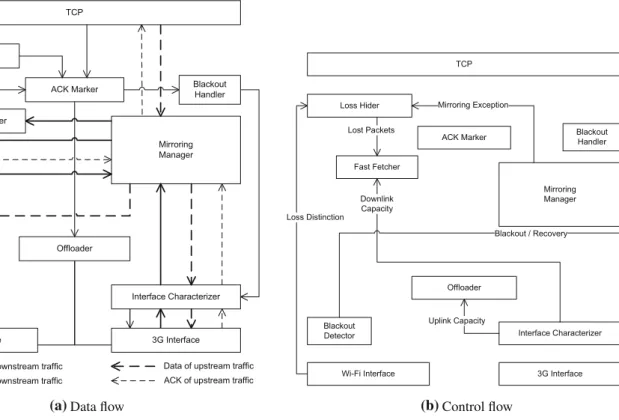
The implementation of eachsuper-aggregationprinciple is divided into multiple components in the software archi-tecture, as shown in Fig.3(a). We now briefly explain the components. Offloading-ACK is realized with the ACK Marker and Offloader components. Proxying-blackout-freezeis realized with the Blackout Detector and Blackout Handler.Mirroring-loss-fetching is realized with the Mir-roring Manager, Loss Hider, and Fast Fetcher. Interface Characterizer is a common component used by offloading-ACKandmirroring-loss-fetching.
Figure3(a) shows packet flows across the super-aggregation components. There are four types of TCP packets in the diagram: data packets and ACK of
downstream traffic; data packets and ACK of upstream traffic. The four types of packets are illustrated with dif-ferent arrows in the packet flow diagram. For ease of exposition we describe thesuper-aggregationoperations in the order of upstream data (request from client), upstream ACK, downstream data (content from server), and down-stream ACK. Figure 3(b) shows the exchange of control messages among the super-aggregation components. The details are explained along with the data traffic.
4.2.1 Data of upstream traffic
Each packet generated by the TCP layer is recorded by the Mirroring Manager for establishing a mirroring connection on the 3G interface. The Mirroring Manager duplicates each data packet and puts the IP address of the 3G interface in the IP header. The data packets of the original connec-tion are sent to the WiFi interface. The duplicate packets are sent via the 3G interface in the same order to establish a mirroring connection and request for the same content from server.
4.2.2 ACK of upstream traffic
When a packet is received on the downlink of any wireless interface, it could be an ACK for previously sent data packets or data packets sent by server in response to user request. Both data packets and ACK packets may belong to the original connection or the mirroring connection. All packets received on any wireless interface are sent to the Mirroring Manager, which differentiate the four cases. It distinguishes packets belonging to the original connection and the mirroring connection by comparing destination IP addresses with the record of mirroring. Data packets and ACKs are differentiated from each other by calculating their TCP payload length. TCP ACKs belonging to the original connection are sent to TCP layer directly without any modification. ACKs belonging to the mirroring con-nection are processed by Mirroring Manager itself. It re-transmits data packets if they are lost in the Internet so that requests on the mirroring connection is always the same as the original one.
4.2.3 Data of downstream traffic
Similar to ACKs of upstream traffic, downstream data packets belonging to the original connection and the mir-roring connection are treated separately. The Mirmir-roring Manager first checks if data seen on the original connection and the mirroring connection are identical. If the data seen on both connections are different, mirroring cannot be supported since the TCP sender serves different data on the two paths. The Mirroring Manager falls back to no
mirroring and sends a mirroring exception notification to the Loss Hider to stop hiding packet loss. When mirroring is enabled, the data packets belonging to the original connection are sent to the Loss Hider, and those of the mirroring connection are sent to the Fast Fetcher. Loss Hider sends all in-sequence data packets to TCP layer. If it finds a hole in the received data packets, it retrieves the loss information from the lower link layer. If the hole is attributed to a random wireless loss, the Loss Hider stores out-of-sequence packets in its buffer and notifies the Fast Fetcher about the lost packets to fetch on the mirrored connection. It sends a TCP ACK for highest data sequence number it has seen in order to hide the losses from the TCP sender. The Loss Hider waits for the Fast Fetcher to recover the lost packets and delivers all recovered packets to TCP in sequence. Data packets coming from the mir-roring connection are sent to the Fast Fetcher by the Mir-roring Manager. The Fast Fetcher identifies the packets that were lost in the original connection and passes them to the Loss Hider. The Fast Fetching technique is used to control the process of sending ACKs in the mirrored connection to accelerate the retrieving of the lost packets.
4.2.4 ACK of downstream traffic
ACKs of downstream traffic are generated by the TCP layer and several components, such as the Loss Hider and
the Fast Fetcher. All those ACKs are sent to the ACK marker to perform appropriateoffloading-ACK. It marks all ACKs as offloadable so that the Offloader knows they can be offloaded to 3G interface. If an ACK only contains cumulative information and can be replaced by newer ACKs, ACK Marker adds a mark of replaceable. The Offloader takes ACKs of both the original connection and the mirroring connection for offloading-ACK via 3G interface. The Offloader gets the information of uplink capacity in the 3G interface from the interface characte-rizer. If the 3G interface has enough uplink capacity for offloading, it sends all the ACKs via the 3G interface. Otherwise, Offloader discards replaceable ACKs without affecting TCP operations.
4.2.5 Blackout handling
The Blackout Detector on the WiFi interface monitors all activity events in the WiFi network to detect blackout and link recovery events. It sends a probe message to default gateway if no activity is observed on the WiFi interface for a period of time. When blackout is detected, the Blackout Detector sends a blackout notification to Blackout Freezer, which sends ACKs with zero-window advertisement to freeze the connection. When the link recovers from blackout, the Blackout Detector sends a link recovery notification to Blackout Freezer to resume the TCP
(a) (b)
transmission with a non-zero window update. The ACKs are generated with the latest ACK sent by the ACK Marker, and their flow window size is modified by the Blackout Detector. The ACKs directly go through the 3G interface since they are sent when the WiFi interface is in blackout. 4.2.6 Interface characterizer
All four types of packets traverse Interface Characterizer if they are sent through the 3G interface. The Interface Characterizer measures the achieved uplink/downlink bandwidth in the 3G interface, which is the actual rate that can be used by the super-aggregation principles. The measurement of achieved bandwidth can be done by observing the amount of uplink/downlink traffic flowing through the network layer of the 3G interface. Since super-aggregation is a layer-3.5 solution, it can read all traffic going through an interface and count the traffic volume. Traffic belonging to other application flows will be sub-tracted from the available bandwidth. Since offloading-ACK and mirroring-loss-fetching creates traffic that fully utilizes the 3G interface, no explicit probing packet needs to be sent to measure the achieved bandwidth. The uplink and downlink capacity information is sent to the Offloader and the Fast Fetcher whose decision relies on the remaining capacity. The Offloader reduces amount of ACKs sent to the 3G interface when there is not enough uplink capacity. The Fast Fetcher also adjusts the guard time that is inver-sely proportional to the downlink capacity on the 3G interface.
4.3 Issues 4.3.1 IP spoofing
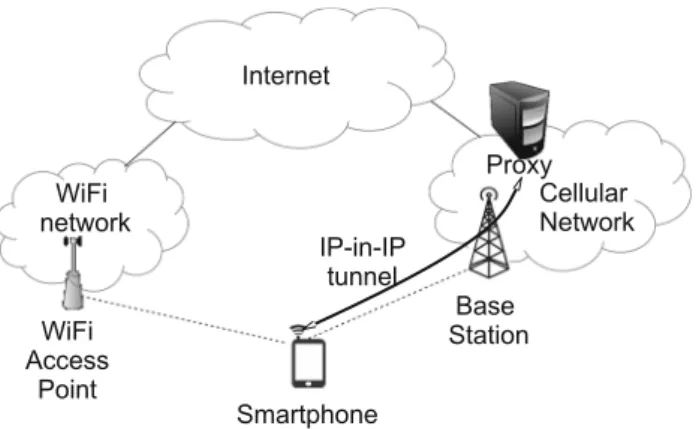
Offloading-ACK and proxying-blackout-freeze require IP spoofing, which might be blocked by ingress filtering at routers. A recent study [10] showed that four large cellular ISPs covering US and Europe do allow IP spoofing. In cases where spoofed packets are blocked by ingress fil-tering, IP spoofing can be supported by tunneling packets to a proxy server, as shown in Fig.4. IP spoofing is only required for the one-way communication from the sec-ondary interface to the server, and that can be realized with a stateless proxy based on IP-in-IP encapsulation. A packet with the primary interface as the source address is encap-sulated as the payload of another IP packet, which has the secondary interface as the source address and the proxy server as the destination address. The proxy server has a public IP address and is capable of performing IP spoofing. When it receives a packet with IP-in-IP encapsulation, it extracts the contained IP packet and sends it on behalf of the primary interface of the mobile host. The proxy
architecture enables IP spoofing for mobile hosts under ingress filtering in a simple and robust manner.
A proxy is practical since forwarding light traffic can provide significant improvement. While the economic model for such a proxy is out of the scope of this work, WAN optimization vendors and Cellular ISPs are two intuitive adopters of such a solution. WAN optimization vendors [11–13] can adopt super-aggregation as optimi-zation for mobile users, and proxy can be provided as part of WAN optimization service. On the other hand, Cellular ISPs [14–16] can adopt super-aggregation as a value-added service that enhances the network performance of their users. They can allow IP spoofing from users sub-scribing to such service. Existing network optimization solutions for mobile devices [17, 18] also follow similar architecture.
4.3.2 Network address translation (NAT)
Network address translation (NAT) is employed in several residential, campus and enterprise networks to hide a pri-vate address space behind a single public address. A mobile client behind a NAT only knows the private address-port of WiFi interface but not its public address-port seen at the TCP server. Thus,offloading-ACKand proxying-blackout-freeze cannot be used as is in these situations. However, several existing tools, such as session traversal utilities for NAT (STUN) [19], traversal using relays (TURN) [20] or simple traversal of UDP over NAT and TCP (STUNT) [21] provide public servers for public address delivery. Any of these tools can be used to discover the public address of the primary interface, which can be used for IP spoofing in offloading-ACK and proxying-blackout-freeze. If the mobile host is behind a symmetric NAT, the secondary interface cannot discover the port used for the TCP con-nection and cannot send a TCP packet which appears to be coming from the primary interface.
We discuss more related issues, such aslayer violation, resource consumption, extension to more interfacesin [8].
5 Performance evaluation
In this section, we describe our prototyping on real multi-interface wireless devices and their performance in exper-imental field trials. We present performance of all super-aggregationprinciples on laptop in detail. Results on Go-ogle Android phone are summarized since they demon-strate similar performance.
5.1 Experimental testbed
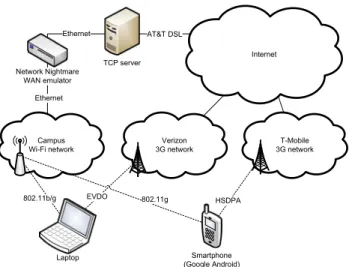
Figure5shows the topology of the experimental testbed. It includes both typical types multi-interface wireless device: laptop and smartphone equipped with WiFi and 3G. The laptop is equipped with an Atheros 802.11a/b/g PCMCIA card and a Verizon USB727 EVDO stick. Its operating system is Fedora 9 with Linux kernel 2.6.27. The driver of the WiFi interface and the EVDO interface are MadWifi 0.9.4 and wvdial, respectively. The smartphone is T-Mobile G1, which has embedded WiFi and HSDPA interfaces. It runs with Google Android operating system and Linux kernel 2.6.25. The primary results are collected from experiments of bulk data transfer sent by the TCP server for at least 100 s. We also uses traces collected from real TCP applications to study the performance enhance-ment ofsuper-aggregation in reality.
To evaluate the performance of super-aggregation in real life, both mobile clients connects to the Internet via real service providers. The WiFi access is provided by the campus network service at Georgia Tech. The 3G access on
the laptop and the smartphone is provided by Verizon and T-Mobile, respectively. We add 50 ms RTT in the WiFi path using a WAN emulator to make the testbed repre-sentative of realistic multi-interface wireless networks.3In order to construct controllable scenarios in the real testbed, disconnections and random packet losses are injected below transport layer at the mobile host.
5.2 Solution prototyping
In order to evaluate super-aggregation performance with user-space implementation, we use a user-space TCP implementation so that super-aggregation can be realized below it. We select Atou (Almost TCP over UDP) [22], which is a validated tool for studying TCP performance. Both server and client program include bulk data transfer on top of Atou. Atou sends out segments and ACKs encapsu-lated in UDP datagrams, and TCP mechanisms are imple-mented based on standards. It has impleimple-mented most TCP mechanisms, including checking if a received ACK falls in the send window. We use NewReno with SACK in Atou and verify that it gives almost the same performance as TCP (using iperf) as shown in the preliminary study in Sect.3. Atou allows generation of random wireless losses. In the prototype, we enable loss distinction by adding a boolean variable to indicate whether the last frame is dropped due to bit error. The loss distinction can be implemented by reading information from the link layer. For example, the ath_stats command of MadWifi driver gives the number of received frames that failed because of bad CRC.
All three TCP-based super-aggregation principles are implemented in C and integrated with Atou. They are implemented only at the receiver-side source code and deployed to wireless clients. Sender-side codes are the original Atou, except some mechanisms are added for better TCP standard compliance (flow control and appro-priate byte counting). We use gcc and ARM GNU/Linux cross-compiler to build the executable for laptop platform and Android platform, respectively.
5.3 Offloading-ACK performance
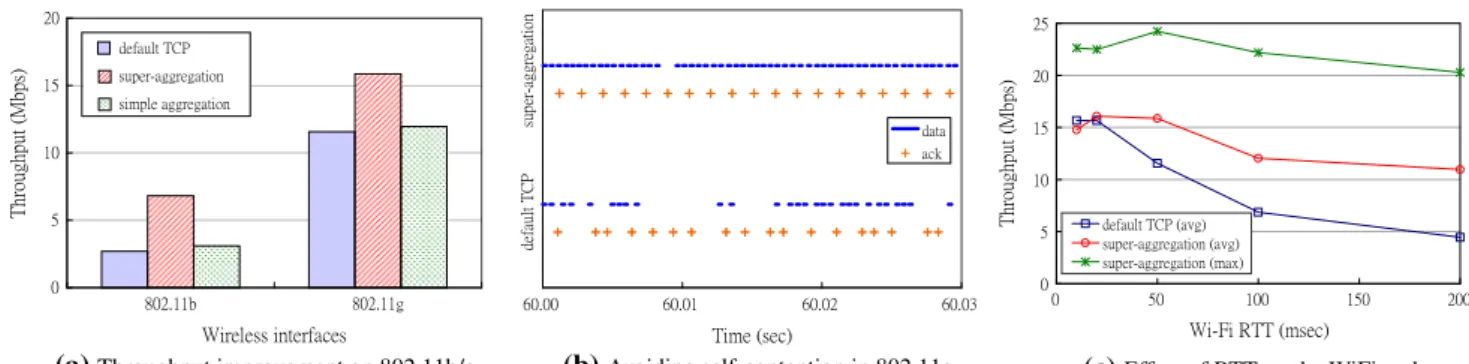
In experiments, Offloading-ACK resolves self-contention and improves TCP throughput with same magnitude as expected from the motivation. It improves TCP throughput by 37 and 152 %4on the laptop client using 802.11g and 802.11b, as shown in Fig.6(a). Figure6(b) is packet traces
Fig. 5 Topology of the experimental testbed
3 We conduct RTT measurement from the WiFi interface to 20 popular websites, and the average value is 58.6 m
4 To compare with TCP ACK aggregation techniques such as [23], we perform ACK aggregation (one for 12 packets) in 802.11g, and it only improves default TCP by 8.27 % in experiments.
captured with tcpdump. It demonstrates self-contention of default TCP, in which data packets and ACKs don’t overlap in time. It also shows capability ofOffloading-ACKto allow TCP to fully utilize the 802.11g interface for downlink data. The round trip time on the 3G links observed during the experiments range from 100ms to 150ms. As shown in Fig.6(c), offloading-ACK provides considerable throughput improvement over default TCP when the RTT of the WiFi link is 50ms or above. When the RTT of the WiFi link is 20ms or less, the effect of the RTT inflation of offloading via the 3G link is relatively higher, and thus offloading-ACK provides similar throughput to the default TCP.
5.4 Proxying-blackout-freeze performance
Blackouts are generated every 20 s on average within the 100-s connection. Figure7(a) demonstrates the effective-ness of Proxying-blackout-freeze by showing TCP states under blackout. TCP doesn’t go to slow start or cut down congestion window when receiving zero-window adver-tisement via the EVDO interface. TCP throughput is also immediately resumed after receiving window update after link comes back. Compared to default TCP in Fig.2(b), proxying-blackout-freeze improves TCP throughput by 87 %. Figure7(b) shows that proxying-blackout-freeze gives close-to-ideal throughput with different RTT on WiFi path, where ideal throughput values are calculated as throughput with no blackout times the ratio of link avail-ability. Improvement magnitude is 161 % when WiFi RTT is 200 msec since TCP spends more time to recover its congestion window. Figure7(c) shows that proxying-blackout-freeze gives more improvement with longer blackout duration. It improves TCP throughput by 136 % when average blackout duration is 10 s.
5.5 Mirroring-loss-fetching performance
Figure8(a) shows that Fast Fetching technique is effective in fetching lost packets using the EVDO interface. It can
recover lost segments 36 times faster than naive fetching with a normal TCP connection. As shown in Fig.8(b), mirroring-loss-fetching significantly outperforms default TCP. It keeps TCP throughput close to loss-less environ-ment until loss rate is more than 3 %. Figure8(c) shows that mirroring-loss-fetching gives more improvement magnitude when the WiFi path has longer RTT since TCP spends more time in recovering its congestion window. It improves TCP throughput by 175 % when WiFi RTT is 200 ms.
In order to prove the feasibility of the mirroring-loss-fetching principle, we have conducted two sets of experi-ments. The first is to verify that real TCP implementations react to the proactive ACKs as expected. We have imple-mented the proactive acknowledgment mechanism as a kernel module based on NetFilter [9]. While both sides of the TCP connection are real TCP implementations, the module intercepts the ACKs sent by the mobile hosts and processes them. It sends proactive ACKs both inside and outside the send window to test the behavior of the TCP sender. We have tested the module against TCP imple-mentations of different operating systems and top websites [24]. Table1shows the response of TCP implementations to a proactive ACK that falls inside or outside the current send window. The feasibility of the proactive acknowl-edgment is supported by the observation that all the oper-ating systems and web sites in the experiments responds to proactive ACKs as our expectation. First, all TCP senders respond to a proactive ACK inside the send window with new data segments, thus proactive ACKs triggers data segments to be sent faster. Second, no TCP sender responds to a proactive ACK outside the send window with an RST, so a TCP connection won’t be dropped by proactive acknowledgment. Third, most TCP senders respond to a proactive ACK outside the send window with an empty ACK, which can serve as a notification to the mirroring principle to adjust the rate of proactive acknowledgment. Figure9 shows an example packet sequence of sending proactive ACKs to Windows XP.
(a)Throughput improvement on 802.11b/g (b)Avoiding self-contention in 802.11g (c)Effect of RTT on the WiFi path
Second, we present a study of the viability of connection mirroring for top Internet web sites. We have used the Linux command of wget (with options -r -p -H -U Mozilla/ 5.0 -l 1) to recursively crawl the web pages and fetch HTTP objects (including HTML, image, css, JavaScript files, etc.) from those websites. The results in Table1show that on average, 94.81 % of HTTP requests produce the same result between the two wget fetches, and the con-nection mirroring technique can be widely used when fetching content from Internet application servers. 5.6 Performance of integrated operations
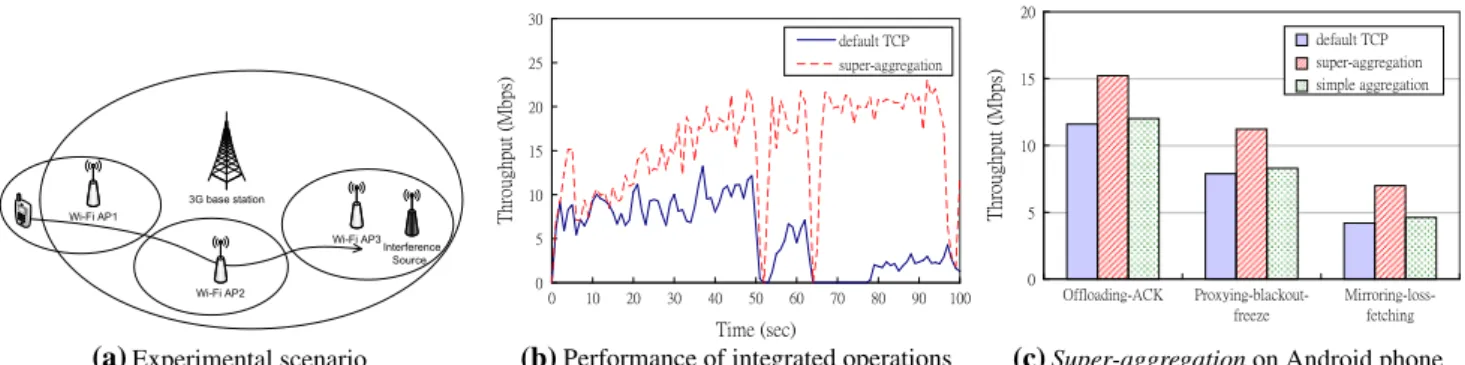
Figure10(a) shows the experimental scenario for inte-grated operations. At first only WiFi is available, then the client enters coverage of 3G network. It experiences 2-s blackout when it moves out from first WiFi network, across second one, and enters third WiFi network. There is an interference sources in the third WiFi network that causes one-percent random wireless losses.
Figure10(b) shows instantaneous throughput of super-aggregation and default TCP as the client moves along. They have similar throughput when WiFi is the only access at first, andsuper-aggregation starts to outperform default TCP once 3G is available because ofoffloading-ACK. Both
throughputs drop to zero during blackouts, but proxying-blackout-freezecan immediately resume throughput while default TCP falls back to slow start. Mirroring-loss-fetch-ing provides most significant improvement when random wireless losses happen in AP3. Overall,super-aggregation gives 189 % improvement, which almost triples default TCP’s throughput.
5.7 Performance on Google Android
We conduct experiments in the Google Android phone that uses the T-Mobile 3G network and the same WiFi network in campus. Two-second blackouts are injected into the WiFi interface to compare proxying-blackout-freeze against default TCP and simple aggregation. Similarly, random packet loss rate of 0.3 % is injected in the exper-iment set of mirroring-loss-fetching. Figure10(c) shows throughput improvements of all super-aggregation princi-ples on Google Android phone with 802.11g: 31 % with offloading-ACK, 42 % with proxying-blackout-freeze, and 67 % with mirroring-loss-fetching. Although throughput achieved on Android is typically lower than that of laptop, which may be due to different hardware capabilities, improvements from super-aggregation principles are significant.
(a)Freezing TCP during blackout (b)Effect of RTT on WiFi path (c)Effect of blackout duration
Fig. 7 Performance ofproxying-blackout-freeze
(a)Fast fetching (b)Effect of packet loss rate (c)Effect of RTT on WiFi path
5.8 Trace-based evaluation
We have added trace-based experiments with real TCP applications to evaluate the performance of super-aggre-gation with respect to applications besides bulk data transfer. We consider three representative application protocols: HTTP, POP3, and CIFS. We generate bidirec-tional traffic of those three protocols using real application clients. Traces are generated by capturing all packets in the application traffic and replaying those packets into the Atou-based prototype of super-aggregation. HTTP is commonly used in web browsing and web services, and the trace is collected when viewing a 1080p video in YouTube. POP3 is a popular protocol used in email applications, and
the trace is collected when synchronizing mailbox with the campus email server. CIFS is a protocol for file and resource (ex. printers) sharing in a local area network, and the trace is collected when downloading a file of 100MB from a file server. The traces include scenarios with dif-ferent amount of uplink traffic: one request is made in the entire HTTP connection; one request is sent to fetch each email in the POP3 trace; CIFS divides a file into blocks and sequentially fetch each block with a request. In the trace-based evaluation, each packet recorded in the uplink is replayed by the mobile host at the corresponding time. Similarly, the downlink packets are replayed by the TCP server. Figure 11(a) shows the performance of the three application traces. Figure11(b) shows the performance under 2-s blackouts, and Fig.11(c) shows the performance under 0.3 % packet loss rate. In the experiments, super-aggregation principles are applied to both the downlink and the uplink traffic to enhance TCP throughput against the fundamental issues, applications with bidirectional traffic still benefits from the proposed solution. As a result, the trace-based experiments show that all three super-aggregation principles still provide significant throughput improvement with bidirectional traffic.
Table 1 Proof of feasibility of mirroring-loss-fetching TCP sender’s response to proactive acknowledgment
Operating system Inside window Outside window
Windows XP SP3 New segments Empty ACK
Windows Server 2003R2 SP2 New segments Empty ACK Red Hat EL4 (kernel 2.6.9) New segments none Ubuntu 7.04 (kernel 2.6.22) New segments none Ubuntu 10.04 (kernel 2.6.32) New segments none
Website Inside window Outside window
Google New segments Empty ACK
Facebook New segments Empty ACK
Youtube New segments Empty ACK
Yahoo New segments Empty ACK
Blogger New segments Empty ACK
Baidu New segments Empty ACK
Wikipedia New segments Empty ACK
Windows Live New segments Empty ACK
Twitter New segments Empty ACK
CNN New segments Empty ACK
Percentage of content that supports mirroring
Website Number of objects Percentage of objects
Google 196 89.29 Facebook 24 91.67 Youtube 556 88.85 Yahoo 3225 99.10 Blogger 265 97.36 Baidu 541 98.15 Wikipedia 316 100 Windows Live 1296 94.52 Twitter 319 92.79 CNN 5195 96.36
Fig. 9 Packet sequence of proactive acknowledgment with TCP
6 Related work
Simple aggregation mechanisms have been proposed in several related works. Most works of simple aggregation are done at the transport layer, such as pTCP [2], WAMP [25], RMTP [4], Multipath TCP (MPTCP) [26] and MAR [27]. It can also be achieved at the network layer as in [28], [29], and [30], or the application layer as in [31]. R2CP [3] and PRISM [32] also include mechanisms to address issues in wireless network, but they both require end-to-end deployment. They all provide linear throughput improve-ment by simply dividing traffic to multiple interfaces.
Some mechanisms are proposed to address similar issues of TCP over wireless networks. They typically consider just one wireless technology and cannot solve all issues with only client-side deployment. For example, Snoop [33] and WTCP [34] both address random wireless losses, but they are deployed at AP or both ends, respec-tively. Freeze-TCP [35] also uses flow-control mechanisms to freeze TCP connection before blackout happens. How-ever, it requires appropriate TCP implementation on sender side and accurate prediction of blackout occurrence time to make the mechanism work. In [36], a routing scheme is
proposed to leverage a secondary interface to keep a TCP connection alive during handoff, and that requires modifi-cations to the routers.Super-aggregation principles lever-age multiple interfaces to provide a more robust solution with minimal deployment requirement.
Some mechanisms are proposed to use multiple inter-faces to address issues other than throughput improvement. CoolSpots [37] uses Bluetooth-enabled access points to reduce energy consumption on wireless divides with both WiFi and Bluetooth interfaces. Cell2Notify [38] uses cel-lular radio to wake up WiFi interface on a smartphone when there is incoming traffic. It improves battery lifetime of VoIP over WiFi by reduce energy consumption in idle time of WiFi. Context-for-Wireless [39] proposes an adaptive radio selection strategy between WiFi and cellular based on context.
Detection of link failure has also been addressed in TCP with explicit link failure notification (TCP-ELFN) [40], where route error messages are used to convey discon-nections. TCP-ELFN requires changes to the routing pro-tocol and the route error messages. super-aggregation principles, on the other hand, uses simple ICMP ping messages to discover blackouts in connectivity.
(a) (b) (c)
Fig. 10 Integrated operations and performance on Android phone
(a)Offloading-ACK (b)Proxying-blackout-freeze (c)Mirroring-loss-fetching
Acknowledgments This work was supported in part by funds from the Georgia Tech Broadband Institute and the NSF under Grants CNS-0519733, CNS-0519841, and CNS-0721296.
Appendix: Super-aggregation beyond TCP
Generic principles and case study
We now generalize thesuper-aggregation principles pro-posed in Sect.3and demonstrate their generic application with a case study of a non-TCP protocol. Each generic principle describes an approach of leveraging multiple interfaces of wireless devices that can increase throughput beyond the sum of the parts. We pick rate-adaptive video streaming [41] for the case study since it is a popular UDP application in the Internet. In such systems, the server sends video streams in the form of UDP datagrams to clients. To provide good video quality in response to capacity variation, the server adjusts its codec or sending rate based on available bandwidth to the client.
Selective offloading: tackling self-contention of client reports
Selective offloading chooses some packets to move from the WiFi interface to the 3G interface. One design principle is moving some packets to the 3G interface to resolve self-contention in the WiFi network, as in offloading-ACK. Moving small packets can provide significant improve-ments since overhead of sending them via the WiFi inter-face is relatively higher. The other design principle is to use the 3G interface when overall performance is affected by some characteristics that the WiFi interface performs poorer than the 3G interface. In rate-adaptive video streaming, clients keep sending reports of traffic charac-teristics to the sender to rate adaptation. The rate adaptation and overall throughput may be impaired by intermittent availability of the WiFi interface of a mobile host5On the other hand, 3G provides better availability in terms of broader coverage of each base station and thus fewer dis-connections to the same mobile host. A video client on mobile host is unable to send reports via a WiFi link under blackout and handoff, and the server may interpret missing of reports as client disconnection or network congestion. Incorrect characterization causes improper rate adaptation of the video stream. Offloading-report moves report packets to the 3G interface with high availability enables continuous reporting, which allows server to do timely and accurate rate adaptation. It also reduces packet loss rate of
video on downlink, since small report packets cause self-contention in WiFi networks.
Proxying: improving reliability and timeliness of command packets
Proxyingimproves performance of the connection on WiFi by masquerading packets from 3G, which serves as a proxy when WiFi is temporarily unavailable. One design princi-ple is to enable communication when the WiFi interface has blackouts, as in proxying-blackout-freeze. Adding control packets via the 3G interface can help in preventing blackout’s adverse effects to application. The other design principle is to improve reliability and timeliness of some packets by sending them to both interfaces. Heterogeneous interfaces provide diversity in packet losses, so sending a redundant packet to the 3G interface can effectively improve end-to-end reliability. Video streaming clients send command packets to perform control operations, such as pause/resume video delivery and updating configura-tions. Losing command packets degrades response time perceived by the client. Proxying-redundant-commands sends a duplicate copy of those command packets to improve the reliability. It improves response time to the client and may also improve other dimensions of perfor-mance since commands are delivered more timely.
Mirroring: reducing loss rate of baseline frames
Mirroring creates a independent connection on the 3G interface, and same or related content is downloaded to improve performance by leveraging loss diversity. One design principle is decoupling some of high-layer mech-anisms to the mirroring connections, as in mirroring-loss-fetching. This helps the client to separate operation of two mechanisms that have adverse interaction in WiFi net-works. The other design principle is reducing packet loss rate by fetching redundant contents from both connec-tions, especially essential portions in the original con-nection. Scalable Video Coding [42] is commonly considered in rate-adaptive video streaming since it encodes video content into different quality levels in a scalable way. All clients receive baseline frames and those with higher capacity also receive enhancement frames that rely on baseline frames. Baseline frames are more critical packets and requires less bandwidth than enhancement frames. Mirroring-baseline-frames estab-lishes a mirroring connection via the 3G interface and requests for a baseline video stream of the same video content. Having duplicate baseline frames from server can significantly improve overall video quality, especially in a lossy environment.
5 A study of vehicular WiFi networks [5] shows that the average duration between AP associations at vehicular speeds is 75 s.
Generic architecture
We present the generalized software architecture in a modular fashion such that it is evident how to reuse the common components for genericsuper-aggregation prin-ciples. As shown in Fig.3(a), some components in the super-aggregationarchitecture are specific for TCP, while others provide common functionalities needed in other principles. For example, Offloader is used for offloading-ACK, Report Offloading, and Voice Offloading. Offload-ing-ACKuses ACK marker to notify Offloader that ACK packets should be offloaded. The Report Offloading and Voice Offloading should have their own component to mark report packets and voice frames. The Offloader takes all packets marked and split them according to available uplink bandwidth on 3G interface. Other common com-ponents include the Blackout Detector and the Interface Characterizer Table (Table2).
Theoretical analysis
In this section we present an analytical model to study the throughput of super-aggregation. The analysis answers a fundamental question: in what conditions does super-aggregation yield throughput more than sum of the parts? The analytical model can also be used to assess the per-formance of super-aggregation when applied to other networks. Each of the three super-aggregation principles are analyzed separately in the corresponding network conditions. In the analysis ofoffloading-ACK, there is no blackout or random wireless loss. In the analysis of proxying-blackout-freeze, there are blackouts but no ran-dom wireless loss. In the analysis of mirroring-loss-fetch-ing, there are random wireless losses but no blackout. We
summarize the analysis of the average throughput of default TCP and each super-aggregation principle. The detailed analysis is included in [8] due to lack of space. At the end of this section, we presents the insights from the analysis to show that in most of the cases super-aggrega-tion is able to provide throughput more than sum of the parts. The analytical model is validated with experiments in the next section.
Analysis of offloading-ACK
When self-contention occurs to TCP, uplink ACK packets compete with downlink data packets for the same wireless network resources. A TCP receiver replies with an ACK for every two data segments. The saturated throughput of TCP at the wireless link is determined by the time to send both the TCP data segments and ACKs (Table 3).
TsðtcpÞ ¼ 2mss
2tdataþtack ð1Þ
Offloading-ACK eliminates self-contention of TCP in the WiFi network by moving TCP ACKs to the 3G link. With the WiFi link purely used for downstream TCP data seg-ments, the saturated throughput does not contain time to send TCP ACKs.
TsðoffloadingÞ ¼ mss
tdata ð2Þ
We provide a more detailed analysis of the average throughput of TCP based on its congestion control mechanism. TðpÞ ffi3 4 TsRTT mss þrp mss RTT ð3Þ Analysis of proxying-blackout-freeze Table 2 Variables Variable Definition
TsðpÞ Saturated throughput of TCP protocolp(default TCP or
super-aggregation)
TðpÞ Average throughput of TCP protocolp(default TCP or super-aggregation)
tdata Time to send a TCP data segment
tack Time to send a TCP acknowledgement
tblackout Duration of a blackout
tinterval Interval between two blackout occurrences
Ws Congestion control window size under saturation
Wmax Maximum congestion window size achieved upon packet
loss
NðplÞ Number of packets sent in a congestion avoidance phase
pl Packet loss rate
Table 3 Parameters
Parameter Definition Value
htcp TCP header length 32 bytes
mss TCP maximum segment size 1448 bytes
hip IP header length 20 bytes
hmac 802.11 MAC header length 28 bytes
hmack 802.11 MAC ACK length 14 bytes
tsifs 802.11 SIFS 34ls
tdifs 802.11 DIFS 16ls
tslot 802.11 slot duration 9ls
CWmin Minimum contention window size 15 tpreamble 802.11 PLCP preamble duration 16ls
tsignal 802.11 PLCP signal field duration 16ls
hserv 802.11 PLCP service field length 16 bits
To analyze the impact from blackout, we assume that blackouts occurred in the WiFi network periodically. The period of a blackout is tblackout, and the frequency of its occurrence isfblackout. TðtcpÞ ¼tss ðWsþ1Þmss 2RTT þ ðtintervaltidletssÞ ðWmaxþWminÞmss 2RTT tinterval ð4Þ Proxying-blackout-freezing can freeze the TCP transmis-sion during the blackout and immediately resumes the transmission after the blackout.
TðproxyingÞ ¼ðtintervaltblackoutÞ
ðWmaxþWminÞmss
2RTT
tinterval ð
5Þ Analysis of mirroring-loss-fetching
To analyze the impacts from random wireless loss, we assume that each packet loss is an independent event with probabilitypl. The analysis of TCP throughput is based on N, the number of packets sent in a congestion avoidance phase, which is defined as the duration between two packet losses. WmaxðplÞ ¼ ffiffiffiffiffiffiffiffiffiffiffiffiffiffiffiffiffiffiffiffiffiffiffiffiffiffiffiffi 8 3E½NðplÞ þ3 r 1 ð6Þ Tðtcp;plÞ ffi3 4WmaxðplÞ mss RTT ð7Þ
Mirroring-loss-fetching prevents TCP from unnecessary reduction in congestion window by hiding random wireless losses to the TCP sender. The throughput achieved with mirroring-loss-fetchingis constrained by two factors. The first one is the throughput of data transfer in the primary connection, and the second one is the rate in recovering lost packets in the mirroring connection. The rate in recovering lost packetsTris determined by the average time to trigger a data segment (no matter lost or not) from the TCP sender.
Tr ¼
mss
pltg;dataþ ð1plÞ tg;ack ð8Þ Tðmirroring;plÞ ¼minTðtcp;0Þ;Tr ð9Þ Insights from the analysis
In this subsection, we present the insights from the theo-retical analysis on the throughput of super-aggregation under different conditions. We specifically look at an important aspect ofthe degree of heterogeneity required in the capacity of the two interfaces to observe aggregate throughput more than sum of the parts. The following observations will be verified with extensive experiments in the next section.
The throughput improvement fromoffloading-ACKand/ or proxying-blackout-freeze is independent from the capacity of the secondary interface. As shown in the the-oretical analysis, the throughput formulas of offloading-ACK (Eq. 3) and proxying-blackout-freeze (Eq.5) do not contain the capacity of the secondary interface. Those two principles are able to achieve a saturated throughput higher than sum of the parts no matter how small the capacity of the secondary interface is. While the secondary interface has higher capacity than necessary, offloading-ACK or proxying-blackout-freezedoes not exhaust its capacity, and the remaining capacity can be utilized with simple aggre-gation. In general,offloading-ACKand proxying-blackout-freezecan provide aggregate throughput more than the sum of the parts under any degree of capacity heterogeneity.
Contrary to the above two principles, the throughput improvement of mirroring-loss-fetching depends on the capacity of the secondary interface. Eq.9, when capacity of the secondary interface is significantly lower than that of the primary interface, the overall throughput of mirroring-loss-fetchingis dominated byTr. In that case, the aggregate throughput depends on the capacity of the secondary interface, as shown in Eq.8. That is because the data transport ofmirroring-loss-fetchingis stagnated by waiting for loss recovery in the secondary interface. The analytical model can also be used to predict ifmirroring-loss-fetching is beneficial when the capacity in the secondary interface drops down. If the capacity in the secondary interface is insufficient to benefit the overall throughput, super-aggregationshould not hide all packet loss in the primary connection.
Validation of the analysis
In this subsection, we conduct extensive experiments with diverse capacity in the two interfaces to validate the the-oretical analysis. To manipulate the network capacity in the experiment testbed, we use a WiFi AP (Linksys WAP55AG) and an emulated cellular network (Network Nightmare WAN Emulator). By using the network emu-lation, we covers a broad range of wireless technologies of heterogeneity capacity. The data rate in the WiFi interface ranges from 6Mbps to 54Mbps. The data rate of the sec-ondary interface also varies from 2.5G (GPRS/EDGE) with around 100kbps to 4G (WiMAX/LTE) with tens of Mbps. Figure12 compares the analysis and experimental results of both default TCP and offloading-ACK. The results show that the analytical model accurately capture the throughput performance of TCP and offloading-ACK under different circumstances. It is noteworthy in
Fig.12(b) that when the cellular network has capacity lower than 500kbps, the observed throughput in our default experiment settings is lower than what expected by the analysis. The reason is because offloading ACKs through a cellular interface of narrow bandwidth slows down TCP in achieving the saturated throughput, even though the satu-rated throughput is independent of the cellular interface capacity. RFC 3465 [43] specifies that TCP should not increase its congestion window by more than two full segments with each acknowledgement, the growth rate in congestion control window is reduced when fewer acknowledgements are delivered. With the 100-s data transfer in default experiments, TCP withoffloading-ACK
does not have enough time to achieve the supported throughput. By extending the connection duration to 1000 s, the average throughput achieved in the experiments matches with the analysis. From the analytical framework, we have derived the maximum data usage of offloading-ACK in 3G as 317Kbps. It matches with the above experimental observation. Such data usage is considered low when compared with the throughput improvement of 11.27 Mbps in the WiFi network.
Figure13 compares the analysis and experimental results of both default TCP and proxying-blackout-freeze under blackouts. The default blackout duration is 2 s. The analysis and the experimental results are very close to each
(a)Effect of WiFi data rate (b)Effect of capacity in secondary interface
Fig. 12 Comparison of offloading-ACKanalysis and experiments
(a)Effect of WiFi data rate (b)Effect of capacity in secondary interface (c)Effect of blackout duration
Fig. 13 Comparison ofproxying-blackout-freezeanalysis and experiments
(a)Effect of WiFi data rate (b)Effect of capacity in secondary interface (c)Effect of packet loss rate