Towards a theory of digital network de/centralization: platform-infrastructure lessons drawn from blockchain
LSE Research Online URL for this paper: http://eprints.lse.ac.uk/102963/ Version: Published Version
Monograph:
Rossi, Enrico and Sørensen, Carsten (2019) Towards a theory of digital network de/centralization: platform-infrastructure lessons drawn from blockchain. . SSRN.
[email protected] https://eprints.lse.ac.uk/
Reuse
Items deposited in LSE Research Online are protected by copyright, with all rights
reserved unless indicated otherwise. They may be downloaded and/or printed for private study, or other acts as permitted by national copyright laws. The publisher or other rights holders may allow further reproduction and re-use of the full text version. This is
1
Towards A Theory of Digital Network De/Centralization
Platform-Infrast ruct ure Le ssons Drawn from Blockchain
Enrico Rossi1 & Carsten Sørensen2 Digital Innovation
Department of Management
The London School of Economics & Political Science London, UK
theory.digitalinfrastructures.org www.digitalinfrastructures.org
Global digital platforms are conquering the world and rely critically on digital infrastructures to function, yet little research has explored the fundamental interrelationship between the two. This working paper argues that understanding centralization and decentralization in digital networks as asymmetry and symmetry in mutual interdependencies between the constitutive elements of a digital network can help us understand the platform-infrastructure relationship more fundamentally (and vice versa). To this end, the paper proposes, as a starting point, the in-depth analytical and literature study of blockchain networks as a particularly revealing type of digital platform/infrastructure duality. The paper proposes an analytical model for characterizing de/centralization in digital networks and maps this onto blockchain networks. Based on this, the paper explores the de/centralization of blockchain, arguing that the extant blockchain literature largely has failed in providing a comprehensive understanding of de/centralization by not considering the complex second-order interdependencies between the different constitutive dimensions of a blockchain: the symbolic, technological and political dimension. Based on this, the paper provides an analysis of the meaning of de/centralization in blockchain networks by studying the interdependencies between its constitutive elements of coin, network technology, and social community.
Keywords: Digital Networks, Blockchain Analytical Framework, Definition, Decentralization, Digital Infrastructure, Digital Platform
This working paper is published as:
Rossi, Enrico and Sørensen, Carsten, Towards A Theory of Digital Network De/Centralization: Platform-Infrastructure Lessons Drawn from Blockchain (December 13, 2019). Available at SSRN: https://ssrn.com/abstract=3503609 It is also available at theory.digitalinfrastructures.org
The working paper can be used and cited as long as it is referenced as indicated above. 1 https://www.lse.ac.uk/management/people/academic-staff/erossi https://www.linkedin.com/in/enrico-rossi-22a64a25/ 2 https://www.lse.ac.uk/management/people/academic-staff/csorensen http://carstensorensen.com http://scholar.carstensorensen.com https://www.linkedin.com/in/carsten/
2
Table of Contents
Table of Contents ... 2
1 Introduction ... 3
1.1 Overview of Working Paper ... 6
2 Setting the Stage ... 8
2.1 Platforms and Infrastructures ... 8
2.2 Blockchain and Cryptocurrencies ... 10
2.3 Decentralization in Blockchain Literature ... 12
2.3.1 Decentralization and Distribution Origins... 12
2.3.2 Critiquing Decentralization in Blockchain Networks ... 14
2.4 Problems with the Current Literature ... 15
2.4.1 Decentralization as a Lack of Centralization ... 15
2.4.2 Defining a De/centralization Framework ... 21
2.4.3 Defining de/centralization: a framework for the study of socio-technical system ... 23
3 A Digital Network De/centralization Framework ... 26
3.1 Blockchain Decentralization: Literature Overview ... 26
3.2 Defining the Access and Use Dimensions ... 27
3.2.1 Infrastructure Access and Use ... 27
3.2.2 Platform Access and Use ... 28
3.2.3 Platforms and Infrastructure Duality ... 29
3.3 A De/centralization Framework ... 30
3.4 De/centralization in Digital Networks ... 36
3.4.1 First-Order Interdependencies ... 36
3.4.2 Access and Use Interdependencies ... 39
4 Blockchain as a Digital Network ... 46
4.1 Blockchain Dimensions in the Literature ... 46
4.2 Defining Blockchain as Digital Network ... 48
4.2.1 (C) Coin: Data as Social Claims ... 49
4.2.2 (NT) Network Technology: Interactions among Equal Nodes ... 50
4.2.3 (SC) Social Community: Privacy (Liberty) and Equality in Transaction ... 51
4.2.4 (CP) Consensus Protocol: Holding Everything Together ... 53
4.2.5 Blockchain as a Digital Network ... 54
4.3 First-Order Blockchain Dimensions ... 54
4.3.1 (NT) Architectural and Logical A/symmetries ... 55
4.3.2 (C) Legal and Economic A/symmetries ... 55
4.3.3 (SC) Political and Ethical A/symmetries ... 56
4.3.4 First-Order Decentralization ... 57
4.3.5 Summarizing the Framework ... 59
5 De/centralization and Blockchain Networks ... 62
5.1 Second-Order Blockchain Symmetries ... 62
5.2 SCC: Social Community and Coin ... 64
5.2.1 Metallist De/centralization: Coin as Digital Commodity ... 65
5.2.2 Informational De/centralization: Coin as Digital Fiat Money or Social Claim ... 69
5.3 NTC: Network Technology and Coin ... 73
5.3.1 Protocol-Logic: Protocol as Risk-Free Lender of Last Resort ... 75
5.3.2 Permission-Logic: Protocol as a Neutral Validation Mechanism... 78
5.3.3 Market-Power: Network as an Egalitarian Distribution of Capital ... 81
5.3.4 Summary of Techno-Economic Interpretations of De/centralization ... 84
5.3.5 Platform-Logic: Network as a Neutral and Open General-Purpose Technology ... 87
5.3.6 Code-is-Law: Network as On-chain Governance Mechanism ... 89
5.3.7 Principal-Agent: Network as Coordination Mechanism for On-Chain Division of Labour... 91
5.3.8 Summary of Techno-Legal Interpretations of De/centralization ... 95
5.4 NTSC: Network Technology and Social Community ... 98
5.4.1 Social Community & Information Sharing: Decentralization as Information Symmetries ... 99
5.4.2 Social Community & Information Sharing: Access and Control Symmetries ... 101
5.4.3 Social Community & Participation and Decision Rights: On-Chain Modification Symmetries ... 102
5.4.4 Social Community & Political Power: Decentralization as Capacity to Influence... 103
5.4.5 Summary of Socio-Technical / Techno-Political Approach ... 104
6 Conclusion ... 105
7 Appendix A: Approach ... 106
3
1
Introduction
Digital platforms and infrastructures play a critical role in the lives of individuals and in the functioning of societies. However, they have mostly been discussed in the literature within the implicit or explicit context of either an open Internet that supports the agnostic packaging, distribution, and re-assembly of data packages, or in terms of highly complex and organic evolved infrastructural arrangements characterized by innovation inertia. Core to the understanding of either of these discussions is the understanding of decentralization. In the case of the open Internet infrastructure, the relationship between centralization and decentralization can be characterized as through paradoxical forces of concurrent centralized and decentralized control (Tilson et al, 2010). The basic open Internet infrastructure has supported the highly decentralized exchange of data, and of unrestricted decentralized innovation of new services and protocols based on a common anchor-point of the IP protocol. However, the secure exchange of economic or legal rights requires established institutional arrangements or digital platforms as mediators — hence the open Internet has been a petri-dish for an explosive growth of digital platforms of which a few has gained global dominance within their field of activity. Some of the most successful global digital platforms are blurring the platform/infrastructure boundaries by seeking to become infrastructural, for example through offering easy open authentication (de Reuver, 2018). Furthermore, much debate on these digital platforms are concerned with their central position in the harvesting of data, having excess market power, and distorting the political debate (Zuboff, 2019). In the contemporary academic debate on digital innovation, discussions of the interrelationships between digital platforms and -infrastructures, the issue of de/centralization is, therefore, of core theoretical importance.
The aim of this working paper is to propose an analytical framework characterizing de/centralization in digital networks.3 This framework can subsequently be used for the in-depth analysis of de/centralization of digital platforms and -infrastructures in general. However, at this stage the framework will have most immediate impact for the theoretical framing of de/centralization within blockchain networks.4 The specific characteristics of blockchain networks render these particularly fertile in serving as the foundation for novel theorization on de/centralization since this has been one of the core issues under discussion within the broader blockchain community, and since blockchain networks cannot be considered as merely technological, cryptographic, organizational, personal, legal, or economic entities, but all of the above. The agnostic character of the IP-based open Internet “hour-glass” (Zittrain, 2008, 2019) implies that aspects and interdependencies that here easily can be abstracted, such as the content of data, in the blockchain context becomes an immediate concern.
3
We will purposefully in this report avoid using the terms “platform” and “infrastructure” as theoretical constructs for our analysis as the aim of the framework is subsequently to serve as a means of unpacking the de/centralization of digital platforms and -infrastructures and, therefore, formulating the theory in terms of the object we wish to characterize is problematic.
4 Please note that we assume readers have a basic understanding of blockchain and cryptocurrency mechanics
to appreciate the argumentation forwarded, as the document does not provide such an introduction. A good source could be one of the books by DuPont (2019), Burniski & Tatar (2017), Lacity (2019), or Tapscott & Tapscott (2017). There are also brief introductions in the articles by Lacity and colleagues (2018, 2019), Beck et al (2018), or Zachariadis et al (2019). The Internet also has plenty of articles and videos to assist if necessary.
4 We have not been able to identify any work attempting to establish a relationship between the inherent tensions generated by the interplay between the platform and the infrastructural dimension of any digital network and the tensions emerging from the centralizing forces in blockchain networks. Neither have we identified any work attempting to study the centralizing trends of blockchain networks in the light of the platform-infrastructure interplay even though an emerging literature in media studies (Helmond, 2015; Helmond et al., 2019; Nechusthai, 2018; Plantin et al., 2018; Plantin and Punathambekar, 2019), information system (Bygstad and Hanseth, 2018; Costantinides et al., 2018; Lorenz and Stefan, 2018; Kazan et al, 2018) and legal studies (Zittrain, 2018; Flew, 2019; Flew et al., 2019) is beginning to address the issue.
Blockchain is usually defined in the literature either as a platform (De Filippi and Wright, 2018: chapter 1; Glaser et al., 2019; Mattila and Seppӓlӓ, 2018; Narayanan et al., 2016: chapter 9; Perreira et al, 2019), or as an infrastructure (DeFilippi and McMullen, 2018; De Filippi and Wright, 2018: chapter 2; Finck, 2019: 11; Glaser, 2017), especially as a “financial infrastructure” (McWaters et al., 2016; Walch, 2015). Nakamoto (2008) never qualifies its distributed time-stamp system neither as platform nor as infrastructure, but Buterin (2014) defines Ethereum as a “decentralised application platform.” The confusion might reflect the shift in attention from the original bitcoin use case, which tend to understand blockchain as an infrastructure as also originally envisioned (Nakamoto, 2008), to the rise of the new Ethereum-based use cases supported by general-purpose networks such as Hyperledger or Corda, which are often referred to as “platforms” (Lacity, 2018).5
But no work has so far attempted to define blockchain theoretically in function of the concepts of digital platform and infrastructure, and through this derive its necessary and sufficient characteristics in an analytical manner. This might be problematic when trying to discuss the meaning and nature of de/centralization in digital networks as our understanding of de/centralization might directly depend on the way in which the interplay between platform and infrastructure is understood. As a result, such a study of the fundamental characteristics of digital platforms and infrastructures, through the case of blockchain, will also in turn enable a theoretical discussion of the degree of de/centralization of a given blockchain in terms of the infrastructural and platform aspects of a digital network. The working paper, therefore, extends a nascent stream of literature with the last few years witnessing an increasing interest in the governance of blockchain technology, and in the meaning of its “decentralized” nature. An emerging body of academic research seeking to make sense of this phenomenon is still very much in its infancy with relatively less work than warranted by the public debate. Although an increasing number of papers on blockchain governance is emerging especially, but not exclusively, in the legal literature, there is still a paucity of conceptual and theoretical works on blockchain grounded within management and Information Systems. Current exceptions are Beck et al’s (2018) and Zachariadis et al’s (2019) papers on blockchain governance, along with practitioner-oriented papers on corporate blockchain arrangements (Lacity, 2018; Beck et al 2019; Lacity et al, 2019).
The governing rationale of the report is that there is a lack of theoretical understanding of de/centralization in digital networks in general, and in the multi-disciplinary blockchain debate in
5 The four limitations of Bitcoin recognised by Buterin (2014: 12-13) – lack of Touring completeness; value
blindness; lack of state; blockchain blindness– can all be understood as more or less directly associated to the transition from infrastructures to platforms.
5 particular. This paper seeks to address this issue by providing an analytical framework for digital networks, and critically to apply this in the context of blockchain networks. De/centralization is characterized in terms of interactional symmetries and asymmetries between the generic elements of Data, Network Technology, and Social Community, where these three elements belong to, respectively, three basic dimensions of a digital network: the symbolic dimension (the social meaning of value and rights), the technological dimension (the logic and architecture of the network), and the political dimension (moral principles norming and guiding the decisions of the community members). This is, in the context of blockchain arrangements translated into an investigation of the relationships between Coin (C), Network Technology (NT), Social Community (SC), and analysing how the addition of the element of the Consensus Protocol (CP) shapes their interaction.
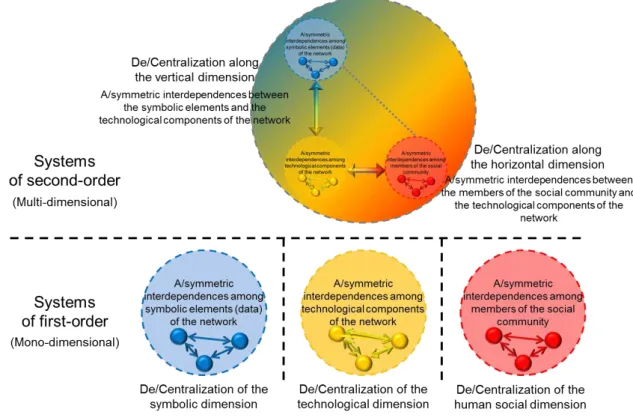
We show how de/centralization can be described in terms of symmetrical and asymmetrical interdependencies between these elements across two different dimensions. Our first-order analysis of de/centralization considers the relationships within each of the three main constitutive elements (C, NT, and SC) within the context of a Consensus Protocol. For example, symmetry or asymmetry in the interdependencies between coins within a blockchain, between members of the social community, or between the nodes in the network. Our second-order analysis of de/centralization then considers the possible variation in the interdependencies between the constitutive elements in the analytical framework — between: (CSC) the coin and the social community; (CNT) the coin and the network technology; and (NTSC) the network technology and the social community. The insights proposed in this report are gained from theoretically focusing the analytical study of de/centralization on the interdependencies between the constitutive elements in the framework, combined with the insight that de/centralization in digital networks must be considered as both first- and second-order interdependencies. This allows us, based on the study of the extant blockchain literature, to make theoretical claims on the diversity of aspects of de/centralization in blockchain networks. This is in contrast to the main thrust of the theoretical debate on blockchain de/centralization, which either takes decentralization as a given, or is based on one particular perspective, thus ignoring the way in which the interactions between different elements belonging to different dimensions can dynamically affect the nature of the overall system. This report disentangles these perspectives and provides a synthesis of a number of distinct de/centralization perspectives.
The main insight of the work regarding blockchain de/centralization is that while much blockchain research makes claims related to decentralization, there is a fundamental incongruity between the way in which blockchain (and digital network in general) is defined and the way in which de/centralization in understood. The analysis of blockchain in function of the core dimensions of digital platforms and digital infrastructures reveals that blockchain (as any digital network) is a multi-dimensional system defined by the dynamic interactions of multiple elements across different dimensions. As a result, in order to retain logical and analytical consistency we argue that all concepts qualifying blockchain should also be understood as multi-dimensional and dynamic (relational). While much blockchain research makes claims related to decentralization, then these claims are generally related to first-order and static interdependencies. However, decentralization at the level of the individual elements for one specific dimension of the digital network does not necessarily imply that the digital network can be characterized as de/centralized. The report
6 discusses in significant depth and detail the diversity of de/centralization when considering second-order interdependencies between network elements across the three different dimensions (symbolic, technological and political).
In the current version of the report, we exclusively relate the analytical model of digital network de/centralization to blockchain literature. It is the aim of the present work to provide the most comprehensive overview and detailed understanding of the nature and meaning of de/centralization in the case of blockchain. It is, however, the aim of subsequent work to draw more general conclusions on the applicability of the analytical framework to characterize de-centralization in digital networks in general. This could also allow us to make fundamental claims on a variety of digital platforms and infrastructures.
1.1
Overview of Working Paper
Practically, this working paper is in effect three interrelated, yet to some extent separate, arguments wrapped into one document. The paper also proposes a theoretical framework for analysing the first- and second-order interdependencies between the constitutive elements of a digital network. The paper then proposes a variant of this framework for the analysis of blockchain networks. Finally the paper applies this framework to the analysis of de/centralization in blockchain networks. This is, in more detail organized as follows:
Section 2 sets the stage by briefly outlining the main themes in the literature on digital platforms and -infrastructures. Then the section turns to an overview of the treatment of de/centralization within the discussions of blockchain and cryptocurrencies. The section then identifies the main issues with the current literature, namely, 1) the predominant underlying circular definition of blockchains being decentralized because they are based on blockchain technology; and 2) the mono-dimensional discussions of decentralization in an inherently multi-mono-dimensional context. Section 2, furthermore, established the analytical categories, which will form the foundation for the further discussion, the: Technological (architectural and logical); economic, political, and legal interpretive approaches.
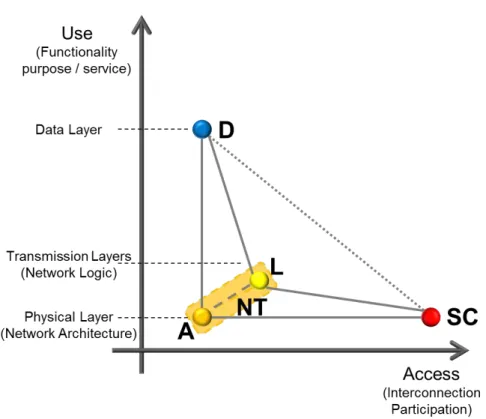
Section 3 develops a general framework characterizing de/centralization in digital networks, across the dimensions of use and access, consisting of the elements of: Data, Network Technology (Architectural and Logic), and Social Community. This section, furthermore, develops the notion of first-order and second-order systems of de/centralization.
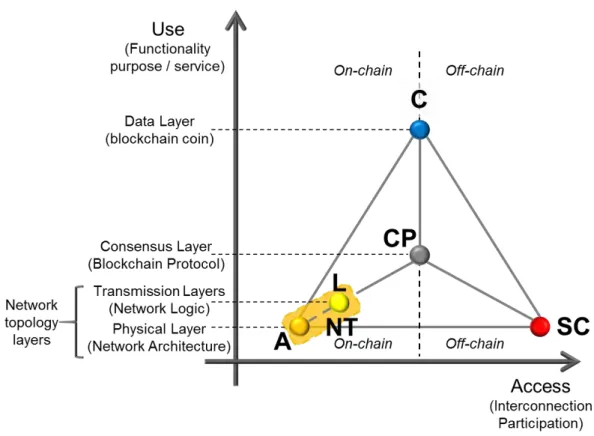
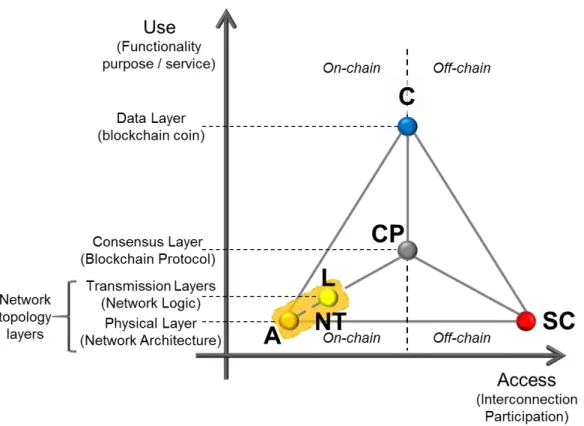
Section 4 applies the analytical framework presented in Section 3 and translates it into the context of blockchain as a digital network. This translation presents the elements of the framework as: Coin (C), Network Technology (NT) — Architectural (A) and Logical (L), Social Community (SC), and the additional element of the Consensus Protocol (CP) — See Figure 1.1. The section argues that rather than considering de/centralization as either characteristics of each element, or indeed as merely first-order interdependencies, the notion should be understood in terms of second-order interdependencies between the elements. The section also proposes necessary and sufficient conditions for a network to be considered a blockchain, and discusses the types of systems emerging when one of the necessary conditions are not satisfied. Finally, the section argues that while the necessary and sufficient conditions may enable the definition of a blockchain, this does not
7 necessarily imply that blockchains are decentralized as this aspect is not determined by the properties of first-order interdependencies, but of more complex second-order interdependencies. Section 5 then in detail explores these second-order interdependencies by carefully in turn analysing the three interactions between the three main elements in the framework: (CSC) the coin — social community interdependencies yielding the metallist and information perspectives on blockchain; (CNT) the coin — network technology interdependencies yielding the protocol-logic, the permission-logic, and the market power perspective within a techno-economic framing, and the platform-logic, the code-is-law, and the principal-agent perspective within a techno-legal framing; and finally, (NTSC) the network technology — social community interdependencies, discussing the critical and often neglected role of the social community to sustain and developments.
Section 6 provides a brief conclusion.
Section 7 – Appendix A: provides a brief characterization of the approach adopted for the literature study of more than 400 academic articles on blockchain.
Readers who are really mainly interested in a brief overview of an analytical framework for understanding blockchain and cryptocurrencies, can skip to Section 4. Each of Section 3, 4, and 5 contains summary sub-sections
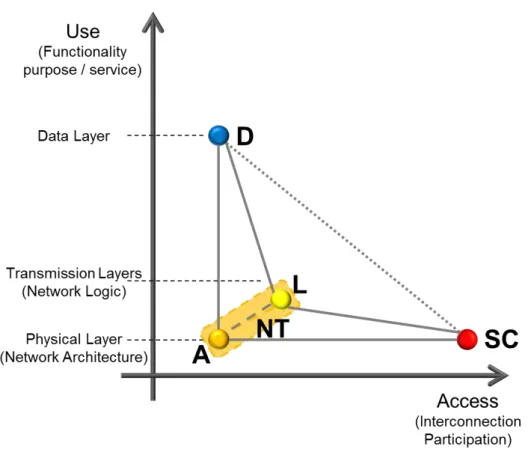
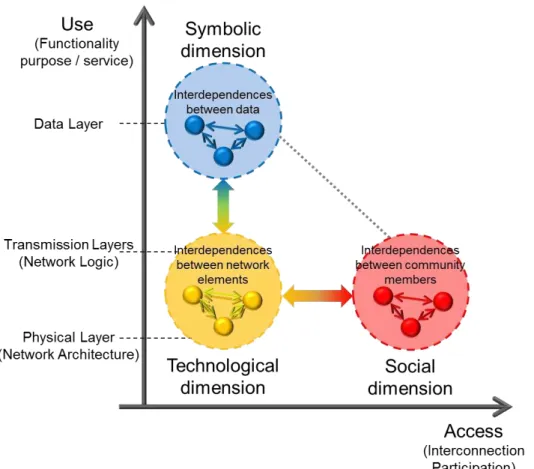
Figure 1.1: The analytical blockchain de/centralization framework. Constructed by projecting the general framework Data, Network Technology (Architectural, Logic), and Social Community onto the context of blockchain, replacing Data with Coin (C) with the addition of the consensus protocol (CP).
8
2
Setting the Stage
This section briefly situates the issue of de/centralization within the context of: 1) digital platform and -infrastructure research; and 2) within the context of blockchain developments.
2.1
Platforms and Infrastructures
The recent years have witnessed the emergence of the platform concept as one of the core elements of the current socio-economic system. This increasing importance of platforms, or “platformization” has been characterised as “platform revolution” (Parker et al., 2016), “platform society” (van Dijck et al., 2018), or even “platform capitalism” (Srniceck, 2017). This is especially true with respect to the governance of digital ecosystems and, more specifically, of the internet.
Digital networks were originally analysed and understood as digital infrastructures, consistent with a long-standing tradition that conceived networks providing access to public service utilities as “infrastructures”. This was true for the field of law (Frischmann, 2004 and 2012), economics (Valletti and Estache, 2001), communication policy (Musiani et al, 2016; Epstein et al, 2016), and information system (Ciborra et al., 2000; Edwards et al., 2007 and 2009; Tilson et al., 2010). This original focus on infrastructure was especially interested in the problems emerging from the interconnection of heterogeneous and situated actors, and from their open access and free use of the network, usually seen alternatively as a commons, essential facility, or common carrier. Since the mid-2000s, the concept of platform gained momentum in organization and management studies (Baldwin and Clark, 2000; Gawer and Cusumano, 2002; Gawer, 2009a; Parker et al., 2016), in legal studies (Farrell and Weiser, 2003; Page and Childers, 2012; Speta, 2002; Weiser, 2002), economics (Evans, 2011), sociology and media studies (Gillespie, 2010 and 2018; van Dijck, 2013) and information systems (Tiwana et al., 2010; de Reuver et al., 2018; Yoo et al., 2012). Consistent with the general trend, the concept of platform started to emerge as the dominant concept driving our understanding of digital networks. This “platformization of the web” (Helmond, 2015) – “data platforms” (Alaimo and Kallinikos, 2017), or “platformized internet” (Flew, 2019) – is founded on the conflation of infrastructural and platform elements of the digital networks, with a pronounced prominence of the latter (Andersson Schwarz, 2017; Flew, 2019; Helmond et al., 2019; Plantin et al., 2016; van Dijck et al., 2018).
The concept of platform has a relatively established and accepted meaning in organization and management studies (Gawer, 2014; Thomas et al, 2014), but this mainly derives from the fact that these disciplines usually do not need to contrast it to the infrastructural dimension of digital networks. When the study of infrastructures becomes core and essential, the situation becomes much more problematic. The academic literature has only very recently started to acknowledge that infrastructures and platforms are two distinct elements (or dimensions) of digital networks and that an analysis of the contribution of both dimensions is required (Constantinides et al., 2018; Plantin et al., 2016; Kazan et al, 2018; Plantin and Punathambekar, 2019). As a result, there is no clear understanding of what the platformization of an infrastructure precisely means in the context of digital networks, or what it entails. On the one hand, there is often no clarity on the way in which the two concepts shall be univocally characterised and distinguished from each other: infrastructures are very often intended and conceptualised as platforms (Benkler, 2006; Yoo et al., 2010; Zittrain, 2008), while platforms are often defined as infrastructures (Gillespie, 2018; van Dijck
9 et al., 2018). This categorical confusion does not help in distinguishing the two concepts in the context of digital networks.
This transition from infrastructure to platforms has, however, not been interpreted in a univocal manner by the literature. Different authors have interpreted the interaction between the infrastructural and the platform dimensions of digital networks in different ways. Various authors have originally interpreted the platformized and modular nature of infrastructures as one of the fundamental characteristics of the digital networks, at the very heart of their generative, open and distributed nature, while the recent literature has started to interpret the platformization of digital infrastructures as a problematic characteristics of the internet, enabling centralized control and supervision over the transmitted content (de Reuver et al, 2018).
This divergence in opinions concerning the meaning and implications of the interplay between platforms and infrastructures certainly derives from the unclear nature of both concepts emerging from the paradoxical tensions inherent in both concepts of platforms (de Reuver et al., 2018; Tiwana et al., 2010; West, 2003; Yoo et al., 2012) and infrastructures (Edwards et al., 2009; Hanseth and Lyytinen 2010; Tilson et al., 2010). Both platforms and infrastructures can be simultaneously seen as determinants of centralization and decentralization depending on the way in which they are defined. As a result, these irreconcilable understandings of the two concepts, and of the implications of their linkage, also reveal a fundamental uncertainty with respect to the meaning and nature of both centralization and decentralization of a digital network. Depending on the point of view adopted, it can either be the infrastructural or the platform dimension of a network that ensures its decentralized nature.
Some authors, mainly rooted in the economic and legal approach, interpret infrastructures as natural monopolies and therefore as an inherent source of centralization. These actors regard the platformization emerging from the layered architecture of digital infrastructures as the necessary way through which decentralization can be introduced in digital networks. This is especially true for those approaches that focus on digital innovation and the generative potential of modular systems (Eaton et al., 2015; Gawer and Cusumano, 2008; Monteiro et al., 2013; Van Schewick, 2010; Yoo et al., 2012, Zittrain, 2006 and 2008), and on the “end-to-end” principle of the layered architecture that enables open innovation, collaborative production and diffused entrepreneurship (Autio et al., 2018; Benkler, 2006; Nambisan et al., 2018; Srinivasan and Venkatraman, 2018). Other authors perceive the platformization of the internet as a phenomenon fostering centralization of digital networks. According to this alternative interpretative approach platformization is a way to introduce centralized control points in the digital networks that can affect and influence the free and private use of the infrastructure and the free flow of data over it. In this case, platformization becomes a phenomenon breaching the end-to-end principle by shifting control away from the edges of the network, rather than a way to support it (Flew, 2019; Gilespie, 2018; Lemley and Lessig, 2001; Lessig, 2006; Wu, 2010; Zittrain, 2018).
The first stream of works — linking platformization to decentralization in infrastructures — mainly links the platform concept to the layered modular architecture of the internet (Greenstein, 2009; Hanseth and Lyytinen 2010; Van Schewick, 2010; Yoo, 2010), and conceives these as neutral and agnostic elements ensuring the decoupling between the structural and ontological characteristics of the underlying infrastructure and its use or functionalities (Kallinikos et al., 2013; Yoo et al., 2010).
10 The second stream of works views platforms as intermediaries or control points that not only enable interconnection, but purposefully organize, shape and influence social interactions within an ecosystem (de Reuver et al, 2018; Jacobides et al, 2018). The introduction of intermediating platforms became necessary with the emergence of Web 2.0 where the sharing, exchange and transaction of user-generated content among dispersed peers of a network had to be organized, rationalized, aggregated and coordinated (Goldsmith and Wu, 2006). This centralized intermediation introduces new issues as it necessarily requires some form of surveillance, inspection, filtering and censorship (more generally, control) of the data and content transmitted over the infrastructure (Deibert el al., 2010; Fuchs, 2011 & 2013; Gillespie, 2010 and 2018; Nieborg and Poell, 2018; Srnicek, 2017; Trottier, 2016 and 2019; van Dijck, 2013; van Dijck et al., 2018; Zittrain and Palfrey, 2008; Zuboff, 2019). Both the economic literature on two-sided platforms (Rochet and Tirole, 2003,2006; Evans and Schmalensee, 2005) and the managerial literature on business ecosystems (Adner, 2017; Baldwin, 2012; Gawer, 2009a; Gawer and Henderson, 2007; Gulati et al., 2012; Jacobides et al 2018; Kapoor and Agarwal 2017; Thomas et al., 2014) mainly belong to this second interpretation of platform, conceived as a focal hub or intermediary that exercises some central organizing or coordinating function over the wider networked system.
To summarize, the current literature on platforms and infrastructures has not provided a univocal answer to the question of whether the platformized nature of digital infrastructures is a centrifugal force fostering decentralization, or rather a centripetal trend towards an increasing centralization of digital networks. The first and original interpretation of platformization as the essence of the layered, agnostic, and decentralized internet infrastructure was essential for the development of the first Web in the early 1990s. The second, more recent interpretation, views the platformization of the internet a centralizing force of an otherwise decentralized network. This interpretation mainly emerged in the early 2000s, with the transition towards the “networked sociality” of the Web 2.0 (van Dijck, 2013: chapter 1). A better understanding of the meanings of both concepts of platform and infrastructure will help in clarifying how to interpret the de/centralized nature of a digital network.
It is precisely in light of this second trend, and in response to its novel problems that blockchain technology was developed as the technology supporting the exchange of bitcoin. Blockchain can be mainly interpreted as a response to the centralizing forces emerging from the platformization of digital infrastructures in Web 2.0. Consistent, the founding fathers of blockchain adopted an interpretative approach consistent with a Web 2.0 view of platformization of a digital infrastructure.
2.2
Blockchain and Cryptocurrencies
The 2008 global financial crisis has a lot to answer for in terms of, for example, the possible links to the rise of populism in the West. However, it also provided an anchor-point bringing together communities with divergent interests into a global movement seeking to use digital technologies to bring about a new financial system. When an individual or group of people under the pseudonym Satoshi Nakamoto (2008), published a whitepaper outlining such a new system, the subsequent efforts of establishing the Bitcoin blockchain unified people motivated by the desire for pseudonymous peer-to-peer cash, with those desiring for a deflationary financial system (Swartz, 2018; Kavanagh et al., 2019). The subsequent decade has seen a rollercoaster ride spawning the Bitcoin open source protocol into many new cryptoassets, the establishment of Ethereum as an infrastructure for smart contracts, the 2017 explosive growth in crowd financing of blockchain-based
11 startups through Initial Coin Offerings (ICOs), and fluctuating cryptoasset prices. The 2017 price hike of bitcoin and other cryptoassets was followed by a rapid decline. Subsequently, much discussion amongst practitioners has been concerned with the viability of so-called “public permissionless” blockchains, such as Bitcoin, as opposed to equally so-called “private permissioned” blockchains offering possibilities for closed consortia of firms to engage in streamlined collaboration. In June 2019, The Libra Association was announced. It is a consortium of just under 30 global firms coordinated by Facebook aiming at supporting Peer-to-Peer (p2p) transfer of funds through blockchain technology.
Blockchain has been a buzzword for the past few years with few subjects drawing such a broad scope and diverse opinions and emotions. Blockchain seems to be both all things to all people with some being devotees and others deeply critical. One of the key reasons for the diversity of opinions is a poor public debate littered with preconceptions and misunderstanding.6 Only in the last few years the literature has started to take blockchain seriously and to grasp its peculiar nature.
A brief look at all the main writings of the early supporters of bitcoin show clear concerns with the novel problems posed by intermediaries acting as centralized points of control prone to surveillance, censorship, filtering and manipulation: from cryptographer David Chaum’s first framework for an untraceable electronic cash in the 1980s,7 over Hal Finney’s Cypherpunks’ writings in the 1990s,8 to the inventor of the notion of smart contracts, Nick Szabo’s writings in computer science, law and economics.9
The bitcoin blockchain was eventually developed in order to reintroduce decentralization in platformized networks subject to increasing centralization and to mitigate the potential associated risks. As stated by Satoshi Nakamoto in one of their letters to peers in the winter of 2008: “Governments are good at cutting off the heads of a centrally controlled networks like Napster, but pure peer-to-peer (p2p) networks like Gnutella and Tor seem to be holding their own” (Nakamoto, 2008). Here, centralization emerges following the introduction of a platform acting as a third-party intermediary in a peer-to-peer network. Platforms and infrastructures have univocal meanings; they do not manifest an ambiguous dual nature. As a result, the original interpretation of platformization,
6
References goes from authors claiming cryptocurrencies are pure speculative bubbles ( https://www.cnbc.com/2019/05/08/nouriel-roubini-and-michael-novogratz-battle-over-bitcoin-and-crypto.html; https://cointelegraph.com/news/nouriel-roubini-at-salt-conference-in-ny-crypto-is-the-mother-and-father-of-all-bubbles), to blockchain being completely useless ( https://cointelegraph.com/news/nouriel-roubini-cryptocurrency-as-a-technology-has-absolutely-no-basis-for-success), or a Ponzi scheme.
7“The use of credit cards today is an act of faith on the part of all concerned. Each party is vulnerable to fraud
by the others, and the cardholder in particular has no protection against surveillance. Paper cash is considered to have a significant advantage over credit cards with respect to privacy, although the serial numbers on cash make it traceable in principle.” (Chaum et al., 1988: 319; emphasis added).
8“One concern I have is that the move to electronic payments will decrease personal privacy by making it
easier to log and record transactions. Dossiers could be built up which would track the spending patterns of each of us … I think that the convenience of credit and debit cards will overcome most people’s privacy concerns and that we will find ourselves in a situation where great volumes of information exist about people’s private lives. This is a place that I could see digital cash playing a role … [as] still no central location is able to track everything I buy.” (Finney, 1993; emphasis added).
9“Commercial security is a matter of solving the practical problems of business relationships such as privacy, integrity, protecting property, or detecting breach of contract … The invocation or assumption in a security protocol design of a "trusted third party" (TTP) or a "trusted computing base" (TCB) controlled by a third party constitutes the introduction of a security hole into that design. The security hole will then need to be plugged by other means.” (Szabo, 2001: 1).
12 intended as a layered modular architecture of an agnostic and generative network, is absent among early enthusiasts of the bitcoin’s blockchain technology, and it will only be partially recovered after the introduction of Ethereum).
Yet, in the same way in which the evolution of digital networks has shown a confusing swing from centralization to decentralization due to the dual nature of platforms and infrastructures, the development of blockchain was also affected by the same fate. Starting with the 2013 hack of the Japanese cryptocurrency exchange Mt. Gox,10 it became clear that a technology that was specifically developed in order to counteract the centripetal trends of the platformized Web 2.0 concealed similar tendencies and the same incentives towards centralization. By the 2016 DAO (Distributed Autonomous Organization)11 hack it was apparent that the technology was in fact exhibiting the same type of tendencies towards centralization of the internet network (DuPont, 2019). This spurred a debate among practitioners and experts in the sector on the meaning of decentralization and on the way in which this concept should be intended in the in blockchain space (DuPont, 2018; Musiani et al., 2018). The launch of the Libra project lead by Facebook could only reinvigorate a debate on whether blockchain really addresses and counteracts the re-centralizing tendencies of platformized digital infrastructures, or if it will inexorably follow the same fate.12
The global innovation effort seems to be seeking two different goals through blockchain technology. The first is to establish a distributed “internet of value” (Web 3.0) based on a mixture of “public permissionless” and “private permissioned” blockchain technology, and the second is comprised of efforts to establish blockchains for business use (Lacity, 2018; DuPont, 2019). The “public permissionless” community frequently relate to Baran’s (1964) architectural distinction between centralised, decentralised, and distributed systems in the emphasis on fully distributed p2p transactions. The “private permissioned” debate emphasises business-to-business interaction within closed consortia.
The following will seek to establish a conceptual framework allowing for a more rigorous unfolding of these concepts characterizing de/centralization in digital networks in general, and blockchain networks in particular. As will be evident from our discussion, the issue of de/centralization is a good deal more multi-faceted than the mainstream academic and practitioner debate so far has acknowledged.
2.3
Decentralization in Blockchain Literature
This section reviews the blockchain literature in order to establish the foundational categories for the following discussion of de/centralization.
2.3.1 Decentralization and Distribution Origins
Blockchain, and the tokens transacted over it, are usually defined as a decentralized. The term “decentralization” does not appear in Satoshi Nakamoto’ 2008 white paper (Nakamoto, 2008: 1), nor
10 https://en.wikipedia.org/wiki/Mt._Gox
11 https://en.wikipedia.org/wiki/The_DAO_(organization)
https://en.wikipedia.org/wiki/Privacy_and_blockchain#DAO_Hack
12 A good summary of the debate over the decentralized nature of Libra is provided by this response article of the FT “Facebook fights back against Libra criticism”
13 in any of the emails exchanged between Satoshi and friends between 2008 and 2009.13 Nevertheless, Nakamoto’s “peer-to-peer distributed timestamp server” (Nakamoto, 2008: 1) was developed in order to overcome centralization in digital payment networks and to devise an alternative to “the standard common solution […] to introduce a trusted central authority”. Building on the same concerns with centralized control points (or intermediaries) Ethereum was originally defined as a “Decentralized Application Platform” (Buterin, 2014; Wood, 2014) and bitcoin was defined by Buterin (2014: 1) as a “decentralized currency” even though Nakamoto never used the term. The term “decentralized” will also appear in the name of the most famous enterprise set up on the Ethereum network: the DAO (Decentralized Autonomous Organization) (Jentzsch, 2016).
Since then, the terms decentralization and distribution have mingled and the two have been originally regarded not just as a characteristic of blockchain, but probably as the fundamental characteristic defining blockchain: blockchain is decentralized (see for instance De Filippi and Wright, 2018: chapter 1). Numerous works have emerged discussing how blockchain achieves decentralization and what this means and implies in the case of decentralized technologies (Wright and De Filippi, 2015; Reyes, 2016), architectures (De Filippi, 2016), infrastructures (Glaser, 2017; Pereira et al., 2019), platforms (Pereira et al., 2019; Wright and De Filippi, 2018: chapter 1), consensus protocols and mechanisms (Glaser and Bezzenberger, 2015; Tasca et al., 2017; Werbach and Cornell, 2017), governance (Atzori, 2015; Arrunada and Garicano, 2018), money and currencies (Gervais et al., 2014; Pagnotta, 2018; Tschorsch and Sceuermann, 2016), and even regulation (Nabilou, 2019). In all these works, decentralization represents the starting point of the analysis; in other words, decentralization is usually the given preliminary assumption from which the analysis develops.
The definition of blockchain in function of the concept of decentralization creates evident conceptual, epistemological and analytical difficulties: if decentralization is the premise of the analysis, it becomes impossible (or even irrelevant) to test whether blockchain really is decentralized, or even what this means. As noted by Walch (2019a: 2) in a recent working paper, the logic becomes very similar to the argument that “blockchain system is decentralized because, well, blockchains are decentralized”. Moreover, the diversity of the interpretative approaches (which depend on the point of view adopted) also generates a lack of clarity and prevents a common understanding of the concept to be tested and analysed. As decentralization is the preliminary assumption from which the argument develops, the concept is very rarely defined.
The lack of a clear and precise definition also generates other confusions and misunderstandings. One striking example is that decentralization (the newer concept used by the Ethereum founders) is commonly mixed up by the literature with the concept of distribution (the original concept used by bitcoin creators). As a result, blockchain as a decentralized technology is usually interpreted as a distributed ledger technology (DLT), even though decentralization and distribution refer to two very different things: distribution simply refers to the way in which something is dispersed, accessed or appropriated by various actors of a social system (usually resources, content or data), while decentralization is a relational concept that defines the way in which interpersonal relationships between these actors are structured, organised and governed. This same confusion is also present in
13 There is just one single exception where the term decentralization appears. The full email exchange can be
14 the broader literature on digital networks and the internet where distribution and decentralization are often conflated (Mathew, 2016; Möller and von Rimscha, 2017; Troncoso et al., 2017), and in the literature on digital infrastructures, where both the term distribution and decentralization is used (Hanseth and Lyytinen, 2010; Tilson et al, 2010).
2.3.2 Critiquing Decentralization in Blockchain Networks
A series of events and general developments challenges the notion of decentralization, such as: 1) The hacking of Mt Gox in 2013 and its subsequent bankruptcy in 2014; 2) the development of specialised ASIC14 (Application-Specific Integrated Circuit) cryptocurrency mining equipment allowing for the emergence of powerful mining pools15 that potentially would be able to reach the critical 51% of mining capacity for a specific cryptocurrency network and through this subvert the distributed consensus;16 and 3) the collapse of the DAO leading to the forking of Ethereum in 2016.17 These important events showed that decentralization cannot be treated as an inherent characteristic of the blockchain technology, of its tokens, or of the social communities adopting it. In the light of these events, an increasing amount of works have recently started to question the assumption of decentralization by showing that blockchain is far from the archetype of decentralization that is usually portrayed to be.
As a result, some works have focussed on the collapse of Mt Gox and on the emergence of many other wallet providers and exchange platforms to show that the blockchain ecosystem abounds with central intermediaries that, most importantly, also represents single points of failure of the entire network (Beikverdi and Song, 2015; Gencer et al., 2018; Vidan and Lehdonvirta, 2019). The emergence of very powerful mining pools showed that the blockchain protocol could be centrally controlled by a handful and maybe even one single actor (as for Ghash.io), and it was therefore prone to manipulation regardless of the will of the majority and the incentive mechanisms adopted (Eyal and Sirer, 2018; Kwon et al., 2019; Vidan and Lehdonvirta, 2019).
The hacking and bankruptcy of the DAO and the implications that this event had for the underlying Ethereum blockchain network has fostered what is probably the most interesting and prolific strand of critiques to the assumption of decentralization. An increasing amount of recent works have focussed on the governance of blockchain networks and on their inherent problems and failures (Arrunada, 2018; Beck et al., 2018; De Filippi and Loveluck, 2016; Dupont, 2018; Finck, 2019: chapter 8; Hsieh et al., 2018; John and Pam, 2018; Miscione et al., 2018 and 2019; Musiani et al., 2018; Reijers et al., 2016; Reyes, 2019; Walch, 2015 and 2018; Zachariadis et al., 2019; Ziolkowski et al., 2019). These works have mainly compared the problems emerging from blockchain governance to the governance of digital platforms and, especially, of digital infrastructures. This literature discusses how the way in which decisions are taken, adopted, and implemented always reflects some governance arrangement of the social community that is far from the ideal of pure decentralization as portrayed by the literature in economics, management and organization studies.
14 https://en.wikipedia.org/wiki/Application-specific_integrated_circuit 15
The pooling of computer capacity to gain a more predictable cryptocurrency awards from proof-of-work consensus arrangements https://en.wikipedia.org/wiki/Mining_pool
16 https://www.coindesk.com/bitcoin-miners-ditch-ghash-io-pool-51-attack 17 https://en.wikipedia.org/wiki/Ethereum
15 This governance conundrum is not limited to the Ethereum community. Many other blockchain communities are currently experiencing “governance crises” derived from the need to update and change their respective protocols in response to a variety of urgent and pressing issues, such as: 1) ensuring sufficient performance when scaling the network; 2) ensuring that the blockchain consensus mechanism can resist the advantages of ASIC mining equipment; 3) the environmental impact of cryptocurrency mining; 4) the interconnection and interoperability of different blockchain networks, and 5) the privacy in exchange of tokens (for a similar list of challenges, see Zachariadis et al., 2019). This has fostered an emerging fierce debate over the meaning and the nature of blockchain governance much beyond academia, and even among the various members of these communities (Buterin, 2017b and 2018).18 These debates on blockchain governance among members of the blockchain communities inevitable mingled with, and result into, the debate on the nature and meaning of de/centralization in blockchain networks (Halaburda and Mueller-Bloch, 2019; Srinivasan and Lee, 2017).19
2.4
Problems with the Current Literature
Although these recent works do not up front assume that blockchain by assumption is a decentralized system, there are still fundamental problems with the current literature discussing the centralizing trends of blockchain networks. First, all works critically challenging the assumption of decentralization usually adopt a partial and mono-dimensional approach to decentralization by focussing on one specific aspect or dimension of blockchain technology, thus ignoring the multidimensionality of blockchain and the related inter-disciplinary nature of the concept of decentralization (Schneider, 2003 and 2019). By doing so these works mainly provide narrow and tailor-made definitions of decentralization for the very specific case of blockchain (or digital networks at most), while ignoring the fact that decentralization is a much more fundamental characteristic of any social (and socio-technical) system where actors and individuals interact in order to pursue their interests and enact their will in relationship (and often in conflict) with the interests and will of others. Secondly, these works usually fail to provide an analytical definition of decentralization, while they mainly focus on its antonym, centralization. The goal is usually to argue that blockchain is not decentralized by showing and verifying that blockchain networks present centralizing tendencies. But what centralization and, especially, decentralization precisely mean and how they should be conceptualised has so far remained vague, implicit, or completely unaddressed (Walch, 2019a). Let us analyse these two aspects in turn.
2.4.1 Decentralization as a Lack of Centralization
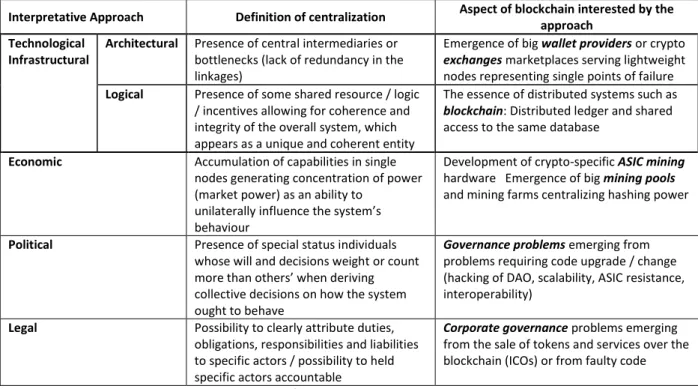
Even though many works now recognise that blockchain networks manifest centralizing tendencies, each work interprets centralization according to the interpretative lens provided by its own specific epistemological field and, as a result, each work only focuses on one single aspect of de/centralization. At least four interpretative approaches to de/centralization can be inferred from the literature (see also Buterin, 2017a; Schneider, 2003 and 2019 on this issue): a technological (or
18 This is particularly evident in the Ethereum community, where prominent members are discussing the way
in which blockchain governance can be applied to the Ethereum blockchain. For a summary of the debate, see the overviews provided by CleanApp on Medium (CleanApp, 2018a, 2018b, 2018c, 2019).
19 See also the approach adopted by ConsenSys to measure centralization in ethereum:
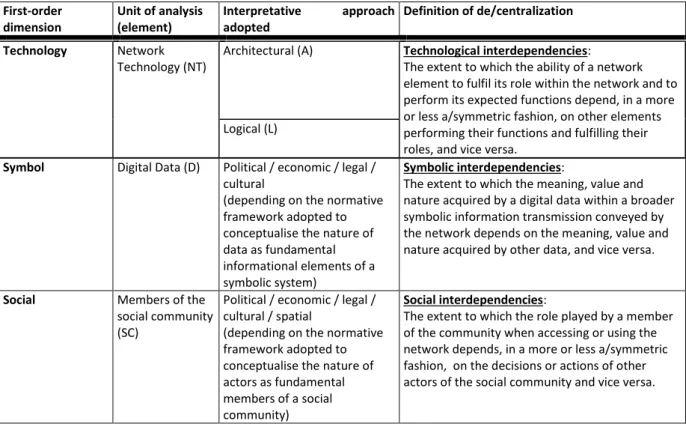
16 infrastructural) one, an economic one, a political one, and a legal one (see table 2.1 for a summary of the four approaches)
a. Architectural and logical approaches: technological centralization of networks
First, a technological or infrastructural approach to centralization defines centralization by looking at the technological characteristics of a networked system and at the way in which the network is designed. Following Buterin (2017a), two different variations of this technological or infrastructural approach can be identified.
The architectural approach defines centralization as a degree of redundancy of the system (Baran, 1964: 1). For this reason, architectural decentralization can be intended as a measure of the number of nodes that can break down before the entire system breaks down (Buterin, 2017a). In this case a networked system is defined as centralized if the network presents a central point of failure, or bottleneck, in the form of an intermediate or focal node collecting, aggregating, organising, and rooting the traffic generated by other nodes. The architectural approach defines centralization as a function of the design of the network’s linkages. We define this approach as architectural as it focusses on the architecture of the network intended as the design of the network’s pipes and conduits connecting the various nodes.
The works adopting an architectural perspective mainly focus on the role played by big wallet providers and exchanges and acquired an early prominence in the literature following the rise (and fall) of big exchanges (such as Mt.Gox). The architectural approach is also widely adopted by the managerial literature on platforms’ architecture and ecosystems (Baldwin and Woodward, 2009; Langlois and Robertson, 1992), by the economic literature on networks (Economides, 1996; Shapiro & Varian, 1998; Shy, 2001), and by the sociological literature (Burt, 1992; Granovetter, 1973 & 1985; Powell, 1990; Smith-Doher and Powell, 2005; Uzzi, 1997). In all these approaches the focus is on the structure or architecture of the relationships between the elements (nodes).
The second sub-branch of the technological-infrastructural approach to centralization is represented by what can be called the logical interpretation of centralization (Buterin, 2017a). This second approach is the one more closely rooted in the computer science literature and is the one directly linked to the theory of distributed or peer-to-peer (p2p) systems (Tanenbaum and van Steen, 2007). In this case, centralization is still a static feature of the infrastructure, but the focus is shifted from the architecture of the pipes “in the middle” to the role of the nodes “at the edges”. A networked system in this case is logically centralized if the various nodes within the system behave as a unique and coherent entity, and cannot operate autonomously and independent from each other as this would breach the integrity and consistency of the system. Logical centralization implies some form of social coordination or collaboration, while the various elements in a logically decentralized system are potentially adversarial and might act inconsistently from each other (Troncoso et al., 2017). Logical centralization simply requires that all nodes are on the same page and share the same common vision of the world and of the state of the system so that they can cooperate and collaborate towards a common and coherent goal. Logical centralization implies an agreement among the nodes on some common state or goal. For this reason, some shared resource is necessary to retain the logical consistency and integrity of the overall system across all nodes as this facilitates the social coordination by ensuring the alignment of incentives. Obviously, this integrity can be ensured by means of centralized architecture through a shared access to a common intermediate
17 hub, but it does not need to. Coordination can simply be ensured by some form of logical centralization by ensuring sharing of information, or alignment of incentives or goals. For this reason, the focus of logical centralization is on the edges (the way in which common resources or data are distributed to, or shared by, the edges), not on the pipes (the way in which these data and resources can be transmitted and communicated).
Peer-to-peer (p2p) systems can be logically decentralised and architecturally centralised in the case of p2p platforms or marketplaces such as Uber or Airbnb (Sundararajan, 2013), or more often architecturally decentralized but logically centralized, as in the case of standard distributed computer networks (Tanenbaum and van Steen, 2007). More generally, distributed systems are usually characterised by the architectural decentralization of the infrastructure but by its logical centralization. A distributed system is defined by Tanenbaum and van Steen (2007: 2) as “a collection of independent computers that appears to its users as a single coherent system.” Consistent with many other p2p networks, blockchains are always logically centralized (Buterin, 2017a), where the common resources shared by all nodes and ensuring the integrity and consistency of the overall system is time or, more specifically, the blockchain timestamp. The presence of a peer-to-peer distributed timestamp server ensures that all nodes synchronise transactions in the same chronological order and this ensures that a single version of a ledger is distributed among all nodes: the distribution of the timestamp server implies centralization of the system. As a result, a blockchain is logical centralized, which ensures the integrity of the system and its behaviour as a single coherent system even in the absence of architectural centralization.20
The inherent centralization brought about by a distributed timestamp has not been sufficiently highlighted by the blockchain literature on blockchain and it has been discussed only indirectly with respect to the debates on the scalability problem of proof-of-work protocols, and the need for independent side chains (Croman et al., 2016; Gervais et al., 2016). In fact, decentralization and scaling have usually been understood by industry participants as potentially incompatible aspects of a distributed system such as blockchain.21
More generally, it can be argued that it is the confusion of the logical aspect of a network (behaviour at the edges) with its pure architectural aspect (the organization of the pipes) that generates the
20
The trade-off between logical and architectural de/centralization is well summarised by Nakamoto (2008: 2) in his discussion of the double-spending problem: “The problem of course is the payee can't verify that one of the owners did not double-spend the coin. A common solution is to introduce a trusted central authority, or mint, that checks every transaction for double spending … The problem with this solution is that the fate of the entire money system depends on the company running the mint, with every transaction having to go through them, just like a bank [architectural centralization]. We need a way for the payee to know that the previous owners did not sign any earlier transactions … To accomplish this without a trusted party, transactions must be publicly announced, and we need a system for participants to agree on a single history of the order in which they were received [logical centralization].” In sum, blockchain addresses the problems emerging from architectural centralization by introducing logical centralization and this is practically achieved by switching from point-to-point communication to broadcasting communication.
21For an overview of Buterin’s scalability trilemma, see Buterin (2014b), and the overviews and summaries in
Medium: https://medium.com/@aakash_13214/the-scalability-trilemma-in-blockchain-75fb57f646df ; https://medium.com/logos-network/everything-you-know-about-the-scalability-trilemma-is-probably-wrong-bc4f4b7a7ef; and Coindesk: https://www.coindesk.com/decentralization-vs-scale-studies-explore-cryptos-growing-struggle.
18 confusing conflation of distribution with decentralization (see Troncoso et al., 2017). In Baran’s (1964) famous article, the distributed system lacks architectural centralization, even though a high degree of redundancy is precisely the way in which coherence and integrity of the overall system (logical centralization) can be ensured. A broad range of literature primarily conceives of centralization in terms of its logical dimension. The focus is on the set of common rules and principles shared by all participants ensuring cooperation and coordination among various independent elements (or nodes). This is the case for works on: Social (or peer) production (Benkler, 2006), open innovation (West and Bogers, 2014), modularity (Baldwin and Clark, 2000; Langlois, 2003), and platform ecosystems (Adner, 2017; Jacobidies et al., 2018) and, especially, the one dealing with digital infrastructures and the birth of internet governance (Ciborra et al., 2000; Goldsmith and Yoo, 2006; Tilson et al, 2010).
Although it is possible to keep architectural and logical approaches distinct as done by Buterin (2017a), they both focus on some objective design features of the network’s infrastructure and for this reason we think that it is possible to consolidate them into one single common approach: the technological or infrastructural approach to centralization (this is similar to Scheneider (2019: 15-17) network approach).
Buterin (2017a) completes his taxonomy with a last dimension, political centralization, defining the extent to which different individuals controls the various nodes of the network. This political dimension is also highlighted by Scheneider (2019). However, control can emerge in various ways and for different reasons, making it very hard to group all the social determinants of centralization into one single dimension. As a result, three other approaches can be identified from the literature.
b. Economic approaches to centralization
A second approach to centralization shared by many works discussing centralization in blockchain networks can be defined as the economic interpretative approach. In this case authors criticising the decentralization assumption of a blockchain highlight how a handful of mining nodes can control the entire system by escalating their investments and concentrating the mining power (Kwon et al., 2019). This line of research mainly considers the dispersion of computing power intended as a proxy for the capacity of one or few nodes to unilaterally affect the way in which the network can evolve and behave. This can be defined as an economic approach as the dynamics according to which the processing capacity of the various mining nodes tend to coalesce and be concentrated into, and thus controlled by, a few or many nodes is usually studied through standard game-theoretic models of market dynamics: degree of competition, incentives to invest, market concentration, collusion and monopoly power (Abadi and Brunnermeier, 2018; Biais et al., 2019; Chiu et al., 2017; Huberman et al., 2017; Kwon et al., 2019; Ma et al., 2018). Consistent with the economic approach, these works adopt a social welfare perspective on centralization.
While the architectural critique of decentralization was inspired by the emergence and failure of central intermediaries, the economic approach to centralization was clearly inspired by the centralization of hashing power (computing power) into few big mining pools (such as BTC.com or Antpool) following the development of ASCI appliances in 2011-12. This aspect became especially relevant considering that the biggest manufacturer of consumer appliances (Bitmain) is also the one directly managing one of the biggest mining pools (AntPool).
19
c. Political approaches to centralization
A third approach considers political de/centralization. The degree of political centralization is usually interpreted by the literature as the way in which private preferences, or wills of single actors, are aggregated and represented at the public (or social) level (Torrisi et al., 2011: 10). Political decentralization measures and defines the rules governing participation to, and representation in, the public sphere: “The best way to summarize these functions might be in terms of representation, which refers to the way political institutions map the multiplicity of citizen interests onto policy decisions […]” (Schneider, 2003: 39). The political approach to decentralization characterises the degree of centralization of the governance of a social system, or the process through which collective decisions are taken.
The political approach usually looks at centralization in terms of normative political categories, such as democracy or fairness. As the political approach focusses on the way in which private values are aggregated, weighted, and translated into public values, it is inherently evaluative and normative (Schneider, 2003). In this case, decentralized systems are democratic systems where all actors have the same “weight” and social influence, and therefore the same probability to see their instances represented and embraced. In this case, a centralized system becomes a hierarchy whenever few actors can take decisions in behalf of the others, such as in an oligarchy, or when the decisions taken by few actors weights more than the will and preferences of others, as in aristocracy or plutocracy. The political approach emerged fairly recently, following the governance problems characterising many blockchain networks, especially with respect to the responses to hacking, protocol change, and scalability. This approach is the one mainly followed by the works interested in the way in which blockchain communities govern themselves, and on the way in which rules governing blockchain networks are developed and established by their respective communities, especially with respect to the proof-of-stake consensus protocol (Buterin, 2017b; 2018).22 The focus is mainly on the various governance forms, such as hierarchy, market, network, and bazaar (see also Ziolkovski et al., 2018a and 2018b; Miscione, 2019). More generally, the literature analysing blockchain governance and the debates emerging out of it mainly adopt a political understanding of de/centralization. A similar approach is also adopted by the literature on open access and networked-production that compares network governance arrangements to hierarchies. Thus, Benkler (2006: 62) defines a system as decentralized whenever coordination can happen without hierarchy, and when “many agents cohere and are effective despite the fact that they do not rely on reducing the number of people whose will counts to direct effective action”. This is a political interpretation of decentralization (democracy) nested within a requirement of logical centralization (overall coherence and effectiveness of the system).
d. Legal approaches to centralization
The legal interpretation of centralization is a fourth and last to be found in the literature. This approach is similar to, yet distinct from, the political approach as it mainly looks at the legal dimension of centralization. A system is centralized whenever duties, obligations, responsibilities, accountabilities and liabilities can be clearly identified and clearly attributed to some actor. Decentralization in this case implies duties and liabilities equally shared or diffused among all