ON THE PROJECT MANAGEMENT SCHEDULING BASED
ON AGENT TECHNOLOGY AND THEORY OF
CONSTRAINT
Chi-Ming Tsou
*Department of Information Management
Lunghwa University of Science and Technology
Taoyuan (333), Taiwan
ABSTRACT
This study proposes a method incorporating agent technique and critical chain technique that based on theory of constraints to solve the project scheduling problem. The approach utilizes thoroughly designed procedure and analytical methods to effectively allocate resources dynamically to achieve the targets of the project. The effectiveness of various scheduling strategies proposed based on the method can be evaluated by parameter simulation techniques. The evaluation results can be used to modify the scheduling for performance improvement. Through case studies it has been demonstrated that the proposed methods can not only shorten the project duration but also improve the project performance in terms of total throughput and less project schedule days.
Keyword: Project Management, Agent Technique, Critical Chain
1. INTRODUCTION
1
A Project is the effort devoted for a specific target [21], novelty is an inherent character of a project, so all the projects are always full of high uncertainty [20]. Project management is a set of rules, methods or techniques, with which to accomplish the target of the project with a designed duration, cost and quality [39, 40]. One of the main functions of project management is to generate the project schedule [4], which includes effectively allocating resources to achieve the targets of the project [14]. This is also commonly known as the resource constraint project scheduling problem (RCPSP). The recent research topics of RCPSP are mainly focused on developing hybrid or improving heuristic algorithms [18, 24, 31, 37, 38], generalizing or releasing constraints [1, 26, 36] and optimizing resource allocation [2] etc..
Currently widely used tools to solve the scheduling problem of project include CPM, PERT, GERT, P-GERT, Q-GERT and VERT etc. However, the number of project failure cases frequently far exceeded that of successful cases [6, 10, 11, 42]. One of the major causes for project failure is unable to control the project schedule accurately; this usually leads to project delay and cost overrun. The major activity of a project at initial stage is schedule
*Corresponding author: [email protected]
planning. A poor schedule planning can eventually lead to project failure [7, 23, 29, 43].
Even schedule planning at the initial stage is conducted well, there is still no guarantee that the project can be finished successfully, because during the proceeding of project one frequently encounters highly uncertain or changing environment. To deal with environment change a project must be rescheduled dynamically, and related resources should also be rearranged according to the changing environment in order to achieve the ultimate target of the project.
This study proposes a method incorporating agent technique and critical chain technique that based on theory of constraints to solve the project scheduling problem. In the meantime simulation techniques are used to evaluate the effectiveness of various scheduling strategies on improving the performance of project scheduling.
2. RELATED WORK
2.1 Theory of Constraints
Theory of constraint (TOC) was proposed by Dr. Goldratt. It is based on utilizing the resources constraint factors, which are inherent in the project, to conduct a set of systematic management activities [12, 13]. In traditional project management one uses the estimated duration of individual activity in a project to conduct the scheduling work. On the other hand, in scheduling technique of critical chain one
uses the accumulated project reserved time as the project buffer, and through managing the project buffer in order to shorten the project duration. Since the duration is deducted from each individual activity and added into the project buffer, the main focus of the schedule is to accomplish the ultimate target date of the project, and the finish date of individual activity does not need to be precisely planned [34, 35].
In traditional project management one uses the technique of critical path to conduct the project schedule planning. Usually in the critical path technique one does not take the resource constraint into account at the initial stage; rather resource constraint is only considered by the technique of resource leveling in the next planning stage. On the other hand, in the critical chain technique one takes the resource constraint into account during the initial planning stage, he needs to find out the activities that consume the most resources and form the critical chain. In order to prevent the non-critical activities from becoming the critical activities due to the activity delaying, the feeding buffer will be added to non-critical activities where the non-critical activities feed into the critical activities. The feeding buffer includes the reserved time for related non-critical path. Properly managing the feeding buffer can avert the critical chain change so as to ensure the successful accomplishment of project duration [15].
The key factor for successful introduction of TOC into project management is to identify the constraints of the system. Basic principles are [13]: 1. Identify the constraints that are inherent in the
system.
2. Decide how to maximize the throughput of the constraints.
3. Let the non-constraint resources operate in coordination with the decision of constraint resources.
4. Elevate the capacity of constraint resources and eliminate it from bottleneck.
5. Uncover the new constraint of the system and return to step 1.
The procedure can be summarized as follows. Firstly one needs to identify the capacity constraint of resources (step 1). Then he arranges the schedule and work sequence for this constraint resource (step 2). Next, coordinate the scheduling of all non-constraint resources to operate coherently to meet the target of the constraint resource (step 3). Then place the critical resource buffer (CRB) before the activities of capacity constraint resource (CCR) (step 4); such buffers prevent the CCR from having to wait if a preceding activity has been delayed. Finally increase capacity to constraint resource to alleviate the pressure on it with the goal of enhancing the resource
to a level so it is no longer the bottleneck resource. At this stage, a new bottleneck resource should be identified for future consideration (step 5), the management work now back to step 1 again.
Using TOC to conduct the research of project scheduling has mainly focused on several directions, such as exploration of constraint criteria extension [41], using heuristic method to solve the mathematic planning problem of stochastic model [30], or incorporating agent component technique of information technology to conduct schedule simulation [17]. This study follows the approach of agent technology and incorporating critical chain scheduling method to explore the effectiveness of various scheduling strategies to the performance of project management.
2.2 Agent Technology
Agent technology is a subfield of distributed Artificial Intelligence (AI) [25]. Fisher [9] defined an agent as an encapsulated entity with traditional AI capabilities. Jennings and Wooldridge [16] defined an agent as self-contained and problem-solving entity. Davidsson et al. [5] defined an agent as an entity with the capability to interact independently with its environment through its own sensors and effectors. According to the definition of Maes [22], an agent is a system that tries to fulfill a set of preset goals under a complex and dynamic environment where the agent located in. Nwana and Ndumn [27] defined an agent as a software and/or hardware component capable of acting exactly in a way for users to accomplish the tasks.
In general, an agent may have both high-level and low-level reasoning capabilities [5], and these capabilities will be influenced by its intentions and beliefs [33]. Moreover, an agent may have the ability of proceeding planning based on its goals, such as performing the activity according to the plan, monitoring the environment to determine the effects of the action, analyzing the extent to which the action brought to the environment, and re-planning the action to achieve the ultimate goals [32].
An agent based system may have the advantages of begin robust, flexible and fault tolerant compared with traditional systems [22]. Meanwhile, the simple behavior patterns of agent are easier to program [8]. In addition, this approach can solve the problems that have previously been unsolvable in a more nature, easy and efficient way [16]. In particular, this natural way of approach can help us to better understand the behavior of a complex system [33]. Finally, an agent-based system can often solve the problems by approaches with lower communication cost, and most likely these approaches are more flexible and more reliable than traditional approaches [25].
Agent technology has been adopted to solve problems of operation research. Colorni et al. [3] applied agent technology to the traveling salesman problem (TSP); Parunak [28] addressed using agent technology on solving the problems of manufacturing scheduling; Liu and Sycara [19] applied agent technology to the problems of job shop scheduling (JSP), and all obtained remarkable results.
In this work a methodology has been developed to demonstrate that applying agent technology to the problem of RCPSP can obtain better results than traditional approach as well.
3. PROJECT MANAGEMENT
INFORMATION PLATFORM
3.1 System Operation Architecture
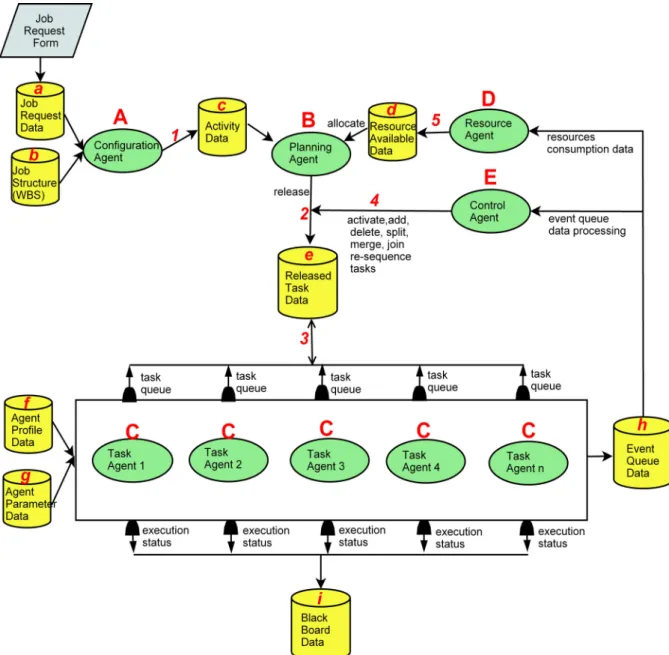
This study proposes a high available and scalable architecture of information platform as shown in Figure 1 according to the project management scheduling requirements. The architecture comprises three layers of operation, which includes the backend data layer, the middle execution layer and the frontend presentation layer. The data layer is the file server in which the system operation related data will be stored. The execution layer will deploy the agents with which the system will perform its functions. The presentation layer will provide the interfaces with which the users can access the system. In execution layer, five agents named Configuration, Resource, Planning, Task and Control will be deployed on it. During system execution, the Configuration agent will determine the work breakdown structure (WBS) first. Then the Planning agent will determine the timing of releasing a task to be executed according to the sequence of the work and available resources. The released tasks will be put into the task queue and waited for execution by each Task agent. After finishing the execution of a task or any exceptional situation taking place during executing a task, the Task agent will put a record into the event queue. The Control agent will extract the records from the event queue to determine the succeeding work for continuation or adjusting the task sequence accordingly. In the meantime, the Resource agent will extract the records from event queue as well to update the resource consumption data that the Planning agent will retrieve for available resources checking. The functions of each agent and the operation procedures will be described in detail in the following sections.
Figure 1: Project management information platform architecture
3.2 System Operation Functions and Procedures
Operation functions of the project management information platform will be described as follows: 1. DB Server
DB server is at the backend of the information platform in which the system operation data will be stored.
2. Application Server
Application server is at the middle of the information platform, which will provide the basic services that are needed between frontend requests and backend data.
3. Service Agent Container
This part is deployed on the application server, which is a middleware that comprises with service agents. Various services will be provided such as request execution of a task, execution status logging of a task, execution results analysis of a task, work load management and performance monitoring of an agent. Those mechanism can incorporate with IaaS (infrastructural as a service) to provide services of cloud computing.
4. Configuration agent
This agent determines the work breakdown structure of a project.
5. Resource agent
This agent carries out available resources management work.
6. Planning agent
This agent proceeds work scheduling according to the project work breakdown structure and available resources.
7. 7. Task agent
This agent performs the pre-defined functions to complete the works that are assigned in the task queue list.
8. Control agent
This agent determines the succeeding task according to the execution results of each Task agent. 9. Security control mechanism
The security control mechanism includes authentication, authorization and access control of the platform.
10. Interface module
This module provides the interface for users to communicate with the system, which can support various request protocols including Http, FTP, SMTP, SOAP or RPC etc..
11. Portal
The portal provides a service entry to the system.
3.3 System Deployment
During operation of the aforementioned project management information platform, the deployed agents and the required data tables are shown in Figure 2. The Configuration agent (A) will extract data from both job request table and job structure table to generate activity data. The Planning agent (B) will extract data from both activity table and available resource table to arrange the schedule and activate the tasks for execution. The Task agents (C) will extract the assigned task for execution from the task queue. After finishing the execution of a task, the Task agents will write the execution result into the event queue table. Finally, the Resource agent (D) will extract the data from event queue table and update the resource consumption table accordingly. Meanwhile, the Control agent (E) will retrieve the data from event queue table to determine the succeeding work of each Task agent. The related tables and agents for system operation will be described in detail as follows:
1. Data structure
The related tables for system operation are shown in Figure 2 and labeled as lowercase letter. A brief description for each table is narrated as below: (a) Job Request Data
This table stores the project job requests that are waiting for execution.
(b) Job Structure
This table stores the work structure of a project.
(c) Activity Data
This table stores the project activities data to be performed.
(d) Resource Available Data
This table stores project available resources data.
(e) Released Task Data
This table stores the released task data that are waiting for execution.
(f) Agent Profile Data
This table stores all the operation related data that an agent is authorized to perform its functions. (g) Agent Parameter Data
This table consists the pre-setting parameters that an agent needs for initialization, change this table will change the behavior of an agent.
(h) Event Queue Data
When the Task agent finishes an assigned task, it will write the processing results into this event queue. Later on, the Control agent will determine the succeeding work to be performed.
(i) Black Board Data
This table stores the current status data of each agent for other agent reference.
2. Agent component
The related agents for system operation are shown in Figure 2 and labeled as uppercase letter. A brief description for the functions of each agent is narrated as below:
(A) Configuration Agent
The main function of the Configuration agent is to determine the whole works that are needed to be performed for a project.
(B) Planning Agent
The main function of the Planning agent is to determine whether or not releasing a task for execution according to the work sequence and current available resource.
(C) Task Agent
The Task agent will perform the assigned tasks. Every Task agent will extract the data from the task queue for execution according to the preset strategy. The combination structure of Task agents is defined in Agent Profile Data where the type of agent and resource required for execution are stored. In addition, the parameters required for initializing a Task agent are defined in the Agent Parameter Data. (D) Control Agent
The Control agent will extract the event data from event queue table to determine the succeeding work; or splitting, merging, adding, deleting or changing the current work, according to the execution results of the Task agent.
(E) Resource Agent
The Resource agent is responsible for available resource management. It will extract data from event queue table and update the available resource data that are needed by the Planning agent for scheduling. 3. System operation procedures
The system operation procedures are shown in Figure 2 and labeled as numbers. A brief description for the procedure is narrated as below:
(1) The Configuration agent writes the activities data that are needed to be performed into the activity data table according to the project work request and work breakdown structure.
(2) The Planning agent will extract records from activity data table and resource available data table to decide if it is available to release a task according to the sequences of the activities and required resources.
(3) The Task agents will extract the released tasks for execution. After finishing execution or occurring exceptional situation, the Task agents will write the execution results into the event
queue table. Meanwhile, they will also update the system black board for performance monitoring.
(4) The Control agent will extract data from event queue table to determine the succeeding work or adjust the work sequence accordingly.
(5) The Resource agent will extract data from event queue table as well and update available resource table with which the Planning agent will use for allocating resources.
Figure 2: Overview of agents operation
3.4 Scheduling and Dispatching Strategies
Regarding the project scheduling strategies, the traditional methods only consider the sequence of the activities and ignore the resources constraint when developing the project schedule at the initial stage. The resource leveling technique will be adopted to adjust the schedule at a later stage. Nevertheless, the critical chain scheduling method employs the activities that consume the most resources and form the critical chain as a system constraint factor to develop the project schedule. Therefore, there are two
scheduling models in terms of dispatching strategies; one is based on the activity, and the other is based on the resource. During dispatching, the activity based strategies only consider the sequence and duration of each activity. Any activity can be released for execution as long as its precedent activities are completed. After dispatching, the duration of a released task will be determined based on the available and required resources. This kind of dispatching strategy will incur execution delay and cause the schedule to be adjusted continuously.
The resource based dispatching strategies use the bottleneck resources of the project as a constraint factor to determine the schedule of the project. For an activity that employs non-bottleneck resources will be scheduled and executed in coordination with activities that employ bottleneck resources. Although this kind of dispatching strategy will not shorten the whole project duration, it will maximize the throughput of the project due to the time delay between activities is eliminated, and this is the advantage of the critical chain scheduling strategy.
In addition, there are several strategies with which a Task agent can select for execution from the task list. The available strategies are: 1) first in first out, 2) random selection, 3) select the task of longest execution time needed, and 4) select the task of shortest execution time needed. This study will use simulation method to explore the effectiveness of each dispatching and scheduling strategy to the project ultimate duration performance.
4. CASE STUDY
4.1 Simulation Project
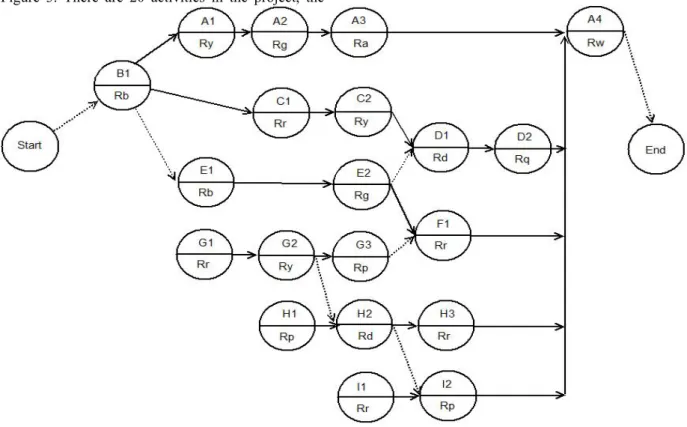
This study uses a simulation project to explore the various project dispatching and scheduling strategies on the effectiveness of project performance. The project work structure is shown in Figure 3. There are 20 activities in the project, the
resource needed for each activity is expressed in different color, In Figure 3, activity is denoted by circle, the label in the upper part of the circle is the activity code, and the label in the lower part of the circle is the resource required to execute the activity, In the project structure, two circles labeled with start and end are dummy nodes.
4.2 Simulation Cases
This study uses both fixed and variable duration for simulation. Duration of activity B1 and A4 is fixed to 1 day; durations of other activities are designated to be 8, 18 and 28 days and a variation range from 0, 2, 4, and 6 days accordingly. For a variation of 0 day means a fixed duration; other variation range of 2, 4, and 6 will accompany with duration 8, 18, and 28 respectively. The actual duration of each activity in simulation cases is determined by the designated days and plus/minus 1 to 3 times of the variation days that are generated randomly. For example, the duration of activity A1 under the conditions of designated 8 days and 1 time of 2 days variation is randomly determined within the range of 6 – 10 days; and randomly determined within the range of 4 - 12 days for cases of 2 times of variation; and randomly determined within the range of 2 – 14 days for cases of 3 times of variation.
Figure 3: Work structure of simulation project
4.3 Simulation Data Analysis
This study conducts the simulation by varying the project duration days and ranges of variation for
the cases of various dispatching and scheduling strategies, which include: A) first in first out, B) random selection, C) choosing the longest duration
activity, D) choosing the shortest duration activity, and E) applying resource constraint dispatching strategy (for Planning agent), and with first in first out scheduling strategy (for Task agent). The first 4 strategies are activity based scheduling methods; and
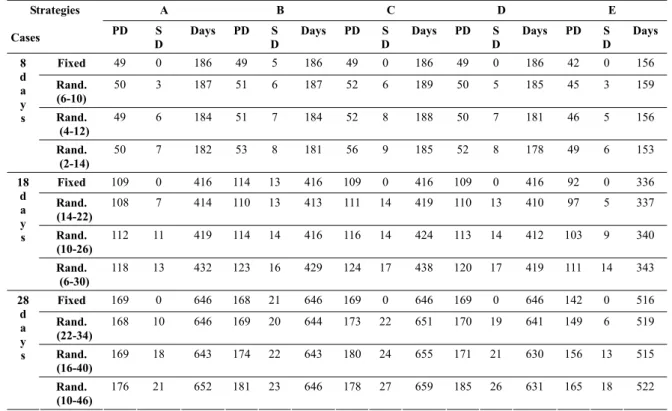
the last strategy is the resource based scheduling method. Total numbers of 50 times are conducted for each case of different dispatching and scheduling strategy. The simulation results are shown in Table 1.
Table 1: Simulation results of project duration and total scheduling days (unit: day)
A B C D E Strategies
Cases PD S D Days PD S D Days PD DS Days PD DS Days PD S D Days Fixed 49 0 186 49 5 186 49 0 186 49 0 186 42 0 156 Rand. (6-10) 50 3 187 51 6 187 52 6 189 50 5 185 45 3 159 Rand. (4-12) 49 6 184 51 7 184 52 8 188 50 7 181 46 5 156 8 d a y s Rand. (2-14) 50 7 182 53 8 181 56 9 185 52 8 178 49 6 153 Fixed 109 0 416 114 13 416 109 0 416 109 0 416 92 0 336 Rand. (14-22) 108 7 414 110 13 413 111 14 419 110 13 410 97 5 337 Rand. (10-26) 112 11 419 114 14 416 116 14 424 113 14 412 103 9 340 18 d a y s Rand. (6-30) 118 13 432 123 16 429 124 17 438 120 17 419 111 14 343 Fixed 169 0 646 168 21 646 169 0 646 169 0 646 142 0 516 Rand. (22-34) 168 10 646 169 20 644 173 22 651 170 19 641 149 6 519 Rand. (16-40) 169 18 643 174 22 643 180 24 655 171 21 630 156 13 515 28 d a y s Rand. (10-46) 176 21 652 181 23 646 178 27 659 185 26 631 165 18 522
In Table 1, column ‘PD’ is the project duration, column ‘SD’ is the standard deviation of the project duration that is derived from the 50 times of simulation, and column ‘Days’ is the scheduling days that is calculated by summing up the total days from being released until completion for all activities.
The simulation results show that the project duration will be the same for strategies of activity based scheduling methods and fixed activity duration. While for scheduling of variable duration, choosing first in first out strategy will be better than strategies of choosing the longest or shortest duration. The random selection strategy for scheduling is inferior to the other strategies and should be avoided in any circumstance.
In addition, it is demonstrated in Table 1 that the resource based critical chain scheduling method, no matter in terms of the project duration or the total days of scheduling, is superior to all the activity based scheduling methods due to controlling the dispatching of all non-bottleneck activities. By comparison, in order to lower the project expenses and risks, the critical chain scheduling method will be the best strategy for better project management.
5. CONCLUSIONS
This work proposes an agent based information platform architecture to deal with project scheduling problems and explores the effectiveness of various dispatching and scheduling strategies. The agent based information platform architecture has a mechanism that can support the agents to arrange and adjust the project schedule dynamically and effectively, under the situation of resources constraint, through communication and collaboration between agents with the goal of meeting the ultimate target of project management. This approach can solve the resource constraint scheduling problem that the traditional project management encountered.
This work also uses simulation methods to explore the effectiveness of various project dispatching and scheduling strategies on the project duration and schedule performance. The major conclusion from the simulation results is that the approach of using the resource based critical chain method to determine the schedule of the bottleneck activities and control the dispatching of non-bottleneck activities is very effective. This approach can not only shorten the project duration but also improve the project performance in terms of total throughput and less project expenses owing to shorter scheduling days.
Project management is always a critical issue in any organization due to tight schedule and short of resources to fulfill the goal of the project. Information systems that adopt agent technology can be deployed in a distributed environment to help the management applying the global planning and local execution strategies to enhance the project management capability of the organization so as to establish the core competence of the organization. In this situation, a good project scheduling approach, such as the methods proposed in this work, that executed in a dynamic environment can not only increase the planning performance of the project but it can also decrease the resources needed for executing the project.
Furthermore, in this sturdy, only normal cases are considered. For situations of abnormal cases, how to adjust the resources and work structure accordingly, and also the behavior of other agents that addressed in the information platform structure to deal with the abnormal situation are topics for future research work.
ACKNOWLEDGEMENT
The author would like to thank National Science Council (Taiwan, R.O.C.) for supporting this study under the plan number: NSC 98-2622-E-262-011-CC3.REFERENCES
1. Ballestín, F., Valls, V. and Quintanilla, S., 2008, “Pre-emption in resource-constrained project scheduling,” European Journal of Operational Research, Vol. 189, pp. 1136-1152.
2. Chen, J. and Askin, R. G., 2009, “Project selection, scheduling and resource allocation with time dependent returns,” European Journal of Operational Research, Vol. 193, pp. 23-34. 3. Colorni, A., Dorigo, M. and Maniezzo, V., 1992,
“Distributed optimization by ant colonies, in Toward a Practice of Autonomous Systems,” In: Proceedings of the First European Conference on Artificial Life, Verela, F. J. and Bourgine, P. (eds.), MIT Press, Cambridge, MA.
4. Davis, K. R., Stam, A. and Grzybowski, R. A., 1992, “Resource constrained project scheduling with multiple objectives: A decision support approach,” Computer and Operations Research, Vol. 19, pp. 657-669.
5. Davisson, P., Astor, E. and Ekdahl, B., 1994, “A framework for autonomous agents based on the concept of anticipatory systems,” In: Proceedings of Cybernetics and Systems ’94, Vol. II, World Scientific, Singapore, pp. 1427-1434. 6. DeMarco, T., 1982, Controlling Software
Projects, Yourdon Press, New York, NY.
7. Eisner, H., 1997, Essentials of Project and Systems Engineering Management, John Wiley and Sons, New York.
8. Ferber, J., 1996, “Reactive distributed artificial intelligence: Principal and application,” In: Foundations of Distributed Artificial Intelligence, O’Hare, G.M.P and Jennings, N. R. (eds.), John Wiley and Sons, New York, pp. 287-314.
9. Fisher, M., 1994, “Representing and executing agent-based systems,” In: Proceedings of the ECAI’94 Workshop on Agent Theories, Architectures, and Languages, Springer-Verlag, Berlin, pp. 307-323.
10. Forsberg, K., Mooz, H. and Gotterman, H., 1996, Visualizing Project Management, John Wiley and Sons, New York, NY.
11. Fried, L., 1992, “The rule of project management,” Information Systems Management, Vol. 9, pp. 71-74.
12. Goldratt, E. M., 1990, What is the thing called theory of constraint and how should it be implemented, North River Press, Inc..
13. Goldratt, E. M., 1997, Critical chain, North River Press, Inc..
14. Herroelen, W. S. and Demeulemeester, E. L., 1994, “Project management and Scheduling,” European Journal of Operational Research, Vol. 90, pp. 187-199.
15. Herroelen, W. S. and Leus, R., 2001, “On the merits and pitfalls of critical chain scheduling,” Journal of Operation Management, Vol. 19, No. 5, pp. 559-577.
16. Jennings, N. R. and Wooldridge, M., 1995, “Applying agent technology,” Applied Artificial Intelligence, Vol. 9, pp. 357-369.
17. Knotts, G., Doro, M. and Hartman, B. C., 2000, “Agent-based project scheduling,” IIE Transaction, Vol. 32, pp. 387-401.
18. Krüger, D. and Scholl, A., 2009, “A heuristic solution framework for the resource constrained (multi-) project scheduling problem with sequence-dependent transfer times,” European Journal of Operational Research, Vol. 197, pp. 492-508.
19. Liu, J. S. and Sycara, K. P., 1998, “Multiagent coordination in tightly coupled task scheduling,” In: Reading in Agents, Huhns, M. N. and Singh, M. P. (eds.), Morgan Kaufmann, San Francisco, CA, pp. 164-171.
20. Lock, D., 1996, The Essentials of Project Management, Gower, Brookfield, VT.
21. Lweis, J. P., 1995, Project Planning, Scheduling, and Control, Irwin, Chicago, IL.
22. Maes, P., 1995, “Modeling adaptive autonomous agents,” In: Artificial Life: An Overview, Langton, C. G. (ed.), MIT Press, Cambridge, MA, pp. 135-162.
23. McComb, D. and Smith, J. Y., 1991, “System project failure: The heuristics of risk,” Journal of Information Systems Management, Vol. 8, pp. 25-34.
24. Mika, M., Waligóra, G. and Wçglarz, G., 2008, “Tabu search for multi-mode resource-constrained project scheduling with schedule-dependent setup times,” European Journal of Operational Research, Vol. 187, pp. 1238-1250.
25. Moulin, B. and Chaib-Draa, B., 1996, “An overview of distributed artificial intelligence,” In: Foundations of Distributed Artificial Intelligence, O’Hare, G.M.P and Jennings, N.R. (eds.), John Wiley and Sons, New York, pp. 3-55.
26. Moumene, K. and Ferland, A., 2009, “Activity list representation for a generalization of the resource-constrained project scheduling problem,” European Journal of Operational Research, Vol. 199, pp. 46-54.
27. Nwana, H. S. and Ndumu, D. T., 1997, “An introduction to agent technology,” In: Software Agents and Soft Computing: Towards Enhancing Machine Intelligence, Nwana, H. S. and Azarmi, N. (eds.), Springer-Verlag, Berlin, pp. 3-26.
28. Parunak, H. V. D., 1996, “Application of distributed artificial intelligence in industry,” In: Foundations of Distributed Artificial Intelligence, O’Hare, G.M.P and Jennings, N. R. (eds.), John Wiley and Sons, New York, pp. 139-164.
29. Pulk, B. E., 1990, “Improving software project management,” Journal of Systems Software, Vol. 13, pp. 231-235.
30. Rabbani, W., Fatemi-Ghomi, Jolai, S. M. T., F. and Lahiji, N. S., 2007, “A new heuristic for resource-constrained project scheduling in stochastic networks using critical chain concept,” European Journal of Operational Research, Vol. 176, pp. 794-808.
31. Ranjbar, M., Reyck, B. D. and Kianfar, F., 2009, “A hybrid scatter search for the discrete time/resource trade-off problem in project scheduling,” European Journal of Operational Research, Vol. 193, pp. 35-48.
32. Rozenblit, J. W., 1992, “Design for autonomy: An overview,” Applied Artificial Intelligence, Vol. 6, pp. 1-18.
33. Singh, M. P., 1994, Multiagent Systems: A Theoretical Framework for Intentions, Know-how, and Communication, Springer-Verlag, Berlin.
34. Steyn, H., 2000, “An investigation into the fundamentals of critical chain project management,” International Journal of Project Management, Vol. 19, No, 6, pp. 363-369.
35. Steyn, H., 2002, “Project management
application of the theory of constraint beyond critical chain scheduling,” International Journal of Project Management, Vol. 20, pp. 75-80. 36. Tiwari, V., Patterson, J. H. and Mabert, V. A.,
2009, “Scheduling projects with heterogeneous resources to meet time and quality objectives,” European Journal of Operational Research, Vol. 193, pp. 780-790.
37. Valls, V., Ballestín, F. and Quintanilla, S., 2008, “A hybrid genetic algorithm for the resource-constrained project scheduling problem,” European Journal of Operational Research, Vol.185, pp. 495-508
.
38. Van de Vonder, S., Demeulemeester, E. and Herroelen, W., 2008, “Proactive heuristic procedures for robust project scheduling: An experimental analysis,” European Journal of Operational Research, Vol. 189, pp. 723-733. 39. Wallace, R. and Halverson, W., 1992, “Project
management: A critical success factor or a management fad,” Industrial Engineering, Vol. 24, pp. 48-50.
40. Ward, J. A., 1999, “Productivity through project management: Controlling the project variables,” Information System Management, Winter, pp. 16-21.
41. Wei, C. C., Liu, P. H. and Tsai, Y. C., 2002, “Resource-constrained project management using enhanced theory of constrained,” International Journal of Project Management, Vol. 20, pp. 561-567.
42. Willcocks, L. and Griffiths, C., 1994, “Predicting risk of failure in large-scale information technology projects,” Technological Forecasting and Social Change, Vol. 47, pp. 205-228.
43. Williams, B. R., 1995, “Why do software projects fail,” GEC Journal of Research, Vol. 12, pp. 13-16.
ABOUT THE AUTHOR
Chi-Ming Tsou is an assistant professor in the department of information management at Lungwha University of Science and Technology Taiwan. He received his Ph.D. in business from Fu-Jen Catholic University Taiwan with an emphasis on intelligent data analysis and information technology. Before that, he was a business consultant in the software industry for almost 20 years. His research interests encompass the domain where intelligent data analysis or agent-oriented engineering approaches can be used for the development and realization of project management information systems.
(Received January 2011, revised February 2011, accepted March 2011)