University of Zurich Main Library Strickhofstrasse 39 CH-8057 Zurich www.zora.uzh.ch Year: 2018
Consensus through Blockchains: Exploring Governance across
interorganizational Settings
Ziolkowski, Rafael ; Miscione, Gianluca ; Schwabe, Gerhard
Abstract: The blockchain technology challenges the view on established modes of governance by offering distributed authentication without the need for a central authority, which is well-exemplified by Bitcoin. While the governance of and through Bitcoin is well- accentuated in research, we spotlight impacts on governance which blockchain-based systems bring to inter-organizational settings as well as their pur-pose. To build our arguments, we explore those impacts on two contrasting cases from the domains of automotive and public administration and relate them to cryptocurrencies. Relying on interviews with experts from said organizations utilizing blockchain technology, and a content analysis of related grey literature, we discuss established forms of governance as well as platforms and infrastructures against the impacts which blockchain-based systems cause. After referring those to the concepts of markets, hierarchies, networks, and tribes, we critically reflect on their purpose by utilizing the notions of infras-tructures and platforms, and conclude blockchain-based systems to possibly alter the way established modes of governance are enacted.
Posted at the Zurich Open Repository and Archive, University of Zurich ZORA URL: https://doi.org/10.5167/uzh-160378
Conference or Workshop Item Published Version
Originally published at:
Ziolkowski, Rafael; Miscione, Gianluca; Schwabe, Gerhard (2018). Consensus through Blockchains: Ex-ploring Governance across interorganizational Settings. In: International Conference of Information Systems (ICIS 2018), San Francisco, USA, 12 December 2018 - 16 December 2018.
Consensus through Blockchains:
Exploring Governance across inter
-organizational Settings
Completed Research Paper
Rafael Ziolkowski
University of Zurich
Binzmühlestrasse 14
8050 Zürich, Switzerland
[email protected]
Gianluca Miscione
University College Dublin
Belfield
Dublin 4, Ireland
[email protected]
Gerhard Schwabe
University of Zurich
Binzmühlestrasse 14
8050 Zürich, Switzerland
[email protected]
Abstract
The blockchain technology challenges the view on established modes of governance by offering distributed authentication without the need for a central authority, which is exemplified by Bitcoin. While the governance of and through Bitcoin is well-accentuated in research, we spotlight impacts on governance which blockchain-based systems bring to inter-organizational settings as well as their purpose. To build our arguments, we explore those impacts on two contrasting cases from the domains of automotive and public administration and relate them to cryptocurrencies. Relying on interviews with experts from said organizations utilizing blockchain technology, and a content analysis of related grey literature, we discuss established forms of governance as well as platforms and infrastructures against the impacts which blockchain-based systems cause. After referring those to the concepts of markets, hierarchies, networks, and tribes, we critically reflect on their purpose by utilizing the notions of infrastructures and platforms, and conclude blockchain-based systems to possibly alter the way established modes of governance are enacted.
Keywords: Blockchain Governance, Inter-organizational Systems, Distributed Ledger Technology Governance, Distributed Authentication, Consortia Blockchain
Introduction
Ruling with many rulers is not easy. Ruling without rulers is a paradox in theory with interesting consequences in practice. Both stances manifest in the emerging problems of governance regarding blockchain-based systems. Bitcoin, born at the time of a major financial crisis and the most prominent blockchain to date, proved at scale the technical functioning of this distributed consensus system. However, it also continues to show the shortcomings of its mode of governance, which refrain from formal and central authorities. The maintenance of the public ledger of all Bitcoin transactions relies on distributed mining, which substitutes external authorities acting as intermediates, often depicted as expensive and prone to corruption. In other words, trust is promised to be maintained by a cheaper
system which leaves little space to political maneuvering. This is proving questionable. We explore this and related issues in practice by considering several different implementations of blockchains.
Despite its growth, due to substantive inflow of capital in recent years, Bitcoin’s peculiar governance proved troublesome: Bitcoin’s decade long history is defined by constant crises (De Filippi and Loveluck 2016), particularly in relation to never-ending conflicts on core technical decisions with far-fetched consequences. Those problems put repeatedly Bitcoin on the verge of a stand-still if not collapse (De Filippi and Loveluck 2016), and arguably hindered a number of innovations like micro-payments.
Those remarkable set-backs did not hurt the great deal of enthusiasm that persists around blockchains. This can be best exemplified by the so-called decentralized autonomous organizations (DAOs: Self-organized communities whose operation is set in code) as three projects alone (Tezos, Aragon, TheDAO) gathered hundreds of millions USD in funds just to run in governance problems shortly after (DuPont 2017; Floyd 2018). Hence, the hype that blockchain solutions come wrapped in may not predict how they will develop in practice but it explains what stakeholders mobilize resources, how they use them, and with what expectations, which is consistent with the concept of the organizing vision proposed by Swanson and Ramiller (1997). Therefore, most of our data collection relied on interviews with key figures in their respective companies. For the time being, we have no way, nor it is our intention with this paper, to enter the prediction game. Rather, we use those cases to distill insights into if and how blockchains impact governance in inter-organizational settings.
This research has an exploratory character and is inspired by the call for a deeper understanding on how blockchain systems can be utilized and what impacts on governance they cause (Beck et al. 2018; Tapscott and Tapscott 2017). We understand governance as the means for organizational and economic coordination utilizing decision rights, incentives, and accountabilities (Beck et al. 2018); we study and contrast the governance of (system governance) and through (brought by the system) blockchains.
In sum, the aim of this paper is to contribute to the scarce body of knowledge on governance in and around blockchain-based systems, which targets a vibrant and growing debate in academia and
practitioners’. To achieve that purpose, thus improve also the practice of governance in different domains,
we reviewed a large amount of grey literature (authoritative and specialized news, blogs, articles), complementary to the scarce scientific literature, and interviewed and analyzed 18 companies to uncover reoccurring patterns of governance. Our effort was led by the following research questions:
RQ1: How do blockchain-based systems impact governance?
RQ2: How does their governance relate in practice to established forms of governance as well as platforms and infrastructures?
To better characterize the systems we studied, thus to answer our research questions, we related our cases to ongoing debates. Most cases that we studied are at early stages, but we see two lines of development emerging: One more profit-oriented, the other more motivated by the pursue of public good. Relying on the dichotomy well-formalized by Plantin et al. (2016), the former is better explained by the concept of platform, the latter by that of infrastructure. It has to be stressed that a platform and infrastructure do not necessarily match specific types of blockchains, respectively: In fact, blockchains like those used in many land registry cases may be oriented to public good, whereas blockchains like Ethereum may aim at two- or multiple-sided markets that are typical of platforms. Last but certainly not least, it has to be stressed that these domains of application remain very fluid. So, applications presenting characteristic of platforms may develop into infrastructures and vice versa. Plantin (et al. 2016) argue that Facebook and Google perform infrastructural functions despite having begun as platforms. Those two concepts, the former more suitable for public services and utilities, the latter more for businesses engaged in the so-called sharing economy, prospect different forms of governance, which may vary depending on the actors involved, main stakeholders, and blockchain’s purpose. Some may point to existing governance types,
others to novel ones.
The paper is organized as follows: Our literature review connects works on governance with insights from the blockchain domain. After this, our methodological choices are described. For the results section, due to space limitations, we clustered kindred cases and present three of them in detail in respect to their purpose and the way they are governed; findings from the remaining cases are filled in wherever appropriate. The discussion reflects on shown cases, discusses their merits and pitfalls, and sets them in relation to established form of governance. The paper concludes with possible avenues for future research.
Literature Review
In this section, we introduce fundamental concepts of blockchain technology, differentiate between variations of its current governance, and relate them to existing modes of governance.
Blockchain Classification
We will refrain at this point to provide a detailed technical explanation of how blockchains work as this paper centers on their advantages and shortcomings from a governance perspective. As foundation, however, we rely on Beck et al. (2018) who defines the blockchain as “(…) a decentralized, transactional
database technology that facilitates validated, tamper-resistant transactions consistent across a large
number of network participants called nodes”. According to Peters and Panayi (2015), a classification of blockchain systems can roughly be seen along the access to transactions (public or private) and the right to validate transactions (permissioned or permissionless).
Access to Transactions Access to Transaction Validation
Permissioned Permissionless
Public All nodes can read and submit transactions. Only authorized nodes can validate transactions. All nodes can read, submit, and validate transactions. Private Only authorized nodes can read, submit, and validate transactions.
Table 1. Classification on Blockchain Types, taken from Peters and Panayi (2015)
Governance and its many Faces
In an effort to classify forms of governance into archetypes, Williamson (1975) defined the market and the
hierarchy based on transaction costs (Williamson 1981), i.e. one or the other depend which one has a lower transaction costs for a given purpose. Powell (1990) later extended this classification with the
network, which differs from both market and hierarchy and which is more efficient in domains in which trust is central and outcomes are difficult to measure. The bazaar (Demil and Lecocq 2006) as well as the
tribal (Miscione et al. 2018) archetypes are based on digital modes of governance that emerged later. We anticipate them here and explain them below.
The hierarchy refers to the walled-up, bureaucratic, authority-based fashion of organizing and coordinating. Markets, on the other hand, constitute a coordination form in which ownership, price, and trade freedom are fundamental. The network refers to relatively stable inter-organizational relations, where reputation and reciprocity build a maintain trust, which substitute hierarchical power and the
invisible hand of market forces. As for the actor’s preferences (Powell 1990; Williamson 1975), they can be seen as independent (market), dependent (hierarchy), and interdependent (network). Besides enhancing managerial controlling in hierarchies, IT is also said to impact the inter-organizational forms of coordinating economic activities (networks and markets) as it facilitates the sharing of data and by that lowers costs of agency and coordination. From an agency perspective, IT lowers agency costs in relation to
one company’s size by providing scalable systems for supervision and coordination (Klein et al. 1978).
Williamson’s and Powell’s classification does not suffice to capture some of the characteristics which
emerged after their writings, especially in relation to information technologies. This can be seen in free and open-source software (FOSS) with the formulation of the bazaar archetype by Demil and Lecocq (2006). FOSS lowers significantly transaction costs through unrestricted access to source code, which prevents the trade of software as property. Actors can wander and choose among products upon liking, with low incentive and control intensity. The identities of parties are partly relevant, as software developers build their reputation. Overall, the bazaar follows the normative basis of openness and fairness. Following Miscione et al. (2018), the bazaar differs from (1) networks as togetherness remains fluid, (2) from markets as no exclusive ownership on a product is granted, and (3) from hierarchies as formal lines of control nor a defined organizational structure can be found.
As for the last archetype, the tribal governance (Miscione et al. 2018) captures peculiarities of governance in the blockchain domain: Blockchains differ from FOSS, thus bazaar, because they bring authentication thus uniqueness of data to digital environments, hence rivalry among actors – e.g., a bitcoin/digital
tokens always belong to one entity and no one else at any point in time. This contrasts to digital infrastructures as we have known them today, where replication costs are nearly null, and scarcity a non-issue (Benkler 2006; Zittrain 2006). Uniqueness of data (or token in blockchains) gives them value. As soon as there are conflicting versions of data, people lose trust in the reliability of the ledger, so its value decreases or disappears altogether. The same holds true for a community surrounding blockchains: Its users have a mutually dependent interest in the uniqueness and reliability of data and its value, which originates an organizational togetherness that the bazaar archetype does not account for and makes forks undesirable (Miscione et al. 2018). As the ledger acts as the consensus mechanism, the majority can
enforce changes to the protocol upon the minority. This fashion of coordination has been labeled “Tribal”
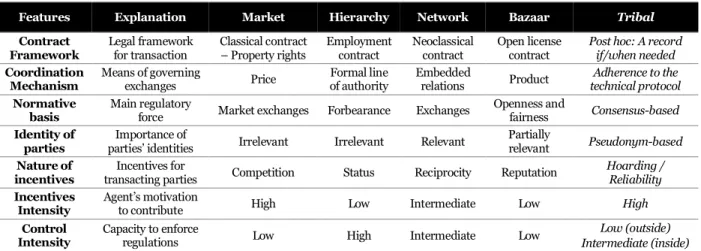
as it reflects the togetherness of a tribe but also the openness to join or leave other tribes upon liking (Miscione et al. 2018). Table 2 contrasts the governance types.
Features Explanation Market Hierarchy Network Bazaar Tribal Contract
Framework
Legal framework
for transaction Classical contract – Property rights Employment contract Neoclassical contract Open license contract Post hoc: A record if/when needed
Coordination Mechanism
Means of governing
exchanges Price Formal line of authority Embedded relations Product technical protocol Adherence to the
Normative basis
Main regulatory
force Market exchanges Forbearance Exchanges Openness and fairness Consensus-based Identity of
parties
Importance of
parties’ identities Irrelevant Irrelevant Relevant Partially relevant Pseudonym-based Nature of
incentives
Incentives for
transacting parties Competition Status Reciprocity Reputation Hoarding / Reliability
Incentives Intensity
Agent’s motivation
to contribute High Low Intermediate Low High Control
Intensity
Capacity to enforce
regulations Low High Intermediate Low
Low (outside) Intermediate (inside)
Table 2. Governance Archetypes and Features, taken from Miscione et al. (2018)
Public and permissionless Blockchains and their Governance
The best known and widely spread kind of blockchain are permissionless and public ones like Bitcoin, Ethereum, and many, mostly token-based systems, which attracted interest of research (Campbell-Verduyn 2017; DuPont 2017; Morabito 2017; Reijers et al. 2016; Tapscott and Tapscott 2017). Those systems, in general, rely on decentralization, immutability, auditability, and anonymity (Quinn DuPont and Bill Maurer 2015), eliminating the need for a third party such as banks or auditors (Gerald P. Dwyer 2015). Those systems are open for participations either for transacting or validating. Participants can be relying on a pseudonymous identification through key pairs (public and private), which may not disclose
any legal identify. From a user’s perspective, transacting on those systems is incentivized by higher transaction speed (minutes instead of days) and lower transaction fees, especially when international payments are concerned. In blockchains based on proof-of-work, which is currently the most common architecture, validation is incentivized by a reward which is randomly allocated to miners, who can increase their chances by providing more hashing power. Incentivizing computing power constitutes a core mechanism to ensure transaction validity and network security, thus its allocation keeps miners honest. This coordination mechanism of the technical protocol defines how validators can participate in
the blockchain functioning. Differently from other information systems, developers’ influence over its
design is counterbalanced by both miners and users’ influence (Morabito 2017; Walport 2016).
There is neither an identifiable, thus accountable, nor a steering board for Bitcoin or Ethereum but influential actors such as core developers (Bitcoin Core contributors), opinion leaders (Vitalik Buterin at Ethereum), and mining pools; an eventual agreement of any sorts resides with the variety of actors involved in their respective blockchain. Even though the influence of Bitcoin’s core developers and Vitalik
Buterin on emerging governance issues varies, the absence of a clear decision-making and accountable authority challenged both blockchains. Eventually, it caused delayed decision-making processes, an attempted centralization of decision power by core developers, and eventually hard forks (De Filippi and Loveluck 2016). Public and permissionless blockchains surely constitute an interesting approach to governance, but their evolution and trustworthiness on the long term remains to be seen. Other
utilizations of blockchains, such as permissioned, private, or consortia-based implementations constitute more recent novelties and thus demand exploratory research.
Inter-organizational Relations, permissioned Blockchains, and Governance The prospect of digital scarcity, thus immutability, through native authentication, and the possibility of governance through blockchains is also reflected in the rise of business consortia to explore the benefits of blockchain technology for own profit-seeking behaviors (Gratzke et al. 2017). Collaboration among companies, however, is a challenging endeavor as history has shown (Daugherty et al. 2006; Fawcett et al. 2015). Inter-firm rivalry, own interest, and lack of trust are some of the many inhibitors to inter-organizational collaboration; a governance structure in those settings can be safeguarding each company’s
interests (Fawcett et al. 2015; Walport, 2016).
Permissioned blockchains vary in assigning transaction, validation, and access rights. While permissioned
blockchains preserve some permissionless blockchain’s core characteristics such as decentralization,
immutability, and auditability, the participating actors, in contrast, are known. Thereby, they strive to foster collaboration between known (hence accountable) parties with agreed upon validators and other enforcing systems to be used to maintain the ledger. Network maintenance, in contrast, is not primarily driven by mining but by other, more efficient consensus algorithms like proof-of-stake. The value of the stored data in the permissioned blockchains still depends on its unambiguity, which fosters the
participants’ common interests and sense of togetherness. Same as in permissionless blockchains, consensus on permissioned blockchains is defined by the technical protocol; the decision upon the technical protocol, however, relies on the consensus of the parties or consortium which initiate and run the blockchain with some shared interest (it has to be noted that once inscribed in technology and deployed, the functioning is difficult to change). The latter contrasts both blockchain archetypes: Consensus among known parties with shared interests vs. consensus among unknown parties whose interests may vary greatly.
The feature of embedding programming functions on blockchains is appealing as it promises to automatize parts of business processes. Those pieces of software are usually referred to as smart contracts (Gatteschi et al. 2018). Referring to social contract theories, Reijers, O’Brolcháin, and Haynes (2016)
concede that smart contracts in blockchains enable to create a self-governing partnership with enforceable rules of interaction without the need for a central authority (Werbach 2017). Smart contracts thereby contribute to an governance through blockchain (Kitchin 2017; Shermin 2017). It is worth mentioning that smart-contracts can be seen as a way to extend the influence of algorithms beyond the governance of blockchain to the governance by blockchain (Pelizza and Kuhlmann 2017) to the extend they can help governing domains like, e.g., the second-hand car market (Notheisen et al. 2017). Same as with many other systems, the business logic inherent to a smart contract depends on its environment and is subject to change (Nitto et al. 2008). This requires the collaborating parties that run the system to agree on a minimum common ground, which may vary in inter-organizational collaboration (Daugherty et al. 2006).
Methodology
Building on what is commonly understood as blockchain governance, we strove to explore how organizations at different levels of advancement in their blockchain efforts approach governance (blockchains in conceptualization, development, or operational), what purposes they serve, and – as much as possible – how they put them in practice. As typical for exploratory research (Briggs and Schwabe 2011; Stebbins 2001), we utilized all available sources and derived appropriate concepts to describe them. Overall, we followed those steps: A literature review, semi-structured expert interviews, review of grey literature, data analysis, and evaluation and refinement, which are detailed in the following.
First, we conducted a literature review, which covered the relatively scarce body of academic publications available to date following the methodology proposed by vom Brocke et al. (2009). We retrieved those publications from searches on the main online databases (including Scopus, Web-of-Science, Google Scholar, iEEE), using a variety of search terms about blockchain governance and used both forward and backward searches. Then, the same approach has been utilized to cast a typology about shared systems and how organizations strove to collaborate using shared systems in the past, e.g. in the supply chain
domain (Stevens and Johnson 2016). This allowed to put permissioned blockchains in a broader academic context. This depicted the state of the art and further enabled us to define our interview questions.
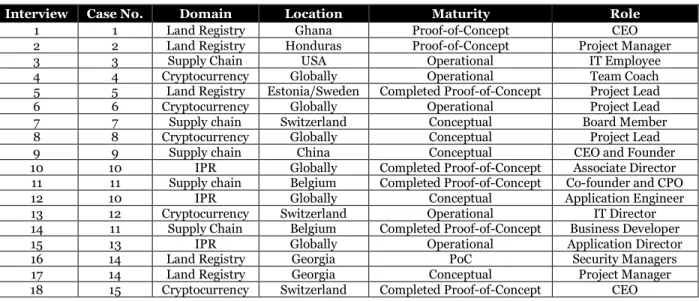
Interview Case No. Domain Location Maturity Role
1 1 Land Registry Ghana Proof-of-Concept CEO
2 2 Land Registry Honduras Proof-of-Concept Project Manager
3 3 Supply Chain USA Operational IT Employee
4 4 Cryptocurrency Globally Operational Team Coach 5 5 Land Registry Estonia/Sweden Completed Proof-of-Concept Project Lead 6 6 Cryptocurrency Globally Operational Project Lead 7 7 Supply chain Switzerland Conceptual Board Member 8 8 Cryptocurrency Globally Conceptual Project Lead 9 9 Supply chain China Conceptual CEO and Founder 10 10 IPR Globally Completed Proof-of-Concept Associate Director 11 11 Supply chain Belgium Completed Proof-of-Concept Co-founder and CPO 12 10 IPR Globally Conceptual Application Engineer 13 12 Cryptocurrency Switzerland Operational IT Director 14 11 Supply Chain Belgium Completed Proof-of-Concept Business Developer 15 13 IPR Globally Operational Application Director 16 14 Land Registry Georgia PoC Security Managers 17 14 Land Registry Georgia Conceptual Project Manager 18 15 Cryptocurrency Switzerland Completed Proof-of-Concept CEO Table 3. Overview on Interviewees and Cases, adapted from Ziolkowski et al. (2018)
Second, as for the empirical part, since 2017 we searched for as many actual blockchain systems as possible on a variety of online sources like Crunchbase and Coindesk. Identifying cases of operational blockchains, however, proved a difficult task. While there is a plethora of blockchain startups, GitHub projects, and similar in the initiating phase, advanced blockchain-based systems are hard to find. As a result, scientific research with solid empirical grounding appears still scarce. From a longlist of 121 companies, we chose those we deemed most mature and appropriate based on company size, collaborators, time length of operation, and revenue, if available, which resulted in 42 companies whose representatives we invited for expert interviews. Those have mostly been held via phone or conference calls with an average duration of one hour in the fashion of semi-structured interviews, following the classification by Myers and Newman (2007), in respect to the exploratory character of our research,
leaving room to lean towards interviewee’s perspective and to foster discussions. To assure the right
framing and the appropriate person to speak to, we introduced our research in brief and sent exemplary questions beforehand. 18 representatives from 15 different companies responded to our call. Our interview sample thereby covers blockchain experts from higher management from various parts of the world, and a variety of application domains as it can be seen in table 3. The interviews were then transcribed as a preparation for coding.
Next, we complemented the interview data with additional information, mainly from grey literature (whitepapers, widely considered authoritative specialized blogs and news-site, practitioner’s reports,
company websites), on respective companies to enhance the internal validity of our findings through triangulation of different data sources. As for the analysis, we coded all information and discussed the results among ourselves. Our coding dimensions centered around governance and system characteristics: (1) The purpose (aspired business case/fit of blockchain), placement of (2) accountabilities, (3) incentives, and (4) decisions and their enactment, (5) related actors and their relationships, (6) challenges (technology- or organization-related), and (7) system design. As all researchers involved in the coding process were familiar with related concepts, a training for coding was not deemed necessary. The triangulation of data caused rare disagreements among coders; where necessary, deviating codings were resolved through discussion on the basis of available information. For external feedback, we made the coding results available to other research groups and revised them in accordance to their feedback where necessary.
Our coding has shown certain patterns about the way governance is practiced. Rather than presenting all cases in detail in the results section, we highlight three cases, each standing for several kindred cases. For a first conceptualization system-wise, we compared our codes with the features that Plantin et al. (2016) proposed. Later, we considered our results to the governance archetypes (Demil and Lecocq 2006; Miscione et al. 2018; Powell 1990; Williamson 1975). The coding’s results are shown in tables 4-9 below.
Results
Our interviews focused on how blockchain systems impact governance in their respective domains. The following three cases, which represent groups of kindred cases, illustrate these impacts. We introduce each case in brief and explain its underlying governance system. In a next step, we relate our findings to Plantin et al.'s (2016) items for classifying the cases into platforms or infrastructures.
Blockchain-based Land Registries
The land registry domain gained attention in the last years as a promising use case for blockchain systems as they may overcome several of the challenges of this complex and multi-stakeholder (land-owners, brokers, notaries, banks, and state agencies) inter-organizational setting with far-fetched ramifications in all parts of economy and society. The processes of authenticating rightful land ownership and the rightfulness of a land ownership transfer vary vastly among countries; overall, they can be considered slow, sparsely digitized, often opaque, and costly. Because of its high valuations at stake, not least for its use as collateral, land registration is heavily exposed to fraudulent behaviors which have been particularly problematic in developing countries (De’ 2005, 2006). From a cost perspective, notaries would charge up
to 4% of the property’s value for granting a state certificate; in EastLand (anonymized), e.g., the land registry application fees range between 50-200 USD (against a GDP per capita in 2016 of USD 4,000 ca.) depending on the speed of the transaction to be notarized. Especially in developing countries, those high costs contribute to a high percentage of land left unregistered, up to approximately 78% in Ghana (Kshetri 2017). Furthermore, most of those records are paper-based. A blockchain system promises to increase the efficiency cost- and time-wise dramatically; the same could hold true for the transparency and reliability of records. On a blockchain, both costs could be reduced to no more than 0.05-0.10 USD per transaction (Kshetri 2017). From a temporal perspective, the processes of land registration or transfer might be conducted within days instead of months. Last but not least, transparency and immutability of the ledger may reduce corruption. The following case of EastLand (anonymized, case in eastern Europe) depicts its properties further; in its core, its kindred with three more cases we analyzed.
The blockchain-based Land Registry in eastern Europe and its Governance
EastLand is a well-known country for its advancements in digitizing public services. Since banks, notaries,
and EastLand’s agency of land registry (ALR) are loosely coupled and cannot trace processes amongst each other, mistakes occur and they are costly to correct, also for citizens. Hence, EastLand’s ALR started
in 2016 a project together with a platform developer for a blockchain-based land registry. Their goals have been to digitize and facilitate transacting in registering and transferring land ownership. In a first effort, the paper-based records of land ownership have been digitized and imported into a private and permissioned blockchain. Relying on the digital version of all records, the platform developer implemented a set of smart contracts for the process of buying and selling land which aim to replace the previously manually conducted authentication processes. Those measures do not only promise to decrease transaction costs in land registry or transfer by avoiding costs associated with hiring and interfering with legal authorities but are also said to increase the reliability of records. This motif has been confirmed by other stakeholders in land registry projects in northern Europe, middle America, and Northern Africa, who we interviewed.
The governance of EastLand’s land registry function is organized in collaboration of several parties and the ALR. Although their blockchain system is technically consensus-based, the ALR is leading the effort while holding major decision rights, inter alia on system design, data authenticity, and access control. As the lone gatekeeper to the system, the ALR effectively steers the in- and outflow of participating actors. The ALR further can exclude unwanted actors or reverse fraudulent transactions, which overcomes
blockchain’s decentralization dogma. Indeed, the ALR is imposing its decisions onto others what is remarkable for blockchain systems which are rooted in the rejection of authorities. We could observe a similar governance approach in the other land registry cases we considered. As major decision rights are
centralized at the ALR’s, its governance might point towards a hierarchy, in which transacting agents follow a formal line of authority with bureaucratic procedures, which are partly automatized.
The main issue, which too often is conflated with immutability, is how to certify data quality before it gets on the immutable ledger. In Eastland, the ALR is responsible for data entry to the system, which requires
trust in its reliability. For the sake of transparency, the ALR foresees two measures: firstly, it allows parties to access the ledger, which contains all historical data, and thereby to control the well-functioning of the system (banks, notaries, and later also citizens). Secondly, its own blockchain is concatenated with another one to implement a backup function: The state of the ledger is backed up to the Bitcoin blockchain in form of a hash at specified points in time. This serves as a checkpoint and prevents fraudulent behavior on past transactions; the immutable Bitcoin blockchain thereby assures a given state of the land registry ledger at a given time. Interestingly enough, this may open up a novel legal dimension as it may decouple claims on land ownership from its local jurisdiction. This may prove helpful when
records are in doubt, local authorities would not help, EastLand’s system fails to work, or, in extreme cases, when states are overtaken.
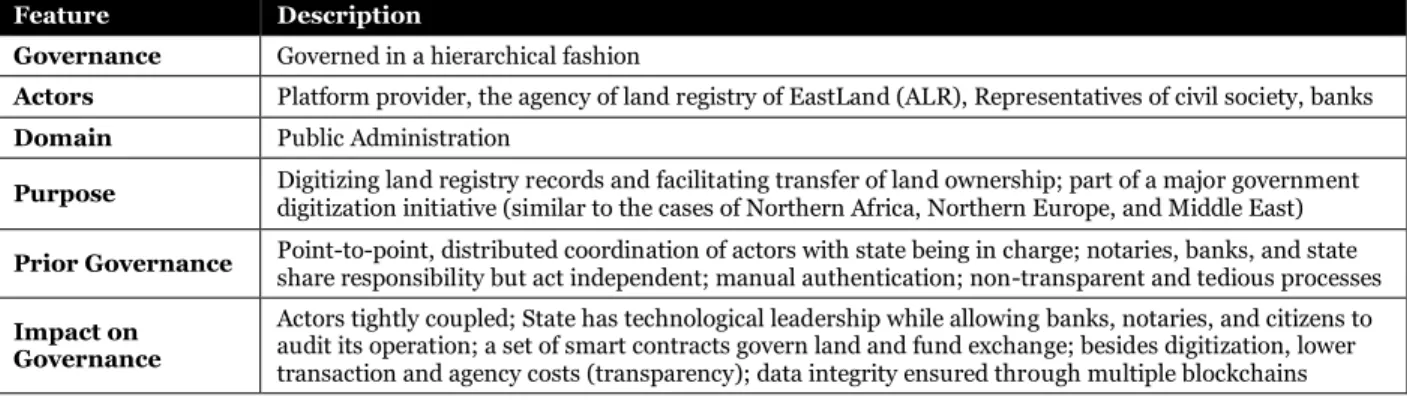
In sum, EastLand’s case shows an example of how a blockchain-based system impacts the land registry function and its governance (see table 4). Creating a distributed system within an existing eco-system while preserving some centralized decision-making locus may prove a promising solution to (1) share the audit of the system for accountability, (2) foster inter-organizational business process integration (hence, efficiency gains), and (3) increase the reliability of records (trust in the overall system).
Feature Description
Governance Governed in a hierarchical fashion
Actors Platform provider, the agency of land registry of EastLand (ALR), Representatives of civil society, banks
Domain Public Administration
Purpose Digitizing land registry records and facilitating transfer of land ownership; part of a major government
digitization initiative (similar to the cases of Northern Africa, Northern Europe, and Middle East) Prior Governance Point-to-point, distributed coordination of actors with state being in charge; notaries, banks, and state share responsibility but act independent; manual authentication; non-transparent and tedious processes Impact on
Governance
Actors tightly coupled; State has technological leadership while allowing banks, notaries, and citizens to audit its operation; a set of smart contracts govern land and fund exchange; besides digitization, lower transaction and agency costs (transparency); data integrity ensured through multiple blockchains Table 4. Governance in a blockchain-based Land Registry
Towards a public blockchain-based Infrastructure
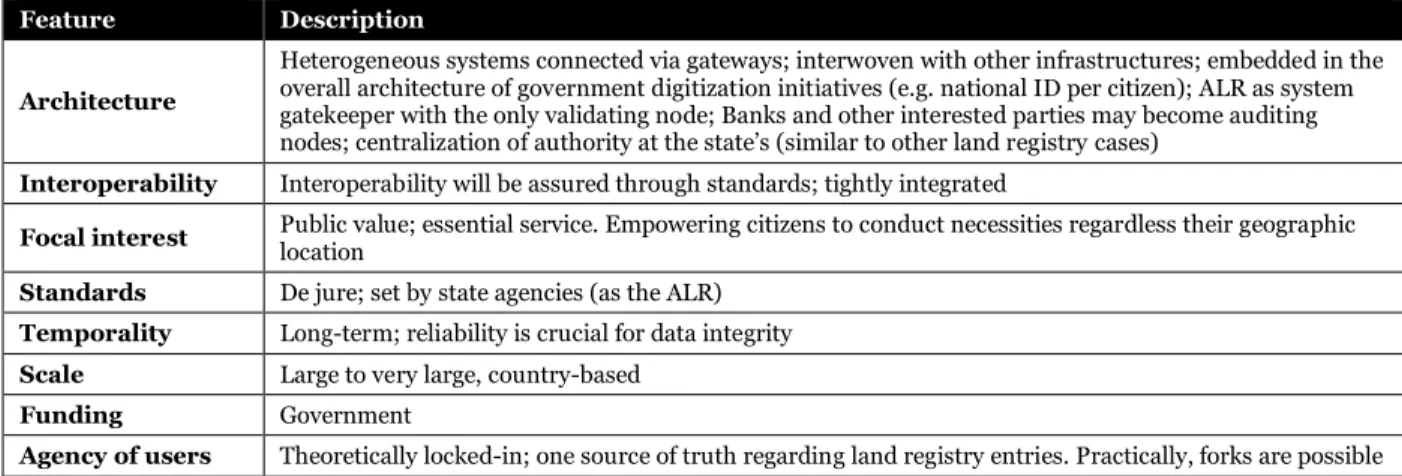
Following the classification of Plantin et al. (2016), the current implementation covers many of the characteristics of an infrastructure which is in line with the other cases we collected data about (see table 5). From an architectural standpoint, the ALR, together with the platform developer, runs the only validating node – the control over the system is, hence, centralized under state authority. Other parties, such as central or commercial banks, and representatives of civil society, however, run auditing nodes, which allows them to double-check occurring transactions for validity and their compliance with law. The property transactions are not public for citizens to see them, yet. On the long run, reading access for citizens will be granted – transaction details, however, will remain private. The overall system is heterogeneous and connects the blockchain system with systems of other digitization initiatives (e.g., electronic personal ID linked to the land registry system) and, hence, can be considered as tightly integrated; their interoperability is thereby assured through standards set by the ALR. The system is further regulated exclusively in public interests with its focus on public value, as a land registry acts as an essential service of property ownership. Standards are de jure (at the moment) and dictated by the ALR. The blockchain-based land registry is designed with scalability and longevity in mind, hence long-term reliability and availability of data. Thereby, the blockchain-based system should be able to scale to cover
all country’s land, so to cover all land titles, ideally. For the time being however, this scale is not yet
reached. As for the agency, users would be locked in the system because a competing system would put data integrity in doubt (scarcity of data); a fork of the same blockchain would theoretically be possible – in
practice, the previously described link to the Bitcoin blockchain would make forks ineffective as the authentic ledger always can be identified. A further anchor for data authenticity, which applies solely to the case of EastLand, comes from the known identities of actors through a digital personal ID for citizens; transactions can therefore be allocated to legal persons. The latter is of particular importance as this allows for an accountability of actions, which can be used in courts in case of disputes.
Feature Description Architecture
Heterogeneous systems connected via gateways; interwoven with other infrastructures; embedded in the overall architecture of government digitization initiatives (e.g. national ID per citizen); ALR as system gatekeeper with the only validating node; Banks and other interested parties may become auditing
nodes; centralization of authority at the state’s (similar to other land registry cases)
Interoperability Interoperability will be assured through standards; tightly integrated
Focal interest Public value; essential service. Empowering citizens to conduct necessities regardless their geographic
location
Standards De jure; set by state agencies (as the ALR)
Temporality Long-term; reliability is crucial for data integrity
Scale Large to very large, country-based
Funding Government
Agency of users Theoretically locked-in; one source of truth regarding land registry entries. Practically, forks are possible
Table 5. Land Registry Description, Features taken from Plantin et al. (2016)
Car Data and blockchain-based Systems
The information asymmetry constitutes an integral part of markets and causes the parties with better information to strike better deals Akerlof (1970). In the following, we shed light on the promising solution which currently is in progress and which promises to solve some of those challenges. The automotive sector is a promising domain for blockchain-based systems. In the past years, many initiatives have been launched to digitize the eco-system around the car. Those initiatives range from B2B platforms for
authenticating spare parts to the aggregation of a car’s related data itself for information transparency.
The latter relates to Market for Lemons by the Nobel Laurate Akerlof (1970), which regards the information asymmetry in the used-car market – bad cars are said to supersede good ones to their
extinction. Tracing car’s lifecycle, aggregating its data, hence, aims at reducing the information asymmetry between buyer and seller by making data immutable and accessible to different parties in the same eco-system.
The blockchain-based CarDossier and its Governance
During a lifecycle of a car, numerous stakeholders (insurances, repair shops, state agencies, and many more) are involved. These conduct authentication processes manifold (such as proof of car ownership,
insurance/driver’s license validity) while collaborating merely to the necessary degree; this leaves all
information of a car fragmented at best which entices to opportunistic behavior. The CarDossier, a Swiss-based project initiated in early 2017, strives to overcome these challenges. For the time being it consists of a consortium of major stakeholders in the Swiss car ecosystem such as the biggest importer and repair shop of cars, a major insurance, a road traffic agency, legal experts, a mobility service provider, as well as a research and an IT implementation partner. Building a blockchain-based system to gather, maintain, and access car-related data benefits businesses, citizens, and state agencies as it constitutes a promising approach to reduce the information asymmetry of car-related data and to achieve operational excellence amongst each other. To make the system work, not only car drivers but also corporations and state agencies contribute car-related data (e.g., telemetric, accident history, changes to the car) which in turn may be accessed and processed by others for financial compensation. The CarDossier entitles the car-owner to decide upon his/her data, which differs from corporations using data for their own profit. The CarDossier includes an organizational core which consists of a board of representatives of major stakeholder in the car ecosystem; all major decision rights are centralized at the board’s level. Their
demands are translated into system requirements and then developed and enacted by a third-party
platform provider. The collaborating partner’s interests are not the same but partly overlap. It is therefore
of highest importance to safeguard each partner’s interest to maintain their willingness to collaborate. The CarDossier project, hence, ensures all major stakeholder’s voice to be heard in regular board
meetings. The decision-making process, however, is split in two: Members are allowed to propose changes to the system, similar to the DAO. While lower-critical changes can be decided, budgeted, developed (by the third-party platform developer), and enacted autonomously upon vote by its members, strategic decisions remain decided upon vote at the board to ensure the project’s right course.
The overview allowed by blockchain data offers an audit trail that guarantees the data about a car has not been tempered with. As in the case of EastLand, rightfulness depends on data quality, not immutability. If wrong data is entered, it remains wrong on the blockchain. What is worth stressing instead is that immutability is a good deterrent of fraud, because wrong data stays wrong and can be brought to court.
What’s more, the system collects personal and car-related data. While the sharing of the latter is rather harmless, the former is quite sensitive, and drawing the line between the two may not be straightforward. To be legally compliant, the system has to be designed compartmentalizing different kinds of data. The CarDossier not only provides a single source for car data, but also immutable, shared, and agreed upon functions, e.g. the rules for data access management (via encryption/decryption). These rules are inscribed in smart contracts and vary per role (a role represents an actor in the ecosystem); a role merely sees data which s/he is allowed to see. A role can further inhere rights to perform specific functions, such as issuing an electronic vehicle registration document (road traffic agency) or the insurance certificate (insurer).
At its very core, the CarDossier inheres the same architectural design and governance as four more companies we interviewed and analyzed; in those cases, know-your-object (KYO) was targeted, meaning the tracking of a good throughout its supply chain and making this information visible to supply chain participants for one and to end customers for two. Those systems offer a means for prior loosely integrated entities to connect and collaborate through a shared repository of formerly isolated or not available data.
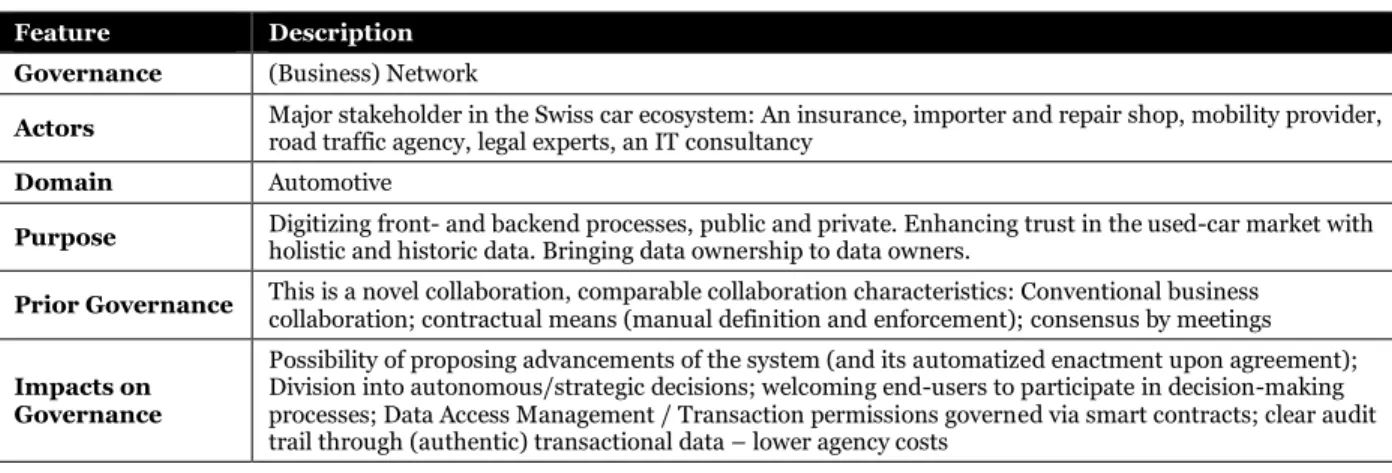
In sum, the CarDossier relies on the strengths of blockchain-based systems in inter-organizational settings shown in EastLand in terms of (1) shared audit of data for accountability, (2) efficiency gains through process integration, and (3) an enhanced reliability of records. Following the classification by Powell, the envisioned blockchain-based implementation may fit well to the network archetype. The CarDossier is further described in table 6 below.
Feature Description
Governance (Business) Network
Actors Major stakeholder in the Swiss car ecosystem: An insurance, importer and repair shop, mobility provider, road traffic agency, legal experts, an IT consultancy
Domain Automotive
Purpose Digitizing front- and backend processes, public and private. Enhancing trust in the used-car market with holistic and historic data. Bringing data ownership to data owners. Prior Governance This is a novel collaboration, comparable collaboration characteristics: Conventional business collaboration; contractual means (manual definition and enforcement); consensus by meetings
Impacts on Governance
Possibility of proposing advancements of the system (and its automatized enactment upon agreement); Division into autonomous/strategic decisions; welcoming end-users to participate in decision-making processes; Data Access Management / Transaction permissions governed via smart contracts; clear audit trail through (authentic) transactional data – lower agency costs
Table 6. Governance in the blockchain-based CarDossier Between a Platform for Data Exchange and an Infrastructure for public Use
Relating to the classification of Plantin et al. (2016), does the CarDossier constitute a platform or an
infrastructure? Defining the CarDossier’s system characteristics is challenging. From an architectural
point of view, the CarDossier provides a stable core system (the ledger) which will be complemented with variable components in the hands of other companies – an insurance, e.g., could wish to extract data from the ledger for own analytical purposes by using the CarDossier’s API. The latter would point towards a
platform characteristic. The CarDossier, however, also assures interoperability through standards which constitutes an infrastructure characteristic. The focal interest, however, lies between public value, private
profit, and user benefits. The latter also have a say in the CarDossier’s design as they can make proposals
which are voted upon. The intended timeframe, points at the infrastructure perspective because of its expected long-term life-cycle, with special regard on reliability with a large to very large scale. The system is funded via pay-per-use, which reflects a private cost-recovery mode. One could argue, however, that the CarDossier would provide an essential service for the domain, if embedded right, on a large scale with a
public interest, which would point towards an infrastructure. In the foreseeable future, the CarDossier will be enacted as a platform; depending on the extent of public value, use, and interoperability, however, it may undergo the process of infrastructuralization (Plantin et al. 2016). Table 7 below summarizes its characteristics.
Feature Description Architecture
Stable core system; modular, variable complementary components; Provision of an API and basic CarDossier Frontend; Loosely integrated with other systems on partner’s side; one validating node per
stakeholder; peers can be set accordingly. Data access management based on encryption and decryption.
Interoperability Interoperability will be assured through standards; loosely integrated systems
Focal interest Primarily user benefits as it targets the purchase of a used-car. Private profit in form of service optimization through analytics and public value through trust in used-car market
Standards De facto; made in consensus and set by the consortium
Temporality Long-term; reliability is crucial for data integrity. Updating due to novel types of data cannot be excluded
Scale Small to very large, country-based
Funding Pay-per-use, platform character
Agency of users Theoretically locked-in; one source of truth regarding car data. Practically, forks are possible
Table 7. CarDossier Case Description, Features taken from Plantin et al. (2016)
Blockchain-based Money Management
The public service of money management, has been challenged by Bitcoin and the plethora of cryptocurrencies that sprung recently. According to common-wisdom of this industry, parties like banks and state agencies are needed to ensure the integrity and well-functioning of the financial system. In this multi-tiered system, the authentication of a transaction lies in the hand of established organizations, and customers have no alternatives but relying on those intermediaries to act honestly, and not to exploit the status quo to their only advantage. In general, this system has proven to work, even if costs, especially for international money transfers, remain high. The financial crisis, however, has shown that current financial services can fail. This acted as a catalyst for alternative currencies to rise. In Bitcoin, the authentication of a transaction is conducted on a technical level by 51% of computing power, thus omitting the reliance on any external third party. The eco-system around Bitcoin and the likes consists of actors such as miners, developers, exchanges, wallet providers, and users (wallet holders). Users are allowed to propose Bitcoin improvement proposals (BIP) which are discussed in a public forum, then assessed by core developers and applied if a majority consensus is met. The integrity of the ledger, however, lies in the hand of the miners which are financially incentivized to mine through the same tokens they mine. The mining rewards constitutes a major governance mechanism as it steers the
community’s behavior.
The Governance of Cryptocurrencies
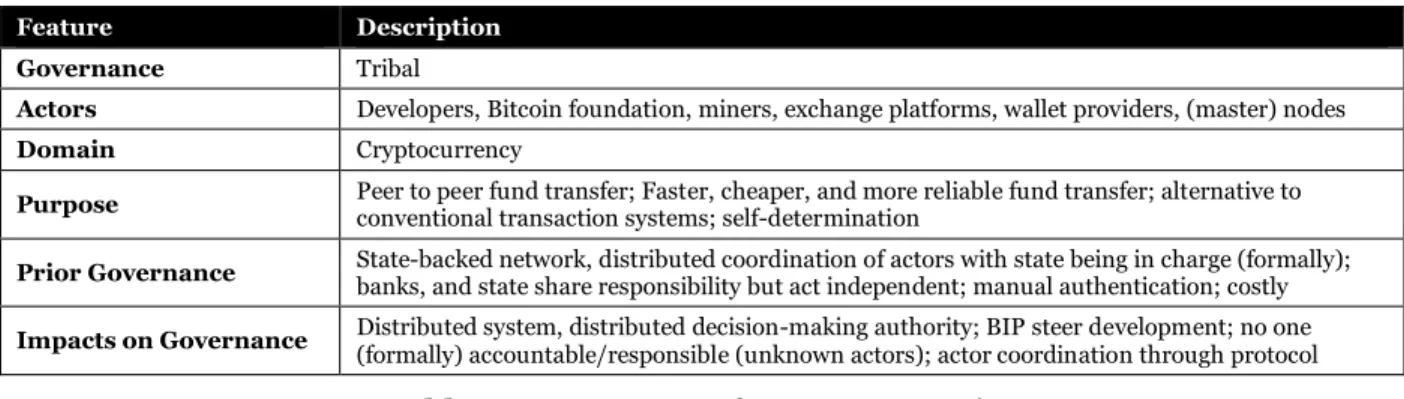
One may expect that currencies, being the usual counterpart of trades, are defined by market governance. Indeed, this idea is not new. A century ago Hayek proposed to get away from state/fiat currencies and let private currencies to coexist and compete. His proposal didn’t uproot state money, which still counts for nearly all world trades. While the emergence of cryptocurrencies revamped Hayek’s ideas, the principles
of market do not appear to define crypto. Rather, the systems of cryptocurrencies (table 8), whose governance was labeled Tribal (Miscione et al. 2018), is based on consensus, coordinated by a technical protocol, they rely on pseudonymous identities and incentivize hoarding (because of their deflationary nature). Reliability granted by large mining pools, is paired with low control intensity from the outside and intermediate from the inside. The mining reward, constitutes an important governance mechanism as increasing or lowering mining rewards would influence the miners’ willingness to mine and, hence,
influence the systems security.
Other cases (4, 6, 8, 12, and 15) we considered showed commonalities, but also differences. One of those considers a company in Africa working with their own fork of Bitcoin. Their intention to fork lays in being
independent from Bitcoin’s decision-making and security risks it may entail (e.g., mining pool centralization). Another relevant case is based in Germany, and it is also about a Bitcoin fork; they forked
to add more functionalities to its payment system. The latter and the former cases, and forks of Bitcoin in
general, show cryptocurrencies to be easily adaptable to community’s needs, which links to Hayek’s
thought of them not being mere market participants but rather what has been labeled Tribal.
Feature Description
Governance Tribal
Actors Developers, Bitcoin foundation, miners, exchange platforms, wallet providers, (master) nodes
Domain Cryptocurrency
Purpose Peer to peer fund transfer; Faster, cheaper, and more reliable fund transfer; alternative to conventional transaction systems; self-determination Prior Governance State-backed network, distributed coordination of actors with state being in charge (formally); banks, and state share responsibility but act independent; manual authentication; costly Impacts on Governance Distributed system, distributed decision-making authority; BIP steer development; no one (formally) accountable/responsible (unknown actors); actor coordination through protocol
Table 8. Governance of Cryptocurrencies Towards a public blockchain-based Infrastructure
From a technical perspective, Bitcoin and the other cryptocurrencies fit to the infrastructure type. As for the architecture, they consist of heterogeneous systems and networks running the same protocol. Furthermore, they are interoperable through defined technical standards. Standards are set de facto and the temporality is long-term where system reliability is crucial due to its essential character relating to public good; updating, however, will be done when necessary. Its scale ranges from large to very large and
may become ubiquitous if any of these currencies becomes embedded into everyone’s daily life. Its
funding is achieved through coins for mining and pay-per-use (transaction fees). While theoretically, communities could choose to fork towards an own system, those networks rely on a critical mass to maintain the systems. Since Bitcoin is the first of its kind and obtained the largest scale since then, one could argue the Bitcoin network to be the first proven blockchain-based public infrastructure. Table 9 sums up their features.
Feature Description
Architecture
Large pool of heterogeneous systems executing a mining protocol in the backend; interwoven with other infrastructures; Open for access (links to the Bitcoin blockchain are found in many other use cases as backups) and transparent in transaction history; Bitcoin Improvement Proposals (BIP) can be submitted by anyone, implemented by core developers if strong majority agreed upon; Proof-of-Work
Interoperability Interoperability of those systems is assured; loosely integrated; easily replaceable
Focal interest Public / Community interests; essential service by providing safer, faster, and cheaper payment
Standards De facto; set through consensus by the community and implemented by developers
Temporality Long-term; reliability is crucial for data and transaction integrity
Scale Large to very large, ubiquitous
Funding Pay-per-use (Bitcoin transaction fee)
Agency of users Theoretically locked-in; one source of truth regarding transaction and historical data integrity; Practically, forks are possible. Table 9. Cryptocurrency Description, Features taken from Plantin et al. (2016)
Discussion
In this research, we relied on three main cases, each of them represents a group of kindred cases, to shed some new light on the emerging phenomena of blockchain governance. In pursuing this objective, we were guided by two research questions:
RQ1: How do blockchain-based systems impact governance?
RQ2: How does their governance relate in practice to established forms of governance as well as platforms and infrastructures?
We start with the answer to the former, then continue with the latter.
Blockchain-based Systems and their Impact on Governance
Each of the analyzed cases’ governance is well-characterized by aforementioned governance archetypes: In the form of established ones seen on a hierarchy (Land Registry) and a network (CarDossier), but also in rather emergent ones seen on a tribe (cryptocurrencies). In general, we see that blockchain systems impact governance in practice; these differences may signal broader relevance for archetypes, but this discussion is beyond the scope of this paper. To proof our points, we summarize in the following our findings from the case analyses which characterize governance but also show their shortcomings and set them in relation to existing scientific works.
Sharing the audit for accountability. Interestingly enough, and counterintuitively for blockchains,
the blockchain-based land registry gains its legitimation from a single party, who remains in charge of major decisions. The latter is pivotal as land titles constitute high values at stake. While this centralization
of power overcomes blockchain’s promise of decentralization, the ALR offers full transparency of its records and operations by inviting other parties to audit; this thought is native to blockchain systems and in line with the CarDossier and Bitcoin. However, in the case of northern Africa and EastLand, an additional link to the Bitcoin blockchain further certificates the integrity of past records at a given point in time. Both the concatenation of blockchains and a shared audit creates a multi-tier security architecture which allows to reconstruct records even if single points of the system fail; this approach is especially appealing for developing countries where social order and state powers are often volatile. While this constitutes a promising mechanism to overcome the unwanted tampering of records, the system becomes dependent on the well-functioning of Bitcoin, whose longevity remains to be seen.
Efficiency gains. The re-organization and the efficiency gains can most evidently be seen in the CarDossier project. The extensive utilization of smart contracts to embed business logic to provide automatized financial compensation, data access management, and transaction permissions facilitates the interaction of users with the system and promises to improve the governance of the used-car market
through a blockchain (Miscione et al. 2018; Pelizza and Kuhlmann 2017); blockchain systems thereby allow for a more granular planning of governance functions (as they are written in code) and to enact them automatically when defined criteria are met (similar to DAOs). As above, the expectation is, hence, to lower transaction and agency costs (Klein et al. 1978).
In the intentions of the blockchain-based systems in the land registry domain, our findings show that all those and related functions remain enacted in the fashion of a hierarchy led by the state; actors in the land registry ecosystem (the state, banks, notaries, and citizens), however, now partake in a distributed system that guarantees the immutability of transactions, which promises to lower not just transaction but also agency costs. In practice, a set of smart contracts ensures the exchange of funds and land titles. This enacts the notion of governance through blockchain (Pelizza and Kuhlmann 2017) and fosters a novel way
of making and enforcing contracts (Reijers et al. 2016). Said efficiency gains show how a blockchain-based system can act as a catalyst for digitization in the public administration while empowering citizens to conduct their business in a faster and more efficient way.
The togetherness of parties inherent to a KYO-case such as the CarDossier project is of different nature than in the case of EastLand as it concerns a more dispersed and flatter inter-organizational collaboration. The CarDossier consortium represents various stakeholders with various interests but at
least some sort of common interest to collaborate; hence, we classified this mode of governance ‘network’.
While the blockchain-based system can be ensured as far as possible to function in the intended fashion, it can be questioned, if it can overcome inhibitors to inter-organizational collaboration (Fawcett et al. 2015). While low trust and poor data quality certainly can be improved upon, inhibitors such as inter-firm rivalry or own interests may persist. Unlike in the hierarchy, where trust in the system can be instilled or enforced from the top, this multi-party network needs to build mutual trust to operate.The trust into the system and its outputs has to be produced (Werbach 2017); instead of authenticating a single, peer-to-peer transaction, a governing body may be needed to ensure the authenticity and the well-functioning of the blockchain-based system. For the organization behind it, the CarDossier project strives to instill a democratic character through regular consortia meetings to make voices heard – the project, shows an interesting dilemma which may be inherent to many consortia-based collaboration endeavors: Mutual dependence (to aggregate data) and own interest (not to share data).
Data immutability as a deterrent of fraud. While the technical consensus of blockchain-based
systems solves the Byzantine General’s problem on a temporal dimension, the message he wants to share
with his generals remains a challenge: The input to blockchain-based systems is crucial. As soon as an entry has been made, it is irreversible, at least in theory. What entry has been made remains in the hands of the users or authorities; if a land title is wrongfully assigned to someone, this wrong statement would be maintained by the blockchain (and immutable). It can therefore be questioned if a blockchain-based land registry would solve problems, especially in developing countries, where corruption or a certain mistrust into the political order and its operation is widespread. In consortia-based blockchains as the CarDossier, where more complex data is dealt with, authenticating the truthfulness of data entries constitutes a challenging task. Even though one may assign several parties with the same information to cross-validate its truthfulness – at larger scale, this may become a daunting endeavor. The full potential of a blockchain-based system seems to be dependent on actors’ honesty. It can be argued then that network and tribal governance risk to fall back to some sort of hierarchy with a high (and expensive) control intensity which would question the necessity for a blockchain-based system. However, immutability can be a good deterrent of fraud: Wrong data stays wrong and can be brought to court, which might steer participants behavior towards acting honestly.
System evolution. While smart contracts seem promising, one should keep an eye on risks (DuPont 2017), especially when automatisms are expected to generally avoid human supervision. Analogous to the case of EastLand, the CarDossier project develops its platform under the technical lead of an IT provider. The utilization of smart contracts and the design of the overall platform, hence, come with same limitations of possible misdesign because of misunderstanding or changing socio-technical environments (Morabito 2017); remaining aware that the environment of an IT system changes over time (Nitto et al. 2008), smart contracts eventually require updating. This increases the risk of incompatible contracts and misalignment between requirements and design. The latter also opens the door for ad-hoc
decision-making in case of malfunctions and ‘precedents’, a crucial issue, especially in countries with Common Law (as opposed to Civil Law). So, in case of disputes, the last resort in all land registry cases we analyzed remain courts. We are not aware of any blockchain-based record that has undergone a trial. It would be of great theoretical and practical relevance to follow such process and see the outcome. Indeed, our findings in land registries and the CarDossier support the claim that intended automatic as well as human decision-making often takes place side-by-side, sometimes distinct and sometimes in competition. Rather than substituting, automatisms are therefore merging with other modes of governance.
Blockchain-based Systems between Platforms and Infrastructures
This part focuses on the relationship between our case-studies and their relationship to platforms and infrastructures. Our results show that several similarities as well as differences can be seen, e.g. in the cases of land registries or cryptocurrencies. Even though blockchain-based applications did not prove themselves at scale, yet (except for Bitcoin and a few others) the interest in using blockchain technology for public services is remarkable. The problem of scale cannot be overemphasized; the Internet, in its beginning, also has been thought of having a very narrow set of use cases to be applied for. Then it became the infrastructure we know today (analogies between blockchains being the new internet have been made repeatedly). The interest in those use cases is due to the native authentication that blockchain system provides: State agencies not only spend a significant amount of effort into authenticating documents between parties and giving public deed, they also put their credibility and legitimation in those. Blockchain systems provide this function natively as long as rightful data is entered. As argued in the results section, land registries aspire to become public infrastructures handled in a quasi-hierarchical fashion. So, a blockchain-based system would ease the ways hierarchies can steer related actors through a shared audit and clearer accountabilities. Bitcoin might be another infrastructure; this hypothesis is backed by a high fit of infrastructural criteria such as reliability, ubiquity, and interconnectedness. The architecture of such systems as Bitcoin or a public infrastructure, however, is in high dependency on other infrastructures (network systems, protocols, and further) which are out of their control; a mere blockchain system would raise doubt regarding its reliability in an extreme situation such as a power outage, or foreign invasion. As public records are of paramount interest, those systems have to provide multiple levels of assurance. The case of EastLand and Northern Africa show their architecture to be interwoven with other (public) trans-jurisdictional blockchains where a backup in form of a hash is sent to