An Evaluation of ISO 9001 and BPM in Amadeus
Master of Science Thesis in the Master Degree Program, Quality and Operations ManagementSAHAR KAZEMI
Department of Technology Management and Economics Division of Quality Sciences
CHALMERS UNIVERSITY OF TECHNOLOGY Göteborg, Sweden, 2012
MASTER‟S THESIS E2012:085
An Evaluation of ISO 9001 and BPM in Amadeus
SAHAR KAZEMI
Supervisor: SVERKER ALÄNGE
Department of Technology Management and Economics Division of Quality Sciences
CHALMERS UNIVERSITY OF TECHNOLOGY Göteborg, Sweden, 2012
An Evaluation of ISO 9001 and BPM in Amadeus SAHAR KAZEMI
© SAHAR KAZEMI, 2012
.
MASTER‟S THESIS E2012:085
Department of Technology Management and Economics Division of Quality Sciences
CHALMERS UNIVERSITY OF TECHNOLOGY SE-412 96 Göteborg
Sweden
Telephone + 46 (0)31-772 1000
Chalmers reproservice Göteborg, Sweden 2012
I
Abstract
Purpose - The purpose of this study is to understand how ISO 9001 and BPM are positioned relative to each other and how they can be applied together in Amadeus. It is also aimed to identify the critical elements in BPM implementation and to provide recommendations for successful BPM implementation accordingly.
Methodology – Literature review was performed to develop a set of statements with regard to the definition, success factors of BPM and the contribution of ISO 9001 and BPM to TQM principles. The empirical data were collected through semi-structured interviews and from people that work on or are knowledgeable about ISO 9001, BPM or both of them. Through analysis of the empirical data and the literature the research questions were answered.
Findings – The results show that ISO 9001 and BPM can and should be applied together in order to get closer to TQM. The areas that ISO 9001 and BPM can be applied together are discussed
extensively.
Delimitation – This research is limited to the data from Nice site of Amadeus and also to the
evaluation of ISO 9001 and BPM relative to each other. Although there are other similar programs in Amadeus that can be included in such study and bring more insights about the role of these similar programs in approaching the company to TQM, such programs are not included in this research.
II
Acknowledgement
The ideas, insights, and results of this research project should not be attributed to my personal efforts alone. Rather, to a large extent, this thesis is the result of many contributions made by several people in several ways.
First, I would like to express my gratitude to my academic supervisor, Sverker Alänge, for his guidance and advice throughout the thesis work. I am also grateful to Christian Apitzsch, my supervisor in Amadeus, for his advice through this study and for sponsoring my work. I also would like to thank Chantal Sini, a member of the Quality Management and Compliance team, for her advice and help throughout my thesis work.
Finally I would like to express special thanks to all the people who agreed to be interviewed without which this research would not have been possible. I would like to thank them for all their help, support, interest and valuable hints.
Tehran, September 2012 Sahar Kazemi
III
Contents
1 Introduction ... 1 1.1 Background ... 1 1.2 Purpose ... 1 1.3 Research questions ... 1 1.4 Delimitation ... 1 2 Methodology ... 22.1 The research process ... 2
2.2 Research design and strategy... 2
2.3 Reliability and validity of the research ... 3
3 Theoretical framework ... 4
3.1 Management initiatives, how they influence on behavior ... 4
3.1.1 Documentation structure(s) ... 5
3.1.2 Explicit normative structure(s) ... 6
3.1.3 Tacit guiding structure(s) ... 6
3.1.4 Behavioral patterns ... 6
3.2 Business Process Management ... 7
3.2.1 History ... 7 3.2.2 Definition ... 7 3.2.3 IT component in BPM ... 9 3.2.4 Implementation ... 9 3.2.5 BPM limitations ... 13 3.2.6 Success factors of BPM ... 13 3.3 Quality management ... 16 3.3.1 Quality concept ... 16
3.3.2 Total Quality Management and its principles ... 16
3.4 ISO 9000 and 9001 ... 22
3.4. 1 Evolution of ISO 9001 ... 22
3.4.2 ISO 9001 requirements ... 23
3.4.3 Risks and limitations of ISO 9001 ... 25
3.4.4 Benefits of ISO 9001 ... 26
3.5 ISO 9001 and Total Quality Management ... 27
IV
3.6 Business Process Management and Total Quality Management ... 31
3.7 ISO 9001 and BPM ... 34
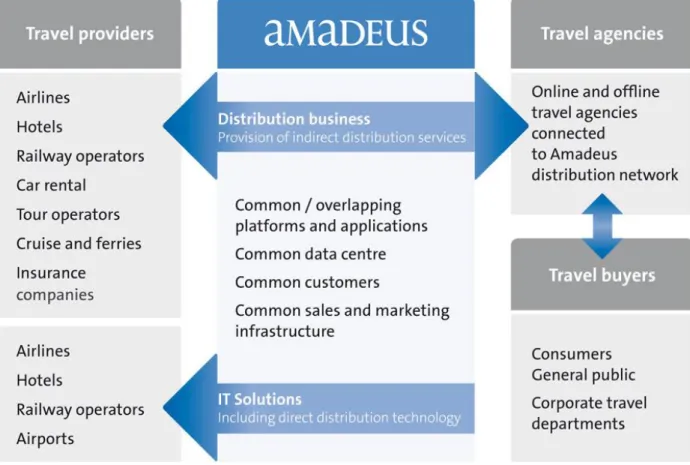
4 Company presentation ... 35
4.1 Overview ... 35
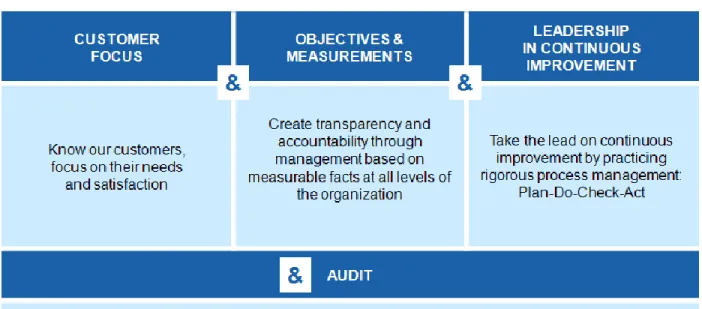
4.2 Quality work in Amadeus ... 36
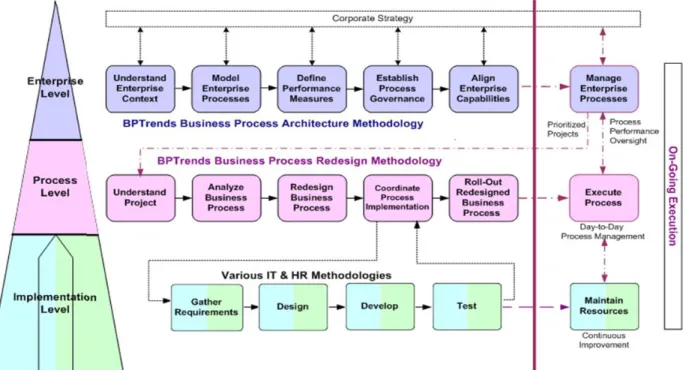
4.3 BPM initiative in Amadeus ... 40
5 Empirical results ... 44
5.1 BPM understanding between interviewees ... 44
5.2 BPM limitations ... 45
5.3 Problems with BPM initiative in Amadeus ... 46
5.4 BPM privilege in Amadeus ... 47
5.5 BPM success factors ... 47
5.6 ISO 9001 according to the interviewees ... 49
5.7 ISO limitations... 50
5.8 Problems with ISO in Amadeus ... 50
5.9 ISO 9001 benefits ... 51
5.10 ISO has created a good foundation for quality and BPM ... 51
5.11 ISO 9001 and BPM ... 52
5.12 Applying ISO 9001 and BPM together ... 53
6 Analysis and discussion ... 56
6.1 BPM initiative through the lens of the framework ... 56
6.2 ISO 9001 through the lens of the framework ... 57
6.3 Answering the research questions... 59
6.3.1 How are ISO 9001 and BPM positioned relative to each other? ... 59
6.3.2 Do they complement each other? If yes, how? ... 59
6.3.3 What are the suggestions for successful BPM implementation? ... 65
7 Recommendations and concluding discussion ... 67
7.1 Integrating ISO 9001 and BPM ... 67
7.2 Suggestions for future research ... 69
8. References ... 70 Apendix: Interview questions
V
Tables and figures
Table 1: Interviewee position ... 3
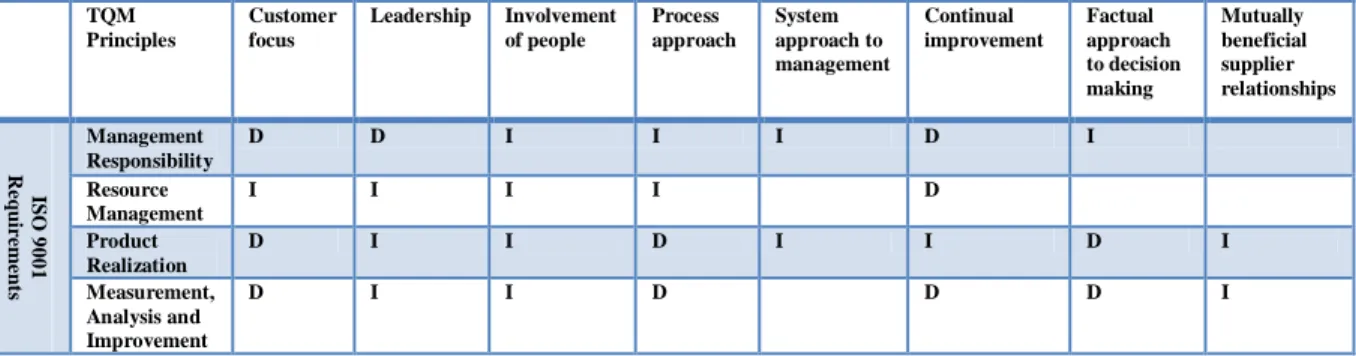
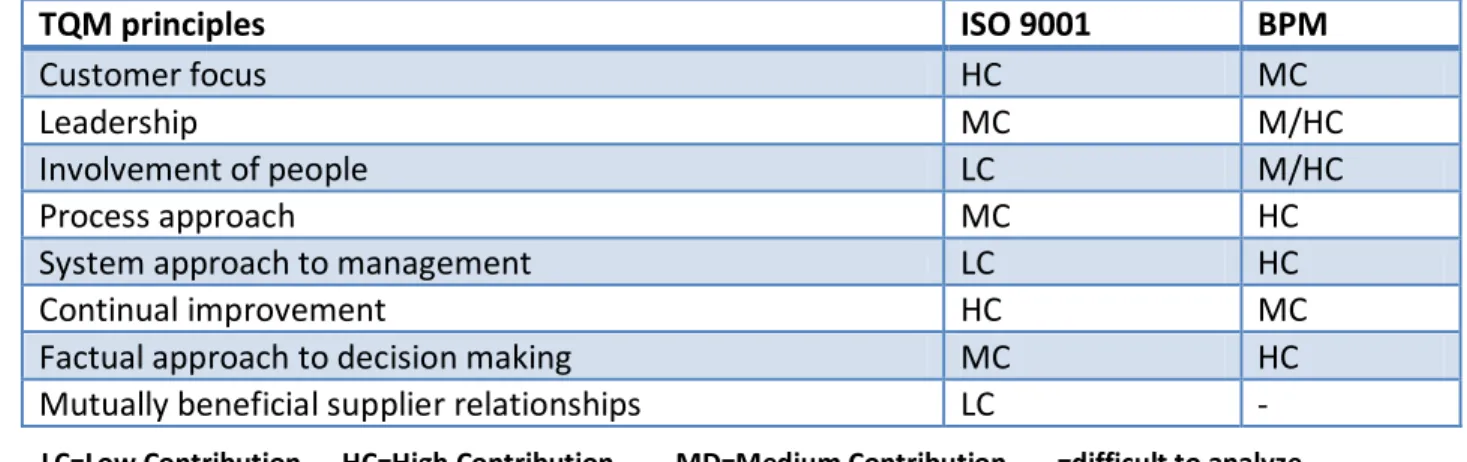
Table 2: Contribution of ISO 9001 to TQM principles ... 28
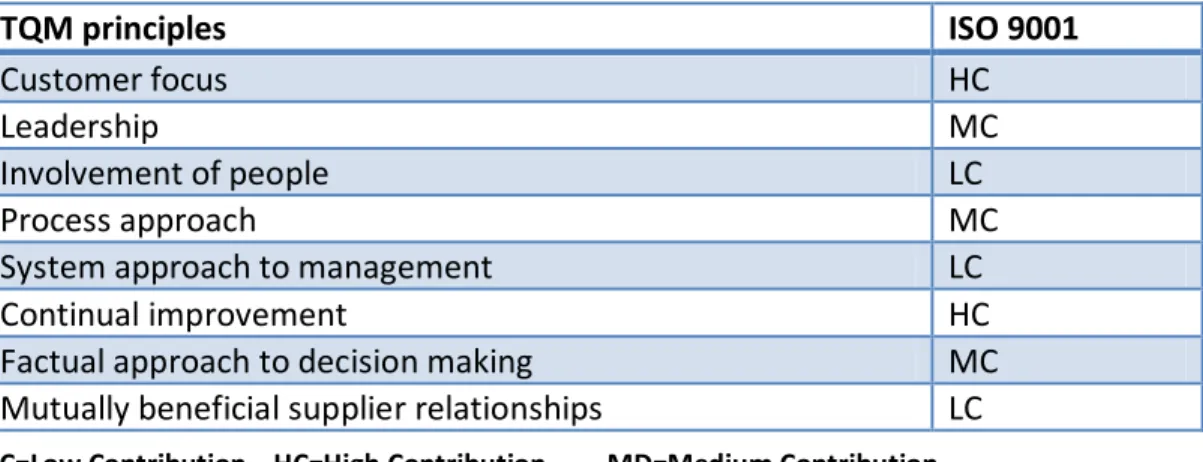
Table 3: Contribution of ISO 9001 to TQM principles, summary ... 31
Table 4: Contribution of ISO 9001 and BPM to TQM principles ... 34
Table 5: Contribution of ISO 9001 and BPM to TQM principles ... 60
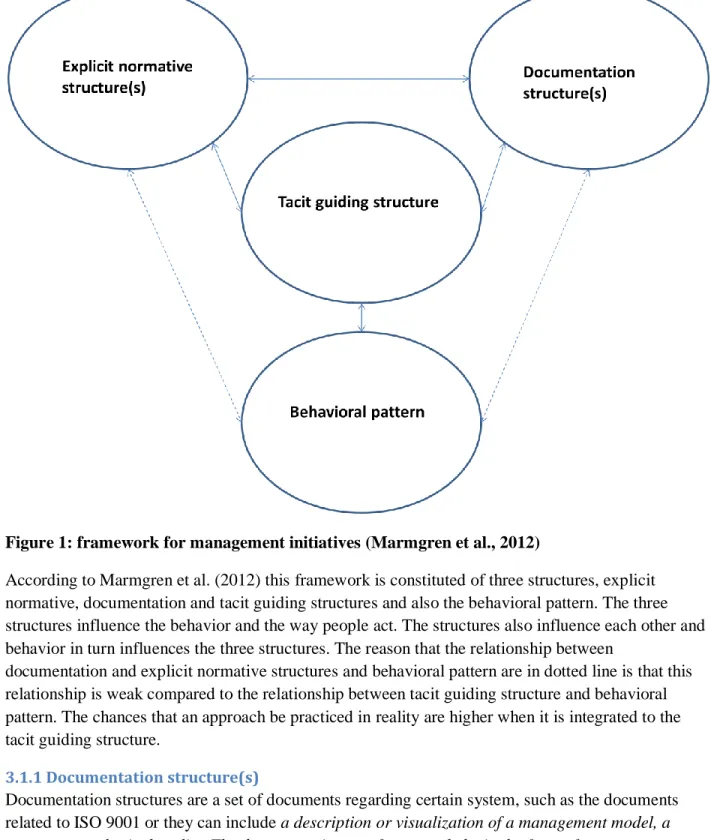
Figure 1: framework for management initiatives (Marmgren et al., 2012) ... 5
Figure 2: Michael Porter‟s value chain model ... 11
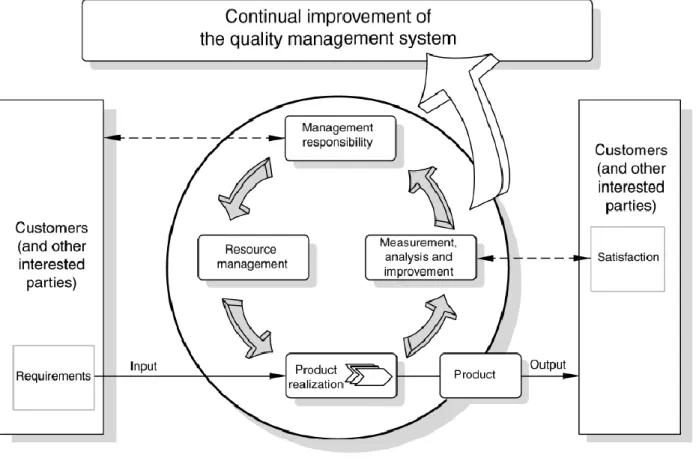
Figure 3: Model of a process-based quality management system ... 23
Figure 4: Amadeus business structure ... 35
Figure 5: Amadeus Quality Policy ... 36
Figure 6: Consultant‟s BPM methodology ... 40
Figure 7: The BPTrends pyramid and levels of corporate BP activities ... 41
Figure 8: BPM initiative through the lens of the framework ... 56
Figure 9: ISO 9001 through the lens of the framework ... 58
1
1 Introduction
1.1 Background
When there are parallel programs with similarities such as two quality management programs within an organization it is important to study the relationship between them and understand the inter-dependencies among them (Carri, 2011). It is also essential to link them together and if possible integrate them. Ignoring this will create confusion within the organization and will create silos that their efforts might not be aligned together or might be duplicated. This will create waste and will avoid reaching the intended benefits of these programs (Ibid).
Amadeus has recently started to deploy Business Process Management (BPM) as an approach to improve the overall business performance by building enterprise-wide, sustainable, and end to end Business Process Management capabilities. Amadeus also holds ISO 9001 certification since 1998. The current certification is based on the latest version of the standard which is 2008 version.
Studying how ISO and BPM are positioned relative to each other and whether they can work together is an important subject that will help Amadeus to better understand the different roles of each
program. It will also assist Amadeus in decision making by a clarification on the contributions that any of the two programs will provide.
From theoretical point of view this study will provide an analysis of ISO 9001 and BPM and will elaborate on how the two approaches can be applied together. There are useful literatures and researches about each of the two programs but we lack studies that analyze them in comparison to each other or investigate how they could be applied together.
1.2 Purpose
The purpose of this study is to understand how ISO 9001 and BPM are positioned relative to each other and how they can be applied together in Amadeus. It is also aimed to identify the critical elements in BPM implementation and to provide recommendations for successful BPM implementation accordingly.
1.3 Research questions
The research questions that will be answered in this study are:
How are ISO 9001 and BPM positioned relative to each other? Do they complement each other? If yes, how?
What are the suggestions for successful BPM implementation?
1.4 Delimitation
This study is limited to the evaluation of ISO 9001 and BPM relative to each other although there are other similar programs in Amadeus that can be included in such study and bring more insights about the role of these similar programs in approaching the company to Total Quality Management (TQM). CMMI for example is a process improvement approach and is applied in some departments in
2
Another delimitation of this study is about the Amadeus sites studied in this research. Amadeus operates world-wide and has different sites around the world. For this research the site located in Nice, France has been studied.
2 Methodology
2.1 The research process
To select the subject of this study several brainstorming sessions were conducted with my supervisor in Amadeus, one of the members of Quality Management and Compliance, and BPM team and also my academic supervisor. Based on my interest and the need of Amadeus in developing a better understanding of ISO 9001 and BPM, I decided to research about these concepts and clarify their roles in making Amadeus a more quality-oriented company. The research questions were selected to address the aim of the study and to make the investigation easier. This was followed by extensive literature review about BPM as it is not a very clear concept. When a better understanding of BPM was achieved I started collecting the practical data through semi-structured interviews and document reviews. By collecting the data I tried to understand the interviewees‟ opinion about BPM and ISO as separate concepts and also as two concepts that can be evaluated relative to each other. For example I asked interviewees‟ opinion about the definitions of BPM and ISO 9001 and about the areas in which ISO 9001 and BPM can be applied together. You can find the list of interview questions in the appendix.
The results of the interviews allowed me to come up with ideas about how BPM and ISO 9001 are positioned relative to each other however there was a need to conduct more literature review about their position through the lens of academic researches. As there was very few literatures in this area I decided to approach this subject through developing an understanding about how ISO 9001 and BPM contribute to Total Quality Management (TQM) principles. This selection was affected by the results of the interviews. Because through interviews I could better understand that in which areas of quality management ISO 9001 and BPM are stronger. For example through interviews it was found that BPM is stronger in developing process approach compared to ISO 9001. Evaluation of ISO 9001 and BPM contribution to TQM principles allowed me to develop ideas about the areas in which ISO 9001 and BPM can be applied together. This was complemented by the opinions of the interviewees and resulted in the findings of this study. In order to have more reliable results in evaluating the
contribution of ISO 9001 to TQM principles one student in an MBA program and knowledgeable about quality management assisted me through doing the evaluation by studying the ISO 9001 standard and scoring the contribution of sections 5 to 8 in the standard to each TQM principles. The result of his evaluation was compared to the result of my own evaluation. The results were very similar and a single evaluation achieved through discussing the differences and arriving at consensus.
2.2 Research design and strategy
This study is based on the case study design. According to Bryman and Bell (2003) case study design is an in-depth analysis of an individual case. The case study research design is attractive due to the availability of the sample of study and the possibility to do a more reliable research (Remenyi et al.,
3
2002). Being an intern in Amadeus for one year allowed me to do an in-depth analysis about the subject of the study in Amadeus.
The research strategy is a general plan of how to go about answering the research question (Saunders et al., 2007). It should have a clear objective which is derived from the research question and should be appropriate for answering the research question on hand. Bryman and Bell (2003) divide research strategy into two different clusters: quantitative and qualitative research. Quantitative research focuses on quantification in data collection and analysis. On the other hand the focus in qualitative research is on words. As these authors explain quantitative research involves a deductive approach with an emphasis on theory testing and qualitative research has an inductive approach emphasizing the generation of theory. In this research in order to answer the research questions the qualitative strategy is selected. This is the suitable strategy considering the research questions and the field of study. Through this research it is attempted to understand the feelings and opinion of the
interviewees based on their knowledge and experience. As details about feelings and thoughts are investigated, qualitative research is ideally suited for this research.
Through semi-structured interviews the qualitative data were gathered for this research. The
interviewees were selected based on their knowledge and experience about ISO 9001 and BPM. The position of the interviewees is presented in the following table:
Interviewee position Number of interviewees
ISO 9001 Internal Auditor – Quality Manager – Head of the QMC Team 5
BPM manager – Head of the BPM team 5
Previously ISO 9001 Internal Auditor 1
External BPM Consultant 1
Table 1: Interviewee position
The total number of interviews conducted is 10. Two of the interviewees had two roles, ISO 9001 Internal auditor and BPM Manager. The interview questions were slightly different depending on the role of the interviewee. Most of the questions for the external BPM Consultant were different from the other interviewees. The most part of the data collected from the external Consultant was regarding their BPM framework and their approach to BPM.
All of the interviews were recorded and transcribed for analysis. The analysis of the interview data was done through categorizing the information into a number of clusters.
The data from interviews were supplemented by the data from observations and documents review. My observations include the way that internal auditors approach an ISO 9001 audit interview and their interpretation of ISO 9001. The documents review includes studying the documents relevant for this research in the quality management system and previous student researches in Amadeus.
2.3 Reliability and validity of the research
According to Bryman and Bell (2003) reliability refers to the consistency of a measure of a concept and validity refers to the issue of whether or not a measure of a concept really measures that concept. Reliability and validity of a research are evaluated extensively for quantitative research and are
4
extended to be used in qualitative research as well. According to Bryman and Bell (2003) internal reliability refers to whether there is more than one observer, members of the research team, agreeing about what they see and hear; and external reliability refers to the degree a research can be completed for a second time with results comparable to the original study. The internal reliability of this
research is low as it was conducted by one person. Although the external reliability as discussed by Bryman & Bell (2003) is difficult to maintain in qualitative research this research has sufficient external reliability since it is not difficult to recreate the same settings in order to replicate the study. Some parts of this research can be compared to the results of the previous researches in Amadeus and the data collected through observation. This comparison shows that this research is reliable since the data collected through interviewees are consistent with the data collected through studying previous researches and observation of the author. For example the fact that Amadeus is vertically-oriented is supported in previous researches.
As was mentioned validity refers to the issue of whether or not a measure of a concept really measures that concept. Validity of this research was maintained through a detailed and careful examination of the kind of data required to answer the research question. Triangulation is the way to establish the validity of findings by using multiple data collection devices, sources, analysts, etc... Triangulation of data collection also helped in maintaining the validity of this research since the data collected through documents review and observation complemented the data collected through interviews.
3 Theoretical framework
In this section a framework will be presented that clarifies what needs to be considered if management initiatives are to be practiced in reality. The concepts of Business Process Management (BPM), quality management and ISO 9001 will be introduced as well. Finally, the contribution of ISO 9001 and BPM to Total Quality Management (TQM) principles will be presented and will subsequently serve as an important theoretical guide for this study.
3.1 Management initiatives, how they influence on behavior
Marmgren et al. (2012) have researched about the structures that make a management initiative to be practiced in reality and be integrated into the behavior of people. In practice, the development of a “management system" may be limited to a structure of documents and connected actions, which meets requirements based on a certain norm. A risk is thus, that the initiative ends up in a mainly normative and document oriented work, creating a type of virtual reality that does not drive actions on genuine needs (Ibid). We need to understand what structures influence the way we work. A framework has been developed that presents these influencing structures and their relationships:
5
Figure 1: framework for management initiatives (Marmgren et al., 2012)
According to Marmgren et al. (2012) this framework is constituted of three structures, explicit normative, documentation and tacit guiding structures and also the behavioral pattern. The three structures influence the behavior and the way people act. The structures also influence each other and behavior in turn influences the three structures. The reason that the relationship between
documentation and explicit normative structures and behavioral pattern are in dotted line is that this relationship is weak compared to the relationship between tacit guiding structure and behavioral pattern. The chances that an approach be practiced in reality are higher when it is integrated to the tacit guiding structure.
3.1.1 Documentation structure(s)
Documentation structures are a set of documents regarding certain system, such as the documents related to ISO 9001 or they can include a description or visualization of a management model, a process or a physical reality. The documentation can for example be in the form of a process map, descriptions, checklists, explicit requirements on a product, contracts, etc (Marmgren et al., 2012).
some people refer to documentation structures when they talk about management systems but according to the framework documentation structure is only one of the structures of management systems.
6
As discussed by Marmgren et al. (2012) there can be multiple documentation structures which might not be coordinated e.g. ISO-related process maps and procedures in parallel with "informal"
templates, checklists, etc., that are actually the ones used. This is not the intention of any
management system and there should be coordination between different documentation structures. 3.1.2 Explicit normative structure(s)
This structure is apparent when managers advocate a certain approach and communicate about it. As explained by Marmgren et al. (2012) explicit normative structures are expressions of how things should be done. They are naturally less specific and more complex than what is documented. Two examples of explicit normative structures are when a management team meets and agrees on certain central ideas to promote in the organization or towards other stakeholders, or when a manager is presenting a strategy for business development, marketing, or organizational development. Sometimes there is not a good correspondence between documentation structure and explicit normative structure. This happens when management does not formally support the adopted frameworks or standards.
3.1.3 Tacit guiding structure(s)
As discussed by Marmgren et al. (2012) Tacit guiding structures are guiding individuals´ behavioral patterns, and they are also guiding behavioral patterns within groups and among groups of persons.
These structures are informal structures that exist in the organization and cannot be directly observed, they can be seen when e.g. a person behaves in a defined way in a similar situation.
Marmgren et al. (2012) argue that if we want something to be practiced in reality and be part of our behavior it has to be integrated into a tacit guiding structure. This means that in order to be effective and influence practice, the documented structure and the normative structure have to be integrated into the more complex tacit guiding structure (Ibid).
3.1.4 Behavioral patterns
According to Marmgren et al. (2012) behavioral patterns are patterns of actions, the way that we actually act and things are done. Behavioral patterns are very much affected by tacit guiding
structures; these structures that are leading us are actually reflected in the way we behave. They lead managers e.g. to prioritize resources, take actions… these are the real actions that happen practically and define the behavioral patterns.
The relationship between explicit normative structure and tacit guiding structure is weak when managers communicate about certain approach and support it informally but they orientate in another way in reality. They might be supportive about the approach but this support is not tangible and accompanied by resources. As discussed by Marmgren et al. (2012) there might be also situations in which there is not a good correspondence between documentation structure and tacit guiding
structure. In documentation certain ways of working may be described although in practice another way of working may be predominant (Ibid).
In these situations what is documented and expressed through normative structure will have limited impact on the tacit guiding structure and therefore on the way that we actually behave.
7
3.2 Business Process Management
3.2.1 HistoryProcess management and working with processes has been in use since late eighties. Geary Rummler was one of the business process gurus of the 1980s. Together with Alan Brache, at the end of eighties they wrote the book “Improving Performance: How to Manage the White Space on the Organization Chart” and they developed a system view on organization that is constituted by processes which need to be analyzed and improved. The emphasis was on the processes and managing them as a whole; they argued that many process problems arise when departments hand over the work to the next department and there is no consideration about how the process should benefit from the collaboration between different departments (Rummler and Brache, 1995).
In early nineties business process reengineering was introduced by Hammer and Davenport and as it is defined it their book it‟s about breakthrough change programs, it‟s about starting from a blank sheet and completely redesigning main business processes in order to achieve huge performance improvements.
This is to mention that process management was around for some times, however the book “BPM: the third wave” by smith and Fingar (2002) created significant attention to Business Process Management; Jeston and Nelis (2008) attribute the BPM movement to the time that this book was published.
3.2.2 Definition
It is difficult to define Business Process Management. The term means different things to different people like business process consultants, business analysts and software developers. Here are some examples of the definitions:
According to Zairi (1997) BPM is a structured approach to analyze and continually improve
fundamental activities such as manufacturing, marketing, communications and other major elements of a company's operation.
Smith and Fingar (2003) define the BPM as:
BPM is the convergence of management theory - total quality management, Six Sigma, business engineering and general system thinking - with modern technologies-application development, systems integration, computation, service-oriented architecture, workflow, transaction management, XML and Web services. From business perspective they further explain that BPM aligns processes more directly with organizational objectives and allows companies to represent their source of competitive advantage and differentiation. BPM provides end-to-end process visibility and
accountability, removes redundancies and increase automation of simple support processes such as human resources and complex processes such as product design (Ibid).
8 Jeston and Nelis (2008) define BPM as:
The achievement of an organization’s objectives through the improvement, management and control of essential business processes.
They explain all of the words in their definition as following:
Achievement: Realizing the strategic objectives as outlined in the organization‟s strategic plan. At a project level, it is about realizing the value or business benefits as outlined in the project business case.
Organization: The organization in this context refers to an enterprise or parts of an enterprise, perhaps a business unit that is discrete in its own right. It is the end-to-end business processes associated with this part of an organization. This end-to-end focus will ensure that a silo approach does not develop.
Objectives: The objectives of a BPM implementation range from the strategic goals of the
organization through to the individual process goals. It is about achieving the business outcomes or objectives. BPM is not an objective in itself, but rather a means to achieving an objective. It is not „a solution looking for a problem‟.
Improvement: Improvement is about making the business processes more efficient and effective. Management: Management refers to the process and people performance measurement and management. It is about organizing all the essential components and subcomponents for your processes. By this we mean arranging the people, their skills, motivation, performance measures, rewards, the processes themselves and the structure and systems necessary to support a process. Control: BPM is about managing your end-to-end business processes and involves the full cycle of plan–do–check–act (Deming circle). An essential component of control is to have the ability to measure correctly. If you cannot measure something, you cannot control and manage it. Essential: Not every process in an organization contributes towards the achievement of the organization‟s strategic objectives. Essential processes are the ones that do.
Business: An implementation of BPM must have an impact on the business by delivering benefits. It should focus on the core business processes that are essential to your primary business activity – those processes that contribute towards the achievement of the strategic objectives of the
organization.
Processes: What is a process? There are as many definitions of process as there are processes. One we agree with is Roger Burlton‟s, where he says that „a true process comprises all the things we do to provide someone who cares with what they expect to receive‟ (Burlton, 2001: 72). This covers a true end-to-end process, from the original trigger for the process to the ultimate stakeholder satisfaction. Burlton adds that the „… final test of a process‟s completeness is whether the process delivers a clear product or service to an external stakeholder or another internal process‟.
9
The fact that there are different definitions of BPM and that there is no complete consensus on its meaning is a negative point for BPM. As we saw Smith and Fingar (2003) and some other authors include the IT component also in the definition of BPM.
After reviewing some literature about BPM the definition of Jeston and Nelis seems to be more comprehensive and precise and therefore this definition will be used in this research. I will also elaborate on the IT component in BPM as it is highlighted in many literatures.
3.2.3 IT component in BPM
In most of the literatures about BPM there is a section dedicated to use of IT in BPM and some authors such as Smith and Fingar, see the IT role very important. But it is stated by several authors that IT shouldn‟t come in the beginning; first we need to identify processes and improve them and then if possible use IT systems. Jeston and Nelis (2008) state: in our experience, technology should not be the initial focus in a BPM implementation. The initial work should relate to reviewing the current processes with a goal of increased efficiency and effectiveness.
The volume of work and the complexity of the business process demand that organizations look for possible IT applications to support and automate their processes (Jeston and Nelis, 2008). According to Smith and Fingar (2003) BPM implementation should be in collaboration with IT. They discuss that IT organizations will bring their years of experience with general systems thinking to problems of business innovation. Previously, business process modeling was developing models that could not be used as requirement specifications for developing software applications and this was creating problems in software development process and it created discrepancy between business and IT models. Business Process Management instead is based on a single model architecture that should be shared and maintained over the life cycle of any business process (Ibid).
Mapped processes are important documents in BPM. There are a number of tools such as Visio or PowerPoint that are used for mapping the processes. These types of tools are easy to understand and use but they cannot act as a repository that can save information about the processes or link them together. Therefore they are useful for separate business processes. Business Process Modeling tools (BP Modeling tools) help organizations to define and document processes and also to save
information about them. This way processes can be updated if there is a change in the process and they are easy to maintain (Smith and Fingar, 2003).
Jeston and Nelis (2008) argue that there is a risk that organizations think buying a process-modeling tool will solve all of their problems and they will start process improvement afterwards. But the fact is that a process-modeling tool is just a tool and can facilitate process improvement.
3.2.4 Implementation
Jeston and Nelis (2008) believe that BPM is not simple at all; they believe that it is very difficult and
there are many components and elements to a BPM implementation. They suggest starting with one project and do not expect to do one-time BPM implementation.
In the BPM literature there are several approaches or methods for BPM implementation. These approaches are very similar and usually they vary only in some points. In this section a common
10
approach that is based on the approaches discussed by Elzinga et al. (1995), Pritchard and Armistead (1999), Jeston and Nelis (2008) and Harrington (1995) will be presented.
BPM implementation firstly requires the strategy and guiding principles for the enterprise to be defined and known by all employees. The existence of business strategy and the vision and mission statements are very important for staring BPM work. As argued by Jeston and Nelis (2008) before staring improvement of the processes objectives and strategy of the business should be defined and agreed upon. Zairi (1997) also argues that the achievement of a BPM culture depends very much on the establishment of total alignment to corporate goals and having every employee's efforts focused on adding value to the end customer. The team assigned for improving the process should know if they are heading to the right direction and ensure that the process will contribute to the strategy and objective of the business. If the strategy does not exist explicitly (it is only in the heads of
management) it should be first defined and communicated so that the BPM projects are aligned with business strategy.
Elzinga et al. (1995) propose to define a set of critical success factors (CSFs) to be able to focus on the vision, mission and goals of the organization. CSFs are those actions that are necessary to enable an organization to achieve its goals. With the CSFs defined it is clearer for the organization in which areas to focus. This will be very helpful for the process selection that will be explained later.
Building up process architecture is the next important element in BPM implementation. Process architecture is developed as a means of understanding organization (Pritchard and Armistead, 1999). Michael Porter‟s value chain model is said to be the first model that presented the way an
organization delivers value to customer. Process architecture is a similar illustration that shows how an organization delivers value for customers and how it makes money. In process architecture there can be more than one value chain depending on the company products and services. For a process architecture a set of top-level business processes that describe the business are to be defined. These processes usually entail core business processes and support processes. Support processes do not directly contribute to delivering value or making money but without them the value chain(s) containing core processes cannot function.
As discussed by Jeston and Nelis (2008) a good process architecture will ensure that more time and effort is saved by its use. It will also provide a means of communicating, specifying and agreeing the process objectives and principles in a way that it is clear for everyone. The first step in building the process architecture is to involve top management and stakeholders so that they all will provide inputs, will have consensus on it and will use it. The usage of the architecture is the measurement of its success. The process architecture will need to adjust to business requirements and thus it will need to be dynamic, rather than the static architectures of the past (Ibid).
11 Figure 2: Michael Porter’s value chain model
The next step in BPM implementation is selecting and ranking core processes among several
processes for deep analysis and improvement. Focus on core processes is vital to the success of BPM (Armistead et al., 1999). As mentioned earlier the role of CSFs is essential here because they will guide the selection process since they make it clear what processes are essential for the business goals.
Assigning process owner is very critical in BPM implementation and is discussed by many authors (e.g. Elzinga et al. 1995, Pritchard and Armistead 1999, Jeston and Nelis 2008, Armistead and Machin 1997). Armistead and Machin (1997) report the result of their research on a number of companies that are considered excellent against process management. Process owners and process groups as they discuss were the common element in those companies. Process owner can be an individual or a team that has the responsibility for the process end to end to avoid the boundaries inside the process. Armistead (1996) discusses that another important role of process owner is to interface with other processes to avoid making process silos.
The next step is describing the selected process for improvement and documenting it. Without a precise documentation of the process, there are often conflicting views of what the process actually is and what it is doing (Elzinga et al., 1995). It is important to do this task together with the team responsible for that process. If there is no consensus on what the process constitutes this task should help defining the process correctly that is agreed by the people concerned. There are some tools for performing this task such as flowcharts. Computerized tools are more effective since they allow the update of the process easily and in some tools there are the possibilities to connect different
processes and measure the performance. One important outcome of this step is AS IS process map. The next step is to quantify the process. Metrics for different activities making the process or sub processes should be defined and measured. Then the team should define targets for improving the
12
process. One helpful tool in this step is value stream mapping. With this tool value-added and non value-added activities will be identified. The aim is to remove non value-added activities. Other tools that visualize the performance of the process such as Pareto charts and Histograms are useful as well. Armistead and Machin (1997) argue that measurement is a key principle to managing processes. Their research on a number of companies excellent in process management showed that these companies are giving importance to measure of customer satisfaction and loyalty. They also
developed and used measures of efficiency instead of only measuring if the process is delivering the aimed results.
Pritchard and Armistead (1999) discuss that top level BPM strategy should be integrated with team level activity and that can be done through performance measures. High level goals and objectives should be translated and cascaded down to the operational levels. Therefore high level objectives of the organization should be translated to metrics for the selected high level process. Low level metrics for the sub processes in the operational level should then be defined and aggregated for the end to end process.
As argued by Armistead and Machin (1997) it is important to first define high-level measures and then define detailed low-level ones and relate them to those high-level measures. in their research they observed that in some cases detailed measures were implemented into lower-level process maps, directly related to processes, however, this resulted in a large number of measures that it was then difficult to prioritize, because, at a higher level, measures had not been (or had not been properly) defined.
The next step in BPM implementation is to select between improvement opportunities. This requires financial justification of the selected opportunity with tools such as cost-benefit analysis. The selection process preferably will be a group decision making process. The information gathered through previous steps and any other information about the activities in the sub processes should be aggregated to be used in the decision making process. Elzinga et al. (1995) believe that the decision making process should be carried out in as structured form as is possible and they suggest using documented decision aids for this purpose.
The next step is to implement specific improvements based on the selected improvement opportunities. The TO BE process map should be drawn with refined measures previously
established and in some cases new measures will be defined. As discussed by Elzinga et al. (1995) once the improvement is implemented it should be monitored over time to verify whether the aimed results are gained and maintained.
After the improvement is implemented, the process should be considered for continuous improvement and further improvement opportunities should be acted upon. The BPM
implementation can be repeated from process selection step. Other processes that are essential for objectives of the organization should be improved through BPM implementation.
13 3.2.5 BPM limitations
The most common limitations of BPM that have been discussed in the literature are:
Lack of clarity – There is considerable debate about what business process management means and how organizations interpret the business process paradigm (Armistead and Machin, 1997). Hung (2006) discusses that BPM as a field of study is still in its infancy and there are not many researches about it. It is also discussed by Pritchard and Armistead (1999) who researched about companies applying BPM that Lack of understanding of BPM was regarded as a big difficulty for them. As discussed by Armistead et al. (1999) the resulting ambiguity leads to a lack of shared understanding shown in confusion, frustration and wasted effort.
Man-hours involved - Elzinga et al. (1995) argue that the numbers of man-hours involved in a BPM project are high and considering that the BPM benefits will be achieved in a long term period
assigning resources are not easily welcomed by managers. 3.2.6 Success factors of BPM
In BPM literature there are a number of elements that are repeatedly named as critical success factors of BPM or Process Management. Perhaps Armistead (1996) belief can best describe the importance of people, processes and system in BPM: It has consistently been my belief that business process management only works when attention is given to people, processes and systems in the context of the organization structure and organizational culture. The following list of BPM success factors are developed based on reviewing a number of researches on BPM (Armistead, 1996; Hung, 2006; Pritchard and Armistead, 1999; Armistead and Machin, 1997; Armistead et al., 1999; Ittner and Larcker, 1997; Lee and Dale, 1998; and Balzarova et al., 2004).
Executive commitment
Every change initiative requires top management support and commitment. Without top management commitment the BPM effort will not be a success (Hung 2006). Elzinga et al. (1995) report that one of the major problems encountered in the implementation of process management is attributed to a lack of management concentration. Harrington (1995) believes that BPM is fundamentally a senior management objective; however there are debates among authors that the role of employees and their involvement is also critical for BPM and focus on management can undermine the important role of employees. In general the importance of both executive and employees involvement is discussed by many authors.
Organizational culture
BPM requires systematic structural change but it is important to note that implementing BPM will not be successful only with a change in the structure; it requires a process-based culture that will enable the implementation (Zairi, 1997). Majchrzak and Wang (1996) conducted a research on U.S. electronic manufacturers and they found that process-complete departments that passed through different departments (departments that were responsible for most manufacturing steps, support tasks, and interfaces with customers) did not necessarily have faster cycle times than functional departments. The only ones that had faster cycle times were those whose managers had taken steps to
14
promote a collective sense of responsibility among workers that went beyond merely changing the organization's structure.
Rosemann et al. (2004) have identified culture as a critical success factor in BPM implementation. Consistent with this point, a research conducted by Forrester Group identified cultural resistance as the major reason for BPM project failure (Savvas, 2005). This resistance can result from lack of process understanding and intendancy for collaboration (Brocke and Sinnl, 2011).
Zairi (1997) provides some suggestions for developing a BPM culture. Continuous improvement and performance measurement are among those suggestions. Brocke and Sinnl (2011) in their research about BPM culture identified values such as consistency, quality, continuous improvement, customer orientation, process orientation and responsiveness to change as organizational values supporting BPM culture.
Developing a culture of team work is also essential for BPM (Balzarova et al., 2004). Armistead and Machin (1997) report that the formation of cross-functional teams in BPM implementation appeared critical to the success of the organizations they researched. According to Armistead (1996) Process management is about teams rather than individuals and therefore a team-work culture carries a suitable background for BPM. Reward system should also be in line with the team-work environment and should move from individual reward system (Majchrzak and Wang, 1996).
Armistead (1996) argue that training and skill development for individuals and teams will affect change in the culture of organization. Therefore training plays an important role and many authors have emphasized this (e.g. Pritchard and Armistead 1999, Ittner and Larker 1997, Balzarova et al. 2004). Training on end to end processes, problem solving and cross-skill training that allow flexibility of employees are types of trainings that are useful in transition to process based management.
Reward and recognition systems are influential in acquiring the desired culture. According to
Armistead (1996) for BPM rewards and recognition should be set in accordance with performance of the processes. Without changes in measure and reward the benefits from the new process will
probably be lost (Ibid).
Change management and communication
Balzarova et al. (2004) believe that the effective and efficient management of the change initiative is essential for the successful transition from a functional to a process management approach to managing the business. The case studies that Pritchard and Armistead (1999) have studied suggest that BPM should be tied in with some kind of change management process if it is to survive. Elzinga et al. (1995) discuss that accepting the change in BPM implementation is difficult for employees and it should be managed. Involvement of people during implementation is very important if
organizations are to excel in BPM and also in managing the change (Elzinga et al., 1995; and Hung, 2006).
15
Hung (2006) discusses that empowerment of employees is essential for BPM. According to Pickering & Matson (1992) Empowerment means building a shared vision of where we want the organization to go and constructing an organizational culture and climate with operating values that enable all employees to participate actively and creatively in pursuing the vision. Empowerment will motivate employees and reduce their resistance to change (Hung, 2006).
Communication is another important element in BPM implementation. Pritchard and Armistead (1999) in their research on companies well progressed at BPM and companies at early stage of BPM implementation report that the ambiguity about BPM is one of the difficulties that companies faced. This highlights the importance of defining and communicating about BPM. Furthermore,
communication and awareness about BPM and its benefits reduce the barriers to change. According to Balzarova et al. (2004) effective communication includes encouraging and maintaining
employees‟ enthusiasm and full participation, defining and understanding roles and responsibilities in processes and motivating people to work on their full potential.
Clarity of BPM approach
Pritchard and Armistead (1999) in their research on companies at early stage of BPM implementation report that the majority of respondents identified lack of understanding of BPM as the single most difficult factor they had encountered in implementing a BPM approach. They also report that their research on companies well progressed at BPM shows that lack of consistency in the approach to BPM across the organization and confusion or ambiguity between functions and processes were the most referred difficulties in BPM implementation. Ambiguity of BPM is therefore a major problem and should be resolved by clarifying on what BPM is for managers and employees. Defining and sharing BPM definition in the organization is helpful. Pritchard and Armistead (1999) warn that the inability of an organization to determine and communicate its view of processes or the way it intends to use that perspective can create a level of cynicism among its members which may be difficult to overcome by the time they are asked to implement that strategy.
Time
Adopting a process perspective takes significant amount of time and may be a long term objective (Balzarova et al., 2004). Motivating key stakeholders and managers to work and manage based on cross-functional processes is not an easy and straightforward task. For managers that have been managing based on functions moving to process management is different and challenging. The power base of senior managers has been in functions. The career path of individuals has been through functions. Abandoning this structure challenges the way organizations work (Armistead, 1996). Therefore it is important to allow time to acquire a process perspective.
Performance measurement
As many authors discussed measurement is a key principle of managing by processes and is central to successful approaches to business process management (e.g. Armistead and Machin, 1997; Hung, 2006; Balzarova et al., 2004; Armistead et al., 1999; Melan, 1989). As Armistead (1996) discusses
16
key measures are the ones that people at the next step in the process use to judge your team and which influence the attainment of performance against key customer-based measures.
Lee and Dale (1998) believe in the importance of the measurement as well but warn that if everything gets measured, nothing gets done.They argue that many companies are obsessed with measurement but producing too many measures is not ideal and it will avoid focusing on the core measures of the processes. Therefore developing measures should only be based on the objectives and they should be as an input for decision making and not being developed only for having measures.
3.3 Quality management
3.3.1 Quality conceptThere are several definitions for quality in the literature. Deming, Juran, and Crosby are among the gurus of quality management field and they define quality respectively as:
A product or service… that helps somebody and enjoys a good and sustainable market (Deming, 1986)
Fitness for use which means a product or service should do what the user needs or wants (Juran and Gyrna, 1980)
Conformance to requirements (Crosby, 1980)
Bergman and Klefsjo‟s (2003) definition of quality is: the quality of a product is its ability to satisfy or preferably exceed customer needs and expectations of a product.
These authors have approached quality subject from almost different perspectives but there are elements that they all have emphasized. Those areas include the role of top management, process management and employees‟ involvement. Saraph et al. (1989) have systematically studied and synthesized the quality management literature. Three elements mentioned earlier are among the factors that they have found essential for quality management based on the literature and practice. 3.3.2 Total Quality Management and its principles
TQM is defined in BS 4778 Part 2 as: A management philosophy embracing all activities through which the needs and expectations of the customer and the community, and the objectives of the organization are satisfied in the most efficient and cost effective way by maximizing the potential of all employees in a continuing drive for improvement. According to Bergman and Klefsjo (2003) TQM principles are as following. International Organization for Standardization defines the followings as the quality management principles as well.
Customer focus
Organizations depend on their customers and therefore should understand current and future customer needs, should meet customer requirements and strive to exceed customer expectations
17
This principle is at the heart of the total quality management framework and has been highlighted by many authors in quality management field. Understanding customers‟ expectations and needs and meeting them are essential for a supplier. Establishing good relationship with important customers and receiving their feedback helps increasing the quality of the product. Hoyle (2007) argues that being customer focus means that you put your energy to satisfy your customers and the profit comes in when you increase the customer satisfaction. A profit focus is an inward seeking focus; a customer focus is an outward seeking focus. If you focus on profit and don‟t pay attention to customer needs you are not a customer focused company. If people were to ask themselves before making a decision, what does the customer need or expect? – the organization would begin to move its focus firmly in the direction of its customers. This principle means that not only the top management but all employees should be customer focus (Ibid).
According to Hoyle (2007) an organization applying the customer focus principle would be one in which people:
Understood customer needs and expectations. Met the needs and expectations of all stakeholders.
Communicated these needs and expectations throughout the organization.
Have the knowledge, skills and resources required to satisfy the organization’s customers. Measured customer satisfaction and acted on results.
Managed customer relationships.
Could relate their goals and targets directly to customer needs and expectations. Acted upon the results of customer satisfaction measurements.
Leadership
Leaders establish unity of purpose and direction of the organization. They should create and maintain the internal environment in which people can become fully involved in achieving the organization’s objectives (International Organization for Standardization).
Top management commitment is a central element for quality management. Garvin (1986) reports strong top management commitment as vital for product quality. This principle refers to continuous management support for quality work and management action as a role model consistent with the organization values. As Hoyle (2007) argues culture, values and vision of an organization arises from leaders; setting them and acting in accordance with values and vision will allow people to know what the organization is trying to do and to have a role model to get affected by. This element of the quality management also includes establishing rewarding schemes based on quality performance which has been found very essential (Flynn et. al, 1994).
According to Hoyle (2007) an organization applying the leadership principle would be one in which leaders are:
Being proactive and leading by example.
18 Considering the needs of all interested parties.
Establishing a clear vision of the organization’s future.
Establishing shared values and ethical role models at all levels of the organization. Building trust and eliminating fear.
Providing people with the required resources and freedom to act with responsibility and accountability.
Promoting open and honest communication. Educating, training and coaching people. Setting challenging goals and targets.
Implementing strategy to achieve these goals and targets. Involvement of people
People at all levels are the essence of an organization and their full involvement enables their abilities to be used for the organization’s benefit (International Organization for Standardization). People in the organization are important resources and their involvement is essential for the
company. Establishing an environment that empowers employees and encourages their involvement and commitment allows them to work with their full potential and will provide employees
satisfaction which in turn will help increasing satisfaction of customers. Hoyle (2007) argues that every person has potentials, knowledge and experience over what she has been asked to do in her job and this principle means that management should tap these potentials and as mentioned before provide the environment in which people can work up to their full potentials.
According to Hoyle (2007) an organization applying the involvement of people principle would be one in which people are:
Accepting ownership and responsibility to solve problems. Actively seeking opportunities to make improvements.
Actively seeking opportunities to enhance their competencies, knowledge and experience. Freely sharing knowledge and experience in teams and groups.
Focusing on the creation of value for customers.
Being innovative and creative in furthering the organization’s objectives.
Better representing the organization to customers, local communities and society at large. Deriving satisfaction from their work.
Enthusiastic and proud to be part of the organization. Process approach
A desired result is achieved more efficiently when activities and related resources are managed as a process (International Organization for Standardization).
This principle highlights the importance of identifying the processes and managing them. People need to know what outputs they should create through processes; they should define measures of
19
success and the critical activities to achieve the desired results. This principle also encourages process approach when there are processes that pass through different functions in the organization. Having a process approach allows coordination and effective management of interrelated processes.
The organization exists to create and satisfy customers and other stakeholders therefore the
organization’s processes must serve the needs of these stakeholders (Hoyle, 2007). For reaching the desired outcomes not only the processes and their activities, required resources and competences need to be identified but this element also means that the ways to better execute and manage the processes need to be sought; this highlights the importance of process efficiency.
According to Hoyle (2007) an organization applying the process approach principle would be one in which people are:
Establishing what it is they want to do – what objectives they want to achieve or what outputs they want to deliver.
Establishing measures of success – the factors that will indicate whether the objectives have been achieved or the outputs meet requirements.
Defining the activities that are critical to achieving these objectives and delivering these outputs.
Identifying the interfaces between the process and the functions of the organization the external customers, suppliers and other stakeholders.
Establishing clear responsibility, authority, and accountability for managing the process. Defining the resources, information and competences required to deliver the required
outputs.
Identifying and measuring the inputs and outputs of the process.
Identifying the risks and putting in place measures that eliminate, reduce or control these risks.
Taking action to eliminate the cause of nonconforming inputs or outputs.
Taking action to prevent use or delivery of nonconforming inputs or outputs until remedial action has been effected.
Determining how performance will be measured against the objectives and reducing variation.
Finding better ways of achieving the process objectives and improving process efficiency. Establishing whether the processes objectives remain relevant to the needs of the
stakeholders and if necessary changing them. System approach to management
Identifying, understanding and managing interrelated processes as a system contributes to the organization’s effectiveness and efficiency in achieving its objectives (International Organization for Standardization).
Having a system approach means identifying and managing interrelated processes that aim at
20
processes that efficiently seeks a defined objective. In line with system approach Zairi (1997) stresses the need to associate quality efforts to a larger sense of corporate purpose. Hoyle (2007) defines taking a systems approach to management as managing the organization as a system of processes so that all the processes fit together, the inputs and outputs are connected, resources feed the processes, performance is monitored and sensors transmit information which cause changes in performance and all parts work together to achieve the organization’s objectives. He emphasizes the importance of the processes that work well within a system that has an objective. He explains that if one process works very well the whole system does not necessarily works very well if the processes are not in accordance to each other. It is the interaction between processes, and not the actions of any single part or process that determines how well a system performs (Ibid).
According to Hoyle (2007) an organization applying the system approach principle would be one in which people are:
Defining the system by identifying or developing the processes that affect a given objective. Structuring the system to achieve the objective in the most efficient way.
Understanding the interdependencies among the processes of the system.
Taking into account the needs of all stakeholders when making decisions or taking action. Understanding the impact of their actions and decision on the organization’s goals and the
processes that deliver outputs that are intended to satisfy these goals. Establishing resource constraints prior to action.
Continual improvement
Continual improvement of the organization’s overall performance should be a permanent objective of the organization (International Organization for Standardization).
Continuously improving processes and products is an essential element of quality management. Every individual needs to apply this principle in its day to day work. Continual improvement is about improving efficiency and improving effectiveness and people need to be trained on the relevant frameworks such as PDCA that helps to systematically set goals for improvement and improve accordingly. Hoyle (2007) sees three key areas where improvement is necessary: performance, method and target. Continuous improvement in performance means that everyone should
continuously attempt to improve its performance and seek ways to decrease variation. Continuous improvement of methods means continuously seeking ways that can help better do things and continuously improving target means to seek new targets constantly to enhance the organization‟s capability.
According to Hoyle (2007) an organization applying the continual improvement principles would be one in which people are:
Making continual improvement of products, processes and systems an objective for every individual in the organization.
21
Applying the basic improvement concepts of incremental improvement and breakthrough improvement.
Using periodic assessments against established criteria of excellence to identify areas for potential improvement.
Continually improving the efficiency and effectiveness of all processes. Promoting prevention-based activities.
Providing every member of the organization with appropriate education and training, on the methods and tools of continual improvement.
Establishing measures and goals to guide and track improvements. Recognizing improvements.
Factual approach to decision making
Effective decisions are based on the analysis of data and information (International Organization for Standardization).
For taking decisions we need correct information therefore it is important to collect real data and measurements and analyze them. We need also suitable methods for collecting and analyzing the data. The factual approach leads us to control activities based on fact rather than opinion or emotion
(Hoyle, 2007). We need to make sure about quality of data and use effective data collection methods. Hoyle (2007) argues about the importance of collecting information based on the needs and not only for the sake of having data that once can be used. He suggests going backward from the decision that one should take to the required information and not the other way around, this way the data
collection has a purpose.
According to Hoyle (2007) an organization applying the factual approach principle would be one in which people are:
Taking measurements and collecting data and information relevant to the objective. Ensuring the data and information are sufficiently accurate, reliable and accessible. Analyzing the data and information using valid methods.
Understanding the value of appropriate statistical techniques.
Making decisions and taking action based on the results of logical analysis balanced with experience and intuition.
Mutually beneficial supplier relationships
An organization and its suppliers are interdependent and a mutually beneficial relationship enhances the ability of both to create value (International Organization for Standardization).
According to Hoyle (2007) an organization applying the supplier relationship principle would be one in which people are:
Identifying and selecting key suppliers on the basis of their ability to meet requirements without compromising quality.
22
Establishing supplier relationships that balance short-term gains with long-term considerations for the organization and society at large.
Creating clear and open communications.
Initiating joint development and improvement of products and processes. Jointly establishing a clear understanding of customers’ needs.
Sharing information and future plans.
Recognizing supplier improvements and achievements
3.4 ISO 9000 and 9001
According to International Organization for Standardization ISO 9000 family addresses various aspects of quality management and contains some of ISO’s best known standards. The standards provide guidance and tools for companies and organizations who want to ensure that their products and services consistently meet customer’s requirements, and that quality is consistently improved. There are many standards in the ISO 9000 family, including:
ISO 9001:2008 – sets out the requirements of a quality management system. ISO 9000:2005 – covers the basic concepts and language
ISO 9004:2009 – focuses on how to make a quality management system more efficient and effective
As stated previously ISO 9001 sets out the requirements of a quality management system. It can be used by any organization regardless of its size and field of activities. ISO 9001 was first published in 1987. Next versions were published in 1994, 2000 and 2008.
3.4. 1 Evolution of ISO 9001
Many authors criticized ISO 9001 because of the limitations of the 1987 and 1994 versions of the standard (e.g. Avery, 1994; Brown, 1994; Reedy, 1994). They point to the extensive documentation required and lack of focus on customer satisfaction and continuous improvement. These limitations in 1987 and 1994 versions developed a negative idea about the standard between researchers and practitioners.
However, the 2000 version of ISO 9001 significantly changed compared to the previous version. The new standard placed more emphasis on customers. Although the 1994 version was also oriented to meeting customer needs, the 2000 version addressed meeting customer requirements and satisfaction more in details and with more emphasis. Another area that was modified in 2000 version was
continuous improvement. Continuous improvement was implicitly required in 1994 version but the new standard demanded organizations explicitly to make improvements. Moreover, the amount of documentation required decreased in the new version.
The 2000 versions placed emphasis on a process approach to quality management as well. ISO 9000:2005 defines the process approach as the systematic identification and management of the processes employed within an organization and particularly the interactions between such processes. This standard states that system approach to management and Identifying, understanding and
23
efficiency in achieving its objectives. As explicitly stated in the standard the intent of ISO 9001 is to encourage the adoption of the process approach to manage an organization.
The standard suggests that organizations have to identify and manage numerous interrelated and interacting processes in order to operate effectively. Figure 4 illustrates the process-based quality management system described in the ISO 9000 family of standards.
Figure 3: Model of a process-based quality management system
The 2008 version of ISO 9001 standard uses the same structure as of the 2000 version and the content of the standard is very similar to the last version. There are only some clarifications and modifications. The process approach to quality management system remains as the important approach of the standard.
3.4.2 ISO 9001 requirements
ISO 9001 is based on the eight quality management principles that were previously explained. All the requirements of ISO 9001 are related to one or more of these principles. These principles provide the reasons for the requirements. There are 8 sections in ISO 9001:2008: