Optimizing Resource Allocation with
Energy Efficiency and Backhaul
Challenges
Jialing Liao
A dissertation submitted in partial fulfillment of the requirements for the degree of
Doctor of Philosophy of
University College London.
Department of Electrical and Electronic Engineering University College London
I, Jialing Liao, confirm that the work presented in this thesis is my own. Where information has been derived from other sources, I confirm that this has been indi-cated in the work.
Abstract
To meet the requirements of future wireless mobile communication which aims to increase the data rates, coverage and reliability while reducing energy consump-tion and latency, and also deal with the explosive mobile traffic growth which im-poses high demands on backhaul for massive content delivery, developing green communication and reducing the backhaul requirements have become two signif-icant trends. One of the promising techniques to provide green communication is wireless power transfer (WPT) which facilitates energy-efficient architectures, e.g. simultaneous wireless information and power transfer (SWIPT). Edge caching, on the other side, brings content closer to the users by storing popular content in caches installed at the network edge to reduce peak-time traffic, backhaul cost and latency. In this thesis, we focus on the resource allocation technology for emerging network architectures, i.e. the SWIPT-enabled multiple-antenna systems and cache-enabled cellular systems, to tackle the challenges of limited resources such as insufficient energy supply and backhaul capacity. We start with the joint design of beamforming and power transfer ratios for SWIPT in MISO broadcast channels and MIMO relay systems, respectively, aiming for maximizing the energy efficiency subject to both the Quality of Service (QoS) constraints and energy harvesting constraints. Then move to the content placement optimization for cache-enabled heterogeneous small cell networks so as to minimize the backhaul requirements. In particular, we enable multicast content delivery and cooperative content sharing utilizing maximum dis-tance separable (MDS) codes to provide further caching gains. Both analysis and simulation results are provided throughout the thesis to demonstrate the benefits of the proposed algorithms over the state-of-the-art methods.
Impact Statement
This thesis mainly contributes in developing resource allocation technology for wireless mobile networks under the challenges of limited resources such as insuffi-cient energy supply and backhaul capacity. In particular, we have studied the joint design of beamforming and power transfer ratios for SWIPT in MISO broadcast channels and MIMO relay systems, and optimized the content placement for cache-enabled heterogeneous small cell networks taking the advantages of coded caching, multicast content delivery and cooperative content sharing.
The significance of the proposed resource allocation techniques in academia mainly comes from the following aspects: (i) responding to the requirements of future wireless mobile communication for increasing the data rates, coverage and reliability while reducing energy consumption and latency; (ii) developing green communication and improving energy efficiency; (iii) dealing with the high de-mands on backhaul for massive content delivery imposed by the explosive mobile traffic growth. SWIPT has been recognized as an important mechanism for battery-limited mobile communications. The trade-off between information decoding and energy harvesting, the combination with multi-antenna technologies, and the im-perfect CSI scenario, which we have discussed, are all essential issues to guarantee the performance of the SWIPT systems. As one of the key techniques enabling fog radio access network (F-RAN), Internet of Things (IoT), edge caching provides an effective means to facilitate caching, computing and communication (3C) services to provide more flexible and intelligent connection. Our research provides some prior results for edge caching in cellular networks, and also opens up a series of new directions for further research: mobility-aware caching, content popularity
predic-tion and evolupredic-tion, privacy preservapredic-tion, joint caching and transmission design and the combination of emerging networks and technologies.
From the perspective of industry, resource allocation technology for wireless mobile networks also plays an important role. Although the SWIPT technology has not been widely applied to industry due to some technical reasons, e.g. the limited energy harvesting rate, the continuous efforts and attempt offer potentials for the application of SWIPT technology in industry. Edge caching, on the other hand, has attracted lots of attention in information technology companies. For instance, Google has launched the Google Global Cache (GCC) system which aims to serve locally requests for YouTube content while reducing backhaul costs. Netflix has focused on studying spatio-temporal demands, popularity prediction, and caching mechanisms. Hierarchical caching mechanism has been utilized by Facebook for delivering pictures to users. Thanks to the efforts of many companies, 3GPP Stan-dards have mentioned implementing edge caching in wireless networks. And we believe that the standardization efforts will in turn motivate further research in edge caching in wireless networks in both academic and industry.
Acknowledgements
Firstly, I would like to express my sincere gratitude and appreciation to my supervi-sor, Prof. Kai-Kit Wong, for granting me the opportunity to pursue my PhD degree at UCL, guiding me through my first steps in research and sharing his knowledge and experience. I would also like to thank Dr. Miguel Rodrigues and Dr. Xu Zhu for serving as my thesis committee members. Moreover, I thank all the group mem-bers and the lab mates in both Boston House and MPEB 708 for creating a friendly and inspirational atmosphere for research.
Many thanks to all of my friends met in London, Wenting, Jie, James, Victoria, Willie and Qun, for sharing the joy and sadness altogether so that I have had lots of joyful times and also found the courage to get through bad moments. I also want to express my gratitude to my friends in China for their warm greetings now and then. Last but not least, my deepest thanks go to my sister for always being on my side and giving me strengths every time when I face difficulties. Only you can understand how I get here, and I would like to dedicate this work to you for your unconditional encouragement and support.
Contents
List of Figures 13 List of Abbreviations 14 List of Symbols 17 1 Introduction 18 1.1 Motivation . . . 181.1.1 Simultaneous Wireless Information and Power Transfer . . 18
1.1.2 Edge Caching . . . 20
1.2 Outline of the Thesis . . . 23
1.3 Publications . . . 25
2 Background 26 2.1 Wireless Fading Channels . . . 26
2.1.1 Wireless Channel models . . . 27
2.1.2 Channel State Information . . . 28
2.1.3 Imperfect CSI Models . . . 28
2.2 Performance Measures . . . 30 2.2.1 SNR and SINR . . . 30 2.2.2 Channel Capacity . . . 31 2.2.3 Hitting Rate . . . 32 2.2.4 Network Delay . . . 32 2.2.5 Backhaul Load . . . 32
2.3 More on SWIPT Systems . . . 33
2.3.1 Receiver Architectures for SWIPT Systems . . . 33
2.3.2 The Application of Beamforming for SWIPT Systems . . . 35
2.3.3 Taxonomy of Beamforming for SWIPT Systems . . . 36
2.4 More on Wireless Edge Caching . . . 38
2.4.1 The Development of Edge Caching . . . 38
2.4.2 Taxonomy of Cache-Enabled Wireless Networks . . . 42
2.4.3 Content Placement and Delivery Strategies . . . 47
3 Robust Beamforming for SWIPT Broadcast Channels 52 3.1 Overview . . . 52
3.2 Related Work . . . 53
3.3 System Model . . . 54
3.4 Robust Optimization . . . 55
3.4.1 SDR Guided Randomization . . . 58
3.4.2 Penalty Function Method . . . 59
3.4.3 Complexity Analysis . . . 61
3.5 Simulation Results . . . 63
3.6 Summary . . . 65
4 Beamforming for SWIPT MIMO Relaying 67 4.1 Overview . . . 67
4.2 Related Work . . . 68
4.3 System Model . . . 68
4.4 Relay and TS Ratio Only Design . . . 70
4.5 Joint Source, Relay and TS Ratio Design . . . 75
4.5.1 Optimization with Fixedqqq . . . 77
4.5.2 Optimization with Fixeddddandε . . . 78
4.5.3 Iterative Optimization . . . 78
4.6 Simulation Results . . . 78
5 Optimizing Cache Placement for Heterogeneous Small Cell Networks 82 5.1 Overview . . . 82 5.2 Related Work . . . 83 5.3 System Model . . . 84 5.3.1 Network Model . . . 84 5.3.2 MDS Coding . . . 85
5.3.3 File Popularity Profile . . . 86
5.4 Content Placement Optimization . . . 87
5.5 Simulation Results . . . 93
5.6 Summary . . . 95
6 Coding, Multicast and Cooperation for Cache-Enabled Heterogeneous Small Cell Networks 98 6.1 Overview . . . 98
6.2 Related Work . . . 99
6.3 System Model . . . 102
6.3.1 Network Model . . . 102
6.3.2 MDS Coding . . . 104
6.3.3 File Popularity Profile . . . 105
6.4 Multicast-Aware Caching . . . 106 6.4.1 Problem Formulation . . . 106 6.4.2 Comparison . . . 108 6.4.3 Optimization . . . 109 6.5 Cooperative Caching . . . 112 6.5.1 Problem Formulation . . . 112 6.5.2 Comparison . . . 114 6.5.3 Optimization . . . 114
6.6 Multicast-Aware Cooperative Caching . . . 115
6.6.1 Small Scale Networks . . . 116
6.6.2 Large Scale Networks . . . 117
6.7.1 Multicast-aware caching . . . 123
6.7.2 Cooperative caching (unicast and multicast) . . . 124
6.7.3 Multicast-aware and in-cluster cooperative caching . . . 128
6.8 Summary . . . 132
7 Conclusion and Future Work 133 7.1 Conclusion . . . 133
7.2 Future Work . . . 135
7.2.1 Energy Harvesting enabled UAVs . . . 135
7.2.2 Energy Harvesting enabled IoTs . . . 136
7.2.3 Energy Harvesting enabled Satellite Communication . . . . 136
7.2.4 Content Popularity Estimation and Evolution . . . 136
7.2.5 Privacy-Aware Caching . . . 137
7.2.6 Joint Transmission and Caching Designs . . . 138
7.2.7 Mobility-Aware Caching . . . 138 Appendices 139 A Proof ofProposition3.1 139 B Proof ofLemma 5.1 140 C Proof ofLemma 5.3 141 D Proof ofLemma 5.4 142 E Proof ofLemma 6.2 143 F Proof ofLemma 6.4 144 G Proof ofLemma 6.5 146 H Proof ofLemma 6.6 148 I Proof ofLemma 6.7 149
List of Figures
1.1 Global mobile data traffic growth by 2021 forecast by Cisco . . . . 21
2.1 Typical SWIPT receiver structures. α1 denotes the TS factor, ρ1 denotes the PS factor, andT denotes the transmission block duration. 34 2.2 Architectures of typical wired and wireless networks with caching. . 39
2.3 Taxonomy of cache-enabled wireless networks. . . 42
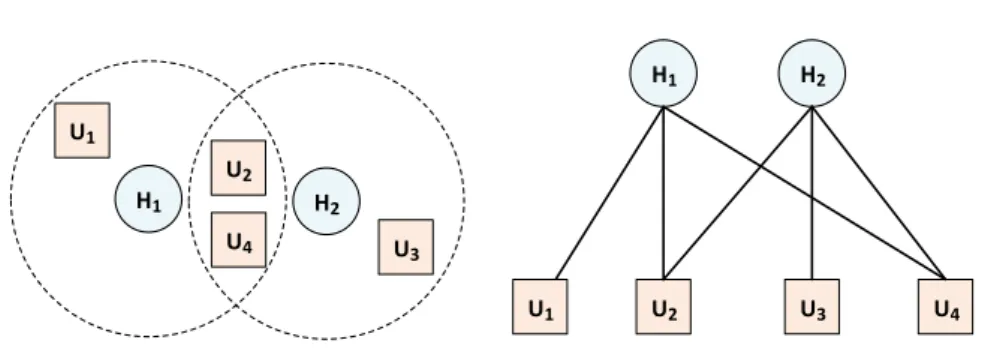
2.4 An example of a bipartite graph indicating the connectivity between the UTs and the helpers. . . 48
2.5 An example of coded caching strategy for two files(A,B), two users and cache sizeM=1 with two typical user requests. . . 49
2.6 An example of the probabilistic placement policy whenN=10 and M=4. Drawn uniformly a random number(0.7), the vertical line intersects with the memory chunks at{c2,c4,c7,c9}, respectively, i.e. the four files will be cached. . . 51
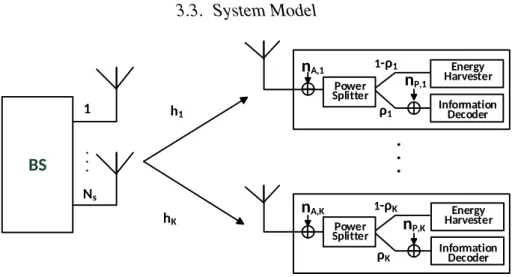
3.1 A MISO SWIPT broadcast system with power splitters. . . 54
3.2 The BS transmit power versus the SINRγ. . . 64
3.3 Transmission power versus harvested powerη. . . 65
3.4 Transmission power versus channel uncertainty thresholdε. . . 66
4.1 A SWIPT enabled relay system. . . 69
4.2 The framework of the proposed TS relaying. . . 69
4.3 Rate results against differentP0. . . 79
5.1 Multicast-aware cache enabled heterogeneous small cell networks. . 85
5.2 The flowchart of the MDS coding process . . . 86
5.3 The backhaul rates versus the total cache sizeM0. . . 94
5.4 The backhaul rates versus∆m. . . 95
5.5 The backhaul rates versusI. . . 96
5.6 The backhaul rates versus skewnessγ. . . 97
6.1 Cache-enabled heterogeneous small-cell networks. . . 104
6.2 The average backhaul rate of the proposed multicast-aware caching scheme versus the unicast based caching scheme and the multicast-aware caching schemes. . . 123
6.3 The average UA cost of the proposed cooperative caching schemes versus the non-cooperative scheme. . . 127
6.4 The average UA cost of the proposed multicast-aware in-cluster cooperative caching scheme versus in-cluster cooperative caching scheme and non-cooperative caching scheme. . . 131
List of Abbreviations
5G Fifth-Generation
QoS Quality of Service
EH Energy Harvesting
RF Radio Frequency
WPT Wireless Power Transfer
BS Base Station
SWIPT Simultaneous Wireless Information and Power Transfer
CR Cognitive Radio
MIMO Multiple-Input Multiple-Output
D2D Device-to-Device
NOMA Non-Orthogonal Multiple Access mmWave Millimeter Wave
HetNet Heterogeneous Network CoMP Coordinated Multipoint CSI Channel State Information IoT Internet of Things
MTC Machine Type Communication CAPEX Capital Expenditure
OPEX Operational Expenditure
UT User Terminal
SINR Signal-to-Interference-Plus-Noise Ratio
TS Time Switching
MDS Maximum Distance Separable MINLP Mixed Integer Nonlinear Program
UA User Attrition
PS Power Splitting
AS Antenna Switching
SS Spatial Switching
OFDM Orthogonal Frequency-Division Multiplexing
AN Artificial Noise
SDP Semi-Definite Programming SOCP Second Order Cone Programming SCA Successive Convex Approximation CDN Content Distribution Networking ICN Information Centric Networking LFU Least Frequently Used
F-RAN Fog Random Access Network C-RAN Cloud-Radio Access Network
BBU Baseband Unit
RRH Remote Radio Head
SBS Small Cell Base Station
MBS Macro Base Station
PPP Poisson Point Processes PCP Poisson Cluster Process SNR Signal-to-Noise Ratio
MS Mobile Station
ID Information Decoder
ER Energy Receiver
SDR Semi-Definite Relaxation AWGN Additive White Gaussian Noise NAF Naive Amplify-and-Forward MILP Mixed Integer Linear Program
eICIC Enhanced Inter-cell Interference Coordination Technique SIC Successive Interference Cancellation
List of Symbols
I an Identity Matrix with Appropriate Dimension 0 an All-Zero Matrix with Appropriate Dimension S−1 the Inverse of the Square Full-Rank MatrixS tr(S) the Trace of the Square MatrixS
S0 Sis Positive Semi-Definite S0 Sis Positive Definite SH the Hermitian of MatrixS ST the Transpose of MatrixS Rank(S) the Rank of MatrixS
Cx×y the Space ofx×yComplex Matrices Cx thex×1 Complex Vector Space
R the Real Number Space
Introduction
1.1
Motivation
1.1.1
Simultaneous Wireless Information and Power Transfer
The target of the fifth generation (5G) wireless communication is to enhance wire-less connectivity by increasing the data rates, coverage, bandwidth and reliability while reducing energy consumption and latency [1]. In response to two of the major requirements of 5G systems, developing green communication and improving en-ergy efficiency have become the trends. One of the promising techniques to provide green communication while maintaining the required Quality of Service (QoS) is energy harvesting (EH), which works by converting ambient energy source such as sound, heat and radio frequency (RF) signals into electricity. These energy sources can provide more flexible, portable power supply compared to batteries. Initially, natural energy sources were considered for EH in wireless networks [2,3]. However, the energy efficiency was not satisfactory because the natural sources in ambient environments are always irregular and unpredictable. Moreover, the performance depends heavily on the environments [4]. Wireless power transfer (WPT) avoids these problems by enabling the nodes to utilize electromagnetic radiation to get charged [5]. In this case, both the ambient signals and the specified power sources, e.g. base stations (BSs), can be used to provide energy. Recently, WPT has been more frequently considered for near-field than far-field, with the existence of several challenges for implementing short distance WPT such as distance limitations,main-tenance of field strengths, high cost, and resonant inductive tuning [6]. Moreover, the essential demand of enhancing communication distance motivates the research on far-field WPT techniques. Another significant trend for WPT is to merge WPT into wireless communication networks for better resource utilization. Therefore, simultaneous wireless information and power transfer (SWIPT), a technology that can transfer information and power simultaneously to the users, was first introduced in [5] from the perspective of information theory.
Recently, SWIPT has been recognized as one of the key technologies to achieve green communication and attracted tremendous attentions. As mentioned, SWIPT can achieve joint energy and information transmission in the era of 5G communication, and also be integrated with many modern communications net-works and technologies, such as multi-carrier systems [7], cognitive radio (CR) [8], full-duplex communications [9], multiple-input multiple-output (MIMO) [10], device-to-device communication (D2D) [11], symbol level precoding [12], cooper-ative relaying [13], non-orthogonal multiple access (NOMA) [14], millimeter wave (mmWave) communications [15], heterogeneous networks (HetNets) [16], coordi-nated multipoint (CoMP) systems [17], smart grid [18] and sensor networks [19]. Despite the variations in different application scenarios, in general, SWIPT can pro-vide notable gains in numerous perspectives, such as spectral efficiency, power con-sumption, interference management and latency by enabling simultaneous power and information transmission [4, 5, 20]. Nevertheless, challenges appear in order to balance between the performances of information transmission and power trans-fer as the power transtrans-fer process destroys information transmission. For example, more sufficient power from the energy harvesting can be ensured by increasing the transmit power. However, that increases interference as well as the susceptibility to eavesdropping which destroys the effective and secure information transmission, and hence gives rise to the research on secure SWIPT transmission aiming at en-hancing the throughput and security of the SWIPT systems [21]. Long-distance information and power transfer is another significant issue for SWIPT systems con-sidering the multi-path fading effects due to wireless propagation. To this end,
multiple antenna technology and cooperative communication technology have been merged into SWIPT systems where joint optimization of the transmit beamforming and power transfer ratios is required. However, the joint information and energy scheduling problems are always noncovex and difficult to handle. Since it is un-likely to have perfect channel state information (CSI) at the transmitters in reality, additional challenges arise when imperfect CSI is assumed, which leaves lots of space for further research in this field. Besides the conventional issues for imple-menting SWIPT in wireless networks which requires careful investigation, there are a series of directions possible for future research such as resource scheduling aspect, CSI feedback strategies, information theoretic framework, hardware impairments, channel coding techniques, internet of things (IoT), machine type communications (MTC), and satellite communication [22].
1.1.2
Edge Caching
The second part of the thesis is focused on the resource allocation technology aimed at reducing backhaul traffic, in particular, which is driven by the explosion of traffic stemming from healthcare, machine-to-machine communication, connected vehi-cles, social media, smart metering, IoTs and other new applications. By the end of 2016, mobile data traffic has reached 7.2 exabytes per month, and is expected to continue growing exponentially to reach 49 exabytes per month by the end of 2021 (seeing Fig 1.1) [23]. There will be changes in users’ consuming habits as well due to the big boost of data rate. In particular, video will make up 82% of the total traffic by 2021. These high traffic requirements motivate the era of 5G net-works to provide high spectral efficiency, dense deployment, new spectrum, green networking by facilitating a number of promising techniques, such as ultra-wide-band communication, massive MIMO communication, mmWave communication, and HetNets [24, 25]. However, all these techniques rely on expensive backhaul links between the core network and BSs (or among BSs) [26–29], which justifies a need for reducing backhaul traffic. Moreover, the sheer volume and dimensionality of large-scale data sets in mobile traffic streaming brings a fundamental challenge of big data analytics and decision making, and thereby requires more decentralized
Figure 1.1: Global mobile data traffic growth by 2021 forecast by Cisco
and flexible network architectures with predictive resource management leveraging recent advances in context-awareness, storage and fog computing.
Besides the exposure of mobile data traffic, the backhaul traffic itself has some notable features which bring potential bottlenecks in terms of successful content delivery, energy efficiency, and latency.
Firstly, when a user makes a request, the serving base station needs to fetch the corresponding content from the core network via backhaul links, in a typical cellular network. As a result, there exists a huge amount of data traffic at the core network in peak time, which causes long delay and impose high requirement. In this case, if we equip the BSs with cache memories, the BSs can save popular content in their local storage. In so doing, they can serve the users directly using the cached content rather than fetching the content via backhaul repeatedly. Ideally, if the BSs can predict the user requests and update the cached data in advance [30, 31], the users can be served by the BSs directly without using the backhaul links, which guarantees timely data transmission in peak hours. Secondly, duplicate data transmission actually makes up a large portion of the total backhaul traffic due to the users’ eagerness for current popular content (including the hottest audios, videos, and webpages). As a result, the same content needs to be repeatedly sent though the backhaul links to a number of users over and over again. If this type of duplicate
data transmission can be avoided, the backhaul traffic can be significantly reduced. And edge caching actually solves this issue effectively.
In addition, installing storage costs less than improving the backhaul capacity. For instance, a piece of memory storage of 2-3 TB only costs about 100 US dol-lars [32] while equipping backhaul links in network is usually quite expensive with a capital expenditure (CAPEX) including equipment and infrastructure expenses and operational expenditure (OPEX) breakdown [33]. Due to the advantages men-tioned above, edge caching has played a crucial role in 5G networks as an effective approach to reducing backhaul traffic by storing popular content in caches equipped at the network edge. In doing so, the cached content can be delivered to users from local caches rapidly instead of being downloaded from the core network via back-haul, which helps reduce the peak-time traffic and latency in communicating with the core network when users make requests.
Currently, caching has been considered in BS or/and user terminals (UTs) to release the backhaul requirements while enhancing the overall performance of the networks from different perspectives [34–36, 50–52]. However, there are still many crucial issues that require to be better looked into despite of the progresses that have been made in the existing attempts. The first issue is about cache content place-ment, i.e. where and what to cache. Though early studies have shown that caching the most popular items at each of the small cells without coverage overlapping pro-vides the highest local caching gains, for more complicated but efficient topologies, e.g. the small cell networks facilitated with multicast content delivery or/and con-tent sharing, the concon-tent placement requires to be redesigned based on the coordi-nation and cooperation among different cells instead of being optimized in terms of each cell separately. Moreover, the performance comparison between base station caching and D2D caching, as well as the combination of the two caching mech-anisms, has not been well studied. Third, the impacts of the heterogeneity of the networks and content characteristics on the caching decision need further clarifica-tion. Third, how the transmission characteristics of the wireless networks (e.g. the broadcast nature of the wireless medium) affect the design of caching approaches,
i.e. the joint design of caching and transmission policies is another hot issue which opens up many potential research directions such as (i) multicast-aware caching for serving multiple concurrent requests, (ii) cooperative caching for content sharing among the caches and the associated interference management, and routing issues due to simultaneous transmission, (iii) mobility-aware caching considering the fact that the users may move from one cell to another during data transferring, and (iv) content popularity prediction and evolution, privacy preservation, and the combina-tion of emerging networks and technologies.
In the following section, we present the outline and contributions of our work towards tackling the challenges mentioned above.
1.2
Outline of the Thesis
This thesis consists of two main parts dealing with SWIPT and edge caching, re-spectively. We first study the joint optimization of beamforming and power transfer ratios for SWIPT enabled systems in Chapter 3 and Chapter 4. Then we move to cache enabled small cell networks, where the cache content placement is care-fully designed in Chapter 5 and Chapter 6. In particular, the results in Chapter 6 are derived for cache enabled small cells with heterogeneous settings and take the advantages of multicast content delivery and content sharing. Below, we briefly discuss the contribution of our work in each chapter.
Chapter 2: Background.This chapter provides a more profound introduction on SWIPT technology and edge caching technology. The main design aspects in the two fields and the essential issues are discussed followed by a more detailed investigation on the beamforming design for SWIPT enable systems and content placement and delivery strategies for cache enable networks, respectively.
Chapter 3: Robust Beamforming for SWIPT Broadcast Channels. In this chapter, we study MISO broadcast system for SWIPT using receiver power splitting and aim to optimize jointly the beamforming vectors and the power splitting ratios for minimizing the transmit power subject to the individual signal-to-interference-plus-noise ratio (SINR) and the energy-harvesting constraints assuming
imper-fect CSI. We propose a reverse convex non-smooth optimization algorithm, which provides the near-optimal rank-one solution, compared to semi-definite relaxation (SDR) guided iterations in literature.
Chapter 4: Beamforming for SWIPT MIMO Relaying. In this chapter, we consider SWIPT for a two-hop MIMO relay system where the relay is powered by harvesting energy from the source via time switching (TS) to finish information for-warding. We aim to maximize the rate of the system subject to the power constraints at both the source and relay nodes. In the first scenario where the source covariance matrix is an identity matrix, we present the joint-optimal solution for relaying ma-trix and the TS ratio in closed form. An iterative scheme is then proposed for jointly optimizing the source and relaying matrices and the TS ratio.
Chapter 5: Optimizing Cache Placement for Heterogeneous Small Cell Networks. In this chapter, we optimize the cache content placement for a typical cache-enabled small cell network with heterogeneous file and cache sizes. In par-ticular, multicast content delivery is adopted to reduce the backhaul rate exploiting the independence among maximum distance separable (MDS) coded packets. We estimate the possible joint user requests using the file popularity information and aim at minimizing the long-term average backhaul load subject to the cache capac-ity constraints. The problem is reformulated into a mixed integer nonlinear program (MINLP) and solved with existing solvers after linearization.
Chapter 6: Coding, Multicast and Cooperation for Cache-Enabled Het-erogeneous Small Cell Networks. This chapter considered the design of content caching and sharing for cache-enabled heterogeneous small cell networks using MDS codes under heterogeneous file and network settings. We first presented the multicast-aware caching and the cooperative caching schemes, for minimizing the long-term average backhaul load or the user attrition (UA) cost subject to the over-all cache capacity constraint, and obtained the optimal content placement in both cases via convexification. A compound caching scheme, referred to as multicast-aware cooperative caching, was then proposed exploiting the independence of MDS coded packets to further reduce the backhaul requirements. In this case, a greedy
algorithm can be used for small scale networks while for large scale networks a multicast-aware in-cluster cooperative caching algorithm was developed. The ad-vantages of storing coded packets over the uncoded fragments in all the scenarios as well as the benefits of utilizing multicast-aware caching and/or cooperative caching over common caching schemes have been analyzed.
Chapter 7: Conclusion and Future work.This chapter summarizes the main contributions of this thesis and introduces several potential research directions for future work.
1.3
Publications
The results, the ideas and figures are included in the following publications:
• J. Liao, M. R. A. Khandaker and K. K. Wong, “Robust Power-Splitting SWIPT Beamforming for Broadcast Channels,”IEEE Commun. Lett., vol. 20, no. 1, pp. 181–184, Jan. 2016.
• J. Liao, M. R. A. Khandaker and K. K. Wong, “Energy harvesting enabled MIMO relaying through power splitting,” inProc. IEEE 17th Intl. Workshop on Signal Processing Advances in Wireless Commun. (SPAWC), Edinburgh, UK, July 2016, pp. 1–5.
• J. Liao, K. K. Wong, M. R. A. Khandaker, Z. Zheng, “Optimizing Cache Placement for Heterogeneous Small Cell Networks,” IEEE Commun. Lett., vol. 21, no. 1, pp. 120–123, Jan. 2017.
• J. Liao, K. K. Wong, Y. Zhang, Z. Zheng and K. Yang, “Coding, Multicast and Cooperation for Cache-Enabled Heterogeneous Small Cell Networks,”
IEEE Trans. Wireless Commun., vol. 16, no. 10, pp. 6838–6853, Oct. 2017. • J. Liao, K. K. Wong, Y. Zhang, Z. Zheng and K. Yang, “MDS Coded
Coop-erative Caching for Heterogeneous Small Cell Networks,” in Proc. Global Commun. Conf. (GLOBECOM), Singapore, Dec. 2017, pp. 1–7.
Background
This chapter aims to provide the reader with the information and reference neces-sary to better understand the study in the following several chapters of this disser-tation. General information about wireless background, and receiver architectures and beamforming for SWIPT will be presented firstly, and then the focus will shift onto the profound introduction about edge caching from various perspectives, such as the development, taxonomy, and caching strategy of cache-enabled wireless net-works.
2.1
Wireless Fading Channels
Channel is the physical medium over which signal is transmitted from the sender to the receiver. One of the distinct features of wireless channels is fading, which refers to the random attenuation in the signal strength and the random phase shift of the received signal, as a result of the radio wave propagation in the environment. In general, two types of fading effects characterize wireless fading channel, namely large scale fading and small scale fading. The former refers to path loss character-ized by distance and shadowing caused by prominent terrain contours such as hills, forests, and tall buildings [37]. Small-scale fading occurs as a result of multipath propagation, which mainly results from a combination of effects such as diffraction, reflection and refraction. Frequency selectivity is another important characteristic of wireless fading channels [38]. When all frequency components of the transmit-ted signal experience the same fading magnitude, the fading is said to be frequency
flat. This occurs when the coherence bandwidth of the channelBcis larger than the signal bandwidth Bs, i.e. Bs <Bc. On the contrary, if the frequency components are affected by different amplitude gains and phase shifts, it is called frequency selective, which occurs whenBs>Bc.
Recently, there have been a range of statistical models which characterize wire-less fading channels with applicable trade-off between accuracy and complexity. In the following, we introduce several typical channel models which will be consid-ered in this thesis.
2.1.1
Wireless Channel models
A. Rayleigh FadingRayleigh fading model is often used for multipath fading channels with no di-rect line-of-sight (LOS) path. The probability density function (PDF) of the channel fading amplitude is given by [39]
p(α) = 2α
Ω exp(−
α2
Ω),α ≥0, (2.1)
whereα is the channel fading amplitude, andΩ=E{α2}denotes the mean value.
B. Rician Fading
Rician fading is frequently used to characterize propagation paths with one strong direct LOS component and many random weaker components. Here the channel fading amplitudeα follows the distribution
p(α) = 2(1+n 2)e−n2α Ω exp −(1+n 2)α2 Ω I0 2nα r 1+n2 Ω ,α ≥0, (2.2)
whereI0(∗) is the Bessel function of the first kind [40], andn denotes the fading parameter ranging from 0 to 1. The Rician factor refereed to asK, which reflects the connection between the power of the LOS component and the power of the Rayleigh component, can then be derived usingK=n2. Particularly whenK=0, there is no LOS component and the Rician PDF is reduced to the Rayleigh PDF.
2.1.2
Channel State Information
The channel state information (CSI) of a communication link is defined as the known channel properties describing the propagation of a signal between the trans-mitter and the receiver, and reflecting the combined effect of wireless transmission, such as scattering, fading, and power decay with distance [41]. As it is crucial to adapt transmissions to current channel conditions to reconstruct the useful in-formation with minimum distortion at the receiver, CSI needs to be estimated at the receiver and fed back to the transmitter. And the process of CSI acquisition is referred to as channel estimation.
There are two major types of channel estimation methods, the data-aided method and the blind estimation method. The data-aided method is also referred to as training sequence (or pilot sequence), where a known sequence is transmitted and the channel coefficient will be estimated by removing the known data at the received signal. If there is no noise at the received signal, the estimation will be perfect. There are two typical ways to insert the pilot sequence, block-type pilot arrangement and comber-type pilot arrangement [42]. According to the evaluation criteria, the channel estimation methods can be divided into least-square (LS) esti-mation and the minimum mean square error (MMSE) estiesti-mation. The former aims to minimize the sum of squared errors while the later focuses on the mean square error (MSE) between estimated and actual received signal [43]. Generally speaking, MMSE estimation outperforms LS estimation by shortening the required pilot se-quence and reducing the estimation error. However, MMSE estimation requires the channel correlation and noise correlation information in advance, and therefore can be seen as the Bayesian counterpart to LS estimation. In contrast, blind estimation only depends on the received data without any training symbols [44]. Data-aided estimation usually achieves better accuracy than blind estimation at the expense of a higher overhead, e.g., more bandwidth.
2.1.3
Imperfect CSI Models
In practice, CSI needs to be estimated in the presence of noise, and therefore the acquired CSI is destined to be imperfect. For this reason, channel errors are
some-times considered in the design of more robust communication systems. Channel errors are often modeled using stochastic or deterministic (worst-case) models. A popular stochastic model utilizes Gaussian random variables to model the CSI un-certainty, while the deterministic model usually assumes that the error is modeled by an ellipsoid-bounded uncertainty region [45]. Compared with the perfect CSI case, the imperfect CSI case is always more challenging for optimizing the resource al-location for wireless communication. Here, we discuss about the typical types of channel uncertainties.
A. Ellipsoidal Channel Vector Uncertainty
If the CSI is estimated in the form of channel vector (as is typical in a multi-dimensional channel such as in a multiple antenna system), then the channel at the receiver, denoted as the vectorh, can be modeled as [46]
h,hˆ+∆h, (2.3)
where ∆h is the CSI estimate while ∆h is the CSI error. Depending on the
esti-mation methods or feedback schemes, the channel errors follow specific random distributions. Without loss of generality, we consider the case that∆his subject to
colored noise and bounded by an ellipsoid, i.e.,
H ={∆h:∆h†C∆h≤1}, (2.4)
whereC0 determines the quality of CSI and is assumed known at the receiver. B. Ellipsoidal Channel Covariance Uncertainty
Compared with the channel vector, the second-order statistics of the channel changes more slowly. Thus, the estimated CSIs in the form of channel covariances are more practical. In this case, we model channel covariance uncertainties as [47]
H,hh†=Hb+∆H, (2.5)
whereHb denotes the CSI estimate at the receiver while∆Hcorresponds to the CSI
errors. Similarly, we consider the more practical scenario where the channel covari-ance matrices are estimated in the presence of colored noises, and∆His bounded by
ellipsoidal regions. In addition,∆Hshould be set to guarantee the positive
semidef-initeness properties of the matrixHb+∆H, i.e., f
H ={∆H:∆H=∆H†,Hb+∆H0,Tr(∆H†C∆H)≤1}, (2.6)
where the parametersC0 are known a priori. C. Stochastic CSI Errors
The CSI error may also be modeled as Gaussian random variables following a known distribution, i.e., [48]
h,hˆ+∆h, (2.7)
where CSI error∆h is modeled as zero-mean Gaussian random variables with
co-variancesC, i.e.,∆h∼N (0,C). As∆his unbounded, meeting deterministic
con-straints in all time would be impossible and therefore probabilistic conditions occur that guarantee the deterministic conditions being satisfied with high probability.
2.2
Performance Measures
There are many performance metrics that are commonly used in evaluating the performance of resource allocation schemes in wireless communication systems. The most relevant ones that are used throughout this thesis are signal-to-noise ra-tio (SNR), signal-to-interference-and-noise rara-tio (SINR), channel capacity, hit rara-tio and backhaul load. In this section, a brief introduction of these performance metrics is now presented.
2.2.1
SNR and SINR
The output SNR is defined as the ratio between the power of signal component in the output and the power of the noise component in the output. LetPbe the power of the transmit symbol defined asP=E(ss∗), σ2 be the noise level, andh be the fading channel, the SNRrcan be expressed as
r= P|h| 2
σ2 . (2.8)
Due to the fading effects of the wireless channels, the average SNR is considered, which is defined by ˜r=E|h|(r).
The SNR has high impact on the quality of data detection, and is therefore frequently used as the performance metric in both network optimization and perfor-mance analysis.
The definition of SINR is similar to the SNR except that the impact of co-channel interferences is considered in addition to the impact of the noise. In wireless communication systems, interference frequently appears as the result of frequency reuse among neighboring cells, which makes the SINR more practical than the SNR. For instance, assuming that there is only one strong interference channel of which the fading coefficient is defined asg, the received signal can then be expressed as
y=hs+gx+n, (2.9)
wheres,x,nare the transmitted signal, the interference signal and the noise signal, respectively. The power of the interference signal is defined as Pi=E(xx∗). Con-sidering co-channel interference, the SINR is defined as the ratio between the power of the desired signal and the sum power of the interference and noise, i.e.,
e r= P|h| 2 Pi|g|2+σ2 . (2.10)
2.2.2
Channel Capacity
Firstly proposed by Claude Shannon in [49], channel capacity refers to the maxi-mum rate at which information can be reliably transmitted over a communication channel. Channel capacity is defined as the maximum of the mutual information be-tween the transmitter and the receiver. The instantaneous channel capacity is given by C=log2 1+P|h| 2 σ2 ! . (2.11)
Depending on the situations, channel capacity can be divided into two types, i.e., ergodic capacity and outage capacity, according to the property of the fading channelh. The basic assumption for ergodic capacity is that the transmission time is long enough to present the long-term ergodic properties of the fading process. In this case, the ergodic capacity can be written asCe =E|h|{C}. However, the assumption on ergodicity is not always achievable in practical delay-constrained
communication systems. On the contrary, when there is no significant channel vari-ability in the transmission process, the actual transmitted rate may exceed the in-stantaneous channel capacity at a non-negligible probability. In this case, it is better to considerq% outage capacityCo, which is defined as the channel capacity which can be achieved by(100−q)% of the channel realizations and guarantees reliable services, i.e., Pr{C≤Co} ≤q%.
2.2.3
Hitting Rate
Hitting rate is one of the most frequently used metrics in measuring the performance of cache content placement scheme. In deterministic caching, it is defined as the ra-tio between the number of cached files that are requested and the overall number of files stored in the storage. For instance, a hitting rate higher than 90% demonstrates that most of the requests are satisfied by the cache. On the other hand, in proba-bilistic caching, the hitting ratio is the probability for the required file being stored in the cache. An efficient caching scheme maximizes the cache hits while minimiz-ing the cache misses, yieldminimiz-ing higher hittminimiz-ing rate, lower latency, and better storage utilization. Although hitting rate directly shows the cache miss, it fails to reflect the impact of the caching scheme on the performance of wireless communication system [50].
2.2.4
Network Delay
Network delay is defined as the response time from the time when the file is re-quested until delivery [51]. From the perspective of the users, it is necessary to minimize the delay of being served which is critical to user’s experience especially for delay-sensitive content services. As fetching content from local storage is much faster than delivering content from the core network, the network delay can be re-duced by taking full advantage of storage space.
2.2.5
Backhaul Load
In cache enabled wireless networks, backhaul load refers to the amount of content that requires to be delivered form the core network to the BSs via backhaul. As the user demands are usually assumed to be unknown and random following particular
distributions, e.g., Zipf’s distribution, the backhaul load is usually measured in long term average in terms of all possible user demands [52]. In general, higher backhaul load results in higher peak-time traffic and network delay, and places higher demand on backhaul capacity.
2.3
More on SWIPT Systems
2.3.1
Receiver Architectures for SWIPT Systems
In wireless communication systems, RF signals can convey both information and energy simultaneously, and hence RF-based SWIPT has become a promising en-ergy harvesting technology where the terminals can not only access wireless data but also harvest energy from RF signals simultaneously. Though early fundamental studies on SWIPT have assumed lossless information and power transfer with the same signal [53], it is difficult to achieve in reality as the power transfer affects the performance of information transmission directly. For instance, enhancing trans-mit power can increase harvested energy but also impose high interference. More-over, the RF signal acts as a dual-purpose carrier for conveying information and energy to the receivers simultaneously. However, the huge gap between the power sensitivity for energy harvesting receivers (-10 dBm) and information decoding re-ceivers (-60 dBm), which is referred to as the near-far issue, becomes a barrier to implement SWIPT technology and requires reconsideration of receiver architecture design [10].
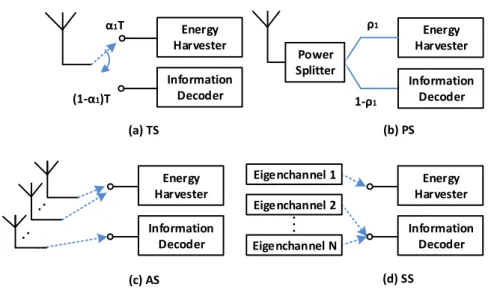
In general, there are two types of receivers in SWIPT systems, the separated and collocated receivers. Fig. 2.1 presents the different receivers architectures.
A. Separated Receivers
For separated receivers, the receivers are either responsible for energy har-vesting (EH) or information decoding (ID). For instance, a location based receiver scheduling was proposed in [54], where receivers located near or far away from the transmitter were assigned for energy harvesting or information decoding, respec-tively. This technique can be easily implemented.
ρ1 1-ρ1 (a) TS (b) PS (c) AS (d) SS (1-α1)T α1T Information Decoder Energy Harvester Information Decoder Energy Harvester Power Splitter Information Decoder Energy Harvester Eigenchannel 1 Eigenchannel 2 Eigenchannel N Information Decoder Energy Harvester
Figure 2.1: Typical SWIPT receiver structures.α1denotes the TS factor,ρ1denotes the PS factor, andT denotes the transmission block duration.
The collocated receiver can coordinates between the energy harvesting and the information decoding processes. To achieve SWIPT for systems with collocated re-ceivers, the received signal requires to be split for information decoding and energy harvesting, respectively. The signal splitting strategies involve different domains, i.e. time, power, antenna, space domains [4].
• Time Switching (TS):In consideration of TS, each time slot is partitioned into two orthogonal slots. The receiver works alternatively as information decoder and energy harvester by a certain ratio referred to as a TS ratio [55]. • Power Splitting (PS):As an opposite, the PS technique enables SWIPT by splitting the received signal into two parts of different power levels according to a PS ratio, one of which is converted to base-band for information decod-ing while the other is sent to the rectenna circuit for energy harvestdecod-ing [56]. Compared with TS, the PS technique requires higher complexity in receiver design, but achieves information and power transfer in the same time slot which makes it more suitable for delay-sensitive networks. Compared with other techniques, it achieves the best trade-off between information rate and
harvested energy.
• Antenna Switching (AS):In this architecture, the receiver always has mul-tiple antennas a subset of which is assigned to decode the information, while the remaining are responsible for energy harvesting [57]. Antenna switch is an easy-to-implement and low-complexity protocol.
• Spatial Switching (SS):In this architecture, spatial domain is mainly on the spatial degrees of freedom of the channel rather than the antenna elements. Utilizing the singular value decomposition (SVD) of the MIMO channel, the SS technique transforms the communication link into parallel eigenchannels conveying either information or energy [58].
2.3.2
The Application of Beamforming for SWIPT Systems
Beamforming has been widely applied in wireless communications to focus the sig-nal in a narrow direction by generating pencil beams. In wireless networks, the usage of beamforming can bring lots of advantages. By focusing the signal towards the intended receiver, and therefore reducing the multi-path attenuation and interfer-ence, beamforming enhances SINR, data rate, security level and spectral efficiency, and therefore helps accommodate more users and provide larger coverage area [59]. However, there are still a couple of challenges in beamforming design for wireless networks. For instance, the usage of antenna arrays and signal processing modules places higher requirements on money and power in deployment. Moreover, the SCI acquisition and signal processing needed in learning the channel status and deriving optimal beamforming solution, result in higher complexity and overhead.As mentioned previously, the power sensitivity of the EH process is quite low compared with the ID process [10]. And the EH process is quite sensible to sig-nal decay caused by the properties of wireless propagation, such as scattering, re-flection, and fading. To deal with this problem, multi-antenna techniques, e.g., beamforming, have been widely applied in SWIPT enabled communication net-works to guarantee efficient information and power transfer [20]. The advantages of beamforming in wireless communication mentioned above make beamforming a
significant transmission scheme in SWIPT systems.
And the main target for beamforming design in SWIPT systems is to derive the optimal beamforming solution that achieves desired energy-information trans-mission tradeoff. Recently, many studies have focused on the beamforming design in SWIPT systems. For instance, an optimal beamforming solution was derived for MISO SWIPT with two and three PS-based receivers in [60]. Physical layer secu-rity is another important issue worth careful investigation in beamforming design for SWIPT systems [59]. Another challenge will be channel conditions acquirement, because the selection and updating of transmit beams and transmit scheme depend heavily on channel conditions as mentioned in the previous section. Compared with the perfect CSI case, the imperfect CSI case is always more challenging for beam-forming design in SWIPT systems. However, it is quite difficult to guarantee perfect CSI for SWIPT systems in reality, as the CSI acquirement of the ID receiver will be heavily interfered by the interference of both information and power signals while the EH receiver, even worse, usually has no special circuit to feedback the CSI to the transmitter. Robust beamforming is consequently an indispensable process for re-source allocation for SWIPT systems. What is more, the energy constraints, which always conflict with the information transmission efficiency, bring extra difficulties to the beamforming design, compared with the conventional networks.
2.3.3
Taxonomy of Beamforming for SWIPT Systems
Recently, there have been many papers focusing on beamfoming design for SWIPT systems which differ from each other in a variety of design aspects, such as the net-work topology, performance metric, and mathematical tool. These net-works focused on joint data transmission and power transfer factor design for SWIPT systems in terms of enhancing the energy or spectral efficiency assuming either perfect CSI or imperfect CSI with bounded or stochastic uncertainties at the transmitters. Due to the broadcasting nature of wireless channels, increasing transmit power can not only boost the harvested energy but also increase the susceptibility to eavesdroppers, which shows synergy between communication, energy and security, a significant is-sue for SWIPT systems [21, 61, 62].
A. Network Topology
The emergence and development of SWIPT has opened up numerous new op-portunities including the SWIPT works for orthogonal frequency-division multi-plexing (OFDM) systems [64], frequency-selective channels [65] and multiuser scenarios, such as the relay channel [13], the interference channel [66], the mul-ticasting channel [67], and the broadcast channels [56] and [68]. Instead of con-sidering the essential issues in implementing SWIPT for conventional networks, the research of SWIPT has recently been extended to involve emerging network topologies and techniques to achieve the targets of the 5G cellular communication systems, such as full-duplex communications, MIMO, D2D, symbol level precod-ing, NOMA, mmWave communications, HetNets, CoMP systems, smart grid, and sensor networks [9–19].
B. Performance Metric and Constraints
The beamforming design problem in SWIPT systems has been formulated from different perspectives, such as minimizing total transmit power or outage probability [56], maximizing system capacity or throughput [63], and deriving rate-energy trade-off [10]. The possible constraints in these cases may differ accord-ing to the design objectives. There are several general types of constraints, such as power consumption constraint, energy harvesting constraint and the SINR con-straint [10, 56, 63]. To control the power consumption, the total transmit power should not surpass a given threshold. On the other hand, to ensure enough power from the energy harvesting, we need to make sure that the power received at the EH receiver is higher than a threshold. To meet quality of service requirements, the SINR at the ID receiver should be large enough to guarantee accurate information decoding at the ID receiver. However, those constraints are always conflicting, and also not jointly convex, which turns the beamforming design problems non-convex optimization problems. As an example, [10] characterized the rate-energy regions for MIMO broadcast systems for SWIPT with separated and co-located information and energy receivers.
The most frequently used optimization strategies for beamforming design in SWIPT systems are Semi-Definite Programming (SDP) [69], Second Order Cone Programming (SOCP) [70], sub-optimal algorithms like block coordinate descent (BCD) method [71], or convex relaxation methods like, Successive Convex Ap-proximation (SCA) [72]. Meanwhile, reformulation is a good way to convexify the original unconvex problems by strategies such as introducing new variables and matrix transformation. For robust beamforming design with ellipsoidal channel vec-tor uncertainty, S-Procedure is usually used for reformulation. Taking the SWIPT MIMO system with perfect CSI as an example [10], the transmit power minimiza-tion problem subject to the SINR and harvested energy constraints is a minimum convex SDP because the objective function is linear and the constraints are defined by a finite number of convex sets [73]. However, the number of constraints be-comes infinite when it be-comes to the imperfect CSI scenario. To handle the infinitely many inequalities, S-Procedure is an efficient way to turn the constraints with chan-nel uncertainty into linear matrix inequalities (LMIs) [45]. In particular, for MISO systems with beamforming vector defined asb, there is always uncovexity in beam-forming design problems due to the presence of (bbH) in essential performance metrics such as transmitted power or SINR. By replacing(bbH)with a new matrix Wwhich satisfiesW,bbH, the original problem can again be reformulated into an SDP. However, this type of reformulation is not completely equivalent as we are not guaranteed to be able to derive the optimal vector bby decomposing the obtained W, unless the rank ofWequals to 1. To deal with this rank-one issue, we need to prove that Rank(W) =1 holds true, or alternatively resort to suboptimal solution utilizing randomization [74].
2.4
More on Wireless Edge Caching
2.4.1
The Development of Edge Caching
As one of the emerging techniques to deal with the explosive wireless traffic growth, caching techniques have been widely applied in wired networks for web caching firstly emerged in the early 1990s [75], content distribution networking (CDN) since
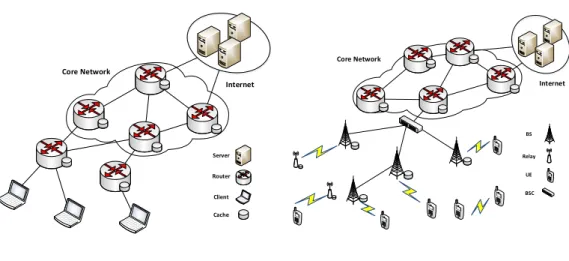
Router Server Cache Client Internet Core Network
(a) Cache enabled wired network.
Relay BS BSC UE Internet Core Network
(b) Cache enabled cellular network.
Figure 2.2: Architectures of typical wired and wireless networks with caching.
the late 1990s and 2000s [76, 77] and more recently, information centric network-ing (ICN) [78], with the popular content changnetwork-ing from web pages and images, to videos generated by servers or clients, and the cache memories installed at clients, proxy servers, and routers, respectively. In particular, ICN achieves efficient con-tent placement based on concon-tent popularity and network parameters [78]. Fig. 2.2a presents a typical cache-enabled wired network consisting of clients, routers, and servers. When the clients send requests to the routers, if the routers store the re-quested content, the clients can be served by the routers directly without contacting the core network, which reduces the latency in the network [79].
The concept of caching has recently been introduced to the physical layer to reduce peak-time traffic, latency as well as the requirement for expensive high ca-pacity backhaul links [34]. Similarly, the main idea of caching in cellular networks is to store popular content at the network edge, either at the BSs or/and UTs to bring the content closer to the users. Fig. 2.2b provides a typical cache-enabled cellular network consisting of a wired core network, BSs and backhaul links connected to the internet. If the requested content is stored in the user itself, neighboring users, or serving BSs, the user can fetch the content therein. Otherwise, the requested content should be fetched from the core network via backhaul. Though implement-ing cachimplement-ing techniques in wireless networks share a lot of resemblance with that
in wired networks, the wired caching strategies in upper layer cannot be directly applied to cellular networks due to the unique structures and transmission features of cellular networks [80]. Firstly, wireless users usually have smaller cache capac-ities than the wired clients. Moreover, challenges appear due to node mobility and dynamic network topology in wireless networks. For instance, wired clients are usually fixed while users in wireless networks may move from one cell to another. And wireless channels are more uncertain and complicated compared with wired channels. The unique barriers of wireless transmission, such as co-channel inter-ference and limited spectrum, make it even more challenging to design efficient caching strategies for wireless networks.
For cache-enabled cellular networks, one needs to address, e.g., where to cache, what to cache, the corresponding delivery and transmission policy, and so on [35]. Regarding the first question, caching can take place at the BSs or UTs. By caching at the BSs, we can reduce the traffic in backhaul and improve the en-ergy and spectral efficiencies, while caching at the UTs adds cooperation gain and improves network scalability, facilitating D2D links.
Also, cache content placement addresses what to cache. As far as content updating is concerned, caching schemes can be divided into adaptive caching and proactive caching. Adaptive caching, a.k.a. pull-based caching, works in a reac-tive manner by storing content in the caches on demand. In this scheme, caching decision is performed only after users have made their requests so that online algo-rithms, such as the least frequently used (LFU) and least recently used (LRU), can be used. As a result, the cached content in each cell is updated every time a new round of requests is made by the users. By contrast, proactive caching is a push-based approach which proactively estimates user demand patterns and performs content placement before the users make requests. Popular schemes include com-mon uniform placement, popularity based placement, probabilistic placement [50], partition-based placement [36] and other offline schemes. When caching contents, we can either store the entire files or fragments of the files based on file splitting to ensure diversity of the cached contents in the case that the cache capacity is
rel-atively limited compared to the average file size. For this reason, network codes, such as MDS codes have been utilized to construct file pieces in order to improve storage utilization. In optimizing content placement, the objective is usually on one of the followings: the hit ratio [50], latency [51], backhaul load [52], service cost, spectral/energy efficiency, and so on.
Recently, considerable research has been done on physical layer caching. In-spired by the primary research [81] where caching schemes were designed in presence of routing, cooperative, and physical layers in 2009, an comprehensive information-theoretic study was first given in [52] in 2010 for a homogeneous sys-tem with a single content server and several users served with a shared link. Sub-sequently in, e.g., [82–89], more complex network topologies with heterogeneous network settings have been studied for, respectively, nonuniform file popularity, file sizes and cache sizes, random requests, secure delivery, interference channel, D2D networks, and recently fog random access networks (F-RANs). In 2012, a typical femto-cell BSs (helpers) assisted wireless distributed caching network was proposed in [90] aimed at minimizing the network delay by jointly designing the content placement and the cooperation among the helpers. More recently, wire-less caching techniques have been extended into diverse network topologies, e.g. cache-enabled macro-cellular networks [91, 92], HetNets [93, 94], D2D cellular networks [95,96], cloud-radio access networks (C-RANs) and fog-radio access net-works (F-RANs) [97, 98]. Most of these papers focused on the typical issues of designing the content placement and content delivery algorithms.
Another hot topic for cache-enabled networks is the beamforming design which focuses more on the transmission aspects in presence of caching. In [97], in-stantaneous beamforming and BS activation for C-RAN were addressed, while [99] considered the joint design of data assignment and beamforming for a cooperative multi-cell network both assuming a given cache content placement in a short-term time scale. In [100], beamforming and cache content placement were jointly op-timized utilizing a mixed time-scale stochastic optimization scheme. In addition, performance analysis of cache-enabled wireless networks has also been extensively
Cache-Enabled Cellular networks Performance Metrics Control Structure Mathematical Tools Caching Strategy Network Topology Cache-enabled D2D networks Cache-enabled multi-cell networks Cache-enabled HetNets Cache-enabled C-RANs/F-RANs Backhaul cost Throughput Backhaul load
Network delay Spectral/energy efficiency Caching placement Caching delivery Optimization Game theory Machine learning Stochastic geometry Centralized Distributed
Successful transmission rate
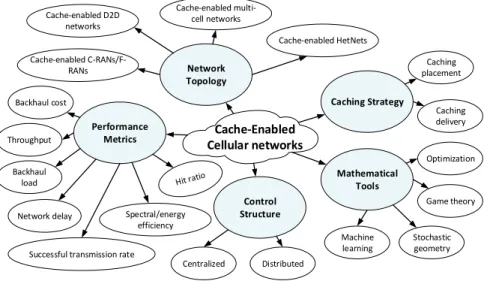
Figure 2.3: Taxonomy of cache-enabled wireless networks.
conducted in the literature, e.g., [101–104]. To summarize, those results largely an-alyzed cache-enabled small-cell networks using stochastic geometry to model the stochastic properties of channel fading and interference. However, the results either ignored the spatial diversity of the cached content and disabled the coordination and cooperation aspect among different cells [101, 102] or even ignored the file popu-larity information altogether [103, 104].
Apart from the above, emerging topics in physical layer caching also in-clude multicast-aware caching [105], hierarchical caching [106], mobility-aware caching [107, 108], cooperative caching, and caching architecture design in fog-RAN [109]. Moreover, learning, matching and online algorithms have also be used to solve physical layer caching problems in [110–112].
2.4.2
Taxonomy of Cache-Enabled Wireless Networks
According to the network topology, caching model, performance metric, control structure and mathematics tool, the existing research on physical layer caching can be classified into different categories. Next, we briefly discuss the caching tech-niques in cellular networks from different design aspects (seeing Fig. 2.3) [113].
A. Network Topology
macro-cellular networks, cache-enabled HetNets, cache-enabled D2D networks, and cache-enabled CRANs/F-RANs. One of the most notable differences among them is the cache location which ranges from the BSs, the SBSs, the UEs, the baseband units (BBUs), and remote radio heads (RRHs), respectively. Moreover, reducing the requirements on backhaul is the major target in the first two types of networks, while edge caching is expected to facilitate collaboration and improve the spectral efficiency and energy efficiency additionally in cache-enabled D2D works and C-RANs/F-RANs. In the following, we briefly discuss the different net-works, respectively.
• Cache-Enabled Multi-Cell Networks: In this type of networks [91], each BS is equipped with memory storage to store popular content. And it is al-ways assumed that no coverage overlap exists among the BSs.
• Cache-Enabled HetNets: Cache-enabled HetNets integrates a variety of technologies, and cell layers, i.e. macro-cells, small cells (femtocells, pico-cells), and relay nodes, in order to meet the higher requirements on coverage, capacity, and latency. In this case, coverage overlap and spectrum sharing occurs among the macro-cells, and other nodes, which causes concerns on interference and coordination aspects [93]. The associated network topology can be grid-based or random spatial. For the former, the macro base station (MBS) is central-located with a number of small cell base Stations (SBSs) being deployed inside the cell. In the random spatial topology, the MBSs and SBSs are randomly deployed in each cell based on stochastic geometry [114]. Since both the MBSs and SBSs can have memory storage, the multiple-level hierarchical caching and cooperative caching can be considered to further im-prove the caching gains.
• Cache-Enabled C-RANs/F-RANs: C-RAN is a centralized, cloud computing-based architecture while F-RAN takes the advantages of both edge caching and centralized processing and creates a new distributed, edge computing-based radio access network [116]. In both of the two structures,
there are a number of BBUs with caches clustered as the BBU pool, the RRHs connected to the BBU pool through fronthaul links, and the UEs. In C-RAN, the BBU pool carries memory and offers collaborative processing, while the edge nodes, RRHs, take charges of edge caching and signal processing in F-RAN, which reduces the latency and transmission power by moving major transmission tasks from the BBU pool from RRHs [117].
• Cache-Enabled D2D Networks: In cache-enabled D2D networks, the de-vices are enabled to have memory storage and communicate directly with nearby devices without contacting the BSs [95, 115]. In this case, adjacent devices usually form a cluster, if the requested file has not been stored in lo-cal cache, it can fetch the file from any user in the same cluster that caches the file. Compared with the base station caching, D2D caching has some unique challenges due to the properties of the network topology, such as smaller cache capacity, more limited transmitted power and coverage, denser com-munication links, and higher user mobility.
B. Caching Strategy
As mentioned, the caching process always has two phases: the content place-ment phase and the content delivery phase. The former decides which files should be stored in the caches, and occurs during off-peak hours, e.g. night time. The later usually happens right after the users make requests in peak traffic periods. In this phase, the requested files need to be sent to the users from the caches or the core network. Note that the content placement phase, except for the online caching case, happens in a relative long-term time scale compared with the content delivery phase which occurs instantaneously, and therefore lots of papers have assumed that the content placement has been fixed when designing the content delivery strate-gies, while authors in [100] proposed a new strategy for joint optimization of the two phases utilizing mixed time-scale stochastic optimization.
• Caching Placement Strategy: As mentioned previously, there are a variety of content placement schemes which can be grouped into several types ac-cording to different aspects, e.g. file partition, placement updating, caching
model, performance metric and etc. For instance, we can distinguish the con-tent placement schemes among uncoded caching or coded caching, proactive caching or reactive caching, deterministic caching or probabilistic caching, and so on. For the uncoded caching, complete files or uncoded segments of the files will be stored in the caches. For the coded placement, each file is par-titioned, processed by particular codes [118,119], and then cached, in order to improve the utilization of storage. Most of the literature considers proactive content placement strategy, e.g. popularity based placement and probabilistic placement, which is an offline caching strategy deciding the content place-ment by actively predicting the file popularity. Oppositely, adaptive content placement strategy, e.g. the least frequently used (LFU), least recently used (LRU), and other online algorithms [121], determines how to update the con-tent in the caches according to the users’ demands. The basic idea of the two typical replacement strategies is removing the least recently requested or least frequently used content from the caches, and then replacing them with more popular content, respectively [122].
• Caching Delivery Strategy: The target of caching delivery strategy design is to find a most effective way to transmit the requested content to the users. To do so, we need to decide where and how to fetch the requested con-tent, which requires carefully optimization of user association, transmission method (e.g. unicast, or multicast), power allocation, channel allocation, and other required transmission parameters, according to different performance metrics and physical transmission conditions. In particular, multicast trans-mission plays an important role in content delivery by utilizing a single mul-ticast transmission to serve temporal-spatial requests for the same content, instead of sending multiple unicast transmissions each corresponding to an individual request [123]. Coded multicast is another effective way to satisfy different requests concurrently with multicast utilizing linear coding [52]. C. Control Structure