For More Information
Visit RAND at www.rand.org
Explore the RAND National Defense Research Institute View document details
Support RAND
Purchase this document Browse Reports & Bookstore Make a charitable contribution
Limited Electronic Distribution Rights
This document and trademark(s) contained herein are protected by law as indicated in a notice appearing later in this work. This electronic representation of RAND intellectual property is provided for non-commercial use only. Unauthorized posting of RAND electronic documents to a non-RAND website is prohibited. RAND electronic documents are protected under copyright law. Permission is required from RAND to reproduce, or reuse in another form, any of our research documents for commercial use. For information on reprint and linking permissions,
please see RAND Permissions.
Skip all front matter: Jump to Page 1
6
The RAND Corporation is a nonprofit institution that helps improve policy and decisionmaking through research and analysis.
This electronic document was made available from www.rand.org as a public service of the RAND Corporation.
CHILDREN AND FAMILIES EDUCATION AND THE ARTS ENERGY AND ENVIRONMENT
HEALTH AND HEALTH CARE INFRASTRUCTURE AND
TRANSPORTATION INTERNATIONAL AFFAIRS LAW AND BUSINESS NATIONAL SECURITY POPULATION AND AGING PUBLIC SAFETY SCIENCE AND TECHNOLOGY TERRORISM AND HOMELAND SECURITY
This product is part of the RAND Corporation monograph series. RAND monographs present major research findings that address the challenges facing the public and private sectors. All RAND mono-graphs undergo rigorous peer review to ensure high standards for research quality and objectivity.
NATIONAL DEFENSE RESEARCH INSTITUTE
VOLUME 4
Program Manager Tenure, Oversight of Acquisition Category II Programs, and Framing Assumptions
MANAGEMENT PERSPECTIVES PERTAINING TO
ROOT CAUSE ANALYSES
OF NUNN-MCCURDY BREACHES
MARK V. ARENA, IRV BLICKSTEIN, ABBY DOLL, JEFFREY A. DREZNER, JAMES G. KALLIMANI,
JENNIFER KAVANAGH, DANIEL F. MCCAFFREY, MEGAN MCKERNAN, CHARLES NEMFAKOS,
NATIONAL DEFENSE RESEARCH INSTITUTE
Prepared for the Office of the Secretary of Defense Approved for public release; distribution unlimited
Approved for public release; distribution unlimited
MANAGEMENT PERSPECTIVES PERTAINING TO
ROOT CAUSE ANALYSES
OF NUNN-MCCURDY BREACHES
VOLUME 4
Mark V. arena, IrV BlIcksteIn, aBBy Doll, Jeffrey a. Drezner, JaMes G. kallIManI, JennIfer kaVanaGh, DanIel f. Mccaffrey, MeGan Mckernan, charles neMfakos,
rena ruDaVsky, Jerry M. sollInGer, DanIel treMBlay, carolyn WonG
Program Manager Tenure, Oversight of Acquisition Category II Programs, and
The RAND Corporation is a nonprofit institution that helps improve policy and decisionmaking through research and analysis. RAND’s publications do not necessarily reflect the opinions of its research clients and sponsors.
Support RAND—make a tax-deductible charitable contribution at www.rand.org/giving/contribute.html
R® is a registered trademark.
© Copyright 2013 RAND Corporation
This document and trademark(s) contained herein are protected by law. This representation of RAND intellectual property is provided for noncommercial use only. Unauthorized posting of RAND documents to a non-RAND website is prohibited. RAND documents are protected under copyright law. Permission is given to duplicate this document for personal use only, as long as it is unaltered and complete. Permission is required from RAND to reproduce, or reuse in another form, any of our research documents for commercial use. For information on reprint and linking permissions, please see the RAND permissions page (www.rand.org/pubs/permissions.html).
RAND OFFICES
SANTA MONICA, CA • WASHINGTON, DC
PITTSBURGH, PA • NEW ORLEANS, LA • JACKSON, MS • BOSTON, MA DOHA, QA • CAMBRIDGE, UK • BRUSSELS, BE
www.rand.org
Library of Congress Cataloging-in-Publication Data is available for this publication. ISBN: 978-0-8330-8205-3
The research described in this report was prepared for the Office of the Secretary of Defense (OSD). The research was conducted within the RAND National Defense Research Institute, a federally funded research and development center sponsored by OSD, the Joint Staff, the Unified Combatant Commands, the Navy, the Marine Corps, the defense agencies, and the defense Intelligence Community under Contract W91WAW-12-C-0030.
iii
Preface
Continuing concern about large cost overruns in a broad range of major defense pro-grams led Congress to enact new statutory provisions extending the ambit of the exist-ing Nunn-McCurdy Act, stipulatexist-ing that the U.S. Department of Defense (DoD) review and report on the factors affecting program costs in both specific and general terms. In accordance with the revised Nunn-McCurdy Act, the Performance Assess-ments and Root Cause Analysis (PARCA) office must provide its root cause explana-tion as part of a 60-day program review triggered when the applicable military depart-ment secretary reports a breach.
In March 2010, in view of staffing limitations, the newly created PARCA within the Office of the Secretary of Defense (OSD) elected to rely on federally funded research and development center support in discharging its new responsibilities. Since then, PARCA engaged the RAND Corporation to conduct multiple studies on the root causes of Nunn-McCurdy breaches or other large cost increases in seven major defense acquisition programs: the Wideband Global Satellite, the Longbow Apache, the Zumwalt-class destroyer (DDG-1000), the Joint Strike Fighter, the Excalibur, the Joint Tactical Radio System Ground Mobile Radio, and the Navy Enterprise Resource Planning.1
This report derives management perspectives from analysis of Nunn-McCurdy
breaches and other cost growth questions with three issues related to the acquisition of
materiel by DoD. Partly in response to a finding by the U.S. Government Accountabil-ity Office that the tenure of program managers was relatively short, the head of PARCA asked RAND to analyze the tenure of program managers and to provide an alternative perspective on the data relating to this topic, along with any conclusions that could be
1 See Irv Blickstein, Michael Boito, Jeffrey A. Drezner, James Dryden, Kenneth Horn, James G. Kallimani, Martin C. Libicki, Megan McKernan, Roger C. Molander, Charles Nemfakos, Chad J. R. Ohlandt, Caroline Reilly, Rena Rudavsky, Jerry M. Sollinger, Katharine Watkins Webb, and Carolyn Wong, Root Cause Analyses of Nunn-McCurdy Breaches, Volume 1: Zumwalt-Class Destroyer, Joint Strike Fighter, Longbow Apache, and Wide-band Global Satellite, Santa Monica, Calif.: RAND Corporation, MG-1171/1-OSD, 2011; and Irv Blickstein, Jeffrey A. Drezner, Martin C. Libicki, Brian McInnis, Megan McKernan, Charles Nemfakos, Jerry M. Sollinger, and Carolyn Wong, Root Cause Analyses of Nunn-McCurdy Breaches, Volume 2: Excalibur Artillery Projectile and the Navy Resource Planning Program, with an Approach to Analyzing Complexity and Risk, Santa Monica, Calif.: RAND Corporation, MG-1171/2-OSD, 2012.
iv Management Perspectives on Root Cause Analyses of Nunn-McCurdy Breaches, Volume 4
drawn about whether recent policy changes have been effective in increasing tenure. A second issue was the management of Acquisition Category II programs and whether existing decentralized systems used to track the cost growth and performance of these programs are adequate or whether additional centralized guidance is warranted. The third issue that this report deals with is an exploratory one to determine whether it is feasible in acquisition programs to identify program assumptions that are so key to the program’s success that they could be used as a way to manage cost and schedule risk.
This report should interest DoD staff and military personnel who are involved in the acquisition of defense systems.
This research was sponsored by OSD PARCA and conducted within the Acquisi-tion and Technology Policy Center of the RAND NaAcquisi-tional Defense Research Insti-tute, a federally funded research and development center sponsored by the Office of the Secretary of Defense, the Joint Staff, the Unified Combatant Commands, the Navy, the Marine Corps, the defense agencies, and the defense Intelligence Community.
For more information on the RAND Acquisition and Technology Policy Center, see http://www.rand.org/nsrd/ndri/centers/atp.html or contact the director (contact information is provided on the web page).
v
Contents
Preface . . . . iii Figures . . . . ix Tables . . . . xi Summary . . . .xiii Acknowledgments . . . . xxiii Abbreviations . . . . xxv ChAPTer One Introduction . . . . 1 Tenure Research . . . 1 ACAT II Programs . . . .2 Framing Assumptions . . . .2Organization of This Report . . . .3
ChAPTer TwO Program Manager Tenure . . . .5
Research Approach . . . .5
Data Shortcomings. . . .6
The Past 40 Years . . . 6
Policies and Recommendations . . . 6
Quantifying Program Manager Tenure over the Past 40 Years . . . .9
Analysis Using Data on Recent Program Manager Tenure . . . .12
RAND Analysis of Data on Program Manager Tenure, CY 1997–2011 . . . .12
Statistical Analysis Including Open Tenure Periods . . . .14
Time in Position . . . .16
Conclusions . . . .18
ChAPTer Three Oversight of ACAT II Programs . . . .21
Do ACAT II Programs Need Additional Oversight? . . . .21
vi Management Perspectives on Root Cause Analyses of Nunn-McCurdy Breaches, Volume 4
Nunn-McCurdy Provisions and Breaches . . . 24
Changes Brought by WSARA 2009 . . . .25
Military Department Oversight of ACAT II Programs . . . 30
Army . . . .31
Air Force . . . .32
Navy . . . .33
Summary . . . 34
Assessing ACAT II Programs . . . 34
Approach . . . 34
Graphs and Program Assessments . . . 36
Challenges . . . .37
Assessing ACAT II Programs: Program Narratives and Results . . . .37
Overview and Summary . . . .37
Program Narratives and Assessments . . . .39
No Serious Concerns . . . 40
Minor Concerns . . . 46
Some Concern . . . 60
Summary . . . .67
Comparison of MDAPs and ACAT II Programs . . . .69
Factors Supporting Success and Failure . . . .69
Cost Growth and Program Size . . . .70
Evaluating MDAPs . . . .71
Comparing Technological Complexity . . . .71
Overview and Summary of Results . . . .72
MDAP Program Assessments . . . .72
Summary . . . 80
Performance of ACAT II Programs Compared to MDAPs . . . .81
Conclusion . . . .82
ChAPTer FOur Framing Assumptions . . . .83
Introduction . . . .83
Assumptions in Planning . . . 84
Definition of a Framing Assumption . . . .85
Example Programs . . . 87
Approach . . . 87
Advanced Pilot Training System . . . 88
Joint Light Tactical Vehicle . . . 90
Joint Precision Approach and Landing System . . . 92
Contents vii
Space Fence . . . 101
Framing Assumptions Based on Prior RAND Root Cause Analyses . . . .103
Observations . . . 104 ChAPTer FIve Conclusions . . . .105 PM Tenure . . . .105 ACAT II Oversight . . . .105 Framing Assumptions . . . .106 Bibliography . . . . 109
ix
Figures
S.1. Average Number of Months PM Is Assigned to Program (full dataset) . . . .xv
2.1. Average Number of Months PM Is Assigned to Program (full dataset) . . . .13
2.2. Average Number of Months PM Is Assigned to Program (1997–2008 only) . . . . .14
2.3. Average Number of Months PM Is Assigned to Program (1997–2008 only, excluding tenure periods of more than 60 months and less than 7 months) . . . . .15
2.4. Distribution of Time in Position Before and After Policy Change, All Periods (excluding those closed in less than 180 days) . . . .17
3.1. Program Management Responsibility . . . 30
3.2. Sample Exhibit P-1 . . . .35
3.3. Sample Exhibit P-40 . . . 36
3.4. Unit Cost and Quantity, MRLS RRPR . . . .41
3.5. Unit Cost and Quantity, LCAC SLEP . . . 44
3.6. Unit Cost and Quantity, M2 .50 Cal . . . 46
3.7. Unit Cost and Quantity, C-37A . . . 48
3.8. Unit Cost and Quantity, Assault Breacher Vehicle . . . 50
3.9. Unit Cost and Quantity, Hellfire, Army . . . .52
3.10. Unit Cost and Quantity, Hellfire, Navy . . . .53
3.11. Unit Cost and Quantity, Hellfire, Air Force, Years with Purchase . . . 54
3.12. Unit Cost and Quantity, Hellfire, Air Force, All Years . . . 54
3.13. Unit Cost and Quantity, MQ-8 . . . .57
3.14. Unit Cost and Quantity, RQ-11 . . . 60
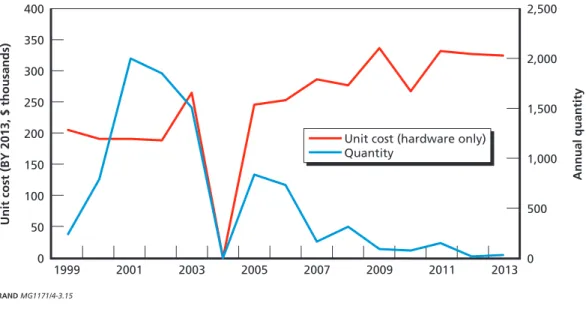
3.15. Unit Cost and Quantity, MTVR . . . .63
3.16. Unit Cost and Quantity, RAM . . . 66
3.17. Unit Cost and Quantity, Virginia-Class Submarine . . . .74
3.18. Unit Cost and Quantity, HIMARS . . . .75
3.19. C-27J Unit Cost and Quantity. . . .75
3.20. Unit Cost and Quantity, JDAM . . . .76
3.21. Unit Cost and Quantity, Standard Missile . . . 77
3.22. Unit Cost and Quantity, SM-2 . . . .78
3.23. Unit Cost and Quantity, SM-6 . . . .78
3.24. Unit Cost and Quantity, Light Utility Helicopter . . . .79
3.25. Unit Cost and Quantity, MQ-9 . . . 80
4.1. JPALS Tri-Service Structure . . . .95
xi
Tables
S.1. Framing Assumptions Identified for Five Acquisition Programs . . . .xx
2.1. Quantifying PM Tenure over the Past 40 Years . . . .11
2.2. Exclusions for Quantifying PM Tenure . . . .12
2.3. PM Tenure Periods and Percentage That Remained Open at Last Data Collection, by Year . . . .16
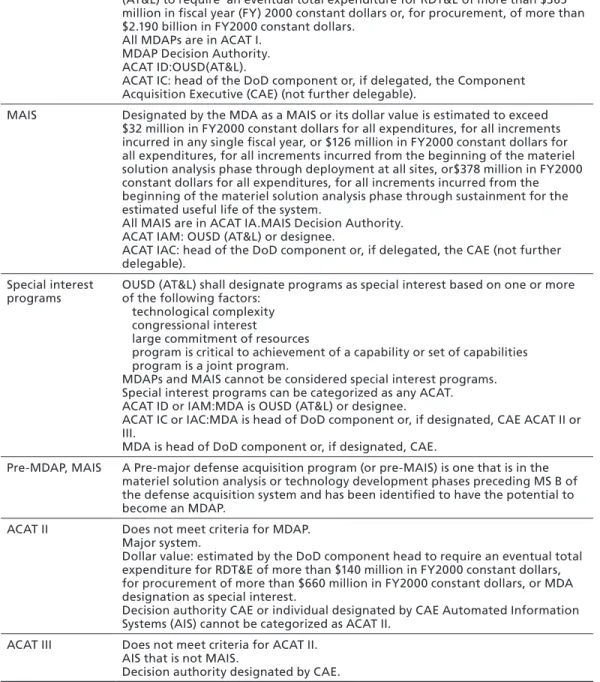
3.1. Program Types . . . 28
3.2. Program Type: By the Numbers . . . .29
3.3. ACAT II Programs Selected . . . 38
3.4. ACAT II Performance Assessments . . . .39
3.5. MDAP Program Selections . . . .72
3.6. Comparative Technological Complexity . . . .73
3.7. MDAP Program Assessments . . . .74
3.8. Comparison of MDAP and ACAT II Performance (FY2010–FY2011) . . . .82
4.1. Example Program Areas for Framing Assumptions . . . 87
4.2. APT Framing Assumptions . . . .89
4.3. JLTV Framing Assumptions . . . .91
4.4. JPALS Framing Assumptions . . . .93
4.5. LCS Modules Framing Assumptions . . . 97
4.6. Space Fence Framing Assumptions . . . 101
xiii
Summary
In light of continuing program cost growth and observations by the U.S. Government Accountability Office (GAO) placing defense acquisition on the high-risk target list, Congress has become particularly concerned about the execution of major defense acquisition programs. This concern, coupled with the reality of shrinking defense bud-gets, led Congress to enact statutory provisions that would focus greater policymaker attention on the oversight of major defense acquisition programs (MDAPs) and other large, costly programs.2 For example, the Weapon Systems Acquisition Reform Act of
2009 (WSARA) established a number of requirements affecting the operation of the Defense Acquisition System and the duties of the key officials who support it, includ-ing the requirement to establish a new organization in the Office of the Secretary of Defense (OSD) with the mandate to conduct and oversee performance assessments and root cause analyses for MDAPs.3
In March 2010, the director of the Office of Performance Assessments and Root Cause Analysis (PARCA) determined that he required support to execute his statutory responsibilities and turned to federally funded research and development centers and academia to help with the research and analysis of program execution status. RAND was among the institutions engaged to carry out root cause analyses, which it has com-pleted for six programs to date.4
In addition to the root cause analysis of Nunn-McCurdy breaches in specific acquisition programs, the PARCA director posed some additional questions to RAND to determine whether they affect the management of such programs or might provide a useful perspective in managing them. One pertained to program manager (PM) tenure, which was not a featured cause in the analyses RAND had previously performed. However, PARCA asked RAND to calculate current PM tenure using easily available sources, in part to determine whether tenure periods have increased since policy guid-ance designed to lengthen tenure was published in 2005 and 2007. A second question posed was whether existing decentralized systems used to track the cost growth and
2 Public Law 111-383, Ike Skelton Defense Authorization Act for Fiscal Year 2011, December 20, 2010. 3 Public Law 111-23, Weapon Systems Acquisition Reform Act of 2009, May 22, 2009.
xiv Management Perspectives on Root Cause Analyses of Nunn-McCurdy Breaches, Volume 4
performance of acquisition category (ACAT) II programs are sufficient, or whether additional centralized guidance and control from OSD are warranted. Additional oversight may provide transparency of ACAT II performance and contribute to more efficient acquisition processes. However, new reporting and control requirements will place additional burden on the defense agencies and military departments as well as on the Office of the Under Secretary of Defense for Acquisition, Technology, and Logis-tics (OUSD (AT&L) and the PARCA office, which is given the authority to issue guid-ance on ACAT II programs by WSARA and will bear responsibility for any additional oversight. The third question dealt with the management of cost and schedule risk and whether the identification of key assumptions, which we call framing assumptions, could be a useful risk management tool.
Program Manager Tenure
Program manager tenure is frequently mentioned in regard to improving acquisition outcomes and accountability. Policies have attempted to enforce longer program man-ager tenure over the past few decades, because it has been found in at least one study that longer program tenure is one of the building blocks for program success typically leading to lower cost growth.5 GAO reported in 2007 that PM tenure was 17.2 months
in the programs it reviewed.
PARCA asked RAND to calculate current PM tenure using easily available sources to provide an understanding of the length of PM tenure. Part of the motiva-tion behind this request was to see if tenure periods have been increasing since policy guidance designed to lengthen tenure was published in 2005 and 2007.
Results
To quantify PM tenure using current data, we extracted program point-of-contact data from Selected Acquisition Reports (SARs) from calendar years 1997 through 2011. Our final database, excluding incomplete tenure periods, contained 370 program man-ager tenure periods from 136 programs submitting SARs from 1997 to 2011 (both annual and quarterly).
Using the largest available dataset of program manager tenure periods that had been completed, we calculated that the average tenure for those program manager peri-ods was 33.7 months, which aligns more closely to the GAO statement in 2005 regard-ing PM tenure (no more than three to four years) rather than the November 2007 statement of 17.2 months. The results of this set of data are presented in Figure S.1. We also calculated tenure by eliminating several outliers in terms of tenure length, and we
5 1st Lt Christina F. Rusnock, Predicting Cost and Schedule Growth for Military and Civil Space Systems, thesis, Wright-Patterson Air Force Base, Ohio: Air Force Institute of Technology, AFIT/GRD/ENC/08M-01, March 2008, p. 99.
Summary xv
included only tenure periods that started between 1997 and 2008. The result was an average of 33.2 months, only slightly lower than the average from the larger dataset.
This initial data analysis did not help us answer the question regarding PM tenure periods after the 2005 and 2007 PM tenure policies, however, because there were too many tenure periods that had not been completed after 2008. We therefore also conducted a statistical analysis that includes open tenure periods. One challenge in introducing open tenure periods to this analysis is that these periods cause bias in the average, because the program managers have not finished their tenure in a particular program, which makes the overall average shorter than if they had. We applied a sta-tistical approach that calculates probable tenures for open periods. (See the discussion in Chapter Two for details).
Given this statistical treatment, the data provide some support that program managers remained in positions longer after the release of the revised guidelines in 2007. However, because of the small numbers of positions and the large number of open positions among those beginning in 2006 or later, the differences among groups are not statistically significant, and the observed differences could be chance occur-rences rather than real difference among the groups of positions.
Additional years of data for these positions and new positions starting in 2011 or later could help to establish if the differences among groups demonstrate persistent changes to practice after the release of the revised guidelines. But even if the differences Figure S.1
Average Number of Months PM Is Assigned to Program (full dataset)
aRAND calculated average of 370 program manager terms using 1997 to 2011 SAR data.
SOURCE: SARs (1997–2011). RAND MG1171/4-S.1 PMT tenur e (months) 120 100 80 60 40 20 2010 2008 2006 2004 2002 2000 1998 1996
Year PM assigned to program 1994 1992 1990 2012 140 0 48 months 17 months 33.7 monthsa November 2005 GAO report on PM tenure: 3 to 4 years is longest PMs stay May 2007 OUSD (AT&L) Krieg guidance (should stay 4 years);
November 2007 GAO reports PM tenure at 17 months June 2008 OUSD (AT&L) Young stresses PM agreements with 4 year stay or major milestone
xvi Management Perspectives on Root Cause Analyses of Nunn-McCurdy Breaches, Volume 4
proved to be persistent, they might not have been caused by the revised guidelines. We would need to rule out other potential sources of change before we could make that attribution. However, analysis of additional data would be a valuable first step to exploring fully the effects of the 2007 guideline change.
Observations
Our research leads us to the following observations:
The intent of policies to lengthen PM tenure may not have been achieved.
PM tenure has been reviewed/quantified periodically during the last 40 years. It is dif-ficult to assess whether these policies have been successful based on previous data and studies and current data.
no enforcement mechanism has been readily apparent over time. This could be because enforcement is limited because of the fundamental conflict that exists between what military officers need to do to be promoted and their tenure as program managers. Unless these two are aligned such that lengthy tenure in a program can be advantageous for promotion, then it appears unlikely that these tenure policies will consistently yield positive results.
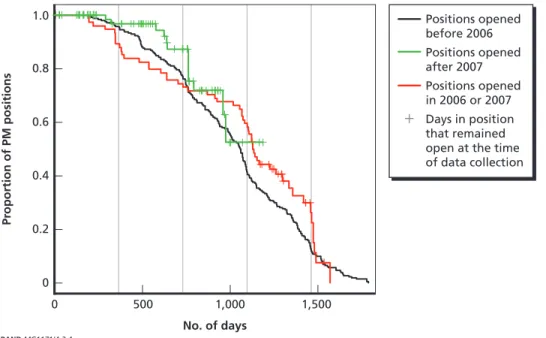
we cannot determine whether the policies of 2005 and 2007 have helped to lengthen PM tenure. A statistical analysis using open/closed tenure periods indicated that the estimate of the mean time in position for tenure periods starting after 2007 is biased, because of the large number of tenure periods that remain open at the last data collection. This creates an average that is lower than if all PM tenure periods in a sample have both a beginning and an ending. Using these same data, we found that PMs are less likely to stay as long in their tenure periods, meaning that 75–85 percent will likely reach two years, but only 50 percent will likely reach three years. PMs that started in tenure periods after the policy change are much more likely to remain in those periods longer than PMs starting in periods between 2005 and 2007.
We also found that adjusting for a variety of data issues (outliers, open periods, etc.) will give us more confidence in the data but will only minimally change the result of PM tenure during the last 14 years for MDAPs.
By taking into account closed program manager tenure periods, we found that PM tenure is on average 33 months. This result is much higher than GAO’s 2007 figure of 17.2 months for 39 programs but includes a larger sample size covering more years and does not include any open periods.
In conclusion, this analysis has been able to quantify PM tenure using current data but cannot definitely say whether recent policies regarding PM tenure have had any positive effect toward lengthening tenure over the last several years, because there are still too many open tenure periods during that time period.
Summary xvii
Performance of ACAT II Programs
Because additional reporting and control requirements come with costs, the decision to mandate additional guidelines for ACAT II programs may be warranted only if there are problems with the existing system that result in cost growth and schedule slippage and that can be dealt with by more centralized oversight. To determine if such perfor-mance issues do plague current ACAT II programs, we conducted two sets of analyses, one on a sample of ACAT II programs and one on a comparable set of MDAPs. Both sets include programs from across military departments and procurement program categories (e.g., aircraft, weapons, shipbuilding and conversion). We evaluate program performance focusing specifically on unit cost growth over the program’s life and insta-bility in annual quantity procured over time. Then, we compared the overall perfor-mance of the ACAT II and MDAP samples. This comparison leads to some general inferences about the performance of ACAT II programs under the current system of oversight, their performance relative to MDAPs, which are subject to more centralized monitoring and requirements, and the need for additional centralized reporting and control requirements.
For our analysis, we rely on budget information provided by the military depart-ments and included in the President’s official budget justifications as well as congressio-nal hearings and testimony to construct program narratives. The information includes summary information on cost and quantity for the past, current, and requested fiscal year. We used the information to select ten ACAT II programs and seven MDAP pro-grams, covering all procurement program categories across all three military depart-ments. We used the information to construct time series datasets of unit cost and annual quantity procured for each program in our sample by collecting and integrating annual data on cost and quantity provided in these budget documents.
Using the time series data on program cost and quantity, we graphed annualized unit cost against annualized quantity. We assessed these graphs looking at large revi-sions and sharp fluctuations in quantity and cost as well as slow growth over time. To explain cost growth or periods of apparently weak performance, we matched the nar-rative information on each program to the unit cost graphs.
Results
Although our sample size and composition prevent a meaningful statistical compari-son of cost growth, our qualitative assessment of program performance should have some general application to acquisition programs. Furthermore, our intention was to conduct broad assessment of the performance of the two program types to deter-mine whether ACAT II programs appear to perform, on average, better or worse than MDAPs, rather than to provide precise metrics on this performance or precise quanti-fication unit cost growth over time. We find that, overall, both ACAT II and MDAP programs perform reasonably well once they have entered production. In both cases,
xviii Management Perspectives on Root Cause Analyses of Nunn-McCurdy Breaches, Volume 4
programs experience some cost growth and some instability in unit cost and annual quantity procured over the period considered. However, in neither case do we observe crippling instability, runaway cost growth, or severe production delays. Of the ACAT II programs we consider, we find that four show no reason for concern, five have some issues of minor concern, and three warrant some more significant concerns. Across the board, ACAT II programs in our sample are more significantly affected by instability in unit cost than by actual cost growth. Instability is particularly likely early in the lives of new ACAT II programs, associated with development and modernizations. There also seems to be a clear relationship between unit cost and quantity. Much of the cost growth that we do observe occurs as a result of downward revisions in pro-curement quantities, perhaps stemming from changes in demand associated with the contingencies in Iraq and Afghanistan.
Programs in the MDAP sample can similarly be distributed across the three per-formance categories: no serious concerns, minor concerns, and some concerns. Our assessment places three programs in the first category, three in the second, and only one in the third. As was true for ACAT II programs, several MDAP programs show some cost growth over their program life (including projected out-years), and some have experienced periods of instability associated with modernizations and fluctua-tions in demand. However, several also show a decrease in average unit cost over the period considered.
Our assessment suggests that ACAT IIs reach a level of performance currently, without rigorous centralized oversight, that is at least equal to that of MDAPs operat-ing with centralized reportoperat-ing and control requirements and oversight.
Framing Assumptions
Defense acquisition programs routinely must estimate cost, schedule, and technologi-cal performance far in advance of actual work. And they must account for differ-ences in acquisition strategy and market conditions. As a result, programs must make assumptions about their programs and the conditions that might affect them. When these assumptions prove faulty, they can cause the program to miss important cost and schedule benchmarks, which can lead to breaches of Nunn-McCurdy thresholds. Key assumptions are called “framing” because of the influence they have on program per-formance. This exploratory research was done in an attempt to define framing assump-tions in a way that others can use them to assess and, potentially, control program risk and to explore the possibility of identifying them for a selected set of programs. Results
Summary xix
A framing assumption is any explicit or implicit assumption that is central in shaping cost, schedule, and/or performance expectations.
A framing assumption has the following five characteristics. First, the conse-quences of the assumption being wrong will significantly affect the program in a way that matters (e.g., significant cost growth or schedule slippage). In other words, the assumption is important to the success of the program. Second, the consequences of the assumption being wrong cannot be avoided. Third, the outcome or certainty with respect to the assumption is unknown (there is some risk). Fourth, the consequences of the assumption failing or holding true do not hinge on other events or chain of events. Finally, a framing assumption should typically distinguish a program from all other programs. An example of a framing assumption might be that “competitive prototyping will save 5 percent of the procurement cost.” This would be opposed to an assumption that held, “the contractor will perform well,” which would be common to all programs.
Researchers then examined five defense programs in various stages of maturity: • Advanced Pilot Training (APT) System
• Joint Light Tactical Vehicle
• Joint Precision Approach and Landing System • Littoral Combat Ship Modules
• Space Fence.
For each program, we attempted to identify framing assumptions in three cat-egories: technological, management incentives and program structures, and mission requirements. The results appear in Table S.1.
A similar exercise using the seven programs on which RAND conducted a root cause analysis yielded similar results, i.e., researchers were able to apply the definition to the programs and identify framing assumptions. Note, however, that identifying framing assumptions is typically much easier after the fact, and the reason for the root cause analyses was that the programs had already breached the Nunn-McCurdy thresholds.
The important finding of this research is that it is possible to define framing assumptions and apply them to programs that are in their early stages, which is when program managers would want to do this to help them manage program risk. The efficacy of using framing assumptions to manage risk remains to be seen. However, this research suggests some common characteristics for such assumptions. One is that the assumption needs to focus at a high level and not on the fine-grained detail of the program. Additionally, framing assumptions should be relatively few in number; about three to five seems right. Clearly, more assumptions could be identified, but the focus must fall on the ones that can truly affect the program’s outcomes. Assumptions need
xx M an ag em en t P er sp ec tiv es o n R o o t C au se A n aly se s o f N u n n -M cC u rd y B re ac h es , V o lu m e 4 Table S.1
Framing Assumptions Identified for Five Acquisition Programs
Program Technological Management Incentives and Program Structures Mission Requirements APT System Training aircraft (both airframe and avionics)
will be nondevelopmental. Potential customers will want to buy the APT with minimal modifications. Current training scenario is valid: Use of existing T-38 can be extended until 2020.
Simulators can be used instead of actual flight time (to save money). Joint Light
Tactical Vehicle
Incremental/open architecture will reduce risk and allow for more efficient upgrades.
Competitive prototyping will reduce risk and cost.
A Joint Army and Marine Corps program will save
money as requirements are compatible. The services have effectively assessed long-term and short-term needs.
Joint Precision Approach and Landing System
Incremental development will lower risk, while COTS/
GOTS hardware and software will lower costs. Navy is the best service to lead acquisition with the ordering of the increments driven by the Navy’s more demanding requirements.
System is suitable for all types of air vehicles.
Littoral Combat
Ship Modules Sea frames and modules can be independently developed: Spiral/incremental development will lower risk. Can successfully test modules on other ship platforms.
New capabilities can be added easily.
New, open business model approach allows for independent development of sea
frames and modules:
Leveraging PARMs and other programs. Benefits of open architecture/commercial practices.
Government suited to act as system integrator.
RDA can be program focal point (4 PMs, 3 PEOs, 2 SYSCOMs).
The Navy is willing to drop requirements (in spiral context) to keep to schedule.
Space Fence Capability is achievable despite some immature technologies at the outset.
Can scale technology to track order of magnitude greater number of objects (radar components, software interoperability).
Competitive prototyping reduces risk and cost.
Block approach is a more effective acquisition strategy.
The legal, diplomatic, and political issues with site decisions can be resolved easily.
Minimal manpower required to operate and support system.
Two instead of three sites will be sufficient to meet operational goals.
Summary xxi
to be revisited as the program moves through the acquisition process, because they can change or even be supplanted by other assumptions. Implicit assumptions are more dif-ficult to identify than the explicit ones.
As mentioned, the utility of framing assumptions as a risk management tech-nique remains to be demonstrated. A useful extension of this research would be to examine the assumptions of a broader range of programs to identify those that might be problematic.
xxiii
Acknowledgments
We would like to thank former PARCA deputy director David Nicholls, who provided us with rich discussion and guidance on these topics. Other PARCA officials who were immensely helpful include Gary Bliss, Larry Gwozdz, and Charles Hines. We also appreciate the invaluable insights of Mark Husband, who, when we interviewed him, was at the Defense Acquisition University.
We also thank James Kallimani and Rena Rudavsky for their invaluable assis-tance in mining prior root cause analysis reports to identify potential issues for the work on framing assumptions.
And we deeply appreciate the efforts of director Cynthia Cook and associate director Paul DeLuca of the RAND Acquisition and Technology Policy Center, who provided insightful comments that helped improve this report.
We received thoughtful reviews from our RAND colleague Jack Graser and Claude Bolton. Their careful reading of the report and their many suggestions made this a much better document.
Finally, we thank Lauren Skrabala, Maria Falvo, and Jennifer Miller for their editing and superb administrative support for this project.
xxv
Abbreviations
AAE Army Acquisition Executive
ABV assault breacher vehicle
ABP assumption-based planning
ACAT acquisition category
ACP Army Cost Position
ACTD Advanced Concept Technology Demonstration
ADM Acquisition Decision Memorandum
AFRB Air Force Review Board
AFSSS VHF Air Force Space Surveillance System Very High Frequency
AME aviation mission equipment
AoA Analysis of Alternatives
APB Acquisition Program Baseline
APT Advanced Pilot Training System APUC average procurement unit cost
ASA (ALT) Assistant Secretary of the Army (Acquisition, Logistics, and Technology)
ASA (FMC) Assistant Secretary of the Army (Financial Management and Comptroller
ASA (I&E) Assistant Secretary of the Army (Installations and Environment) ASA (M&RA) Assistant Secretary of the Army (Manpower and Reserve Affairs) ASARC Army Systems Acquisition Review Council
xxvi Management Perspectives on Root Cause Analyses of Nunn-McCurdy Breaches, Volume 4
ASN (RDA) Assistant Secretary of the Navy (Research, Development & Acquisition)
ASP Acquisition Strategy Panel ASR Acquisition Strategy Review
ATC Air Traffic Control
BCT Brigade Combat Team
BY base year
CAE Component Acquisition Executive
CAPE Cost Assessment and Program Evaluation
CCD charge-coupled device
CDD Capability Development Document
CIO chief information officer
CMC Commandant of the Marine Corps
CNO Chief Naval Officer
COCOM combatant commander
COTS commercial off-the-shelf
CY calendar year
DAB Defense Acquisition Board
DAES Defense Acquisition Executive Summary
DAMIR Defense Acquisition Management Information Retrieval DASA (ASM) Deputy for Acquisition and Systems Management
DCS Deputy Chief of Staff
DDL digital data link
DoD U.S. Department of Defense
DoDD Department of Defense Directive DoDI Department of Defense Instruction
DDR&E Director of Defense Research and Engineering
DSB Defense Science Board
Abbreviations xxvii
DUSA (T&E) Deputy Under Secretary of the Army (Test and Evaluation)
ELSG Electronic Systems Group
ELSS Electronic Systems Squadron
ELSW Electronic Systems Wing
EMD engineering, manufacturing, and development
ER extended range
ERP Enterprise Resource Planning
FCS Future Combat System
FRP full-rate production
FY fiscal year
FYDP Future Years Defense Program
GAO U.S. Government Accountability Office
GOTS government off-the-shelf
GWOT Global War on Terror
HAC House Appropriations Committee
HASC House Armed Services Committee
HBCT Heavy Brigade Combat Team
HIMARS High Mobility Artillery Rocket System ICD Initial Capabilities Document
ICE independent cost estimate
IIR imaging infrared
ILCM Integrated Life Cycle Management
IPT Integrated Product Team
IR infrared
ISP Information Support Plan; also Initial Spares Package JDAM joint direct attack munition
JLTV joint light tactical vehicle
JPALS joint precision approach and landing system JROC Joint Requirements Oversight Council
xxviii Management Perspectives on Root Cause Analyses of Nunn-McCurdy Breaches, Volume 4
JSF Joint Strike Fighter
JSOF Joint Special Operations Force JTRS Joint Tactical Radio System
KPP key performance parameter
KSA key system attribute
LAIRCM large aircraft infrared countermeasure
LCAC SLEP Landing Craft Air Cushion Service Life Extension Program
LCMP Life Cycle Management Plan
LCRRPR low-cost reduced-range practice rocket
LCS littoral combat ship
LRIP low-rate initial production
LSI lead system integrator
LUH light utility helicopter
MCATTD Marine Corps Advanced Technology Transition Demonstrator
MDA Milestone Decision Authority
MDAP major defense acquisition program
MDR milestone decision review
MLRS RRPR Multiple Launch Rocket System Reduced-Range Practice Rocket
MOA memorandum of agreement
MP mission package
MS milestone
MTVR medium tactical vehicle replacement NATO North Atlantic Treaty Organization NDAA National Defense Authorization Act
NDI nondevelopmental items
OCO Overseas Contingency Operation
OEF Operation Enduring Freedom
Abbreviations xxix
OIPT overarching integrated process team OPEVAL operational evaluation
ORDALT ordnance alteration
OSD Office of the Secretary of Defense
OTS off-the-shelf
OUSD (AT&L) Office of the Under Secretary of Defense for Acquisition, Technology, and Logistics
PA performance assessment
PARCA Performance Assessments and Root Cause Analysis PARM participating acquisition resource manager
PAUC program acquisition unit cost
PDR Preliminary Design Review
PE program element
PEO Program Executive Office
PM program manager
PMA Program Management Activity
PMS Program Manager, Ship
PR program review
RAM rolling airframe missile
RCA root cause analysis
RDA research, development, and acquisition RDT&E research, development, test, and evaluation
RF radio frequency
RMP Risk Management Plan
ROS reduced operational status
SAC Senate Appropriations Committee
SAE service acquisition executive
SAR Selected Acquisition Report
xxx Management Perspectives on Root Cause Analyses of Nunn-McCurdy Breaches, Volume 4
SDS system design specification
SE systems engineering
SEP Systems Engineering Plan
SFAE-AV-A9 U.S. Army Program Manager for Aviation Systems SLAMRAAM surface-launched medium-range air-to-air missile SLEP Service Life Extension Program
STRC Standards in Training Commission SUAS small unmanned aircraft system
SYSCOM Systems Command
TEMP Test and Evaluation Master Plan
TRA technology readiness area
UAV unmanned aerial vehicle
UAS unmanned aerial system
UCR Unit Cost Report
USA U.S. Army
USAF U.S. Air Force
USN U.S. Navy
VCSA Vice Chief of Staff of the Army
VTUAV vertical takeoff and landing tactical unmanned aerial vehicle W&TCV weapons and tracked combat vehicles
WGS wideband global satellite
WSARA Weapon Systems Acquisition Reform Act
1
ChAPTER ONE
Introduction
In addition to doing root cause analyses on major defense acquisition programs (MDAPs) that incurred Nunn-McCurdy breaches, the Director of the Office of Per-formance Assessments and Root Cause Analyses (PARCA) asked RAND to explore some additional issues to determine whether they might affect the management of such programs. This report presents research conducted on three relevant topics: the tenure of program managers, the need for Department of Defense (DoD)–level oversight on Acquisition Category (ACAT) II programs, and the potential use of framing assump-tions as a way to manage program risk. The issues raised by these topics are discussed briefly below.
Tenure Research
In November 2007, the U.S. Government Accountability Office (GAO) released a report that observed the following regarding program manager (PM) tenure:
while DoD policy provides for program managers of major defense acquisition programs to serve as close to 4-year tenures as practicable, many serve for only 2 years. . . . our work has shown that rather than lengthy assignment periods between key milestones as suggested by best practices, many of the programs we have reviewed had multiple program managers within the same milestone. . . . analysis for this review showed that for 39 major acquisition programs started since March 2001, the average time in development was about 37 months. The average tenure for program managers on those programs during that time was about 17.2 months—less than half of what is prescribed by DoD policy.1
PM tenure has long been a topic of interest to DoD, which has established poli-cies designed to increase that tenure, most recently in 2005 and 2007. The Office of the Secretary of Defense (OSD) asked RAND to conduct research on the tenure of PMs
1 U.S. Government Accountability Office, Defense Acquisitions: Department of Defense Actions on Program Man-ager Empowerment and Accountability, GAO-08-62R, Washington, D.C., November 9, 2007a, p. 8.
2 Management Perspectives on Root Cause Analyses of Nunn-McCurdy Breaches, Volume 4
in MDAPs. The policy question addressed is whether PM tenure has lengthened since the 2005 and 2007 policy guidance that attempted to extend it.2 OSD PARCA is also
interested in any historical and recent outcomes in PM tenure in MDAPs. In addition, it is seeking an alternative to GAO’s 2007 analysis of PM tenure. Reviewing data after 2007 is one way to identify whether PM tenure policies have been able to increase the tenures of PMs as intended.
ACAT II Programs
Cost growth in defense acquisition and procurement programs has long been an issue of concern to policymakers. The size of these programs, their often long development time lines and significant costs, and the need for repair and modernization of equip-ment create significant risk for unexpected costs that exceed expectations and slips in schedule that delay the delivery of important systems. DoD also often depends on contractors to produce and supply procured equipment and technology, raising con-cerns about contractor incentives and competition as well as oversight and monitoring. There have been many legislative attempts to control cost growth and development delays. These have achieved some success but have failed to either fully control unex-pected increases in program costs or eliminate long production delays. In addition, existing requirements cover primarily the largest acquisition programs—MDAPs— leaving smaller and non-MDAP programs without consistent oversight at the OSD level. Oversight for these smaller programs occurs only at the military department level.3 The motivating question driving this report is whether existing decentralized
systems used to track cost growth and performance of ACAT IIs are sufficient or whether additional centralized guidance is warranted.
Framing Assumptions
Defense acquisition programs routinely face the challenge of estimating cost, sched-ule, and technological performance far in advance of actual work. They must also account for differences in acquisition strategy and market conditions. As a result, pro-grams must make a number of assumptions about their propro-grams and the conditions
2 The guidance is presented in the following DoD documents: U.S. Department of Defense Instruction (DoDI) 5000.66, Operation of the Defense Acquisition, Technology, and Logistics Workforce Education, Training, and Career Development Program, December 21, 2005; and Kenneth J. Krieg, Under Secretary of Defense for Acquisition, Technology, and Logistics, “Program Management Tenure and Accountability,” memorandum, Washington, D.C., May 25, 2007.
Introduction 3
that might affect them. Although a necessity, assumptions expose the program to cost growth and schedule delays.
When assumptions prove faulty, they can cause the program to miss important cost and schedule benchmarks. More important, they can cause programs to breach Nunn-McCurdy thresholds, which can lead to a program’s termination. Key assump-tions are called “framing” because they so influence the program performance expec-tations that, when faulty, they lead to significant cost growth, performance shortfalls, schedule slips, or any combination of these three undesirable outcomes.
This exploratory research was done for the PARCA office in an attempt to define framing assumptions in a way that others can use them to assess and, potentially, con-trol program risk and to explore the possibility of identifying them for a selected set of programs.
Organization of This Report
This report is organized as follows. Chapter Two explores the topic of PM tenure over the past 40 years. The chapter specifically looks at policies and recommendations, along with how PM tenure has been quantified in the literature. It next provides our analysis of PM tenure using data available since 1997. The analysis initially focuses on data presented in the Selected Acquisition Reports (SARs) for PM tenure periods in which PMs have completed their tenure. It then provides a short statistical analysis that incorporates more recent data on PMs who have not completed their tenure. The goal of the latter analysis was to reach conclusions regarding PM tenure length and the 2005 and 2007 policies that attempted to lengthen tenure. The final part of the chapter presents our conclusions.
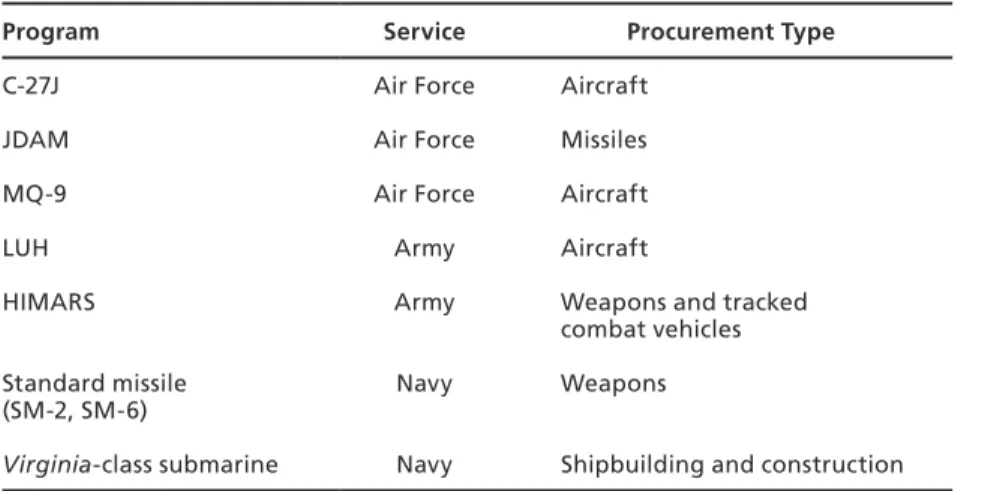
Chapter Three deals with the topic of oversight for ACAT II programs. It describes the existing oversight policies and the practices in the military services. It then com-pares 12 programs (when treating Hellfire as a separate program), MDAP program performance with that of ACAT II, describes the factors that contribute to success and failure, and lays out three courses of action that the PARCA office could pursue con-cerning the issuance of guidance.
Chapter Four explores the topic of framing assumptions and their possible use as a way to manage risk in acquisition programs. It begins by defining framing assump-tions and listing their salient characteristics. It then tests the feasibility of identifying framing assumptions by examining five DoD acquisition programs. It also takes a retrospective look at the programs for which the RAND National Defense Research Institute has done root cause analyses. It concludes by providing some overarching observations.
5
ChAPTER TwO
Program Manager Tenure
As outlined in Chapter One, PM tenure has long been a topic of interest to DoD, which has established policies designed to increase that tenure, most recently in 2005 and 2007.
Additional exploration of other research quantifying PM tenure since 2007 did not yield any relevant answers to the research question of whether PM tenure has lengthened as a result of these policies. However, a look back over the past 40 years revealed that PM tenure is not a new policy issue, and it has been measured sev-eral times in sample sets of programs, by individual service, and also by all services collectively.
Research Approach
PARCA requested that RAND calculate current PM tenure using easily available sources to determine the evidence base since GAO’s 2007 assessment. Part of the moti-vation behind the request was to determine whether tenure periods have been increas-ing since the 2005 and 2007 guidance as a way to better understand the reasons for program success or failure. The RAND team completed a literature review to identify previously existing PM tenure policies and to track how other studies have quantified PM tenure.
To quantify PM tenure using current data, we extracted program point-of- contact data from the SARs for 1997–2011. This method was advantageous because the data were standardized in one location and were easily extracted from OSD’s Defense Acquisition Management Information Retrieval (DAMIR) system. In addi-tion, given that that the available data went back to 1997, there was sufficient informa-tion on a variety of programs. We chose to use data from MDAPs that had multiple PMs, because we could define the tenure of a particular PM as the date that the PM was assigned to the date that the subsequent PM was assigned. This approach provided distinct starting and ending points for each PM in the data set. For PMs with open tenure periods (that is, the period of service by a program’s current PM), we conducted
6 Management Perspectives on Root Cause Analyses of Nunn-McCurdy Breaches, Volume 4
a statistical analysis to determine the effects of open tenure periods, particularly in the most recent years.
Data Shortcomings
The data used for the analysis had several notable shortcomings. Some PM tenure peri-ods did not have an end date, either because the PMs were still with the program or because the program was no longer submitting SARs. Finding end dates for programs when this information was not included in the data would have required a significant amount of research beyond of the scope of this study, so we excluded these data. There were also several raw data errors in which the start date for one PM was announced but the following chronological SAR listed a different PM with a start date before that of the previous PM. This caused negative numbers in tenure periods. Thus, we excluded these data also. Some PMs managed several programs, so we had to count “tenure peri-ods” rather than PMs. In addition, the data pulled from the SARs do not differentiate between acting and permanent PMs, so very short periods may indicate changeover between PMs, in which the deputy PM is acting in the PM role temporarily. Shorter periods may also indicate pre–Milestone (MS) B programs, and longer periods could reflect data reporting issues between subprograms.
The Past 40 Years
Over the past 40 years, various policies have been implemented in an attempt to increase PM tenure in defense programs. Several studies have also attempted to quan-tify the tenure of PMs. For example, GAO, the Defense Science Board (DSB), the RAND Corporation, and the Institute for Defense Analyses have all done work quan-tifying PM tenure.
Policies and Recommendations
Recommendations and policy actions have appeared in a variety of sources since the early 1970s. Deputy Secretary of Defense David Packard addressed PM tenure in his speeches and memorandums from the early 1970s. According to Dews et al., one major policy element of Packard’s initiatives was to “reduce the turnover rate of program managers so that they have longer job tenure.”1 Likewise, in 1973, a DSB report on
reducing the costs of defense system acquisition addressed the role of PM tenure by pointing out that “the program manager’s tenure may be abbreviated due to rotational
1 Edmund Dews, Giles K. Smith, Allen Barbour, Elwyn Harris, and M. Hesse, Acquisition Policy Effectiveness: Department of Defense Experience in the 1970s, Santa Monica, Calif.: RAND Corporation, R-2516-DR&E, 1979, p. 2.
Program Manager Tenure 7
tours of duty that stress command responsibilities, rather than management achieve-ment, for recognition and advancement.”2 As a consequence, the DSB recommended
that “the tenure of key DoD program people be increased, at least to coincide with the beginning and end of major phases of a program.”3 The DSB recommendation was
fol-lowed up shortly thereafter by DoD Directive (DoDD) 5000.23 in November 1974, which looked at “System Acquisition Management Careers.” Though not as specific as the DSB recommendation, the policy stated that “the tenure of program manager assignments should be sufficient to ensure management continuity.”4
About ten years after the 1973 DSB study, the board surveyed the services and contractors regarding selection, training, career patterns, and the length of assignment of PMs. It concluded that “management continuity during the start-up of production was critical and suggested that the milestone provision be modified” based on data indicating that PM turnover is much more likely during the early phases of a program.5
The panel also concluded that “tour lengths for military program managers appear too short,”6 adding that program management should be improved by “stabilizing the
tours of military program managers. Extend tours beyond the current practice of about 30 months.”7
The Defense Acquisition Workforce Improvement Act was enacted in November 1990. Two years later, in 1992, GAO reviewed some of the act’s provisions regarding PMs. Particularly applicable to our study were the findings concerning tenure require-ments for PMs:
Effective October 1, 1991, the act required that newly appointed program manag-ers of major and significant nonmajor defense acquisition programs . . . agree to a tenure requirement that they remain in their position until the completion of the first major milestone closest in time to the date they had served 4 years, and sign a written agreement to remain on active duty or in federal service, as applicable, during this period.8
2 Office of the Director of Defense Research and Engineering, Defense Science Board Task Force, Reducing Costs of Defense Systems Acquisition: Design-to-Cost, Commercial Practice vs. Department of Defense Practice, Wash-ington, D.C.: Defense Science Board, AD-762-487, March 15, 1973, p. xvi.
3 Office of the Director of Defense Research and Engineering, Defense Science Board Task Force, 1973, p. 29. 4 U.S. Department of Defense Directive 5000.23, System Acquisition Management Careers, November 26, 1974. 5 Quoted in U.S. General Accounting Office, DoD Acquisition: Strengthening Capabilities of Key Personnel in Systems Acquisition, Washington, D.C., GAO/NSIAD-86-45, May 1986a, p. 75.
6 Defense Science Board, Report of the Defense Science Board Task Force on Transition of Weapons Systems from Development to Production, Washington, D.C.: Office of the Under Secretary of Defense, Research and Engineer-ing August 1983, p. 47.
7 Defense Science Board, 1983, p. 52.
8 U.S. General Accounting Office, Defense Management: Implementation of the Defense Acquisition Workforce Improvement Act, Washington, D.C., GAO/NSIAD-92-97, January 1992, pp. 2–2.
8 Management Perspectives on Root Cause Analyses of Nunn-McCurdy Breaches, Volume 4
The above tenure agreements were in place for nearly 15 years before Under Sec-retary of Defense for Acquisition, Technology, and Logistics Kenneth Krieg reiter-ated the importance of acquisition position tenure requirements for PMs working on MDAPs and major automated information systems (MAIS) in DoDI 5000.66. The new policy stated that a PM should have a tenure period around the “milestone closest to 4 years or as tailored by [Component Acquisition Executive] based on unique pro-gram requirements. [PMs should also] execute a written tenure agreement.”9
Following this guidance was Section 853 of the John Warner National Defense Authorization Act for Fiscal Year 2007.10 The law, which passed in September 2006,
directed “the Department [of Defense] to revise guidance on qualifications, resources, responsibilities, tenure, and accountability of program managers before and after Mile-stone B.”11 In response to the act, Under Secretary Krieg issued a memorandum on
May 25, 2007, stating that, “in accordance with 10 U.S.C. 1734, the tenure period for program managers of major defense acquisition programs shall correspond to the major milestone closest to 4 years, subject to an exceptional circumstances waiver.” Tenure agreements should be used in Acquisition Category I and II programs.12
In 2008, Krieg’s successor, John Young, again stressed the importance of PM per-formance and of having a strategy in place to ensure longer tenures. He testified before Congress regarding the initiatives in place as of 2008:
I have put in place a comprehensive strategy to address improving the performance of program managers. Key to this are program manager tenure agreements for Acquisition Category (ACAT) I and II programs, which are our largest programs. My expectation is that tenure agreements should correspond to a major milestone and last approximately 4 years. Another fundamental piece I have established is Program Management Agreements—a contract between the program manager and the acquisition and requirements/resource officials—to ensure a common basis for understanding and accountability; that plans are fully resourced and realistically achievable; and that effective transparent communication takes place throughout the acquisition process.13
9 U.S. Department of Defense Instruction 5000.66, 2005, p. 21.
10 Public Law 109-364, John Warner National Defense Authorization Act for Fiscal Year 2007, October 17, 2006.
11 See Office of the Under Secretary of Defense for Acquisition, Technology, and Logistics, Report to Congress on Program Manager Empowerment and Accountability, Washington, D.C.: U.S. Department of Defense, August 2007, p. 1–2.
12 Krieg, 2007, p. 1.
13 John J. Young, Under Secretary of Defense, Acquisition, Technology, and Logistics, testimony before the U.S. Senate Committee on Armed Services, Washington, D.C., June 3, 2008, pp. 3–4
Program Manager Tenure 9
These examples of policy and study recommendations illustrate the long-standing view that PM tenure should be actively monitored to ensure leadership stability in acquisition programs. The repetition of themes over the past 40 years also illustrates the difficulty of implementing and enforcing these policies. The next section presents some quantitative data from the same period to provide a better understanding of PM tenure over time.
Quantifying Program Manager Tenure over the Past 40 Years
In October 1979, RAND published a report that attempted to quantify PM tenure using data from the military services. The authors found that PM tenure averaged two and a half to three years and that there had been an increasing trend in tenure since the mid-1960s:
By the end of the 1960s it had become apparent that acquisition programs often suffered from too rapid a turnover of program managers. Program duration some-times exceeded 10 years, and program managers frequently served less than 2 years on the job. . . . In the period 1961–1965, for example, the average tenure for all pro-gram managers was 18 months; for Army propro-gram managers, the average was only 12 months. . . . The data on program manager tenures from 1961 to 1978 indicate a steady increase in tenure from an all-Service average of about 18 months in the 5 years centered on 1963 to about 32 months in the 5 years centered on 1976. . . . The steady upward trend in the 5-year moving averages that was already established in the 1960s has continued in the 1970s. Since 1969, the 5-year moving average has lengthened from 26 months to 32 months, an increase of nearly one-fourth. . . . But, as in so many instances, a direct causal connection between these elements of policy and practice cannot be established.14
The RAND research was followed by a DSB study in 1983 that surveyed the services and contractors regarding selection, training, career patterns, and length of assignment among PMs. The survey results indicated that the average tour length for military PMs had improved but still averaged less than three years. The study also pointed out the drastic difference in PM tenure between government and industry, stating that “industry program managers have tours of up to 10 years with four to six years being quite common.”15 The panel concluded that PM tenure was too short and
should be extended “beyond the current practice of about 30 months.”16
In the mid-1980s, GAO also released a report addressing PM tenure, and, as in the 1979 RAND study, tried to provide some quantitative data. GAO used case-study programs but also tried to look at tenure in the early and later phases of programs:
14 Dews et al., 1979, pp. 15–16. 15 Defense Science Board, 1983, p. 46. 16 Defense Science Board, 1983, p. 52.
10 Management Perspectives on Root Cause Analyses of Nunn-McCurdy Breaches, Volume 4
Programs experienced considerable turnover in program managers during their earliest phases, particularly in the Army and the Air Force. In our 17 case study programs, the tenure of program managers who had been replaced averaged 9 months for 3 Army programs, 16 months for 6 Air Force programs, and 39 months for 6 Navy programs. As the programs progress, tenure tends to increase. Those currently serving as program managers have been in their positions (as of August 1986) for an average of 26 months for Army programs, 31 months for Air Force programs, and 26 months for Navy programs. Tenure of program managers replaced from January 1982 to August 1984—for all programs and phases—was longest in the Navy. The average tenure of Navy program managers was 3.9 years, compared with 3.1 years for Army program managers and only 1.9 years for Air Force program managers.17
In July 1986, GAO released more figures on program manager tenure. At that point, GAO reported, “The program managers averaged approximately 27 months experience on their current program as either the program manager or deputy program manager. The deputies had approximately 30 months of experience on their current program as either the deputy or the program manager.”18
Continuing the trend to quantify program manager tenure, the Institute for Defense Analyses released a study in November 1988 stating that, in the Army “the average tenure of departing program managers was 37.8 months through 1987,” and, in the Navy, “about 23 months at the end of 1985.” It added, “Tenure at departure is not reported. However, Navy sources say that most program managers stay for almost a full four years.”19
In October 2007, the Commission on Army Acquisition and Program Manage-ment in Expeditionary Operations used a prior 2001 Center for Naval Analyses study to characterize PM tenure in the Army. The study rated PM tenure as “red” in both the Army and Air Force but “yellow” in the Navy and Marine Corps. The rationale for the Army rating was that “more than half of sampled PMs served less than 3 years.”20
Some of the most recent quantifications of PM tenure were done by GAO. In 2005, GAO stated that PM tenure was longer but that most PMs still left after three
17 U.S. General Accounting Office, 1986a, pp. 79–80.
18 U.S. General Accounting Office, Acquisition: DoD’s Defense Acquisition Improvement Program: A Status Report, Washington, D.C., GAO/NSIAD-86-148, July 1986b, p. 11.
19 David R. Graham, Barbara A. Bicksler, Robert P. Hilton, Marshall Hoyler, Herschel Kanter, Walter M. Locke, George H. Sylvester, and John R. Transue, Defense Acquisition: Observations Two Years After the Packard Commission, Institute for Defense Analyses, Volume I: Main Report, IDA Report R-347, Arlington, Va.: Institute for Defense Analyses, November 1988, pp. VI-4.
20 Commission on Army Acquisition and Program Management in Expeditionary Operations, Urgent Reform Required: Army Expeditionary Contracting, Washington, D.C., October 31, 2007, p. 18.
Program Manager Tenure 11
or four years.21 In November 2007, it released more data on PM tenure, finding
signifi-cantly shorter averages. In this second study, GAO analyzed 39 MDAPs that started after March 2001. It calculated the average PM tenure for these programs at only 17.2 months.22
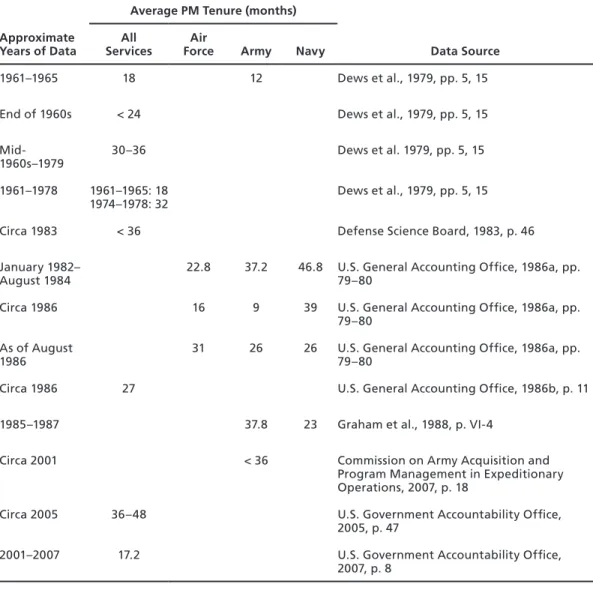
Table 2.1 summarizes the data that have been presented on program manager tenure in the literature over the last 40 years. These data indicate that average PM
21 U.S. Government Accountability Office, Best Practices: Better Support of Weapon System Program Managers Needed to Improve Outcomes, Washington, D.C., GAO-06-110, November 2005, p. 47.
22 U.S. Government Accountability Office, 2005, p. 8. Table 2.1
Quantifying PM Tenure over the Past 40 Years
Approximate Years of Data
Average PM Tenure (months)
Data Source All
Services ForceAir Army Navy
1961–1965 18 12 Dews et al., 1979, pp. 5, 15 End of 1960s < 24 Dews et al., 1979, pp. 5, 15
Mid-1960s–1979 30–36 Dews et al. 1979, pp. 5, 15 1961–1978 1961–1965: 18
1974–1978: 32 Dews et al., 1979, pp. 5, 15 Circa 1983 < 36 Defense Science Board, 1983, p. 46 January 1982–
August 1984 22.8 37.2 46.8 U.S. General Accounting Office, 1986a, pp. 79–80 Circa 1986 16 9 39 U.S. General Accounting Office, 1986a, pp.
79–80 As of August
1986 31 26 26 U.S. General Accounting Office, 1986a, pp. 79–80 Circa 1986 27 U.S. General Accounting Office, 1986b, p. 11 1985–1987 37.8 23 Graham et al., 1988, p. VI-4
Circa 2001 < 36 Commission on Army Acquisition and Program Management in Expeditionary Operations, 2007, p. 18
Circa 2005 36–48 U.S. Government Accountability Office, 2005, p. 47
2001–2007 17.2 U.S. Government Accountability Office, 2007, p. 8