Article
Uniting sport and heritage: An evaluation of the Our
Sporting Life exhibition programme
Reilly, Justine Nicola, Clayton, Jane and Hughson, John Ewing
Available at http://clok.uclan.ac.uk/13574/
Reilly, Justine Nicola, Clayton, Jane and Hughson, John Ewing ORCID: 0000000270304806 (2014) Uniting sport and heritage: An evaluation of the Our Sporting Life exhibition programme. Cultural Trends, 23 (1). pp. 4255. ISSN 09548963
It is advisable to refer to the publisher’s version if you intend to cite from the work. http://dx.doi.org/10.1080/09548963.2014.862000
For more information about UCLan’s research in this area go to
http://www.uclan.ac.uk/researchgroups/ and search for <name of research Group>. For information about Research generally at UCLan please go to
http://www.uclan.ac.uk/research/
All outputs in CLoK are protected by Intellectual Property Rights law, including
Copyright law. Copyright, IPR and Moral Rights for the works on this site are retained by the individual authors and/or other copyright owners. Terms and conditions for use of this material are defined in the http://clok.uclan.ac.uk/policies/
CLoK
Central Lancashire online Knowledge
www.clok.uclan.ac.uk
1
Uniting sport and heritage: an evaluation of the Our Sporting Life
exhibition programme
Justine Reilly, Jane Clayton & John Hughson
International Football Institute, University of Central Lancashire, Preston, United Kingdom.
University of Central Lancashire, C/O SSTO Administration Office, Greenbank Building, Preston, Lancashire, PR1 2HE, United Kingdom. Tel: 01772 895715. Email:
Justine Reilly is currently researching an AHRC collaborative doctoral award examining the role and value of sport in museums. She works as a freelance cultural consultant and is an assessor for the Associateship of the Museums Association (AMA).
Justine began her career at the BBC and Granada Television before joining the museums sector. Holding posts at National Museums, Liverpool and the National Media Museum, Bradford, Justine developed a passion for how museums can support learning and engage new audiences. She headed the BBC’s outreach programme in Yorkshire, before joining the Museums, Libraries, and Archives Council as a Regional Learning Manager.
Dr Jane Clayton is a postdoctoral research assistant at the International Football Institute, University of Central Lancashire. With a BA (Hons) in History and Politics and an MA in Journalism Studies, she recently completed a PhD at the University of Liverpool on arts policy, community arts practices and culture-led regeneration in Liverpool from 1985-2010.
Jane is currently working with the National Football Museum, Manchester, to develop research on museums of popular culture and community engagement. She is coordinating the Football 150 conference to be held in September 2013, and providing historical research for the FA during their 150th
anniversary year.
John Hughson is Professor of Sport and Cultural Studies at the University of Central Lancashire and is research partner to the National Football Museum of England. His most recent book is The Making of Sporting Cultures (2009, pbk ed. 2012).
He was guest editor of a special issue of the International Journal of Cultural Policy (14:4, 2008) on the emerging significance of sport within cultural and urban policy programs. His research on the role of sport within the unsuccessful bid by Newcastle/Gateshead to become the European City of Culture is outlined in the book The Uses of Sport (2005).
2
Uniting sport and heritage: an evaluation of the Our Sporting Life exhibition
programme
2012 provided an opportunity to celebrate sporting history during the year when London staged that most historical of international sporting events, the Olympic Games.
However, the Department for Culture, Media, and Sport, and the London Organising Committee of the Olympic Games (LOCOG) made no reference to sporting history within official documentation, and there was no mention of sport in the Cultural Olympiad programme. This paper aims to understand the role of the Sports Heritage Network in exploring England’s sporting heritage, despite being excluded from the official planning of the London 2012 Olympic Games. This affiliation of museums and archives with an interest in England’s sporting past, recognised the potential of the 2012 Olympic Games and established a community exhibition programme, Our Sporting Life, which aligned with LOCOG’s aims and objectives. This paper evaluates the outputs and outcomes of Our Sporting Life, and aims to understand why it was not supported financially or integrated into the official Cultural Olympiad programme. The data collection for Our Sporting Life is analysed and critiqued, and the impact of the programme is considered using the Generic Learning Outcomes and the Generic Social Outcomes frameworks. Our Sporting Life delivered over 1 hundred exhibitions and reached over 1 million people, with outcomes that included increasing knowledge and understanding, and strengthening public life. It provides an off-the-shelf methodology for future major sporting events and, as such, its omission from the London 2012 Cultural Olympiad can be regarded a lost opportunity.
Keywords:sport; museum; Olympic Games; Cultural Olympiad; Generic Learning Outcomes; Generic Social Outcomes
Introduction
In the same year that London was awarded the 2012 Olympic Games, Wood (2005, p. 307) speculated about “how timely and powerful a partnership would be if sport and heritage could be tackled together,” and in the years leading to 2012, an unprecedented number of museums addressed the theme of sport through a range of temporary exhibitions. This appeared to mark a shift in the museum sector which has historically been unsure of the validity of sport as a topic. Sport has traditionally been seen as ‘low’, rather than ‘high’, culture (Moore, 1997, pp. 123-4) and it has only been during the last thirty years, with the rise in social history as a discipline for museums (Moore, 1997, p. 4), that there has been an increase in representations of the everyday.
3
As such, museums have been increasingly positioned as agents for social change on agendas as diverse as education, mental health, and community cohesion due to the New Labour government’s social inclusion policies after 1997. In this context, Moore (1997) demonstrated that popular culture, of which sport is an integral part, was relevant as a subject matter for museums to collect, interpret, and display because it has the potential to attract new audiences. However, whilst he demonstrates how sporting objects can be valued and addressed in the same manner as any other artefact (Moore, 1997, pp. 106-7), and wider discussions of the history of sport have asserted the merits of material culture and sport in museums,1 few other academic publications on museums have included sport exhibitions and programming as part of their research. Questions surrounding the role and value of sport as a genre for museums, its place within wider cultural policy, and its impact on audiences, has continued to be overlooked (Moore, 2012. p. 93).
This paper aims to address this oversight by evaluating a series of temporary
exhibitions, entitled Our Sporting Life, in order to understand the potential impact of sporting
heritage in museums. Our Sporting Life was a national2 exhibition programme developed by
the Sports Heritage Network (SHN) which was held at a number of museums, galleries and public spaces during 2012. Established in 2003 by Paul Mainds, Director of the River and Rowing Museum, and Kevin Moore, Director of the National Football Museum, the SHN aims to increase awareness and understanding of sports heritage in the UK (Sports Heritage Network, 2013), and “extend its reach to new audiences nationally, inspiring public
involvement in sport and its history” (King, 2011, p. 3). The network includes members from
1See Vamplew, (1998; 2004; 2012), Johnes and Mason (2003), Brabazon (2006), and Phillips (2010;
2012)
2 The study of Our Sporting Life focuses only on England because its funding was derived in the first
instance from the Museums, Libraries and Archives Council (MLA), and latterly Arts Council England, whose funding remit is geographically limited to England. In Wales there was a similar project entitled Following the Flame (http://www.wrexham.gov.uk/english/heritage/flame/) and in Scotland there was less engagement with the London 2012 Olympic Games, perhaps due to distance from the capital city, and increased interest in the upcoming Glasgow 2014 Commonwealth Games.
4
sports specific, national and local authority museums, archive services, sports bodies, and community archive groups. It has grown from the unease within the museum sector regarding the relationship between sports heritage and museums and, as such, the SHN was intended to be used as a means of establishing sport as a viable and relevant subject matter for museum activity and programming.
Despite the executive committee of the SHN being primarily from sports specific museums,3 their fundamental aim was for sports heritage to be integrated beyond their own institutions and into non-sports specific organisations. Research conducted in 2006 revealed that whilst a vast amount of sporting heritage material existed in museum collections across the country, museums often failed to fully understand how to use them. In addition, there was a lack of awareness of the wealth of sporting heritage items nationally. This resulted in a lack of public access to diverse sporting heritage items (Hood, 2006), and in light of these
findings, Our Sporting Life was created to raise the profile of sports heritage, safeguard its
future, increase museums understanding of how to deliver sports heritage exhibitions, and ensure greater access to collections. An evaluation of the programme is presented below before conclusions are drawn on the limitations of existing evaluation practices within the museum sector.
Our Sporting Life and the Cultural Olympiad
The staging of the Olympic Games in London in 2012 provided an opportunity for a greater than ever appreciation of sports heritage in the UK, and the event led to increased exposure and funding opportunities. The relationship between sport and culture has arguably been embedded in the Olympic Games since Pierre de Coubertin outlined his vision of a union of
3 The organisations represented on the executive committee of the SHN are the National Football
Museum, Wimbledon Lawn Tennis Museum, MCC Museum at Lord’s Cricket Ground, River and Rowing Museum, World Rugby Museum, The National Horse Racing Museum, the British Golf Museum, the British Library, and the National Archives.
5
sport and art at the turn of the 20th century. However, Garcia outlines a lack of unity between the two, and states that it was not until Barcelona 1992 that a four-year integrated Cultural Olympiad was officially launched (Garcia, 2012). In London’s bid for the 2012 Olympic Games, the potential for cultural activity in response to the event was clearly outlined, yet whilst a number of cultural projects were conducted, there was no specific reference to sporting heritage.4 Despite claims that Britain created many of the international sports represented at the Olympics (Holt, 1989), the omission of sports heritage from the language of the Cultural Olympiad signifies the divide between sport and culture, with sport seemingly positioned outside the cultural sphere.
With an unclear vision outlined by the Cultural Olympiad, the museum sector initially viewed London 2012 with scepticism (DCMS, 2005), and concerns were raised about
whether funding would be diverted from core budgets (DCMS, 2007, p. 7). David Lammy, the Minister for Culture, addressed this concern in his speech to the Museums Association Conference in 2005.
The Olympics presents far more of an opportunity than a threat for culture. It will be the greatest possible showcase to present all that is best about Britain. Our museums and galleries must be part of that, and the sector will be fully involved in the planning of the cultural festival and other elements of the Olympic programme (Lammy, 2005).
Furthermore, in the Department for Culture, Media and Sport’s (DCMS) Annual Report for 2005, a chapter was dedicated to ‘Bringing communities together through culture and sport’. Whilst some optimism was voiced following these statements of intent (Wood, 2005, p. 311), the strategies for delivery outlined by the DCMS demonstrated a perpetuation of the schism between the two areas (DCMS, 2005).
4 For more information on London 2012 and the Cultural Olympiad, visit:
6
The ensuing programme left museums unsure of how to participate in the Cultural Olympiad, and at the Museums Association conference in 2008, delegates were asked to express their feelings about it, with many respondents using the words “confused” and “complex,” and one asking “what is it? I’ve never heard of it” (Museums Association, 2008). The lack of dialogue between the Cultural Olympiad and the museum sector led to a failure to realise the potential of sports heritage to meet community agendas. Wider museum and cultural activity funders such as the Arts Council England (ACE) and the Museums, Libraries and Archives Council (MLA) were only provided with small, ring-fenced pots of money which did not have a specific focus on sport5 (Museums Association, 2005; DCMS, 2006/7). Consequently, it was only with the creation of Our Sporting Life that there was a sustained
and unified programme of sport and its heritage during London 2012.
Our Sporting Life maintained a community focus and national reach during 2012, and
although it was not originally developed as a reaction to London 2012, it became one of the key mechanisms through which the museum sector could respond to the event. The
overarching programme objectives aimed to support wider policy agendas, such as audience development, education, and tourism, and it situated sporting heritage as the central theme. These aims were embedded into an off-the-shelf exhibition framework which included text panels and cases that narrated the story of England’s sporting past. The pre-written panels, objects and cases were loaned to venues, primarily museums but also leisure centres and airports, across the country and host organisations were encouraged to create a second component of the exhibition in partnership with, and focusing on, their local
community.
5 See for example Stories of the World,
7
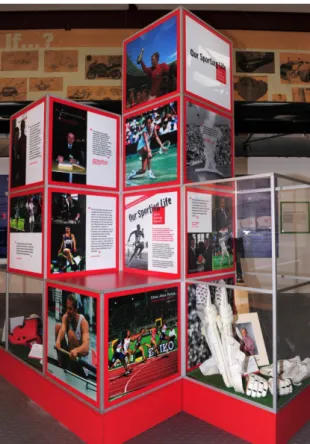
Figure 1: Our Sporting Life exhibition cubes, Ironbridge
Our Sporting Life was funded by the MLA for a period of twelve months to the value of £100,000, which financed the initial set-up costs and a project manager to oversee the initial delivery. By the beginning of 2012, however, the money ran out and the project manager left just as exhibition activity increased nationally. Consequently, the partnerships and contacts developed by the project manager could no longer be sustained and
co-ordination of the project became difficult, with some partners withdrawing, and others hosting exhibitions without notifying the central Our Sporting Life team.
Evaluating Our Sporting Life
The formal evaluation of Our Sporting Life was driven by its funders, initially the MLA and
latterly, ACE. On their funder’s request, SHN identified a number of Key Performance Indicators (KPIs) to enable the measurement of the outcomes of Our Sporting Life, but on the
8
disbanding of the MLA, ACE requested a new range of indicators to measure the programme’s success.6
Table 1 near here.
The use of KPIs to measure Our Sporting Life, and the redefinition of these objectives
part-way through the project, was problematic. Whilst measuring visitor demographics is a difficult task for museums, particularly when events and activities are delivered as drop-in sessions staffed by people tasked to deliver and not evaluate the programme, the lack of demographic evidence makes it difficult to ascertain whether sporting exhibitions during 2012 encouraged different audiences to visit museums and exhibitions. Furthermore, the change from the initially KPIs to different objectives created confusion, with project teams often being asked to provide data retrospectively. The final evaluation of the project used only the ACE objectives to measure the quantitative outputs, and the data returned was focused more towards numerical objectives than on impact and outcomes.
An evaluation methodology (Figure 3) was initially outlined by the SHN and this focused on individual organisation-led evaluation, with project leads requested to conduct questionnaires, focus groups, and consultations. However, data capture from project teams was ad hoc, an issue that pervades the museum sector as a whole (Heath and Davies, 2012),
and the absence of a project manager to co-ordinate the evaluation process had a significant impact on the final data set.
Table 2 near here
6 In 2010, MLA was disbanded during the “Bonfire of the Quangos,” and control for museum activity
9
This approach to evaluation has led to data of questionable validity. When comparing the data from the interim report, at a time when the project manager was still in post, with the data set at the end of the programme, there is a substantial gap left by the conclusion of the funding. This restricts the quantitative picture of the project, but the results from both the interim report and final data set have been compiled here, where possible, with an element of careful conjecture to build a representative picture of Our Sporting Life.
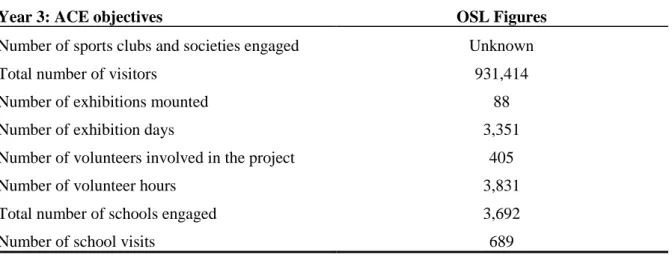
The final evaluation recorded responses from 30 project leads. Whilst the total number of Our Sporting Life exhibitions delivered in England is difficult to establish, it is
known that 37 project teams advertised exhibitions and events directly relating to the programme. As such, there were 7 non-respondents to the survey7.
Table 3 near here
Exhibition numbers and themes
Using the data from the 30 project leads, each team mounted an average of 2.9 exhibitions. Assuming this average was matched by the 7 known non-respondents, the total number of exhibitions mounted was 108. The average exhibition ran for 38 days, demonstrating that museum services were using Our Sporting Life as part of their temporary exhibition
programme. This suggests that it was seen as a project to be integrated into broader exhibition programmes, a level of sporting heritage activity that had not previously been seen in
England.
The exhibitions were thematically linked by categories which represent how sport intersects with wider museum collections and objectives. With education, engagement and widening participation high on cultural policy agendas, exhibitions were used to engage
7 Many other sporting exhibitions were delivered as a direct result of Our Sporting Life without using the
10
schools, families and community groups, and although several museums chose to focus on the art or science of sport, the vast majority explored sporting heritage within a local context, either through local sporting activities, local heroes, or local clubs. In the broader context of London 2012, Our Sporting Life demonstrates that local communities could relate to an
international event in a remote location through sport, and that this local angle was a key factor behind attracting new audiences and engaging with the community.
Table 4 near here
Geographical Spread
The geographical impact of Our Sporting Life was strongest in museums and regions that
were not included in official Cultural Olympiad programming. The project management team for Our Sporting Life was based in the South East and, as shown in Figure 2, the majority of
activity took place in this region. This can be attributed to the contagion effect from the site of the Olympic Games,8 and the greater concentration of cultural organisations, funding, and existing partnerships between the project manager and local activities. The loss of the project manager post, however, reduced the relationship-building potential of Our Sporting Life on a
wider geographical scale.
8 The DCMS’s Taking Part Survey identified that 4.3% of people nationally identified the Olympic
Games as having encouraged them to participate in a cultural activity during 2012, whereas in East London it was 11.3% (DCMS, 2012, p. 19)
11
Figure 2: Geographical spread of Our Sporting Life exhibitions (King, 2011)
12
The change from the MLA to ACE shifted the focus onto the role of volunteers, a move that was in line with the government’s ‘Big Society’ agenda.9 Volunteering was a key aspect of London 2012 (DCMS, 2012, pp. 20-21), and was perceived to be a significant success. The data from Our Sporting Life demonstrates a similar achievement. On average there were 13
volunteers per exhibition, however, the data does not show how many of these volunteers already had active roles within the museum, or whether the sports heritage theme appealed to different types of volunteers.
Visitor Numbers
Whilst Our Sporting Life was frequently used as part of a broader engagement objective,
traditional footfall measures were used to ascertain visitor numbers. The overall visitor figures represent an average of 31,047 visitors per exhibition, and if this average was true for the seven non-responders, the total number of visitors can be projected as 1,148,743. As with the data on volunteers, the visitor data lacks detail on the demographics of those visitors, or whether they were attending the museum specifically for the exhibition or visited Our
Sporting Life because they were in the museum. As such, it is only through qualitative
research that any assertions can be made about the ability of sport to attract new audiences to museums, although in this case, the qualitative analysis is somewhat inconclusive.
The Impact of Our Sporting Life
The limitations of the quantitative data for Our Sporting Life are evident and it is necessary to
adopt a broader qualitative approach to establish impact. The qualitative responses of those
13
who held exhibitions have been tested against the Generic Learning Outcomes (GLOs) and Generic Social Outcomes (GSOs),10 and the evidence is presented below.
Learning Outcomes
Our Sporting Life demonstrated significant learning outcomes for organisations and
individuals in the GLO areas of Knowledge and Understanding, Enjoyment and Creativity, and Activity, Behaviour and Progression. Organisations stated a new breadth of knowledge and understanding about their current collections, which has informed their collection policies moving forward, and involvement in the programme has seen organisations change their attitudes towards sporting heritage, particularly in relation to sporting stories from their communities.
Table 5 near here
Without more comprehensive surveying of audiences, it is impossible to ascertain whether they gained increased knowledge and understanding of local history and the nation’s sporting heritage, but it is in the response to questions on enjoyment, inspiration and creativity that the greatest impact can be observed. Visitors stated that they felt inspired after attending Our
Sporting Life exhibitions having enjoyed learning about their community and stories of
sporting heroism.
Table 6 near here
The final learning outcome reveals a more balanced level of response from both organisations and individuals, with exhibitions being believed to encourage a change in behaviour by
10 For more information, visit the Inspiring Learning for All Framework at
14
attracting different audiences. These audiences shared both objects and memories relating to their community’s sporting past for the benefit of future generations.
Table 7 near here
Table 8 near here
Social Outcomes
A similar approach has been undertaken to code Our Sporting Life against the GSOs, with the
findings demonstrating that the programme impacted on all three GSO areas. Our Sporting
Life partners stated that the programme encouraged stronger and safer communities by
reaching new audiences, working together with museum communities to develop exhibitions, and building partnerships with local organisations to tell difficult histories and untold stories of local heroes. Partnerships have been forged to support future projects, and many
organisations identified relationships with local communities and individuals as a significant outcome of Our Sporting Life.
Table 9 near here
Table 10 near here
It was also found to provide advice on health and wellbeing, with many exhibitions
concentrating on healthy living and supporting local sports clubs and activities as a means of engaging new audiences. Dorset Museums Service stated that their programme on healthy lifestyles with adults with learning disabilities “raised awareness and built confidence of participants.” However, the main area of success was in helping children and young people to make a positive contribution to public life, and many projects allowed young people to curate exhibitions and lead decision making. Ironbridge Museums stated that Our Sporting Life
15
“gave us the unique opportunity to engage new and diverse audiences [and] to engage young people in the exhibition process.” Plans to integrate this into future activities have been introduced at some of Our Sporting Life’s partners.
Finally, a key impact from Our Sporting Life was its role in strengthening public life.
It was seen to encourage participation from volunteers in all areas of exhibition development and delivery, and many organisations worked with new volunteers. This approach allowed museums to work in a new way with their communities, opening spaces for community exhibitions which told the story of the locality, and inspired them to feel part of the venue. The development of a sense of ownership has been identified as a way to assert the role of consultation groups and audience forums, a further aspect of the Our Sporting Life
framework that has been integrated into future practice.
Table 11 near here Table 12 near here Table 13 near here Table 14 near here
Conclusion
The evaluation shows that, despite the complex relationships between the museum sector and the London 2012 Olympic Games, Our Sporting Life contributed significantly to the sporting
heritage of England during 2012. As a result of the programme, many museums unearthed new artefacts which were accessioned into their collections and new oral histories were captured from sports players, club staff, fans and people living near sports stadia. Exhibitions focused on local social histories and increased the understanding of the role that sport plays in inter-generational communication, changes to the landscape, and changes in attitudes
16
towards sport. Involvement in the project was cited as an opportunity to celebrate the sporting heritage of museum communities and the recreation of old and valued sporting traditions have inspired schools, young people, adult learners and other community members to participate, research, teach and learn about their own history and heritage.
The building of partnerships and the development of innovative engagement practices have shown that Our Sporting Life could be developed into a model of best practice for future
thematic exhibition programmes, particularly in relation to major sporting events. Having been constructed by museum and archive professionals, it is based upon considerable experience and expertise. No other museum exhibition programme has delivered over 100 community-based exhibitions, attracting more than one million visitors, and whilst there are limitations to the subsequent evaluation, certain assertions have been made about the
project’s contribution to learning and social outcomes.
However, whilst the programme can be seen as something of a success, it highlights a number of issues with cultural policy, funding, and evaluation that need to be addressed. The absence of formal inclusion into the Cultural Olympiad programme, and general disjunction in planning for London 2012, reveals an ongoing lack of integration between the three arms of the DCMS. Whilst culture and media appear to become increasingly intertwined, sport has yet to be fully accepted as a component of Britain’s cultural offer. With policy-makers heavily influencing funding objectives, the lack of sports heritage exhibitions in museums shows the scale of the divide, and despite the wide reach of Our Sporting Life, it is too early
to know whether it has led to greater representation of sports heritage in museums. The lack of data for Our Sporting Life makes it difficult for the SHN to assert its
impact across a range of agendas, and it restricts their ability to reflect on lessons learned. Furthermore, the change of funding during the project fundamentally altered the scope of the evaluation, and this lack of investment in evaluation is symptomatic of a deeper problem in
17
the cultural sector. Cultural activities rely on short-term project funding, and evaluation is often conducted as an afterthought, by inexperienced staff with a lack of resources, and focuses on quantitative rather than qualitative measures.
Had the SHN initiated the evaluation framework at the outset of Our Sporting Life,
integrated the needs of their funders instead of being led by them, and received adequate financial support to fund an evaluation, the project would have been better placed to develop a new model of practice. However, just as London 2012 failed to capitalise by engaging with Our Sporting Life, the project struggled to present a conclusive case that supports claims that
sport in museums can attract different audiences. As such, this ground-breaking cultural engagement project is set to be lost due to a lack of importance place on evaluation by the museum sector, and inadequate provision for evaluation from funders who, conversely, insist upon token evaluation measures to be conducted in order to determine the value of culture in England.
18
References:
Brabazon, T. (2006). Playing on the periphery: Sport, identity and memory. Oxon: Routledge.
DCMS. (2012). Inspiring a generation: A Taking Part report on the 2012 Olympic and Paralympic Games. Retrieved from
https://www.gov.uk/government/uploads/system/uploads/attachment_data/file/78316/Taking _Part_Olympic_Report.pdf
DCMS. (2007). Government response to the Culture, Media and Sport Select Committee. Retrieved from http://books.google.co.uk/books?id=FygmiVO6gHcC&pg=PA7&lpg=PA7&dq=museums+c oncerns+and+the+2012+olympics&source=bl&ots=tj5VdsrNu5&sig=BGoUQMyE6ecWBC nX4T7wHsFoYXE&hl=en&sa=X&ei=PoUTUcmmCfS00QXRg4HgAQ&ved=0CDoQ6AE wAjjCAw#v=onepage&q=museums%20concerns%20and%20the%202012%20olympics&f= false
DCMS. (2006/7). Caring for our collections. Retrieved from:
http://books.google.co.uk/books?id=BigpRiGcYpQC&pg=PA9&lpg=PA9&dq=museums+as
sociation+cultural+olympiad&source=bl&ots=iNairbcWp0&sig=NmPyU3kQW-
4cnSiG3oboG9Fjf0Q&hl=en&sa=X&ei=4okTUYnlD-Or0AWBnYD4Bg&ved=0CFUQ6AEwBg#v=onepage&q=museums%20association%20cult ural%20olympiad&f=false
DCMS. (2005). Government response to “A London Olympic bid for 2012”. Retrieved from
http://webarchive.nationalarchives.gov.uk/+/http://www.culture.gov.uk/images/publications/ OlympicsCm5867.pdf
Garcia, B. (2012). The Olympic Games and cultural policy. New York & Oxford: Routledge.
Heath, C & Davies, M. (2012). Why evaluation doesn’t measure up. Retrieved from
http://www.museumsassociation.org/museums-journal/comment/01062012-why-evaluation-doesnt-measure-up
Holt, R. (1989). Sport and the British: A modern history. Oxford: Oxford University Press.
Hood, A. (2006). Sports heritage mapping survey. Retrieved from
19
Johnes, M. & Mason, R. (2003). Soccer, public history and the National Football Museum. Sport in History, 23.1, 115-131.
King, L. (2011). Our Sporting Life interim report (unpublished). Made available to the authors.
Lammy, D. (2005). Keynote address. Paper presented at the Museums Association Conference. Retrieved from
http://webarchive.nationalarchives.gov.uk/+/http://www.culture.gov.uk/reference_library/min ister_speeches/2036.aspx
Moore, K. (1997). Museums and popular culture. London: Leicester University Press.
Moore, K. (2012). Sport in museums and museums of sport: An overview. In J. Hill, K. Moore & J. Wood (Eds.), Sport, history and heritage: An investigation into the public representation of sport (93-106). Woodbridge:Boydell & Brewer.
Museums Association (2008). What are your feelings towards the Cultural Olympiad? Retrieved from http://www.museumsassociation.org/news/17376
Museums Association (2005). Collections for the future. Retrieved from:
https://www.google.co.uk/url?sa=t&rct=j&q=&esrc=s&source=web&cd=2&ved=0CDsQFjA B&url=http%3A%2F%2Fwww.museumsassociation.org%2Fdownload%3Fid%3D11117&ei
=_3wTUbT7E6qf0QX6iIGYDg&usg=AFQjCNGDeN5cTE5vC-OdmgOFrKCk6aiaIA&sig2=L_wRiySvMvM9QKIZ3RYtzg
Phillips, M. (2012). Representing the sporting past in museums and halls of fame. New York: Routledge.
Phillips, M. (2010). A historian in the museum: Story spaces and Australia’s sporting past. Australian Historical Studies, 41, 396-408
Sports Heritage Network (2013). About Us. Retrieved from
http://www.oursportinglife.co.uk/about-us/sports-heritage-network
Vamplew, W. (2012). Renamed, refurbished and reconstructionist: Comparisons and contrasts in four London sports museums. In M. Phillips (Ed.). Representations of the sporting past in museums and halls of fame (130-142). New York: Routledge.
Vamplew, W. (2004). Taking a gamble or a racing certainty: Sports, museums and public sports history. Journal of Sport History, 31.2, 177-192
20
Vamplew, W. (1998). Facts & artefacts: Sports historians and sports museums. Journal of Sport History, 25.2, 268-282
Wood, J. (2005). Olympic opportunity: realising the value of sport heritage for tourism in the UK. Journal of Sport Tourism, 10.4, 307-321
21
Table 1: KPI Indicators and ACE Objectives
Year 1 and 2: MLA KPIs Year 3: ACE objectives
No. of sports and clubs engaged No. of sports clubs and societies engaged Total visitors Total visitors
No. of exhibitions mounted No. of exhibitions mounted No. of new partnerships created No. of exhibition days No. of special events by clubs No. of events/workshops held
No. of open activity weekends No. of volunteers involved in the project No. of open activity event day No. of volunteer hours
No. of schools engaged (facilitated visits) Total no. of schools engaged No. of young people under 19 engaged No. of school visits
No. of young people involved in formal on-site activity
No. of families participating No. of volunteers new to museums
22
-Table 2: Original programme evaluation methodology (King, 2011)
Our Sporting Life Evaluation Methodology
What? When? How and Who?
Who is engaging with an OSL exhibition or event
During each exhibition or event
Exhibition organiser to carry out facilitated evaluation sessions using the questionnaire provided by OSL team
The quality of the visitor’s
engagement with an OSL exhibition
During each exhibition or event
Exhibition organiser to carry out facilitated evaluation sessions using the questionnaire provided by OSL team
The effectiveness of the process of putting on an OSL exhibition
After opening of each OSL exhibition (target is within 2 weeks)
Lessons learned meeting between OSL team and exhibition organiser Questionnaire supplied by OSL to be
completed by each exhibition organiser
Performance against identified measures of success (MLA’s identified KPIs)
Ongoing data capture from start to end of MLA funded activity
Tabulated data collection template with identified KPIs provided by OSL Specific data is collected by each
individual exhibition organiser Data is collated by OSL National team
23
Table 3: Overall exhibition data
Year 3: ACE objectives OSL Figures
Number of sports clubs and societies engaged Unknown Total number of visitors 931,414 Number of exhibitions mounted 88 Number of exhibition days 3,351 Number of volunteers involved in the project 405 Number of volunteer hours 3,831 Total number of schools engaged 3,692 Number of school visits 689
24
Table 4: Themes of Our Sporting Life
Our Sporting Life Themes
The art of sport Sport and social history Sporting heroes
Local sporting events and activity
The science of sport The history of a sport or sports club
25
Table 5: Knowledge and Understanding – Outcomes for Organisations
Indicator Evidence
Organisations will say they have an increased knowledge and understanding of:
- sporting collections
- working with communities
- local stories, figures and history
Ironbridge Museum:
“We were also able to showcase collection items that had not been displayed before and also to increase our knowledge and interpretation of these objects and archive material. This helped us develop our collections; increase our knowledge and
understanding of our collections, local history and local sport.”
Manx Museum:
“We were very reliant on the expertise of our new sporting contacts.”
Surrey Heritage:
“One of our most interesting stories involved the chance find of an historical document that proved to be of international importance and led to the development of a relationship between Surry Heritage and the UK Youth Baseball
Association as well as sporting re-enactments, which inspired young people to take up a non-traditional sport.”
26
Table 6: Enjoyment, Inspiration and Creativity – Outcomes for Individuals
Indicator Evidence
Individuals will say, or organisations will be able to demonstrate, how the impact of the exhibition has:
- contributed to people’s enjoyment
- inspired people to learn more about the topic, sport, or take an active role in the museum or community
- allowed people to be more creative
Visitor, Bowes Museum:
“Thank you for a fun and inspiring exhibition – with history and colour – to motivate the Olympians of the future!”
Manx Museum:
“Visitors were encouraged to engage in sport, to use the equipment and have fun.”
Visitor, Meridian Leisure Centre, Louth, North East Lincolnshire:
“It's great to celebrate local Olympians, it's got me and the kids really excited about the 2012 games.”
27
Table 7: Activity, behaviour, and progression – Outcomes for Individuals
Indicator Evidence
Individuals will say, or
organisations will demonstrate, that the exhibition has directly led people to explore further
opportunities, including:
- taking part in community exhibitions
- taking up new forms of learning; taking up new forms of activities, including sport
Visitor, Bowes Museum:
“One of our most enthusiastic partners, George Phelan from the Durham Amateur Football Trust, was particularly enthusiastic about the exhibition; we have given him some of the graphic panels on football, which he will use in his work with DAFT.”
Surrey Heritage:
“The links with sports clubs has encouraged them to deposit archives with heritage organisations.”
28
Table 8: Activity, behaviour, and progression – Outcomes for Organisations
Indicator Evidence
Organisations will say that the exhibition supported them to:
- create new partnerships, or new ways of working.
- create or plan other community exhibitions,
- further exhibitions about sport
- new partnerships
Manx Museum:
“The art was moved to our smaller temporary exhibition space, which was a bold move by the organisation as we might have alienated our traditional visitors. In reality the exhibition was so engaging that we had very few complaints …. and most people thought it was exciting.”
Ironbridge Museums:
“The Science of Sport exhibition allowed us to expand our focus in Enginuity and investigate the science and technology behind sports and sporting equipment.”
29
Table 9: Stronger and Safer communities – Improving Dialogue and Understanding
2nd Tier Indicator Evidence
Improving group and inter-group dialogue and understanding. Through:
- exhibitions about specific community groups
- community focussed programming etc.
Dorset Museums Service:
“The stories were not to be just those of the superstars, but the unsung heroes within the clubs and teams across Dorset.” “The partnership of museums across Dorset is stronger as a result of a successful project.”
Surrey Heritage:
“By exhibiting in sports grounds, leisure centres, sporting events we reached new audiences.”
30
Table 10: Stronger and Safer communities - Supporting Cultural Diversity and Identity
2nd Tier Indicator Evidence
Supporting cultural diversity and identity including:
- audience development programmes
- recognition of individual memories and stories
- focus on local issues and stories
- highlighting different cultures through exhibition programmes
Dorset Museum Service:
“Attracted an audience with a more diverse background than other museum exhibitions.”
Manx Museum:
“From 2010 – 2012 we conducted almost 100 recorded interviews with representatives from the Manx sporting community.”
“The exhibition team worked with a broad range of sporting clubs on the Island … to tell a complete story of sport on and from the Isle of Man.”
Ironbridge Museums:
“Local audiences could share their memories of sport, local heroes and loan items for display.”
31
Table 11: Strengthening Public Life – Local Decision Making
2nd Tier Indicator Evidence
Encouraging and supporting awareness and participation in local-decision making and wider civic and political engagement. Including:
- community exhibitions
- new objects accessioned from community
involvement
- greater public consultation
Manx Museum:
“The bulk of the artefacts on display were items on loan to us from the sporting community.”
“We have developed strong links with our sporting community, and have received donations to our social history collections as a result.”
Ironbridge Museum:
“We are continuing to build links and relationships with the local community through consultation and focus groups for specific projects and events.”
32
Table 12: Strengthening Public Life – Building Capacity
Indicator Evidence
Building the capacity of
community and voluntary groups. Including :
- supporting volunteer led exhibitions - encouraging community involvement in museum exhibitions - supporting volunteer skills development
Visitor, Bowes Museum:
“The exhibition would not have happened without volunteer pressure at the outset and their continuing enthusiasm and commitment.”
Surrey Heritage:
“In some cases the events were largely run by a museum or village cricket team…. These were often entirely volunteer run, local events.”
Manx Museum:
“We therefore felt that the sporting community volunteered as guest curators throughout this process.”
Dorset Museums Service:
“The community museums are all run by volunteers so their exhibitions were completely volunteer led.”
33
Table 13: Strengthening Public Life – Community Empowerment
2nd Tier Indicator Evidence
Enabling community empowerment through the awareness of rights, benefits and external services. Including:
- the development of focus groups and consultation opportunities with the public
Dorset Museums Service:
“The community responded with time, energy and commitment.”
“Stronger links with the community, the participant’s contributions were clearly evident in the exhibition.”
34
Table 14: Strengthening Public Life – Improving Responsiveness
2nd Tier Indicator Evidence
Improving the responsiveness of services to the needs of the local community: Including:
- the development of focus groups
- consultation
opportunities with the public
- providing the public with opportunities to inform museum practice
Bowes Museum:
“The exhibition was unlike other exhibitions at the Bowes Museum. A community exhibition has not been staged during the life of the current Trust.”
Ironbridge Museum:
“We are continuing to build links and relationships with the local community through consultation and focus groups for specific projects and events.”
35
Figure 1. Our Sporting Life exhibition cubes, Ironbridge © Sports Heritage Network