EUROPEAN COMMISSION DIRECTORATE-GENERAL
TAXATION AND CUSTOMS UNION Indirect Taxation and Tax administration
Administrative cooperation and fight against fiscal fraud
C
OMPLIANCE
R
ISK
M
ANAGEMENT
G
UIDE
FOR TAX ADMINISTRATIONS
Fiscalis Risk Management Platform Group
(FINANCIAL CODE: FPG32/GRP4)
© European Union, 2010
Reproduction for personal use or for further non-commercial dissemination to end-users (for educational purposes, research, private study, or internal circulation within an organisation) is authorised subject to the condition that appropriate acknowledgement is given to the
European Union and to the source (Fiscalis Risk Management Platform Group and publication title).
Compliance Risk Management
Capacity Ta x p a y e rs Effects In s tr u m ent s Compliance Risk Management Balanced choices
P
REFACESince 2008 a Fiscalis Risk Management Project group has been working on the update of the original Risk Management Guide. This is a Guide prepared by tax officials for tax officials1. Member States approved the original Risk Management Guide in 2006. It was discussed at a Fiscalis Risk Management Seminar in June of that year and published on the Commissions 'Europa' website:
http://ec.europa.eu/taxation_customs/resources/documents//taxation/tax_cooperation/gen_overview/Risk_ Management_Guide_for_tax_administrations_en.pdf
The Guide provides background information, best practices and a framework for the implementation of modern compliance risk management principles for tax administrations. Compared to the original Guide, the up-date focuses more on influencing behaviour. A few years ago Risk Management was more or less applied as a form of risk analysis, focused on a better selection for tax audits. In more recent years Risk Management has been significantly developed, both within and outside the EU. It has evolved as a systematic process in which efficient and effective choices are made. These choices, to stimulate compliance and to prevent non-compliance, are based on the behaviour of taxpayers. These developments are reflected in the up-dated Guide with the introduction of a new section about influencing behaviour (part B). The emphasis on compliance is reflected in the new title of the Guide: Compliance Risk Management Guide.
Reading guidance
This Guide is targeted at policy makers, management and staff of tax administrations working in the area of compliance risk management. Chapters may have different relevance for different groups. Some reading guidance is set out in the following table:
Chapter Readers
1. Introducing Compliance Risk Management Policy makers, management and staff 2. The Compliance Risk Management Model
A. The Risk Management Environment B. Influencing Behaviour
C. The Risk Management Process D. Organisational factors
A. Policymakers, management B. Policymakers, management and staff C. Management and staff
D. Management
3. Examples Policy makers, management and staff
4. Data, techniques and tooling Staff
5. Organisational aspects of Compliance Risk
management Management
1 The working group was headed by the Netherlands and comprised of delegates of the following Member States: Finland, Ireland, Latvia, The Netherlands, Slovenia and Slovak Republic. Three working groups headed by the United Kingdom, Italy and Sweden, comprising nearly all Member States, delivered input for the up-date.
I
NDEXINDEX... 3
0. EXECUTIVE SUMMARY ... 5
1. INTRODUCING COMPLIANCE RISK MANAGEMENT... 7
1.1. INTRODUCING THE COMPLIANCE RISK MANAGEMENT MODEL... 8
1.2. LIMITATIONS OF COMPLIANCE RISK MANAGEMENT... 10
1.3. COMPLIANCE RISK MANAGEMENT IN A FUTURE PERSPECTIVE... 10
2. THE COMPLIANCE RISK MANAGEMENT MODEL ... 12
A.THE COMPLIANCE RISK MANAGEMENT ENVIRONMENT... 14
2.1. CONTEXT... 14
2.1.1. External context ... 14
2.1.2. Internal context ... 16
2.2. OBJECTIVES... 16
2.3. STRATEGY... 17
2.3.1. Methods, principles and ways of thinking ... 18
2.3.2. Knowledge ... 19
2.3.3. Implementing strategy ... 19
B.INFLUENCING TAXPAYER COMPLIANCE BEHAVIOUR... 21
2.4. INFLUENCING TAXPAYER COMPLIANCE BEHAVIOUR... 21
C.THE COMPLIANCE RISK MANAGEMENT PROCESS... 25
2.5. RISK IDENTIFICATION... 25
2.5.1. Risk Genres... 25
2.5.2. Levels of identification... 26
2.5.3. Tax Gap ... 29
2.5.4. Sources for risk identification... 29
2.5.5. Risk identification output... 30
2.6.RISK ANALYSIS... 31
2.6.1. Sources ... 32
2.6.2. Analysis ... 32
2.6.3. The timing of analysis... 33
2.6.4. Risk analysis output ... 34
2.7.PRIORITISATION... 35
2.7.1. Risk assessment ... 36
2.7.2. Risk ranking... 37
2.7.3. Possible treatment forms ... 37
2.7.4. Risk prioritisation ... 39
2.7.5. The Risk prioritisation output... 39
2.8.TREATMENT... 39
2.8.1. Risk Transfer ... 40
2.8.2. Risk Reduction ... 41
2.8.3. Risk covering ... 46
2.8.4. Timing and quality of the intervention... 49
2.8.5. Output of the treatment step ... 50
2.9.EVALUATION... 50
2.9.1. Introduction to evaluation ... 50
2.9.2. Evaluation in practice ... 52
2.9.3. Practical considerations... 53
2.9.4. Output of the evaluation step... 54
D.ORGANISATIONALFACTORS ... 55
2.10.CORPORATE GOVERNANCE –ADDRESSING INTERNAL RISK... 55
2.11.ORGANISATIONAL CULTURE... 56
2.12.HUMAN RESOURCES... 57
2.12.1. Recruitment and selection... 57
2.12.2. Skills and competency... 57
2.13.IMPACT ON THE ADMINISTRATION... 58
2.14.MANAGING THE PROCESS... 60
3. EXAMPLES... 62
3.1.EXAMPLES FOR CHAPTER 2.3–STRATEGY... 62
3.1.1. Example 1 Denmark: The Danish Compliance Risk Management Model... 62
3.2.EXAMPLES FOR CHAPTER 2.5–RISK IDENTIFICATION... 63
3.2.1. Example 2 Italy: Risk Analysis on new VAT identification numbers ... 63
3.2.2. Example 3 The Netherlands: National Risk Database... 64
3.2.3. Example 4 Italy: APPLE (Application to fight against tax evasion) ... 65
3.2.4. Example 5 Sweden: The Swedish Tax Gap Map... 66
3.3.EXAMPLES FOR CHAPTER 2.6–RISK ANALYSIS... 67
3.3.1. Example 6 The Netherlands: External sources, Internet (web robot XENON) ... 67
3.3.2. Example 7 Ireland: REAP- Risk Evaluation Analysis and Profiling ... 68
3.3.3. Example 8 Germany: Qualified new registrations by using checklists... 69
3.3.4. Example 9 Italy: FALCO ... 70
3.4.EXAMPLES FOR CHAPTER 2.7–PRIORITISATION... 71
3.4.1. Example10 The Netherlands: Attention Category ... 71
3.5.EXAMPLES FOR CHAPTER 2.8–TREATMENT... 72
3.5.1. Example 11 The Netherlands: Consultation in the Agricultural Sector ... 72
3.5.2. Example 12 Sweden: Early Letter Treatment (antiques) ... 73
3.5.3. Example 13 Denmark: Fair Play (combating the underground economy with visible enforcement and moral messages) ... 74
3.5.4. Example 14 Sweden: Taxpayer Campaign ... 75
3.5.5. Example 15 Poland, Cyprus, Austria and Sweden: Visiting Schools ... 76
3.5.6. Example 16 Poland: Publishing information on areas of tax audit... 77
3.5.7. Example 17 The Netherlands: Increasing perceived probability of detection... 78
3.5.8. Example 18 Italy: Sector studies ... 79
3.5.9. Example 19 Poland: Take the bill ... 81
3.5.10. Example 20 The Netherlands: Horizontal Monitoring ... 83
3.6.EXAMPLES FOR CHAPTER 2.9–EVALUATION... 84
3.6.1. Example 21 Ireland: Construction Industry ... 84
3.6.2. Example 22 Sweden: Campaign against late tax payment (randomised controlled trial)... 85
3.6.3. Example 23 United Kingdom: Impact of Working Families Tax Credit (difference-in-difference method)... 86
3.7.EXAMPLES FOR CHAPTER 2.10–CORPORATE GOVERNANCE... 87
3.7.1. Example 24 United Kingdom: Management Assurance ... 87
3.7.2. Example 25 Italy: Quality Certification ... 88
4. DATA, TECHNIQUES AND TOOLING... 90
4.1.CATALOGUE OF IT BASED RISK MANAGEMENT TOOLS (RISK TOOLS)... 91
4.2.THE USE OF DATA PROCESSING TECHNIQUES FOR INTELLIGENCE PURPOSES... 92
4.3.RULE BASED SYSTEMS... 94
5. ORGANISATIONAL ASPECTS OF COMPLIANCE RISK MANAGEMENT ... 96
5.1.RISK MANAGEMENT IN AUSTRIA... 96
5.2.RISK MANAGEMENT IN THE BULGARIAN REVENUE ADMINISTRATION... 97
5.3.RISK MANAGEMENT IN GERMANY... 100
5.4.RISK MANAGEMENT SYSTEM IN GREECE... 101
5.5.ITALIAN REVENUE AGENCY: RISK ANALYSIS FOR ASSESSMENT PURPOSES... 101
5.6.COMPLIANCE RISK MANAGEMENT IN THE NETHERLANDS... 103
5.7.RISK MANAGEMENT IN POLAND... 105
5.8.HOW RISK MANAGEMENT IS OPERATED IN SWEDEN... 107
5.9.RISK MANAGEMENT IN UK ... 108
0.
E
XECUTIVES
UMMARYA tax administration is part of a society in which citizens, businesses, organisations and public bodies react to each other’s actions. Certain actions on the part of a tax administration lead to a reaction from the taxpayer and vice versa. In order to influence taxpayer behaviour a tax administration needs to be aware of its own behaviour but also of behaviour within society. It is important too to know what causes non-compliant behaviour by citizens and businesses. Making mistakes because of ignorance differs from aggressive tax planning and from tax fraud. Behavioural science has shown that criminal sanctions are not the appropriate response (and may have an adverse effect) when non-compliance is caused by complex legislation or a lack of knowledge on the part of the taxpayer. A tax administration should match its (compliance) strategy to the taxpayer’s attitude and motives.
Compliance Risk Management could be described as a systematic process in which a tax administration makes deliberate choices on which treatment instruments could be used to effectively stimulate compliance and prevent non-compliance, based on the knowledge of all taxpayers (behaviour) and related to the available capacity.
The objective of Compliance Risk Management is to enable a Tax Administration to accomplish its strategic objectives by facilitating management to make better decisions. This Compliance Risk Management Guide brings together a unified view of the relevant factors that form the environment in which Compliance Risk Management takes place, as well as the sequence of steps that need to be taken to implement the process. The theoretical framework is supported with some examples that have been provided by Member States.
The Guide is a practical reference for a full range of readers from policy makers to operational staff. A reader’s guide is provided in the Preface.
Compliance Risk Management
Capacity Ta x p a y e rs Effects In s tr u m ent s Compliance Risk Management Balanced choices
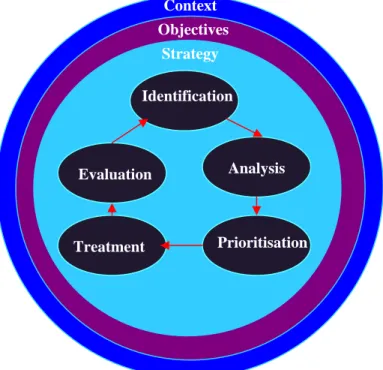
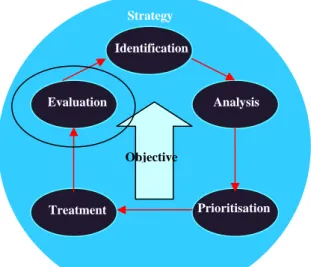
The Introduction to the guide describes the Compliance Risk Management Model and shows the steps in the process, (identification, analysis, prioritisation, treatment and evaluation), set in context, objectives and strategy.
Chapters 2.1 to 2.3 deal with the Compliance Risk Management Environment. It sets out in more detail the external and internal context as well as objectives and strategy. Special attention is paid to the influence of changing economic conditions.
Chapter 2.4 discusses the role of Influencing Taxpayer Compliance Behaviour. This is still a developing and relatively new area for most tax administrations. It comes from the basic principle that understanding behaviour is the first step towards influencing behaviour. In their efforts to advance the desired patterns of behaviour of taxpayers, tax administrations are guided by perceptions of what drives behaviour and consequently what treatments are most appropriate when it comes to influencing it in a desired direction.
Chapters 2.5 to 2.9 set out in more detail each of the Compliance Risk Management steps (identification, analysis, prioritisation, treatment and evaluation). Evaluation focuses on outcomes. This is a more difficult area than output measurement. However, it is recognised as a more reliable measurement of the effectiveness of treatment strategies and actions to stimulate better levels of compliance.
Chapters 2.10 – 2.14 deal with some Organisational Factors that need to be considered. These include corporate governance, organisational culture and human resources. There is also a summary of the type of “shifts” that a change to a risk management approach will require.
Chapter 3 brings together all of the examples used to demonstrate the practical implementation of different aspects of the Guide. These examples have been provided by Member States.
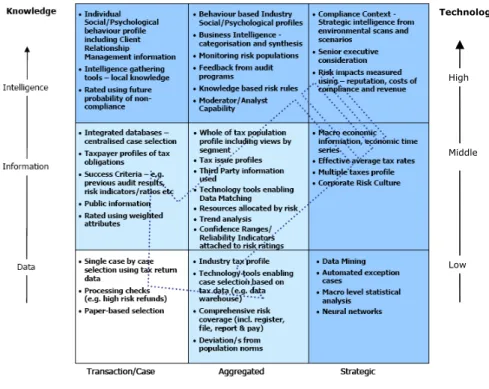
Chapter 4 sets out a picture of a risk identification model, combining levels of knowledge, focus and IT. This forms a backdrop for more information on the risk tools and statistical analysis that are necessary to support a risk-based approach to compliance.
Chapter 5 has contributions from nine Member States where they set out a brief description of how Risk Management is handled in their countries.
The Guide specifically reflects the new directions that are emerging in relation to influencing compliance behaviour and a shift in the evaluation of effectiveness through a focus on the measurement of outcomes rather than outputs.
1.
I
NTRODUCINGC
OMPLIANCER
ISKM
ANAGEMENTRisk Management is part of our subconscious behaviour that guides us in making the best possible choices each time we have to make a decision. Usually, this can be seen as a human instinct, for instance when we have to make a choice between the different queues at the post-office, where we detect the shortest line, the least likely troublesome clients, etc.
Tax administrations have to deal with a large number of risks. These may concern the risk of non-compliance, including risk of tax fraud, the risk of insolvency by the taxpayer etc. Compliance Risk Management allows us to deal with these risks by looking at the behaviour of taxpayers (causing the risks). The term (compliance) 'risk management' can have many different meanings depending on the area in which it is used. However, they all have one thing in common; it helps us to treat risks, which appear to threaten our objectives. It can also provide us with a quality assurance for our actions.
The objective of applying Compliance Risk Management in this context is to enable a tax administration to accomplish its mission(s) by facilitating management to make better decisions. The Compliance Risk Management process helps to identify the
different steps in the decision-making cycle, and allows us to make explicit and more educated decisions, in each stage of the process before moving on to the next one. As a result, Compliance Risk Management allows us to better measure the quality of each of the individual stages of the decision-making process, making it easier to detect mistakes. Furthermore, Compliance Risk Management helps us to:
• achieve equal treatment of the taxpayers;
• focus the burden of audit to non-compliant taxpayers;
• make best use of the available human, financial and technical resources;
• increase the level of voluntary compliance of taxpayers;
• adjust available resources to the levels of risks;
• weigh the possibilities that a compliant taxpayer could become non- compliant. In the context of this Guide, Risk Management can be defined as a technique to improve the tax administration’s effectiveness in dealing with compliance risks. This may result in measures aimed at improving compliance and at avoiding non-compliance by taxpayers. It also helps us when it is decided that active treatment is required, by better targeting the available treatment options.
As such, this Guide provides a common foundation for decisions at all management levels within tax administrations, where each has to make the most informed decision about budgets and resources.
1.1. Introducing the Compliance Risk Management Model
The primary goal of the tax authorities is to collect the taxes payable in accordance with the law, in such a manner that will sustain confidence in the tax system. Some taxpayers, due to ignorance, carelessness or deliberate actions, as well as weaknesses in a tax administration, fail to meet their obligations. Therefore, tax administrations should have in place strategies that strike a balance between traditional enforcement activities and innovative treatments seeking more effective ways to arrive at high levels of compliance and high taxpayer satisfaction.
Increasing the effectiveness of the Compliance Risk Management function is now more
important than ever. There are several factors, which are recognised as increasing the risks faced by the tax authorities. These include such factors as the complexity and innovations in business structures, new financial products, large numbers of taxable persons and services, e-commerce developments, etc. At the same time, tax administrations are faced with the need to work more efficiently both in the eyes of public opinion (which demands new levels of efficiency and accountability of government services), and in view of reductions in budgets and restrictions to hire new personnel.
This all dictates new and flexible actions and approaches for tax administrations. Many tax administrations, in order to cope with the above-mentioned challenges, have introduced specific procedures incorporated in a general framework, the so-called Compliance Risk Management Model.
The Compliance Risk Management Process can be illustrated as a continuous loop, having the following steps: Identification, Analysis, Prioritisation, Treatment and Evaluation. The Compliance Risk Management Process takes place in a context, with
objectives and a strategy and these links have been inserted into the model.
Fig. 1 Compliance Risk Management Model
Objectives Identification Analysis Evaluation Treatment Context Strategy Prioritisation
Central to this process is the context. This can be defined as the combination of all facts or circumstances that surround an organisation, and which, in the short to medium term, should be considered as a given. Context can also be defined as the 'environments' in which the tax administration operates. As can be seen from the model, the context and objectives are not part of the Compliance Risk Management process itself.
The objectives of the organisation are the specifically measurable results and outcomes which, when completed, will achieve the stated goal. Such goals can be defined at central level, but also at regional or operational level. Usually, the central objective for a tax administration is to collect the correct amount of taxes at the right time.
In general, the European tax authorities have the (implicit or explicit) strategic goal to stimulate compliance and to prevent non-compliance. The willingness of a taxpayer to fulfil his/her tax obligations has a major impact on compliance levels. Therefore, it refers to behaviour. In order to select the most efficient (low costs) and effective (best outcome) way to achieve the optimal level of compliance it is necessary to pay attention to taxpayer behaviour and methods of influencing that behaviour.
Compliance is the willingness of taxpayers to fulfil their tax obligations. In accordance with international standards this relates to registering, filing, correct declaration of the tax return and payment of the tax due.
In short: context can be viewed as the playing field together with the rules of the game. This is the framework that compliance risk management is applied within. The objectives describe the purpose of the game, what to achieve. The strategy describes how to play the game in order to reach the objectives. Within this framework, compliance risk management is used to decide what to do in order to achieve the objectives.
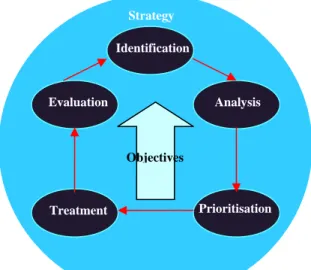
Fig. 2 Compliance Risk Management Process
The Compliance Risk Management Process is based on 5 consecutive steps. These steps form the Compliance Risk Management cycle. The first two steps relate to risk identification, analysis of risks and the behaviour of taxpayers that cause the risks. The next two relate to treatment planning i.e. making choices – about (groups of) taxpayers,
Identification Analysis Evaluation Treatment Strategy Objectives Prioritisation
risks and options for treatment - and the implementation of the treatment. The final step relates to measurement, evaluation and learning. All steps revolve around the goals implied by the strategy of the tax administration: e.g. higher compliance (leading to a lower tax gap) and higher taxpayer satisfaction. In the paragraphs 2.5 to 2.9 each step in the Compliance Risk Management model will be explained in more detail.
1.2. Limitations of Compliance Risk Management
While Compliance Risk Management is an instrument to allow tax administrations to make best use of their resources, we should also look at its limitations. Solutions to reduce non-compliance or to fight fraud need more structured approaches. Sometimes, it is the tax laws that represent a category of risk. The treatment required may be to change the legal framework rather than any administrative changes. In practice, many factors may directly influence Compliance Risk Management decision-making such as:
• variations in a tax authority’s financial resources that may substantially affect its capacity to deal with all of the risks identified;
• likely government position on specific tax legislation changes, e.g. powers for officials, that may represent an opportunity to deal with a risk;
• weaknesses or shortages in staff skills that may seriously prevent a tax authority’s ability to deal with major risks.
1.3. Compliance Risk Management in a future perspective
As much as Compliance Risk Management is based on universal and basic theoretical concepts it can be said that, when applied to tax administrations, it is a way of working and thinking that develops continuously. A Guide like this would not be complete if it could not contribute to this ongoing development.
A few years ago Risk Management was more or less applied as a form of risk analysis, focused mainly on better selection for tax audits. As the Risk Management approach has evolved, it is now applied in a more structured way and is using more advanced technology. This evolution will continue and some new elements will emerge.
This leads to a way of thinking that, in the long run, will change the administration in a more profound way (Compliance Risk Management). Tax administration is not about detecting tax evasion and applying sanctions. It is about ensuring compliance. In order to achieve this, a holistic and cooperative approach is necessary. New risks will emerge and new forms of treatment will be necessary that involves different parts of society.
In practice, this means that for the coming years the following developments may be predicted:
• Influencing of taxpayer behaviour will be developed further and will lead to
effective and efficient use of different enforcement instruments based on knowledge of the behaviour and of the risks related to taxpayers;
• Compliance Risk Management asks for a pro-active and preventive approach to
between a tax administration and tax intermediaries and the use of pre-filled tax returns are illustrative for such an approach;
• More tax administrations will make Compliance Risk Management an explicit part of their organisational structure by creating risk intelligence units and use
Compliance Risk Management as an integrated tool for all planning and decision processes;
• Concentration on Compliance Risk Management asks for building a learning circle and as such includes a focus on measurement of outcomes (effects) rather
that a concentration on outputs;
• Compliance Risk Management strategies not only concentrate on lowering the
‘tax gap’ but also on the level of assurance of the tax yield (compliance map). • Enhanced co-operation in the area of Compliance Risk Management by sharing
strategies, the development of common criteria and exchange of best practices (in the area of both direct and indirect taxes) through mutual assistance between
Member States;
• Concentration and specialisation of Compliance Risk Management will allow for a higher level of professionalism and as such, tax administrations will be better equipped to exchange risk information to or from tax administrations in other
2.
T
HEC
OMPLIANCER
ISKM
ANAGEMENTM
ODELIn an ideal, law-abiding society, people would pay the taxes they owe, and tax administrations would only facilitate provisions for citizens to carry out the responsibility. No such society exists. Compliance with tax laws must be created, cultivated, monitored and enforced in any society.
The administration of taxes is a complex task. The “best” tax administration is not simply one that collects the most revenues; facilitating tax compliance is not simply a matter of adequately penalising non-compliance. Tax administration depends on much more and there is a complex interaction between various environmental factors.
The purpose of applying Risk Management is to enable a tax administration to accomplish its objective(s) by facilitating management to make better decisions.
The Compliance Risk Management Process (see figure 2) is a dynamic and structured
process. A systematic identification and analysis of risks and behaviour of taxpayers is followed by the determination of treatment options, the selection of treatment areas and the treatment itself. It concludes with the measurement of output and outcome and evaluation of the project or activity.
Compliance Risk Management looks at ‘basic’ risks that affect the fulfilling of fiscal obligations. These are registration, filing, declaration and payment of taxes. All steps in the compliance risk management process revolve around the objectives of the tax administration and should lead to higher compliance levels (lower tax gap) and higher customer satisfaction.
Purpose of Compliance Risk Management
Compliance Risk Management means taking deliberate action to improve the odds of a good outcome and reducing the odds of a bad outcome. Compliance Risk Management is not a magic formula that will always give the right answers. It is a way of working and thinking that will give better answers to better questions. It is a tool for decision-making and will help the organisation to reach its objectives.
The general objective is to provide value for the administrations stakeholders. Value is created, preserved or eroded by management decisions ranging from strategy setting to the day-to-day operation of the administration. Inherent in decisions is recognition of risk and opportunity. This requires that management considers information about internal and external environments, deploys precious resources and recalibrates activities to changing circumstances.
No administration operates in a risk-free environment and risk management does not create such an environment. Compliance Risk management enables management to operate more effectively in environments filled with risks.
Definition of risk
The concept of risk has its roots in the ancient Italian maritime trade. It stems from the combination of the concept of chance or uncertainty on the seas and the materiality of loss of ships and cargo (regretfully, crew was expendable). In order to have risk, one
The threat or probability that an action or event will adversely affect an organisation’s ability to achieve its objectives.
must have both uncertainty and exposure to loss. Risk consists of the following characteristics; vulnerability, severity or significance and relative occurrence or frequency.
Risks are events or circumstances that could or will result in problems for the organisation. Risks should be defined to a level such that the risk and the causes of risk are understandable and can be accurately assessed. Risk covers all of the following: Hazard - bad things are happening
Uncertainty - things are not occurring as expected Opportunity - good things are not happening
In simple terms, risk is ‘uncertainty of outcome’. This covers pursuing a future positive
opportunity as well as an existing negative threat in trying to achieve a current objective. If the outcome would be a higher level of compliance, risk could also be understood as the chance of non-compliance.
The understanding of this concept is imperative. The risk definition makes it clear that the organisation's objectives are the starting point for identifying risks. Without an understanding of the objectives, it is not possible to identify risks. The identification of risks has to start with high-level objectives and continue with other objectives on different levels. The risk is the events or circumstances that could result in a bad outcome (not reaching the objectives). These events or circumstances must be identified. It is the objectives that decide what the risks are. The risks will be quite different depending on the objectives. Both external and internal risks should be identified but focus should be on risks that are possible to be influenced in some degree by the tax administration. External risks are, for instance, taxpayer behaviour and different factors depending on the external environment. Internal risks are, for instance, tax officer behaviour (like corruption). It is important to cover both external and internal risks in some way.
A.
T
HEC
OMPLIANCER
ISKM
ANAGEMENT ENVIRONMENT2.1.Context
Central to the Compliance Risk Management process is the operational context. This
can be defined as the 'environments' in which the tax administration operates. There are a wide variety of environmental and organisational factors that have to be considered. The administration works in both an external and internal context. These can range across the economic level, governmental level, national and regional level.
2.1.1. External context
A number of factors in the external environment affect the operation context, including legislation, public opinion and economic conditions. Examples of external factors are described below.
Legislation
The laws provide the basis for taxation. It is not possible to appraise the efficiency or effectiveness of the tax administration without taking into account both the degree of complexity of the tax structure it is expected to administer and the extent to which that structure remains stable over time. Even the most sophisticated tax administration can easily be overloaded with impossible tasks. Enforcing a bad tax law is usually not a good idea. For a law to be enforced properly, it should both be appropriate to the environment and enforceable: good enforcement requires good tax law. The law also sets the framework for the Tax Administration's formal powers.
Public opinion
Examples of important public opinion are taxpayer attitudes toward taxation and toward government in general. Attitudes affect intentions and intentions affect behaviour. Attitudes are formed in a social context (social norms) by such factors as the perceived level of evasion, the perceived fairness of the tax structure, its complexity and stability, how it is administered and the value attached to government activities and the legitimacy of government.
Economic conditions
The economic environment also has an important impact on the effectiveness of a tax administration. Factors to consider could be the size of the economy and its influence on trading partners, its accessibility to and from other markets, the competitive tax policies of its main trading partners and the nature of its economy.
Many administrations focus upon existing processes within the administration, with a lower priority being given to consideration of the industrial and commercial world. In addition to perhaps placing unnecessary burdens on business it is possible that the administration could be creating risks to the revenue. It is therefore important to consider taxation from the taxpayers’ viewpoint. Globalisation and internationalisation influence the capacity to collect taxes and examine taxpayers. Corporations that operate internationally no longer consider national borders as an impediment to their activities.
Economic conditions are part of the taxpayer’s context and the same behavioural drivers in a changing context, e.g. economic recession, will have some impact on behaviour.2
This impact is complex and therefore difficult to predict. Besides the obvious payment problems that can occur there is no straightforward correlation between tax compliance and economic recession.
Economic recession
A basic starting point is to conclude that taxes on profits can only be evaded if profits exist. Economic recession can lead to no profits, which lead to no taxes, and therefore to no tax evasion or no reason for advanced tax planning. But reality is more complex than this. Many taxes are not related to profit (but to work or consumption) and many businesses are handling VAT even if they are not actually paying VAT themselves.
Some behaviours observed in economics, like risk avoidance or risk seeking in case of gains or losses, can be explained by referring to the prospect theory.3 Among other things, the theory
says that people are willing to take risks in order to avoid losses but they are not willing to take risks that might cause the loss of an otherwise certain gain. This means that tax evasion is more likely when a taxpayer faces a tax bill than a tax refund. This is supported by several studies.4
People are willing to take big risks in order to avoid big losses or failures. It is therefore a possibility that a taxpayer starts to evade tax in a situation where his business and life’s’ work is threatened.5 This kind of evasion is often directed towards those taxes that have an impact on the
liquidity in the short run (e.g. VAT).
Another issue is whether a higher rate of unemployment means more informal work (underground economy, cash sector, illicit work)? Will unemployed people find work in the informal sector and thus evade more tax? Studies in UK and Sweden indicate that the unemployed are underrepresented in the informal sector.6 People that tend to do well in the
formal sector are the same people that are doing well in the informal sector and vice versa. An economic recession will in this regard not increase the informal sector.
These are just a few examples but it shows that it is a complex question with no simple answers. Some compliance risks increase and others decrease in a changing economic environment. There are of course also other factors besides those described in these few lines. Changes in the economy will always present new businesses opportunities and behaviour that can be difficult to predict. It is important for a tax administration to closely monitor compliance behaviour at all times.
An economic crisis increases the relevance of the compliance risk management model. If a tax administration has to operate with budget cuts and reduced staffing levels it must carry out its tasks with limited resources. This makes it even more important to systematically handle the risks that threaten the compliance objectives of the tax administration.
2 Collecting Taxes during an Economic Crisis: Challenges and Policy Options. IMF Staff Position Note, July 14, 2009.
3 Prospect Theory was developed by Daniel Kahneman and Amos Tversky.
4 Pieter J D Drenth, Henk Thierry, Charles J de Wolff, Work Psychology, p 271, Psychology Press, 1998. Swedish Tax Agency report 2005:1B Right from the Start.
5 Lars Korsell, Tax, risk and crime, Expert report to the Swedish Tax Base Commission 2002.
6 Raymond E. Pahl, Does Jobless Mean Workless? Unemployment and Informal Work, AAPSS 493, September 1987. Swedish National Audit Office RRV:1998:29.
2.1.2. Internal context
A number of key internal capabilities impact upon risks associated with the administration of a taxation system. These include organisation, resources and tools. Examples of internal factors are described below.
Organisation
The organisational culture and structure is important. First and most importantly, risk awareness and awareness about taxpayer’s behaviour at all administrational levels is necessary to manage compliance risks successfully.
All officials have to understand and accept what they are doing and why they are doing it. Like in a gear mechanism, all parts of the administration must fit their contributions together, or the whole mechanism will not work.
The structure and characteristics should be aligned to the mission statement and treatment strategies so that the organisation can operate effectively and efficiently.
Resources
The number of employees and their level of training and education are also part of the context. As a consequence of a risk-oriented approach, the allocation of human and other resources must be made according to risk and not the other way around. This means that treatment strategies should not be based on the current knowledge or location of staff. Treatment should be based on the prioritised risk and knowledge, the location of staff will need to adapt to this over the course of time.
Tools and access to data
The availability of IT-tools and access to data is of great importance. Intensive use of information technology creates opportunities to improve the performance of the Tax Administration. It affects factors such as reliable and updated taxpayer files as well as databases with crosschecking possibilities. Advanced tools are of no use if access to data is poor. The level of gathering data in digital form is therefore crucial to the administration.
2.2.Objectives
Objectives describe the desired outcome and state what has to be achieved at any administrative level within an organisation. There is a direct relationship between objectives, which are what an organisation strives to achieve, and the risk management process, which represents what is needed to achieve them.
Every tax administration within the EU is a law enforcement organisation with the statutory duty of levying and collecting taxes. By which methods a tax administration intends to implement its statutory remit, and which values and standards it adheres to in doing so, depends on its mission and the strategic goals it pursues. With respect to these missions, research shows that within the EU roughly four categories of strategies can be distinguished: some Member States strive for a higher level of ‘compliance’, others want to ‘levy tax efficiently and accurately’, others strive for a ‘modern
customer-oriented tax organisation’ and the rest have the ‘payment of taxes’ as the central objective.7
The objectives decide what risks are to be identified. The objectives also have an impact on the risk assessment and on how the risks are being addressed. Every decision that is made in the compliance risk management process must take account of the objective(s) the organisation is trying to reach.
Risk is derived from the objectives. One example can describe this.
Your objective is to increase voluntary compliance of all taxpayers including new businesses. Based on this objective, you can start identifying risks. Risks can be that new businesses fail to register as a taxpayer, fail to file their tax return on time, fail to completely and correctly declare their taxes or fail to pay on time. These risks need to be assessed and prioritised. According to the objective of voluntary compliance, it is important to determine what could be the reasons that caused the risks. Is it because the new businesses have a lack of knowledge, or the legislation is too complex, or their internal or social norms are not strong enough? If the objective is voluntary compliance, it is important to address willing taxpayers in such a way that they will be able to comply voluntarily with their fiscal obligations. If the objective was different, e.g. to maximise tax revenue, the focus could be to raise additional tax from the incorrect tax return and to impose penalties.
When risks have been derived from the objectives is it also possible to derive new objectives from the risks. In order to address a risk, an objective to achieve something could be stated. This objective would be a lower-level objective targeting a higher-level objective. For instance, if tax fraud is perceived as a risk, an objective could be that a good mutual administrative assistance process should be developed. This new objective (better administrative assistance) could then be used for identifying new (lower-level) objectives (for example: lower levels of irrecoverable losses for foreign taxpayers. For a tax administration, it could look like this:
High-level objective: Increase voluntary compliance
Identified risk: Lack of confidence in the tax administration
New objective: Increase confidence in the tax administration
New risk: Tax officers treating taxpayers badly
New objective: Change attitudes amongst tax officers etc.
This shows that an objective must exist in order to start working with compliance risk management. The objective is the starting point but when the process is working, it can also have an impact on the objectives.
2.3. Strategy
Strategy is an approach that is used in order to reach an objective. The objective describes what to achieve, the strategy describes how to do it. Strategy bridges the gap
between objectives and activities. Strategy, which by itself depends on the context, has
7 European Co-operation and Legal Guidelines for an intra-community tax audit. A comparative survey of legal guidelines for tax auditing in the 27 Member States of the European Union (March 2009) E.C.J.M. van der Hel – van Dijk.
no existence apart from the objectives sought. It is a general framework that provides guidance for actions to be taken and, at the same time, is shaped by the actions taken. Compliance Risk Management is a process that supports the development and review of strategies, but it does not create a strategy itself. The implementation of risk management must start with the development of a strategy.
A strategy could be a set of methods or principles describing how to act. However,
strategy also incorporates principles for ways of thinking. It is also necessary that the
strategies be based on knowledge. Knowledge is an absolute necessary part of risk
management, regardless of risk model, structure and definitions. Without knowledge about the tax gap, taxpayer behaviour and the effectiveness of different treatment options, Compliance Risk Management is of no use. Based on methods, principles, a way of thinking and knowledge it is possible to decide how the objectives are going to be reached.
See example 1 Denmark (par 3.1.1.): The Danish Compliance Risk Management Model
2.3.1. Methods, principles and ways of thinking
Strategic thinking involves thinking and acting within a certain set of assumptions and potential alternatives as well as challenging existing assumptions and alternatives, potentially leading to new and more appropriate options.
The strategy should make it easier to choose an appropriate line of action. Some assumptions and principles could be established. These must be based on the objectives. If the objective is to increase voluntary compliance such assumptions or principles could be:
• as first priority address future taxpayer behaviour - to identify and correct historical errors are not equally important;
• an assumption that the taxpayer is honest as long as nothing else is proven;
• that there is not justification to use extreme measures against one or a few taxpayers in order to influence behaviour of others;
• to detect small errors early rather than to detect big errors late.
• carried out in a way that shows respect and understanding for the situation of the taxpayer.
Predefined principles and assumption can be very useful but it is not enough. Strategic thinking must also incorporate methods of how one should think, and not only what to think. This is necessary in order to constantly develop the work and to cope with new situations.
When a strategic decision has to be made it is important to focus on what the organisation wants to do or achieve. This focus on intent is important because it prevents the organisation from only looking at the obstacles. If focus is on limitations and obstacles it will be more difficult to find solutions and a possible way forward.
All members of an organisation have an understanding of how it works. These individual understandings are structures that affect the behaviour of the organisation. New ways of working fail to get put into practice because they conflict with deeply held ideas of how the world works, ideas that limit us to familiar ways of thinking and acting. Individual understanding’s can be improved or changed by surfacing the existing ideas and
confronting them with facts about how things work. New knowledge, reflection and discussions tend to be an effective recipe for influencing work practices in an organisation.
It is also important to be able to think outside the box and to see the big picture. Most problems have a series of different inter-related causes. To understand the patterns will make it easier to identify possible solutions. It is seldom that there exists a quick fix for complicated problems. A holistic view of risk management (from an organisation-wide perspective) is necessary to successfully achieve the objectives of the tax administration. It would be very difficult to optimise the outcome for the end user without a holistic view, based on a dynamic way of thinking.
2.3.2. Knowledge
Historically, many tax administrations have addressed compliance risks only in terms of enforcement programmes. Traditional reactive intervention strategies, such as comprehensive audit, represent expensive, though necessary approaches to addressing some aspect of non-compliance. But a “single action” strategy is unlikely to be successful, particularly one based solely on enforcement actions. By giving greater attention to understanding the factors that shape taxpayers’ compliance behaviour, a more effective set of responses can be crafted and implemented.
What induces compliance with tax laws has been subject to extensive research. The traditional view in economic models of taxpayer behaviour has not proven consistent with empiric evidence. A host of other factors such as social values, public morality, and people’s perception about the fairness of the system also matter in shaping attitudes to tax laws.
This knowledge in itself is not part of the strategy, but the strategy is that decisions should be based on knowledge. Without knowledge about taxpayer behaviour and the effectiveness of treatment strategies, good decisions cannot be made.
2.3.3. Implementing strategy
Based on methods, principles, way of thinking and knowledge, it is possible to decide how the objectives are going to be reached.
Tax administrations must foster, and not simply enforce, tax compliance. This includes facilitating compliance, monitoring compliance and dealing with non-compliance.
Facilitating compliance involves such elements as improving services to taxpayers by providing them with clear instructions, understandable forms, and assistance and information as necessary. Monitoring compliance requires information systems as well as appropriate procedures to detect non-compliance. Improving compliance requires a mix of both these measures and additional measures to deter non-compliance such as the effective application of penalties. As a rule, successful strategies require an appropriate mix of all these approaches.
Compliance is most likely to be optimised when a tax administration pursues a citizen-inclusive approach to compliance. This can be done through policies that encourage dialogue and persuasion, combined with an effective mix of incentives and sanctions. Integrity and compliance are most at risk of parting ways when a tax administration seeks to improve compliance solely through making changes to the administrative or legal infrastructure without regard to the sensibilities of citizens.
Based on this a strategy on how to act could have the following approaches:
Increase the willingness to comply
Influence attitudes and norms
Reduce neutralisation factors (like “everybody cheats”) Explain why one should comply
Make it easy to comply
Simplify Assist Inform
Use incentives
Rewards for compliance Detection of non-compliance Punishment
While there are three different approaches here, approaches two and three have an impact on the willingness to comply (approach one). The actions should therefore be done in the order they are described, but all three should be used. If taxpayers are mostly unwilling to comply and if it is difficult to do so, incentives will have little chance of success. Incentives can encourage and support certain behaviour but it can’t change behaviour in any fundamental way.
B.
I
NFLUENCINGT
AXPAYERC
OMPLIANCEB
EHAVIOUR2.4. Influencing taxpayer compliance behaviour
In general the European tax authorities have the (implicit or explicit) strategic goal to stimulate compliance and to prevent non-compliance. Compliance is about the willingness of a taxpayer to fulfil his tax obligations. Therefore, it refers to behaviour.
In order to choose the most efficient (low costs) and effective (best outcome) way to achieve the optimal level of compliance it is necessary to pay attention to taxpayer behaviour and the methods of influencing behaviour.
Understanding taxpayer behaviour is about understanding human behaviour. The specific behavioural aspects of paying taxes must be understood in the context of a broader perspective on human behaviour in general. Understanding behaviour is the first step towards influencing behaviour.
Research into tax compliance and taxpayers’ behaviour started to attract attention in 1972 as a result of the research conducted by Allingham and Sandmo8. They presented a model, which, in simplified terms, explained that tax evasion was a product of the risk of detection and punishment in the form of tax penalties. Higher risk of detection or higher sanctions leads to less tax evasion. Based on this, the best and only way to increase compliance is to use traditional enforcement, i.e. audits and sanctions.
It is very important to note that taxpayers all over the world evade much less than these purely economic models predict. There must, therefore, be other explanations for compliance behaviour. This has put a focus on wider behavioural issues. Research has identified a number of factors and drivers that influence compliance behaviour.
Some of these factors are briefly described below: Opportunity
Perceived justice Social norms Personal norms
Deterrence, i.e. perceived probability of detection and sanctions
(a) The opportunity for cheating is an important factor in order for cheating to occur.
For example, a business-owner has considerably more opportunity than a wage earner. But this knowledge does not explain the behaviour. While this is an important piece of knowledge when one is looking for tax evaders, it does not explain why non-compliance occurs.9
(b) The way taxpayers perceive equity and fairness in a tax system has importance for
whether the system is accepted or not. Three areas of justice can be identified;
distributive justice refers to how taxes are paid and spent, procedural justice refers to
the quality of treatment in interaction between taxpayers and authorities and retributive justice refers to perceived appropriateness of sanctions in case of rule breaking. Justice
8 Allingham, M., G., Sandmo, A. 1972, Income Tax Evasion: A Theoretical Analysis. University of Pennsylvania, Philadelphia, USA and The Norwegian School of Economics and Business Administration, Bergen, Norway.
9 Webley, P. 2002, Tax Compliance, Chapter from Economic Crime presented at Linköping International Conference on Economic Crime 2002.
must be perceived to exist in all three areas in order for the taxpayer to perceive equity and fairness in the tax system. This perception will increase the willingness to comply. All areas are therefore important, but tax research shows that procedural justice is of particular importance.10 If the procedures are perceived as just and fair, the authority will be perceived as just and fair. The decisions of the authority, that is to say the outcome, will therefore also be perceived as more just and fair. An individual may thus perceive an authority as just and fair even if it has made a decision that goes against the individual, if the authority acts fairly when dealing with the case. This leads in turn to fewer complaints about the authority’s decisions.11
(c) Social norms can be seen as the values of a certain social group. Personal norms are
the individual’s own ethical values and moral convictions. Social norms can be transformed into personal norms when norms are internalised by the individual and become a real part of his or her values.12
(d) Deterrence is not the most important factor behind compliance behaviour. Most of
the research points in the same direction: the fear of feelings of guilt and the risk of social stigmatisation, i.e. personal and social norms, have a considerably greater effect on the decision to pay tax than pure economic self-interest.13 This means that the direct effect of deterrence should not be overestimated. But deterrence also has an indirect effect of supporting social norms in favour of tax compliance. The most important aspect of deterrence is probably this norm-reinforcing function.
Influence of the factors on compliance behaviour
Norms and punishment are consequently both important for whether a person chooses to comply or not. A person can choose to comply with rules because social norms have been internalised in that person and become a part of his or her convictions. They have become personal norms. A person who is ruled by personal norms (his conscience) is always controlled. The person will follow his own conviction regardless of a potential risk of detection. Rules can also be followed in order to avoid trouble in the form of informal or formal punishment. To act on the basis of threat of punishment is to act in accordance with self-interest. No one wants to be punished; avoiding punishment is therefore in line with self-interest. But this also means that rules will not be followed when there is no punishment.
Compliance based on one's own convictions or personal norms mean that the person has an internal motivation to do the right thing. To comply based on the risk of punishment means that the person has an external motivation to do the right thing.
It is therefore likely that the highest levels of compliance would occur when internal motivation and external motivation are aligned. People are then compliant because they
want to and because non-compliance will result in some form of punishment. Research shows that this can be the case but research also shows that external motivation (punishment) can influence and change the internal motivation.
10 Kirchler, E., Hoelzl, E. 2006, Modelling Taxpayers Behaviour as a Function of Interaction Between Tax Authorities and Taxpayers. Managing and Maintaining Compliance edited by H. Elffers, P. Verboon and W. Huisman. Legal Publisher, The Hague.
11 Murphy, M. 2003, “Trust me, I’m the taxman”: The role of trust in nurturing compliance (draft). Centre for Tax System Integrity, The Australian National University
12 Wenzel, M. 2002, An Analysis of Norm Processes in Tax Compliance. Centre for Tax System Integrity, The Australian National University. Working Paper No 33.
13 Taylor, N. 2001, Understanding Taxpayer Attitudes Through Understanding Taxpayer Identities. Centre for Tax System Integrity, The Australian National University. Working Paper No 14.
All forms of external incentive, both positive in the form of rewards and negative in the form of punishment, influence the internal motivation. Of great importance is the fact that external incentives can either increase (support) or decrease (destroy) the internal
motivation.14
Whether the internal motivation decreases or increases depends on the following factors: 1. The internal motivation decreases if the external incentive is perceived as
controlling. The person’s willingness to comply is not recognised which leads to
reduced self-esteem and engagement. This means that if a person that wants to comply is forced to comply, the person will change, and will no longer want to comply. The internal motivation is replaced by the external motivation. In this case the external motivation is (punishment) counterproductive.
2. The internal motivation increases if the external incentive is perceived as supportive. An external incentive can reinforce the internal motivation and
confirm that they are right. If the individual feels supported and has freedom to act, self-esteem and engagement increase.
The practical conclusion from this is that all forms of external incentives (punishment) should be used and designed in such a way that they support social and personal norms. This is not primarily a question about the severity of the sanctions but more a question about perceived justice and that people’s good faith is recognised. Most people accept a system with sanctions but they want to be recognised for their good intentions. If a regulatory authority treats people like untrustworthy cheaters they tend to respond by behaving that way.
Strategy to influence compliance behaviour
A higher level of compliance can be achieved if knowledge on behaviour is used. A successful strategy for measures to combat tax evasion must attend to all the relevant factors and how they affect one another.
The considerations on compliance behaviour have important implications for revenue authorities, as they provide for new perspectives and possibilities.
It has already been argued that the task of revenue authorities is to promote compliance and reduce non-compliance with tax legislation. In their efforts to advance these desired patterns of behaviour, tax administrations are guided by perceptions of what drives behaviour and consequently what means are most appropriate when it comes to influencing it in a desired direction. These perceptions are often not explicit, but rather deeply rooted in staff experience and organisational culture, and consequently reflected in strategies and the day-to-day business of tax administration. Revenue authorities can therefore benefit from increased awareness on the relevance of behavioural considerations and how these reflect back on strategies, culture and practices.
In the framework of compliance risk management, revenue authorities can start by conceptualising compliance risks and treatments in behavioural terms. This will serve to direct additional attention to the root causes of compliance risks and provide a framework and a vocabulary for the systematic discussion on what treatments would be most appropriate for what behaviours. This discussion should ideally be informed by all
14 Frey, B. S., Jegen, R. 2000, Motivation Crowding Theory: A Survey of Empirical Evidence. Institute for Empirical Research in Economics, University of Zurich. Working Paper No 49.
available sources of knowledge on behaviour (including accumulated experience and insights from the behavioural and regulatory sciences) and the means of influencing it. At a very basic level this would involve distinguishing between intentional and unintentional non-compliance. A distinction can then be made between unintentional non-compliance caused by rules being unknown and unintentional non-compliance caused by rules being difficult or even impossible to follow from the perspective of the taxpayers. Such distinctions will help couple compliance risks with the most appropriate treatments and facilitate learning, as explicit assumptions guiding the choice of treatment are tested against reality. This, in turn, will increase the chances of success and reduce the risk of offending feelings of procedural justice by, for instance, directing traditional enforcement at unintentional non-compliance. They will also serve to promote a modern compliance risk management culture as opposed to a traditional enforcement culture.
Therefore compliance risk management is more than just identifying risks: only knowledge about the reasons for non-compliance, that caused the identified risks, facilitates an appropriate treatment, leading to a higher level of compliance.
C.
T
HEC
OMPLIANCER
ISKM
ANAGEMENTP
ROCESSThe Compliance Risk Management Process (figure 2) is based on 5 consecutive steps. These steps form the compliance risk management cycle. The first step in the risk management process is the identification of risks.
2.5. Risk identification
Objectives describe the desired outcome and state what has to be achieved within a tax administration (e.g. to increase compliance). The first step in the risk management process is the identification of risks that act as a barrier to achieving the objective. Risk identification is an important phase because if risks are not identified here, they are unlikely to be identified, and therefore, may not be covered. Also, when a risk is
identified is crucial. The earlier a risk is identified, the earlier it can get appropriate attention. Therefore, a shorter time period between detection and remedy reduces the collection risk of non-payment and increases the preventive effect. The phase of risk identification results in a list of potential risks.
2.5.1. Risk Genres
Risks can be categorised under four basic genres:
1. Register Risk; 2. Filing Risk; 3. Declaration Risk; 4. Payment Risk.
1. Register Risk: risk that tax yield is reduced by;
•Those that are on the register but have no entitlement to registration: within this
category the full range of taxpayers can be found, ranging from ‘Carousel’ fraudsters and classic repayment frauds through to potentially compliant taxpayers who by act of error or omission have remained registered when entitlement ceases.
See example 2 Italy (par 3.2.1.): Risk Analysis on new VAT identification numbers Identification Analysis Evaluation Treatment Strategy Objective Prioritisation
•Those who fulfil the requirements to register but fail to do so: this encompasses
the informal economy, taxpayers who remain unregistered for some taxes and taxpayers who use avoidance devices to remain unregistered;
•Incorrect information about a taxpayer being held on the register: data quality
will always be an issue, and there is also a danger of carrying out inappropriate treatments based on incorrect information as well as the potential for tax loss due to incorrect information being held.
2. Filing Risk: risk that tax yield will be understated/reduced by taxpayers not filing their returns by the due date.
In order to provide the correct preventive and corrective treatments there is a need to be able to target those taxpayers likely to file their returns late, or not at all. There are many treatment options available to tax administrations to cover this risk before an audit is considered.
3. Declaration Risk: risk that tax yield will be affected where the amounts shown on the tax return are incorrect by error or deliberate act.
Traditionally, many tax administrations concentrated on this risk area with the intention of determining which cases should be selected for conducting audit activity. It is now being increasingly recognised that other treatment options are available to verify that the declarations made by taxpayers are correct and where error or fraud is discovered, to allow for corrective action to be taken. Tax administrations also have the option now to carry out preventive programmes to help and encourage taxpayers to get it right from the start.
4. Payment Risk: risk that tax yield will be reduced by non-payment of amounts due on tax returns and assessments.
Payment risk and filing risk could be closely related but it is important to analyse them separately since the treatments may vary. In times of economic recession it is especially important to manage taxpayers debts and to avoid accumulation of debts.
By classifying risk under these headings, any tax administration will be in a stronger position to determine the appropriate treatment technique. Within each of these genres,
there is a wide spectrum of sub-sets and individual risks.
2.5.2. Levels of identification
Risks can be identified and described at different levels, using either top-down techniques such as macro-economic analysis or by bottom-up processes such as case-based risk assessment systems.
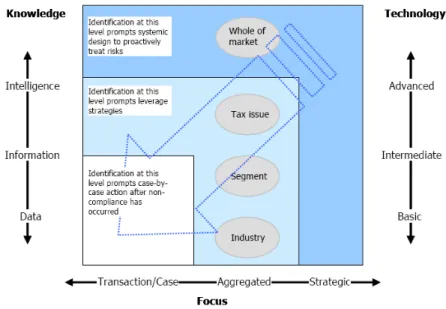
Figure 3 illustrates the combinations of knowledge, technology and focus that come together at the high, medium and case level of risk identification. The direction of the arrow suggests an approach that commences at the high strategic level and leads down, through the medium, to the case level.15
15 This figure is a copy of figure 2.1. from page 21 of OECD Compliance Risk Management Guidance Note (Oct 2004) Risk Identification Diagnostic.
Fig. 3 Risk Identification Diagnostic
One way of identifying risks is to start at the high level and drill down to detailed and taxpayer level:
High level – high level identification starts with the composition of a general risk overview of risky areas or of groups/segments of taxpayers with different compliance
levels e.g. large, medium or small. A general risk overview can be helpful at an early stage because it provides insight without too many details. Simply recorded, such a document gives a general overview of the risk areas and how it is divided in different taxpayer groups. It can also give a description of demographic and economic development and possible regional differences including major risks and recent trends. Last but not least, it provides the direction for identification of risky activities.
Medium level – the entrance to the medium level of identification is a risk area or a
group of taxpayers e.g. the area of under declared income or the risks related to a group of taxpayers with a specific compliance level.
Something to keep in mind is the difference between risky activities and risky taxpayers. Some activities possess a higher level of risk than others. Also, taxpayers can have different compliance levels. Risk identification will therefore always refer to both of these elements.
(1) Risk area
A risk area is a collection of connected risks, for example, risks referring to turnover or to a specific part of tax legislation. Different risk areas can be identified and described in a risk register, a national risk database.
See example 3 The Netherlands (par 3.2.2.): National Risk Database
It is important to identify risks area by area but it is equally important to recognise that a risk in one area can have an impact on one or more risks in other areas.
(2) Groups of taxpayers (segmentation)16
In a tax administration context, segmenting the taxpayer population into sub-populations of taxpayers with similar characteristics and behaviours facilitates more precise identification and categorisation of compliance risks.
Taxpayers can be grouped in different ways, from business size (large, medium and small) to economic activity sector (construction, wholesale, professional) to tax type (direct, indirect). Criteria for segmentation are e.g. level of economic importance, legal form, compliance level or a combination of these.
There are several options for getting a measure of the level of economic importance. For example, the turnover is an indicator, or the total net assets or number of employees. Specifically for fiscal purposes, the annual tax paid (only VAT or VAT plus direct taxes) can be used as an indicator.
The compliance level is of course always a rough calculation based on a number of criteria that says something about the degree of the known (tax) behaviour by a taxpayer, for example:
• the regularity of the tax returns;
• the appearance of any supplementary payments;
• the quality of the administration (bookkeeping);
• the appearance of corrections on the tax return in the past;
• the regularity of payment.
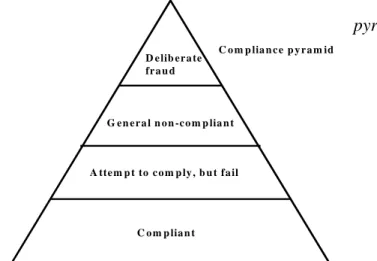
The compliance level can be shown in the shape of a triangle, the compliance pyramid.
Fig. 4 Compliance pyramid
Detailed level: – this level leads to the area of identifying individual taxpayers. An
example here is the list of taxpayers with a high risk of under declared income. Another is a list of taxpayers with an expected relative low compliance level and an overview of the related risks.
See example 4 Italy (par 3.2.3.): APPLE
16 Segmentation breaks down the client base into sub-populations or segments with similar characteristics and features. Differentiation in this way enables an organisation to better understand the behaviours and demands of its clients. D e lib e r a te fr a u d G e n e r a l n o n -c o m p lia n t A tte m p t to c o m p ly , b u t fa il C o m p lia n t C o m p lia n c e p y r a m id
The levels described are based on a top down model that works on a top down basis. However, it is also possible to use a bottom up approach, involving staff at all levels of the organisation, related to the risk sources used for identification e.g. random audit, test audits and insights of revenue officials on the shop floor.
See example 1 Denmark (par 3.1.1.): The Danish Compliance Risk Management Model
2.5.3. Tax Gap
As one of the main objectives of the tax administration is to ensure that the right amount of tax is paid, one starting point of the phase of identification is to try and find an answer to the question ‘what is missing’ (the tax gap, the potential tax yield minus the actual tax revenues). This approach has now been taken by a number of Member States. The tax gap reflects the estimated financial extent of the risk. The determination of the tax gap is not a perfect science. Sometimes statistical support is possible, based on research, data and analysis. However, often the only calculations that can be done are a rough estimation.
Ideally, the calculated gap should be further broken down into areas such as aggressive tax avoidance, fraud, serious non-compliance, error and non-payment. This would
provide additional information on areas that should be addressed. The gap can also be broken down into economic sectors. In some instances, the major problem may be that
many potential taxpayers are simply not known to the tax administration. In others, it may be that many taxpayers who are in the system are substantially under declaring their tax liability. There may also be instances where both problems may be important. The final focus for the tax gap is the contribution by the different categories of taxpayers, for example what is the extent of the tax gap accounted for by large
businesses, by medium businesses and by small businesses? Insight into this can support the direc