8-2020
A Data-parallel Approach for Efficient Resource Utilization in
A Data-parallel Approach for Efficient Resource Utilization in
Distributed Serverless Deep Learning
Distributed Serverless Deep Learning
Kevin Tunder Elom AssogbaFollow this and additional works at: https://scholarworks.rit.edu/theses
Recommended Citation Recommended Citation
Assogba, Kevin Tunder Elom, "A Data-parallel Approach for Efficient Resource Utilization in Distributed Serverless Deep Learning" (2020). Thesis. Rochester Institute of Technology. Accessed from
This Thesis is brought to you for free and open access by RIT Scholar Works. It has been accepted for inclusion in Theses by an authorized administrator of RIT Scholar Works. For more information, please contact
Resource Utilization in Distributed
Serverless Deep Learning
by
Kevin Tunder Elom Assogba
A Thesis Submitted
in
Partial Fulfillment of the
Requirements for the Degree of
Master of Science
in
Computer Science
Supervised by
Dr. M. Mustafa Rafique
Department of Computer Science
B. Thomas Golisano College of Computing and Information Sciences
Rochester Institute of Technology
Rochester, New York
August 2020
Learning
by
Kevin Tunder Elom Assogba
has been examined and approved by the following Committee:
Dr. M. Mustafa Rafique, Chair
Dr. Taejoong Chung, Reader
Dedication
Acknowledgments
“If we knew what is was we were doing, it would not be called research, would it?” —Albert Einstein This work concludes two years of passionate exploration of a field initially new to me. Diving into the nuts and bolts of Computer Science, I became part of a community filled with people of great integrity, professionalism and leadership. I am grateful for the inspiration of many and the wisdom of others in their guidance, assistance and services. I would like to acknowledge the support of the Fulbright Program, the International Institute of Education and Rochester Institute of Technology for the opportunity to undertake my M.Sc. degree. I express my sincere gratitude ...
—to my Research Advisor Dr. M. Mustafa Rafique for his well-oriented and enriching guidance throughout this research.
—toDr. Minseok Kwon, Observer of the Defense Committee and Instructor of the Com-puter Networks course, for his undisputed professionalism and rigor.
—to Dr. Taejoong Chung, Reader of the Defense Committee, for his promptitude and efficiency throughout this research.
—toDr. Hans-Peter Bischof, Program Director of M.Sc. in C.S., for his rigor and peda-gogy. Your Advanced OOP class triggered my interest in Distributed Systems.
—to Dr. Mohan Kumar, Chair of the C.S. Department, for the opportunity to grade for his Analysis of Algorithms class.
—to Mrs. Rebecca O Connor, Academic Advisor, for her assistance in diverse circum-stances, especially in the final semesters.
—toMr. Allahsera A. Tapo, Aqueel Syeda, Aseem Mehtafor being friends and brothers, and contributing to my academic-social balance.
Abstract
A Data-parallel Approach for Efficient Resource Utilization in
Distributed Serverless Deep Learning
Kevin Tunder Elom Assogba
Supervisor: Dr. M. Mustafa Rafique
Serverless computing is an integral part of the recent success of cloud computing, offer-ing cost and performance efficiency for small and large scale distributed systems. Owoffer-ing to the increasing interest of developers in integrating distributed computing techniques into deep learning frameworks for better performance, serverless infrastructures have been the choice of many to host their applications. However, this computing architecture bears re-source limitations which challenge the successful completion of many deep learning jobs.
In our research, an approach is presented to address timeout and memory resource lim-itations which are two key issues to deep learning on serverless infrastructures. Focusing on Apache OpenWhisk as severless platform, and TensorFlow as deep learning frame-work, our solution follows an in-depth assessment of the former and failed attempts at tackling resource constraints through system-level modifications. The proposed approach employs data parallelism and ensures the concurrent execution of separate cloud functions. A weighted averaging of intermediate models is afterwards applied to build an ensemble model ready for evaluation. Through a fine-grained system design, our solution executed and completed deep learning workflows on OpenWhisk with a 0% failure rate. Moreover, the comparison with a traditional deployment on OpenWhisk shows that our approach uses 45% less memory and reduces the execution time by 58%.
Contents
Dedication. . . iii Acknowledgments . . . iv Abstract . . . v 1 Introduction . . . 1 1.1 Motivation . . . 1 1.2 Problem Definition . . . 31.3 Research Objective and Contribution . . . 5
1.4 Layout of the Thesis . . . 6
2 Literature Review . . . 7
2.1 Parallel and Distributed Deep Learning . . . 7
2.2 Serverless Computing . . . 10
2.3 Serverless Machine Learning . . . 11
2.4 Chapter Summary . . . 13
2.4.1 Limitations of Current Approaches . . . 13
2.4.2 Common Challenges . . . 14 3 Enabling Technologies . . . 15 3.1 Apache OpenWhisk . . . 15 3.1.1 System Workflow . . . 16 3.1.2 OpenWhisk Invoker . . . 17 3.2 TensorFlow Framework . . . 18
3.2.1 Distributed Computing Using TensorFlow Framework . . . 18
4 A Scalable Serverless System for Deep Learning . . . 25
4.1 System-Level Improvement . . . 25
4.2 Distributed Serverless Deep Learning Module . . . 31
4.2.1 System Interaction . . . 31
4.2.2 Custom Action Runtime Image . . . 32
4.2.3 Controller . . . 33
4.2.4 Scheduler . . . 34
4.2.5 Model Training and Averaging . . . 35
5 Computational Experiments . . . 37
5.1 Experiments Design and Data . . . 37
5.1.1 Test Cases . . . 38
5.1.2 Data Instances . . . 38
5.1.3 Evaluation Metrics . . . 39
5.2 Analysis and Discussion . . . 40
5.2.1 Numerical Analysis . . . 40
5.2.2 Sensitivity Analysis . . . 44
5.2.3 Discussion and Implications . . . 45
6 Conclusions . . . 48 6.1 Lessons Learned . . . 48 6.2 Future Work . . . 49 Bibliography . . . 50 7 Appendix . . . 57 7.1 Experiments Configuration . . . 57 7.1.1 Environment Setup . . . 57 7.1.2 Additional resources . . . 59
List of Tables
1.1 Comparison of some capabilities of virtual machines and serverless platforms. 3 5.1 Summary of experiments data instances. . . 40 5.2 Comparison of experiments results of the proposed solution and a brute-force
approach on OpenWhisk. Results obtained with 4 GB as maximum mem-ory are labeled in bold. . . 41 5.3 Comparison of failure rate of the proposed solution and a brute-force
ap-proach on OpenWhisk. Results obtained with 4 GB as maximum memory are labeled in bold. . . 42 5.4 Comparison of experiments results of the proposed solution and a
List of Figures
1.1 Failed action invocation using default memory allocation. . . 4
1.2 Successful action invocation after increasing the memory limit. . . 4
2.1 Illustration of the data parallelism strategy. . . 8
2.2 Illustration of the model parallelism strategy. . . 9
3.1 OpenWhisk action invocation workflow. . . 16
3.2 Behind the scenes of OpenWhisk operations [10]. . . 17
3.3 Flowchart of TensorFlow Lite operations. . . 21
3.4 Flowchart of TensorFlow Extended. . . 22
3.5 Variation of computation time with respect to the epoch parameter. . . 23
3.6 Variation of computation time with respect to the batch size. . . 23
4.1 Finite state machine illustrating the container pool-proxy contract. . . 27
4.2 Enhancement of the Run function within OpenWhisk’s docker runtime image. 30 4.3 Workflow of the controller of our proposed module. . . 33
4.4 Distributed deep learning workflow using serverless resources. . . 36
5.1 Impact of the serverless architecture on the model training accuracy and loss. 45 5.2 Impact of the batch size on the memory usage. . . 46
Chapter 1
Introduction
1.1
Motivation
The scale and complexity of computations in this era of big data significantly challenge the engineering of highly efficient software and systems. The end-to-end design of a modern distributed system is subject to issues related to the location of the required data, commu-nication overhead, latency, resource sharing, scalability, fault-tolerance, etc. Traditionally, using a single compute node results in running problem-solving algorithms for hours, days or weeks. But nowadays, the ability to perform trillions of tasks within seconds has mo-tivated many researchers to employ advanced computing strategies for large scale prob-lems. Several parallel and distributed architectures have evolved for high performance computing, especially solving problems in deep learning, DNA sequencing, galaxies simu-lation, etc. Existing strategies involve sharing resources of multiple machines and assigning chunks of instructions and/or data to different processors without compromising minimum latency and space requirements [15]. These distribution strategies are employed in a variety of computing tools like TensorFlow [1], one of the most used deep learning frameworks.
Horizontally scaling by adding more machines reduces the workload of the existing sys-tem and decreases the overall computation time. However, the ubiquitous practice of using physical machines for occasional computations is economically inefficient, even for long running jobs. Furthermore, deploying large scale deep learning algorithms on a cluster of computers requires an extensive resource management, engendering additional opera-tions costs to companies for the recruitment of systems administrators. Subsequently, more
companies are moving towards cloud computing, a compute paradigm where designs for complex problems are simplified.
Diverse distributed systems are deployed in the cloud, and benefit from cloud comput-ing features such as elasticity, pay-as-you-grow, diversity and ease of deployment. Services such as Platform as a Service (PaaS) [17], Infrastructure as a Service (IaaS) [50], Software as a Service (SaaS) [54], Function as a Service (FaaS) [65] are offered to cloud natice ap-plication developers, and the list has been growing with the provision of more specialized services like Machine Learning as a Service (MLaaS) [41] and Data Analytics as a Service (DAaaS) [55].
Our research focuses on FaaS, also known as Serverless Computing. These services offer a strong support to deep learning applications, hence more companies nowadays are deploying their software using serverless resources. A classic example is IoT (Internet of Things) where research are being conducted to improve the performance of edge de-vices [61,12]. Aware of the limited processing capacity of smartphones, watches, camera or other small IoT devices at training or serving deep learning models, applications often offload tasks to cloud infrastructures. While the maintenance of these infrastructures causes an economic and operational burden, serverless computing services remove all operations concerns and provide a high level of concurrency for faster executions [12]. The latter rep-resents an effective support for inference jobs which are short-lived and can leverage the concurrency level to reduce the response time [33]. Furthermore, the event-triggered archi-tecture of serverless platforms offers an ideal environment to deploy IoT applications [37]. Despite the unequivocal advantages of serverless computing, Distributed Deep Learn-ing (DDL) still accounts for a mere percentage of the research conducted on the subject. Essentially, operations like MapReduce [22] in data science or hyper-parameters update in deep learning are challenged by a requirement of the architecture restraining direct com-munication between running cloud functions. Consequently, there is still substantial room for further research on the topic of distributed deep learning on serverless infrastructure, especially on how to train large models and large data sets.
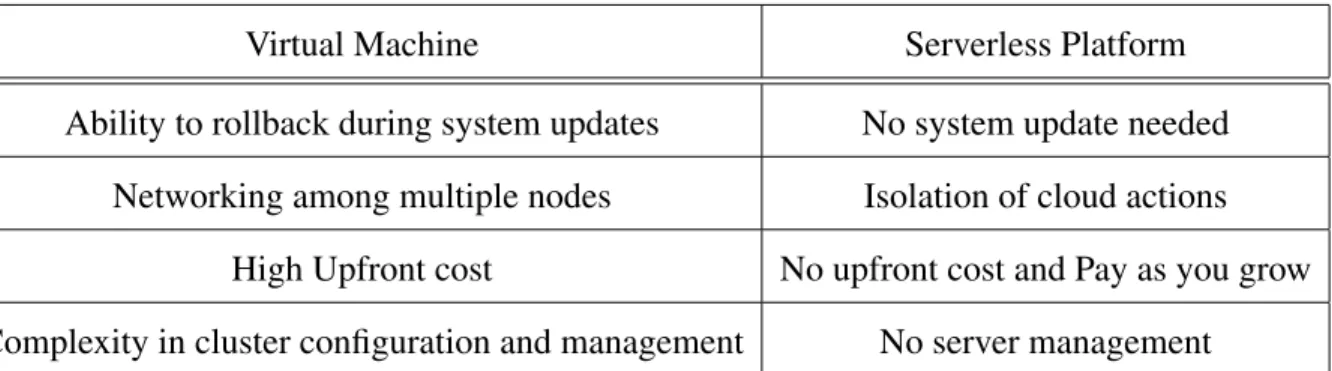
Networking among multiple nodes Isolation of cloud actions
High Upfront cost No upfront cost and Pay as you grow
Complexity in cluster configuration and management No server management
Table 1.1: Comparison of some capabilities of virtual machines and serverless platforms.
1.2
Problem Definition
Consider a cloud native software company X which offers machine learning services to its customers. Having built an image classification platform and trained model M to recognize customers’ inputs and classify them accordingly, X stored an averagely accurate model M on Y Cloud, and contracted OpenWhisk for inference jobs. After a certain period of time, X noticed that the average inference accuracy has declined, and thus decided to adopt a periodic re-training strategy to improve model M’s performance.
Considering available options such as contracting virtual servers or employing Open-Whisk to retrain model M with a medium size data instance, X evaluates some of the ad-vantages and disadad-vantages of each option summarized in Table1.1, and decides to move forward with OpenWhisk. The iterative process of deep learning jobs leverages the ad-vantages offered by multiple layers in a neural network. However, these memory-intensive operations significantly challenge an efficient deployment of deep learning applications on serverless infrastructure.
As the basic unit of serverless computing, an action is configured with resource lim-its to ensure concurrency, scalability and security. The configuration of action limlim-its varies among platforms, but differences are little. While there exists many platforms, this research focuses on Apache OpenWhisk [9] as it is an open-source system and is considered as a de-facto standard for conducting research in serverless computing [13]. On OpenWhisk, the default timeout is 60 seconds allowing up to a maximum of 300 seconds; any action
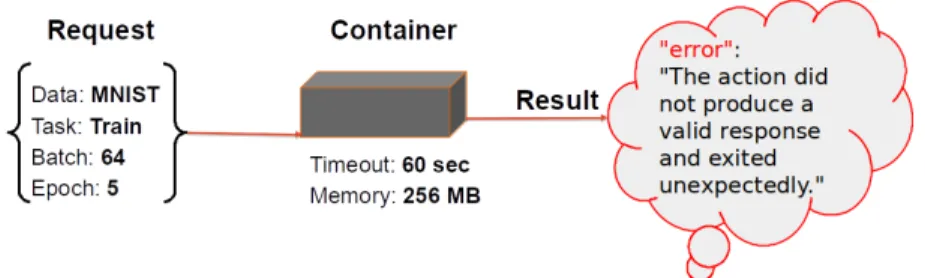
Figure 1.1: Failed action invocation using default memory allocation.
Figure 1.2: Successful action invocation after increasing the memory limit.
exceeding the defined timeout exits with an error. Similarly, a default memory limit per action of 256 MB applies. The maximum memory limit of 512 MB constrains the size of self-contained packages, and challenges the deployment of applications with large depen-dencies, e.g. of machine learning applications. OpenWhisk has other action limits related to logs, payload size, number of triggers, etc., but our research only addresses the timeout and memory resource limits.
To further illustrate the problem under consideration, we train a deep learning model for image classification on the MNIST [40] dataset using TensorFlow on OpenWhisk platform. The entire algorithm is written as a cloud function and therefore expected to fit in a single action. Results are reported on Figure 1.1 and Figure 1.2 representing respectively cases of error and successful completion. As shown on the figures, although the dataset size (32.06 MiB) is significantly smaller than the default memory limit, the action exits with an error message. However after several trials, setting 1792 MB as memory limit by adding the tag–memory <value>during invocation yields a success response. In fact, the allocation of more memory was necessary as each package imported within the function is loaded in the corresponding container, and takes an amount of memory before assigning the remainder
distributed frameworks such as PyWren [35] and ExCamera [25] employ external services to complete fork-join operations in order to ensure consistency, but thereby violate the basic “no server management” policy of serverless platforms [13]. Another common approach is the use of in-memory storage for shared objects in order to minimize latency [14], and many applications use Redis [49] for such purpose.
In summary, unsuccessful completion due to timeouts or low memory availability are common scenarios when running deep learning jobs on serverless infrastructure. The pur-pose of our research is to address these challenges, and enable the migration of more deep learning applications towards serverless computing by reducing the failure rate observed with training deep learning models using serverless resources.
1.3
Research Objective and Contribution
In this thesis, we consider the need for a trade-off between cost, complexity, accessibility, and user satisfaction, and propose a distributed system for DDL using Apache OpenWhisk. Our main hypothesis is that the efficient management of resource utilization using dis-tributed computing strategies would ensure the reduction of the failure rate of deep learn-ing’s training jobs. In order to verify that hypothesis, we intend to enhance OpenWhisk’s core system with the capabilities to collect resource utilization metrics and allocate addi-tional resource when requested by running actions. This approach is also supported by the implementation of an external module aiming at reducing the workload of individual ac-tions through data parallelism and improving the rate of successful execuac-tions of training. Considering its widespread in the community, open-source nature, and support from a large number of contributors, our research employs TensorFlow as deep learning framework, cre-ates models within the scope of TensorFlow Mirrored strategy [57], and deploys Apache OpenWhisk system on Kubernetes. A series of experiments on the proposed solution is
conducted on CloudLab [23] using a collection of test instances and evaluation metrics. While important contributions were already made on serverless deep learning, to the best of our knowledge, research on training models using serverless resources are very scarce, and very few work exist on the deployment of deep leaning jobs on Apache Open-Whisk. Therefore, our research contributes in the following ways:
1. We focus on the time and memory resource constraints challenging to the utilization of large packages as in deep learning,
2. We propose a fine-grained design of the deep learning workflow, and introduce data parallelism to support the reduction of job failures.
3. Considering that machine learning on a distributed system usually requires users to configure parameter server and workers, this research offers a single entry point through command line interface and require user to simply specify the target dataset and job.
1.4
Layout of the Thesis
The remainder of this manuscript is organized into 5 Chapters.
In Chapter2, we introduce the background of the research through a detailed review of existing theoretical and experimental advances in parallel and distributed computing and in serverless machine learning. Chapter 3 describes OpenWhisk and TensorFlow which are the technologies enabling deep learning using serverless architectures in the context of our research. Chapter 4 presents our proposed solution approach, and includes a detailed description of some failed attempts to modify OpenWhisk’s core system. Chapter 5 ex-poses the settings of conducted experiments, explains in detail the different data-sets, test cases and evaluation metrics. This chapter also presents the outcome of the experiments, analyzes and discusses the computational results. Concluding remarks and future works are proposed in Chapter6.
Chapter 2
Literature Review
Extending on existing technologies, this research involves theoretically and experimentally supported fields of research such as Distributed Computing, Machine Learning and Server-less Computing. This section provides a review of previous research on the frameworks, systems architectures, and strategies related to our topic. The following subsections will explore related works and comment on how they offer an effective background for the success of this research but could still benefit from further improvements.
2.1
Parallel and Distributed Deep Learning
Artificial Intelligence (AI) has existed since the 1950s [62], and is based on the assumption that human cognition can be described in detail and be replicated by a machine. Since then, AI has evolved into many sub-fields like Robotics and Machine Learning (ML). The latter constitute the most widely explored AI field of research, and led to the introduction of new topics like deep learning, whereas the former has revolutionized the manufacturing sector.
The rising complexity of deep learning models is tightly coupled with the advances in High Performance Computing (HPC) where strategies involving the sharing of multiple machines’ compute resources have emerged to facilitate faster computation. As the com-munity grows, there is a considerable amount of research in parallel and distributed systems for deep learning which leverages data, model, or hybrid parallelism to optimize resource utilization without compromising latency and space requirements [15].
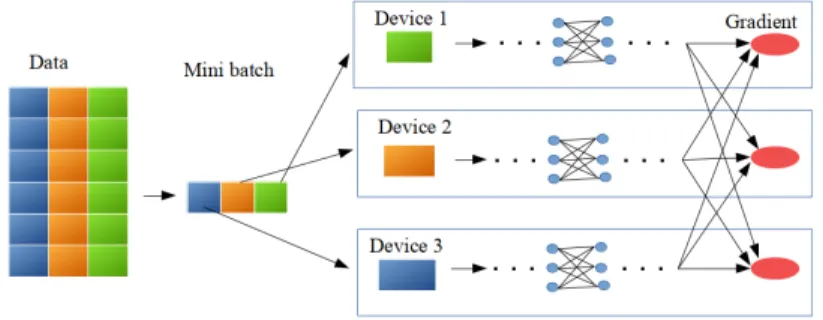
Figure 2.1: Illustration of the data parallelism strategy.
aforementioned parallel computing models for its simplicity and ease to modify. It is a data batch splitting approach which consists in assigning batches to different processors. Figure 2.1 shows data parallelism with TensorFlow where each compute node completes the entire program on a given set of data. Following the computation of the error func-tion, a collective all-reduce is applied to update the gradient on every device and maintain consistency throughout all epochs. Among early DDL frameworks, DistBelief [21] of-fered significant performance, but as the number of parameters has grown exponentially, TensorFlow’s release propelled a faster emergence of DDL. Subsequently, researchers in-creasingly focused on integrating more features to TensorFlow to yield new distributed ar-chitectures. For example, Message Passing Interface (MPI) was used and proved efficient as a communication interface for TensorFlow in a large distributed cluster [64].
Model parallelism. Model parallelism [41] consists in splitting the model and having each processor perform a specific task from the model’s graph. This approach eliminates synchronization between devices for hyper-parameters update, but it requires data transfer between operators. An example of model parallelism is shown in Figure2.2, where device placement is employed to assign a given operation to each device. Therefore, data is trans-ported in its entirety, and operations are performed following their order of implementation in the model graph. In most cases, collective all-reduce communication occurs to update the gradient before launching the following epoch.
Figure 2.2: Illustration of the model parallelism strategy.
deep learning. Some researchers integrate data, model and other types of parallelism [26], whereas others use reinforcement learning for operator assignment in model. To reduce the level of uncertainty and non-suitability in the choice of parallelization strategies, some experts determine the most suitable in a search space through simulations. FlexFlow [34] was proposed to simultaneously integrate operators, parameters, data, and attributes of the model graph for tasks distribution. The system uses SOAP (Sample, Operator, Attribute, and Parameter) search space to determine the most effective strategy for parallel training. To this end, FlexFlow employs a fast, incremental execution simulator to evaluate different strategies, and a Markov Chain Monte Carlo search algorithm which takes advantage of the incremental simulator to rapidly explore the large search space.
In summary, the advent of HPC and the design of multiple parallelism models have facilitated the evolution of distributed deep learning. The aforementioned strategies proved efficient in different applications, but also bear certain disadvantages. Despite its pop-ularity, data parallelism may need excessive memory and higher latency to synchronize parameters updates when training very large models. Model parallelism suits very large models [52], but the implementation of algorithms for model parallelization is complex due to the amount of involved operations. In view of these possible scenarios, several fac-tors such as the type of the problem, the available memory resource, the concurrency limit,
etc., should be under consideration during the design of any distributed system for deep learning.
2.2
Serverless Computing
The abstraction of server management, the reduction of computation costs, the scalabil-ity of compute systems and the availabilscalabil-ity of resources on request are key features of serverless computing as defined by Amazon Web Services (AWS) [6]. For many years, this computing model has revolutionized ways of deploying software, and offers economic and engineering advantages to users from different level of technical skills. It provides an architecture which facilitates an ease-of-deployment and ease-of-management, and thereby attracts diverse applications irrespective of the programming language [4, 67, 53]. Many use cases of serverless applications exist and an increasing range of serverless platforms are being engineered by researchers and developers [8, 27, 9, 24]. Moreover, aiming at alleviating the deployment overhead of an application, orchestration frameworks have also been released [7,43,11], allowing developers to define compositions and launch sequences of actions with a single call. Comparing the overhead of sequential computations and par-allel workflows, Barcelona-Pons et al. [13] used a benchmark of 5 to 320 parallel tasks to analyze the efficiency of Amazon Step Functions (ASF) [7], Azure Durable (ADF) [43], and OpenWhisk Composer [11]. Conducted experiments predefined 20 seconds as fixed duration for a task, and concluded Composer as better at performing parallel workloads.
Research related to serverless computing also focused on solving the cold start, commu-nication, and storage issues, to name a few issues observed during the deployment of a soft-ware. Common to all existing platforms, the cold start problem refers to the extra-latency caused during the initialization of newly requested resources [42]. Openwhisk pre-warms containers to reduce the firing time, but only few container runtimes are cached because they use additional resources. Consequently, solutions ranging from agile implementations to an additional application layer are introduced by researchers to achieve a better perfor-mance. Mohan et al. [44] introduced a strategy to pre-warm and cache network endpoints,
age the knowledge of an action invocation to cold start the containers before sending the request. Following experiments using AWS Lambda and OpenWhisk, authors conclude a 40% reduction of cold start delay.
2.3
Serverless Machine Learning
Within few years of its advent, serverless computing has emerged as an efficient model to perform a large number of parallel tasks. The computation intensity of machine learn-ing and serverless platforms’ capability to perform event-triggered executions led some researchers to develop and evaluate serverless architectures for machine learning.
Related research primarily focused on lightweight computations, specifically on edge computing [47, 46] and serving models for inference [42, 28, 20]. For example, Lin and Glikson [42] deployed a cat/dog image classification model on Knative [28] for inference using TensorFlow, while Ishakian et al. [33] employed AWS Lambda to serve large deep learning models with TensorFlow serving. Rausch et al. [47] explored the feasibility of Edge AI workflow on serverless platforms and proposed a serverless model using edge de-vices as cluster resources and forming an edge cloud platform. Palade et al. [46] defined a hypothesis that the incorporation of serverless computing at the edge of IoT devices for small tasks will improve their processing time. Accordingly, the authors evaluated quali-tatively and quantiquali-tatively the performance of frameworks such as Kubeless, OpenWhisk, OpenFaaS and Knative, and concluded that Kubeless offers better response time and higher throughput. Although those research concluded the possibility of machine learning on serverless infrastructure, yet they only consider a single phase (inference) in the entire ma-chine learning workflow.
Exploring the structure of training jobs in neural networks and the challenges to server-less computing, Feng et al. [39] argued that serverless runtime is also beneficial to train-ing small models, and minimiztrain-ing data transfer between subsequent actions increases the performance of the platform. Carreira et al. [19] expanded the design of serverless ar-chitectures to end-to-end machine learning to develop Cirrus, a system which integrates a stateless server-side back-end and addresses resource constraints as well as workers’ scal-ability issues. The authors designed Cirrus to meet three critical goals defined in their preliminary work [18]:
• A high level language based API;
• A low latency and scalable data storage; and
• A lightweight and high performing worker runtime.
Some of the existing serverless platforms for ML do not support worker failure [18], increasing the probability of sudden job interruption, which in turn would impact the ac-curacy of trained models. Consequently, many developers use additional supports such as external server disks, in-memory data storage like REDIS [49] or cloud data storage like Amazon S3. In-memory data storing has proven more efficient in terms of latency compared to the other options [14], and is employed by a large community of practitioners. In summary, numerous researchers focused on exploring ways to achieve efficiency and performance in machine learning using serverless architectures. Nevertheless, while some authors address a segment of the machine learning workflow, the review of related work also displays an imbalanced attraction towards commercial platforms like AWS Lambda. Among other reasons supporting its selection, authors accredit better resource constraints. This can also be proven by the comparison of AWS Lambda limits [5] and Openwhisk system limits [45] which shows that AWS Lambda offers more resources. For example, while the maximum memory allocation on the former is 3008MB, the latter just allows up to 512MB. In addition, as a commercial platform, AWS Lambda provides a better interface
research settings. Under such circumstances, open source frameworks are more effective, as they offer a larger breath for system-level modifications in order to adapt the platform to different problems.
2.4
Chapter Summary
2.4.1
Limitations of Current Approaches
The preceding literature review evaluates research work which are related to distributed deep learning and its achievement using serverless resources. As can be seen, earlier sys-tems have benefited from a significant amount of enhancement, which led to the wide application of distributed computing approaches in deep learning, and in recent years on serverless platforms. However, while the majority of research on parallel and distributed deep learning proposed problem-specific or job-specific designs, little attention was given to resource utilization for distributed deep learning on serverless platforms.
Meanwhile, the few research articles on distributed serverless deep learning have fo-cused on training models. In fact, many authors have argued that this type of jobs poses a challenge to the deployment on serverless platforms as it requires more data, more opera-tions, and subsequently more memory. Training also necessitates the underlining architec-ture to accommodate the statefullness of hyper-parameters.
The consideration of these problems would drastically improve computations’ effi-ciency as well as user experience, and offer multiple research opportunities especially in this era where the majority of computations, both in academia and industry, are moving towards cloud and edge computing.
2.4.2
Common Challenges
Many limitations of existing serverless platforms undermine the effectiveness of an end-to-end fully server-free deep learning job. Among other issues, the memory and compute time constraints predominantly influence the design of solutions to address the problem under consideration. These two challenges can be described as follows:
1. Memory size limit. Existing serverless frameworks have hard memory constraints conditioning running functions with a higher data storing requirement.
2. Compute time constraints. Deep learning jobs consume more time, but actions are constrained to complete within given time windows, often defined for few thousands of milliseconds.
At the core of our research, we propose and implement approaches of solutions to by-pass these obstacles in order to yield a fully-functional software for end-to-end distributed deep learning.
Chapter 3
Enabling Technologies
3.1
Apache OpenWhisk
The revolution of open-source software development has been a strong enabler of cloud computing [29], yet fewer serverless platforms are available as open-source projects. One of the few open-source serverless computing platforms, Apache OpenWhisk was developed as a joint project by IBM and Adobe and latter released under Apache Software Founda-tion’s flag as open-source project.
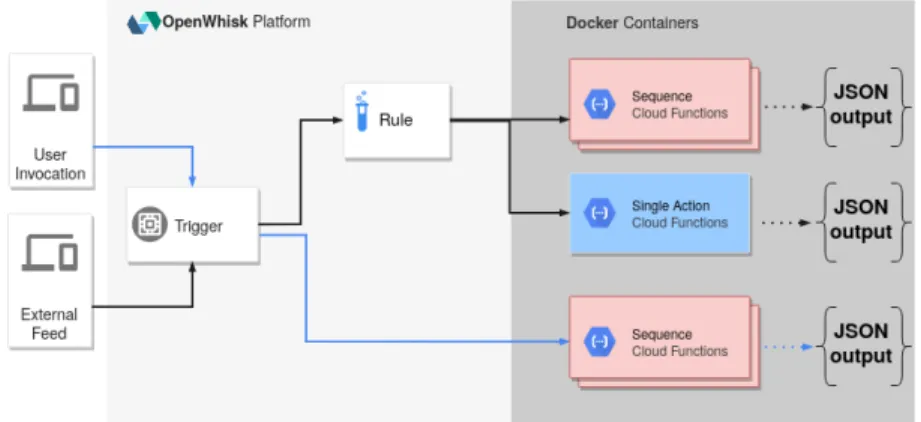
OpenWhisk supports multiple concurrent cloud functions with key-value outputs, where each function, also referred to as action, is deployed in a docker container. However, an in-voked action is restricted from communicating with any other running one. The invocation often follows a threefold procedure involving the emission of a user request, its validation and assignment, and the execution of the requested action. This process can be expanded to a more comprehensive approach including an event source, a trigger, some rules, and the target action. Illustrated in Figure 3.1, the event source can be a web-based request, an external feed from a database, a Git update, or commands executed by the user through OpenWhisk CLI. An event would automatically fire a defined trigger in order to complete a given action or sequence of actions. The developer can also optionally specify rules stating actions to execute, or use a single trigger to call for different actions. It is important to note that actions and triggers are not always linked, thus any user can invoke an action without defining a trigger.
Figure 3.1: OpenWhisk action invocation workflow.
3.1.1
System Workflow
The architecture supporting OpenWhisk’s operations integrates several well-know software stacks such as Nginx, Kafka, Docker, CouchDB, Kubernetes, to name a few. Each com-ponent plays an important role backing the two main entities of the serverless computing platform which are the controller(s) and invoker(s).
OpenWhisk can be deployed through a standalone platform using Docker containers or with Kubernetes to manage the entire cluster. While the former option is straightforward and simpler, the latter is more resilient for middle or large scale clusters. Figure3.2depicts what happens behind the scenes of Openwhisk system, showing the interaction between the enabling packages. Nginx, a high performance open-source web-server, opens the system to the outside exposing HTTP services to clients. This server is primarily used for SSL termination and a reverse proxy to forward the client’s request to the controller.
At the core of OpenWhisk, the controller implements a REST API to authenticate and proceed with the system’s orchestration. Upon reception of a call, the controller checks the credentials of the user, and verifies the authenticity of the user’s request on the basis of data stored in CouchDB. After validation, an activation message is generated and pub-lished by the loadBalancer to an invoker through Kafka. In addition to the loadBalancer, OpenWhisk’s controller encompasses a leanBalancer which directly communicates with
Figure 3.2: Behind the scenes of OpenWhisk operations [10].
the invoker without Kafka as intermediary. The loadBalancer has a holistic view of the en-tire system, and the workload of the invokers, hence proceeds to the selection of the most appropriate one considering its availability and features.
The invoker, manager of the pool of containers, picks the activation messages from Kafka or through feeds, collects the code corresponding to the action from CouchDB, and proceeds to the invocation. In comparison to the controller, the invoker is the closest entity to the action’s container. Consequently, its in-depth evaluation is conducted in the follow-ing chapter in order to examine possible improvements for a better memory management. Meanwhile the following section describes the operations of the invoker.
3.1.2
OpenWhisk Invoker
The invoker is the final stage in the OpenWhisk flow of processing actions. Upon detection of an activation message through the procedure described in Algorithm1, a container with the runtime language corresponding to the action is selected among warmed containers, or created if none is available for use. OpenWhisk supports several programming languages
Algorithm 1:OpenWhisk Invoker workflow.
Data:Command line arguments: invoker [options] [proposedInvokerId]
Result:Void(Launches server and listens for activation messages) basic system configuration;
Kamon shutdown;
load properties from the environment;
ifproperties and runtime manifest are validthen
initialize execution runtime manifest;
get command line arguments and assign invoker ID; initialize Kamon with the assigned ID;
instantiate the invoker provider; launch Invoker server;
such as NodeJs, Java, Python, Go, Swift, PhP, and has docker images for each runtime hosted in its repository. After the selection or creation of a target container, the action code is extracted from CouchDB, and injected into the container for execution. In the end, results and logs are collected and stored back into CouchDB. The container is afterwards destroyed or kept warm for future use.
The direct interaction of the invoker with the pool of containers makes it an ideal target for understanding how action memory is handled in the system. Through the analysis of source codes, and as Algorithm2shows, we noticed that an invoker is instantiated with the configuration of the entire container pool, and has access to the user memory limit.
3.2
TensorFlow Framework
3.2.1
Distributed Computing Using TensorFlow Framework
TensorFlow [1] is a machine learning platform which is widely used in the community by developers and researchers for fast computation and efficient completion of jobs like image classification, pattern recognition, regression, etc. TensorFlow allows developers to perform data, model or hybrid parallel computations with very high accuracy for many problems while maintaining a simple parallelism design. It has extensively been improved
Result:Invoker Provider
Execution context and whisk configuration;
instantiate a container factory to provide container proxy actor; initialize container factory;
clean runtime containers if any existed; initialize necessary databases;
initialize message consumers;
define ack messages transmision pipeline;
instantiate a container proxy actor which will be parsed to the container pool and used when containers are called;
define an activation feed with a method to process activation messages read from Kafka(refer to Algorithm3);
create the container pool with the proxy, pool configuration instructions, and the activation feed;
since its initial release by Google Brain in 2015 as an open-source software, and currently counts variants such as TensorFlow Lite, TensorFlow Extended, Mesh TensorFlow, etc.
TensorFlow Lite
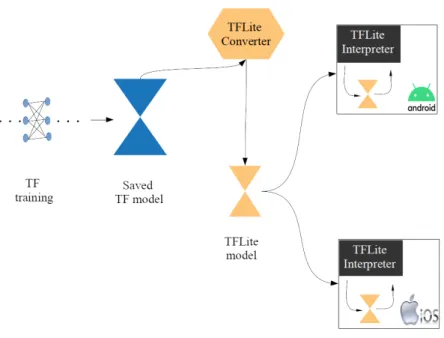
TensorFlow Lite (TFLite) [58] is the lightweight version of TensorFlow, designed for mo-bile and embedded devices. The architecture consists of a converter which transforms a TensorFlow model into TensorFlow Lite format, and an interpreter which reads and works with the converted model. An illustration of the workflow is provided in Figure 3.3. Note that currently only sequential inferences are implemented, offering research opportunities for distributed training on mobile devices.
Algorithm 3:How activation messages are processed.
Data:Activation message
Result:Sends request to container get transaction ID;
set trace context;
load properties from the environment;
ifaction namespace not blacklistedthen
get the action;
create action executable;
send Run(executable, message) request to the poll for assignment to an idle container;
TensorFlow Extended
TensorFlow Extended (TFX) [59] is a distributed architecture ensuring a rapid software production where the developer distributes tasks like transforms, model analysis and serv-ing to different components of the distributed computserv-ing platform. The framework incor-porates Apache Beam, and supports Flink, Spark or Dataflow to ensure data transmission across the entire pipeline.
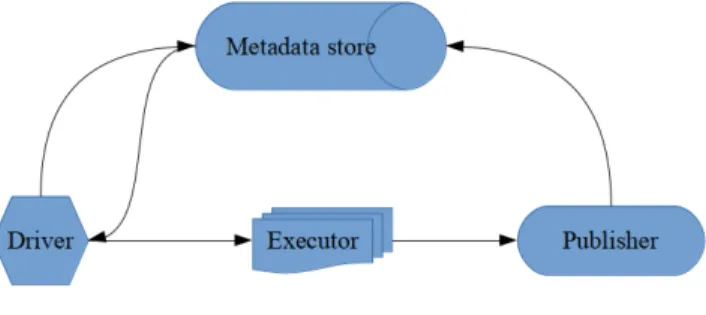
As shown in Figure3.4, TFX uses a driver to read from a metadata store, where infor-mation about the model is kept, and passes it to an executor. Executions of tasks mentioned above can run in parallel before sending the ready-to-serve product to the publisher. The publisher uploads the data back to the metadata store. Note that the executor does not read or write directly to the storage, thereby it can avoid read-write problems which may emerge out of running tasks in a distributed environment.
Mesh TensorFlow
Mesh TensorFlow (MTF) [51] incorporates both data and model parallelism. It is effi-cient at addressing problems with a large number of parameters, attributes, operators. This method can stipulate the type of parallelism through the setting of the mesh shape and the computation layout. As well, it can define the size and configuration of the computational
Figure 3.3: Flowchart of TensorFlow Lite operations.
resources as 1D, 2D, or moreD meshes. A Mesh TensorFlow graph consists of parallel operations coupled with all-reduce as collective communication.
Distributed TensorFlow
Distributed TensorFlow consists in distribution strategies such as Mirrored, Parameter server, One-device, Multi worker Mirrored, to name a few, and follows a dataflow computational model. Operations are represented as a direct acyclic graph replicated on each compute node. The process is common to the majority of the strategies, except parameter server which employs a slightly different approach to update hyper-parameters. The cluster spec-ification, in case of the parameter server strategy, requires the definition of at least one device as parameter server. At the end of each epoch, every worker device sends its gra-dient to the designated parameter servers to update the global value. Similarly, devices refer to the parameter servers to collect the necessary parameter for a given computation. Thus, less space will be used on each worker, however, it may create a communication overhead owing to the number of concurrent requests [15]. The mirrored strategy [57] is a
Figure 3.4: Flowchart of TensorFlow Extended.
base model in Distributed TensorFlow where variables are maintained as mirrored objects across devices. The common reduction methodology is an all-reduce approach which mir-rors the variable onto all devices forming the compute cluster. All-reduce is analogous to broadcasting a value to all components of a network. In TensorFlow, a value-destinations pair is maintained and used to ensure that the same value is broadcast to all the devices.
3.2.2
Distributed TensorFlow Performance Analysis
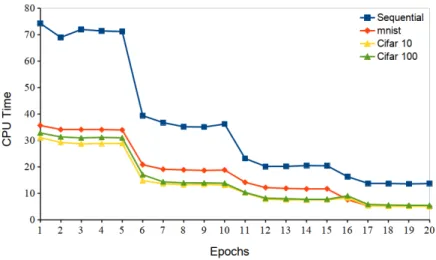
We evaluate the performance of Distributed TensorFlow through the computation time taken per iteration, and per batch size. For comparative analyses, we respectively trained an image classification model with a sequential program and within the scope of the Mir-roredStrategy distribution. One CPU-enabled node from CloudLab hosting Ubuntu 18.04 was instantiated. We imported version 2.0.0b0 of the TensorFlow framework, and defined other parameters as following: data ={MNIST, CIFAR-10, CIFAR-100}; epochs = 5, for visualization and interpretation purposes; batch size ={8, 16, 32, 64}; buffer size = 10000. Computation results are collected and presented on Figures3.5and3.6for comparison. Accordingly, our observations and conclusions can be summarized in the following points: • An increase in the batch size yielded more computation speed. From a distributed computing standpoint, this observation implies the reduction of communication over-head because larger batches minimize the number of parameter updates. In addition,
Figure 3.5: Variation of computation time with respect to the epoch parameter.
Figure 3.6: Variation of computation time with respect to the batch size.
larger batches improve randomness in the training, which does not only avoid over-fitting, but also allows faster convergence. However, the batch size should not be extreme as doing more job at a time will impact the accuracy of the output.
• As the index of the epoch increases, less variation is observed in the computation. However, there is an improvement in the accuracy and reduction of the loss. On the one hand, it illustrates the process of gradient descent, where the update of the gradient at the end of an epoch allows better performance during the next one. On the other hand, it explains the iterative process where the entire dataset, in the form
of mini batch, goes through the neural network at each epoch.
• Distribution of tasks to multiple compute nodes allows faster computation. The co-ordination of each node’s resources reduces their workload, and consequently allows to make an efficient use of the CPU cycles for more operations.
Chapter 4
A Scalable Serverless System for Deep
Learning
With regards to OpenWhisk timeout and memory resource constraints, our research aims at enhancing the system and providing the most efficient approach to train deep learning mod-els and/or infer testing data. Therefore, we explore two different enhancement strategies, and analyze their feasibility taking into account the design of the current platform.
4.1
System-Level Improvement
The overview of Apache OpenWhisk presented in Section3.1.2has introduced the factors which define the selection of a pre-warm or warm container to execute requested functions. We emphasized on the choice of a container which kind (runtime language) matches the invoked action, but the memory requirement of the request is also considered. As a matter of fact, an action can be configured by the user with a desired value for memory allocation, and it is part of the invoker’s responsibilities to ensure that the selected container satisfies the request. Henceforth, not only does the kind of a warm container play a role in deciding whether or not to cold start a new container, but the capacity of the latter is also assessed.
A record of the memory allocated to active containers is maintained by the invoker. Using a pool hierarchy to track free, busy, pre-warm starting and prewarmed containers, an OpenWhisk invoker communicates with managed containers through their proxies, and established a contract to define the interaction. The container proxy is a representation of
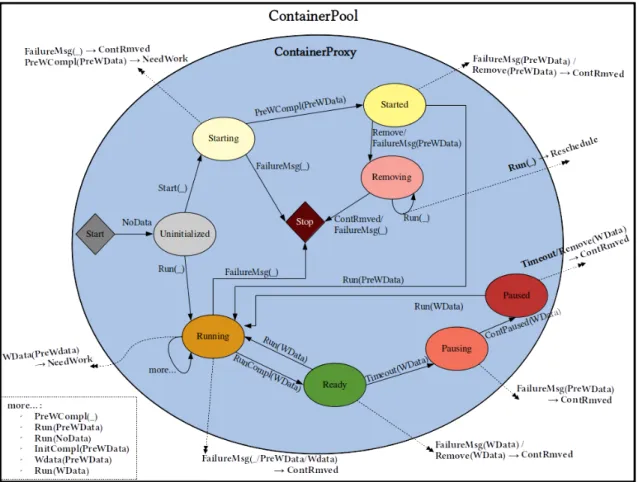
the running container, and is used to route connections that would have otherwise directly reached the invoker. While communication is achieved through HTTP, the proxy contract defines the content of the request as well as actions to perform on the basis of the response. The contract between the invoker and the container proxy is implemented using Akka Actor model [2]. The interaction is interpreted by a Finite State Machine (FSM) [3] using a set of relations as follows: In the occurrence of Event E in State S, perform Action A and move to State T.
State(S) x Event(E)→Action(A), State(T)
Figure4.1describes the contract established with the proxy in order to efficiently man-age resources. A container can be in one of eight different states (Initialized, Starting, Started, Running, Ready, Pausing, Paused and Removing), and one or more actions can be performed following the occurrence of an event. For example, following transmission of aRunrequest with pre-warmed data, a started container changes its state toRunning. The current system configuration allows the container proxy to receiveStart,Run,Removeand HealthPingEnabledrequests from the pool, respectively to initialize, launch computations, reclaim the container, and check if the container is healthy. In return, the container proxy can send to the invoker requests such asNeedWork,ContainerPaused,ContainerRemoved, RescheduleJob,PreWarmCompleted,InitCompletedandRunCompleted.
A running container is allowed to request for more work from the container pool. In view of the possibility of such action, can we redirect this mechanism to request for more memory? In order to evaluate the feasibility, we formulate the following proposition and verify them on OpenWhisk.
Proposition 1. Let the container proxy periodically check for memory usage, and send a NeedMemory request to the pool when the remaining memory is critical.
The implementation of a resource monitor in the container proxy is our first attempt to achieve a dynamic memory management. As shown in Algorithm 4, the container would periodically get the remaining memory, checks if there are less than 10 MB available. Be
Figure 4.1: Finite state machine illustrating the container pool-proxy contract.
the result true, the container would notify the pool through a NeedMemory request. The container’s information is encapsulated inside a warmData variable which is forwarded along with the request. In case of a NeedMemory event, Algorithm5shows that the pool checks if it has enough memory to assign an additional 256 MB to the requesting actor, otherwise assign the amount of free memory in the pool. In order to successfully compile these algorithm, we had to also modify the variable holding the memory limit of an ac-tion from "val" to "var" as the former defines immutable variables while the latter allows modifications after the variable’s definition.
Although this approach maintains the consistency of resource inventory on every actor of the transaction, it failed to collect the accurate memory usage because the container proxy does not operate inside the docker container where the action is run. Henceforth, the
Algorithm 4:Memory resource monitor.
whilestatus is runningdo
get remaining memory;
ifremains less or equal to 10.MBthen
ContainerPool←NeedMemory(WarmData);
end end
Algorithm 5:ContainerPool handling of NeedMemory requests.
ifEvent: NeedMemorythen
ifhasPoolSpaceFor(freePool, 256.MB)then
// If there is not enough memory, increase by 256.MB; warmData.increaseMemoryBy(256);
else
// Remove a a too cold container to free up space in the containerPool; availableSpace = Math.min(256, memoryConsumptionOf(freePool)).MB; ContainerPool.remove(freePool, availableSpace).map(removeContainer); warmData.increaseMemoryBy(availableSpace.toMB.toInt);
end end
resource monitor just keeps track of what is internally happening inside the invoker pod, which is not the desired behavior.
Lemma 1. The container proxy, entity which holds metadata about the running container is hosted by the invoker pod. Therefore, we cannot monitor the active memory usage of a running container from the proxy.
Proposition 2. Aware that actions run inside docker containers within a different pod from that of the invoker, let adapt the existing communication strategy between the run-ning docker container and the invoker and incorporate a warrun-ning notification in case of critical memory consumption level.
As mentioned above, the invoker uses HTTP to send requests to the container. Two routes, namely/initand/run, are available in the existing system architecture respectively to initialize the container and launch the execution of the action. The expansion mentioned in Proposition2involves modifying the behavior of therunfunction executed upon reception
execute code in global context; get results of the execution;
ifresult is a dictionarythen
return result with a 200 status code;
else
return a 502 status code with an error message;
end
of a request through the/runroute. The resource monitor is launched inside the container before the execution of the code, as shown in Algorithm 6. Once the monitor detects the usage in the critical region, our implementation summarized in Figure 4.2 requires the container to return a 200 HTTP status code with the word "memory" as a warning, and continue listening until the execution of the code is completed. The container proxy then forwards a NeedMemory to the pool which update the entire deployment accordingly. Our choice of the response status is defined by the current system in which the invoker considers any response with a 500 status code as a failure, and removes the corresponding container from the pool. Willing to maintain the action running until completion, an HTTP response with a 200 status code appears ideal.
In part, this system enhancement works because the memory usage of the running con-tainer is accurately monitored. However, setting a new memory limit was not successful as the underlying deployment environment is Kubernetes, and the resource limits of a run-ning pod cannot be modified. The destruction of the runrun-ning pod, cold starting a new one and resuming the action from beginning does not present an efficient strategy as it infers a longer execution time and worse results.
(a)Original Design of the Run function
(b)Memory-Aware Design of the Run function
Figure 4.2: Enhancement of the Run function within OpenWhisk’s docker runtime image.
invoker and the docker container hosting the execution of the invoked action. The com-munication is established and maintained through HTTP services, and we could moni-tor the utilization of either pod successfully. However, the modification of the memory resource limits of the action’s pod failed as Kubernetes does not support the update of a running pod’s resources. The execution of the command kubectl patch pod wskwsktf-invoker-00-1-prewarm-nodejs10 -n openwhisk -p ’{"spec":{"containers":[{"name":"user-action","resources":{"limits":{"memory":"512Mi"}}}]}}’ aiming at externally modifying the memory limit of a testing pod ”wskwsktf-invoker-00-1-prewarm-nodejs10” failed with an error which declares that The Pod "wskwsktf-invoker-00-1-prewarm-nodejs10" is in-valid: spec: Forbidden: pod updates may not change fields other than ‘spec.containers[-*].image‘, ‘spec.initContainers[‘spec.containers[-*].image‘, ‘spec.activeDeadlineSeconds‘ or ‘spec.tolera-tions‘ (only additions to existing tolerations). Although we can destroy the running con-tainer an assign more memory before redeploying, yet this approach would undermine the efficiency of our solution because there would be a significant and inefficient memory re-source utilization. Considering the risk of a worse performance, our research has expanded
4.2
Distributed Serverless Deep Learning Module
A deep learning workflow is an iterative process which improves the efficiency of the trained model on the basis of hyper-parameters update. Employing serverless computing to perform such tasks necessitates the ability to synchronize actions and accordingly update parameters. However, not only is this feature unavailable on OpenWhisk, but communica-tion between accommunica-tions is also restricted, thereby requiring for an outside support. Moreover, the timeout and memory resource limitations enforced by serverless platforms expose deep learning jobs to a higher risk of unexpected termination, compromised results and worse ac-curacy. Considering the challenges of a dynamic memory allocation at the system level, our research proposes a distributed module to provide scheduling and task assignment support using a fine-grained system design. We introduce DISDEL, a distributed serverless deep learning module, which employs data-parallelism to ensure a fine-granularity of deployed actions, and computes containers memory resources based on an SAP (Sample - Attributes - Parameters) feature set. These features are factored to determine the appropriate memory allocation of a container in order to avoid over-provisioning or under-provisioning as the former would lead to a poor resource utilization and the latter to the interruption of running containers.
4.2.1
System Interaction
The proposed architecture follows a workflow applicable to many problems be it image classification, object detection, text processing, etc. In view of storage constraints of cloud actions and aware that communication between actions is not supported on existing plat-forms, our strategy combines both client and serverless resources. As shown in Figure4.4, the entry point into the system is a command line interface where users submit their re-quests by providing the target dataset and the job type, and optionally specify the desired
batch size and the number of epochs. In case of omission of optional parameters, default values of 64 data entries per batch and five epochs are applied.
A user request is received by a controller, which is the main component of our additional module, and the only part which is launched on the host system. As the name specifies, the controller processes the request and proceeds accordingly. An example is used in Fig-ure 4.4to illustrate a training request from a user who targets the mnist dataset. First, an initialization phase occurs and consists in reading the parameters, computing the number of actions to create, and creating a package to wrap the entire composition. Another use of the package is to define all the parameters as a dictionary which can be inherited and accessed by invoked actions. Second, actions are created. For the example under consideration, only the training and collectWeights actions are created, but if the requested job were an infer-ence, an additional action would have been created for the evaluation phase. Third, training actions are invoked concurrently with a blocking call maintaining the main thread until all worker threads join. Each action stores the trained model in a Redis in-memory data store for later use. The fork-join mechanism is employed to ensure that more data points are used to build a more accurate ensemble model. Following the join operation, the collectWeights action collects all trained models from the data store for a weighted averaging of each layer and generates an ensemble model. This model is stored back into Redis, and can be used at time of inference.
4.2.2
Custom Action Runtime Image
Considering the different entities enabling deep learning on OpenWhisk, the default stack consists in the execution of docker containers inside Kubernetes pods, with an underly-ing docker image built from the base OpenWhisk docker runtime image. Under several circumstances, images specific to the runtime of the requested action are often used, or recreated as custom images with additional packages to accommodate applications which import additional modules. Nevertheless, it is important to point out that although Open-Whisk is compatible with custom runtime images, the system requires the implementation
Figure 4.3: Workflow of the controller of our proposed module.
of the action interface, an interface where routes for invocation requests are defined. The default python action runtime image does not contain TensorFlow framework, thus, it is imperative to parse a custom docker image with the–dockerflag at creation. However, in our setting where many actions are concurrently deployed, we reduced the overhead of parsing the image each time by building a custom image which contains all the required modules for the python runtime along with TensorFlow, TensorFlow-datasets and Redis. For simplicity and ease of reproduction, we adapt OpenWhisk’s image for python actions1, and define the resulting custom image as default runtime for python actions in the invoker pod’s manifest.
4.2.3
Controller
At the core of DISDEL, the controller is the main processing unit of our proposed module. Its primary functions, as shown in Figure 4.3, are the reception and authentication of the user’s request, the generation of application configuration parameters, the transmission of a request to the scheduler to determine the memory allocation, the initiation of the fork-join operations, and the transmission of the result back to the user. The validation of the job is a simple comparison to ensure the entry is either train or infer, whereas that of the dataset ensures the target data is available in the TensorFlow Dataset Catalog [56].
Data is a critical ingredient in every deep learning model training or inference. The availability and quality of collected data does not only impact the execution’s duration, but it also influences the accuracy of the generated model. Our goal being to enable the training of medium and large datasets on serverless platforms without the failure of any invoked container, we implemented our module around a data parallelism approach. Based on the number of actions, the controller splits the target dataset into smaller chunks which would fit in a single action. The fitness of the obtained data size is evaluated with the assistance of a scheduler which determines the most suitable memory allocation for the data. More on the scheduler is provided in the next section. Upon reception of the memory to allocate, the controller creates and invokes serverless actions which are executed on OpenWhisk. Finally the result of the execution is collected and returned to the user.
4.2.4
Scheduler
Training a deep learning model is a memory-intensive job. From the assembly of the model to its compilation and fitting, a significant amount of the host’s resources are consumed, and the shortage in the amount of memory needed for an operation leads to the sudden interruption of the entire training. In this section, we introduce our scheduler, one of the main components of DISDEL, which has the primary responsibility of partitioning memory based on a set of features.
The memory computation considers three different features which are the Sample (num-ber of examples/records in the dataset), Attribute (input size, num(num-ber of output classes, number of channels in a given sample), and Parameter (number of trainable parameters at each layer). The defined model is of three layers (one convolution layer and two dense layers) with a max pooling phase after the first layer. Therefore, the total number of param-eters is computed as the aggregation of each layer. At the convolution layer, the number of trainable parameters is computed using p = (m×k2 ×n) +n [36] where m designates the number of input channels,kis the filter size andnthe number of output channels. Sub-sequently, we estimate the memory usage of fitting the model as f it= e×p×swheree
we include the size of the generated runtime imagepkg, the size of the datasetdta, the size of the compiled model mod and a safety limit saf in order to compute the total memory estimation of an action as memory = f it+pkg +dta+mod+saf. The purpose of the safety limit is to ensure that there is enough space to hold generated variables, the directories containing logs and checkpoints, and a.h5file storing the generated model.
4.2.5
Model Training and Averaging
The maximum user memory on OpenWhisk is defined by default as 2048 MB, which is the maximum memory allocated to a pool of container as well. Aware of the memory usage of the custom runtime image, the compiled model, logs and checkpoints, training a large dataset in a single action represents a significant risk of execution failure due to the lack of memory. However, the restriction on inter-action communication prevents the concurrent use of multiple actions to perform all-reduce updates of parameters.
We propose a fork-join strategy in which training is performed concurrently on portions of the dataset inside different containers. Upon completion of all training jobs, we invoke a single action to collect all models stored during training actions from a designated data store, proceed to their weighted averaging (equal weights are used in our implementation), and return the ensemble model to the data store for future use during inference. With regards to the traffic between actions and the storage, the selection of a suitable intermediate storage proves critical as it may incur additional delay. For the sake of faster insertion and retrieval, we employ Redis due to its efficiency as proved by many researchers and its popularity in the open-source community. An experience with 1 KB payload also supports the performance of Redis as the average latency of put and get requests to an Amazon S3 database largely exceeds storage on Redis [14].
Figure 4.4: Distributed deep learning workflow using serverless resources.
Our strategy does not only yield an efficient performance, but is also scalable as a con-troller takes care of the scheduling of the number of actions, implements data parallelism, manages the fork-join process, and returns the result. Ultimately, the user would not have to manage the burden of individually determining the amount of data to assign to an action or the number of action to create. The proposed system just requires the name of the dataset and the job to complete. The rest is handled internally and results are returned to the user.
Chapter 5
Computational Experiments
This section presents computational experiments designed to evaluate the performance of the proposed module. In section5.1we introduce different components of our experiments starting from the system configuration, and explain the considered data instances along with comparison metrics used to assess the implemented test cases. Section5.2reports the results and discusses their implications.
5.1
Experiments Design and Data
The proposed module is validated on a CloudLab testbed where OpenWhisk is deployed in a Kubernetes cluster. Prior to computation, we installed software packages such as Docker [63], Kind [60], Helm [30], Kubernetes [31], OpenWhisk CLI (wsk) [9] that are re-quired for the cluster deployment. Kind creates the cluster for running Kubernetes locally; Helm installs the deployment; Kubernetes orchestrates the OpenWhisk system; Docker containers host the execution of users’ requested actions. The script used to setup the ex-periment is provided in Appendix7.1and the code is available in the GitHub repository of RIT’s High Performance Distributed Systems Lab1.
DISDEL is developed in Python to ensure that it is lightweight and user-friendly, and additional shell scripts are written to orchestrate the creation and invocation of our actions. A collection of five data instances from the TensorFlow datasets catalog [56], six evaluation metrics and three different test cases were used to facilitate the validation of our solution.
1
5.1.1
Test Cases
Three different scenarios are evaluated in our experiments in order to assess diverse run-time environments and validate the efficiency of our proposed solution. The test cases are described as following:
• DISDEL:This implementation employs our proposed module for distributed server-less deep learning as described in Section4.2.
• Brute Force: We directly run the algorithms on OpenWhisk and increase either the memory size by 256 MB or the timeout by 10 seconds every time the container fails based on the returned error type. These values are maintained as they avoid restarting the containers many times which ends up increasing the total memory usage and duration.
• Virtual Machine: We execute the deep learning algorithms on the host virtual ma-chine to imitate deep learning on a server and for further comparisons.
5.1.2
Data Instances
Five data instances classified into two groups are used. Table 5.1describes each instance and presents their respective size, number of labels, number of examples and the job re-quested in our computational experiments. The first set refers to datasets of size measured in KiB and the second set groups datasets measured in MiB.
• Binary_Alpha_Digits2: This dataset contains 20×16representations of numbers from 0 to 9 and capital letters from A through Z.
• CIFAR10 [48]: From the Canadian Institute For Advanced Research (CIFAR), this dataset is a collection of images that are commonly used to train machine learning and computer vision algorithms. Ten different classes representing airplanes, cars, birds, cats, deer, dogs, frogs, horses, ships, and trucks are included.
2The homepage is
• MNIST [40]:The Modified National Institute of Standards and Technology (MNIST) database is a large database of handwritten digits that is commonly used for training various image processing systems.
• Fashion_MNIST [66]: This dataset consists of gray scale28×28images labeled from ten different classes.
5.1.3
Evaluation Metrics
We use the following six metrics to measure the performance of our test cases: 1. Number of created containers
2. Total memory usage 3. Total execution duration
4. Total container initialization time (cold start) 5. Number of failed containers
6. Failure rate
Computational results are obtained on a 3-node cluster composed of Intel(R) Xeon(R) CPU E5-2630 v3 @ 2.40GHz machines from the CloudLab [23] Wisconsin data center. Each node has 40 CPUs with 32-bit and 64-bit op-modes, offers 196 GB of RAM, and hosts an Ubuntu 18.04 operating system. For the sake of diversity among the results, we ran experiments varying the batch size and number of epochs such that: batch={32, 64, 128}; epochs={5, 10}.
Set Name Size Classes Number of examples Jobs requested
1 (KiB) Binary_Alpha_Digits 519.83 36 1404 train
2 (MiB)
CIFAR100 292.74 100 60000 train
CIFAR10 294.58 10 60000 train & test
Fashion_MNIST 65.78 10 70000 train & test
MNIST 32.06 10 70000 train & test
Table 5.1: Summary of experiments data instances.
5.2
Analysis and Discussion
5.2.1
Numerical Analysis
We provide the results of our computations with a batch size of 64 over five epochs shown in Table5.2,Table5.3and Table5.4. Among others sets of parameters, we report results with the aforementioned values as they provide the best sample for analysis, especially with "Out Of Memory" errors which are obtained as outcomes of some experiments. For all the tables reporting the computational results, Column 1 states the dataset used during the experiment under consideration. In Table 5.2 and Table5.4, Columns 2 and 3 respectively report the memory usage during the execution of the deep learning job in each of our test cases; Columns 4 and 5 contain the duration of the execution, while Table 5.2 specifically has Columns 6 and 7 present the time taken by the initialization of a container for the requested action. We have not measured the initialization time for the direct deployment on a virtual machine as this case does not use serverless resources. In Table 5.3, Columns 2 and 3 report the number of containers used to execute jobs requested in cases of deployments using OpenWhisk; Columns 4 and 5 present the number of restarted containers due to out-of-memory or timeout failures; Columns 6 and 7 compute the failure rates in the compared cases.

![Figure 3.2: Behind the scenes of OpenWhisk operations [10].](https://thumb-us.123doks.com/thumbv2/123dok_us/9901387.2483545/27.918.244.682.133.497/figure-scenes-openwhisk-operations.webp)