Finance and Banking
The Value Relevance of IFRS: The Case of Turkey
Professor Ahmet Türel, PhD
Istanbul University, School of Business, Turkey [email protected]
Abstract: Accounting standards that are mostly compatible with International Financial Reporting Standards (IFRS) are required for consolidated financial statements of all Turkish listed firms starting from 2005 fiscal year end. Before that, financial reporting in Turkey was closely related to tax reporting. Until 2003, all Turkish listed firms were preparing their financial statements in accordance with the local standards issued by the Capital Market Board of Turkey. In this study, I examine the relative and incremental value relevance of earnings and the book value of equity under Capital Market Board (CMB) Accounting Standards (2001-2002) and under IFRS (2005-2006) for Turkish listed firms. I compare these two periods to investigate whether the mandatory adoption of IFRS increase relevance of earnings and book value of equity which are accepted as proxies of accounting quality. I find evidence that the value relevance of earnings and book value of equity has increased significantly after adopting IFRS. In addition, I find that the incremental value relevance of earnings increased between the CMB accounting standards period and the IFRS period. However, the incremental value relevance of book value of equity degreased in the same period.
Keywords: accounting standards, fiscal year, incremental value, IFRS, Capital Market Board. Jel Classification: M40, M41, G28
1. Introduction
Since January 1st 2005 EU publicly traded companies are required to prepare consolidated accounts on the basis of International Financial Reporting Standards (IFRS) that are developed by International Accounting Standards Board (IASB). Prior to that, using IAS/IFRS was voluntary in many European countries. This paper explores the impact of transition to IFRS on accounting quality in Turkey by examining and comparing the value relevance of earnings and the book value of equity under Capital Market Board Accounting Standards during 2001-2002 with those under IFRS during 2005-2006. For this purpose, I conduct my investigation using all Turkish companies listed on the Istanbul Stock Exchange (ISE). The study is based on the model which has also been used in prior research (Ohlson, 1995). This model expresses stock price as a function of both earnings and book value of equity. I measure value relevance in terms of the ability of accounting measures to explain stock prices. Particularly, I investigate whether there is a change in the relative and incremental value relevance of earnings and the book value of equity during these two periods.
I limit my investigation to Turkish companies to control for institutional and political factors such as legal system, taxation, providers of finance, and inflation which affect companies’ reporting and stock market participants’ investing behaviors. The other reason for choosing Turkey as the focus of this study is that relatively little is known about its accounting practices although it has an attempt to become a full member of the European Union (EU).
The Turkish economy has been an emerging one during the last decades. So has been the Turkish Capital Market. Total number of companies listed in the ISE was 304 and the shares of the foreign or international investors represented 66, 3% as of 2005. As well, there had been hyper-inflationary environments since the early 1970s. For some years, the annual inflation rate had been more than 100% (Pekdemir & Turel). Having high inflation for over 30 years, the financial statements in Turkey have been considered useless tools in decision-making. The companies tried to benefit from the incentives in the Turkish Tax Regulation (i.e. LIFO, accelerated depreciation) to negate the effects of inflation till the year 2003. In recent years, this problem seems to be solved with the legislations about the mandatory application of inflation accounting and subsequently full IFRSs (Yılmaz & Sarıoglu, 2005). Moreover, foreign exchange rates have been stabilized, interest and inflation rates have declined to reasonable levels since 2003. Therefore, I think that Turkey offers an interesting setting because of its distinctive economic context. The aim of the accounting regulations in Turkey was to protect the interests of the Treasury. Therefore, accounting practices for most companies in Turkey has been strongly influenced by the need to produce information to tax authorities (Cooke & Curuk, 1996). Besides this, there have been significant changes in accounting rules in Turkey. In an attempt to become a member of the EU, publicly traded companies in Turkey have been presenting their financial reports under IFRS since 2005. Without mentioning the level of compliance, a study reported that Turkey has been among the countries where the IFRSs have been entirely implemented since 2005 (Barth, 2007). This research is mainly motivated by the major revisions to Turkish accounting rules that have been following the development of new and revised IASs and IFRSs. Many of these revisions and new standards reflect IASB’s preference for fair value measurement of assets and liabilities (King, 2006). Taking into consideration the developments in the accounting practices in Turkey, I predict that these changes are likely to affect the value relevance of earnings and book value of equity.
The remainder of this paper is organized as follows. In section 2, a short overview of the development of International Financial Reporting Standards in Turkey is given. In section 3, prior research on the value relevance of earnings and book value is briefly discussed. In section 4, the research design and the sample is described. Section 5 presents the results while section 6 concludes.
2. The Development of International Financial Reporting Standards in Turkey
The development of IFRS in Turkey has a long story. The most influential institutions affecting the development of International Financial Reporting Standards in Turkey can be cited as (1) The Expert Accountants’ Association of Turkey (TMUD) (2) Capital Markets Board of Turkey (CMB) (3) Turkish Accounting and Auditing Standards Board (TMUDESK) (4) The Banking Regulation and Supervising Agency (BDDK) (5) Turkish Accounting Standards Board (TMSK). The first attempt was made by the TMUD that was established in 1942. Following the establishment of International Federation of Accountants (IFAC) in 1977 (of which TMUD was a founding member) the TMUD translated all IASs and presented them to TMUD members. Since the TMUD had not been a powerful organization the implementation of International Accounting Standards Committee (IASC) standards was not very effective (Yılmaz & Selvi, 2004).
The forceful implementation of accounting standards came with the establishment of CMB that was empowered by the Capital Markets Law (CML), which was enacted in 1981. CMB was based on the Securities and Exchange Commission in the US and has extensive powers including specifying accounting standards for companies. The listed companies in the Istanbul Stock Exchange (ISE) have started to use accounting and reporting standards that were set by the Board. In 2001, the Board issued a communiqué on inflation accounting and a revised communiqué on consolidation of financial statements. The first financial statements prepared using these communiqués were published as of December 31, 2003. These regulations were fully compatible with the related IASs. Moreover, the Board issued a broad set of financial reporting standards that are mostly compatible with IASs and IFRSs in 2003. These standards became effective for listed companies from the beginning of 2005.
Another attempt was made by the TMUDESK which was established in 1994. The members of this board were appointed by Union of Chambers of Certified Accountants of Turkey (TURMOB) and the representatives of the related institutions. From 1994 to 2001, TMUDESK has published 19 Turkish Accounting Standards which were in conformity with the IASs. However, these standards could not be applied by companies due to lack of sanction.
BDDK which was established in 2000 after the banking crisis in Turkey, was another regulatory body that set accounting standards for banks and financial institutions. The standards issued by BDDK in 2002 were compatible with IASs and IFRSs.
TMSK was established in 2002 by a legal regulation. This new Board has legal power for setting Turkish Accounting Standards and sanction for all companies in
Turkey. The Board has been publishing accounting standards which are fully compatible with IASs and IFRSs.
All of the accounting standards published by these different regulators were similar in nature. However, a harmonization of accounting standards was needed within the country. For this purpose, BDDK abolished its accounting standards by issuing a regulation in 2006. BDDK decided that banks and financial institutions will use accounting standards published by the TMSK. In addition to that, CMB of Turkey abolished its accounting standards by issuing a communiqué in 2008. The communiqué requires listed companies in the ISE to prepare their financial statements compatible with IFRSs adopted by the European Union. The communiqué specifies that companies can use accounting standards published by the TMSK which are compatible with the IFRSs adopted by the European Union. Currently, TMSK became the only organization that published accounting standards which are fully compatible with IASs and IFRSs. Moreover, the draft of Turkish Commerce Law requires not only public companies, but all companies’ to prepare their financial statements in accordance with the Turkish Accounting Standards that are compatible with International Financial Reporting Standards (IFRS).
3. Prior Research
A large number of studies compare the accounting quality of IFRS versus national GAAPs after mandatory IFRS adoption. Paananen et al. (2005) found that the accounting quality increases in Sweden after the adoption of IFRS as the association of book values and share prices increases significantly after the switch. In addition, they find an increase in the incremental value relevance of both measures.
Bellas et al. (2007) examine the value relevance of the 2004 book values on 2004 market values and compares the value relevance of the restated 2004 IFRS figures again on the 2004 market values. They find book value of equity to be more value relevant under IFRS for Greek companies. However, they could not reach the same result for profit after tax.
Jermakowicz et al. (2007) examine the association between book values of earnings and equity with market values for DAX-30 companies during the period 1995-2004 to assess whether adopting IFRS or US GAAP or cross-listing on the NYSE improves or worsens the association between book values of earnings and stock prices. The results confirm that adopting IFRS or US GAAP or cross-listing on the NYSE significantly increased the value relevance of earnings relative to market prices.
A study conducted by the Callao et al. (2007) partly focuses on the effects of the new standards on the value relevance of financial reporting in Spain. They find that there has been no improvement in the relevance of financial reporting to local stock
market operators because the gap between book and market values is wider when IFRS are applied.
Morais & Curto (2007) investigate whether adopting IASB standards is associated with higher value relevance for Portuguese listed firms. They find that the value relevance of accounting information decreases with the adoption of IASB standards. Finally, Gjerde et al. (2008) examine the firms listed on the Oslo Stock Exchange in Norway. They test whether the IFRS accounting figures correlate more strongly with stock market values than the corresponding Norwegian Generally Accepted Accounting Principles figures. They find little evidence of increased value-relevance after adopting IFRS when comparing and evaluating the two regimes unconditionally.
4. Hypothesis and Research Design
As it is stated earlier, Turkey had a hyper-inflationary environment for over 30 years. Because of that fact, financial statements in Turkey had been considered useless tools in decision-making. However, this problem seems to be solved with the mandatory application of inflation accounting and accounting standards enforced to listed companies by the CMB of Turkey. These standards are mostly compatible with IASs and IFRSs. The first financial statements prepared using inflation accounting was published as of December 31, 2003 and the accounting standards enforced by the CMB became effective for listed companies from the beginning of 2005. The application of inflation adjustment was a turning point for the financial statements of listed companies in Turkey (Arsoy & Gücenme, 2009). Therefore I regard the period 2003-2004 as a transition period and excluded from the study. I compare the value relevance of earnings and the book value of equity under CMB accounting Standards during 2001-2002 with those under IFRS during 2005-2006. It is expected that the change from CMB accounting standards to IFRS should increase the accounting quality in Turkey, defined as the relationship between accounting measures and market values. Accordingly, my research hypothesis is stated as follows;
(H1): The Value relevance of accounting measures increases after the switch from CMB accounting standards to IFRS.
My test of relative value relevance is based on a valuation framework provided by Ohlson (1995) where a firm’s share price is a function of both earnings and book value of equity.
Pit = βo + β1Eit + β2BVEit + εit
Where Pit is the market value of the company at the end of the fiscal year end in year t of company I, and Eit, and BVEit are earnings , and book value of stockholders’
equity three months before fiscal year end in year t, respectively, and εit is the other value relevant information of company i in year t. The regression model’s R2 indicates the strength of the association between the respective accounting variables(s) and stock price.
To examine the incremental explanatory power that earnings and equity book values have for stock prices, I follow the approach adopted in Collins et al. (1997) and used by Lin& Paananen (2008). I estimate the following three equations over the CMB accounting standards period and the IFRSmandatory period.
Pit = βo + β1Eit + β2BVEit + εit (1) Pit = βo + β1Eit + εit (2) Pit = βo + β2BVEit + εit (3)
The relative explanatory power of earnings is defined as model (1) – model (3), and the relative explanatory power of book value of equity is defined as model (1) – model (2). These tests are outlined in Table 1.
Table 1: Comparison of models to test the incremental value relevance for earnings and book value of equity
CMBSTANDARDS (2001-2002) IFRSMANDATORY (2005-2006) Book value of equity R2E+BVE - R 2 E R 2 E+BVE - R 2 E Earnings R2E+BVE - R 2 BVE R 2 E+BVE - R 2 BVE 5. Sample Selection
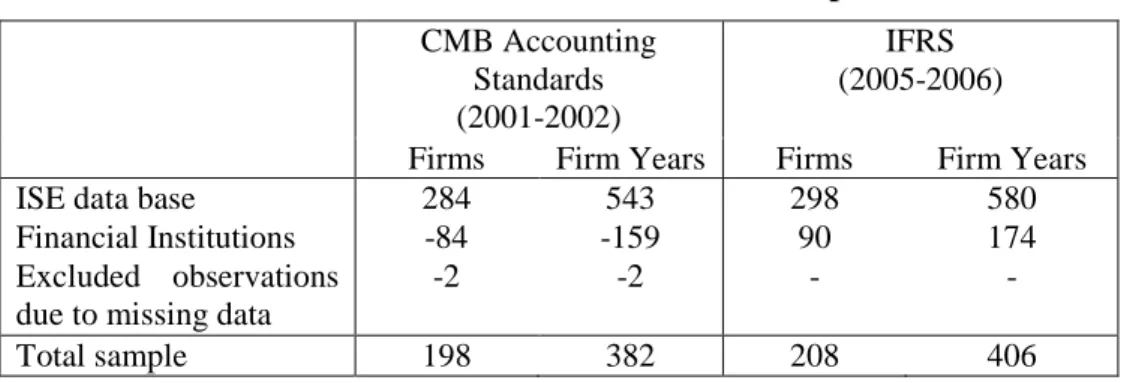
The population consists of all listed companies that are traded in ISE in the years 2001-2002 and 2005-2006. Financial institutions such as banks, insurance companies, and investment trusts had their own specific accounting regulations imposed by the Banking Regulation and Supervising Agency in the experiment periods (2001-2002) and (2005-2006). Therefore, they are extracted from the sample. The sample selection process yields a CMB Accounting Standards sample of 382 year observations for 198 companies and an IFRS sample of 406 firm-year observations for 208 companies. Table 2 outlines my sample selection procedures.
Table 2: Sample Selection Process CMB Accounting Standards (2001-2002) IFRS (2005-2006)
Firms Firm Years Firms Firm Years
ISE data base 284 543 298 580
Financial Institutions -84 -159 90 174
Excluded observations due to missing data
-2 -2 - -
Total sample 198 382 208 406
6. Results
I measure value relevance in terms of the ability of accounting measures to explain stock prices. The R2 from the estimated regressions measures value relevance. As shown in Table 3, my primary test of the relative value relevance of earnings and book value of equity for Turkish companies reporting under CMB accounting standards and IFRS supports my prediction and shows that value relevance of has increased significantly over time. The overall R2 of the regression model for each of the time period examined was 0,27 in the CMB accounting standards period, and 0,84 in the IFRS period. In addition, both the magnitude of the earnings and book value of equity coefficients are significant. I find that the magnitude of earnings coefficient has changed its direction from negative to positive and increased significantly. However, the magnitude of the book value of equity coefficient has degreased. This could be interpreted as a switch to IFRS brings a greater reliance on earnings as opposed to book value of equity.
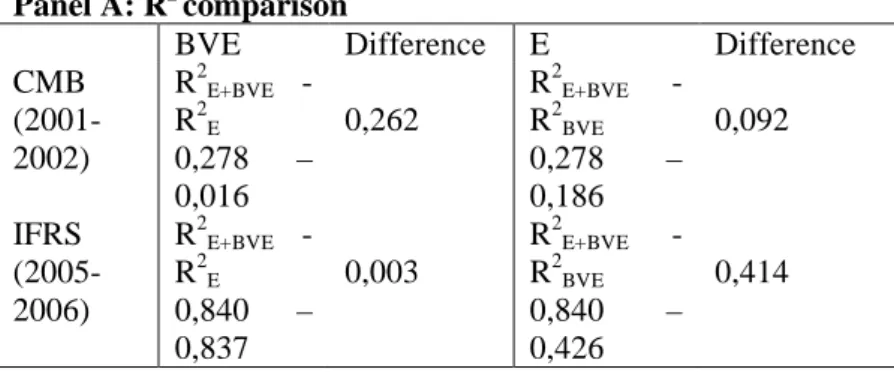
I also examine whether the incremental value relevance of earnings and book value of equity have changed over the time periods. Table 4 shows that the incremental value relevance of earnings increased between the CMB accounting standards period and the IFRS period. However, the incremental value relevance of book value of equity degreased in the same period. Both the increase in the incremental value relevance of earnings and the decrease in book value of equity are statistically significant. I interpret the increase in the incremental value relevance of earnings between the CMB accounting standards period and the IFRS period as an effect of changes mainly related to investor behaviour that rely more on IFRS performance figures. We expect an increase in the incremental value relevance of BVE between the CMB accounting standards period and the IFRS period related to changes in IAS 16 Property, plant & equipment, IAS 38 intangible assets, IAS 19 employee benefits, IAS 39 financial instruments, IAS 40 investment property, IAS 41 agriculture, IFRS 2 share based payments, IFRS 3 business combinations and IFRS 4 insurance contracts, all of which are fair value oriented. However, we could not find any statistical evidence that confirms our prediction.
Table 3: Regression results of Turkish accounting measures on share price
Pit = βo + β1Eit + β2BVEit + εit
Panel A: CMB accounting standards (2001-2002)
Variable Coefficient Std. Dev. p-value Adj. R2
Intercept 58661,22 25753,26 0,023 E -3,55982 0,508437 1,16E-11 BVE 2,432873 0,206561 1,68E-27 0,278 Panel B: IFRS(2005-2006) Variable Intercept 114095,0536 29550,73 0,000 E 10,2786814 0,317645 4,1E-114 BVE 0,253959423 0,087825 0,004 0,840 Panel C: Comparison of R2: R2 CMB accounting standards 0,278 R2 IFRS 0,840 Difference -0,562
Table 4: Evaluation of the incremental value relevance for earnings and book value of equity Panel A: R2 comparison
BVE Difference E Difference
CMB (2001-2002) R2E+BVE - R2E 0,278 – 0,016 0,262 R2E+BVE - R2BVE 0,278 – 0,186 0,092 IFRS (2005-2006) R2E+BVE - R2E 0,840 – 0,837 0,003 R2E+BVE - R2BVE 0,840 – 0,426 0,414
Panel B: Evaluation of R2 comparison Incremental value relevance of BVE under IFRS 0,003 Incremental value relevance of E under IFRS 0,414 Incremental value relevance of BVE under CMB accounting standards 0,262 Incremental value relevance of E under CMB accounting standards 0,092
Net Degrease -0,232 Net Increase 0.322
7. Conclusion
Having high inflation for over 30 years, the financial statements in Turkey had been considered useless tools in decision-making. In recent years, this problem seems to be solved with the legislations about the mandatory application of inflation accounting and subsequently full IFRSs.
I investigate whether the change from CMB accounting standards to IFRS should increase the accounting quality in Turkey, defined as the relationship between accounting measures and market values. Therefore, I compare the value relevance of earnings and the book value of equity under CMB accounting Standards during 2001-2002 with those under IFRS during 2005-2006.
The test of the relative value relevance of earnings and book value of equity for Turkish companies reporting under CMB accounting standards and IFRS shows that value relevance of has increased significantly over time. This result is mainly compatible with previous literature that shows that the adoption of IFRSs improves value relevance which is accepted as a proxy of accounting quality. In particular, I find that the earnings coefficient has turned to positive and increased significantly from the CMB accounting standards period to IFRS period. I also find that the incremental value relevance of earnings and book value of equity have changed over the time periods. The incremental value relevance of earnings increased between the CMB accounting standards period and the IFRS period. However, the incremental value relevance of book value of equity degreased in the same period. I interpret the increase in the incremental value relevance of earnings between the CMB accounting standards period and the IFRS period as an effect of changes mainly related to investor behavior that rely more on IFRS performance figures. We expect an increase in the incremental value relevance of BVE between the CMB accounting standards period and the IFRS period related to changes in IAS 16 Property, plant & equipment, IAS 38 intangible assets, IAS 19 employee benefits, IAS 39 financial instruments, IAS 40 investment property, IAS 41 agriculture, IFRS 2 share based payments, IFRS 3 business combinations and IFRS 4 insurance contracts, all of
which are fair value oriented. However, we could not find any statistical evidence that confirms our prediction. Taken as a whole, the results suggest that the revisions and new standards of IFRS improve the value relevance of accounting measures of Turkish listed companies.
8. References
Alfred M. King (2006). Fair Value For Financial Reporting. John Wiley&Sons Inc., New Jersey.
Arsoy, Aylin Poroy & Gücenme, Ümit, The development of inflation accounting in Turkey, Critical
Perspectives on Accounting, vol. 20.
Barth, M. (2007). One Global Conceptual Framework For Financial Reporting”, 30th EAA Annual Congress, Lisbon, Portugal.
Bellas, A. Toudas, K. & Papadatos, C., (2007) The Consequences of applying International Accounting
Standards (IAS) to the financial statements of Greek companies, Forthcoming in SPOUDAI: Journal of
Business and Economics
Callao, Susana & Jarne, Jose I. & Laines, Jose A. (2007). Adoption of IFRS in Spain: Effect on the
Comparability and Relevance to Financial Reporting, Journal of International Accounting, Auditing and
Taxation, vol. 16.
Collins, D.W. & E.L. Maydey & I.S. Weiss. (1997). Changes in the Value-Relevance of Earnings and Book
Values over the Past Forty Years. Journal of Accounting and Economics, vol. 24.
Cooke TE & Curuk T. (1996). Accounting in Turkey with reference to the particualar problems of lease
transactions. The European Accounting Review, vol. 5 no. 2.
Fatih Yılmaz & Yakup Selvi, (2004) Recent Accounting Developments in Turkey on the Way to Global
Harmonization, Accounting, Theory and Practice Conference, Taipei, Taiwan
Fatih Yılmaz & Kerem Sarıoğlu (2005). Problems in Alayzing Financial Statements in Hyper-inflationary
Economies. 12th Annual South Dakota International Business Conference, Rapid City, South Dakota.
Gjerde, Oystein & Knivsfla, Kjell & Saettem, Frode (2008). The Value-Relevance of Adopting IFRS:
Evidence from 145 NGAAP Restatements. Journal of International Accounting, Auditing and Taxation, vol.
17.
Jermakowicz, Eva K. & Kinsey-Prather, Jenice & Wulf, Inge (2007). The Value Relevance of Accounting
Income Reported by DAX-30 German Companies. Journal of International Financial Management and
Accounting, vol. 18, no. 3.
Morais, Ana Isabel & Curto, Jose Dıas (2007). Accounting Quality and The Adoption of IASB Standards –
Portuguese Evidence, 30th Annual Congress of the European Accounting Association, Lisbon.
Ohlson, James A. (1995). Earnings, Book Values, and Dividends in Equity Valuation. Contemporary Accounting Research, Vol. 11, No. 2.
Paanaen, M. Hamberg & M.-Marton, J. (2005). The implementation of IFRS in Europe and accounting
quality. Working paper.
Recep Pekdemir & Aslı Gunduzay Türel (2007). IFRS 2005 in Turkey; Can We See the Evidences on the