СБОРНИК ДОКЛАДИ
НАУЧНА КОНФЕРЕНЦИЯ
НА МЛАДИТЕ ИЗСЛЕДОВАТЕЛИ
18 май 2018 г.
Велико Търново
© Авторски колектив, 2018 © Иванка Минчева, Гергана Маркова, Силвия Върбанова, Калина Иванова, съставители, 2018 © Университетско издателство „Св. св. Кирил и Методий“, 2018 гр. В. Търново, ул. „Теодосий Търновски“ № 2 ISBN 978-619-208-190-4
СБОРНИК ДОКЛАДИ
НАУЧНА КОНФЕРЕНЦИЯ
НА МЛАДИТЕ ИЗСЛЕДОВАТЕЛИ
18 май 2018 г.
Велико Търново
ВЕЛИКОТЪРНОВСКИ УНИВЕРСИТЕТ „СВ. СВ. КИРИЛ И МЕТОДИЙ“ ФАКУЛТЕТ „МАТЕМАТИКА И ИНФОРМАТИКА“ Университетско издателство „Св. св. Кирил и Методий“ Велико Търново, 2018Сборникът включва докладите, допуснати до участие в Четирина-десетата научна конференция на младите изследователи, организирана и проведена във факултет „Математика и информатика“, Великотърновски университет „Св. св. Кирил и Методий“. Докладите в Сборника са публикувани според тематичното им направление:
•
Информатика и компютърни науки;•
Обучението по математика и информатика. Научната конференция на младите изследователи продължава тради-цията на Студентската научна сесия на факултет „Математика и инфор-матика“. Провежда се ежегодно през месец май. Участват студенти (ОКС – бакалавър и ОКС – магистър), докторанти и млади учени, представящи изследователски идеи и резултати по учебни, дип-ломни и дисертационни проекти. Целите са:•
Да се стимулират и усъвършенстват изследователските, презента-ционните и комуникапрезента-ционните умения на участниците.•
Да се повиши качеството на учебната и научноизследователската дейност на младите изследователи. 5000 ВЕЛИКО ТЪРНОВО, УЛ. „АРХ. ГЕОРГИ КОЗАРOВ“ № 3 ФАКУЛТЕТ „МАТЕМАТИКА И ИНФОРМАТИКА“ ТЕЛ.: 062 60 04 61, [email protected], www.uni-vt.bg Организационен комитет Председател: доц. д-р Иванка Минчева Георгиева Членове: гл. ас. д-р Гергана Виолетова Маркова гл. ас. д-р Силвия Ангелова Върбанова гл. ас. д-р Калина Йорданова Иванова гл. ас. д-р Стела Валериева Георгиева ас. д-р Стефка Николаева Чернева Програмен комитет Председател: проф. д-р Маргарита Генова Върбанова Членове: проф. д-р Димитър Петков Цветков проф. д-р Лъчезар Георгиев Георгиев доц. д-р Златко Георгиев Върбанов доц. д-р Живка Василева Радева доц. д-р Александър Маринов Ковачев доц д-р Марияна Иванова Николова5 СЪДЪРЖАНИЕ ТЕМАТИЧНО НАПРАВЛЕНИЕ „ИНФОРМАТИКА И КОМПЮТЪРНИ НАУКИ“ ...7 QR КОД – ТЕХНОЛОГИЯ, ПРИЛОЖЕНИЕ И ТЕНДЕНЦИИ Мариела Николаева Николова Научен консултант: гл. ас. д-р Гергана Маркова ... 7
СONVOLUTIONAL NEURAL NETWORK AS AN ARCHITECTURE FOR DEEP LEARNING
Mirjana Blagoy Kocaleva
Научен консултант: доц. д-р Златко Върбанов ... 17 ПРОЕКТИРАНЕ И РАЗРАБОТВАНЕ НА ПОТРЕБИТЕЛСКИ ИНТЕРФЕЙС ЗА ЕЛЕКТРОНЕН ПРОФИЛ НА СТУДЕНТ Теодора Йорданова Тошева Научен консултант: гл. ас. д-р Силвия Върбанова ... 27 ТЕМАТИЧНО НАПРАВЛЕНИЕ „ОБУЧЕНИЕТО ПО МАТЕМАТИКА И ИНФОРМАТИКА“ ...37 ИЗПОЛЗВАНЕ НА МАТЕМАТИЧЕСКИ СОФТУЕР ЗА УСВОЯВАНЕ НА СТЕРЕОМЕТРИЧНИ ЗНАНИЯ В ОБУЧЕНИЕТО ПО МАТЕМАТИКА Жоржета Йорданова Ангелова Научен консултант: доц. д-р Иванка Минчева ... 37 ИЗСЛЕДОВАТЕЛСКИЯТ ПОДХОД В ОБУЧЕНИЕТО ПО СТЕРЕОМЕТРИЯ Николинка Тодорова Бъчварова Научен консултант: проф. д-р Маргарита Върбанова ... 45
6 ЗАДАЧИ ЗА ФОРМИРАНЕ НА УНИВЕРСАЛНИ УЧЕБНИ ДЕЙСТВИЯ, РЕАЛИЗИРАНИ В УРОК ПО МАТЕМАТИКА ПО ПРИМЕРА НА JUMPMATH Цветелина Мирославова Петрова-Русева Научен консултант: проф. д-р Даринка Гълъбова ... 56
17
Scientific Conference of Young Researchers Faculty of Mathematics and Informatics “St. Cyril and St. Methodius” University of Veliko Tarnovo, 2018
CONVOLUTIONAL NEURAL NETWORK AS AN ARCHITECTURE FOR DEEP LEARNING
Mirjana Blagoy Kocaleva
PhD student,Faculty of Computer Science
Goce Delcev University of Stip, Macedonia Научен консултант: доц. д-р Златко Върбанов
Abstract: Machine learning has become important for solving
problems in many areas: computational finance, image processing and computer vision, face recognition, motion detection, object detection, tumour detection, drug discovery, DNA sequencing, energy production, price and load forecasting, automotive, aerospace, manufacturing, predictive maintenance, etc. The paper reviews the machine learning as a process for teaching computers to learn from experience or directly from data without being based on a predefined equation as a model. Then neural networks are considered. Special attention is paid to the deep learning and some architecture for deep learning are reviewed. For this research and further research the most important architecture for deep learning is convolutional neural network and we will hold on to it.
Keywords: machine learning, neural networks, deep learning, CNN.
INTRODUCTION
The process that teaches computers to learn from experience is known as Machine learning. Algorithms for machine learning use methods that can learn information directly from data without using on before determined equation as a model. These algorithms give better decisions and predictions [17].
There are two techniques for machine learning:
– Unsupervised learning – this kind of learning is useful when we want to explore data but do not yet have a specific goal or we do not what at all what kind of information the data contains. Most techniques for unsupervised learning are a form of cluster analysis [17];
18
– Supervised learning – the algorithms for this technique for learning work with known set of input and output data and trains a model to generate predictions for new input data. There are given training examples Z = {z1, z2, …, zn} with the zi examples sampled from
an unknown process P(Z). Also a loss functional L which takes as argument a decision function f and an example zi, and returns a
real-valued scalar is given. The goal is to minimize the expected value of
L(f, Z) under the unknown generating process P(Z). Each example is presented as a pair
Z
(
X
,
Y
)
andf
takes anX
as argument. All supervised learning techniques are a form of classification or regression [4], [17].– classification:
Y
is a finite integer which corresponds to a class index, and often is taken as loss function the negative conditionallog-likelihood, with the interpretation that
f
i(
X
)
estimates) | (Y i X
P :
L
(
f
,
(
X
,
Y
))
log
f
Y(
X
)
, with the constraints0 ) ( , 1 ) (
f X fY X i i– regression:
Y
is a real-valued scalar or vector, the output off
is in the same set of values asY
, and we often take as loss functional the squared errorL
(
f
,
(
X
,
Y
))
||
f
(
X
)
Y
||
2.EXPOSITION Neural networks
In the conventional programming approach, the programmers telling the computer what to do, also they break a big problems up into a lot of small problems in order to make the computer easier to perform. Otherwise, when the people work with neural network they don't tell the computer how to solve the problem. Instead, it learns from observational data, trying to give its own solution to the problem [19]. Neural network present mathematical model similar with the model of human brain. There are two types of neural networks: biological and artificial neural network.
19
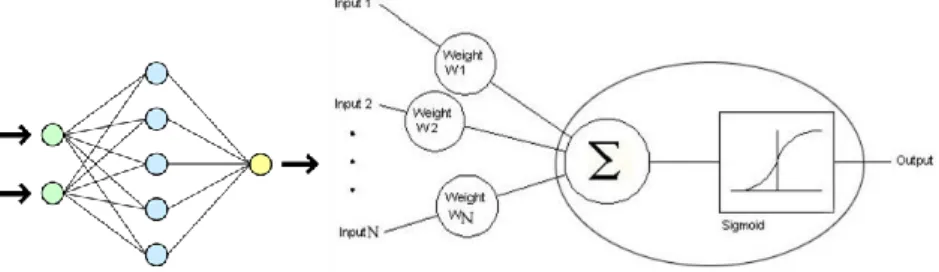
Artificial neural network (ANN) is an algorithm for learning. It is also a paradigm for processing information. The structure of this processing information system is composed of a number of interconnected processing elements named neurons that work all together to solve specific problems. Neurons are split into layers and each layer performs a certain change in the input parameters [22]
There are three major groups of neurons (Fig. 1): Input
neurons (input layer), in this layer of neurons, the direct neuronal network inputs from the outside world are defined and implemented in
the neural processing network. Hidden neurons (hidden layer) or
even called the middle layer, is a layer of neurons where the input is indirect and is obtained from the previous layers or directly from the input layer when it comes to neurons from the hidden layer that are placed at the very beginning the hidden layer. The last layer is the output layer that defines neurons that give way out of processing that is executed on the implemented input [10], [21].
Artificial neural networks consist of the following components:
inputs, which are multiplied by weight coefficients, and then are computed by some mathematical function (like summation function and transfer function) which determines the activation of the neuron (activation function) and at the end there is an output (Fig. 2) [10], [21].
Fig. 1. Artificial neural network Fig. 2. Artificial neural networks components
20
The most important features of artificial neural networks are: 1. Have the ability to learn
2. Have the ability to generalize
3. They are resistant to wrong input and noise
Modern neural networks are tools for non-linear statistical data modeling. Neuronal networks, with their extraordinary ability to derive meaning from complicated or imprecise data, can be used to produce patterns and detect trends that are too complex to be noticed by humans or other computing techniques. A trained neural network can be considered as an expert in the category of information that is given to be analyzed. Then, this expert can be used to provide forecasts in given situations in the domain of interest, and to answer the questions of the type "what if ...?".
Artificial neural networks (ANNs) provide a general, practical method for learning real-valued, discrete-valued and vector-valued functions. ANN learning is successfully applied to issues such as interpretation of visual scenes, speech recognition, and robot learning strategies.
Deep learning
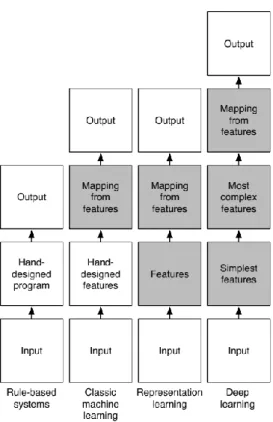
Deep Learning is a new area of Machine Learning research that learns features and tasks directly from data. This data can include images, text, or sound. Also this method is based on learning data representations. Learning can be supervised, partially supervised or unsupervised. Deep learning can also be defined as an AI method, a powerful set of techniques for learning in neural networks. It allows computational models that are composed of multiple processing layers to learn representations of data with multiple levels of abstraction and is almost everywhere: Object recognition, Object classification, Object detection, segmentation, pose estimation, Image captioning, question answering, Machine translation, Speech recognition, Robotics [14], [25].
21
Fig. 3. Work of deep learning (Bengio, 2015)
Deep learning (also known as hierarchical learning) is the application to learning tasks of artificial neural networks (ANNs) that contains more than one hidden layers. There are many different architectures for deep learning such as deep neural networks, deep belief networks, recurrent neural networks and convolutional neural
network and they have been applied to fields such as computer vision,
speech recognition, natural language processing, audio recognition, social network filtering, machine translation and bioinformatics.
Different architecture for deep learning
A deep neural network (DNN) is an ANN with a certain level of complexity, with multiple hidden layers between the input and
22
output layers. This networks use sophisticated mathematical modelling to process data in complex ways. Each layer performs specific types of sorting and ordering in a process known as feature hierarchy. These sophisticated neural networks are often used to work with unlabelled or unstructured data (Techopedia).
A deep belief network (DBN) is a generative graphical model, or alternatively a type of deep neural network, composed of multiple layers of hidden units, with connections (edges) between the layers but not between the units within each layer. DBN can also be defined as a class of deep neural network which comprises of multiple layer of graphical model having both directed and undirected edges. In the DBN, the input layer represents the raw sensory inputs, and each hidden layer learns abstract representations of this input. The output layer, which is treated somewhat differently than the other layers, implements the network classification. Training occurs in two steps: unsupervised pre-training and supervised fine-tuning [4], [29].
The recurrent neural networks (RNN) is one of the base network architectures from which other deep learning architectures are built. The primary difference between a typical multilayer network and a recurrent network is that rather than completely feed-forward connections, a recurrent network might have connections that feed back into prior layers (or into the same layer). This feedback allows RNNs to maintain memory of past inputs and model problems in time. The key differentiator is feedback within the network, which could manifest itself from a hidden layer, the output layer, or some combination thereof. [14]
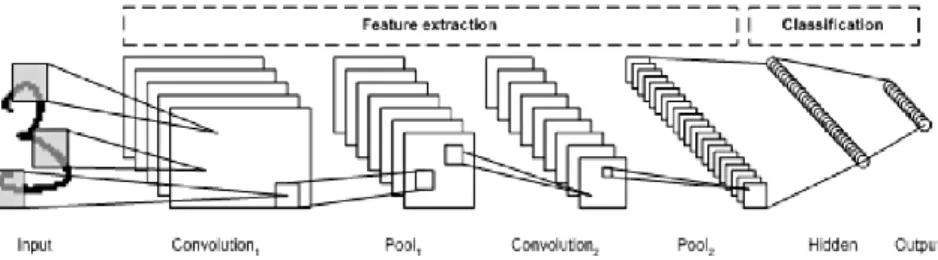
A convolutional neural network (CNN) is comprised of one or more convolutional layers and then followed by one or more fully connected layers as in a standard multilayer neural network. They are extremely effective at complex image recognition problems because their architecture is designed to take advantage of the 2D structure of an input image. Beside images, the CNN has been successfully applied to video recognition and various tasks within natural language processing. The LeNet CNN architecture is made up of several layers that implement feature extraction, and then classification (Fig.4.) [30], [2], [6].
23
Fig. 4. CNN architecture
The image is divided into receptive fields that feed into a convolutional layer, which then extracts features from the input image. The next step is pooling, which reduces the dimensionality of the extracted features (through down-sampling) while retaining the most important information (typically through max pooling). Another convolutional and pooling step is then performed that feeds into a fully connected multilayer perceptron. The final output layer of this network is a set of nodes that identify features of the image (in this case, a node per identified number). The network is trained by using back-propagation [23], [8].
The first layer in a CNN is always a Convolutional Layer. The
input to this convolution is an image where m is the height and width
of the image and r is the number of channels, e.g. an RGB image has r
= 3. The convolutional layer have k filters of size
n
n
q
where n issmaller than the dimension of the image and q can either be the same as
the number of channels r or smaller and may vary for each filter. The
filters produce k feature maps of size m−n+1. Each map is then
subsampled typically with mean or max pooling over
p
p
contiguousregions where p ranges between 2 for small images and is usually not
more than 5 for larger inputs. Either before or after the subsampling layer an additive bias and sigmoidal nonlinearity is applied to each feature map [14], [27], [12].
In addition, some of the main shortcomings of these techniques are presented and also are explored research that seeks solutions to overcome them, as following:
In the paper [7] the difficulties involved in training deep neural networks are given. To improve deep learning architectures an analysis is given of the activation values in four different architectures using
24
various activation functions. Current state of the art classifiers use dropout, max-pooling as well as the maxout activation function. New components may further improve the architecture by providing a better solution for the diminishing gradient problem.
Deep Learning have shown promising results, but such techniques find it difficult to process natural language. Calibrated Quantum Mesh (CQM), on the other hand, is an AI specifically developed for language (Project Coseer). CQM is designed to emulate cognitive steps of humans when they solve any problem, such as understanding a text written in natural language.
According to [16] in the field of deep learning in the five subsequent years wasn’t discovered something new. Against a background of considerable progress in areas such as speech recognition, image recognition, and game playing, and considerable enthusiasm in the popular press, he present ten concerns for deep learning, and suggest that deep learning must be supplemented by other techniques.
CONCLUSION
In this paper, we make an overview at recent studies about machine learning, neural network, deep learning and architecture for deep learning. In the future research we will concern mainly on CNN as an architecture for deep learning because we are going to work with object recognition in images. It is known that with the development of CNN architectures, a computer can be better than human performance in object recognition task under some specific conditions, as in case of face recognition [11].
REFERENCES
1. Bengio, Y. (2015). Deep Learning. Machine Learning Summer
School Lisbon, Portugal.
2. Britz, D. (2015). Understanding Convolutional neural networks for
NLP.
3. URL: http://www. wildml. com/2015/11/understanding-convolutional-neuralnetworks-for-nlp/ (Accessed on 04.04.2018).
25
4. Chandrayan, P. (2017). Deep Learning : Deep Belief Network
Fundamentals. Blog. Cours IFT6266 Hiver. (2010). Very Brief Introduction to Machine Learning for AI.
5. URL:http://www.iro.umontreal.ca/~pift6266/H10/notes/mlintro.html
(Accessed on 28.03.2018)
6. Deshpande, A. (2016). A Beginner's Guide To Understanding
Convolutional Neural Networks. URL:
7.
https://adeshpande3.github.io/adeshpande3.github.io/A-Beginner's-Guide-To-Understanding-Convolutional-Neural-Networks/ (Accessed
on 01.02.2018)
8. Doorn, J. (2014). Analysis of Deep Convolutional Neural Network
Architectures. 21th Twente Student Conference on IT URL:
http://referaat.cs.utwente.nl/conference/21/paper/7438/analysis-of-deep-convolutional-neural-network-architectures.pdf (Accessed on
14.05.2018)
9. Doukkali, F. (2017). Convolutional Neural Networks (CNN, or
ConvNets).
10. URL:
https://medium.com/@phidaouss/convolutional-neural-networks-cnn-or-convnets-d7c688b0a207 (Accessed on 31.01.2018)
11. Gershenson, C. (2003). Artificial neural networks for beginners.
arXiv preprint cs/0308031.
12. Hien, D. (2017). The Modern History of Object Recognition —
Infographic. https://medium.com/@nikasa1889/the-modern-history-of-object-recognition-infographic-aea18517c318
13. Karpathy, A. CS231n Convolutional Neural Networks for Visual
Recognition.
14. URL:http://cs231n.github.io/convolutional-networks/ (Accessed on
31.01.2018)
15. Jones, M. T. (2017). Deep learning architectures.
16. URL:
https://www.ibm.com/developerworks/library/cc-machine-learning-deep-learning-architectures/index.html (Accessed on
06.04.2018)
17. Marcus, G. (2018). Deep Learning: A Critical Appraisal. arXiv
preprint arXiv:1801.00631.
18. MathWorks (2016). What Is Machine Learning?.
19. URL:https://www.mathworks.com/discovery/machine-learning.html
(Accessed on 28.03.2018)
20. Nielsen, M. A. (2015). Neural Networks and Deep Learning.
26
21. Project Coseer. What is Calibrated Quantum Mesh? URL:
https://coseer.com/blog/what-is-calibrated-quantum-mesh (Accessed
on 14.05.2018)
22. Reingold, E., & Nightingale, J. (1999). Artificial Intelligence
Tutorial Review.
23. Stergiou, C., & Siganos, D. (1996). Neural Networks.
24. Stutz, D. (2014). Understanding convolutional neural networks.
InSeminar Report, Fakultät für Mathematik, Informatik und Naturwissenschaften Lehr- und Forschungsgebiet Informatik VIII Computer Vision.
25. Techopedia. Deep Neural Network. URL: https://www.techopedia.com/definition/32902/deep-neural-network (Accessed on 28.03.2018)
26. UVA deep learning course. Introduction to Neural Networks and Deep Learning.
27. URL:https://uvadlc.github.io/ (Accessed on 17.03.2018)
28. UFLDL Tutorial, Convolutional Neural Network
29. URL:http://ufldl.stanford.edu/tutorial/supervised/ConvolutionalNeura
lNetwork/ (Accessed on 06.04.2018)
30. Wikipedia. Deep belief network. URL: https://en.wikipedia.org/
wiki/Deep_belief_network (Accessed on 28.03.2018)
31. Wu, J. (2017). Introduction to convolutional neural networks.
National Key Lab for Novel Software Technology. Nanjing University. China.
Contact: Mirjana Blagoy Kocaleva, PhD student, Faculty of Computer Science, Goce Delcev University of Stip, Macedonia [email protected]