Proceedings of the
21st Annual Conference of
the European Association
for Machine Translation
28–30 May 2018
Universitat d’Alacant
Alacant, Spain
Edited by
Juan Antonio P´erez-Ortiz Felipe S´anchez-Mart´ınez
Miquel Espl`a-Gomis Maja Popovi´c
Celia Rico Andr´e Martins Joachim Van den Bogaert
Mikel L. Forcada
Organised by
The papers published in this proceedings are —unless indicated otherwise— covered by the Creative Commons Attribution-NonCommercial-NoDerivatives 3.0 International (CC-BY-ND 3.0). You may copy, distribute, and transmit the work, provided that you attribute it (au-thorship, proceedings, publisher) in the manner specified by the author(s) or licensor(s), and that you do not use it for commercial purposes. The full text of the licence may be found at https://creativecommons.org/licenses/by-nc-nd/3.0/deed.en.
c
2018 The authors ISBN:978-84-09-01901-4
Multi-Domain Neural Machine Translation
Sander Tars and Mark FishelInstitute of Computer Science University of Tartu, Estonia
[email protected], [email protected]
Abstract
We present an approach to neural ma-chine translation (NMT) that supports mul-tiple domains in a single model and al-lows switching between the domains when translating. The core idea is to treat text domains as distinct languages and use mul-tilingual NMT methods to create multi-domain translation systems; we show that this approach results in significant trans-lation quality gains over fine-tuning. We also explore whether the knowledge of pre-specified text domains is necessary; turns out that it is after all, but also that when it is not known quite high translation quality can be reached, and even higher than with known domains in some cases.
1 Introduction
Data-driven machine translation (MT) systems de-pends on the text domain of their training data. In a typical in-domain MT scenario the amount of par-allel texts from a single domain is not enough to train a good translation system, even more so for neural machine translation (NMT; Bahdanau et al., 2014); thus models are commonly trained on a mixture of parallel texts from different domains and then later fine-tuned to in-domain texts (Luong and Manning, 2015).
In-domain fine-tuning has two main shortcom-ings: it depends on the availability of sufficient amounts of in-domain data in order to avoid over-fitting and it results in degraded performance for all other domains. The latter means that for
trans-c
2018 The authors. This article is licensed under a Creative Commons 3.0 licence, no derivative works, attribution, CC-BY-ND.
lating multiple domains one has to run an individ-ual NMT system for each domain.
In this work we treat text domains as distinct languages: for example, instead of English-to-Estonian translation we see it as translating En-glish news to Estonian news. We test two mul-tilingual NMT approaches (Johnson et al., 2016; ¨Ostling and Tiedemann, 2017) in a bilingual multi-domain setting and show that both outperform single-domain fine-tuning on all the text domains in our experiments.
However, this only works when the text domain is known both when training and translating. In some cases the text domain of the input segment is unknown – for example, web MT systems have to cope with a variety of text domains. Also, some parallel texts do not have a single domain while they are either a mix of texts from different sources (like crawled corpora) or naturally consti-tute a highly heterogeneous mix of texts (like sub-titles or Wikipedia articles).
We address these issues by replacing known do-mains with automatically derived ones. At training time we cluster parallel sentences and then apply-ing the multi-domain approach to these clusters. When translating, the input segments are classified as belonging to one of these clusters and translated with this automatically derived information.
In the following we review related work in Sec-tion 2, then present our methodology of multi-domain NMT and sentence clustering in Section 3. After that, we describe our experiments in Sec-tions 4 and 5 and discuss the results in Section 6. Section 7 concludes the paper.
2 Related Work
The baseline to which we compare our work is fine-tuning NMT systems to a single text domain
P´erez-Ortiz, S´anchez-Mart´ınez, Espl`a-Gomis, Popovi´c, Rico, Martins, Van den Bogaert, Forcada (eds.)
Proceedings of the 21st Annual Conference of the European Association for Machine Translation, p. 259–268
(Luong and Manning, 2015). There, the NMT system is first trained on a mix of parallel texts from different domains and then fine-tuned via continued training on just the in-domain texts. The method shows improved performance on in-domain test data but degrades performance on other domains.
In (Sennrich et al., 2016a) the NMT system is parametrized with one additional input feature (po-liteness), which is included as part of the input se-quence, similarly to one of our two approaches (in our work – the domain tag approach). However, their goal is different from ours.
In (Kobus et al., 2017) additional word features are used for specifying the text domain together with the same approach as (Sennrich et al., 2016a). Although both methods overlap with the first part or our work (domain features and domain tags), they only test these methods on pre-specified do-mains, while we include automatic domain clus-tering and identification. Also, they use in-domain trained NMT systems as baselines even for small parallel corpora and do experiments with a differ-ent NMT architecture. Finally, their results show very modest improvements, while in our case the improvements are much greater.
Other approaches also define a mixture of do-mains, for example (Britz et al., 2017; Chen et al., 2016). However, both define custom NMT meth-ods and also limit the experiments to the cases where the text domain is known.
3 Methodology
In the following we describe two different ap-proaches to treating text domains as distinct lan-guages and using multi-lingual methods, resulting in multi-domain NMT models. The first approach is inspired by Google’s multilingual NMT (John-son et al., 2016) and the second one by the cross-lingual language models ( ¨Ostling and Tiedemann, 2017). Then we describe our methods of unsu-pervised domain segmentation used in our exper-iments in comparison with the pre-specified text domains.
3.1 Domain as a Tag
The first approach is based on (Johnson et al., 2016). Their method of multilingual translation is based on training the NMT model on data from multiple language pairs, while appending a token specifying the target language to the beginning of
the source sequence. No changes to the NMT ar-chitecture are required with this approach. They show that the method improves NMT for all lan-guages involved; as an additional benefit, there is no increase in the number of parameters, since all language pairs are included in the same model.
We adapt the language tag approach to text do-mains, appending the domain ID to each source sentence; thus, for instance, “How you doin’ ?” from OpenSubtitles2016 (Lison and Tiedemann, 2016) becomes “ OpenSubs How you doin’ ?”.
The described method has two advantages. Firstly, it is independent of the NMT architecture, and scaling to more domains means simply adding data for these domains. We can assign a domain to each sentence pair of the training set sentence pair, or set the domain to “other” for sentences whose domain we cannot or do not want to identify.
Secondly, in a multilingual NMT model, all pa-rameters are implicitly shared by all the language pairs being modeled. This forces the model to gen-eralize across language boundaries during training. It is observed that when language pairs with lit-tle available data and language pairs with abun-dant data are mixed into a single model, transla-tion quality on the low resource language pair is significantly improved.
We expect this to be even more useful for text domains. Traditional tuning to a low-resource do-main, or for any specific domain for that matter, would result in a likely over-fitting to that domain. Our approach, where all parameters are shared, learns target domain representations without harm-ing other domains’ results while maintainharm-ing the ability to generalize also on in-domain translation, because little to no over-fitting will be caused. Fur-thermore, since domains are much more similar than languages, we expect the parameter sharing to have a stronger effect.
3.2 Domain as a Feature
The second approach is based on ( ¨Ostling and Tiedemann, 2017) for continuous multilingual lan-guage models. The authors propose to use a sin-gle RNN model with language vectors that indi-cate what language is used. As a result each lan-guage gets its own embedding, thus ending up with a language model with a predictive distribution p(xt|x1...t−1, l)which is a continuous function of
the language vectorl.
via word features of Nematus (Sennrich et al., 2017), with their learned embeddings replacing the language vector of ( ¨Ostling and Tiedemann, 2017). For example, translating ”This is a sentence .” to the Estonian Wikipedia domain would mean an in-put of ”This|2wi is|2wi a|2wi sentence|2wi .|2wi”1 Having a single language model learn several languages helps similar languages improve each others representations ( ¨Ostling and Tiedemann, 2017). Also, they point out that this greatly alle-viates the problem of sparse data for smaller lan-guages. We expect the same effect for text do-mains, especially since similarity between differ-ent domains of the same languages is higher than between different languages. Moreover, similarly to the domain tag approach, the usage of many do-mains in one model helps bypass the over-fitting problem of smaller domains.
3.3 Automatic domain tags
Here we define the domain of each of the source– target sentence pair automatically. We take two different approaches to achieve the annotation.
Supervised approach is done only in single do-main setting. It involves assigning categories to roughly 10,000 Wikipedia articles, for which it could be done with high certainty. Assigning cate-gories to more articles is problematic, because the categories assigned in Wikipedia can often be mis-leading in terms of content. Next we tag each sen-tence with the article category.
After tagging the sentences, we train a FastText (Bojanowski et al., 2016; Joulin et al., 2016) clas-sification model with default settings and apply it to classify the rest of the sentences that were not classified based on the article categories. Test/dev set sentences are tagged using the same FastText model that is used to cluster training data.
Unupervised approach is applied to sentence-split data. In case of multi-domain data we still treat it as a single domain data of which we have no domain structure knowledge. In this approach, we train a model and calculate sentence vectors in an unsupervised manner using sent2vec (Pagliardini et al., 2017). After that, we apply KMeans cluster-ing to identify the clusters in the set of calculated sentence vectors. Finally, we tag each sentence with the label that it was assigned by KMeans. To
1the ”
|” is a special symbol in Nematus for delimiting input features.
find the optimal number of clusters, we create sev-eral versions with different numbers of clusters.
To tag the test/dev set sentences, we train a FastText (Bojanowski et al., 2016) (Joulin et al., 2016) supervised classification model on the tagged training set. For each of the cluster versions and for each language pair, we train a separate FastText model. The additional benefit of this kind of clustering is that each new input sentence can be efficiently assigned its cluster. Also, because of more potentially homogenous train-set clusters, the new sentence is hypothetically assigned more appropriate domain than it would be assigned in case of the pre-defined domains.
The potential benefit of the unsupervised ap-proach over supervised apap-proach is that it does not assume any prior knowledge of the data and thus the domain structure does not rely on potentially faulty pre-defined domain structure. This in turn allows the multi-domain translation approach to be applied to any data without the knowledge of its domain structure.
4 Experiments with Known Domains
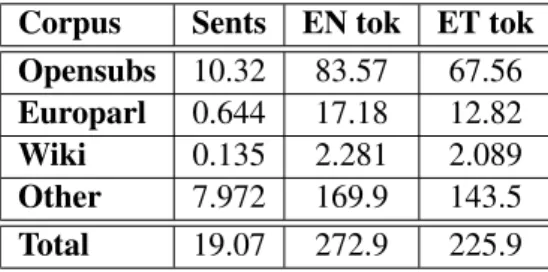
In the experiments we use mixed-domain paral-lel data consisting of Europarl (Koehn, 2005), OpenSubtitles2016 (Lison and Tiedemann, 2016), parallel data extracted from English-Estonian Wikipedia articles and some more mixed paral-lel corpora from the OPUS collection (Lison and Tiedemann, 2016). The size of the corpora is shown in Table 1. For each corpus we use a ran-domly chosen and held-out test set of 3000 parallel sentences.
Corpus Sents EN tok ET tok Opensubs 10.32 83.57 67.56
Europarl 0.644 17.18 12.82
Wiki 0.135 2.281 2.089
Other 7.972 169.9 143.5
Total 19.07 272.9 225.9
Table 1:Data sizes for the training data. Number of tokens (tok) is given pre-BPE. All of the numbers are given in mil-lions
4.1 Mining Wikipedia for Translations
Wikipedia2 itself is a big set of articles. The arti-cles have two properties, which are extremely use-ful from our task point of view. Firstly, the
arti-2http://www.wikipedia.org/
cles have links to the articles of same topic, but in different languages, which makes it easier to find comparable data from which to extract paral-lel data. Secondly, each article has one or several categories attached to it. This means that hypothet-ically we can assign domain(s) to at least some of the articles based on these categories.
To extract meaningful text from the Wikipedia XML dumps, we used the WikiExtractor tool3. The data is extracted in a way that preserves ar-ticle and paragraphs boundaries. The extraction is done separately for English and Estonian version.
After extracting text from the dumps, another custom-made solution is applied to detect parallel articles. The number of Wikipedia articles in En-glish is well over 5 million whereas for Estonian it is just over 100 thousand. We keep all Estonian articles and only those English articles that have a parallel article in Estonian articles. This leaves us with roughly 70 thousand English articles.
The parallel articles form a comparable corpus. In case of this comparable corpora we know that the articles are parallel in terms of topics but not in sentences. To extract parallel sentences from par-allel articles, we used the LEXACC (S¸tef˘anescu et al., 2012) tool, which is a part of the ACCU-RAT toolkit (Pinnis et al., 2012; Skadin¸a et al., 2012). Parallel sentence identification allows also to maintain the info of article origin, which means that direct domain assigning is possible. The iden-tification process also assigns score to each se-quence pair, which allows us to create parallel sets with different grade of purity. The optimal grade of purity produced 340 thousand parallel sentences. The size of Estonian Wikipedia in to-tal is 2.8 million sentences. To the rest 2.5 million sentences back-translation is applied to extend the Wikipedia dataset for EN-ET direction; the back-translated sentences are also filtered based on at-tention weights (Rikters and Fishel, 2017) with a 50% threshold.
4.2 Technical Settings
We apply BPE segmentation (Sennrich et al., 2016b) in a joint learning scenario, learning from the input and the output, limiting the vocabu-lary to 65,000 entries. The acquired segmen-tation mostly corresponds to the linguistic intu-ition on frequent tokens (which are left intact) and medium-frequency tokens (which are split
3https://github.com/attardi/wikiextractor
into compound parts or endings off stems); low-frequency tokens (also names, numeric tokens) are split into letters and letter pairs.
The NMT model we use is encoder-decoder with an attention mechanism (Bahdanau et al., 2014), implemented in Nematus (Sennrich et al., 2017). All settings (like embedding size, number of recurrent layers in encoder and decoder, etc.) are kept at their default values. Batch size in ex-periments is 50 sequences.
4.3 Results
For theBaselineexperiment we first train a base-line model on all the datasets are used, and use it for translation. Then in the Tuned approach for each dataset separately we fine-tune theBaseline
model to each corpus separately.
For the comparability of the results, the num-ber of iterations during training (800,000) and in-put parameters are kept equal for Baseline, Tag,
Feat. The tuning ofBaselineis done for additional 60,000 iterations. One iteration means one batch seen during training.
Tables 2 and 3 show the BLEU scores (Pap-ineni et al., 2002) and the p-values of the statistical significance of their difference for Baseline, fine-tuned baseline, domain tags, and domain feature approaches.
As we can see from the results, both of the ad-ditional domain info models perform really well. The domain tag (Tag) model outperforms both of its baseline (Baseline) and tuned (Tuned) coun-terpart in ET–EN direction. It even goes as far as exceeding the Tuned approach by more than 1.0 BLEU in all domains. The same holds, but even more strongly, for the version where we add the domain embedding as an input feature for each word (Feat).
For EN–ET direction the results do not show such strong improvements. In this direction both
TagandFeatoutperformBaselinefor all domains. However, the scoring is quite close to theTuned
approach with the results between Tag and Feat
also being closer than in ET–EN case. All in all, the fact that the domain tagging results are essen-tially on-par with Tuned approach, means it is su-perior to theTunedapproach in practice because of the fact that it requires only one model rather than three.
Table 4 shows an example of theET–EN trans-lations highlighting some improvements. Since the
Corp Baseline Tuned Tag Feat Eu 33.0±0.3 35.4±0.3 36.2±0.3 37.3±0.3
Op 27.9±0.6 28.1±0.6 30.5±0.6 30.3±0.6
Wi 15.3±0.4 15.4±0.4 16.9±0.4 17.7±0.4
Corp Baseline Tuned Tag Feat
Eu 0.0001/0.0001 0.009/0.0001 -/0.0001 0.0001/
-Op 0.0001/0.0001 0.0001/0.0001 -/0.1 0.1/
-Wi 0.0001/0.0001 0.0001/0.0001 -/0.001 0.001/
-Table 2:BLEU scores and p-values for Estonian-English direction.Baselinemodel is trained without domain tags.Tunedis achieved by tuning these models with the specific corpus.Tagis trained with data that has domain tag prepended to each source sentence.Featis trained with data that has domain embedding added as a feature to each source sequence word. p-values are given for significance againstTagandFeatrespectively, separated with/.
Corp Baseline Tuned Tag Feat
Eu 22.5±0.3 25.3±0.3 25.4±0.3 24.9±0.3 Op 24.2±0.6 24.5±0.6 24.8±0.6 25.3±0.6 Wi 11.8±0.4 12.1±0.4 12.5±0.3 12.8±0.4
Corp Baseline Tuned Tag Feat
Eu 0.0001/0.0001 0.3/0.04 -/0.04 0.04/
-Op 0.01/0.001 0.09/0.03 -/0.06 0.06/
-Wi 0.01/0.001 0.06/0.03 -/0.14 0.14/
-Table 3:BLEU scores and p-values for English-Estonian direction.Baselinemodel is trained without domain tags.Tunedis achieved by tuning these models with the specific corpus.Tagis trained with data that has domain tag prepended to each source sentence.Featis trained with data that has domain embedding added as a feature to each source sequence word. p-values are given for significance againstTagandFeatrespectively, separated with/.
quality ofTunedis close toTagandFeat, we omit it from the comparison since the differences would be highly circumstantial and would not hold much information in small scale.
Src vastuseid saab muidugi olla ainult ¨uks (ET) : l˜opetada kohe igasugused
l¨abir¨a¨akimised T¨urgiga .
Ref there is , of course , only one possible (EN) response : to immediately cease all
negotiations with Turkey .
Base only one can only be one : stop any (EN) negotiations with Turkey immediately .
Tag the answer , of course , can only be (EN) one : stop all the negotiations with
Turkey immediately .
Feat there is , of course , only one answer : (EN) to put an end to all negotiations with
Turkey immediately .
Table 4: An example of Europarl corpus translations from Estonian to English using the Baseline,TagandFeat meth-ods.
5 Experiments with Automatic Domains
Since the results on the full parallel data show that both of multi-domain approaches are on-par, or su-perior to the single-domain baseline, we apply the methods in a setting where we do not assume be-forehand knowledge of the origin domain of source sentences. Here we take the domain tagging ap-proach: even though domain features show better results, domain tags are more generic and compat-ible with any NMT architecture.
We experiment with two data settings. In the first one, we have a single heterogeneous text do-main. We explore both supervised and unsuper-vised tagging of single text domain based on sen-tence vectors.
In the second one, we have texts from several domains but we ignore the pre-specified text do-mains and replace them with automatic clustering based on sentence embeddings.
5.1 Automatic single-domain tagging
To choose the best setting for unsupervised ap-proach, we do a small sweep for input data ver-sions. We check for best number of clusters by 263
training a model for each number of clusters. The input data for this is the whole Wikipedia cor-pus. The models are trained for 12 hours, which should be sufficient to make them diverge enough to choose the best number of clusters. We also train a regular model without data clustering for reference.
It is important to note that for this experiment a different test set was used than in the full data ex-periments. Thus the scores in 5 are not comparable to scores presented earlier.
The initial sweep indicates that the best option for the unsupervised classification is 12 clusters. Also, the 12 hours – 100,000 iterations are al-ready showing the effect that domain tagging has over the regular reference approach, making other clusterings also a viable choice.
Wikipedia Translation Results
In the final experiment, three models were trained:
• Supervised 5-domain source tag model
• Unsupervised 5-domain source tag model
• Unsupervised 12-domain source tag model
• Regular not domain-tagged model
Unsupervised 5-domain model was included to compare the performance of supervised and un-supervised approach with the same amount of do-mains, giving an indication of the ”goodness” of these cluster assignments. The Unsupervised 12-domain model was included to compare the per-formance of best unsupervised clustering and the intuitively optimal supervised clustering. Super-vised 12-domain model is not presented because we were not able produce such reasonable struc-ture from ET Wikipedia. The results are presented in 6. The models were trained for 48 hours.
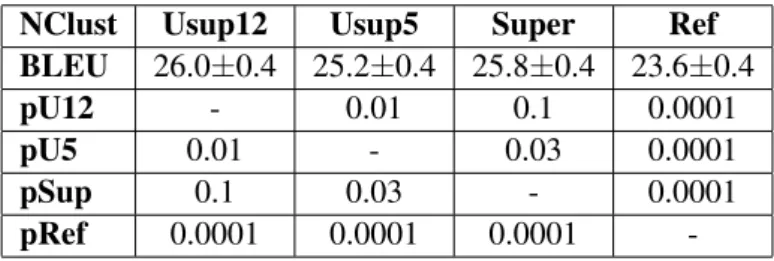
As we see in Table 6, the Supervised approach (Super) with five clusters slightly outperforms Un-supervised 5-cluster approach (Usup5). The best option for Unsupervised clustering (Usup12) per-forms as well as the Supervised approach. The re-sults show that Unsupervised approach is compa-rable in performance to the Supervised approach, which means that at least in this setting both of the approaches are viable. Even more so, when ob-taining labelled data for supervised clustering can
often require a lot of additional effort, the unsu-pervised approach is not chained by the (lack) of pre-existing knowledge about the data.
Most important is the fact that both of the un-supervised cluster versions outperform the regular reference (Ref) version where sentence cluster tags were not used. This shows that the unsupervised clustering approach can potentially be used in set-tings that previously were viewed upon as single clusters. For example OpenSubtitles corpus could be clustered further, to improve the translations.
5.2 Unsupervised multi-domain tagging
Hinging on the fact that domain tagging approach outperformed the traditional tuning approach and on the results that unsupervised Wikipedia dataset clustering produced, the ”traditional” approach of text domains should be given another look. One possible action is to cluster or sub-cluster the exist-ing parallel data to restructure it from the domain point of view.
In addition to the results produced on wikipedia dataset, the hypothesis on why this would work, is that large text domains are probably not very ho-mogenous. Also, different domains have probably pretty big overlap of similar sentences. This would mean that the usual approach of domain tuning or domain tagging does not achieve its true potential, because predefined domains are de facto several domains and the same domains are actually present in other predefined domains also.
To check for this property and its potential ben-efit for NMT, we cluster existing parallel sentences to n clusters in the previously described unsu-pervised manner, train NMT models with domain tagged sentences, and finally, cluster test set sen-tences in a supervised manner with a supervised clustering model that is trained on the data that was obtained from unsupervised clustering.
The training is done using Nematus with the same settings as in the initial experiment with do-main tags. Firstly, we do the sweep of clusters by training 4, 8, 16, and 32 cluster versions for both EN–ET and ET–EN direction. After that we choose the version that has achieved the best BLEU scores on the dev sets for both of the direc-tions and train it for the same time as in the initial domain tag experiment with full data.
Results of unsupervised multi-domain tagging
To evaluate the model performance, we train supervised FastText classification models on the
NClust C4 C5 C6 C8 C12 Ref BLEU 19.7 19.5 19.6 19.5 20.0 17.9
Table 5:BLEU scores for Unsupervised Wikipedia parameter setting.
NClust Usup12 Usup5 Super Ref
BLEU 26.0±0.4 25.2±0.4 25.8±0.4 23.6±0.4
pU12 - 0.01 0.1 0.0001
pU5 0.01 - 0.03 0.0001
pSup 0.1 0.03 - 0.0001
pRef 0.0001 0.0001 0.0001
-Table 6:BLEU scores and p-values for test on Wikipedia-only data to compare the effect of Unsupervised clustering (Usup12, Usup5), supervised clustering (Super) and no-clustering approach (Ref). The p-values are shown in respect to the version where the value is-.
tagged training data. We apply these models on the test/dev sets to classify the sentences. This means that each of the sets – Opensubs, Europarl, and Wiki – gets actually tags from several clusters, depending on which cluster the FastText model as-signs to each of the sentences. This means that for each source test set we create four different ver-sions, each for cluster numbers 4, 8, 16, and 32.
The initial parameter sweep shows that the best option is 16 clusters for both EN–ET 7 and ET– EN 8 directions across all test sets. Hence the final models were both trained with 16 clusters.
Corp C4 C8 C16 C32
Eu 4.13 3.19 5.94 4.17
Op 9.41 9.36 10.80 10.62
Wi 1.09 0.94 1.31 0.81
Table 7:BLEU scores for English-Estonian direction sweep. The model is trained on parallel data that is tagged in unsuper-vised manner using sent2vec + Kmeans clustering. The dev sets are clustered based on this tagged data using FastText. The best scores for each corpus are presented inbold.
Corp C4 C8 C16 C32
Eu 20.48 19.88 20.82 18.43
Op 20.05 19.54 20.17 20.01
Wi 4.61 4.38 5.50 4.32
Table 8:Test set BLEU scores for Estonian-English direction sweep. The model is trained on parallel data that is tagged in unsupervised manner using sent2vec + Kmeans clustering. The dev sets are clustered based on this tagged data using FastText. The best scores for each corpus are presented in
bold.
In table 9 is shown the OpenSubs test sets clus-ter structure. The test sets are tagged using Fast-Text models trained on tagged train set. We can
see that different train set clusters produce differ-ent granularity in test sets also. ForC4, C8 the OpenSubs structure is similar, same holds for other test sets. C16vsC8however shows a significant difference in test set clustering. Here we see that OpenSubs, which based on content is probably not homogeneous domain, is separated quite granu-larly inC16, producing 3–4 main sub-domains. In
C32the test set is clustered even further, but based on sweep scores, it could be said that the achieved clustering is already too granular.
Corp N1 N2 N3 N4 N5 N6
C4 2921 29 - - -
-C8 2907 43 - - -
-C16 1331 1015 398 181 18 7
C32 1137 828 356 293 241 71
Table 9:Cluster structure of FastText tagged English Open-Subs test sets. The test sets are clustered based on tagged train data. The clusters are numbered left to right based on size. Here only top 6 clusters are shown. For C32N7 = 11,
N8 = 6,N9 = 3,N10 = 2,N11 = 2. Test set structures
for Estonian sets are similar.
Considering that our OpenSubs cluster is 10 million sentence pairs in size, we can say thatC16
finds 5 significant sub-domains and one less sig-nificant sub-domain inside it. This shows that, at least from sentence vectorizing point of view, there exists more than one domain inside OpenSubs, and similarly in other domains.
When looking at the number of clusters present in Table 9, one could notice that the clusters present is less than number of clusters defined. It should be kept in mind that we have 3 main text sources in training set and fourth mixed-corpus which could be divided into 5-6 parts, so 8-9 text domains in total. Also, some sentences are quite 265
Corp N1 N2 N3 N4 N5 N6 N7 N8 Train 4859672 4444177 3704753 2767889 1407228 822225 711526 134301
Corp N9 N10 N11 N12 N13 N14 N15 N16
Train 114778 40260 22004 18165 10298 9585 2492 646
Table 10:Cluster structure of KMeans tagged English train set forC16. The clusters are numbered left to right based on size. Train set structure for Estonian is similar.
distinct from the others based on full train set clus-ter structure as we can see from the train set struc-ture of C16 in Table 10. The clustering and its structure is probably interesting aspect to look into in future work.
The final results, where the 16 cluster models were trained for the same amount of iterations as in the initial full data experiments, are presented in 11 and 12 for EN–ET and ET–EN language pairs respectively.
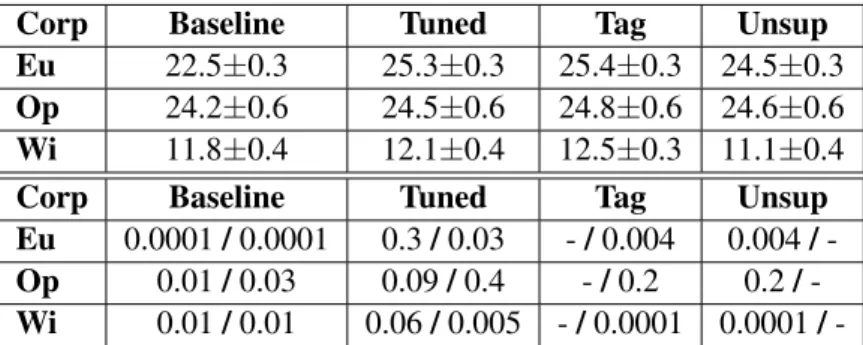
The results show that the unsupervised clus-tering approach performs similarly with the pre-defined tag version. The results are evidence that the unsupervised tagging approach can serve as a viable alternative to the traditional pre-defined domain approach. Our hypothesis is that this is caused by the pre-defined domains being less ho-mogenous in content than the unsupervised clus-tered ”domains”. However, this hypothesis should be investigated further to assert its existence and magnitude. Also, since the clustering approach is pretty much applied out-of-the-box, then proved clustering could provide considerable im-provements.
All-in-all, taking into consideration the fact that unsupervised approach allows new sentences to be translated with potentially more appropriate do-main assigned to them, the unsupervised tagging approach can be seriously considered as the go-to approach for multi-domain translation models.
6 Discussion
The results from the experiments - EN–ET and ET–EN direction parallel translation, Wikipedia data translation, and unsupervised sentence tag-ging - show that both of the two chosen multi-domain approaches outperform regular approach of uniform translation and domain-tuning.
This indicates the hypothesis that the parame-ter sharing effect discussed in Google’s zero-shot article would benefit domain translation holds. The translation scores even outperform domain-tuning approach, which could be explained by the
same parameter sharing. In tuning we tune the model to translate sentences characteristic to the model we are tuning to. This means that domain-characteristic sentences get translated really well. On the other hand, the not-so-characteristic sen-tences get neglected. The parameter sharing ef-fect of the multi-domain approach helps negate the negative effect by the support of other domains while still learning to more effectively represent each domain by the additional domain info.
Furthermore, the results indicate that adding do-mains as an input feature can have even stronger effect on the translation scores. This shows that concatenating the domain feature embedding with word embedding at each timestep - basically re-membering the source domain equally throughout the sequence improves model performance. This could be explained by the fact that in tag prepend-ing case, the neural net may ”forget” for longer se-quences what the input tag was, making the effect of it weaker.
The results also show that for highly quality de-pendent settings the domain feature concatenation with word embedding is the more suitable option. However, the differences in scores are not dras-tically different from the domain tag prepending. This means that for the sake of data simplicity, model simplicity and efficiency the tag prepend-ing approach could prove more reasonable of the two for in-production settings.
Finally, the performance of unsupervised do-main tagged model indicates that there is grounds to substitute the pre-defined domain approach with automatically assigned domain approach. The un-supervised certainly serves as an improvement in less homogenous single domain settings, where the effect of the detection of underlying ”domains” was shown on the example of Wikipedia.
No less important are the facts that the unsuper-vised tagging approach ensures better domain as-signment to each new sentence and can efficiently incorporate new data from various small domains to fortify each of the learned ”domain” (clusters).
unsuper-Corp Baseline Tuned Tag Unsup Eu 22.5±0.3 25.3±0.3 25.4±0.3 24.5±0.3
Op 24.2±0.6 24.5±0.6 24.8±0.6 24.6±0.6
Wi 11.8±0.4 12.1±0.4 12.5±0.3 11.1±0.4
Corp Baseline Tuned Tag Unsup
Eu 0.0001/0.0001 0.3/0.03 -/0.004 0.004/
-Op 0.01/0.03 0.09/0.4 -/0.2 0.2/
-Wi 0.01/0.01 0.06/0.005 -/0.0001 0.0001/
-Table 11:Test set BLEU scores and p-values for English-Estonian direction. Baselinemodel is trained without domain tags.
Tunedis achieved by tuning these models with the specific corpus.Tagis trained with data that has domain tag prepended to each source sentence. Unsupis trained with data that has domain tags assigned to each sentence in an previously described unsupervised manner. p-values are given for significance againstTagandUnsuprespectively, separated with/.
Corp Baseline Tuned Tag Unsup
Eu 33.0±0.3 35.4±0.3 36.2±0.3 36.0±0.3 Op 27.9±0.6 28.1±0.6 30.5±0.6 30.2±0.6 Wi 15.3±0.4 15.4±0.4 16.9±0.4 16.0±0.4
Corp Baseline Tuned Tag Unsup
Eu 0.0001/0.0001 0.009/0.01 -/0.3 0.3/
-Op 0.0001/0.0001 0.0001/0.0001 -/0.1 0.1/
-Wi 0.0001/0.004 0.0001/0.009 -/0.01 0.01/
-Table 12:Test set BLEU scores and p-values for Estonian-English direction. Baselinemodel is trained without domain tags.
Tunedis achieved by tuning these models with the specific corpus.Tagis trained with data that has domain tag prepended to each source sentence. Unsupis trained with data that has domain tags assigned to each sentence in an previously described unsupervised manner. p-values are given for significance againstTagandUnsuprespectively, separated with/.
vised clustering performed in these experiments is applied basically in out-of-the-box manner, which means that domain assignments can be improved and thus the translation scores should also im-prove.
7 Conclusions
In this article we tested two approaches to im-prove multi-domain neural translation. One ap-proach involves prepending domain tags to source sentences, the other adding domain embeddings as an input feature to each source sentence word. We showed that both ways of adding domain informa-tion to source sentences in bilingual neural transla-tion improves translatransla-tion scores considerably com-pared to both regular baseline translation and fine-tuning. These improvements in source sentence tagging case can be obtained with mere data ma-nipulation.
We also showed that the domain tagging ap-proach can be successfully coupled with unsuper-vised sentence clustering to add a ”domain dimen-sion” to a previously single-domain corpus. This approach produces better results as opposed to us-ing the corpus as a sus-ingle domain. The results
indi-cate that unsupervised or semi-supervised training data clustering can be effectively used to improve neural machine translation.
Finally, to bring the two experiments together, we apply unsupervised domain tagging to full par-allel data and show that it can serve as a viable alternative to the pre-defined domain approach.
For future work the clustering in fully unsuper-vised tagging approach should be improved to see if this gives a visible improvement in translation scores.
Secondly, a more comprehensive sweep on number of clusters should be done. It would be interesting to see for how many clusters the effect still persists. This however would need more ex-tensive computational resources and should proba-bly be done with some model dataset.
The differences of the two approaches - source sentence tagging and adding domain info as an in-put feature - deserve to be looked into more deeply. More precisely, the result profiles of the two in dif-ferent cases of domain granularity.
Finally, in this work domains are still treated as nominal values; it would be interesting to explore the estimation of domain embeddings at transla-267
tion time as continuous values.
Acknowledgements
This work was supported by the Estonian Research Council grant no. 1226. Also we are grateful for the anonymous reviews and their help in improving this article.
References
Bahdanau, Dzmitry, Kyunghyun Cho, and Yoshua Bengio. 2014. Neural machine translation by jointly learning to align and translate. CoRR, abs/1409.0473.
Bojanowski, Piotr, Edouard Grave, Armand Joulin, and Tomas Mikolov. 2016. Enriching word vectors with subword information. CoRR, abs/1607.04606. Britz, Denny, Quoc Le, and Reid Pryzant. 2017.
Effec-tive domain mixing for neural machine translation. In Proceedings of WMT, pages 118–126, Copen-hagen, Denmark.
Chen, Wenhu, Evgeny Matusov, Shahram Khadivi, and Jan-Thorsten Peter. 2016. Guided alignment training for topic-aware neural machine translation. CoRR, abs/1607.01628.
Johnson, Melvin, Mike Schuster, Quoc V. Le, Maxim Krikun, Yonghui Wu, Zhifeng Chen, Nikhil Thorat, Fernanda B. Vi´egas, Martin Wattenberg, Greg Cor-rado, Macduff Hughes, and Jeffrey Dean. 2016. Google’s multilingual neural machine translation system: Enabling zero-shot translation. CoRR, abs/1611.04558.
Joulin, Armand, Edouard Grave, Piotr Bojanowski, and Tomas Mikolov. 2016. Bag of tricks for efficient text classification.CoRR, abs/1607.01759.
Kobus, Catherine, Josep Crego, and Jean Senellart. 2017. Domain control for neural machine transla-tion. In Proceedings of RANLP, pages 372–378, Varna, Bulgaria.
Koehn, Philipp. 2005. Europarl: A parallel corpus for statistical machine translation. InProceedings of MT Summit, volume 5, pages 79–86, Phuket , Thailand. Lison, Pierre and J¨org Tiedemann. 2016.
Opensub-titles2016: Extracting large parallel corpora from movie and tv subtitles. In Proceedings of LREC, pages 923–929, Portoroˇz, Slovenia.
Luong, Minh-Thang and Christopher D Manning. 2015. Stanford neural machine translation systems for spoken language domains. In Proceedings of IWSLT, pages 76–79, Da Nang, Vietnam.
¨Ostling, Robert and J¨org Tiedemann. 2017. Continu-ous multilinguality with language vectors. In Pro-ceedings of EACL, pages 644–649, Valencia, Spain.
Pagliardini, Matteo, Prakhar Gupta, and Martin Jaggi. 2017. Unsupervised learning of sentence embed-dings using compositional n-gram features. CoRR, abs/1703.02507.
Papineni, Kishore, Salim Roukos, Todd Ward, and Wei-Jing Zhu. 2002. Bleu: a method for automatic evalu-ation of machine translevalu-ation. InProceedings of ACL, pages 311–318, Philadelphia, Pennsylvania, USA. Pinnis, M¯arcis, Radu Ion, Dan S¸tefˇanescu, Fangzhong
Su, Inguna Skadin¸a, Andrejs Vasil¸jevs, and Bogdan Babych. 2012. Accurat toolkit for multi-level align-ment and information extraction from comparable corpora. InProceedings of ACL, pages 91–96, Jeju Island, Korea.
Rikters, Mat¯ıss and Mark Fishel. 2017. Confidence through attention. In Proceedings of MT Summit, pages 299–311, Nagoya, Japan.
Sennrich, Rico, Barry Haddow, and Alexandra Birch. 2016a. Controlling politeness in neural machine translation via side constraints. In Proceedings of NAACL, pages 35–40, San Diego, California. Sennrich, Rico, Barry Haddow, and Alexandra Birch.
2016b. Neural machine translation of rare words with subword units. InProceedings of ACL, pages 1715–1725, Berlin, Germany.
Sennrich, Rico, Orhan Firat, Kyunghyun Cho, Alexan-dra Birch, Barry Haddow, Julian Hitschler, Marcin Junczys-Dowmunt, Samuel L¨aubli, Antonio Valerio Miceli Barone, Jozef Mokry, and Maria Nadejde. 2017. Nematus: a toolkit for neural machine transla-tion. InProceedings of EACL, pages 65–68, Valen-cia, Spain.
Skadin¸a, Inguna, Ahmet Aker, Nikos Mastropavlos, Fangzhong Su, Dan Tufi `ETM, Mateja Verlic, Andrejs
Vasil¸jevs, Bogdan Babych, Paul Clough, Robert Gaizauskas, Nikos Glaros, Monica Lestari Paramita, and M¯arcis Pinnis. 2012. Collecting and using com-parable corpora for statistical machine translation. In Proceedings of LREC, pages 438–445, Istanbul, Turkey.
S¸tef˘anescu, Dan, Radu Ion, and Sabine Hunsicker. 2012. Hybrid parallel sentence mining from compa-rable corpora. InProceedings of EACL, pages 137– 144, Trento, Italy.