THE IMPACT OF WASTE AND SANITATION IN THE LOCALITIES
ON THE LOWER COURSE OF THE DNIESTER
Moroz Ivan Academy of Economic Studies of Moldova
Abstract
This study introduces the main waste and the actions that are taken in order to stock and remove it, actions that have a direct influence upon the development of tourism in the lower course of the riverDniester. The basin of the Dniester has a patrimony of special value which is insufficiently exploited. This situation is conditioned by the insufficiency and the poor state of the garbage dumps and of the spaces allotted for garbage collection, by the absence of trash bins in locations for balneary recreation and ecotourism of the described region, by the problems of the farmsteads on the one hand, and the ones of the town halls on the other. Despite the cuts in the number and surface of the unauthorized landfills reported by the environmental authorities, the situation of the communal waste management remains tense, and in many localities critical. According to the number of existing landfills, especially unauthorized ones, just as the number of illicit garbage dumps of big and medium size, the most critical situation is recorded in the districts of Anenii Noi, Căuşeni, Ştefan Vodă.These districts must be declared priority to the financing of sanitation.
Key words: waste, Dniester, difficulties, storages, sanitation.
Introduction
This study and the variety of the proposed objectives have determined the application of a range of various methods and techniques, and was developed in consultation with several bibliographical sources (geographical, historical, statistical),and by processing a certain number of data, meant to familiarize with the impact of waste and sanitation that serve as difficulties standing at the basis of the tourism development in the given region. As a result of inefficient public policies on regional and zonal management of the communal landfills, we can find the overcharging of landfills in some localities (particularly in the proximity of big urban centers) and the very poor exploitation of some landfills in other localities, included those that have been built or rebuilt with substantial financial contributions from environmental funds. The absolute majority of landfills of municipal solid waste (MSW) do not have methane capture plants.
Theory and methodology
For the development of this study I used such methods as: description, synthesis, analysis, comparison etc. The relevance of the topic of study is determined by the fact that tourism is a very dynamic element, the changes occurring in the evolution of economic, demographic, and natural phenomena standing as an argument. Taking into consideration that the given region is poor in exploitable mineral resources, and the primary and secondary sectors of the economy decline, the development of tourism is needed as an alternative livelihood resource for the population, and for the conservation of natural and human geographical environment.
Localization of the study area
The Lower Dniester region indwells the S-E region of the Republic of Moldova within the plain with the same name, and the eastern sector of the South Moldova Plateau from the lower sectors of river’s Bîc and Botna basins. The conventional border from the S-W of the given region passes over the river Ceaga, on the Taraclia-Chircăetii Noi – Cărbuna – Țîpala line from the confluence of the Căușeni and Ialoveni districts. The conventional N-W border crosses the Criuleni and Dubăsari districts. An the one from the North, starting from the left affluent of the Dniester, the Iagorlîc stream, and the southern part of the artificial storage lake Dubăsari. The eastern border traverses the Transnistria Autonomous Territorial Unit and its border with Ukraine. Thus, we can say this region includes territories from the districts of
Ștefan-Vodă, Căușeni, Anenii Noi, Criuleni, a big part from the district of Ialoveni and Dubăsari, as well as a lot of the Chișinău municipality and the Transnistria Autonomous Territorial Unit (Dubasari, Grigoriopol, Slobozia).
Results and discussions
The impact of waste on the environment
The increasing production and expenditure of natural and material goods was followed, continuously, by a similar increase of the waste stocks and the amplification of the their management problems. The waste generates, not just the squandering of raw materials, but, also a multitude of economical, environmental, and social problems. In the post-war period, the problems with management of the production, and, especially with the household waste existed in almost every locality of our Republic. Nevertheless, the problem was insufficiently tackled with in the geographical studies at that time(Bacal, 2010).
Actually, the waste represents a reflection of the economic and environmental reality, especially in the rural areas of the region. The most stringent problems in the management of waste are: the presence of unusable and illicit pesticide stocks; the inefficient centralized evacuation, and the non-performance of separate collection and processing of solid waste; the liquidation of illicit garbage dumps; the storing of manure in town; the excessive accumulation and insufficient treatment of organic waste from biological treatment plants; the stocks of toxic industrial waste, especially from the wine industry; the superficial exploitation of vegetable waste (Bacal, 2007; HG nr. 606 din 28.06.2000 privind aprobarea Programului Naţional de Valorificare a Deşeurilor de Producţie şi Menajere ).
The adoption, in 2004, of the National Strategy and of the Stockholm Convention on POPs reduction and elimination signified a new stage in achieving these goals. The implementation of the Strategy was based on financial assistance, information and external management, and the allocation of sufficient financial, operational, and domestic human resources (Bacal, 2007).
In recent years, to address this problem, the project "Management and destruction of persistent organic pollutants" is being implemented successfully. It is a pioneering project in Central and Eastern Europe. Under the agreement between the Government of the Republic of Moldova and the NSPA - NATO Support and Procurement Agency, the absolute majority of obsolete pesticides and capacitors were collected, repackaged and stored.
The impact of household wast
For Moldova, like other countries with low financial provisions and inefficient institutional structures, the most serious problem is not the very large stocks of such waste, but their location in chaotic and unacceptable places in terms of environmental safety and sanitary hygiene. The impact of household waste has increased alarmingly and inefficient management of the communal landfills leads to the contamination of soil, the water pollution and toxic gas emissions (Anuarul privind calitatea factorilor de mediu şi activitatea Inspectoratului Ecologic de Stat in anul 2007 ). However, about 40% of the solid waste components are recyclable waste (paper, cardboard, plastic, glass, metal) (Anuarul privind calitatea factorilor de mediu şi activitatea Inspectoratului Ecologic de Stat in anul 2005 ).
Very alarming is the situation of illegal dumps in and near rural areas. Annually, virtually innumerable big, medium and small illegal dumps are detected. Most of these dumps are located on the banks of ravines, small rivers and around wells and springs. Although in recent years, about 70% of dumps were liquidated, they reappear in most localities. This critical situation is conditioned by the perfunctory sanctioning of these activities, by the careless attitude of the population and the local administration, by insufficient technical, economical and human resources, necessary to prevent and solve this problem. Endless piles of rubbish not only affect the environment and human health in this space, they also transform our villages’ attractive sights in garbage fields and huge pits. In 2009, the maximum number of detected illegal dumps was recorded in Căuşeni (180) and Stefan Vodă. The minimum weight of liquidated garbage dumps is found in Anenii Noi (23%).
The number of dumps discovered and liquidated not only depends on the size of the settlements, financial and technical assistance and effectiveness of sanitation measures, but also on the frequency, scope and effectiveness of the measures for tracking and monitoring these dumps. Of the total volume of this mandatory waste management only waste collection and disposal in municipal landfills is usually performed. The most common method of waste management is its storage on the ground with serious risks of polluting the soil and water. Separate collection and processing of household solid waste, especially plastic, is made only in certain neighborhoods in the city.
Due to the overloaded landfills, as well as the high consumption, the area of ramps and the volume of communal deposited waste registers a slight increase. The ascending evolution in the total area is observed in most districts.
Excessive growth in waste volumes was seen between 2001-2009, in the Anenii Noi district. About 40% of the area and the number of municipal landfills are unauthorized. As a result of the persistent efforts of the ecological authorities, the surface of unauthorized landfills decreased in percentage from 61% in 2001 to only 27% in 2014. The maximum area of unauthorized dumps documented is in Anenii Noi district (29.2 ha) and Căuşeni (20 ha). The minimum weight (under 10%) is observed in Dubăsari district.
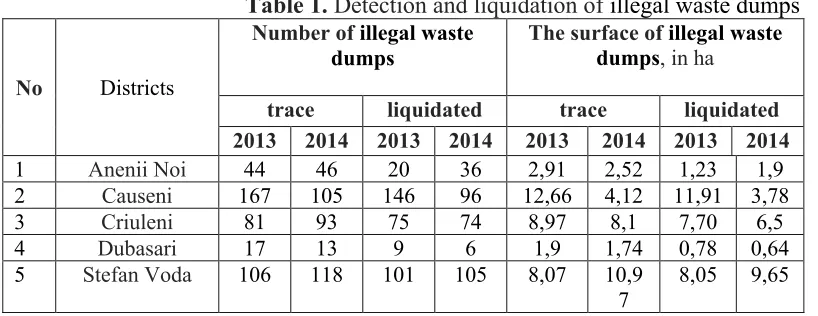
The maximum weight of spectered garbage dumps is found in Anenii Noi, Căuşeni și Ştefan-Vodă (table 1).
Table 1. Detection and liquidation of illegal waste dumps
No Districts
Number of illegal waste dumps
The surface of illegal waste dumps, in ha
trace liquidated trace liquidated
2013 2014 2013 2014 2013 2014 2013 2014
1 Anenii Noi 44 46 20 36 2,91 2,52 1,23 1,9
2 Causeni 167 105 146 96 12,66 4,12 11,91 3,78
3 Criuleni 81 93 75 74 8,97 8,1 7,70 6,5
4 Dubasari 17 13 9 6 1,9 1,74 0,78 0,64
5 Stefan Voda 106 118 101 105 8,07 10,9
7
8,05 9,65
According to the Regional Development Strategy, waste disposal polygons were placed in some localities, one of which is located at Opaci, Căuşeni.
The location of the landfill in the town hall perimeter, which calls for the implementation of the project, is facilitating the application of public private partnership (PPP), since the private investor is interested in its presence in good condition, in order to have lower operational, and particularly environmental costs and risks. Most forms of concession in waste management and sanitation look for construction, reconstruction, ownership and operation of the respective ramps.
In this region, there is not a shortage of municipal landfills, on the contrary. In Soviet times, they were built by one or several ramps, including authorized ones, in most of the localities. After independence, the situation and attitude remained the same. In the 1990s, due to the lack of funds, the condition of many ramps worsened considerably and their impact on the natural and social environment increased. In the last decade, with the support of the National Environmental Fund (NEF) and other institutions providing such assistance, they were modernized and a large number of such locations were built.
However, as mentioned above, a large part of the existing ramps are used at very low capacity, and people continue to throw garbage in landfills and unauthorized spectered dumps in and near the cities, in rivers and groundwater, seriously affecting the health of people in the area. Therefore, it is not the extension in the number of the ramps that is the priority, but their reduction, modernization, adequate construction of selected sites, and their effective management.
are currently used: composting, incineration, and landfilling. Waste transported to polygons are not subject to composting and burial as required, but are stored erratically throughout the perimeter, including roadways in the given area. The technology designed for the execution of composting is not working.
The main forms of impact and risk on the development of tourism caused by the waste in the region are:
• changes of landscape and visual discomfort;
• air pollution with odors, suspensions driven by wind and emission of greenhouse gases;
• pollution of surface and groundwater, especially in the result of the formation of the filtrate from washing waste deposited by rainwater;
• Changes of biocoenoses on the polluted fields and the ones neighboring them, so the ruderal plant associations become dominant species specific to polluted areas, and some mammals, birds, insects leave the area for the benefit of those who feed on refuse (rats, crows, stray dogs).
Lately, the amount of animal waste has reduced significantly. The maximum amount of this waste is found in Anenii Noi district (28 000 t). However, most districts do not show the full information about this waste. To improve that situation, several joint platforms for storing manure were appointed in Anenii Noi şi Căuşeni districts. It is necessary to impose severe restrictions on the evacuation of pig manure from sheepfold locations.
The amount of communal household waste is the solid waste and the remaining waste from the water treatment stations. Currently, most of the treatment plants lack modern technologies for dehydration and processing of such waste, usually, calling on the services of nature. Processed organic sludges and solids collected from sewage are transported to filtration fields that often are not arranged according to respective regulations. Because of the direct contact with the natural environment, atmospheric air, groundwater and surface water are heavily polluted.
A particularly alarming situation is found in toxic waste management resulting from individual consumption, such as polyethylene bags, plastic and aluminum dishes, or waste tires. They are bypassed by centralized management records and statistics, but are found in abundance in all ramps and dumps in ravines and small rivers.
Conclusions and recommendations:
1. The Lower course of the Dniester River has a great tourism heritage varied and rich, but because of the particularly strong rural and agrarian character, tourism activities are underdeveloped.
2. Despite the high value of the tourism sites, a good part of the natural geological monuments are transformed into unauthorized dumps and quarries while landscape reservations are subjected to massive illegal deforestation, overgrazing, landslides and other forms of degradation.
3. In the '90s, due to the decline of the industrial and agricultural production, substantial reduction in emissions (8 times) was registered, as well as reductions in water consumption and discharges (4 times), followed, in 2000, by the fluctuation amid a slow trend of overall increase. About 90% of the total weight of the emissions is generated by mobile sources.
pesticides, cyanide from wineries and the share of communal unauthorized ramps dropped by 30%. In a few localities the following were initiated: the separate collection of communal waste, landscaping livestock for biogas production platforms, treatment and incineration of municipal waste, including waste water treatment plants. The following are required: a) proper implementation of environmental initiation and education; b) mandatory provision of data by environmental authorities on waste general production and harsh sanctions for the failure; c) adequate monitoring and enforcement of mandatory drainage works at communal waste storage ramps; d) adequate involvement of branch subdivisions of central and local public authorities in order to achieve the National Program waste recovery; e) implementation of the Urban Plans of localities that include specific technical projects for waste management. 5. Tourism capitalization of the region is conditioned by economic underdevelopment and the predominantly agrarian and rural character of the region, the poor state of access roads, insufficient sanitation, unauthorized settlements and waste areas. At the same time, regulating the Transnistrian problem and implementing the Association Agreement with the EU will enhance the attractiveness of the territory, and tourism will become one of the main areas of attraction for foreign investments and overall economic recovery in Moldova.
Bibliography:
1. Bacal, P. (2010), Gestiunea protecţiei mediului înconjurător în Republica Moldova. Aspecte teoretice și applicative, Chişinău: ASEM.
2. Bacal, P. (2007), Aspectele teritoriale ale gestionării deşeurilor în creşterea competitivităţii şi dezvoltarea economiei bazate pe cunoaştere, Tezele Simp. Int. Chişinău: ASEM, , Vol. II, p. 411-415.
3. Bacal, P. (2007), Gestionarea deşeurilor. In: Republica Moldova 2007, Raportul de Stare a Ţării. Centrul Analitic Independent „Expert Grup”. Chişinău, p. 192-196.
4. Duca, Gh., Cazac, V., Galcă, G. (2004), Poluanţii organici persistenţi. Starea actuală şi evaluarea capacităţii de monitoring in Republica Moldova. Chişinău. 5. Garaba, V., Pleşca, V., Isac, A. (2005), Poluanţii organici persistenţi. Mediul şi
sănătatea, Mediul Ambiant, nr. 1, 38-41.
6. HG nr. 606 din 28.06.2000 privind aprobarea Programului Naţional de Valorificare a Deşeurilor de Producţie şi Menajere, Monitorul Oficial nr. 078 din 08.07.2010.
7. Anuarul IES – 2013 „Protecţia mediului în Republica Moldova”. Chişinău, 2014. 8. Anuarul IES – 2014 „Protecţia mediului în Republica Moldova”, Chişinău, 2015. 9. Anuarul privind calitatea factorilor de mediu şi activitatea Inspectoratului Ecologic
de Stat în anul 2005, Chişinău, 2006.