INTRODUCTION
One of the main areas of rational technical support for the forming products process in vari-ous industries involves machines with roller op-erating elements. At present, there is no sufficient variety of designs of roller operating elements, which carry out the technological operation of in-jection and transportation of a viscous medium. These machines need to be improved and inves-tigated in order to implement new developments in production [1, 2, 3]. Special attention is paid to small-size, efficient machines with controlled processes occurring in the working chamber. While designing such machines, special attention should be paid to the substantiation of the scheme and the appropriate construction solution of the decisions made, since it significantly influences the possibility of such machine manufacturing
under the enterprise conditions, the technological capabilities of which are aimed at equipment re-pair and recovery [3].
At present, the creation of new and refine-ment of the current technologies cannot be lim-ited to different semi-empirical approaches based on the production experience alone. They must be based on sound fundamental theoretical conclu-sions. Therefore, the development of the theory of pouring process is carried out by developing the methods of fairly accurate quantitative de-scription of the processes that take place in the medium when it forms in the inter-roll gap and after deformation. A comprehensive study on the behavior of the medium (dough) in the deforma-tion zone during pumping and injecdeforma-tion and the establishment of regularities that link the quality parameters with the modes of their deformation, are possible only when using the methods of solid
The Substantiation of the Optimal Parameters
for Dough Pinning-Out Rollers
Tetiana Vitenko
1*, Igor Stadnik
1, Paweł Droździel
2, Anna Rudawska
21 Ivan Puluj TNTU, Faculty of Engineering of Machines, Structures and Technologies, Ruska 56 Street,
46001 Teronpil, Ukraine
2 Lublin University of Technology, Faculty of Mechanical Engineering, ul. Nadbystrzycka 36, 20-618 Lublin,
Poland
* Corresponding author’s e-mail: [email protected]
ABSTRACT
The article defines the rather complex and unpredictable movement of the dough in the gap between the working
rolls and suggests the calculation for the optimal parameters for the rolls shape (particularly the parameters and
their effect on the dough). The functional dependences of the permissible diameter and the gap between rotating rollers were substantiated. The block diagram of the geometric bounding parameters of the gradient field of the viscous fluid flow was proposed and the equation on the basic constructive parameters (h, r) affecting the pouring process efficiency was presented. The analysis of the experimental results revealed that the main features of the
machine provide the necessary stable shape products and good rheological parameters of these products. The rheo-logical testing indicators allow for a rational approach to the decision to operate a rolling process. At the same time,
they improve the quality control methods and have an influence on the design parameters of rollers and modes of chambers. The proposed method not only allows obtaining a predetermined pressure, but also enables defining the
optimal shape of the gap, wherein the pressure gradient is constant.
Keywords: rolls shape, pouring process, rheological parameters.
Volume 14, Issue 1, March 2020, pages 32–41
https://doi.org/10.12913/22998624/113611
Research Journal
Accepted: 2020.02.03medium mechanics [4, 5]. They allow conduct-ing quantitative assessments of transitions in the environment (dough). In order to analyze these processes, it is necessary to consider the basic rheological properties, conditions on the surface of its contact with the rolls and other factors.
At the same time, a large part of the achieve-ments of the fundamental sciences does not find appropriate application in solving new classes of theoretical and applied problems in the impact of rolls on the environment. These include the prediction of the structure and properties of the environment, defects, stresses, deformation and loading in the treated environment [4].
Thus, due to the multifactorial, complex in-terdependence, multi-stage production processes, it is not possible without sufficiently rigorous mathematical modeling of the learning processes. The correctness of mathematical models, taking into account the maximum number of influential factors, including the use of previous assumptions in the components of mathematical dependencies, should be based on the results of the studies that are recognized achievements of scientific and technological progress [5,6].
ANALYSIS OF THE AVAILABLE
INVESTIGATIONS
Rolling is a way of processing the dough with plastic deformation, which is the most common method in the baking and confectionery industry when molding products. This method was born in the eighteenth century and over time has reached a high level of perfection. The essence of the pro-cess is that the weight of the dough in the working chamber of the machine is compressed passing in the gap between the rotating rolls; thus, it decreas-es in the cross section and increasdecreas-es in length. The cross-sectional shape is called the profile [7, 9].
The process of passing the dough between the rolls is ensured by the friction forces of the rotating surfaces of the rollers and the dough. Due to the loose surface of the rolls, the dough moves in the gap between them, simultaneously deform-ing. At the moment of the dough being gripped by each roll, two forces are exposed: normal force and tangent friction force.
In order to develop and improve equipment with roller working bodies and its implementa-tion, a scientifically sound method of calculating
the operating parameters flowing in these ma-chines is required. The hydrodynamic theory in the field of processing of food masses has been greatly advanced in the study of the flow of non-Newtonian fluids in the gap of rotating rolls, ow-ing to the scientists O.G. Lunina, Yu. A. Machykh-ina, S.A. MachihMachykh-ina, V.A. Aretha, V.A. Panfilova and others. They have established that the dough refers to pseudo plastic bodies, the flow of which is described by Ostwald’s power law [7, 8, 9].
Accordingly, all scientific work was aimed at forming a viscous environment by rolls. They should influence it in such a way that the losses of raw materials and finished products are minimal and the quality of products is high. This led to the need to ensure full compliance with the pro-cessing modes, design forms and parameters of the working roll bodies, as well as the structural and mechanical properties of the viscous medium [7, 10].
While working with wheat yeast and pasta dough, the above-mentioned researchers did not fully pay attention to the influence of the gap be-tween the rolls, feed and discharge angle, diam-eter and geometry of the rolls, changes in torque and energy consumption as well as reliability. The possibility of using this data to form a test piece with the necessary, in terms of practice, shape and size has not been sufficiently studied. It was found that the formation of the dough layer with mini-mal compaction and preservation of the form-holding properties is only ensured by the use of step-by-step rolling of cylindrical rolls [7, 11]. All the data nowadays demand new results, as changes occurred in dough kneading, properties of components and formulations.
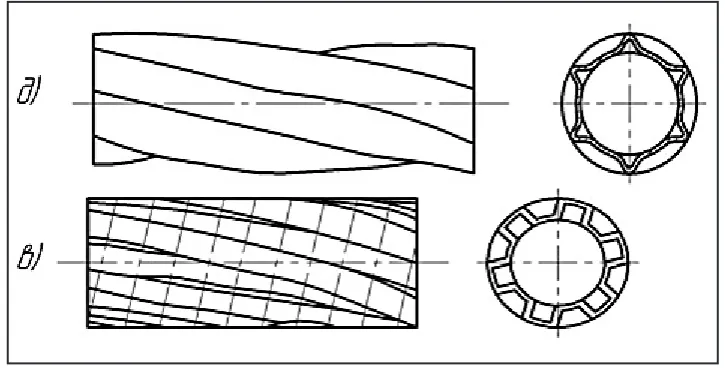
The specific character of such investigations is associated with an extremely wide range of technological environment properties, the va-riety of materials used, the distinction of oper-ating conditions. It should be noted that the in-vestigation of the process of a viscous medium rolling by rollers is due to the need for complex use of physical-chemical mechanics of materi-als, solid-state physics, metallurgy, etc. It should also be pointed out that the traditional methods of viscous medium rolling by rollers (Fig. 1) are based mainly on the combination of deformation load – compression of the working medium in
quasi-static and dynamic modes, with the defor-mation of the entire three-phase medium volume [2, 4, 9, 11, 12]. Any of the structural schemes with the participation of roller operating elements (Fig. 1) can be mathematically described in the presence of the equations that connect in time by continuous functions the geometric equipment di-mensions, properties and the physical-mechanical state of viscous medium, depending on the sheet-ing, as well as the rollers geometric and climatic characteristics.
The generalized mathematical model of the sheeting process can be presented by the system of differential equations:
( , , , , );
( );
( , , , , , )
( , , , , , , );
;
0;
( ).
v
J A
y x
d
f t v T
P
dt
dv f t
dt
dJ
f
r t v x
dA
f J M t x T
dt
dt
dv
dv
d
dP
P P x
dt
dx dx
dy
µ
µ
r
µ
r
µ r
t
ì
=
ï
ï
ï
=
ïï
=
í
ï
=
ï
ï
ï
=
+
=
=
ïî
where: J is intensity of rollers mechanical action on medium;
P(x) is pressure; х is coordinate in the di-rection of shear rate gradient change;
T is temperature;
M is parameter of medium mechanical properties;
v is rollers rotation velocity;
µ is viscosity;
А is specific sheeting work; τ is shear stress.
It is clear that the solution of such system is possible under certain initial and boundary condi-tions determining the medium state, the mechani-cal effect parameters.
Materials. Dough with moisture content 33%, for high quality wheat flakes on pressed yeast, was prepared in the opaque manner with the fermentation time of 60 minutes at temperature 32–33°С. The quality of the pressed yeast corre-sponds to the DSTU. The characteristics of wheat flour are as follows:
• mass fraction of moisture,% – 14.5;
• the content of raw gluten, % – 28;
• resistance gluten compression on the device IDK-1, per. pril. – 54;
• gluten stretch, sm – 14.
Methods. Any of the structural schemes that were developed and exist with the participation of roller operating elements can be mathematically described by equations connected in time with continuous functions. These include the geomet-ric dimensions of equipment and characteristics of working rollers, as well as the properties and physical-mechanical state of the viscous medium, which depends on the conditions of sheeting.
On the basis of the developed approaches for describing the process of injecting dough in the gap between the rollers, the hydrodynamic theory of calibration of the pseudo plastic fluid was used. This enables to set [19] the quantitative depen-dencies between the geometric characteristics of the working space (gap) and the properties of ma-terials and processing modes. With the use of this process theory, a number of formulas have been developed to determine the pressure in the gap between the rollers, based on the medium param-eters and viscosity.
The characteristics of dough with indestruc-tible structure were investigated by the device RV-8. The experiments were carried out at small shear forces, the magnitude of which was lesser than the boundary shear stress. Every 10–20 sec-onds the deformation values indicated by the ar-row deviation were registered. Knowing the geo-metric characteristics of the device and measure-ment data, the shear stress is calculated
t
¢:пр в
шк к
=
(
m
2
-
p
m
R
02)
h
gR
t
-t
=
t¢
where: m – weight of the load that rotates the ro-tor. It consists of the mass of two weights and masses of cups, kg (except for the val-ue compensating friction in the bearings); m0 is the mass of the load in which the
rotor starts to rotate. Accordingly, [10, 13] plastic viscosity was determined:
1
(
) /
плµ
= -
t t g
Statement of the problem.Successful solu-tion of the assigned multifaceted tasks to ensure quality operation of the B-4–58 molding machine on the basis of in-depth study of the impact roll-er working bodies at the stage of formation of
bakery and confectionery products. In this regard, the work carried out to determine the influence of various parameters on the structure of the formed “Podolskiy” dough bagel. It should be noted that to ensure more accurate operation of the mould-ing machine, a partial absence of gas inclusions in the dough is of great importance. Under the ac-tion of the rolls, the dough is subjected to repeat-ed staving and rolling. This action leads to the dough compaction, due to the allocation of gas in it and has quite a significant value to stabilize pressure at its discharge and compliance the op-timal modes of operation of the rolls. Therefore, with the passage of the technological process, it is necessary to apply the correct method of deter-mining the required design parameters for design-ing a roller workdesign-ing bodies.
In the research, the authors assumed that in the dough between the rolls is in active connec-tion of the individual particles. An important rheolo-mechanical parameter characterizing the process of the discharge under the conditions of uniform compression, is the pressure generation in the dough. Pressure is a constant for a given machine and has its limits. This is because the compression of the dough rolls leads to a decrease in pore volume and the elastic deformation of the particles. Therefore, in our experiments, the pres-sure was not taken into account and the indicators that influence more on hisotory property that af-fects the structure of the bagel were taken note of. Table 1 presents the indicators of the overall technological quality indicators of the test work-piece. They provide an opportunity to judge the compliance process for a “ Podolskiy” bagel.
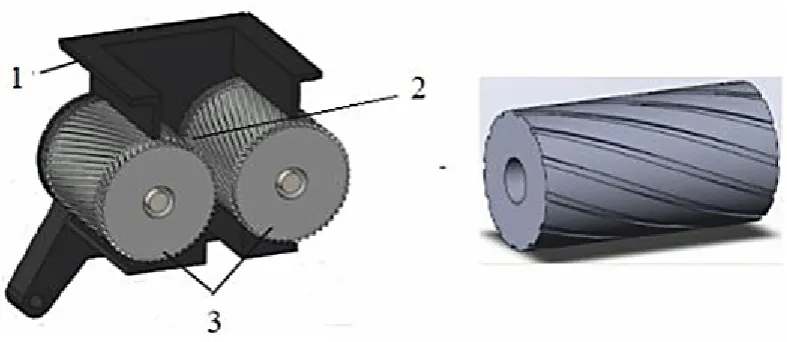
Let us consider the feeding unit of the mold-ing machine (Fig. 2) consistmold-ing of dough load-ing hopper 1, discharge chamber 2 made of two ribbed rollers 3 installed in parallel with the pos-sibility of dough passing between them. Any of the existing and developed structural schemes with the participation of roller operating elements can be mathematically described by equations that are connected in time by continuous func-tions. We will take into account the geometric dimensions and characteristics of rollers, as well as the properties and some physical-mechanical characteristics of viscous medium. The new roll-ers surface shape proposed by the authors diffroll-ers by cylindrical-screw grooves with constant along the length of screw lines step [13, 14].
complicated and at the same time, an essential-ly important problem [1, 15]. This is due to the need for various types of calculations for form-ing workform-ing rollers determinform-ing their effect on the medium. In order to solve such class of problems, it is reasonable to involve the logic algebra and the set theory [1, 2, 16]. At the same time, it is necessary to take into account the medium prop-erties. This enables to consider the arrangement as the ordered set of operating links, and their var-ious combinations, as logical relations of the set elements [2, 16, 17]. In general case, these tasks are more extreme. While choosing the best option for determining the influence of roller structural parameters, the prioritization method, i.e. the op-tions qualitative assessment, is chosen. The solu-tion of the set tasks is possible on the basis of careful investigation of the essence of the process occurring during dough sheeting by rollers.
The irregularity of the velocity of the move-ment of the medium (bagel yeast wheat dough) is due to the nature of the flow. Therefore, a signifi-cant factor in increasing the effectiveness of the intensive rolls on the environment is the uniform pumping of its elementary volumes coming from the working chamber of the machine. On the ba-sis of the assumption that the specific flow of the medium is the same for all elementary volumes of mass that are in the gap between the rolls, the viscosity remains constant and it was not taken into account in the calculations.
The objective of the paper was to determine the influence of the rollers geometry on the in-jection quality under the condition of horizontal dough sheeting.
RESULTS AND DISCUSSION
The analysis of papers [7, 13, 17, 18, 20] proved that the medium velocity unevenness (bread ring yeast wheat dough) is due to the flow nature. Therefore, a significant factor in increas-ing the effectiveness of the rollers intensive ac-tion on the medium is the uniformity of sheeting its elementary volumes running out from the ma-chine working chamber. Taking into account the assumptions that the specific medium flow is the same for all the elementary mass volumes located in the gap between the rollers, the viscosity re-mains constant and it was not considered in the calculations.
Schematically, the process of dough sheeting is shown in Figure 3. The rollers of similar diam-eters rotate towards each other under continuous medium motion (wheat dough).
The inertial properties of viscous medium are omitted. The type of the function describing the consumption rate is as follows:
2
( )
( , , ) A B Par
J Par A B =e × - (1) Assuming that J(Par)=G,the unknown coef-ficients in equation (1) А and В are determined for each case with the smallest squares method. Three cases are considered.
THEORETICAL CALCULATION RESULTS
FOR THE CASE OF THE GAP EFFECT
length. We form the consumption distribution J hµ( )
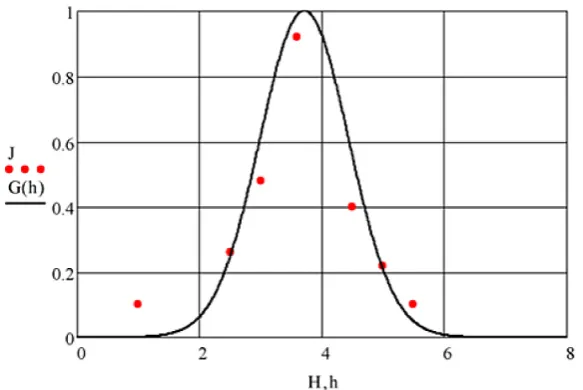
on the gap h, which varies from 1 ... 5.5 mm and the probability of the given factor availability. The highest probability 0.92 is investigated for
h = 3.6 mm. While moving from the centre, it de-creases to 0.1.
1...2.5...3...3.6....4.5...5...5.5 0.1...0.26...0.48...0.92...0.4...0.22...0.1
Jµ =æç ö÷
è ø (2)
For the practical use of expression (1), you need to set the values Аand В. Let us apply the smallest errors operator to determine А та В. Let us also apply the smallest error operator of MathCAD program. We use the Given – Minerr block. n = cols (mh) n = 7 B = 3.60 A = – 0.01 Given
1, 0,
1
2 , 0
(
i(
i, )) 0
nh h
i
A B
-=
µ
-
µ µ
=
å
( , )
0,954 3.718
h h h h
A Minerr A B B
A B æ ö
= ç ÷ è ø
-æ ö
=ç ÷
è ø
1
: max ( T)
m
M = é µ á ñù
ë ûm: min (= éëµhT)á ñ1 ùû
M=0.92 m=0.1
Ah= – 0.954, Bh=3.718, i=0…n – 1, h=1,1.1…6 ( ) : ( , , )
h h h A Bh h
µ = µ
h0 = 1 hm = 6 c = 2.9
According to the calculation results, the de-pendence of the consumption rate of viscous mass according to (1) is as follows:
2 0.95 (3.72 )
( ) h
G h =e- × - (3)
Let us construct the graphs of functions (μh),
[G(h)] according to the data (2) Figure 4.
In Figure 3 the results of theoretical calcula-tions are represented by the curve, while the ex-perimental data – by points. The analysis of the curve nature shows that the gap size affects the consumption and, accordingly, the process qual-ity. The rational value of the gap between the rollers, which ensures high-quality dough roll-ing sheetroll-ing, is within 3–4.2 mm. It should be noted that the comparisons of experimental and research data are well correlated.
Some characteristics of dough and blanks for different gap values and rollers diameter are rep-resented in Table 1. These data prove the rational values of the gap between the rollers obtained on the basis of the theoretical calculation.
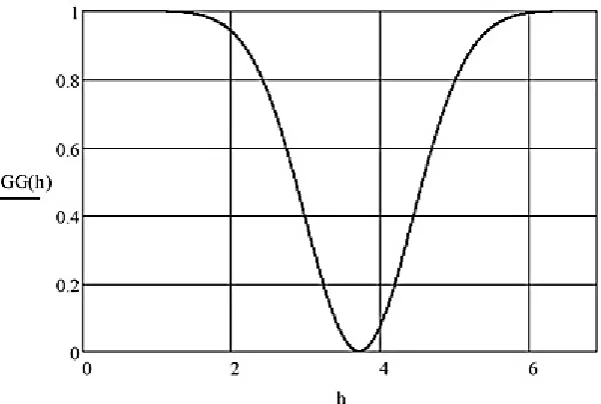
At the next stage, the belonging function of consumption rate GG(h) along the rollers plane as the normalized quantity was investigated. In-terval of argument change is h: h0 = 1…hm= 7:
0
( )
9.664
m
h h
GG h dh
S
S =
=
ò
Fig. 3. Profile scheme of dough sheeting between the rollers: 1 – rotating rollers with
The dependence of the belonging function
GG(h) is shown in Figure 4. function. (1 ( )) 0 7 0
( )
C G h if hotherwiseGG h
=
- £ £ (4)The obtained results prove the correctness of the initial conditions assumed for the determina-tion of the dependence of the gap between the rollers along the length on the working medium consumption.
THEORETICAL CALCULATION
RESULTS FOR THE CASE OF ROLLER
RADIUS PARAMETERS ACTION
The investigation of the belonging function parameters for the consumption rate of the vis-cous medium between the rolls relatively to its radius was carried out. The position of point O (Fig. 3) was fixed in mm. The function GG(r) in the rollers plane was searched as the normalized
quantity. The calculation principle was the same as in paragraph 1.
155 158 161 167 170 175 0.14 0.36 0.68 0.66 0.32 0.11
Fµ =æç ö÷
è ø (5)
n: = cols(Fµ) n: = 7 B: = 164 A: = – 0.1
Given 1 2
1, 0,
0( ( , , )) 0
n
i i
i F G F A B
-µ µ
= - =
å
( , )
0,032 163.862 r
r
r r
A Minerr A B B
A B
æ ö
=
ç ÷
è ø
-æ ö
=ç ÷
è ø
We obtain the formula of the medium con-sumption dependence on the parameter r
0.032 (163.862 )
( ) 0.99 r
GG r = ×e- ×
-(listing 2) ( )m
n cols= µ n=7, : 164, : 0.1B = A =
-Given
Fig. 4. Function of medium consumption belonging along the rollers plane
Table 1. Experimental data of dough properties after the rollers and molding device action
No. rev./min.n, m1,
kg. gas formationG, specific K h, gap between rollers, mm. W humidity kg/mρ 2 Temperature
1. 1.2 0.0078 10 1.57 1 31.6 1.12 27
2. 1.2 0.0077 10 1.57 2 31.6 1.12 27
3. 1.2 0.0079 10.2 1.57 2.5 31.7 1.12 27.3
4. 1.2 0.0087 10.2 1.57 3 31.7 1.123 27.2
5. 1.2 0.0097 10.3 1.57 3.5 31.7 1.123 27.3
6. 1.2 0.0099 10.2 1.57 4.5 31.6 1.124 27.4
1, 0, 1
2 , 0
( i ( i , ))
n
m m
i
A B
µ µ µ
-=
-å
( , ) r
r
A Minerr A B B
æ ö
=
ç ÷
è ø 1, 0,
1
2 0( i ( i , ))
n
m m
i A B
µ µ µ
-=
-å
Аr= - 0.032 Br= 163.862mm: min (= éëµmT)á ñ1ùûm=0.11
( ) : ( , , ) : co ( )
m r r A B nr r ls m
µ = µ = µ
I = 0…n – 1; r = 155, 155.1…175
Let us carry out the normalization test accord-ing to the standard and select CС in the belongaccord-ing function formula choosing the interval for argu-ment change the r: r0=155 to rm=175.
r0 = 155 rm=175 S = 9.689 CC=0.99 mmr= CCmm(r)
0 ( )
rm m r
S=
ò
µ r drThe consumption belonging to function GG(r) in the rollers plane is found as the normalized quantity. Let us carry out the normalization test according to the standard G=9.7 and select CС in the belonging function formula, choosing the in-terval for argument change r: r0 = 155 to rm= 175. We obtain the formula of the medium consump-tion dependence on parameter r:
0.032 (163.862 )
( ) 0.99 r
GG r = ×e- × - (6)
On the basis of carried out calculations, let us construct the function graphs F(mh),[G(h)] ac-cording to the data (5) in Fig. 5. In Figure 5, the theoretical values are represented by the curve, and experimental data by the points. According
to the obtained results rational values of the roller diameters from 162 to 168 mm.
COMPLEX EFFECT OF GAP H
AND RADIUS-VECTOR R
The joint effect of two factors was carried out through the logical product of the belongings by minimizing two determined functions along two-dimensional area of two factors r and h.
G(h,r)=min(GG(h), GG(r)),
In order to ensure the calculations, the prob-lem of coarse grain argument was solved by choosing number N – the number of points of the change range division of the range r and h.
N=20 i=0…Nj=0…N r1=155 r2=175 h1=o h2=7
, ( , )
i j r i j
M =µ h r h
For practical reasons we choose submatrix М of the entire array( ri, hj, Mij)
ri=r1+(r2-r1)i/N
hj=h1+(h2-h1)j/N
The functional dependences of the medium consumption, depending on r, and h are shown in Figure 7.
Mm=min(M)=0.019
M=submatrix (M,0,20,5,15)
between the rollers, respectively [3, 8].The analysis of the obtained results shows that the largest medium movement occurs near the roll-ers surfaces, which depends on h and changes in the direction of the central inter-roller axis reduction. This special medium movement can be divided into two stages. The first one is the adhesive medium contact with the roller surface [20, 21]. The speed changes along the roller surface. At this stage of the movement, the determining factor is the rollers diameter of. The second stage of the movement is the inter roller variable medium motion.
CONCLUSIONS
On the basis of the proposed method for the investigation of the influence of the roller radius and the gap between them on the dough consump-tion, the functional dependences for calculating the rational roller diameter and the gap between them were substantiated. Thus, to ensure rational dough consumption, the rollers diameter range is 155–165 mm, the gap – 1.5–3.4 mm. It is deter-mined that the mass is moving more intensely near the rollers surface due to the adhesion influence. The proposed method of investigation the nature Fig. 7. Graphs of fizzy medium consumption function: а- three-dimensional; b- order line
of the medium motion can be used while design-ing the roller injectors (dough dividdesign-ing machines, molding machines), while doing, mixing, and etc.
Determination of r and h parameters en-ables to reduce energy consumption, increase efficiency and minimize the material loss. The analysis of the experimental results proved that the machine design features provide the neces-sary stable products form and sufficient rheo-logical products parameters. This improved the quality control methods and control design parameters of rolls and modes in the camera. The proposed method of calculation enables to determine the rational gap shape, to provide constant pressure gradient.
REFERENCES
1. Mitsoulis E., Hatzikiriakos S.G. 2009. Rolling of bread dough: Experiments and simulations. Food and bioproducts processing.
2. Bloksma A.H. 1990. Dough structure, dough rheol-ogy, and baking quality. Cereal Foods World, 35(2),
237–244.
3. Holzapfel G.A. (2000). Nonlinear Solid Mechanics: A Continuum Approach for Engineering, New York. 4. Malkin A.Y., Isayev A.I. 2006. Rheology: concep-tion, methods, application. ChemTec Publishing,
Toronto, 474 p.
5. Mitchell T. A. 1984. Dough mixer controls for the
mechanical dough development process, Proceed-ings of the International Symposium on Advances in Baking Science and Technology, Kansas State University, Manhattan, KS.
6. Bloksma A. Niemann W. 1975. The effects of temper
-ature on some rheological properties of wheat flour
doughs. Journal of Texture Studies, 6(3), 343–361.
https://doi.org/10.1111/j.1745–4603.1975.tb01130.x 7. Machikhin Y.A. 1992. Formation of food masses.
8. Chakrabarti S. Bergström J.S., Lindskogand E., Sridhar T. 2010. Computational modeling of dough sheeting and physical interpretation of the
non-lin-ear rheological behavior of wheat flour dough, pp. 278–288, doi:10.1016/j.jfoodeng.2010.04.010
9. Chu S.G. 1989. Handbook of pressure sensitive adhesive technology, Chapter 8. New York: Van
Nostrand Reinhold.
10. Paul Singh R., Kenneth J., Valentas E., Handbook of food engineering practice. E. Rotstein (Ed), Includes bibliographical references and index. (alk. paper). 11. Khamis M. 2014. Characterization and evaluation of
heat treated wheat flours: dissertation theses. Man -hattan, Kansas: Kansas State University, p. 160.
https://core.ac.uk/download/pdf/33353737.pdf.
12. Declarative Patent for utility model Ukraine. Dough feeding unit of the molding machine. Patent owner:
Stadnyk I. А 21С 3/10 (2006.01) Ukraine. Patent no.111058., 25.10.16.
13. Declarative Patent for utility mo Ukraine. Dough feeding unit of the molding machine. Patent
own-er: A.Derkach, I., Stadnyk, O. Stadnyk.А 21С 3/10
(2006.01) Ukraine. Patent no.111061. 25.10.2016. 14. Muratova E., Smolihina P. 2015. Reologiya
kondit-erskih mass: monografiya: FGBOU VPO«TGTU», vol. 6, p. 188 http://oreluniver.ru/e/chair/thkimp/
news/Sbornik_2015.pdf
15. Nikolaev B. 1976. Measuring of structural and me
-chanical properties of flour dough. Food Industry, 83–127.
16. Obolkina V., Skrypko A., Kyianytsia S. 2016. The
scientific approach to the creation of technologies pastry recreational purposes using flour with malt oats. Food industry, vol. 19, p. 73–78. Available at:
http://nbuv.gov.ua/UJRN/Khp_2016_
17. Pareyt B. 2013. Impact of mixing time and sodium stearoyllactylate on gluten polymerization during
baking of wheat flour dough. Food Chemistry, 141, 4179–4185.
18. Paul Singh R., Kenneth J., Valentas E. Handbook of food engineering practice. E. Rotstein (Ed.), Includes bibliographical references and index. (alk. paper). 19. Stadnyk D.I., Katarzyna S. 2016. Determinanion of
power output and impact on the rheological param-eters of raw materials during rolling. Agricultural Engineering, 20, 5–12.
20. Stadnyk I., Novak L,, Matenchuk L. 2018, Global
rheological approach to the quality of medium in-jected by the rollers. Potravinarstvo Slovak Journal for Food Sciences, 11, 234–245.
21. http://www.potravinarstvo.com/journal1/index.
php/potravinarstvo/article/viewFile/867/pdf
22. Stadnyk I.Y., Piddubny V., Karpyk H., Yeremeeva
O. 2018. Features of heat transfer in the environ -ment when it is sprayed with rotary rollers. Potravi-narstvo Slovak Journal for Food Sciences, 12(11),