An NN Based Feature Analysis Model for Sleep
Apnea Identification
Bhanu Priya
1, Ms. Isha
21
Student, M. Tech Dept. of ECE, SPGOI Rohtak, Haryana
2
Asstt. Professor, Dept. of ECE, SPGOI Rohtak, Haryana
ABSTRACT
ECG signal is able to identify different kind of heart disease. One of the critical heart problem is the abnormal heart beat behavior during sleep. This problem is recognized as sleep apnea. In this work, a feature adaptive model is presented for Sleep apnea identification. To generate the effective signal features, the spectral subtraction and DWT methods are applied at earlier phase. After generating the low level features, the neural network is applied for signal recognition and disease class identification. The implementation results are obtained on real time sleep apnea dataset. The results show that the work model has provided the recognition rate over 80%.
Keywords: ECG, Neural Network,
I. INTRODUCTION
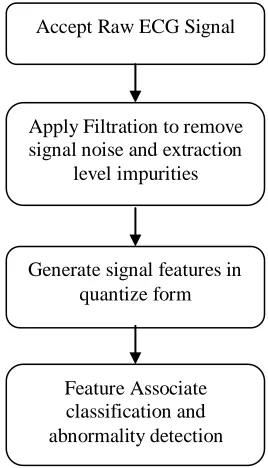
Heart diseases are having the major ratio in all disease which can be monitor using ECG signal processing. To identify the abnormality over the ECG signal, feature based analysis is applied over the signal. One of such feature extraction method is QRS complex detection. This kind of processing includes the extraction of feature vector under quantitative measures. The feature level evaluation is applied on such ECG datasets to provide the disease identification and classification. QRS is having the certain significance in identification of different kind of abnormalities. The algorithmic model applied for QRS detection processed under of number of sub stages to filter the signal and feature extraction over the signal. The first level analysis is here defined to improve the signal feature. The signal filtration is here applied to explore the features so that more effective recognition and classification will be performed. The processing model for the ECG signal processing is shown in figure 1.
Figure 1: Standard Model for ECG Processing
The signal level analysis and abnormality detection is one of the major concern and requirement. But as the signal is extracted, it can have some impurities because of device level problems. Because of this there is the requirement of improve the signal so that more effective signal extraction will be done. This noise level impurities reduction is
Accept Raw ECG Signal
Apply Filtration to remove signal noise and extraction
level impurities
Generate signal features in quantize form
required to identify the quantized ECG signal. After improving the signal, the next work is to apply the high level signal operations so that the signal features will be obtained. These operations includes the low pass filtration, squared signal form, thresholding etc. After this stage, the required signal features are explored and non required features get hide. After this stage, the final stage is to apply the low level classification operation to identify the abnormality over the ECG signal. The ECG signal is able identify most of the disease problems. One of such critical problem is sleep apnea. Sleep apnea actually represents the disease or the abnormal signal occurrence during the sleep.
A) Sleep Apnea
Sleep Apnea is the common disease instances identified as the pauses in the breath during the sleep. This breath pause is called an apnea which is analyzed in terms of frequency and duration. The lesser breathing during sleep is a kind of disease called hypopnea. It is classified in two main types called Obstructive Sleep Apnea and Central Sleep Apnea. The first type of apnea occurs in middle age adults because of collapse of upper respiratory airway and second occurs because of absent of inhibited respiratory drive. There are number of existing method for identification of sleep apnea identification under statistical measures so that the feature level analysis and the flow analysis can be derived. The parameter driven estimation is applied to identify the various abnormality levels.
In this work, a feature analytical model is presented underweight driven neural network approach. The presented model used the spectral subtraction and DWT decomposition at the earlier stage to obtain the low level signal features. In second stage, the signal features are obtained from the signal. In final stage neural network is applied for signal classification. In this section, the basic model of ECG signal processing is applied. In this stage the constraints for sleep apnea are described. In section II, the work defined by the earlier researcher is discussed. In section III, the proposed work model is presented. In section IV, the results obtained from the work are presented. In section V, the conclusion obtained from work is presented.
II. RELATED WORK
There are number of critical heart disease which are required to identify using ECG signal processing. Some of the work defined by different researchers on ECG processing is described in this section. Author[1] provided a SVM integrated model ECG signal processing. Author defined the disease identification during sleep based on the signal feature analysis. Author obtained the recognition rate over 95% under the defined method. Author[2] also provided an effective solution to identify the sleep apnea disease over the ECG signal set. Author defined the work in two main sub stages. In first sub stage, the signal level impurities are reduced and the phase driven analysis is applied with architectural are facts of the signal. In this stage, the apnea cases are identified to remove the signal errors. Nandakumar Selvaraj[3] provided a work on apnea detection under respiratory signal processing with healthy signal control method.
Author analyzed the relative productivity under high recognition rate to identify the integrated abnormal cases so that the signal improvement will be done. The work defined on this improved signal provided more accurate recognition and disease identification. Another work on sleep apean under layer architecture is presented by Author[4]. Author provided the spectral method implementation to generate the signal improvement in terms of signal peak identification. Author obtained the statistical measures to obtain the mean value, standard deviation and frequency analysis to perform the recognition. Author[5] provided feature driven analysis applied over the signal under component driven non linear signal analysis. Author defined the work under different classifiers such as KNN, naïve bays and SVM approaches. These approaches provided the signal level validation along with random sampling to derive the signal level solution.
accuracy over 95%. Author[7] provided a neural network based model to identify the ECG signal to identify the disease probability. Author provided the abnormality identification over the signal based on the weight adjustment method along with neural classifier. Author applied the classifier to identify the relative disease prediction. Author[8] provided the work for identification of heart disease using remote monitoring. Author integrated the hardware and software terms so that the disease diagnosis and signal classification is obtained. Author extracted the signal feature to obtain the decision under the monitoring statistical observation. Author provided the decision driven monitoring for knowledge. Author[9] provided the QRS detection so that the signal extraction so that the complexities over the signal will be reduced. Author defined the algorithmic modeling with procedural estimation so that the slope vector algorithm will be defined with associated criticalities analysis. Author improved the noisy signal for signal classification. Another QRS based method under complexities analysis is provided by author[10]. Author defined the morphological operator based ventricular disease identification under accurate decision and processing. Author provided the disease signal analysis and amplitude level modelling with signal complexes generation. Author achieved the accuracy rate of 98%. Author[11] provided a mobile integrated environment for disease identification and relative diagnosis provider. Author defined the signal extraction and the raw signal capturing model for signal processing for mobile device. Author defined the Bluetooth driven processing for communication improvement for the signal.
III. RESEARCH METHODOLOGY
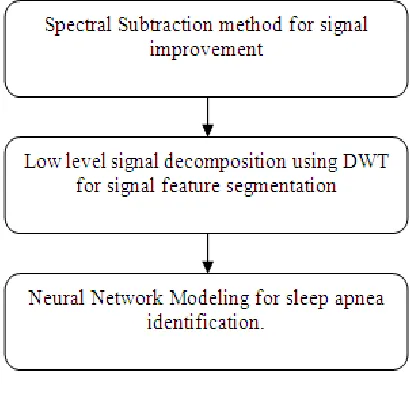
In this present work, an improved feature based method is presented for sleep apnea detection from ECG signal processing. The presented model is based on the feature adaptive analysis applied to generate the signal features. The work is considered to be applied on the noisy signal. This work is defined to improve the signal improvement and later on signal segmentation is applied to extract the signal features. The phase driven analysis is applied over the signal to generate the adaptive signal features. In this stage, the low level signal analysis is provided. The signal improvement is here done using spectral subtraction method. This stage also captured the effective signal features based on frequency level analysis. In this work a three stage model is presnted to provide the sleep apnea detection. The higher level work model of this work is shown in figure 2.
Figure 2: Presented Model
Figure 3: Work Model
Here figure 3 is showing the detail work model signal feature extraction and its classification for sleep apnea identification. The main consideration of this work is to generate the signal features. This analysis is provided under the band pass filtration and signal level decomposition to obtain the low level signal features. After generating the low level features, the squared signal transformation is done. Finally the thresholding is applied to generate the signal peaks and obtained the peak interval over the signal. These all collectively formed the featured dataset. After generating the featured dataset, the neural network classifier is applied for disease identification. The work is applied on real time signal set. The results shows that the work model has provided the effective results.
IV. RESULTS
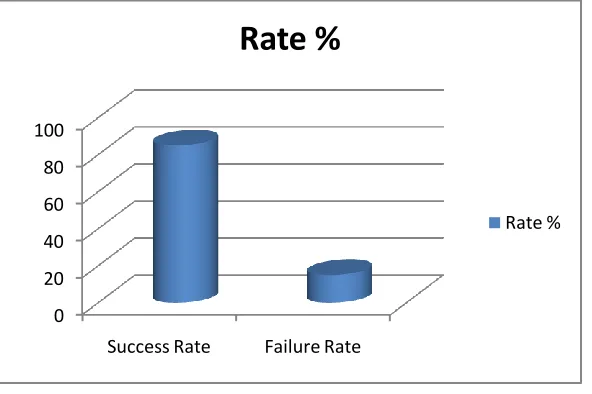
with a sample set of 20 signals. The sample set signal classes are unknown. The recognition rate obtained for the signal classification is shown in figure 4.
Figure 4 : Recognition Rate Analysis
Here figure 4 is showing the recognition rate obtained from the work for known signal analysis. The feature adpative neural network is applied for the classifciation of 20 signal set. The resutls shows that the presnted work model has provided the recognition rate of 85%.
CONCLUSION
In this work, a feature adaptive neural network model is presented for sleep apnea identification. The work is applied on noisy signal for improving the signal features. To improve the signal spectral subtraction method is applied. Later on signal decomposition is provided to generate the low level signal features. In final stage, the neural based distance analysis method is applied for sleep apnea identification.
REFERENCES
[1]. Laiali Almazaydeh performed a work," Obstructive Sleep Apnea Detection Using SVM-Based Classification of ECG Signal Features", 34th Annual International Conference of the IEEE EMBS 2012.
[2]. Sofien performed a work," Detection of Sleep Apnea in SWS Stages Using ECG Signal ",3rd International Conference on Image Processing and Electronics Engineering (ICIPEE'2013).
[3]. Nandakumar Selvaraj performed a work," Detection of Sleep Apnea on a Per-Second Basis Using Respiratory Signals ", 35th Annual International Conference of the IEEE EMBS 2013, 978-1-4577-0216-7/13©2013 IEEE
[4]. Lorena S. Correa performed a work," Sleep Apnea Detection based on Spectral Analysis of Three ECG - Derived Respiratory Signals", 31st Annual International Conference of the IEEE EMBS 2009, 978-1-4244-3296-7/09©2009 IEEE
[5]. Sani M. Isa performed a work, "Sleep Apnea Detection from ECG Signal-Analysis on Optimal Features, Principal Components, and Nonlinearity", 978-1-4244-5089-3/11 ©2011 IEEE
[6]. Laiali Almazaydeh performed a work, "SVM-Based Sleep Apnea Identification Using Optimal RR-Interval Features of the ECG Signal".
[7]. Walter Karlen performed a work, "Sleep andWake Classification With ECG and Respiratory Effort Signals", 2009. [8]. Sherin Sebastian, "Remote Patient Monitoring System", International Journal of Distributed and Parallel Systems
(IJDPS) 2012.
[9]. Xiaomin Xu," ECG QRS Complex Detection Using Slope Vector Waveform (SVW) Algorithm", 0-7803-8439-3/04@2004 IEEE.
[10]. V.S. Chouhan," Detection of QRS Complexes in 12-lead ECG using Adaptive Quantized Threshold", IJCSNS International Journal of Computer Science and Network Security 2008.
[11]. Deep Modi, "Android Based Patient Monitoring System", International Journal For Technological Research In Engineering 2014, ISSN (Online): 2347 - 4718.
0 20 40 60 80 100
Success Rate Failure Rate