R E S E A R C H
Open Access
Application of a self-enhancing classification
method to electromyography pattern
recognition for multifunctional prosthesis
control
Xinpu Chen, Dingguo Zhang
*and Xiangyang Zhu
Abstract
Background: The nonstationary property of electromyography (EMG) signals usually makes the pattern recognition (PR) based methods ineffective after some time in practical application for multinational prosthesis. The conventional EMG PR, which is accomplished in two separate steps: training and testing, ignores the mismatch between training and testing conditions and often discards the useful information in testing dataset.
Method: This paper presents a novel self-enhancing approach to improve the classification performance of the electromyography (EMG) pattern recognition (PR). The proposed self-enhancing method incorporates the knowledge beyond the training condition to the classifiers from the testing data. The widely-used linear discriminant analysis (LDA) and quadratic discriminant analysis (QDA) are extended to self-enhancing LDA (SELDA) and self-enhancing QDA (SEQDA) by continuously updating their model parameters such as the class mean vectors, the class covariances and the pooled covariance. Autoregressive (AR) and Fourier-derived cepstral (FC) features are adopted. Experimental data in two different protocols are used to evaluate performance of the proposed methods in short-term and long-term application respectively.
Results: In protocol of short-term EMG, based on AR and FC, the recognition accuracy of SEQDA and SELDA is 2.2% and 1.6% higher than conventional that of QDA and LDA respectively. The mean results of SEQDA(C) and SEQDA (M) are improved by 2.2% and 0.75% for AR, and 1.99% and 1.1% for FC respectively when compared to QDA. The mean results of SELDA(C) and SELDA (M) are improved by 0.48% and 1.55% for AR, and 0.67% and 1.22% for FC when compared to LDA. In protocol of long-term EMG, the mean result of SEQDA is 3.15% better than that of QDA.
Conclusion: The experimental results show that the self-enhancing classifiers significantly outperform the original versions using both AR and FC coefficient feature sets. The performance of SEQDA is superior to SELDA. In addition, preliminary study on long-term EMG data is conducted to verify the performance of SEQDA.
Keywords: Electromyography (EMG), Myoelectric control, Pattern recognition, Self-enhancing classification, Prostheses
*Correspondence: [email protected]
State Key Laboratory of Mechanical System and Vibration, School of Mechanical Engineering, Shanghai Jiao Tong University, Shanghai 200240, China
Introduction
Surface electromyogram (EMG) signal is a noninvasive measurement and contains rich information associated with the muscle electrical activities. It is considered to be an important input for the control of electrically powered prostheses, referred to as myoelectric control [1]. Conven-tional myoelectric control systems enable the amputees to operate a single device such as a hand or a wrist [2], simply based on amplitude decoding of the EMG sig-nal recorded from the separable forearm muscles. The early myoelectric controllers can only operate in an on-off mode to control electrically powered hands with open-close functions [3]. Controlling a multi-degree prosthetic hand requires more sophisticated technique for decoding of different muscle states from the recorded EMG [4].
To increase the number of motion classes, much atten-tion has been drawn to a pattern-recogniatten-tion (PR)-based approach to the myoelectric control of multifunctional prostheses in last two decades. Unlike the conventional EMG decoding method that assigns each function to a specific control muscle, the PR-based approach extracts useful information from several EMG channels to form a feature vector and maps it to a motion class, maximiz-ing the separability between each motion. Several types of EMG PR systems are introduced to fulfill the multifunc-tional prothesis control [2,5-10].
The feature extraction and classifier design are the major components of PR-based control strategy. The per-formance of EMG PR is mainly evaluated by the classi-fication accuracy. Various EMG feature sets have been employed to extract the most discriminant information for improving the classification accuracy. The feature extraction methods include autoregressive (AR) model [11], multivariate AR model [12], time domain statistics [2,13], root mean square (RMS) [14], higher-order statis-tics [15], cepstral coefficients [16], time-frequency rep-resentation [17,18] and EMG preprocessing method, e.g. the individual principal component analysis (iPCA) [8]. To achieve a high classification accuracy, researchers have extensively explored different types of classifiers, such as MLP [2], LDA [7,19], Gaussian Mixture Model [9], hid-den Markov model [6], support vector machine [10], fuzzy logic [20], K-nearest neighbor classifier [21] and unsuper-vised clustering [22]. In addition, due to the large number of EMG channels [23] and high dimensionality of feature set, feature selection and feature projection methods such as sequential feedforward selection [8,23], PCA [17] and uncorrelated linear discriminant analysis [24] are used to transform the EMG features to a lower dimensional subspace.
Usually, a successful classifier of EMG PR method is accomplished by two separate parts: (1) training step that aims to train the classification model from the knowl-edge of training data and (2) testing step that simulates
the situation in real-world application and evaluates the classification performance using the testing data. How-ever, the training EMG data are normally acquired at one time during a short period, and the contained informa-tion is limited, so they cannot be representative to the data of whole temporal span in application period including testing step. In real-world application, if an EMG classi-fier is trained well for a specific amputee, the amputee can control the prothetic hand well at the early stage, but the performance is degraded as the time moves on. This phenomenon is very common, and it is mainly because of the nonstationary property of EMG signals. The possi-ble EMG variation is contributed to these factors such as electrodes condition, muscle fatigue, sweating and so on [25-27]. It is a big problem hindering the commercializa-tion of advanced myoelectric controlled prosthetic hand that was developed in laboratory environment. Therefore, we plan to make further exploration in the testing stage since it simulates the real application situation, and expect to develop a kind of robust or adaptive classifier. In previ-ous research, the training and testing steps are two inde-pendent processes. When there exists mismatch between training and testing conditions, the performance of the EMG PR might deteriorate, i.e. the classification accuracy decreases. Enlarging the EMG recordings in training step that contain more information may be a possible solution, but it is a time-consuming task and can give additional burden to the users. So we are inspired to retrain the classifier with the testing data in addition to the training data, which perhaps can alleviate the mismatch problem. In previous research, the parameters of original classi-fiers, e.g. the mean vector and pooled covariance in LDA, are estimated from the training set only. We believe using more available data to train classifiers can lead to more accurate and stable parameter estimation that is close to the true sampling distribution. Exploiting information in testing dataset is a possible way to enlarge the data pool for training and further increases the recognition accuracy of classifiers.
In order to guarantee the stable performance of the con-tinuous EMG PR in view of above remarks, the idea of self-enhancing classifiers is presented in this paper. As far as we have known, few previous works in myoelec-tric pattern recognition focus on the classifier adaptation, especially in designing an adaptation procedure for the continuous classification.
feature extraction, and proposed self-enhancing LDA and QDA (SELDA and SEQDA) classifiers. Section ‘Experiment results’ provides the experimental results. Section ‘Discussion’ is the discussion. Finally, conclusions are presented in Section ‘Conclusion’.
Method
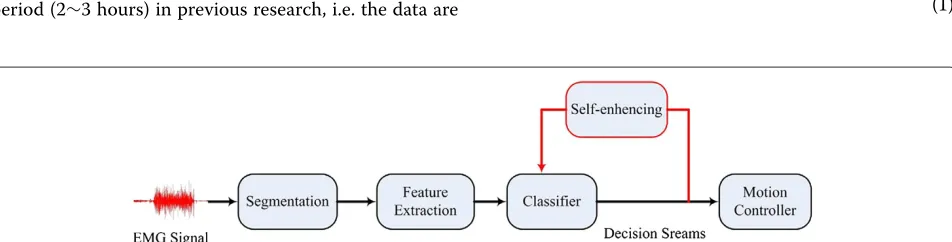
The traditional process of EMG PR method generally con-tains segmentation, feature extraction, and classification. The decision streams are finally generated for the motion controller. A self-enhancing mechanism is added to the traditional process in this work, and Figure 1 illustrates the flowchart. The key components will be expounded in the following parts.
Segmentation
The N-sample analysis window, which is used to esti-mate the feature, segments the raw EMG signal and slides
with m-sample window increment. The procedures of
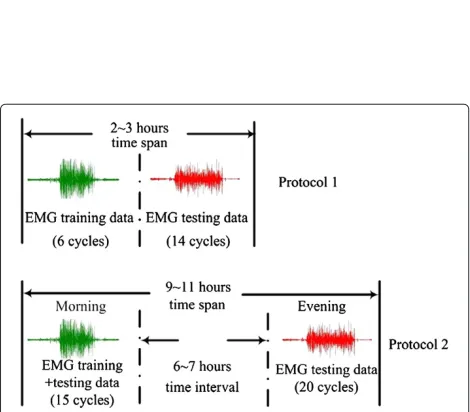
the feature extraction and classification are completed in the window-increment intervals. The continuous classi-fier sequentially produces a stream of prediction decision for each analysis window. The self-enhance classifier is ini-tiated by training set and then updated its model using the classified continuous EMG data. The self-enhancing step works as a feedback process to the classifier when assess-ing the classifier in testassess-ing step or applyassess-ing it in real-world application. To easily fit the manner of continuous EMG PR, the self-enhancing algorithm adopts an incremental mode (updating window by window). The parameters of classifiers are continuously adjusted to each new-coming testing data. The data is then thrown away after com-pleting the classifier updating. Namely, the incremental self-enhancing method has the advantage of the small storage requirements. In order to completely evaluate the proposed methods, two protocols are designed for EMG data recording. One is the conventional case, testing data is collected adjacently after the training data measure-ment. The other case is to let the testing data be collected about 7 hours later after the training data measurement. Generally the EMG data used are collected during a short period (2∼3 hours) in previous research, i.e. the data are
short-term. Towards the practical application in future, long-term EMG data are more meaningful.
EMG feature extraction
The surface EMG signal detected during the voluntary contraction resembles stochastic noise due to the variabil-ity of MUs (Motor Units) firing rate and recruiting rate. Although EMG signal recording from different motions is a non-stationary process, it has demonstrated that the signal can be assumed to be wide-sense stationary under the 0.5 s analysis windows if the contractions are iso-tonic and isometric[29]. For the continuous EMG PR, it has no advantages to use the time-scale methods, such as wavelet and wavelet pack [7], to extract EMG features from steady-state signals. Time and frequency analyses are selected to extract the useful features of EMG sig-nal in terms of classification accuracy. Previous studies have shown that the feature set AR + RMS, which respec-tively describes the amplitude and spectral information of EMG, presents better classification performance than other features [10,28].
The cepstral coefficient is an efficient feature in speech recognition. The AR-derived cepstral coefficient has been applied in EMG PR task and presents good classification performance [16]. Another way of cepstrum coefficients derivation is based on the Fourier spectrum [30]. The dis-crete cosine transform (DCT) [31] is used for converting fourier spectrum to the meaningful cepstral feature since it can decorrelate the feature and compress spectral infor-mation. The Fourier-derived cepstral (FC) is well studied in [32], and it shows better performance compared with other EMG features. The FC coefficients are achieved by two steps:
1) calculate the energy spectrum using the discrete Fourier transform (FT)
X[k]= N−1
n=0
x[n] exp−j2Nπnk, k=0, 1,. . .,N−1
(1)
2) calculate FC coefficients from the nonlinear magnitude of the Fourier-spectrum transform directly using DCT
FCi= N−1
k=0
Ykcos(
(k+1/2)(i−1)π
N ), i=1, 2,. . .,N
(2)
wherex[n]is the sEMG signal,Yk =f(|X[k]|)
denotes a nonlinear transformation (e.g., logarithm of magnitude) of|X[k]|,|X[k]|is the magnitude of Fourier coefficients, andN is the number of FC coefficients. In addition, it should be noted that the computation of the FC feature extraction is mainly dependent on the fast FT (FFT) and DCT algorithms and it is computationally efficient.
Since AR and FC have shown superior performance in previous study, they are selected as the EMG feature sets to evaluate the performance of the self-enhancing classi-fiers proposed in this paper. More details about AR and FC can be found in [11,32], respectively.
Classifier design
Our improvement is based on two conventional linear and nonlinear classification methods: LDA and QDA. The LDA and QDA classifiers are the Gaussian Maximum-likelihood classification methods based on the Bayes’ rule. LDA has been demonstrated to be suitable for the EMG PR. In addition, LDA and QDA classifiers have no manu-ally specified hyperparameters that significantly affect the generalization performance, thus eliminating trial-and-error approaches such as cross-validation, and the whole classifiers are determined by the training set.
Given an input feature vectorxfor classifiers, the Bayes decision rule shows that the minimum error decision is based on the posterior probability of class membership p(ωi|x)as [33]
p(ωi|x)=p(ωi)
p(x|ωi)
p(x) (3)
wherep(x | ωi)is the class-conditional probability den-sity function (PDF), p(ωi) is the prior probability, p(x) is the unconditional PDF, and ωi denotes the ith class, i=1, 2,. . .,C.
The discriminant function is defined as gi(x) = log[P(ωi)p(x|ωi)] ,i =1, 2,. . .,C. The class label ofxis
ωi, ifgi(x)≥gj(x), for alli=j. The common assumption is that all class-conditional PDF are the normal distribu-tion with meansμiand covariance matricesi. The final decision rule can make use of the following discriminant function:
gi(x)=log(p(ωi))− 1
2(x−μi) T−1
i (x−μi) (4)
where the unbiased estimates ofμiandiare defined as
μi= 1 ni
x∈ωi
x (5)
i= 1
ni−1
x∈ωi
(x−μi)(x−μi)T (6)
It is shown that the discriminant function constructs the pairwise linear decision surface if all covariances i are the same as pooled within-class scatter matrixW:
W =
c
i=1
ni−1
n−ci; (7)
where n is the total number of the EMG patterns. It is called the LDA classier. If i is assumed to be differ-ent, the decision boundaries are the hyperquadric sur-face and this is the QDA classifier. For sufficient data condition, QDA is superior to LDA since the specific covariance estimates accurately characterize the second-order information in the classification model and has nonlinear separability for different classes. Otherwise, LDA using the averaged pooled covariance controls less parameters and has better performance for small data condition.
Self-enhancing method for classifiers
We extend the LDA and QDA classifiers to the self-enhancing versions (SELDA and SEQDA) using addi-tional knowledge from the classified data in testing set. The parameters of the original classifiers are adjusted by updating the mean vector and covariance matrix. Suppose that there areN patterns used for training the classifier, and the new-coming testing EMG feature patterns are acquired as xN+1,xN+2,xN+3,. . .. To illustrate the
pro-posed self-enhancing procedure, we make the case of the first testingxN+1pattern updating as an example. Let the
patternxN+1bezand labeled as thekth class by the
orig-inal classifier, there are origorig-inalncjpatterns for each class before updating, wherej=1, 2,. . .,C. After thezpattern updating, the number of patterns in kth class becomes nck =nck+1.
The updated mean vectorμkfor thekth class is
μk= nck∗μk+z nck+1
(8)
Denote Sk = nci=k1(xi − μk)(xi − μk)T andSk = nck+1
Sk = nck+1
i=1
(xi−μk)(xi−μk)T
= nck
i=1
(xi−μk)(xi−μk)T +(z−μk)(z−μk)T
= nck
i=1
(xi−
nck∗μk+z nck+1
)(xi−
nck∗μk+z nck+1
)T
+(z− nck∗μk+z nck+1
)(z−nck∗μk+z nck+1
)T
=Sk+ nck
(nck+1)2
(z−μk)(z−μk)T
+ nc2k
(nck+1)2
(z−μk)(z−μk)T
=Sk+ nck
(nck+1)
(z−μk)(z−μk)T
(9)
The parameters of other classes are unchanged for thez pattern updating. Then, letCk = (ncnkk+1)(z−μk)(z−μk)
T,
Sk=Sk+Ck (10)
For the SEQDA classifier, the class covariance matrixk is updated by
k= 1
nck+1 Sk
= 1
nck+1 Sk+
1 nck+1
Ck
= nck nck+1
k+ 1
nck+1 Ck
(11)
For the SELDA classifier, the pooled covariance matrix
Wis updated by
W =
c
j=1
ncj
N+1j
= c
j=1,j=k ncj N+1j+
nck+1 N+1 k
= c
j=1
ncj N+1j+
1 N+1Ck
= N
N+1W+
1 N+1Ck
(12)
The entire procedure of self-enhancing classifier works in two steps. First, the parameters of original classifier are initiated by the training set. Second, the trained classifier is evaluated by the testing set. The continuous classi-fier receives the EMG feature data and predicts the class labels for them. The proposed incremental self-enhancing
method updates the parameters of the discriminant clas-sifier immediately by above equations (9), (11) and (12) when the current EMG feature is classified to one out-put of the possible motions. Therefore, the information of testing data is continuously incorporated into the clas-sification model. This sequential parameter updating is suitable for the continuous EMG PR in the real-world application. In addition, the self-enhancing automati-cally proceeds through the testing stage without manual operations.
EMG data acquisition
The experiment included ten classes of hand and wrist motions, which are pronation, supination, hand closing, hand opening, radial flexion, ulnar flexion, flexion, exten-sion, palmar and cylinder grasp. We collected the EMG data using a portable EMG system (ME6000, Mega Elec-tronics Ltd, Kuopio, Finland) with a band-pass filter of bandwidth 8–500 Hz and a 14 bit A/D converter. CMRR is Typ. 110 dB. The 1000 Hz sampling frequency was satis-factory for obtaining sufficient information on the surface EMG signal, as the most relevant information is con-tained in the range of 20–500 Hz. Two surface Ag/AgCl disc electrodes of one bipolar-electrode pair were placed 2 cm apart, after first rubbing the skin with alcohol. Four channels of surface EMG signals were used for the data acquisition, placed on palmaris longus, flexor carpi ulnaris, flexor digitorum supercifialis, extensor digitorum (shown in Figure 2). All recruited subjects have signed the informed consent. The procedures conformed to the Dec-laration of Helsinki. Ethical approval was obtained from the Bioethics Committee, School of Biomedical Engineer-ing, Shanghai Jiao Tong University.
The EMG measurement was designed in two protocols as shown in Figure 3. In first protocol, the testing data and training data are collected at one time, i.e. there is no break between testing data measurement and training data measurement. This is the general case like most pre-vious research. While, in the second protocol, the time scan is about 9∼11 hours. It is close to the real-world application situation, and it is the first try in this area.
Figure 2Photo of electrode placements on the forearm.(a) Posterior view: extensor carpi radials, extensor carpi ulnaris. (b) Anterior view: palmaris longus, flexor carpi ulnaris.
Figure 3Two protocols for EMG data collection.Protocol 1: EMG data are collected during a short period (2∼3 hours) at one time. Protocol 2: EMG data are collected at two separate times during a day, and the time interval is about 6∼7 hours.
could relax every two cycles and no fatigue was reported. The experiment collected twenties cycles of ten motions for each participant. The whole experiment of data acqui-sition lasted for about 2 to 3 hours for each participant. In EMG PR evaluation, the first 6 cycles were assigned as a training set and the next 14 cycles as a testing set.
In the second protocol, four able-bodied healthy sub-jects (all males) participated and the age ranges from 22 to 25. The EMG data were acquired at two separate times for each subject in one day. One time was in the morn-ing, and the other was in the evening. The time interval was about 6∼7 hours. During the interval, the EMG elec-trodes were not removed, and the subjects still could do the daily activities as usual. The other procedure of EMG measurement is the same as that in the first protocol. For each subject, 35 cycles of measurement were conducted (15 cycles in the morning, and 20 cycles in the evening), and each trials contained five cycles. The data of the first 5 cycles are used for training, while the data of rest 30 cycles are used for testing.
Experiment results
Novel classifiers with self-enhancing are proposed, while the available feature extraction methods are not improved in this work. To evaluate the performance of self-enhancing classifiers, AR and FC feature sets are prepared, where the 6th order AR coefficients with RMS value of each channel form the AR feature, and the first seven FC coefficients of each channel construct the FC feature. The two feature sets are 24 dimensional vectors. For EMG feature extraction, the data from a 200 ms analysis win-dow are used to estimate the feature, with the analysis window incremented by 25 ms. The traditional classifiers (LDA and QDA) and the proposed classifier (SELDA and SEQDA) are applied respectively, and their performance is compared. Please note that the results in subsections ‘Comparison of self-enhancing methods with the tradi-tional classifiers, Effect of mean vector and covariance updating on the classification performance and Changes of recognition accuracy and classifier parameters across different testing trials’ are accomplished using the EMG data from the first protocol, and subsection ‘Evaluation on long-term EMG data’ will show the results using the data from the second protocol.
Comparison of self-enhancing methods with the traditional classifiers
Table 1 Participant-specific and mean RA results of different classifiers
Classification accuracy(%)
Participant LDA QDA SELDA SEQDA
P1 AR 95.29 94.36 97.36 96.39
FC 95.30 96.65 97.12 99.29
P2 AR 92.95 88.15 93.58 92.95
FC 94.60 94.61 97.09 97.60
P3 AR 96.23 98.02 97.14 99.44
FC 98.00 97.79 98.89 99.62
P4 AR 91.97 91.58 93.00 92.60
FC 91.83 93.49 92.49 94.26
P5 AR 90.23 90.47 91.68 92.60
FC 92.05 93.85 94.49 98.10
P6 AR 94.17 95.34 96.62 97.09
FC 94.48 95.60 96.48 98.15
P7 AR 89.24 84.88 93.66 88.96
FC 86.61 90.88 90.79 94.53
P8 AR 93.18 96.88 93.58 98.33
FC 95.59 97.45 98.22 98.54
P9 AR 96.75 96.32 98.24 97.18
FC 97.25 98.17 98.22 99.05
P10 AR 95.66 95.31 96.20 97.64
FC 95.08 96.17 95.45 97.04
Mean±std
AR 93.57± 93.13± 95.11± 95.34±
2.54 4.24 2.25 3.32
FC 94.08± 95.47± 95.67± 97.62±
3.26 2.28 2.52 1.87
The best RA results for each participant are highlighted in bold.
mean/standard deviation (std) recognition accuracy (RA) rates of different classifiers, where the combinations of the feature and classifier achieving the best performance for each participant are highlighted in bold. From this table, it can be observed that 1) the self-enhancing method can improve the classification performance when compared to the original classifiers. 2) the self-enhancing classifiers has less variability (small std) than their original versions and thus shows more robust performance. 3) the SEQDA method (about 2.2%) has greater performance improve-ment than the SELDA (about 1.6%) for both feature sets, indicating that individual class covariances updating is superior to the pooled covariance updating.
We have also studied the mean RA results of individ-ual motions. For the prosthesis control, the reliability of systems requires high accuracy not only within the mean RA rate but also within the RA of each motion. The poor recognition of certain specific motions would be of hazard
to the safe operation of prostheses. It is found that the self-enhancing method raises RA results for most motions. For SEQDA + FC method, the RAs of motions are all above 93%.
Effect of mean vector and covariance updating on the classification performance
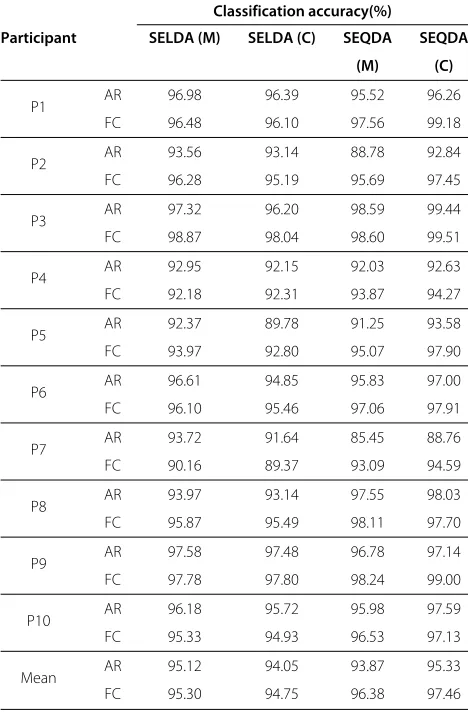
The self-enhancing mechanism is realized by two types of updating, the class mean vectors and the class (or pooled) covariances, which respectively characterize the first order and second order information in the LDA and QDA classifiers. This experiment aims to evaluate how these parameters impact on the RA results. The SELDA (M) or SEQDA (M) and SELDA (C) or SEQDA (C) denote the mean vectors updating and covariances updating respectively. Table 2 lists the participant-specific and mean classification accuracies of different classifiers. It shows that each parameter updating has the positive effect for improving the classification performance. The mean results of SEQDA(C) and SEQDA (M) are improved
Table 2 Participant-specific and mean RA results of the different parameter updating for SEQDA and SELDA
Classification accuracy(%)
Participant SELDA (M) SELDA (C) SEQDA SEQDA
(M) (C)
P1 AR 96.98 96.39 95.52 96.26
FC 96.48 96.10 97.56 99.18
P2 AR 93.56 93.14 88.78 92.84
FC 96.28 95.19 95.69 97.45
P3 AR 97.32 96.20 98.59 99.44
FC 98.87 98.04 98.60 99.51
P4 AR 92.95 92.15 92.03 92.63
FC 92.18 92.31 93.87 94.27
P5 AR 92.37 89.78 91.25 93.58
FC 93.97 92.80 95.07 97.90
P6 AR 96.61 94.85 95.83 97.00
FC 96.10 95.46 97.06 97.91
P7 AR 93.72 91.64 85.45 88.76
FC 90.16 89.37 93.09 94.59
P8 AR 93.97 93.14 97.55 98.03
FC 95.87 95.49 98.11 97.70
P9 AR 97.58 97.48 96.78 97.14
FC 97.78 97.80 98.24 99.00
P10 AR 96.18 95.72 95.98 97.59
FC 95.33 94.93 96.53 97.13
Mean AR 95.12 94.05 93.87 95.33
by 2.2% and 0.75% for AR, and 1.99% and 1.1% for FC respectively when compared to QDA. The mean results of SELDA(C) and SELDA (M) are improved by 0.48% and 1.55% for AR, and 0.67% and 1.22% for FC respectively when compared to LDA.
Changes of recognition accuracy and classifier parameters across different testing trials
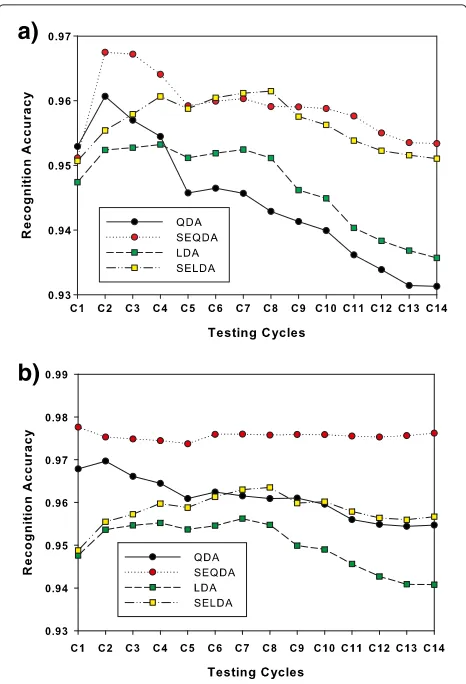
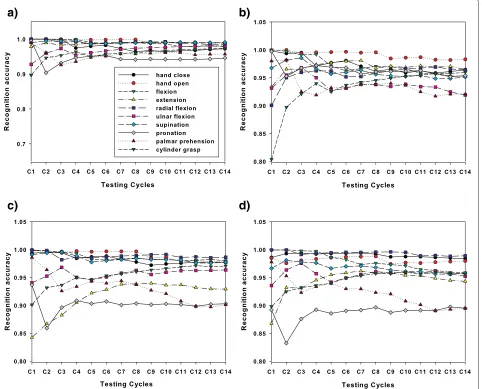
To compare the recognition performance of the self-enhancing and original classifiers across the testing stage, we plot Figure 4 displaying the mean RA results for each testing cycle, where the ith mean RA averages the clas-sification results over the past i testing cycles, and the final result is the overall mean RA. These plots show that the RA rates of the classifiers change over time (testing cycles), and the final RA rates of the original classifiers are lower than their preceding rates. Figure 5 presents the RA performance based on SEQDA and SELDA for ten motion classes across testing cycles.
a)
b)
Figure 4Mean recognition accuracy across testing cycles.(a) Recognition accuracy of different classifiers in the testing cycles using AR features, (b) Recognition accuracy of different classifiers in the testing cycles using FC features.
We have investigated the changes of some classifier parameters across different testing cycles. Under the assumption of data with a Gaussian distribution, the class mean vectorsμand the covariancesof the discriminant classifier describe the distribution of each class by a hyper-ellipsoid. The class mean vectors indicate the difference between classes, and the covariances depict the shape of distributions referring to equations (5),(6). The principal axes of these hyperellipsoids are given by the eigenvec-tors of the covariances, and the eigenvalues determine the lengths of these axes [34]. To describe the direction changes of principal axes and mean vectors, the cosine of angle between the original vector (the training one) and the current vector (theith testing cycle) is given by
cos= v0·vi
|v0||vi|
(13)
where v0 and vi denote the original and current vec-tors respectively, ·denotes the internal product, and|v| denotes the norm of the vector.
Based on the FC feature, we study the changes on SEQDA and SELDA for a specific subject (P6) respec-tively. The four kinds of parameters are further consid-ered: length of class mean vectors, length of first two principal axes of class covariances, cosine of angle of class mean vectors, and cosine of angle of first two principal axes of class covariances. All the parameters more or less show some changes in different testing cycles along the time, but there is no very significant and useful infor-mation. We can only find that the changes on pooled covariance of SELDA, the class mean vectors of both SELDA and SEQDA are relatively small. So perhaps they make minor contribution to adaptivity of the proposed classifier.
Evaluation on long-term EMG data
In this part, based on the EMG data collected in the second protocol mentioned in EMG data acquisition section, we tested the performance of the proposed classifier. As QDA (SEQDA) generally performs better than LDA (SELDA), we just present the results on QDA (SEQDA). Only FC is used as the EMG feature here.
a)
b)
c)
d)
Figure 5Recognition performances of ten motion classes across testing cycles.The motion classes include pronation, supination, hand closing, hand opening, radial flexion, ulnar flexion, flexion, extension, palmar and cylinder grasp. (a) and (b) show the performance of SEQDA using FC and AR features respectively. (c) and (d) show the performance of SELDA using FC and AR features respectively.
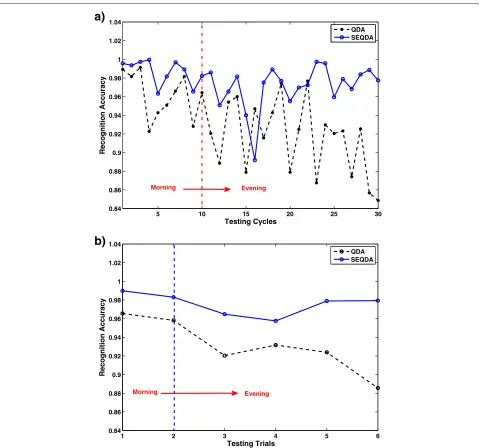
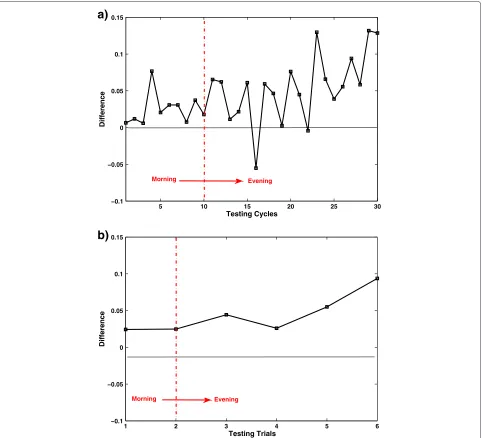
For a clear view, the difference of average RA between QDA and SEQDA (RA of SEQDA minus RA of QDA) is shown in Figure 7. The trend that SEQDA outperforms QDA can be observed. At the early stage, the difference is very small, while the difference becomes significant after certain time.
Discussion
For feature sets in Table 1, FC shows better performance than AR when using the QDA. The possible reason is that
Table 3 Average recognition accuracy of 10 types of motions on four subjects (S1-S4) using long-term EMG data
S1 S2 S3 S4 Mean
QDA 93.45 93.09 94.33 96.85 94.43
SEQDA 95.56 97.56 97.63 99.58 97.58
5 10 15 20 25 30 0.84
0.86 0.88 0.9 0.92 0.94 0.96 0.98 1 1.02 1.04
Testing Cycles
Recognition Accuracy
QDA SEQDA
Morning Evening
1 2 3 4 5 6
0.84 0.86 0.88 0.9 0.92 0.94 0.96 0.98 1 1.02 1.04
Testing Trials
Recognition Accuracy
QDA SEQDA
Morning Evening
b)
a)
Figure 6Recognition accuracy for the individual subject (S1).(a) Results of QDA/SEQDA in 30 testing cycles. (b) Results of QDA/SEQDA in 6 testing trials. Note: Each trial contains 5 cycles.
In Table 2, for SEQDA, the class covariance updating presents greater improvement than the class mean vectors updating. On the contrary, the pooled covariance updat-ing has less improvement than the class mean vectors updating for SELDA. The class mean vectors updating has different classification strength on SELDA and SEQDA. This might be caused by the different effects of the two (class or pooled) covariance estimates upon the classifica-tion performance. The combinaclassifica-tion of mean vector and covariance updating can further increase the RA results except the SELDA classifier using the AR feature. The paired t-test shows that the RA results are significantly improved when using the SEQDA(C), SEQDA(M) and
SELDA(M) for both AR and FC features. The improve-ment of SELDA(C) is not significant. In a word, the class covariance updating and the class mean updating play major roles in both SEQDA and SELDA classifiers.
5 10 15 20 25 30 −0.1
−0.05 0 0.05 0.1 0.15
Testing Cycles
Difference
Morning Evening
1 2 3 4 5 6
−0.1 −0.05 0 0.05 0.1 0.15
Testing Trials
Difference
Morning Evening
a)
b)
Figure 7Difference between QDA and SEQDA for the individual subject (S1).(a) Results in 30 testing cycles. (b) Results in 6 testing trials. Difference represents the average RA of SEQDA minus that of QDA. Note: Each trial contains 5 cycles.
RA differences of the two types of classifiers are enlarged with the increase of testing cycles. This may be attributed to the fact that the self-enhancing method can incorporate more information from testing set to the initial models and can accurately estimate the parameters of classifiers with change of the different testing cycles. It is observed that the performance declines in Figure 4 for all but the FC+SEQDA. It means that FC+SEQDA might be more robust than other combinations. In the experiment, the length of testing cycles might not be long enough for the declining of FC+SEQDA.
Figure 5 shows the classed-based performance for ten motion classes, where the classification performance of
most motion classes declined with the increase of test-ing cycles. But a few classes (e.g. extension and cylinder grasp) have the increasing performance. The possible rea-sons for this phenomenon may include: 1) the adaptation enlarges the data size for training and therefore leads to more accuracy estimation of classifier parameters, par-ticularly with covariance. 2) the training data have much difference from the first two or three testing cycles. The adaptation mechanism allows the classifier to learn the information in testing data and enhance the performance.
adaptation cannot guarantee stable performance in a long duration. For SEQDA, the performance does not degrade much in general, although the performance is not good at several points. This is reasonable, because none can get absolutely perfect information from the testing data, and there must be some unexpected disturbing data. However, even the worst case of SEQDA (RA=0.885) is still better than any result of QDA.
The experimental evaluation confirms the efficiency of the proposed self-enhancing approaches. The SELDA and SEQDA classifiers outperform the original versions using both AR and FC features. The adaptation of clas-sifier parameters has meaning at two levels. First, it can incorporate the information of testing data into the clas-sifier. Second, it indeed enlarges the data for training the classifier. We think that these two adaptation factors will mutually improve the classification performance. The results also show that SEQDA is superior to SELDA and suggest the individual class covariance updating can give more accurate estimation of the second order informa-tion than the pooled covariance. The possible reason is that the class covariance updating takes the individual class information into accounts and thus is a type of semi-supervised method (using the classified labels), and the pooled covariances updating is an unsupervised method. The self-enhancing method provides the feedback on each testing EMG data to update the classification algorithm. Using online testing feedback of the current state of the prostheses will help the users to recognize the misclas-sification and to adjust themselves to proper conditions. It is expected that the two types of feedbacks, one to algorithms and another to users, will mutually improve the classification performance further. Moreover, similar to their original classifiers, SELDA and SEQDA have no hyperparameters and require no time-consuming trial-and-error procedures, facilitating their application to the prosthesis control.
Computational efficiency is an important implemental issue of the classification method. In our EMG PR algo-rithm, the AR model is estimated by the Burge algoalgo-rithm, and the FC coefficients are computed by the fast algo-rithms such as FFT and DCT. The experimental hardware platform is a personal computer, consisted of a Core2 Duo 2.0G Hz CPU, 2G DDR2 memory. The software platform is Matlab version 7.1 under the windows XP operating system. To process 200 samples EMG data, the time cost of AR feature set is about 4 ms, the time cost of FC fea-ture set is about 2 ms and the classifier requires 1∼2 ms. The FC feature extraction has relatively faster computing speed than AR by the use of fast algorithms. In addition to the original classification procedure, our self-enhancing method needs additional step to update the parameters of the classifier and it cost about 2 ms. More sophisticated digital signal processing hardware will expedite the online
processing. Moreover, the self-enhancing method stores the class mean vectors, class covariances and pooled covariance for saving the model information after each updating and has no need to store the large EMG data.
The most promising highlight of the self-enhancing method is for the long-term EMG PR task, since it pro-vides a basis for prosthetic control in real-world appli-cation. Our method continuously adds the immediate information of the EMG pattern to the classifier by updat-ing the model parameters. The measurements involve the EMG data for about 8∼10 hours that may include the pos-sible variation factors. The testing data have larger size than the training data and the ratio is 7:3. The results have verified the performance of adaptive ability of the pro-posed algorithm. It can be seen that RA results of SEQDA outperforms QDA in the testing stage especially in the late stage. The good RA results of self-enhancing clas-sifiers exhibit their robust characteristics for long-term application. Actually, there are many factors contributing to the nonstationary changes of long-term EMG signals such as electrode position, muscle fatigue, or other phys-iological/psychological condition [25-27]. The underlying physiological mechanism needs more investigation, and this work does not focus on this issue. Evaluating on the longer-term EMG data such as over days and months may shed more lights on the self-enhancing approach into practice.
Conclusion
In summary, this paper proposes a self-enhancing method for EMG classification based on the traditional LDA and QDA classifiers, which can incorporate the useful infor-mation of EMG signal in testing data to the classification model. The improved classifiers named as SELDA and SEQDA continuously update their parameters such as the class mean vectors, the class covariances and pooled covariances using the labelled EMG feature data. We have shown that the self-enhancing classifiers significantly improve the recognition performance of the EMG PR sys-tem including the preliminary application on long-term EMG data.
Competing interests
The authors declare that they have no competing interests.
Authors’ contributions
XC participated in algorithms, data recordings, data processing and drafted the manuscript. DZ conceived of the study, participated in algorithms, protocol of experiments, and drafted the manuscript. XC and DZ are the first co-authors. XZ coordinated the study, participated in its design and helped to polish the manuscript. All authors read and approved the final manuscript.
Acknowledgements
Received: 11 April 2012 Accepted: 10 April 2013 Published: 1 May 2013
References
1. Parker P, Englehart K, Hudgins B:Myoelectric signal processing for control of powered limb prostheses.J Electromyogr Kinesiol2006, 16(6):541–548.
2. Hudgins B, Parker P, Scott R:A new strategy for multifunction myoelectric control.Biomed Eng IEEE Trans1993,40:82–94. 3. Merletti R, Parker P:Electromyography: Physiology, Engineering, and
Noninvasive Applications. Hoboken: John Wiley & Sons, Inc.; 2004.
4. Liu H:Exploring human hand capabilities into embedded multifingered object manipulation.Ind Informatics, IEEE Trans2011, 7(3):389–398.
5. Ajiboye A, Weir R:A heuristic fuzzy logic approach to EMG pattern recognition for multifunctional prosthesis control.Neural Syst Rehabil
Eng IEEE Trans2005,13(3):280–291.
6. Chan A, Englehart K:Continuous myoelectric control for powered prostheses using hidden Markov models.IEEE Trans Biomed Eng2005, 52:121–124.
7. Englehart K, Hudgins B:A robust, real-time control scheme for multifunction myoelectric control.Biomed Eng IEEE Trans2003, 50(7):848–854.
8. Hargrove L, Li G, Englehart K, Hudgins B:Principal components analysis preprocessing for improved classification accuracies in
pattern-recognition-based myoelectric control.IEEE Trans Biomed Eng
2009,56(5):1407–1414.
9. Huang Y, Englehart K, Hudgins B, Chan A:A Gaussian mixture model based classification scheme for myoelectric control of powered upper limb prostheses.IEEE Trans Biomed Eng2005,52(11):1801–1811. 10. Oskoei M, Hu H:Support vector machine-based classification scheme
for myoelectric control applied to upper limb.IEEE Trans Biomed Eng
2008,55(8):1956–1965.
11. Graupe D, Cline W:Functional separation of EMG signals via ARMA identification methods for prosthesis control purposes.Syst Man
Cybern IEEE Trans1975,5(2):252–259.
12. Hu X, Nenov V:Multivariate AR modeling of electromyography for the classification of upper arm movements.Clin Neurophysiol2004, 115(6):1276–1287.
13. Fougner MCAEK A Scheme, Stavdahl O:Resolving the limb position effect in myoelectric pattern recognition.Neural Syst Rehabil Eng IEEE
Trans2011,19(6):644–651.
14. Shenoy P, Miller K, Crawford B, Rao R:Online electromyographic control of a robotic prosthesis.Biomed Eng IEEE Trans2008,55(3):1128–1135. 15. Boostani R, Moradi M:Evaluation of the forearm EMG signal features
for the control of a prosthetic hand.Physiol Meas2003,24(2):309–319. 16. Kang W, Shiu J, Cheng C, Lai J, Tsao H, Kuo T:The application of cepstral
coefficients and maximum likelihood method in EMG pattern recognition [movements classification].Biomed Eng IEEE Trans1995, 42(8):777–785.
17. Englehart K, Hudgins B, Parker P, Stevenson M:Classification of the myoelectric signal using time-frequency based representations.
Med Eng Phys1999,21(6-7):431–438.
18. Wang G, Yan Z, Hu X, Xie H, Wang Z:Classification of surface EMG signals using harmonic wavelet packet transform.Physiol Meas2006, 27(12):1255–1268.
19. Huang H, Zhang F, Sun Y, He H:Design of a robust EMG sensing interface for pattern classification.J Neural Eng2010,7:056005. 20. Chan F, Yang Y, Lam F, Zhang Y, Parker P:Fuzzy EMG classification for
prosthesis control.IEEE Trans Rehabil Eng2000,8(3):305–311. 21. Peleg D, Braiman E, Yom-Tov E, Inbar G:Classification of finger
activation for use in a robotic prosthesis arm.Neural Syst Rehabil Eng
IEEE Trans2002,10(4):290–293.
22. Momen K, Krishnan S, Chau T:Real-Time classification of forearm electromyographic signals corresponding to user-selected intentional movements for multifunction prosthesis control.
IEEE Trans Neural Syst Rehabil Eng2007,15(4):535–542.
23. Zhou P, Lowery M, Englehart K, Huang H, Li G, Hargrove L, Dewald J, Kuiken T:Decoding a new neural machine interface for control of artificial limbs.J Neurophysiol2974,98(5).
24. Chan A, Green G:Myoelectric control development toolbox.InProc.
30th Conf. on Canadian Medical and Biological Engineering Society. Toronto,
ON; 2007.
25. Sensinger J, Lock B, Kuiken T:Adaptive pattern recognition of myoelectric signals: exploration of conceptual framework an practical algorithms.Neural Syst Rehabil Eng IEEE Trans2009, 17(3):270–278.
26. Hargrove L, Englehart K, Hudgins B:A training strategy to reduce classification degradation due to electrode displacements in pattern recognition based myoelectric control.Biomed Signal Process
Control2008,3(2):175–180.
27. Nishikawa D, Yu W, Maruishi M, Watanabe I, Yokoi H, Mano Y, Kakazu Y: On-line learning based electromyogram to forearm motion classifier with motor skill evaluation.JSME Int J Ser C, Mech Syst Mach
Elements Manuf2000,43(4):906–915.
28. Hargrove L, Englehart K, Hudgins B:A comparison of surface and intramuscular myoelectric signal classification.IEEE Trans Biomed Eng
2007,54(5):847–853.
29. Bilodeau M, Cincera M, Arsenault A, Gravel D:Normality and stationarity of EMG signals of elbow flexor muscles during ramp and step isometric contractions.J Electromyography Kinesiol1997,7(2):87–96. 30. Campbell J:Speaker recognition: A tutorial.Proc IEEE1997,
85(9):1437–1462.
31. Rao K, Yip P:Discrete Cosine Transform: Algorithms, Advantages,
Applications. San Diego: Academic Press, Professional, Inc; 1990.
32. Chen X, Zhu X, Zhang D:Use of the discriminant Fourier-derived cepstrum with feature-level post-processing for surface electromyographic signal classification.Physiol Meas2009, 30:1399–1413.
33. Fukunaga K:Introduction to, Statistical Pattern Recognition. San Diego: Academic press; 1990.
34. Duda R, Hart P, Stork D:Pattern Classification. New York: Wiley-Interscience; 2000.
35. Zar J:Biostatistical Analysis. Upper Saddle River: Prentice-Hall, Inc; 1999.
doi:10.1186/1743-0003-10-44
Cite this article as:Chenet al.:Application of a self-enhancing classifica-tion method to electromyography pattern recogniclassifica-tion for multifuncclassifica-tional prosthesis control.Journal of NeuroEngineering and Rehabilitation201310:44.
Submit your next manuscript to BioMed Central and take full advantage of:
• Convenient online submission
• Thorough peer review
• No space constraints or color figure charges
• Immediate publication on acceptance
• Inclusion in PubMed, CAS, Scopus and Google Scholar
• Research which is freely available for redistribution