Open Access
Research
How well do cognitive and environmental variables predict active
commuting?
Mélanie Lemieux
†1and Gaston Godin*
†1,2,3Address: 1Department of Social and Preventive Medicine, Division of Kinesiology, Laval University, Québec, Canada, 2Research Group on
Behaviour in the Field of Health, Laval University, Québec, Canada and 3Canada Research Chair on Behaviour and Health, Faculty of Nursing,
Pavillon Ferdinand-Vandry, 1050 rue De la Médecine, 3e étage, Laval University, Québec, G1V 0A6, Canada
Email: Mélanie Lemieux - [email protected]; Gaston Godin* - [email protected] * Corresponding author †Equal contributors
Abstract
Background: In recent years, there has been growing interest in theoretical studies integrating
cognitions and environmental variables in the prediction of behaviour related to the obesity epidemic. This is the approach adopted in the present study in reference to the theory of planned behaviour. More precisely, the aim of this study was to determine the contribution of cognitive and environmental variables in the prediction of active commuting to get to and from work or school.
Methods: A prospective study was carried out with 130 undergraduate and graduate students (93
females; 37 males). Environmental, cognitive and socio-demographic variables were evaluated at baseline by questionnaire. Two weeks later, active commuting (walking/bicycling) to get to and from work or school was self-reported by questionnaire. Hierarchical multiple regression analyses were performed to predict intention and behaviour.
Results: The model predicting behaviour based on cognitive variables explained more variance
than the model based on environmental variables (37.4% versus 26.8%; Z = 3.86, p < 0.001). Combining cognitive and environmental variables with socio-demographic variables to predict behaviour yielded a final model explaining 41.1% (p < 0.001) of the variance. The significant determinants were intention, habit and age. Concerning intention, the same procedure yielded a final model explaining 78.2% (p < 0.001) of the variance, with perceived behavioural control, attitude and habit being the significant determinants.
Conclusion: The results showed that cognitive variables play a more important role than
environmental variables in predicting and explaining active commuting. When environmental variables were significant, they were mediated by cognitive variables. Therefore, individual cognitions should remain one of the main focuses of interventions promoting active commuting among undergraduate and graduate students.
Background
Obesity has reached endemic proportions, affecting devel-oped and developing countries [1]. Unfortunately, obese individuals are more likely to develop co-morbidities,
such as type 2 diabetes, hypertension and cardiovascular diseases [2,3]. Thus, it is urgent to take action and improve public health. Given that physical activity is known to contribute to maintaining a healthy weight [4], Published: 6 March 2009
International Journal of Behavioral Nutrition and Physical Activity 2009, 6:12 doi:10.1186/1479-5868-6-12
Received: 30 July 2008 Accepted: 6 March 2009
This article is available from: http://www.ijbnpa.org/content/6/1/12
© 2009 Lemieux and Godin; licensee BioMed Central Ltd.
it is important to promote a physically active lifestyle. This could be accomplished by integrating active commuting into people's daily routine. However, in the North Amer-ican population, only a small proportion of individuals uses walking and bicycling as a mode of transport [5]. Therefore, the purpose of this study was to gain informa-tion on the determinants of active commuting in order to guide promotional campaigns. This was accomplished in reference of the theory of planned behaviour (TPB) since this theory has proven efficient in predicting health-related behaviours [6,7]. The advantage of this theory is also that it allows testing of the contribution made by other variables, such as environmental variables, in the prediction of behaviour either as direct determinants or as moderators of the intention-behaviour relationship [8].
Theory of Planned Behaviour
The TPB suggests that behaviour is predicted by intention and perceived behavioural control (PBC) [8,9]. Intention represents the level at which an individual is ready to act, whereas PBC corresponds to the individual's perceived ability to accomplish the behaviour. The TPB also suggests that intention is predicted by PBC, attitude and subjective norm. Attitude corresponds to the positive or negative value that a person associates with the performance of a given behaviour, whereas subjective norm represents the social pressure felt whether or not to engage in the behav-iour. Thus, someone with a favourable attitude who per-ceives approval from significant others and has a high PBC is more likely to have high intentions to perform the behaviour. The TPB is also open to consideration of other variables if there is evidence that they could be important dimensions. In this regard, there is growing evidence that environmental factors (perceived or real) are associated with the regular practice of physical activity [10-12]. The built environment refers to the presence of physical activ-ity equipment, facilities or infrastructures in one's envi-ronment. The built environment may also interact with intention in the prediction of behaviour [13,14].
Determinants of Active Commuting
To date, only a small number of studies have investigated the cognitive determinants of active commuting, and var-iations in findings have been reported. Some authors have reported significant associations between walking/bicy-cling for transport/leisure and intention [15] and PBC [16], whereas others have not observed these associations [15,17].
Likewise, growing interest has been paid to environmen-tal variables and it has been suggested that these variables should be considered in the promotion of physical activ-ity [18]. One of the most promising environmental con-cepts in active commuting is walkability [19-21]. Walkable neighbourhoods are characterized by high
resi-dential density, high land use mix and good connectivity [21]. Others have also reported walking and bicycling facilities such as sidewalks and bicycle paths to be related to active transport [16,22,23]. In contrast, car accessibility was associated negatively with active transport [22,24-26]; people who did not have access to a car were more inclined to use an active transport mode.
Recently, Sallis, Cervero, Ascher, Henderson, Kraft and Kerr [27] suggested a more holistic approach and expressed the opinion that the promotion of physical activity should be based on ecological models that con-sider the individual, the social environment, the physical environment and policies. As such, it is appropriate to consider individual and environmental variables in the same model when predicting active commuting. How-ever, to date, only a few studies have adopted this approach in the study of physical activity [13,14,28,29] including active transport [30]. In this latter study, walk-ing for transport was correlated with social (family social support) and environmental variables (street connectivity and coastal neighbourhood), whereas cognitions were not significant correlates of active transport. However, these observations were based on cross-sectional data. Other studies have taken intention as the dependant vari-able. For instance, Eves, Hoppea and McLaren [15] stud-ied walking and bicycling for leisure and transport and determined that walking intentions were predicted by PBC only, whereas bicycling intentions were predicted by attitude and PBC. Similarly, Rhodes and collaborators investigated the role of cognitive and environmental vari-ables on leisure-time walking intentions [13,14]. In their studies, walking intentions were predicted by attitude and social norm. None of the environmental variables con-tributed to the prediction. Obviously, more studies are needed before a definite conclusion can be reached on the determinants of active commuting.
Thus, the aims of this study were: 1) to identify cognitive and environmental variables predicting active commut-ing; 2) to identify cognitive and environmental variables explaining intentions to adopt active commuting; 3) to test if environmental variables are mediated by cognitive variables in the prediction of behaviour and intentions; and 4) to test if environmental variables moderate the intention-behaviour relation.
Methods
Population and Sample
agreed to do so were included in the study. A total of 256 undergraduate and graduate students from different aca-demic programs (130 in Nutrition; 36 in Administration; 90 in Nursing) were contacted, and 161 agreed to partici-pate (response rate of 62.9%). Of these 161 respondents, 134 successfully completed the follow-up measure two weeks later (response rate of 83.2%). Four respondents were excluded because it was not possible to match pre-and post-questionnaires. Thus, data from 130 participants were retained for the analysis.
Procedure for Data Collection
A prospective design was adopted for this study. Students were contacted in class and invited to participate in the study. The study was first explained, and those who agreed to participate had to complete a baseline questionnaire assessing environmental, cognitive and socio-demo-graphic variables. At two-week follow-up, a self-report of use of active commuting frequency (i.e. walking and bicy-cling to get to and from work or school) was obtained. The project received the approval of the ethics committee of the local university.
The Baseline Questionnaire
The baseline questionnaire contained five sections: 1) neighbourhood environment; 2) physical activity habits; 3) variables from the theory of planned behaviour (TPB) and related cognitions; 4) habit of using active commut-ing; and 5) socio-demographic variables [see Additional files 1, 2 and 3].
Neighbourhood Environment
As suggested by the International Physical Activity & the Environment Network (IPEN), the Neighbourhood Envi-ronment Walkability Survey (NEWS) was used to assess environmental variables related to using walking and bicycling for commuting. It is also considered a reliable and valid instrument [31-34]. However, a modified ver-sion was used in order to adjust the instrument to the local environmental context. Thus, the environmental aspects assessed were: a) residential density; b) land use mix (diversity); c) walking/bicycling facilities; d) traffic safety; and e) connectivity. Five-point scales were used to standardize measurement levels for all variables studied. A question regarding access to a motorized vehicle was also added to the questionnaire. Finally, participants were asked how long they had been living in their current neighbourhood. This measure was taken to verify if partic-ipants had a good knowledge of their neighbourhood.
Theory of Planned Behaviour
The guidelines provided by Ajzen [9] were followed to select items to assess the main variables of the TPB. Each variable was assessed using three to five items (five-point
scales) and the average of the items for each construct was taken as the score in the analysis.
Past Behaviour and Habit
Active commuting was defined as an activity performed for at least 10 minutes, as recommended by the Public Health Agency of Canada (PHAC) and the American Col-lege of Sports Medicine (ACSM) [35,36]. Thus, frequency of active commuting during the past four weeks was obtained. In addition, the habit of using active commut-ing was measured in reference to the index of Verplanken and Orbell [37]. This scale includes twelve questions related to frequency, automaticity and self-identity. Ver-planken and Melkevik [38] have demonstrated the effi-cacy of their scale in measuring exercising habit. For the purpose of this study, it was adapted to active commuting.
Socio-demographic Factors
Socio-demographic variables assessed included gender, age, working/study status, height and body weight. Height and body weight were used to compute body mass index (BMI).
Follow-up Behaviour
At two-week follow-up, participants were asked to report the number of times they had used active commuting to get to and from work or school. The same question used to assess past behaviour at baseline was also used to assess behaviour at follow-up, but in reference to the last two weeks: "In the past 2 weeks, how many times (for a period of a least 10 minutes) did you walk/bicycle to get to your work-place or your school?"
Psychometric Qualities of the Questionnaire
To ensure the psychometric qualities of the study ques-tionnaire, 32 participants not involved in the present study completed a two-week test-retest reliability study. The evaluation of the internal consistency and temporal stability of the variables showed appropriate values [see Additional files 1, 2 and 3].
Analysis
variables and 5) habit. After each step, non-significant var-iables (p > .05) were withdrawn one by one, starting with the less significant, until all variables left in the model were significant. For all regression analyses, past behav-iour was first entered in order to control for its effect. Habit was entered in the last step to ascertain its addi-tional contribution to the model. Since the habit index used in this study is not a measure of behavioural fre-quency, past behaviour and habit can be used independ-ently [39]. Finally, the Z test procedure described by Tabachnick & Fidell [40] was employed to determine if there was a significant difference between the variance explained by cognitive and environmental variables, respectively, for the prediction of active commuting. The same approach was applied to predict intention to use active commuting.
The role of intention as mediator in the relationship between environmental variables and active commuting was tested using the method suggested by Baron and Kenny [41]. As intention significantly affects active com-muting, environmental variables that significantly affected intention (i.e. the mediator) and active commut-ing (i.e. the dependant variable) were kept for analysis [42]. We used the SAS bootstrap procedure proposed by Preacher and Hayes [43], where age and habit were con-sidered as covariates. The same strategy was used to deter-mine if environmental variables were mediated through intention by the determinants of intention. Habit was considered as a covariate.
A three-step hierarchical regression was applied, as sug-gested by Aiken and West [44], to test for the moderating effect of environmental variables on the intention-behav-iour relationship. To this end, the variables were first mean-centered [41,44]. A significance level of α = 0.05 was used to define statistical significance.
Results
SampleA total of 130 respondents completed both baseline and follow-up questionnaires. The mean age of the sample was 24.0 ± 4.9 years (range: 19 to 48 years), with a pre-dominance of female participants (71.5%). The majority of the participants studied full time (86.2%) and were also working (60.8%). More than half of the participants (52.3%) always had access to a car. In general, partici-pants self-reported having a healthy weight with an aver-age BMI of 22.0 (SD = 3.4). The majority of participants could get to school (74.6%) or work (73.4%) within a 10-minute walk. Also, the majority had been living in their neighbourhood for more than a year (63.8%). No signifi-cant differences were observed between participants who completed and those who did not complete the follow-up questionnaire.
Concerning active commuting at follow-up, participants reported using an active commuting mode an average 6.3 times per week (SD = 5.81). Walking was a more popular activity than bicycling (33.1% no walking; 89.2% no bicy-cling). However, 36.2% of the respondents used active commuting ten or more times per week to get to and from work or school.
Students had a slightly positive intention to use active commuting in the next two weeks (mean: 3.42 ± 1.45, on a five-point scale). Intention was significantly associated with active commuting (r = 0.60, p < .001). For environ-mental variables, active commuting and intention were positively correlated with « apartments » and negatively associated with « detached single-family residence », « time to access services », « time to get to school/work » and « car accessibility ». Concerning socio-demographic varia-bles, only age was negatively associated with active com-muting, whereas work status was negatively related to intention.
Predicting Active Commuting
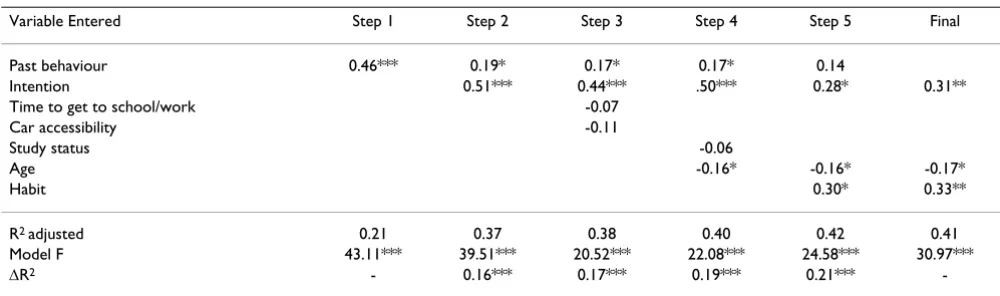
Regression of active commuting at follow-up on past behaviour and cognitions at baseline showed that 37.4% of the variance in active commuting (p < 0.001) was explained by past behaviour (β = 0.19, p < 0.05; all stand-ardized betas) and intention (β = 0.51, p < 0.001). When habit was added to the model, only intention (β = 0.33, p < 0.01) and habit (β = 0.34, p < 0.01) remained significant predictors, explaining 38.7% of variance (p < 0.001). None of the other cognitive variables reached significance (p > 0.05).
Regression of follow-up behaviour on past behaviour and environmental variables at baseline yielded to a signifi-cant model explaining 26.8% of variance (p < 0.001). Three variables were significant predictors: past behaviour (β = 0.29, p < 0.001), time to get to work or school (β = -0.19, p < 0.05) and car accessibility (β = -0.26, p < 0.01). The latter two environmental variables varied as expected; that is, longer time to get to work or school and having access to a car played a negative role.
The model predicting behaviour based on cognitions was compared with the model predicting behaviour based on environmental variables. The Z test showed that the total variance explained by cognitive variables (i.e. past behav-iour and intention) was significantly higher than the model of environmental variables (i.e. past behaviour, time to get to school/work and car accessibility) in the prediction of active commuting (Z = 3.86, p < 0.001, N = 130).
anal-ysis, none of the environmental variables reached signifi-cance (p > 0.05) (see Table 1). The final model explained 41.1% of the variance in behaviour (active commuting) (p < 0.001); the significant determinants were intention (p < 0.01), age (p < 0.05) and habit (p < 0.01).
Predicting Intention
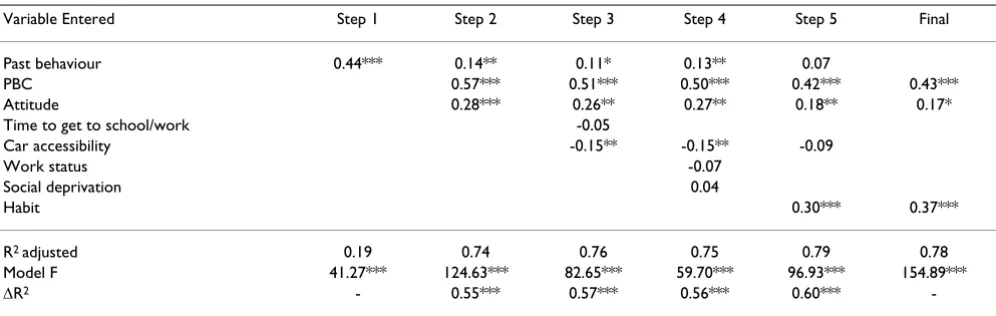
Given that intention is the most important predictor of behaviour according to the TPB, analyzing its determi-nants was justified. When only TPB variables were consid-ered, 72.6% of variance (F(3, 126) = 114.85, p < 0.001) in intention was explained by PBC (β = 0.60, p < 0.001), atti-tude (β = 0.29, p < 0.001) and subjective norm (β = 0.02, p = 0.77). When past behaviour was included in the model, intention was predicted by past behaviour (β = 0.14, p < 0.01), PBC (β = 0.57, p < 0.001) and attitude (β = 0.28, p < 0.001); the explained variance was 0.74 (p < 0.001). The final model for the cognitive variables explained 78.2% of the variance of intention (p < 0.001), with significant determinants being PBC (β = 0.43, p < 0.001), attitude (β = 0.17, p < 0.05) and habit (β = 0.37, p < 0.001).
In the context of environmental variables and controlling for past behaviour (β = 0.27, p < 0.001), two factors con-tributed to the prediction of intention: time to get to work or school (β = -0.27, p < 0.001); and car accessibility (β = -0.36, p < 0.001). The contribution of these two environ-mental variables varied as expected, i.e. negatively. This model of the environmental variables explained 40.4% of the variance (p < 0.001).
The models predicting intention from cognitions and environmental variables were compared. The Z test score (Z = 9.51, p < 0.001, N = 130) showed that the proportion of variance in intention explained by cognitive variables (i.e. past behaviour, PBC and attitude) was significantly greater than the model based on environmental variables
(i.e. past behaviour, time to get to school/work and car accessibility).
Combining environmental and cognitive variables indi-cated that no environmental variable contributed signifi-cantly to the prediction of intention (see Table 2). The final model was formed by PBC (p < 0.001), attitude (p < 0.05) and habit (p < 0.001); it explained 78.2% (p < 0.001) of the variance in the intention to use active com-muting.
Mediation Analysis
Mediation tests were performed to identify how environ-mental factors contribute to the formation of intention and prediction of behaviour. Five environmental varia-bles met Baron and Kenny's (1986) criteria and were tested for mediation by intention in the prediction of active commuting, controlling for age and habit. None of these factors reached significance: detached single-family residence (CI95%: -0.52, 0.17); apartments (CI95%: -0.14,
0.41); time to access services (CI95%: -0.04, 0.05); time to get to work or school (CI95%: -0.06, 0.002); and car acces-sibility (CI95%: -0.93, 0.02). In fact, mediation analyses
indicated that environmental variables were mediated by the determinants of intention. Time to get to work or school was mediated by PBC (CI95%: -0.03, -0.0008; cov-ariate: habit) and habit (CI95%: -0.13, -0.06), whereas detached single-family residence (CI95%: -0.65, -0.13), apartments (CI95%: 0.12, 0.67), time to access services (CI95%: -0.13, -0.06) and car accessibility (CI95%: 1.51, -0.80) were mediated by PBC. No other significant relation was found. Figure 1 illustrates the interrelationship between cognitions and environmental variables in explaining intention and predicting behaviour.
Analysis for Moderating Effects
Detached single-family residences, apartments, time to access services, time to get to work or school and car acces-sibility were environmental variables tested as potential
Table 1: Hierarchical multiple regression analysis of active commuting combining cognitive and environmental variables
Variable Entered Step 1 Step 2 Step 3 Step 4 Step 5 Final
Past behaviour 0.46*** 0.19* 0.17* 0.17* 0.14
Intention 0.51*** 0.44*** .50*** 0.28* 0.31**
Time to get to school/work -0.07
Car accessibility -0.11
Study status -0.06
Age -0.16* -0.16* -0.17*
Habit 0.30* 0.33**
R2 adjusted 0.21 0.37 0.38 0.40 0.42 0.41
Model F 43.11*** 39.51*** 20.52*** 22.08*** 24.58*** 30.97***
ΔR2 - 0.16*** 0.17*** 0.19*** 0.21***
moderators of the intention-behaviour relationship, since they were significant correlates of active commuting. However, none of these variables interacted significantly with intention in the prediction of active commuting (all p > 0.05).
Discussion
To our knowledge, this is the first prospective study inves-tigating cognitive and environmental variables to deter-mine their relative contribution to the prediction of active commuting by undergraduate and graduate students to get to and from work or school. Intention, habit and age were identified as significant predictors of active commut-ing. None of the environmental variables contributed to this prediction.
The observation that intention contributes to the predic-tion of active commuting is in agreement with previous published meta-analyses showing its role in the predic-tion of health-related behaviours [7,45,46]. Notwith-standing this observation, the TPB was not fully supported
because factors other than intention (or PBC) contributed to the prediction of behaviour.
The most important active commuting predictor observed in this study was habit. People who are in the habit of using active commuting do so more often. This observa-tion is congruent with Triandis' theory of interpersonal behaviour [47] that considers habit as a direct predictor of behaviour. Usually, in scientific literature, habit is assessed as a frequency of past behaviour. However, in the present study, habit was measured using the scale of Ver-planken and Orbell [37] as well as the mere measure of frequency of past behaviour. However, when habit and frequency of past behaviour were tested in the same anal-ysis, frequency of past behaviour did not reach signifi-cance. This suggests that frequency of past behaviour is mediated by habit. This observation provides additional support to Verplanken and Orbell [37], who consider habit as a cognitive construct. Thus, as proposed by Ver-planken and Melkevik [38], the development of habitua-tion should be considered as an intervenhabitua-tion goal for active commuting among undergraduate and graduate students. It was reported in a recent Canadian survey [48] that distance separating an individual's home from the workplace or school can be a barrier to active commuting. In this respect, it may be noted that living close to one's workplace/school most likely contributes to the develop-ment of the habit of using active commuting, since in the present study the effect of "time to get to work or school" on behaviour was mediated by habit, along with PBC.
Another predictor of active commuting was age. Younger individuals were more likely to use active commuting. Similar findings were reported by Butler, Orpana, and Wiens [49] who suggested that the effect of age was related to "safety" concerns among older individuals. However, this was not confirmed in the present study, since traffic safety did not contribute to the prediction. Given the cul-Table 2: Hierarchical multiple regression analysis of intention combining cognitive and environmental variables
Variable Entered Step 1 Step 2 Step 3 Step 4 Step 5 Final
Past behaviour 0.44*** 0.14** 0.11* 0.13** 0.07
PBC 0.57*** 0.51*** 0.50*** 0.42*** 0.43***
Attitude 0.28*** 0.26** 0.27** 0.18** 0.17*
Time to get to school/work -0.05
Car accessibility -0.15** -0.15** -0.09
Work status -0.07
Social deprivation 0.04
Habit 0.30*** 0.37***
R2 adjusted 0.19 0.74 0.76 0.75 0.79 0.78
Model F 41.27*** 124.63*** 82.65*** 59.70*** 96.93*** 154.89***
ΔR2 - 0.55*** 0.57*** 0.56*** 0.60***
-*: p < .05, *-*: p < .01, **-*: p < .001; PBC = perceived behavioural control; all standardized betas
Observed model for the prediction of active commuting
Figure 1
Observed model for the prediction of active
com-muting. Only significant associations are illustrated.
Perceived behavioural control
Active commuting Intention
Habit
Age Attitude
Time to get to work or school Detached single-family residence
Apartments
Car accessibility
tural context of the present study (undergraduate and graduate student population), we are more inclined to believe that older adults are less open to the idea of taking more time to get to work/school. This could be particu-larly true for older individuals who have to cope with school, work and family duties. Others studies conducted in different cultural and social milieus are needed before a more definite conclusion can be reached.
Finally, cognitive variables were stronger predictors of behaviour than were environmental factors. In fact, none of the environmental variables contributed to the predic-tion when cognipredic-tions were included in the model. This concurs with the work of Giles-Corti and Donovan [29] who found that "individual and social environment deter-minants outweigh the role played by physical environ-mental determinants of exercising as recommend" (p.1804). Moreover, none of the environmental variables had moderating effects on the intention-behaviour rela-tionship. This result differs from those previously reported by Rhodes et al. [13,14], who found that "infra-structures proximity" moderate the intention-leisure time walking relation. These differences in findings may be attributed to the type of environmental variables meas-ured, their variation in operationalization and differences in the population under study. It is also conceivable that environmental moderators varied for different types of physical activity. However, these results reveal that cogni-tions nevertheless have an important place in active com-muting promotion, notwithstanding the growing attention given to environmental variables. From an eco-logical perspective, it is clear that individuals evolve in an environment with which they interact and from which they could be influenced. Nonetheless, it seems that envi-ronmental variables can facilitate the behaviour but are insufficient to generate the action [29].
Given that intention was a significant determinant of behaviour among undergraduate and graduate students, it can be used to guide the development of interventions. In this regard, perceived behavioural control, attitude and habit deserve special attention. Perceived behavioural control was found to be the most important determinant of intention. This means that students who had a high perception of behavioural control also had a high inten-tion to use active commuting. Similar results have been observed for physical activity [14,15,46,50]. In the context of the present study, it may also be proposed that PBC is partly defined by residential density (detached single-family residence; apartments), land use mix (time to access services; time to get to work/school); and car acces-sibility, since their effect on intention was mediated by PBC.
Attitude was another factor positively associated with the intention to use active commuting among undergraduate
and graduate students. Thus, someone with a positive out-look towards active commuting is more inclined to use it. The meta-analysis of Downs and Hausenblas [50] on exer-cising supports this view. In their review, they noted that attitudes were as important as PBC in the prediction of intention. However, in the present study, the role of atti-tude was less important than the contribution of PBC, which is in line with the meta-analysis of Hagger, Chatz-isarantis, and Biddle [46]. These variations in relative importance suggest that the contribution of the determi-nants can vary according to the type of physical activity under study (e.g. active commuting versus leisure-time physical activity).
Regarding the contribution of habit, this point was dis-cussed previously with respect to behaviour prediction. The only additional point that needs to be mentioned is the fact that several authors have previously reported that habit contributes to the prediction of intention [15,46].
Limitations and Strengths
Some limitations in the present study should be men-tioned. First, the study population consisted of under-graduate and under-graduate students. More females (71.5%) than males participated. Therefore, the present observa-tions cannot be extended to the general population. In addition, the sample size was modest (N = 130). Notwith-standing this point, we obtained a power of 100% for our final model predicting behaviour. Participants were vol-unteers, consequently more likely to be interested in the studied behaviour. Also, an objective measure of active commuting would have been preferable to a self-report measure, although our measure presented good test-retest value. The inclusion of objective measures of environ-mental variables would also have been interesting, since it was recently documented that objective and subjective environmental measurements are not necessarily equiva-lent [51]. Notwithstanding this latter observation, the environmental questions used in this study have been val-idated in previous studies [31,32,34]. Nonetheless, addi-tional work is needed on this topic, since certain difficulties were encountered translating a number of items into French. To be more effective, more reliable tools standardizing the definitions of environmental vari-ables should be developed.
as a cognitive variable evaluated with the validated Self-Report Habit Index [37,38] instead of measuring fre-quency of past behaviour alone.
Conclusion
In summary, intention, habit and age predicted behaviour significantly. These results indicate, along with the find-ings of Giles-Corti and Donavan [29], that cognitive vari-ables play a more important role in the prediction of active commuting than do environmental variables. This reinforces the opinion of Giskes, Kamphuis, van Lenthe, Kremers, Droomers and Brug [53] that it is premature to encourage extensive investment in environmental inter-ventions and that more studies are needed to determine a standardized and validated method to operationalize environmental variables. Until then, interventions pro-moting active commuting among undergraduate and graduated students should focus on developing a high intention to use active commuting based on the develop-ment of perceived behavioural control and attitude. In addition, some consideration should be given to residen-tial density, land use mix and car accessibility, as their influence is mediated by the cognitions explaining inten-tion to use active commuting.
Competing interests
The authors declare that they have no competing interests.
Authors' contributions
ML carried out the study, performed the statistical analysis and drafted the manuscript. ML and GG participated in the study design. GG revised critically the manuscript. All authors read and approved the final manuscript.
Additional material
Acknowledgements
The authors would like to thank Herminé Naccache and Léo-Daniel Lam-bert for their collaboration in questionnaire development and data analysis.
References
1. Caballero B: The Global Epidemic of Obesity: An Overview.
Epidemiol Rev 2007, 29:1-5.
2. Bray GA: Medical consequences of obesity. J Clin Endocrinol Metab 2004, 89:2583-2589.
3. Neilson A, Schneider H: Obesity and its comorbidities: present and future importance on health status in Switzerland. Soz Praventivmed 2005, 50:78-86.
4. Saris WH, Blair SN, van Baak MA, Eaton SB, Davies PS, Di Pietro L, Fogelholm M, Rissanen A, Schoeller D, Swinburn B, Tremblay A, Westerterp KR, Wyatt H: How much physical activity is enough to prevent unhealthy weight gain? Outcome of the IASO 1st Stock Conference and consensus statement. Obes Rev 2003, 4:101-114.
5. Gilmour H: Les Canadiens physiquement actifs. Rapports sur la santé 2007, 18:49-70.
6. Conner M, Armitage CJ: Extending the Theory of Planned Behavior: A Review and Avenues for Further Research. J Appl Soc Psychol 1998, 28:1429-1464.
7. Godin G, Kok G: The theory of planned behavior: a review of its applications to health-related behaviors. Am J Health Promot
1996, 11:87-98.
8. Ajzen I: The theory of planned behavior. Organ Behav Hum Decis Process 1991, 50:179-211.
9. TPB model [http://people.umass.edu/aizen/index.html]
10. Duncan M, Spence J, Mummery WK: Perceived environment and physical activity: a meta-analysis of selected environmental characteristics. Int J Behav Nutr Phys Act 2005, 2:11.
11. Humpel N, Owen N, Leslie E: Environmental factors associated with adults' participation in physical activity. Am J Prev Med
2002, 22:188-208.
12. Wendel-Vos W, Droomers M, Kremers S, Brug J, van Lenthe F: Potential environmental determinants of physical activity in adults: a systematic review. Obes Rev 2007, 8:425-440. 13. Rhodes RE, Brown SG, McIntyre CA: Integrating the Perceived
Neighborhood Environment and the Theory of Planned Behavior When Predicting Walking in a Canadian Adult Sample. Am J Health Promot 2006, 21:110-118.
14. Rhodes RE, Courneya KS, Blanchard CM, Plotnikoff RC: Prediction of leisure-time walking: an integration of social cognitive, perceived environmental, and personality factors. Int J Behav Nutr Phys Act 2007, 4:51.
15. Eves F, Hoppea R, McLaren L: Prediction of Specific Types of Physical Activity Using the Theory of Planned Behavior. J App Behav Res 2003, 8:77-95.
16. Troped PJ, Saunders RP, Pate RR, Reininger B, Addy CL: Correlates of recreational and transportation physical activity among adults in a New England community. Prev Med 2003, 37:304-310.
17. Ball K, Timperio A, Salmon J, Giles-Corti B, Roberts R, Crawford D: Personal, social and environmental determinants of educa-tional inequalities in walking: a multilevel study. J Epidemiol Community Health 2007, 61:108-114.
Additional file 1
Environmental variables: Questions, scales and psychometric qualities of the survey. Table presenting all the questions and answer scales used in the baseline survey and the psychometric values obtained at the test-retest study. Items used to assess the environmental variables and their psychometric qualities.
Click here for file
[http://www.biomedcentral.com/content/supplementary/1479-5868-6-12-S1.pdf]
Additional file 2
Behaviour, habit and cognitive variables: Questions, scales and psy-chometric qualities of the survey. Table presenting all the questions and answer scales used in the baseline survey and the psychometric values obtained at the test-retest study. Items used to assess behaviour, habit and cognitive variables and their psychometric qualities.
Click here for file
[http://www.biomedcentral.com/content/supplementary/1479-5868-6-12-S2.pdf]
Additional file 3
Behaviour, habit and cognitive variables: Questions, scales and psy-chometric qualities of the survey (continued). Table presenting all the questions and answer scales used in the baseline survey and the psycho-metric values obtained at the test-retest study. Items used to assess behav-iour, habit and cognitive variables and their psychometric qualities.
Click here for file
Publish with BioMed Central and every scientist can read your work free of charge "BioMed Central will be the most significant development for disseminating the results of biomedical researc h in our lifetime."
Sir Paul Nurse, Cancer Research UK
Your research papers will be:
available free of charge to the entire biomedical community
peer reviewed and published immediately upon acceptance
cited in PubMed and archived on PubMed Central
yours — you keep the copyright
Submit your manuscript here:
http://www.biomedcentral.com/info/publishing_adv.asp
BioMedcentral 18. Sallis JF, Bauman A, Pratt M: Environmental and policy
interven-tions to promote physical activity. Am J Prev Med 1998, 15:379-397.
19. Frank LD, Sallis JF, Conway TL, Chapman JE, Saelens BE, Bachman W: Many Pathways from Land Use to Health. J Am Plann Assoc
2006, 72:75-87.
20. Gebel K, Bauman AE, Petticrew M: The Physical Environment and Physical Activity: A Critical Appraisal of Review Articles.
Am J Prev Med 2007, 32:361-369.
21. Saelens BE, Sallis JF, Frank LD: Environmental correlates of walk-ing and cyclwalk-ing: Findwalk-ings from the transportation, urban design, and planning literatures. Ann Behav Med 2003, 25:80-91. 22. Giles-Corti B, Donovan RJ: Socioeconomic status differences in recreational physical activity levels and real and perceived access to a supportive physical environment. Prev Med 2002, 35:601-611.
23. Owen N, Humpel N, Leslie E, Bauman A, Sallis JF: Understanding environmental influences on walking: Review and research agenda. Am J Prev Med 2004, 27:67-76.
24. Plaut PO: Non-motorized commuting in the US. Trans Res Part D 2005, 10:347-356.
25. Badland HM, Schofield GM, Garrett N: Travel behavior and objec-tively measured urban design variables: Associations for adults traveling to work. Health Place 2008, 14:85-95.
26. Coogan MA, Karash KH, Adler T, Sallis J: The role of personal val-ues, urban form, and auto availability in the analysis of walk-ing for transportation. Am J Health Promot 2007, 21:363-370. 27. Sallis JF, Cervero RB, Ascher W, Henderson KA, Kraft MK, Kerr J: An
ecological approach to creating active living communities.
Annu Rev Public Health 2006, 27:297-322.
28. Duncan M, Mummery K: Psychological and environmental fac-tors associated with physical activity among city dwellers in regional Queensland. Prev Med 2005, 40:363-372.
29. Giles-Corti B, Donavan RJ: The relative influence of individual, social and physical environment determinants of physical activity. Soc Sci Med 2002, 54:1793-1812.
30. Ball K, Timperio A, Salmon J, Giles-Corti B, Roberts R, Crawford D: Personal, social and environmental determinants of educa-tional inequalities in walking: a multilevel study. J Epidemiol Community Health 2007, 61:108-114.
31. Brownson RC, Chang JJ, Eyler AA, Ainsworth BE, Kirtland KA, Sael-ens BE, Sallis JF: Measuring the environment for friendliness toward physical activity: A comparison of the reliability of 3 questionnaires. Am J Public Health 2004, 94:473-483.
32. Cerin E, Saelens BE, Sallis JF, Frank LD: Neighborhood Environ-ment Walkability Scale: validity and developEnviron-ment of a short form. Med Sci Sports Exerc 2006, 38:1682-1691.
33. De Bourdeaudhuij I, Sallis J, Saelens B: Environmental correlates of physical activity in a sample of Belgian adults. Am J Health Promot 2003, 18(1):83-92.
34. Saelens BE, Sallis JF, Black JB, Chen D: Neighborhood-Based dif-ferences in physical activity: An environment scale evalua-tion. Am J Public Health 2003, 93:1552-1558.
35. Haskell WL, Lee IM, Pate RR, Powell KE, Blair SN, Franklin BA, Mac-era CA, Heath GW, Thompson PD, Bauman A: Physical activity and public health: updated recommendation for adults from the American College of Sports Medicine and the American Heart Association. Med Sci Sports Exerc 2007, 39:1423-1434. 36. Canada's Physical Activity Guide to Healthy Active Living
[http://www.phac-aspc.gc.ca/pau-uap/fitness/pdf/guideEng.pdf] 37. Verplanken B, Orbell S: Reflections on past behavior: A
self-report index of habit strength. J Appl Soc Psychol 2003, 33:1313-1330.
38. Verplanken B, Melkevik O: Predicting habit: The case of physical exercise. Psychol Sport Exerc 2008, 9:15-26.
39. Verplanken B: Habits and implementation intentions. In The ABC of behavioural change Edited by: Kerr J, Weitkunat R, Moretti M. Oxford, UK: Elsevier Science; 2005:99-109.
40. Tabachnick BG, Fidell LS: Using multivariate statistics Fifth edition. Bos-ton: Pearson Education; 2007.
41. Baron RM, Kenny DA: The moderator-mediator variable dis-tinction in social psychological research: Conceptual, strate-gic, and statistical considerations. J Pers Soc Psychol 1986, 51:1173-1182.
42. Calculation for the Sobel Test-An interactive calculation tool for mediation tests [http://people.ku.edu/~preacher/sobel/ sobel.htm]
43. SPSS and SAS Macros for Estimating and Comparing Indi-rect Effects in Multiple Mediator Models [http:// www.comm.ohio-state.edu/ahayes/SPSS%20programs/indirect.htm] 44. Aiken LS, West SG: Multiple Regression: testing and interpreting
interac-tions New Park, CA: Sage; 1991.
45. Armitage CJ, Conner M: Efficacy of the Theory of Planned Behaviour: a meta-analytic review. Br J Soc Psychol 2001, 40:471-499.
46. Hagger MS, Chatzisarantis NLD, Biddle SJH: A meta-analytic review of the theories of reasoned action and planned behav-ior in physical activity: predictive validity and the contribu-tion of addicontribu-tional variables. J Sport Exerc Psychol 2002, 24:3-32. 47. Triandis HC: Values, attitudes and interpersonal behavior. In
Nebraska Symposium on Motivation, 1979 Edited by: Howe HEJ. Lin-coln, NE: University of Nebraska Press; 1980:195-259.
48. Go For Green: National active transportation survey 2004 . 2006.
49. Butler GP, Orpana HM, Wiens AJ: By your own two feet – Fac-tors associated with active transport in Canada. Can J Public Health 2007, 98:259-264.
50. Downs DS, Hausenblas HA: The Theories of Reasoned Action and Planned Behavior Applied to Exercise: A Meta-analytic Update. J Pers Soc Psychol 2005, 2:76-97.
51. Frohlich KL, Bodnarchuk JL, Chateau D, Roos L, Forsyth S: What you see is what you get? Questioning the relationship between objective and subjective appraisals of neighbour-hood resources in relation to health. Can J Public Health 2007, 98:292-296.
52. Hoehner CM, Brennan Ramirez LK, Elliot MB, Handy SL, Brownson RC: Perceived and objective environmental measures and physical activity among urban adults. Am J Prev Med 2005, 28:105-116.