The Genomic Standards Consortium
RCN4GSC Workshop Report: Modeling a Testbed for
Managing Data at the Interface of Biodiversity and
(Meta)Genomics, April 2011
Robert J. Robbins1 Guy Cochrane2 Neil Davies3 Peter Dawyndt4 Renzo Kottmann5, Leonard (Kris) Krishtalka6 Norman Morrison7 Éamonn Ó Tuama8 Inigo San Gil6 John Wooley1
1University of California San Diego, La Jolla, California, USA
2European Molecular Biology Laboratory (EMBL) Outstation, European Bioinformatics Institute (EBI), Wellcome Trust Genome Campus, Hinxton, Cambridge, United Kingdom 3Richard B. Gump South Pacific Research Station, University of California Berkeley, PO Box
244, 98728 Moorea, French Polynesia
4Department of Applied Mathematics and Computer Science, University of Ghent, Ghent, Belgium
5Microbial Genomics Group, Max Planck Institute for Marine Microbiology & Jacobs University Bremen, Bremen, Germany
6University of Kansas Natural History Museum, Lawrence, KS, USA
7School of Computer Science, Kilburn Building, University of Manchester, Oxford Road, Manchester, UK M13 9PL
8Global Biodiversity Information Facility, GBIF Secretariat, Copenhagen, Denmark 9LTER Network Office, Department of Biology, University of New Mexico. Albuquerque,
New Mexico, USA
At the GSC11 meeting (4-6 April 2011, Hinxton, England, the GSC’s genomic biodiversity work-ing group (GBWG) developed an initial model for a data management testbed at the interface of biodiversity with genomics and metagenomics. With representatives of the Global Biodiversity In-formation Facility (GBIF) participating, it was agreed that the most useful course of action would be for GBIF to collaborate with the GSC in its ongoing GBWG workshops to achieve common goals around interoperability/data integration across (meta)-genomic and species level data. It was determined that a quick comparison should be made of the contents of the Darwin Core (DwC) and the GSC data checklists, with a goal of determining their degree of overlap and compatibility. An ad-hoc task group lead by Renzo Kottman and Peter Dawyndt undertook an initial compari-son between the Darwin Core (DwC) standard used by the Global Biodiversity Information Facili-ty (GBIF) and the MIxS checklists put forward by the Genomic Standards Consortium (GSC). A term-by-term comparison showed that DwC and GSC concepts complement each other far more than they compete with each other. Because the preliminary analysis done at this meeting was based on expertise with GSC standards, but not with DwC standards, the group recommended that a joint meeting of DwC and GSC experts be convened as soon as possible to continue this joint assessment and to propose additional work going forward.
Background
In March of 2011, a planning meeting on manag-ing data at the interface between biodiversity and (meta)genomics was held at the University of Cali-fornia at San Diego [1]. The recommendations of that planning meeting were brought to the GSC11 meeting, held 4-6 April 2011 at the Wellcome Trust Conference Centre in Hinxton England. The recommendations were presented in plenary session of the full GSC meeting, then discussed at
length in breakout sessions of the GSC Genomic Biodiversity Working Group (GBWG). This report summarizes the discussion, analysis, conclusions, and recommendations that occurred on this topic at the GSC11 meeting, particularly in the GBWG breakout sessions.
paper on the publishing and discovery of, and ac-cess to, primary biodiversity data in the form of genomic level observations” [2] with a submission date in March; this request was later withdrawn. Given our knowledge of their interests, GBIF was subsequently invited to attend the GSC11 meeting, so that mutual interests could be explored.
Purposes of the Meeting
The purposes of the meeting were to present the GBWG planning-meeting recommendations to the full GSC plenary session for input, and then to hold GBWG breakout sessions to consider the recom-mendations in depth and form task groups as nec-essary.
Participants
Participants included members of the GBWG and other participants at GSC11, including attendees from GBIF, who are especially interested in this activity.
Activities and Analysis
The recommendations of the planning-meeting were considered during the first GBWG breakout session. The GBIF call for a white paper on genomic level bi-odiversity observational data was again discussed and it was agreed that the most useful course of ac-tion would be for GBIF to collaborate with the GSC in its ongoing GBWG workshops to achieve common goals around interoperability/data integration across (meta)-genomic and species level data. It was determined that a quick comparison should be made of the contents of the Darwin Core (DwC) and the GSC data checklists, with a goal of determining their degree of overlap and compatibility.
During first breakout, GBWG members introduced the history and mission of this working group to six-teen participants who represented other GSC com-munities; namely, biodiversity data managers (GBIF), genomic data centers (such as Genbank), (meta)genomics researchers (UCSD, Moorea, MPI, etc), commercial representatives and museums and collections (Smithsonian, Estonia). The working group chair presented the developments and rec-ommendations reached at the March meeting at UCSD, and set the context for the next working group session.
An ad-hoc task group lead by Renzo Kottman and Peter Dawyndt undertook an initial comparison be-tween the Darwin Core (DwC) standard used by the
Global Biodiversity Information Facility (GBIF) and the MIxS checklists put forward by the Genomic Standards Consortium (GSC) and implemented in GCDML. In this group, some of the GSC standards developers were present and one of the members had some basic familiarity with the Darwin Core standard. Thus, the analysis of DwC concepts was based on a non-expert assessment of on-line docu-mentation and must be considered only preliminary.
A second working group session served as
a forum for discussions of topics such as
• The differences between the obse r-vation and the event concept as in-terpreted by members of the biodi-versity communities
• The challenges associated with ve r-sioning of the metadata records. How different institutions approach data and metadata revisions, and ex-amples of uses in several reposito-ries.
• Standards compliance and best pra c-tices
The second part of this second working group ses-sions was devoted to discuss the preliminary re-sults of the overlap and concept coverage by the DwC and MIxS, attained at the ad-hoc session.
Conclusions
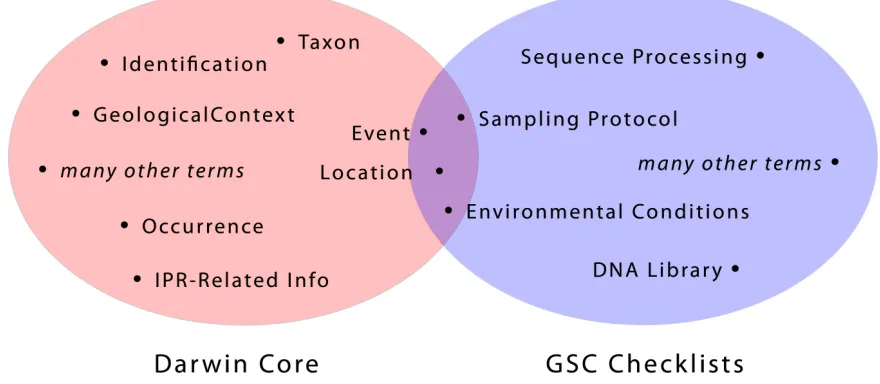
The first question that needed to be answered was whether DwC and GSC behave as overlapping or orthogonal (complementary) standards. A term-by-term comparison showed that DwC and GSC concepts complement each other far more than they compete with each other (Figure 1). Although this is not surprising (DwC is focused on the de-scription of observational biodiversity data, whereas the scope of the GSC checklists is ge-nomics and metagege-nomics data), it is highly desir-able that a union set of terms and concepts could be created without requiring major internal revi-sions to either individual set.
Where both standards overlap, DwC is usually more detailed. Prime exceptions are the DwC terms SamplingProtocol and those within the
cat-egory of MeasurementOrFact (which can include
outlined above, this might arise since the GSC standards are used for inferring insights at a mo-lecular level and aim to make momo-lecular data re-usable for comparative studies (e.g., sampling pro-tocol is more detailed in GSC because in metagenomic studies the sampling and processing
can affect what taxa are discovered in the sample — for metagenomic datasets to be comparable, the sampling protocols for each need to be well documented), whereas the DwC standard is more generally applied and targetted at the organismal level, and then, most often for higher organisms.
Figure 1. Summary comparison of the relative overlap between terms of the Darwin Core and GSC. The two sets of concepts are generally disjoint and complementary, rather than overlapping and competitive.
It was also observed that GSC checklists seem to have a different and more intense approach to us-ing ontologies. Compared to DwC, the MIxS uses different ontologies to specify the precise terms to be used to fill out checklist item. From this analy-sis, the breakout group recommended the GSC community should use DwC terms for specific GSC sections that are covered in DwC and use GCDML terms for sections not covered by DwC. In particu-lar, this concerns the DwC categories (classes) Record-level Terms (inc IPR related information),
Occurrence, Event, Location, GeologicalContext, Taxon, Identification, Taxon. Only Event and Loca-tion have been covered by the GSC checklists,
albe-it in less detail. The DwC Taxon sections have
de-liberately been left out of the GSC checklists as they were already covered in the sequence rec-ords of the International Nucleotide Sequence Da-tabase Collaboration (INSDC) and the GSC check-list was designed as an extension to the infor-mation already covered.
The conclusion that the GSC checklist elaborates more on sampling protocol and environmental conditions — details of which are extremely im-portant in light of comparative microbial
genomics — was somewhat surprising in the sense that these topics perfectly fit within the scope of DwC. The participants recommended that a discussion should be started with DwC experts and designers to see how a joint approach could be developed.
Finally, the significance of the GBWG initiative was recognized by the general attendees at the GSC11 meeting and by the GSC Board, resulting in a deci-sion to allocate substantial time to GBWG presen-tations and activities (i.e., not in a parallel session) at the coming GSC12 meeting (September 2011 in Bremen, Germany).
In a more general context, we note that one of the long-standing challenges for integrating data has been that communities differ in the granularity with which they collect data - cf., the old notion that those who live in the Arctic have more words for snow than do those who live in more temper-ate climtemper-ates - making it historically difficult to achieve political consensus for developing de novo
data-exchange standards: any system that is suffi-ciently complex to meet the needs of all groups
simultaneously is invariably seen as too complex
The present observation of little overlap be-tween DwC and GSC concepts suggests that achieving globally useful standards for data and metadata may in fact be possible, provid-ed it occurs following this general sequence: • First, individual communities deve
l-op and refine data standards to meet the needs of their users.
• Then, when a need arises for data e x-change between the communities, the relevant data standards are ana-lyzed to determine their relative orthogonality (as in the Venn dia-gram of Figure 1).
• Finally, a joint effort is undertaken, involving data-standards experts from the two communities, to ana-lyze formally the relationship be-tween the standards, then to develop a union set of terms and concepts, aggregated across the disjoint com-ponents and harmonized in the in-tersection.
• Repeat as necessary, as more com-munities become engaged.
This method can succeed where de novo efforts
have failed because it involves the development of standards (both intra- and inter-community standards) to meet immediate actual needs, rather than the commitment of scarce resources to meet possible future needs.
Harmonization must be done effectively. For ex-ample, one could harmonize the intersection only, i.e., develop guidelines for using only subsets of resolution as needed by one community, but es-tablish the capability for others to use the full standard to expand the annotation without ad-versely affecting the initial annotation. Doing so would result in standards that simultaneously meet the needs of both local and global users. This approach, if applied repeatedly and systematical-ly, would yield standards that would be capable of meeting the changing needs of the scientific com-munities. It would, however, require a recognition of constant change and thus to be fully effective would necessitate the development of additional approaches (e.g., internal data-standard version documentation) that could allow comparability of data collected and documented at different times, using different versions of the data standards.
Although systematically accommodating change over time adds additional complexity, it must be noted that this approach would not create the
need for methods to support data-standard ver-sioning — it just forces the recognition that such a
need exists.
Recommendations
Given that this was only a comparison, the breakout group also made some additional rec-ommendations and outlined some future work to be done. It was clear from reading the DwC docu-mentation that the Event and Location sections are
worked out in much detail and are based on solid theoretical foundations. However, some of the de-tails were not immediately clear from a first in-spection of DwC. Therefore, it was recommended that a DwC expert should be invited during the next GSC12 meeting to give a best practice work-shop on the use of the Event and Location sections
from the DwC standard.
In addition, the breakout group would like to fur-ther explore the ecosystem of tools and extension mechanism built around DwC. These tools are largely unknown (and so unused) in the (me-ta)genomics community, but might also be appli-cable in that field rather than the field reinventing the wheel for their purposes. Of prime relevance here are the GBIF vocabularies server [3] and the suite of data publishing tools and supporting doc-umentation and guides [4,5]. GBIF members with expertise in the DwC ecosystem could also be in-vited during GSC12 in order to bring the GSC community up to date on this matter. Another is-sue to look at further is the use of the Occurrence
term in DwC and the Environmental Ontology
(EnvO) used by the GSC checklist. It seems that for this term, there is a semantic mismatch between the two standards that needs to be sorted out. The breakout group will also finalize a term-by-term mapping between the DwC and GSC checklist and publish this information on the GSC wiki for fur-ther use. There is also scope for the two communi-ties to cooperate on the development, mainte-nance and govermainte-nance of shared vocabularies and ontologies.
The breakout group of the biodiversity session therefore proposed to set up a framed experiment that could be entitled the “Microbial Earth Cata-log”. The idea is to collect meta-information about all bacterial and archaeal type strains and their complete genome sequences if available, and mold it into DwC and GCDML formats. As a rough esti-mate, there are about 11,000 bacterial and archaeal species with 8,000 type strains (showing some synonymy among the species). The complete genome sequence of about 800 type strains is publicly available from the INSDC databases, of which about 100 have been published in Stand-ards in Genomic Sciences (SIGS) — the journal of the GSC.
If formally accepted, this experiment could be set up as a GSC project, undertaken as a joint initiative between the GBIF and GSC communities. Having such integrated catalog information would direct-ly support the “Microbial Earth Project” — an es-tablished GSC project with the aim to sequence the complete genome of all bacterial type strains — and could open the door to integrate microbial information into the GBIF portal, which for the moment only has limited coverage for this domain of life. This initial outline for an integrated DwC/GCDML case study found immediate interest within the GSC community, with proposals to ex-tend it later on to cover fungi and metagenomes. GBIF is liaising with UNITE [6] (the fungal rDNA ITS sequence database) to explore serving of its data to the GBIF network via DwC. Potential con-flicts between publishing such a catalog and SiGS policy remain to be discussed within the GSC board.
Because the preliminary analysis done at this meeting was based on expertise with GSC stand-ards, but not with DwC standstand-ards, the group rec-ommended that a joint meeting of DwC and GSC experts be convened as soon as possible to con-tinue this joint assessment and to propose addi-tional work going forward.
GBWG Timeline for 2011
Efforts by the GBWG to facilitate the development of useful data standards and procedures for the interface of biodiversity with genomics and metagenomics will be an ongoing activity. Corre-spondingly, we provide a timeline of events. Ital-ics indicate that the suggested activity has already occurred; plain text indicates that the activity is proposed.
Mar: Convene a GBWG planning meet-ing to initiate an analysis of biodi-versity, genomics, and meta-genomics: opportunities and chal-lenges.
Apr: Introduce the GBWG initiative at GSC11 meeting, UK; invite the de-velopment of use cases.
May: Form an RCN Working Group with GSC and Darwin Core spe-cialists
Jul: Engage with DNA barcode stand-ard through Consortium for the Barcode of Life working group. Sep: Report and discuss progress on
initiative at GSC12 meeting, Bre-men, Germany.
Oct: Engage GBIF and EOL before and during TDWG meeting, 16-21 Oc-tober, in New Orleans, Louisiana, US.
Nov: Discuss metadata capture, ecolog-ical sampling and analysis, NEON workshop, Boulder, CO.
Dec: Present and discuss initiative at Fourth International Barcode of Life Conference, Adelaide, Aus-tralia.
Acknowledgements
We gratefully acknowledge the support from the US National Science Foundation (NSF) grant RCN4GSC, DBI-0840989.
Brian Bramlett — Lux Bio Group / DigiBio Guy Cochrane — EMBL-EBI (ENA)
Chuck Cook — EBI
Peter Dawyndt — straininfo.org
Neil Davies — UC Berkeley, Moorea BioCode/BiSciCol
Denise Huber — Pfizer
Wim De Smet — straininfo.org / University of Gent Petra ten Hoopen — EBI
Kris Kristalka — University of Kansas, Biodiversity Institute
Alex Mitchell — EBI
Éamonn Ó Tuama — Global Biodiversity
Infor-mation Facility
Robert Robbins — UCSD Dan Sullivan — PATRIC / VBI
Inigo San Gil — NSF [http://www.lternet.edu/ LTERs]Eric Allen, UCSD
References
1. Robbins RJ, Amaral-Zettler L, Bik H, Blum S, Ed-wards J, Field D, Garrity G, Gilbert J, Kottmann R, Krishtalka L, et al. 2012 RCN4GSC Workshop Report: Managing Data at the Interface of Biodi-versity and (Meta)Genomics, March 2011. Stand Genomic Sci 2012; 7:159-165.
2.
3.
4.
5.