PhD Dissertation
International Doctorate School in Information and Communication Technologies
DISI - University of Trento
End-to-End Relation Extraction
via Syntactic Structures and Semantic
Resources
Truc-Vien T. Nguyen
Advisor:
Professor Alessandro Moschitti
Universit`a degli Studi di Trento
Abstract
Information Extraction (IE) aims at mapping texts into fixed structure
representing the key information. A typical IE system will try to answer
the questions like who are present in the text, what events happen and when
these events happen. The task is making possible significant advances in
applications that require deep understanding capabilities such as
question-answering engines, dialogue systems, or the semantic web. Due to the huge
effort and time consumation of developping extraction systems by domain
experts, our approach focuses on machine learning methods that can
ac-curately infer an extraction model by training on a dataset. The goal of
this research is to design and implement models with improved performance
by learning the combination of different algorithms or by inventing novel
structures that are able to exploit kinds of evidence that have not been
ex-plored in the literature.
A basic component of an IE system is named entity recognition (NER)
whose purpose is to locate objects that can be referred by names,
belong-ing to a predefined set of categories. We approach this task by proposbelong-ing
best candidate. The task is considered as sequence labelling with
Condi-tional Random Fields (CRFs) is selected as the baseline algorithm. Our
research employs novel kernels based on structured and unstructured
fea-tures for reranking the N-best hypotheses from the CRFs baseline. The
former features are generated by a polynomial kernel encoding entity
fea-tures whereas tree kernels are used to model dependencies amongst tagged
candidate examples.
Relation Extraction (RE) is concerned with finding relationships
be-tween pairs of entities in texts. State-of-the-art relation extraction model
is based on convolution kernel over the constituent parse tree. In our
re-search, we employ dependency parses from dependency parsing in addition
to phrase-structure parses from constituent parsing. We define several
vari-ations of dependency parses to inject additional information into the trees.
Additionally, we provide an extensive ablation over various types of kernels
by combining the tree, sequence, and polynomial kernels. These novel
ker-nels are able to exploit learned correlations between phrase-structure parses
and grammatical relations.
A large amounts of wide-coverage semantic knowledge today exists in
large repositories of unstructured or semi-structured text documents. The
increased availability of online collaborative resources has attracted the
at-tention of much work in the Artificial Intelligence (AI) community.
Nev-ertheless, the ability to extract it using statistical machine learning
tech-niques is hindered by well-known problems such as heavy supervision and
scalability. These drawbacks can be alleviated by applying a form of weakly
supervision, specifically named distant supervision (DS), to automatically
derive explicit facts from the semi-structured part of Wikipedia.
To learn relational facts from Wikipedia without any labeled example
or hand-crafted pattern, we employ DS where the relation providers are
training instances are gathered from Freebase (a huge semantic database).
These allow for potentially obtaining larger training data and many more
relations, defined in different sources. We apply state-of-the-art models for
ACE RE, that are sentence level RE (SRLE), to Wikipedia. Based on a
mapping table of relations from YAGO to ACE (according to their semantic
definitions), we design a joint RE model of DS/ACE and tested it on ACE
annotations (thus according to expert linguistic annotators). Moreover, we
experiment with end-to-end systems for real-world RE applications.
Con-sequently, our RE system is applicable to any document/sentence, i.e.
an-other major improvement on previous work, which, to our knowledge, does
not show experiments on end-to-end SLRE.
Keywords
[relation extraction, named entity recognition, kernel methods, tree kernel,
Acknowledgements
First and foremost, I want to thank my advisor Alessandro Moschitti,
whose nice guidance and support have shaped my development to a
re-searcher. His advices at any needed time have been leaded to lucid
reason-ing and clear explanation. His words of encouragement have also helped
me overcome less fruitful periods in my research, and have shown me the
value of being patient and proceeding the directed way.
I would like to thank Massimo Poesio for his encouragement, scientific
advices, and insightful feedback in various stages of my PhD process. I
thank Marco Baroni for prompt answers of almost every questions I have
made. That has significantly helped to keep constant inspired ideas with
enthusiasm. I am grateful to Fausto Giunchiglia for his active support,
thanks to that my PhD defense has been hold smoothly.
I would like to thank the members of my thesis committee - Michael
Strube, Razvan C. Bunescu, and Roberto Basili for their helpful comments
during my defense, especially thank Michael Strube for his insightful
feed-backs for the completion of this dissertation. I thank useful discussion and
and thank Sebastian Varges for useful advices before he left the group.
I am grateful to Cogito S.p.a. for sponsoring me during three years
of the Ph.D. and the LiveMemories project for a such useful academic
environment and financial support for missions.
Finally, I would like to thank my family for believing in me and for
Contents
Abstract 3
Acknowledgements 7
1 Introduction 1
1.1 Natural Language Processing . . . 1
1.2 Information Extraction . . . 2
1.3 Convolution Kernels . . . 3
1.4 Research Directions . . . 5
1.5 Thesis Contributions . . . 6
1.5.1 Named Entity Recognition . . . 6
1.5.2 Relation Extraction . . . 8
1.6 Thesis Outline . . . 10
2 Background 13 2.1 Named Entity Recognition . . . 14
2.2 Relation Extraction . . . 15
2.3 Learning Machines . . . 17
2.4 Kernel Machines . . . 18
2.5 Support Vector Machines (SVMs) . . . 19
2.6 Tree Kernels . . . 20
3 Reranking Model for NER 25
3.1 Introduction . . . 26
3.2 Motivation . . . 27
3.3 Datasets and Baseline . . . 28
3.3.1 Datasets . . . 28
3.3.2 The baseline algorithm . . . 29
3.3.3 Baseline Results . . . 31
3.4 Reranking Method . . . 33
3.4.1 Reranking Strategy . . . 33
3.4.2 Representation of Tagged Sequences in Semantic Trees 34 3.4.3 Global features . . . 35
3.4.4 Reranking with Composite Kernel . . . 39
3.5 Experiments . . . 40
3.5.1 Experimental setup . . . 40
3.5.2 Reranking Results . . . 41
4 Combining Parsing Paradigms 43 4.1 Introduction . . . 43
4.2 Motivation . . . 44
4.3 Kernels for RE . . . 45
4.3.1 Constituent and Dependency Structures . . . 46
4.3.2 Sequential Structures . . . 49
4.3.3 Combining Kernels . . . 50
4.4 Experiments . . . 52
4.4.1 Experimental setup . . . 53
4.4.2 Results . . . 53
5 Relation Ordering Strategies 57 5.1 Motivation . . . 57
5.1.2 Statistics . . . 58
5.1.3 Relation Ordering Strategy . . . 59
5.2 Experiments . . . 60
5.2.1 Kernel Setting . . . 60
5.2.2 Ordering Strategy . . . 62
5.2.3 Experimental Setup . . . 63
5.2.4 Results . . . 64
6 Large Scale IE 71 6.1 Motivation and Related Work . . . 71
6.2 Distant Supervision . . . 73
6.3 Methodology for Data Creation . . . 75
6.3.1 ACE (Automatic Content Extraction) . . . 76
6.3.2 YAGO . . . 77
6.3.3 Freebase . . . 79
6.3.4 Distant Supervision and generalization . . . 80
6.3.5 Mapping relations between YAGO-ACE . . . 81
6.4 Joint Learning Paradigms . . . 82
6.4.1 RE based on Kernel Methods . . . 83
6.4.2 Joint Distantly and Directly Supervised Model . . . 84
6.5 Experiments with standard RE . . . 86
6.5.1 Experimental setup . . . 86
6.5.2 Results . . . 87
6.6 End-to-end Relation Extraction . . . 89
6.6.1 Motivation . . . 89
6.6.2 Entity Extraction from ACE and Wikipedia . . . . 91
6.6.3 RE from Automatic Entity Extraction . . . 92
7.1.1 From One Vs. Rest to N-Best hypotheses . . . 95
7.1.2 Candidate Set Size and Oracle Performance . . . . 97
7.2 Potential People Search Engine . . . 98
7.2.1 Motivation . . . 98
7.2.2 Problem Statement . . . 99
8 Conclusions 101
List of Tables
3.1 Statistics on the CoNLL English dataset . . . 29
3.2 Statistics on the EVALITA Italian dataset . . . 29
3.3 CRFs results on the CoNLL Test set . . . 32
3.4 SVMs results on the CoNLL Test set . . . 32
3.5 CRFs results on the EVALITA Test set . . . 32
3.6 SVMs results on the EVALITA Test set . . . 32
3.7 Global features with the polynomial kernel for reranking. . 39
3.8 Reranking results on the English test set. . . 41
3.9 Reranking results on the Italian test set. . . 42
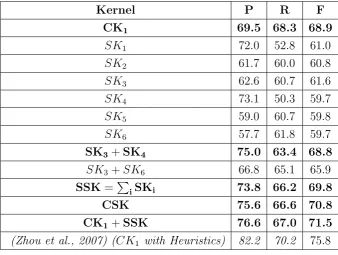
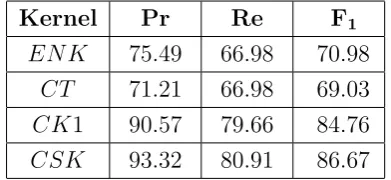
4.1 Results on the ACE 2004 with six structures. . . 54
4.2 Results on the ACE 2004 with different kernel setups. . . . 55
5.1 Statistics ACE . . . 58
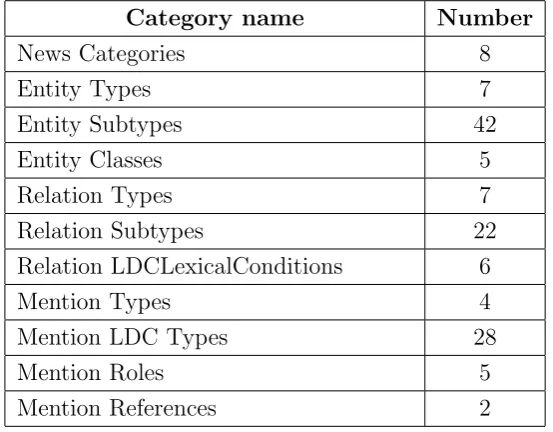
5.2 Entity types and subtypes defined in ACE 2004. . . 58
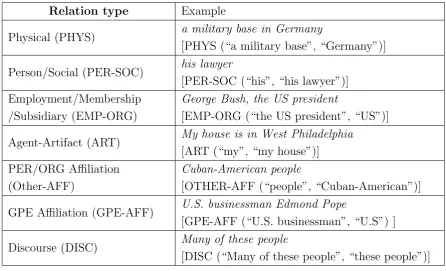
5.3 Relation types and their description as defined in ACE 2004. 59 5.4 Statistics on the average number of relation types for each combination of categories/subcategories of entities and men-tions. The deeper level of the category, the lower number of relation types, corresponding to the higher results in relation classification. . . 59
5.6 Results with one feature: mention headword; the order is
established by using one feature. . . 68
5.7 Results with two features: entity type and mention
head-word; the order is established by using two features. . . 68
5.8 Results with three features: entity type/subtype, and
men-tion headword; the order is established by using three features. 69
5.9 Results with four features: entity type/subtype, and
men-tion type/headword; the order is established by using four
features. . . 69
5.10 Results with five features: entity type/subtype, and mention
type/LDCtype/headword; the order is established by using
five features. . . 69
5.11 Results with six features: entity type/subtype, and mention
type/LDCtype/role/headword; the order is established by
using five features: entity type/subtype, mention
type/LD-Ctype/headword. . . 69
5.12 Results with seven features: entity type/subtype, and
men-tion type/LDCtype/role/reference/headword; the order is
established by using one feature: mention headword. . . . 70
5.13 Results with seven features: entity type/subtype, and
men-tion type/LDCtype/role/reference/headword; the order is
established by using two features: entity type and mention
headword. . . 70
5.14 Results with seven features: entity type/subtype, and
men-tion type/LDCtype/role/reference/headword; the order is
established by using five features: entity type/subtype,
5.15 Previous results with five features: entity type/subtype, and
mention type/LDCtype/headword; the order is established
by using three features: entity type, mention type, and
men-tion headword. . . 70
6.1 Some of Relation instances extracted by our system that did not appear in YAGO. . . 76
6.2 YAGO relations . . . 79
6.3 Statistics Freebase-ACE . . . 80
6.4 Mapping YAGO-ACE . . . 83
6.5 Results on Wikipedia . . . 88
6.6 Results on the ACE 2004 with relations between all entities 90 6.7 Improvement on the ACE 2004 with relations between all entities . . . 90
6.8 Results on ACE 2004 with relations between named entities 90 6.9 Results on ACE 2004 with relations between named entities 91 6.10 Results of automatic ACE . . . 93
6.11 Results of automatic Wiki . . . 93
List of Figures
1.1 A sentence with the best hypothesis. . . 7
1.2 10-best hypotheses of one sentence. . . 7
2.1 CoNLL text with all entities in bold. . . 14
2.2 An ACE 2004 relation with all entity mentions in bold. . . 15
2.3 Three kinds of tree kernels. . . 21
3.1 Semantic structure of a candidate sequence . . . 34
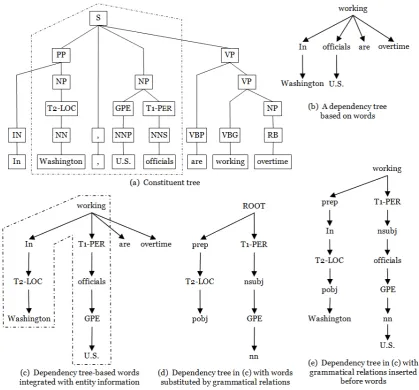
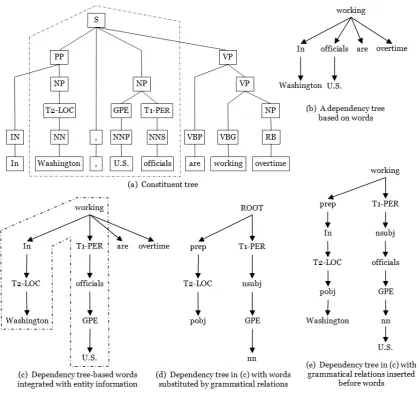
4.1 The constituent and dependency parse trees integrated with
entity information . . . 48
5.1 The constituent and dependency parse trees integrated with
entity information . . . 61
6.1 A text that signifies a relation instance in ACE 2004 with
all entity mentions in bold. . . 77
6.2 A text derived from Wikipedia Freebase, annotated with
YAGO relation with all entity mentions in bold. . . 82
6.3 The constituent and dependency parse trees integrated with
Chapter 1
Introduction
1.1
Natural Language Processing
In order to facilitate the understanding of human language, one needs
knowledge from both linguistics and computer science perspectives.
Nat-ural Language Processing (NLP) lies as the interdisciplinary field between
these two, dealing with statistical and/or rule-based modeling. In general,
NLP strongly involves cognitive science, artificial intelligence,
psycholin-guistics, and neuroscience, among others. However, up to the 80s, most
early NLP works were dominated by hand-built models, requiring a huge
amount of human effort and time consuming. As a consequence, the past
two decades have seen NLP algorithms mainly grounded in machine
learn-ing (ML). In this method, a corpus consistlearn-ing of annotations made by
human experts is used to infer a model. ML has made modern NLP
algo-rithms require the understanding of a number of disparate fields, including
linguistics, computer science, and statistics.
Most of ML-based approaches employ features that form the basic to
infer a model. However, natural language tasks often have to deal with
complex structures to be classified or clustered based on similarity. Thus,
it is desirable to have a method of constructing kernels on sets whose
1.2. INFORMATION EXTRACTION CHAPTER 1. INTRODUCTION
(Haussler, 1999) proposed convolution kernels that define a function
be-tween two objects based on similarities of their parts. These kernels allow
a generalized convolution. However, linguistic objects prohibit this
com-putation due to complex representations and thus, lead to huge number of
sub-structures, (Collins and Duffy, 2001) showed how the algorithms can
be efficiently applied to exponential sized representations of parse trees and
tagged sequences.
1.2
Information Extraction
The term “Information Extraction” (IE) refers to a technology that is
ori-ented towards the user’s point of view in the current information-driven
world. Rather than letting the user consider which documents need to be
read, it extracts “relevant” pieces of information that answer the user’s
need. The kinds of information to be extracted vary in detail and tasks
required. For example, a very classical task is extraction of named
enti-ties such as persons and organizations. However, it does not provide as
much detail as attributes of the entities, relationships between them, or
specific occurrences of events. Much has happened since the 90s with more
demanding IE tasks and more steady evaluation methodology.
The research direction dates back in the 80s with the FRUMP
sys-tem (DeJong, 1982), which seeks for event descriptions of newswire texts.
In the early 1990, the MUC evaluations (DARPA, 1987 1995) were
fund-ing the development of metrics and statistical algorithms to support IE
technologies. The results of these evaluations were reported at conferences
that were called ”Message Understanding Conferences (MUC)”. The MUC
proceedings were held in order to exchange research findings on the
effec-tiveness of techniques used to extract a variety of levels of information from
CHAPTER 1. INTRODUCTION 1.3. CONVOLUTION KERNELS
hand-built models. The first use of machine learning for IE was only seen
from (Bikel et al., 1997; Leek, 1997) with Hidden Markov Models (HMMs).
Since then, various IE learning algorithms have been developed.
The Automatic Content Extraction programme (Doddington, 1999 2008)
is a successor to MUC that has been running since a pilot study in 1999
and which has continued the competitive quantitative evaluation cycles of
its predecessor. ACE differs from MUC in three significant ways: i) several
MUC tasks are unified in ACE, for example the named entity recognition
and co-reference resolution are conflated into one task “Entity Detection
and Tracking (EDT)”; ii) the ACE program defines more complex tasks
with more fine-grained taxonomy of entities and relations; iii) ACE results
are restricted to participants and not public as MUC results.
Although the programs MUC and ACE provide several advantages to
the IE community, the datasets and tasks developed are restricted in
sev-eral ways. The data relies on pre-defined categories and, typically, these
categories are given to an IE system as input to learn. Shifting to a new
entity/relation requires a person to manually annotate new training
exam-ples with new labels. This expensive labor scales linearly with the
num-ber of categories required. Also, the dataset is annotated on a particular
corpus, it tends to be biased towards the text domain it is built upon.
These drawbacks can be alleviated by applying a form of weakly
supervi-sion, specifically named distant supervision (DS), using a huge amount of
data (Etzioni et al., 2008; Mintz et al., 2009; Hoffmann et al., 2010), e.g.
Wikipedia.
1.3
Convolution Kernels
Natural language tasks often has to deal with complex structures to be
1.3. CONVOLUTION KERNELS CHAPTER 1. INTRODUCTION
method of constructing kernels on sets whose elements are structures like
strings, trees and graphs. To fulfill this need, (Haussler, 1999) proposed
convolution kernels that define a function between two objects based on
the similarities of their parts. These kernels allow a generalized
convolu-tion. However, linguistic objects prohibit this computation due to complex
representations and thus, lead to huge number of sub-structures. (Collins
and Duffy, 2001) showed how the algorithms can be efficiently applied to
exponential sized representations of parse trees and tagged sequences.
The syntactic (or subset) tree kernel (SST) (Collins and Duffy, 2001;
Collins and Duffy, 2002) defines kernel funtion between parse trees which
encode grammatical derivations. Tree kernel counts the number of
sub-trees shared by two input parse sub-trees. Similarly, sequence kernel (Lodhi
et al., 2002) tackles problems with objects that are strings of characters
and the kernel function computes the number of common subsequences of
characters in the two strings. Such substrings are then weighted according
to a decay factor penalizing longer ones. Later, (Cancedda et al., 2003)
proposed the use of this technique with sequences of words rather than
characters. This approach shows efficient computationally since it ties in
closely with standard linguistic pre-processing techniques that are based
on words.
Since then, convolution kernels have been seen in numerous NLP tasks,
including event extraction (Agarwal and Rambow, 2010), opinion
analy-sis (Johansson and Moschitti, 2010; Wiegand and Klakow, 2010), question
answering (Moschitti et al., 2007), semantic role labelling (Moschitti et
al., 2008), relation extraction (Zhang et al., 2006; Nguyen et al., 2009b),
named entity extraction and classification (Collins, 2002; Nguyen et al.,
2010). These tasks either i) employ convolution kernels as key features
to learn the model or ii) use them as evidence in discriminating between
CHAPTER 1. INTRODUCTION 1.4. RESEARCH DIRECTIONS
1.4
Research Directions
Researchers have been noticed that NLP has been relied on ML. Statistical
methods now dominate NLP, and have moved the field positively. Several
ML models have been developed in the past two decades. How could we
benefit from ML to purpose more robust IE systems? We follow three
research directions:
1. From a linguistics point of view, semantics contrasts with syntax, the
study of the combinatorics of units of a language (without reference
to their meaning). However, semantics and syntax form two sides of
human language, one may benefit from another to contribute for an
overall effect. We propose an integrated model of syntactic and
se-mantic computing for relation extraction. The proposed model makes
use of structures derived from both the constituent and dependency
parsing paradigms, integrated with semantic features derived from
entities and relations.
2. From a computer science point of view, single learning algorithm does
not lead to good enough accuracy. Different learning algorithms such
as CRFs, SVMs employ their own encoding schemes, generalization
techniques and optimization strategies. It is desirable to design a
model that can combine multiple learning phases, exploiting various
learning strategies with the target being to improve the basic model.
Reranking is one of such models, providing the ability of using the
output of one learning algorithm as the input of another.
3. From an artificial intelligence point of view, to cope with the need of
labeled data in supervised learning setting, we employ distant
super-vision. However, the DS paradigm is based on the asumption that the
1.5. THESIS CONTRIBUTIONS CHAPTER 1. INTRODUCTION
source (e.g. Freebase is a large repository of relation instances that
is consistent with Wikipedia texts from Freebase Wikipedia
Extrac-tion). We relax this assumption by employing an external source that
is YAGO. Although YAGO also uses Wikipedia as one source to build
its relation instances. We show that, our method is generic and can be
applied to any external source of relation instances and any Wikipedia
document.
1.5
Thesis Contributions
The goal of this thesis is to design and develop computational models for
information extraction systems with improved accuracy, but, at the same
time, allow the most generalization.
1.5.1 Named Entity Recognition
Previous approaches for named entity recognition often take the first
hy-pothesis ranked by the baseline for each sentence. However, in many cases,
the first hypothesis is not the most accurate, i.e., its F-measure is not
the highest among the N hypotheses. This means that reranking could
improve the NER performance. Intuitively, arbitrary features different
from those used by the base model should be employed by the reranker
to exploit discriminative aspects of candidate tagged sequences. That has
been seen in various reranking algorithms applied to parsing (Collins, 2000;
Collins, 2002; Charniak and Johnson, 2005; Huang, 2008), machine
trans-lation (Shen et al., 2004), and opinion mining (Johansson and Moschitti,
2010).
Let H,. . . , Hn be hypotheses generated over one sentence (figure 1.1),
where each hypothesis Hi is represented by a list of named entity (NE)
CHAPTER 1. INTRODUCTION 1.5. THESIS CONTRIBUTIONS
Campesewill be up against a familiar foe in the shape of Barbar-ians captain Rob Andrew , the man who kicked Australia to defeat with a last-ditch drop-goal in theWorld Cup quarter-final inCape Town.
Figure 1.1: A sentence with the best hypothesis.
[Campese] [Barbarians] [Rob Andrew] [Australia] [World Cup] [Cape Town]
H1: [O] [MISC] [PER] [LOC] [MISC] [LOC]
H2: [O] [ORG] [PER] [LOC] [MISC] [LOC]
H3: [PER] [MISC] [PER] [LOC] [MISC] [LOC]
H4: [MISC] [MISC] [PER] [LOC] [MISC] [LOC]
H5: [O] [LOC] [PER] [LOC] [MISC] [LOC]
H6: [ORG] [MISC] [PER] [LOC] [MISC] [LOC]
H7: [PER] [ORG] [PER] [LOC] [MISC] [LOC] (the right hypothesis)
H8: [O] [O] [PER] [LOC] [MISC] [LOC]
H9: [MISC] [ORG] [PER] [LOC] [MISC] [LOC]
H10: [PER] [LOC] [PER] [LOC] [MISC] [LOC]
Figure 1.2: 10-best hypotheses of one sentence.
various types of candidate tagged sequences, we propose using a framework
that does linear combination of structural kernel and polynomial kernel.
The former encodes the tree-like structure with entity types anchored as
nodes and words as leaves. The latter is used to encode arbitrary features
motivated from entity types with their n-grams of the preceding/following
words.
The strength of these correlations is captured by a tree kernel and a
polynomial kernel. Given a sentence with its N-best list, all pairs of
1.5. THESIS CONTRIBUTIONS CHAPTER 1. INTRODUCTION
methods can be trained to discriminate between the best hypothesis, i.e.
< Hi > and the others. At testing time the hypothesis receiving the
high-est score is selected (Collins and Duffy, 2001). Experimental results on two
standard datasets in two different languages show that a significant increase
in performance is obtained when a linear combination of the structural and
polonomial kernels is used.
1.5.2 Relation Extraction
We take the pairwise approach for the task of relation extraction (RE).
Pair of entity mentions in the same sentence are generated as potential
relations and then are classified as to whether they belong to a predefined
set of relationships. We present a set of approaches to learn relational
extractors that focus on one of two issues related to the nature of the task:
1) difference in the syntactic parsing structure and 2) difference in the
type of supervision. We also propose a joint learning framework trying to
combine two types of supervision and to improve the basic models.
Combining Parsing Paradigms
State-of-the-art relation extraction model is based on convolution
ker-nel (Zhang et al., 2006) over the constituent parse tree. However,
de-pendency structures offer some unique advantages, which should be
ex-ploited by an appropriate kernel. In our research, we employ syntactic
parsing as the key features for our learning framework. In addition to
phrase-structure parses from constituent parsing that are popular in NLP
applications, we employ dependency parses from dependency parsing. We
define several variations of dependency parses to inject additional
infor-mation into the trees. Additionally, we provide an extensive ablation over
various types of kernels by combining the tree, sequence, and polynomial
be-CHAPTER 1. INTRODUCTION 1.5. THESIS CONTRIBUTIONS
tween phrase-structure parses and grammatical relations.
Distant Supervised Relation Extraction Using Kernel Methods
Previous work has shown that selecting the sentences containing the
enti-ties targeted by a given relation is enough accurate (Etzioni et al., 2008;
Mintz et al., 2009) to provide reliable training data. However, only
(Hoff-mann et al., 2010) used DS to define extractors that are supposed to detect
all the relation instances from a given input text. This is a harder test for
the applicability of DS but, at the same time, the resulting extractor is very
valuable: it can find rare relation instances that might be expressed in only
one document. For example, the relationPresident(Barrack Obama, United
States) can be extracted from thousands of documents thus there is a large
chance of acquiring it. In contrast, President(Eneko Agirre, SIGLEX) is
probably expressed in very few documents, increasing the complexity for
obtaining it.
We extend DS by (i) considering relations from semantic repositories
dif-ferent from Wikipedia, i.e. YAGO, and (2) using training instances derived
from any Wikipedia document. This allows for (i) potentially obtaining
training data for many more relation types, defined in different sources; (ii)
meaningfully enlarging the size of the DS data since the relation examples
can be extracted from any Wikipedia document 1.
Additionally, by following previous work, we define state-of-the-art RE
models based on kernel methods (KM) applied to syntactic/semantic
struc-tures. We use tree and sequence kernels that can exploit structural
infor-mation and interdependencies among labels. Experiments show that our
models are flexible and robust to Web documents as we achieve the
inter-esting F1 of 74.29% on 52 YAGO relations. This is even more appreciable
if we approximately compare with the previous result on RE using DS, i.e.
1.6. THESIS OUTLINE CHAPTER 1. INTRODUCTION
61% (Hoffmann et al., 2010). Although the experiment setting is different
from ours, the improvement of about 13 absolute percent points
demon-strates the quality of our model.
Combining Learning Paradigms
In the second approach, we conduct a study on DS for the automatic
acqui-sition of labeled data: the aim is to build sufficiently accurate RE
applica-ble to general domains. Our approach is based on support vector machines
(SVMs) and kernel methods applied to syntactic trees, where the latter are
obtained with different parsing paradigms. We explore domain adaptation
by defining a joint model between Web data derived with DS and manually
annotated data from ACE. The results derived on both ACE and DS data
demonstrate that our models improve previous state-of-the-art.
Addition-ally, the learning ability of our approach allowed us to generalize the DS
hypothesis to any relation using any Wikipedia document. This allows for
enlarging the size of automatically produced RE datasets of several order
of magnitude.
1.6
Thesis Outline
Below is a summary of the remaining chapters in this thesis, with references
to the relevant publications:
• Chapter 3: This chapter presents a reranking framework that em-ploys two learning phases to pick the best candidate for named entity
recognition (Nguyen et al., 2010; Nguyen et al., 2009a).
• Chapter 4: We propose a novel convolution kernel that combines the two parsing structures - constituent and dependency parsing for
CHAPTER 1. INTRODUCTION 1.6. THESIS OUTLINE
• Chapter 5: We conduct intensive experiments to investigate the ef-fects of relation order in the RE task using convolution kernels. The
relation order is established using a number of entity properties.
• Chapter 6: An end-to-end distant supervised learning framework for extracting relational facts from Wikipedia articles with a relevant
67% F-measure (Nguyen and Moschitti, 2011). We also propose a
Chapter 2
Background
In this chapter, we describe the background of the tasks this thesis is
deal-ing with and basic algorithms that we employ. The tasks are concerned
with automatic extraction of semantic aspects of text. Semantics (Liddell
et al., 1891) is the study of meaning. It focuses on the relation between
signifiers, such as words, phrases, signs and symbols, and what they stand
for, their denotata. In computer science, the term refers to the meaning
of languages, as opposed to their form (syntax). Additionally, it is
ap-plied to certain types of data structures specifically designed and used for
representing information content. In this context, the term “semantics” is
used to characterize concepts or entities in the world, and the relationships
between them.
Following the literature, we define entity as one object in the world,
and relation as binary relationship between pair of entities. Our tasks are
framed as relation extraction (RE) and named entity recognition (NER).
We explore the use of kernel methods based on syntactic and semantic
structures for the targets RE and NER tasks. Syntax is derived from
con-stituent and dependency parse trees whereas semantics concerns to entity
types when used as flat features and as integrated in the syntactic parse
rep-2.1. NAMED ENTITY RECOGNITION CHAPTER 2. BACKGROUND
resentations in the automated RE from texts and in the incorporation of
syntatic/semantic features into a reranking framework for NER.
2.1
Named Entity Recognition
Named-entities (NEs) are objects that can be referred by names (Chinchor
and Robinson, 1998), such as people, organizations, and locations. NEs are
essential for defining the semantics of a document. The research on NER
has been promoted by the Message Understanding Conferences (MUCs,
1987-1998), the shared task of the Conference on Natural Language
Learn-ing (CoNLL, 2002-2003), and the Automatic Content Extraction program
(ACE, 2002-2005). Figure 2.1 shows a text from the CoNLL 2003 corpus,
where all named entities are in bold.
Owen Finegan has recovered from the knocks he took in last weekend’s test againstWalesand retains his place in the back-row ahead of Daniel Manu. The Wallabies have their sights set on a 13th successive victory to end their European tour with a 100 percent record but also want to turn on the style and provideDavid Campese with a fitting send-off in his final match inAustralian
colours.
Figure 2.1: CoNLL text with all entities in bold.
The named entity recognition task involves either rule-based
model-ing or machine learnmodel-ing. Whereas the semantic web community mainly
focused on rule based algorithms (Nguyen and Cao, 2007; Popov et al.,
2003), natural language processing community mainly develops machine
learning algorithms to reduce efforts and time required by domain experts.
CHAPTER 2. BACKGROUND 2.2. RELATION EXTRACTION
A NER system may employ one learning algorithm to build a model. The
used algorithms include maximum entropy (Bender et al., 2003; Chieu
and Ng, 2003; Curran and Clark, 2003), hidden markov model (Zhou and
Su, 2002), perceptron (Carreras et al., 2003a), adaboost (Carreras et al.,
2003b), conditional random fields (McCallum and Li, 2003), support vector
machines (Mayfield et al., 2003). However, single learning algorithm has
limited performance, while possesses disparate properties and techniques,
(Florian et al., 2003) presents a classifier combination experimental
frame-work for NER in which four diverse classifiers are combined under different
conditions.
2.2
Relation Extraction
Relation Extraction (RE) is defined as the task of finding relevant semantic
relations between pairs of entities in texts. Figure 2.2 shows part of a
document from the ACE 2004 corpus, a collection of news articles. In
the text, the relation between president and NBC’s entertainment division
describes the relationship between the first entity (person) and the second
(organization) where the person holds a managerial position.
Jeff Zucker, the longtime executive producer of NBC’s “Today” program, will be named Friday as the new president of NBC’s entertainment division, replacing Garth Ancier, NBC executives said.
Figure 2.2: An ACE 2004 relation with all entity men-tions in bold.
To identify semantic relations using machine learning, three learning
2.2. RELATION EXTRACTION CHAPTER 2. BACKGROUND
al., 2000; Zelenko et al., 2002; Culotta and Sorensen, 2004; Kambhatla,
2004; Zhou et al., 2005), semi supervised methods (Brin, 1998; Agichtein
and Gravano, 2000), and unsupervised method (Hasegawa et al., 2004). In
a supervised learning setting, representative related work can be classified
into generative models (Miller et al., 2000), feature-based (Roth and tau
Yih, 2002; Kambhatla, 2004; Zhao and Grishman, 2005; Zhou et al., 2005)
or kernel-based methods (Zelenko et al., 2002; Culotta and Sorensen, 2004;
Bunescu and Mooney, 2005a; Zhang et al., 2005; Zhang et al., 2006).
The learning model employed in (Miller et al., 2000) used statistical
parsing techniques to learn syntactic parse trees. It demonstrated that a
lexicalized, probabilistic context-free parser with head rules can be used
ef-fectively for information extraction. Meanwhile, feature-based approaches
often employ various kinds of linguistic, syntactic or contextual
informa-tion and integrate into the feature space. (Roth and tau Yih, 2002) applied
a probabilistic approach to solve the problems of named entity and relation
extraction with the incorporation of various features such as word,
part-of-speech, and semantic information from WordNet. (Kambhatla, 2004)
employed maximum entropy models with diverse features including words,
entity and mention types and the number of words (if any) separating the
two entities.
Recent work on Relation Extraction has mostly employed kernel-based
approaches over syntactic parse trees. Kernels on parse trees were
pio-neered by (Collins and Duffy, 2001). This kernel function counts the
num-ber of common subtrees, weighted appropriately, as the measure of
simi-larity between two parse trees. (Culotta and Sorensen, 2004) extended this
work to calculate kernels between augmented dependency trees. (Zelenko
et al., 2002) proposed extracting relations by computing kernel functions
between parse trees. (Bunescu and Mooney, 2005a) proposed a shortest
CHAPTER 2. BACKGROUND 2.3. LEARNING MACHINES
relationship between two entities can be captured by the shortest path
between them in the dependency graph.
Although approaches in RE have been dominated by kernel-based
meth-ods, until now, most of research in this line has used the kernel as some
similarity measures over diverse features (Zelenko et al., 2002; Culotta and
Sorensen, 2004; Bunescu and Mooney, 2005a; Zhang et al., 2005). These
are not convolution kernels and produce a much lower number of
sub-structures than the PT kernel. A recent approach successfully employs
a convolution tree kernel (of type SST) over constituent syntactic parse
tree (Zhang et al., 2006; Zhou et al., 2007), but it does not capture
gram-matical relations in dependency structure.
2.3
Learning Machines
Machine learning allows to develop algorithms which learn from
environ-ment and improve automatically with experience. The input is often
pro-vided with a set of instances (so-called training data), from those a target
function is learnt and applied to the output (i.e. test data). Usually the
examples are in the form of attribute vectors, so that the input space is a
subset of Rn. Once the attribute vectors are available, a number of sets of
hypotheses could be chosen for the problem. Among these, linear functions
are the best understood and simplest to apply.
Traditional statistics and the classical neural networks literature have
developed many methods for discriminating between two classes of
in-stances using linear functions, as well as methods for interpolation using
linear functions. These techniques, which include both efficient iterative
procedures and theoretical analysis of their generalisation properties,
pro-vide the framework within which the construction of more complex
2.4. KERNEL MACHINES CHAPTER 2. BACKGROUND
Binary classification is frequently performed by using a real-valued
func-tion f : X ⊆ Rn −→ R in the way that x = (x1, . . . , xn)0 is assigned to
the positive class if f(X) ≥ 0, and otherwise to the negative class. We
consider the case where f(X) is a linear function of x ∈ X so that it can
be written as:
f(x) = hw·xi
= Pn
i=1wixi+ b
where (w, b) ∈ Rn × R are the parameters that control the function and
the decision rule is given by sgn(f(x)), where we will use the convention
that sgn(0) = 1. The learning methodology implies that these parameters
must be learned from the data.
2.4
Kernel Machines
The limited computational power of linear learning machines was
high-lighted in the 1960s by Minsky and Papert. Complex real-world
appli-cations require more expressive hypothesis spaces than linear functions.
Kernel representations offer an alternative solution by projecting the data
into a high dimensional feature space to increase the computational power
of the linear learning machines. The use of linear machines in the dual
representation makes it possible to perform this step implicitly.
By replacing the inner product with an appropriately chosen “kernel”
function, one can implicitly perform a non-linear mapping to a high
dimen-sional feature space without increasing the number of tunable parameters,
provided the kernel computes the inner product of the feature vectors
cor-responding to the two inputs. A kernel function is a scalar product that
does implicit mapping feature vectors from <d to a new space <n. Kernels
provide an efficient way to carry out these calculations when n is large or
CHAPTER 2. BACKGROUND 2.5. SUPPORT VECTOR MACHINES (SVMS)
The kernel trick allows us to rewrite the decision hyperplane as:
H(~x) = X
i=1..l
yiαi~xi
·~x+b =
X
i=1..l
yiαi~xi ·~x+ b =
X
i=1..l
yiαiφ(oi)·φ(o) + b,
where yi is equal to 1 for positive and -1 for negative examples, αi ∈ <
with αi ≥ 0, oi ∀i ∈ {1, .., l} are the training instances and the product
K(oi, o) =hφ(oi)·φ(o)i is the kernel function associated with the mapping
φ.
However, in many NLP applications, the input data cannot fit to
fea-ture vectors in <d as the objects being modeled are strings, trees, graphs.
(Collins and Duffy, 2001) proposed convolution kernels for various NLP
structures. From then, kernel methods have attracted much interest due
to their ability of implicitly exploring huge amounts of structural features
automatically extracted from the original object representation. The
ker-nels for structured natural language data, such as parse tree kernel (Collins
and Duffy, 2001), string kernel (Lodhi et al., 2002), or word sequence
ker-nel (Cancedda et al., 2003) are examples of the well-known convolution
kernels used in many NLP applications.
2.5
Support Vector Machines (SVMs)
Support Vector Machines refer to a supervised machine learning technique
based on the latest results of the statistical learning theory (Vapnik, 1998).
SVMs provide efficiently training the linear machines in the kernel-induced
feature spaces, while respecting the insights provided by the generalisation
theory, and exploiting the optimisation theory. Thanks to the
Karush-Kuhn-Tucker theorem, they can produce “sparse” dual representation of
2.6. TREE KERNELS CHAPTER 2. BACKGROUND
to Mercer’s conditions on the kernels, the corresponding optimization
prob-lems are convex and hence no local minima.
An important feature of these systems is that, while enforcing the
learning biases suggested by the generalisation theory, they also produce
“sparse” dual representations of the hypothesis, resulting in extremely
effi-cient algorithms. This is due to the Karush-Kuhn-Tucker conditions, which
hold for the solution and play a crucial role in the practical
implementa-tion and analysis of these machines. Another important feature of the
Support Vector approach is that due to Mercer’s conditions on the
ker-nels the corresponding optimisation problems are convex and hence have
no local minima. This fact, and the reduced number of non-zero
param-eters, mark a clear distinction between these system and other pattern
recognition algorithms, such as neural networks.
Given a vector space and a set of training points, i.e. positive and
negative examples, SVMs find a separating hyperplaneH(~x) =~ω×~x+b = 0
where ω ∈ Rn and b ∈ R are learned by applying the Structural Risk
Minimization principle (Vapnik, 1995). SVMs is a binary classifier, but it
can be easily extended to multi-class classifier, e.g. by means of the one
vs. rest method (Rifkin and Poggio, 2002). One strong point of SVMs
is the possibility to apply kernel methods (Robert M¨uller et al., 2001) to
implicitly map data in a new space where the examples are more easily
separable.
2.6
Tree Kernels
Tree kernels represent trees in terms of their sub-structures (called tree
fragments). Such fragments form a feature space which, in turn, is mapped
into a vector space. Tree kernels measure the similarity between pair of
CHAPTER 2. BACKGROUND 2.6. TREE KERNELS
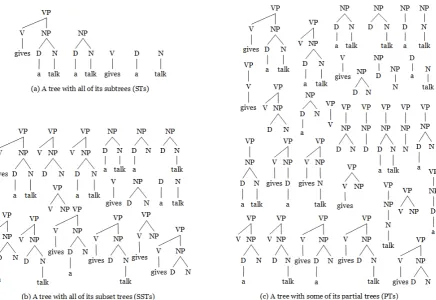
important characterizations of fragment type: the SubTrees (STs), the
SubSet Trees (SSTs) and the Partial Trees (PTs).
Figure 2.3: Three kinds of tree kernels.
A SubTree (ST) is defined by taking any node along with its
descen-dants. A SubSet Tree (SST) is a more general structure which does not
necessarily include all the descendants. The distinction is that an SST
must be generated by applying the same grammatical rule set which
gen-erated the original tree, as pointed out in (Collins and Duffy, 2001). A
Partial Tree (PT) is a more general form of sub-structures obtained by
re-laxing constraints over the SSTs. Figure 2.3 shows the overall fragment set
of the ST, SST and PT kernels for the syntactic parse tree of the sentence
fragment: gives a talk. In general, the tree kernel results depend on the
2.6. TREE KERNELS CHAPTER 2. BACKGROUND
type should be applied for the target task.
To see how to carry out efficient computation of this high dimensional
representation, we follow the algorithm (Collins and Duffy, 2001). We
enumerate all tree fragments that occur in the training data 1,...,n. Each
tree is represented by an n dimensional vector where the i’th component
count the number of occurences of the i’th tree fragment. Let us define the
function hi(T) to be the number of occurrences of the i’th tree fragment in
tree T, so that T is now represented as h(T) = (h1(T), h2(T), ..., hn(T)).
We then examine the inner product between two trees T1 and T2 under
this representation K(T1, T2) = h(T1) · h(T2). To compute K we first
define the set of nodes in trees T1 and T2 as N1 and N2 respectively. We
define the indicator function Ii(n) to be 1 if sub-tree is seen rooted at
node n and 0 otherwise. It follows that hi(T1) =
P
(n1 ∈ N1)Ii(n1) and
hi(T2) =
P
(n2 ∈ N2)Ii(n2). With some simple algebra we have:
h(T1)·h(T2) =
P
ihi(T1)hi(T2)
= P
(n1 ∈ N1)
P
(n2 ∈ N2)
P
iIi(n1)Ii(n2)
= P(n1 ∈ N1)
P
(n2 ∈ N2)C(n1, n2)
where we define C(n1, n2) =
P
iIi(n1)Ii(n2). Note that C(n1, n2) can be
computed in polynomial time, due to the following recursive definition:
• If the productions at n1 and n2 are different C(n1, n2) = 0.
• If the productions at n1 and n2 are the same, and n1 and n2 are
pre-terminals, then C(n1, n2) = 1.
• Else if the productions at n1 and n2 are the same and n1 and n2 are
not pre-terminals,
C(n1, n2) =
n
Y
CHAPTER 2. BACKGROUND 2.6. TREE KERNELS
where nc(n1) is the number of children of n1 in the tree; because the
productions at n1/n2 are the same, we have nc(n1) = nc(n2). The i’th
child node of n1 is ch(n1, i).
Note that C(n1, n2) counts the number of common subtrees rooted at
bothn1 and n2. From the identity h(T1)·h(T2) =
P
(n1, n2)C(n1, n2), and
the recursive definition of C(n1, n2) can be calculated in O(|N1||N2|) time.
2.6.1 Kernel Engineering
Kernel engineering can be carried out by combining basic kernels with
additive or multiplicative operators or by designing specific data objects
(vectors, sequences and tree structures) for the target tasks.
It is worth noting that well-known kernels applied to new structures
produce completely new kernels as shown hereafter. Let K(t1, t2) = φ(t1)·
φ(t2) be a basic kernel, where t1 and t2 are two trees. If we map t1 and
t2 into two new structures s1 and s2 with a mapping φM(·), we obtain:
K(s1, s2) =φ(s1)·φ(s2) = φ(φM(t1))·φ(φM(t2)) = φ0(t1)·φ0(t2)=K0(t1, t2),
Chapter 3
Reranking Model for NER
In this chapter, we present a method of incorporating global features for
named entity recognition based on reranking technique, combining the
two state-of-the-art NER learning algorithms, conditional random fields
(CRFs) and support vector machines (SVMs). The reranker employs two
kinds of features: flat and structured features. The former features are
generated by a polynomial kernel encoding entity features whereas tree
kernels are used to model dependencies amongst tagged candidate
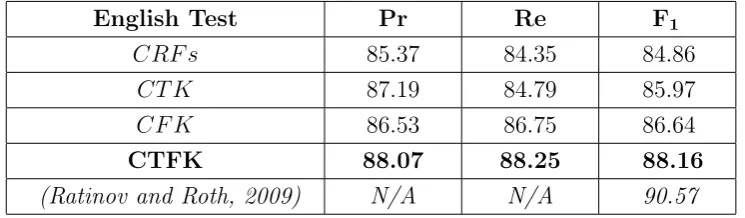
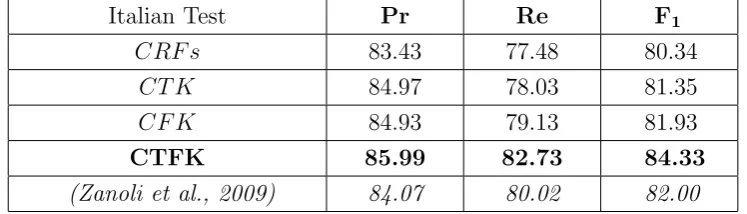
exam-ples. The experiments on two standard corpora in two languages, i.e. the
Italian EVALITA 2009 and the English CoNLL 2003 datasets, show a large
improvement on CRFs in F-measure, i.e. from 80.34% to 84.33% and from
84.86% to 88.16%, respectively. Our analysis reveals that both kernels
provide a comparable improvement over the CRFs baseline. Additionally,
their combination improves CRFs much more than the sum of the
indi-vidual contributions, suggesting an interesting kernel effect. Lastly, the
global features, when integrated in the baseline, yields much less
improve-ment wrt. when integrated by reranking, proving the necessity of those
3.1. INTRODUCTION CHAPTER 3. RERANKING MODEL FOR NER
3.1
Introduction
Research in statistical natural language processing has shown the promise
of reranking approach in enhancing the accuracy. This method first
em-ploys a probabilistic model to generate a list of top-N candidates and
then reranks this N-best list with additional features. The approach is
appealing in its flexibility of incorporating arbitrary features into a model.
These features help in discriminating good from bad hypotheses and
con-sequently their automatic learning. Various algorithms have been applied
for reranking in NLP applications, including parsing (Collins, 2000; Collins
and Duffy, 2002; Charniak and Johnson, 2005; Huang, 2008), name
tag-ging (Collins, 2002; Collins and Duffy, 2002), machine translation (Shen
et al., 2004) and opinion detection (Johansson and Moschitti, 2010). This
work has exploited the disciminative property as one of the key criterion
of the reranking algorithm.
Recent works have shown substantial improvement of the reranker in
coupling with kernel methods (Collins and Duffy, 2001; Moschitti, 2004),
as the latter allow for extracting from the ranking hypotheses a huge
amount of features along with their dependencies. Indeed, while
feature-based learning algorithms involve only the dot-product between feature
vectors, kernel methods allow for a higher generalization by replacing the
dot-product with a function between pairs of linguistic objects. Such
func-tions are a kind of similarity measure satisfying certain properties. An
example is the tree kernel (Collins and Duffy, 2001), where the objects
are syntactic trees that encode grammatical derivations and the kernel
function computes the number of common subtrees. Similarly, sequence
kernels (Lodhi et al., 2002) count the number of common subsequences
CHAPTER 3. RERANKING MODEL FOR NER 3.2. MOTIVATION
3.2
Motivation
The reranking algorithms described in (Collins, 2002; Collins and Duffy,
2002) only targeted the entity detection (and not entity classification) task.
Besides, since kernel methods offer a natural way to exploit linguistic
prop-erties, applying kernels for NE reranking is worthwhile. In the context of
named entity recognition, as a hypothesis generated over one sentence
pro-vide a natural way to integrate semantic features, we can flexibly integrate
those features into the post-process. We employ a tree kernel encoding
NE tags of a sentence and combine them with a polynomial kernel, which
efficiently exploits global features.
In this chapter, we describe how kernel methods can be applied for
reranking, i.e. detection and classification of named-entities, in standard
corpora for Italian and English. The key aspect of our reranking approach
is how structured and flat features can be employed in discriminating
can-didate tagged sequences. For this purpose, we apply tree kernels to a
tree structure encoding NE tags of a sentence and combined them with a
polynomial kernel, which efficiently exploits global features.
Our main contribution is to show that (a) tree kernels can be used to
define general features (not merely syntactic) and (b) using appropriate
algorithms and features, reranking can be very effective for named-entity
recognition. Our study demonstrates that the composite kernel is very
effective for reranking named-entity sequences. Without the need of
pro-ducing and heuristically combining learning models like previous work on
NER, the composite kernel not only captures most of the flat features
but also efficiently exploits structured features. More interestingly, this
kernel yields significant improvement when applied to two corpora of two
different languages. The evaluation in the Italian corpus shows that our
3.3. DATASETS AND BASELINE CHAPTER 3. RERANKING MODEL FOR NER
data it reaches the state-of-the-art.
3.3
Datasets and Baseline
Statistical natural language learning always has to deal with the problem
that is the possibility to crash on any new dataset. This happens with any
approach of any NLP task. A robust NER system is expected to be
well-adapted to multiple domains and languages. Therefore, we experimented
with two datasets: i) the well-known CoNLL 2003 English shared task
corpus; and ii) the EVALITA 2009 Italian corpus. Statistics are shown in
tables 3.1 and 3.2.
3.3.1 Datasets
The CoNLL English dataset
The CoNLL 2003 English dataset is created within the shared task of
CoNLL-2003 (Tjong Kim Sang and De Meulder, 2003). It is a
collec-tion of news wire articles from the Reuters Corpus, annotated with four
entity types: Person (PER), Location (LOC), Organization (ORG) and
Miscellaneous name (MISC). The training and the development datasets
are news feeds from August 1996, while the test set contains news feeds
from December 1996. Accordingly, the named entities in the test dataset
are considerably different from those that appear in the training or the
development set.
The EVALITA Italian dataset
The EVALITA 2009 Italian dataset is based on I-CAB, the Italian Content
Annotation Bank (Magnini et al., 2006), annotated with four entity types:
Loca-CHAPTER 3. RERANKING MODEL FOR NER 3.3. DATASETS AND BASELINE
CoNLL LOC MISC ORG PER
Train 7140 3438 6321 6600
30.38% 14.63% 26.90% 28.09%
Dev 1837 922 1341 1842
30.92% 15.52% 22.57% 31.00%
Test 1668 702 1661 1617
29.53% 12.43% 29.41% 28.63%
Table 3.1: Statistics on the CoNLL English dataset
tion (LOC). The training data, taken from the local newspaper “L’Adige”,
consists of 525 news stories which belong to five categories: News Stories,
Cultural News, Economic News, Sports News and Local News. Test data,
on the other hand, consist of completely new data, taken from the same
newspaper and consists of 180 news stories.
EVALITA GPE LOC ORG PER
Train 2813 362 3658 4577
24.65% 3.17% 32.06% 40.11%
Test 1143 156 1289 2378
29.53% 12.43% 29.41% 28.63%
Table 3.2: Statistics on the EVALITA Italian dataset
3.3.2 The baseline algorithm
We selected Conditional Random Fields (Lafferty et al., 2001) as the
base-line model. Conditional random fields (CRFs) are a probabilistic
frame-work for labeling and segmenting sequence data. They present several
advantages over other purely generative models such as Hidden Markov
models (HMMs) by relaxing the independence assumptions required by
HMMs. Besides, HMMs and other discriminative Markov models are prone
3.3. DATASETS AND BASELINE CHAPTER 3. RERANKING MODEL FOR NER
The named-entity recognition (NER) task is framed as assigning label
sequences to a set of observation sequences. We follow the IOB notation
where the NE tags have the format B-TYPE, I-TYPE or O, which mean
that the word is a beginning, a continuation of an entity, or not part of an
entity at all. For example, consider the sentence with their corresponding
NE tags, each word is labeled with a tag indicating its appropriate
named-entity, resulting in annotated text, such as:
Il/O presidente/O della/O Fifa/B-ORG Sepp/B-PERBlatter/I-PER affermando/O
che/O il/O torneo/Oera/Ostato/O ottimo/O (FIFA president Sepp Blatter says that the tournament was excellent)
For our experiments, we used CRF++ 1 to build our recognizer, which
is a model trained discriminatively with the unigram and bigram features.
These are extracted from a window at k words centered in the target word
w (i.e. the one we want to classify with the B, O, I tags). More in detail
such features are:
• The word itself, its prefixes, suffixes, and part-of-speech
• Orthographic/Word features. These are binary and mutually ex-clusive features that test whether a word contains all upper-cased,
initial letter upper-cased, all lower-cased, roman-number, dots,
hy-phens, acronym, lonely initial, punctuation mark, single-char, and
functional-word.
• Gazetteer features. Class (geographical, first name, surname, or-ganization prefix, location prefix) of words in the window.
• Left Predictions. The predicted tags on the left of the word in the current classification.
CHAPTER 3. RERANKING MODEL FOR NER 3.3. DATASETS AND BASELINE
The gazetteer lists are built with names imported from different sources.
For English, the geographic features are imported from NIMA’s GEOnet
Names Server (GNS)2, The Alexandria Digital Library (ADL) gazetteer3.
The company data is included with all the publicly traded companies listed
in Google directory4, the European business directory5. For Italian, the
generic proper nouns are extracted from Wikipedia and various Italian
sites. Moreover, the gazetteer lists for Italian are extracted from La
Re-pubblica (Baroni et al., 2004), a large corpus of Italian newspaper text
by using rule-based approach with patterns tuned specifically for each NE
class.
3.3.3 Baseline Results
We trained the NER classifier on the two datasets. The Italian system
participated in the EVALITA 2007 NER task (Nguyen et al., 2009a). In
addition to the base CRF classifier we trained another classifier where we
employed Support Vector Machines (SVMs). Although the second model
performed worse than the base model, we reported the results for
com-pleteness.
The CoNLL English dataset
The EVALITA Italian dataset
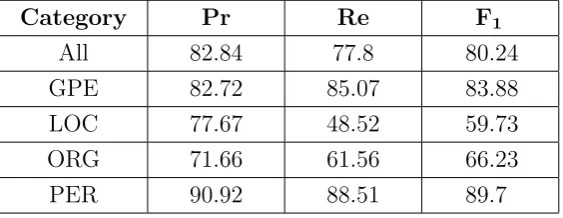
Table 3.5 and 3.6 shows the final results on the Italian test set with
CRFs and SVMs. We found that, with the same set of features, the
accu-racy of the NE classifiers trained with two models are rather competitive.
Moreover, the NE classes GPE and PER reach quite good F1 values, while
2http://www.nima.mil/gns/html 3http://www.alexandria.ucsb.edu
3.3. DATASETS AND BASELINE CHAPTER 3. RERANKING MODEL FOR NER
Category Pr Re F1
All 85.37 84.35 84.86
LOC 90.25 88.61 89.42
MISC 79.81 74.51 77.07
ORG 80.02 77.85 78.92
PER 87.94 90.92 89.41
Table 3.3: CRFs results on the CoNLL Test set
Category Pr Re F1
All 84.76 84.18 84.47
LOC 87.99 88.6 88.29
MISC 79.22 75.76 77.45
ORG 80.96 76.81 78.83
PER 87.3 90.85 89.04
Table 3.4: SVMs results on the CoNLL Test set
Category Pr Re F1
All 83.43 77.48 80.34
GPE 83.83 84.6 84.22
LOC 76.99 45.74 57.38
ORG 72.74 60.42 66.01
PER 90.6 89.14 89.86
Table 3.5: CRFs results on the EVALITA Test set
Category Pr Re F1
All 82.84 77.8 80.24
GPE 82.72 85.07 83.88
LOC 77.67 48.52 59.73
ORG 71.66 61.56 66.23
PER 90.92 88.51 89.7
CHAPTER 3. RERANKING MODEL FOR NER 3.4. RERANKING METHOD
the recognition of ORG and LOC seems problematic. This is in line with
previous results in which ORG seems to be the most difficult to learn.
Lack of resource (the gazetteer for LOC is the least) may stand for this
low accuracy of LOC class.
3.4
Reranking Method
3.4.1 Reranking Strategy
As a baseline we trained the CRFs model to generate 10-best candidates
per sentence, along with their probabilities. Each candidate was then
rep-resented by a semantic tree together with a feature vector. We consider
our reranking task as a binary classification problem where examples are
pairs of hypotheses < Hi, Hj >.
Given a sentence “South African Breweries Ltd bought stakes in the Lech and
Tychy brewers” and three of its candidate tagged sequences where the first is the correct sequence:
H1 B-ORG I-ORG I-ORG I-ORG O O O O B-ORG O B-ORG O
H2 B-MISC I-MISC B-ORG I-ORG O O O O B-ORG I-ORG I-ORG O
H3 B-ORG I-ORG I-ORG I-ORG O O O O B-ORG O B-LOC O
where B-ORG, I-ORG, B-LOC, O are the generated NE tags according
to IOB notation as described in Section 3.2.
With the above data (an original sentence together with a list of
candi-date tagged sequences), the following pairs of hypotheses will be generated
< H1, H2 >, < H1, H3 >,< H2, H1 > and < H3, H1 >, where the first
two pairs are positive and the latter pairs are negative instances. Then
a binary classifier based on SVMs and kernel methods can be trained to
discriminate between the best hypothesis, i.e. < H1 > and the others. At
testing time the hypothesis receiving the highest score is selected (Collins
3.4. RERANKING METHOD CHAPTER 3. RERANKING MODEL FOR NER
3.4.2 Representation of Tagged Sequences in Semantic Trees
We now consider the representation that exploits the most discriminative
aspects of candidate structures. As in the case of NER, an input candidate
is a sequence of word/tag pairs x = {w1/t1...wn/tn} where wi is the i0th
word and ti is the i0th NE tag for that word. The first representation we
consider is the tree structure. See figure 3.1 as an example of candidate
tagged sequence and its semantic tree.
With the sentence “South African Breweries Ltd bought stakes in the Lech
and Tychy brewers” and three of its candidate tagged sequences in the pre-vious section, the training algorithm considers to construct a tree for each
sequence, with the named-entity tags as pre-terminals and the words as
leaves. See figure 3.1 for an example of the semantic tree for the first
tagged sequence.
Figure 3.1: Semantic structure of a candidate sequence
With this tree representation, for a word wi, the target NE tag would
CHAPTER 3. RERANKING MODEL FOR NER 3.4. RERANKING METHOD
allows us to best exploit the inner product between competing candidates.
Indeed, in the kernel space, the inner product counts the number of
com-mon subtrees thus sequences with similar NE tags are likely to have higher
score. For example, the similarity between H1 and H3 will be higher than
the similarity of the previous hypotheses with H2; this is reasonable since
these two also have higher F1.
It is worth noting that another useful modification is the flexibility of
incorporate diverse, arbitrary features into this tree structure by adding
children to the parent node that contains entity tag. These characteristics
can be exploited efficiently with the PT kernel, which relaxes constraints of
production rules. The inner product can implicitly include these features
and deal better with sparse data.
3.4.3 Global features
Mixed n-grams features
In previous works, some global features have been used (Collins, 2002;
Collins and Duffy, 2002) but the employed algorithm just exploited
arbi-trary information regarding word types and linguistic patterns. In contrast,
we define and study diverse features by also considering n-grams patterns
preceding, and following the target entity.
Complementary context
In supervised learning, NER systems often suffer from low recall, which
is caused by lack of both resource and context. For example, a word like
“Arkansas” may not appear in the training set and in the test set, there
may not be enough context to infer its NE tag. In such cases, neither
global features (Chieu and Ng, 2002) nor aggregated contexts (Chieu and
3.4. RERANKING METHOD CHAPTER 3. RERANKING MODEL FOR NER
To overcome this deficiency, we employed the following unsupervised
procedure: first, the baseline NER is applied to the target un-annotated
corpus. Second, we associate each word of the corpus with the most
fre-quent NE category assigned in the previous step. Finally, the above tags
are used as features during the training of the improved NER and also for
building the feature representation for a new classification instance.
This way, for any unknown word w of the test set, we can rely on the
most probable NE category as feature. The advantage is that we derived
it by using the average over many possible contexts of w, which are in the
different instances of the un-nanotated corpus.
The unlabeled corpus for Italian was collected from La Repubblica 6
and it contains over 20 millions words. Whereas the unlabeled corpus for
English was collected mainly from The New York Times 7 and BBC news
stories 8 with more than 35 millions words.
Head word
As the head word of an entity plays an important role in information
ex-traction (Surdeanu et al., 2003; Bunescu and Mooney, 2005a), it is included
in the global set together with its orthographic feature. We now describe
some primitives for our global feature framework.
1. wi for i = 1. . . n is the i0th word
2. ti is the NE tag of wi
3. gi is the gazetteer feature of the word wi
4. fi is the most frequent NE tag seen in a large corpus of wi
CHAPTER 3. RERANKING MODEL FOR NER 3.4. RERANKING METHOD
5. hi is the head word of the entity. We normally set the head word
of an entity as its last word. However, when a preposition exists in
the entity string, its head word is set as the last word before the
preposition. For example, the head word of the entity “University of
Pennsylvania” is “University”.
6. Mixedn-grams features of the words and their gazetteers/frequent-tag
before/after the start/end of an entity. In addition to the normal
n-grams solely based on words, we mixed words with
gazetteers/frequent-tag seen from a large corpus and create mixed n-grams features.
Table 3.7 shows the full set of global features in our reranking
frame-work. These features are anchored for each entity instance and adapted to
entity categories. For example, the entity string (first feature) of the
en-tity “United Nations” with enen-tity type “ORG” is “ORG United Nations”.
This helps to discriminate different entities with the same surface forms.
Moreover, they can be combined with n-grams patterns to learn and
ex-plicitly push the score of the correct sequence above the score of competing
sequences.
Feature Description
ws ws+1 . . . we Entity string
gs gs+1 . . . ge The gazetteer feature within the
en-tity
fs fs+1 . . . fe The most frequent NE tag feature
(seen from a large corpus) within the entity
hw The head word of the entity
lhw Indicates whether the head word is
3.4. RERANKING METHOD CHAPTER 3. RERANKING MODEL FOR NER
Feature Description
ws−1 ws; ws−1 gs; gs−1 ws; gs−1 gs Mixed bigrams of the words/gazetteer
features before/after the start of the entity
we we+1; we ge+1; ge we+1; ge ge+1 Mixed bigrams of the words/gazetteer
features befor