R E S E A R C H
Open Access
A single sample GnRHa stimulation test in the
diagnosis of precocious puberty
Parvin Yazdani
1*, Yuezhen Lin
1, Vandana Raman
2and Morey Haymond
3Abstract
Context:Gonadotropin-releasing hormone (GnRH) has been the standard test for diagnosing central precocious
puberty. Because GnRH is no longer available, GnRH analogues (GnRHa) are now used. Random LH concentration, measured by the third-generation immunochemiluminometric assay, is a useful screening tool for central
precocious puberty. However, GnRHa stimulation test should be considered, when a basal LH measurement is inconclusive. However optimal sampling times for luteinizing hormone (LH) have yet to be established.
Purpose:To determine the appropriate sampling time for LH post leuprolide challenge.
Methods:A retrospective analysis of multi-sample GnRHa stimulation tests performed in 155 children
(aged 1–9 years) referred for precocious puberty to Texas Children’s Hospital.
After 20 mcg/kg of SQ leuprolide acetate, samples were obtained at 0, 1, 3, and 6 hours.
Results:Of 71 children with clinical evidence of central precocious puberty, fifty nine children had a peak LH>5 mIU/mL. 52 (88%) of these responders had positive responses at 1 hour (95% CI is 80–96%), whereas all 59 children (100%) had a peak LH response>5 mIU/mL at 3 hours (95% CI is 94-100%), P = 0.005.
Conclusions:A single serum LH sample collected 3 hours post GnRHa challenge is the optimal sample to establish
the diagnosis of central precocious puberty.
Keywords:Central precocious puberty, Luteinizing hormone, Gonadotropin releasing hormone analogue
Background
Central precocious puberty is the early onset of pubertal development as a result of gonadotropin release by the pituitary gland. Precocious puberty in a child can be associated with adverse consequences including compro-mised final adult height and psychosocial problems. Establishing the diagnosis of central precocious puberty requires documenting pubertal physical findings and measuring luteinizing hormone (LH) concentration, which is the key biochemical assessment of pubertal sta-tus. Gonadotropin-releasing hormone (GnRH)-stimu-lated plasma LH concentrations have been the mainstay for establishing the diagnosis of precocious puberty, but it is no longer available in the United States. GnRH analogue (leuprolide acetate) administered subcutane-ously is a suitable substitute for GnRH in the diagnosis of central precocious puberty [1-5]. Ibanez et al.
reported that a peak serum LH response >8 IU/L
oc-curred in patients with progressive puberty and in patients with Tanner stage II puberty 3 hours post leu-prolide acetate challenge [3]. The LH concentrations
declined progressively from 3 to 6 hours
post-stimulation. In patients with non-progressive puberty and in pre-pubertal controls, the LH peak occurred be-tween 3 and 6 hours after injection [3].
Rosenfield et al. measured gonadotropin levels at 0, 2, 4, 8, 16, and 24 hours post leuprolide acetate injection in
a dose–response study comparing acute hormonal
responses of the GnRHa leuprolide acetate to GnRH in 15 women and 15 men [6]. They reported peak plasma LH concentration at 1 and 4 hours in men and women, respectively. Other investigators using alternative sam-pling times demonstrated peak sample at 1 hour follow-ing leuprolide administration [2]. A previous study by Houk et al. demonstrated that a single LH measurement obtained 30 minutes post GnRHa stimulation provided adequate information to ascertain pubertal status in
* Correspondence:[email protected]
1Pediatric Endocrinology, Baylor College of Medicine, Houston 77030, TX, USA
Full list of author information is available at the end of the article
girls. However, they examined GnRHa stimulation test-ing with stest-ingle 30-minute post-stimulus gonadotropin measurements, and none of the patients in their study had slowly progressive puberty [7]. Thus, despite the evi-dence of the efficacy of subcutaneous leuprolide acetate in the diagnosis of central precocious puberty, the opti-mal sampling times for LH post leuprolide challenge has not yet been determined based on the published results. The objective of our study is to re-evaluate optimal sam-pling time for LH post leuprolide acetate challenge in a cohort of patients presenting with signs of early pubertal development.
Materials and Methods
We conducted a retrospective analysis of the results of leuprolide acetate stimulation tests in children referred
for possible precocious puberty to Texas Children’s
Hos-pital from January 2003-December 2006. During this time, we utilized a multiple sampling protocol as described below.
Children of both genders and all ethnicities (aged 1–
9 yrs) were identified who had undergone this multi-sample leuprolide acetate (20 mcg/kg SQ) stimulation tests for the suspected diagnosis of central precocious puberty [2]. Serum luteinizing hormone (LH) and follicle stimulating hormone (FSH) concentrations were mea-sured at 0, 1, 3 and 6 h post-injection. Serum estradiol and testosterone concentrations were measured at 0 and 6 h. Of the 155 subjects identified, one subject did not have a blood sample taken at 6 hours; the data from this subject was included since the analysis of the overall data including or excluding these data did not affect the results or conclusions and the primary comparisons were between 1 and 3-hour samples.
The diagnosis of central precocious puberty was estab-lished based on the clinical history of onset of pubertal
changes (girls<8y, boys<9y), physical examination
sug-gesting puberty based on Tanner-stage breast and pubic hair development in girls, testicular volume in boys, growth velocity over at least 6 months and bone age.
Based on these criteria and a follow up of at least 6 months with the exception of a few cases in which the-larche resolved after 4 months, the subjects were divided into three groups: A. Non-progressive puberty with the-larche, B. Non-progressive puberty with adrenarche, and C. Central precocious puberty.
Gonadotropin and sex steroid assays
The serum LH and FSH concentrations were analyzed at our clinical laboratory using the ADVIA Centaur immu-noanalyzer (a two-site sandwich immunoassay) and
dir-ect chemiluminometric technique (ICMA,
third-generation assay). The sensitivity of the FSH and LH assays were 0.3 mIU/mL and 0.07 mIU/mL, respectively. The published per cent coefficient of variation for
repli-cate analysis were <4% for both assays in the 0.3-200
mIU/ml for FSH and 0.07-200 mIU/mL for LH, and the precision accuracy of assay was validated according to CAP laboratory accreditation standards. Serum estradiol and testosterone were measured by LCMS at Esoterix, Calabasas Laboratory.
Statistical analysis
All data are provided as mean ± SEM. An LH value<0.1
mIU/mL was assumed to be 0.1mIU/ml for purposes of
calculations. The generalized estimating equations
method for the binomial distribution and logit link func-tion (SPSS 18.0) was used to estimate and compare the
percent with LH>5 at each time point while accounting
for repeated measures collected longitudinally on each subject. Time was treated as fixed, AR1 was assumed for
the correlation structure, and Fisher’s LSD was used in
the pairwise comparison of time points 1 vs 3, 1 vs 6, and 3 vs 6. Correlations of basal and GnRHa-stimulated
peak serum LH values were analyzed by Spearman’s rank
correlation.
Subjects
Of the 155 subjects identified with premature sexual de-velopment who had undergone a leuprolide stimulation test, 48 were excluded. Thirty eight (38) had inadequate follow-up, 3 were diagnosed with organic disorders of hypothalamic-pituitary axis and 7 had peripheral puberty e.g. congenital adrenal hyperplasia, testotoxicosis and McCune Albright syndrome. Thus the total number of subjects included for analyses were 107. There were 21 girls in Group A with non-progressive puberty with the-larche. Group B, non-progressive puberty with adre-narche, had 15 subjects of which 12 were girls and 3 were boys. Finally, Group C with central progressive pu-berty included 71 children (58 girls & 13 boys) (Table 1).
Table 1 Patient Characteristics
Premature Thelarche Premature Adrenarche Central Precocious Puberty
Patients# 21 (girls) 15 (12 girls, 3 boys) 71 (58 girls, 13 boys)
Chronological Age 5.04 ± 0.46 ** 6.0 ± 0.55 * 7.78 ± 0.18
Bone Age 6.73 ± 0.57 ** 8.64 ± 0.57 10.46 ± 0.25
Values represent“Mean ± SEM”.
Baseline hormone concentrations
Group A (Premature thelarche)
Basal serum LH concentrations were 0.1 ± 0.0 mIU/ml.
None had a basal LH concentration>0.1 mIU/mL.
Mean basal serum FSH was 2.18 ± 0.3 mIU/ml. All 21
girls had a basal LH/FSH ratio<1. The basal serum
concentrations of estradiol were 0.37 ± 0.15 ng/dL
(pre-pubertal<1.5 ng/dL). Serum testosterone was not
mea-sured in this group.
Group B (Premature adrenarche)
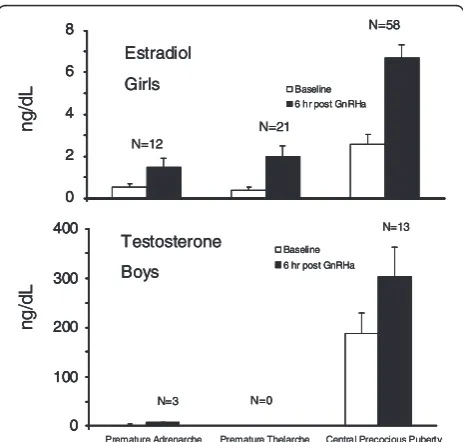
Basal serum LH concentrations were 0.1 ± 0.0 mIU/ml whereas basal FSH concentrations were 1.48 ± 0.31 mIU/ml (Figure 1). All 15 subjects with premature adrenarche had a
basal LH/FSH ratio<1. The basal estradiol concentration
in the girls (n = 12) was 0.51 ± 0.17 ng/dL. Although the mean basal estradiol concentration was slightly higher than the patients with premature thelarche, it was statistically in-significant (P = 0.38). Additionally, their estradiol levels were in the pre-pubertal range and clinical follow up confirmed the diagnosis of premature adrenarche. Mean testosterone concentrations in the boys (n = 3) was
2.05 ± 0.34 ng/dL (pre-pubertal<10 ng/dL) (Figure 2).
Group C (true central precocious puberty)
The basal LH and FSH concentrations were 1.96 ± 0.26 and 3.68 ± 0.31 mIU/mL, respectively (Figure 1). Both were higher than in either the children with premature
thelarche or premature adrenarche (p <0.005). Of the
58 female subjects with true puberty, fifteen (26%) had a
basal LH value<0.1 mIU/mL. All 13 of male subjects
had a basal LH value>0.1 mIU/mL (ranged from
0.5-5.3 mIU/mL). Basal estradiol concentrations of the 58 female subjects were 2.59 ± 0.46 ng/dl, and basal testos-terone concentrations of the 13 male subjects were 187.69 ± 41.84 ng/dl (Figure 2).
Leuprolide - Stimulated Hormonal Concentrations
Group A (premature thelarche)
All 21 girls with a clinical diagnosis of premature
the-larche had a peak stimulated LH concentration<5
mIU/mL (Figure 1). Of these, 3 had a peak LH concen-tration at 1 h (14%), 18 at 3 h (86%), 0 at 6 h (Figure 3). Two girls had values at 1 and 3 h which were identical. Plasma FSH concentrations increased and peaked at 3 hr and decreased slightly by 6 h. All of these girls had
stimulated LH/FSH ratios of<1 at 1, 3 and 6 hours.
Mean stimulated estradiol concentrations of these 21 girls at 6 hours was 2.00 ± 0.5 ng/dL (Figure 2).
0 10 20 30 40 Premature Adrenarche Premature Thelarche Central Precocious Puberty
LH
mI
U
/m
L
FSH 0 10 20 30 40 500 1 2 3 4 5 6
Premature Adrenarche Premature Thelarche Central Precocious Puberty
mI
U
/m
L
Hours 0 10 20 30 40 Premature Adrenarche Premature Thelarche Central Precocious PubertyLH
mI
U
/m
L
FSH 0 10 20 30 40 500 1 2 3 4 5 6
Premature Adrenarche Premature Thelarche Central Precocious Puberty
mI
U
/m
L
0 10 20 30 40 0 10 20 30 40 Premature Adrenarche Premature Thelarche Central Precocious Puberty Premature Adrenarche Premature Thelarche Central Precocious PubertyLH
mI
U
/m
L
FSH 0 10 20 30 40 500 1 2 3 4 5 6
Premature Adrenarche Premature Thelarche Central Precocious Puberty
mI
U
/m
L
FSH 0 10 20 30 40 50 0 10 20 30 40 500 1 2 3 4 5 6
0 1 2 3 4 5 6
Premature Adrenarche Premature Thelarche Central Precocious Puberty Premature Adrenarche Premature Thelarche Central Precocious Puberty
mI
U
/m
L
Hours
Figure 1Baseline and peak stimulated serum LH (upper panel) and FSH (lower panel) concentrations (mean ± SEM) at 1, 3, and 6 hours after leuprolide injection.LH concentrations in central precocious puberty were significantly higher than in either the children with premature thelarche or premature adrenarche (P<0.005).
0 100 200 300 400 Testosterone Boys Baseline 6 hr post GnRHa
N=3 N=0 N=13 0 2 4 6 8 Baseline 6 hr post GnRHa Estradiol Girls N=12 N=21 N=58 ng /d L ng /dL 0 100 200 300 400
Premature Adrenarche Premature Thelarche Central Precocious Puberty Testosterone
Boys
Baseline 6 hr post GnRHa
N=3 N=0 N=13 0 100 200 300 400 0 100 200 300 400
P remature Adrenarche Premature Thelarche Central Precocious Puberty Testosterone
Boys
Baseline 6 hr post GnRHa
N=3 N=0 N=13 0 2 4 6 8 Baseline 6 hr post GnRHa Estradiol Girls N=12 N=21 N=58 0 2 4 6 8 0 2 4 6 8 Baseline 6 hr post GnRHa Estradiol Girls N=12 N=21 N=58 ng /d L ng /dL
Group B (premature adrenarche)
Of the 15 children with premature adrenarche (Figure 1)
only 1 girl had a stimulated LH concentration>5 mIU/
mL; the child had a baseline LH = 0.1 mIU/mL and peak stimulated plasma LH concentrations of 5.3 and 5.2 mIU/mL at 3 and 6 h, respectively. Clinically, her diag-nosis remained premature adrenarche after 23 months follow up. Among these 15 children, two had a peak sti-mulated LH at 1 h (13%), 13 at 3 h (87%), none at 6 hr (Figure 3). One child had values of LH that were equal
at 1 and 3 h. All had a stimulated LH/FSH ratio<1 at 1,
3 and 6 hours. It was surprisingly observed that children with premature adrenarche had an FSH-predominant re-sponse in our cohort. Their plasma FSH concentrations increased following leuprolide injection and peaked at 3 h but the peak concentrations were significantly less than those of the girls with premature thelarche. We noted that two of the patients in this cohort who were significantly younger (15 months and 3 years) than most
patients had a significant FSH–predominant response,
but our clinical observation confirmed the diagnosis of premature adrenarche. The mean stimulated serum es-tradiol of the 12 girls was 1.46 ± 0.42 ng/dl at 6 h and the mean stimulated serum testosterone of the 3 boys was 6.6 ± 1.23 ng/dL at 6 hours (Figure 2).
Group C (central precocious puberty)
Group C Overall Results
Of the 71 children with central precocious puberty (Figure 1) 15 subjects had a maximum plasma con-centrations of LH at 1 h (21%), 38 at 3 h (54%), 18 at 6 h (25%) and 2 subjects had a maximum concen-tration at both 3 & 6 hours (Figure 3). The plasma LH concentrations were higher than in either the children with premature thelarche or premature
adrenarche (p<0.005).
The mean stimulated FSH concentrations of girls with premature thelarche (Group A) were higher than chil-dren with central precocious puberty or premature adre-narche at both 1 and 3 h, but not at 6 h. Maximal FSH responses were detected 3 hours post stimulation in children with premature adrenarche and thelarche but at 6 h in children with central precocious puberty (Figure 1).
All 13 boys with central precocious puberty had a
sti-mulated LH/FSH ratio >1 at 1 & 3 hours. In contrast,
only 32 (70%) girls with central precocious puberty, and
a stimulated LH>5 mIU/mL, had a stimulated LH/FSH
ratio>1 at 1 and 3 hours.
Mean Stimulated testosterone concentrations of
13 male subjects with central precocious puberty (302 ± 61.3) were higher than the boys with premature
adrenarche (6.6 ± 1.2 ng/dl) at 6 h, (P<0.005). The
mean stimulated plasma estradiol concentrations of the 58 girls with central precocious puberty (6.68 ± 0.64 ng/ dL) were higher than those of the girls in Groups A and
B at 6 h (p<0.005) (Figure 2).
Concordant and Discordant Stimulated LH with Clinical Precocious Puberty
Pubertal subjects were divided in two groups based on their responses to leuprolide challenge:
a. With a concordant response for the leuprolide challenge (LH>5 mIU/mL)
Out of 71 children with clinical evidence of progres-sive puberty, 59 subjects (83%) had a pubertal response to leuprolide challenge (13 boys and 46 girls). Among
these 59 subjects, 52 (88%) had a peak LH>5 mIU/mL
at 1 h (95% CI: 80-96%), but all 59 children (100%) had
a peak LH >5 mIU/mL at 3 h (95% CI: 94-100%),
P = 0.005 (Figure 3). All 13 boys had clinical evidence of
true puberty, and a pubertal response (LH>5mIU/mL)
at 1, 3 and 6 h. Out of these 13 boys, 11 had a maximum concentration of LH at 3 h. Eleven (11) boys (85%) and 32 girls (70%) were treated with GnRHa.
b. With a discordant response for the leuprolide challenge (LH<5 mIU/mL)
Among 71 children with clinical evidence of true
pu-berty, 12 girls (17%) had a pre-pubertal response (LH<5
mIU/mL) to Leuprolide challenge despite pubertal pro-gression. Among these 12 subjects, the peak stimulated LH concentrations ranged from 0.9 to 4.6 mIU/mL re-gardless of the sampling time but had a predominant FSH response, such that we know that the leuprolide was in fact administered. Their stimulated estradiol
concentrations at 6 h were not different from groups A and B (data not shown).
Diagnostic values of the measured hormones in the evaluation of central precocious puberty
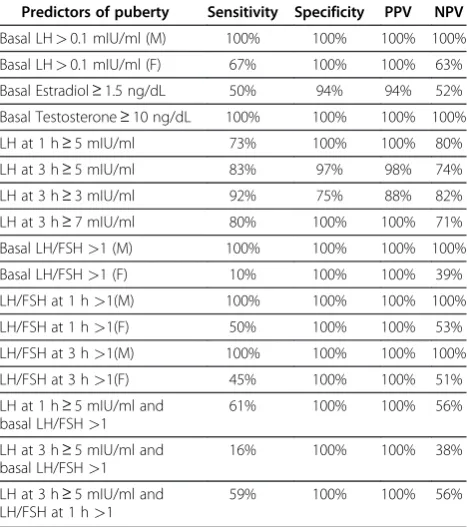
Although not the primary purpose of this study, we eval-uated and compared the relative diagnostic values of dif-ferent parameters including basal LH, estradiol and testosterone, stimulated LH, LH/FSH ratio in the predic-tion of pubertal status. Our data demonstrates that in
boys basal LH (>0.1 mIU/mL), testosterone
concentra-tions (≥10 ng/dL), basal and stimulated LH/FSH ratios
(at 1 and 3 h) have excellent sensitivity and specificity all
to be 100% (Table 2). However, in girls basal LH>0.1
mIU/ml, basal and stimulated LH/FSH ratios and basal
estradiol (≥1.5 ng/dL) have low sensitivity though
excel-lent specificity (Table 2). When serial potential predic-tors were combined, the sensitivities were reduced even though specificities were improved (Table 2). Compared to stimulated LH concentration at 1 h, the LH
concen-tration>5mIU/ml at 3 h had better sensitivity (83% vs
73%) without compromising specificity (97% vs 100%). This cut off also has optimal sensitivity (83%) and speci-ficity (97%) when compared to a lower cut off of 3mIU/ ml or a higher cut off of 7mIU/ml (Table 2).
Discussion
In the early phase of central sexual precocious puberty, laboratory confirmation is important to provide an ac-curate diagnosis and appropriate therapy. When random plasma LH concentrations are low in the presence of physical findings suggestive of precocious puberty, GnRHa stimulation testing is recommended to deter-mine activation of hypothalamic-pituitary-gonadal axis. Despite wide utilization of the GnRHa stimulation test, the timing of blood sampling remains controversial if a single sample protocol is used. In our present study, the peak LH response occurred 3 hours post leuprolide stimulation test in those with true central precocious puberty. However, only 59 of 71 of the children with true central precocious puberty had an LH
concentra-tion>5 mIU/mL at 3 hours. When compared to the 1 h
value, the 3 h value was higher (p<0.005) and had
bet-ter sensitivity in diagnosing central precocious puberty. We recommend that a 3 h sample should be considered for those cases in which clinical presentation and base line laboratory values are not conclusive, despite the practical difficulties posed by a prolonged test protocol, particularly for those families traveling at a distance.
Girls with central precocious puberty in the early phase of activation of the hypothalamic-pituitary-gonadal axis are capable of clinically relevant estradiol production, which may occur in the face of low LH se-cretion and low LH/FSH ratios [2]. This observation is puzzling and one speculation is that endocrine or para-crine factors other than LH and FSH may play an im-portant role in amplifying the effects of gonadotropins on ovarian E2 secretion in the early phase of sexual pre-cocity [2]. Among our subjects with clinical evidence of precocious puberty, 12 girls with Tanner stage II-III breast development had a pre-pubertal response to
leu-prolide challenge (LH<5 mIU/mL), a predominant FSH
response and therefore a low LH/FSH ratio. Their la-boratory findings were indistinguishable from those of subjects with proven premature thelarche and adre-narche. Interestingly, 10 out of these 12 subjects had both breast and pubic hair development at initial presen-tation, and only 2 subjects presented with just thelarche. Only one of these 12 girls with discordant response required GnRHa treatment. She was 6.5 y of age at pres-entation with Tanner III breast and pubic hair, a bone age of 10 y and a normal brain MRI. Her baseline LH was 0.1 mIU/mL, peak stimulated LH 3.9 mIU/mL at 3 h and estradiol concentration of 5.2 ng/dl at 6 h des-pite continued pubertal development. Therefore, clinical judgment and follow up continues to be of great import-ance in the evaluation of precocious puberty.
In our study, the basal plasma LH concentration dif-ferentiated the pubertal and pre-pubertal boys, without overlap, and is entirely consistent with the findings of
Table 2 Diagnostic values of basal LH, Estradiol, Testosterone, stimulated LH and the ratio of LH/FSH for Puberty
Predictors of puberty Sensitivity Specificity PPV NPV
Basal LH>0.1 mIU/ml (M) 100% 100% 100% 100%
Basal LH>0.1 mIU/ml (F) 67% 100% 100% 63%
Basal Estradiol≥1.5 ng/dL 50% 94% 94% 52%
Basal Testosterone≥10 ng/dL 100% 100% 100% 100%
LH at 1 h≥5 mIU/ml 73% 100% 100% 80%
LH at 3 h≥5 mIU/ml 83% 97% 98% 74%
LH at 3 h≥3 mIU/ml 92% 75% 88% 82%
LH at 3 h≥7 mIU/ml 80% 100% 100% 71%
Basal LH/FSH>1 (M) 100% 100% 100% 100%
Basal LH/FSH>1 (F) 10% 100% 100% 39%
LH/FSH at 1 h>1(M) 100% 100% 100% 100%
LH/FSH at 1 h>1(F) 50% 100% 100% 53%
LH/FSH at 3 h>1(M) 100% 100% 100% 100%
LH/FSH at 3 h>1(F) 45% 100% 100% 51%
LH at 1 h≥5 mIU/ml and basal LH/FSH>1
61% 100% 100% 56%
LH at 3 h≥5 mIU/ml and basal LH/FSH>1
16% 100% 100% 38%
LH at 3 h≥5 mIU/ml and LH/FSH at 1 h>1
59% 100% 100% 56%
Resende et al. in normal male subjects [8]. However, this was not true for the girls. Twenty six percent of the girls ultimately diagnosed with central precocious puberty (Tanner breast stage II-III at presentation) and pubertal responses to leuprolide had basal serum LH
concentra-tions in the pre-pubertal range (LH<0.1 mIU/mL).
Basal LH concentrations in excess of 0.1 mIU/mL were strongly correlated with a pubertal stimulated LH
concentrations (>5 mIU/mL at 3 h) in pubertal subjects
(r = 0.842, P, 0.0001) (data not shown). This finding is in agreement with others [9]. Thus, a random LH concen-tration measured by third-generation assays such as immunochemiluminometric assay is a useful tool in screening for central precocious puberty. However, our experience suggests that a GnRHa stimulation test should be considered when a basal serum LH is incon-clusive or does not fit with the clinical presentation. This conclusion is further strengthened in that none of our children with either premature thelarche or premature
adrenarche had a random serum LH>0.1 mIU/mL.
Although mean spontaneous serum FSH concentra-tions were greater in children with central precocious
puberty (p<0.005) and provided fair sensitivity and
spe-cificity, subjects in groups A and B had predominant FSH responses to leuprolide challenge and mean stimu-lated serum FSH concentrations in girls with prema-ture thelarche were higher than pubertal children at
both 1 and 3 h (P<0.005). These observations further
strengthen the findings of others [9] that the stimu-lated FSH is of limited utility in partitioning the chil-dren with central precocious puberty from those without central stimulation. We also demonstrate that
both basal LH/FSH>1 and the stimulated LH/FSH
ratio >1 at 1 and 3 hours are excellent predictors in
diagnosing central precocious puberty in boys. This was not true for girls however (Table 2).
Conclusion
This is the largest group of children reported who have undergone a 6 h leuprolide acetate stimulation test for the evaluation of central precocious puberty. We con-clude that in our study a single basal LH measurement using third-generation assays was adequate to diagnose central precocious puberty in boys. In addition, basal LH is adequate to diagnose central precocious puberty in most but not all girls, indicating the need for GnRHa test when a basal LH is inconclusive. Basal testosterone (measured by LCMS) in conjunction with clinical correl-ation is diagnostic of central precocious puberty in boys. In contrast, a basal estradiol (measured by LCMS) is helpful in most girls, but not all. However, when a GnRHa stimulation test is undertaken, our data demon-strates that a single sample at 3 h is superior in sensitiv-ity and specificsensitiv-ity to that of the 1 h sampling time in
diagnosing central precocious puberty in girls, and pro-vides the optimal sample to ascertain a diagnosis of cen-tral precocious puberty. Obviously, clinical judgment and follow up continues to be essential in that a quarter of our girls with central precocious puberty had discord-ant clinical findings with those of either the basal or sti-mulated LH values.
Abbreviations
GnRH, Gonadotropin-releasing hormone; LH, Luteinizing hormone; FSH, Follicle stimulating hormone; GnRHa, Gonadotropin-releasing hormone analogue; ICMA, Immunochemiluminometric assay; SQ, Subcutaneous.
Acknowledgments
We would like to thank E. O’Brian Smith, PhD for his statistical help and Arman Sadeghpour PhD, Andrea Balazs, MD, and Rachel Edelen, MD for their support in the development of this protocol.
Financial disclosure
The authors have no financial relationship relevant to disclose regarding this article.
Author details
1
Pediatric Endocrinology, Baylor College of Medicine, Houston 77030, TX, USA.2University of Utah, Salt Lake City, UT, USA.3Baylor College of Medicine,
Children’s Nutritional Research Center, Houston, TX, USA.
Received: 26 March 2012 Accepted: 23 June 2012 Published: 18 July 2012
References
1. Carel JC, Eugster EA, Rogol A, Ghizzoni L, Palmert MR, Antoniazzi F, Berenbaum S, Bourguignon JP, Chrousos GP, Coste J,et al:Consensus statement on the use of gonadotropin-releasing hormone analogs in children.Pediatrics2009,123(4):e752–e762.
2. Garibaldi LR, Aceto T Jr, Weber C, Pang S:The relationship between luteinizing hormone and estradiol secretion in female precocious puberty: evaluation by sensitive gonadotropin assays and the leuprolide stimulation test.J Clin Endocrinol Metab1993,76(4):851–856.
3. Ibanez L, Potau N, Zampolli M, Virdis R, Gussinye M, Carrascosa A, Saenger P, Vicens-Calvet E:Use of leuprolide acetate response patterns in the early diagnosis of pubertal disorders: comparison with the gonadotropinreleasing hormone test.J Clin Endocrinol Metab1994,78(1):30–35.
4. Sathasivam A, Garibaldi L, Shapiro S, Godbold J, Rapaport R:Leuprolide stimulation testing for the evaluation of early female sexual maturation.
Clin Endocrinol (Oxf )2010,73(3):375–381.
5. Potau N, Ibanez L, Sentis M, Carrascosa A:Sexual dimorphism in the maturation of the pituitary-gonadal axis, assessed by GnRH agonist challenge.Eur J Endocrinol1999,141(1):27–34.
6. Rosenfield RL, Perovic N, Ehrmann DA, Barnes RB:Acute hormonal responses to the gonadotropin releasing hormone agonist leuprolide: dose–response studies and comparison to nafarelin--a clinical research center study.J Clin Endocrinol Metab1996,81(9):3408–341. 1.
7. Houk CP, Kunselman AR, Lee PA:The diagnostic value of a brief GnRH analogue stimulation test in girls with central precocious puberty: a single 30-minute post-stimulation LH sample is adequate.J Pediatr Endocrinol Metab2008,21(12):1113–1118.
8. Resende EA, Lara BH, Reis JD, Ferreira BP, Pereira GA, Borges MF:
Assessment of basal and gonadotropin-releasing hormone-stimulated gonadotropins by immunochemiluminometric and immunofluorometric assays in normal children.J Clin Endocrinol Metab2007,92(4):1424–1429. 9. Neely EK, Wilson DM, Lee PA, Stene M, Hintz RL:Spontaneous serum
gonadotropin concentrations in the evaluation of precocious puberty.J Pediatr1995,127(1):47–52.
doi:10.1186/1687-9856-2012-23
Cite this article as:Yazdaniet al.:A single sample GnRHa stimulation