
Doctoral School in Materials Engineering – XXIII cycle
B
B
i
i
o
o
r
r
e
e
a
a
c
c
t
t
o
o
r
r
D
D
e
e
s
s
i
i
g
g
n
n
f
f
o
o
r
r
D
D
y
y
n
n
a
a
m
m
i
i
c
c
P
P
r
r
o
o
c
c
e
e
s
s
s
s
O
O
p
p
t
t
i
i
m
m
i
i
z
z
a
a
t
t
i
i
o
o
n
n
i
i
n
n
T
T
i
i
s
s
s
s
u
u
e
e
E
E
n
n
g
g
i
i
n
n
e
e
e
e
r
r
i
i
n
n
g
g
E
E
n
n
r
r
i
i
c
c
o
o
M
M
e
e
r
r
z
z
a
a
r
r
i
i
T
T
u
u
t
t
o
o
r
r
:
:
A
A
n
n
t
t
o
o
n
n
e
e
l
l
l
l
a
a
M
M
o
o
t
t
t
t
a
a
,
,
P
P
h
h
D
D
C
C
l
l
a
a
u
u
d
d
i
i
o
o
M
M
i
i
g
g
l
l
i
i
a
a
r
r
e
e
s
s
i
i
,
,
P
P
r
r
o
o
f
f
.
.
3
Pubblications:
Papers
1. Motta A, Maniglio D, Merzari E, Foss C, Bella E, Migliaresi C. Multicomponent scaffold for osteochondral defects tissue
engineering. Tissue Engineering Part A 2008, 14 (5): 883-883.
Conference Acta
1. C. Foss, D. Maniglio, E. Merzari, C. Migliaresi, A. Motta. Silk fibroin-based multicomponent scaffold for osteochondral defects tissue engineering. VII Convegno nazionale INSTM sulla Scienza dei Materiali. 9-12 Giugno 2009, Tirrenia (PI).
2. A. Motta, C. Foss, E. Merzari, D. Maniglio, C. Migliaresi. Silk fibroin-based scaffolds for osteochondral defect regeneration. BIOMED 2009, 15th International Biomedical Science and Technology Symposium. 16-19 August METU, Northern Cyprus Campus, Guzelyurt, TRNC.
3. M. Floren, E. Merzari, E. Carletti, A. Motta, C. Migliaresi. Osteoblast genotypic response and matrix formation: Effect of scaffold morphology and mechanical stimuli in vitro – Preliminary evaluation. Proceedings of TERMIS-EU, Gallway, Ireland, June 13-17 2010.
4
Abstract 8
1. INTRODUCTION 10
1.1 Cartilage 10
1.2 Cartilage types 11
1.3 Hyaline Articular Cartilage 11
1.4 Composition of Hyaline Cartilage 12
1.5 Anatomy and Function of Articular Cartilage 16 1.6 Organization and Hierarchical Structure of Cartilage 18 1.7 Mechanical behaviour of articular cartilage 20 1.8 Viscoelastic Analysis of Articular Cartilage and Meniscus 22
1.8.1 Solid Matrix Properties
1.8.2 Compressive Fluid-Solid Properties
1.9 State of the art in articular repair and regeneration 29 1.9.1. Hyaline Articular Cartilage Injuries and defects
1.9.2 Cartilage Healing Techniques
1.9.2.1 Arthroscopic repair: abrasion and drilling arthroplasty (Marrow-stimulating procedures) 1.9.2.2 Periosteal and Perichondral Implants
1.9.2.3 Osteochondral trasplantation (MosaicPlasty) 1.9.2.4 Tissue Engineering
1.9.3 Brief Considerations
1.10 Bone 40
1.11 Bone composition 40
1.12 Bone Structure 42
1.13 Structural complexity and mechanical properties 44
1.14 Remodelling 46
1.15 Bone Repair and Regeneration Techniques 47 1.15.1 Bone transfer through fixators
1.15.2 Distraction osteogenesis 1.15.3 Bone-Grafting
1.15.4 Bone Tissue Engineering
2. TISSUE ENGINEERING 53
5
2.2 Polymer scaffold process techniques 64 2.3 Bioreactors, from static 2D to dynamic 3D culture 68
2.4 Bioreactor stimuli 71
2.4.1 Low/High oxygen partial pressure
2.4.2 Mechanical stresses and shear stress induced by fluid
2.4.3 Growth factors
2.5 Bioreactors used in tissue engineering 76 2.6 Mechanical stimulation in tissue engineering cartilage 85 2.7 Bioreactor used in bone tissue engineering 100
3. MATERIALS AND METHODS 107
3.1 Materials & Methods part 1: Device description 108 3.1.1 Culture Chambers
3.1.2 Mechanical components 3.1.3 Controller and Software
3.1.3.1 Hardware description 3.1.3.2 Software Description 3.1.4 Stimulation setting description
3.2 Materials & Methods part 2: Scaffold characterization 137 3.2.1 Cartilage tissue engineering: Silk fibroin sponges 3.2.2 Bone tissue engineering: P(d,l)LA sponges
3.2.3 Characterization techniques 3.2.3.1 Mechanical properties 3.2.3.2 SEM and ESEM microscopy 3.2.3.3 Porosity evaluation
3.2.3.4 Statistical analysis
3.3 Materials & Methods part 3: in vitro Experiment 144 3.3.1 in vitro experiment description
3.3.1.1 Cartilage tissue engineering: validation experiment
3.3.1.2 Cartilage tissue engineering: condition investigations
3.3.1.3 Bone tissue engineering: validation experiment
6
3.3.1.5 Bone tissue engineering: dynamic hydrostatic pressure, long experiment
3.3.2 Biological evaluation Techniques 3.3.2.1 XTT proliferation test 3.3.2.2 Histology
3.3.2.3 ESEM & SEM microscopy
3.3.2.4 Confocal laser microscopy (CLM) 3.3.2.5 Alamar Blue Assay
3.3.2.6 Real time-polymerase chain reaction (RT-PCR)
4. RESULTS AND DISCUSSIONS 158
4.1 Results & Discussions Part1: Device Development 158 4.1.1 Peristaltic Pump Calibrations
4.1.2 Pressure Gauge Calibrations 4.1.3 Load Cell Calibrations 4.1.4 Motor Calibrations 4.1.5 Device testing
4.2 Results & Discussions part 2: Scaffold characterization 169 4.2.1 Silk fibroin and PDLLA sponges
4.2.2 Electron Microscopy characterization 4.2.3 Porosity characterization
4.2.4 Mechanical properties characterization
4.3 Results and Discussions part 3: in vitro Experiment 184 4.3.1 Cartilage tissue engineering: validation
experiment
4.3.2 Cartilage tissue engineering: condition investigations
4.3.3 Bone tissue engineering: validation experiment 3.3.1.4 Bone tissue engineering: dynamic hydrostatic pressure, condition investigations 3.3.1.5 Bone tissue engineering: dynamic hydrostatic pressure, long experiment
5. FINAL REMARKS 212
ABSTRACT
8
Abstract
Tissue engineering(1) is an interdisciplinary field in which cell biology, biomaterials science, and surgery are combined and its main goal is to repair, replace and reproduce tissues and organs.
Following this procedure, cells are seeded on proper scaffolds and induced in sequence to adhere, eventually differentiate, proliferate and finally to produce the wanted extracellular matrix (ECM). During cell culture, the usefulness of applying proper physiological-like stimuli, i.e., biochemical but also mechanical signals to drive and accelerate both cell differentiation and ECM production has been demonstrated(2).
ABSTRACT
9
INTRODUCTION
10
1. INTRODUCTION
1.1 Cartilage
Cartilage is a connective tissue highly specialized to guarantee support functions, load bearing behaviour, low friction and viscoelastic properties to absorb stresses and shocks. Cartilage properties leads to a complex structure characterized by low capability of self-regeneration and absence of vascular, neural and lymphatic systems, making cartilage completely different from other tissues(4).
Cartilage is composed by cells, called chondrocytes, and extracellular
INTRODUCTION
11
1.2 Cartilage types
In human body, three main types of cartilage can be found: elastic cartilage, fibrocartilage and hyaline cartilage. Elastic cartilage appears opaque and yellowish, and it is principally present in the epiglottis, Eustachian tube, outer ear and larynx. This tissue is composed by elastin fibers, and results to be more flexible than hyaline cartilage, although they are histologically very similar. Fibrocartilage is found permanently in the intervertebral disc, temporomandibular joint, pubic symphysis and meniscus; moreover it is often present temporary in fracture sites. It appears as a dense and fibrous
tissue. The third type, hyaline cartilage, mainly exists in ribs, larynx, trachea, bronchi and on articular surfaces covering the proximal part of long bones involved in the joint area. In addition, hyaline cartilage also forms the
epiphyseal plate which is replaced by long bones during the childhood growth. In general, articular cartilage appears as a thin coating, thick approximately between 1 and 5 mm, on the contact surface of the joint and it looks like a ivory coloured tissue with a very smooth surface. In this chapter, the hyaline cartilage characteristics are discussed in detail, concerning the structure and the biomechanical behaviour of this tissue in the joints and in the meniscus of the knee.
1.3 Hyaline Articular Cartilage
INTRODUCTION
12
articular surfaces. Therefore the contact region must have a low coefficient of friction and the stresses must be transferred along the interface at the same time. In summary, the main cartilage features are friction reducing, relative motion transferring, load bearing and distribution. However, the shock or stress absorption profiles result to be quite different compared to damper behaviour, as described in the next paragraph.
1.4 Composition of Hyaline Cartilage
The mechanical properties of articular cartilage are given by the presence of
synovial fluid, which may flow out from the porous matrix when cartilage is stimulated by compression. The basic components of articular cartilage can be divided in two different phases, solid and liquid. The solid structural
INTRODUCTION
13
cells, and by a very slow anaerobic metabolism. Chondrocytes present a membrane with numerous protrusions, having an highly developed Golgi apparatus, and may be binucleated. These cells produce and maintain the extracellular matrix, which is principally composed by collagen and proteoglycans. The extracellular matrix ECM represents the 90-95% of the total dry volume, while cells only the 5-10%. The extracellular matrix is macroscopically homogeneous, although at microscopic level, the structural and compositional characteristics change, moving from outer surface to bone.
Fig.1.1. Composition of articular cartilage, meniscus and intervertebral disc(5, 6,192).
alpha-INTRODUCTION
14
helical conformation. The collagen biosynthesis can be carried out by different cell types depending on the tissue. The biosynthesis begins through the gene transcription and the subsequent mRNA maturation. However, the process is completed outside the cell where tropocollagen can be synthesized. The tropocollagen molecules are spontaneously arranged in parallel staggered rows through hydrogen bounds and chemical cross-linking, forming semicrystalline fibrils. Finally, fibrils may aggregate in waved or parallel fibers. Collagen has a high level of structural organization and several types of collagens can be found. Collagen type I and type II are
predominant in articular cartilage. Collagen type I is mainly present in the fibrocartilage and in the main connective tissues such as skin, tendons, bones and cornea, and represents nearly the 90% of the total collagen in the
body. Instead, collagen type II can be found mostly in hyaline cartilage, intervertebral discs and in the vitreous humor. Due to its structure, composed by fibers and fiber threads, collagen improves the tensile and shear strength, providing stiffness to the tissue.
-INTRODUCTION
15
and carboxylic acid COO- terminal groups mostly deprotonated, which thus introduce a strong negative charge. Proteoglycans possess the ability to interact with other elements or with each other, forming a network structure with densified meshes, providing a filtering action. In fact, GAGs are located in the extracellular matrix in order to filter cell nutrients and other substances; in addition, a large amount of water can be stored thanks to the negative charge, regulating the hydration level in the tissue.
Fig.1.2. Proteoglycan structure(7,193).
INTRODUCTION
16
of the tissue, between 58% and 78%. In articular cartilage, water provides the chondrocyte nutrition by diffusion and also contains inorganic ions in solution, such as Ca++, Na+, K+ and Cl-. The 70% of water binds to proteoglycans, while the remaining 30% to collagen. Water is usually concentrated on the surface. Thanks to the interaction between the molecules in the extracellular matrix, viscoelastic behaviour can be achieved. Therefore, water may freely move in the matrix and between the fibrils, providing mechanical and tribological properties to cartilage and adjusting tissue deformation during load. In synovial fluid, hyaluronic acid
and glycoprotein, such as lubricin, proteinases, and collagenases, are also contained.
1.5 Anatomy and Function of Articular Cartilage
INTRODUCTION
17
from chondrocytes, which synthesizes the molecules. In addition, low mobility, induced by ECM, prevent the migration of other cell types within the tissue, such as macrophages. Chondrocytes are distributed in the micropores of the tissue exhibiting several connections with the matrix, to evaluate the status and the biomechanical behaviour of the tissue.
Fig.1.3. Hierarchical level of articular cartilage(8).
INTRODUCTION
18
is composed by bone, cartilage, ligaments, tendons, muscles and joint capsule. The next level (fig.1.3 top right) reports a sketch of the joint surface, in particular it describes where the stresses are transferred between bones. In the third level, between 1 µm and 100 µm, cartilage does not appear as a homogeneous matrix anymore, but a specific organization, which contains chondrocytes and collagen type II fibrils, is present. In the fourth and fifth levels, the micro- and submicroscopic organization of the main solid components is shown. It is possible to observe the individual collagen fibrils and the proteoglycan network between 0.01µm and 1µm,
while at a nanometer level the molecular structures of proteoglycans and collagen are schematized. This brief description is not enough to explain the complex mechanical behaviour of cartilage, in fact, an important key to
understand the tissue properties is to consider the interaction between structures, water and the electrolytes. Thus, the fluid-solid interaction may be considered the main cause of the cartilage mechanical characteristics.
1.6 Organization and Hierarchical Structure of Cartilage
INTRODUCTION
19
articular cartilage is to withstand shear stresses. The collagen content generically decreases up to the tide mark, reaching a value of about 68% in the middle zone. The surface zone is a fraction of the total thickness, between 10% and 20%. In this surface region, the produced proteins behave as a lubricant, further reducing the shear stresses.
Fig.1.4. Cartilage section (left) and top view (right)(5, 6, 8-10, 191-193).
The middle zone has a high content of proteoglycans and a randomly distributed collagen fibers which appear to be thicker. The middle zone represents the 60% of the thickness. In the deep zone, which is about 30% of the thickness, collagen fibers are longer and vertically oriented, in order
to improve the stress distribution and the compressive strength. The tide mark is the interfacial region of junction between cartilage and bone.
INTRODUCTION
20
bone. The scheme described in this section and photos achieved by optical microscopy are shown in figure 1.4 as well as the top view of the collagen fibers distribution on the articular cartilage of the knee. In the outer zone of articular cartilage and meniscus, the collagen fibrils are arranged in a circular way and are more organized compared with middle zone fibers. This orientation can increase considerably the tensile strength in the outer cartilage.
1.7 Mechanical behavior of articular cartilage
As previously described, the hyaline cartilage composition presents two main phases, fluid and solid one. The first contains water and electrolytes, and the second is composed by collagen (type I in the meniscus and type II
in the joint), proteoglycans, glycoproteins and chondrocytes (191). The specific constituent contents are shown in the table of figure 1.5.
Fig.1.5. Component contents in articular cartilage and Meniscus(5, 6, 193).
INTRODUCTION
21
In the extracellular matrix, proteoglycans are aggregated in the collagen network, also absorbing about 30% of the total water content. The water content, but also the collagen fiber diameters, are determined by the swelling pressure due to accumulation of negative charge density (fixed charge density FCD) on proteoglycans. The swelling pressure is the developed pressure inside the tissue, which allows the water absorption. In other words, thanks to the strong negative charges given by proteoglycans, repulsion forces are generated, which can only be neutralized by positive ions contained in the surrounding fluid. The difference in ion concentrations
can be considered the driving force determining the swelling pressure. In this way an increase in repulsion forces and swelling pressure can be achieved when water is released such as by compression. Water content
INTRODUCTION
22
1.8. Viscoelastic Analysis of Articular Cartilage and Meniscus
As widely described, the three main factors, which contribute to influence the articular cartilage mechanical behaviours, are the swelling pressure, the elastic properties of the solid matrix and the fluid-solid interaction in cartilage under compression. In this chapter, the influence of ECM structure on mechanical properties is examined.
1.8.1 Solid Matrix Properties(191)
As a first analysis, the tensile properties and the solid matrix behaviours will
be considered. Considering most of the soft tissues, characterized by low stiffness matrix and randomly orientated fibers, the solid matrix mechanical behavior is determined by the collagen fiber content and by their
INTRODUCTION
23
reported elastic moduli correspond to the linear portion of the measured tensile curves in different regions of cartilage.
Fig.1.6. (A) J-shape curve and test specimen; (B) Graph: Tensile Modulus vs Collagen/proteoglycans ratio(9, 191).
The results listed in the table (figure 1.7(a)) can be confirmed analyzing the graph in figure 1.6(b), which plots the measured tensile modulus as a function of the ratio between collagen and proteoglycan contents in cartilage matrix.
INTRODUCTION
24
Osteoarthritis (OA) are the main cartilage diseases in which tissue degeneration and a significant change in solid matrix mechanical properties are found. As explained by histological analysis, this dysfunction is caused by the collagen fibers breakdown. The table (figure 1.7(b)) shows how the elastic modulus decreases with the pathology degeneration; Fibrillated corresponds to an intermediate situation where the defect is filled with fibrocartilage. Being a soft tissue, cartilage cannot show a linear trend and can be considered hyperelastic. Consequently, it is also possible to derive the strain energy function to calculate the relationship between stress and
strain. The following function can be assumed:
)
(e E
k
W = BE − (1)
where k and B are material constants and E is the Green-Lagrange deformation. Differentiating the function on the strain E, the stress S can be obtained: ) 1 ( − = ∂ ∂ = BE e Bk E W
S (2)
1.8.2 Compressive Fluid-Solid Properties
INTRODUCTION
25
porous solid (discharge) with the applied pressure gradient and the hydraulic permeability coefficient k. Darcy's law is expressed mathematically by the relation(191):
h P A k
Q= ⋅ ⋅∆ (3)
where Q is the volumetric flow rate [m3/s], k is the permeability coefficient
[m4/Ns], A is the surface [m2], ∆P is the pressure gradient [N/m2] and h is the sample thickness [m]. The permeation rate V can be obtained by differentiating Q on the surface. The diffusion resistance coefficient K, which can be defined as the resistance generated by the liquid on the solid, is determined through the equation 4:
( )
k
K V
2
Φ
= (4)
where K is the mentioned resistance, k is the permeability and the remaining term ФV is the fluid volume fraction. The permeability and load distribution
between liquid and solid phases are the basic concepts of the biphasic theory in articular cartilage, and can be summarized as follows(191):
the isotropic or anisotropic matrix can assume elastic or hyperelastic
behaviours;
the solid and fluid phases are considered incompressible. Thus, it is
clear how cartilage can be compressed only when the fluid is completely expelled from the tissue;
the dissipated energy corresponds to the energy consumption during
INTRODUCTION
26
the friction caused by the fluid-solid resistance is proportionally
related to the relative velocity, through the coefficient K.
The equations of dynamic equilibrium (5) can be written according to the biphasic theory, as follows:
0 )
( − =
+ ∂
∂ S f
j ij S
K
x
ν
ν
σ
; + ( − )=0
∂
∂ f S
j ij f
K
x
ν
ν
σ
(5)
where σSij and σfij are the stresses along the i-j principal directions, respectively for the solid and the fluid, K is the resistance coefficient, νS is the solid speed and νf is the fluid speed. This theory summarizes the cartilage mechanical behaviour under compression. As example, it is possible to observe figure 1.8. In this specific case fluid can not immediately leave the matrix due to the resistance (point A); therefore the system has a tendency to retain a high level of stresses. In this way, the cartilage at point B can no longer deform and an increase in the total stress
can be observed. When the fluid leaves the tissue (points C-D), stresses are transferred to the solid matrix and hence are significantly reduced. Equilibrium modulus and permeability coefficient are two key material properties in the described theory. The equilibrium modulus corresponds to the cartilage stiffness after the total fluid flow out (point E).
INTRODUCTION
27
pressure is counteracted by the collagen network and by the applied compression.
Fig.1.8. In figure the loading and unloading behaviours are reported(4).
In advanced osteoarthritis (OA), the permeability increases due to collagen fibers loss; consequently the maximum stress achieved during the fluid flow out decreases, causing a rise of the stress exerted on the solid phase. The increased stress on the solid matrix can increase the tissue damage, creating a “vicious loop” which leads to a further tissue degeneration. In figure 1.9
ECM structure and collagen network are reported. The articular cartilage viscoelastic behaviour can be summarized as follows:
the liquid flow out, due to the compression, may alter the
INTRODUCTION
28
the stress-strain relationship is not linear, and depends on water
content in the system;
different behaviour of the tissue when it is subjected to compression
or tensile stresses;
resilience: low permeability prevents a quick water squeeze out from
the cartilage. Thus, the fluid phase "protects" the solid one during impacts or shocks, preventing matrix damage;
anisotropy;
very low friction coefficient: ankle 0.005 - 0.02; hip: 0.01 - 0.04;
graphite on steel: 0.1, UHMWPE (Ultra High Molecular Weight PolyEthylene) on cobalt-chromium: 0.01 to 0.05.
INTRODUCTION
29
1.9. State of the art in articular repair and regeneration
1.9.1. Hyaline Articular Cartilage Injuries and defects
Articular cartilage is a highly specialized connective tissue which must sustain considerable mechanical stresses while ensuring an extreme smoothness between articular heads. Due to the complete absence of blood vessels and nerves, cartilage exhibits little self-regenerative capacity when an injury or a disease occurs. Cartilage lesions can be classified as full or
INTRODUCTION
30
the position on the joint and on the patient age. In fact, the articular cartilage has not a strong inclination to a spontaneous regeneration. It is well known how only small lesions may be filled with fibrocartilaginous tissue, while larger defects are rarely self-healed, incurring in a progressive complete degeneration. Full thickness lesions induce a vascular proliferation response which produces only fibrocartilage. This natural process of cartilage is mainly based on the effusion of mesenchymal stem cells from bone marrow. Several techniques for partial defect care take the advantage of this natural mechanism. After the surgical drilling, the subchondral bone occurs
infiltration of stem cells from the bone, resulting in tissue formation which mainly consists of fibrocartilage. Although fibrocartilage fills and covers the defect, the newly formed tissue is not the correct material in terms of
INTRODUCTION
31
filler properties. However, these techniques have shown poor successful due to the complex properties and histological characteristics of the cartilage(13). Now, it is important to distinguish between the concepts of "repair" and "regeneration" in order to choose the most appropriate healing technique to use with a specific type of injury(1, 11, 14-18).
Repair: generally it is related to the healing or replacement process which
involves the damaged tissue by cell proliferation and new extracellular matrix synthesis. Typically, the repaired tissue shows different structure and composition and worse functions if compared to the normal cartilage.
Regeneration: it refers to the formation of new ECM which essentially
duplicates the original hyaline articular cartilage.
1.9.2 Cartilage Healing Techniques
INTRODUCTION
32
technique. Open surgical techniques have only limited applications, such as osteotomies and osteodistraction in which bone orientation and position is externally modified in order to shift the maximum stressed region, preventing further damages. Other open surgical procedures involve autograft or allograft transplantation, including chondral or osteochondral implants (mosaicplasty), perichondral and periosteal grafts. Tissue engineering is a very promising technique in which autologous chondrocyte implantation ACI, or the application of mesenchymal stem cells MSCs, scaffolds, growth factors and cytokines are considered.
Currently, different surgical techniques were proposed for articular cartilage treatment. However, there are not clear results which show long-lasting repair or regeneration, in terms of composition, structure, functions and
finally integration. The previously listed techniques are explained and divided into reparative techniques, such as drilling, abrasion or microfracture; and regeneration techniques, such as mosaicplasty, perichondrium or periosteum transplantation, or tissue engineering.
1.9.2.1 Arthroscopic repair: abrasion and drilling arthroplasty (Marrow-stimulating procedures)
INTRODUCTION
33
which penetrate and stimulate the formation of fibrocartilaginous new tissue. Arthroscopic repair techniques are minimal invasive procedures which can induce a significant pain relief, nevertheless these methods cannot be considered curative techniques, but only palliative. The main problems regarding these techniques are tissue degeneration and necrosis, resulting in cell death induced by the heating during abrasion and drilling processes. In addition, subchondral bone may be compromised affecting any future operation in repairing or regenerating the tissue. Finally, fibrocartilage does not present the basic properties to guarantee the needed
mechanical performance, such as wear resistance and mechanical interface strength. In fact, the results cannot be considered satisfactory in most cases(11, 12).
1.9.2.2 Periosteal and Perichondral Implants
INTRODUCTION
34
1.9.2.3 Osteochondral trasplantation (MosaicPlasty)
Osteochondral transplantation (or mosaicplasty) is a widely used technique for the osteochondral defect treatment. The implants can be divided in two categories, autologous grafts, from the same organism, and allografts, when the allogenic implants are harvested from other organisms. Autologus graft are obtained from an unstressed articular portion. Obviously, auto trasplantation is only applied for small lesion treatments, while allografts are preferred in larger defects. This technique presents several advantages, such
as low cost, it’s minimally invasive and may be conducted either via arthroscopic or via open surgery. Furthermore, there is no immune rejection for autografts, it is one-stage operation and it does not depend on cell
proliferation. It is very useful for joint defect associated to ACL (Anterior Cruciate Ligament) tears and finally can give good and promising results, in term of structural and composition properties of the filler material.
However, integration problems are not resolved due to the incomplete geometric filling of the defect, where a minimum gap between the natural tissue and the graft is difficult to eliminate; in addition, cell necrosis and death are induced during graft harvesting.
1.9.2.4 Tissue Engineering
INTRODUCTION
35
Implantation) and MACI (Matrix-Induced Autologous Chondrocyte Implantation) techniques are briefly described.
Autologous Chondrocyte Implantation (ACI)
ACI technique is currently used as treatment of chondral and osteochondral symptomatic defects of the knee and it is developed following two main stages. ACI technique involves the use of chondrogenic cells harvested from the patient and then expanded to induce proliferation. The obtained chondrocytes are finally reimplanted (~ 3·107cells/mL) in the patient's knee
to promote the formation of hyaline cartilage-like tissue and defect regeneration. In surgical practice, the defect is enlarged to reach the subchondral bone and washed to prepare the cell container. Cells are finally
INTRODUCTION
36
updated for few years, with uncertain long-term data. Figure 1.10 shows the ACI technique. However, in clinical practice, ACI procedures have given satisfactory results, in terms of pain relief, formed ECM structure and function properties. Most of the ACI treated patients (often over 70% of the analyzed patients) presents an improvement of articular cartilage and a better quality of life; while studies, which compare ACI and mosaicplasty techniques, have reported contradictory results(11).
Fig.1.10. ACI Technique: A) defect opening; B) suturing.
INTRODUCTION
37
Matrix-Induced Autologous Chondrocyte Implantation (MACI)
Although ACI technique have shown remarkable results especially in the articular cartilage regeneration, a new method to improve ACI techniques was developed. In MACI technique (matrix-induced autologous chondrocyte), cell culture is favoured through the transplantation of a preseeded bioreabsorbable polymer matrix. So, biodegradable scaffolds are studied to resolve the observed problems by ACI. In fact, scaffolds can also act as a barrier against the migration of fibroblasts derived from subchondral bone, which may cause a fibrous repair, while maintaining a homogeneous
chondrocyte distribution. MACI implant presents several advantages, such as the absence of sutures, it does not require the harvesting of a periosteal portion and can be carried out quickly and without an extended exposure.
The preliminary performed tests are promising, but limited in the patient number. In addition, the long-term evaluations are not yet reported, considering how MACI is still a recent technique. However, the MACI procedure is currently considered the most promising approach.
MSCs, Scaffolds, Growth Factors and Cytokines
INTRODUCTION
38
combine the use of stem cells and scaffolds. Scaffold materials may satisfy certain specific characteristics of biocompatibility, strength and structural stability. In addition, these matrix must be able to induce cell maturation and differentiation, as well as sustain cell growth and ECM synthesis. Finally, cell culture stimulation by cytokines and growth factors is commonly used to promote cell proliferation and synthesis of extracellular matrix. For example, Matsusaki and Kawasaki have found respectively the positive effect of hyaluronic acid (HA) and transforming growth factor α (TGF-α) on cell proliferation and chondroitin-sulfate synthesis by seeded
chondrocytes(11).
1.9.3 Brief Considerations
INTRODUCTION
39
INTRODUCTION
40
1.10 Bone
Bone(22) is a mineralized connective tissue. The main function of bone is to sustain and protect the soft tissues of the body, while also allowing movements through the joints. The intercellular matrix is mainly formed by mineral crystals, principally calcium phosphate. The presence of minerals combined with an appropriate distribution of collagen fibers in the extracellular matrix provides strong mechanical properties in terms of
hardness, and compressive, tensile, torsion strength. The calcium diffusion and deposition in bone are driven by endocrine mechanisms, contributing
substantially to the ion regulation of plasma levels. Bones can be classified as long bones (e.g. femur, tibia), short (e.g. carpal, tarsal), flat (e.g. cranium, scapula), irregular (e.g. vertebra) and sesamoid bones (e.g. patella), while there are two main types considering the macrostructure, the compact bone and the trabecular (also known as cancellous or spongy) bone with a sponge-like porous structure. The bone structure is generally composed by inorganic substance, hydroxylapatite (65-70%w), water (about 9%w); cell amount represents the 1%w of the total weight, while the remaining 20-25% is made up by the extracellular matrix, which can be divided in collagen (90-96%w), proteoglycans and glycoproteins (4-10%w).
1.11 Bone composition
INTRODUCTION
41
by relatively long 5-10 µm collagen fibers, randomly oriented. The fibrous bone is normally found only in the periosteum; even if it is the first deposed tissue both in physiological growth and during healing process, it is then rapidly reabsorbed and replaced by lamellar bone. The lamellar bone is the most common structure, constituting nearly all the collagen content of compact and spongy bone. It is characterized by the ordered arrangement of collagen fibers in layers, called lamellae. In bone, proteoglycans are mainly formed by short glycosaminoglycans, byglican and decorin. The bone glycoproteins include different molecules, which are considered crucial in
the regulation of mineralization processes. Among them osteonectina, having an high calcium affinity, is responsible for the nucleation of mineral crystals; alkaline phosphatase enzyme is capable of hydrolyzing phosphate
groups attached to organic substrates and it is involved in the synthesis of bone organic matrix; fibronectin molecule drives cell adhesion thanks to the high affinity with collagen; bone sialo-proteins BSP, having an high content of sialic acid, may mediate cell adhesion such as the osteopontin BSP-I, BSP-II and the bone acid glycoprotein BAG-75; and finally proteins that contain Gamma-Carboxyglutamic Acid (GLA), (i.e. osteocalcin) playing a important role in the inhibition of mineralization, caused by the strong tendency to bind with phosphate ions. The mineral component is mainly represented by calcium phosphate crystals in apatite structure, in which cells unit are formed by flattened hexagonal prism Ca10(PO4)6++, and
INTRODUCTION
42
the collagen fibers, and then are replaced by thin needle-like apatite crystals. The bone tissue is relatively cell-free, in which four main types of cells can be found, osteoprogenitor, osteoblasts, osteocyte and osteoclast cells. Osteoprogenitor cells, deriving from periosteum, present an high proliferative ability and secrete growth factors for differentiation. Osteoblasts possess a size of about 20 µm and are responsible for the ECM synthesis and mineralization. Osteoblasts tend to form sheets on the bone surface during tissue formation, initially producing matrix only on preexisting bone surface. After the appropriate bone deposition, cells start to
form bone in all directions, causing a progressive separation between cells. Afterward, osteoblasts decrease their metabolism and finally differentiate into osteocytes. Osteocytes are the typical cells of mature bone, responsible
for tissue maintenance and remodelling. Instead, osteoclast cells are predisposed to bone reabsorption, and derive from hematopoietic stem cells, unlike all the previous which derive from osteoprogenitor cells. Osteoclasts are 100-200 µm plurinucleate giant cells.
1.12 Bone Structure
INTRODUCTION
43
consists of cylindrical formation, also called Osteons or Haversian systems. A blood vessel can be found in the centre of each osteon, and it is contained in the Haversian canal. Bone structure is arranged in concentric cylindrical lamellae around these canals (osteons). The vessels are connected to each other by Volkmann’s canal, which cross the section in transversal and oblique way. Lamellae are formed by collagen fibrils on which hydroxylapatite is deposited (Ca10(PO4)6(OH)2 half of the volume and two
thirds of weight). Osteocytes are contained in cavities (lacunae) along the lamella edges, which are connected by several small canals. Osteon is
delimited by the cement line (still concentric related to the Volkmann’s canal), that is mainly composed by proteoglycans and represents the area with the highest rupture probability caused by osteon delamination under
shear stresses.
INTRODUCTION
44
The gaps between osteons are filled by interstitial lamellae. Figure 1.11 shows the femoral bone structure on different levels. Trabecular bone structure is very similar compare to compact bone, showing concentric lamellae arranged to form a reticular structure oriented along the direction of the greatest stress in which the ratio between mechanical strength and weight is optimized. However, haversian canals are absent and osteoblast layers can be found on the trabecular surface, which make the tissue more suitable for tissue remodelling.
1.13 Structural complexity and mechanical properties
The complex bone substructure is due to several reasons, including: modality of bone growth;
organization of capillary perfusion for cell nutrients;
structural centrality around the capillary circulation, such as osteons; optimum organization of the filling space, considering the total bone
weight;
external stiffening and optimization of bone geometry; anisotropy depending on the stress type and amplitude; optimization of the mechanical strength.
INTRODUCTION
45
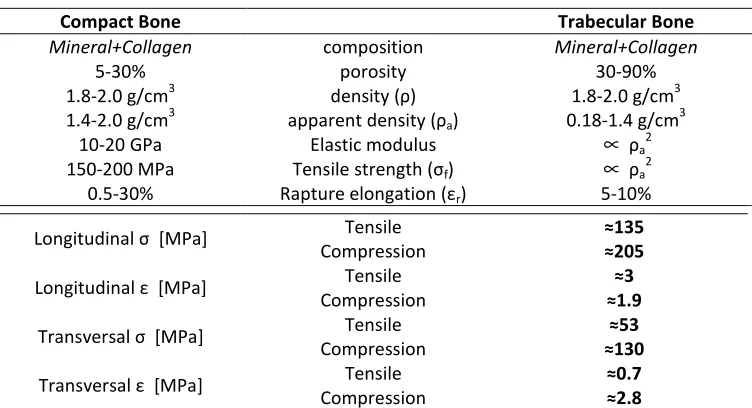
Compact Bone Trabecular Bone
Mineral+Collagen composition Mineral+Collagen
5-30% porosity 30-90%
1.8-2.0 g/cm3 density (ρ) 1.8-2.0 g/cm3 1.4-2.0 g/cm3 apparent density (ρa) 0.18-1.4 g/cm 3
10-20 GPa Elastic modulus ∝ ρa2 150-200 MPa Tensile strength (σf) ∝ ρa
2
0.5-30% Rapture elongation (εr) 5-10%
Tensile ≈135
Longitudinal σ [MPa]
Compression ≈205
Tensile ≈3
Longitudinal ε [MPa]
Compression ≈1.9
Tensile ≈53
Transversal σ [MPa]
Compression ≈130
Tensile ≈0.7
Transversal ε [MPa]
Compression ≈2.8
Table 1.1. Mechanical properties of cortical and trabecular bone(22).
It is important to underline how bone shows strong viscoelastic behaviours, especially when it is stimulated at different strain rates, changing its stiffness, the maximum deformation and stress before the failure. In table 1.1, the principal mechanical properties are reported. As shown, the compact bone and cancellous bone density is the same, while the apparent density varies due to the porous structure. As a consequence, the mechanical properties are strongly influenced by the ratio of full-empty spaces in the trabecular structure. The complex organization leads to a macroscopic
structure with anisotropic properties both in compression and in tension, but also along different stress directions, such as longitudinal and transverse
INTRODUCTION
46
1.14 Remodelling
In bone, continuous processes of bone reabsorption and deposition coexist in a dynamic equilibrium, aimed to adapt the bone structure on the different and variables mechanical stresses which normally occur. Currently, it is a general opinion how the evolutionary process has produced an optimal engineering design for all bone types. Considering the bone physiology, several considerations can be formulated on the base of an optimal design, such as the structural design in which the material is mainly arranged along the force lines, to ensure a good strength-weight ratio and to distribute
homogeneously as well as possible the stress during the maximum load condition (homogeneous resistance distribution). These concepts, applied to the geometry of the bone structure, are well known and were firstly
formulated by the Wolff’s laws in 1982. The first law explains how a bone transformation corresponds to a functional variation, while the second is related to the trabecula directional remodelling as a function of the loading history. Thus, bone remodelling is driven by a dynamic equilibrium between deposition and reabsorption, regulated by mechanotransduction mechanisms in which mechanical signals are converted into biochemical activities by cells. Various models were proposed to explain the mechanisms of cell regulation, in which the most accredited involves the formation of flow, pressure and transport gradients along the canals, causing a cellular response (23-25). In figure 1.12 it is possible to observe the bone remodelling activity
INTRODUCTION
47
Fig.1.12. Remodelling activities and Frost’s theory(26).
1.15. Bone Repair and Regeneration Techniques
In general, bone has a good ability to self-regenerate. However, as any tissue, bone possesses a critical defect size for which spontaneous regeneration cannot be achieved, causing nonunion defect or delayed union
defect (regeneration does not occur within a predetermined period, depending on the location). Fractures, which lead to delayed or nonunion defect, are common among the long bone. When the critical size is
INTRODUCTION
48
using ring fixators, intramedullary nailings, Ilizarov frames or general external fixators. Moreover, in the orthopaedic field, extensive bone reconstruction is needed in case of widespread loss, as resulting by severe congenital malformations, trauma, hypoplasia, ischemic necrosis, primary neoplastic lesions (osteosarcoma, benign bone tumors) or secondary (metastases). Prostheses are also used to provide a replication of the missing bone segment or joint, but poor integration, high probability of infections and rejections can occur, as well as technical problems involving breakage, friction wear and loosening, precluding their general use in orthopaedic
field. Currently, bone-grafting plays a predominant role in treatment of delayed or nonunion defects, joint arthrodeses, trauma or tumors; but recently tissue engineering is also considered a very promising technique. A
brief description of the common techniques for bone regeneration will be presented.
1.15.1 Bone transfer through fixators(27)
INTRODUCTION
49
processes. However, the process rate is relative slow (2 months/cm), leading to complications in prolonged treatment, such as pin site infections, cellulites, contractures and edema.
1.15.2 Distraction osteogenesis(28)
Distraction osteogenesis can be considered a bone transfer technique and it consists in a surgical process used to restore long bone deformities and length. Bone is fractured in two segments (corticotomy), then the relative parts are gradually stretched (distraction rate 1mm/days) during the
distraction procedure with an external fixator (Ilizarov external fixator), allowing the stimulation of the biosynthetic activity, new bone formation and the consequent lengthening. If the desired length is achieved, the
distraction is followed by a consolidation phase in which the healing process may occur. Distraction osteogenesis can increase both the bone and the surrounding soft tissue length simultaneously. Although this techniques is commonly used to correct long bone deformities caused by congenital diseases and old injuries, distraction is often a long and laborious process and it is reserved only to mentally prepared patients.
1.15.3 Bone-Grafting(28)
The common grafting techniques can be divided in autograft, allograft and vascularized transplants.
Autograft is obviously the most favourable procedure, especially when
INTRODUCTION
50
as the “gold standard” for regeneration, are commonly considered as a safe solution in terms of compatibility and immune response absence, but also uncomfortable for patient in which a second surgery is needed and an associated morbidity can also occur. The bone trabeculae graft may be reabsorbed either entirely or partially, while new bone formation can be observed. Actually, the regeneration is unpredictable and depends strongly on graft vascularization and nutrient diffusion. Furthermore, the graft availability may limit the application of this technique. In general, cancellous bone grafts are mainly used due to their osteogenic inductive
capacity that results higher if compared with compact bone.
When the defect size exceeds the homologous donor possibility, allografts may be a good alternative thanks to the existence of bone banks which
provide allogeneic bone graft with no size or quantity limitation. Anyway, several studies have demonstrated how allograft transplantation often results in poor and inadequate remodelling, reabsorption, revascularization, and so the implant can be considered as only a mere support. Moreover, it is important to not underestimate the problems concerning the graft rejection and the risk of infections (5-12% of the studied cases). Also in this case cancellous bone is preferred.
INTRODUCTION
51
hypertrophy early occurs thus making prolonged immobilization unnecessary. Although vascularized graft leads rapidly to a good healing status, structural support, remodelling and minimal donor site morbidity; this technique requires microsurgical sophisticated procedures (8-12 hours as operation time) including specific infrastructures.
1.15.4 Bone Tissue Engineering(16, 17)
As widely mentioned, a promising alternative to the traditional approaches is constituted by (TE) tissue engineering, which has revealed potential
results, causing a significant increase of research works in recent years. Considering tissue engineering for bone regeneration, two alternative are proposed: tissue engineering and in situ tissue regeneration. The first
INTRODUCTION
52
able to induce a local cell response, stimulating the tissue regeneration in
situ.
STATE of ART: tissue engineering
53
2. TISSUE ENGINEERING
The definition of tissue engineering was coined by the National Science Foundation at Lake Tahoe conference in 1988 when it was stated that "Tissue engineering involves the application of the principles and methods of engineering and life sciences in order to understand the fundamental relationships between the structure and functions in mammalian tissues (both normal and pathological) and to develop biological substitutes to restore, maintain and improve tissue functions". The philosophy of this interdisciplinary field is related on the ability to lead the repair and regeneration of damaged tissues allowing cell growth and thus restoring the original tissue.
three-STATE of ART: tissue engineering
54
dimensional organization of cells until tissue synthesis. The paradigm upon tissue engineering fundamentals is the mutual relationship between cells, scaffolds and cellular signals. Cells are the simplest building block units of living organisms and all their characteristic properties can be expressed, such as reproduction, growth, death, assimilation, respiration, motion, ability to synthesize and respond to stimuli. In fact, cells are able to adapt the shape as a function of their activities or as a result of external stimuli. Cells are surrounded by extracellular matrix ECM with different compositions depending on the specific tissue. ECM production can be
understood as balance between the anabolic (biosynthesis) and catabolic (lysis of molecules) processes. This equilibrium inevitably changes by introducing foreign materials. One of tissue engineering aims is to
STATE of ART: tissue engineering
55
environmental factors, by the cell-cell and cell-ECM interactions and migration and adhesion play a key role particularly. In the adhesion process, cell attachment provides signals for spreading, migration, survival, and proliferation. As mentioned, cell surface receptors recognize reversibly and specifically ECM components. Therefore adhesion results a fundamental mechanism to induce cellular functions. Migration must also be considered as a mechanism by which cell motions involve the presence of specific signals or pathways on the extracellular matrix. In this way, the important role played by proteins and molecules becomes clear. Another very
important process is the proliferation, essential to guarantee life and tissue growth. This process is faster and increase in efficiency when cells are less differentiated. For example, the contact inhibition is an intrinsic property of
cells to stop reproducing and in general all the available space is theoretically employed but not exceeded. Finally, the extracellular matrix biosynthesis is crucial to create a biological substitute or to maintain the natural tissue, as a result of the described cellular functions. Many of the mentioned processes are either inhibited or supported by chemical and physical factors, such as the presence of certain molecules (growth factors, adhesion proteins), pH, CO2, temperature, oxygen, nutrients, metabolite
STATE of ART: tissue engineering
56
well as the production of the first cellular signals. The second phase includes cell differentiation, proliferation and eventually cell apoptosis (death), which takes place in days or weeks. In the third and final phase, taking months or years depending on the material size, matrix remodelling occurs. Thus, during tissue growth and integration between native and developed tissue, scaffold must provide a mechanical support, encouraging cellular functions. At the same time, scaffold material should also be reabsorbed with a kinetics that is comparable to matrix production.
Fig.2.1. Cell culture scheme(193).
The development of 3D scaffolds, support structures or matrices that induce cells to form functional tissues, is one of the main objects of tissue engineering. Tissue engineering scaffolds or matrices are an important
component for tissue development and their characteristics are fundamental in forming tissues with a proper cell morphology, orientation, arrangement
STATE of ART: tissue engineering
57
anatomic site. Therefore scaffolds represent the space available for the tissue to develop and a physical support for cells growth. It is possible to find a lot of commercial scaffolds for tissue engineering, such as cartilage or skin (Apligraf is the best known).
Tissue regeneration can be either conducted entirely in vivo or assisted by in
vitro phase. Considering the latter situation, a bioreactor can be defined as
any apparatus that attempts to mimic physiological conditions in order to maintain and encourage tissue regeneration in 3D scaffolds and in dynamic conditions. Cell cultures in bioreactors can be considered an intermediate
step between the conventional in vitro static approach and in vivo studies. The aim is thus promoting the formation of cartilage or bone tissue by simulating physiological conditions via the application of specific
mechanical and biochemical stimuli(2, 30). Several studies have reported promising results when in vitro dynamic conditions were applied before implantation, describing the effect of many variable and how those can influence cell metabolisms(31-33). In several cases, bioreactors can be considered useful tools not only for tissue regeneration, but also to investigate the pathway signals between cells and matrix during biochemical and physical stimulation.
STATE of ART: tissue engineering
58
nutrients, measuring and controlling cell culture variables (T, pH,% Rh, pCO2, pO2,...) and, considering bone and cartilage, also applying specific
mechanical stimuli(34-38). To increase the cellular response in these tissues, several mechanical stresses were applied with the intent to mimic physiological conditions: shears induced by fluid (medium)(39-41), tension (unidirectional or biaxial stretching)(42), sometimes shears(43) induced by torsion(44), direct compression(45, 46) and finally the application of hydrostatic pressure(41, 47, 48). Applying appropriate biochemical and mechanical stimuli through a bioreactor, cell culture can be conducted
closer to in vivo conditions. Many studies have widely emphasized how osteoblasts and chondrocytes respond in different ways(33, 49) depending on the dynamic cell culture conditions, in particular frequency, amplitude
STATE of ART: tissue engineering
59
pressure was explained considering the external physiological loads, from 0.5-2 MPa up to 10 MPa(54, 55). All three given explanations are consistent, but the assumptions were taken from three different levels, respectively microscopic (cells), macroscopic (matrix structure), and finally on a large scale (human body). Similar stimulations were studied in bone tissue engineering, with the addition of stretching in one or two directions. Again, the conclusions regarding the obtained benefits were focused principally on the parallelism between physiological and applied stresses(39, 49, 56-58). Recent studies have also shown how low pressure,
between 10 and 40 kPa, plays an important role in bone regeneration. In fact, the intraosseous pressure calculated for an adult body is about 30 kPa. Subsequently, this pressure results to be the same stress state at which
osteoblasts are normally exposed(42, 59).
STATE of ART: tissue engineering
60
promoting the fluid transport. These early studies have demonstrated both the importance of nutrients and waste exchange but the disadvantage caused by a turbulent flow within the culture, in terms of cell damage and apoptosis(65-68).
2.1 Scaffold
An ideal scaffold should be non-toxic, biocompatible, non-immunogenic, porous, easily reproducible and also it must have the mechanical properties as close as possible to the native tissue(69-76). In fact, the proposed scaffold
must present an high interconnected porosity and good permeability to allow diffusion of nutrients, waste removal and cellular mobility. In addition, pore size must be included between 50 µm and 500 µm to facilitate
cell migration. During the process of matrix remodelling, the scaffold must be designed with a desired degradation and bioreabsorption rate in order to obtain the correct tissue substitution. In skeletal tissues, such as cartilage and bone, scaffold mechanical properties also play a crucial role, providing the adequate strength and stiffness to maintain the assigned space after implant. A list of the main scaffold properties is following reported:
Porosity and Morphology: high and three-dimensional characterized
STATE of ART: tissue engineering
61
designed to guide the formation of new tissue in term of size, shape and vascularization.
Biocompatibility: can be defined as the ability of a material to
perform with an appropriate host response in a specific application. The definition does not give an absolute concept, but depends on the application. Therefore, the material can be designed and its compatibility can be evaluated(72, 79, 80). For example, a stable implant should not be hydrolysable or a contact lens must prevent cell adhesion as opposed to a scaffold for bone and cartilage tissue engineering. In general, host cells must
tolerate the presence of the material without generating immune response. The scaffold must avoid cell damage and apoptosis, enhancing the proper cellular functions.
Biodegradability, for tissue engineered construct, must be controlled
in order to ensure the correct degradation rate, showing a kinetics comparable to tissue regeneration(81-86).
Bioabsorbability, for tissue engineered constructs, to allow cell
growth in vitro and/or in vivo, avoiding immune response caused by monomer dissolution.
Surface: chemically appropriate in order to communicate in a proper
STATE of ART: tissue engineering
62
prevent de-differentiation in other cell types. Finally, the surface must accommodate the ECM synthesis.
Mechanical properties should be similar to the native tissue ones, to
guarantee an appropriate response of the material when implanted in vivo or mechanically stimulated in vitro(87-89). Considering cartilage and bone application, scaffold must show mechanical stability to sustain wound contraction and later forces in the initial part, while maintaining the required three dimensional structure during the degradation.
Reproducibility, focusing on a widespread clinical use and process
engineering, both material and its structure must be reproducible, scalable and cost effective by a controlled method, avoiding scaffold mutations or contaminations which may cause culture failure.
Sterilization should be easy, essential to prevent contamination,
cellular apoptosis and tissue death. The sterilization process must not modify material structure, e.g. gamma rays significantly reduce the molecular weight of PDLLA (racemic blend of Polylactic Acid)
It is important to emphasize how an ideal scaffold does not exist, but a proper scaffold for a certain application can be designed with specific and desired material properties.
Glass-STATE of ART: tissue engineering
63
ceramic), natural organic materials (i.e. Collagen, fibrin gel, Hyaluronic Acid) and finally inorganic materials natural derived (i.e. Coralline Hydroxylapatite, Calcium Carbonate). For bone and cartilage tissue engineering, the most commonly used materials are natural and synthetic polymers, due to their degradation properties; while in some bone applications, ceramic materials are also used, especially combined with polymers as composites, due to their mechanical properties.
These considerations are focused principally on synthetic and natural polymers for tissue engineering. Synthetic polymers normally used are
biodegradable under the aggressive action of the physiological fluids. The material can be decomposed and bio-absorbed through several mechanisms, such as oxidation and hydrolysis. In general, a synthetic material presents
STATE of ART: tissue engineering
64
Naturally-derived polymers are obtained by extraction from living organisms. In general, a good interaction cell-material can be achieved, increasing cell adhesion and proliferation. In fact, natural polymers are intrinsically able to communicate with cells, offering good biocompatibility, non-toxicity, low chronic inflammatory response and an ideal environment for cell growth. These kind of materials are generally expensive, less processable and less stable in terms of mechanical properties. Collagen, Chitosan, Hyaluronic Acid(103-106), Glycosaminoglycan (GAG)(77, 107), Silk Fibroin(61, 108-111), Starch(112-115), Agarose(116-118) and finally
Alginate(119-122) are natural polymers often used in tissue engineering. Thanks to their chemical composition, the organic naturally-derived polymers possess the ability to induce stimuli on the seeded cells during
adhesion. However, the main problem is to understand which are the induced stimuli. In fact, cell response may not be what expected or desired.
2.2 Polymer scaffold process techniques(123)
STATE of ART: tissue engineering
65
cells anchorage also control cells gene expression. The desired characteristics, such as porosity, permeability and mechanical properties can be achieved providing a structure mimicking the ECM architecture as much as possible. The commonly used techniques can be divided in two main categories; in the first case, scaffolds are generated with a random structure and unpredictable pore sizes. Generally, the obtained constructs lack in reproducibility, mechanical strength and structural stability. Precisely, Solvent Casting / Particulate Leaching, Freeze-Drying, Phase Inversion, Fiber Bonding, Electrospinning, melt based technologies, have been
employed to produce non-ordered scaffolds. Considering also the second category, in recent years, considerable attention has been paid to fabrication methods for producing porous scaffolds with a certain, predetermined
design, complex shapes and defined architecture, such as Stereolithography, Selective Laser Sintering, 3D Printing, Shape Deposition Manufacturing, Robotic Microassembly, Fused Deposition Modelling. These techniques are normally based on the use of a computer-assisted device and the material is often deposited layer by layer. High resolution can be achieved depending on the apparatus precision. Following, it is reported a brief explicative list of the mentioned fabrication techniques:
Random structure
Solvent casting / Particulate Leaching; polymer solution is casted on
STATE of ART: tissue engineering
66
casting substrate but also on process conditions (i.e. temperature, Relative Humidity, pressure). Obviously, the solvent must be volatile. Solvent casting is often combined with particulate leaching to obtained 3D porous scaffolds. Sodium Chloride, Ammonium Bicarbonate and Glucose are generally used as porogen agents with different crystal sizes.
Freeze-Drying(124); solution sublimation can induce pore
formation, under proper pressure and temperature conditions. Adjusting polymer concentration, viscosity, quenching temperature and cooling rate, the desired structure can be obtained in term of mechanical properties,
presence of gradient and structural alignment, pore size and distribution. Phase Inversion(125-127); under specific conditions, such as
solution viscosity, polymer density, interfacial energy and mechanical
stirring, a liquid-liquid dispersion can be inverted by diffusive processes, interchanging mutually the dispersed and continuous phase. After casting, a single phase can be separated using a nonsolvent. In tissue engineering, supercritical carbon dioxide is often used as nonsolvent due to its non-toxic properties.
Electrospinning(107, 128-131); submicrometric fibers can be
Figure


Related documents
