A checklist of vascular plants and uses of
some species for livelihood-making in
Setiu Wetlands, Terengganu, Malaysia
Jamilah Mohd Salim1,2, Gaik Ee Lee1,2, Muhamad Razali Salam2,
Salwa Shahimi1,2, Elizabeth Pesiu2, Jarina Mohd Jani2,
Nurul Amira Izzaty Horsali2, Rohani Shahrudin2,
Siti Mariam Muhammad Nor2,3, Ju Lian Chong1,2,
Faridah Mohamad2, Akmal Raffi1,4, Dome Nikong2
1 Institute of Tropical Biodiversity and Sustainable Development (Bio-D Tropika), Universiti Malaysia Terengga-nu, 21030 Kuala Nerus, TerenggaTerengga-nu, Malaysia 2 Faculty of Science and Marine Environment, Universiti Ma-laysia Terengganu, 21030 Kuala Nerus, Terengganu, MaMa-laysia 3 Mangrove Research Unit, Institute of Oceano-graphy and Environment, Universiti Malaysia Terengganu, 21030 Kuala Nerus, Terengganu, Malaysia 4 Faculty of Resource Science and Technology, Universiti Malaysia Sarawak, 94300 Kota Samarahan, Sarawak, Malaysia
Corresponding author: Gaik Ee Lee ([email protected])
Academic editor: Ricarda Riina | Received 11 April 2020 | Accepted 3 July 2020 | Published 8 September 2020
Citation: Jamilah MS, Lee GE, Salam MR, Shahimi S, Pesiu E, Jani JM, Horsali NAI, Shahrudin R, Nor SMM, Chong JL, Mohamad F, Raffi A, Nikong D (2020) A checklist of vascular plants and uses of some species for livelihood-making in Setiu Wetlands, Terengganu, Malaysia. PhytoKeys 160: 7–43. https://doi.org/10.3897/phytokeys.160.52946
Abstract
The Setiu Wetlands, a unique area with nine interconnected habitats, comprises a considerable fraction of the total Peninsular Malaysia’s wetland flora. Although botanical collecting in the area has been active in the past 10 years, only a few studies dealing with the wetland flora have been published. Thus, a detailed checklist of this area is urgently needed to ensure the continuity of its inter-relating flora and fauna, as well as the livelihood of the local people. In this work we conducted a survey of the vascular plant flora of Setiu Wetlands and investigated the most important plants used by the local communities. Our checklist ac-counts for 406 taxa from 277 genera and 106 families, including 24 (6%) species of ferns and lycophytes, three gymnosperms, 257 (64%) dicotyledons and 122 (30%) monocotyledons. This comprehensive plant checklist will be a primary reference for the management of the newly gazetted Setiu Wetlands State Park covering more than 400 hectares of lands and water bodies.
Keywords
coastal ecosystem, diversity, flora, local community, Malesia, useful plants http://phytokeys.pensoft.net
Copyright Jamilah Mohd Salim et al. This is an open access article distributed under the terms of the Creative Commons Attribution License (CC BY 4.0), which permits unrestricted use, distribution, and reproduction in any medium, provided the original author and source are credited.
Jamilah Mohd Salim et al. / PhytoKeys 160: 7–43 (2020)
8
Introduction
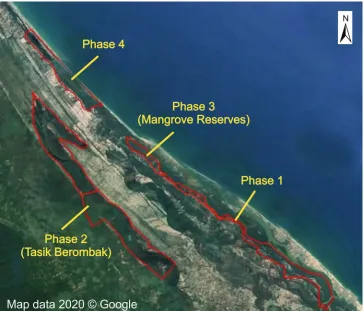
Wetlands are not only among the most productive and complex ecosystems (Costanza et al. 1997), but are also known to benefit humans with significant economic and eco-logical values (Barbier et al. 2011). The importance of wetlands has increased tremen-dously following the 2004 catastrophic tsunami which affected many places severely in the Asian region. The Setiu Wetlands (SW) constitutes the largest wetland complex in the east coast of Peninsular Malaysia which is located in an arbitrary but exclusive zone referring to the larger Setiu district in Terengganu. The coastal lagoon is the largest part of the SW, stretching approximately 14 km, parallel to the coastline, from Lem-bah Bidong in the south up to Beting Lintang to the north, while the wetland basin covers about 23,000 ha of lands and 880 ha of water bodies (Nakisah and Fauziah 2003). In 2018, in lieu of protecting vital catchment areas and their natural heritage, the state government of Terengganu gazetted two new state parks, one of which was in the Setiu district. Driven by its importance for the local economy and the dire need to wisely manage SW for the sustainability, efforts to legally protect SW were initiated more than 20 years ago. However, it was not until recently that the state authority of Terengganu passed the Terengganu State Park Enactment 2017, under which, 432 ha of SW were gazetted as State Park in Phase 1 covering mainly the SW brackish lagoon and estuary (Fig. 1). In the near future, the gazettement for three more phases of this State Park will cover possibly one of the largest coastal freshwater lakes in Peninsular Malaysia, locally known as Tasik Berombak. Tasik Berombak is hydrologically impor-tant by supplying the primary source of freshwater into the brackish lagoon of SW (Sathiamurthy 2015) which is a hub for economic and livelihood activities of the SW local community. In addition, phases 3 and 4 of the gazettement intend to cover mostly mangrove islands in SW, but many issues and challenges, primarily related to land title, need to be addressed.
stripe and such unique vegetation is not found on the west coast of Peninsular Malaysia (Jamilah et al. 2014).
Setiu lagoon supports several islets within the lagoon with healthy mangrove veg-etation. However, the mangrove ecosystem here is also characterised by a relatively sandier habitat as compared to the typical mangroves on the west coast of Peninsular Malaysia such as the Matang mangroves. Setiu mangroves are not only supporting the three classes of common mangrove vegetation, namely exclusive, non- exclusive and associate (Japar 1994), but also additional vegetation associated with sand ridges. This vegetation, including vascular plants, offers significant ecosystem services, such as providing food and shelter to animals residing in the area, with many being economi-cally important. Furthermore, Setiu lagoon, which is the longest brackish wetlands in Terengganu, includes several patches of sandy-mudflats which support a healthy com-munity of bivalves [including Scapharca cornea (local name: kepah bulu) and Meretrix
meretrix (kepah minyak)] (Wan Bayani and Zaleha 2015) that are harvested by the
Jamilah Mohd Salim et al. / PhytoKeys 160: 7–43 (2020)
10
seagrass-mangrove continuum is reported to be an important nursery ground for the juveniles of fishes such as grouper, and pink ear emperor fish, Lethrinus lentjan (Le et al. 2018). The mangroves of Setiu, and its lagoon, are also an important habitat for highly demanded mangrove crabs, Scylla spp. (Ikhwanuddin et al. 2010), and is the source of income for many local fishermen in the area. The geography and the vegeta-tion cover of the area support it as a hub for aquaculture activities, covering brackish water cage culture, pond culture, pen culture especially on groupers, and also oyster farming (Suratman et al. 2014).
In terms of soil origin, the Setiu coastal plain originated from marine-based deposit, arranged in a series of ridges and depressions parallel to the shoreline (Ali and Mohamed 2007; Sathiamurthy 2015) known as BRIS (Beach Ridges In-terspersed with Swales). BRIS is oligotrophic or infertile and unsuitable for agri-culture (Lim 2002) partly due to extreme water retention capacity and comprises 90% sand (Mohd Ekhwan et al. 2009). However, BRIS soil supports a distinct natural vegetation formation which is different from a typical evergreen rainforest (Jamilah et al. 2013). The ridge part supports heath-like ecosystem plants, while the depression site is usually a pocket of seasonal wetland with adapted vegetation (Jamilah et al. 2011).
The nine habitats in SW are increasingly being exposed to various anthropogenic and natural pressures. This could threaten the integrity and ability of those natural ecosystems to fulfil their ecological roles for the benefit of the local community and the coastal environment. As vegetation is the most important entity of the wetlands that supports other important life forms, it is essential to highlight the diversity of flora in SW. The aims of this paper are to provide the first comprehensive checklist of vascular plants of SW, and to understand the use of wild plants for livelihood continu-ity and sustainabilcontinu-ity in SW. The latter also further aims to understand how the local community’s utilisation affects the plants’ sustainability, so that sustainable resource management and conservation policy for SW can be achieved.
Materials and methods
The checklist is based on the plant collections carried out by JMS, EP, SMMN and DN with the help of field assistant, MRS. More than 30 different localities were visited after 2010 in the nine different ecosystems of SW. Specimens were deposited at the Herbarium of Universiti Malaysia Terengganu (UMTP). In addition, the checklist is also based on a search of the literature (e.g., Mohd Lokman and Sulong 2001; Jamilah et al. 2014; Siti Fatimah et al. 2015; Razali et al. 2017; Rohani et al. 2017; Pesiu 2018) as well as herbaria that store collections of specimens collected from SW, such as the Herbarium of Forest Research Institute of Malaysia, Kepong (KEP) and the Herbari-um of Universiti Kebangsaan Malaysia, Bangi (UKMB). The checklist includes family, species and local names, and life forms. It also provides the conservation status accord-ing to the IUCN Red List of Threatened species (IUCN 2020), Malaysia Plant Red List, Peninsular Malaysia Dipterocarpaceae (Chua et al. 2010), Malaysia Biodiversity Information System (MyBIS) and Convention on International Trade on Endangered Species of Wild Fauna and Flora (CITES).
A total of 188 houses from six villages, i.e. Beting Lintang, Gong Batu, Pengkalan Gelap, Fikri, Mangkok and Penarek, were opportunistically selected for a rapid liveli-hood survey to determine their dependence on SW wild flora resources. In addition to that, a stratified sampling of 10 households belonging to identified resource users was later conducted in Beris Tok Ku, to provide a better representation of wild flora resource utilisation in the area.
Results and discussion
Families, genera and species diversity
Jamilah Mohd Salim et al. / PhytoKeys 160: 7–43 (2020)
12
and G. gnemon), with 257 being dicotyledons, and 122 monocotyledons (Table 1). This
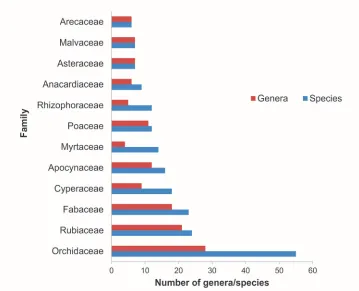
represents 19% of 2168 species recorded growing in wetlands of Peninsular Malaysia (Said and Zakaria 1992) and also illustrates the fact that SW flora is relatively species rich. The most speciose family recorded from SW is Orchidaceae (56 species/28 genera), followed by Rubiaceae (24 species/20 genera) and Fabaceae (22 species/17 genera) (Fig. 3), while there are 43 families represented only by a single species e.g., Amaryllidaceae, Commelinaceae, Cycadaceae, Dioscoreaceae, Flagellariaceae and Pittosporaceae (see Appendix 1 for other families). Among the genera that contribute most to the total number of species are Dendrobium (11 species), Bulbophyllum and Syzygium with 10 species, while Bruguiera, Cyperus and Sonneratia have five species each. In terms of the life forms (Table 2), trees have the highest percentage (39.7%) followed by terrestrial herbs and epiphytes with 16.5% and 13.3% of the taxa, respectively. Apart from the trees, the herbaceous species which can be terrestrial, epiphytic or climbing, are represented by 27.8% of the species, which implies that trees and herbaceous flora are the most important components of the SW areas.
The Orchidaceae (Fig. 4) are well represented in SW, representing 23% of 245 orchid species recently reported in Terengganu (Besi et al. 2019). Thus, to date, there are 56 species of orchids found in SW from which 14 species were recorded by Siti Fatimah et al. (2015) and 42 represent new records in SW, mostly being recent collections by Dome Nikong. The highest number of orchid species in SW, as expected, are in the widespread genera Bulbophyllum and Dendrobium, similar to the results of Besi et al. (2019) in Tasik Kenyir logging sites. Both genera are found to be most abundant epiphytic orchids grow-ing in disturbed and logged forests in which the weather and microclimate are favourable for growth and reproductive processes. However, orchid density is due in part to the severity of the disturbance in which highly disturbed logging sites harbour lower density than somewhat disturbed sites (Besi et al. 2019). Among the species recorded in SW, there are some that are exceptional. The orchid diversity in SW is enriched with the sight-ing of the uncommon Papilionanthe hookeriana that is confined to the freshwater swamp area of Tasik Berombak in SW. It usually coexists with shrubs and tall grasses for support (Pridgeon et al. 2014). On the other hand, the discovery of Vanilla griffithii in its unchar-acteristic habitat of the BRIS forest signified its capability to thrive in xeric environment and supported its local genus distribution pattern suggested by Mohd Raffi et al. (2014) which was best described as constantly sparse, widespread and in many habitats.
As for the mangroves, there are about 33 exclusive mangrove species including three hybrids i.e. Sonneratia × hainanensis, Bruguiera × rhynchopetala, Table 1. Number of families, genera and species from Setiu Wetlands, Terengganu.
Families Genera Species
Ferns and lycophytes 12 16 24
Gymnosperms 2 2 3
Dicotyledons 73 191 257
Monocotyledons 19 70 122
Figure 3. The 12 largest families and genera of the vascular plants of Setiu Wetlands.
Table 2. Number of species from Setiu Wetlands according to their life form.
Life form No. of species Percentage (%)
Trees 161 39.7
Terrestrial herbs 67 16.5
Epiphytic herbs and shrubs 54 13.3
Shrubs 39 9.6
Climbing herbs and shrubs 33 8.1
Ferns 23 5.7
Aquatic herbs 15 3.7
Palms 5 1.2
Parasitic herbs and shrubs 5 1.2
Palm-like (Pandanus spp.) 4 1
Total 406 100
Rhizophora × annamalayana and four individuals of Bruguiera hainesii located at Pulau
Jamilah Mohd Salim et al. / PhytoKeys 160: 7–43 (2020)
14
Faridah-Hanum 2014), and are also threatened by strong waves during monsoon months as well as anthropogenic activities e.g., many mangroves in SW had been uprooted to make way for aquaculture, shrimp ponds and constructions of infrastructures.
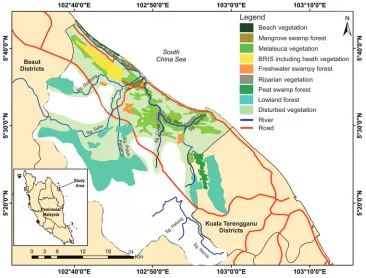
The relatively species rich profile of SW reflects on the interconnected forest types in SW which consists of different plant communities (Fig. 5) including beach, man-groves, peat swamp and freshwater swamp plants. Beach vegetation includes Casuari-naceae and Convolvulaceae and mixed mangroves plants such as the families Avicen-niaceae, Lythraceae and Rhizophoraceae. Peat swamp plants can be found behind the mangrove belt and further inland, Melaleuca swamp forest dominates the waterlogged area associated with BRIS soil (Jamilah et al. 2015). On the other hand, the heath-like dune landscape established on the ridge areas of Setiu coast is characterised by stunted and low stature vegetation growing in a clumping pattern (Jamilah et al. 2014).The vegetation on the sandy and dry ridge is dominated by Myrtaceae family (Melaleuca
cajuputi, Baeckea frutescens, Rhodomyrtus tomentosa and Syzygium spp.). Woody
epi-phytic shrubs (e.g., Ficus deltoidea) and herbaceous species such as orchids are adapted to grow underneath the clump on BRIS soil dune landscape (Jamilah et al. 2014). However, the natural ecosystem on BRIS soil ridge and swamps is becoming scarce and smaller in coverage due to various threats faced by the coastal ecosystem of SW. It has become more scattered and fragmented, resulting in difficulty in finding an area that could be a good representative of BRIS soil flora. Fragmentation and degradation also expose this natural ecosystem to the invasion of exotic invasive alien species, such
as Acacia mangium, A. auriculiformis and their hybrids (Jamilah et al. 2014). It is
pre-dicted that without legal protection and authority commitment to conserve BRIS soil natural vegetation, it will soon be replaced by these alien species, particularly Acacia
spp. Although the gazettement of BRIS soil habitat is still underway, land conversion in BRIS is rampant and to prevent further land uses, ecotourism activity is recom-mended. Therefore, the hope is that in the near future, BRIS soil habitat would be in-cluded in the next phases of State Park gazettement which will likely have a significant effect in ensuring the conservation of this unique habitat.
As for the wetland or swamp, a rainfed swamp with a water table is highest during the monsoon months. The swamp is dominated by Melaleuca cajuputi trees with larger diameter of M. cajuputi trees relative to trees growing on the drier ridge of BRIS soil, as it grows better in waterlogged conditions as compared to dry sites (Suzuki 1999). This Melaleuca swamp harbours carnivorous species of pitcher plants (Nepenthes spp.), sundews (Drosera burmannii in particular) and Utricularia bifida which are adapted to freshwater swamp. The hydrological contribution of patches of Melaleuca swamp as a seasonal wetland is worth exploring and the wetlands may provide a critical ecosystem service of mitigating floods, particularly in monsoon months in Terengganu (Jamilah et al. 2015). In addition, SW also harbours a large freshwater lake, locally known as Tasik Berombak. The water is contributed by rain and a few small river tributaries (Sathiamurthy 2015) and comprises BRIS soil with heath-like vegetation on its ridge, but is less rich than natural BRIS ecosystem. The lake is invaded by thick bush of
Jamilah Mohd Salim et al. / PhytoKeys 160: 7–43 (2020)
16
The high diversity of wild orchids and other potentially useful plant species on coastal habitat of SW is indeed a natural capital for SW State Park and furthermore, the habitat supports an option value, which could be tapped in the future as outlined in Total Economic Value (TEV) (Costanza et al. 1997). The biodiversity resources in SW can be managed sustainably to support the local community green economy as an alternative to unsustainable economic activities such as sand mining. The SW State Park will also be crucial to protect the critically endangered Painted Terrapin (Batagur
borneoensis (Schlegel & Muller, 1844)) and to serve as a refuge for some 29 mammals,
161 birds and 36 reptiles and amphibians (WWF-Malaysia). Furthermore, it is also classified as an Important Bird Area (IBA) by Birdlife International.
Conservation status
Eight species have been classified as threatened species including one Critically En-dangered (CR), Bruguiera hainesii, two Endangered (EN), Anisoptera marginata and
Pterocarpus indicus, and five Vulnerable (VU) (Avicennia rumphiana, Halophila
becca-rii, Intsia bijuga, Ternstroemia wallichiana and Vatica pauciflora). The Critically
Endan-gered, B. hainesii is only found in several localities in Southeast Asia including SW, and the lower estimates of mature individuals probably due to the low rates of propagation and germination (Polidoro et al. 2010). However, recent molecular analyses revealed that B. hainesii did not merit recognition of species as it has no unique haplotype/allele of its own but instead shared nuclear allele with B. cylindrica and B. gymnorhiza, and thus indicating the hybrid origin of B. hainesii (Ono et al. 2016). Five species partially met the classification thresholds under the threatened species category and therefore were listed as Near Threatened i.e. Cycas edentata, Myristica lowiana, Olax scandens,
Phoenix paludosa, Sonneratia ovata, while 155 species are regarded either as Least
Con-cern (LC) or Data Deficient (DD). However, about half of the vascular plants (59%) occurring in SW have not been assessed and categorised under the IUCN Red List of Threatened Species.
For the Malaysia Plant Red List, two species have been classified as threatened species, namely Anisoptera marginata (EN) and Anodendron candolleanum (VU). There were nine species listed as Near Threatened i.e. Cycas edentata, Cerbera odollam,
Cer-bera manghas, Vatica pauciflora, Drosera burmannii, Xylocarpus moluccensis, Horsfieldia
irya, Myristica lowiana, Olax scandens while 32 species were listed as Least Concern
Jamilah Mohd Salim et al. / PhytoKeys 160: 7–43 (2020)
18
Wild flora based livelihoods in SW
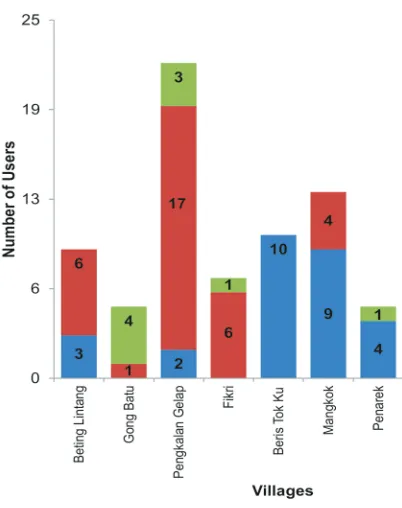
We found that in the SW, the local households’ utilisation mainly focused on three species, namely Nypa fruticans (nypa), Lepironia articulata (Blue-grey sedge) and
Pandanus tectorius (Sea Pandan, Sea screwpine). Figure 6 shows the number of flora
user households based on the species utilised in each village. Nypa fruticans records the highest number of users with 34 households from five out of seven villages.
Lepi-ronia articulata is a close second, with recorded utilisation in 28 households in five
villages as well. Meanwhile P. tectorius is the least utilised of the three species with only nine user households in total from four villages. The wide use of N. fruticans
coincides with the highest variety of products that can be made using its various plant parts (see Fig. 7). The nypa palm is the most versatile wild plant among the three as different parts of the plant are used to make different kinds of products. For example, the young leaves are used to make tobacco wrappers, its dried midrib is weaved into baskets, while mature fronds with leaves are used to make roof-thatch. The midribs of the nypa, which are unsuitable for weaving lekar baskets, are used to make brooms. Due to this, nypa is the most preferred plant species used in SW. Its utilisation is well documented in Malaysia (see Latiff 2009; Tsuji et al. 2011). It is not only an important wild resource for the Malays but also for indigenous tribes such as the Mah Meri who use nypa leaves to produce decorative items for spirit huts, altars, homes and dancers (Baba et al. 2013).
As for Lepironia articulata, although it can be used to make similar types of prod-ucts as those made using Pandanus tectorius, i.e. mats and bags, its livelihood-based utilisation in Malaysia appears less recorded compared to the latter. Instead, there ap-pears to be more documentation on its utilisation in grey water treatment (see Sim et al. 2008; Wurochekke et al. 2014). However, its utilisation is significant for the users in SW, as it supplemented up to 45% of their monthly household income and repre-sents a strong cultural link to the local tradition for the users who are mostly exclusive (not using other flora resource) users of this resource. The 11 users from SW produced mats, six users made sacks, while 10 users made accessories’ items such as hats and bags. Our findings suggest that current utilisation is at a sustainable level thanks to the user’s knowledge about the ecology of these plants. Its use therefore poses no threat to the integrity of the state park. According to MacDonald (2009), L. articulata is listed among eight major species that are commonly used for weaving activities by the Plant Resources of South-East Asia (PROSEA) (Brink and Escobin 2003) due to their high suitability as a raw material for weaving activities, in particular their toughness, plas-ticity, sustainable strength and impermeability after being dried (Truyen et al. 2014).
Jamilah Mohd Salim et al. / PhytoKeys 160: 7–43 (2020)
20
past. Indeed, while pandan mats are produced in various parts of Malaysia (Ismail and Nawawi 2011; Baba et al. 2013) the quality of pandan mats produced by Terengganu weavers is of excellent quality (Ismail and Nawawi 2013). Therefore, it is highly prob-able that the weavers in SW could also produce a variety of products (Fig.8), just as the weavers of Mah Meri tribe who are well known for producing varied, exquisite handicrafts such as purses, pouches, mats and baskets in Pulau Carey, Selangor (Baba et al. 2013). However, there needs to be a steady market demand that guarantees a good income stream, which is provided to the Mah Meri weavers by the Gerai OA, an NGO that helps market their products through fairs and online marketing.
Conclusions
Our survey indicates that the nine connected habitats in SW are relatively rich in vascular plants, harbouring nearly 20% of Peninsular Malaysia wetland flora. The current checklist is far from complete as additional species will likely be found with wider sampling cover-age and additional systematic inventories. The utilisation of plant resources for the liveli-hood of coastal communities in SW is still significant for the three main species used in the area (Nypa fruticans, Lepironia articulata and Pandanus tectorius). Local communities play an important role in the sustainability of SW, so it is essential to understand their de-pendence on the intricate network of wetland ecosystems and their plant species to ensure that they are not overlooked in the management plans of the Setiu Wetlands State Park.
Acknowledgements
We are grateful to the Director of Terengganu State Parks, Muhammad Aizat Mohd Rashid and Nabila Husna Mohd Zohuri for providing and helping with the map, and Universiti Malaysia Terengganu for the facilities and utilities used during this study. Part of this paper is based on a research project awarded to JMJ (53131) undertaken for Univer-siti Malaysia Terengganu’s Niche Research Grant Scheme (NRGS) programme through funding by the Malaysian Ministry of Education. We are also grateful to the subject edi-tor Ricardia Riina and two anonymous reviewers for providing very useful comments and also for suggesting substantial improvements to earlier drafts of this manuscript.
References
Ali CA, Mohamed KR (2007) Fragile Environment under Threat-The Study Lagoon Case Study. Geological Heritage of Malaysia, 457–469.
Baba S, Chan HT, Aksornkoae S (2013) Useful Products from Mangrove and Other Coastal Plants. ISME Mangrove Educational Book Series No. 3, International Society for Man-grove Ecosystems (ISME) and International Tropical Timber Organization (ITTO), Japan, 1–111. http://www.mangrove.or.jp/img/publications/book_pdf/EB03-Educational_3.pdf Barbier EB, Sally D, Hacker SD, Kennedy C, Koch EW, Stier AC, Silliman BR (2011) The Val-ue of Estuarine and Coastal Ecosystem Services. Ecological Monographs 201(2): 169–193. https://doi.org/10.1890/10-1510.1
Besi EE, Nikong D, Mustafa M, Go R (2019) Orchid diversity in anthropogenic-induced degraded tropical rainforest, an extrapolation towards conservation. Lankesteriana 19(2): 107–124. https://doi.org/10.15517/lank.v19i2.38775
Brink M, Escobin RP (2003) Plant Resources of South-East Asia No. 17 Fibre Plants. Prosea Foundation, Backhuys, 1–459.
Jamilah Mohd Salim et al. / PhytoKeys 160: 7–43 (2020)
22
Costanza R, d’Arge R, de-Groot R, Farber S, Grasso M, Hannon B, Limburg K, Naeem S, O’Neil R, Paruelo J, Raskin R, Sutton P, van den Belt J (1997) The value of the world’s ecosystem services and natural capital. Nature 387(6630): 253–260. https://doi. org/10.1038/387253a0
Domyos P, Te-chato S (2013) In vitro propagation of Lepironia articulata in Kuan Kreng Peat lands, Nakhon Si Thammarat. Journal of Agricultural Technology 6: 1595–1605. http:// www.ijataatsea.com/pdf/v9_n6_13_November/21_IJAT_2013_9(6)_Plant%20Science_ Premrudee%20%20Domyos%20and%20Sompong%20Te-chato.pdf
Faridah M, Jamilah MS, Jarina MJ, Rohani S (2015) Setiu Wetlands Species, Ecosystem and Livelihoods. Universiti Malaysia Terengganu Publishing, 1–228. https://www.e-sentral. com/book/info/269181/Setiu-Wetland-Species-Ecosystems-and-Livelihoods
Faridah M, Yusof Shuaib I, Nursalwa B, Allyza Azura ARA, Muhammad Hafiz B (2016) The Invertebrates of Setiu Wetlands. Universiti Malaysia Terengganu Publishing, 1–211. http:// bookstore.umt.edu.my/index.php?route=product/product&product_id=292
Ikhwanuddin M, Bachok Z, Hilmi MG, Ghazali A, Zakaria MZ (2010) Species diversity, carapace width-body weight relationship, size distribution and sex ratio of mud crab, genus
Scylla from Setiu Wetlands of Terengganu coastal waters, Malaysia. Journal of Sustain-ability Science and Management 5: 97–109. http://www.myjurnal.my/public/article-view. php?id=4857
Ismail NH, Nawawi NM (2011) Design motive and pattern in screwpine and pandan plaiting from Peninsular Malaysia. In IEEE Colloquium on Humanities, Science and Engineering, 137–142. https://doi.org/10.1109/CHUSER.2011.6163703
Ismail NH, Nawawi NM (2013) Pandanus, Pattern and Design. International Journal of Lit-erature and Art 1: 1–6.
IUCN (2020) IUCN Red List of Threatened Species. Version 2020-1. http://www.iucnredlist. org [accessed 30.3.2020]
Jamilah MS, Norhayati Y, Kasawani I, Nursalwa B, Razali MS (2011) Brief floristic descrip-tions of Jambu Bongkok Forest Reserve, BRIS ecosystem, Melaleuca Swamp of Tereng-ganu. In: Jamilah MS, Faridah M (Eds) A Biological Assessment of Jambu Bongkok Forest Reserve, Terengganu and Nearby Ecosystem, Universiti Malaysia Terengganu Publishing, Terengganu, 1–24.
Jamilah MS, Umairah H, Nur-Hanani AJ, Risnayati L, Razali MS (2013) Natural vegetation of BRIS soil ecosystem on coastal dune of Terengganu. Paper presented at the Seminar Kebangsaan Pemuliharaan Hutan Pesisir Pantai Negara; Universiti Malaysia Terengganu, Malaysia.
Jamilah MS, Nur-Faiezah AG, Siti Kehirah A, Siti Mariam MN, Razali MS (2014) Woody plants on dune landscape of Terengganu, Peninsular Malaysia. Journal of Tropical Forest Science 26(2): 267–274.
Japar SB (1994) Mangrove plant resources in the ASEAN region. In: Wilkinson CR, Sudara S, Chou LM (Eds) Proceedings of the third ASEAN-Australia Symposium on living coastal resources vol. 1: Status Reviews, AIMS, Townsville, 123–138.
Latiff A (2009) Malaysian nipah: An appraisal of its scientific, economic potential and future. In: Abd. Rahman AR, et al. (Eds) Prosiding Seminar Pengurusan dan Pemuliharaan Hutan Nipah 2008. Jabatan Perhutanan Semenanjung Malaysia, Kerajaan Negeri Pulau Pinang & Kementerian Sumber Asli & Alam Sekitar, 49–58.
Latiff A, Faridah-Hanum I (2014) Mangroves ecosystem of Malaysia: Status, challenges and management strategies. In: Faridah-Hanum I, Latiff A, Hakeem KR, Ozturk M (Eds) Mangrove Ecosystems of Asia. Springer publishing, New York, 1–22. https://doi. org/10.1007/978-1-4614-8582-7_1
Le DQ, Tanaka K, Hii YS, Sano Y, Nanjo K, Shirai K (2018) Importance of seagrass-mangrove continuum as feeding grounds for juvenile pink ear emperor Lethrinus lentjan in Setiu La-goon, Malaysia: Stable isotope approach. Journal of Sea Research 135: 1–10. https://doi. org/10.1016/j.seares.2018.02.004
Lim JS (2002) National Report for the UNCCD Implementation: Combating Land Degrada-tion and Promoting Sustainable Land Management in Malaysia. Department of Agricul-ture, Kuala Lumpur.
MacDonald EM (2009) Guidelines for the Rehabilitation of degraded peat swamp forests in Central Kalimantan. Master Plan for the Conservation and Development of the Ex-Mega Rice Project Area in Central Kalimantan. Government of Indonesia/Royal Netherlands Embassy, Jakarta, 1–66. https://edepot.wur.nl/175467
Mohd Ekhwan HT, Mazlin BM, Muhammad Barzani G, Nor Azlina AA (2009) Analysis of the Physical Characteristics of BRIS Soil in Coastal Kuala Kemaman, Terengganu. Research Journal of Earth Sciences 1: 1–6.
Mohd Lokman H, Sulong I (2001) Mangrove of Terengganu, Mangrove Reserch Unit, Insti-tute of Oceanography. A joint publication between Kolej Universiti Sains dan Teknologi Malaysia and Forestry Department Peninsular Malaysia, 1–135.
Mohd Raffi MA, Abdullah NAP, Go R, Abdullah TL, Saleh G (2014) Vanilla. In: Abdullah NAP, Ding P, Wan Daud WN (Eds) Recent advances in crop science Vol. 2. Universiti Putra Malaysia Press, Selangor, 300–329.
Nakisah MA, Fauziah AB (2003) Setiu Wetlands: Tranquility amidst plenty. Kolej Universiti Sains dan Teknologi Malaysia, Terengganu, 1–105.
Ono J, Yong JWH, Takayama K, Mohd Nazre S, Wee AKS, Asakawa T, Yllano OB, Salmo AG III, Suleiman M, Tung NX, Soe KK, Meenakshisundaram SH, Watano Y, Webb EL, Kajita T (2016) Bruguiera hainesii, a critically endangered mangrove species, is a hybrid between B. cylindrica and B. gymnorhiza (Rhizophoraceae). Conservation Genetics 17(5): 1137–1144. https://doi.org/10.1007/s10592-016-0849-y
Pesiu E (2018) Tree community structure and above ground biomass in off-coast islands, Setiu Wetlands and Hulu Terengganu, Terengganu. MSc. Thesis, Universiti Malaysia Tereng-ganu, Malaysia.
Jamilah Mohd Salim et al. / PhytoKeys 160: 7–43 (2020)
24
VN, Ong JE, Primavera JH, Salmo SG III, Sanciangco JC, Sukardjo S, Wang Y, Yong JWH (2010) The loss of species: Mangrove extinction risk and geographic areas of global concern. PLoS One 5(4): e10095. https://doi.org/10.1371/journal.pone.0010095 Pridgeon AM, Cribb PJ, Chase MW, Rasmussen FN (2014) Genera Orchidacearum, Volume
6: Epidendroideae, Part 3. Oxford University Press, Oxford, 1–576.
Razali MS, Muhammad Khairul FZ, Wan Juliana WA (2017) Distribution and rarity of man-grove and coastal plants in developing indicators of hotspots in Setiu Wetlands. In: Abdul-lah DM, Nasir MZ, Mohd Mazlan N, Wan Faridah AWK (Eds) Prosiding seminar ekspe-disi saintifik Tanah Bencah Setiu 2016. World Wildlife Fund-Malaysia, Selangor, 14–23. Rohani S, Jamilah MS, Abdul Shukor Y (2017) Plant Diversity of Gelam Forest at Setiu
Wet-lands, Terengganu. In: Abdullah DM, Nasir MZ, Mohd Mazlan N, Wan Faridah AWK (Eds) Prosiding seminar ekspedisi saintifik Tanah Bencah Setiu 2016. World Wildlife Fund-Malaysia, Selangor, 70–77.
Said IM, Zakaria R (1992) An updated list of wetland plant species of Peninsular Malaysia, with par-ticular reference to those having socio-economic value. Asian Wetland Bureau No. 67a, 1–109. Sathiamurthy E (2015) Setiu River Basin: A brief account of the hydrologic connections of
Setiu Wetlands. In: Faridah M, Jamilah MS, Jarina MJ, Rohani S (Eds) Setiu Wetlands: Species, Ecosystem and Livelihood. Universiti Malaysia Terengganu Publishing, Tereng-ganu, 101–107. https://www.e-sentral.com/book/info/269181/Setiu-Wetland-Species-Ecosystems-and-Livelihoods
Sim CH, Yusoff MK, Shutes B, Ho SC, Mansor M (2008) Nutrient removal in a pilot and full scale constructed wetland, Putrajaya city, Malaysia. Journal of Environmental Manage-ment 88(2): 307–317. https://doi.org/10.1016/j.jenvman.2007.03.011
Siti Fatimah MI, Rusea G, Jamilah MS, Yien CYS (2015) Orchids in Coastal Heath Forest of Terengganu. In: Faridah M, Jamilah MS, Jarina MJ, Rohani S (Eds) Setiu Wetlands Spe-cies, Ecosystem and Livelihood. Universiti Malaysia Terengganu Publishing, Terengganu, 51–56. https://www.e-sentral.com/book/info/269181/Setiu-Wetland-Species-Ecosystems-and-Livelihoods
Suratman S, Hussein ANAR, Latif MT, Weston K (2014) Reassessment of physico-chemical water quality in Setiu Wetland, Malaysia. Sains Malaysiana 43(8): 1127–1131. http:// journalarticle.ukm.my/7507/
Suzuki K (1999) An ecological study of Melaleuca communities in littoral swamps. Eco-Hab-itat 6: 133–141.
Syarifah NTB, Shazili NAM, Abdullah SA, Mamat AS (2008) Experimental and Field Study on Accumulation of Heavy Metals in Seagrasses (Halodule pinifolia and Halophila minor) in Se-tiu Wetland, Terengganu. Journal of Sustainability Science and Management 3(1): 41–73. Truyen DM, Le HT, Manshor M (2014) Conservation and exploitation of bang grass
effec-tive in Phu My village, Vietnam. International Journal of GEOMATE, Geotechnique, Construction Materials and Environment, Tsu, Mie, Japan 7(2): 1096–1100. https://doi. org/10.21660/2014.14.4117
Wan Bayani WO, Zaleha K (2015) Biodiversity of Mollusc in Setiu Wetlands by Using Mo-lecular Markers for Characterization and Conservation. In: Faridah M, Jamilah MS, Ja-rina MJ, Rohani S (Eds) Setiu Wetlands Species, Ecosystem and Livelihood. Universiti Malaysia Terengganu Publishing, Terengganu, 27–37. https://www.e-sentral.com/book/ info/269181/Setiu-Wetland-Species-Ecosystems-and-Livelihoods
Wurochekke AA, Harun NA, Mohamed RMSR, Kassim AHBM (2014) Constructed Wet-land of Lepironia articulata for household greywater treatment. APCBEE Procedia 10: 103–109. https://doi.org/10.1016/j.apcbee.2014.10.025
Appendix 1
Checklist of vascular plants from Setiu Wetlands, Terengganu, Malaysia. The habitat for all species are ab-breviated as MSF = Mangrove Swamp Forest; PSF = Peat Swamp Forest; RV = Riparian Vegetation; LF = Lowland Forest; HV= Heath vegetation including CDF= Coastal Dunes Forest; BV = Beach Vegetation; DV = Disturbed Vegetation; FSF = Freshwater Swamp Forest; and BRIS including Melaleuca vegetation (MV=Melaleuca vegetation). Six categories in the conservation status, EN: Endangered, VU: Vulnerable, NT: Near Threatened, LC: Least Concern, DD: Data Deficient, NE: Never Evaluated.
Family Species Local Name Life Form Habitat IUCN
Status Red List/Malaysia MyBIS LYCOPHYTES
Lycopodiaceae Lycopodiella cernua (L.)
Pic.Serm. Sorok-sorok Fern RV, DV LC NE
FERNS
Aspleniaceae Asplenium longissimum
Blume - Fern LF NE NE
Asplenium nidus L. Paku Sarang Burung, Daun
Semun, Paku Langsuir, Paku Langsuyar, Paku
Pandan, Paku Sakat, Rumah Langsuyar
Fern LF NE NE
Blechnaceae Blechnum indicum Burm.f. - Fern CDF NE NE
Stenochlaena palustris
(Burm.f.) Bedd. Paku Miding Fern LF NE NE Davalliaceae Davallia denticulata
(Burm.f.) Mett. ex Kuhn. Paku Tertutup, Paku Terutup Fern FSF, RV, DV NE LC
Davallia solida (Forst.) Sw. - Fern BV NE NE
Dennstaedtiaceae Pteridium esculentum
(G.Forst.) Cockayne - Fern LF NE NE
Lygodiaceae Lygodium flexuosum (L.)
Sw. Akar Sidin, Darai Paku Ribu-ribu, Paya
Fern LF LC LC
Lygodium microphyllum
Jamilah Mohd Salim et al. / PhytoKeys 160: 7–43 (2020)
26
Family Species Local Name Life Form Habitat IUCN
Status Red List/Malaysia MyBIS
Nephrolepidaceae Nephrolepis auriculata (L.)
Trimen Paku Hitam Fern DV DD NE
Nephrolepis biserrata (Sw.)
Schott Paku Hitam, Paku Larat, Paku Uban Fern DV LC LC Polypodiaceae Drynaria quercifolia (L.)
J.Sm. Paku Sakat Tupai, Sakat Laipang, Daun Kelapa Tupai, Daun Kepala Tupai
Fern LF LC LC
Goniophlebium percussum
(Cav.) Wagner & Grether Paku Pakis Fern LF LC LC
Phymatosorus cuspidatus
(D.Don) Pic.Serm. Paku Pakis Fern LF, DV DD NE
Phymatosorus scolopendria
(Burm.f.) Pic.Serm. Paku Wangi, Sakat Hitam Fern LF, DV DD NE
Pyrrosia lanceolata (L.)
Farw. Bulu Ayam, Sakat Batu, Tetumpang Fern BV,CDF LC LC
Pyrrosia piloselloides (L.)
M.G.Price Duit-duit, Sakat Ribu-ribu, Sisik Naga
Fern LF, MSF LC LC
Pyrrosia longifolia
(Burm.f.) C.V.Morton Sakat, Suloi Fern LF, FSF, DV LC LC Psilotaceae Psilotum nudum (L.)
P.Beauv. - Fern CDF NE NE
Pteridaceae Acrostichum aureum L. Piai Raya, Paku
Larat, Paku Laut Fern MSF LC LC
Acrostichum speciosum
Willd. Piai Lasa Fern MSF LC LC
Salviniaceae Salvinia molesta
D.S.Mitch. Kiambang Fern FSF NE NE
Schizaeaceae Schizaea dichotoma (L.)
Sm. Payung Ali, Misai Janggut keli, Rimau, Paku Cakar Ayam
Fern CDF LC NE
GYMNOSPERMS
Cycadaceae Cycas edentata De Laub. Pokok Sakat Tree CDF NT NT Gnetaceae Gnetum cuspidatum
Blume Melinjau akar Climbing Shrub LRW LC NE
Gnetum gnemon L. Melinjau/Cokok Tree BV LC NE
DICOTYLEDONS
Acanthaceae Acanthus ebracteatus Vahl Jeruju Putih Shrub MSF, RV,
LF LC NE
Acanthus ilicifolius L. Jeruju Hitam Shrub MSF LC NE
Ruellia tuberosa L. - Terrestrial
herb DV NE NE
Thunbergia fragrans Roxb. Akar Patuk Tuau, Akar Sebiak, Kacang Akar, Kelemai Merah, Sambung Nyawa,
Tunbergia Putih
Terrestrial
herb DV NE NE
Anacardiaceae Anacardium occidentale L. Gajus, Jambu Golok, Jambu
Monyet,
Family Species Local Name Life Form Habitat IUCN
Status Red List/Malaysia MyBIS
Anacardiaceae Buchanania arborescens
(Blume) Blume Tumpul, Otak Otak Udang Udang, Katak Udang, Ketak Udang, Puah Pipit, Puan, Terentang Tikus
Tree RV, CDF NE NE
Buchanania sessilifolia
Blume Otak Udang Tumpul Tree LF DD NE
Campnosperma coriaceum
(Jack) Hallier f. ex Steenis Terentang, Terentang Kelintang
Tree SF, FSF NE NE
Campnosperma
squamatum Ridl. Terentang Daun Terentang, Kecil,
Tree SF NE NE
Gluta velutina Blume Rengas, Rengas air Tree SF, RV,
CDF NE NE
Mangifera griffithii
Hook.f. Asam Raba, Asam Rawa, Rawa Tree LF NE NE
Mangifera pentandra
Hook.f. Pauh, Mangga, Mangga Air, Mangga Dodol, Mempelam
Bemban
Tree LF DD NE
Gluta wallichii (Hook.f)
Ding Hou Rengas Tree PSF DD NE
Annonaceae Annona glabra L. Nona Licin Tree MSF NE NE Ancistrocladaceae Ancistrocladus tectorius
(Lour.) Merr. Hitam, Jejulong Akar Julong Akar
Shrub LF NE LC
Alyxia reinwardtii Blume Palusari Climbing
shrub LF, PSF NE LC
Anodendron candolleanum
Wight Akar kikat, Akar nirwali Climbing shrub PSF, RV NE VU
Calotropis gigantea (L.)
W.T.Aiton Remingu Shrub CDF, BV NE NE
Cerbera odollam Gaertn. Pong-pong,
Buta-buta Tree SF NE NE
Cerbera manghas L. Pong-pong, Pong Pong Pong,
Buta-buta, Nyan
Tree MSF, BV NE NT
Dischidia major (Vahl)
Merr. Akar Bano, Akar Kul Epiphytic herb BV NE NE
Dischidia nummularia
R.Br. Daun Pitis Kecil Epiphytic herb FSF NE NE
Finlaysonia obovata Wall. Kalak kambing,
Pelir Kambing Climbing shrub MSF NE NE
Hoya carnosa (L.f.) R.Br. Akar Banok
Jantan Climbing shrub BV NE NT
Hoya coronaria Blume Akar Setebal Epiphytic
shrub MSF NE NE
Hoya coriacea Blume Akar Setebal Epiphytic
Jamilah Mohd Salim et al. / PhytoKeys 160: 7–43 (2020)
28
Family Species Local Name Life Form Habitat IUCN
Status Red List/Malaysia MyBIS
Ancistrocladaceae Hoya diversifolia Blume Akar Setebal Epiphytic
shrub MSF NE NE
Hoya verticillata (Vahl)
G.Don Akar Setebal Epiphytic shrub MSF NE NE
Parsonsia alboflavescens
(Dennst.) Mabb. - Climbing shrub MSF, PSF, BV NE NE
Tylophora flexuosa R.Br. Akar Banok
Jantan Climbing shrub MSF NE NE Aquifoliaceae Ilex cymosa Blume Mensirah,
Mensirah Puteh Tree MSF NE NE
Araliaceae Arthrophyllum
diversifolium Blume Tumbuh Kelapa Tree LF NE NE
Schefflera elliptica (Blume)
Harms. Cenama Gajah Climbing shrub MSF NE NE Apocynaceae Alstonia pneumatophora
Baker ex Den Berger Pulai Paya Tree FSF LC NE
Catharanthus roseus (L.)
G.Don Kemunting Cina Shrub CDF, MSF NE NE
Sarcolobus globosus Wall. Buah Pitis Climbing
shrub MSF NE NE
Secamone elliptica R.Br. - Shrub DV NE NE
Asteraceae Melanthera biflora (L.)
Wild Seremai, Serenah, Serenai Laut, Sunai Laut
Climbing
herb MSF, BV NE NE
Mikania micrantha Kunth Selaput Tunggul Climbing
herb DV NE NE
Pluchea indica (L.) Less Beluntas Shrub MSF NE NE
Sphagneticola trilobata (L.)
Pruski - Terrestrial herb DV NE NE
Synedrella nodiflora (L.)
Gaertn. - Terrestrial herb DV NE NE
Tridax procumbens L. Butang Baju Terrestrial
herb DV NE NE
Avicenniaceae Avicennia alba Blume Api-api Putih,
Api-api Hitam Tree MSF, RV LC NE
Avicennia officinalis L. Api-api Ludat, Api-api, Api-api
Sudu
Tree MSF LC NE
Avicennia rumphiana
Hallier f. Api-api Bulu Tree MSF VU NE
Bignoniaceae Dolichandrone spathacea
(L.f.) K.Schum. Tui, Poko Kulo, Tuj, Kulok Tree MSF LC NE Bonnetiaceae Ploiarium alternifolium
(Vahl) Melchior Riang-riang Tree FSF, DV NE LC Calophyllaceae Calophyllum inophyllum L. Bintangor laut Tree CDF LC NE
Calophyllum rupicola Ridl. Bintangor Tree MSF, CDF NE NE
Calophyllum sclerophyllum
Vesque Bitangor Jangkang Tree PSF NE NE
Mesua ferruginea (Pierre)
Kosterm. Sembawang Tree PSF NE NE
Family Species Local Name Life Form Habitat IUCN
Status Red List/Malaysia MyBIS
Celastraceae Gymnosporia littoralis
(Backer) Jordaan - Shrub CDF NE NE
Salacia chinensis L. Akar pelanduk Climbing
shrub MSF NE NE
Chrysobalanaceae Licania splendens (Korth.)
Prance Nyalas Tree PSF, LF LC LC
Parastemon urophyllus
(Wall.ex A.DC.) A.DC. Malas Siangus Tree CDF, BV NE NE Clusiaceae Garcinia hombroniana
Pierre Beruas Tree CDF, BV NE NE
Garcinia nigrolineata
Planch.ex T.Anderson Beruas Tree CDF NE NE
Garcinia brevirostris
Scheff. Lulai, Kandis Tree CDF NE NE
Garcinia parvifolia (Miq.)
Miq. Beruas Tree FSF NE NE
Combretaceae Lumnitzera littorea (Jack)
Voigt Teruntum Merah Tree MSF LC NE
Lumnitzera racemosa
Willd. Teruntum Bunga Teruntum Putih, Putih
Tree MSF LC NE
Combretum tetralophum
C.B.Clarke - Climbing shrub PSF NE NE
Terminalia catappa L. Ketapang Tree MSF,
CDF, BV NE NE
Convolvulaceae Ipomoea cairica (L.) Sweet Seri pagi jalar Terrestrial
herb CDF,BV LC NE
Ipomoea pes-caprae (L.)
R.Br Tapak Kuda, Seri pagi Terrestrial herb CDF, DV, BV NE NE Dilleniaceae Dillenia suffruticosa
(Griff.) Martelli. Simpoh Air Tree LF,DV NE NE
Tetracera indica (Christm.
& Panz.) Merr. Akar Mempelas Licin, Akar Mempelas, Mempelas, Mempelas Minyak, Mempelas Paya
Climbing
shrub LF,DV NE NE
Tetracera scandens (L.)
Merr. Akar Mempelas Climbing shrub LF,DV,BV NE NE Dioscoreaceae Tacca leontopetaloides (L.)
Kuntze Lekir Pasir Terrestrial herb CDF, BV LC NE Dipterocarpaceae Anisoptera marginata
Korth. Mersawa Paya Tree PSF EN EN
Vatica pauciflora Blume Resak raya Tree MSF VU NT
Droseraceae Drosera burmannii Vahl - Terrestrial
herb LF LC NT
Ebenaceae Diospyros ferrea (Willd.)
Bakh. Buey, Kayu Arang, Kayu Arang Tree MSF NE NE
Diospyros lanceifolia Roxb. Arang Tree LF NE NE
Diospyros maingayi
(Hiern) Bakh. Kayu Arang, Siangus, Merpinang Daun
Besar
Jamilah Mohd Salim et al. / PhytoKeys 160: 7–43 (2020)
30
Family Species Local Name Life Form Habitat IUCN
Status Red List/Malaysia MyBIS
Elaeocarpaceae Elaeocarpus macrocerus
(Turcz.) Merr. Mendong Tree FSF NE NE
Elaeocarpus mastersii King Mendong Tree LF, FSF,
PSF NE LC
Elaeocarpus petiolatus
(Jack) Wall Mendong Tree LF NE LC
Ericaceae Styphelia malayana (Jack)
Spreng. Chuchur Atap, Choreng atap, Maki China, Tasek Timbul
Tree CDF,BV NE NE
Vaccinium littoreum Miq. Inai batu Tree BV NE NE
Erythroxylaceae Erythroxylum cuneatum
(Miq.) Kurz. Cinta Mula Tree CDF, BV NE NE Euphorbiaceae Excoecaria agallocha L. buta,
Buta-buta, BeButa-buta, Betak-betak
Tree MSF LC NE
Macaranga hypoleuca
(Rchb.f. & Zoll.) Müll. Arg.
Mahang Putih Tree LF,DV NE NE
Macaranga laciniata
Whitmore & Airy Shaw. Mahang Tree LF,DV NE NE
Shirakiopsis indica (Willd.)
Esser Gurah Tree MSF LC NE
Suregada multiflora
(A.Juss.) Baill. Merlimau, Limau Hantu Tree LF NE NE Fabaceae Aganope heptaphylla (L.)
Polhill Ketui Besar, Omis omis Climbing shrub MSF, BV NE NE
Archidendron clypearia
(Jack) I.C.Nielsen Petai Kera Tree PSF, DV NE NE
Caesalpinia bonduc (L.)
Roxb. Gorek Climbing shrub CDF, BV NE NE
Caesalpinia crista L. Akar Kuku Tupai Climbing
shrub MSF NE NE
Canavalia rosea (Sw.) DC. Kekacang Laut Terrestrial
herb BV NE NE
Cynometra ramiflora L. Katak Puru Tree MSF NE NE
Dalbergia candenatensis
(Dennst.) Prain Akar Kait, Api-api Jambu, Climbing shrub MSF NE NE
Dendrolobium umbellatum
(L.) Benth. Dedulang, Petai Petai laut, belalang, Petai laut
Shrub MSF NE NE
Derris trifoliata Lour. Ketui, Tuba laut, Ketui, Salang,
Selang, Setui
Climbing
shrub MSF NE NE
Desmodium adscendens
(Sw.) DC. Sisik Naga Terrestrial herb PSF, DV LC NE
Desmodium heterophyllum
(Willd.) DC. Sisik Naga Terrestrial herb LF, DV NE NE
Desmodium triflorum (L.)
Family Species Local Name Life Form Habitat IUCN
Status Red List/Malaysia MyBIS
Fabaceae Intsia bijuga (Colebr.)
Kuntze Ipil, Merbau Ipil, Merbau Changkat, Merbau laut
Tree MSF VU NE
Mimosa pudica L. Semalu Terrestrial
herb DV LC NE
Ormosia sumatrana (Miq.)
Prain Sepit-sepit Tree LF NE NE
Peltophorum pterocarpum
(DC.) K.Heyne Jemerlang Tree MSF, BV NE NE
Pongamia pinnata (L.)
Pierre Mempari Tree MSF, BV LC NE
Pongamia pinnata (L.) Pierre var. xerocarpa
(Hassk.) Alston
Malapari Tree RV,LF
Pterocarpus indicus Willd. Angsana Tree CDF VU NE
Senna alata (L.) Roxb. Gelenggang Shrub LSF,DV NE NE
Senna occidentalis (L.)
Link Gelenggang Pasir Shrub DV NE NE
Tamarindus indica L. Asam Jawa Tree LF LC NE
Gentianaceae Cyrtophyllum fragrans
(Roxb.) DC. Tembusu Tree FSF, DV NE NE
Fagraea auriculata Jack Pelir Musang Tree CDF NE NE
Fagraea racemosa Jack Kahwa Hutan Tree LSF,DV NE NE
Fagraea fragrans Roxb. Tembusu Tree FSF, DV LC NE
Goodeniaceae Scaevola taccada (Gaertn.)
Roxb. Ambong-ambong Shrub BV NE LC
Hemerocallidaceae Dianella ensifolia (L.) DC. Siak-siak, Akar Siak, Benjuan, Jamaka, Lenjuang, Meroyan Bangkai, Setagit, Senjuang
Terrestrial
herb LF NE NE
Hypericaceae Cratoxylum arborescens
(Vahl) Blume Geronggang Tree PSF, DV LC LC Lamiaceae Volkameria inermis L. Lampin Budak,
Gambir Laut, Pawan,
Tulang-tulang
Shrub MSF NE NE
Gmelina elliptica Sm. Bulangan Shrub DV NE NE
Premna serratifolia L. Buas-buas, Bangkung Kayu,
Sarunai,
Shrub MSF, BV NE NE
Vitex pinnata L. Leban Tree DV NE NE
Vitex rotundifolia L.f. Langundi Shrub BV NE NE
Vitex trifolia L. Halban, Lagundi Tree MSF NE NE
Lauraceae Cassytha filiformis L. Cemar batu Parasitic
herb CDF, BV NE NE
Neolitsea zeylanica (Nees)
Merr. Teja pasir Tree CDF NE NE
Phoebe grandis (Nees)
Merr. Medang Tree LF NE NE
Jamilah Mohd Salim et al. / PhytoKeys 160: 7–43 (2020)
32
Family Species Local Name Life Form Habitat IUCN
Status Red List/Malaysia MyBIS
Loranthanceae Dendrophthoe pentandra
(L.) Miq. Dedalu Parasitic shrub LF NE NE Lecythidaceae Barringtonia asiatica (L.)
Kurz. Butong, Butun, Putat Laut, Butung
Tree BV LC LC
Barringtonia racemosa (L.)
Spreng. Putal Kedul, Putat Putat Sungai, Air, Putat Ayam,
Putat Darat, Putat Kampung, Putat Padi, Putat Rambai, Putat
Sawah
Tree MSF NE NE
Linaceae Indorouchera griffithiana
(Planch.) Hallier f. Akar Ipoh Climbing shrub LF, PSF NE NE Lythraceae Lagerstroemia speciosa (L.)
Pers. Biru, Bungor Rya, Bungor, Bungor Tibabah
Tree DV NE NE
Sonneratia alba Sm. Perepat, Pauh
Kijang Tree MSF LC NE
Sonneratia caseolaris (L.)
Engl. Perapat, Perapat Berembang, Laut, Perepat
Tree MSF LC NE
Sonneratia x hainanensis
W.C.Ko Gedabu Hibrid Tree MSF DD NE
Sonneratia lanceolata
Blume Berembang Putih, Tree MSF LC NE
Sonneratia ovata Backer Gedabu, Kedabu,
Rogam Tree MSF NT NE
Malpighiaceae Tristellateia australasiae
A.Rich. - Climbing shrub MSF NE NE
Malvaceae Brownlowia argentata
Kurz. Durian Laut Tree MSF,BV DD NE
Commersonia bartramia
(L.) Merr. Angkut Besi Tree LF,DV LC NE
Heritiera littoralis Aiton Dungun, Bayur Laut, Buah Pelir Kambing, Atun
Laut
Tree MSF LC NE
Talipariti tiliaceum (L.)
Fryxell Baru-baru Laut, Bebaru, Bebaru Laut
Tree MSF LC NE
Thespesia populnea (L.)
Sol. ex Correa Laut, Buah Keras Bebaru, Baru Laut
Tree MSF LC NE
Sida acuta Burm.f. Kelulut Putih Terrestrial
herb DV NE NE
Urena lobata L. Pulut-pulut, Pepulut, Pulut
Lembu
Terrestrial
Family Species Local Name Life Form Habitat IUCN
Status Red List/Malaysia MyBIS
Melastomataceae Melastoma malabathricum
L. Senduduk, Kenduduk Shrub LF DD NE
Memecylon caeruleum Jack Dali Dedali,
Delek Jambu Tree LF LC LC
Memecylon edule Roxb. Delek Air, Nipis
Kulit, Delek Ayer Tree LF LC LC Meliaceae Xylocarpus granatum
J.Koenig Nyireh Bunga, Nyireh Tree MSF LC LC
Xylocarpus moluccensis
(Lam.) M.Roem. Nyireh Batu Tree MSF LC/NT LC Menyanthaceae Nymphoides indica (L.)
Kuntze Telipot Aquatic herb DV LC NE
Moraceae Ficus deltoidea Jack Mas Cotek, Ara, Serapat Angin,
Telinga Beruk
Shrub LF DD NE
Ficus microcarpa L.F. Beringin, Ara
Jejawi, Jawi Jawi Tree MSF LC NE
Ficus sundaica Blume Ara Bertih, Ara
Punai Tree LF DD NE
Myrtaceae Baeckea frutescens L. Cucur Atap, Tuturun Atap, Rempah Rempah
Tree PSF LC NE
Melaleuca cajuputi Powell Gelam Putih,
Kayu Putih Tree PSF, MSF LC NE
Rhodamnia cinerea Jack Mempoyan, Mempoyan Bukit,
Mengkoyan Pinang
Tree LF LC NE
Rhodomyrtus tomentosa
(Aiton) Hassk. Kemunting, Lidah Katak Laut Shrub BV LC NE
Syzygium antisepticum
(Blume) Merr. & L.M.Perry
Kelat Tikus, Gelam Tikus, Kelat Gelam
Tree LF NE NE
Syzygium densiflora var.
angustifolia Ridl. - Tree LF DD NE
Syzygium grande (Wight)
Walp. & Wight Jambu laut, Jambu Air Laut, Kelat Jambu Laut
Tree CDF NE NE
Syzygium oblatum (Roxb.) Wall. ex A.M. Cowan &
Cowan
Kelat Kecham Tree LF, PSF DD NE
Syzygium incarnatum
(Elmer) Merr. & L.M.Perry
Kelat Kertas,
Kulat Gelam Tree LF, PSF DD NE
Syzygium leucoxylon
Korth. Kelat Putih Tree PSF DD NE
Syzygium pyrifolium
(Blume) DC. Kelat Putih, Kelat Lapis Tree LF, PSF NE NE
Syzygium palembanicum
Jamilah Mohd Salim et al. / PhytoKeys 160: 7–43 (2020)
34
Family Species Local Name Life Form Habitat IUCN
Status Red List/Malaysia MyBIS
Myrtaceae Syzygium syzygioides
(Miq.) Merr. & L.M.Perry Kelat Hitam Tree LF NE NE
Syzygium zeylanicum (L.)
DC. Jambu, Gelam Kelat Gelam, Tikus, Kelat Nenasi, Ubah
Gelam
Tree LF, FSF NE NE
Myricaceae Morella esculenta (Buch.-Ham. ex D.Don)
I.M.Turner
Telur Cicak, Kesami, Keteng,
Lenketing
Tree FSF LC LC
Myrisinaceaae Aegiceras corniculatum (L.)
Blanco Teruntun, Kacang Kacang, Kuku Helang
Tree MSF LC NE
Rapanea porteriana (Wall.
ex A.DC.) Mez Dedahruang Tree MSF NE NE
Myristicaceae Horsfieldia irya (Gaertn.)
Warb. PenarahanPianggu, Tree MSF, FSF LC NT
Knema conferta (King)
Warb. Penarahan Hitam Tree LF LC NE
Knema globularia (Lamk.)
Warb. Chendarah PadiPenarahan Padi, Tree LF NT NE
Myristica lowiana King Penarahan arang, Penarah Arang
Gambut
Tree PSF NT NT
Nepenthaceae Nepenthes ampullaria Jack Periok Kera Climbing
shrub LF, FSF LC NE
Nepenthes gracilis Korth. Periok Kera Climbing
shrub PSF LC NE
Nepenthes mirabilis (Lour.)
Druce Periok Kera Climbing shrub PSF,LF LC NE Ochnaceae Brackenridgea hookeri
(Planch.) A.Gray Merah, Mata Bunga Kelat Ketam, Kayu Luru
Tree LF LC NT
Olacaceae Olax scandens Roxb. Kodak Aching,
Meribut Shrub DV NT NE
Oleaceae Olea brachiata (Lour.)
Merr. Menserah Tree BV NE NE
Opiliaceae Champereia manillana
(Blume) Merr. Chemperai Tree FSF LC NE
Cansjera rheedei J.F.Gmel. Chemperai Akar Shrub BV NT NE Passifloraceae Passiflora foetida L. Buah Letup, Buah
Tikus, Pokok Lang Bulu, Timun
Denfdang, Timun Hutan
Climbing
herb RV, DV NE NE
Peraceae Chaetocarpus castanocarpus
(Roxb.) Thwaites Bebatu, BedikMembatu, Tree LF, PSF LC NE Pentaphylacaceae Adinandra sarosanthera
Miq. Pamah, Petuta Tetiup, Kelat Bukit, Pongpong
Raya, Samak
Tree LF NE NE
Ternstroemia wallichiana
Family Species Local Name Life Form Habitat IUCN
Status Red List/Malaysia MyBIS
Phyllanthaceae Antidesma cuspidatum
Müll.Arg. Beruni, Berunai, Sebasah Bukit Tree LF, FSF NE NE
Antidesma ghaesembilla
Gaertn. Beruni, Balong Ayam, Guncak Tree LF, PSF LC NE
Breynia racemosa (Blume)
Müll.Arg. Hujan panas, Ambin Kera, Peringat, Saga,
Sumbar
Tree LF, BV LC NE
Glochidion littorale Blume Jambu Kera Tree BV, MSF LC NE Pittosporaceae Pittosporum ferrugineum
W.T.Aiton. Cemperai Ikan, Belalang Puak, Chabek Hantu
Tree BV LC LC
Primulaceae Aegiceras corniculatum (L.)
Blanco Kacang-kacang, Kuku Lang, Teruntun
Tree MSF LC NE
Ardisia crenata Sims. Mata ayam, Akar Bebuluh, Mata Pelandok, Sirih
Puyuh
Shrub NE NE
Ardisia elliptica Thunb. Mata pelanduk, Buah Letus,
Daun Bisa Hati, Jambulan Pantai, Jangkang,
Kayu Lampilan, Mempenai
Tree FSF NE E
Embelia ribes Burm.f. - Shrub/
Climbing shrub
LF NE NE
Rapanea porteriana (Wall.
ex A.DC.) Mez. DedahruangKicar, Tree MSF NE NE Rhizophoraceae Bruguiera cylindrica (L.)
Blume Bakau Putih, Berus-berus, Berus Putih
Tree MSF LC NE
Bruguiera gymnorhiza (L.)
Lam. ex Savigny Tumu Merah, Lenggadai Tree MSF LC NE
Bruguiera sexangula
(Lour.) Poir Tumu Berau, Tumu Putih, Mata Buaya,
Putut
Tree MSF LC NE
Bruguiera hainesii
C.G.Rogers Berus Mata Buaya Tree MSF CR NE
Bruguiera x rhynchopetala
(W.C.Ko) N.C.Duke & X.J.Ge
Tumu Hibrid Tree MSF DD NE
Carallia brachiata (Lour.)
Merr. Sisik Puyu, Merpuing, Meransi
Tree LF, MSF,
Jamilah Mohd Salim et al. / PhytoKeys 160: 7–43 (2020)
36
Family Species Local Name Life Form Habitat IUCN
Status Red List/Malaysia MyBIS
Rhizophoraceae Ceriops tagal (Pers.)
C.B.Rob. Tengar, Tengar Samak Tree MSF LC NE
Ceriops zippeliana Blume Tengar Tree MSF LC NE
Gynotroches axillaris
Blume Bulu, Kandis BatuMata Keli, Bulu Tree NE NE
Rhizophora apiculata
Blume Bakau Minyak, Bakau Akik, Bakau Tandok,
Bangkita
Tree MSF LC NE
Rhizophora mucronata
Lam. Bakau Belukap, Bakau Kurap, Bakau Gelukap, Bakau Jankar
Tree MSF LC NE
Rhizophora x
annamalayana Kathir. Bakau Hibrid Tree MSF DD NE
Rhamnaceae Colubrina asiatica (L.)
Brongn. Bidara Laut , Peria Pantai Shrub BV NE NE Rubiaceae Canthium confertum
Korth. Kemuning Jantan Tree BV,LF NE NE
Catunaregam spinosa
(Thunb.) Tirveng. Duri Timbang Tahil Tree CDF NE NE
Catunaregam tomentosa
(Blume ex DC.) Tirveng. Duri Timbang Tahil Tree BV NE NE
Gardenia tubifera Wall.
ex Roxb. Chempaka Hutan, Mentiong Paya, Delima Hutan
Tree LF DD NE
Guettarda speciosa L. Selar Malam, Bebaru Laut, Katapang Pasir
Tree BV NE NE
Gynochthodes sublanceolata
Miq. Akar sulong, Akar Lampai Hitam Shrub LF NE NE
Oldenlandia herbacea (L.)
Roxb. Siku-siku Terrestrial herb BV DD NE
Hydnophytum formicarum
Jack Kepala Berok, Sarang Semut Epiphytic shrub PSF, BV NE NE
Hypobathrum racemosum
(Roxb.) Kurz. Empawang Putih Tree LF NE NE
Ixora concinna R.Br.ex
Hook.f. Jenjarum Shrub LF NE NE
Ixora grandifolia Zoll. &
Moritzi Jenjarum, Jarum Hutan Shrub LF DD NE
Kailarsenia tentaculata
(Hook.f.) Tirveng. Kecubong Paya, Kepayang Air Shrub RV NE NE
Morinda citrifolia L. Mengkudu Daun Kecil, Noni,
Mengkudu, Mengkudu Besar
Tree DV NE NE
Morinda umbellata L. Mengkudu akar,
Mengkudu Hutan Climbing shrub BV,LF NE NE
Ixora congesta Roxb. Pecah Periok, Bunga Penaga Riam, Jarum
Saluang
Family Species Local Name Life Form Habitat IUCN
Status Red List/Malaysia MyBIS
Rubiaceae Ixora umbellata var.
multibracteata (H.Pearson ex King & Gamble)
Corner
Pecah Periok Shrub LF DD NE
Mussaenda glabra Vahl Balik Adap Shrub FSF, DV NE NE
Myrmecodia tuberosa Jack Periok Hantu Shrub MSF, FSF NE NE
Oxyceros longiflorus (Lam.)
T.Yamaz. Akar Kekait, Akar Bedara Laut, Akar Duri
Climbing
shrub MSF DD NE
Psychotria sarmentosa
Blume Akar Daldaru, Kaum Kopi Climbing shrub LF, FSF NE NE
Scyphiphora hydrophyllacea
C.F.Gaertn. Chengam Shrub MSF LC NE
Tarenna fragrans (Blume)
Koord. & Valeton Julong-julong Jantan Tree LF,RV DD NE
Timonius flavescens (Jacq.)
Baker Kurau, Kaum Kopi Tree LF,PSF LC NE
Uncaria acida (W.Hunter)
Roxb. Gambir-gambir Climbing shrub LF NE NE Rutaceae Acronychia pedunculata
(L.) Miq. Jenjagong Tree LF LC NE
Melicope lunu-ankenda
(Gaertn.) T.G.Hartley Pepauh, Chabang Tenggek burung, Tiga
Shrub LF LC NE
Salicaceae Flacourtia rukam Zoll. &
Moritzi Rukam Tree RV NE NE
Scolopia macrophylla (W.&
A.) Clos Rukam Hutan Tree MSF, RV NE NE Santalaceae Dendrotrophe buxifolia
(Blume) Miq. Setong Jundor Parasitic shrub BV DD NE
Viscum orientale Willd. Dedalu Parasitic
shrub MSF DD NE
Viscum ovalifolium DC. Dedalu Emping,
Api-api Parasitic shrub MSF LC LC Sapotaceae Palaquium obovatum
(Griff.) Engl. Nyatoh, Nyatoh Taban Putih, Putih
Tree LF, FSF LC NE
Planchonella obovata
(R.Br.) Pierre Nenasi, Misi, Nyatoh Laut, Nyatoh Kuning
Tree MSF, BV NE NE
Sapindaceae Allophylus cobbe (L.)
Raeusch Congkol, Cungkil, Buah Penancang, Kasai, Kasai Daun
Kecil
Shrub LF, MSF,
BV NE NE
Dodonaea viscosa (L.) Jacq. Serengan laut,
Kayu Bertih Tree RV, BV LC NE
Guioa bijuga (Hiern)
Radlk. Senyamok Tree LF NE NE
Guioa pleuropteris (Blume)
Radlk. Samak, Kelentit, Senyamok, Nyamuk Laut,
Pena-pena, Sempayan Ular
Jamilah Mohd Salim et al. / PhytoKeys 160: 7–43 (2020)
38
Family Species Local Name Life Form Habitat IUCN
Status Red List/Malaysia MyBIS
Sapindaceae Lepisanthes rubiginosa
(Roxb.) Leenh. Mertajam, Kelat Layu, Terajah Tree RV LC NE
Mischocarpus sundaicus
Blume Suji Tree LF NE NE
Simaroubaceae Eurycoma longifolia Jack Tongkat Ali, Bidara Merah, Lempedu Pahit,
Pasak Bumi, Setunjang Bumi
Tree LF, BV NE NE
Quassia indica (Gaertn.)
Noot. Kayu Pahit, Gatip pahit, Kacang-kacang
Tree PSF, MSF NE NE
Symplocaceae Symplocos adenophylla
Wall. ex G.Don Semugum, Jiak Tree LF DD NE Thymelaeaceae Wikstroemia indica (L.)
C.A.Mey Depu Shrub DV NE NE
Vitaceae Cayratia trifolia (L.)
Domin Galing-galing, Lakum Shrub LF, DV NE NE
Cissus hastata Miq. Akar Asam Riang,
Akar Kerayong Shrub LF NE NE
Ximeniaceae Ximenia americana L. Bedara laut Tree BV LC NE
MONOCOTYLEDONS
Aizoaceae Sesuvium portulacastrum
(L.) L. Gelang Laut, Gelang Pasir, Saruni Air
Terrestrial
herb MSF, CDF NE LC
Amaryllidaceae Crinum asiaticum L. Bakong, Tembaga
Suasa Terrestrial herb RV, LF, FSF NE NE Araceae Cryptocoryne ciliata
(Roxb.) Schott. Keladi Payau Aquatic herb MSF LC NE
Cryptocoryne cordata Griff. - Aquatic
herb RV LC NE
Cryptocoryne griffithii
Schott. - Aquatic herb PSF NE NE
Lasia spinosa (L.) Thw. Geli-geli Terrestrial
herb PSF LC NE
Scindapsus hederaceus
(Zoll. & Moritizi) Miq. Akar Lebang Aleh Climbing herb PSF NE NE Arecaceae Calamus erinaceus (Becc.)
J.Dransf. Rotan Bakau Palm MSF NE NE
Licuala spinosa Wurmb. Palas, Palas Duri Palm MSF NE NE
Nypa fruticans Wurmb. Nipah Palm MSF LC NE
Oncosperma tigillarium
(Jack) Ridl. Linau, Nibung, Nibong, Ibas, Nibong
Palm MSF NE NE
Phoenix paludosa Roxb. Kedangsa, Dangsa Palm MSF NT NE Asparagaceae Dracaena porteri Baker Jarum-jarum Shrub LF, FSF NE NE Commelinaceae Cyanotis cristata D.Don Petungan Terrestrial
herb BV LC NE
Cymodoceaceae Halodule pinifolia (Miki)
Family Species Local Name Life Form Habitat IUCN
Status Red List/Malaysia MyBIS
Cyperaceae Bulbostylis barbata
(Rottb.) C.B.Clarke Rumput rusiga Terrestrial herb FSF NE NE
Cyperus distans L.f. Rumput rusiga Aquatic
herb RV,PSF LC NE
Cyperus digitatus Roxb. Rumput rusiga Aquatic
herb PSF LC NE
Cyperus javanicus Houtt. Rumput rusiga Terrestrial
herb MSF NE NE
Cyperus rotundus L. Rumput rusiga Terrestrial
herb RV,BV LC NE
Cyperus stoloniferus Retz. Rumput rusiga Terrestrial
herb BV LC NE
Eleocharis geniculata (L.)
Roem. & Schult. Rumput rusiga Terrestrial herb RV LC NE
Eleocharis ochrostachys
Steud. Rumput rusiga Terrestrial herb PSF LC NE
Eleocharis retroflexa (Poir.)
Urb. Rumput rusiga Terrestrial herb RV LC NE
Fimbristylis acuminata
Vahl Rumput rusiga Terrestrial herb RV LC NE
Fimbristylis cymosa R.Br. Rumput rusiga Terrestrial
herb MSF LC NE
Fimbristylis pauciflora
R.Br. Rumput rusiga Terrestrial herb LF NE NE
Fuirena umbellata Rottb. Rumput rusiga Terrestrial
herb RV LC NE
Lepironia articulata (Retz.)
Domin Kercut/Kerchut Aquatic herb FSF NE NE
Rhynchospora brownii
Roem. & Schult. Rumput rusiga Terrestrial herb HV, BRIS NE NE
Remirea maritima Aubl. Rumput rusiga Terrestrial
herb CDF,BV NE NE
Scleria levis Retz. Rumput rusiga Terrestrial
herb FSF,DV NE NE
Scleria poaeformis Retz. Rumput rusiga Terrestrial
herb FSH,DV NE NE
Eriocaulaceae Eriocaulon truncatum
Buch.-Ham. ex Mart. - Aquatic herb DV LC NE
Eriocaulon willdenovianum
Moldenke - Aquatic herb DV NE NE
Flagellariaceae Flagellaria indica L. Rotan Dini, Rotan Tikus, Rotan Kera
Climbing
shrub MSF, FSF NE NE
Hanguanaceae Hanguana malayana
(Jack) Merr. Bakong Aquatic herb RV, FSF LC NE Hydrocharitaceae Blyxa aubertii Rich. - Aquatic
herb FSF LC NE
Halophila beccarii Aschers. - Aquatic
herb MSF VU NE
Halophila minor
(Zollinger) den Hartog - Aquatic herb BV LC NE
Halophila ovalis