A study of community structure and beta diversity
of epiphyllous liverwort assemblages in Sabah,
Malaysian Borneo
Tamás Pócs1, Gaik Ee Lee2,3, János Podani4, Elizabeth Pesiu2, Judit Havasi5,
Hung Yung Tang6, Andi Maryani A. Mustapeng7, Monica Suleiman8
1 Eszterházy University, Institute of Biology, Botany Department, Eger, Pf. 43, H-3301, Hungary 2 Facul-ty of Science and Marine Environment, 21030, Kuala Nerus, Universiti Malaysia Terengganu, Terengganu, Malaysia 3 Institute of Tropical Biodiversity and Sustainable Development, 21030, Kuala Nerus, Universiti Malaysia Terengganu, Terengganu, Malaysia 4 Department of Plant Systematics, Ecology and Theoretical Bio-logy, Eötvös University, H-1117, Budapest, Hungary 5 Balassi Institute, Bajcsy-Zsilinszky street 57. III. 1065, Budapest, Hungary 6 Department of Geology, University of Malaya, 50603, Kuala Lumpur, Malaysia 7 Forest Research Centre, Sabah Forestry Department, PO Box 1407, 90715, Sandakan, Sabah, Malaysia 8 Institute for Tropical Biology and Conservation, Universiti Malaysia Sabah, 88400, Kota Kinabalu, Sabah, Malaysia
Corresponding author: Gaik Ee Lee ([email protected]); János Podani ([email protected])
Academic editor: P. de Lange | Received 25 April 2020 | Accepted 4 June 2020 | Published 16 July 2020
Citation: Pócs T, Lee GE, Podani J, Pesiu E, Havasi J, Tang HY, Mustapeng AMA, Suleiman M (2020) A study of community structure and beta diversity of epiphyllous liverwort assemblages in Sabah, Malaysian Borneo. PhytoKeys 153: 63–83. https://doi.org/10.3897/phytokeys.153.53637
Abstract
We evaluated the species richness and beta diversity of epiphyllous assemblages from three selected lo-calities in Sabah, i.e. Mt. Silam in Sapagaya Forest Reserve, and Ulu Senagang and Mt. Alab in Crocker Range Park. A total of 98 species were found and a phytosociological survey was carried out based on the three study areas. A detailed statistical analysis including standard correlation and regression analyses, or-dination of species and leaves using centered principal component analysis, and the SDR simplex method to evaluate the beta diversity, was conducted. Beta diversity is very high in the epiphyllous liverwort assemblages in Sabah, with species replacement as the major component of pattern formation and less pronounced richness difference. The community analysis of the epiphyllous communities in Sabah makes possible their detailed description and comparison with similar communities of other continents.
Keywords
Lejeuneaceae, liverworts, Malesia, Marchantiophyta, statistical analyses
http://phytokeys.pensoft.net
Copyright Tamás Pócs et al. This is an open access article distributed under the terms of the Creative Commons Attribution License (CC BY 4.0), which permits unrestricted use, distribution, and reproduction in any medium, provided the original author and source are credited.
Introduction
Beta-diversity can be defined as the change or turnover in species composition among particular sites (Anderson et al. 2011). This pattern provides a platform into under-standing processes that form and maintain biodiversity (e.g., Tuomisto et al. 2003; Chase 2010; Anderson et al. 2011; Kraft et al. 2011). According to Whittaker (1972), the level of beta-diversity in plant communities is associated with two mechanisms known as habitat heterogeneity and dispersal limitation. This has brought the atten-tion of ecologists to further assess the patterns of beta-diversity and to investigate the mechanisms behind observed patterns through specifically designed data collection (Smith 1982; Bolnick et al. 2002; Harrison et al. 2006; Philippot and Hallin 2011; Myers et al. 2013). Hence, epiphyllous liverworts communities seem to give advantages and provide an excellent system for the study of beta diversity (Kraichak 2014) in nu-merous ways. First, they can be easily sampled and obtained in a large number within a relatively small area and extended across multiple habitat types and scales (Kraichak 2014). They usually occur and thrive well in moist and warm forests of tropical and subtropical regions (Chen and Wu 1964) and can be preserved intact for later examina-tion (Richards 1932). Besides, due to their simple morphological structure and poikilo-hydric status, they rely greatly on air moisture as the condition of survival, allowing reli-able quantification of particular resource levels and fluctuations (Monge-Najera 1989; Pócs 1996; Gradstein 1997; Pócs and Tóthmérész 1997; Zotz et al. 1997).
Liverworts commonly occur as epiphytes and epiphylls in tropical rainforests (Gradstein 1997; Gehrig-Downie et al. 2013). The epiphylls or epiphyllous liverworts (i.e. species found growing on the living leaves of vascular plants) constitute a special life form, occurring in permanently moist and warm evergreen forests in tropical and subtropical regions. They are considered as the most important component in epiphyllous assemblages, in which an average of 4–8, but sometimes much more, up to 25 species, can grow on a single leaf (Lücking 1995; Gehrig-Downie et al. 2013). In addition, they often exhibit high rates of endemism, especially in montane forests above 1,500 m elevation (Pócs 1996). Epiphyllous liverworts have been described
since the 18th century; the first report of an epiphyllous liverwort, i.e., Jungermannia
Sabah, located at the East of Malaysia, consists of several unique landscapes and regions of higher altitudes that offer promising biological sites for the study of epiphyllous liver-worts. Much of this region has been declared either as state parks under the management of Sabah Parks or conservation areas under the management of Yayasan Sabah Group. For example, the Crocker Range, the longest range in Sabah extending from Kudat (northern tip of Borneo) to Sipitang (southern part of Sabah) (Suleiman et al. 2017), has the highest mountain peak in Southeast Asia (Mount Kinabalu, 4059 m a.s.l), together with other 16 peaks that exceed 1,000 m above sea level (Usui et al. 2006). Meanwhile, huge areas of unique landscapes (basin, valley, coast, canyon and river) that have been protected host a remarkable biological diversity with a staggering number of plant species.
A fair number of bryophyte studies have been published and reported from Sabah (e.g., Mizutani 1974; Inoue 1989; Yamada 1989; Piippo 1989; Frahm et al. 1990; Akiy-ama et al. 2001; Suleiman et al. 2006; Andi et al. 2015; Zhu et al. 2017). However, no spe-cific study focused on epiphyllous liverwort communities has been conducted in tropical rainforests of Sabah and within Malaysia. Therefore, the present study is aimed to evaluate the species richness and beta diversity of epiphyllous assemblages from three selected lo-calities in Sabah by performing a phytosociological survey and detailed statistical analysis.
Materials and methods
Study area
1) Ulu Senagang
Ulu Senagang is located in the western part of Sabah (Fig. 1), near the boundary of Tenom and Keningau districts. It is part of the Crocker Range Park (CRP) and located in the south eastern zone of the park. The CRP was shaped by the Crocker Range For-mation where the lower part is of Paleocene to Middle Eocene age (Hutchison 2005). The most dominant parental soil types found in the Crocker Range are sandstone and mudstone (Dinor et al. 2007). The temperature on the lowlands of CRP is within 22–40 °C throughout the year. CRP has one of the highest precipitation areas in Sa-bah. However, the eastern part of the park, including Ulu Senagang, has a relatively low rainfall with less than 2,000 mm/year (Usui et al. 2006). The forest vegetation zone of Ulu Senagang is lowland rainforest and it is classified as hill dipterocarp forest. According to Majit et al. (2011), the forest type of this area is considered as a young secondary forest due to past disturbance from human activities and forest fires.
2) Mount Silam
Figure 1. The three selected localities in the present study.
is stunted, showing a classic ‘Massenerhebung effect’, which is the compression of forest zones on a small mountain (Proctor et al. 1988). The altitudinal gradient of Mount Si-lam can be divided into four layers which are the lowland ultramafic forest (200–300 m), upland ultramafic forest (330–540 m), lower montane ultramafic forest (540–770 m) and the upper montane ultramafic forest (>770 m) (Sabah Forestry Department 2017). The lowland climate of Mount Silam is humid tropical with an average precipitation of 2,132 mm/year. The annual mean temperature is 27 °C and the mean monthly relative humidity is about 85%. However, the summit region receives higher rainfall of up to 2,700 mm/year and relative humidity of 90–91% (Bruijnzeel et al. 1993). The mean temperature of the summit region is 18.8–27.7 °C (Proctor et al. 1988).
3) Mount Alab
Sampling and data analysis
During our present study in Malaysia, by the selection and guidance of the second author, we studied 23 rainforest habitats in Sabah. Of these we could take representative samples of the epiphyllous communities in 12 habitats at different altitudes. The routine followed the sampling protocol of Pócs (1978). For the present study, we selected three sites: Crock-er Range Park, W of Keningau district at Ulu Senagang Substation (a lowland rainforest at 525–570 m elevation); Crocker Range Park, NNW of Tambunan district at Gunung Alab Substation (mossy elfin forest or cloud forest at 1900–1940 m elevation); and Mt. Silam, Sapagaya Forest Reserve of Lahad Datu district (lower montane rainforest at 600–740 m elevation). From the shrub layer of each site, 50 average sized leaves well-covered by epi-phylls were collected randomly and prepared for further study. From a coenological point of view, each leaf was considered to be a different stand of the epiphyllous assemblage. The species composition on each leaf was identified, yielding a total of 98 species. That is, the present study is based on a 98 × 150 presence-absence data matrix, as given separately for the three study areas in Tables 2–4. In addition, the area of each leaf was also measured.
The epiphyllous liverwort assemblage data served as a basis for a detailed statistical survey. The relationship between the number of species and leaf area was graphically illustrated by a scatterplot, and standard correlation and regression analyses were con-ducted to evaluate its linear component. Centered (i.e. covariance-based) principal com-ponent analysis (Podani 2001) was used to generate a simultaneous ordination of species and leaves, the biplot. In addition, beta diversity and related structural phenomena were evaluated by the SDR simplex method developed by Podani and Schmera (2011).
Results and discussion
The localities of epiphyllous collections and phytosociological survey
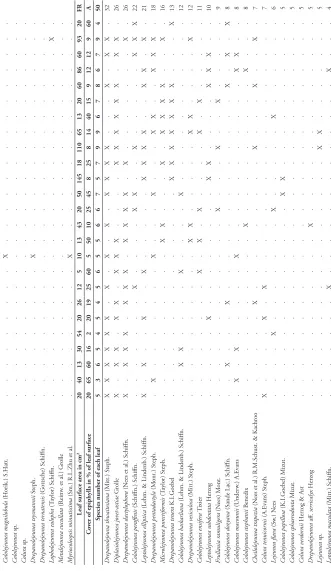
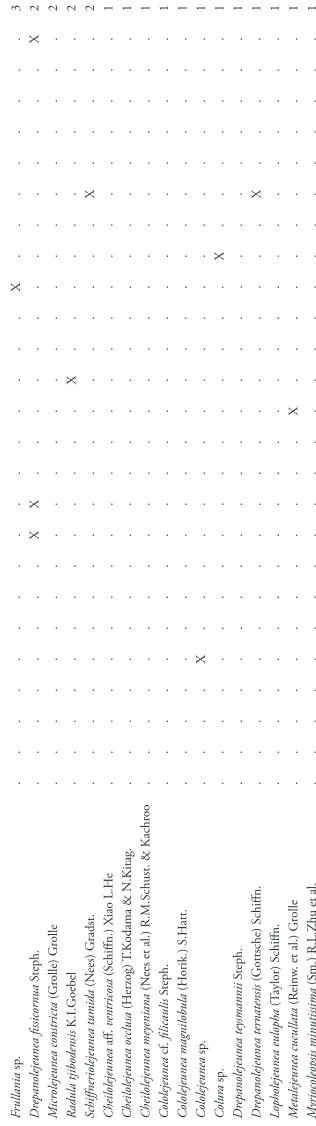
Table 1 shows the enumeration of rainforest habitats visited during the period of 30 July to 17 August, 2018 in which epiphyllous liverworts were collected. In Tables 2–4,
each column represents the epiphyll flora of one leaf. The leaf area in cm2 and the
number of species of each leaf are indicated. The X and + symbols mean presence only, while the black dots in Table 3 indicate the dominant species on each leaf. The species
Table 1. The three investigated habitats in the present study.
Locality Forest type GPS coordinates Elevation (m)
Table 2. 1822. Ulu Senagang Substation, Crocker
Range Park, Keningau district Lowland rainforest below waterfalls, with 50 m high canopy of Dipterocarpaceae 05°21.776'N, 116°01.713'E 525–570
Table 3. 1811. Mt. Silam, Sapagaya Forest Reserve,
22 km WSW of Lahad Datu district, from the telecommunication towers to the
sum-mit ridge of Mt. Silam
Lower montane rainforest with 15–20 m high canopy with Shorea tenuiramulosa
and Borneodendron enigmaticum.
04°57'12"N, 118°9'39"E 600–740
Table 4. 1823. Mt. Alab Substation, Crocker
Range Park, Tambunan district Mossy cloud (elfin) forest, about 6 m high canopy of Phyllocladus hypophyllus, Rhodo-dendron, Dacrydium and Nepenthes spp.
Tab
le 2.
The epiphyllous communities in U
lu S
enagang, a lo
wland tr
opical rainfor
est at 525–570 m elev
ation.
Leaf sur
face ar
ea in cm
2 130 44 120 150 38 145 115 46 17 70 120 30 42 96 45 240 130 12 230 14 44 13 85 41 70 Co
ver of epiphylls in % of leaf sur
face 5 25 70 2 20 10 40 4 15 30 18 7 12 18 40 9 5 55 8 40 50 65 8 18 20
Species number of each leaf
8 5 10 4 6 5 8 4 5 9 8 6 4 4 8 5 6 3 4 4 3 5 7 2 6 Leptolejeunea epiphylla (M itt.) S teph. . . X X X X X . X . X . . X X . . . X X X . X . X Leptolejeunea maculata (M itt.) Schiffn. X X . X X . X X X X X X X X . X . . X X . . X X . Cololejeunea planissima (M itt.) A beyw . X . X X X X . . . X X . . . X X X X X X . . . . X Cololejeunea gottschei (S teph.) M izut. X . . . X . . . X X . X X . . X X X . X . . X . X Lejeunea sp. . . . . . . . . . . . . . . . X . X . . X . . . . Dr epanolejeunea tener a K.I.G oebel . . X . . . X X . . X X . X . X . . . . . . X . X Cheilolejeunea tr apezia (N
ees) R.M.Schust. & Kachr
oo . . X . . . X . . X . . X . . . . . . . . X . . . Cololejeunea lanciloba S teph. . X . . . . . . X . . . . . . . X . X . . . X . . Cololejeunea longifolia (M itt.) M izut. . . . . . . . X . X X . . X . . . . . . . . . . . Leptolejeunea vitr ea (N ees) Schiffn. X . X . . X X X . . X . . . . . . . . . . . . . . M icr olejeunea punctifor mis T aylor (S teph.) . . . . . . . . . . . . . . . . . . . . . X . . . Cololejeunea hildebr andii (A ustin) S teph. . . X . . . . . . . . . . . X . . . . . . . . . . Cololejeunea peponifor mis M izut. . . . . . . . . . X . . . . X . . . . . . . . . . Dr epanolejeunea pentadactyla (M ont.) S teph. . . . . . X . . X X . X X . . . . . . . . . . . . Lejeunea sp .2 X X . . X . X . . . . X . . . . . . . . . . . . . C audalejeunea r eniloba (G ottsche) S teph. . . . . . . . . . . . X . . . . X . . . . . X . . Cololejeunea tenella B enedix . X . . X . X . . X . . . . . . . . . . . . . . . Colur a acr oloba (S teph.) Ast . . X X . . X . . X . . . . . . . . . . . . . . . Fr ullania sp. . . . . . . . . . . . . . . X . X . . . . . . . . Lopholejeunea subfusca (N ees) Schiffn. . . . . . . . . . . X . . . . . . . . . . X . . . Cololejeunea acuminata M izut. X . . . . . . . . . . . . . . . . . . . . . . . . Cololejeunea r aduliloba S teph. . . . . . . . . . . . . . . . . . . . . X . . X X Dr epanolejeunea v esiculosa (M itt.) S teph. . . . . . . . . . . . . . . . . . . . . . X . . . Leptolejeunea elliptica
(Lehm. & Lindenb
.) Schiffn. . X . . . X . . . . . . . . . . . . . . . . X . . Cheilolejeunea ( Cyr tolejeunea ?) X . X . . . . . . . . . . . . . . . . . . . . . . Colur a conica (S
ande Lac.) K.I.G
oebel X . X . . . . . . . . . . . . . . . . . . . . . . Colur a cor ynophor a (N
ees et al.)
Tr evis . . . . . . . . . . X . . . X . . . . . . . . . . Leptolejeuna ligulata H er zog . . . . . . . . . . . . . . X . . . . . . . . . . Leptolejeunea tripuncta (M itt.) S teph. . . . . . . . . . . . . . . . . . . . . . . . . X Cheilolejeunea inter texta (Lindenb .) S teph. . . . . . . . . . . . . . . . . . . . . . . . . . Cheilolejeunea vittata (G.H
offm.) R.M.Schust & Kachr
oo . . . . . . . . . . . . . . . . . . . . . . . . . Cololejeunea aff. schmidtii Steph. . . . . . . . . . . . . . . . . . . . . . . . . . Cololejeunea stylosa (S teph.) M izut. . . . . . . . . . . . . . . . . X . . . . . . . . Colur a superba (M ont.) S teph. . . . . . . . . . . . . . . . . . . . . . X . . . Colur a or nata K.I.G oebel . . . . . . . . . . . . . . X . . . . . . . . . . Lejeunea flav a (S w.) N ees . . X . . . . . . . . . . . . . . . . . . . . . . Lopholejeunea nigricans (Lindenb .) Schiffn. . . . . . . . . . . . . . . . . . . . . . . . . . M icr olejeunea filicuspis (S teph.) H
einrichs et al.
Leaf sur
face ar
ea in cm
2 23 70 120 50 66 63 36 90 27 42 98 56 240 66 44 39 44 100 28 38 17 20 28 100 75 B Co
ver of epiphylls in % of leaf sur
face 12 6 5 6 7 8 30 8 28 24 60 5 3 30 14 10 5 30 4 16 12 30 7 9 45 50
Species number of each leaf
5 5 6 4 4 4 6 8 1 3 3 4 5 3 9 9 10 5 4 3 7 3 5 5 4 Leptolejeunea epiphylla (M itt.) S teph. X . X . X X . X . X X X X X X X . X . X X X X X X 32 Leptolejeunea maculata (M itt.) Schiffn. X X X . X X . X . X . . X . X X X . . . X . X X X 32 Cololejeunea planissima (M itt.) A beyw . . X X . . . . . . . . . . . . X . X X X X . . X . 22 Cololejeunea gottschei (S teph.) M izut. X X X . . . . . . . . . . . X X X . . . X . . . . 19 Lejeunea sp. X . . . X X X X . . . X X . . X X . X X X X X . X 18 Dr epanolejeunea tener a K.I.G oebel . . . X . . . X . . . . . . X . X X . . X . X . . 16 Cheilolejeunea tr apezia (N
ees) R.M.Schust. & Kachr
oo . . . . . . X X X . . X . X X X X X . . . X . . . 15 Cololejeunea lanciloba S teph. X . X X . . . . . . . X X . . . X . . . . . . . . 11 Cololejeunea longifolia (M itt.) M izut. . . . X . X . . . . . . . X X . . . X . X . X . . 11 Leptolejeunea vitr ea (N ees) Schiffn. . . . . . . . . . X X . . . . . . . . . . . . . . 8 M icr olejeunea punctifor mis T aylor (S teph.) . . . . . . X X . . . . . . X . X . . . . . . . X 6 Cololejeunea hildebr andii (A ustin) S teph. . . . . . . . . . . X . . . . X . . X . . . . X . 5 Cololejeunea peponifor mis M izut. . . X . . . . . . . . . . . . X X . . . . . . . . 5 Dr epanolejeunea pentadactyla (M ont.) S teph. . . . . . . . . . . . . . . . . . . . . . . . . . 5 Lejeunea sp .2 . . . . . . . . . . . . . . . . . . . . . . . . . 5 C audalejeunea r eniloba (G ottsche) S teph. . . . . . . X . . . . . . . . . . . . . . . . . . 4 Cololejeunea tenella B enedix . . . . . . . . . . . . . . . . . . . . . . . . . 4 Colur a acr oloba (S teph.) Ast . . . . . . . . . . . . . . . . . . . . . . . . . 4 Fr ullania sp. . . . . . . . . . . . . . . . . X X . . . . . . . 4 Lopholejeunea subfusca (N ees) Schiffn. . X . . . . . X . . . . . . . . . . . . . . . . . 4 Cololejeunea acuminata M izut. . . . . . . X . . . . . . . X . . . . . . . . X . 3 Cololejeunea r aduliloba S teph. . . . . . . . . . . . . . . . . . . . . . . . . . 3 Dr epanolejeunea v esiculosa (M itt.) S teph. . . . . . . X X . . . . . . . . . . . . . . . . . 3 Leptolejeunea elliptica
(Lehm. & Lindenb
.) Schiffn. . . . . . . . . . . . . . . . . . . . . . . . . . 3 Cheilolejeunea ( Cyr tolejeunea ?) . . . . . . . . . . . . . . . . . . . . . . . . . 2 Colur a conica (S
ande Lac.) K.I.G
oebel . . . . . . . . . . . . . . . . . . . . . . . . . 2 Colur a cor ynophor a (N
ees et al.)
Tr evis . . . . . . . . . . . . . . . . . . . . . . . . . 2 Leptolejeuna ligulata H er zog . . . X . . . . . . . . . . . . . . . . . . . . . 2 Leptolejeunea tripuncta (M itt.) S teph. . X . . . . . . . . . . . . . . . . . . . . . . . 2 Cheilolejeunea inter texta (Lindenb .) S teph. . . . . . . . . . . . . . . . X . . . . . . . . . 1 Cheilolejeunea vittata (G.H
offm.) R.M.Schust & Kachr
oo . . . . . . . . . . . . X . . . . . . . . . . . . 1 Cololejeunea aff. schmidtii Steph. . . . . X . . . . . . . . . . . . . . . . . . . . 1 Cololejeunea stylosa (S teph.) M izut. . . . . . . . . . . . . . . . . . . . . . . . . . 1 Colur a superba (M ont.) S teph. . . . . . . . . . . . . . . . . . . . . . . . . . 1 Colur a or nata K.I.G oebel . . . . . . . . . . . . . . . . . . . . . . . . . 1 Lejeunea flav a (S w.) N ees . . . . . . . . . . . . . . . . . . . . . . . . . 1 Lopholejeunea nigricans (Lindenb .) Schiffn. . . . . . . . . . . . . . . X . . . . . . . . . . 1 M icr olejeunea filicuspis (S teph.) H
einrichs et al.
Tab
le 3.
The epiphyllous communities in Mt S
ilam, a
lo
w
er montane rainfor
est at 600–740 m elev
ation.
Leaf sur
face ar
ea in cm
2 33 100 50 63 100 62 42 94 68 25 25 65 100 57 48 26 25 72 130 65 110 52 85 19 21 Co
ver of epiphylls in % of leaf sur
face 60 85 35 65 18 16 30 28 30 15 18 38 28 80 35 40 18 8 30 48 12 30 65 45 2
Species number of each leaf
2 4 9 5 8 6 11 7 9 4 8 3 6 5 4 2 3 4 8 3 11 4 6 2 3 Dr epanolejeunea tricor nua H er zog ● + + ● ● . ● ● ● . . ● ● + ● ● . + ● ● ● ● ● ● . Dr epanolejeunea pentadactyla (M ont.) S teph. . . + . + . + + . . . + + ● + + . . ● . + . . . . Leptolejeunea aff. balansae Steph. . . + + + ● + . + . . . + . + . . + + . + . . + + Cheilolejeunea tr apezia (N
ees) R.M.Schust. & Kachr
oo . + + + + + + . . . . + ● . . . . . + + + + + . . Leptolejeunea amphiophthalma Z wickel . . + . + . . . . . . . + + . . + . + . + . . . . Colur a cor ynophor a (N
ees et al.)
Tr evis . . . . . . . . + . . . . . . . . . . . + . . . . Cololejeunea mutabilis Benedix . . . . . . + + . + + . . . . . . + . . + + + . . Colur a conica (S
ande Lac.) K.I.G
oebel . . . . . + . . . . . . . . . . . . + . . + . . . Colur a sp. . + + + + . + + . . . . . . . . . . . . . . . . . Dr epanolejeunea dactylophor a (N
ees et al.) Schiffn.
+ ● ● + . . . . + + . . . . . . . . . . . . . . . Cololejeunea equialbi Tixier . . . . . . . . + + + . . . . . + . . . + . + . . Cololejeunea metzgeriopsis (K.I.G oebel) G
radst. et al.
. . + . + . . . . . . . . . . . . . + . + . . . . M etalejeunea cucullata (R einw
. et al.) G
rolle . . . . + + + + . . . . . . . . . . . . . . . . . Colur a superba (M ont.) S teph. . . . . . . . . . . . . . . . . . . . . . . . . . Cololejeunea stylosa (S teph.) M izut. . . . . . . . . . . . . . . . . . . . . + . . . . Colur a cristata Ast . . . . . + . . + . . . . . . . ● . . . . . . . . M icr olejeunea lunulatiloba H orik. . . . . . . . . . . . . . . . . . . . . . . . . . M icr olejeunea punctifor mis (T aylor) S teph. . . . . . . + + + . + . . . . . . . . . . . . . . Tuyamaella serr atistipa S.H att. . . . . . . . . . . . . . . . . . . + . . . . . . Cheilolejeunea par videns B.M.Thiers . . . . . . . . . . . . + . . . . . . + . . + . . Lejeunea papilionacea Prantl. . . . . . . . . . . . . . . . . . + . . . . . . . Cheilolejeunea v entricosa
(Schiffn.) Xiao L.H
e . . . . . . . . + . . . . + . . . . . . . . . . . Cololejeunea papillosa (K.I.G oebel) M izut. . . . . . . . . . . . . . . . . . . . . . . + . + Colur a maxima Ast . . . . . . . . + . . . . . . . . . . . . . . . . Fr ullania apiculata (R einw
. et al.) D
umor t. . . . . . . . . . . + . . . . . . . . . . . . . . Lejeunea exilis (R einw
. et al.) G
rolle . . . . . . . . . . + . . . . . . . . . . . . . . Lejeunea micholitzii G rolle . . . . . . . . . . + . . . . . . . . . . . . . . Leptolejeunea aff. punctata H er zog . . . . . . . . . . . . . . . . . . . . . . . . . Acr omastigum bancanum (S
ande Lac.) A.E
vans . . . . . . . . . . ● . . . . . . . . . . . . . . Cheilolejeunea ceylanica (G ottsche) R.M.Schust. . . . . . . . . . . + . . . . . . . . . . . . . . Cheilolejeunea inter texta (Lindenb .) S teph. . . . . . . + . . . . . . . . . . . . . . . . . . Cheilolejeunea mey eniana (N
ees et al.) R.M.Schust. & Kachr
oo . . . . . . . . . . . . . . + . . . . . . . . . . Cheilolejeunea occlusa (H er zog) T.K
odama & N.Kitag.
. . . . . . + . . . . . . . . . . . . . . . . . . Cheilolejeunea trifaria (R einw
. et al.) M
Cheilolejeunea sp. . . . . . . . . . . . . . . . . . . . . . . . . . Cololejeunea haskar liana
(Lehm. & Lindenb
.) Schiffn. . . . . . . . . . . . . . . . . . . . . . . . . . Cololejr unea obliqua (N
ees & M
ont.) Schiffn. . . . . . . + . . . . . . . . . . . . . . . . . . Colur a acr oloba (S teph.) Ast . . . . . . . . . . . . . . . . . . . . + . . . . Colur a aff. mosenii S teph. . . . . . + . . . . . . . . . . . . . . . . . . . Diplasiolejeunea cavifolia Steph. . . . . . . . . . . . . . . . . . . . . . . . . + Diplasiolejeunea sp. . . . . . . . . . . . . . . . . . . . . . . . . . Dr epanolejeunea longicor nua (H er zog) M izut. . . ● . . . . . . . . . . . . . . . . . . . . . . Dr
epanolejeunea serricalyx
H er zog . . . . . . . . . . . . . + . . . . . . . . . . . Dr epanolejeunea ter natensis (G ottsche) Schiffn. . . . . . . . . . . . . . . . . . . . . . . . . . Lejeunea cf. tuber culosa Steph. . . . . . . . . . . . . . . . . . . . . . . . . . Lepidolejeunea bidentula (S teph.) R.M.Schust. . . . . . . . . . + . . . . . . . . . . . . . . . Leptolejeunea elliptica
(Lehm. & Lindenb
.) Schiffn. . . . . . . . + . . . . . . . . . . . . . . . . . Leaf sur face ar
ea in cm
2 90 52 150 150 55 160 106 120 136 130 45 65 42 110 8 41 16 36 19 155 72 20 15 120 120 50 Co
ver of epiphylls in % of leaf sur
face 25 55 5 5 55 20 15 8 10 45 50 35 70 6 12 40 60 18 15 5 20 40 30 15 5
Species number of each leaf
4 5 6 4 4 7 3 4 5 3 1 4 3 3 4 6 3 4 6 9 4 4 2 4 1 Dr epanolejeunea tricor nua H er zog ● + . . ● ● ● . ● ● ● ● ● . ● ● ● ● . . . ● ● . + 37 Dr epanolejeunea pentadactyla (M ont.) S teph. + ● ● . ● + ● + + . . + + . . + + + . . . + + . . 26 Leptolejeunea aff. balansae Steph. . . . ● + . + + + . . . . ● . + + + . ● ● + . ● . 26 Cheilolejeunea tr apezia (N
ees) R.M.Schust. & Kachr
oo + . + . + . . . + + . + . . . + . . . + . . . . . 21 Leptolejeunea amphiophthalma Z wickel . . . . . + . . . . . . . . . + . . + . . . . . . 10 Colur a cor ynophor a (N
ees et al.)
Tr evis . + . . . + . ● . + . . + . . + . . + . . . . . . 9 Cololejeunea mutabilis Benedix . . . . . . . . . . . . . . . . . . . . . . . . . 8 Colur a conica (S
ande Lac.) K.I.G
oebel . . . . . . . . . . . . . + . . . . + + . . . + . 7 Colur a sp. . + . . . . . . . . . . . . . . . . . . . . . . . 7 Dr epanolejeunea dactylophor a (N
ees et al.) Schiffn.
. . . . . . . . . . . . . . . . . . . + . . . . . 7 Cololejeunea equialbi Tixier . . . . . . . . . . . . . . . . . . . . . . . . . 6 Cololejeunea metzgeriopsis (K.I.G oebel) G
radst. et al.
+ . . . . . . . . . . . . . . . . + . . . . . . . 6 M etalejeunea cucullata (R einw
. et al.) G
rolle . + . . . . . . . . . . . . . . . . . + . . . . . 6 Colur a superba (M ont.) S teph. . . . + . + . + . . . . . . . . . . . + . . . + . 5 Cololejeunea stylosa (S teph.) M izut. . . . + . + . . . . . . . . . . . . . . . . . + . 4 Colur a cristata Ast . . . . . . . . . . . . . . + . . . . . . . . . . 4 M icr olejeunea lunulatiloba H orik. . . + + . . . . . . . + . . . . . . . . + . . . . 4 M icr olejeunea punctifor mis (T aylor) S teph. . . . . . . . . . . . . . . . . . . . . . . . . . 4 Tuyamaella serr atistipa S.H att. . . . . . + . . + . . . . . . . . . . . . + . . . 4 Cheilolejeunea par videns B.M.Thiers . . . . . . . . . . . . . . . . . . . . . . . . . 3 Lejeunea papilionacea Prantl. . . ● . . . . . . . . . . . + . . . . . . . . . . 3 Cheilolejeunea v entricosa
(Schiffn.) Xiao L.H
Colur a maxima Ast . . . . . . . . . . . . . . . . . . + . . . . . . 2 Fr ullania apiculata (R einw
. et al.) D
umor t. . . . . . . . . . . . . . . . . . . + . . . . . . 2 Lejeunea exilis (R einw
. et al.) G
rolle . . + . . . . . . . . . . . . . . . . . . . . . . 2 Lejeunea micholitzii G rolle . . . . . . . . . . . . . + . . . . . . . . . . . 2 Leptolejeunea aff. punctata H er zog . . . . . . . . . . . . . . . . . . + + . . . . . 2 Acr omastigum bancanum (S
ande Lac.) A.E
vans . . . . . . . . . . . . . . . . . . . . . . . . . 1 Cheilolejeunea ceylanica (G ottsche) R.M.Schust. . . . . . . . . . . . . . . . . . . . . . . . . . 1 Cheilolejeunea inter texta (Lindenb .) S teph. . . . . . . . . . . . . . . . . . . . . . . . . . 1 Cheilolejeunea mey eniana (N
ees et al.) R.M.Schust. & Kachr
oo . . . . . . . . . . . . . . . . . . . . . . . . . 1 Cheilolejeunea occlusa (H er zog) T.K
odama & N.Kitag.
. . . . . . . . . . . . . . . . . . . . . . . . . 1 Cheilolejeunea trifaria (R einw
. et al.) M
izut. . . ● . . . . . . . . . . . . . . . . . . . . . . 1 Cheilolejeunea sp. . . . . . . . . . . . . . . . . . . . . + . . . . 1 Cololejeunea haskar liana
(Lehm. & Lindenb
.) Schiffn. . . . . . . . . . . . . . . + . . . . . . . . . . 1 Cololejr unea obliqua (N
ees & M
ont.) Schiffn. . . . . . . . . . . . . . . . . . . . . . . . . . 1 Colur a acr oloba (S teph.) Ast . . . . . . . . . . . . . . . . . . . . . . . . . 1 Colur a aff. mosenii S teph. . . . . . . . . . . . . . . . . . . . . . . . . . 1 Diplasiolejeunea cavifolia Steph. . . . . . . . . . . . . . . . . . . . . . . . . . 1 Diplasiolejeunea sp. . . . . . . . . . . . . . . . . . . . + . . . . . 1 Dr epanolejeunea longicor nua (H er zog) M izut. . . . . . . . . . . . . . . . . . . . . . . . . . 1 Dr
epanolejeunea serricalyx
H er zog . . . . . . . . . . . . . . . . . . . . . . . . . 1 Dr epanolejeunea ter natensis (G ottsche) Schiffn. . . . . . . . . . . . . . . . . . . . + . . . . . 1 Lejeunea cf. tuber culosa Steph. . . . . . . . . . . . . . . . . . . . . + . . . . 1 Lepidolejeunea bidentula (S teph.) R.M.Schust. . . . . . . . . . . . . . . . . . . . . . . . . . 1 Leptolejeunea elliptica
(Lehm. & Lindenb
Tab
le 4.
The epiphyllous communities in Mt. Alab
, a mossy cloud (elfin) for
est at 1900–1940
m elev
ation.
Leaf sur
face ar
ea in cm
2 100 75 72 100 60 60 70 35 80 63 36 100 35 16 67 22 27 50 15 60 36 207 41 26 120 Co
ver of epiphylls in % of leaf sur
face 30 12 30 28 15 40 70 40 20 25 30 8 30 45 8 15 18 14 55 30 30 25 65 65 2
Species number of each leaf
10 7 5 8 10 8 70 4 6 11 7 9 6 7 4 4 5 7 8 8 4 13 7 9 4 Dr epanolejeuna thwaitesiana (M itt.) S teph. X X . . X X X X . X X X X . X . X X X . . X X . . Diplasiolejeunea jo vet-astiae G rolle X X . X . X . . X X . X . X . . X . X . . X . . . Dr epanolejeunea dactylophor a (N
ees et al.) Schiffn.
. . . X . . X . . X X X X . X X X . X X . . X . X Cololejeunea per affinis (Schiffn.) Schiffn. . X . . X X X . . X X . X X . X . X X X . X X X X Leptolejeunea elliptica
(Lehm. & Lindenb
.) Schiffn. . X X . X . X X X . . . . . . . . X . X . . . . X Dr epanolejeunea pentadactyla (M ont.) S teph. X . X X . . X X . . X X . . . . . . X . X X . . . M icr olejeunea punctifor mis (T aylor) S teph. X . . . X . . . X X . X . . . . . . . X . X . X . Dr epanolejeunea tener a K.I.G oebel . . . . X . . . X . X . . . . . X . . X . . . X . Cololejeunea haskar liana
(Lehm. & Lindenb
.) Schiffn. . . X . . . X . . . X . . . . X . . X . X . X X . Dr epanolejeunea v esiculosa (M itt.) S teph. X . . X . X . . . . . X X X . . . . X . . . . . . Cololejeunea ensifer a Tixier . X . . . . . . . X . . X . . X . . . . . . X . X Leptolejeunea subdentata H er zog . . X . X X . . X . . . . . . . . . . . . . . . . Fr ullania r amuliger a (N ees) M ont. X . . X . . . . . . . X . X . . . X . . . X . . . Cololejeunea dozyana (S
ande Lac.) Schiffn.
. . . X . X . . . X . . . . . . . . . . . X . . . Cololejeunea macounii (U nder w.) A.E vans . . . . X . . . . . . . . . X . X . . . . . . . . Cololejeunea stephanii Benedix . X X . . . . . X . . . . . X . . . . . . . X . . Cheilolejeunea tr apezia (N
ees et al.) R.M.Schust. & Kachr
oo . . . . . . . . . . . . . . . . . X . . . X . X . Colur a tenuicor nis (A.E vans) S teph. . . . X X . . X . . . . . . . . . X . . . . . . . Lejeunea flav a (S w.) N ees X . . . X . . . . . . . . X . . . . . . . . . . . Cololejeunea papillosa (K.I.G oebel) M izut. . . . . . X . . . . . . . . . . . . . . . X . X . Cololejeunea sphaer odonta M izut. . . . . . . X . . . X . . . . . . . X . X X . . . Colur a v er dor nii H er
zog & Ast
. X . . X X . . . . . . . . . . . X . . . X . . . Dr epanolejeunea aff. serricalyx H er zog . . . . . . . . . . . X X . . . . . . X . . X . . Lejeunea sp. X . . . . . . . . . . . . . . . . . . . . X . X . Leptolejeunea maculata (M itt.) Schiffn. . . . X . . . . . . . . . . . . . . . . . X . . . Fr ullania sp. X . . . . . . . . . . . . X . . . . . . . . . . . Dr epanolejeunea fissicor nua Steph. . . . . . . . . . . . . . . . . . . . . . . . . . M icr olejeunea constricta (G rolle) G rolle X . . . . . . . . . . . . . . . . . . X . . . . . Radula tjibodensis K.I.G oebel . . . . . . . . . . . . . . . . . . . . X . . . . Schiffneriolejeunea tumida (N ees) G radst. . . . . . . . . . X . . . . . . . . . . . . . . . Cheilolejeunea aff. v entricosa
(Schiffn.) Xiao L.H
e . . . . . . . . . . . . . . . . . . . X . . . . . Cheilolejeunea occlusa (H er zog) T.K
odama & N.Kitag.
. . . . . . . . . . . X . . . . . . . . . . . . . Cheilolejeunea mey eniana (N
ees et al.) R.M.Schust. & Kachr
Cololejeunea magnilobula (H orik.) S.H att. . . . . . . . . . X . . . . . . . . . . . . . . . Cololejeunea sp. . . . . . . . . . . . . . . . . . . . . . . . . . Colur a sp. . . . . . . . . . . . . . . . . . . . . . . . . . Dr epanolejeunea teysmannii Steph. . . . . . . . . . X . . . . . . . . . . . . . . . Dr epanolejeunea ter natensis (G ottsche) Schiffn. . . . . . . . . . . . . . . . . . . . . . . . . . Lopholejeunea eulopha (T aylor) Schiffn. . . . . . . . . . . . . . . . . . . . . . . . X . M etalejeunea cucullata (R einw
. et al.) G
rolle . . . . . . . . . . . . . . . . . . . . . . . . . M yriocoleopsis minutissima (S
m.) R.L.Zhu et al.
. . . . . . . . . X . . . . . . . . . . . . . . . Leaf sur face ar
ea in cm
2 20 40 13 30 54 20 26 12 5 10 13 43 20 50 145 18 110 65 13 20 60 86 60 93 20 FR Co
ver of epiphylls in % of leaf sur
face 20 65 60 16 2 20 19 25 60 5 50 10 25 45 8 25 8 14 40 15 9 12 12 9 60 A
Species number of each leaf
5 3 6 5 4 5 4 5 6 5 5 6 6 7 5 7 9 9 6 7 8 6 7 9 4 50 Dr epanolejeuna thwaitesiana (M itt.) S teph. X X X X X X . X . X . X . X X X X . . . X . X X . 32 Diplasiolejeunea jo vet-astiae G rolle X . X X . X X . X X X . . . . X X X X X X . X X . 26 Dr epanolejeunea dactylophor a (N
ees et al.) Schiffn.
X . X X X . X X X . X X X X . X . . . . . . . X . 26 Cololejeunea per affinis (Schiffn.) Schiffn. . . . . . . . X . . . . X X . . X . . . . . X X X 22 Leptolejeunea elliptica
(Lehm. & Lindenb
.) Schiffn. X . X . . X . . X . . . . . X X X X . . X X . X . 21 Dr epanolejeunea pentadactyla (M ont.) S teph. . X . . . . . . . X . . . X . . . X X . . X X X . 18 M icr olejeunea punctifor mis (T aylor) S teph. . . . . . . . . . . X X . . . X . X X X X . . X . 16 Dr epanolejeunea tener a K.I.G oebel . . . . . . . . . . . . . . X X X X X X X . . . X 13 Cololejeunea haskar liana
(Lehm. & Lindenb
.) Schiffn. . . X X . . . . X . . . . X . . . . . . . . . . . 12 Dr epanolejeunea v esiculosa (M itt.) S teph. . . . . . . . . . . X X . . . . . X X . . . . X . 12 Cololejeunea ensifer a Tixier . . . . . . . . X . X . X . . . . X . X . . . . . 11 Leptolejeunea subdentata H er zog . . . . . X . . . . . . . . X X . . . . X X X . . 10 Fr ullania r amuliger a (N ees) M ont. . . . . . . . . . . . . X . . . X . . X . . . . . 9 Cololejeunea dozyana (S
ande Lac.) Schiffn.
. . X . . . X . . . . . . . . . . . . . X . X . X 8 Cololejeunea macounii (U nder w.) A.E vans . X . X . . . . . X . . . . . . . . . . . X X . . 8 Cololejeunea stephanii Benedix . . . . . . . . . . . X . . . . . . . . . X . . . 8 Cheilolejeunea tr apezia (N
ees et al.) R.M.Schust. & Kachr
oo . . . . . . X . . . . . . . . . X . . . X . . X . 7 Colur a tenuicor nis (A.E vans) S teph. X . . . . X . X . . . . . . . . . . . . . . . . . 7 Lejeunea flav a (S w.) N ees . . . . X . . . . . . . X . . . . . X . . . . . . 6 Cololejeunea papillosa (K.I.G oebel) M izut. . . . . . . . . . . . . . X X . . . . . . . . . . 5 Cololejeunea sphaer odonta M izut. . . . . . . . . . . . . . . . . . . . . . . . . . 5 Colur a v er dor nii H er
zog & Ast
Fr
ullania
sp.
.
.
.
.
.
.
.
.
.
.
.
.
.
.
.
.
X
.
.
.
.
.
.
.
.
3
Dr
epanolejeunea fissicor
nua
Steph.
.
.
.
.
.
.
.
.
X
X
.
.
.
.
.
.
.
.
.
.
.
.
.
.
X
2
M
icr
olejeunea constricta
(G
rolle) G
rolle
.
.
.
.
.
.
.
.
.
.
.
.
.
.
.
.
.
.
.
.
.
.
.
.
.
2
Radula tjibodensis
K.I.G
oebel
.
.
.
.
.
.
.
.
.
.
.
.
.
X
.
.
.
.
.
.
.
.
.
.
.
2
Schiffneriolejeunea tumida
(N
ees) G
radst.
.
.
.
.
.
.
.
.
.
.
.
.
.
.
.
.
.
.
.
X
.
.
.
.
.
2
Cheilolejeunea
aff.
v
entricosa
(Schiffn.) Xiao L.H
e
.
.
.
.
.
.
.
.
.
.
.
.
.
.
.
.
.
.
.
.
.
.
.
.
.
1
Cheilolejeunea occlusa
(H
er
zog)
T.K
odama & N.Kitag.
.
.
.
.
.
.
.
.
.
.
.
.
.
.
.
.
.
.
.
.
.
.
.
.
.
1
Cheilolejeunea mey
eniana
(N
ees et al.) R.M.Schust. & Kachr
oo
.
.
.
.
.
.
.
.
.
.
.
.
.
.
.
.
.
.
.
.
.
.
.
.
.
1
Cololejeunea
cf.
filicaulis
Steph.
.
.
.
.
.
.
.
.
.
.
.
.
.
.
.
.
.
.
.
.
.
.
.
.
.
1
Cololejeunea magnilobula
(H
orik.) S.H
att.
.
.
.
.
.
.
.
.
.
.
.
.
.
.
.
.
.
.
.
.
.
.
.
.
.
1
Cololejeunea
sp.
.
.
.
.
X
.
.
.
.
.
.
.
.
.
.
.
.
.
.
.
.
.
.
.
.
1
Colur
a
sp.
.
.
.
.
.
.
.
.
.
.
.
.
.
.
.
.
.
X
.
.
.
.
.
.
.
1
Dr
epanolejeunea teysmannii
Steph.
.
.
.
.
.
.
.
.
.
.
.
.
.
.
.
.
.
.
.
.
.
.
.
.
.
1
Dr
epanolejeunea ter
natensis
(G
ottsche) Schiffn.
.
.
.
.
.
.
.
.
.
.
.
.
.
.
.
.
.
.
.
X
.
.
.
.
.
1
Lopholejeunea eulopha
(T
aylor) Schiffn.
.
.
.
.
.
.
.
.
.
.
.
.
.
.
.
.
.
.
.
.
.
.
.
.
.
1
M
etalejeunea cucullata
(R
einw
. et al.) G
rolle
.
.
.
.
.
.
.
.
.
.
.
.
X
.
.
.
.
.
.
.
.
.
.
.
.
1
M
yriocoleopsis minutissima
(S
m.) R.L.Zhu et al.
.
.
.
.
.
.
.
.
.
.
.
.
.
.
.
.
.
.
.
.
.
.
.
.
.
1
Tab
le 4.
are arranged according to their frequency in the analysed communities. Table 5 shows the comparison of the three assemblages, their similarities and differences, in which species with at least 10% occurrence in Tables 2–4 are included only. Those with fre-quency less than 5 out of 50 are omitted.
Table 5.The comparison of the epiphyllous assemblages of three localities in terms of the number of
occurrences of constituting liverwort species.
Locality Ulu Senagang Mt. Silam Mt. Alab Total
Leptolejeunea maculata (Mitt.) Schiffn. 32 26 4 62
Drepanolejeunea pentadactyla (Mont.) Steph. 5 24 18 47
Cheilolejeunea trapezia (Nees et al.) R.M.Schust. & Kachroo 15 21 7 43
Microlejeunea punctiformis (Taylor) Steph. 6 4 16 26
Leptolejeunea elliptica (Lehm. & Lindenb.) Schiffn. 3 1 21 25
Leptolejeunea epiphylla (Mitt.) Steph. 32 . . 32
Cololejeunea planissima (Mitt.) Abeyw. 22 . . 22
Cololejeunea gottschei (Steph.) Mizut. 19 . . 19
Cololejeunea lanciloba Steph. 11 . . 11
Cololejeunea longifolia (Mitt.) Mizut. 11 . . 11
Leptolejeunea vitrea (Nees) Schiffn. 8 . . 8
Cololejeunea hildebrandii (Austin) Steph. 5 . . 5
Cololejeunea peponiformis Mizut. 5 . . 5
Colura corynophora (Nees et al.) Trevis 2 9 . 11
Colura conica (Sande Lac.) K.I.Goebel 2 6 . 9
Lejeunea sp. 2 5 1 . 6
Colura acroloba (Steph.) Ast 4 1 . 5
Colura superba (Mont.) Steph. 1 4 . 5
Drepanolejeunea tricornua Herzog . 37 . 37
Leptolejeunea amphiophthalma Zwickel . 11 . 11
Cololejeunea mutabilis Benedix . 8 . 8
Colura sp. . 7 . 7
Cololejeunea equialbi Tixier . 6 . 6
Cololejeunea metzgeriopsis (K.I.Goebel) Gradst. et al. . 6 . 6
Colura superba (Mont.) Steph. . 5 . 5
Drepanolejeunea tenera K.I.Goebel 16 . 13 29
Lejeunea sp. 18 . 5 23
Drepanolejeunea vesiculosa (Mitt.) Steph. 3 . 12 15
Frullania sp. 4 . 3 7
Lejeunea flava (Sw.) Nees 1 . 6 7
Drepanolejeunea dactylophora (Nees et al.) Schiffn. . 7 26 35 Cololejeunea haskarliana (Lehm. & Lindenb.) Schiffn. . 1 12 13
Metalejeunea cucullata (Reinw. et al.) Grolle . 6 1 7
Cololejeunea papillosa (K.I.Goebel) Mizut. . 2 5 7
Cheilolejeunea occlusa (Herzog) T.Kodama & N.Kitag. . 1 1 2
Drepanolejeuna thwaitesiana (Mitt.) Steph. . . 32 32
Diplasiolejeunea jovet-astiae Grolle . . 26 26
Cololejeunea peraffinis (Schiffn.) Schiffn. . . 22 22
Cololejeunea ensifera Tixier . . 11 11
Leptolejeunea subdentata Herzog . . 10 10
Frullania ramuligera (Nees) Mont. . . 9 9
Cololejeunea dozyana (Sande Lac.) Schiffn. . . 8 8
Cololejeunea macounii (Underw.) A.Evans . . 8 8
Cololejeunea stephanii Benedix . . 8 8
Colura tenuicornis (A.Evans) Steph. . . 7 7
Cololejeunea sphaerodonta Mizut. . . 5 5
Colura verdoornii Herzog & Ast . . 5 5
Species/leaf area relationships and beta diversity analyses
The number of species vs leaf area relationships are shown by the scatter plot in Fig. 2. Although the variance of the number of species per leaf is fairly high, there is a definite increase of species number over area. Since the number of points is large, and there-fore the degrees of freedom is also large (n = 148), the resulting Pearson correlation,
r = 0.22 with a probability point of p = 0.007, is a highly significant result. The
regres-sion equation is N = 0.01A + 4.93 in which N is the estimate of species number at leaf
area A expressed in cm2.
The entire data set was evaluated by centered principal component analysis. The first two ordination axes explain 14% and 10% of the total variance. Although these percentages may appear low at first sight, the biplot diagram for axes 1–2 (Fig. 3) is well-interpretable. The leaves from the three sites form separate clusters, oriented away from the origin in three directions. The three sites do not separate completely, the spe-cies-poor leaves are positioned around the centroid. The length and position of arrows indicate species that are most responsible for the differences between the three sites. It is seen that site number 1 in Fig. 3, i.e. Mt. Alab has a fairly large number of species
Figure 2. Leaf area (in cm2, x axis) – number of epiphyll liverwort species (y axis) relationship based on
Figure 3. The Principal Components ordination biplot of the three groups of epiphyllous assemblages, each containing 50 leaves. Numbers identify forest sites 1 mossy cloud (elfin) forest, Mt. Alab (Table 4)
2 lowland rainforest, Ulu Senagang (Table 2) 3 lower montane rainforest, Mt. Silam (Table 3).
that typically occur there, such as Diplasiolejeunea jovet-astiae Grolle, Drepanolejeunea
thwaitesiana (Mitt.) Steph., D. dactylophora (Nees, Lindenb. & Gottsche) Schiffn. and
Cololejeunea peraffinis (Schiffn.) Schiffn. Site 2 in Ulu Senagang is mostly characterized
by the presence of Leptolejeunea epiphylla (Mitt.) Steph., Cololejeunea gottschei (Steph.)
Mizut. and C. planissima (Mitt.) Abeyw., whereas Drepanolejeunea tenera K.I.Goebel
occurs in both sites. In site 3 (Mt. Silam, a lower montane rainforest near to the sea,
exposed to rain carrying winds), Drepanolejeunea pentadactyla (Mont.) Steph. and D.
tricornua Herzog appear most typical. Most species are positioned near the origin,
showing that they are either relatively rare as Cololejeunea macounii (Underw.) A.Evans
or Colura superba (Mont.) Steph. or common to all the three sites like Leptolejeunea maculata (Mitt.) Schiffn.
di-versity (91%) of epiphyllous assemblages in the study sites, leaving only a 9% share by similarity (Fig. 4A). Beta diversity is dominated by turnover (species replacement, R = 66%) while richness difference (D) is 25%. Its graphical manifestation is that most of the points (each representing a pair of leaves) lie within or near the upper third of the triangle (R – replacement). The anti-nestedness fraction within beta diversity, cor-responding to points lying on the left edge of the triangle, is 11% – this is caused by pairs of leaves that do not have a single species in common. Nevertheless, quite many points lie on the bottom side, demonstrating that nestedness is also characteristic of the epiphyllous bryophyte assemblages – the species occurring in certain leaves are subsets of the species assemblage of other leaves (D + S – Anti-nestedness fraction = 22.5%). The three simplex diagrams obtained for the three forests (Fig. 4B–D) show that the very high overall beta diversity is not merely the result of between-site differences; their beta diversity is 81%, 80% and 80.5%, leaving 19–20% for the similarity component. That is, the liverwort assemblages on the leaves of rainforest trees are extremely diverse. A major difference between the sites is in the partitioning of beta in which species
Figure 4. Ternary (or simplex) plot for the epiphyllous liverwort assemblages based on presence-absence
data for three rainforest sites in Sabah A all sites taken together B mossy cloud (elfin) forest, Mt. Alab
replacement is the highest in the cloud forest, i.e. in Mt. Alab (60%), and the lowest in the lowland montane forest in Mt. Silam (50.5%). This explains why nestedness is much less conspicuous in the cloud forest than elsewhere in which only a few points fall onto the bottom side of the plot.
Conclusion
The overall conclusion is that the major component of pattern formation in epiphyl-lous liverwort assemblages from Sabah is species replacement (50–60% for individual forests, 66% for combined data), while richness difference is less pronounced (20– 25%). This is in contrast to the results of a study performed on similar assemblages in southern Thailand (Pócs and Podani 2015), where differences in species number were much more influential than species replacement (50% versus 37%). In any case, beta diversity – the sum of richness difference and species replacement – is extremely high in both studies, leaving only 10–20% similarity in the species composition of leaf surfaces. The ecological explanation is that the assemblage of a given leaf is likely to be formed by a random choice from the liverwort species pool of the forest, species follow one another haphazardly as allowed by the size of the leaf. In Sabah, the three forests selected for the present study were floristically very different, forming three clusters in the PCA ordination plane with a couple of characteristic species in each. Their separation was not sharp at all, species-poor leaves were arranged around the centroid regardless of their origin, and three sites were overlapping. Extended studies involving more forests from Malaysia, as well as from other areas in south-eastern Asia, may give further insight into the structure of this special type of plant communities.
Acknowledgements
This study was supported by the Ministry of Education (MOE) Malaysia through Fundamental Research Grant Scheme (FRGS/1/2018/WAB13/UMT/03/1), CRIM Universiti Malaysia Terengganu (TAPE-RG Fasa 1/2018), and Nagao Natural Envi-ronment Foundation (research grants awarded to G.E.Lee). We thank the Sabah Bio-diversity Council, Sabah Parks and Sabah Forestry Department for their support in obtaining permits and research permissions. Liverwort samples in Sabah were collected under SaBC access licence number JKM/MBS.1000-2/2 JLD.7 (107).
References