The identity of
Prunus dielsiana
(Rosaceae)
Baohuan Wu1, Daniel Potter2, Dafang Cui1
1 College of Forestry and Landscape Architecture, South China Agricultural University, Guangzhou 510642, China 2 Department of Plant Sciences, University of California, One Shields Avenue, Davis, CA 95616, USA
Corresponding author: Dafang Cui ([email protected])
Academic editor:A. Sennikov | Received 9 April 2019 | Accepted 1 June 2019 | Published 12 July 2019
Citation: Wu B, Potter D, Cui D (2019) The identity of Prunus dielsiana (Rosaceae). PhytoKeys 126: 71–77. https:// doi.org/10.3897/phytokeys.126.35305
Abstract
The valid publication date of Prunus dielsiana was found to be later than that of P. rufoides, which has been
considered a synonym of P. dielsiana. Prunus dielsiana is therefore reduced to a synonym of P. rufoides,
instead of the reverse. In addition, all previously named varieties of Prunus dielsiana, including var.
ab-breviata, var. conferta, and var. laxa, as well as P. carcharias are also listed as synonyms of P. rufoides in the present paper.
Keywords
Prunus rufoides, Prunus carcharias, taxonomy, typification, China
Introduction
Prunus L. subg. Cerasus A. Gray, a group commonly known as cherries, is historically
controversial in its taxonomy. As concluded by Wu et al. (2018), the taxonomy of this clade needs extensive study.
Prunus dielsiana C. K. Schneid. is a species widely distributed around central China
and east China (Li and Bartholomew 2003). While reviewing the protologue of this spe-cies of P. subg. Cerasus, P. dielsiana C. K. Schneid. was found to be an invalid name. This name first appeared in Schneider’s account in 1905. Schneider (1905) proposed a de-scription of a cherry collection, Wilson 308, which he determined as “Prunus szechuanica
var.?,” indicating his uncertainty about its identification. Schneider stated that should this collection be a new species or a distinct variety of Prunus szechuanica, he would have proposed to name it as “P. dielsiana” or rather “var. dielsiana”. Schneider set the varietal name in bold and also indicated acceptance of the varietal status by citing only “Prunus
http://phytokeys.pensoft.net
Copyright Baohuan Wu et al. This is an open access article distributed under the terms of the Creative Commons Attribution License (CC BY 4.0), which permits unrestricted use, distribution, and reproduction in any medium, provided the original author and source are credited.
Baohuan Wu et al. / PhytoKeys 126: 71–77 (2019)
72
szechuanica var. dielsiana” in the index. Prunus szechuanica var. dielsiana C. K. Schneid.
was therefore validly published while P. dielsiana C. K. Schneid. was invalid.
Prunus dielsiana was validly published seven years later by Koehne (1912), who
provided an entirely new description of the taxon. The name was ascribed to “Schnei-der in Fedde, Rep. Nov. Sp. I. 68 (1905)”, which should be treated as a reference to the basionym, and Koehne’s name should be considered as a new combination based on
Prunus szechuanica var. dielsiana C. K. Schneid..
Unaware of the fact mentioned above, Yü and Li (1986) published a combination,
Cerasus dielsiana (Schneid.) Yü et Li in “Flora Reipublicae Popularis Sinicae”, with a
di-rect reference to “Prunus dielsiana Schneider (Fedde, Rep. Nov. Sp. I. 68 1905)” rather than to the correct varietal name. Nevertheless, this reference satisfies the requirements of Art. 41.5 of International Code of Nomenclature for algae, fungi, and plants (ICN), and the errors in the basionym citation are correctable under Art. 41.6 (Turland et al. 2018). Yü et Li’s name should be recognized as a combination based on Prunus
sze-chuanica var. dielsiana C. K. Schneid. and should be cited as Cerasus dielsiana (C. K.
Schneid.) Yü et Li.
Most recently, Prunus rufoides C. K. Schneid. was listed as a synonym of Cerasus
dielsiana by Li and Bartholomew (2003). This is incorrect since P. rufoides C. K.
Sch-neid. was validly published in 1905, while the earliest homotypic species-level synonym
for C. dielsiana was published in 1912. Thus, Li and Bartholomew (2003) should have
listed C. dielsiana (C. K. Schneid.) Yü et Li as a synonym of P. rufoides C. K. Schneid. Three varieties have been published under Prunus dielsiana. Prunus dielsiana var.
conferta and P. dielsiana var. laxa were described by Koehne (1912), based on specimens
from western Hubei. They were thought to be different in their involucres (bracts sub-tending the inflorescence), with the involucres of P. dielsiana var. conferta described as erect and closed and those of P. dielsiana var. laxa described as open or sub-reflected. However, neither of these varieties was accepted as distinct in “Flora Reipublicae
Popula-ris Sinicae” (Yü and Li 1986) and “Flora of China” (Li and Bartholomew 2003), where
both were listed as synonyms of Cerasus dielsiana. In addition, P. dielsiana var. conferta
was based on the same type as P. szechuanica var. dielsiana, making it a later homotypic synonym that cannot be validly published under Art. 22.2 of ICN (Turland et al. 2018).
Prunus dielsiana var. abbreviata Cardot was described by Cardot (1920) based on
Cavalerie et Fortunat 2276 collected from Guizhou (Kouy-Tcheou). He stated that this
Prunus carcharias was described based on a leafy branch without flowers and fruit collected from China, Chongqing, Nanchuan County (Koehne 1912), and the name is still unresolved today (Li and Bartholomew 2003). This species was considered as a member of P. sect. Microcerasus (Spach) C. K. Schneid. by Koehne (1912) because its leaf shape and serration were very similar to P. nakaii H. Lév. (P. japonica var. nakaii
(H. Lév.) Rehder). However, we believe that this branch must represent an adventi-tious shoot of P. rufoides (Figure 2), a phenomenon commonly observed in Nanchuan. Leaf dimorphism often occurs in P. subg. Cerasus, such that the leaves on the adventi-tious shoots and summer shoots may be obviously different from typical leaves of the species. Therefore it is not advisable to describe new species of this clade based solely on differences in leaf morphology, and we consider P. carcharias Koehne to be a synonym
of P. rufoides.
Koehne cited three gatherings from Hubei, Wilson 37, Wilson 37a and Wilson 68, when describing P. dielsiana var. laxa. There are 12 sheets of these three gatherings that can be found in the Global Plant Database (JSTOR 2019), and we found that two
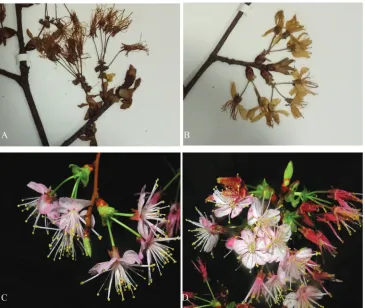
Figure 1. Variations of flora characters of Prunus rufoides. A (Zhou et Song 1405020, CSFI026575)
B (Zhou et Zhou 1403107, CSFI026572) specimens collected from Hunan, Suining County, Huangsang
Baohuan Wu et al. / PhytoKeys 126: 71–77 (2019)
74
Figure 2. Adventitious shoot of Prunus rufoides C. K. Schneid. (photograph by Dr. W. Y. Zhao).
sheets of Wilson 37a, both with identification slips from Koehne, were mixed species collections. One of them, HBG511107, contains a flowering branch of P. conradi-nae Koehne, while another one, US00623845, contains a leafy branch of P. tomentosa
Thunb. Therefore, a lectotype was selected in agreement with Art. 9.3 and Art. 9.14 of ICN (Turland et al. 2018).
Taxonomic treatment
Prunus rufoides C. K. Schneid., Repert. Spec. Nov. Regni Veg. 1: 55. 1905.
Type: China, Sichuan (Szetschwan), A. Henry 5780 (E [E00011284 image!], US [US00107992 image!]).
= Prunus szechuanica var. dielsiana C. K. Schneid., Repert. Spec. Nov. Regni Veg. 1: 68.
1905, syn. nov. ≡Prunus dielsiana (C. K. Schneid.) Koehne, Pl. Wilson. (Sargent) 1(2): 243. 1912 ≡ Prunus dielsiana var. conferta Koehne, Pl. Wilson. (Sargent) 1(2): 244. 1912, nom. inval. ≡Cerasus dielsiana (Koehne) Yü et Li in Fl. Reipubl. Popularis Sin. 38: 59. 1986.
Type: China, Hubei, Badong, April 1900, E. H. Wilson Veitch Exped. 308 (A [A00032048 image!], E [E00011281 image!], NY [NY00429944 image!], P [P01819046 image!]).
= Prunus carcharias Koehne, Pl. Wilson. (Sargent) 1(2): 267–268. 1912, syn. nov.
= Prunus dielsiana var. laxa Koehne, Pl. Wilson. (Sargent) 1(2): 208. 1912, syn. nov. Type: China, Hubei, Xingshan, 1907, E. H. Wilson 68 (lectotype designated here: A
[A00032051 image!]; isolectotype: A [A00032052 image!], E [E00011280 image!], HBG [HBG511108 image!], P[P01819047 image!], US [US00107951 image!]); China, Hubei, Badong, 1907, E. H. Wilson 37 (paratype: A [A00032049 image!], HBG [HBG511106 image!], US [US00623846 image!]); China, Hubei, Badong, 1907, E. H. Wilson 37a (paratype: A [A00032050 image!], HBG [HBG511107 in part, image!], US [US00623845 in part, image!]).
= Prunus dielsiana var. abbreviata Cardot, Notul. Syst. (Paris) 4(1): 29. 1920, syn. nov.
≡ Cerasus dielsiana var. abbreviata (Cardot) Yü et Li, Fl. Reipubl. Popularis Sin.
38: 59. 1986.
Type: China, Guizhou, Pingfa, 1905, Cavalerie et Fortunat, 2276 (syntype: P [P03357963 image!]); China, de la Touche 32 (syntype: E).
Acknowledgements
This study was supported by the National Natural Science Foundation of China (NSFC, 31370246). We are indebted to Dr. Wanyi Zhao and Dr. Huizhe Feng for the images of Prunus rufoides. We thank Dr. Kanchi Gandhi for his advice on nomenclatu-ral issues. And we thank Dr. Alexander Sennikov and Dr. Dezhu Li for their careful review of this work. We are also grateful to the curators of herbaria A, CDBI, CSFI, CSH, E, GH, GZAC, HBG, HGAS, IBK, IBSC, JJF, JXAU, NAS, NY, P, PE, SYS, US for access to the images of the specimens.
References
Cardot J (1920) Rosacées Nouvelles d'Extrême-Orient (Suite). Notulae Systematicae (Paris) 4: 20–34.
JSTOR (2019) Global Plants. https://plants.jstor.org [February 2, 2019]
Koehne BAE (1912) Prunus. In: Sargent CS (Ed.) Plantae Wilsonianae: an enumeration of the woody plants collected in western China for the Arnold arboretum of Harvard university during the years 1907, 1908, and 1910 by E.H. Wilson. The University press, Cambridge, 196–282.
Li CL, Bartholomew B (2003) Cerasus. In: Flora of China. Science Press & Missouri Botanical Garden Press, Beijing & St. Louis, 404–420.
Schneider CK (1905) Nonnullae Species Varietatesque Novae Asiae Orientalis Ad Gen-era Prunum et Padum Pertinentes. Repertorium Novarum Specierum Regni Vegetabilis 1(5/6): 65–71. https://doi.org/10.1002/fedr.19050010502
Baohuan Wu et al. / PhytoKeys 126: 71–77 (2019)
76
(Shenzhen Code) adopted by the Nineteenth International Botanical Congress Shenzhen, China, July 2017. Regnum Vegetabile 159. Glashütten: Koeltz Botanical Books. DOI https://doi.org/10.12705/Code.2018
Wang XR (2014) An Illustrated Monograph of Cherry Cultivars in China. Science Press, Bei-jing, 130–132.
Wu BH, Huang WX, Shi WT, Yang HJ, Cui DF (2018) Numerical taxonomy study on Prunus
L. subgenus Cerasus (Mill.) A. Gray in China. Acta Scientiarum Naturalium Universitatis Sunyatseni 57(1): 36–43.
Yü TT, Li CL (1986) Cerasus. Flora Reipublicae Popularis Sinicae. Science Press, Beijing, 41–89.
Appendix 1
Additional specimens examined: (The code of the herbaria and barcode numbers was proposed in the brackets) China, Chongqing: Beibei, Chuanqiandui 142 (PE 00773209), Chuanqiandui 189 (PE 00773212); Chengkou, R. P. Farges s. n. (P 03357965, P 03357966, P 03357967, P 03357968, P 03357969, P 03357970, P 03357971, P 03357972, P 03357973, P 03357974, P 03357975, P 03357976, P 03357977, P 03357978, P 04149089, P 04167989); Nanchuan, Zhengyu Liu15323 (P 03358066, PE 00773218), Jihua Xiong & Zilin Zhou 90010 (PE 00773198, PE 01438524), Jihua Xiong & Zilin Zhou 90016 (IBSC 0295268, IBSC 0295269, PE 00773216, PE 01438523), Jihua Xiong & Zilin Zhou 90679 (PE 00773217), ZhongguoxibukexueYuan 2867 (PE 00773196), ZhongguoxibukexueYuan 2877 (PE 00773211). Wushan, T. P. Wang 10628 (PE 00773197), Guanghui Yang 57654 (PE 00773204). Fujian: Ningde, Xiangxiu Su CSH15063 (CSH CSH0120724). Guangxi:
Rongshui, Yuanbaoshan-zonghe-kaochadui Y1334 (IBK IBK00226390). Guizhou:
Daozhen, Anonymous 16348 (PE 00773219); Jiangkou, Zhisong Zhang & Cheng-zhong Dang 400177 (HGAS 020949, PE 01296334, PE 01296335); Qianyang, Xue-gen Li 202823 (IBSC 0295265), XueXue-gen Li 202918 (IBSC 0295264), Peixiang Tan 60529 (IBSC 0295266); Suiyang, Kaimin Lan 90-0678 (GZAC GZAC0016518, GZAC GZAC0016519); Yinjiang, Mingtai An YJ-0101 (GZAC GZAC0016714).
CSFI CSFI011566, CSFI CSFI011567); Yongxing, Jianggeng Xiao 1008 (CSFI CSFI011574); Xinshao, Bangyi Li 6437 (PE 01438526); Yongshun, Hunannongx-ueYuan 3622 (PE 00773199). Jiangxi: Fengxin, Ceming Tan et al. 1506604 (JJF JJF00018547), Ceming Tan et al. 1506577 (JJF JJF00018548, JJF JJF00018549); Jin-ggangshan, Qiang Fan et al. JGS-1022 (SYS SYS00173104), Qiang Fan et al. JGS4004 (SYS SYS00172771), Qiang Fan et al. JGS4075 (SYS SYS00175310); Lichuan, Non-glinzhi 350 (JXAU JXAU0004787) Xiangxue Yang 650052 (IBSC 0295247); Pingxi-ang, Xinghua Shi 84004(JXAU JXAU0004770); Tonggu, Zhengming Tao 960074 (JXAU JXAU0004779); Wuning, Jihua Zhang TCM702 (JJF JJF00018545); Yichun, Wanyi Zhao et al. LXP13-10757 (SYS SYS00181906). Sichuan: C.T.Hwa 331 (NAS NAS00357021), C.T.Hwa 343 (NAS NAS00357022), Yang 3054 (PE 00773208);