© Georgios Sigletos, Georgios Paliouras, Constantine D. Spyropoulos and Michalis Hatzopoulos
Combining Information Extraction Systems Using Voting
and Stacked Generalization
Georgios Sigletos
[email protected]Georgios Paliouras
[email protected]Constantine D. Spyropoulos
[email protected]Institute of Informatics and Telecommunications
National Centre for Scientific Research (NCSR) “Demokritos” Aghia Paraskeyh, 153 10, Athens, Greece
Michalis Hatzopoulos
[email protected]Department of Informatics and Telecommunications University of Athens
Panepistimiopolis, 157 71, Athens, Greece
Editor: William Cohen
Abstract
This article investigates the effectiveness of voting and stacked generalization -also known as stacking- in the context of information extraction (IE). A new stacking framework is proposed that accommodates well-known approaches for IE. The key idea is to perform cross-validation on the base-level data set, which consists of text documents annotated with relevant information, in order to create a meta-level data set that consists of feature vectors. A classifier is then trained using the new vectors. Therefore, base-level IE systems are combined with a common classifier at the meta-level. Various voting schemes are presented for comparing against stacking in various IE domains. Well known IE systems are employed at the base-level, together with a variety of classifiers at the meta-level. Results show that both voting and stacking work better when relying on probabilistic estimates by the base-level systems. Voting proved to be effective in most domains in the experiments. Stacking, on the other hand, proved to be consistently effective over all domains, doing comparably or better than voting and always better than the best base-level systems. Particular emphasis is also given to explaining the results obtained by voting and stacking at the meta-level, with respect to the varying degree of similarity in the output of the base-level systems. Keywords: stacking, voting, information extraction, cross-validation
1
Introduction
place when voting on the predictions of multiple classifiers. Voting is typically used as a baseline against which the performance of stacking is compared.
Research on voting and stacking has primarily focused on classification. Each training instance in the domain of interest is represented by a vector <x1...xn,y>, where n is a set
of attribute values or features, and is the class value describing a particular event in the domain, which is to be recognized at runtime. In order to classify a new vector , the predictions of the base-level classifiers form a new feature vector, which is assigned the class value either by the meta-level classifier or by voting. Cross-validation in the base-level set of feature vectors is required by stacking, in order to create the entire set of meta-level vectors by the predictions of the base-level classifiers, and thus train the meta-level classifier.
x x1...
y
> <x1...xn
y
In this article we investigate the effectiveness of voting and stacking on the task of Information Extraction (IE). IE is a form of shallow text processing that involves the population of a predefined template with relevant fragments extracted from a text document. The proliferation of the Web and the other Internet services in the past few years intensified the need for developing systems that can effectively recognize relevant information in the enormous amount of text that is available online. A variety of systems have been developed in the context of IE from online text (e.g. Freitag and Kushmerick, 1999; Sonderland, 1999; Freitag, 2000; Ciravegna, 2001; Califf and Mooney, 2003). The key idea behind combining a set of IE systems through stacking is to learn a common meta-level classifier, such as a decision tree or a naive-Bayes classifier, based on the output of the IE systems, towards higher extraction performance. On the other hand, a simpler approach is to vote on the predictions of different IE systems.
In order to apply voting and stacking to IE, the base-level classifiers should be normally replaced by systems that model IE as a classification task. The main problem, however, is that IE is not naturally a classification task (Thompson et al., 1999). A typical IE system is trained using a set of sample documents, paired with templates that are filled with relevant text fragments from the documents. IE could be mapped to a common classification problem by classifying almost every possible unbroken sequence of tokens (usually up to a predefined maximum length) that can be found within a document, as relevant or not (Freitag, 2000). This way of modelling the IE task, however, results in an enormous increase in the number of candidate text fragments, where only the small number of annotated fragments is considered as positive examples, while all the other fragments are considered as negative examples during training. Table 1 shows the examples that are constructed from a hypothetical text fragment within a page describing laptop products.
Text Fragment: …processor <br> <b> 256 MB SDRAM… Positive Examples: 256 MB
Negative Examples: processor processor <br> ….
processor <br> <b> 256 MB …
256 MB
256 MB SDRAM MB SDRAM …
Table 1. An indicative example of recognizing an instance of the field ram (highlighted in bold) from a page that describes a laptop product and the set of examples it generates.
Although the size of the candidate text fragments can be somehow reduced by using various heuristics (Freitag, 2000), modelling IE in this manner, does not seem natural.
have been marked as relevant for a field (e.g. “256“, “MB”) are extracted. A variety of other approaches (e.g. Sonderland, 1999; Califf and Mooney, 2003) induce matching rules that extract whole fragments from a text document at runtime and fill the corresponding slots in the template.
This article initially introduces the idea of merging the templates filled by different IE systems into a single merged template, which facilitates the application of voting and stacking to IE. The merged template contains those text fragments that have been identified by at least one IE system, along with the individual predictions by the systems. Various voting schemes are then presented that rely either on the nominal or the probabilistic predictions of the IE systems that are available at the base-level.
A new stacking framework is then introduced that combines a wide range of base-level IE systems with a common classifier at the meta-level. Only the output of the IE systems is combined, i.e., the filled templates, which are merged into a single template, independently of how the instances that populate the templates were identified. In the new framework, only the meta-level data set consists of feature vectors that are constructed by the predictions of the IE systems, while the base-level data set consists of text documents, paired with filled templates. In contrast, both base-level and meta-level data sets in stacking for classification consist of feature vectors. An extension of the stacking framework for IE is also proposed that is based on using probabilistic estimates of correctness in the predictions of the IE systems.
Extensive experiments were conducted for comparing voting against stacking. Particular emphasis was given to analyzing the results obtained by voting and stacking with respect to how the base-level IE systems correlate in their output. Three well known IE systems were employed at the base-level, each drawn from a different learning paradigm: (LP)2, a sequential covering rule-induction algorithm, Hidden Markov Models (HMMs), a finite-state approach to IE, and Boosted Wrapper Induction (BWI) that introduces the application of boosting to IE. A diverse set of classifiers were comparatively evaluated at the meta-level. Experiments were conducted on five collections of pages from five different domains.
The remainder of this article is structured as follows: Section 2 presents some background in the areas of voting, stacking and IE. Section 3 introduces the concept of the merged template and describes various voting schemes for IE. Section 4 describes the new stacking framework for IE. Section 5 describes the experimental design. Section 6 presents the results obtained by voting and stacking, and compares all IE systems at both base-level and meta-level. Section 7 explains the results obtained at the meta-level, with respect to the varying degree of correlation in the output of the base-level systems. Section 8 presents our conclusions, discussing potential extensions.
2
Background
Sections 2.1 to 2.3 provide background in the areas of voting, stacking and information extraction respectively.
2.1 Voting
The simplest way to combine the output of multiple classifiers is within a voting framework. Let be the set of classifiers that are induced by training different learning algorithms on a data set consisting of feature vectors. To classify a new instance at runtime, the classifiers are queried for a class value and the class with the highest count is finally selected. This scheme is known as majority (or plurality) voting. Variations include weighted majority voting and voting using class probability distributions (Dietterich, 1997). In the former approach, each classifier’s vote is weighted by its accuracy, as measured by either using a holdout data set or the entire training data set by cross-validation. In the probabilistic approach, each classifier outputs a probability distribution vector over all relevant classes. For each class, the individual probability values are averaged (or summed) by all classifiers, and the class with the maximum value is finally selected.
N
C
C1... N
N
L L1...
D
N
C C1...
Note that methods like boosting (Freund and Schapire, 1996) and bagging (Breiman, 1996) vote on a set of classifiers that are generated by applying a single learning algorithm to
different versions of a given data set, rather than training different algorithms.
N
C C1...
2.2 Stacking
Section 2.2.1 presents stacking, while Section 2.2.2 describes some related work.
2.2.1 Definition
Wolpert (1992) introduced a novel approach for combining multiple classifiers, known as stacked generalization or stacking. The key idea is to learn a meta-level (or level-1) classifier based on the output of base-level (or level-0) classifiers, estimated via cross-validation as follows:
Define D a data set consisting of feature vectors, also referred to as level-0 data, and a set of different learning algorithms. During a -fold cross-validation process,
N
L L1...
N
J
D israndomly split into disjoint parts of almost equal size. At each th fold, , the learning algorithms are applied to the training part and the induced classifiers
are applied to the test part
J
JD
D1... j j=1..J
N
L
L1... j
D D\ ) ( )... ( 1 j C j
C N Dj. The concatenated predictions of the induced
classifiers on each feature vector xi in j
D , together with the original class value , form a new set ) ( i i x y j
MD of meta-level vectors.
At the end of the entire cross-validation process, the union MD=
∪
MDj, j=1..Jconstitutes the full meta-level data set, also referred to as level-1 data, which is used for applying a learning algorithm and inducing the meta-level classifier . The learning algorithm that is employed at meta-level could be one of the or a different one. Finally, the learning algorithms are applied to the entire data set
M
L CM LM
N
L
L1... L1...LN
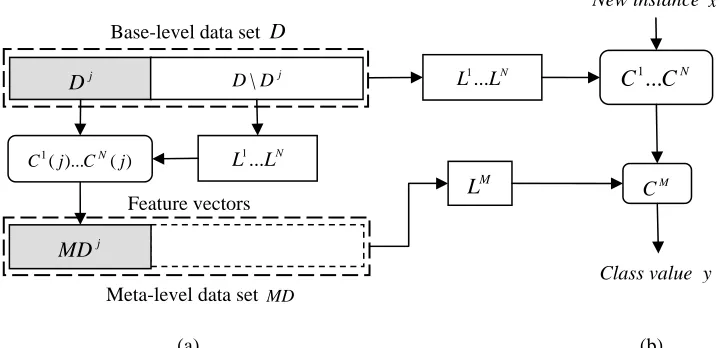
D inducing the final base-level classifiers to be used at runtime. In order to classify a new instance, the concatenated predictions of all base-level classifiers form a meta-level vector that is assigned a class value by the meta-level classifier . Figure 1(a) illustrates the cross-validation methodology, while Figure 1(b) illustrates the stacking framework at runtime.
N
C C1...
N
C C1...
M
C
j
D D\Dj
N
L L1... Base-level data set D
j
MD
Meta-level data set MD
) ( )... ( 1 j C j C N Feature vectors N L
L1... N
C C1...
New instance x
M
L M
C
Class value y
(a) (b)
Figure 1. (a) Illustration of the J-fold cross-validation process for creating the meta-level data set. (b) The stacking framework at runtime.
2.2.2 Related Work
Research on stacking concerns two major issues, initially described as black art by Wolpert (1992). The first is the choice of classifiers at both base-level and meta-level that will lead to the best empirical results. The second issue, which has generally received more attention in the literature, concerns the combination of the predictions of the base-level classifiers and their mapping to attributes for the features vectors at the meta-level. Typical attributes that are used at the meta-level are the class predictions of the N base-level classifiers.
also experimented with an arbiter scheme, where a meta-classifier is only trained on a subset of the base-level vectors, in which the base-level classifiers disagree in their predictions. A hybrid
scheme was also evaluated, in which a meta-classifier is only trained on a subset of the meta-level data set that follows the class-attribute-combiner scheme, where the base-level classifiers disagree in their predictions. Experimental results showed that the class-attribute-combiner is the best scheme. A slight improvement in the accuracy was obtained at meta-level over the best base-level results, but the differences were not measured as statistically significant.
Ting and Witten (1999) introduced a variant of stacking where each base-level classifier predicts a probability distribution vector over all classes, instead of predicting a single nominal value. The individual vectors by the classifiers are concatenated, thus resulting in
attributes at meta-level, where the number of relevant classes. Ting and Witten (1999), suggested also the use of multi-response linear regression (MLR) for meta-level learning that proved to be highly effective. MLR is an adaptation of linear regression (Breiman, 1996a) which transforms the classification problem into different binary prediction problems: for each relevant class, a linear equation is constructed to predict one if the class value equals the class under consideration or zero otherwise.
N N*Q
Q
Q
Seewald (2003) suggested a modification of the approach described by Ting and Witten (1999), where different sets of meta-level features should be used for each of the Q binary prediction problems. In particular, only the probability values for the class under consideration should be used at meta-level, instead of concatenating the probability distributions of all classifiers, and thus reducing the number of meta-level attributes to . Experimental results showed an improvement over stacking with probability distributions.
N
Džeroski and Ženko (2004) investigated the use of MLR in conjunction with class probability distributions augmented with an additional set of attributes that is based on the entropies of the class probability distributions and the maximum probability returned by each classifier. This scheme was found to perform better than using only probability distributions.
Stacking typically outperforms voting. However, voting does not involve cross-validation and the training of a meta-level classifier, and thus it is computationally cheaper than stacking.
2.3 Information Extraction
Sections 2.3.1 and 2.3.2 provide background on the task of Information Extraction (IE), while Section 2.3.3 describes an existing framework for combining multiple IE systems.
2.3.1 Definition
)
Let be a set of Q extraction fields for a particular domain of interest, and a text document annotated by the domain experts with instances of those fields. A field instance is a pair where t is a text fragment, with s and e be the boundaries of the fragment in a document’s token table and the associated field. A boundary has been defined above as the virtual space between two adjacent tokens. Define
} ...
{ 1 Q
f
f d
>
<t(s,e),f , (s,e
∈
f { 1... Q}
f f
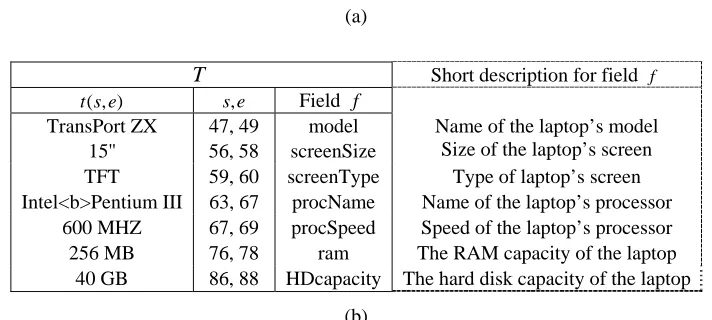
T a template that is filled with pairs <t(s,e),f >. A field is typically a target-slot in template T , while is a slot-filler. A field may also have multiple or no instantiations within a document. Table 2(a) shows a part of a Web page describing laptop products where the relevant text is highlighted in bold. Table 2(b) shows the hand-filled template for this page.
) , (s e t
The Information Extraction (IE) task can be defined as follows: given a new document find all possible instances for each relevant field within and populate a template This definition states that each field learning problem is considered in isolation, and thus modelled as a binary learning task: given a learning algorithm designed for IE, then for each relevant field
, a target concept is learned that identifies relevant instances within text. At runtime, all target concepts are applied separately to and used to populate .T
,
d
d T.
∈
f { 1... Q}
f
f <t(s,e),f >
d
…TransPort ZX <br> <font size="1"> <b> 15" XGA TFT Display </b> <br> Intel <b> Pentium III 600 MHZ </b> 256k Mobile processor <br> <b> 256 MB SDRAM up to 1GB </b> <br> <b> 40 GB hard drive </b> ( removable ) <br> …
(a)
T Short description for field f )
, (se
t s,e Field f
TransPort ZX 47, 49 model Name of the laptop’s model 15'' 56, 58 screenSize Size of the laptop’s screen TFT 59, 60 screenType Type of laptop’s screen Intel<b>Pentium III 63, 67 procName Name of the laptop’s processor
600 MHZ 67, 69 procSpeed Speed of the laptop’s processor 256 MB 76, 78 ram The RAM capacity of the laptop
40 GB 86, 88 HDcapacity The hard disk capacity of the laptop (b)
Table 2. (a) Part of a Web page describing laptop products (b) The hand-filled template for this page.
2.3.2 Related Work
The IE task from free text has been the focus of the Message Understanding Conferences (e.g. DARPA 1995, 1996). On the other hand, the advent of the Web intensified the need for developing systems that help people to cope with the large amount of text that is available online. Systems that perform IE from online text, should generally meet the requirements of low cost and high flexibility in development, and adaptation to new domains. MUC-level systems fail to meet those criteria, in addition to the fact that the linguistic analysis performed for free text does not exploit the extra-linguistic information (e.g. HTML/XML tags, layout format) that is available in online text. Therefore, this type of system has not found wide applicability in the context of online sources.
As a result, less linguistically intensive approaches have been developed for IE on the Web using wrappers, which are sets of highly accurate rules that extract a particular resource’s content. The manual development of wrappers (Chawathe et al., 1994) has proved to be a time-consuming task, requiring a high-level of expertise. Machine-learning techniques that learn wrappers for IE, either using supervised learning (e.g. Kushmerick, 1997; Muslea et al., 2001; Cohen et al., 2002) or unsupervised learning (e.g. Crescenzi et al., 2001; Chang and Lui, 2001), have been designed to handle highly structured collections of Web pages, such as telephone directories and product catalogues. Those approaches, however, fail when the text type is less-structured, which is also common on the Web.
Recent effort on adaptive IE (Ciravegna, 2001; Ciravegna and Lavelli, 2003), motivates the development of IE systems that can handle different text types, from rigidly structured to almost free text -where common wrappers fail- including mixed types. For example, the algorithms presented in (Sonderland, 1999; Ciravegna, 2001; Califf and Mooney, 2003) learn IE rules that exploit shallow natural language knowledge and thus can be applied to less structured text. The BWI algorithm (Freitag and Kushmerick, 1999) relies on a method called boosting (Freund and Schapire, 1996) for improving the extraction performance of the learned IE rules, which allows the applicability of the algorithm to less structured text. Hidden Markov modelling (Rabiner, 1989) is a powerful statistical learning technique that has found wide applicability in IE from both structured and unstructured text (Seymore et al., 1999; Freitag and McCallum, 1999, 2000).
In this article we focus on adaptive IE systems and investigate how their performance can be further improved, by combining their output at meta-level. The presence of the token boundaries
Ciravegna, 2001), information about token boundaries is implicitly represented by inserting appropriate start and end XML tags within documents, i.e. < f > and </f > tags for each relevant field . A template such as the one in Table 2(b) can then be easily constructed. Thus, we assume in the remaining of this article that we deal with templates that include information about token boundaries, as in Table 2(b), which is a realistic assumption, since such information is typically available.
∈
f { 1... Q}
f f
2.3.3 Multistrategy Learning
Despite the growing interest in combining machine learning algorithms and the application to some natural language parsing tasks such as part-of-speech tagging (Halteren et al., 2001) and word-sense disambiguation (Florian et al., 2002), this topic has received little attention by the IE community. The only relevant work is described in (Freitag, 2000), where the IE task was modelled as a classification one, using a set of four base-level systems, which were then combined by multistrategy learning.
The term multistrategy learning generally refers to the combination of multiple learning approaches under a single algorithm and was mainly used for combining inductive with analytical learning (Michalski and Tecuci, 1994). Domingos (1996) used the term empirical multistrategy learning for distinguishing the case where all learning components are inductive. The basic notion behind empirical multistrategy learning was to design a new complex algorithm that heuristically combines a set of learning components by requiring, however, implementation details of each individual component. For example, the RISE algorithm in (Domingos, 1996) unifies an instance-based learner with a rule-based learner under a new implementation, aiming to overcome the limitations of both approaches.
Stacking combines a set of multiple learning components in a more loose fashion, by only learning to integrate their output at meta-level, and thus treating them as black boxes. Despite its simplicity, stacking offers the advantage of being highly extensible to more algorithms at both base-level and meta-level, regardless of their internal structure. On the other hand, voting is the simplest form of loosely integrating the output of multiple components.
Freitag (2000) followed the voting paradigm in the context of IE, which he called “multistrategy learning for IE” and it is based on using probabilistic estimates produced by the IE systems. Specifically, for each relevant field f∈{ 1... Q}
f
f , the confidence scores that are produced by the base-level systems are mapped into probabilistic estimates of correctness in the predictions of the systems. In case of more than one predictions of the field for a fragment
, a combined probability is estimated for
f
) , (s e
t <t(s,e),f > using (1).
= −
∏
−j
j C
p
P 1 (1 ), (1)
where C
P is the combined probabilistic estimate that the text fragment belongs to the field , and the probabilistic estimate that some IE system
) , (s e t
f j
p j
E has predicted the field for . Actually,
f
) , (s e
t C
P measures the probability that at least one of those IE systems that have predicted the field for , has predicted correctly, which equals the probability that not all predictions for are wrong.
f t(s,e)
f
Finally, the constraint of “one per document” (OPD) is imposed on some fields. This means that only one instance of OPD fields is allowed for each page. For example, a page in the domain of computer science (CS) courses should describe only one course, and thus should contain only one instance of the field course title. Therefore, if more are identified, then the one with the highest (combined) probability is selected, while all others are rejected. The example in Table 3 illustrates the usefulness of the OPD constraint.
) , (se
t Probability by the first system
Probability by the second system
Combined probability
256 MB 0.4 0.5 0.7
1GB 0.6 - 0.6
Table 3. Combining the predictions of two hypothetical IE systems for a “ram” instance. Supposing that the correct instance is <"256 MB" ,ram>
The OPD field constraint, though useful in certain cases, is restrictive for IE in general and does not hold for all relevant fields. For example, a Web page may describe more than one laptop products, and thus more than one ram instances may exist. The OPD constraint was also applied for fields that allow many instances per page, without significant loss of performance1. For example, a page may rarely describe more than one CS courses. This approach is still restrictive for IE, since a Web page very often describes more than one laptop products.
Finally, converting confidence scores to probabilistic estimates takes place by validating the performance of each IE system on a hold-out set, or by cross-validation in the entire training data set and using a form of regression modelling which is described in more detail by Freitag (2000). The motivation behind mapping confidence scores to probabilistic estimates is that confidence scores are not always reliable, since incorrect matches may be assigned high scores. Thus voting on different IE systems using confidence scores may not always be reliable. The correlation among confidences and probabilities has been also investigated by Kauchak et al. (2004) in the context of the BWI algorithm for IE, and found to be weaker for more difficult IE tasks, e.g. from free-text domains.
In the remainder of this article, the term “multistrategy learning” will be used to refer to the work in (Freitag, 2000).
3
Voting for Information Extraction
Section 3.1 presents an example of combining IE systems. The concept of the merged template is introduced, which is important for combining different IE systems either through voting or stacking. Various voting schemes for IE are then presented in Sections 3.2 and 3.3, against which the performance of stacking for IE will be compared.
3.1 Example of Combining Different Systems – The Merged Template
Let be a set of learning algorithms, designed for IE, which are given a corpus of training documents, annotated with relevant field instances. The algorithms typically generalize from the training corpus, towards a set of pattern-matching extraction rules. Define the corresponding set of IE systems that exploit the acquired knowledge, to identify relevant instances in new documents. Each trained IE system consists of a set of target concepts that have been learned for the relevant fields. Finally, define a set of templates for a document populated by respectively with relevant field instances.
N
L
L1... N D
N
L L1... N
E E1...
N
T T1... ,
d N
E E1...
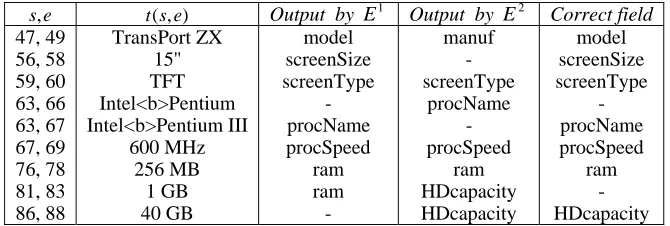
We suggest in this article that a merged template can be constructed from as follows: all text fragments identified by in are inserted to an initial pool. Duplicate fragments are removed: two fragments differ if either their start or end boundary differs. For the remaining distinct fragments, the fields predicted by are collected and inserted together with the correct field in the template. If some IE system does not predict a field for a text fragment, then the corresponding cell in the merged template is empty. If a text fragment does not exist in the hand-filled template, then the corresponding cell in the last column is also empty. Table 4 shows an illustrative example of a merged template that has been constructed by the output of two IE systems , for the page of Table 2(a).
N
T T1... )
, (s e
t N
E
E1... N
T T1...
N
E E1...
2 1
,T
T 1 2
,E E
1
e
s, t(s,e) Output by E1 Output by E Correct 2 field
47, 49 TransPort ZX model manuf model 56, 58 15'' screenSize - screenSize 59, 60 TFT screenType screenType screenType 63, 66 Intel<b>Pentium - procName -
63, 67 Intel<b>Pentium III procName - procName 67, 69 600 MHz procSpeed procSpeed procSpeed
76, 78 256 MB ram ram ram
81, 83 1 GB ram HDcapacity -
86, 88 40 GB - HDcapacity HDcapacity
Table 4. Merged template, based on the output of two IE systems. Each entry corresponds to a text fragment that has been identified by at least one system.
Examining Table 4, we note some disagreement in the predictions of the two systems. For two text fragments (“TransPort ZX”, “1GB”) the predicted fields by E1 and E2 differ. Comparing to the hand-filled template of Table 2(b), we conclude that “TransPort ZX” has been correctly identified as model only by E1, while E2 identified the same fragment as manuf (the manufacturer of the laptop). On the other hand, the fragment “1GB” does not exist in the hand-filled template. Therefore, the fields predicted by the two systems for this fragment are false. Furthermore, some text fragments have been identified by only one of the two IE systems. The fragment “15''” has been identified only by E1, while the fragment “40 GB” has been identified only by E2. The fields predicted for both fragments are correct.
Examining again Table 4, we wonder whether we can exploit, at some higher level, the disagreement in the predictions of the different IE systems, aiming to achieve superior extraction performance. The desirable result is to automatically fill the last column in the merged template of Table 4 with the correct fields. In other words, we would like to assign the correct field to each text fragment that has been identified by at least one base-level system.
3.2 Majority Voting
A simple idea for combining the predictions of different IE systems is to use majority voting: for each entry in the merged template, we count the predicted fields by the available systems and select the field with the highest count. In the case of a tie, a random selection is typically performed among even fields.
Note that Table 4 contains missing values, reflecting the natural fact that some system may not have predicted a field for a text fragment that has been identified by another system. The significance of missing values has to be carefully considered. For example, if some system predicts an incorrect field for a text fragment , while the remaining systems do not predict any field at all, then ignoring missing values during voting harms precision, since the incorrect field is returned. An alternative is to record a missing value as “false”, providing evidence that no field should be predicted for . If the value with the highest count is “false” then no field is assigned to . If, however, is the correct field for , interpreting the missing predictions by the remaining systems as “false” values harms overall extraction performance, since the correct field is rejected.
f t(s,e)
) , (s e t
) , (s e
t f t(s,e)
Therefore, two different settings of majority voting are defined, depending on whether missing values are ignored or encoded as “false” values that indicate rejection of prediction.
3.3 Voting Using Probabilities
The voting with probabilities scheme that is presented in this section shares many features with multistrategy learning, as described in (Freitag, 2000) and was briefly outlined in Section 2.3.3. Both schemes share the same method for mapping confidence scores to probabilistic estimates and the same Equation (1) that estimates the combined probability of correctness for an instance
. However, the two schemes differ in how they model the IE task.
> <t(s,e),f
3. On the other hand, voting using probabilities takes place on a merged template, like the one in Table 4, while no OPD assumption is required for any relevant field. This allows the case of contradictory field predictions among different systems during combination, as demonstrated in Table 4, where the fragment “1GB” has been identified as ram by the first system and as
HDcapacity by the second one. The field with the highest probability should be selected. Multistrategy learning for IE ignores contradictory field predictions.
In Section 3.2 two different settings of majority voting were defined, depending on whether absence of prediction by some system for a text fragment, i.e. a missing value in the merged template, is ignored or encoded as “false” that indicates rejection of prediction. The problem here is that there is no probability for “false”. If we assume that “false” corresponds to probability 1, then voting will lead to spurious results. Thus, two different settings for voting using probabilities are defined as follows:
In the first setting, missing values are ignored, similar to the first setting of majority voting. Given a fragment , the field with the highest probabilistic estimate by those systems that have predicted a field for is returned. In the second setting, however, a constraint is imposed on whether should be accepted or not. If the probability that is attached to is less than 0.5, then is rejected. Otherwise, is returned, as in the first setting. The motivation behind using this constraint, is that if has been predicted with low degree of confidence by the base-level systems, then it should not be accepted. The value of 0.5 is the natural choice of a threshold for deciding whether should be accepted or not.
) , (s e
t f
) , (s e t
f f
f f
f f
4
Stacked Generalization for Information Extraction
This section starts with the motivation for performing learning, rather than simply voting. Then a new stacking framework for IE is presented, along with an extension that relies on using probabilistic estimates on the output of the base-level systems.
4.1 Motivation for Performing Learning
Examining the merged template of Table 4, we wonder whether we can learn to predict the correct field, based on the fields predicted by the available systems, rather than simply voting. A simple motivation for preferring learning, rather than voting, is that the latter cannot handle situations where most of the systems make an error. For example, if a system correctly predicts
ram for the hypothetical fragment “1,5 GB”, while the other systems erroneously predict
HDcapacity, then voting chooses the latter value. Therefore, it would be desirable to perform learning in order to induce a rule of the form: if the first IE system predicts “ram” and the other systems predict “HDcapacity”, then the correct field is “ram”.
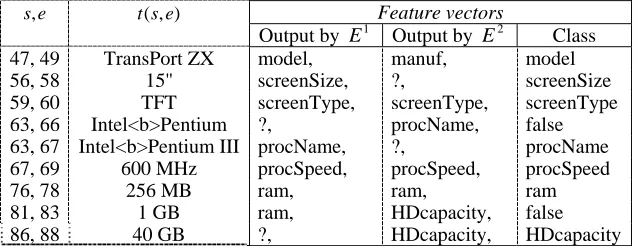
In order to train a common classifier, a set of feature vectors should be provided as training data. The idea suggested in this article is to create a feature vector for every row entry of the merged template, i.e. for each text fragment that has been identified by at least one base-level system. Table 5 shows the new feature vectors created by the merged template of Table 4.
Feature vectors e
s, t(s,e)
Output by E1 Output by E2 Class 47, 49 TransPort ZX model, manuf, model 56, 58 15'' screenSize, ?, screenSize 59, 60 TFT screenType, screenType, screenType 63, 66 Intel<b>Pentium ?, procName, false 63, 67 Intel<b>Pentium III procName, ?, procName 67, 69 600 MHz procSpeed, procSpeed, procSpeed 76, 78 256 MB ram, ram, ram 81, 83 1 GB ram, HDcapacity, false 86, 88 40 GB ?, HDcapacity, HDcapacity
Absence of prediction by an IE system is indicated by “?”. If a text fragment does not exist in the hand-filled template, the class attribute of the corresponding vector takes the value “false” that indicates rejection of prediction. At runtime, the class value is to be assigned by the classifier.
Having specified the format of the feature vector, the remaining issue is to construct the full set of vectors for training the meta-level classifier using cross-validation, as described for the stacking framework in Section 2.2. However, in IE we deal with collections of text documents, annotated with relevant instances, rather than feature vectors. This disparity between base-level and meta-level data sets is handled by sampling from documents during cross-validation, rather than from feature vectors as in stacking for classification.
4.2 Stacking Using Nominal Values
The key idea behind stacking for IE, is to learn a meta-level classifier based on the output of base-level systems via cross-validation as follows:
At the jth fold, , of cross-validation, the learning algorithms are trained on the document set and the induced IE systems are applied to the test set
J
j=1.. N L1...LN
j
D
D\ 1( )... ( )
j E j
E N j
D . For each document d in Dj, let be the populated templates by
respectively. A merged template
N
T
T1... 1( )... ( )
j E j
E N
MT is assembled from , as shown in Section 3.1. A new feature vector is produced for each entry in the merged template, which is added to the meta-level data set
N
T T1...
j
MD . At the end of the cross-validation process, the union MD=
∪
MDj constitutes the full meta-level data set, which is used by a learning algorithm to train the meta-level classifier . Finally, the learning algorithms are applied to the entire data set inducing the base-level systems to be used at runtime.M
L
M
C N D,
N
E E1...
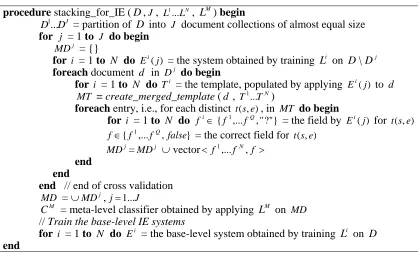
Figure 2 presents an algorithmic description of the new stacking framework for IE. The vectors in the new meta-level data set MD belong to Q+1 classes, where Q is the number of relevant fields in the domain of interest plus the value “false”. A vector classified as “false” indicates that the corresponding fragment does not exist in the hand-filled template, and thus the available base-level systems should not have predicted a field for it (for example the fragment “1 GB” in Table 5).
) , (s e t
procedure stacking_for_IE (D, , J N, L
L1... M
L ) begin J
D
D1... = partition of D into document collections of almost equal size J
for = 1 j to J do begin j
MD = {}
for i = 1 to N do Ei(j) = the system obtained by training Li on j
D D\ foreach document d in Dj do begin
for i = 1 to N do Ti = the template, populated by applying Ei(j) to d MT = create_merged_template (d , T1...TN)
foreach entry, i.e., for each distinct t(s,e), in MT do begin
for i = 1 to N do fi∈{f1,...fQ,"?"} = the field by Ei(j) for t(s,e)
f ∈{f1,...fQ,false} = the correct field for t(s,e)
j
MD = j
MD ∪ vector< f1,...fN,f >
end end
end // end of cross validation
MD = ∪ j
MD , j=1...J
M
C = meta-level classifier obtained by applying M
L on MD
// Train the base-level IE systems
for = 1 i to N do Ei = the base-level system obtained by training i
L on D
end
The key difference among stacking for IE and common stacking is that cross-validation operates on text documents paired with hand-filled templates, instead of feature vectors labelled with class values. This removes the constraint of performing common classification at base-level, thus allowing the application of stacking to IE. The base-level algorithms are designed for IE, while the learning algorithm
N
L L1... M
L that is applied at meta-level is designed for classification, and thus cannot be one of L1...LN as in stacking for classification.
The size of the meta-level data set is not a-priori known in stacking for IE, unlike common stacking where there is a one-to-one correspondence between base-level and meta-level vectors. Here, the size of the meta-level data set is determined by the output of the base-level systems, i.e. by the individual templates T1...TN that assemble a merged template, as shown in Figure 2.
The one-to-one correspondence between base-level and meta-level features vectors in common stacking, results in identical class values at both base-level and meta-level. In IE, however, a text fragment that is relevant to our task may not have been identified by any of the available base-level systems. In that case, there is no possibility of identifying that fragment at meta-level, since no feature vector is created and thus resulting in loss of information. This observation suggests that IE systems biased towards recall (percentage of the annotated field instances that were identified), should be generally preferred for combination, expecting to reduce the loss of information at meta-level.
Moreover, a meta-level vector in common stacking for classification does not contain missing values, since each base-level classifier predicts a nominal class value or a probability distribution over the relevant classes. On the other hand, a meta-level vector in stacking for IE may contain missing values, as shown in Table 5, since some system may not have predicted a field for a fragment that has been identified by another system. In correspondence to majority voting, missing values in Table 5 can be handled by recording them as “false”, which indicates rejection of prediction. In that case, all attribute values, should share the same set of values
, thus replacing the set in Figure 2. } , ... { 1 false f f Q } ?" " , ,... {f1 fQ
Another issue in stacking for IE is the choice of in the -fold cross-validation process depicted in Figure 2. The choice of usually depends on the size of the training data and the computational cost of training. The choice of also affects the difference in the number of documents for training the base-level systems and the meta-level classifiers. According to Figure 2, the base-level systems that will be used at runtime are retrained on the entire collection J J J J N E E1...
D of training documents. On the other hand, the meta-level vectors on each jth fold are created by the predictions of the systems , as trained on a lower proportion of the training documents . The larger the value of , the smaller the size of and therefore the smaller the difference between the size of the training data set for and the complete data set
) ( )... ( 1 j E j E N j D
D\ J Dj
j
D
D\ 1( )... ( )
j E j
E N
D.
To illustrate this point, for a collection of 40 training documents, the final base-level systems are trained on the full data set. If we assume a five-fold cross validation process, then on each fold
N
E E1...
j, the are trained on 32 documents. An alternative is to use a higher value for , suffering however a higher computational cost.
) ( )... ( 1 j E j E N J
4.3 Stacking at Runtime
Given a new document d, the systems are used to identify relevant field instances and fill the corresponding templates . A merged template is then created from . For each row entry in the merged template, i.e., for each distinct , a feature vector is created by the predicted fields of for (absence of prediction by an IE system is indicated by “?” or “false”). The new vectors are finally classified by the meta-level classifier into
N
E E1... N
T
T1... T1...TN
) , (s e t
N
E
E1... t(s,e)
M
C Q+1
predefined categories . If a vector is classified into one of the relevant fields then the corresponding instance
} , ... { 1 false f f Q Q f
f1... < >
f e),
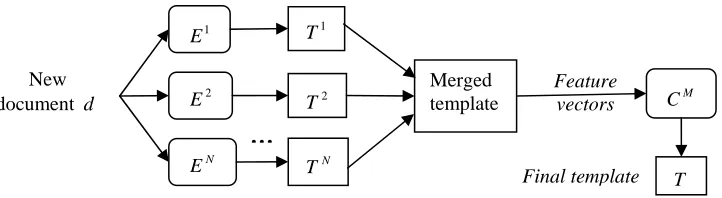
t(s, is inserted in the final template for Otherwise (“false” prediction) the entry is excluded from the final template. For example, if we assume that the class column in Table 5 has been filled by then for the two vectors that have been classified as “false”, the corresponding entries will be excluded from the final template. At runtime, the stacking framework for IE is graphically depicted in Figure 3.
.
d
,
M
…
Feature vectors
New document d
1 E
2 E
N
E
1 T
2 T
N
T
Merged
template CM
T Final template
Figure 3. The stacking framework for information extraction at runtime.
According to Figure 3, the input to the systems is a new text document while the output is the corresponding filled template. In contrast, both input and output in the runtime stacking for classification architecture of Figure 1(b), consist of a single feature vector.
4.4 Stacking Using Probabilities
A straightforward extension of stacking with nominal values is to rely on the confidence scores by the base-level systems that have been converted into probabilistic estimates of correctness. The new framework is described as follows:
• Instead of predicting one of the Q relevant fields for each fragment , each system generates a confidence score for the predicted field k
. This is modelled by a -element vector that contains zero values, except for the kth position where appears, i.e.,
. If a system does not predict a field, all elements are zero. ) , (s e t
k
c f Q
k
c
> <0,...,ck,...0
• Each vector is converted to a new one , where is a probabilistic estimate that corresponds to k
and reflects the probability of correctness of the prediction. The conversion process is described in more detail in (Freitag, 2000).
N
> <0,... k,...0
p k
p c
• Finally, the output vectors by for form a single vector of elements, appended by the correct field, according to the hand-filled template.
E E1...
) , (s e
t N*Q
Table 6 shows an illustrative example of the new feature vectors at the meta-level, using probabilistic estimates of correctness.
Feature vectors using probabilistic estimates e
s, t(s,e)
Output by E1 Output by E2 Class 47, 49 TransPort ZX 0, 0, 0.92, 0, 0, 0, 0, 0, 0, 0.34, 0, 0, 0, 0, 0, 0, model 56, 58 15'' 0, 0, 0, 0, 0, 0, 0.83, 0, 0, 0, 0, 0, 0, 0, 0, 0, screenSize 59, 60 TFT 0, 0, 0, 0, 0, 0, 0, 0.85, 0, 0, 0, 0, 0, 0, 0, 0.91, screenType 63, 66 Intel<b>Pentium 0, 0, 0, 0, 0, 0, 0, 0, 0, 0, 0, 0.61, 0, 0, 0, 0, false 63, 67 Intel<b>Pentium III 0, 0, 0, 0.67, 0, 0, 0, 0, 0, 0, 0, 0, 0, 0, 0, 0, procName 67, 69 600 MHz 0, 0, 0, 0, 0.82, 0, 0, 0, 0, 0, 0, 0, 0.79, 0, 0, 0, procSpeed 76, 78 256 MB 0, 0, 0, 0, 0, 0.91, 0, 0, 0, 0, 0, 0, 0, 0.77, 0, 0, ram 81, 83 1 GB 0, 0, 0, 0, 0, 0.55, 0, 0, 0.89, 0, 0, 0, 0, 0, 0, 0, false 86, 88 40 GB 0, 0, 0, 0, 0, 0, 0, 0, 0.65, 0, 0, 0, 0, 0, 0, 0, HDcapacity
Table 6. The new meta-level vectors using probabilistic estimates of correctness.
The same vector representation used in Table 6 was also used in the extension of stacking for classification proposed in (Ting and Witten, 1999). The only difference is that class (or field) probability distributions, as they suggest, are not typically produced by IE systems. Given a text fragment , either a field is predicted for or no field is predicted at all. Thus, except for the vector elements that correspond to the predicted fields, all other values are set to zero, as shown in Table 6.
) , (s e
t f t(s,e)
number of meta-level attributes will be then
N
(
Q
+
1
)
. The probability value of the extra attribute will be complementary to the value of the non-zero element of the vector. For example, in the first row entry of Table 6, the value of the extra attribute for the system E1 will be 0.08, while for each absent prediction the extra attribute takes the value “1”. The significance of handling the missing values in stacking is empirically evaluated by comparing the performance of the trained classifiers over the new vectors against the trained classifiers over the vectors with missing values.5
Experimental Setup
ive experiments i real-world domains, using well-known
5.1 Domains
r re conducted using five collections of text documents from five different
ages, describing laptop pr from
job announcements from the
aus
ents (Califf and Mooney, 200
uring the training of the bas
We have performed extens n five
algorithms at both base-level and meta-level. The primary target was to determine whether stacking provides added value over the base-level systems and voting in the examined domains. Therefore, we comparatively evaluated all combination methods (voting and stacking) for IE, as described in Sections 3 and 4, while also comparing against the best base-level system for each domain of interest. Since the success of stacking relies on the disagreement in the output of the base-level components, we were particularly interested in how stacking behaves with respect to the diversity in the output of the base-level systems, and how that compares to voting.
Expe iments we
domains. The first two collections consist of 101 Web pages describing computer science (CS) courses and 96 Web pages describing research projects respectively, and were constructed in the context of the WebKB project (Craven et al., 1998). Both collections were hand-filled for three and two extraction fields respectively: crsNumber, the official number of the course (for example, “CS 305”), crsTitle, the title of the course (for example, “Operating Systems”), crsInst, the name of the course instructor, projTitle, the title of the project (for example, “WebKB”) and
projMember, the name of a project member.
The third collection consists of 50 Web p oducts that were collected various vendor sites. A total of 19 fields were hand-filled, including the manufacturer of the laptop, model name, processor name, speed, ram, hard disk capacity, etc. This collection was constructed in the context of building a shopping comparison agent2 that visits various vendor sites, extracts laptop descriptions and presents the results to user.
The last two collections consist of 300 pages describing
tin.jobs newsgroup at Austin and 485 pages describing seminar announcements from the Carnegie Mellon University, respectively. Both collections were obtained from RISE (1998) and have been widely used in information extraction research. A total of 17 fields were hand-filled for job announcements, including the title of the available position, the salary, the name of the company, the identifier code of the announcement, etc. Four fields were hand-filled for seminar announcements: stime, the starting time of the seminar, etime, the ending time of the seminar,
speaker, the speaker’s name and location, the location of the seminar. Note that the available hand-filled templates for job announcem
3) do not contain information about the starting and ending token boundaries of the annotated instances, which is however essential for combining different IE systems. Therefore, the entire corpus was re-annotated, using the available hand-filled templates as a guide, so that the new templates include token boundary information, as the one in Table 2(b).
Finally, the HTML tags in the three Web domains were not omitted d
e-level systems, but appropriately tokenized, including their attributes and values. For example, the stream <td valign="top"> corresponds to the subsequence “td_start_tag”, “attrib_valign”, “value_top” in the token table of a Web page.
2
5.2 Base-level Information Extraction Systems
At the base-level we employed three systems that are well known in the literature for information extraction: the (LP)2 system, the BWI system and a HMM-based IE system.
The Learning Pattern by Language Processing or (LP)2 system implements a sequential covering algorithm that learns symbolic pattern-matching rules for IE. For each interesting field, a set of start-rules and another one of end-rules are induced that identify the starting and ending boundaries respectively of the relevant instances. Shallow natural language knowledge is used during the induction process such as lexical information (e.g. capitalized, numerical), part-of-speech tagging (for example, noun) and stemming information. Additional contextual and
correction rules are learned that improve the performance of the previously induced rules. Each instance that is recognized at runtime is assigned a confidence score
, where is the number of erroneous matches, as estimated during training, of the rules that matched , and is the total number of matches by the rules. The lower this score, the higher the confidence attached to the instance. A detailed description of (LP)
> <t(s,e),f
matched wrong
LS = / wrong
) , (s e
t matched
2
can be found in (Ciravegna and Lavelli, 2003).
The Boosted Wrapper Induction or BWI system learns also symbolic starting and ending pattern-matching rules for each relevant field. Each rule is assigned a confidence score according to a boosting methodology, which is described in more detail in (Freitag and Kushmerick, 1999). The induced rules exploit lexical information (e.g. capitalized, numerical). Each instance
recognized at runtime is assigned the product of confidences of the start and end rules that match . The more rules match , the higher is the value of the score that is assigned to the instance. A comprehensive analysis of the performance of BWI in a variety of IE tasks can be found in (Kauchak et al., 2004).
> <t(s,e),f
) , (s e
t t(s,e)
Finally, our HMM-based IE is inspired by work described in (Freitag and McCallum 1999; Seymore et al., 1999), whereby a separate HMM is trained for each relevant field. The entire training page is probabilistically modelled by the HMM, by assuming that the first token of the page is emitted by the initial state of the model, then transitioning to the next state that emits the second token, etc. until the ending token of the page is emitted. Special prefix, suffix and target
states model the immediate prefix, suffix and the internal structure of the relevant instances respectively. Inducing a HMM for each field involves the calculation of the state-transition and token-emission probabilities over all training pages, based on simple ratios of counts. The Viterbi
algorithm is used at runtime to identify relevant instances and assign to them a confidence score. More details on how HMMs assign confidence scores for IE can be found in (Sigletos, 2005). An excellent tutorial on HMMs can be found in (Rabiner, 1989).
5.3 Meta-level Algorithms for Classification
At meta-level, we employ the following algorithms, implemented in the WEKA data mining platform (Witten and Frank 2000):
• J48, the well known C4.5 (Quinlan, 1993) decision tree algorithm.
• NaiveBayes, the well known Naïve Bayes classifier (John and Langley, 1995).
• IB1, the 1-nearest-neighbor algorithm.
• Multi-response linear regression (MLR), an adaptation of least-squares linear regression (Breiman, 1996a).
• SMO, a fast implementation of Support Vector Machines (Platt, 1999).
• LogitBoost, an implementation of the corresponding algorithm (Friedman et al., 1999), using decision stumps as weak-classifier.
Most of these algorithms have already been evaluated as meta-level classifiers in recent studies for stacking (Ting and Witten, 1999; Seewald, 2003; Džeroski and Ženko, 2004).
5.4 Evaluation Methodology and Metrics
evaluation, and the pages in the remaining four parts were used in order to induce the base-level systems and the meta-level classifiers. Results on the test parts were averaged over all 5 folds. Notice that within the training part at each of the 5 folds, a separate 5-fold cross-validation procedure was used in order to create the meta-level set of feature vectors and thus train the classifiers, as described in Section 4.2.
For the two WebKB domains and seminar announcements, a different evaluation methodology was followed that was also applied in (Freitag, 2000). Each corpus was randomly split into 2 parts of almost equal size. The first part was used to induce the base-level systems and the meta-level classifiers, while the second part was used for evaluation. An internal 3-fold cross-validation process was followed in the training part in order to collect the meta-level set of feature vectors and then train the classifiers. The whole process was repeated 5 times, averaging the results at the end. Moreover, the constraint of “one instance per document” (OPD) was applied for the fields crsNumber and crsTitle in CS courses, for the field projTitle in research projects, and for all four fields in seminar announcements, towards an objective comparison against multistrategy learning for information extraction and the results presented in (Freitag, 2000). Therefore, whenever two or more instances of an OPD field were present within a page, only the instance with the highest score was selected.
Three metrics were used for measuring the performance: precision (P), the percentage of the identified field instances that are correct, recall (R), the percentage of the annotated field instances (in the hand-filled templates) that were identified, and finally 1F , the harmonic mean of recall and precision defined as F1=2RP/(R+P). Our definition of recall and precision is equivalent to micro-average recall and micro-average precision (Sebastiani, 2002), formally defined as:
∑
=∑
= + = + = Q I I I Q I I FP TP TP FP TP TP P 1 1 ) ( ,∑
∑
= = + = + = Q I I I Q I I FN TP TP FN TP TP R 1 1 ) ( ,where TPi is the number of instances of the field that have been correctly identified (true positive),
} ,...
{ 1 Q
i
f f f ∈
i
FP is the number of instances that have been incorrectly identified (false positive), and finally is the number of instances that were not identified (false negative). Choosing micro-average metrics allows for an objective overall comparison among different systems, by considering all target instances by all relevant fields. Statistical significance in the conducted comparisons was evaluated using the well-known paired t-test (Dietterich, 1998) with a significance level of 95%.
i
f
i
FN fi
6
Results and Comparisons
The results obtained by all base-level systems in the domains of interest are initially presented in this section, while also investigating whether any improvement in the best results for each domain is possible at meta-level. Then, the meta-level data is analyzed, in order to determine whether and how the predictions of the base-level systems are correlated. This study is intended to serve as a basis for a comparative evaluation of voting against stacking. Then all combination methods are comparatively evaluated, while also comparing against the best base-level results. More detailed analysis of the experimental results is provided in Section 7.
6.1 Results of Base-level
Table 7 shows the F1 scores (%) obtained by the base-level systems in the domains of interest. Only the highest F1 score for research projects was measured as statistically insignificant. Appendix B.1 shows the scores obtained in all three measures of performance.
CS courses Projects Laptops Jobs Seminars
BWI 51.30 60.75 62.26 80.01 83.09
HMM 59.39 61.64 63.81 75.71 79.20
(LP)2 65.73 58.82 61.26 83.22 86.23
The simple choice is to select the best base-level system for each domain. On the other hand, a more desirable approach is to try to exploit the diversity in the output of all systems, hoping to improve the best base-level results. Note that there is no generally accepted measure for diversity, but a variety of measures exist in the literature (Kuncheva and Whitaker, 2003). Ali and Pazzani (1996) define the similarity between two classifiers, as the conditional probability that both classifiers make an error, given that either of them makes an error.
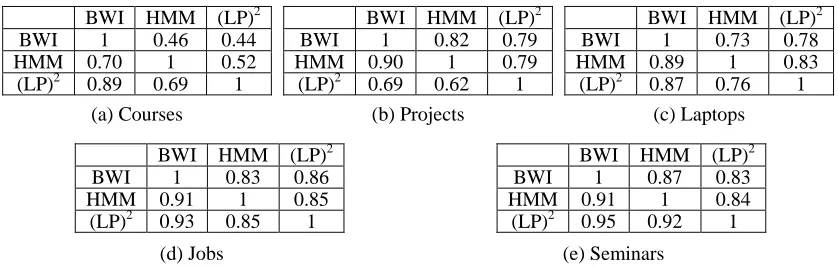
Tables 8(a) to 8(e) are instances of the “contingency table” that was introduced by Freitag (2000) for measuring the similarity in the output of pairs of systems, and inspired by Ali and Pazzani’s measure. Each cell in a contingency table measures the conditional probability that the row system makes the correct prediction, given that the column system also predicts correctly. Tables 8(a) to 8(e) suggest that there is space for improving the best base-level system in each domain. For example, in CS courses we notice that only in 69% of the meta-level instances where HMMs yield a correct prediction, (LP)2 also predicts correctly. Thus, in the remaining 31%, where HMMs predict correctly, (LP)2 either predicts an incorrect field, or does not predict any field. Therefore, the performance of (LP)2, which is the best system for this domain, can be further improved.
BWI HMM (LP)2 BWI 1 0.46 0.44 HMM 0.70 1 0.52
(LP)2 0.89 0.69 1 (a) Courses
BWI HMM (LP)2 BWI 1 0.82 0.79 HMM 0.90 1 0.79
(LP)2 0.69 0.62 1 (b) Projects
BWI HMM (LP)2 BWI 1 0.73 0.78 HMM 0.89 1 0.83
(LP)2 0.87 0.76 1 (c) Laptops
BWI HMM (LP)2 BWI 1 0.83 0.86 HMM 0.91 1 0.85
(LP)2 0.93 0.85 1 (d) Jobs
BWI HMM (LP)2 BWI 1 0.87 0.83 HMM 0.91 1 0.84
(LP)2 0.95 0.92 1 (e) Seminars
Table 8. Contingency tables, measuring the agreement in the predictions of the base-level systems. Each cell is the probability that the row system makes a correct prediction, given that the column system makes a correct prediction.
6.2 Analysis of the Meta-level Instances
Each meta-level instance corresponds to a text fragment that has been identified by at least one base-level system, together with the predicted fields for by the base-level systems, the associated probabilistic estimates, and finally the correct human-annotated field for . Figure 4 shows a partition of the meta-level instances in the testing corpus, according to whether all systems agree on the same field for a fragment or not.
) , (s e t
) , (s e t
) , (s e t
) , (s e t
The leftmost column for each domain in Figure 4 shows that there are regularities in the text documents that can be easily recognized by all available IE systems. For example, the fragment “TFT” is a typical instance of the field screen type in the domain of laptops that commonly appears in both training and testing corpus and thus easily detected by all systems.
Observing the rightmost column for each domain in Figure 4, leads to the interesting conclusion that situations where at least two base-level systems predict different fields for a text fragment are not frequent. In order to explain that, one should note that the IE systems exploit both the target content and the surrounding context of the relevant instances, and thus are capable of disambiguating among field instances with similar content. For example, instances of the fields
0.0 0.2 0.4 0.6 0.8 1.0
P
e
rc
e
n
ta
ge
o
f
m
e
ta
-le
vel d
a
ta
Courses Projects Laptops Jobs Seminars
Analyzing the diversity in the output of the base-level IE systems
Overall agreement in the predicted fields
Partial agreement in the predicted fields, plus missing value(s)
Disagreement in the predicted fields
Figure 4. Partitioning the meta-level instances for each domain into three disjoint sets, according to whether all systems agree on the same field for a text fragment (left column), or some system(s) predict the same field while the other(s) abstain from prediction (middle column), or there are at least two contradictory predictions (right column).
For example, (LP)2 explores a window of w tokens to the left and tokens to the right of the starting and ending boundaries of the annotated field instances, where the value of is predefined. Also in HMMs, a predefined number of prefix and suffix states model the immediate prefix and suffix respectively of the annotated field instances. The largest rate of disagreement appears in seminars (9.9%). This is because the ending time (field etime) of a seminar was many times confused with the starting one (field stime), thus increasing the size of the rightmost column in Figure 4 for this domain. In CS courses and research projects, contradictory predictions do not exceed 0.5% of all meta-level data, in laptops they are 3.7%, while for jobs they are 5.5%.
w
w
Since differences in the predicted fields for a text fragment are not frequent, the interesting question is what kind of disagreement can both voting and stacking exploit in pursuit of improved performance at meta-level? The answer lies in the middle column for each domain, which indicates that the majority of the meta-level instances derive from text fragments that have been assigned identical fields by some, but not all, system(s), while the remaining system(s) abstain from prediction. Since we deal with three systems, this corresponds to situations where either two systems predict the same field, plus a missing prediction by the third system or only one system predicts a field, plus two missing predictions. Therefore, we expect voting and stacking to exploit this kind of disagreement, leading to better results at meta-level. It is also interesting to observe the behaviour of stacking when the predictions by all systems are identical, according to the left column for each domain in Figure 4.
Note finally that the partition of meta-level data as shown in Figure 4, will allow for a more comprehensive comparison of stacking against voting, while also exploring the various aspects of the behaviour of stacking and voting, with respect to the varying degree of correlation in the output of the base-level systems. On the other hand, Table 8 shows a quantitative analysis of the disagreement among pairs of different IE systems that helps in determining whether there is space for improving the best system for each domain.
6.3 Results of Meta-level and Comparisons
Let MVotM and MVotF be the two majority voting settings, as defined in Section 3.2. The former setting ignores missing field prediction by some system, while the latter setting records missing prediction as “false”. Let also PVotM and PVotF be the two corresponding settings of voting using probabilities, as defined in Section 3.3. In PVotM, missing predictions are ignored. In
PVotF, if the highest probability for a field is less than 0.5, then is rejected. Table 9 shows the best
f f
1