Probability Product Kernels
Tony Jebara [email protected]
Risi Kondor [email protected]
Andrew Howard [email protected]
Computer Science Department Columbia University
New York, NY 10027, USA
Editors: Kristin Bennett and Nicol `o Cesa-Bianchi
Abstract
The advantages of discriminative learning algorithms and kernel machines are combined with gen-erative modeling using a novel kernel between distributions. In the probability product kernel, data points in the input space are mapped to distributions over the sample space and a general inner product is then evaluated as the integral of the product of pairs of distributions. The kernel is straightforward to evaluate for all exponential family models such as multinomials and Gaussians and yields interesting nonlinear kernels. Furthermore, the kernel is computable in closed form for latent distributions such as mixture models, hidden Markov models and linear dynamical sys-tems. For intractable models, such as switching linear dynamical systems, structured mean-field approximations can be brought to bear on the kernel evaluation. For general distributions, even if an analytic expression for the kernel is not feasible, we show a straightforward sampling method to evaluate it. Thus, the kernel permits discriminative learning methods, including support vector machines, to exploit the properties, metrics and invariances of the generative models we infer from each datum. Experiments are shown using multinomial models for text, hidden Markov models for biological data sets and linear dynamical systems for time series data.
Keywords: Kernels, support vector machines, generative models, Hellinger divergence, Kullback-Leibler divergence, Bhattacharyya affinity, expected likelihood, exponential family, graphical mod-els, latent modmod-els, hidden Markov modmod-els, dynamical systems, mean field
1. Introduction
Recent developments in machine learning, including the emergence of support vector machines, have rekindled interest in kernel methods (Vapnik, 1998; Hastie et al., 2001). Typically, kernels are designed and used by the practitioner to introduce useful nonlinearities, embed prior knowledge and handle unusual input spaces in a learning algorithm (Sch ¨olkopf and Smola, 2001). In this article, we consider kernels between distributions. Typically, kernels compute a generalized inner product between two input objects x and x0 which is equivalent to apply a mapping function Φ to each object and then computing a dot product betweenΦ(x)andΦ(x0)in a Hilbert space. We
kernel design in general. It permits kernel design to leverage the large body of tools in statistical and generative modeling including Bayesian networks (Pearl, 1997). For instance, maximum likelihood or Bayesian estimates may be used to set certain aspects of the mapping to Hilbert space.
In this paper, we consider the mapping from datumx to a probability distribution p(x|x)which has a straightforward inner product kernel k(x,x0) =R
pρ(x|x)pρ(x|x0)dx (for a scalarρwhich we typically set to 1 or 1/2). This kernel is merely an inner product between two distributions and, if these distributions are known directly, it corresponds to a linear classifier in the space of probability distributions. If the distributions themselves are not available and only observed data is given, we propose using either Bayesian or Frequentist estimators to map a single input datum (or multiple inputs) into probability distributions and subsequently compute the kernel. In other words, we map points asx →p(x|x)andx0→p(x|x0). For the setting ofρ=1/2 the kernel is none other than the classical Bhattacharyya similarity measure (Kondor and Jebara, 2003), the affinity corresponding to Hellinger divergence (Jebara and Kondor, 2003).1
One goal of this article is to explore a contact point between discriminative learning (support vector machines and kernels) and generative learning (distributions and graphical models). Dis-criminative learning directly optimizes performance for a given classification or regression task. Meanwhile, generative learning provides a rich palette of tools for exploring models, accommo-dating unusual input spaces and handling priors. One approach to marrying the two is to estimate parameters in generative models with discriminative learning algorithms and optimize performance on a particular task. Examples of such approaches include conditional learning (Bengio and Fras-coni, 1996) or large margin generative modeling (Jaakkola et al., 1999). Another approach is to use kernels to integrate the generative models within a discriminative learning paradigm. The pro-posed probability product kernel falls into this latter category. Previous efforts to build kernels that accommodate probability distributions include the Fisher kernel (Jaakkola and Haussler, 1998), the heat kernel (Lafferty and Lebanon, 2002) and kernels arising from exponentiating Kullback-Leibler divergences (Moreno et al., 2004). We discuss, compare and contrast these approaches to the probability product kernel in Section 7. One compelling feature of the new kernel is that it is straightforward and efficient to compute over a wide range of distributions and generative mod-els while still producing interesting nonlinear behavior in, for example, support vector machine (SVM) classifiers. The generative models we consider include Gaussians, multinomials, the ex-ponential family, mixture models, hidden Markov models, a wide range of graphical models and (via sampling and mean-field methods) intractable graphical models. The flexibility in choosing a distribution from the wide range of generative models in the field permits the kernel to readily ac-commodate many interesting input spaces including sequences, counts, graphs, fields and so forth. It also inherits the properties, priors and invariances that may be straightforward to design within a generative modeling paradigm and propagates them into the kernel learning machine. This article thus gives a generative modeling route to kernel design to complement the family of other kernel engineering methods including super-kernels (Ong et al., 2002), convolutional kernels (Haussler, 1999; Collins and Duffy, 2002), alignment kernels (Watkins, 2000), rational kernels (Cortes et al., 2002) and string kernels (Leslie et al., 2002; Vishawanathan and Smola, 2002).
This paper is organized as follows. In Section 2, we introduce the probability product kernel and point out connections to other probabilistic kernels such as Fisher kernels and exponentiated Kullback-Leibler divergences. Estimation methods for mapping points probabilistically to Hilbert
space are outlined. In Section 3 we elaborate the kernel for the exponential family and show its specific form for classical distributions such as the Gaussian and multinomial. Interestingly, the kernel can be computed for mixture models and graphical models in general and this is elaborated in Section 4. Intractable graphical models are then handled via structured mean-field approxima-tions in Section 6. Alternatively, we describe sampling methods for approximately computing the kernel. Section 7 discusses the differences and similarities between our probability product ker-nels and previously presented probabilistic kerker-nels. We then show experiments with text data sets and multinomial kernels, with biological sequence data sets using hidden Markov model kernels, and with continuous time series data sets using linear dynamical system kernels. The article then concludes with a brief discussion.
2. A Kernel Between Distributions
Given a positive (semi-)definite kernel k :
X
×X
7→Ron the input spaceX
and examplesx1,x2, . . . ,xm∈X
with corresponding labels y1,y2, . . . ,ym, kernel based learning algorithms return a hypothesis ofthe form h(x) =∑m
i=1αik(xi,x) +b. The role of the kernel is to capture our prior assumptions of
similarity in
X
. When k(x,x0) is large, we expect that the corresponding labels be similar or thesame.
Classically, the inputs{xi}mi=1are often represented as vectors inRn, and k is chosen to be one
of a small number of popular positive definite functions onRn, such as the Gaussian RBF
k(x,x0) =e−kx−x0k2/(2σ2). (1)
Once we have found an appropriate kernel, the problem becomes accessible to a whole array of non-parametric discriminative kernel based learning algorithms, such as support vector machines, Gaussian processes, etc. (Sch ¨olkopf and Smola, 2002).
In contrast, generative models fit probability distributions p(x) tox1,x2, . . . ,xm and base their
predictions on the likelihood under different models. When faced with a discriminative task, ap-proaching it from the generative angle is generally suboptimal. On the other hand, it is often easier to capture the structure of complex objects with generative models than directly with kernels. Spe-cific examples include multinomial models for text documents, hidden Markov models for speech, Markov random fields for images and linear dynamical systems for motion. In the current paper we aim to combine the advantages of both worlds by
1. fitting separate probabilistic models p1(x),p2(x), . . .pm(x)tox1,x2, . . . ,xm;
2. defining a novel kernel kprob(p,p0)between probability distributions on
X
;3. finally, defining the kernel between examples to equal kprobbetween the corresponding distri-butions:
k(x,x0) =kprob(p,p0).
We then plug this kernel into any established kernel based learning algorithm and proceed as usual. We define kprobin a rather general form and then investigate special cases.
Definition 1 Let p and p0 be probability distributions on a space
X
andρbe a positive constant. Assume that pρ,p0ρ∈L2(X
), i.e. thatR
The probability product kernel between distributions p and p0is defined
kprob(p,p0) = Z
X p(x)
ρp0(x)ρdx=
pρ,p0ρL
2. (2)
It is well known that L2(
X
)is a Hilbert space, hence for any setP
of probability distributions overX
such thatRXp(x)2ρdx is finite for any p∈
P
, the kernel defined by (2) is positive definite. Theprobability product kernel is also a simple and intuitively compelling notion of similarity between distributions.
2.1 Special Cases and Relationship to Statistical Affinities
Forρ=1/2
k(p,p0) = Z
p
p(x)pp0(x)dx,
which we shall call the Bhattacharyya kernel, because in the statistics literature it is known as Bhattacharyya’s affinity between distributions (Bhattacharyya, 1943), related to the better-known Hellinger’s distance
H(p,p0) =1
2
Z p
p(x)−pp0(x)2dx
by H(p,p0) =p2−2k(p,p0). Hellinger’s distance can be seen as a symmetric approximation to the Kullback-Leibler (KL) divergence, and in fact is a bound on KL, as shown in (Topsoe, 1999), where relationships between several common divergences are discussed. The Bhattacharyya kernel was first introduced in (Kondor and Jebara, 2003) and has the important special property k(x,x) =1.
Whenρ=1, the kernel takes the form of the expectation of one distribution under the other:
k(x,x0) =Z p(x)p0(x)dx=E
p[p0(x)] =Ep0[p(x)]. (3)
We call this the expected likelihood kernel.
It is worth noting that when dealing with distributions over discrete spaces
X
={x1,x2, . . .},probability product kernels have a simple geometrical interpretation. In this case p can be repre-sented as a vector p= (p1,p2, . . .)where pi =Pr(X=xi). The probability product kernel is then
the dot product between ˜p= pρ1,pρ2, . . .
and ˜p0= p0ρ1,p0ρ2, . . .
.
In particular, in the case of the Bhattacharyya kernel, ˜p and ˜p0 are vectors on the unit sphere. This type of similarity measure is not unknown in the literature. In text recognition, for exam-ple, the so-called “cosine-similarity” (i.e. the dot product measure) is well entrenched, and it has been observed that preprocessing word counts by taking square roots often improves performance (Goldzmidt and Sahami, 1998; Cutting et al., 1992). Lafferty and Lebanon also arrive at a similar kernel, but from a very different angle, looking at the diffusion kernel on the statistical manifold of multinomial distributions (Lafferty and Lebanon, 2002).
2.2 Frequentist and Bayesian Methods of Estimation
Various statistical estimation methods can be used to fit the distributions p1,p2, . . . ,pmto the
exam-plesx1,x2, . . . ,xm. Perhaps it is most immediate to consider a parametric family{pθ(x)}, take the
T
(x)A
(x)K
(θ)Gaussian (θ=µ,σ2=1 ) x −1
2x Tx−D
2log(2π)
1 2θ
Tθ
Gaussian (θ=σ2, µ=0 ) x −1
2log(2π) −
1 2logθ
Exponential (θ=−1/β) x 0 −log(−θ)
Gamma (θ=α) log x −log x−x logΓ(θ)
Poisson (θ=log p ) x −log(x!) expθ
Multinomial (θi=logαi) (x1,x2, . . .) log ∑ixi
!/ ∏ixi!
1
Table 1: Some well-known exponential family distributions
The alternative, Bayesian, strategy is to postulate a prior onθ, invoke Bayes’ rule
p(θ|x) = R p(x|θ)p(θ) p(x|θ)p(θ)dθ,
and then use either the distribution p(x|θˆMAP)based on the maximum a posteriori estimator ˆθMAP=
arg maxθp(θ|x), or the true posterior
p(x|x) = Z
p(x|θ)p(θ|x)dθ. (4)
At this point the reader might be wondering to what extent it is justifiable to fit distributions to single data points. It is important to bear in mind that pi(x)is but an intermediate step in forming the
kernel, and is not necessarily meant to model anything in and of itself. The motivation is to exploit the way that probability distributions capture similarity: assuming that our model is appropriate, if a distribution fit to one data point gives high likelihood to another data point, this indicates that the two data points are in some sense similar. This is particularly true of intricate graphical models commonly used to model structured data, such as times series, images, etc.. Such models can capture relatively complicated relationships in real world data. Probability product kernels allow kernel methods to harness the power of such models.
Whenx is just a point inRnwith no further structure, probability product kernels are less com-pelling. Nevertheless, it is worth noting that even the Gaussian RBF kernel (1) can be regarded as a probability product kernel (by setting setting ρ=1 and choosing pi(x)to be a σ/2 variance
Gaussian fit toxi by maximum likelihood). In particular situations when the pointx does not yield
3. Exponential Families
A family of distributions parameterized byθ∈RDis said to form an exponential family if its mem-bers are of the form
pθ(x) = exp(
A
(x) +θTT
(x)−K
(θ)).Here
A
is called the measure,K
is the the cumulant generating function andT
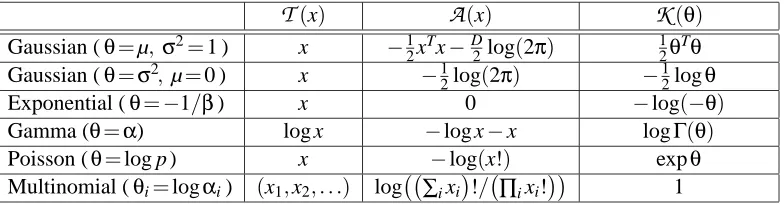
are the sufficient statistics.Some of the most common statistical distributions, including the Gaussian, multinomial, Pois-son and Gamma distributions, are exponential families (Table 1). Note that to ensure that pθ(x)is normalized,
A
,K
andθmust be related through the Laplace transformK
(θ) =logZ
exp
A
(x) +θTT
(x)dx.
The Bhattacharyya kernel (ρ=1/2) can be computed in closed form for any exponential family:
k(x,x0) =k(p,p0) = Z
x
pθ(x)1/2pθ0(x)1/2dx =
Z
x
exp
A
(x) + 12θ+12θ0TT
(x)−12K
(θ)−12K
(θ0)dx= exp
K
12θ+1 2θ0
−1
2
K
(θ)− 1 2K
(θ0).
Forρ6=1/2, k(x,x0)can only be written in closed form when
A
andT
obey some special properties. Specifically, if 2ρA
(x) =A
(ηx)for someηandT
is linear in x, thenlog
Z
exp
2ρ
A
(x) +ρ θ+θ0TT
(x)dx=log 1 η Z exp
A
(ηx) +ρ η θ+θ0T
T
(ηx)d(ηx)
=
K
ρη θ+θ0−logη,
hence
k(p,p0) =exp
h
K
ρη θ+θ0−logη−ρ2
K
(θ)−ρ2K
(θ0)i.In the following we look at some specific examples.
3.1 The Gaussian Distribution
The D dimensional Gaussian distribution p(x) =
N
(µ,Σ)is of the formp(x) = (2π)−D/2|Σ|−1/2exp
−1
2(x−µ)
TΣ−1(x−µ)
where Σ is a positive definite matrix and |Σ| denotes its determinant. For a pair of Gaussians p=
N
(µ,Σ)and p0=N
(µ0,Σ0), completing the square in the exponent gives the general probability product kernelKρ(x,x0) =Kρ(p,p0) = Z
RDp(x)
ρp0(x)ρdx=
(2π)(1−2ρ)D/2ρ−D/2Σ†
1/2
Σ −ρ /2 Σ0 −ρ /2 exp
−ρ2µTΣ−1µ+µ0TΣ0−1µ0−µ†TΣ†µ†
whereΣ†= Σ−1+Σ0−1−1
and µ†=Σ−1µ+Σ0−1µ0. When the covariance is isotropic and fixed, Σ=σ2I, this simplifies to
Kρ(p,p0) = (2ρ)−D/2(2πσ2)(1−2ρ)D/2e−kµ−µ0k2/(4σ2/ρ),
which, forρ=1 (the expected likelihood kernel) simply gives
k(p,p0) = 1
(4πσ2)D/2e−k
µ0−µk2
/(4σ2)
,
recovering, up to a constant factor, the Gaussian RBF kernel (1).
3.2 The Bernoulli Distribution
The Bernoulli distribution p(x) =γx(1−γ)1−x with parameter γ∈(0,1), and its D dimensional
variant, sometimes referred to as Naive Bayes,
p(x) = D
∏
d=1 γxd
d (1−γd) 1−xd
withγ∈(0,1)D, are used to model binary x∈{0,1}or multidimensional binary x∈{0,1}D
observa-tions. The probability product kernel
Kρ(x,x0) =Kρ(p,p0) =
∑
x∈{0,1}DD
∏
d=1
(γdγ0d)ρxd((1−γd)(1−γ0d))ρ(1−xd)
factorizes as
Kρ(p,p0) = D
∏
d=1
(γdγ0d)ρ+ (1−γd)ρ(1−γ0d)ρ
.
3.3 The Multinomial Distribution
The multinomial model
p(x) = s!
x1! x2!. . .xD!
αx1
1α x2
2 . . .α xD D
with parameter vector α = (α1,α2, . . . ,αD) subject to ∑Dd=1αd =1 is commonly used to model
discrete integer counts x= (x1,x2, . . . ,xD)with∑Di=1xi=s fixed, such as the number of occurrences
of words in a document. The maximum likelihood estimate given observations x(1),x(2), . . . ,x(n)is ˆ
αd=
∑n i=1x
(i)
d
∑n
i=1∑Dd=1x
(i)
d
.
For fixed s, the Bhattacharyya kernel (ρ=1/2) can be computed explicitly using the multinomial theorem:
k(p,p0) =
∑
x=(x1,x2,...,xD)∑ixi=s
s! x1! x2!. . .xD!
D
∏
d=1
(αdα0d)xd/2 =
"
D
∑
d=1
(αdα0d)1/2
#s
which is equivalent to the homogeneous polynomial kernel of order s between the vectors(√α1,√α2, . . . ,√αD)
and(p
α0 1,
p
α0 2, . . . ,
p
α0
D). When s is not constant, we can sum over all its possible values
k(p,p0) =
∞
∑
s=0
"
D
∑
d=1
(αdα0d)1/2
#s
= 1−
D
∑
d=1
(αdα0d)1/2
!−1
or weight each power differently, leading to a power series expansion.
3.4 The Gamma and Exponential Distributions
The gamma distributionΓ(α,β)parameterized byα>0 andβ>0 is of the form
p(x) = 1 Γ(α)βαx
α−1e−x/β.
The probability product kernel between p∼Γ(α,β)and p0∼Γ(α0,β0)will then be
kρ(p,p0) = Γ(α †)β†α†
h
Γ(α)βαΓ(α0)β0α0iρ
where α†=ρ(α+α0−2) +1 and 1/β†=ρ(1/β+1/β0). When ρ=1/2 this simplifies to α†= (α+α0)/2 and 1/β†= (1/β+1/β0)/2.
The exponential distribution p(x) = 1
βe−x/β can be regarded as a special case of the gamma family withα=1. In this case
kρ(p,p0) =ρ(1/β+1/β0) (ββ0)ρ .
4. Latent and Graphical Models
We next upgrade beyond the exponential family of distributions and derive the probability product kernel for more versatile generative distributions. This is done by considering latent variables and structured graphical models. While introducing additional complexity in the generative model and hence providing a more elaborate probability product kernel, these models do have the caveat that estimators such as maximum likelihood are not as well-behaved as in the simple exponential family models and may involve expectation-maximization or other only locally optimal estimates. We first discuss the simplest latent variable models, mixture models, which correspond to a single unob-served discrete parent of the emission and then upgrade to more general graphical models such as hidden Markov models.
Latent variable models identify a split between the variables in x such that some are observed and are denoted using xo(where the lower-case ’o’ is short for ’observed’) while others are hidden and
denoted using xh(where the lower-case ’h’ is short for ’hidden’). In the latent case, the probability
product kernel is computed only by the inner product between two distributions p(xo)and p0(xo)
over the observed components, in other words k(p,p0) =R
p(xo)p0(xo)dxo. The additional variables
xh are incomplete observations that are not part of the original sample space (where the datum or
data points to kernelize exist) but an augmentation of it. The desired p(xo) therefore, involves marginalizing away the hidden variables:
p(xo) =
∑
xhp(xo,xh) =
∑
xhFor instance, we may consider a mixture of exponential families model (a direct generalization of the exponential family model) where xhis a single discrete variable and where p(xo|xh)are exponential
family distributions themselves. The probability product kernel is then given as usual between two such distributions p(xo)and p0(xo)which expand as follows:
k(p,p0) =
∑
xo(p(x))ρ p0(x)ρ
=
∑
xo∑
xhp(xh)p(xo|xh)
!ρ
∑
x0h
p0(x0h)p0(xo|x0h)
ρ
.
We next note a slight modification to the kernel which makes latent variable models tractable when
ρ6=1. This alternative kernel is denoted ˜k(p,p0)and also satisfies Mercer’s condition using the same line of reasoning as was employed for k(p,p0)in the previous sections. Essentially, for ˜k(p,p0)we will assume that the power operation involvingρis performed on each entry of the joint probability distribution p(xo,xh)instead of on the marginalized p(xo)alone as follows:
˜k(p,p0) =
∑
xo∑
xh(p(xh)p(xo|xh))ρ
∑
x0hp0(x0h)p0(xo|x0h)
ρ .
While the original kernel k(p,p0) involved the mapping to Hilbert space given byx → p(xo), the above ˜k(p,p0)corresponds to mapping each datum to an augmented distribution over a more com-plex marginalized space where probability values are squashed (or raised) by a power ofρ. Clearly, k(p,p0)and ˜k(p,p0)are formally equivalent whenρ=1. However, for other settings ofρ, we prefer handling latent variables with ˜k(p,p0)(and at times omit the∼symbol when it is self-evident) since it readily accommodates efficient marginalization and propagation algorithms (such as the junction tree algorithm (Jordan and Bishop, 2004)).
One open issue with latent variables is that the ˜k kernels that marginalize over them may produce different values if the underlying latent distributions have different joint distributions over hidden and observed variables even though the marginal distribution over observed variables stays the same. For instance, we may have a two-component mixture model for p with both components having the same identical emission distributions yet the kernel ˜k(p,p0) evaluates to a different value if we collapse the identical components in p into one emission distribution. This is to be expected since the different latent components imply a slightly different mapping to Hilbert space.
We next describe the kernel for various graphical models which essentially impose a factor-ization on the joint probability distribution over the N variables xo and xh. This article focuses
on directed graphs (although undirected graphs can also be kernelized) where this factorization implies that the joint distribution can be written as a product of conditionals over each node or vari-able xi∈ {xo,xh},i=1. . .N given its parent nodes or set of parent variables xpa(i)as p(xo,xh) = ∏N
i=1p(xi|xpa(i)). We now discuss particular cases of graphical models including mixture models,
hidden Markov models and linear dynamical systems.
4.1 Mixture Models
In the simplest scenario, the latent graphical model could be a mixture model, such as a mixture of Gaussians or mixture of exponential family distributions. Here, the hidden variable xhis a single
discrete variable which is a parent of a single xo emission variable in the exponential family. To
(a) HMM for p. (b) HMM for p0. (c) Combined graphs.
Figure 1: Two hidden Markov models and the resulting graphical model as the kernel couples com-mon parents for each node creating undirected edges between them.
elementary kernel between any pair of entries (indexed via xhand x0h) from each mixture model as
follows:
˜k(p(xo|xh),p0(xo|x0h)) =
∑
xop(xo|xh)p0(xo|x0h)
ρ .
In the above, the conditionals could be, for instance, exponential family (emission) distributions. Then, we can easily compute the kernel for a mixture model of such distributions using these ele-mentary kernel evaluations and a weighted summation of all possible pairings of components of the mixtures:
˜k(p,p0) =
∑
xo∑
xh
(p(xh)p(xo|xh))ρ
∑
x0h
p0(x0h)p0(xo|x0h)
ρ
=
∑
xh,x0h
p(xh)p0(x0h)ρ
˜k(p(xo|xh),p0(xo|x0h)).
Effectively, the mixture model kernel involves enumerating all settings of the hidden variables xh
and x0h. Taking the notation|.|to be the cardinality of a variable, we effectively need to perform and sum a total of|xh| × |x0h|elementary kernel computations ˜kxh,x0hbetween the individual emission
distributions.
4.2 Hidden Markov Models
We next upgrade beyond mixtures to graphical models such as hidden Markov models (HMMs). Considering hidden Markov models as the generative model p allows us to build a kernel over se-quences of variable lengths. However, HMMs and many popular Bayesian networks have a large number of (hidden and observed) variables and enumerating all possible hidden states for two dis-tributions p and p0 quickly becomes inefficient since xh and x0h are multivariate and/or have large
cardinalities. However, unlike the plain mixture modeling case, HMMs have an efficient graphical model structure implying a factorization of their distribution which we can leverage to compute our kernel efficiently. A hidden Markov model over sequences of length T+1 has observed variables
xo={x0, . . . ,xT} and hidden states xh={q0, . . . ,qT}. The graphical model for an HMM in
Fig-ure 1(a) reflects its Markov chain assumption and leads to the following probability density function (note here we define q−1={}as a null variable for brevity or, equivalently, p(q0|q−1) =p(q0)):
p(xo) =
∑
xhp(xo,xh) =
∑
q0. . .
∑
qT T
∏
t=0
Figure 2: The undirected clique graph obtained from the kernel for efficiently summing over both sets of hidden variables xhand x0h.
To compute the kernel ˜k(p,p0)in a brute force manner, we need to sum over all configurations of
q0, . . . ,qT and q00, . . . ,q0T while computing for each each configuration its corresponding elementary
kernel ˜k(p(x0, . . . ,xT|q0, . . . ,qT),p0(x0, . . . ,xT|q00, . . . ,q0T)). Exploring each setting of the state space
of the HMMs (shown in Figure 1(a) and (b)) is highly inefficient requiring |qt|(T+1)× |q0t|(T+1)
elementary kernel evaluations. However, we can take advantage of the factorization of the hidden Markov model by using graphical modeling algorithms such as the junction tree algorithm (Jordan and Bishop, 2004) to compute the kernel efficiently. First, we use the factorization of the HMM in the kernel as follows:
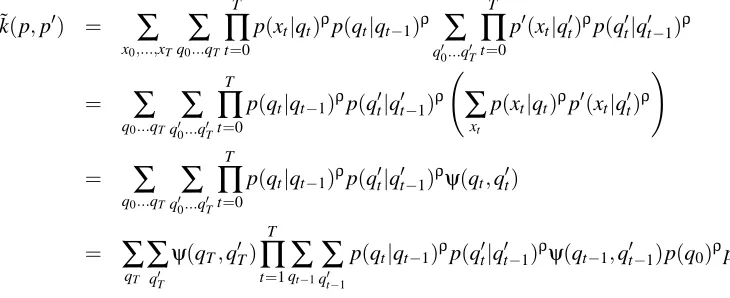
˜k(p,p0) =
∑
x0,...,xT∑
q0...qT T
∏
t=0
p(xt|qt)ρp(qt|qt−1)ρ
∑
q00...q0TT
∏
t=0
p0(xt|q0t)ρp(q0t|q0t−1)ρ
=
∑
q0...qT
∑
q00...q0T T
∏
t=0
p(qt|qt−1)ρp(qt0|q0t−1)ρ
∑
xtp(xt|qt)ρp0(xt|q0t)ρ
!
=
∑
q0...qT
∑
q0
0...q0T T
∏
t=0
p(qt|qt−1)ρp(qt0|q0t−1)ρψ(qt,q0t)
=
∑
qT
∑
q0 T
ψ(qT,q0T) T
∏
t=1q
∑
t−1∑
q0 t−1
p(qt|qt−1)ρp(q0t|qt0−1)ρψ(qt−1,q0t−1)p(q0)ρp0(q00)ρ.
In the above we see that we only need to compute the kernel for each setting of the hidden variable for a given time step on its own. Effectively, the kernel couples the two HMMs via their common children as in Figure 1(c). The kernel evaluations, once solved, form non-negative clique potential functionsψ(qt,q0t)with a different setting for each value of qt and q0t. These couple the
hidden variable of each HMM for each time step. The elementary kernel evaluations are easily computed (particularly if the emission distributions p(xt|qt)are in the exponential family) as:
˜k(p(xt|qt),p0(xt|q0t)) = ψ(qt,q0t) =
∑
xtp(xt|qt)ρp0(xt|qt0)ρ.
Only a total of(T+1)× |qt| × |q0t|such elementary kernels need to be evaluated and form a
lim-ited number of such clique potential functions. Similarly, each conditional distribution p(qt|qt−1)ρ
p(qt|qt−1)ρandφ(q0t,qt0−1) =p0(q0t|q0t−1)ρ. Computing the kernel then involves marginalizing over
the hidden variables xh, which is done by running a forward-backward or junction-tree algorithm
on the resulting undirected clique tree graph shown in Figure 2. Thus, to compute the kernel for two sequencesx andx0of lengths Tx+1 and Tx0+1, we train an HMM from each sequence using
maximum likelihood and then compute the kernel using the learned HMM transition matrix and emission models for a user-specified sequence length T+1 (where T can be chosen according to some heuristic, for instance, the average of all Tx in the training data set). The following is
pseudo-code illustrating how to compute the ˜k(p,p0)kernel given two hidden Markov models(p,p0)and user-specified parameters T andρ.
Φ(q0,q00) =p(q0)ρp0(q00)ρ
for t=1. . .T
Φ(qt,q0t) =
∑
qt−1∑
q0t−1
p(qt|qt−1)ρp0(q0t|qt0−1)ρψ(qt−1,q0t−1)Φ(qt−1,q0t−1)
end
˜k(p,p0) =
∑
qT∑
q0T
Φ(qT,q0T)ψ(qT,q0T).
Note that the hidden Markov models p and p0need not have the same number of hidden states for the kernel computation.
4.3 Bayesian Networks
The above method can be applied to Bayesian networks in general where hidden and observed vari-ables factorize according to p(x) =∏N
i=1p(xi|xpa(i)). The general recipe mirrors the above
deriva-tion for the hidden Markov model case. In fact, the two Bayesian networks need not have the same structure as long as they share the same sample space over the emission variables xo. For instance,
consider computing the kernel between the Bayesian network in Figure 3(a) and the hidden Markov model in Figure 1(b) over the same sample space. The graphs can be connected with their common children as in Figure 3(b). The parents with common children are married and form cliques of hid-den variables. We then only need to evaluate the elementary kernels over these cliques giving the following non-negative potential functions for each observed node (for instance xi∈xo) under each
setting of all its parents’ nodes (from both p and p0):
ψ(xh,pa(i),x0h0,pa(i)) = ˜k(p(xi|xh,pa(i)),p0(xi|xh0,pa(i)0))
=
∑
xi
p(xi|xh,pa(i))ρp0(xi|xh0,pa(i)0)ρ.
(a) Bayesian network for p. (b) Combined graphs.
Figure 3: The resulting graphical model from a Bayesian network and a hidden Markov model as the kernel couples common parents for each node creating undirected edges between them and a final clique graph for the junction tree algorithm.
xh contains scalars and vectors, as is the case in linear Gaussian models, which we develop in the
next subsections.
4.4 Linear Gaussian Models
A linear Gaussian model on a directed acyclic graph
G
with variables x1,x2, . . . ,xN associated to itsvertices is of the form
p(x1,x2, . . . ,xN) =
∏
iN
xi;βi,0+∑j∈pa(i)βi,jxj,Σi
where
N
(x; µ,Σ)is the multivariate Gaussian distribution, and pa(i)is the index set of parent ver-tices associated with the ithvertex. The unconditional joint distribution can be recovered from the conditional form and is itself a Gaussian distribution over the variables in the model p(x1,x2, . . . ,xN).Hence, the probability product kernel between a pair of linear Gaussian models can be computed in closed form by using the unconditional joint distribution and (5).
Latent variable models require an additional marginalization step. Variables are split into two sets: the observed variables xoand the hidden variables xh. After the joint unconditional distribution
p(xo,xh)has been computed, the hidden variables can be trivially integrated out:
k(p,p0) =
Z Z
p(xo,xh)dxh
ρZ
p(xo,x0h)dxh0
ρ
dxo = Z
p(xo)ρp0(xo)ρdxo,
so that the kernel is computed between Gaussians over only the observed variables.
4.5 Linear Dynamical Systems
A commonly used linear Gaussian model with latent variables is the linear dynamical system (LDS) (Shumway and Stoffer, 1982), also known as the state space model or Kalman filter model. The LDS is the continuous state analog of the hidden Markov model and shares the same conditional independence graph Figure 1(a). Thus, it is appropriate for modeling continuous time series data and continuous dynamical systems. The LDS’s joint probability model is of the form
p(x0, . . .xT,s0, . . .sT) =
N
(s0; µ,Σ)N
(x0;Cs0,R) T∏
t=1
where xt is the observed variable at time t, and st is the latent state space variable at time t, obeying
the Markov property.
The probability product kernel between LDS models is
k(p,p0) = Z
N
(x; µx,Σxx)ρN
(x; µ0x,Σ0xx)ρdx,where µx and Σxx are the unconditional mean and covariance, which can be computed from the
recursions
µst = Aµst−1
µxt = Cµst
Σstst = AΣst−1st−1A0+Q
Σxtxt = CΣststC0+R.
As with the HMM, we need to set the number of time steps before computing the kernel. Note that the most algorithmically expensive calculation when computing the probability product kernel between Gaussians is taking the inverse of the covariance matrices. The dimensionality of the covariance matrix will grow linearly with the number of time steps and the running time of the matrix inverse grows cubically with the dimensionality. However, the required inverses can be efficiently computed becauseΣxx is block diagonal. Each extra time step added to the kernel will
simply add another block, and the inverse of a block diagonal matrix can be computed by inverting the blocks individually. Therefore, the running time of inverting the block diagonal covariance matrix will only grow linearly with the number of time steps T and cubically with the (small) block size.
5. Sampling Approximation
To capture the structure of real data, generative models often need to be quite intricate. Closed form solutions for the probability product kernel are then unlikely to exist, forcing us to rely on approximation methods to compute k(p,p0).
Provided that evaluating the likelihood p(x)is computationally feasible, and that we can also efficiently sample from the model, in theρ=1 case (expected likelihood kernel) we may employ the Monte Carlo estimate
k(p,p0) ≈ β
N N
∑
i=1
p0(xi) + (1−β)
N0 N
∑
i=1
p(x0i),
where x1, . . . ,xN and x01, . . . ,x0N are i.i.d. samples from p and p0 respectively, and β∈[0,1]is a
parameter of our choosing. By the law of large numbers, this approximation will converge to the true kernel value in the limit N→∞for anyβ. Other sampling techniques such as importance sampling and a variety of flavors of Markov chain Monte Carlo (MCMC), including Gibbs sampling, can be used to improve the rate of the sampling approximation’s convergence to the true kernel.
1
q q2 q3
0
q
1
s s2 s3
0
x
0
s
1
x x2 x3
Figure 4: Graph for the Switching Linear Dynamical System.
The sampling approximation then becomes
k(p,p0) ≈ β
N N
∑
i=1
Z p0(xˆi)ρ + (1−β)
N0 N
∑
i=1
Z0p(xˆ0i)ρ,
where Z and Z0 are the normalizers of p and p0 after they are taken to the power of ρ. In this formulation ˆx1, . . . ,xˆN and ˆx01, . . . ,xˆ0N are i.i.d. samples from ˆp and ˆp0where ˆp= pZρ and ˆp0= pZ0ρ0 .
In practice, for a finite number of samples, the approximate kernel may not be a valid Mercer kernel. The non-symmetric aspect of the approximation can be alleviated by computing only the lower triangular entries in the kernel matrix and replicating them in the upper half. Problems as-sociated with the approximation not being positive definite can be rectified by either using more samples, or by using an implementation for the kernel based classifier algorithm that can converge to a local optimum such as sequential minimal optimization (Platt, 1999).
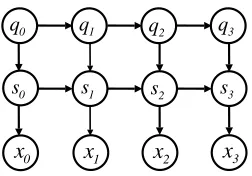
5.1 Switching Linear Dynamical Systems
In some cases, part of the model can be evaluated by sampling, while the rest is computed in closed form. This is true for the switching linear dynamical system (SLDS) (Pavlovic et al., 2000), which combines the discrete hidden states of the HMM and the continuous state space of the LDS:
p(x,s,q) =p(q0)p(s0|q0)p(x0|s0) T
∏
t=1
p(qt|qt−1)p(st|st−1,qt)p(xt|st),
where qt is the discrete hidden state at time t, st is the continuous hidden state, and xt are observed
emission variables (Figure 4). Sampling q1. . . ,qN according to p(q)and q01, . . . ,q0N according to p0(q0), the remaining factors in the corresponding sampling approximation
1 N
N
∑
i=1
Z Z
p(s0|qi0)p0(s00|q00i) T
∏
t=1
p(st|st−1,qti)p0(st0|s0t−1,qt0i) T
∏
t=0
p(xt|st)p0(xt|s0t)ds ds0
!ρ
dx
6. Mean Field Approximation
Another option when the probability product kernel between graphical models cannot be computed in closed form is to use variational bounds, such as the mean field approximation (Jaakkola, 2000). In this method, we introduce a variational distribution Q(x), and using Jensen’s inequality, lower bound the kernel:
k(p,p0) = Z
p(x)ρp0(x)ρdx= Z
Ψ(x)ρdx=exp
log
Z Q(x)
Q(x)Ψ(x)
ρdx
≥ exp
Z
Q(x)logΨ(x) ρ
Q(x) dx
=exp(ρEQ[logΨ(x)] +H(Q)) =B(Q),
whereΨ(x) =p(x)p0(x)is called the potential, EQ[·]denotes the expectation with respect to Q(x),
and H(Q)is the entropy. This transforms the problem from evaluating an intractable integral into that of finding the sufficient statistics of Q(x)and computing the subsequent tractable expectations. Note, using the mean field formulation gives a different (and arguably closer result) to the desired intractable kernel than simply computing the probability product kernels directly between the ap-proximate simple distributions. It is interesting to note the following form of the bound when it is expressed in terms of the Kullback-Leibler divergence, D(Qkp) =R
Q(x)logQp((xx))dx, and an entropy term. The bound on the probability product kernel is a function of the Kullback-Leibler divergence to p and p0:
k(p,p0) ≥ B(Q) = exp −ρD(Qkp)−ρD(Qkp0) + (1−2ρ)H(Q) .
The goal is to define Q(x)in a way that makes computing the sufficient statistics easy. When the graphical structure of Q(x)has no edges, which corresponds to the case that the underlying variables are independent, this is called the mean field method. When Q(x) is made up of a number of more elaborate independent structures, it is called the structured mean field method. In either case, the variational distribution factors in the form Q1(x1)Q2(x2). . .QN(xN) with x1,x2, . . . ,xN disjoint
subsets of the original variable set x.
Once the structure of Q(x)has been set, its (locally) optimal parameterization is found by cy-cling through the distributions Q1(x1),Q2(x2), . . . ,QN(xN)and maximizing the lower bound B(Q)
with respect to each one, holding the others fixed:
∂log B(Q) ∂Qn(xn)
= ∂
∂Qn(xn)
ρZ Qn(xn)EQ[logΨ(x)|xn]dxn+H(Qn) +constant
=0.
This leads to the update equations
Qn(xn) =
1 Zn
exp(ρEQ[logΨ(x)|xn]),
where the conditional expectation EQ[· |xn]is computed by taking the expectation over all variables
except xnand
Zn= Z
exp(ρEQ[logΨ(x)|xn])dx
1 1 q 1 2 q 1 3 q 0 x 1 0 q 1
x x2 x3
2 1
q 2
2
q q23
2 0 q 1 1 q 1 2 q 1 3 q 0 x 1 0 q 1
x x2 x3
2 1
q 2
2
q q23
2 0 q
'1 1
q '1
2
q '1
3 q '1 0 q '2 1
q '2
2
q '2
3 q '2 0 q 1 1 q 1 2 q 1 3 q 0 x 1 0 q 1
x x2 x3
2 1
q 2
2
q q32
2 0 q
'1 1
q '1
2
q '1
3 q '1 0 q '2 1
q '2
2
q '2
3 q
'2 0 q
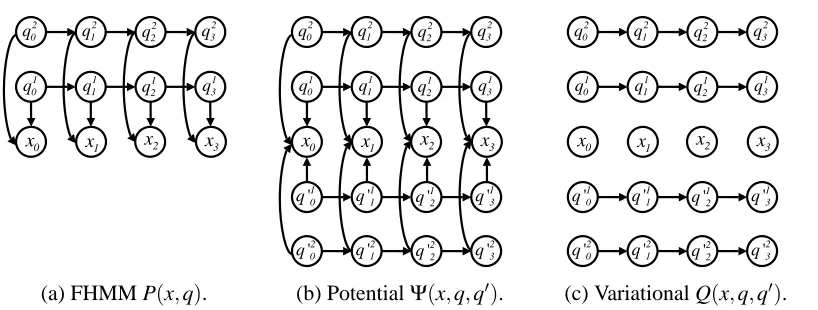
(a) FHMM P(x,q). (b) PotentialΨ(x,q,q0). (c) Variational Q(x,q,q0).
Figure 5: Graphs associated with the factorial hidden Markov model, its probability product kernel potential, and its structured mean field distribution.
In practice this approximation may not give positive definite (PD) kernels. Much current re-search has been focused on kernel algorithms using non-positive definite kernels. Algorithms such as sequential minimal optimization (Platt, 1999) can converge to locally optimal solutions. The learning theory for non-PD kernels is currently of great interest. See Ong et al. (2004) for an inter-esting discussion and additional references.
6.1 Factorial Hidden Markov Models
One model that traditionally uses a structured mean field approximation for inference is the factorial hidden Markov model (FHMM)(Ghahramani and Jordan, 1997). Such a model is appropriate for modeling output sequences that are emitted by multiple independent hidden processes. The FHMM is given by
p(x0,x1,x2, . . . ,xT) = C
∏
c=1
"
p(qc0) T
∏
t=1
p(qct|qct−1)
#
T
∏
t=0
p(xt|q1t, . . . ,qCt ),
where qct is the factored discrete hidden state at time t for chain c and xt is the observed Gaussian
emission variable at time t. The graphs of the joint FHMM distribution, the potentialΨ(x,q,q0), and the variational distribution Q(x,q,q0)are depicted in Figure 5. The structured mean field ap-proximation is parameterized as
Q(qc0=i) ∝ expρlogφc(i)−ρ
2log|Σi| −
ρ
2EQ
(x0−µi)TΣi−1(x0−µi)
Q(qct=i|qct−1=j) ∝ exp
ρlogΦc(i,j)−ρ
2log|Σi| −
ρ
2EQ
(xt−µi)TΣi−1(xt−µi)
Q(xt) =
N
(xt; ˆµt,Σˆt)ˆ
Σt =
1
ρ
∑
i,c
EQ[sct(i)]Σ−i 1+
∑
i,cEQ
q0tc(i)Σ0−1
i
−1
ˆµt = ρΣˆt
∑
i,c
EQ[qct(i)]Σ−i 1µi+
∑
i,cEQ
qt0c(i)
Σ0−1 i µ0i
θθθθ
θθθθ’
θθθθ*
Figure 6: A statistical manifold with a geodesic path between two generative modelsθandθ0 as well as a local tangent space approximation at, for instance, the maximum likelihood modelθ∗for the aggregated data set.
It is necessary to compute the expected sufficient statistics to both update the mean field equa-tions and to evaluate the bound. The expectaequa-tions EQ[xt]and EQ
xtxTt
can easily be computed from Q(xt), whereas Q(sct =i)and Q(sct =i,sct−1=j)can be computed efficiently by means of a
junction tree algorithm on each independent chain in the approximating distribution.
7. Relationship to Other Probabilistic Kernels
While the probability product kernel is not the only kernel to leverage generative modeling, it does have advantages in terms of computational feasibility as well as in nonlinear flexibility. For in-stance, heat kernels or diffusion kernels on statistical manifolds (Lafferty and Lebanon, 2002) are a more elegant way to generate a kernel in a probabilistic setting, but computations involve finding geodesics on complicated manifolds and finding closed form expressions for the heat kernel, which are only known for simple structures such as spheres and hyperbolic surfaces. Figure 6 depicts such a statistical manifold. The heat kernel can sometimes be approximated via the geodesic distance from p which is parameterized byθto p0parameterized byθ0. But, we rarely have compact closed-form expressions for the heat kernel or for these geodesics for general distributions. Only Gaussians with spherical covariance and multinomials are readily accommodated. Curiously, the probabilistic product kernel expression for both these two distributions seems to coincide closely with the more elaborate heat kernel form. For instance, in the multinomial case, both involve an inner product between the square-rooted count frequencies. However, the probability product kernel is straight-forward to compute for a much wider range of distributions providing a practical alternative to heat kernels.
Another probabilistic approach is the Fisher kernel (Jaakkola and Haussler, 1998) which approx-imates distances and affinities on the statistical manifold by using the local metric at the maximum likelihood estimate θ∗ of the whole data set as shown in Figure 6. One caveat, however, is that this approximation can produce a kernel that is quite different from the exact heat kernel above and may not preserve the interesting nonlinearities implied by the generative model. For instance, in the exponential family case, all distributions generate Fisher kernels that are linear in the sufficient statistics. Consider the Fisher kernel
where Iθ−∗1 is the inverse Fisher information matrix at the maximum likelihood estimate and where
we define
Ux = ∇θlog p(x|θ)|θ∗.
In exponential families, pθ(x) =exp(
A
(x)+θTT
(x)−K
(θ))producing the following Ux=
T
(x)−G
(θ∗)where we defineG
(θ∗) =∇θK
(θ))|θ∗. The resulting Fisher kernel is thenk(x,x0) = (
T
(x)−G
(θ∗))TIθ−∗1T
(x0)T−G
(θ∗),
which is an only slightly modified form of the linear kernel in
T
(x). Therefore, via the Fisher kernel method, a Gaussian distribution over means generates only linear kernels. A Gaussian distribution over means and covariances generates quadratic kernels. Furthermore, multinomials generate log-counts unlike the square root of the log-counts in the probability product kernel and the heat kernel. In practical text classification applications, it is known that square root squashing functions on fre-quencies and count typically outperform logarithmic squashing functions (Goldzmidt and Sahami, 1998; Cutting et al., 1992). In (Tsuda et al., 2002; Kashima et al., 2003), another related probabilis-tic kernel is put forward, the so-called marginalized kernel. This kernel is again similar to the Fisher kernel as well as the probability product kernel. It involves marginalizing a kernel weighted by the posterior over hidden states given the input data for two different points, in other words the out-put kernel k(x,x0) =∑h∑h0p(h|x)p(h0|x0)k((x,h),(x0,h0)). The probability product kernel is similar,however, it involves an inner product over both hidden variables and the input space x with a joint distribution.
A more recently introduced kernel, the exponentiated symmetrized Kullback-Leibler (KL) di-vergence (Moreno et al., 2004) is also related to the probability product kernel. This kernel involves exponentiating the negated symmetrized KL-divergence between two distributions
k(p,p0) = exp(−αD(pkp0)−αD(p0kp) +β)where D(pkp0) = Z
x
p(x)log p(x) p0(x)dx
where α andβ are user-defined scalar parameters. However, this kernel may not always satisfy Mercer’s condition and a formal proof is not available. Another interesting connection is that this form is very similar to our mean-field bound on the probability product kernel (7). However, unlike the probability product kernel (and its bounds), computing the KL-divergence between complicated distributions (mixtures, hidden Markov models, Bayesian networks, linear dynamical systems and intractable graphical models) is intractable and must be approximated from the outset using numer-ical or sampling procedures which further decreases the possibility of having a valid Mercer kernel (Moreno et al., 2004).
8. Experiments
8.1 Text Classification
For text classification, we used the standard WebKB data set which consists of HTML documents in multiple categories. Only the text component of each web page was preserved and HTML markup information and hyper-links were stripped away. No further stemming or elaborate text pre-processing was performed on the text. Subsequently, a bag-of-words model was used where each document is only represented by the frequency of words that appear within it. This corresponds to a multinomial distribution over counts. The frequencies of words are the maximum likelihood estimate for the multinomial generative model to a particular document which produces the vector of parameters ˆαas in Section 3.
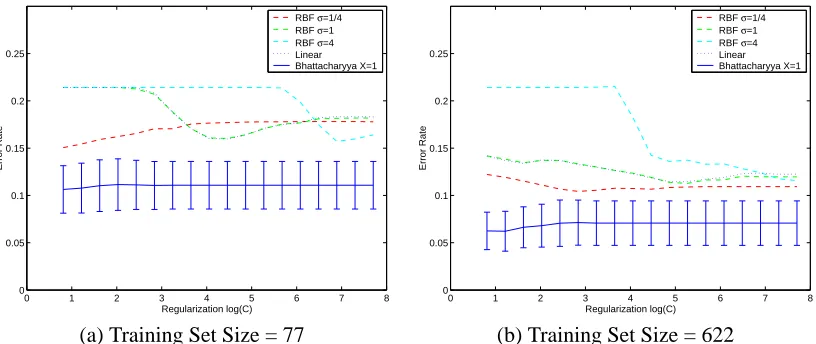
0 1 2 3 4 5 6 7 8
0 0.05 0.1 0.15 0.2 0.25
Regularization log(C)
Error Rate
RBF σ=1/4 RBF σ=1 RBF σ=4 Linear Bhattacharyya X=1
0 1 2 3 4 5 6 7 8
0 0.05 0.1 0.15 0.2 0.25
Regularization log(C)
Error Rate
RBF σ=1/4 RBF σ=1 RBF σ=4 Linear Bhattacharyya X=1
(a) Training Set Size = 77 (b) Training Set Size = 622
Figure 7: SVM error rates (and standard deviation) for the probability product kernel (set atρ=1/2 as a Bhattacharyya kernel) for multinomial models as well as error rates for traditional kernels on the WebKB data set. Performance for multiple settings of the regularization parameter C in the support vector machine are shown. Two different sizes of training sets are shown (77 and 622). All results are shown for 20-fold cross-validation.
product kernel, it outperforms the linear kernel as well as the RBF kernel at multiple settings of the RBFσ parameter (we attemptedσ={1/4,1,4}). This result confirms previous intuitions in the text classification community which suggest using squashing functions on word frequencies such as the logarithm or the square root (Goldzmidt and Sahami, 1998; Cutting et al., 1992). This also related to the power-transformation used in statistics known as the Box-Cox transformation which may help make data seem more Gaussian (Davidson and MacKinnon, 1993).
8.2 Biological Sequence Classification
For discrete sequences, natural generative models to consider are Markov models and hidden Markov models. We obtained labeled gene sequences from the HS3D data set2The sequences are of variable lengths and have discrete symbol entries from the 4-letter alphabet (G,A,T,C). We built classifiers to distinguish between gene sequences of two different types: introns and exons using raw sequences of varying lengths (from dozens of characters to tens of thousands of characters). From the orig-inal (unwindowed) 4450 introns and 3752 exons extracted directly from GenBank, we selected a random subset of 500 introns and 500 exons. These 1000 sequences were then randomly split into a 50% training and a 50% testing subset. In the first experiment we used the training data to learn stationary hidden Markov models whose number of states M was related to the length Tnof a
given sequence n as follows: M=floor(12pO2+4(Tζ+O+1)−1
2O) +1. Here, O is the number
of possible emission symbols (for gene sequences, O=4) andζ is the ratio of parameters to the number of symbols in the sequence T (we usedζ=1/10 although higher values may help avoid over-parameterizing the models). Each hidden Markov model was built from each sequence using the standard Expectation-Maximization algorithm (which is iterated for 400 steps to ensure conver-gence, this is particularly crucial for longer sequences). Gram matrices of size 1000×1000 were then formed by computing the probability product kernel between all the hidden Markov models. It was noted that all Gram matrices were positive definite by a singular value decomposition. We also used the following standard normalization of the kernel (a typical pre-processing step in the literature):
˜k(p,p0) ← q ˜k(p,p0)
˜k(p,p)
q
˜k(p0,p0)
.
Subsequently, we trained a support vector machine classifier on 500 example sequences and tested on the remaining 500. Figure 8(a) depicts the resulting error rate as we vary C, the regulariza-tion parameter on the SVM as well as T the number of time steps used by the kernel. Throughout, these experiments, we only used the settingρ=1. Note that these models were 1st order hidden Markov models where each state only depends on the previous state. Varying T , the length of the hidden Markov models used in the kernel computation has a slight effect on performance and it seems T =9 at an appropriate C value performed best with an error rate as low as 10-11%.
For comparison, we also computed more standard string kernels such as the k-mer counts or spectrum kernels on the same training and testing gene sequences as shown in Figure 8(b). These basically correspond to a fully observed (non-hidden) stationary Markov model as in Figure 9. The zeroth order (K=1) Markov model does poorly with its lowest error rate around 34%. The first
2. This is a collection of unprocessed intron and exon class gene sequences referred to as the homo sapiens splice sites
1 2 3 4 5 6 0.05
0.1 0.15 0.2 0.25 0.3 0.35 0.4
Regularization log(C)
Error Rate
T=7 T=8 T=9 T=10 T=11
1 2 3 4 5 6
0.05 0.1 0.15 0.2 0.25 0.3 0.35 0.4
Regularization log(C)
Error Rate
K=1 K=2 K=3 K=4 K=5
(a) Hidden Markov Models (1st Order) (b) Markov Models (0th to 4th Order)
Figure 8: SVM error rates for the probability product kernel atρ=1 for hidden Markov models and Markov models (equivalent to string or spectrum kernels). In (a) test error rate under various levels of regularization is shown for 5 different settings of T in the probability product kernel. In (b) test error rate under various levels of regularization is shown for 5 different settings of the order K of the Markov model.