1
e-Journal of Media & Society
THE INFLUENCE FACTORS AND PERCEPTIONS TOWARDS THE STUDENT PERFORMANCE AND THE TENDENCY TO CHOOSE
PUBLIC RELATIONS COURSE Siti Nirmala Binti Mohamad Ishak
Abdul Rauf Bin Ridzuan
Faculty of Communication & Media Studies, Universiti Teknologi Mara Melaka
*correspondent: [email protected]
ABSTRACT
The ultimate aim of Public Relations is to present organizations in the best light possible. This requires special skills in the area of research, managerial, persuasive communication, strategic planning and writing. The standpoint is needed to evaluate the progressive of the profession growth in the industry. Public Relations itself can be a best platform for a person to represent themselves and express their interest towards the profession. This research examined the study of factors and perceptions towards the student’s school and academic performances and their tendency to choose Public Relations course as the main options. The amount of survey calculated based on Krejcie and Morgan Table, N=95 , S=76 by using purposive sampling method. Descriptive quantitative research study was conducted through survey using questionnaire form. The hypothesis testing gained by using two different methods which indicated different result which are Pearson Correlation and Multiple Linear Regression. Based on the research by using Pearson Correlation method, the five listed null hypothesis is accepted based on the standardized significant values which is must be or less than 0.05. However, based on Multiple Linear Regression method, there is different reading which formed different results. Based on significant value in Coefficient Multiple Linear Regression analysis, the null hypothesis of self-interest (0.042) and industry prospect (0.037) is being accepted with significant value below than 0.05.
Keynote: Public Relations, Motivation Factor, Perception, Influence Factor
INTRODUCTION
2 their surrounding such as family and friends or some of them being more influence towards the course job scope and opportunity. Most of graduating student especially from the secondary school may not have a solid decision on deciding where the suitable college or what the most suitable degree course to further their study (Ramirez & Dizon, 2014). Academic institution is responsible to promote and preparing the guideline for an educational program to promote the possible course or college (Nadelson, 2013).
Some of the student may not have enough knowledge or awareness about the application process or how they should choose the course based on their ability and academic performance. Pafili and Mylonakis (2011) believe that the right decision towards the proper profession and courses can successfully utilize their skill and knowledge that could contribute to the development of society and country. However, some of studies shown that not all the students who further their study to the university have the intention to obtain the qualification.
The research study is only focused for Bachelor of Public Relations students in UiTM Alor Gajah, Melaka. As the first batch to be the main pioneer in the campus with 21 students for the first intake on September 2015, it is a big improvement and a new platform for new courses establishment in Faculty of Communication and Media Studies. The courses students’ intake now almost reached to 95 students to further their study in Bachelor of Public Relations. This research will give us the overview of tendency by the student in choosing these courses and perception towards the courses content itself. The factors of the tendency may include the motivation factors, family and education background, and self-interest and how the student states their own perception towards the courses. Furthermore, the research can be used by the educator to study the enhancement and rational of the courses established in the campus. Tendency factors and students perception can be shown by how their academic performance and their involvement towards the course assessment itself. The findings and data analysis are important for the education institute to play their roles in enhancing the study environment or the on-going assessment itself for an excellent academic performance.
PROBLEM STATEMENT
Academic performance of students has been of great concern to educationists, guidance and counselors. It is important for the student to choose suitable course based on their interest, ability and previous academic performances. Decision making process can be influence by various factors that indicated towards the future results and performances. Education institution plays an important role to give an exposure to the student about the background and potential course to wisely choose the suitable field.
Such of influence factors and perceptions discussed in the study indicated that there are significantly affected the decision making process. Motivation from internal and external factors, family and education background, self-interest are the main influence factors that indicated the tendency of the student to choose the suitable course and academic performances.. Industry prospect and course assessment content are two main dimensions of perceptions that indicated the result towards the student performances.
3 decision making on the selected course, they may tend to have a problem during the university academic session or it might cause to risk their job opportunity.
ELEMENT OF INFLUENCE FACTORS (LITERATURE REVIEW 2) Motivation Factor
Motivation play an important roles in student behavior towards the student performances such as in achieving a certain goals, increasing initiative and perseverance of an activity (Ormrod,2000). Bandura (1997) define motivation as a strong passion and desire in a personal identity to encourage them on doing and trying something in order to succeed. Motivation effects student learning which play as a main key factor in keeping the students in their learning process and have been found as the most significant factor that influence academic and student performances (Pintrich,1994).
Family and Education Background
Many investigations have demonstrated that understudies whose families have low instructive levels and low financial status encounter higher rates of early school leaving, low scholastic desires, and rejection from higher instructive tracks than those from more advantaged social gatherings (Bourdieu and Passeron, 1970; Flore). Albeit social disparities endure, schools can basically advance social change past generation (Giroux, 1988; Willis, 1981 ) and families' inclusion in their kids' instruction can assume an essential part in this change. In spite of the fact that a broad collection of writing has concentrated on the effect of various kinds of family interest, the capability of family instruction to close the accomplishment hole among scholastic and non-scholarly families, still should be further created.
Self-Interest
Interest is often thought of as a process that contributes to learning and achievement. That is, being interested in a topic is a mental resource that enhances learning, which then leads to better performance and achievement (Hidi, 1990). Indeed, research has demonstrated that both situational and individual interest promote attention, recall, task persistence, and effort (Ainley, Hidi, & Berndorff, 2002; Hidi, 1990; Hidi & Renninger,2006).
ELEMENTS OF PERCEPTIONS (LITERATURE REVIEW 3)
Content and Course AssessmentThe students performances during class can be observe and measure by the development of direct involvement of the student from classroom instruction, group work and activities. It can be considered as a valid and reliable method to facilitate the student’s participation in evaluation process. The evaluation process can be control and observe through the given task, decision making, problem solving and the implementation of the skill through the student presentations.
4 A recent study by Richardson’s (2009), the perceptions of Australian tourism and hospitality students was important factors for them to choice of career and the extent to which a career in these industries would offer those factors as an enjoyable job, pleasant working environment, job security, colleagues they can get along with and high earnings over the length of their career were the most important.
ACADEMIC PERFORMANCES (LITERATURE REVIEW 4)
Education plays an essential role in the acquisition of knowledge and skills. It is a tool which can be used to train the future generations to inculcate skills and competencies. The way a child is raised has an adverse impact not only to oneself but to the whole society. While growing up the child spends most of his time at home and the type of environment he or she is brought in also hamper their cognitive development. In order to help a child grow in good health, parents should come into the picture in shaping the child’s character and frame of mind. Literature around the globe shares that the level of education which the parents have achieved can also affect the child’s growth as literate parents have the ability to instill wisdom acquired by them to their children. Literate and illiterate parents differ in the sense of being able to read and write and the accumulation of skills and knowledge of certain fields of study.
RESEARCH METHODOLOGY
This research examined the study of factors and perceptions towards the student’s school and academic performances and their tendency to choose Public Relations course as the main options. The amount of survey calculated based on Krejcie and Morgan Table, N=95 , S=76 by using purposive sampling method. Descriptive quantitative research study was conducted through survey using questionnaire form. The hypothesis testing gained by using two different methods which indicated different result which are Pearson Correlation and Multiple Linear Regression.
RESULTS AND DISCUSSIONS
a) Profile of the Public Relations Bachelor Student of UiTM Melaka
The profile of the sample is discussed in terms of six characteristics: sex, age group, current semester, previous education, PR as first choice and the happiness towards the choices.
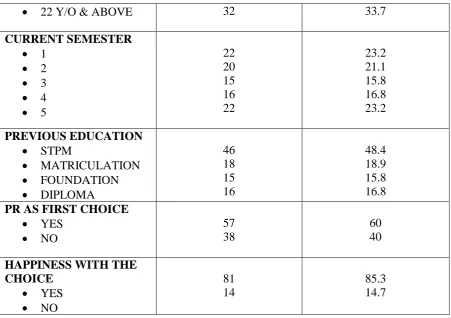
Table 1: Distribution of Public Relations Bachelor Student by Profile (n=95)
ITEM FREQUENCY PERCENTAGE %
SEX
• MALE
• FEMALE
22 73
23.2 76.8 AGE GROUP
• 19 Y/O
• 20 Y/O
• 21 Y/O
6 27 30
5
• 22 Y/O & ABOVE 32 33.7
CURRENT SEMESTER • 1 • 2 • 3 • 4 • 5 22 20 15 16 22 23.2 21.1 15.8 16.8 23.2 PREVIOUS EDUCATION • STPM • MATRICULATION • FOUNDATION • DIPLOMA 46 18 15 16 48.4 18.9 15.8 16.8 PR AS FIRST CHOICE
• YES • NO 57 38 60 40 HAPPINESS WITH THE
CHOICE • YES • NO 81 14 85.3 14.7
Table 1 above shows the profile of respondents of Public Relations degree student in UiTM Alor Gajah, Melaka is from different background. Based on the female is the dominant population in the sample of study which is involving 76.8%. The highest age group of the student is 22 years old and above which represent 33.7%. The highest previous education background is mostly come from STPM qualification which indicated 48.4%. From 95 Bachelor in Public Relations students, only 60% is possible to choose Public Relations course as the first choice. However, most of the population which represents 85.3% is happy with their decision to choose Public Relations course.
Table 2 : Coefficient for Multiple Regression Analysis Coefficientsa
Model Unstandardized
Coefficients
Standardized Coefficients
t Sig.
B Std. Error Beta
1
(Constant) .735 .46 1.600 .113
Motivation Factor .086 .07 .120 1.245 .216
Family & Education Background
.030 .06 .047 .499 .619
Self-Interest .190 .09 .211 2.064 .042
Course & Assessment Content
.185 .12 .171 1.542 .127
6 a. Dependent Variable: STUDENT PERFORMANCE
The Coefficient table above shows Beta value for all the independent variables when they are regressed jointly against dependent variable. Based on the standardized coefficients reading, the Beta values for all independent show positive relationship towards the dependent variables.
• H1 The higher the level factors of motivation factor, the higher the level of student’s academic performances.
Factor 1 is regarding motivation factor which indicated Beta value of positive relationship (β=0.120) with the significant level (p=0.216). Thus the null hypothesis is rejected and accepts the new alternate hypothesis. Bandura (1997), stated motivation as the highest desire to be the main factor for the student being influence towards their school performances. Kimani (2003), student’s performances will be positively affect by the strong interest and high motivation through internal and external aspect.
• H2 The higher the level factors of family education background, the higher the level of student’s academic performances.
Factor 2 is referring to education and family background which indicted the lowest positive reading (β=0.047) at significant level (p=0.619). Thus the null hypothesis is rejected and accepts the new alternate hypothesis. Epstein (1995) said, the parental involvement directly to their children school activity and social interaction will enhance their children cognitive behavior towards their school performances and decision making process.
• H3 The higher the level factors of self-interest, the higher the level of student’s academic performances.
Factor 3 stated that the positive reading of self-interest (β=0.211) at significant value (p=0.42). Thus the null hypothesis is accepted due to the significant value is (p<0.05). Self-interest is the strongest influence for an individual to attract on each action, belief and decision making process (Hidi,1990).
• H4 The higher the level perception towards the course content and assessment, the higher the level of student’s performances.
The Perception 1 which refer to the perception towards the content and course assessment with positive Beta value (β=0.171) at significant value (p=0.127). The null hypothesis is rejected and accepts the new alternate hypothesis. The enhancement of individual skill based on their learning process will directly influence their interest towards the course and positively affect on the academic performances (Linn & Miller, 2005).
• H5 The higher the level perception towards the industry prospect, the higher the level of student’s performances.
7
CONCLUSION
Based on Multiple Linear Regression method, there were two indicated result based on the coefficients analysis. The first reading indicated the Beta (β) values which represent the significant relations directly from the independent towards dependent variables. The Beta (β) values shown, industry prospect (β=0.234) was the strongest significant relations towards the dependent variable of student’s academic performance which influenced the tendency of the decision making process to choose Public Relation course. Besides, based on coefficients significant level of Multiple Linear Regression analysis indicated the standardized significant value must be or less than 0.05. They were two independent variables and hypothesis is accepted. Thus, the null hypothesis (Ho) for H3 (Sig.= 0.042) and H5 (Sig.=0.037) is accepted. The remaining null hypothesis (H1, H2, and H4) is rejected and accepted the alternate hypothesis (Ha).
References
Ainley, M., Hidi, S., & Berndorff, D. (2002). Interest, learning, and the psychological processes that mediate their relationship. Journal of educational psychology, 94(3), 545.
Bandura, A. (1997). The nature and structure of self-efficacy. Self-efficacy: the exercise of
control. New York, NY: WH Freeman and Company, 37-78.
Cronbach, L. J. (1951). Coefficient alpha and the internal structure of tests. psychometrika, 16(3), 297-334.
HYPOTHESIS Sig . RESULT
H1 The higher the level factors of motivation factor, the higher the level of
student’s academic performances. .216
H0 REJECTED
Ha ACCEPTED
H2 The higher the level factors of family education background, the higher the level
of student’s academic performances. .619
H0 REJECTED
Ha ACCEPTED
H3 The higher the level factors of self-interest, the higher the level of student’s
academic performances. .042 H0 ACCEPTED
H4The higher the level perception towards the course content and assessment, the
higher the level of student’s performances. .127
H0 REJECTED
Ha ACCEPTED
H5 The higher the level perception towards the industry prospect, the higher the level of
8 Epstein, J. L. (1995). School/family/community partnerships. Phi delta kappan, 76(9), 701.
Giroux, H. A. (1988). Teachers as intellectuals: Toward a critical pedagogy of learning.
Grunig, J. E., & Hunt, T. T. (1984). Managing public relations. Holt, Rinehart and Winston. idi, S. (1990). Interest and its contribution as a mental resource for learning. Review of
Educational research, 60(4), 549-571.
Kimani, G. N., Kara, A. M., & Njagi, L. W. (2013). Teacher factors influencing students’ academic achievement in secondary schools in Nyandarua County, Kenya. International journal of education and research, 1(3), 1-14.