INTRODUCTION
Cobalt is an important element, not only for industry but for biological systems as well. In rapidly expanding the analytical fields such as environmental, biological and material monitoring of trace metals, there is an increasing need to develop simple, sensitive and selective analytical techniques that do not use expensive or complicated test equipment. For this reason, a wide variety of spectrophotometric methods for the determination of cobalt have been repor ted15. The main chromogenic reagents are pyridylazo reagents, thiazolylazo reagents, benzothiazolylazo reagents, 8-aminoquinoline derivatives, nitroso dyes and the like1-13. But the study of 2-quinolylazo derivatives as chromogenic reagents for the determination of cobalt has received little attention. In our previous wor k, some 2-quinolylazo derivatives were
Materials Science Research india Vol. 4(1),87-92 (2007)
Pre-concentration and solid phase extraction of trace
amounts of Co(II)-BPHA on octadecyl bonded silica
membrane disk and its application to the
determination of trace cobalt
H. AREF-AZAR
1and ALI MOGHIMI
2*
1Islamic Azad university-South Tehran Branch (Iran)
2Department of Chemistry, Varamin Campus Islamic Azad University, Varamin (Iran)
(Received: June 04, 2007; Accepted: June 24, 2007)
ABSTRACT
A sensitive, selective and rapid method has been developed for the determination µg l-1 level of cobalt based on the rapid reaction of cobalt(II) with N-benzoyl-N-phenylhydroxylamine (BPHA) and the solid phase extraction (SPE) of the colored chelate with Waters Porapak Sep-Park C18 disk. The BPHA can react with Co(II) in the presence of pH 3.9 acetic acid -sodium acetate buffer solution and cetyl trimethylammonium bromide (CTMAB) medium to form a violet chelate of a molar ratio 1:2 (cobalt to BPHA). This chelate can retained on Waters Porapak Sep-Park C18 disk quantitatively when they passed the disk as aqueous solution. After the enrichment finished, the retained chelate can be eluted from disk by 2.5 ml of ethanol (contain 5% acetic acid). In the measured solution, the molar absorptivity of the chelate is 1.58×10⁵ l mol-1 cm-1at 636 nm, and Beer’s law is obeyed in the range of 0.01-0.42 µg ml-1. The relative standard deviation for 11 replicate sample of 0.01 µg ml-1 level is 2.28%. The detection limit is 0.01 µg l-1 (in original samples). This method can be applied to the determination of mg l-1 level of cobalt in drinking water with satisfactory results.
Keywords: Cobalt; Solid phase extraction spectrophotometry; N-benzoyl-N-phenylhydroxylamine (BPHA).
synthesized and applied to the determination of metal ion14-18,20-24. In this paper, we thoroughly studied the color reaction of 2- (2-quinolylazo)-5-diethylaminobenzoic acid (BPHA) with cobalt (II), and the solid phase extraction (SPE) of the colored chelate with Waters Porapak† Sep-Park C18 disk. A high sensitive, selective and rapid method for the determination of cobalt was developed.
EXPERIMENTAL Apparatus
Reagents
Preparation of BPHA–naphthalene packing material
A solution of naphthalene and BPHA was prepared by dissolving 1 g naphthalene and 0.5 g BPHA in 5ml acetone in an ultrasonic system. Then, it was added drop by drop into 100 ml of DDW with continuous stirring at room temperature. The mixture was agitated for 5 min in the ultrasonic system and kept on stirring for 2 h andwas then allowed to stand for 4 h at room temperature. It was filtered and the residue was washed at least three times with DDW. The BPHA–naphthalene packing material was dried at room temperature, and was kept at low temperature for future use.
All of the solutions were prepared with ultrapure water obtained by a Milli-Q50 SP reagent water system (Millipore Corporation). High purity ethanol (Fisher Corporation) High purity ethanol (Fisher corporation), BPHA was prepared as described a 2.5×10⁻⁴ mol -1 of solution was prepared by dissolving BPHA with ethanol. A stock standard olution of Co(II) (1.0 mg ml-1) was prepared by dissolving appropriate amount of Co(NO3)2.6H2O with water and adjusting the volume to 500 ml in a 500 ml calibrated flask, then standardized by EDTA titration, a work solution of 0.2 mg ml-1 was prepared by diluting this solution. Acetic acid-/sodium acetate buffer solution, pH 3.8. Cetyl trimethyl ammonium bromide (CTMAB) solution: 2.0%, dissolving with 10% of ethanol. Glycoletherdiamine tetraacetic acid zinc salt (Zn-/EGTA) solution: 5%. NaF solution: 10%. All chemical used were of analytical grade unless otherwise stated.
Procedure
To a standard or sample solution containing no more than 1.0 mg of Co(II) in a 250 ml of flask. 10 ml of acetic acid-sodium acetate buffer solution, with pH 3.9, 5.0 ml Zn-/EGTA solution, 5.0 ml NaF solution, 5.0 ml of BPHA solution and 5.0 ml of CTMAB solution were added. The mixture diluted to volume of 250 ml and mixed well. After 10 min, the solution then was passed the Waters Porapak Sep-Park C18 disk at a flow rate of 50 ml min-1. the colored chelate would be retained on the disk. After the enrichment finished, eluted the retained chelates from the disk with 2.5 ml of ethanol (contain 5% acetic acid) at a flow rate
5 ml min-1 in reverse direction. The absorbance of this solution was measured at 635 nm in a 1 cm cell against a reagent blank prepared in a similar way without cobalt.
RESULTS AND DISCUSSION Absorption spectra
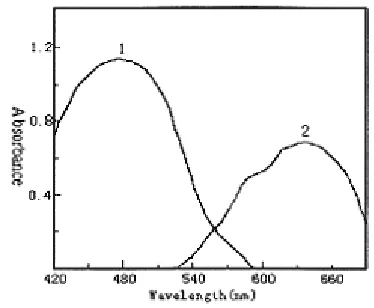
In the measured solution, the absorption spectra of BPHA and its Co(II) chelate are shown in Fig. 1. The absorption peaks of BPHA and its complex are located at 478 and 635 nm.
Fig. -1: Absorption spectra of BPHA and its Co(II) chelate: (1) BPHA -CTMAB blank against water; (2) BPHA Co (II)-CTMAB
complex against reagent blank.
Effect of acidity
Results showed that the optimal pH for the reaction of Co(II) with BPHA was 2.5-/5.2. A pH 3.9 was recommended as the addition of 5-15 ml of the acetic acid-/sodium acetate buffer solution (pH 3.9) per 250 ml of final solution was found to give a maximum and constant absorbance. The use of 10 ml of buffer was recommended.
Effects of surfactants
surfactants SDS, SDBS medium, the Co(II)-/ BPHA chromogenic system give a low absorption, whereas in the presence of nonionic surfactants or cationic surfactants, the absorption of the chromogenic system increases markedly. Various nonionic surfactants and cationic surfactants enhance the absorbance in the following sequence: CTMAB > Tw e e n - 8 0 > C P B > / Tw e e n - 2 0 > Tr i t o n X - 1 0 0 . Accordingly, CTMAB is the best additive. The addition of 4.0-/8.0 ml of CTMAB solution give a constant and maximum absorbance, and the use of addition 5.0 ml were recommended.
Effect of BPHA concentration
The addition of about 5.0 ml of 2.5×/10-4 mol l-1 of BPHA solution has been found to be sufficient for a complete reaction. Accordingly, 5.0 ml of BPHA solution was added in all further measurement.
Stability of the chromogenic system
After mixing the components, the absorbance reaches its maximum within 5 min at room temperature and remains stable for at least 8 h in water solution. When extracted into the ethanol medium. The chelate can keep stable at least 15 h.
Solid phase extraction
Both the enrichment and the elution were carried out on a Waters SPE device, which can prepare 20 samples simultaneously. The flow rate was 50 ml min-1 when enrichment and 5 ml min-1 when elution. Some experiments were carried out in order to investigate the retention of BPHA and its Co(II) chelate on the disk. It was found that the BPHA and its Co(II) chelate could be retained on disk quantitatively when they pass the disk as aqueous solution. The capacity of the disk for BPHA was 25 mg and its Co(II) chelate was 20 mg in a 250 ml of solution. Under the circumstance of this experiment, the disk has adequate capacity to enrich the Co- BPHA chelate and the excessive BPHA.
In order to choose a proper eluant for the retained BPHA and its Co(II) chelate. Various of organic solvents were studied. It was found that the tetrahydrofuran, acetone, acetonitrile, ethanol and methanol could elute the BPHA and its Co(II) chelate from disk quantitatively. Ethanol has a low
volatility, toxicity and price, so ethanol was selected. Co(II)- BPHA chelate has a good stability in weak acid medium. Containing 3-10% of acetic acid in ethanol could increase the stability of the Co(II)-BPHA chelate in the course elution. So ethanol (contain 5% of acetic acid) was selected as eluant. Experiment shows that it was easier to elute the retained BPHA and its Co(II) chelate in reverse direction than in forward direction, so it is necessary to upturned disk when elution. Ethanol (2.5 ml, contains 5% of acetic acid) was sufficient to elute the BPHA and its Co(II) chelate from disk at a flow rate of 5 ml min-1. The volume of 2.5 ml eluant was selected.
Calibration curve and sensitivity
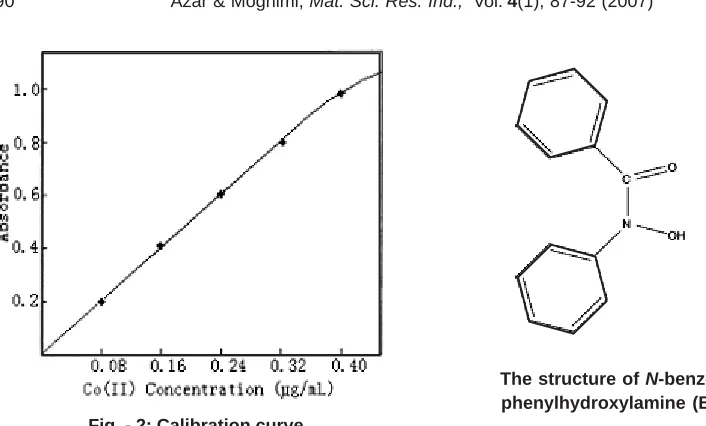
The calibration curve (Fig. 2) shown that Beer’s law is obeyed in the concentration range of 0.01- 0.42mg Co(II) ml-1 in the measured solution. The linear regression equation obtained was: A=2.725C (µg ml-1)+0.0308, (r=0.9997).
The molar absorptivity in the five measured solution was calculated to be1.58×105 l mol-1cm-1 at 636 nm, and the sandell sensitivity was 3.67×10 -4 mg cm-2. The relative standard deviation at a concentration level of 0.01 mg ml-1 of Co(II) ml-1 (11 repeat determination) was 2.28%. The detection limit is 0.01 µg l-1 (in original samples).
Composition of the complex
The composition of the complex was determined by continuous variation and molar ratio method. Both showed that the molar ratio of Co(II) to BPHA is 1:2, which probably has the following structure.
Interference
The selectivity of the proposed method was investigated by the determination 1.0 mg Co(II) in the presence of various ions within a relative error of 9/5% are given in Table 1. Result show that masked with Zn-EGTA and NaF, most foreign ions did not interfered with the determination. This method is high selectivity.
Application
Fig. - 2: Calibration curve
Table -1: Tolerance limits in the determination of 1 mg of Co(II) with BPHA (relative error±/5%)
Tolerate (mg) Ion added
100 SCN-, tartrate, thiourea, NO
3
-,Cl-,Na+ K+ , borate
40 Oxalate, citrate, benzoate, succinate, ascorbate, SO4 2-,NH 4
+
22 Li+,Al3+,PO
4 3+
12 F-,Br-, ClO
4
-,Ca2+,Mg 2+
4 Sr2+, Ce(IV), Ba2+, Zr(IV)
0.8 Mn2+, W(WI), Mo(VI), Zn2+
0.5 Ti(IV), Bi(III), V(V), Cr(VI), Zr(IV), Ni2+ ,Th(IV), Fe3+ 0.2 Ti(III), Ag+,Cd2+,Cr 3+,Fe 2+,La 3+, Sn(IV), Pb2+,Cu 2+ 0.1 Ru(III), Bi(III), Hg2+,Sb3+,Pd2+ Sn(IV)
0.04 Se(IV), U(VI), Te(IV), Au3+,Pt2+
0.005 Os (VIII), Ir(IV), Sb(III)
The structure of N-benzoyl-N -phenylhydroxylamine (BPHA)
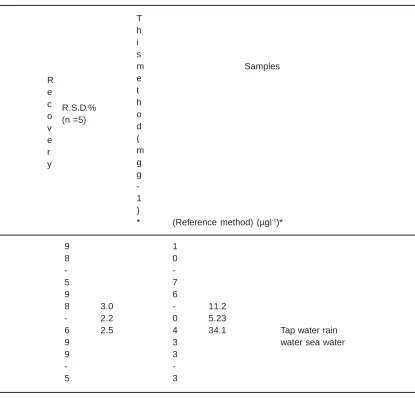
(Tehran, taken after 10 min operation of the tap), rain water (Tehran, 26 January, 2006), and Sea water(taken from Caspian sea, near the Mahmoud-Abad shore) samples were analyzed). The results were shown in Table 2, together with results of a recovery test by added known amounts of silver in water sample. A standard method with ICP-MS has also been used as reference method.
Conclusion
This method is high selectivity and high sensitivity. BPHA is one of the most sensitive and selective spectrophotometric reagents for cobalt. The molar absor ptivity of the chelate reach 1.58×10⁵ l mol-1 cm-1. Most foreign ions do not
Table -2: Determination of silver in the real sample T
h i s
m Samples
e t h o d ( m g g -1 )
* (Reference method) (µgl-1)*
9 1
8 0
-
-5 7
9 6
8 3.0 - 11.2
- 2.2 0 5.23
6 2.5 4 34.1 Tap water rain
9 3 water sea water
9 3
-
-5 3
*, Average of five determinations
The authour wish to thank Department of Chemistr y, Varamin Campus Islamic Azad
University and Saveh Campus Islamic Azad University for financial support.
R e c o v e r y
R.S.D.% (n =5)
ACKNOWLEDGEMENTS
1. H. Watanabe, Talanta21, 295 (1974) . 2. M.L. Siroki, L. Maric, Z. Stefanac, M.J. Herak,
Anal. Chim. Acta75, 101 (1975).
3. M.R. Khan, S.B. Khoo, Analyst 123, 1351 (1998).
4. S.L.C. Ferrira, D.S. De Jesus, J. Braz. Chem. Soc. 7, 109 (1996).
5. A.I. Busev, Z.I. Nemtseva, V.M. Ivanov, Z. Anal. Khim. 24, 1376 (1969).
6. H.X. Shen, J.J. Li, Gaodeng Xuexiao Huaxue Xuebao (Chem. J. Chin. Univ.) 9, 1007 (1988).
7. M.S. Carvalho, I.C.S. Fraga, K.C.L. Neto, E.Q.S. Filho, Talanta43, 1675 (1996). 8. M.P. San Andres, N.L. Marina, S. Vera,
Talanta41, 179 (1994).
9. H.B. Singh, N.K. Agnihotri, V.K. Singh, Talanta 48, 623 (1999).
10. C.I. Park, K.W. Cha, Talanta46, 1515 (1998). 11. H. Eskandari, H.S. Ghaziaskar, A.A. Ensafi,
Anal. Sci. 17, 327 (2001).
12. A.S. Amin, I.S. Ahmed, M.E. Moustafa, Anal. Lett.34, 759 (2001).
13 J.W. Zhao, Q.H. Xu, Huaoxue Shiji (Chin. J. Chem. Reagent) 14 (6), 346 (1992). 14. J.H. Chen, Q.F. Hu, J.Y. Yin, Guangpu
Shiyanshi (Chin. J. Spectrosc. Lab.) 18 (3) 341 (2001).
15. A. Moghimi,Chinese Journal of Chemistry,
25, 640 (2007).
16. Q.F. Hu, G.Y. Yang, D.Y. Tang, J.Y. Yin, Ganhan Huanjing Jiance (Chin. J. Arid Environ. Monit.) 15 (4) 196 (2001).
17. Z. Li, L. Wang, G.Y. Yang, Fenxi Shiyanshi (Chin. J. Anal. Lab.) 20, 45 (2001).
18. Q.F. Hu, G.Y. Yang, D.Y. Tang, J.Y. Yin, Fenxi Huaxue (Chin. J. Anal. Chem.), 30 in press (2002).
19. A.Moghimi,”Preconcentration and
Determination of Fe(III) Using Octadecyl SilicaMembrane Disks and Flame Atomic Absorption Spectrometry” Mat. Sci. Res. India inpress (2006).
20. A.Moghimi, “Preconcentration and
Determination of Copper(II) Using Octadecyl Silica Membrane Disks Modified by 1,5-Diphenylcarbazid and Flame Atomic Absorption Spectrometry. “Material Science Research India inpress (2006).
21. A.Moghimi, M.S.Tehrani, S.Waqif Husain, Mat. Sci. Res. India3(1a), 27 (2006). 22. M.S.Tehrani, A.Moghimi, S.Waqif Husain,
Material Science Research India 3(2) 135 (2005).
23. P. Nayebi; A. Moghimi, Orient. J. Chem. 22(3): 507 (2006).
24. A. Moghimi, Orient. J. Chem. 22(3): 527 (2006).