http://www.sciencepublishinggroup.com/j/sjbm doi: 10.11648/j.sjbm.20180604.11
ISSN: 2331-0626 (Print); ISSN: 2331-0634 (Online)
Multi-dimensional Influence of Dynamic Capabilities on
Innovation Performance in Knowledge-intensive Service
Enterprises
Jin Xin
1, *, Chen Song
2, Xie Fuji
3, Lu Zexia
41School of Economics and Management, Shanghai Maritime University, Shanghai, China
2
School of Economics and Management, Tongji University, Shanghai, China 3
Antai College of Economics and Management, Shanghai Jiao Tong University, Shanghai, China 4Department of Computer Science and Statistical Science, University of Toronto, Toronto, Canada
Email address:
*
Corresponding author
To cite this article:
Jin Xin, Chen Song, Xie Fuji, Lu Zexia. Multi-dimensional Influence of Dynamic Capabilities on Innovation Performance in Knowledge-intensive Service Enterprises. Science Journal of Business and Management. Vol. 6, No. 4, 2018, pp. 81-92. doi: 10.11648/j.sjbm.20180604.11
Received: September 28, 2018; Accepted: November 20, 2018; Published: December 20, 2018
Abstract:
How to enhance enterprise’s innovation performance is an important problem which is well worth thinking when the knowledge-based economy is opening up increasingly today. Taking the knowledge-intensive service enterprises as the example, we have made empirical study on how the different dimensions of dynamic capabilities, namely, sensing capability, learning capability and reconfiguring capability, affect the innovation performance of both exploration and exploitation. This study constructs and verifies a model of multi-dimensional dynamic capabilities to innovation performance using exploratory factor analysis and regression analysis. Result shows that enhancing any of sensing capability and learning capability in dynamic capabilities helps improve enterprises’ exploratory and exploitative innovation performance. Sensing capability and learning capability affect exploratory innovation performance more than exploitative innovation performance. Reconfiguring capability plays a positively significant regulating role in the relationship between sensing capability and exploratory innovation performance. Therefore, when enhancing the innovation performance, a knowledge-intensive service enterprise should not only make efforts to cultivate the sensing capability for technology and market and learning capability for external knowledge, but also enhance reconfiguring capability for both of internal and external resources to form the foundation for future competiveness. This study contributes to previous research by showing how sensing capability and learning capability affect the various dimensions of innovation performance under the regulating effects of reconfiguring capability in dynamic capabilities.Keywords:
Dynamic Capabilities, Innovation Performance, Knowledge-intensive Service Enterprises, Multi-dimensional Influence1. Introduction
As business innovation accelerates, the existing competitive advantages at hand are often short-lived for enterprises which have to continuously introduce new products to cope with the volatile external environment [1]. However, there are tremendous risks and uncertainties in the business innovation process. For example, enterprises often find it difficult to discern whether their research and development capabilities
to developing the ability to discover and integrate both internal and external opportunities, as well as fast-learning and execution abilities [4].
Researchers have been giving attention to the strategic role of dynamic capabilities in the business innovation process, but reviews on existing studies revealed that there is room for further and deeper research. On one hand, previous studies deemed that building dynamic capabilities can help enterprises to cope with the changes in the innovative environment and reduce the uncertainty of innovation, yet neglected to measure how various dimensions of the dynamic capabilities affect various dimensions of the innovation performance at an empirical level. Literature review showed that although Falasca et al. (2017) have examined the relationship between marketing dynamic capability and innovation performance in their empirical study of how customer knowledge influences the innovation performance of enterprises, “dynamic capabilities” was regarded as a one-dimensional concept in the research process which did not reveal the various dimensions within dynamic capabilities and how each dimension influences the mechanism of innovation performance [5].
On the other hand, the definition of dynamic capabilities is vague and lacks a solid theoretical foundation [6]. Since Teece et al. (1997) defined dynamic capabilities as the enterprise's ability to integrate, build, and reconfigure their internal and external competences, researchers have been adopting this definition as the basic understanding [3]. However, there are quite differences in how the dimensions of dynamic capabilities were classified, and there was no strong evidence provided to support such classifications. For example, Eisenhardt and Martin (2000)broke down dynamic capabilities into four aspects, namely the enterprise's ability to create, integrate, recombine, and release resources [7]; Teece et al. (1997)categorized dynamic capabilities into the abilities to sense opportunities, to seize opportunities and to reconfigure resources [3]; Ambrosini et al. (2009) classified dynamic capabilities into four categories: reconfiguration, leveraging, learning and creative integration [8]; Wilden and Gudergan (2015) classified dynamic capabilities into two dimensions: sensing and reconfiguring [9]. Based on the analysis of researchers in other nations, Chinese researchers have also developed many different ways to classify the dimensions of dynamic capabilities. For example, Dong and Ge (2009) defined dynamic capabilities as the ability to integrate resources, the ability to reorganize resource, learning capability, adaptability, and innovative capability [10]; Xie and Wang (2012)classified dynamic capabilities into three dimensions, namely knowledge acquisition, knowledge creation, and knowledge integration [11]; Lin and Su (2012)categorized dynamic capabilities into four dimensions, which are sensing capability, absorptive capability, and creative capability, and the ability to configure and coordinate resources [12]. Therefore, a review on research conducted both at home and abroad shows that the classification of dynamic capabilities dimensions is unorganized and far from reaching consensus.
Thus, research regarding the impact of dynamic capabilities on innovation performance needs further improvement and more supplementary data. First, researchers have given different connotations based on their respective research viewpoints regarding the definition and dimensions of dynamic capabilities, but there is a lack of authoritative dimension classifications and measurement scales that are commonly accepted. Second, how different dimensions of dynamic capabilities affect different dimensions of innovation performance and the different impact levels of each dimension need to be explored in depth. Further, each country has its own industrial environment and cultural background that vary from others, as well as the differences in types of industry, size, age, and nature of business depending on the enterprise, are all factors that could lead to different conclusions in the research. Based on the development and research “blind spots” of
previous studies, this research uses Chinese
knowledge-intensive service enterprises as the sample population and focuses on the following three areas: First, to develop and validate the measurement scales for dynamic capabilities and innovation performance that are suitable for Chinese knowledge-intensive service firms; Second, to construct and validate a multi-dimensional relationship model between dynamic capabilities and innovation performance of Chinese knowledge-intensive service enterprises; Third, to explore the theoretical and management implications of the impact of the dynamic capabilities in knowledge-intensive service enterprises on innovation performance.
2. Theories and Hypotheses
2.1. Dynamic Capabilities
abilities when responding to market changes [7, 19]. When all three dimensions are in place, an enterprise with high sensing capability grasps a market opportunity and acts accordingly, through its learning capability to rapidly renew its knowledge and skill set, while reconfiguring and integrating assets, eventually creates new value that matches the market trend, enabling the enterprise to achieve sustainable growth in a dynamic environment.
2.2. Innovation Performance
Since March (1991)first proposed the definitions of “exploration” and “exploitation” from an organizational learning perspective [20], some studies have directly linked exploration and exploitation with innovation results, i.e., exploratory innovation performance and exploitative innovation performance [21, 22]. Medcof and Song (2013)defined exploratory innovation as searching and adopting technology that is new to the enterprise, and exploitative innovation as utilizing technology that is familiar to the firm [23]. Bierly and Daly (2007) suggested that exploratory innovation means experimenting on new groundbreaking ideas or new ways of doing things, whereas exploitative innovation means refining and utilizing existing knowledge while putting current efficient activities into practice [24]. Danneels (2007) stated that exploratory innovation is offering new technology to service emerging customers, and exploitative innovation is enhancing existing technology to service current customers [25]. Taking all of the above into consideration, this research classifies innovation performance of enterprises into exploratory innovation performance and exploitative innovation performance. At the same time, drawing on the views of Benner and Tushman (2003) [26], this research defines exploratory innovation performance as that which continuously designs new products, develops new markets, and discovers new process applications and new production methods, either relying on current knowledge or breaking away from existing knowledge. Whereas, exploitative innovation performance is defined as that which continuously replicates, refines, promotes, and implements developed knowledge to relevant business areas in order to improve on existing skills, processes, and structure of the organization.
2.3. Hypotheses and Model
2.3.1. The Influence of Sensing Capability on Innovation Performance
In a globalized competing ground, customer needs, technological opportunities, and competitor activities are in a constant flux. Therefore, enterprises need to constantly monitor external opportunities [14]. Sensing capability is shown through an enterprise's ability to observe changes in the technological environment, discern changes in consumer demands, and discover new market opportunities [27]. It is one of the key organizational skills for enterprises to maintain their competitive advantage in an ever-changing environment. The firm's sensing capability promotes innovation
performance mainly through the following two ways. On one hand, a higher sensing capability signifies that the enterprise is good at searching for external knowledge and information through multiple channels [4], including analyzing customer needs, competitors' strategies, suppliers' activities, and initiating strategic collaborations with universities and research institutions [17]. This information is crucial to the enterprise in developing innovative strategies that adapt to the external environment and internal resource conditions; it can greatly promote the innovation process and enhance the enterprise's innovation success rate [28]. On the other hand, enterprises with high sensing capability often have abundant accumulated knowledge. According to the theoretical logic of assimilation and absorption, accumulated knowledge that enterprises have gathered in the past can help enterprises to identify emerging technologies in the market and predict the trend in technological and market changes. Then the enterprise can change old practices and propose new solutions to stimulate the enterprise's innovation performance [29]. Hence, it can be deduced that enterprises with higher sensing capability have higher innovative capability and higher success rate. Based on the above analysis, we propose following hypotheses:
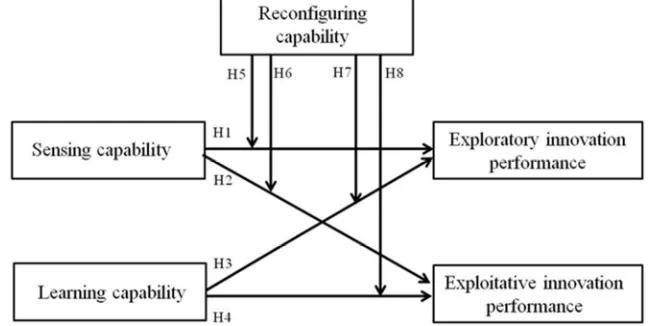
H1: Sensing capability has a significant, positive influence on exploratory innovation performance.
H2: Sensing capability has a significant, positive influence on exploitative innovation performance.
2.3.2. The Influence of Learning Capability on Innovation Performance
The theory of dynamic capabilities states that enterprises need to renew and update their abilities in a timely manner in order to adapt to the ever-changing environment. The impact of organizational learning is especially significant in the innovation process of enterprises. Enterprises that lack learning capabilities can only imitate continuously and are unable to innovate. Learning capability is an enterprise’s ability to learn, assimilate, absorb, and recreate advanced technology [30]. From reviewing previous literature, we believe that learning capability positively impacts an enterprise’s innovation performance through three mechanisms. First, the higher learning capability an enterprise has, the larger its knowledge reserves are and the more opportunities it has to integrate and reorganize various types of knowledge [31]. Innovation has always been considered as the reorganization of existing and new knowledge [32]. Higher learning capabilities allow enterprises to have more
opportunities to make complementary and novel
benefits the enterprises’ innovation performance [35]. Third, enterprises with higher learning capabilities are good at integrating and absorbing knowledge from different areas, and utilizing the knowledge on improving processes and organization strategies [36], consequently saving time and cost required for research and development, accelerating innovation and enhancing innovative efficacy. Based on the above understanding, this study proposes the following:
H3: Learning capability has a significant, positive influence on exploratory innovation performance.
H4: Learning capability has a significant, positive influence on exploitative innovation performance.
2.3.3. The Cross-dimensional Regulating Influences of Reconfiguring Capability
Reconfiguring capability is an organization’s ability to rearrange various types of resources to achieve its goal. Teece (2007)stated that the reconfiguring capability is an enterprise’s ability to rearrange its assets, readjust the organizational structure and reconfigure strategies [4]. After identifying external opportunities, enterprises need to make strategic decisions on key issues of innovative investments, invest in in-house research and development, pilot testing and commercialization. Therefore, reconfiguring capability is critical to the successful implementation of an enterprise’s innovation [4]. First, the process of integrating and reconfiguring can help enterprises to update innovative concepts and understanding, which is strategically significant in driving the innovation process of enterprises[2]. Further, the process of integrating and reconfiguring an enterprise’s internal resources boosts its resource flexibility and coordination flexibility [37], which then rapidly promotes the acceleration of business innovation. Finally, the process of
integrating and reconfiguring resources will inevitably be filled with cooperative argumentation that allows enterprises to make the best strategic choice in constructive conflicts through brainstorming and democratic decision making [38]. As mentioned by Eisenhardt and Martin (2000), the possibility of long term competitive advantage lies in enterprises being faster, more alert, and unpredictable than their competitors in reconfiguring resources to adapt to the environment [39]. Therefore, an enterprise with high sensing capability is able to grasp a market opportunity and act accordingly by rapidly reorganizing and coordinating resources, which is beneficial in promoting the enterprise’s innovation process; at the same time, when an enterprise with high learning capability renews its own knowledge and skill set, it also needs to rapidly reconfigure and integrate organizational resources to create value that keeps it ahead of the market trend and achieve sustainable growth in a dynamic environment. Based on the above studies, the following hypotheses are proposed:
H5: Reconfiguring capability plays a positive regulating role between sensing capability and exploratory innovation performance.
H6: Reconfiguring capability plays a positive regulating role between sensing capability and exploitative innovation performance.
H7: Reconfiguring capability plays a positive regulating role between learning capability and exploratory innovation performance.
H8: Reconfiguring capability plays a positive regulating role between learning capability and exploitative innovation performance.
Based on the above analysis, the empirical model of this study is shown in Figure 1.
Figure 1. Hypothesis framework of the relationship between dynamic capabilities and innovation performance.
3. Samples and Variables
3.1. Samples
The study objects are the knowledge-intensive service enterprises. According to the national economy industry categorization (GB/T4754-2002) and international standard industry categorization (ISIC/Rev.4.0), most of the services
legal, consulting and study services. All these are economic bodies that are based on innovation and knowledge and are driven by service, thus making them suitable for the purpose of this study. These survey questionnaires are collected by site recovery, fax, WeChat, email and other effective approaches. A total of 410 questionnaires are sent out, but only 334 questionnaires are recovered in total and 304 effective questionnaires remain after 30 ineffective questionnaires are excluded. The response rate was thus 74 percent.
In selecting the sample, this study fully considers the evenness of the distribution of the property of enterprises. The sample involves state-owned enterprises, private-run enterprises, joint ventures and individual proprietorships. Each company shall have been founded for three or more years with more than 100 employees. Among the sampled enterprises, 37have a history of 3-5 years (12.1%), 43have a history of 6-10 years (14.3%), 132have a history of 10-20 years (43.5%) and 92 have a history of over 20 years (30.1%). Moreover, 97 enterprises have 100-500 employees (31.9%), 79 have 500-1000 employees (26.0%), 78have 1000-10000 employees (25.6%), and 50 have more than 10000 employees (16.5%). In terms of property of enterprise, 59are state-owned enterprises (19.4%), 61are stock-system enterprises (20.1%), 131are privately run enterprises (43.1%), 27 are joint ventures (8.9%) and 26are individual proprietorships (8.5%). In terms of industry, 67are financial enterprises (22.0%), 72are information and communication enterprises (23.7%), 80 are technological service enterprises (26.3%) and 85are commercial service providers (28.0%).
The main content of this study is the influence of knowledge-intensive service enterprises’ dynamic capabilities on innovation performance. To obtain effective study data, this study selects the objects from mid- and high-level executives of each enterprise, such as managers of information department, HR department, and strategic planning department, and directors of finance and R&D, among others, during the selection of and communication about the study samples. The successful completion of the sample collection is due to the partial sample information
provided by the Chinese knowledge management and innovation research project in which we participated.
3.2. Measurement of Variables
3.2.1. Analysis on the Exploratory Factors, Reliability and Validity of Dynamic Capabilities
In measuring dynamic capabilities, we adopt the common practice of scholars of employing subject evaluation method using multiple indicators [40, 41]. This study divides dynamic capabilities into three dimensions: sensing capability (SC), learning capability (LC) and reconfiguring capability (RC). In measuring sensing capability, the study develops a relevant measurement scale including four measurement items by considering Teece (2007)’s definition and analysis on sensing capability through semi-structural interviews and content analysis. In measuring learning capability, the study develops five measurement items based on Hurley and Hult (1998)’s definition and interpretation of learning capability and through a qualitative analysis [42]. In measuring reconfiguring capability, the study develops a measurement scale that is more understandable in expression and closer to the actual scenarios in the enterprise with four measurement items based on the measurement scale of Helfat et al. (2007) [43]. All these measurement scales adopt seven-level Likert scale.
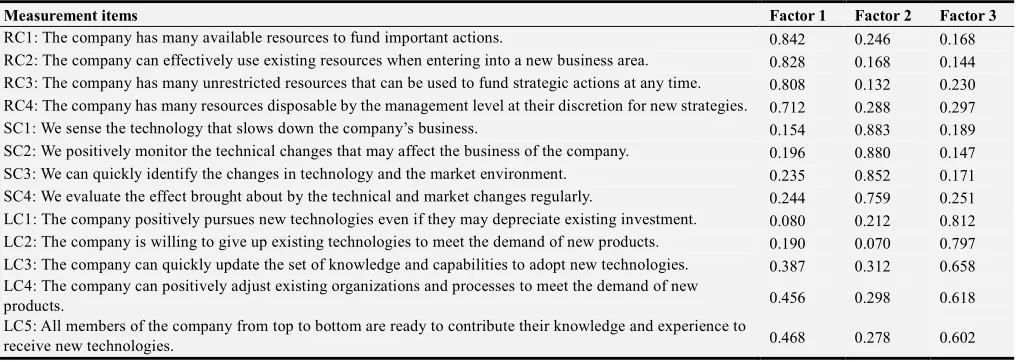
The analysis results reveal that the KMO value of 13 measurement items of dynamic capabilities is 0.900 and the significant probability value of the Bartlett spherical test is P=0.000<0.05. Therefore, it is suitable for factor analysis. The results of the exploratory factor analysis are as Table 1. The factor load matrix shows that three variable factors may be drawn from the 13 measurement items of dynamic capabilities. These variable factors accumulatively interpret a variation of 71.435%, and each factor load in the measurement items for the same dimension is greater than 0.6. Therefore, the measurement items designed in this study can suitably measure the three dimensions of dynamic capabilities, and no items needed to be deleted.
Table 1. Exploratory factor analysis of the dynamic capabilities.
Measurement items Factor 1 Factor 2 Factor 3
RC1: The company has many available resources to fund important actions. 0.842 0.246 0.168
RC2: The company can effectively use existing resources when entering into a new business area. 0.828 0.168 0.144
RC3: The company has many unrestricted resources that can be used to fund strategic actions at any time. 0.808 0.132 0.230 RC4: The company has many resources disposable by the management level at their discretion for new strategies. 0.712 0.288 0.297
SC1: We sense the technology that slows down the company’s business. 0.154 0.883 0.189
SC2: We positively monitor the technical changes that may affect the business of the company. 0.196 0.880 0.147
SC3: We can quickly identify the changes in technology and the market environment. 0.235 0.852 0.171
SC4: We evaluate the effect brought about by the technical and market changes regularly. 0.244 0.759 0.251
LC1: The company positively pursues new technologies even if they may depreciate existing investment. 0.080 0.212 0.812
LC2: The company is willing to give up existing technologies to meet the demand of new products. 0.190 0.070 0.797
LC3: The company can quickly update the set of knowledge and capabilities to adopt new technologies. 0.387 0.312 0.658 LC4: The company can positively adjust existing organizations and processes to meet the demand of new
products. 0.456 0.298 0.618
LC5: All members of the company from top to bottom are ready to contribute their knowledge and experience to
The reliability analysis result shows that the overall α coefficient of the characteristic measurement scale of dynamic capabilities is 0.915. The result of the study on the measurement scale with α indicator deletion shows that the α coefficient of any indicator deletion is smaller than the overall α value of the measurement scale (0.915); therefore, all indicators are reserved. The coefficient of sensing capability, learning capability and reconfiguring capability is greater than 0.8, respectively. The CITC (Corrected Item-Total Correlation) value of any undeleteditem is greater than 0.5. After deleting
any of the items contained in the three variables, the reliability α of internal consistency of any of the three variables is reduced. Therefore, the measurement scale of dynamic capabilities has good internal consistency and better reliability of the overall measurement scale. Meanwhile, we use confirmatory factor analysis to conduct the validity test and the fit indices show that the measurement model fit the data reasonably well (χ2/dƒ=2.12; RMSEA=0.05; IFI=0.96; CFI=0.96; AGFI=0.90). Table 2 indicates the reliability analysis of the measurement scale of dynamic capabilities.
Table 2. Reliability analysis of the measurement scale of dynamic capabilities.
Variables Items CITC α coefficient of any indicator deletion α coefficient
Sensing capability
SC1 0.812 0.882
0.912
SC2 0.831 0.876
SC3 0.836 0.874
SC4 0.728 0.911
Learning capability
LC1 0.616 0.802
LC2 0.661 0.792
LC3 0.708 0.778 0.834
LC4 0.587 0.812
LC5 0.582 0.814
Reconfiguring capability
RC1 0.732 0.855
RC2 0.812 0.815
0.886
RC3 0.757 0.835
RC4 0.710 0.863
3.2.2. Analysis on the Exploratory Factors, Reliability and Validity of Innovation Performance
This study divides innovation performance into two dimensions: exploratory innovation performance and exploitative innovation performance. In the research on enterprises’ innovation, the number of patents owned is commonly used as the indicator of innovation measurement [44, 45, 46]. However, measuring innovation using the number of patents has some shortcomings [47, 48]. Moreover, as most of the enterprises in the samples are unlisted companies, obtaining public objective financial data is impossible. Previous studies indicated that a correlation between subjective performance data and objective performance data. Therefore, as objective financial data are unavailable, we measure innovation performance with the subject evaluation method using multiple indicators, a common practice of current scholars [49, 50, 51]. In this study, we take the maturity measurement scale of
Atuahene-Gima (2005)as reference and conduct semi-structural interviews and a qualitative analysis to form the final measurement scale with 14 measurement items [52]. We adopt a five-level Likert scale.
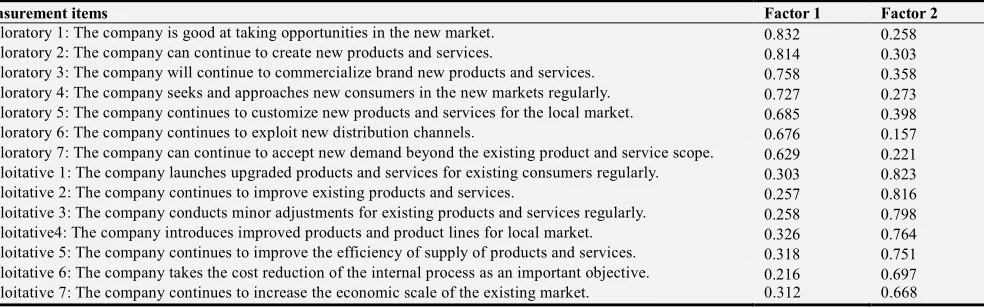
The analysis results reveal that the KMO value of 14 measurement items of innovation performance is 0.922 and the significant probability value of the Bartlett spherical test is P=0.000<0.05. Therefore, it is suitable for factor analysis. The results of the exploratory factor analysis are as Table 3. The factor load matrix shows that two variable factors may be drawn from the 14 measurement items of innovation performance. These variable factors accumulatively interpret a variation of 62.907%, and each factor load in the measurement items for the same dimension is greater than 0.6. Therefore, the measurement items designed in this study can suitably measure the two dimensions of innovation performance, and no items needed to be deleted.
Table 3. Exploratory factor analysis of the innovation performance.
Measurement items Factor 1 Factor 2
Exploratory 1: The company is good at taking opportunities in the new market. 0.832 0.258
Exploratory 2: The company can continue to create new products and services. 0.814 0.303
Exploratory 3: The company will continue to commercialize brand new products and services. 0.758 0.358
Exploratory 4: The company seeks and approaches new consumers in the new markets regularly. 0.727 0.273
Exploratory 5: The company continues to customize new products and services for the local market. 0.685 0.398
Exploratory 6: The company continues to exploit new distribution channels. 0.676 0.157
Exploratory 7: The company can continue to accept new demand beyond the existing product and service scope. 0.629 0.221 Exploitative 1: The company launches upgraded products and services for existing consumers regularly. 0.303 0.823
Exploitative 2: The company continues to improve existing products and services. 0.257 0.816
Exploitative 3: The company conducts minor adjustments for existing products and services regularly. 0.258 0.798
Exploitative4: The company introduces improved products and product lines for local market. 0.326 0.764
Exploitative 5: The company continues to improve the efficiency of supply of products and services. 0.318 0.751
Exploitative 6: The company takes the cost reduction of the internal process as an important objective. 0.216 0.697
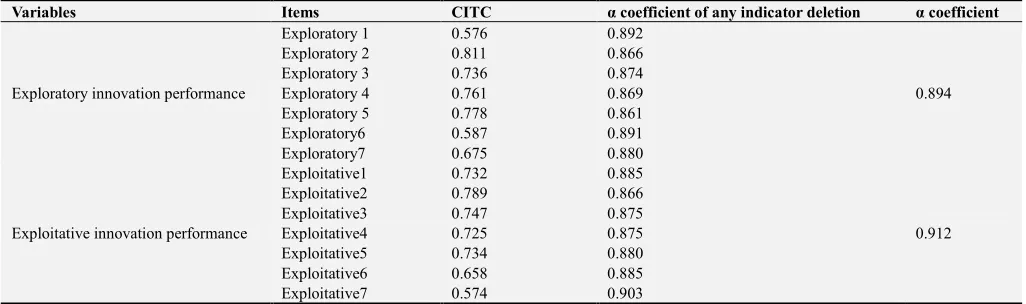
The reliability analysis result shows that the overall α coefficient of the characteristic measurement scale of innovation performance is 0.928. The result of the study on the measurement scale with α indicator deletion shows that the α coefficient of any indicator deletion is smaller than the overall α value of the measurement scale (0.928); therefore, all indicators are reserved. The coefficient of exploratory innovation performance and exploitative innovation performance is greater than 0.8, respectively. The CITC value of any undeleted item is greater than 0.5. After deleting any of
the items contained in the two variables, the reliability α of internal consistency of any of the two variables is reduced. Therefore, the measurement scale of innovation performance has good internal consistency and better reliability of the overall measurement scale. Meanwhile, we use confirmatory factor analysis to conduct the validity test and the fit indices show that the measurement model fit the data reasonably well
(χ2/dƒ=2.91; RMSEA=0.05; IFI=0.92; CFI=0.92;
AGFI=0.92). Table 4 indicates the reliability analysis of the measurement scale of innovation performance.
Table 4. Reliability analysis of the measurement scale of innovation performance.
Variables Items CITC α coefficient of any indicator deletion α coefficient
Exploratory innovation performance
Exploratory 1 0.576 0.892
Exploratory 2 0.811 0.866
Exploratory 3 0.736 0.874
Exploratory 4 0.761 0.869 0.894
Exploratory 5 0.778 0.861
Exploratory6 0.587 0.891
Exploratory7 0.675 0.880
Exploitative innovation performance
Exploitative1 0.732 0.885
Exploitative2 0.789 0.866
Exploitative3 0.747 0.875
Exploitative4 0.725 0.875 0.912
Exploitative5 0.734 0.880
Exploitative6 0.658 0.885
Exploitative7 0.574 0.903
3.2.3. Selection and Setting of Control Variables
Previous studies showed that age, property, industry and size of an enterprise affect innovation [53, 54]. To exclude these inference factors, this study takes age, property, size and industry of an enterprise as the control variables. The number of years since incorporation is considered the age; the number of employees represents the size, and its natural logarithm is adopted. Property is set as the virtual variable: 1 for state-owned enterprise and 0 for other types of enterprises. The industries, which are classified into finance, communication, technological and commercial service, are set as the virtual variables. They are coded as follows: 1 for finance (virtual) or 0 for other industries, 1 for communication service industry (virtual) or 0 for other industries, 1 for technological service industry (virtual) or 0 for other industries and 1 for commercial service (virtual) or 0 for other industries.
3.3. Processing Common Method Variance
In order to reduce the common method bias, this study adopted the following approaches: (1) This survey’s purpose was clearly stated in the questionnaire guidelines as being purely that of academic research and a commitment to maintain confidentiality was also included in the guidelines; (2) Objective language was used to describe the measurement items of the scale to the greatest extent possible; (3) Adopted a five-point scale method and a seven-point scale method for measurement items of different dimensions in designing the scoring method for the measurement scale; and (4) Adopted Harman's single factor test method to test the sample data for
statistical control.
The most widely used technique for testing common method variance is the Harman’s single factor test. All the variables involved in the study were considered in the exploratory factor analysis, and seven common factors with eight values greater than 1 were obtained, which explained 67.889% of the total variance; among these common factors, the numerator with the highest explanatory strength had a value of 11.369, which explained 15.386% of the total variance. The test results showed that there is no situation where only one common factor or one individual factor explains most of the covariance of all variables. Therefore, the impact of the common method variance problem in this study is insignificant and thus can be ignored.
4. Empirical Analysis
4.1. Descriptive Statistics Analysis
performance and the exploitative innovation performance. Otherwise, a correlation coefficients that is lower than 0.65means that no multi-collinearity exists among variables.
4.2. Hypothesis Testing
4.2.1. Multi-dimensional Influence of Dynamic Capabilities on Innovation Performance
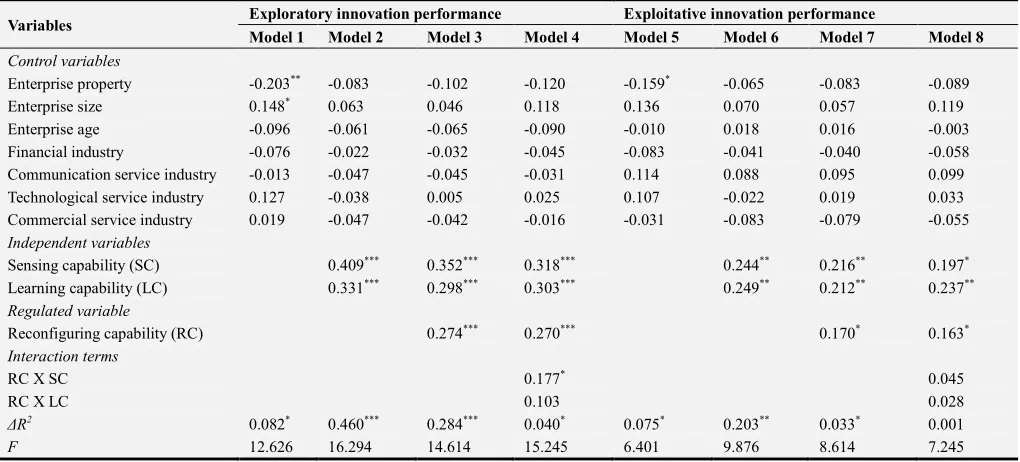
The result of the regression analysis in Table 5 shows that, (1) among the control variables, the property of enterprise has a significant negative influence on innovation performance. This study sets 1 as the property of state-owned enterprises and 0 as the property of other enterprises. Therefore, the property of state-owned enterprises has a significant negative influence on exploratory innovation performance and exploitative innovation performance. The scale of enterprise has a positive influence on exploratory innovation performance. This result indicates that the larger a company is, the easier the exploratory innovation performance. Neither age nor industry of the company has a significant influence on innovation. (2) Based on the control on the effect of variables such as property of company (see Models2 and 6), sensing capability and learning capability have a remarkable positive influence on both exploratory and exploitative innovation performance. Therefore, H1, H2, H3 and H4 are supported. By comparing the regression coefficients of the independent variables in Model 2 and Model 6, we find that sensing capability has a greater influence on the enhancement of exploratory innovation performance (β=0.409, P<0.001) than on the enhancement of exploitative innovation performance (β=0.244, P<0.01) and learning capability has a greater influence on exploratory innovation performance (β=0.331, P<0.001)than on exploitative innovation performance (β=0.249, P<0.01). Therefore, the influence of sensing capability and learning capability on exploratory innovation
performance is greater than that on exploitative innovation performance. In addition, sensing capability (β=0.409, P<0.001) has only a negligible larger marginal contribution than learning capability (β=0.331, P<0.001) to the exploratory innovation performance and learning capability (β=0.249, P<0.01) has only a negligible larger marginal contribution than sensing capability (β=0.244, P<0.01) to the exploitative innovation performance.(3) According to Model 4, the interaction between sensing capability and reconfiguring capability (β=0.177, P<0.05) is significant in exploratory innovation performance. This outcome indicates that reconfiguring capability has a significant regulating effect on the relationship between sensing capability and exploratory innovation performance; thus, H5 is supported. Meanwhile, the interaction between learning capability and reconfiguring capability has an insignificant influence on exploratory innovation performance. This outcome indicates that reconfiguring capability does not have a significant regulating effect on the relationship between learning capability and exploratory innovation performance; thus, H7 is not supported. According to Model 8, the interaction between sensing capability and reconfiguring capability has an insignificant influence on exploitative innovation performance. This outcome indicates that reconfiguring capability does not have a significant regulating effect on the relationship between sensing capability and exploitative innovation performance; thus, H6 is not supported. Meanwhile, the interaction between learning capability and reconfiguring capability has an insignificant influence on exploitative innovation performance. This outcome indicates that reconfiguring capability does not have a significant effect on the relationship between learning capability and exploitative innovation performance; thus, H8 is not supported.
Table 5. Verification of the relationship between the dynamic capabilities and innovation performance.
Variables Exploratory innovation performance Exploitative innovation performance
Model 1 Model 2 Model 3 Model 4 Model 5 Model 6 Model 7 Model 8
Control variables
Enterprise property -0.203** -0.083 -0.102 -0.120 -0.159* -0.065 -0.083 -0.089
Enterprise size 0.148* 0.063 0.046 0.118 0.136 0.070 0.057 0.119
Enterprise age -0.096 -0.061 -0.065 -0.090 -0.010 0.018 0.016 -0.003
Financial industry -0.076 -0.022 -0.032 -0.045 -0.083 -0.041 -0.040 -0.058
Communication service industry -0.013 -0.047 -0.045 -0.031 0.114 0.088 0.095 0.099
Technological service industry 0.127 -0.038 0.005 0.025 0.107 -0.022 0.019 0.033
Commercial service industry 0.019 -0.047 -0.042 -0.016 -0.031 -0.083 -0.079 -0.055
Independent variables
Sensing capability (SC) 0.409*** 0.352*** 0.318*** 0.244** 0.216** 0.197*
Learning capability (LC) 0.331*** 0.298*** 0.303*** 0.249** 0.212** 0.237**
Regulated variable
Reconfiguring capability (RC) 0.274*** 0.270*** 0.170* 0.163*
Interaction terms
RC X SC 0.177* 0.045
RC X LC 0.103 0.028
∆R2 0.082* 0.460*** 0.284*** 0.040* 0.075* 0.203** 0.033* 0.001
F 12.626 16.294 14.614 15.245 6.401 9.876 8.614 7.245
4.2.2. Regulating Effect of Reconfiguring Capability
The result of the regression analysis in Table 5 shows that reconfiguring capability positively regulates the positive relationship between sensing capability and exploratory innovation performance; thus, H5 is supported.
To clearly show the positive regulating effect of reconfiguring capability, we refer to the method ofCohen et
al. (2014) and divide reconfiguring capability into two groups: high effect group and low effect group [55]. Then, we conduct a regression analysis on each group of samples and compare the differences between the groups using a graph of regression equation to show the regulating effect of reconfiguring capability. The results are shown in Figure 2.
Figure 2. Moderation effect analysis of reconfiguring capability between sensing capability and exploratory innovation performance.
4.3. Verification Results
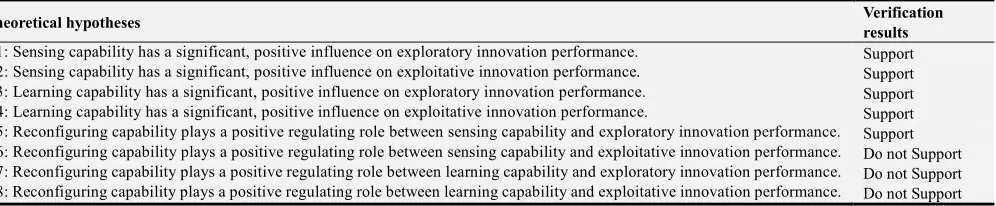
Based on the above analysis and theoretical hypotheses, the results of the verification are presented in Table 6.
Table 6. Theoretical hypotheses and verification results.
Theoretical hypotheses Verification
results
H1: Sensing capability has a significant, positive influence on exploratory innovation performance. Support
H2: Sensing capability has a significant, positive influence on exploitative innovation performance. Support
H3: Learning capability has a significant, positive influence on exploratory innovation performance. H4: Learning capability has a significant, positive influence on exploitative innovation performance.
Support Support H5: Reconfiguring capability plays a positive regulating role between sensing capability and exploratory innovation performance. Support H6: Reconfiguring capability plays a positive regulating role between sensing capability and exploitative innovation performance. Do not Support H7: Reconfiguring capability plays a positive regulating role between learning capability and exploratory innovation performance. Do not Support H8: Reconfiguring capability plays a positive regulating role between learning capability and exploitative innovation performance. Do not Support
5. Conclusion
This research not only empirically tested the measurement scales of the different dimensions of dynamic capabilities and innovation performance but also systematically explored the correlation between dynamic capabilities and innovation performance of Chinese knowledge-intensive service enterprises. Additionally, this research conducted a comparative analysis on the dimensions of dynamic capabilities (sensing capability/learning capability) and innovation performance (exploratory and exploitative), and also, the multiple regulatory impacts of reconfiguring capability. The conclusion of the study enriches the current theory about the relationship between dynamic capabilities and enterprises' innovation performance and provides enterprises with reference on how to enhance their innovation performance.
5.1. Theoretical Implications
Research on dynamic capabilities has always been the focus of academia, but there is yet to be consensus on the classification of dynamic capabilities dimensions. Besides, research on the relationship between dynamic capabilities and innovation performance is mainly limited to theoretical inference and lacks empirical evidence from a large sample size, moreover the question of “how each dynamic capabilities dimension enhances the various dimensions of innovation performance” remains to be further probed and answered. As a result, the theoretical contribution of this research is shown mainly in the following three areas:
carried out on the measurement scales based on the survey data of large samples. This research is an exploratory attempt to develop and validate measurement scales for the different dimensions of dynamic capabilities for Chinese knowledge-intensive service enterprises.
Second, research results show that dynamic capabilities have positive impacts on the innovation performance of Chinese knowledge-intensive service enterprises. Both sensing capability and learning capability have significant positive impacts on innovation performance but the marginal contribution of sensing capability and learning capability on exploratory innovation performance and exploitative innovation performance are different. Sensing capability and learning capability have a higher impact on exploratory innovation performance than on exploitative innovation performance.
Third, reconfiguring capability has a significant positive regulatory effect on the relationship between sensing capability and exploratory innovation performance. With the increase of reconfiguring capability, the positive impact of sensing capability on exploratory innovation performance gradually becomes higher. This is because when enterprises have higher reconfiguring capability, they are able to fully allocate and utilize their own resources, and further improve their sensing capabilities to grasp a market opportunity and act accordingly by rapidly reorganizing and coordinating organizational resources, which is beneficial in promoting the enterprise’s innovation process.
5.2. Managerial Implications
Research findings showed that dynamic capabilities have a significant positive impact on innovation performance in Chinese knowledge-intensive service enterprises. This conclusion matches the current state of innovation in Chinese knowledge-intensive service enterprises. Through improving the sensing capability and learning capability in the organization, knowledge-intensive enterprises are able to discern technological changes earlier, they can periodically assess technological impacts, proactively renew their knowledge and skill set, make timely adjustments to the organizational processes, and also share knowledge and other organizational skills to all members within, consequently continuously improve the enterprises’ innovation performance. The organization’s reconfiguring capabilities include the abilities to support major strategies with large resource reserves, raise short-term capital to support major initiatives, and allow management to have freely accessible resources, as well as a significant positive regulatory effect on the relationship of sensing capability with exploratory innovation performance. Thus, in order to survive and grow in a dynamic competitive environment, enterprises not only need to diligently cultivate their sensing capability in regards to technology and the market, and their learning capability for external knowledge but they also need to enhance their reconfiguring capability in organizing, uncovering, and exploiting resources, while striving for exploratory and exploitative innovations.
The conclusion of this research carries similar implications for the government in policy making. The Chinese government should establish policy mechanisms that encourage enterprises to actively cultivate their own sensing and learning capabilities. By providing various policy mechanisms, it encourages enterprises to initiate collaboration with external parties and implement international development strategies. Additionally, by providing resources and financial support, it can cultivate the reconfiguring capability of enterprises, thus motivating enterprises to establish the practice of integrating internal and external resources, and eventually improving enterprises’ innovation performance.
The relationship between dynamic capabilities and innovation performance is not a simple static relation; it should be a dynamic evolution process. Currently, most empirical studies on capability and innovation remain in the layer of static relations. Empirical studies on the change in dynamic relations between capability and innovation are limited. Capabilities and innovation are evolving dynamic processes. Therefore, conducting studies on the dynamic approaches and the deeper reasons for dynamic capabilities and innovation performance is valuable.
References
[1] Mikalef, P., & Pateli, A. 2017. Information technology-enabled dynamic capabilities and their indirect effect on competitive performance: Findings from pls-sem and fsqca. Journal of Business Research, 70(Journal Article): 1-16.
[2] Marsh, S. J., & Stock, G. N. 2006. Creating dynamic capability: The role of intertemporal integration, knowledge retention, and interpretation. Journal of Product Innovation Management, 23(5): 422-436.
[3] Teece, D. J., Pisano, G., & Shuen, A. 1997. Dynamic capabilities and strategic management. Strategic Management Journal, 18(7): 509-533.
[4] Teece, D. J. 2007. Explicating dynamic capabilities: The nature and microfoundations of (sustainable) enterprise performance.
Strategic Management Journal, 28(13): 1319-1350.
[5] Falasca, M., Zhang, J. M., Conchar, M., & Li, L. K. 2017. The impact of customer knowledge and marketing dynamic capability on innovation performance: An empirical analysis.
Journal of Business & Industrial Marketing, 32(7): 901-912.
[6] Barreto, I. 2010. Dynamic capabilities: A review of past research and an agenda for the future. Journal of Management, 36(1): 256.
[7] Eisenhardt, K. M., & Martin, J. A. 2000. Dynamic capabilities: What are they? Strategic Management Journal, 21(10‐11): 1105-1121.
[8] Ambrosini, V., Bowman, C., & Collier, N. 2009. Dynamic capabilities: An exploration of how firms renew their resource base. British Journal of Management, 20(s1): S9-S24.
[9] Wilden, R., & Gudergan, S. P. 2015. The impact of dynamic capabilities on operational marketing and technological capabilities: Investigating the role of environmental turbulence.
[10] Dong, B. B., & Ge, B. S. 2009. A study on the relationship between the resource integration process and dynamic capabilities of startup enterprises. Research Management, 33(2): 107-114.
[11] Xie, H. J., & Wang, G. S. 2012. A study on the impact of social capital and organizational learning on the dynamic capabilities of logistic service enterprises. Management Review, 24(10): 133-142.
[12] Lin, H. F., & Su, J. Q. 2012. A study on managing innovation efficacy mechanisms: A research framework based on the perspective of dynamic capabilities. Management Review, 24(3): 49-57.
[13] Pezeshkan, A., Fainshmidt, S., Nair, A., Lance Frazier, M., & Markowski, E. 2016. An empirical assessment of the dynamic capabilities–performance relationship. Journal of Business Research, 69(8): 2950-2956.
[14] Pavlou, P. A., & El Sawy, O. A. 2006. From it leveraging competence to competitive advantage in turbulent environments: The case of new product development.
Information Systems Research, 17(3): 198-227.
[15] Teece, D. J. 2007. Explicating dynamic capabilities: The nature and microfoundations of (sustainable) enterprise performance.
Strategic Management Journal, 28(13): 1319-1350.
[16] Fainshmidt, S., Pezeshkan, A., Lance Frazier, M., Nair, A., & Markowski, E. 2016. Dynamic capabilities and organizational performance: A meta-analytic evaluation and extension: Dynamic capabilities and organizational performance. Journal of Management Studies, 53(8): 1348-1380.
[17] Teece, D. J. 2012. Dynamic capabilities: Routines versus entrepreneurial action. Journal of Management Studies, 49(8): 1395-1401.
[18] Zahra, S. A., Sapienza, H. J., & Davidsson, P. 2006. Entrepreneurship and dynamic capabilities: A review, model and research agenda. Journal of Management Studies, 43(4): 917-955.
[19] Girod, S. J. G., & Whittington, R. 2017. Reconfiguration, restructuring and firm performance: Dynamic capabilities and environmental dynamism. Strategic Management Journal, 38(5): 1121-1133.
[20] March, J. G. 1991. Exploration and exploitation in organizational learning. Organization Science, 2(1): 71-87.
[21] Greve, H. R. 2007. Exploration and exploitation in product innovation. Industrial and Corporate Change, 16(5): 945-975.
[22] Jansen, J. J. P., Van Den Bosch, F. A. J., & Volberda, H. W. 2006. Exploratory innovation, exploitative innovation, and performance: Effects of organizational antecedents and environmental moderators. Management Science, 52(11): 1661-1674.
[23] Medcof, J. W., & Song, L. J. 2013. Exploration, exploitation and human resource management practices in cooperative and entrepreneurial hr configurations. International Journal of Human Resource Management, 24(15): 2911-2926.
[24] Bierly, P. E., & Daly, P. S. 2007. Alternative knowledge strategies, competitive environment, and organizational performance in small manufacturing firms. Entrepreneurship Theory and Practice, 31(4): 493-516.
[25] Danneels, E. 2007. The process of technological competence leveraging. Strategic Management Journal, 28(5): 511-533.
[26] Benner, M. J., & Tushman, M. L. 2003. Exploitation, exploration, and process management: The productivity dilemma revisited.
The Academy of Management Review, 28(2): 238-256.
[27] Wilden, R., & Gudergan, S. P. 2015. The impact of dynamic capabilities on operational marketing and technological capabilities: Investigating the role of environmental turbulence.
Journal of the Academy of Marketing Science, 43(2): 181-199.
[28] Teece, D. J. 2012. Dynamic capabilities: Routines versus entrepreneurial action. Journal of Management Studies, 49(8): 1395-1401.
[29] Ali, M., Kan, K. A. S., & Sarstedt, M. 2016. Direct and configurational paths of absorptive capacity and organizational innovation to successful organizational performance. Journal of Business Research, 69(11): 5317-5323.
[30] Zollo, M., & Winter, S. G. 2002. Deliberate learning and the evolution of dynamic capabilities. Organization Science, 13(3): 339-351.
[31] Nieto, M. J., & Santamaría, L. 2007. The importance of diverse collaborative networks for the novelty of product innovation.
Technovation, 27(6): 367-377.
[32] Katila, R., & Ahuja, G. 2002. Something old, something new: A longitudinal study of search behavior and new product introduction. The Academy of Management Journal, 45(6): 1183-1194.
[33] Becker, W., & Dietz, J. 2004. R&d cooperation and innovation activities of firms: Evidence for the german manufacturing industry. Research Policy, 33(2): 209-223.
[34] Bhatt, G. D., & Grover, V. 2005. Types of information technology capabilities and their role in competitive advantage: An empirical study. Journal of Management Information Systems, 22(2): 253-277.
[35] Hargadon, A. B., & Bechky, B. A. 2006. When collections of creatives become creative collectives: A field study of problem solving at work. Organization Science, 17(4): 484-500.
[36] Zahra, S. A., & George, G. 2002. Absorptive capacity: A review, reconceptualization, and extension. The Academy of Management Review, 27(2): 185-203.
[37] Zhou, K. Z., & Wu, F. 2010. Technological capability, strategic flexibility, and product innovation. Strategic Management Journal, 31(5): 547-561.
[38] Danneels, E. 2008. Organizational antecedents of second-order competences. Strategic Management Journal, 29(5): 519-543.
[39] Eisenhardt, K. M., & Martin, J. A. 2000. Dynamic capabilities: What are they? Strategic Management Journal, 21(10‐11): 1105-1121.
[40] Atuahene-Gima, K. 2005. Resolving the capability: Rigidity paradox in new product innovation. Journal of Marketing, 69(4): 61-83.
[41] Bell, G. G. 2005. Clusters, networks, and firm innovativeness.
Strategic Management Journal, 26(3): 287-295.
[43] Helfat, E., Finkelstein, S., Mitchell, W., & Peteraf, M. A. 2007. Dynamic capabilities: Understanding strategic change in organizations. Reference and Research Book News, 22(2): 50-65.
[44] Ahuja, G. 2000. Collaboration networks, structural holes, and innovation: A longitudinal study. Administrative Science Quarterly, 45(3): 425-455.
[45] Russo, A., & Vurro, C. 2010. Cross-boundary ambidexterity: Balancing exploration and exploitation in the fuel cell industry.
European Management Review, 7(1): 30-45.
[46] Sørensen, J. B., & Stuart, T. E. 2000. Aging, obsolescence, and organizational innovation. Administrative Science Quarterly, 45(1): 81-112.
[47] Griliches, Z. 1990. Patent statistics as economic indicators: A survey. Journal of Economic Literature, 28(4): 1661-1707.
[48] Moser, P. 2013. Patents and innovation: Evidence from economic history. The Journal of Economic Perspectives, 27(1): 23-44.
[49] Bell, G. G. 2005. Clusters, networks, and firm innovativeness.
Strategic Management Journal, 26(3): 287-295.
[50] Christiansen, J. 2000. Building the innovative organization. New York: Palgrave Macmillan.
[51] Zhou, K. Z., & Li, C. B. 2012. How knowledge affects radical innovation: Knowledge base, market knowledge acquisition, and internal knowledge sharing. Strategic Management Journal, 33(9): 1090-1102.
[52] Atuahene-Gima, K. 2005. Resolving the capability: Rigidity paradox in new product innovation. Journal of Marketing, 69(4): 61-83.
[53] Chen, X. P., Xu, S. Y., & Fan, J. L. 2012. Empirical methods in organization and management research 2nd edition. Peking: Peking University Press.
[54] Prabhu, J. C., Chandy, R. K., & Ellis, M. E. 2005. The impact of acquisitions on innovation: Poison pill, placebo, or tonic?
Journal of Marketing, 69(1): 114-130.