Second Derivative Free Eighteenth Order Convergent
Method for Solving Non-Linear Equations
V.B. KuMar Vatti
1, raMaDEVi Sri
1and M.S. KuMar MyLapaLLi
21Dept. of Engineering Mathematics, Andhra University, Visakhapatnam, India. 2Dept. of Mathematics, Gitam University, Visakhapatnam, India.
abstract
In this paper, the Eighteenth Order Convergent Method (EOCM) developed by Vatti et.al is considered and this method is further studied without the presence of second derivative. It is shown that this method has same efficiency index as that of EOCM. Several numerical examples are given to illustrate the efficiency and performance of the new method. AMS Subject Classification: 41A25, 65K05, 65H05.
Oriental Journal of Computer Science and technology
Journal Website: www.computerscijournal.org
article History
Received: 14 December 2017
Accepted: 25 Decmber 2017
Keywords
Iterative method, Nonlinear equation, Newton’s method, Convergence
analysis, Higher order convergence
CONtaCt Dr. M. M. Sandeep Kumar [email protected] Dept. of Mathematics, Gitam University, Visakhapatnam, India.
© 2017 The Author(s). Published by Techno Research Publishers
This is an Open Access article licensed under a Creative Commons Attribution-NonCommercial-ShareAlike 4.0 International License (https://creativecommons.org/licenses/by-nc-sa/4.0/ ), which permits unrestricted NonCommercial use, distribution, and reproduction in any medium, provided the original work is properly cited.
To link to this article: http://dx.doi.org/10.13005/ojcst/10.04.19
introduction
It is well known that a wide class of problems, which arises in diverse disciplines of mathematical and engineering science can be studied by the nonlinear equation of the form
f (x) = 0 ...(1.1)
Where f D R: ⊂ →R is a scalar function on an open interval D and f (x) may be algebraic, transcendental or combined of both. The most widely used algorithm for solving (1.1) by the use of value of the function and its derivative is the well known quadratic convergent Newton’s method (NM) given by
...(1.2)
starting with an initial guess x0 which is in the vicinity of the exact root x* . The efficiency index of Newton’s method is 2 2 1.4142= .
The Extrapolated Newton’s method (ENM) suggested by V.B.Kumar, Vatti et.al.,11 which is developed by extrapolating Newton’s method (1.2) introducing a parameter ‘ αn’ given by
( )
( )
( )
1
0,1,2,... f xn
xn x
n f xn
n = −
+ ′
...(1.3)
Here the optimal choice for the parameter ‘ αn’ is
...(1.4)
Where
...(1.5)
Combining (1.3), (1.4) and (1.5), one can have
...(1.6)
Which is same as Halley’s method having third order convergence which requires three functional evaluations. The efficiency index of this method is
3 3 1.4422= .
A three step Predictor-corrector Newton’s Halley method (PCNH) suggested by Mohammed and Hafiz10 , is given by:
For a given x0, compute xn+1 by using
...(1.7)
This method has eighteenth order convergence and its efficiency index is 818 1.4352= .
The three step Eighteenth Order Extrapolated Newton’s method (EOCM) developed by Vatti et.al.,12 is given by:
For a given x0, compute xn+1 by the iterative schemes
...(1.8)
Where ...(1.9)
and ...(1.10)
This method has eighteenth order convergence and its efficiency index is 818 1.4352= .
In section 2, we consider the Second derivative free Eighteenth Order Extrapolated Newton’s method and discuss the convergence criteria of this method in section 3. Few numerical examples are considered to show the superiority of this method in the concluding section.
Second Derivative Free Eighteenth Order Convergent Method (Seocm)
Considering the Eighteenth Order Extrapolated Newton’s method (EOCM) (1.8) with (1.9) and (1.10), and expanding about , we obtain
on taking
in which case ...(2.1)
Now,
which gives
Therefore, (1.9) takes the form
...(2.2)
Similarly, we can have
...(2.3)
and rewriting equations (2.2), (2.3) in (1.8), we thus have the following algorithm:
algorithm 2.1
For a given x0, compute xn+1 by the iterative schemes
...(2.4)
Where and are as given in (2.2) and (2.3).
This algorithm can be called as Second derivative free Eighteenth Order Extrapolated Newton’s method (SEOCM) and it requires eight functional evaluations.
Convergence Criteria theorem 3.1
Let x*∈D be a single zero of a sufficiently differentiable function f D R: ⊂ →R for an open interval D and let x0 be in the vicinity of x*, then the algorithm (2.1) has eighteenth order convergence.
proof
Let be a single zero of (1.1) and
*
x
=
x
n
+
e
n
...(3.1)Then, f (x*) = 0 ...(3.2)
If xn be the nth approximate to the root of (1.1), then expanding f (xn) about x* using Taylor’s expansion, we have
...(3.3)
Where
And,
...(3.4)
Now,
...(3.5)
From (2.4), (3.1) and (3.5), we have
...(3.6)
Let W w= n−x∗ ...(3.7)
Then, expanding f w
( ) ( ) ( )
n , f w′ n , f w′′ n about by using (3.6), we obtain
...(3.8)
...(3.9)
...(3.10)
...(3.11)
...(3.12)
and
...(3.13)
where,
Now,
...(3.14)
Multiplying (3.10) with (3.14), we obtain
...(3.15)
Combining (3.6) to (3.15) and from (2.4), we obtain
*
yn=x +T ...(3.16)
where, T c en= 23 6 ...(3.17) Now, expanding f (yn), f' (yn) about x* by using (3.16), we obtain
...(3.18)
...(3.19)
Now,
...(3.20)
...(3.21)
...(3.22)
and
...(3.23)
where
P1 = c2 , P2 = 2c3 _ 3c
22 , P3 = 3c4 _ 10c2c3 + 7c23 , P4 = 9c22c
3 _ 4c2c4 + 5c24 - 2(c3 - c2)2
Now,
...(3.24)
and,
...(3.25)
where,
Now again,
...(3.26)
where,
From (3.20) and (3.26), we obtain
...(3.27)
Combining (3.18) to (3.27) and from (2.4), we obtain
i.e., ...(3.28)
Hence, we have en+1a en18. Therefore, the algorithm (2.1) has eighteenth order convergence and its efficiency index is which is same as that of the method (1.7) and (1.8).
Numerical Examples
We consider the same examples considered by Mohammed and Hafiz10 and V.B.Kumar, Vatti
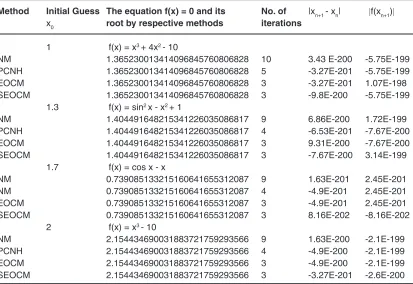
table 1: Comparison of different methods
Method initial Guess the equation f(x) = 0 and its No. of |xn+1 - xn| |f(xn+1)|
x0 root by respective methods iterations
1 f(x) = x3 + 4x2 - 10
NM 1.365230013414096845760806828 10 3.43 E-200 -5.75E-199
PCNH 1.365230013414096845760806828 5 -3.27E-201 -5.75E-199
EOCM 1.365230013414096845760806828 3 -3.27E-201 1.07E-198
SEOCM 1.365230013414096845760806828 3 -9.8E-200 -5.75E-199
1.3 f(x) = sin2 x - x2 + 1
NM 1.404491648215341226035086817 9 6.86E-200 1.72E-199
PCNH 1.404491648215341226035086817 4 -6.53E-201 -7.67E-200
EOCM 1.404491648215341226035086817 3 9.31E-200 -7.67E-200
SEOCM 1.404491648215341226035086817 3 -7.67E-200 3.14E-199
1.7 f(x) = cos x - x
NM 0.739085133215160641655312087 9 1.63E-201 2.45E-201
NM 0.739085133215160641655312087 4 -4.9E-201 2.45E-201
EOCM 0.739085133215160641655312087 3 -4.9E-201 2.45E-201
SEOCM 0.739085133215160641655312087 3 8.16E-202 -8.16E-202
2 f(x) = x3 - 10
NM 2.154434690031883721759293566 9 1.63E-200 -2.1E-199
PCNH 2.154434690031883721759293566 4 -4.9E-200 -2.1E-199
EOCM 2.154434690031883721759293566 3 -4.9E-200 -2.1E-199
SEOCM 2.154434690031883721759293566 3 -3.27E-201 -2.6E-200
It is evident from these tabulated values that SEOCM is superior to the methods (1.2) and (1.7) considering the number of iterations and accuracy and the rate at
which SEOCM converged and the convergence rate is almost same as that of the method (1.8). Of these methods, SEOCM is free from second derivatives.
references
1 I.K. Argyros, S.K. Khattri, An improved semi local convergence analysis for the Chebyshev method, Journal of Applied Mathematics and computing, 42, No-s: 1, 2 (2013), 509-528,
doi: 10.1007/s12190-013-0647-3.
2 M.A. Hafiz, Solving nonlinear equations using steffensen-type methods with optimal order of convergence, Palestine Journal of Mathematics, 3, No: 1 (2014), 113-119.
3 M.A. Hafiz, A new combined bracketing method for solving nonlinear equations,
Journal of Mathematical and Computational Science, 3, No.1 (2013)..
4 M.A. Hafiz, S.M.H. Al-Goria, Solving nonlinear equations using a new tenth-and seventh- order methods free from second derivative,
International Journal of Differential Equations and Applications, 12, No. 3 (2013),
169-183,2013, doi: 10.12732/ijdea.v12i3.1344. 5 S.K. Khattri, Torgrim Log, Constructing
third-order derivative-free iterative methods, Int. J. Comput. Math.,88, No. 7 (2011), 1509-1518,
doi: 10.1080/00207160.2010520705. 6 S.K. Khattri, Quadrature based optimal
iterative methods with applications in high precision computing, Numer. Math. Theor. Meth. Appl.,5 (2012), 592-601.
7 S.K. Khattri, Trond Steihaug, Algorithm for forming derivative-free optimal methods, ,
Numerical Algorithms, (2013), doi: 10.1007/ s11075-013-9715-x.
two-step predictor-corrector method with ninth order convergence for solving nonlinear equations, Journal of Advances in Mathematics , 2 (2013), 432-437.
9 Khalida Inayat Noor, Muhammad Aslam Noor, Shaher Momani, Modified Householder iterative methods for nonlinear equations”,
Applied Mathematics and Computation,
190 (2007), 1534-1539, doi: 10.1016/j.
amc.2007.02.036.
10 Mohamed S.M. Bahgat, M.A. Hafiz, Three-step iterative method with eighteenth order convergence for solving nonlinear equations,
Int. Journal of Pure and Applied Mathematics, Vol. 93, No. 1, 2014, 85-94.
11 Vatti V.B.Kumar, Mylapalli M. S. Kumar, Katragadda A. Kumari,Extrapolated Newton-Raphson Method, Math. Educ. 43, No. 1,
103-108 (2009).
12 Vatti V. B. K, Sri R, Mylapalli M. S. K., Eighteenth Order Convergent Method for Solving Non-Linear Equations. Orient.J. Comp. Sci. and Technol;10(1), 144-150
(2017).
13 Vatti V. B. K, Ramadevi Sri, Mylapalli M. S. K., Two Step Extrapolated Newton’s Method with High Efficiency Index, Journal of Advanced Research in Dynamical and Control Systems;