Practicing What We Teach: Adherence to Healthy Meeting
Guidelines at Extension Meetings and Events
Carol A. Smathers Jennifer M. Lobb Ohio State University Extension
Cooperative Extension promotes healthy behaviors, including nutritious eating and physical activity. Research-based healthy meeting guidelines pertaining to foods and beverages served at Extension-sponsored events have been adopted in some states. The extent of adherence to Healthy Eating at Meetings guidelines was assessed by observing foods and beverages served at Extension-sponsored events across one state. Over a four-month period, 69 events involving foods and/or beverages were observed, including 33 events on a state university’s campus and 46 events across 36 counties. Observed events included meetings, workshops and conferences for faculty and staff, agricultural trainings and field days for the public, 4-H camps and special activities for youth and their families, and county and state fair events. Photos and menus of the foods and beverages served were assessed using a seven-item scorecard based on the Healthy Eating at Meetings guidelines. The average score for adherence to the guidelines was 57%, with a range of 10%-93%. Results suggest that adopting healthy meeting guidelines may not be enough to ensure that nutritious foods are served and that healthy eating is modeled at Extension-sponsored events. This study indicates that further research to explore Extension professionals’ knowledge of and attitudes toward healthy meeting guidelines is needed.
Keywords: healthy meeting guidelines, health promotion, role modeling, leadership, workplace wellness
Background
Diet-related diseases continue to endanger population health and create significant medical costs. Obesity prevalence in the U.S. remains high, with more than one-third (36%) of adults being obese and another third are overweight (Ogden, Carroll, Fryar, & Flegal, 2015). Leading causes of preventable death, including heart disease, stroke, type 2 diabetes, and certain types of cancer, are related to diet and obesity (Centers for Disease Control and Prevention, 2015). The U.S. annually spends an estimated $147 billion on medical costs related to obesity, and approximately 20%-30% of employers’ annual health-care costs are spent on employees with modifiable risk factors, including poor diets and obesity (Goetzel et al., 2012).
Public health interventions that change the contexts in which individuals make nutrition and other health-related decisions are needed to address population health (Lieberman, Golden, & Earp, 2013). Social ecological models posit that behavior is influenced by multiple factors across multiple levels, including: individual (e.g., knowledge, attitudes), social (e.g., families, friends, peers, co-workers), organizational (e.g., worksites, schools, events, organizations), and policy/systems (e.g., laws, regulations, organizational guidelines) (Stokols, 1996). The physical, interpersonal, and sociocultural characteristics of environments serve to support or prevent healthy behaviors (Stokols, Grzywacz, McMahan, & Phillips, 2003). Ecological models further suggest that because behavior is influenced at multiple levels, it is important to implement strategies in multiple dimensions of the community (Sallis & Glanz, 2009).
Numerous studies of both school and workplace settings highlight ways in which strategies that capitalize on the interdependence between levels in the social ecological model can maximize the scope, acceptance, effectiveness, and sustainability of interventions to improve dietary behaviors (Brennan, Ross, Brownson, & Orleans, 2014; Geaney et al., 2013; Hawkes et al., 2015; Moore, de Silva-Sanigorski, & Moore, 2013; Swinburn et al., 2015). Incorporating environmental modifications and using established food guidelines can contribute to the effectiveness of complex workplace dietary interventions while also taking into account the needs and characteristics of the employees (Geaney et al., 2013). Corporations are beginning to put these concepts into practice. The CEO Roundtable, comprised of 26 chief executive officers from large American corporations, has committed to improving the health of their employees through six guiding principles. These principles include serving as role models in taking positive steps to healthy living and recognizing companies that create a culture of health (Brown, 2016).
The Cooperative Extension System, or, for the purposes of this paper, “Extension,” promotes healthy lifestyles, including nutritious eating and physical activity, through nationwide
programming efforts. The Cooperative Extension National Framework for Health and Wellness asserts that Extension has a reputation developed over decades for strength in health and
nutrition education with well-documented outcomes, such as a 4-H youth development program that has included health, the fourth ‘H’ of 4-H, since 1911 and a nationally recognized 4-H Healthy Living mission mandate (Braun et al., 2014).
Extension professionals have knowledge and experience that position them to promote health in their communities using multifaceted approaches (Fitzgerald & Spaccarotella, 2009). As both a large employer and an educational organization, Extension has the potential to implement strategies across levels of the social ecological model to support healthy behaviors among employees and program participants.
purchasing food for programs, and working with caterers or vendors to create menus for events. The availability and use of healthy food guidelines has grown since 2010. The U.S. Centers for Disease Control and Prevention (CDC) developed Improving the Food Environment Through Nutrition Standards: A Guide for Government Procurement to provide practical guidance to state and local governments for use when developing, adopting, implementing, and evaluating a food procurement policy (CDC, 2011). Numerous state and local health departments and nonprofit health promotion organizations have developed guides for choosing healthy foods at work and for meetings and events (CDC, 2016). However, evaluation data related to the use of these guides and toolkits are limited.
The Ohio State University Extension (OSUE) Healthy Eating at Meetings guidelines, originally developed by a team of OSUE professionals in 2009 (Oliveri et al., 2009), are designed to assist OSUE employees to obtain and serve healthful foods and beverages for university-sponsored meetings and events. In 2014, the guidelines were revised to better reflect current health
research, common preferences, and nutrition recommendations, including the Dietary Guidelines for Americans (Kidd, Smathers, Treber, & Barlage, 2014). Adhering to the guidelines provides Extension professionals with opportunities to make environments match their organization’s nutrition messages and to role model ways to serve and consume foods and beverages that meet research-based nutrition recommendations.
Studies suggest that well-planned and carried out multilevel interventions are effective for improving health, and particularly for reducing obesity (Stevens et al., 2017). Organizational policies and guidelines may have the potential to be more sustainable and have a more lasting impact on organizational practices than initiatives directed by individuals or one-time events. Few studies have been done, however, about organizational promotion of and adherence to food policies and guidelines. In a statewide survey of OSUE professionals conducted in October 2014, 74% of the respondents indicated that their offices were following the guidelines some or most of the time (Smathers & Lobb, 2015). The purpose of this current evaluation study was to further assess adherence to the Healthy Eating at Meetings guidelines at OSUE events
throughout the state by observing the actual foods and beverages served. The primary research question was: To what extent are OSUE professionals following the Healthy Eating at Meetings guidelines?
Methods
events whenever possible without notifying the event organizers in advance to take photos of the foods and beverages served. In two cases, however, event organizers were contacted the day of the event to confirm event times and locations. Additionally, to cover a variety of counties, menus were obtained for nine eligible events that research members were unable to attend. This occurred no more than three days prior to these events.
All photos and menus collected through this assessment were scored using a scorecard designed to measure adherence to the Healthy Eating at Meetings guidelines (Figure 1). Criteria were determined using the Healthy Eating at Meetings guidelines and the Dietary Guidelines for Americans. Eighteen members of an obesity prevention coalition reviewed the scorecard to determine face validity.
Figure 1. Healthy Eating at Meetings Scorecard
2 1 0 NA
Is water available?
Yes, it is freely available and easily accessible
Takes some effort to access (i.e. drinking fountain only)
No water
Are other beverages available?
Unsweetened beverages only (i.e. low-fat milk, coffee, tea, and 100% juice)
Mix of sweetened and unsweetened beverages
Sweetened beverages only
Are fruits and vegetables available?
Yes, a colorful mix One fruit or
vegetable None
Are foods low in fat, sodium and added sugar?
All, including desserts Some None
Are whole grain options
available?
Plenty A few None
No grain items served
Are portion sizes
appropriate? Yes, all Some None
Are vegetarian options
available?
Appealing vegetarian options including a protein, in plentiful quantities
Unappealing
vegetarian options or too few servings
None No meal
served
Total score _________
Possible score _________
The scorecard contained seven items. Each event received a “0”, “1” or “2” for each item based on whether the listed criteria were met. Foods were considered high in fat, for example, if they were fried, cream- or mayonnaise-based, made with butter or cream sauce, highly processed with added fat, or naturally high in fat (i.e. ham and bacon). At some events, such as when food was made available but a full meal was not served, not all criteria were applicable. Thus, rather than receiving a score between 0-14, scores were adjusted to account for situations where not all of the criteria applied. The item scores were added together and divided by the total possible score to yield a percentage between 0-100. A subset of 15 events was scored by two members of the research team to establish interrater reliability.
Results
Between July and October 2015, the research team assessed the foods and beverages served at 79 events across all program areas including meetings, workshops, and conferences for OSUE staff and faculty; agricultural workshops and field days for the public; 4-H camps, banquets and ceremonies for youth and their families; and county and state fair events. The majority (n = 46) of events observed were held across the state in 36 different counties. The remaining 33 events were held on the main campus of The Ohio State University where the state Extension offices are located. Food was served at 69 of the events. The average score for adherence to the Healthy Eating at Meetings guidelines at the 69 events where food was served was 57%. Scores ranged from a low of 10% to a high of 93%.
As shown in Table 1:
Water was made available at almost all of the events (93%).
Sugar-sweetened beverages were available at 38 of the events (55%). At least one fruit or vegetable was served at 54 of the events (78%). Whole grain options were made available at only 21 events (30%).
At least some of the portion sizes were appropriate at each event that was observed. Vegetarian options were available at 23 of the 53 events where meals were served
(43%).
Table 1. Number of Events in Each Section of the Healthy Eating at Meetings Scorecard
2 1 0 NA
Is water available? 60 5 4 -
Are other beverages available? 31 35 3 -
Are fruits and vegetables available? 20 34 15 -
Are whole-grain options available? 4 17 43 5
Are foods low in fat, sodium and added sugar? 4 48 17 -
Are portion sizes appropriate? 37 22 0 10
Discussion
Observational data revealed that OSUE professionals were meeting some, but not all, of the Healthy Eating at Meetings guidelines. The extent to which the guidelines are followed may be overestimated by Extension professionals. Limited implementation of the guidelines is of concern because (1) the organization fails to adequately provide physical and social environment modifications that support its educational messages for adult and youth participants, (2) the organization may impede individuals’ efforts to consume only healthy foods or avoid dietary temptations, and (3) unhealthy food options may have negative health and productivity affects.
Potential sizable audiences benefiting from Extension serving healthier foods and beverages and providing fewer unhealthy versions are twofold: employees and participants. Nationwide, many Extension systems employ hundreds of individuals each and may engage the public in millions of “contacts” each year through programming and events. In Ohio, for example, nearly 900 individuals are currently employed by Extension according the OSUE Human Resources office (K. Lobley, personal communication, June 20, 2017). In 2016, over 325,000 individuals were served through nutrition education programs according to the OSUE Program Evaluation Director (B. Butler, personal communication, June 19, 2017), and 16,843 adult volunteers and 120,123 youth were reached through 4-H Youth Development clubs, projects, school
enrichment, and camping activities (Ohio 4-H, 2017). Interventions that convey knowledge without changing food environments are unlikely to improve eating choices. Offering nutritious food selections at Extension meetings, programs, and events can reinforce the research-based nutrition education provided to thousands of participants through Extension programming.
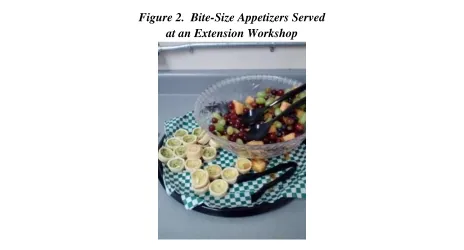
Figure 2. Bite-Size Appetizers Served at an Extension Workshop
Many recommendations in the guidelines can often be followed without increasing costs, such as
replacing traditional rolls or breads with whole grain items;
adding fruits or vegetables to the menu as side dishes instead of offering traditional sides like chips, pasta salad, and coleslaw;
controlling portion sizes of foods in buffet lines and/or providing smaller plates; considering serving plated meals rather than all-you-can-eat options;
serving fruits, whole grains and low-fat yogurts for breakfast instead of doughnuts and muffins; and
offering fruits, vegetables, whole grains and lean proteins as snacks in place of sweets.
Additionally, food does not need to be served at all meetings and events, particularly at shorter meetings and events scheduled between meal times.
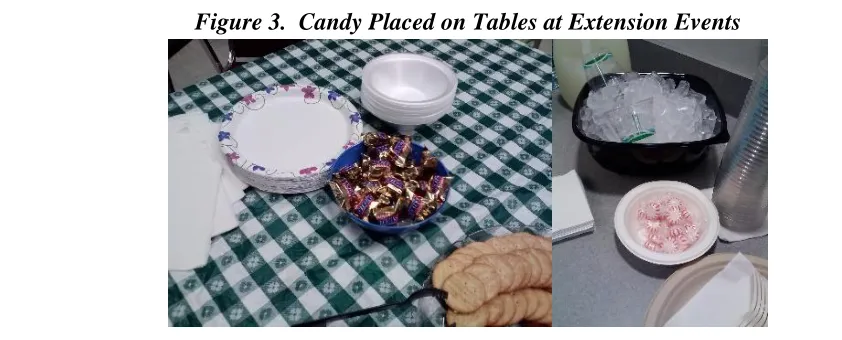
Another way that Extension sometimes fails to adequately provide physical and social
The WHO recommends reducing intake of added sugar to less than 10% of total energy, a
challenging feat even when sugary foods are not placed within easy reach at meetings and events (WHO, 2015). The CDC discourages teachers from giving students low-nutritive foods, such as candy, to reward for good behavior, and from punishing students by denying low-nutritive treats, pointing out that these practices reinforce preferences for low-nutritive foods and contradict nutrition education (CDC, 1996). Although these recommendations are specific to children in a classroom setting, they also apply to youth participating in 4-H programming as well as adults attending conferences, meetings and workshops. As Extension professionals, it is important to support individuals’ efforts to reduce sugar consumption and to follow the recommendations of expert panels not to use sugar as a reward, even in small quantities.
Figure 3. Candy Placed on Tables at Extension Events
Figure 4. Water Served from a Pitcher, from a Dispenser, and from Bottles
One of the six strategic priorities of the Cooperative Extension National Framework for Health and Wellness is positive youth development for health, which involves creating environments where youth can make healthy choices, including nutritious food choices (Braun et al., 2014). Utilizing healthy meeting guidelines when planning summer camps and other 4-H programs will help ensure that youth are presented with opportunities to make healthy food choices, reinforcing the health messages that they receive from Extension professionals and other health educators. Additionally, 4-H camps can be ideal places to provide youth with experiential learning
opportunities related to nutrition, cooking and gardening that, when delivered appropriately, may encourage positive health behaviors and influence the home food environment (Mabary-Olsen, Litchfield, Foster, Lanningham-Foster, & Campbell, 2015).
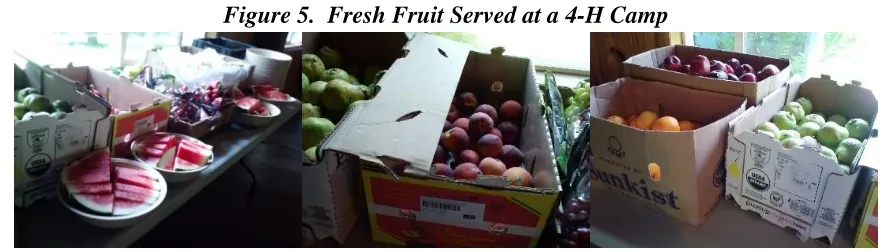
Many 4-H camps are held during the summer months when numerous fruits and vegetables are in season, an ideal time to offer youth a variety of fruits and vegetables at every snack and meal (Figure 5). Salad bars have become a popular addition to many 4-H camp cafeterias, allowing youth to create salads with whatever vegetables are locally available. When provided with a variety of fresh fruits and vegetables, youth respond by trying new items and, in turn, increase the amount and variety of fruits and vegetables that they consume (Harris et al., 2012).
Figure 5. Fresh Fruit Served at a 4-H Camp
environments for children. Specifically, parents would like their children to consume healthful foods and beverages and have opportunities for physical activity when participating in out-of-school time activities (Anzman-Frasca et al., 2014). Given this information, Extension professionals should consider healthy meeting guidelines when planning events for youth, regardless of whether they are the direct sponsor of those activities. When Extension professionals are directly purchasing food for events, the guidelines can help inform their choices. When working with a caterer to purchase food, Extension professionals can request healthier options from the menu. If Extension is not the direct sponsor of an event, Extension professionals can still promote health by informing event organizers of the guidelines and suggesting healthy options that could be offered. Event organizers may include parents who are providing a meal during a youth activity, an advisory or volunteer committee planning a menu for a community event, or other individuals responsible for planning an event that Extension is hosting, partnering in, or endorsing.
In many counties, Extension professionals purchase food for events that they are hosting or sponsoring from local producers. This is a component of the OSUE Healthy Eating at Meetings guidelines, although not specifically measured in this assessment. The guidelines encourage event planners to include local foods in their menus whenever possible. Extension professionals can increase adherence to nutritional components of healthy meeting guidelines when working with local producers by
ensuring that portion sizes are appropriate;
serving pulled pork, beef and chicken sandwiches on whole grain buns instead of highly refined buns;
serving vegetable side dishes instead of chips, potato salads, pasta salads or coleslaw; and,
making an alternate entrée available for vegetarian consumers.
Limitations
Limitations of this study include the sampling method used as well as challenges with the assessment tool. The events included in this assessment were a convenience sample of events that were publicized online during a four-month period. Although the events observed
represented all four Extension program areas and took place in 36 of Ohio’s 88 counties, the sample may not be representative of Extension state- and system-wide events. The four-month duration also posed a limitation because the types of foods and beverages purchased and served can be influenced by the time of the year (e.g., weather, produce availability, traditional seasonal items). Using the scorecard required knowledge of dietary guidelines and there was also
opportunity for potential variability in scoring using the criteria on the scorecard (e.g., identifying whole grain foods, interpreting portion size). The scoring procedure used for the wide variety of events observed may bias the scoring results against meetings with fewer than seven criteria versus those with all seven criteria and thus may give misleading information when comparing such events. In practice, this scoring process can be used by event organizers to guide or give feedback about their selections, without comparing scores across events.
Additionally, the scorecard only shows the extent to which guidelines are followed; it does not explore reasons for nonadherence to the guidelines. Further research is needed to assess
Extension professionals’ awareness of, understanding of, and attitudes toward the guidelines, as well as other considerations such as knowledge and abilities related to nutritional guidelines, nutrient quality of foods, menu planning, menu options, and working with caterers, and the perceived and actual cost and amount of time required to adhere to the guidelines. Factors that may be locally determined range from dietary preferences of specific audiences to available facilities. The role of organizational leadership in promoting awareness of and adherence to healthy meeting guidelines needs further investigation.
Conclusion
The observational data collected through this study indicate a moderate level of adherence to the OSUE Healthy Eating at Meeting guidelines. This suggests that there is ample opportunity for Extension professionals to improve their use of healthy meeting guidelines to create healthful food environments in the workplace and the community. Simple steps that Extension
professionals can take to improve food offerings at meetings and events include
serving water and unsweetened beverages instead of sugar-sweetened beverages; including fruits and vegetables in every meal and snack;
replacing white bread products with whole grain alternatives; serving food in appropriate portions;
Extension professionals can use these guidelines when directly purchasing food for meetings and events as well as when they are participating in planning committees for larger community events. When utilized, the guidelines reinforce the health messages that are shared through various Extension programming efforts across the nation, increasing Extension’s credibility and positively impacting the health of communities.
References
American Cancer Society. (2013). Meeting well. Retrieved from http://www.cancer.org/healthy /morewaysacshelpsyoustaywell/meeting-well-description
Anzman-Frasca, S., Newman, M. B., Angstrom, H. M., Sharma, S., Nelson, M. E., Dolan, P. R., & Economos, C. D. (2014). Parent perspectives on nutrition and physical activity during out-of-school time. Journal of Nutrition Education and Behavior, 46(3), 156–163. doi:10.1016/j.jneb.2013.09.011
Braun, B., Bruns, K., Cronk, L., Fox, L. K., Koukel, S., LeMenestrel, S., . . . Warren, T. (2014). Cooperative Extension’s national framework for health and wellness. Retrieved from
http://www.aplu.org/members/commissions/food-environment-and-renewable-resources/CFERR_Library/national-framework-for-health-and-wellness/file
Brennan, L., Ross C., Brownson, R., & Orleans, C. T. (2014). Childhood obesity policy research and practice evidence for policy and environmental strategies. American Journal of Preventive Medicine, 46(1), e1–16. doi:10.1016/j.amepre.2013.08.022
Brown, N. (2016). The role of leadership in building a workplace culture of health. American Journal of Health Promotion, 30(7), 564–565.
Centers for Disease Control and Prevention. (1996). Guidelines for school health programs to promote lifelong healthy eating. Morbidity and Mortality Weekly Report,45(RR-9), 1– 33. Retrieved from https://www.cdc.gov/MMWR/preview/mmwrhtml/00042446.htm Centers for Disease Control and Prevention. (2011). Improving the food environment through nutrition standards: A guide for government procurement. U.S. Department of Health and Human Services, National Center for Chronic Disease Prevention and Health Promotion, Division for Heart Disease and Stroke Prevention. Retrieved from https://www.cdc.gov/salt/pdfs/dhdsp_procurement_guide.pdf
Centers for Disease Control and Prevention. (2015). The health effects of overweight and obesity. U.S. Department of Health and Human Services, National Center for Chronic Disease Prevention and Health Promotion, Division of Nutrition, Physical Activity and Obesity. Retrieved from https://www.cdc.gov/healthyweight/effects/index.html
Fitzgerald, N., & Spaccarotella, K. (2009). Barriers to a healthy lifestyle: From individuals to public policy – an ecological perspective. Journal of Extension, 47(1), Article 1FEA3. Retrieved from http://www.joe.org/joe/2009february/a3.php
Geaney, F., Kelly, C., Greiner, B.A., Harrington, J. M., Perry, I. J., & Beirne, P. (2013). The effectiveness of workplace dietary modification interventions: A systematic review. Preventive Medicine, 57(5), 438–447. doi:10.1016/j.ypmed.2013.06.032
Goetzel, R. Z., Pei, X., Tabrizi, M. J., Henke, R. M., Kowlessar, N., Nelson, C. F., & Metz, R. D. (2012). Ten modifiable health risk factors are linked to more than one-fifth of employer-employee health care spending. Health Affairs, 31(11), 2474–2484.
doi:10.1377/hlthaff.2011.0819
Ha, V., & de Souza, R. J. (2015). “Fleshing out” the benefits of adopting a vegetarian diet. Journal of the American Heart Association, 4(10), 1–3. doi:10.1161/JAHA.115.002654 Harris, D. M., Seymour, J., Grummer-Strawn, L. Cooper, A., Collins, B., DiSogra, L., . . . Evans,
N. (2012). Let’s Move Salad Bars to Schools: A public-private partnership to increase student fruit and vegetable consumption. Childhood Obesity, 8(4), 294–297.
doi:10.1089/chi.2012.0094
Hawkes, C., Smith, J., Jewell, J., Wardle, R., Hammond, S., Friel, A. M., & Thow, J. K. (2015). Smart food policies for obesity prevention. Lancet, 385(9985), 2410–2421.
doi:10.1016/S0140-6736(14)61745-1
Johnson, R. K., Appel, L. J., Brands, M., Howard, B. V. Lefevre, M., Lustig, R. H., . . . Wylie-Rosett, J. (2009). Dietary sugars intake and cardiovascular health: A scientific statement from the American Heart Association. Circulation, 120(11), 1011–1020.
doi:10.1161/CIRCULATIONAHA.109.192627
Kidd, B., Smathers, C., Treber, M., & Barlage, L. (2014). OSU Extension healthy eating at meetings guidelines. Retrieved from http://fcs.osu.edu/programs/resources/healthy-meetings.
Lieberman, L., Golden, S. D., & Earp, J. A. (2013). Structural approaches to health promotion: What do we need to know about policy and environmental change? Health Education and Behavior, 40(5), 520–525. doi:10.1177/1090198113503342
Leitzmann, C. (2014). Vegetarian nutrition: Past, present and future. The American Journal of Clinical Nutrition, 100(Supplement 1), 4965–5025. doi:10.3945/ajcn.113.071365 Mabary-Olsen, E. A., Litchfield, R. E., Foster, R., Lanningham-Foster, L., & Campbell, C.
(2015). Can an immersion in wellness camp influence youth health behaviors? Journal of Extension, 53(2), Article 2FEA9. Retrieved from http://www.joe.org/joe/2015april/a9.php Moore, L., de Silva-Sanigorski, A., & Moore, S. N. (2013). A socio-ecological perspective on
Ogden, C. L., Carroll, M. D., Fryar, C. D., & Flegal, K. M. (2015). Prevalence of obesity among adults and youth: United States, 2011-2014 (Report No. 219). Retrieved from
https://www.cdc.gov/nchs/data/databriefs/db219.pdf
Ohio 4-H. (2017). 2016 statistical report. Retrieved from https://osu.app.box.com/s/eoa08agj 25dloadsqqia3jutxjbntowb
Oliveri, C. S., Bloir, K., Brinkman, P., Economos, M., Gallup, S., Goard, L., . . . Zies, S. (2009). Healthy meals at meetings [Abstract]. Journal of the American Dietetic Association, 109(9), A-89. doi:10.1016/j.jada.2009.06.297
Painter, J. E., Wansink, B., & Hieggelke, J. B. (2002). How visibility and convenience influence candy consumption. Appetite, 38(3), 237–238. doi:10.1006/appe.2002.0485
Sallis, J. F., & Glanz, K. (2009). Physical activity and food environments: Solutions to the obesity epidemic. Milbank Quarterly, 87(1), 123–154.
doi:10.1111/j.1468-0009.2009.00550.x
Smathers, C. A., & Lobb, J. M. (2015). Extension professionals and community coalitions: Professional development opportunities related to leadership and policy, system and environment change. Journal of Extension, 53(6), Article 6FEA1. Retrieved from http://www.joe.org/joe/2015december/a1.php
Stevens J., Pratt C., Boyington, J., Nelson, C., Truesdale, K., Ward, D. S., . . . Murray, D. M. (2017). Multilevel interventions targeting obesity: Research recommendations for vulnerable populations. American Journal of Preventive Medicine, 52(1), 115–124. doi:10.1016/j.amepre.2016.09.011
Stokols, D. (1996). Translating social ecological theory into guidelines for community health promotion. American Journal of Health Promotion, 10(4), 282–298.
doi:10.1006/appe.2002.0485
Stokols, D., Grzywacz, J. G., McMahan, S., & Phillips, K. (2003). Increasing the health promotive capacity of human environments. American Journal of Health Promotion, 18(1), 4–13. doi:10.4278/0890-1171-18.1.4
Swinburn, B., Kraak, V., Rutter, H., Vandevijvere, S., Lobstein, T., Sacks, G., . . . Magnusson, R. (2015). Strengthening of accountability systems to create healthy food environments and reduce global obesity. Lancet, 385(9986), 2534–2545.
doi:10.1016/S0140-6736(14)61747-5
Wansink, B., & van Ittersum, K. (2007). Portion size me: Downsizing our consumption norms. Journal of the American Dietetic Association, 107(7), 1103–1106.
doi:10.1016/j.jada.2007.05.019
World Health Organization. (2015). WHO calls on countries to reduce sugars intake among adults and children. Retrieved from http://www.who.int/mediacentre/news/releases /2015/sugar-guideline/en/
Young, L. R., & Nestle, M. (2002). The contribution of increasing portion sizes to the obesity epidemic. American Journal of Public Health, 92(2), 246–249. Retrieved from
Carol Smathers, MS, MPH, is an Assistant Professor and Field Specialist in youth wellness and nutrition at Ohio State University Extension. She holds adjunct faculty positions in the OSU College of Public Health and College of Education and Human Ecology.